________________________________________
[Man, Woman Singing Funky Pop]
written & directed by HENRIETTE MANTEL, STEVE SKROVAN
executive producers: HENRIETTE MANTEL, STEVE SKROVAN
producer: KEVIN O'DONNELL
original music by JOE KRAEMER
motion graphics by RYAN NELLIS, EYELUMINATION STUDIO
editors: ALEXIS PROVOST, BETH GALLAGHER
production coordinator: ELLIE KNAUS
consultant: BYRON BLOCH
associate producers: K.D. GULKO, DESIREE CADENA
Consultant
ELLIN BAUMEL
Directors of Photography:
MARK RAKER
LEIGH WILSON
JOHN CHATER MATT DAVIS
STEVE ELKINS
MELISSA DONOVAN
SANDRA CHANDLER
Archive Research/Coordinator
ELIZABETH OLSON
Researcher
ELLIE KNAUS
Sound
YURI RAICIN
TOM WILLIAMS
JOHN OSBORNE
PETR STEPANEK
FRANK KUBITSKY
TOM GUARCELLO
STACY HRUBY
Grip
MIKE MACKEY
KVIN MCCARTHY
FCP Set-up/Tech Support
JOHN KLIMECK
Production Assistants
ELLIE KNAUS
BRYAN HEFFRON
ADAM WEBBER
JENINE DE SHAZER
Transcriptions
CHERYL BRICKER
CARIN WYATT
PAULINE FELDER
Legal Services
JACQUELINE ECKHOUSE
SLOSS LAW OFFICE, LLP
Representation
JOHN BRAUN - SUBMARINE ENTERTAINMENT
PHILIP ALBERSTAT -- WILLIAM MORRIS AGENCY
Still photography
CONRAD ERB
SONJA ZINKE
Post Digital Services
DIGITAL FILM TREE
Online Editor
PATRICK WOODARD
Supervising Online Editor
EDVIN MEHRABYAN
Colorist
HENRY SANTOS
Post Facility
KEEP ME POSTED, LLC
A FOTOKEM COMPANY
Online Editor
JAY SEGIMOTO
Sound Supervisor/Re-recording Mixer
CRAIG CLARK
Dialogue Supervisor
ALAN SCHULTZ
Sound Effects Editor/Re-recording Mixer
CRAIG SCHAFER
Sound Effects Editor
DANNY KIM
TEDDY SALAS
ADR Editor/ADR Mixer/Foley Mixer
COLIN ROGERS
Foley Artist
SUSAN FITZ-SIMON
Facilities Manager
DEBORAH WILLARD
Audio Post Production Services
ROUNDABOUT ENTERTAINMENT, INC.
Web Site design by http://www.Fifty6.com
Very special thanks to
RALPH NADER
Very, very special thanks to
JOHN RICHARD
Interview Thanks
JAY ACTON
ERIC ALTERMAN
THERESA AMATO
CHIP BERLET
BYRON BLOCH
DAVID BOLLIER
PAT BUCHANAN
PETER CAMEJO
SCOTT CARTER
JOAN CLAYBROOK
BARRY COMMONER
JOHN CONYERS, JR.
KAREN CROFT
PHIL CONAHUE
JOE TOM EASLEY
ANDREW AND LINDA EGENDORF
CONRAD ERB
JAMES FALLOWS
MICHAEL FEINSTEIN
RONALD FIEVE
ROBERT FELLMETH
RUTH FORT
HOWARD GARDNER
JOHN GARTNER
TODD GITLIN
MARK GREEN
BILL GREIDER
RICHARD GROSSMAN
JAY HALFON
GREG JAN
GREGKAFOURY
JASON KAFOURY
GENE KARPINSKI
ED LEVIN
BILL MAHER
JUSTIN MARTIN
CARL MAYER
TAREK MILLERON
MORTON MINTZ
ROSS MIRKARIMI
DAN MITCHELL
JIM MUSSELMAN
CLAIRE NADER
LAURA NADER
BRYCE NELSON
GROVER NORQUIST
LAWRENCE O'DONNELL
JOE PAGE
JAMES RIDGEWAY
HARVEY ROSENFIELD
DONALD ROSS
LAURA ROTHROCK
GENE STILP
BILL TAYLOR
ROB WEISSMAN
DR. SIDNEY WOLFE
Special Thanks
SHELLEY POWSNER
WILLIAM B. MANTEL
NICOLE AVRIL
DAN AYKROYD
ELLIN BAUMEL
OBIE BENZ
BRANDON BLOCH
MIKE BORENSTEIN
DIANA BRITTON
SHELLEY BUCHANAN
LIZ BURNS
SCOTT CARTER
KELLY CHEEK
FRANK CONNIFF
JANE CURTIN
MIKE DOUGLAS
JEROME DUBOZ
MARK EBNER
PETER ELKIND
FRANCIS GASPARINI
MARLA GARLIN
MELINDA GEDMAN
BOOTH GUNTER
JOHN HALL
BILL HILLSMAN AND JILL HARRISON
LAURA HENRY
ANN HOLM
MONICA HORAN
BEBE JOHNSON
SUSAN KATZ
MICHAEL PATRICK KING
SUE KOLINSKY
CHARLES KRAMER
ABBE LEVITON
SAM LOVEJOY
BURK MANTEL
CHLOE MANTEL
FANNIE Z. MANTEL
JEFFREY Z. MANTEL
RICHARD MANTEL
LAURIE MARIANI
DONALD MILLER
RUSSELL MOHKIBER
GARRETT MORRIS
GRAHAM NASH
SYLVIA BITTON-NETHERTON
LARAINE NEWMAN
JOHN NOONAN
JAMES O'DONNELL
MARJORIE O'DONNELL
YOKO ONO
STACEY PARKS
MARTY PASETTA
LAURIE PEKICH
JACOB PINGER
JOY PORTIZ
JACK AND CAROL PROVOST
MICHAEL RADNER
BONNIE RAITT
PHILIP ROSENTHAL
NANCY SHAYNE
'SMITTY" SMITH
JOHN SORENSEN
BRUCE SPRINGSTEEN
CARA STEIN
RANDY SUHR
BILL TAYLOR
DAVID TEDESCHI
MARY LYN TIERNEY
NICOLE VANDENBERG
HEIDI VAN LIER
EDDIE VEDDER
Special apologies to
GENE STILP
Production Services by
Complex Corporation
Equipment in Boston supplied by
Boston Camera Rental
Production services and equipment
in New York City provided by
Clark Media Services, Inc.
STOCK AND ARCHIVAL
FOOTAGE COURTESY OF
BBC Motion Gallery
The WPA Film Library
ABC NEWS Videosource
NBC News Archives
The Conus Archive
CNN ImageSource
Special Collection/Getty Images
Historic Films Archive, LLC
University Archives
Princeton University Library
Ralph Nader Election 1886
and Election 2000 interview
footage courtesy Adelphia.
Michael Moore footage courtesy of:
Persistence of Vision Productions
Debbie Melnyk & Rick Caine
Super Rally footage provided by
Greg Kafoury
"Priceless Truth" Nader Campaign 2000
courtesy of North Woods Advertising
STILL PHOTOGRAPHS
COURTESY OF:
AP/Wide World Photos
CORBIS
Time Life Images/Getty Images
Getty Images
Frederick Condon and
Ralph Nader Harvard Law School
Yearbook pages courtesy of
Special Collections Department,
Harvard Law School Library
Ellis Island photographs courtesy of
William Williams Papers,
Manuscripots and Archives Division,
The New York Public Library,
Astor, Lenox and Tilden Foundations
Winsted flood photographs courtesy of
The Connecticut Historical Society,
Hartford, Connecticut
O'Donnell's Fish House photo courtesy of
Historical Society of Washington, DC
Artwork from Fortune Magazine
of Carter/Nader/Trojan Horse
Courtesy of Don Punchatz
"The Safe Car You Can't Buy"
by Ralph Nader,
used with permission from
The April 11, 1959 issue
of The Nation magazine
Cover of the 2/18/67 issue of
The New Republic,
reprinted by permission of
THE NEW REPUBLIC, © 1967
The New Republic, LLC
"Car Design and Public Safety"
by James Ridgeway
The New Republic, 9/19/1964 article
and cover reprinted
by permission
The New Republic, LLC
"The Dick" by James Rideway,
The New Republic, 3/12/1966 article
and cover reprinted by permission
of THE NEW REPUBLIC, © 1966
The New Republic, LLC
"Crusader Nader and the Fresh
Air Underground"
by Art Siedenbaum, © 1968,
Los Angeles Times.
Reprinted with permission
Archival Playboy Magazine material
© 1968 by Playboy.
Used with permission. All rights reserved
U.S. News & World Report
cover © 1974 U.S. News & World Report, L.P.
Used with permission
"Naders Invaders Are Inside the Gates"
FORTUNE magazine
October 1977 © FORTUNE magazine.
Reprinted with permission
"Nader Supporters Fill Madison
Square Garden" © 2000
The New York Times Company
"I Am A Patriot"
by Steven Van Zandt courtesy of
Rondor Music International, Inc.
"The Times They Are A-Changin"
by Bob Dylan,
Courtesy Special Rider Music
"Stand up, Rise Up"
Written and performed by Kemp Harris
[Music Continues]
© 2006 -- TWO LEFT LEGS, LLC
Statistics: Posted by admin — Mon Sep 28, 2015 4:30 am
]]>
[Gregory Kafoury, Nader Campaign Organizer] And at the same time he was told, "If you do run, we will strangle your organizations. We will smother them.
Your people will scream in pain at you for what we're gonna do to you."
Parties to Injustice: Democrats Will Do Anything to Keep Me Off the Ballot
By Ralph Nader
Washington Post
September 5, 2004
This summer, swarms of Democratic Party lawyers, propagandists, harassers, and assorted operatives have been conducting an unsavory war against my campaign's effort to secure a spot on the presidential ballots in various states. It is not enough that both major parties, in state after state, have used the legislatures to erect huge barriers, unique among Western democracies, to third-party and independent candidacies. Now they are engaging in what can only be called dirty tricks and frivolous lawsuits to keep me and my running mate, Peter Miguel Camejo, off the ballot while draining precious dollars from our campaign chest.
This contemptuous drive is fueled with large amounts of unregulated money, much of it funneled through the National Progress Fund, an ostensibly independent group led by Toby Moffett, a former Democratic congressman who is currently a partner in a largely Republican lobbying firm called the Livingston Group. By contrast, to defend ourselves from the assault, we have to draw on funds that are limited and regulated by the Federal Election Commission.
News reports show that the National Progress Fund and other so-called independent 527 organizations (named for the section of the tax code under which they incorporate) were operating openly at the Democratic National Convention. They held meetings to discuss the best strategies and tactics to push the Nader/Camejo ticket off the ballot and they raised money from Democratic fat cats to accomplish their goals. It is evident that these "independent" groups are actually not independent but working closely with the Democratic Party.
In addition, chair of the Democratic Party of Maine, Dorothy Melanson, testified under oath in a public hearing before Maine's secretary of state last Monday that the national Democratic Party is funding efforts throughout the country to stop Nader/Camejo from appearing on ballots.
These ties with Democrats don't prevent the 527s from accepting help from entrenched corporate interests, or even Republican quarters, to finance challenges of the signatures we have collected to meet the requirements of ballot access. According to reports filed with the Internal Revenue Service, Robert Savoie, president of Louisiana-based Science & Engineering Associates, donated $25,000 to the National Progress Fund in June. A month before, Savoie gave $25,000 to the Republican National Committee.
In Pennsylvania, where a court last Monday barred us from appearing on the ballot, signature challenges have been mounted by Reed Smith, a law firm whose political action committee primarily gives to Republicans. A lawyer from the firm boasted to the New York Times that "8 to 10 lawyers in his firm were working pro bono on the case, 80 hours each a week for two weeks, and could end up working six more weeks." The firm is counsel to twenty-nine of the top thirty U.S. banks, twenty-six of the Fortune 50 companies, nine of the top ten pharmaceutical companies, and fifty of the world's leading drug and medical device manufacturers.
The melding of these interests demonstrates that it is the corporate-political duopoly that is working to limit voters' choices for this November. For all their talk about free markets, the major parties do not tolerate competition very well. They don't want voters to be able to consider a candidate who advocates health care for all; a crackdown on corporate crime, fraud, and abuse; a shrinking of the military-industrial complex and corporate welfare; a living wage for all full-time workers; and a responsible withdrawal from Iraq.
The zeal of these ballot access sentries comes from a refusal to respect the rights of millions of voters to have the opportunity to vote for candidates of their choice. With their organized obstruction of our campaign's efforts just to get a place on the ballots, these authoritarians want to deny Americans more voices, choices, and agendas. The voters are the losers.
Watching their bullying maneuvers and harassing lawsuits around the country, I marvel at the absence of condemnation by Senator John F. Kerry or Terry McAuliffe, the Democratic National Committee chairman.
Senator Kerry told us that he would look into this situation seven weeks ago but we have not heard back from him yet. Around the same time, McAuliffe told me in a phone conversation that he actively approved of these organized efforts, one of which is ironically called the Ballot Project. He urged me to run only in the thirty-one states considered to be locked up by one of the two candidates.
Challenging the signatures of your rivals is an old political tactic, and when you're collecting hundreds of thousands of signatures, there are bound to be some that don't withstand scrutiny. But the Democrats are not just seeking compliance with harsh election laws. They are using dirty tricks to intimidate citizens.
That's the way it seemed to a fifty-eight-year-old supporter of ours in Oregon. On August 12, 2004, she was at home with her two grandchildren when she answered a knock on her door and found a man and woman who she said began threatening her with jail if there was any false information on the petitions she was collecting for our ballot access. These people, who called themselves "investigators," were dispatched by a law firm that has worked extensively with Oregon trade unions that have supported Democratic candidates. In many states our signature gatherers have been subjected to similar treatment in what is clearly an orchestrated campaign.
And some people who merely signed Nader/Camejo petitions have also been pressured. One person in Nevada got a call from someone who urged him to admit that he was tricked into signing our petition. When the petition signer said he had signed voluntarily, the caller continued to try to persuade him to claim that he had not signed the petition. After numerous requests, the caller identified himself and admitted he was from the Democratic National Committee in Las Vegas. A call to the number on the caller ID was answered, "Hello, DNC." We have similar reports from around the country.
Ballot access laws are so arbitrary and complex that they leave small parties open to legal pestering. In Arizona, large Democratic donors hired three corporate law firms to file frivolous challenges to our clearly ample number of signatures. For example, 1,349 signatures of registered voters were invalidated because the person who collected them had given his or her correct full address but had neglected to include the correct name of the county. The purpose of these exercises are, in lobbyist Moffett's words, "to neutralize [Nader's] campaign by forcing him to spend money and resources defending these things."
A covey of Democratic operatives in Illinois convinced the election board to disqualify signatures because the registered voters had moved since registering to vote even though they still lived in Illinois. The Democratic Speaker of the state House of Representatives sent state employees, contractors, and interns to review and challenge our ballot access petitions. The speaker wouldn't say -- when asked either by reporters or in a Freedom of Information Act request my campaign filed in July -- whether these state employees took leave from their taxpayer-paid jobs.
In other states, Democratic operatives are using a grace period after the filing date and directly calling voters who signed, pressing them to withdraw their signatures or say that they were misled so that the Democrats could allege fraud later in court.
The Democratic Party's machine is operating in many other ways, too. Its apparatchiks were waiting at the Virginia secretary of state's office on August 20 to say that our signature gatherers did not arrive in time, when in fact they arrived with twenty-five minutes to spare. The head of the state Elections Division, who happens to be the former executive director of the Virginia Democratic Party, refused even to accept our petitions until she was ordered to do so by the state attorney general.
To excuse and distract from this accumulation of organized misdeeds, the Democrats are feeding the press the Big Lie that the Republicans are bankrolling and supporting us. If the Republicans were to spend one-quarter as much to support us as the Democrats are spending to obstruct our access to ballots and our supporters' civil liberties, we would be on all fifty state ballots by now.
We have not been accepting signatures obtained through organized Republican Party efforts in the three or four states where we have learned of such activity.
We are trying, of course, to win over some Republican and independent voters who voted for George Bush in 2000 but are furious with him over endless deficits, federal regulation of local education, corporate subsidies and handouts, the sovereignty-shredding World Trade Organization and North American Free Trade Agreement, the big-government-snooping Patriot Act and, lately, the Iraq quagmire.
In 2000 about 25 percent of our vote came from people who told exit pollsters they otherwise would have voted for Bush. Yet the most recent independent review of our current campaign found that only 4 percent of our donations came from people who have also given to the Republican Party. The Center for Responsive Politics found that this group of fifty-one people gave $406,000 to the Republicans and $53,000 to Nader/Camejo. Amusingly, however, the center found that our Republican backers gave even more, $63,000, to the Democrats.
When I talked to Kerry, I cautioned him that if he did not order a stop to the dirty tricks of his Democratic underlings and allies, he may face a mini-Watergate type of scandal. For Democrats and Republicans who care about civil liberties, free speech, and an equal right to run for elective office, this festering situation should invite their very focused demands to cease and desist.
Hand it to the Democrats to keep some costs down, though. A contractor they hired in Michigan to make phone calls to check the validity of our tens of thousands of signatures outsourced the work to India.
-- Independent Politics: The Green Party Strategy Debate, edited by Howie Hawkins
[Ralph Nader] Again, there was far more at stake in terms of focusing on the redirections of our country than some ample foundation grants ...
to initiate programs which would hit a stone wall here in Washington.
[Donald Ross, NYPIRG - 1973-82] The lesson Ralph took from the 1960s when lots of close friends of his said, "You can't go after General Motors; you're a promising lawyer; you're out of Harvard; you'll ruin your career" -- and he did -- was trust your own instincts, ...
and don't listen necessarily to people who are close to you.
[Gene Karpinski] [Laughing] As I talked to him, I slammed down the phone on him. "Gene, Ralph." I go, "Who? Oh, you're calling --" He goes, "Well, I've been kind of busy the last 10 days."
[Laughs] 'Cause he'd just -- I said, "Yeah, no shit. Well, I'm busy right now, so I gotta go."
[Laughs]
And that was it. I was surprised I did it, but it was the right thing to do.
Money vs. People: The Mystery of the 2004 Elections
By Peter Miguel Camejo
Published on http://www.greensfornader.net.
July 29, 2004
There is a mystery to the 2004 presidential election; a silence has fallen on America regarding a glaring contradiction. As we enter the second half of 2004, there is massive popular opposition to the war in Iraq and to the USA PATRIOT Act -- possibly a majority of Americans. Yet these same people are about to vote in overwhelming numbers for John Kerry for President.
But John Kerry and his running mate, John Edwards, gave President Bush eighteen standing ovations in January, voted for the war, say the war was right, insist on continuing the occupation of Iraq against its peoples' desires, want to increase the number of troops and nations occupying Iraq, voted for "unconditional support to Bush" for his conduct of the war, and backed Bush by voting against the U.S. Constitution for the Patriot Act.
The only explanation for tens of millions voting against their heartfelt opinions is the lack of free elections in America. There are no runoff elections. Without runoffs people are trapped. They fear expressing their true opinions. If they vote for what they are for, they are told, they will only elect Bush. They must learn to vote against themselves, to accept the con game of a two-party system. People are taught not to vote for what they believe but against an individual.
An unpopular policy once identified with an individual can be continued by replacing the individual, keeping the policy with modifications. In replacing Bush, Kerry pledges to more effectively forward the same policy of imperial domination.
If runoff elections existed tens of millions would vote against both Bush and Kerry and for peace. Once the myth of invulnerability of the two-party system is broken the dam against democracy and free elections will break. Already 25 percent of Americans are no longer registered Democratic or Republican; they seek alternatives.
The Democrats' fear of Ralph Nader is rooted in the programmatic conflict between their Party's stance and their supporters. This is the real story of the 2004 elections.
This mystery is never written about in the media -- it is America's dark secret.
The 2000 presidential election was stolen when some sixty thousand people, primarily African Americans, had their right to vote illegally revoked in Florida. The film, Fahrenheit 9/11, opens showing one African-American congressperson after another asking for an investigation. But their cry for justice was squashed because not one Senator, not one Democrat, not Paul Wellstone, Barbara Boxer, Ted Kennedy, John Kerry, or John Edwards would defend democracy, and stand up for free elections.
Three and a half years later the Democratic Party has not lifted a finger to establish free elections in America. Not in a single state have they called for runoffs so Florida could never happen again. They could not make it clearer: the Democratic Party prefers that Republicans win elections, even without majority support, rather than allow free elections where a third party or an independent candidate could attract tens of millions from their base. Their answer is simple: Ralph Nader must not run, must not be an alternative.
If free elections were held with a runoff system like in most civilized nations, if proportional representation existed where if a point of view receives 20 percent of the vote its supporters would receive 20 percent representation, then every vote would count, and the Democratic Party as we know it today would no longer exist. The one hundred million people who never vote would have a reason to vote. New parties would appear and a representative democracy would begin to blossom in America.
Ralph Nader has created a small hole in the dam. The danger is real. The Democrats are on an all-out effort to attack the Nader/Camejo campaign because if voters begin to vote for what they want the entire electoral system would begin to unravel. If twenty million citizens voted for Nader it would be the beginning of the end of the two-party system. The Democrats would enter into a crisis, the ability of money to control people would begin to crack and the possibility of a democracy where citizens could vote for what they believe would be born. The Democrats are determined, not to beat Bush but to stop Nader, to protect the two-party, pro-corporate rule that America lives under.
-- Independent Politics: The Green Party Strategy Debate, edited by Howie Hawkins
[Kerry, Nader have 'friendly talk -- ELECTION 2004]
[Ralph Nader] The meeting with John Kerry was very constructive.
He had been saying just the right thing: "I'm gonna appeal to everybody in this race. We'll make it unnecessary in the end for an alternative." And I look forward to that. Fine. Just exact kind of competition. I relish it. Take all the issues.
Here they are -- 25 pages. I sent them to you in December. Take them all. No "proprietaryship" here. And then I said to him, "Look, let's try to do something counterintuitive. Let's pick three major issues that we both believe in and run with them. And that will make a real contrast with Bush.
[Cash Register Dinging]
"Corporate welfare. The hundreds of billions of dollars out of taxpayer coffers going into corporate subsidies, handouts, giveaways, bailouts. Let's also crack down on the corporate crime wave. A lot of Republican voters there. Bush is never gonna come out against corporate crime. And the third thing: labor law reform, 'cause you know that Bush is not going to come out for labor law reform given his corporate paymasters." He wouldn't buy it. Instead, May 2004 was when the massive coordinated attack by the Democratic Party to harass us, to intimidate us, petitioning drives, to file more and more lawsuits against us, ...
hiring Ken Starr's old lawfirm Kirkland Ellis, and other corporate Republican firms.
That was the fork in the road.
Those three issues would've gotten him more votes. And the election wouldn't even have been close.
[John Kerry] I'm John Kerry, ...
and I'm reporting for duty.
[Cheering]
[Ralph Nader] I have never seen a period in American history so devoid of any tactical and strategic sense by the liberals.
[John Kerry] And I will hunt down and kill the terrorists wherever they are.
[Ralph Nader] What are they scared of, the Democrats? When Kerry was running for office, there was a poll ...
where 42% of the American people wanted the troops home yesterday. Without any leadership by the Democratic Party. Without saying to Bush, ...
"You don't have the decency even to count the casualties on our side, ...
'cause you're not counting injured and sick troops." And when you can't even go after him for something like that --
[John Kerry] And what we have to decide is that we're going to keep coming back ...
until this war ends.
[Man] Yeah!
[Ralph Nader] You let the Swift Boat Veterans turn you on the defensive because you were in Vietnam, and Bush was a draft dodger?
It's like they've lost their nerve completely. And they basically said, "Okay, the Republicans are so terrible, we'll go for the Democrats, and then work on 'em later." But the point is, if you work on 'em later, it's too late. You gotta work on 'em during the election campaign ...
to make 'em look better, to make 'em stand taller, to make 'em be more authentic. Then you might get 'em into office.
[Man] Kerry's not perfect, but he's so, so much better than what's there now.
[Woman] The united goal should be to defeat Bush.
[Woman 2] Anybody but Bush.
[Ralph Nader] Now, let's say he did win. He wouldn't owe any of these people anything, ...
because he knew that he got their vote ...
because they disliked Bush so much.
[DROP OUT NADER: GIVE BUSH ONE TREE HE WILL TAKE THE WHOLE FOREST]
What are you gonna win if you win? So he would have no mandate. He would float into Washington, D.C., ...
and be surrounded by 25,000 corporate lobbyist,s and 9,000 corporate political action committees, and all kinds of demands to put high-level appointments in the hands of corporate selectors in his administration.
And what do we end up with? What is the victory worth?
See? I mean, it was a flawed strategy. And for all their efforts, they lost.
[John Kerry] Earlier today, I spoke to President Bush, ...
and I offered him and Laura our congratulations on their victory.
[Ralph Nader] They lost with a candidate ...
who should've landslided Bush, who should've landslided one of the worst presidents in American history.
And it's not an unwarranted perception to say that this Bush regime, and the ideological hijackers who've taken over our government, is a different cup of tea ...
than Reagan, or Bush I, or Nixon. Then you better start making your candidate stand for the things you believe in, ...
that will oppose and thwart this extremely dangerous incumbent administration.
So not making Kerry better, they made him worse. They made him less electable.
[Susan Sarandon, Actor/Activist] When your guy Ralph Nader is close to filing something about what went on in New Hampshire --
[Bill Maher] Oh, now he's my guy?
[Audience Laughs]
[Susan Sarandon] Well, our guy.
[Bill Maher] Boy, you got away from him awfully quick.
He was your guy the last time too, as I recall.
[Susan Sarandon] Our guy.
[James Musselman, Former Nader's Raider] Tim Robbins and Susan Sarandon had a lot of backlash after the election.
The worst part is that people aren't gonna be venturing out on those ledges again, ...
because there's nothing in it for them except a lot of criticism.
[Michael Moore, 2004] You want me to take a second here and talk about Ralph? Yeah.
[Audience Applauding]
[Ralph Nader] Michael Moore was an example of the switch, ...
of aggressively supporting our agenda and our candidacy in 2000, and turning against us in 2004.
[Michael Moore] Leave him alone?
[Chuckles]
Well, he needs to leave us alone. Um, yeah.
[Audience Applauding]
[Ralph Nader] In 2000, he went to our rallies, and he was the most articulate critic.
He made people laugh and cry.
[Michael Moore, 2000] If you don't vote your conscience now, when will you start?
[Ralph Nader] Then 2004 comes along.
[Michael Moore] And when you go in the voting booth, don't go in there like, "Oh, this is gonna make me feel good though. I'm gonna feel good voting for Ralph Nader, because he's pure, and I'm pure, and I want to feel good.
[Michael Moore] We're at the place we're at because we have settled for so less for so long. If we keep settling, it's only gonna get worse. The lesser of two evils: you still end up with evil. You still end up with evil.
Please, please. Ralph, Ralph, Ralph. Don't run for president. Don't do this to the country. Please, please. Come home, Ralph. Come home.
You want me to take a second here and talk about Ralph? Yeah. Leave him alone? [Chuckles] Well, he needs to leave us alone. Um, yeah.
If you don't vote your conscience now, when will you start? And when you go in the voting booth, don't go in there like, "Oh, this is gonna make me feel good though. I'm gonna feel good voting for Ralph Nader, because he's pure, and I'm pure, and I want to feel good. "So I'm gonna vote for Nader." Listen, my friends, your parents must've told you when you were 14 -- "Five minutes of feeling good, you gotta pay for it for the rest of your life." Come on!

[Audience Laughs]
"So I'm gonna vote for Nader." Listen, my friends, your parents must've told you when you were 14 --
"Five minutes of feeling good, you gotta pay for it for the rest of your life." Come on!
[Audience Applauding]
[Ralph Nader] And I'm trying to say, "Why?"
[Joan Claybrook, President, Public Citizen] When he's involved in politics, and it's that controversial, it doesn't help a nonprofit organization.
And I think that everyone knows Ralph founded Public Citizen. His picture's all over the building. But it looks like we're politicking for him when we send out letters, you know, thousands of letters every single day with his name on them.
And I think that that puts us at risk, both legally and politically. It's a time for us to be our own organization.
He gave us a lot. That's it.
[Joan Claybrook, President, Public Citizen] Carter had been very favorable to hire women in high positions. I was asked to head the National Highway Traffic Safety Administration. So I went to Ralph and said that I'd been asked to take this job. Ralph does not like people to leave his organization. He gets very angry at them when they leave. I said that I thought this was important for the cause, and he had to admit that it was.
The first decision to be made on auto safety was on air bags. It hadn't happened in the Ford administration, so it was now on the table for the Carter administration. And there was a law passed in 1974 that said that Congress could veto this decision. For me, the issue was to get this not vetoed by the Congress. So I felt that if we gave them a little bit more lead time, that would make it possible for us to be successful.
And then Ralph got mad. First he wrote one letter, and no one paid any attention to it. So then he wrote a meaner letter, and it got on the front page of The Washington Post. I had a press conference in my own inner office with only about four or five reporters.
He'd knocked over a secretary or two -- not literally, but, you know what I mean: verbally -- and walked in and sat down, and we had the fight right there. That's okay. I mean, I'm tough. I can have a fight with him. It was just, I'd rather have a discussion with him rather than a public dispute. But that's the way he framed it. So that's the way it was.
Some said he shouldn't have been so harsh on someone he knew had the best intentions, but, you know, that's Ralph's way.
We didn't talk for about a year, maybe two. But we got over it.
He told a lot of his contributors he wasn't gonna go in the swing states in 2000. But then he changed his mind. And then he couldn't resist the competitive part of it. And so he went into the swing states.
Oh, there was a terrifically bad fallout. A terrible fallout. A lot of members quit. And we were in terrible financial straits for a year and a half, two years, as a result. It took a long time to build it back up again.
When he's involved in politics, and it's that controversial, it doesn't help a nonprofit organization.
And I think that everyone knows Ralph founded Public Citizen. His picture's all over the building. But it looks like we're politicking for him when we send out letters, you know, thousands of letters every single day with his name on them. And I think that that puts us at risk, both legally and politically. It's a time for us to be our own organization. He gave us a lot. That's it.

[Public Citizen, Congress Watch, Critical Mass, Global Trade Watch, Health Research Group, Ralph Nader, Founder]
[Harvey Rosenfield, Foundation for Taxpayer & Consumer Rights] Uh, I wish Ralph hadn't run. You want me to say more?
[Stammering] I'm wrestling with both the personal answer to your question and the professional answer. On a professional level, I think the election distracted Ralph from issues that, you know, he would've been a leading figure on. For example, Enron and WorldCom, and the energy crisis here in California. I also think that some people were offended by his run and angry with him for it, and that's probably hurt him with those people. On a personal level, I miss him.
[Harvey Rosenfield, Congress Watch 1979-81] It pays in psychological rewards. So he created an environment where you could do exactly what you felt was right. Think about that. How many Americans today can say that they work in a job where every day they go to work and do exactly what they think was right? There's a satisfaction that if you don't do it, it won't get done.
In the mid '80s, we had a huge insurance crisis all over the country. So they voted "yes" on Prop 103. And of course, Proposition 103 delivered $1.2 billion in rate refunds, and $23 billion in savings the first 10 years just on auto insurance premiums alone.
Uh, I wish Ralph hadn't run. You want me to say more? [Stammering] I'm wrestling with both the personal answer to your question and the professional answer. On a professional level, I think the election distracted Ralph from issues that, you know, he would've been a leading figure on. For example, Enron and WorldCom, and the energy crisis here in California. I also think that some people were offended by his run and angry with him for it, and that's probably hurt him with those people. On a personal level, I miss him.

[Gene Karpinski, Congress Watch 1977-81] My son's 11, and my daughter is 9. And they go, "Dad, you used to work for that guy?"
[Laughs]
It's like, I should be proud of this. You know, I was proud of this. My parents -- You know, when I first started, I was so proud of all that. And my parents come down to meet Ralph Nader. He's from Connecticut. That was so cool. They were so proud of it.
Now every time, you know -- "What's that crazy guy up to?" And I, you know -- that's like a focus group of middle America -- people who actually, again, care about the same things. But, you know, it's like -- just lost it. It's sad. Let's just not talk about it.
[Laughing]
In case you haven't figured it out, ...
angry and sad. Okay. That's enough.
[Laughing]
Very good. Thank you.
[Gene Karpinski, Congress Watch 1977-81] This idea had been on the table since the early '70s, had passed one house one time, another house another time, but for six years hadn't ever become law. Now Carter's president, and Nader had a good relationship with him. It's time to pass the Consumer Protection Agency.
It really was the first time they'd been as organized locally. They do that on all kinds of issues now, but it was their test run. This became their number-one ask: vote against the consumer bill.
We tried to be creative -- "Let's do something different" -- and said, "How much would it cost to set up this Consumer Protection Agency?" It would cost -- the guesstimate was $15 million. That worked out to, at the time, a nickel a person. To say, "I support the Consumer Protection Agency. Here's my five cents." Those nickels attached to postcards was the biggest grass-roots effort the consumer movement ever had.
It wasn't easy to get over it, initially.
There was an image of a Nader's Raider coming out of the late '60s, early '70s, and they're just these smart, sharp people, totally into whatever the issue they're working on, and just burning the midnight oil, writing the book, writing the brief, writing the report. All work and no fun. But it was also a very collegial set of people who shared the same values, shared the same commitments, who were working on many of the same goals, and even some of the same specific projects.
Nader told me when I first interviewed with him, "You can bring your conscience to work every day."
He gave me a line I'll never forget: "Gene, there are two kinds of people in this world, the hard-core and the spouse-core. You gotta decide which side are you on." Today I think he probably regrets he said that. I know he regrets I keep repeating it. But those are his exact words back then. "The hard-core and the spouse-core -- which side are you on?"
The first time he ran for president was this write-in campaign in the New Hampshire primaries in 1992.
[Laughing] As I talked to him, I slammed down the phone on him. "Gene, Ralph." I go, "Who? Oh, you're calling --" He goes, "Well, I've been kind of busy the last 10 days." [Laughs] 'Cause he'd just -- I said, "Yeah, no shit. Well, I'm busy right now, so I gotta go." [Laughs] And that was it. I was surprised I did it, but it was the right thing to do.
My son's 11, and my daughter is 9. And they go, "Dad, you used to work for that guy?" [Laughs] It's like, I should be proud of this. You know, I was proud of this. My parents -- You know, when I first started, I was so proud of all that. And my parents come down to meet Ralph Nader. He's from Connecticut. That was so cool. They were so proud of it. Now every time, you know -- "What's that crazy guy up to?" And I, you know -- that's like a focus group of middle America -- people who actually, again, care about the same things. But, you know, it's like -- just lost it. It's sad. Let's just not talk about it. [Laughing] In case you haven't figured it out, angry and sad. Okay. That's enough. [Laughing]
Very good. Thank you.

[Mark Green, Congress Watch 1970-80] Part of the reason he's running is, he wants to be heard. Is that ego? I guess. But it's not just the ego of fame, which he's had.
It's the ego of trying to make a difference. If that sounds sappy, that's the way he operates. He is privately on the phone the way he is in public. He's just completely outraged by injustice.
It's not an act. And that's what motivates him. That's what's motivating him to run for president.
[Sidney Wolfe, M.D., Public Citizen Health Research Group] You cannot know him and even imagine that this is an ego trip.
If anything, it's the opposite. Because people who are soothing their egos, and gratifying them...
don't do without sleep, don't run on shoestring budgets, don't withstand the kind of abuse that he's gotten.
[Mark Green, Congress Watch 1970-80] In fact, if it were ego, he wouldn't do it. Because the likelihood that he ruins a 40-year reputation as being this pro-justice hero, would lead most people, if they have an ego, to go, "I'm not gonna risk hurting myself like that."
[Ralph Nader] If you get things out in the open, you'll get some action.
[Joe Tom Easley, Former Nader's Raider] One of the things, along with my dismay at what he's doing about the country here with this running for president, ...
is a real concern that Ralph could seriously harm his legacy.
[David Bollier, Public Interest Historian] Ralph's legacy is insinuated into the fabric of our daily life in ways we don't even appreciate.
[James Musselman, Former Nader's Raider] Imagine if you got in a car, and the air bag said "Nader" on it? --
you know how everything says "Trump" on buildings? -- if the air bag said "Nader"?
Or the seat belt said "Nader." Of if you get bumped from a plane, and it says ...
your "renumeration" on your ticket, and you get "Ralph Nader" on your ticket.
Or, you know, you look at the air, and it's cleaner, and it says "Ralph Nader."
Of if you look at your food, and it says, "This food was made safer by Ralph Nader." If people would see that on a day-to-day basis, ...
they'd understand the effect that this guy has had on their daily lives.
[Joe Tom Easley, Former Nader's Raider] Lead protections when you get X-rays in the dentist's office.
Warnings on drugs. Nutrition labeling on foods.
Crash testing for automobiles.
Labeling for cigarettes in tar and nicotine.
Labeling for tires on their tread wear and safety.
The right to know on the job if you're exposed to any chemicals.
This was a cause, and we bought into it, we believed it, and we continue to believe it. And anything that affects Ralph's legacy affects us.
So I wouldn't want this to hurt his legacy.
[Joe Tom Easley, Early Nader's Raider] "Radical nerds" is pretty good, although the radicals would have said, "Nerds -- not radical nerds."
We bought Ralph's idea. We were gonna make the country what it oughta be by working and pressing the system to work.
Ralph had decided to do about six or eight teams, attacking different agencies. There was a team on the Food and Drug Administration, one on water pollution, one on air pollution. And the quality of the reports that came out was, on the whole, pretty high. There was never one of the Nader reports of that summer, or any summer since then, that was exposed as a fraud. Everybody worked until 2:00 in the morning or so, and then we just collapsed, and would get up at 8:00 and start working again.
People always think of Ralph as this dour, gloomy person who's always coming in with these horror stories. Whenever Ralph would come back from the Hill, everybody would flock into the room, because you knew that Ralph was going to re-create the hearing and what somebody said.
I think what Ralph saw was a betrayal of democracy by the Democratic Party that started, really, in the mid to late '70s, and continued on rapidly during the '80s. There was a movement largely instigated by Tony Coelho, who at that time was the third-ranking member of the House leadership. The House and the Senate were both controlled by Democrats then. He said, "There is no reason why the Republican party should be getting all of those contributions."
Nader's Raiders For Gore came about when Gary Sellers, who was one of the first people who worked for Ralph full-time in the summer of '69, had an argument with Ralph about the effect of Ralph's candidacy on a Democrat. Ralph pooh-poohed it all. What did he say? "I wish I were as knowledgeable as to the future that you are," or something like that. It was a really condescending comment. Put him down. Gary came away from that really furious. And so Gary called us and said, "Look, we oughta put together a letter to Ralph, an open letter to Ralph. Set up this. Maybe we can help get Ralph out of the race." And out of it came a composite letter that we presented to Ralph. And we opened up a Web site, and got in business as Nader's Raiders For Gore.
Ralph's response to this bothered me a good deal. "Oh, these are just some people who worked for me a very long time ago, and they've gone on to their other activities." The implication being that whatever public interest we had years ago was long gone, and now we were out there working for Phillip Morris, or something like that. Imagine, his own former associates have turned against him.
I don't think there was anything that Ralph Nader stood for in his campaign that I didn't believe in. There wasn't anything that he said that I didn't think was right, or wouldn't make this a better country if those policies were enacted. But it was very clear that Ralph Nader was not going to be elected president. Lead protections when you get X-rays in the dentist's office. Warnings on drugs. Nutrition labeling on foods. Crash testing for automobiles. Labeling for cigarettes in tar and nicotine. Labeling for tires on their tread wear and safety. The right to know on the job if you're exposed to any chemicals. This was a cause, and we bought into it, we believed it, and we continue to believe it. And anything that affects Ralph's legacy affects us. So I wouldn't want this to hurt his legacy.

[Ralph Nader] I don't care about my personal legacy. I care about how much justice is advanced in America, and in our world day after day, ...
and I'm willing to sacrifice whatever "reputation" in the cause of that effort. And also, what is my legacy? Are they gonna turn around and rip seat belts out of cars? Are they gonna tear air bags out of cars?
When Martin Luther King Jr. came out against the war in Vietnam in 1967, he was also accused of throwing away his legacy. He was the target of withering attacks from the leadership of the Democratic Party, organized liberalism, and the civil rights movement. He suffered a drastic loss of funding from unions, churches, foundations, and wealthy liberals and was completely cut off from former allies in the government by the Johnson administration. King's response was to hold his ground and link his civil rights and antiwar demands. Pushing ahead despite resistance from most of his colleagues in the Southern Christian Leadership Conference and another round of attacks by Democratic liberals, King began organizing the Poor People's Campaign, a radical plan to expand the scope of the civil rights movement into a multiracial, class-based economic justice movement that would channel the discontent expressed in the ghetto riots into a massive nonviolent disruption of the government until it came through with jobs or income for all to end poverty. At the time, King appeared isolated. Within a few years, public opinion had joined him in opposition to the war. Today, his courage in standing against the war and attacking systemic poverty and exploitation are seen as integral to his whole legacy.
Like King, Nader defied the Democratic Party leadership by campaigning independently against a war and a system of economic injustice in which the Democrats were fully complicit. Nader also suffered a loss of liberal allies, funding, and access to government officials for doing so. But as important as his antiwar and pro-justice demands were, Nader's greatest legacy may be his insistence on the right of the people to have alternatives to the two corporate-sponsored parties.
-- Independent Politics: The Green Party Strategy Debate, edited by Howie Hawkins
[Robert Fellmeth, Children's Advocacy Institute] Nader really kind of taught me to have that future perspective. Go into the future and look back, and don't care what people are saying about you now, because they're not as important as the people in the future are. That's who you're working for. You're working to pass it down the line. You're working to pass it on to the next generation after that, and after that. And that's why you're here.
[Mark Green, Congress Watch 1970-80] I can't think of anyone in American history ...
who better embodies the ethic "you can fight city hall" than Ralph Nader. So often people go, "Oh, my vote doesn't count." Or, "These big interests -- I can't affect it." His whole life -- just this no-name from Winsted, Connecticut -- not because of pedigree or money, he talks and wills his way into the national consciousness, and then stands for the ethic that consumers can stand up to corporations and voters can stand up to incumbents.
[William Greider, The Washington Post] I've been in Japan; I've been to Eastern Europe;
Hungary right after the Berlin Wall fell; Southeast Asia; reporting with various kinds of citizen groups, whether they were campaigning for laws, or to take some of the brutality out of sweatshops..
And they will invoke Nader's name as a kind of, ...
"You know what we're doing? It's like Ralph Nader, right?" Where did they learn that? Who knows? But it's in their vocabulary ...
that this man Nader did what we're doing, what we're trying to do.
[Richard Grossman, Publisher "Unsafe At Any Speed"] I suspect that he'll suffer waves over the next hundred years of discovery, rediscovery, and abandonment, and that periodically as the cultural heartbeat ...
[Laughs]
hears a different song, it will yearn for his song and find him. It's happened to many people.
[James Ridgeway, The New Republic] Ralph believes in the legal system. I mean, it's really incredible. The guy is pushing all this stuff, and he actually believes in the legal system. And he believes in small businesses, family small business. And he's a devout small business supporter. And he believes in the marketplace. I mean, it's just amazing to me that he believes in the market.
He believes in all these really American things of the American grain. And he gets trashed for it. I mean, he's one of the very few people who has ever been in this city who actually believes in the American myth.
[Ralph Nader] I see how people up against enormous abuse, deprivation, dictatorships, you name it, ...
taking it on, not giving up, persisting, persevering. That's what life's all about. There'll never be a hill that you don't have to climb when it comes to injustice in this world. But you have to keep climbing.
And the important thing is not to say democracy's a myth in our country. It's to have better gradations. Democracy's very weak today in our country. We have to make it stronger and stronger until it becomes the profoundly realistic American way of life, and crowds out the myths.
Progressives are running scared today. They are scared of Bush and are demanding that the Greens not run a candidate and back a Democrat, or that the Greens backhandedly support the Democrat by not campaigning in the swing states.
To be sure, Bush is scary. Constitutional rights restricted. Unilateral presidential war powers. War budget hiked. International treaties abrogated. Tax cuts for the rich. Worker safety and environmental regulations gutted. Pandering to corporate interests in the midst of a corporate crime wave. An anti-consumer bankruptcy bill. Invasions of Afghanistan and Iraq, with threats of future invasions or proxy wars for regime change in Iran, Syria, Saudi Arabia, North Korea, Venezuela, Cuba, and who knows where else.
But the Democrats are scary, too. The majority of congressional Democrats have let Bush have his way on every one of these issues.
If the Democratic Party won't resist Bush's policies in Congress, why should progressives support them for the presidency?
The Democrats didn't even resist Bush when he stole the Florida vote in 2000. We now know that Gore won Florida handily from the recount done by the media consortium that included the Wall Street Journal, New York Times, and Los Angeles Times. But the Democrats, far more interested in preserving the system's legitimacy than fighting its racism, refused to make an issue of how the Republicans cut Blacks from the voter rolls through computerized racial profiling.
The Congressional Black Caucus gave the Democrats a second chance after the Supreme Court selection of Bush, when it appealed to Senate Democrats to object to accepting the Florida electors. The objection of just one Democratic senator would have forced an investigation of the racial voter profiling and a recount of the Florida vote. But not one of them -- not Wellstone, not Kennedy, not Feingold, not Boxer, not Clinton, not Kerry -- not one of the Democratic liberals objected.
And the Greens are supposed to stand down and leave it to the Democrats to fight Bush?
Yes, a Democrat might beat Bush. But no Democrat is going to beat Bushism.
Just as electing Clinton did not beat Reaganism, but took Reaganism far beyond what Reagan and Bush Sr. could accomplish, so electing a Democrat will not defeat Bushism to change the basic foreign and domestic policies of the U.S.
What was called Reaganism (to scare us into voting Democratic) was really a bipartisan consensus around neoconservative militarism and neoliberal economics. That bipartisan consensus was initiated under Carter, supported by the majority of congressional Democrats during the Reagan and Bush Sr. administrations, carried far beyond what Reagan and Bush Sr. could do by Clinton, and is now being taken even further by Bush, again with the support of the majority of congressional Democrats.
These policies were initiated under Carter, who increased the military budget beyond Ford's projections and got the U.S. into covert military operations in Afghanistan with the hope, successful as it turned out, that it would provoke the Soviets to invade. The U.S. began in 1978 training the Islamic fundamentalists who we now know as Al Qaeda. Bush's military occupation of Afghanistan and Iraq is the Carter Doctrine in practice, which stated in essence that the U.S. would go to war for oil in the Middle East.
Neoconservative militarism is the post-Vietnam foreign policy of the corporate rulers as they reasserted their post-World War II policy of dominating the capitalist world. With the fall of the Soviet bloc, Bush Sr. declared a New World Order in which the U.S. would dominate the whole world and make it safe for capitalist exploitation. The Clinton administration continued this policy through NATO expansion and its intervention in the Balkans without UN authorization, as well as the complex of trade and credit policies administered by the IMF, World Bank, WTO, and numerous corporate-managed trade agreements on the model of NAFTA.
Both parties are just as committed to economic policies of neoliberal austerity. Again, these polices were initiated under Carter, who slashed social programs to increase the military budget and reassert U.S. interventionism with the development of the Rapid Deployment Force, adopted monetarism as fiscal policy with the appointment of Volker to the Fed, and began the attack on organized labor by refusing to support the common situs picketing law he had pledged the AFL-CIO he would support.
Neoliberal austerity became the post-Keynesian economic policy of the corporate rulers as they ran into the internal limits to profits and growth under the Keynesian welfare/warfare state.
The new ruling-class consensus is the austerity/warfare state of neoliberal economics and neoconservative empire.
And that ruling-class consensus is the pro-war, pro-corporate bipartisan consensus.
What is now called Bushism is not a radical departure but a continuation of this bipartisan consensus, with the majority of Democrats in Congress voting for Bush's key programs: the tax cuts, war budgets, war powers, and USA PATRIOT Act.
Worried about Bush's global empire building? Empire building is a bipartisan geopolitical strategy of using military basing and control of oil in the Middle East and Central Eurasia to keep Western Europe, Russia, China, and Japan from challenging U.S. hegemony. This geopolitical strategy is as prevalent in the pronouncements of Democratic national security advisers like Zbigniew Brzezinski as in those of their Republican counterparts like Henry Kissinger. The Bush administration's particular intellectual framework for empire coming out of the Project for a New American Century is authored by Democrats as well as Republicans, such as Clinton's CIA director, James Woolsey, and Paul Wolfowitz, the former aide to the late senator Scoop Jackson (D-WA). The Clinton administration's imperialist motives for supporting Star Wars were stated quite openly in the Air Force's "Vision for 2020": "dominating the space dimension of military operations to protect U.S. interests and investment."
Indeed, the Democrats' unadulterated support for empire goes back before Carter, before Kennedy and Johnson's Vietnam War, to another Democratic administration, that of Truman, with Dean Acheson's Cold War strategy of building alliances of U.S. satellites to contain the Soviet bloc and make the "free" world safe for corporate exploitation. With the demise of the USSR's own empire, the U.S. geopolitical strategy switched "from containment to enlargement," as Clinton's first national security adviser, Anthony Lake, declared in a 1993 speech of that title, adding in words that sound like Wolfowitz's that U.S.-led alliances would accomplish this by "diplomacy where we can; force where we must."
Worried about Bush's militarism? Remember that the post-Vietnam hikes in military spending were initiated by Carter, taking them above the levels Ford had projected, and that the post-Cold War military spending hikes were initiated by Clinton, taking them well above Bush Sr.'s projections. Bush Jr.'s further hikes have been supported by the majority of congressional Democrats. The current mantra among the Democratic Party political consultants and pollsters is that the Democratic presidential candidate must be as "strong on national security" as Bush to be competitive in the 2004 election.
The Clinton foreign policy team was frustrated by the military's cautious Powell Doctrine. As Clinton's secretary of state and then UN ambassador, Madeline Albright, angrily told Colin Powell, now Bush's secretary of state and then chairman of the Joint Chiefs of Staff, "What's the point of having this superb military that you've always been talking about if we can't use it?"
What about Bush's unilateralism? Wouldn't Democratic imperialism be a little softer, more "globalist"? Not hardly. It was Clinton's secretary of state and Brzezinski protege, Madeleine Albright, who told the UN Security Council in 1994 regarding Iraq: "We will act multilaterally when we can, unilaterally when we must." And thus under Clinton the U.S. bypassed the Security Council to impose regime change by military force on Iraqi Kurdistan, Kosovo, and Serbia.
How about Bush's domestic repression? The Clinton/Reno anticrime and antiterrorism bills instituted more than fifty new death penalties, emaciated habeus corpus, militarized domestic policing, gutted Posse Comitatus, legalized FBI and CIA domestic political spying, expanded the drug war, and subsidized expansion of the prison-industrial complex. The Clintonites sent in Delta Force to make sure the heads of anti-WTO demonstrators were cracked in Seattle. The post-September 11 detention of thousands without trial, any kind of hearing, or access to lawyers was done under the statutory authority of Clinton's Anti-Terrorism and Effective Death Penalty Act of 1996. The USA PATRIOT Act just expanded this repressive authority further, again with the votes of the majority of congressional Democrats.
Well, maybe the Democrats aren't as extreme as Bush on domestic economic policy? Here again there is a basic bipartisan consensus. Carter initiated the neoliberal turn as the bipartisan consensus switched from military Keynesianism to military neoliberalism. Though neoliberalism is cloaked in the egalitarian-sounding rhetoric of free markets, the reality is state enforcement of greater inequality: welfare for the corporate rich (investment incentives in theory) and hardship for workers (to motivate higher productivity in theory).
Today's corporate scandals are a legacy of Clinton's financial deregulation, media monopolization a legacy of his deregulatory Telecommunications Act, the loss of two million jobs a legacy of NAFTA and the other trade deals Clinton made that are sending U.S. manufacturing and backroom service jobs to cheap labor markets overseas. Bush's biggest contribution to the neoliberal agenda has been his tax cuts for the rich, which the Democrats enabled by declaring it a "victory" to pare down their size somewhat.
This bipartisan consensus is forged by the corporate ruling class through its media ownership and financing of publications, broadcasts, think tanks, and its two political parties, Democratic and Republican. To be sure, there are tactical differences within this consensus. No doubt the ruling class is split about Bush. Many of them are worried about the economic irrationality of the latest tax cuts, the destabilizing consequences throughout the Middle East and Europe of the military occupation of Afghanistan and Iraq, and Bush's pandering to the domestically destabilizing social agenda of the Christian fundamentalists. And this faction of the corporate rich will support a Democratic version of the bipartisan consensus, the Slick Soft-Right of a Clinton rather than the Crude Hard-Right of a Bush Jr.
-- Independent Politics: The Green Party Strategy Debate, edited by Howie Hawkins
Statistics: Posted by admin — Sat Sep 12, 2015 4:29 am
]]>
[Theresa Amato, Nader Campaign Manager] A lot of people say, "Well, he said there was no difference."
He didn't say there was no difference between the candidates. He said there were few differences for which they're willing to stand up and fight.
Corporate Rule through the Two-Party System
Since the Civil War, the moneyed class in the United States has organized its wealth into large corporations and controlled the government through its sponsorship of the two-party system. The corporate rulers finance two parties -- the Democrats and the Republicans -- to represent them. That way the corporate ruling class always has its people in power on both sides of the aisle in the legislatures and in the executive branch.
By financing two parties, the corporate powers give the illusion of democracy in a choice between two alternatives. But there is no alternative to the economic and foreign policies that are of primary concern to their wealthy sponsors. On economic and foreign policy matters, a pro-corporate "bipartisan consensus" prevails in both corporate-sponsored parties.
The two corporate parties always have some differences on social issues, such as civil rights in the 1950s and 1960s, and the controversies over gun control, gay marriage, and school prayer of recent elections. These issues are certainly important and progressives can always use them to determine that one of the corporate-sponsored candidates is the lesser evil compared to the other. The problem is that with election contests between the two big parties focused on social issues, the bipartisan consensus on economic and foreign policy goes uncontested. Between elections, both corporate parties work together to execute the economic and foreign policies favored by their corporate sponsors.
Only an independent political insurgency can break us out of this box to challenge pro-corporate economic and foreign policies as well as reactionary social policies.
-- Independent Politics: The Green Party Strategy Debate, edited by Howie Hawkins
__________________________________________
There is no difference at all between the Democratic Party and the Republican Party. We've all known that for a long time.
-- Gore Vidal, Co-Chairman, People's Party, from 1995 BBC Documentary
[Morton Mintz, Journalist] Okay, you have two corporate parties, but the differences are simply enormous. You don't get from the Democrats ...
big pushes for constitutional amendments to ban gay marriage. And you don't get the Labor Department telling Wal*mart it'll have 15 days' notice before an inspection of possible child labor abuses. It's on and on with this stuff.
[Morton Mintz, The Washington Post] They could sell power and style, you know, stratospheric V8, or all this kind of stuff, and associating power and style with sex. It was hard to make an issue like safety compete with that.
It was February of '66, a Saturday afternoon, when Ralph Nader told me he'd been followed the previous day. Well, you can't write a story saying somebody says he's being followed. There was absolutely no evidence of it. And then Larry Stern, my boss, told me that another Post reporter, who has white skin and black hair had told him something very similar. I was astonished at having this confirmation.
When the chairman of a big corporation admits something like that, and apologizes, boy, that's big news for everybody. Surrender to the press -- they don't pay attention to all kinds of serious issues until there's some kind of spark. I've often said, I thought that if that G.M. detective who had tailed him and spotted him in a Safeway with his hand on a girl's fanny, that would have been the end.
The issue would not have taken off.
Okay, you have two corporate parties, but the differences are simply enormous. You don't get from the Democrats big pushes for constitutional amendments to ban gay marriage. And you don't get the Labor Department telling Wal*mart it'll have 15 days' notice before an inspection of possible child labor abuses. It's on and on with this stuff.

[Phil Donahue] They killed him for saying there's not a dime's worth of difference between the parties.
They killed him. And then the Democrats spent the next four years proving that he was right.
The Democrats folded on the war.
They folded on health care.
No Child Left Behind.
They hid under their desks.
Democrat Harry Truman's first presidential act was to order two atomic bombs dropped on the Japanese cities of Hiroshima and Nagasaki. Lyndon Johnson, the Democratic Party's "peace candidate" in 1964, had by 1965 massively escalated the Vietnam War -- a war that killed 1.3 million Vietnamese and 58,000 U.S. soldiers....Democrat Woodrow Wilson signed the Espionage Act of 1917, banning protest against U.S. participation in the First World War, and his administration detained and deported thousands of immigrants. In 1942, Democrat Franklin Delano Roosevelt forcibly "relocated" the entire Japanese-American population on the West Coast into concentration camps for the rest of the Second World War.
The Democratic Party's reputation as a liberal alternative to the Republicans is greatly exaggerated -- mainly by its liberal supporters. One need look no further back than the Clinton administration. As a candidate in 1992, Clinton promised to "put people first," but instead of advancing liberal principles, Clinton stole the Republican's agenda on key issues. The hallmark of Clinton's presidency was ending "welfare as we know it" in 1996 -- dismantling sixty-one-year-old New Deal legislation obliging the government to provide income support to the poor. Clinton also helped to pave the way for Bush's USA PATRIOT Act when he signed the 1996 Anti-Terrorism and Effective Death Penalty Act. Also in 1996, Clinton signed the Defense of Marriage Act banning gay marriage, and under his tenure the U.S. prison population nearly doubled in size....Clinton oversaw UN-sponsored sanctions against Iraq that led to the deaths of more than one million Iraqis, and U.S. warplanes dropped bombs on Iraq almost daily during his time in office. And Clinton signed the Iraq Liberation Act in 1998, calling for the U.S. "to seek to remove the regime headed by Saddam Hussein." Clinton's secretary of state, Madeleine Albright, admits in a recent Foreign Affairs article, "I personally felt [Bush's new Iraq] war was justified on the basis of Saddam's decade-long refusal to comply with UN Security Council resolutions on weapons of mass destruction."
-- Independent Politics: The Green Party Strategy Debate, by Howard Hawkins
[Todd Gitlin, School of Journalism, Columbia University] If the game was to get five percent so that you could get standing for the 2004 election under the Election Code, then he should've campaigned in safe states like New York and California ...
where he had many, many potential votes to pick up.
[Ralph Nader] Our campaign was not gonna play favorites between the two parties. We were gonna go for as many votes as we can get. And we were gonna be the only campaign to go with the candidates in every state.
[Joan Claybrook, President, Public Citizen] He told a lot of his contributors he wasn't gonna go in the swing states in 2000.
[Ralph Nader] No, I said I'm not gonna go out of my way to go into the swing states.
[Joan Claybrook, President, Public Citizen] But then he changed his mind. And then he couldn't resist the competitive part of it. And so he went into the swing states.
[Theresa Amato, Nader Campaign Manager] From the very beginning, we were very clear on two things:
(1) Ralph would not drop out, and (2) this would be a 50-state campaign.
[Eric Alterman, Columnist, "The Nation"] He promised he wouldn't run hard where it was gonna be close, ...
and then he went and spent all of his time at the end of the campaign in swing states.
[Ralph Nader] I spent 27 or 28 days in California, and two and a half days in Florida. I mean, if anything, I neglected a swing state like Florida.
[Theresa Amato, Nader Campaign Manager] It's true that he was in Florida right before the election.
[Ralph Nader] I think we spent half a day there, and then came up the East Coast.
[Eric Alterman, Columnist, "The Nation"] I think Nader intended to be a spoiler.
I think Nader is a Leninist. He thinks things have to get worse before they get better.
[Dog Eric Alterman] I think Nader is a Leninist. A very deluded man. Psychologically troubled. A megalomaniac. Dishonest. He intended to be a spoiler. If he believed what he said, he should have given all his money to Gore.
-- Get Sirius, Eric Alterman!, by Tara Carreon
[Priest Eric Alterman] Nader Made Me Do This!
-- Eric Altar Man, by Tara Carreon
[Eric Alterman] This is NOT intellectually Sirius
[Todd Gitlin] This is NOT ethically Sirius
[Gary Sellers] This is LIKE the dog ate my homework
-- Abandon Hope, All Ye Who Enter Here!, by Tara Carreon
[AMERICAN POLITICS RESEARCH]
[PLAYING THE ROLE OF "SPOILER" ...? TRYING TO EARN 5% OF THE POPULAR VOTE]
[Barry Burden, Associate Professor, Government, Harvard University] So I viewed those as empirical questions that needed to be answered by a social scientist, that launching opinions back and forth probably wasn't gonna solve the debate.
So I simply went out and looked at his campaign schedule from Labor Day of 2000 to Election Day. I looked at all the campaign stops he personally made. These were places where he held a rally, or some other event that was open to the public and gathered media attention. And I matched those to the media markets in which they happened.
And I also looked at his TV advertising. Where did he run ads? And as I cut the data in every possible way -- both his candidate appearances and his TV ads --
I couldn't find any evidence that he was trying to spoil. There was nothing there. There was lots of evidence he was trying to maximize his vote. I've been a Democrat as long as I've been involved in politics.
I voted for Al Gore. Actually, my interests are with the Democratic Party first. And yet when I look at the data, I find the pattern you wouldn't expect: that there's no evidence that he was trying to hurt the Democrats, and that most of my fellow Democrats' complaints ...
are just sour grapes, or a misunderstanding, or something else.
Could Nader Win?
Furthermore, Nader's impact could be far greater than that of a potential spoiler for Kerry. The 2000 National Election Survey data show that only 9 percent of voters who preferred Nader actually voted for him. Fifty percent of Nader supporters didn't vote at all. Twenty-six percent of Nader supporters voted for Gore as the lesser evil to Bush. And 19 percent of Nader supporters voted for Bush as the lesser evil to Gore.
If all the voters who preferred Nader had voted for him in 2000, he would have won the election, receiving 54 million votes to Bush's 43 million and Gore's 38 million (if we add the Nader supporters who voted for their lesser evil to Nader's total and subtract them from Bush and Gore's totals). (These numbers are derived from Harvard political scientist Barry Burden's 2001 study of the National Election Survey data: "Minor Parties in the 2000 Presidential Election," see http://psweb.sbs.ohio-state.edulfaculty ... ce/burdosu. pdf.)
In 2004, with antiwar sentiment rising and Nader the only antiwar candidate, Nader could well rise into serious contention. It would be a tragedy if the Greens were on the sidelines in such a race supporting another candidate. But whether or not that scenario unfolds, the role of the Green Party should be mobilizing that latent majority who prefer Nader/Green policies, not running an unknown candidate because we fear spoiling the election for Kerry and the Democrats who oppose almost everything the Greens stand for. A strong vote for Nader will be a victory because it will help set the national political agenda just as Perot's 19 percent showing in 1992 compelled both major parties to rush to balance the federal budget.
-- Independent Politics: The Green Party Strategy Debate, edited by Howie Hawkins
[Eric Alterman, Columnist, "The Nation"] Fifty-two percent of the country voted against Bush -- either for Nader or Gore. The only way those numbers could have insured a Gore victory is if Ralph Nader had gone on television the night before the election and said, "Okay, we've run a good race. We've raised a lot of important issues.
But there is a dime's worth of difference between these two parties, and I was wrong to say what I did. There's too much power in this office. There's too much at stake to risk a Republican takeover of the presidency."
There are differences between the policies of the Democratic and Republican parties. Just as there are differences between GM and Ford, General Electric and Westinghouse, the American and National League in baseball. But the similarity between the two parties is much greater than the differences. Both parties increasingly are financed by many of the same corporate and special interests and act accordingly after the election, rewarding their supporters. The Democratic track record on issues they cite to attract progressive voters -- the environment, women's rights, labor, the federal bench -- is much worse than their rhetoric at campaign time.
The list of the failures of the Democratic Party at the national, state, and local levels is dismal, and is far too long to be chronicled here. Their recent shortcomings include welfare, criminal justice, universal health care, campaign finance reform, global warming, childhood poverty, the ERA, hunger, homelessness, pesticides, genetic engineering, progressive taxes, corporate welfare, nuclear power, the Middle East, nuclear weapons, the military budget, child care, consumer rights, banking, insurance, the war on drugs, foreign policy, corporate crime, etc.
The Democratic Party seldom if ever takes principled stands. Instead, Democrats make decisions based on how it will help them with voters and reward their campaign contributors. At best, the Democratic Party believes for some strange reason that most voters are more conservative than they are, and pander to "them" by moving to the right, while telling progressives not to worry, it will work out in the end, just vote them into power. It didn't work with Clinton in 1992; why would anyone expect it will work with Dean in 2004?
-- Independent Politics: The Green Party Strategy Debate, edited by Howie Hawkins
[Barry Burden, Associate Professor, Government, Harvard University] I have no memory of a candidate ever dropping out at the presidential level because of fear of costing anyone a victory. I've just never seen that.
[Theresa Amato, Nader Campaign Manager] Why would somebody who has gone and recruited, ...
you know, tens of thousands of volunteers -- donors, young people --
and gone all around the country, ...
Why would they drop out at the last minute?
What message does that send? "I'm sorry. You supported me for no good reason. I'm sorry. These issues don't belong on the table"? That would never have come out of Ralph Nader's mouth.
[Barry Burden, Associate Professor, Government, Harvard University] The Nader campaign was polling at close to five percent near the end of the 2000 campaign. So a campaign that was geared towards that goal would absolutely keep going. It would make no sense to drop out.
It would be irrational to try to avoid an outcome that really puts you close to the goal you've been pursuing all along, from his entrance in February, to Election Day in November.
[Eric Alterman, Columnist, "The Nation"] If Nader meant what he said, he would've run his race inside the Democratic Party, and tried to take it over the same way the Christian Coalition took over the Republican Party.
[Gregory Kafoury, Nader Campaign Organizer] You run as a Democrat, you're done in March,...
and you're no longer part of the debate. You're making it too easy for them to channel you, and to get rid of you, and then ultimately to silence you. That's how they treat it.
[Lawrence O'Donnell, Political Analyst] If you want to pull the major party that is closest to the way you're thinking to what you're thinking, ...
you must show them that you're capable of not voting for them.
[William Greider, Journalist] Because the way the Democratic Party has run now ...
for quite a number of presidential cycles ...
is they pick a nominee in a kind of half-assed process that doesn't really represent much of anybody, ...
and then they tell everybody to just shut up. Don't bring up anything that will complicate life for your nominee. "You know he's not for you on this. Why badger him? He's not gonna be for you for reasons that you don't understand, but are good reasons. Shut up. Turn off your brains."
[Lawrence O'Donnell, Political Analyst] If you don't show them you're capable of not voting for them, they don't have to listen to you. I promise you that.
I worked within the Democratic Party. I didn't have to listen to anything on the left while I was working in the Democratic Party, ...
because the left had nowhere to go.
[James Musselman, Nader Campaign Organizer] I mean, it was absolutely the most brutal thing ...
to support Ralph in the 2000 election.
[Joan Claybrook, President, Public Citizen] Oh, there was a terrifically bad fallout. A terrible fallout.
A lot of members quit. And we were in terrible financial straits for a year and a half, two years, as a result.
It took a long time to build it back up again.
[James Musselman, Nader Campaign Organizer] I had artists leave my label. I had one very famous artist ...
say he wasn't gonna do a song for me anymore because of my support for Ralph. And it was probably the hardest day of my life. And I could not imagine what Ralph was going through at the time.
[Peter Camejo, 2003 Gubernatorial Candidate CA] Ralph Nader came to a press conference in support of my candidacy for governor.
Somebody came in and threw a pie in his face.
[James Ridgeway, Journalist] The Democrats just totally trashed the guy, and they have been trashing him for four years.
They're the meanest bunch of motherfuckers I have ever run across.
Nader for President 2004
BY SOURCEWATCH.ORG
Nader for President 2004 is the campaign for consumer activist Ralph Nader in the 2004 United States Presidential election campaign.
Nader 2000 vs 2004
In 2000, the Association of State Green Parties nominated Ralph Nader and Winona LaDuke as Presidential and Vice-Presidential candidates. They succeeded in being placed on the ballot in 44 states and received 2,882,897 votes, or 2.7% of all votes cast. While the vote was less than early polling indicated was likely, it was sufficient to ensure the U.S. Green Party, would be on the ballot in 22 states and the District of Columbia in the 2004 election.
Late in 2003, Ralph Nader declared that he would not be the party's nominee for as Presidential candidate in 2004. However, in February, 2004, Nader announced his intention to run as an independent. A few months later, Nader stated that he would accept the "endorsement" rather than the "nomination" of the Green Party, as well as of other third parties.
The most notable opposition came from lawyer and activist David Cobb, who wanted to run a campaign focused on building the party. On June 26 the Green Party of the United States convention rejected the idea of an endorsement for Nader - who is not a member of the organisation - and chose Cobb as its presidential candidate.
While Nader has won support from the Reform Party, which may get him on the ballot in seven states, his failure to gain support from the Green Party makes his task of just getting on to the ballot elsewhere a formidable task.
Nader is relaxed about support from the Reform Party despite some major differences on policies. "There's no quid pro quo here. They're very kind to let us use their ballot access, because the Democrats are using dirty tricks to try to deny millions of voters an opportunity to vote for the Nader-Peter Miguel Camejo ticket," Nader said on CNN's Crossfire program. Areas of agreement between the Reform Party platform and the Nader/Camejo platform include: denunciation of the Iraq military adventure and rapid withdrawal from Iraq, repeal of the Patriot Act, withdrawal from NAFTA and WTO, an end to the brutal traffic and exploitation of immigrant labor, an end to support for despotic regimes abroad, an end to irresponsibly deficit spending and pork-barrel corporate welfare, a crackdown on corporate unpatriotism, crime and fraud, and shifting the tax burden away from work. Nader's acceptance speech at the Reform Party Convention elaborated on these and other areas of strong agreement, as does the Reform Party website and his cover story interview with the 2000 Reform Party candidate Pat Buchanan in American Conservative Magazine.
Unlike his 2000 Presidential bid - which attracted widespread support - his 2004 campaign has struggled. Many who supported Nader's 2000 Presidential bid have refrained from supporting his current campaign.
Asked about Norman Solomon's opposition to his campaign, Nader argued that while they agreed on policies they disagreed on strategy: "... he believes in anybody but Bush, closes down his mind, and thinks that the Democrats own [our] votes, instead of having to earn them. For example, the Democrats, Kerry and Edwards voted for the war. They voted for the Patriot Act. They're all for corporate globalization. They are for the death penalty. And these are two parties that are corrupt with money. They're turning their back on the country. They've turned Washington, D.C. into corporate occupied territory," Nader said on CNN's Crossfire program.
Nader's campaign has also encountered organised opposition from the Democratic Party, which fears a repeat of the 2000 Presidential campaign where a very tight vote saw the Republican candidate George W. Bush win by the narrowest of margins.
However, exit polling from the Florida presidential election in 2000 shows that if Nader were not on the ballot, Bush would have defeated Gore 49% to 47%. Recent polls have also shown that in Florida and in the nation as a whole, more Nader voters would choose Bush as a second choice over Kerry, if their first choice Nader is not on their state's ballot. That means even if Instant Runoff Voting were in place, Bush would get more Nader votes in the second-round count than Kerry would.
In early July, Nader gave up trying to qualify for the ballot in Arizona after the Secretary of State estimated the campaign fell 550 signatures short of the threshold. Announcing his withdrawal, Nader blamed the lack of "safeguards against harassing challenges by opposing political forces … In this case the deep pocketed harassers were the Democrats and their three law firms." Nader elaborated in a July 7 interview on Democracy Now: "They had filed suit on such things like one of our signature gatherers -- it takes 14,500 signatures to get on the Arizona ballot. One of the signature gatherers collected 550 signatures. He happened to be an ex-felon who paid his debt to society. He had been on juries. He was a registered voter. They found that he did not pay allegedly a $400 fine to the state, and they wanted to knock off 550 signatures. That would have cost us long days in litigation, and we had to drop our effort. We have limited funds under Federal Election Commission regulation. The democrats have unlimited funds outside of any regulation. That's what they're doing in Oregon and elsewhere. I told John Kerry to -- words to the wise. He may be presiding over a situation, whether he knows it or not, that can be a mini Watergate."
As of mid-September the Nader campaign states that it is on the ballot in 35 states, 10 of those under court challenge, that it is suing to gain ballot access in 7 states that have blocked it, is awaiting petition validation in 2 states, and will conduct a write-in campaign in 6 states.
The California Peace and Freedom Party opted to endorse jailed American Indian Movement activist Leonard Peltier instead of Nader. The Missouri Secretary of State's office has ruled that the Nader campaign failed to get the requisite 10,000 signatures to qualify for the ballot there.
In Michigan the Nader campaign stopped collecting signatures when he received the Reform Party nomination, only to have the Republican Secretary of State Terri Lynn Land deny him the Reform Party ballot status because of a complaint by a rival Michigan state Reform Party who lost a bid last year to become the state's affiliate of the national Reform Party. Land claimed she could not resolve the dispute between rival claimants to the Reform Party ballot line, even though the national Reform Party had resolved the dispute a year earlier by an official vote, and a Reagan-appointed federal judge upheld her decision.
The Nader campaign is appealing that decision, and had filed the few thousand signatures it had gathered for Independent status in case it had to argue in court for more time to gather signatures as a partial remedy for being denied its expected Reform Party ballot line. The Republican Party, meanwhile, collected enough signatures on its own to place Nader on the ballot as an Independent, and prevailed in the Michigan Appeals Court over the two Democrats on the four-member Michigan Board of Canvassers who voted to deny Nader Independent ballot status on the argument that the Republican-gathered signatures were illegitimate. The Reform Party was founded by Ross Perot, whose 19% of the vote in the 1992 Presidential election is widely considered to have helped Clinton defeat Bush that year. Nader has consistently described his campaign as a "second front against George W. Bush."
Democrat criticisms on accepting funds from Republican supporters
In early July 2004, the San Francisco Chronicle revealed that of the more than $1 million raised - mostly in small donations - by Nader for his campaign, $23,000 of $275,000 in contributions larger than $1,000 had originated from known Republican contributors. While the amount represented a small percentage of his campaign funding, it was seized up by the Democratic Party as evidence that the Republican Party were mustering support for Nader to run as a 'spoiler'.
The Nader campaign responded with data showing that only 4% of his funds were from Republicans, far less than the 25% of his 2000 votes that came from Republicans, and that the same Republican donors donated more to Democrats this year than to Nader.
In a debate with former Democrat Presidential aspirant Howard Dean at the National Press Club in Washington, Nader rejected Democrat calls to return the contributions as a "smear". Pointing out that Kerry too had also received money from former Republican contributors, Nader asked Dean "So you'll urge John Kerry to return all the money?"
"You're talking about a minuscule amount, 5 percent, from Republican donors, many of whom I have worked with, Gino Pelushi (ph) on these pollution in the Mesabi Iron Range. You know Bob Monks, the key person on corporate governance issues. We've worked with these people," Nader said on CNN's Crossfire program.
However, Nader's vice presidential candidate, Peter Camejo, rejected accepting Republican money. "If you oppose the war, if you're against the Patriot Act, your money is welcome. But if your purpose is because you think this is going to have an electoral effect, we don't want that money. I take no money from people who disagree with us," Camejo told the San Francisco Chronicle. (Camejo is a member of the Green Party of the United States).
When Camejo's views were put to Nader he disagreed, seeing no basis on which to refuse contributions from individuals. "If the Republican National Committee comes up and say, hey, here's some money, we'll throw it back into their face. We don't want that kind of money. But if individuals, whether for civil liberties purposes, because they want more voices and choices on the ballot for the American people to choose from, want to give us funds, why not?," he said on CNN's Crossfire.
More troubling have been revelations that Republican activists have mobilised conservative supporters in an attempt to ensure he is listed on the ballot, in an attempt to split the liberal vote. But it is troubling for democracy, not for the Kerry campaign, which polls show stands to gain as much as it loses in the voting booth from Nader's campaign.
Equally troubling to the anti-democratic contortions being made by the Republican Secretary of State and the Citizens for a Sound Economy CSE in Michigan to force Nader to run Independent rather than Reform Party, are the even worse anti-democratic contortions by the Democrat Secretary of State Bill Bradbury in Oregon, who was castigated recently by a Democrat judge for biased application of existing laws and non-existent laws to invalidate already county-validated Nader petition signatures.
In Iowa there are reports that "As they left a Bush campaign rally in Cedar Rapids Tuesday, activists were greeted by volunteers seeking help with 'a project to help the president'. The volunteers were seeking signatures on petitions to get Nader's name on the ballot, carefully explaining that Nader's presence would be helpful to Bush because the former consumer activist would drain votes from Kerry." This site claims that the volunteers were Nader supporters. While it is not clear who they were it would be a shocking revelation if true.
Polls showing Nader pulling more support from Bush prove that the Nader campaign, however, was correct in its assertion that all the Republicans would accomplish by pushing its supporters to help Nader's ballot access efforts is to risk losing them to Nader's cause. This is evidenced further by John McCain's recent support, in his role as chair of the Reform Institute, for Nader's ballot access in Florida, despite polls showing Nader pulling more votes from Bush than from Kerry in that pivotal swing state, just as exit polls show he did in 2000.
And Republican mobilization to assist Nader has been scant and has had little impact other than in Michigan, where Republican state officials and a Reagan-appointed federal judge have thus far managed to block Nader's intended run as the Reform Party candidate. Thus it appears that both major parties are working to block Nader's ballot access wherever his campaign might mobilize voters to abandon Bush or Kerry over popular issues they both oppose and Nader advocates, like rapid withdrawal from Iraq, elimination of income tax on incomes under $100,000, repeal of the Patriot Act, withdrawal from NAFTA, FTAA and WTO and single-payer Medicare-For-All universal health coverage.
Citizens for a Sound Economy selectively backs Nader's 2004 ballot bid
A case in point is Citizens for a Sound Economy (CSE), which traditionally backs predictable conservative causes, in July 2004 it placed phone calls to supporters to attend an open nominating convention to place Nader on the presidential ballot in Oregon, claiming it would help Bush's re-election effort. By clumsily issuing statements to the press regarding its cynical motives, the CSE provoked a backlash, and few supporters carried out its directive. This contrasts with the CSE's effort in Michigan, where it gathered 45,000 signatures in a short period of time to push Nader onto the ballot as an Independent while Republican state officials and a Reagan-appointed federal judge blocked Nader from his expected and intended status as the Reform Party candidate.
Both the Bush and Kerry campaigns expect the result of the Presidential vote in Oregon to be close. In a close election, the seven electoral college votes the state carries could prove decisive. However, an anti-Nader website actually cites polls that show Nader's presence on the ballot in Oregon results in a net gain for Kerry over Bush.
To be listed on the ballot in Oregon, a candidate must submit signatures of either 15,000 registered voters or gather 1000 signatures in a day. One Saturday June 26 the Nader campaign held a convention in Portland at which 1100 attended.
Democrat infiltrators, responding to an email directive sent out by Chair of the Multnomah County Democratic Party, flooded the hall, preventing legitimate Nader supporters from entering, so that when state officials closed and locked the doors, assured that well over 1000 were present, the Democrats sat without objection while a majority voice vote nominated Nader for President in Oregon, but then proceeded to refuse to fill out and hand in papers validating their status as registered voters. This refusal to verify their voter status caused the Secretary of State to deny Nader ballot access, despite the fact that 950 voters present did ultimately verify their status and there is little doubt that at least 50 of the 150 to 200 Democrat infiltrators present who refused to verity their voter status were in fact registered Oregon voters.
While the Nader campaign attempted to gather the necessary signatures at a convention in April, it fell well short of the target. While Nader pulled 77,000 votes in the state in his 2000 Presidential run, only 750 turned out to the convention. (Gore carried Oregon in 2000 by only 6,765).
In late June the Oregonian reported that Lee Coleman, a member of the Oregon State Republican Central Committee, said that a message left on his answering machine urging his support for the Nader ballot bid left a return number for the Bush-Cheney campaign office in Oregon.
Spokesman for the Bush campaign, Steve Schmidt, told the Oregonian that no paid campaign staffers were making calls to help Nader but said that some volunteers may have made calls from the campaign's office. "The campaign certainly understands that when Republican volunteers see that there are Democrat volunteers trying to restrict the choice and keep Ralph Nader off the ballot, that they should work to expand choice," Schmidt said.
On July 1 CNN reported that a Washington D.C. group Citizens for Responsibility and Ethics in Washington (CREW) had filed a complaint to the Federal Election Commission about support by the Oregon branch of Citizens for a Sound Economy and the Oregon Family Council for the Nader 2004 campaign for President. The complaint argued that the use of phone banks to encourage conservatives to attend a Nader nominating convention was an illegal in-kind contribution to the Nader campaign.
In a media release announcing its complaint CREW argued that while both CSE and OFC are non-profit groups, in law they are no different from corporations which are not allowed to contribute directly to political campaigns. "The costs of creating the scripts as well as the costs of the telephone calls constitute prohibited in-kind contributions. The Oregon Republican Party, which could not have legally made the telephone calls on its own, violated conspiracy laws by working with OFC on the phone bank. BC '04 improperly allowed so called "volunteers" to use BC '04 resources to assist Ralph Nader's campaign," CREW stated.
"Finally, if the Nader campaign knew about the scripts and the calls, then it violated FEC law by accepting those contributions. In any event Nader must reimburse the corporations for the costs of the phone banks," it argued. While CSE and OFC contributed its support as an 'in-kind' contribution rather than direct financial support, CREW argues that the distinction makes no difference.
The complaint was also directed at Bush's re-election campaign and the Oregon Republican Party, which CREW alleged were involved in the strategy of seeking to ensure that Nader appeared on the ballot in Oregon and thereby boosted Bush's prospects by splitting some liberal supporters' support away from Kerry.
The day after the June 26 convention, CSE issued a media release to explain its support for Nader. "Oregon CSE members are working to get Ralph Nader on the November ballot! While this sounds completely backwards -- Ralph Nader opposes nearly every issue CSE fights for -- but there's sound logic behind Oregon CSE's actions. CSE does not advocate the election or defeat of political candidates, but Oregon CSE members feel that having Nader on the ballot helps illuminate the strong similarities between the uber-liberal Nader and John Kerry, CSE stated.
The phone script, in the name of Russ Walker the director of Citizens for a Sound Economy in Oregon explained to supporters that "we have to drive a wedge through the Liberal Left's base of support" by ensuring Nader obtained the requisite 1000 signatures.
The President of CSE, Matt Kibbe, told CNN several days later that "we called about 1,000 folks in the Portland area and said this would be an opportunity to show up to provide clarity in the presidential debate". Kibbe rejected suggestions that the calls were co-ordinated with either the Bush or Nader campaigns.
In a July 2 media statement CSE said "in Oregon last week, CSE organized a phone bank to about 1,000 members in the Portland area … and asked them to attend a weekend Nader event to qualify him for the ballot in Oregon". CSE described its activism as an "effort to broaden the debate -- and ballot access".
"CSE is undeterred by these attacks, and plans to continue the Nader issue strategy with its activists in key battleground states like Wisconsin, Florida, Michigan, Pennsylvania, and elsewhere," it stated.
The Wisconsin state director of CSE, Cameron Sholty, told the New York Times that when Nader's petition drive starts in August they will help. "We'll definitely be spreading the word that we'd like to see Nader on the ballot ... We'll do phone trees and friends-of-friends, and those Nader events will be a great way to drive our membership to get out to sign petitions for Nader," Sholty said.
Nader's campaign has had assistance from Republican supporters in other states too. In Nevada -- where Nader's campaign submitted the names of 11,0000 voters in mid-July to qualify for the ballot -- Republican political consultant Steve Wark provided assistance. Wark, Associated Press reported, is also consulting to the election campaigns of U.S. Senate Republican aspirant, Richard Ziser, and the re-election campaign of state Republican Senator Ray Rawson.
Funds for the ballot bid, solicited via Republican networks, were to be sent to Wark's address. "Please join me in this gallant effort to give our President the best chance possible of winning in November," a fundraising appeal by Republican Stu Richardson stated.
"I raised money from friends of mine who are nonpartisan … It wasn't all Republicans, just folks I do business with," Wark told AP.
Asked on CNN's Crossfire program whether he renounced support from CSE, Nader was emphatic. "I do renounce it," he said.
However, Nader adeptly moved on to talk about the issues he wanted to discuss rather than CSE. "First of all, I haven't seen any results. And, second of all, the only thing about that organization, it's against congressional pay raises. And we -- Congress raises their salary, but they freeze the minimum wage. Congress gives themselves great health insurance, but they make sure that people don't have health insurance," he said.
Faced with the ongoing controversy, Nader/Camejo supporters have defended his right to run in the election in order to present an alternative to the overlap between the major parties. The problem, the president of the San Francisco Board of Supervisors Matt Gonzalez wrote in the San Francisco Examiner, is "simply that their running cannot be accommodated within our two-party system".
"So the answer, for many, is that they shouldn't run. But why make the solution an undemocratic one? Why not insist that the system be changed?," he argued. However, Gonzalez did not address the concern that Nader's campaign is reliant on conservative groups' support to just get on the ballot.
Writing on Alternet, Jeff Cohen, acknowledged that while Nader's 2000 campaign had been an inspiring challenge to the status quo he sees the current campaign differently. "Today, the sad reality on the ground is that a vote for Nader in these swing states is a vote for Bush's money, his organization, his rightwing activists," he wrote.
At the July 2004 Democrat Convention, the Seattle Times reported that Toby Moffet from the Washington D.C. PR and corporate law firm and lobby shop, The Livingston Group was lobbying key Democrats to help United Progressives for Victory (UPV), an anti-Nader attack group. According to a memo from Moffet circulated to Democrats UPV would undertake market research, community organizing, media outreach and Internet marketing to undermine support for Nader.
According to Moffet, opinion polling of potential Nader supporters falls when told "he is in bed with Republicans". Support provided by conservative groups -- such as Citizens for a Sound Economy -- to help get Nader onto the ballot, may well prove to be the final undoing of his campaign.
The Nader campaign has responded by pointing out that Republican gestures at helping Nader, if they were truly more than empty gestures actually aimed at crowding Nader's anti-Bush message out of the media and discrediting his campaign, would have easily won him ballot access in all 50 states by now, as they easily did in Michigan where it served Republican purposes to torpedo his Reform Party ballot line in favor of an Independent line. The Nader campaign has also pointed out that the only one in bed with corporate Republicans and foes of progressive causes is Toby Moffet himself, having been a Vice President for Monsanto Corporation, one of the world's leading multinational corporations in the promotion of genetically modified crops which has successfully sued organic farmers for patent violations when genetically modified crops invaded and cross-pollinated with the organic farmers' crops, and now holding a high position in a corporate law and lobby firm founded by former Republican Congressman Robert Livingston, who in 1999 was to succeed Newt Gingrich as Speaker of the House when he abruptly resigned, admitting an extra-marital affair. The Livingston Group has represented major military-industrial mega-corporations Raytheon and Northrop Grumman, as well as foreign governments like the Cayman Islands.
Despite the corrupt political cynicism displayed by both major parties in their corporate-funded media and legal battles, Nader persists in his call on citizens to become active in politics and think upon politics with a positive attitude. At the Reform Party convention, Nader discussed the Populist Movement and how farmers got into the political arena and taught themselves the complexities of international economics and different proposals for how to reorganize the U.S. monetary system to make it fair to people and no longer rigged against the People by the big banks and railroads, how they risked everything to stand up for their rights and for democracy. He said his campaign would be victorious if it sparked a similar movement of ordinary citizens for political and economic reform against the big corporations in our time, and if young people are drawn into politics by his campaign because, he said: "If you're not into politics, then you should read a little history my friend, because politics will be into you in a big way. But politics should never be considered a dirty word, which reflects the state of our politics. Because in ancient Athens, politics was the word to counteract autocracy. Politics meant the people governing themselves against autocratic regimes."
[Ralph Nader 2004] I want to thank you very much for coming.
I'm Ralph Nader, and I'm on the Independent ticket for president with my vice presidential running mate, Peter Miguel Camejo.
[Todd Gitlin] No rational person could believe that it was a gift to the world to do what he did in the year 2000. So in order to protect his belief that he was, after all, doing the right thing, he needs to repeat; he needs to do it again.
[Todd Gitlin, School of Journalism, Columbia University] One is always right. One is -- One is prefabricated in purity. I think this is Ralph Nader's understanding of the world. He can't make mistakes, because he's saintly. He's the man on the white horse. I find this worse than naive. I think it borders on the wicked.
The day after the election, Ralph Nader was the happiest man in America, outside the State of Texas and Florida. I won't forget that. His exultation at what he had proved. To whom? For Nader to say that he has no responsibility in that matter is a level of ethical dishonesty and incomprehension that I find absolutely flabbergasting. "You know, there were registered Democrats who voted for Bush. There were registered Republicans who voted for Gore." You know, this is like, "The dog ate my homework." Except, it wasn't my dog. Everybody else's dog ate my homework.
This is nuts. This is not intellectually serious. It is not ethically serious.
To claim that they were Tweedle-Dee and Tweedle-Dum, is to be politically idiotic. It's the responsibility of a serious person not to be a fool. And that was garbage.
If the game was to get five percent so that you could get standing for the 2004 election under the Election Code, then he should've campaigned in safe states like New York and California where he had many, many potential votes to pick up.
No rational person could believe that it was a gift to the world to do what he did in the year 2000. So in order to protect his belief that he was, after all, doing the right thing, he needs to repeat; he needs to do it again.
[Eric Alterman, Columnist, "The Nation"] To me, he's a very deluded man.
He's a psychologically troubled man. To continue to argue that he's a force for progressive forces when he's the single most important reason we have the most reactionary president perhaps in the history of the United States, is a form of delusion that I don't understand its source.
[Eric Alterman, Columnist, "The Nation"] Thank you, Ralph, for the Iraq war; for the tax cuts; thank you for the destruction of the environment; for the destruction of the Constitution.
The man needs to go away. I think he needs to live in a different country. He's done enough damage to this one. Let him damage somebody else's now.
You can invent all kinds of excuses as to why other people are responsible. Bill Clinton is responsible because he didn't carry Arkansas. Al Gore is responsible because he didn't carry Tennessee. Bullshit. One man could've stopped it. That's Ralph Nader. He chose not to.
I can spend all day listing the mistakes the Democrats made before and after Florida, before and during Florida. But I don't care. Nader professed to be standing for one thing, when in fact he was deliberately causing another thing. The Democrats were just incompetent. Nader was dishonest. And the country is paying the price for it.
It was entirely predictable what the likely outcome of that race was, and this megalomaniac thought that his campaign was more important than the potential destruction of much of what he claims to stand for.
He promised he wouldn't run hard where it was gonna be close, and then he went and spent all of his time at the end of the campaign in swing states. I think Nader intended to be a spoiler. I think Nader is a Leninist. He thinks things have to get worse before they get better.
Fifty-two percent of the country voted against Bush -- either for Nader or Gore. The only way those numbers could have insured a Gore victory is if Ralph Nader had gone on television the night before the election and said, "Okay, we've run a good race. We've raised a lot of important issues. But there is a dime's worth of difference between these two parties, and I was wrong to say what I did. There's too much power in this office. There's too much at stake to risk a Republican takeover of the presidency."
If Nader meant what he said, he would've run his race inside the Democratic Party, and tried to take it over the same way the Christian Coalition took over the Republican Party.
To me, he's a very deluded man. He's a psychologically troubled man. To continue to argue that he's a force for progressive forces when he's the single most important reason we have the most reactionary president perhaps in the history of the United States, is a form of delusion that I don't understand its source.
[Bill Maher] We are not convincing you with any of our words, so I'm just gonna say, because of all your great service, and because we do really love you but we disagree with you on this, ...
Michael and I are going to get down on our knees and beg you not to run.
[Audience Cheering]
[Ralph Nader] [Holding up book, "Too Much Corporate Power"]
[Michael Moore] Please, please. Ralph, Ralph, Ralph.
[Bill Maher] Please, please.
[Michael Moore] Don't run for president.
[Bill Maher] Please, Ralph. You're a great American. Don't run.
[Michael Moore] Don't do this to the country. Please, please.
[Bill Maher] Don't do this.
Don't do this, Ralph.
Don't do this, Ralph.
[Michael Moore] Come home, Ralph.
[Bill Maher] Come on. We're on our knees. Come home Ralph. We're on our knees.
[Michael Moore] Come home.
[Bill Maher] Fight these Republicans!
[Bill Maher] We are not convincing you with any of our words, so I'm just gonna say, because of all your great service, and because we do really love you but we disagree with you on this, Michael and I are going to get down on our knees and beg you not to run. Please, please. Please, Ralph. You're a great American. Don't run. Don't do this. Don't do this, Ralph. Don't do this, Ralph. Come on. We're on our knees. Come home Ralph. We're on our knees. Fight these Republicans!

[Theresa Amato] A number of people tried to convince Ralph not to run, and amongst that were people who thought, because they had very little first-hand knowledge of Ralph Nader, ...
that they could bribe him.
[Gregory Kafoury, Nader Campaign Organizer] Let me tell you, there were carrots and there were sticks. Nader was told, "If you don't run, we will lavish money on your organizations.
We will lavish money anywhere you want it."
Very extravagant sums of money were mentioned. And he was told face to face, "This is just the beginning."
[Ralph Nader] Oh, yes. I mean, I --
through third parties -- millions of dollars were offered for our programs and projects if I would drop out, or if I would not decide to run.
Statistics: Posted by admin — Mon Aug 10, 2015 12:50 am
]]>
[Pat Buchanan, "Reform Party" Candidate 2000] I came into the green room at CNN, and I walked in. There was the Democrats there, and there was Lanny Davis, and some other guys. "Hey, Pat, how are you? Good goin'? How's it goin' out there?" And then Ralph came in behind me, and he said, "Hey, Pat, how are you?"
I said, "Hi, Ralph." And this --
[Shudders]
Everybody backed away.
[Laughs]
And he said, "They're shunning me." And he was right. They wouldn't even talk to him. They wouldn't even talk to him. And it was remarkable. But they really saw him as a mortal threat.
[NADER'S RAIDERS FOR GORE: NADER, NUDGED, SAYS NO. A dozen old Nader's Raiders are urging Ralph Nader to reassess his presidential campaign, saying he could cost Vice President Al Gore the election. Mr. Nader's support is some 3 percent to 4 percent in most national polls, causing some Democrats to fear that he could win enough votes in some close states to push them into the Bush column. "It is now clear that you might well give the White House to Bush," the group wrote in an open letter to Mr. Nader yesterday. "As a result, you would set back significantly the social progress to which you have devoted your entire, astonishing career." The group, Nader's Raiders for Gore, accused him of reneging on a promise to campaign only in states where his candidacy would not hurt Mr. Gore's changes. His press secretary, Laura Jones, rejected the appeal. "There are always a few," she said, "who lose their zest and will to fight for progressive ideas and settle for moderate conservatives like Al Gore." (AP)]
[Joe Tom Easley, Former Nader's Raider] Nader's Raiders For Gore came about when Gary Sellers, ...
who was one of the first people who worked for Ralph full-time in the summer of '69, had an argument with Ralph ...
about the effect of Ralph's candidacy on a Democrat. Ralph pooh-poohed it all. What did he say?
"I wish I were as knowledgeable as to the future that you are," or something like that. It was a really condescending comment. Put him down. Gary came away from that really furious.
This book raises issues which may not be apparent from the table of contents.
It sketches some of the difficulties faced by our civilization—a civilization which might be perhaps described as aiming at humaneness and reasonableness, at equality and freedom; a civilization which is still in its infancy, as it were, and which continues to grow in spite of the fact that it has been so often betrayed by so many of the intellectual leaders of mankind. It attempts to show that this civilization has not yet fully recovered from the shock of its birth—the transition from the tribal or ‘closed society’, with its submission to magical forces, to the ‘open society’ which sets free the critical powers of man. It attempts to show that the shock of this transition is one of the factors that have made possible the rise of those reactionary movements which have tried, and still try, to overthrow civilization and to return to tribalism. And it suggests that what we call nowadays totalitarianism belongs to a tradition which is just as old or just as young as our civilization itself.
It tries thereby to contribute to our understanding of totalitarianism, and of the significance of the perennial fight against it.
It further tries to examine the application of the critical and rational methods of science to the problems of the open society. It analyses the principles of democratic social reconstruction, the principles of what I may term ‘piecemeal social engineering’ in opposition to ‘Utopian social engineering’ (as explained in Chapter 9). And it tries to clear away some of the obstacles impeding a rational approach to the problems of social reconstruction. It does so by criticizing those social philosophies which are responsible for the widespread prejudice against the possibilities of democratic reform. The most powerful of these philosophies is one which I have called historicism. The story of the rise and influence of some important forms of historicism is one of the main topics of the book, which might even be described as a collection of marginal notes on the development of certain historicist philosophies. A few remarks on the origin of the book will indicate what is meant by historicism and how it is connected with the other issues mentioned.
Although I am mainly interested in the methods of physics (and consequently in certain technical problems which are far removed from those treated in this book), I have also been interested for many years in the problem of the somewhat unsatisfactory state of some of the social sciences and especially of social philosophy. This, of course, raises the problem of their methods. My interest in this problem was greatly stimulated by the rise of totalitarianism, and by the failure of the various social sciences and social philosophies to make sense of it.
In this connection, one point appeared to me particularly urgent.
One hears too often the suggestion that some form or other of totalitarianism is inevitable. Many who because of their intelligence and training should be held responsible for what they say, announce that there is no escape from it. They ask us whether we are really naive enough to believe that democracy can be permanent; whether we do not see that it is just one of the many forms of government that come and go in the course of history. They argue that democracy, in order to fight totalitarianism, is forced to copy its methods and thus to become totalitarian itself. Or they assert that our industrial system cannot continue to function without adopting the methods of collectivist planning, and they infer from the inevitability of a collectivist economic system that the adoption of totalitarian forms of social life is also inevitable.
Such arguments may sound plausible enough. But plausibility is not a reliable guide in such matters. In fact, one should not enter into a discussion of these specious arguments before having considered the following question of method: Is it within the power of any social science to make such sweeping historical prophecies? Can we expect to get more than the irresponsible reply of the soothsayer if we ask a man what the future has in store for mankind? This is a question of the method of the social sciences. It is clearly more fundamental than any criticism of any particular argument offered in support of any historical prophecy.
A careful examination of this question has led me to the conviction that such sweeping historical prophecies are entirely beyond the scope of scientific method. The future depends on ourselves, and we do not depend on any historical necessity. There are, however, influential social philosophies which hold the opposite view. They claim that everybody tries to use his brains to predict impending events; that it is certainly legitimate for a strategist to try to foresee the outcome of a battle; and that the boundaries between such a prediction and more sweeping historical prophecies are fluid. They assert that it is the task of science in general to make predictions, or rather, to improve upon our everyday predictions, and to put them upon a more secure basis; and that it is, in particular, the task of the social sciences to furnish us with long-term historical prophecies. They also believe that they have discovered laws of history which enable them to prophesy the course of historical events. The various social philosophies which raise claims of this kind, I have grouped together under the name historicism. Elsewhere, in The Poverty of Historicism, I have tried to argue against these claims, and to show that in spite of their plausibility they are based on a gross misunderstanding of the method of science, and especially on the neglect of the distinction between scientific prediction and historical prophecy. While engaged in the systematic analysis and criticism of the claims of historicism, I also tried to collect some material to illustrate its development. The notes collected for that purpose became the basis of this book.
The systematic analysis of historicism aims at something like scientific status. This book does not. Many of the opinions expressed are personal. What it owes to scientific method is largely the awareness of its limitations: it does not offer proofs where nothing can be proved, nor does it pretend to be scientific where it cannot give more than a personal point of view. It does not try to replace the old systems of philosophy by a new system. It does not try to add to all these volumes filled with wisdom, to the metaphysics of history and destiny, such as are fashionable nowadays. It rather tries to show that this prophetic wisdom is harmful, that the metaphysics of history impede the application of the piecemeal methods of science to the problems of social reform. And it further tries to show that we may become the makers of our fate when we have ceased to pose as its prophets. In tracing the development of historicism, I found that the dangerous habit of historical prophecy, so widespread among our intellectual leaders, has various functions. It is always flattering to belong to the inner circle of the initiated, and to possess the unusual power of predicting the course of history. Besides, there is a tradition that intellectual leaders are gifted with such powers, and not to possess them may lead to loss of caste. The danger, on the other hand, of their being unmasked as charlatans is very small, since they can always point out that it is certainly permissible to make less sweeping predictions; and the boundaries between these and augury are fluid.
But there are sometimes further and perhaps deeper motives for holding historicist beliefs. The prophets who prophesy the coming of a millennium may give expression to a deep-seated feeling of dissatisfaction; and their dreams may indeed give hope and encouragement to some who can hardly do without them. But we must also realize that their influence is liable to prevent us from facing the daily tasks of social life. And those minor prophets who announce that certain events, such as a lapse into totalitarianism (or perhaps into ‘managerialism’), are bound to happen may, whether they like it or not, be instrumental in bringing these events about. Their story that democracy is not to last for ever is as true, and as little to the point, as the assertion that human reason is not to last for ever, since only democracy provides an institutional framework that permits reform without violence, and so the use of reason in political matters. But their story tends to discourage those who fight totalitarianism; its motive is to support the revolt against civilization. A further motive, it seems, can be found if we consider that historicist metaphysics are apt to relieve men from the strain of their responsibilities. If you know that things are bound to happen whatever you do, then you may feel free to give up the fight against them. You may, more especially, give up the attempt to control those things which most people agree to be social evils, such as war; or, to mention a smaller but nevertheless important thing, the tyranny of the petty official.
I do not wish to suggest that historicism must always have such effects. There are historicists—especially the Marxists—who do not wish to relieve men from the strain of their responsibilities. On the other hand, there are some social philosophies which may or may not be historicistic but which preach the impotence of reason in social life, and which, by this anti-rationalism, propagate the attitude: "either follow the Leader, the Great Statesman, or become a Leader yourself," an attitude which for most people must mean passive submission to the forces, personal or anonymous, that rule society.
Now it is interesting to see that some of those who denounce reason, and even blame it for the social evils of our time, do so on the one hand because they cannot conceive of a social science, or of reason in society, having another function but that of historical prophecy. In other words, they are disappointed historicists; they are men who, in spite of realizing the poverty of historicism, are unaware that they retain the fundamental historicistic prejudice—the doctrine that the social sciences, if they are to be of any use at all, must be prophetic. It is clear that this attitude must lead to a rejection of the applicability of science or of reason to the problems of social life—and ultimately, to a doctrine of power, of domination and submission.
-- The Open Society and Its Enemies, by Karl R. Popper
[Gary Sellers, October, 2000] It's really sad. Ralph is a very sophisticated political thinker. A profound thinker. He knows what the consequences are.
[Joe Tom Easley, Former Nader's Raider] And so Gary called us and said, "Look, we oughta put together a letter to Ralph, ...
an open letter to Ralph. Set up this. Maybe we can help get Ralph out of the race."
[Gary Sellers, October, 2000] The consequences are really profound. Of course it'll lurch the Democratic Party a little bit to the left, ...
but it'll take 30 years to undo the harm that Ralph is going to do in the next 12 days.
[Gary Sellers, October, 2000] It's really sad. Ralph is a very sophisticated political thinker. A profound thinker. He knows what the consequences are. The consequences are really profound. Of course it'll lurch the Democratic Party a little bit to the left, but it'll take 30 years to undo the harm that Ralph is going to do in the next 12 days.

[Joe Tom Easley, Former Nader's Raider] And out of it came a composite letter ...
that we presented to Ralph. And we opened up a Web site, and got in business as Nader's Raiders For Gore.
Naders Raider's For Gore
An Open Letter To Ralph Nader
November 7, 2000
Dear Ralph:
For 35 years, you have stood for the principle that only informed and active citizens can ensure the strength and integrity of our democracy. The hundreds of idealistic young people you brought to Washington-whom the press dubbed "Nader's Raiders"-became the vanguard of these "public citizens." Using skills from law, medicine, economics, and other professions, our mission was to dig hard for facts and speak truth to power. You uniquely personified the idealism and integrity of this effort and are the public trustee of our ongoing legacy.
In this context, we ask you to review the facts and premise of your campaign for the Presidency. To ask voters to support your candidacy on the basis that there are no major differences between the Republican and Democratic Parties is a serious misstatement of fact. No Nader Report would support that assertion. There are major differences between the parties on the environment, social security policy, health care reform, tax policy, and reproductive rights, to name just a few.
The next President will make over 5000 Executive Branch political appointments. Mr. Bush's appointees, unlike Mr. Gore's, will much more likely oppose the full, active enforcement of environmental, consumer protection, and occupational health and safety laws which Nader's Raiders worked so hard to enact. Mr. Gore has a long and distinguished record of commitment to these goals. George W. Bush does not. We are especially concerned about Bush's appointments to the Federal judiciary where so many of the battles over enforcement of these laws are decided. Please remember that President Nixon appointed Mr. Rehnquist to the Supreme Court 30 years ago and his conservative hand still grips American jurisprudence. Please consider that 48% of President Reagan's 379 federal judgeship appointees are still serving today and that George W. Bush, if elected, will have an immediate 64 vacancies to fill as early as January 21, 2001. Bush judicial appointments likely to serve as long as 30 years will be far more likely to deny standing to consumer complaints, to deny or limit discovery, and to limit remedies to expose or rectify corporate errors and abuses. In addition to its influence in the Federal judiciary, the Republican Party currently controls both the House and the Senate. If the White House also reverts to Republican control, the checks and balances against partisan extremism on environmental and consumer issues will be the weakest in 20 years. Executive branch enforcement of environmental and consumer laws and regulations may be passive.
With full respect for you and profound concern over these looming threats to the Nader legacy, we ask you to reassess your candidacy. The attached opinion polls now show that you are drawing between 3 and 8% of the total vote in each of nine states · Florida, Michigan, Missouri, New Mexico, Nevada, Ohio, Oregon, Washington and Wisconsin, a level of support which is equal to or more than the present differences in support for Al Gore and George Bush. More importantly your candidacy has reduced Al Gore's support to between 42 to 45% since most of your likely voters would be in the Gore camp if you were not on the ballot. In an early August fundraiser, in response to a direct request that you withdraw in light of the likely election train wreck you would cause, you declined for three reasons. First, you predicted that Pat Buchanan would reduce the Bush vote by a comparable number. You were wrong. Second, you said you would campaign only where your candidacy would not hurt Gore's ability to carry the state. You now have broken that pledge to us as you have campaigned in Florida and Michigan among other states. Third, you suggested that only "clairvoyance" could predict your impact on the race. It no longer takes clairvoyance. It is now clear that you might well give the White House to Bush. As a result, you would set back significantly the social progress to which you have devoted your entire, astonishing career. You have sacrificed for the benefit of the common good your entire adult life, as we, you friends and colleagues, know well. There have been countless occasions where you stayed in the background when that helped achieve the maximum benefit for others. It is time for you once again to step aside in the best interests of our nation. It would be a cruel irony indeed if your major legacy were to erase the victory from the candidate who most embodies your philosophy, Al Gore, and to give the Executive Branch to the party which has consistently resisted your progressive ideals.
We urge you to ask your supporters, as we do now, to honor your ideas and to vote for the man who is most likely to put them into action - Al Gore.
Sincerely,
Former Nader Raiders, Colleagues:
Gary Sellers, Nader's Raider 1969-73
Michael L. Charney, MD, Nader's Raider 1969
Beverly Moore, Nader's Raider 1969-73
James S. Turner, Nader's Raider 1969-72
Peter Petkas, Nader's Raider 1970-74
Harrison Wellford, Nader's Raider 1969-72
Neil G. McBride, Nader's Raider 1972-73
Joe Tom Easley, Nader's Raider 1969-72
Anita Johnson, Nader's Raider 1979-84
Miles Rappaport, Nader's Raider 1979-84
James Dickson, Nader's Raider 1976-78
Ron Plesser - Nader's Raider 1972-74
[Joe Tom Easley, Former Nader's Raider] Imagine, his own former associates have turned against him.
[Ralph Nader] You know, that always makes for newspaper copy.
[Joe Tom Easley, Former Nader's Raider] Ralph's response to this bothered me a good deal. "Oh, these are just some people who worked for me a very long time ago, and they've gone on to their other activities." The implication being that whatever public interest we had years ago was long gone, and now we were out there ...
working for Phillip Morris, or something like that.
[James Musselman, Former Nader's Raider] I was approached by them, and I asked everybody who approached me simple questions. I said, "How do you feel about universal health care? How do you feel about the death penalty? How do you feel about NAFTA?" And then they would agree with me on all the issues, and I would say, ...
"So why are you supporting Gore?"
[Joe Tom Easley, Former Nader's Raider] I don't think there was anything that Ralph Nader stood for in his campaign that I didn't believe in. There wasn't anything that he said that I didn't think was right, or wouldn't make this a better country if those policies were enacted.
But it was very clear that Ralph Nader was not going to be elected president.
[Robert Fellmeth, Former Nader's Raider] My feeling was, "Listen, I'm on the outside. I'm firing at Republicans. I'm firing at Democrats. I want to be free to do that. I'm not gonna support anybody. I'm not gonna run your campaign, Ralph.
I'm not going to sign a letter opposing you. I'm completely out of it." I think a lot of Nader's Raiders took that position because, as he taught us, we hit whoever gets elected.
We want to be in a position to do that.
[Nader at the Coliseum]
[Gregory Kafoury, Nader Campaign Organizer] In late June of 2000, Ralph called me and said, ...
"Greg, I want you to do an exquisite event for me when I'm in Portland on August 25."
[Theresa Amato, Nader Campaign Manager] The Kafoury and McDougal team in Oregon said, ...
"Well, why don't we rent the Coliseum in Oregon, which seats something like 9,000, 10,000 people?"
We had to divert all the financial resources to be able to do that. And then, because all of our financial resources were tied into doing that, we had to make sure they worked.
[Ralph Nader in Portland! One night only! In Person at Memorial Coliseum, Friday, August 25, 7:00 p.m. Hear the man Bush and Gore are afraid to debate! "The difference between Bush and Gore is the velocity with which their knees hit the floor when corporations knock on their door." -- Presidential Candidate, Ralph Nader. Tickets still available, call 223-1399.]
[Jason Kafoury, Nader Campaign Organizer] An hour into the show it had completely sold out. They were turning people away. Ten thousand people paid seven bucks a head just for Ralph. No entertainment. No music. Just Ralph's political message.
And the super rallies were born.
[Ralph Nader] Thank you. Thank you very much.
[Gregory Kafoury, Nader Campaign Organizer] We did Seattle. We did Minneapolis.
We did Boston. Had a great event in Boston.
[Ralph Nader] It was one rally at a time. And every rally had a tiny surplus, and gave us an opportunity to go to the next city.
[James Musselman, Nader Campaign Organizer] I remember he called me up and said, ...
"We're gonna do New York City. Madison Square Garden." I said, "Okay, next month?" He goes, "No, in 10 days." I said, "Are you crazy? Ten days? New York City? Madison Square Garden?"
He goes, "No. You can do it."
[Gregory Kafoury, Nader Campaign Organizer] Three hundred thousand bucks to do Madison Square Garden.
[James Musselman, Nader Campaign Organizer] It was 10 days of no sleep, and it was quintessential Ralph. It was like, "We're doing this, and don't ask any questions. Just do it. It can be done.
"I have faith in the people who are behind this, so let's do it."
[NADER ROCKS Madison Square Garden, Friday, October 13 at 8 pm]
[Folk]
[Gregory Kafoury, Nader Campaign Organizer] We had Eddie Vedder, Ani DiFranco, Bill Murray, ...
Tim Robbins, Susan Sarandon, Ben Harper, ...
Patti Smith, Phil Donahue, and Michael Moore.
[Jason Kafoury, Nader Campaign Organizer] It was an unbelievable lineup.
[Bill Murray] Someone said to me, "Who are you gonna vote for?"
I said, "I'm gonna vote for Ralph Nader." Who are you gonna vote for?
[Audience Applauding, Cheering]
[Susan Sarandon] You understand that it is more than a win-or-lose situation. It's the bigger picture, and this is where that bigger picture begins.
[Michael Moore] We're at the place we're at because we have settled for so less for so long. If we keep settling, it's only gonna get worse.
The lesser of two evils: you still end up with evil. You still end up with evil.
The lesser-evil strategy of Anybody But Bush rendered progressive movements demoralized after the election. Not only did they fail to beat Bush, but the self-censorship involved in supporting the pro-war corporate Kerry campaign silenced the voice of the peace and other progressive movements. The professional liberals are blaming the supposedly conservative values of Americans, the tactical mistakes of the Kerry campaign, the sycophancy of the corporate media, everything but their own surrender to the politics of the lesser evil. The more upbeat post-election assessments try to highlight a new progressive institutional infrastructure to support the Democrats, including America Votes, Progressive Majority, Camp Wellstone, Democracy for America, Center for American Progress, Air America Radio, Media Matters, MoveOn.org, and Progressive Democrats of America, groups that are bankrolled in large part by liberal capitalists like currency speculator George Soros, insurance magnate Peter Lewis, and bankers Herb and Marian Sandler, who collectively have pledged to put $100 million into this infrastructure over the next 15 years. [60] But these assessments probably say more about career opportunities for professional liberals than the real prospects for any antiwar, anti-corporate insurgency inside the Democratic Party.
In their rank-and-file majority, Democratic voters were against the war in Iraq and for domestic policies that would benefit working people. But in a case of lesser evilism run amok, Democratic progressives defeated themselves by voting for pro-war corporate Kerry as the "electable" candidate in the primaries, leaving the antiwar candidacies of Dennis Kucinich and Al Sharpton with a combined total of barely 1 percent of the Democratic National Convention's delegates. Kucinich kept his campaign going up until the convention on the promise that he would fight there for antiwar and other progressive platform planks. But then, finding that he could not even muster the 20 percent support required for a platform committee minority report to force a vote of the whole convention on his alternative planks, Kucinich withdrew those proposals at the Democratic Platform Committee meeting. He could have at least made the committee members go on record as to where they stood on his progressive planks by calling for a vote on his proposals. But he instructed his people on the committee to drop his platform amendments without calling for a vote. That was how the progressive remnant of the Democratic Party went down to a crushing defeat and gave up without a fight in 2004. [61]
Not only were the movements dispirited, they were also confused by the defensive campaign around Kerry as the lesser evil. They were unable to recognize serious harms when advanced by the "lesser evil" and consequently they were inert as the congressional Democrats' pushed through the Intelligence Reform and Terrorism Prevention Act of 2004 in December. Seeking to bolster their credentials as "National Security Democrats" and one-up the Republicans' anti-terrorism warriors, the Democrats goaded a bloc of reluctant moderate Republicans into passing the bill despite their concerns about its further erosion of civil liberties and its concentration of the intelligence apparatus in the hands of the Pentagon. While the creation of the intelligence czar captured the headlines, the small print in the bill enacted key elements of Bush's proposed Patriot Act II, including steps toward a national ID card with federal standardization of state drivers' licenses and ID cards, expanded FBI powers to conduct secret searches and surveillance, detention without bail for accused terrorists indicted by grand juries, and sharing secret grand-jury information with foreign and domestic law enforcement agencies.
When the new session of Congress convened in 2005, Democrats provided comfortable margins of victory for a string of Republican initiatives: a bankruptcy bill that virtually restores debt peonage; a tort reform bill that closes the state courts to many class-action suits against corporate crimes; and an anti-conservation, pronuclear energy bill. When Bush asked in March for authorization to spend $82 billion more for the wars in Iraq and Afghanistan, the Senate approved it 99-0, and only thirty-four Democrats in the House, less than 20 percent of the Democratic caucus, voted against further funding of the occupations.
-- Independent Politics: The Green Party Strategy Debate, edited by Howie Hawkins
[James Musselman, Nader Campaign Organizer] It really gave me a lot of hope for our society, because there were issues being talked about that night ...
which had not been talked about in 20, 30 years in American politics.
[Ralph Nader] The students are not learning. They're not learning citizen skills. They're not learning how to practice democracy.
They're not learning the creative force of their personality, and idealism and imagination.
Maybe if we started talking about citizen globalization, civic globalization, instead of corporate globalization, the world will move forward! Let not future generations look back on us ...
and say that this was the last generation ...
that refused to give up so little in order to achieve so much.
[Bill Murray] He fights almost impossible battles, and he's won a number of them. He's not afraid.
I think he's the best American I know.
[Man Singing Folk]
[Audience Applauding]
[Jason Kafoury, Nader Campaign Organizer] I expected us to be on the front page of the New York Times. And we had a story, but it was buried, you know, 20 pages in. No other political person -- Bush or Gore -- had gotten 20,000 people to pay money to hear them speak. Ralph was the only guy doing it. And yet the establishment media froze us out.
[THE GREEN PARTY, Nader Supporters Fill Madison Square Garden]
[Theresa Amato, Nader Campaign Manager] And the kind of coverage that we did get was all about the horse race.
"How are you gonna affect Al Gore?"
[Crowd Chanting] [Let Ralph debate! Let Ralph debate!]
From the very beginning months of the campaign, we knew in 2000 and in 2004, we would have to try to get into the presidential debates.
[Phil Donahue, Nader 2000 Co-Chair] Ralph Nader could visit every city and town in this nation personally, and not reach 10% of the people who watch the debates.
[Theresa Amato, Nader Campaign Manager] Now most people don't understand how the presidential debates are run. They have memories of the League of Women Voters hosting it, or they think journalists host it.
But it's really a private corporation that sits a few blocks away from here on New Hampshire Avenue in Washington, D.C., that is run by the former chair of the Democratic National Committee, ...
and the former chair of the Republican National Committee.
[1200 NEW HAMPSHIRE AVENUE]
[COMMISSION ON PRESIDENTIAL DEBATES]
[Phil Donahue] One is the biggest lobbyist for the gaming industry. The other is a lobbyist as well. Frank Fahrenkopf and Kirk produce --
they were producers -- they decided which candidates the voters could see. And their sponsors were Anheuser-Busch, and US Airways. Corporations.
Can you imagine how much an American corporation would want Ralph Nader on that stage?
[Theresa Amato, Nader Campaign Manager] They set criteria that says you have to have 15% ...
of the measure of support, measured by the average of five different national polls.
[Lawrence O'Donnell, Political Analyst] But if what we're picking is a poll number, then what we're picking, what we're in effect saying is, "We'll allow you in the debates if we think you're a factor in the election." And so in an election in which now the Gore world wants to say, "Ralph Nader lost the election for us" --
I guess he must've been a factor in the election. But you said he couldn't be in the debates, because he wasn't a factor in the election.
[Man] Polls showed two-thirds of the American people wanted him in the debates.
[Woman] Because Ralph Nader speaks to issues that the other two candidates are ignoring. Both candidates are pro-death penalty, for instance.
[Man] Look at which issues concern the American public. A fairly broad slab of them are not being covered in the debates as far as we can tell.
[Jason Kafoury, Campaign Organizer] But they froze Ralph out of the debates. The first debate between Gore and Bush was Tuesday, the third of October, in Boston.
[Theresa Amato, Nader Campaign Manager] The campaign had decided that if we weren't going to be able to be in the actual debate on the stage, that we were going to try to be in the debate hall. Thirty seconds.
[Jason Kafoury, Nader Campaign Organizer] I got a phone call from Ralph's entourage ...
that was touring with him, at about 8:00 or 9:00 at night, and they said, "Jason, what we really want for tomorrow is a ticket to the debate." We got this kid at the University of Massachusetts, where the debate was gonna be held, and his dad had gotten him a ticket.
I called this kid, and I said, "How would you, in the name of democracy, like to have a press conference tomorrow at Harvard where you hand over your ticket to Ralph Nader and say ...
[Welcome to UMass Boston, Host site of the U.S. Presidential Debate 2000]
'I think you should be there at this debate?'" And the kid loved it.
[Theresa Amato, Nader Campaign Manager] There were lots of people protesting the exclusion of third parties including, I should mention, not just the Greens. The Libertarians are upset.
Other third parties would like to have a chance to talk to the American people.
[LET RALPH DEBATE / WE WANT DEMOCRACY]
[Man Singing Folk]
[Tarek Milleron, Nephew] We hopped on the "T," and we rode to this staging area for the debates..
Because there was huge security around the debates. Three perimeters, and all the Secret Service, and hundreds of cops and so forth.
And there were also well over 5,000 people there protesting to let my uncle in the debates.
[People chanting] Let Ralph debate! Let Ralph debate!
[Ralph Nader] It was an unbelievable scene. It was like out of some, you know, gigantic painting of a semi-revolutionary journey.
[Tarek Milleron, Nephew] As we started passing these barricades, and these thousands of people recognized my uncle inside the bus, they just went crazy.
[Let Ralph debate! Let Ralph debate!]
Our ticket was for a, you know, video of the debate, ...
where we'd watch it from a remote location.
[Ralph Nader] I was confronted by someone who said he was in charge of security for the Debate Commission. A private security firm.
[Tarek Milleron, Nephew] And they said, "You, Mr. Nader, are not welcome." The man who came out had a Greek last name -- it was Vasaris. And my uncle greeted him in Greek. And so it sort of threw him off a little bit. It was pretty comical. But he immediately reverted to, "Mr. Nader, you're not welcome here."
[To Ralph] Okay, here's the situation.
[Ralph Nader] Yeah.
[Tarek Milleron, Nephew] We have an arrangement to do a show with Fox. Their truck is inside. We could walk through with our ticket, sit in the truck, watch the debates, and do the show.
[Man Speaking] "Yeah, but that's not an option sir."
[Tarek Milleron, Nephew] Right now the Commission is saying they will not let us through the gate to sit in the Fox truck to watch the show, the debate, and then proceed with the interview. So the officers are telling us once again that the Commission's decision is to have us leave the premises.
[Ralph Nader] I kept saying to myself, "I can't believe I'm in America. I can't believe this is going on."
[To Police] Gentlemen, I think you're being subjected to an unlawful order, and you really ought to go to your superiors, ...
because a private party cannot misuse ...
the status of the state police. You're the state police?
[Policeman] Correct, we are.
[Ralph Nader] They cannot do that.
[John Vezeris] Okay, what's gonna happen -- we have two options.
[Ralph Nader] Yeah, yeah.
[John Vezeris] You were warned once before that if you returned, you were gonna be placed under arrest for trespassing.
Is it your intent to be arrested?
[Ralph Nader] Of course not. I have never been arrested, and I will not be arrested.
[John Vezeris] We're still gonna give you the option, Mr. Nader.
[Ralph Nader] I don't understand --
[John Vezeris] Please leave the scene, or you're gonna be placed under arrest for trespassing.
I really don't want to get in a debate with you. We'll give you a police escort off the grounds, or we'll give you a ride off the grounds, or you can be placed under arrest for trespassing and taken off the grounds.
[Ralph Nader] Let me please --
[John Vezeris] What would you like to do right now, please?
[Ralph Nader] Let me please just reply to you. I have no understanding of why you are being instructed to do this. We have an official invitation from one of the major television networks.
[John Vezeris] Well, they're not allowing you access to the grounds.
[Ralph Nader] Who's not allowing me? The Debate Commission?
[John Vezeris] The Debate Committee. Correct, sir.
[Ralph Nader] They have to --
[John Vezeris] I really do not want to get into an argument with you. You seem like too nice of a man to argue.
[Ralph Nader] I don't want to argue. All I want to ask you is, this is a political exclusion. I'm not a security risk. I'm not being disruptive. This is a political exclusion. You should not be misused. The authority of the State of Massachusetts should not be misused for a political exclusion of a presidential candidate who has a ticket to be in Kripke Auditorium to watch the debate on remote television, and who has an official invitation from Fox News. So --
[John Vezeris] Okay, sir.
[Ralph Nader] I make my point?
[John Vezeris] Very good.
[Ralph Nader] This is the strangest situation I've ever seen.
[John Vezeris] How are we gonna get you off the property, Mr. Nader? We have to get a bus or whatever.
[Al Hunt, CNN] The Presidential Debate Commission ...
excluded Ralph Nader and Pat Buchanan from the presidential debates. They also wouldn't even let Mr. Nader into the hall. The independent presidential candidate was given a legitimate ticket by a student supporter for a remote area in the auditorium. But acting like thugs, officials threatened to have him arrested if he didn't leave the premises. Presumably, Mr. Nader's presence might have offended some of the Commission's fat cat contributors in their prominent seats.
[Pat Buchanan] I give him credit. He went down there. I told 'em. I went to parochial school, and if I'm told you don't go somewhere, you don't go somewhere.
[Gene Stilp, Former Nader's Raider] He should not have left. He could have made his point that way, by being escorted out manually by the police, and he could've had a bigger impact in 2000.
[Ralph Nader] Perhaps, but it would've been a very short time, and the complications of being a defendant would've been longer term. And it would've been a defensive situation on my part, not an offensive situation, which is what I turned it into when I sued the Commission on Presidential Debates.
[To audience] They threw out the wrong guy this time.
[Audience Cheering]
[Theresa Amato, Nader Campaign Manager] It turns out we found in a subsequent lawsuit that their counsel had passed around a face book.
[Pat Buchanan] [Laughs] They had Ralph's picture they gave all the cops.
[Theresa Amato, Nader Campaign Manager] Sheets of paper with the pictures of all the third-party candidates, and their vice presidential candidates, and basically said, "If any of these people show up on the premises, don't let them in."
[Pat Buchanan] They had a picture of me, like I was gonna break in? Okay, this is the face book. Gotta look out for these guys. Ralph was the number one guy they were looking for.
[Laughs] He's on the top of the list.
[ATTACHMENT TO NADER/CPD SETTLEMENT AGREEMENT / Dear Mr. Nader: In October 2000, you filed a lawsuit against the Commission on Presidential Debates and its co-chairs, Paul Kirk and Frank Fahrenkopf, in which you asserted claims concerning your ticketed right to enter an auxiliary viewing auditorium in the UMass campus on October 3, 2000, the night of the presidential debate. The Commission and its co-chairs did not know about your interest in attending the auxiliary viewing auditorium. If we had had a clear understanding of your intentions, every effort would have been made to protect your right to attend that event. We apologize for the misunderstanding of John Vezeris, the security consultant for the Commission, on the night of October 3 that resulted in your being required to leave the campus so that you could not attend the auxiliary viewing event and for any inconvenience to you. For the Commission and its co-chairs, Paul Kirk and Frank Fahrenkopf, Sincerely, Janet Brown, Executive Director]
[Theresa Amato, Nader Campaign Manager] The Commission did write a written apology, and they ended up giving $50,000 ...
to the Electoral Reform Project at Harvard Law School.
[Phil Donahue] It all backs up to the guys outside the Capitol ...
with the briefcases, ...
funding the people who make a vote and can make or break billions and billions of dollars' worth of business.
Their life is the price of their stock, and Ralph Nader threatens that. And we cannot overstate the power that they bring to stop him from doing that, including the power to decide ...
that he is not gonna get on this stage.
[Woman Newscaster] And Nader is showing no signs of backing off.
[THE NADER FACTOR, 36 ELECTORAL VOTES]
[Ralph Nader] Gore is gonna have to understand he's gonna have to earn his votes.
Bush has to earn his votes. I have to earn my votes. No one's entitled to any votes.
Katie Couric] The bottom line remains. It's not over until the votes are counted. And I mean really counted one by one.
Twice we've taken back so-called "final" results in Florida.
[Tom Brokaw] My guess is that in a lot of the Nader instances, ...
that he got new voters to the polls as much as Jesse Ventura did when he ran in the State of Minnesota. People who were turned off by the political system altogether decided that they would turn out and vote for Ralph Nader.
They would not have voted for either Al Gore or for George Bush.
[Katie Couric] In fact, many people say they would have stayed home ...
if those two names alone had been on the ballot, and just sat on their hands and not voted for either candidate.
[Tim Russert] But you know what Democrats are gonna say. If their candidate loses by one percent, and Ralph Nader got two, they're not gonna look at the exit polls, Katie.
They're gonna point their finger and say, "Ralph Nader, you're a spoiler," fairly or unfairly.
That a Green campaign might "spoil" the Democrats' chances is exactly what compels attention to the Green alternative. ... Spoiling the Democrats is not our goal. Our goal is to advance our program.
-- Independent Politics: The Green Party Strategy Debate, edited by Howie Hawkins
[Tom Daschle, Democratic Minority Leader] If you look at the numbers in Florida alone, I think it's safe to say that Ralph Nader denied Al Gore a clean victory in Florida. It may be true in other cases as well. But he has had a consequential impact on this presidential election.
[Ralph Nader] By the way, I do think that Al Gore cost me the election, especially in Florida.
[Audience Laughing]
And that's far greater concern than whether I was supposed to help elect Al Gore.
[Todd Gitlin, School of Journalism, Columbia University] The day after the election, ...
Ralph Nader was the happiest man in America, outside the State of Texas and Florida. I won't forget that. His exultation at what he had proved. To whom?
[Pat Buchanan] And I would currently advise Ralph, given the numbers I've seen, ...
that he may be interested in Secret Service protection when he comes in here this morning from some angry Democrats.
[Pat Buchanan, St. Louis Globe Democrat -- 1966] After we heard General Motors had turned the babes loose on him in the grocery, we thought that was an unwise decision from a public relations standpoint for our greatest corporation.
The Consumer Protection Agency bill was a big one we were fighting before I went in with Reagan. It was a bureaucracy. It was gonna have enormous powers. We fought that very hard, because we were anti-big government. And that's what we saw it as.
The whole thing that we were trying to do with the "Great New Deal Coalition" is to drive these wedges into that coalition, split it off, and take parts of it for the Republican base. You did this with social-cultural issues. You carve off all their issues which do not conflict with your own, and which comport with your own social-cultural beliefs, and keep hammering and hammering and hammering them.
The corporations pay their room, board, tuition, beer money, everything for these guys.
I figured that unless you have your own resources -- a couple hundred million dollars -- you can't have the effect. And so I've given it up. What does that say about our democracy? I think our democracy's a fraud. I think it's a consumer fraud.
I came into the green room at CNN, and I walked in. There was the Democrats there, and there was Lanny Davis, and some other guys. "Hey, Pat, how are you? Good goin'? How's it goin' out there?" And then Ralph came in behind me, and he said, "Hey, Pat, how are you?" I said, "Hi, Ralph." And this -- [Shudders] Everybody backed away. [Laughs] And he said, "They're shunning me." And he was right. They wouldn't even talk to him. They wouldn't even talk to him. And it was remarkable. But they really saw him as a mortal threat. I give him credit. He went down there. I told 'em. I went to parochial school, and if I'm told you don't go somewhere, you don't go somewhere. [Laughs] They had Ralph's picture they gave all the cops. They had a picture of me, like I was gonna break in? Okay, this is the face book. Gotta look out for these guys. Ralph was the number one guy they were looking for. [Laughs] He's on the top of the list.
And I would currently advise Ralph, given the numbers I've seen, that he may be interested in Secret Service protection when he comes in here this morning from some angry Democrats.
[James Ridgeway, Journalist] Up and down the street, people would stop me and say things like, ...
"God, Nader lost us the election, and it's so horrible." And, you know, I'd say, "Well, Gore lost you the election."
[Todd Gitlin, School of Journalism, Columbia University] For Nader to say that he has no responsibility in that matter is a level of ethical dishonesty and incomprehension that I find absolutely flabbergasting.
[Theresa Amato, Nader Campaign Manager] Every third-party candidate got more than the difference between Bush and Gore ...
in the 537 votes in Florida. But the Democratic Party was looking for a scapegoat, and I think effectively tried to paint -- and did paint --
Ralph Nader as the reason why they were not in office. Not the fact that 10 million more Democrats voted for George Bush than voted for Ralph Nader.
I mean, they should have been asking, "Why are the people who are registered Democrats voting for George Bush rather than Ralph Nader?"
[Todd Gitlin, School of Journalism, Columbia University] You know, there were registered Democrats who voted for Bush. There were registered Republicans who voted for Gore.
You know, this is like, "The dog ate my homework."
Except, it wasn't my dog. Everybody else's dog ate my homework. This is nuts. This is not intellectually serious. It is not ethically serious.
[Theresa Amato, Nader Campaign Manager] Why did they lose their own states? Al Gore was from Tennessee. He didn't carry his own state. He didn't carry Clinton's state, Arkansas. He's our incumbent vice president for eight years who doesn't carry his home state and the state of his, you know, president? Those are the kinds of questions, not that a third party, be it the Greens or the Libertarians, or any third party, got some sliver of the vote.
[Eric Alterman, Columnist, "The Nation"] You can invent all kinds of excuses as to why other people are responsible. Bill Clinton is responsible because he didn't carry Arkansas.
Al Gore is responsible because he didn't carry Tennessee. Bullshit. One man could've stopped it. That's Ralph Nader. He chose not to.
Blaming Nader absolved the Republicans of their suppression of the Black vote in Florida, the Democrats of their refusal to challenge it, and the U.S. Supreme Court of their selection of Bush, where the majority opinion stated that "the individual citizen has no federal constitutional right to vote" in presidential elections. [30] Blaming Nader excused the electoral college system that denied victory to Gore, who won the national popular vote. Blaming Nader perpetuated the corporate media's suppression of their own comprehensive ballot recount finding that Gore actually won the Florida vote. [31] If one accepts that Nader cost Gore two states (New Hampshire and Florida), then one must also acknowledge that Buchanan cost Bush in four states (Oregon, Iowa, Wisconsin, and New Mexico) and that Buchanan cost Gore Florida due to the deceptive butterfly ballot in Palm Beach County. One can cite dozens of conditions necessary for Bush to prevail over Gore. Singling out Nader was more about stopping Nader and the Greens than explaining what really happened in 2000. [32]
-- Independent Politics: The Green Party Strategy Debate, edited by Howie Hawkins
[Theresa Amato, Nader Campaign Manager] Why did they do so poorly in Florida in terms of the post-election legal strategies? Why didn't they insist every vote should count?
[Eric Alterman, Columnist, "The Nation"] I can spend all day listing the mistakes the Democrats made before and after Florida, before and during Florida.
But I don't care. Nader professed to be standing for one thing, when in fact he was deliberately causing another thing.
The Democrats were just incompetent. Nader was dishonest. And the country is paying the price for it.
A June 2004 Gallup poll found that "With Nader thrown in, Kerry's percentage among Black voters declined from 81 percent to 73 percent. Nader drew 10 percent of Black voters, dropping Bush to only 9 percent. Among Latino voters in a three-way race, Kerry's support fell from 57 percent to 52 percent, while Bush's fell from 38 percent to 35 percent. Nader was the choice of 8 percent of Latino voters." "Poll: Kerry Leads Among Minority Voters," CNN.com July 7, 2004, http://edition.cnn.com/ 2004/ALLPOLlTICS/07/06/gallup.poll/. After Nader did not receive the Green Party's support at the end of June, his numbers among all groups fell considerably. But election day exit polls showed that the proportion of Nader's voters that were non-white was 48 percent (5 percent Black, 36 percent Latino, and 7 percent other non-white), far higher than for Kerry (34 percent) and Bush (12 percent). Exit polls also showed more union households in Nader's base (33 percent) compared to Kerry's (30 percent) and Bush's (18 percent). Considering all the liberal hand-wringing over what the "moral issues" vote meant in 2004, it is worth noting that more voters who identified moral issues as why they voted for their candidate were in Nader's voter base (57 percent) than Kerry's (8 percent) or Bush's (35 percent). See the exit poll conducted by Edison/Mitofsky for the National Election Pool (ABC, AP, CBS, CNN, FOX, NBC), http://election.cbsnews.com/election2004/poll/poll_p __ u_s_aII_us0.shtml.
-- Independent Politics: The Green Party Strategy Debate, edited by Howie Hawkins
[Phil Donahue] These people, their certitude is borne out of the fact that ...
they know now what happened.
[Eric Alterman, Columnist, "The Nation"] It was entirely predictable what the likely outcome of that race was, ...
and this megalomaniac thought that his campaign was more important than the potential destruction of much of what he claims to stand for.
Ralph Nader, the iconic progressive who had been prominent on the national stage for forty years, had a resume with accomplishments and qualifications that dwarfed those of Kerry and Bush. Nader had been instrumental in the passage of more significant legislation than Kerry and Bush combined, perhaps more progressive federal legislation than all the current members of Congress combined, including the National Traffic and Motor Vehicle Safety Act, the Wholesome Meat Act, the Freedom of Information Act, the Clean Water Act, the Clean Air Act, the Community Reinvestment Act, and the acts creating the Occupational Safety and Health Administration (OSHA), the Environmental Protection Agency, the Consumer Product Safety Commission, and the National Cooperative Bank. To help advance the progressive reform agenda, Nader pioneered the concept of citizen action groups with lobbying and litigation capacities. He instigated scores of such groups to deal with consumer rights, energy and environmental issues, union democracy, investigative reporting, corporate crime, women's rights, racial discrimination, poverty, fair trade and corporate welfare, and to monitor the legislatures and government agencies. He had been arguably the most preferred candidate in the 2000 presidential election and might have won the election had it been conducted under a majority preference system instead of the electoral college plurality system. [3]
Camejo had just come off of two runs for California governor -- in 2002 and 2003 -- in which he received by far the most votes any Green gubernatorial candidate had received to date: nearly 400,000 votes, or 5.3 percent, in 2002, and nearly 250,000 votes, or 3 percent, in the 2003 recall election. Exit polls showed that his base of voters was disproportionately Black, Latino, and Asian-Pacific, as well as voters who had previously voted for Greens in lower proportions than other voters. People of color voted for Camejo at twice the rate white people did. Voters who earned less than $15,000 a year voted for Camejo at three times the rate voters making over $75,000 a year did. [4]
Nader and Camejo offered policies -- from ending the U.S. war in Iraq to creating a national health insurance program to spearheading public works projects to create millions of new jobs -- that had broad support among the people. Nader's 2000 campaign had demonstrated his capacity to raise funds and command media attention at the level needed to run a national presidential campaign with a significant impact on U.S. politics.
Since 2000, the Democrats had kept Nader in the national spotlight, keeping his media profile high with their constant whining about Nader's "spoiling" the 2000 election. Nader took most of the heat for the Green Party on this issue. His unbending defense of the Greens' right to run candidates should have earned him the Greens' lasting respect and laid the foundation for another united Nader/Green assault on the corporate-sponsored two-party system. But when delegates at the Green convention chose a "safe states" candidate over Nader, they implicitly affirmed the Democratic hacks' smear campaign against him. For the hacks, this was merely a convenient proxy for Greens or any other independent challenge to the Democrats from their left.
By the time Nader formally declared his candidacy on February 23, 2004, nearly every section of institutionalized progressivism had joined in the Democrats' vitriolic attacks against him. They said his campaign was driven by his ego, as if issues like ending the war and reversing the spread of economic insecurity were irrelevant. They said Nader was throwing away his progressive legacy by increasing Bush's chances for reelection. History may conclude in the end, however, that Nader's insistence on building an independent political alternative to the bipartisan consensus around militarism and corporate domination was a principled and logical extension of his career as a progressive reformer.
-- Independent Politics: The Green Party Strategy Debate, edited by Howie Hawkins
[Todd Gitlin, School of Journalism, Columbia University] To claim that they were Tweedle-Dee and Tweedle-Dum, ...
is to be politically idiotic. It's the responsibility of a serious person not to be a fool. And that was garbage.
The spoiler argument against a Green run for president is garbage. The Democrats spoiled the election by, first of all, offering a phony alternative to the Republicans. And then the Democrats spoiled their own election by not fighting for what they had won in Florida. Contrary to the "Nader elected Bush" refrain of the Anybody- But-Bush Democrats, Nader probably helped Gore beat Bush in the popular vote. Analysts as different as Alexander Cockburn on the left and Al From, chair of the Democratic Leadership Council, on the Democratic right, note that exit polling data show that Gore did better with Nader in the race than he would have without Nader. While From uses this data to preposterously counsel Democrats to ignore their left and run to the right, Cockburn's explanation is obviously more persuasive: Nader's campaign forced Gore to articulate some populist, anti-corporate themes that brought many disillusioned Democrats back into the fold. Without Nader in the race, these Democrats would not have voted, and many of Nader's voters would not have voted either.
-- Independent Politics: The Green Party Strategy Debate, edited by Howie Hawkins
Statistics: Posted by admin — Sat Aug 01, 2015 5:12 am
]]>
[Joe Halfon, NYPIRG] Obviously there were many Democrats that simply wanted to be like Ronald Reagan. He had the winning formula.
[Ralph Nader] That was basically the precursor of about 20 years -- from 1980 to 2000 -- where we tried every way to get the Democrats to pick up on issues that really commanded the felt concern in daily life of millions of Americans, but were issues that corporations didn't want attention paid to. And so when people say, "Why'd you do this in 2000?," I'm saying, I'm a 20-year veteran of pursuing the folly of the least-worst between the two parties. 'Cause when you do that, you end up allowing them to both get worse every four years.
[MONDALE the man for America / REAGAN in '84, Let's Make America Great Again]
[WRITE IN RALPH NADER]
[Gene Karpinski, Congress Watch 1977-81] The first time he ran for president ...
was this write-in campaign in the New Hampshire primaries in 1992.
[Ralph Nader] I am None of the Above, and I'm not running for president.
[Onlookers Chuckling]
This is initially confusing.
[Laughter]
[Justin Martin, Biographer, "Nader: Crusader, Spoiler, Icon"] He was the person who, if you're simply saying "I'm unhappy with who the Democrats have presented; I'm unhappy with the Democratic field,"
that he, Nader, would stand in as the proxy for "none of the above."
[Gene Karpinski, Congress Watch 1977-81] If he'd actually run in the Democratic primary, who knows what might have happened? But he didn't.
[NADER / VOTE GREEN / 1-888-NADER 96]
[Rhythmic Clapping]
[Crowd Chanting] Nader '96! Nader '96!
[Ralph Nader] I got a letter from a number of environmentalists in California, ...
led by the great environmentalist David Brower, and he wanted me to be on the ballot for president in California ...
on the Green Party ticket. Never again, people are told by the Democrats or Republicans -- essentially one corporate party with two heads -- that millions of people have nowhere to go. We really need multi-party development in this country, because we don't have a government of, by, and for the people.
We have a government of the Exxons, by the General Motors, for the Duponts.
But it ended up not really a formal, or even technically, a campaign from the standpoint of the Federal Election Commission.
And the two parties had a deaf ear.
[ELECTION 2000 SPECIAL]
[Theme]
[AN EXCLUSIVE INTERVIEW WITH RALPH NADER]
[Ralph Nader] Most people feel they're losing control to the big guys, the fat cats that dominate the country. It doesn't matter whether they put a conservative, liberal, or progressive label on. They don't like to see the country being taken from them, the democracy for sale.
The Green Party's Step Backward
By Alan Maass
Socialist Worker
July 2, 2004
The Green Party rejected the independent campaign of Ralph Nader at its convention last weekend. Instead, the Greens nominated a little-known attorney and activist from California, David Cobb, as their presidential candidate.
Cobb won the party's presidential nomination by a narrow majority of the nearly eight hundred delegates voting at the convention, heading off a further vote that could have led to an endorsement of Nader's independent campaign. Nader and his vice presidential running mate, Peter Camejo -- a Green Party veteran who ran twice for governor of California, winning more votes in these elections than any Green candidate in the U.S. other than Nader -- had asked for an endorsement of their independent presidential campaign, rather than the party's nomination.
As close as the outcome was, the contrast between Cobb and Nader/Camejo -- and what these campaigns mean for the future of the Green Party -- was stark.
The most important issue is that Cobb and his supporters represent a so-called "safe states" strategy. The idea is that the Green Party presidential candidate should help defeat George Bush in the November election by not running an all-out campaign in "battleground states" where the Greens could do well enough to tip the balance to Bush -- as Nader is accused of doing in the 2000 election.
An online columnist for a newspaper in nearby Racine, Wisconsin, summed up the implications when he suggested that Kerry supporters should "put on a Cobb button" to show Greens coming to the Milwaukee convention "where you stand." "If you want John Kerry to be president, you should hope David Cobb wins big in Milwaukee," wrote the columnist.
Medea Benjamin, a leader of Global Exchange and the Green Party's U.S. Senate candidate in California in 2000, says explicitly that Greens are justified in supporting a vote for Kerry, even though he is opposed to most everything on the Green Party agenda. "In the swing states, where this election's going to be determined, [Greens should] recognize that we owe it to the global community to get rid of George Bush," Benjamin says. "And if people in those swing states support that strategy of getting rid of George Bush, then voting for Kerry might be the strategic vote for them."
Supporters of Nader and Camejo at the convention rejected this argument. "We're the Green Party," Gloria Mattera, cochair of the New York State Green Party, told a Nader/Camejo rally. "It's not our job to elect a pro-war Democrat into the White House."
As Jason West, the Green Party mayor of New Paltz, New York, who came to national prominence by defying state law to marry gay and lesbian couples, put it: "I've been asking Democrats all over the country how the world would be a better place under President Kerry than President Bush, and no one's been able to give me a good answer. The problem with the "safe states" strategy is it leaves unchallenged the illusion that John Kerry is a progressive who is going to do something very different from what Bush is doing now."
At a time when even mainstream commentators are recognizing that the differences between the Republican and the Democrat in the 2004 presidential election are tiny compared to the policies they share in common, Cobb's nomination represents a retreat by the Green Party from offering a clear and uncompromised left-wing alternative to two parties of the status quo.
Cobb himself left it to supporters like Benjamin and New Jersey Green Ted Glick to push the "safe states" strategy. In his convention speech on Saturday, for example, Cobb didn't even raise the issue of the Greens' attitude toward Kerry and the Democrats, though it was the decisive political question. Instead, his campaign made Nader the main issue -- criticizing the party's 2000 presidential candidate for seeking only an endorsement and not the Green nomination.
This was a play for support among what Green Party national cochair Ben Manski estimated was "a majority of Greens [who] would prefer to see a Green presidential nominee, but running in all states unflinchingly."
It's understandable that Greens would want to have Nader as their party's candidate, rather than simply endorse his campaign. What was surprising, though, was the number who spoke about Nader with the kind of venom normally associated with the Democratic Party's anti-Nader attack dogs. Complaints about Nader -- that he's aloof and egotistical, that he won't join the Green Party, that he has refused to fund-raise for the Greens -- circulated throughout the convention.
Actually, Nader's 1996 and 2000 presidential campaigns are, by most accounts, primarily responsible for quadrupling the number of organized state Green parties and guaranteed ballot lines in the last eight years. Nader wasn't a Green Party member in either campaign, but he promoted the party at every appearance. And since the 2000 elections, Nader raised more money than any Green at the national, state, and local levels, according to his campaign's estimates.
It's impossible to square the image of Nader as an egoist who hasn't lifted a finger to "build the Green Party" with the man who campaigned in all fifty states as a Green in 2000 and won 2.7 million votes in the best showing for a left-wing presidential candidate in half a century.
But Cobb's vice presidential running mate, Pat LaMarche of Maine, doesn't seem to care. As she told the Milwaukee Journal-Sentinel: "[Nader] walked away and said afterward, 'Oh, by the way, if you want to throw flowers at me, go ahead.'"
The contempt for Nader contained in this comment is typical among a layer of Greens and dates back to the aftermath of the 2000 election, when -- even as Nader was being savaged for "throwing" the election to George Bush -- leading Greens privately and sometimes publicly vented their complaints. Early on, Cobb associated himself with the attacks on Nader and used it to lay the basis for his campaign for the nomination.
Last year, when Nader was making his decision about whether to run for president again, eighteen well-known Greens, among them Ted Glick, issued an open letter calling on Nader not to run. Now, many of these figures are outspokenly critical of Nader for seeking the endorsement of the Green Party, rather than the nomination. In other words, their gripe with Nader isn't his relationship to the Green Party, but the fact that he ran at all.
Ross Mirkarimi, a cofounder of the California state Green Party, says he fears that the rejection of Nader because he isn't a Green Party member "may have been two steps backward." Mirkarimi pointed to European countries where left parties typically come together in alliances and coalitions to run common electoral campaigns. "I was a little bit turned off by this purist, insular attitude from other Greens saying, 'No hand holding with somebody from another party, you have to be a Green,''' he said. "That to me was strategically short-sighted."
Donna Warren, a Green from Los Angeles and leader of the party's Black caucus, is blunt. "What I think took place is that some small-minded Greens failed to see the big picture," said Warren, who won hundreds of thousands of votes as the party's candidate for lieutenant governor of California in 2002. "When they got to the convention and they saw an opportunity for our voice to be heard over a national stage, they decided that they wanted to keep it within their own confines."
The Greens' venting about Nader is especially cruel coming as the Democratic Party has stepped up its attack. As the Green convention was getting under way, the Congressional Black Caucus lured Nader to a meeting where members tried to browbeat him into withdrawing from the race.
Every effort of Nader's to get on the ballot is being challenged with all the resources that the Democrats can bring to bear. In the run-up to a Nader rally in Oregon last weekend -- where the campaign hoped to draw more than one thousand people to meet a requirement for getting ballot access -- the Democrats even brought out Howard Dean to attack Nader.
Meanwhile, the Democrats have openly intervened within the Greens, sponsoring the formation of a "Greens for Kerry" organization. But the Democrats haven't needed to devote their own operatives. Left-wing writers -- including former Nader supporters like columnist Norman Solomon -- have devoted numerous articles to making the case against Nader, and for a vote for Kerry to defeat Bush.
Camejo believes the Democrats' attacks on Nader set the stage for Cobb's challenge within the Green Party. "What's behind all of this is that they have friends who say that they'll be angry if the Greens support Nader," he says. "It's the pressure from the Democrats. They don't want to defend Nader. They want to hide. That's their policy. We're going to be the exact opposite."
Cobb's campaign to win the Green Party nomination has been years in the making. He was able to take advantage of a delegate structure, based partly on the undemocratic electoral college, which gives disproportionate weight to small states with weak state parties.
Thus, Cobb won about five thousand votes in the California Green Party primary, for less than 12 percent of the total. Fewer people than that voted for him in all of the other state caucuses and primaries combined leading up to the convention. Yet Cobb came to Milwaukee with nearly one-third of delegates already committed to him. Camejo, who won thirty-three thousand votes in the California primary alone, had less than half the number of delegates that Cobb did.
Camejo says that he and Nader have support from a majority of Greens at the grassroots. But this wasn't organized into representation or support at the convention. So the Nader/Camejo forces were fighting an uphill battle from the start.
Camejo proposed a unity resolution that would have produced endorsements for both Nader/Camejo and the Cobb campaign, leaving it up to state parties to decide which campaign would get the Green ballot lines. But Cobb rejected the compromise.
At a meeting of supporters after the convention vote, Camejo said that one battle ahead was to "organize those Greens who agree with us to make sure our voice gets heard."
Ross Mirkarimi says that "what's really at play here for the Green Party's long-term survivability is what happens on the local level. For the Green Party, concentrating hard on local partisan and nonpartisan races is where our bread and butter is." Still, the prominence of Nader's 2000 campaign was an undeniable asset to the Greens in local and state races -- and catapulted the party into the national political debate.
As for what happens next, don't expect to hear much about the Cobb campaign -- whether you're in a "safe" state or not. As one Green put it, "This campaign is a zero. It doesn't matter whether he campaigns in a safe state or a battleground state, because no one's going to pay any attention."
The nomination of Cobb is a step backward, away from an uncompromising challenge to the two-party "duopoly" and away from the prominence that the Greens have achieved, thanks in good part to Nader's 2000 campaign.
For the Nader/Camejo campaign, losing the Green Party endorsement means further difficulties getting on the ballot. Campaign officials say they have the resources to qualify as an independent campaign in most of the twenty-two states and the District of Columbia where the Green Party could have helped with its endorsement. California will present the biggest obstacle in terms of the number of signatures that need to be gathered.
In 2000, the Nader presidential campaign that won 2.7 million votes was much more than a Green Party operation. It drew supporters and volunteers from a much wider milieu -- activists from the global justice movement and other struggles, alongside people new to any political activity who questioned corporate domination of the Washington status quo.
This time -- despite the abuse heaped on him by Democrats and the pull of the "Anybody But Bush" syndrome -- Nader continues to score more than 5 percent support in opinion polls as an antiwar, anti-corporate, pro-worker candidate. "I think that what happened here was a setback," Donna Warren said after the convention vote, "but 1don't think that it's going to stop this campaign. It can't stop this campaign."
-- Independent Politics: The Green Party Strategy Debate, edited by Howie Hawkins
[Joe Tom Easley, Former Nader's Raider] I think what Ralph saw was a betrayal of democracy by the Democratic Party that started, really, in the mid to late '70s, and continued on rapidly during the '80s.
[Reporter] It was something the Democrats had never done before. About 40 prospective congressional candidates lined up so they could be inspected ...
by representatives of about 50 business political action committees.
[Joe Tom Easley, Former Nader's Raider] There was a movement largely instigated by Tony Coelho, who at that time was the third-ranking member of the House leadership.
The House and the Senate were both controlled by Democrats then.
He said, "There is no reason why the Republican party should be getting all of those contributions."
[Rep. Tony Coelho, D-California] Business PACs are sincerely and legitimately looking for Democratic candidates to support.
[Woman] What we're really looking for is money, you see. That's what we're here to talk to you about.
[Reporter] Most of the candidates thought it was a good idea:
the Democrats finally doing for the first time something the Republicans have been doing for years.
[Rep. John Conyers, Jr., D-MI] Because of the K Street lobbyists, ...
the only way we can compete in basically a two-party system, is that we've got to raise somewhere near the amount of money that Republicans raise.
[Joe Tom Easley, Former Nader's Raider] The result of that, of course, was ...
that the Democratic congressional party became very compromised.
[Pat Buchanan] The corporations pay their room, board, tuition, beer money, everything for these guys.
[Rep. John Conyers, Jr., D-MI] It's sad to say, because that distorts the choices of people right from the beginning.
[Joe Tom Easley, Former Nader's Raider] You had situations where Democrats who represented very progressive, liberal districts would wind up voting for some corporation on some environmental issue, ...
and everybody would say, "What?" And then you'd look closely, and you would see the effect of a campaign contribution.
[Pat Buchanan, Reform Party Candidate 2000] I figured that unless you have your own resources -- a couple hundred million dollars -- you can't have the effect.
And so I've given it up. What does that say about our democracy? I think our democracy's a fraud. I think it's a consumer fraud.
[Ralph Nader] For 20 years we saw the doors closing on us in Washington. Our citizen groups, and a lot of other citizen groups. What are we here for? To improve our country. And we couldn't get congressional hearings, even with the Democrats in charge.
[Sidney Wolfe, M.D., Public Citizen Health Research Group] The Democrat Party was in as low a position, in terms of any espousing of progressive politics, as it had ever been in.
[Howard Zinn, Historian] When we now confront ...
a really ruthless Bush presidency, suddenly everybody before Bush looks good.
[President Clinton] My fellow Americans --
[Howard Zinn, Historian] Clinton, for instance, has been much overrated as a so-called liberal president. Clinton essentially followed the aggressive foreign policy that had existed before him. He initiated the idea of Iraq having weapons of mass destruction.
And on domestic policy, he was pitiful. I mean, it was Clinton who signed the bill ...
doing away with federal aid to families with dependent children.
[Mark Green, Public Advocate -- NY] When Clinton and Gore wouldn't meet with Ralph in their last term, on issues that Ralph really had something distinguishing to say -- on auto safety regulation, for example -- it infuriated Ralph. Rightly so.
[Ralph Nader] When I saw the neglect, the indifference, the greed, ...
the corruption of the two parties, I looked around and I said, "Hey, is there anyone else running for president?" I mean, be my guest.
[Sidney Wolfe, M.D., Public Citizen Health Research Group] He would've welcomed a really progressive candidate not just talking politics, but actually running and trying to get elected. And there just wasn't anyone on the horizon.
[Ralph Nader] Nobody wanted to step forward. And year after year would go by. I didn't want to step forward. And then I began realizing that bad politics was driving out potential good candidates. Then I would meet people all over the country who'd say, ...
"I'd like to run for the -- But it's such a dirty game. I don't want anything to do with it."
[Carl Mayer, Nader Campaign Attorney] I've knocked on thousands of doors in my life campaigning, and I'll tell you the number-one comment I hear from people is, ...
"Politicians -- they're all crooks. Politicians -- you can't trust 'em."
[Ralph Nader] In ancient Athens, "politics" was a glorious word. It was the word used as an antidote to autocracy. And now these rascals in politics, this two-party elected dictatorship, has turned politics into such a dirty word that the whole idea of elected public service is now distasteful to thousands and thousands of wonderful people in this country.
That's when I said, "Okay, that's the final straw. I have got to step forward."
The Nader campaign had to start from scratch and was able to get on the ballot in thirty-five states, despite the Democrats and allied 527 organizations spending an estimated $10 million to $20 million to keep Nader off state ballots through intimidation of volunteers and endless lawsuits. [52] Richard Winger of Ballot Access News has said it was the most concerted effort by a major party to deny ballot access to an independent or third-party candidate in U.S. history, surpassed only by the Democrats' campaign in some states to deny ballot access to Earl Browder, the Communist candidate, in 1940.
-- Independent Politics: The Green Party Strategy Debate, edited by Howie Hawkins
[Phil Donahue] I remember through the years, people would come to me and say, "Why doesn't Ralph run?" I said, "Forget it. He's not gonna run. He's not gonna run." Then, boom, he ran. I couldn't wait to get on the bus.
[Theresa Amato, Nader Campaign Manager] I remember George Stephanopoulos calling up and saying, "What are you doing?" And I said, "Well, we're running for president," you know. But that's how the mainstream press treated Ralph's campaign. Like, "What is this oddity, this quirk?"
[Ross Mirkarimi, Green Party Organizer] There were a lot of hiccups in starting, in launching Ralph's campaign, like him starting late, and a party being as small as it is in a country that's not very tolerant of third parties.
Suicide Right on the Stage: The Demise of the Green Party
By Jeffrey St. Clair Published on http://www.counterpunch.org, July 2, 2004"Ignorance of remote causes disposeth men to attribute all events to the causes immediate and instrumental: for these are all the causes they perceive."
-- Thomas Hobbes, Leviathan (1651)
So this is what alternative politics in America has degenerated to: Pat LaMarche, the newly minted vice-presidential candidate of the Green Party, has announced that she might not even vote for herself in the fall elections. The Greens, always a skittish bunch, are so traumatized by the specter of Bush and Cheney that they've offered up their own party -- born out of rage at decades of betrayal by Democrats from Carter to Clinton -- as a kind of private contractor for the benefit of those very same Democratic Party power brokers.
Take a close look at what LaMarche, a not-ready-for-primetime radio "personality," had to say to say to her hometown newspaper in Maine only days after winning the nomination in Milwaukee.
"If the race is tight, I'll vote for Kerry," LaMarche said. "I love my country. But we should ask them that, because if Dick Cheney loved his country, he wouldn't be voting for himself."
This is the sound a political party makes as it commits suicide.
LaMarche's running mate, David Cobb, is no better. The obscure lawyer from Texas is a dull and spiritless candidate, handled by some truly unsavory advisers (more on them in future columns). In action, he functions as a kind of bland political zombie from a Roger Corman flick, lumbering across the progressive landscape from Oregon to Wisconsin and back again, to the tune of his liberal political masters. The tune? The familiar refrain of "Anybody But Bush."
Bland, yes, but it worked, thanks to the likes of Medea Benjamin and the pompous Ted Glick. At their recent convention in Milwaukee, the Green Party, heavily infiltrated by Democratic Party operatives, rejected the ticket of Ralph Nader and Peter Camejo in favor of the sour campaign of Cobb and LaMarche.
This won't harm Nader much. Indeed, it may liberate him. Free of the Green Party's encyclopedic platform, Nader can now distill the themes of his campaign to the most potent elements (war, jobs, corruption, and the environment) and, unburdened by the concern of party building, Nader can, if he chooses (and he should), focus his efforts only on the battleground states, where Kerry must either confront Nader's issues or lose the election. It's as simple as that.
The fatal damage in Milwaukee was done to the Green Party itself, where Cobb and his cohort sabotaged the aspirations of thousands of Greens who had labored for more than a decade to build their party into a national political force, capable of winning a few seats here and there and, even more importantly, defeating Democrats who behave like Republicans (d. Al Gore). The fruits of all that intense grassroots organizing were destroyed in an instant.
But behold: the rebuffed Nader continues to poll nearly 6 percent without the Green Party behind him. Yet, you can't discern Cobb's numbers with an electron microscope. Of course, the pungent irony is that's precisely the way Cobb and his backers want it.
So, the Greens have succeeded in doing what seemed impossible only months ago: they've made the quixotic campaign of Dennis Kucinich, which still chugs along claiming micro-victory after micro-victory long after the close of the primaries (indeed there have been more victories after the polls closed than before), seem like a credible political endeavor. Of course, Cobb and Kucinich share the same objective function: to lure progressives away from Nader and back into the plantation house of the Democratic Party.
But at least Kucinich remained a Democrat. Cobb and LaMarche were supposedly leaders of a political party that formed not in opposition to Republicans, but from outrage at the rightward and irredeemable drift of the Democratic Party. Apparently, the Green Party has not only lost its mind, it's lost its entire central nervous system, including the spine -- especially its spine. They've surrendered to the politics of fear. And once the white flag is raised there's little chance of recovering the ground you've given up.
Always nearly immobilized by an asphyxiating devotion to political correctness, the Green Party has now taken this obsession to its logical extreme by nominating a pair of political cretins at the top of its ticket. Under the false banner of the Cobb/LaMarche campaign, the Green Party is instructing its members to vote for its candidates only in states where their vote doesn't matter. This is the so-called safe-state strategy.
Safe? Safe for whom? Not for Afghan or Iraqi citizens. Not for U.S. troops. Not for the detainees at Gitmo, Bagram, or Abu Ghraib. Not for migrant farm laborers or steelworkers. Not for the welfare mother or the two million souls rotting in American prisons. Not for the spotted owl, the streams of Appalachia, or the rain forests of Alaska. Not for the residents of Cancer Alley or the peasants of Colombia or teenage girls slaving away in Nike's toxic Indonesia sneaker mills. Not for the Palestinians, the Lakota of Pine Ridge, or elementary school students from the hard streets of Oakland. Not for the hopeless denizens of death row or three-strikers in for life for a gram of crack or gays hoping to unite in marriage or even cancer patients seeking simple herbal relief from excruciating pain.
A crucial player in this unsavory affair was Medea Benjamin, the diva of Global Exchange. In rationalizing her decisive vote backing the CobblLaMarche ticket, Benjamin emitted this profundity: "John Kerry is not George Bush." Apparently, that tiny sliver of genetic variation is all it comes down to these days.
Yes, Medea, you're right. Kerry is simply Kerry, a bona fide war criminal, with a record of political infamy that is just as malodorous as that of George Bush -- only it's longer. Over the past four years, Kerry has been complicit in the enactment of some of Bush's most disgusting policies. Indeed, these days Kerry offers himself up mainly as a more competent manager of the Bush agenda, a steadier hand on the helm of the Empire.
Kerry stands unapologetically for nearly every issue that caused the Greens to bolt the Democratic Party. He was present at the founding of the Democratic Leadership Council, the claque of neoliberals that seeks to purge the Democratic Party of every last vestige of progressivism and reshape it as a hawkish and pro-business party with a soft spot for abortion -- essentially a stingier version of the Rockefeller Republicans.
Kerry enthusiastically backed both of Bush's wars and now, at the very moment Bush is signaling a desire to retreat, the senator is calling for twenty-five thousand new troops to be sent to Iraq, where under his plan the U.S. military will remain entrenched for at least the next four years.
Kerry supported the Patriot Act without reservation or even much contemplation. Lest you conclude that this was a momentary aberration sparked by the post-September 11 hysteria, consider the fact that Kerry also voted for the two Clinton-era predecessors to the Patriot Act, the 1994 Crime Bill and the 1996 Counter-Terrorism and Effective Death Penalty Act, which were just as bad if not worse.
Although he regularly hams it up in photo ops with the barons of big labor, Kerry voted for NAFTA, the WTO, and virtually every other job-slashing trade pact that has come before the Senate. Kerry, who has courted and won the endorsement of nearly every police association in the nation, regularly calls for putting another one hundred thousand cops on the streets and even tougher criminal sanctions against victimless crimes. He refused to reconsider his fervid support for the insane war on drug users, which has destroyed families and clogged our prisons with more than two million people, many of them young Black men, whom the draconian drug laws specifically target without mercy. Kerry backs the racist death penalty and mandatory minimum sentences.
A couple of weeks ago the Congressional Black Caucus jeered Ralph Nader when he spoke to them about his campaign, a bizarre reception for a man who has been a tireless advocate for civil rights and poor people. If this group of legislators actually cared about the welfare of their constituents, instead of merely their sinecure within the party, they would hire the twin dominatrixes of Abu Ghraib, Lynddie England and Sabrina Harman, to clip a dog leash on Kerry (who disgustingly said he'd like to become the second Black president) to interrogate him about his dreadful record on civil rights when he comes calling seeking their support. Of course, they won't. The Congressional Black Caucus is perhaps the only political conclave with clout as vaporous as the Greens.
Kerry, and his top adviser Rand Beers (a veteran of the Clinton and Bush National Security Council), crafted Plan Colombia, the brutal and toxic war on Andean peasants, waged for the benefit of oil companies under the phoney rubric of drug eradication. His scrawny energy plan, devoid of any real emphasis on conservation or solar power, calls for more offshore oil leasing, widespread natural gas drilling, transcontinental pipelines, and strip-mining for coal. His deficit-fixated economic policy, scripted by Wall Street bond tycoon Robert Rubin, is even more austere than Clinton's.
Like Joe Lieberman, Kerry markets himself as a cultural prude, regularly chiding teens about the kind of clothes they wear, the music they listen to, and the movies they watch. But even Lieberman didn't go so far as to support the censorious Communications Decency Act. Kerry did. Fortunately, even this Supreme Court had the sense to strike the law down, ruling that it trampled across the First Amendment.
All of this is standard fare for contemporary Democrats. But Kerry always goes the extra mile. The senator cast a crucial vote for Clinton's wretched bill to dismantle welfare for poor mothers and their children and, despite mounting evidence to the contrary, he continues to hail the mean-spirited measure as a tremendous success.
This is merely a precis of the grim resume of the man the Green Party now supports through the proxy candidacy of David Cobb. The message of the Cobb campaign is: a vote for Cobb is a vote for Kerry. Translation: a vote for Cobb is a vote for war, and everything that goes along with it.
It's also a vote for political self-annihilation. David Cobb is the Jim Jones of the Green Party. Form a line and pass the Kool-Aid.
Risk-free voting? I wouldn't bet your life on it.
-- Independent Politics: The Green Party Strategy Debate, edited by Howie Hawkins
[Theresa Amato, Nader Campaign Manager] The conquering goals were fairly mundane, but they were along the lines of:
"Let's raise $5 million. Let's try to get on the ballot in 45 states. Let's try to get five percent of the electorate, so we can help build the Green Party. Let's create a lot of local Greens. Let's bring a lot of new talent into the citizen movement. Let's get the issues out there."
How the Greens Chose Kerry over Nader
By Walt Contreras Sheasby
Published on http://www.unrepentantnadervoter.com.
July 19, 2004
The battleground at the Green Party National Convention on June 23-29 stretched from the West (Oregon, Nevada, New Mexico) to the Great Lakes (Minnesota and Wisconsin) and the corners of the Atlantic coast (Maine and Florida). Those are the seven Unsafe States with Green ballot lines, and denying those ballot lines to Ralph Nader was the mission accomplished at the convention in Minneapolis. David Cobb won the election with 408 of 770 ballots cast, based on the strength of his support in places like Montana, Nebraska, Wisconsin, South Carolina, North Carolina, Georgia, Tennessee, and, of course, his native state of Texas. [1] The urban branches of the party were overcome largely by bending the rural twigs sprouting in Bush country.
From the Green Politics Network to the Cobb/LaMarche Debacle
The convention result was largely engineered by veterans of the Green Politics Network (GPN), which was founded in spring 1992 by John Rensenbrink, Dee Berry, and others opposed to the "Fundi radicalism" of the early Greens. There had been a national Green organization called the Greens/Green Party USA since 1991, growing out of the Committees of Correspondence formed in St. Paul in 1984. The GPN, however, shunned these radicals and hoped to link up electoral-oriented pragmatic reformers into a confederation based on state parties rather than membership locals.
In 1995-96 many of the radicals balked at a presidential campaign, while others worked on the search for a candidate. According to Patrick Mazza of the Oregon Pacific Party, "In states such as Ohio and Texas, G/GPUSA activists blocked efforts to put Nader on the ballot."
Immediately after the election on November 16-17, 1996, an invitation-only meeting of sixty-two Nader supporters was held at the Glen-Ora Farm in Middleburg, forty miles west of Washington, D.C. This historic farm had been surveyed by George Washington at age sixteen. It seems appropriate now that after gathering in a room where JFK used to hold meetings after his election in 1960, many attendees then are now supporting another JFK in 2004.
When Howie Hawkins, a leader of the Greens/Green Party USA and a New York Nader campaigner came to Glen-Ora, he was blocked from entering on the first day, and on the second day, as Mazza put it, "Hawkins was told in no uncertain terms the new organization is a fait accompli."
Rensenbrink announced that it "has been a long, arduous, often agonizing journey," but the Middleburg Meeting "heralds the emergence, at last, of a viable, vigorous, and facilitative Association of State Green Parties (ASGP)."
Nader told the sixty-two ASGP founders at Middleburg that "whoever's going to go for the Democratic nomination in 2000 has got to realize they are going to lose if they don't stop the drift into the corporate maul." [2] The cards were all on the table four years before Nader's second Green campaign, but as the election neared November 2000, the GPN veterans and some Nader novices began to urge their candidate to take a dive.
Nader had written the forward to Rensenbrink's Against All Odds: The Green Transformation of American Politics in 1999, and had told left Greens that the author was a sterling radical and to be trusted, but within a year Rensenbrink was openly venomous toward his former mutual admirer. Rensenbrink conceals his personal rancor in a jumble of indictments that are taken at face value by the liberal media and Green novices: "[Nader] doesn't want to be a Green, he runs with his coterie rather than party organizers, he doesn't involve local Green leaders and he doesn't get the racial issue. I fear if Nader runs, he'll drag down every other Green in this country."[3]
As the A.P. wire reported on June 23, 2004, "Delegate John Rensenbrink of Maine said he was a Nader adviser but had to break with the candidate over his insistence on running an aggressive campaign in swing states, believing it could lead to Bush's reelection. While no backer of John Kerry, Rensenbrink believes the Democrat is the lesser of two evils." Apparently even less of an evil than Nader himself.
Pot-Boiling the Twigs
Various anti-Nader, Anybody-But-Bush, and openly pro-Kerry Web sites and listservs all tried to influence gullible Greens before the convention. The GreensforKerry.com Web site (registered through Go-Daddy.com) was revealed as belonging to NextGeneration.org, a campaign consulting firm mostly for environmental causes but also working for Democratic politicians. [4]
A mass e-mail letter was sent to Greens by Jeff Bennett in San Francisco, who claimed to be a member since 1998, saying: "It is shocking to me that the Green Party would even consider endorsing Ralph Nader for president this year. ... But now I see that the Green Party leaders might not be working for environmental protections and social justice at all. Maybe they just want to break the two-party system, even if they break the planet in the process." No one in the Greens in the Bay Area recalled ever seeing or hearing the name of the sender.
Not to be outdone by covert Democrats, seven Green Party politicians, headed by David Segal, a city councilor in Providence, Rhode Island, formed Greens for Impact (GFI) to "encourage voters in swing states to vote for John Kerry in the general election." Segal revealed that the real aim of the Rensenbrinkians was not independent political action but dependent political action, as with the German Greens: "Though small, the Green Party sometimes has enough sway to change the outcome of an election, but as a party that does not believe in fascism and extortion, our segment of the progressive movement must work together with the dominant left-of-center party, as our fellow Green Party members in Europe and many other nations have done." [5]
The most ambitious effort was funded by George Soros through the Democrats' 527 groups, [6] three of which combined to focus their anti-Nader TV advertising firepower on six states that were decided by two percentage points or less in 2000 -- Wisconsin, New Mexico, Florida, New Hampshire, Iowa, and Oregon. In addition the groups formed TheNaderFactor.com to also beam Internet pleas by repentant Greens and Naderites. [7]
The Real Strategy
To deny those six or more states to Nader, primary battles had to first be won in as many of the forty-five states with delegates as possible, even though only twenty-three states have a ballot line at the moment. In fact, some of the key skirmishes were in states that failed to get a Green line this year, such as Texas and Illinois. Other delegates were selected by relatively small Green formations in the South, stretching from Arkansas, Tennessee, and Georgia to North Carolina and Virginia, all states without a ballot primary which nevertheless chose and sent delegates to keep Nader off the ballot in other states.
Belinda Coppernoll, secretary of the Green Alliance, the left tendency in the Green Party, and a delegate from Ellensburg, Washington, summed up the process:The GPUS Coordinating Council (aka GPCC), which is the national leadership and governing group, is made up of two GPUS reps from each state; was heavily dominated by pro-Cobb leaders who pushed the pro-Cobb agenda for the last year relentlessly. Several in the GPUS leadership were responsible for Nader not seeking the GP nomination last fall when he went out on his exploratory committee. These same aggressive anti-Nader Greens dominated the Steering Committee as well, and the Rules/Procedures, Convention committees. They used their internal power to get the nominee they had pre-selected (Cobb) and tried to use a variety of manipulative tactics and undemocratic processes in their quest to stop Nader/Camejo from winning the GP endorsement or even sharing it with David Cobb, so there would be two progressive choices on the ballot lines. Little was fair or balanced in the conduct of this nominating election process. [8]
The unlikely candidate who defeated Nader, forty-one-year-old David Cobb, said that he would campaign vigorously for all Green candidates in the forty states not considered critical to the outcome of the presidential race. [9] He will be the Green Party candidate on the ballot in all the states that supported Nader, including the biggest, California, as well as Nevada, Utah, Arizona, New Mexico, Kansas, Oklahoma, Mississippi, Florida, Michigan, Pennsylvania, New York, and Vermont. The spectacle of rural states blocking progressive states is an old one in America: it appears in the guise of the electoral college, which overrides any popular vote. The breakdown of the delegate allocation at the convention reveals exactly how that worked. [10]
Had the contest been decided by "one person equals one vote," the Nader/Camejo ticket easily would have been the overwhelming winner; among Greens, the polls show 70 percent support for Nader. [11] While California only had about one-seventh of the delegates at the convention, they represent over one-half of the registered Greens in the country. David Cobb, a Texan who moved to California, won only 5,000 votes, or 10 percent, in the California primary. As a stand-in for Ralph Nader, Peter Camejo won 76 percent, or 33,000 votes, in the California primary, but nationally he had less than half the number of delegates that Cobb claimed. This was on the basis, in many cases, of meetings of less than a hundred Greens in various states without a ballot primary. Those who could afford to go were given delegate status, regardless of whether they faithfully reflected the vote on the candidates.
Moreover, many of the delegates claiming to favor other candidates or to be uncommitted in order to be sent to the convention may have intended to vote for Cobb all along, as soon as they were released from their state mandates after the first round of voting. Some of the most prominent longtime allies of John Rensenbrink, like Tony Affigne from Rhode Island, arrived in Milwaukee as nominally undecided delegates. In several states a significant number of Nader/Camejo or Lorna Salzman votes in the first round turned to Cobb/LaMarche votes in the second round.
As Kevin McKeown, mayor of Santa Monica, California, explained: "In the first round on Saturday, our California delegates were bound to the statewide primary results from March. California cast thirteen votes for Cobb out of our 132 delegate seats, based on his 10 percent showing in the California primary."
"In the second round, it became apparent that Cobb had organized at the county level, particularly in the Bay Area, to get his delegates appointed. When they were released from the primary vote mandate of all California Greens, they switched to Cobb." This meant an extra twenty-six votes for Cobb. "The shift in the California vote alone was enough to put Cobb over the top. If California had again voted the primary outcome of 10 percent Cobb in round two, Cobb would not have had a majority." [12]
As one delegate, Ken Smith, reported: "The only other person waiting with me was sitting two chairs over to my right, and she was our Lorna Salzman team leader. I could swear she also had a Nader/Camejo poster, but in the second round it somehow transformed itself into a Cobb sign.
"The first person to arrive on the left of this so-called Lorna Salzman California delegation row ... was Medea Benjamin. Medea placed three Cobb posters on the chairs to my left, and a second woman with a Cobb sign then sat down on my right. Now why would I think that maybe there was some type of a preplanned conspiracy?"
In the decisive second round, in which Nader/Camejo delegates and those of other candidates supporting that ticket were asked to vote for no nomination, the tally was Cobb, 408; No Nominee, 308; Mesplay, 43; Beeman, 8; abstain, 3.
John Rensenbrink's Maine delegation cast all but one vote for Cobb. In Missouri, a state which has long had a large left Green community in St. Louis that is not actively involved in the party, Dee Berty of Kansas City delivered all her state's votes to Cobb.
Blair Bobier of the Pacific Green Party in Oregon delivered virtually all his state's votes to Cobb. Texas alone cast 34-1 votes for Cobb on the basis of a meeting not much larger than the number of delegates. Georgia chose its delegates at a small meeting far removed from Atlanta during the heightened security of the G8 Summit when travel and lodging were difficult to arrange. As a result, the Georgia State Green Convention that sent twelve delegates to Milwaukee -- eleven obligated to voting for Cobb -- had a grand total of seventeen people in attendance.
In Wisconsin, Minnesota, and Montana the influence of the old New Party chapters that entered the Greens there was decisive.
The Anybody-But-Bush syndrome prevailed at this convention, and John Rensenbrink was honored in the final moments with an orchestrated homage. The Greens will probably come to regret their rigging of the tally in order to stop Nader. The low vote in November for the Cobb/LaMarche ticket will disappoint and anger those Greens who have invested their hopes in the party. There will be a considerable price paid in ballot lines by the less-secure states who depend on a certain percentage of the vote to stay on the ballot.
On the other hand, it is clear that the Greens for Nader and the Green Alliance do not intend to leave the party or allow themselves to be pushed out by the Rensenbrink wing. To the would-be terminators, the left wing of the Greens promises, "We'll be back."
-- Independent Politics: The Green Party Strategy Debate, edited by Howie Hawkins
[Ralph Nader] The very things we should do for the family pocketbook --
more fuel-efficient cars; more solar energy; more fuel-efficient appliances; lighting; air conditioning systems --
will also reduce the contribution to global warming. I would make sure corporations pay their fair share of taxes, so the rest of the individuals don't have to pay what they're now paying. You know, if corporations paid the same rate of taxation as they did in the prosperous 1960s, we'd have another $250 billion in the treasury. There are almost 50 million people in this country making less than 10 bucks an hour. 10 bucks. Some of them are making 8, 7, 6, 5.50. You can support a family on that? We're spending 15% of our economy on health care: 47 million Americans not covered; 20 more million grossly undercovered. The ones who are covered, they're getting hit with more co-payments, deductions, exclusions, give-backs in negotiation with employers, and preexisting conditions. So I don't believe in Gore's step-by-step, and I don't believe in that phony package that George W. Bush put out last week either.
We have a bunch of skulking, cowardly politicians in Washington. They don't want to go down in history as fighting for the people as much as they want to go down next week and get some cash from special interest groups.
[Marching Band] [TV Announcer]
Grilled tenderloin for fund-raiser: $1,000 a plate.
Campaign ads filled with half truths: $10 million.
Promises to special interest groups: over $10 billion
Finding out the truth: priceless.
There are some things money can't buy.
PAID FOR THE NADER 2000 PRIMARY COMMITTEE, INC.
Without Ralph Nader in the presidential debates, the truth will come in last.
PAID FOR THE NADER 2000 PRIMARY COMMITTEE, INC.
Find out how you can help. Go to votenader.com. Nader2000, PO BOX 18002 WASHINGTON, DC 20036
[Theresa Amato, Nader Campaign Manager] One of our press people came to me and said, "MasterCard called, and they want us to pull the ad, or else they're gonna sue us."
And I said, "Oh, you're kidding!" I said, "Make my day."
[Mastercard Spokesman] The suit we filed asks for a discontinuation of airing the spot on TV, as well as monetary damages of $5 million.
[Theresa Amato, Nader Campaign Manager] They had no sense of humor about it.
[Mastercard Spokesman] We've spent a lot of time developing the "priceless" campaign, and we're very concerned that our consumers are confused.
[Jay Acton, Nader Literary Agent] It's amazing to me that MasterCard would take the bait and try to sue him on that, and therefore just replicate the thing a thousand times, and let every TV station in America show it for nothing.
[Theresa Amato, Nader Campaign Manager] And they continued to sue us, but we won on all counts on summary judgment.
[Announcer] Priceless.
[GORE -- STOP BEING CHICKEN! LET NADER DEBATE]
[Al Gore] Yeah. I see it a little bit differently.
Bush Stole the 2000 Election -- and Is Ready to Do It Again
While Democratic partisans argue that Nader cost Gore the election, this is untrue for a variety of reasons, as most campaign experts know.
One, most progressives know that the election was stolen by Bush. Gore won the nationwide popular vote; he also won the Florida and electoral college vote. The U.S. Supreme Court gave away the election. The Democratic Party and the Gore campaign did little to prevent the theft of the election, starting with their failure to aggressively challenge the illegal disenfranchisement of African-American voters in Florida or even to demand that every vote be counted.
Nor have the Democrats made it a major priority to demand election reform since the election, starting with the failure to adopt fairer electoral systems such as preferential voting, or to address the problems with the electoral college. The proposals that have been adopted through the federal Help America Vote Act (HAVA) have increased the likelihood that the election will be stolen again through manipulation of computerized voting results and disenfranchisement of many new voters through improper enforcement of ID requirements, but the national Democratic Party has been largely silent on these issues.
Second, the Nader and Green electoral efforts in 2000 helped the Democrats more than it hurt them. Polls show that more than a million people voted just because Nader was on the ballot. Many of these voters also cast votes for Democratic candidates for other offices, and helped provide the margin of victory in at least two U.S. Senate races, allowing the Democrats to reclaim control of the U.S. Senate. Without Nader on the ballot in 2002, the Democrats promptly lost control. In addition, whenever Gore responded to the Nader candidacy by articulating a more progressive, grassroots agenda, his standing in the polls went up. Whenever he tried to sound more like a Republican to attract the center-right votes, his standing went down.
For the record, polls showed that if Nader had not been in the race, of the three million Americans who cast votes for him, 25 percent would have voted for Bush, 38 percent for Gore, and 37 percent would not have voted. The net gain from Nader voters for Gore would have been 13 percent (38 percent minus 25 percent), not 100 percent. However, the Democrats have decided to throw away this 13 percent net gain by failing to embrace preferential or IRV voting.
-- Independent Politics: The Green Party Strategy Debate, edited by Howie Hawkins
[Theresa Amato, Nader Campaign Manager] Initially, the Democratic Party and the Gore campaign ...
paid very little attention to the Nader campaign. They thought, "Okay, third party -- They're not gonna get anywhere, ...
because we've already rigged the system."
As the campaign developed in 2000, and they saw that we were getting five, seven percent in some major states, that they were starting to get concerned about.
Statistics: Posted by admin — Sat Apr 05, 2014 12:48 am
]]>
[Justin Martin, Biographer, "Nader: Crusader, Spoiler, Icon"] He started to get calls at odd hours -- 2:00 or 3:00 in the morning. They would have strange covers.
They'd say, you know, "This is Western Union calling. There's a package for you."
[Phone ringing]
They'd also say threatening things like, "Watch out, buddy boy."
[Claire Nader, Sister] Mother was getting 3:00 in the morning calls saying, "Tell your son to shove off." There were threats.
[Bryce Nelson, The Washington Post] I was walking to the old Senate office building in an underground corridor they used. One of the Capitol policemen said to me, ...
"You better get out of here. There's a couple of detectives following you."
And I said, "What do you mean: 'Two guys following you.'"
He said, "Didn't you write a book on auto safety?"
I said, "No."
[Morton Mintz, The Washington Post] It was February of '66, a Saturday afternoon, when Ralph Nader told me he'd been followed the previous day. Well, you can't write a story saying somebody says he's being followed. There was absolutely no evidence of it.
[Bryce Nelson, The Washington Post] I felt that I'd better tell somebody in case I wound up face down in the Potomac or Anacostia River. Something strange was going on, so I told my editor ...
the national editor of The Washington Post, Larry Stern.
[Morton Mintz, The Washington Post] And then Larry Stern, my boss, told me that another Post reporter, who has white skin and black hair ...
had told him something very similar.
[Bryce Nelson, The Washington Post] Because we were so tall, thin, dark hair --
[Morton Mintz, The Washington Post] I was astonished at having this confirmation.
[Car Safety Critic Nader Reports Being 'Tailed' -- Two men believed to be private detectives "tailed" Ralph Nader, author of a controversial book on auto safety ...]
[James Ridgeway, The New Republic] The detective is following people, making calls, and saying he was somebody or other.
[THE NEW REPUBLIC: The Dick, by James Ridgeway]
[Justin Martin, Biographer, "Nader: Crusader, Spoiler, Icon"] He went to Ralph Nader's friends and associates, and pretended that Ralph Nader had been offered a job.
People began to wonder why, if he was being offered a job, were they so consumed with, "Was he smoking pot? Was he gay?"
They realized, yes, in fact, a person who is testifying before Congress has someone breathing down their neck, trying to figure out what's going on.
They call some of the big auto companies. Ford says, "It's not us."
Chrysler says, "It's not us."
General Motors sort of issues a statement where they indicate they don't know what's going on, ...
but they don't demur.
[Joe Page, Harvard Law School Classmate] I can remember getting a call in the wee hours of the morning from Ralph. "What's the matter?" And he said, "It's G.M."
[Phil Donahue, Host -- "The Phil Donahue Show"] General Motors sends sexy women into a supermarket to seduce him into a compromising position.
I mean, I thought this was the damnedest thing I'd ever heard in my life.
[Pat Buchanan, St. Louis Globe Democrat -- 1966] After we heard General Motors had turned the babes loose on him in the grocery, we thought that was an unwise decision from a public relations standpoint for our greatest corporation.
[James Ridgeway, The New Republic] I mean, General Motors was clearly, you know, pissed off, because they were gonna face a lot of suits.
[Siren Wailing]
There was a lot of serious stuff here.
[David Bollier, Public Interest Historian] When this was confirmed that General Motors was responsible ...
Senator Ribicoff from Connecticut, who headed the relevant Senate committee in this area, went ballistic.
[Justin Martin, Biographer, "Nader: Crusader, Spoiler, Icon"] The president of General Motors was summoned.
You've got television cameras out there. You've got a packed congressional hearing room. Everything's set up for maximum theater.
You've got Bobby Kennedy there; Abraham Ribicoff; then, at a lower elevation, James Roche, the C.E.O. of General Motors.
[James Roche, C.E.O. General Motors] General Motors' legal right to ascertain necessary facts preparatory to litigation --
[Senator Bobby Kennedy] I don't see how you can order the investigation, and then put out a statement like this, which is not accurate. That, Mr. Roche, disturbs me as much as the fact that you conducted the investigation in the way that it was conducted in the beginning.
[Richard Grossman, Publisher -- "Unsafe at Any Speed"] It made a huge impact, ...
because it was clear that there was something substantive here.
[Senator Abraham Ribicoff] Let us assume that you found something wrong with his sex life. What would that have to do with whether or not he was right or wrong on the Corvair?
[James Roche, C.E.O. General Motors] Nothing.
[Richard Grossman, Publisher -- "Unsafe at Any Speed"] Ribicoff had a copy of the book on the table in front of him as he was questioning General Motors.
He said, "And so you hired detectives to try to get dirt on this young man, ...
to besmirch his character, because of statements he made about your unsafe automobiles?" Then he grabbed the book, threw it down on the table, and said, "And you didn't find a damned thing."
[Ralph Nader] I think the thing that has persuaded me to continue is that I don't want to have a climate in this country where one has to have an ascetic existence and steely determinations...
in order to speak truthfully and candidly and critically of American industry.
[James Roche, C.E.O. General Motors] I want to apologize here and now to the members of this subcommittee, and Mr. Nader. I sincerely hope that these apologies will be accepted.
[Morton Mintz, The Washington Post] When the chairman of a big corporation ...
admits something like that, and apologizes, boy, that's big news for everybody.
[THE NEW REPUBLIC: The Nader Affair, by James Ridgeway & David Sanford.]
[Justin Martin, Biographer, "Nader: Crusader, Spoiler, Icon"] It launched Ralph Nader into instant national prominence.
[Los Angeles Times: Crusader Nader and the Fresh Air Underground]
[Tin can foreign cars; Blind meat inspection; Foul fish canning; Lethal gas-lines: The word went out, "Let's smear this guy Nader before he wipes us out." But all Big Business' dough couldn't stop this dedicated lawyer from blasting the pants off America's biggest robber barons]
[PLAYBOY INTERVIEW: RALPH NADER: a candid conversation with the zealous consumer crusader and wave-making author of "unsafe at any speed"]
[Joan Claybrook, President -- Public Citizen] And it intersects with the auto safety bill.
[The Washington Post: LBJ Signs Two Highway Safety Bills]
The hearing on Ralph being followed by General Motors was in March of 1966, ...
and the bill's through the senate in May. It was just amazing.
[President Lyndon Baines Johnson] We'll somehow be able ...
to build in more safety, without building on more costs.
[Applause]
[Ralph Nader] If you get things out in the open, you'll get some action. There's no place for secrecy anywhere in traffic safety.
[Individual Conscience Scores: GM's Goliath Bows to David. News Analysis]
[Morton Mintz, The Washington Post] Surrender to the press -- they don't pay attention to all kinds of serious issues until there's some kind of spark. I've often said, I thought that if that G.M. detective who had tailed him and spotted him in a Safeway with his hand on a girl's fanny, that would have been the end.
The issue would not have taken off.
[1975-2004: Lives saved by Seat Belts: 195,382 -- National Center for Statistics and Analysis]
[Laura Nader, Sister] Winsted, Connecticut, was then about 10,000 people.
There were lots of mills in town.
[Claire Nader] It was a town that had lots of immigrants:
Polish. Italian. People from the Middle East. Arabic. And Yankee. It was quite a mix.
[Ralph Nader] Winsted was governed by a town-meeting form of government, which meant that the citizens would convene a town meeting, and they were the legislature.
Probably the most pristine form of democracy in the world. We would be taken to these town meetings at a young, impressionable age by my mother and father.
[Laura Nader, Sister] Dad came to this country in 1912. He was self-made in every way.
He was in the food business. But I think what he most liked was not so much the business part of it, ...
but he loved talking to people. Particularly about politics.
[Ralph Nader] They used to say, when you went into Nader's restaurant, ...
for a nickel you got a cup of coffee, and 10 minutes of political conversation.
[Laura Nader, Sister] People would sometimes say to him, ...
"Mr. Nader, if you continue along that line, you're gonna alienate people, and they're not gonna want to come in to your business." And that didn't bother him a bit.
He said, "When I went past the Statue of Liberty, I took it seriously, that you have the freedom to speak your mind."
[Joe Tom Easley, Early Nader's Raider] Every morning, before school started, Ralph's father would announce at the breakfast table a topic that was to be covered at dinner that night.
[Claire Nader, Sister] He would give us problems to answer. It wasn't just a simple question of fact.
[Ralph Nader] He would say, "We're gonna talk now about the problems of Main Street, ...
and the lack of parking."
So we'd try to figure out how to solve this parking problem.
[Laura Nader, Sister] We had opinions, because we had to. Because we talked about these things at the dinner table.
[Claire Nader] You weren't allowed to run, ...
and you certainly weren't allowed to run if you were losing the argument.
[Ralph Nader] One time, when I was around 10, ...
I went home from school, went in the backyard, and my father was there. And he said, "What did you learn in school today? Did you learn how to believe, or did you learn how to think?"
[Claire Nader] My mother really was focused on her family. And as we grew, and went into the school system, ...
she became a great community activist in all kinds of issues.
[Richard Grossman, Publisher -- "Unsafe at Any Speed"] Mother Nader, at one time, is alleged to have talked to ...
Senator Prescott Bush, the grandfather of the current president.
[Claire Nader] He came to his constituents to see how things were, ...
because we had the big floods, which destroyed. In '55.
It just gutted Main Street.
So we needed a dry dam.
[Richard Grossman, Publisher -- "Unsafe at Any Speed"] So she went through the reception line, and as she was shaking hands, she said, --
[Claire Nader] "Senator Bush, I want you to promise me that you will go back to Washington ...
and get us a dry dam, so this kind of destructive flood never happens again."
[Richard Grossman, Publisher -- "Unsafe at Any Speed"] And he says, "Yes, very pleasant to see you." And he began to move her on.
[Claire Nader] She would not let go until he promised her.
[Richard Grossman, Publisher -- "Unsafe at Any Speed"] There's a dam on the Mad River right outside Winsted. I'll show it to you.
[MAD RIVER DAM, CONSTRUCTED BY U.S. ARMY ENGINEER DIVISION, NEW ENGLAND CORPS OF ENGINEERS, STATE OF CONNECTICUT, ENVIRONMENTAL PROTECTION]
***
[GM agrees to pay Nader $425,000 to settle suit]
[Stuart Speiser, Nader Attorney] Today Ralph Nader settled, for $425,000, ...
his action against General Motors arising out of harassment by General Motors, and invasion of his privacy.
[Justin Martin, Biographer, "Nader: Crusader, Spoiler, Icon"] After the congressional testimony, and after the apology that Nader got from James Roche, the C.E.O. of General Motors, he wasn't done with G.M. yet. So he launched what was then a landmark invasion of privacy case.
[Stuart Speiser, Nader Attorney] This is, by far, the largest amount ever paid as damages ...
[David Bollier, Public Interest Historian] There was a delicious irony in the fact that General Motors provided the seed money for the career and history that has become Ralph Nader.
[Stuart Speiser, Nader Attorney] In other words, this is not the end of the crusade of Ralph against General Motors, and other corporations, that he feels are acting in the same manner.
[NADER'S CRUSADES: Tin can foreign cars; Blind meat inspection; Foul fish canning; Lethal gaslines.]
[Ralph Nader] The misuse of law as an instrument of oppression is not new.
The annual increase of oil and gas prices.
Fantastic swindling in the marketplace, knowingly.
One million pounds of meat a day is unfit for human consumption.
The U.S. Department of Agriculture -- Corporate crime -- And the National Air Pollution Control Administration.
[Corporate Schill] You are committing a fraud on the American public.
[Ralph Nader] Enough facts and enough proof? Do you want me to read you the 18 volumes before this committee and the Senate antitrust committee?
What do you call them? Do you want me to reproduce them all? The facts are overwhelming!
[Newsweek, January 22, 1968, Consumer Crusader, Ralph Nader]
[Andrew Egendorf, Original Nader's Raider] I saw Ralph Nader in a suit of armor on the cover of Newsweek magazine.
It was '68, and that's what gave Bob Fellmeth the idea of contacting him.
[Newsweek -- MEET RALPH NADER, Consumer Crusader, Everyman's Lobbyist and His Consumer Crusade]
[Andrew Egendorf, Original Nader's Raider] I had never written or spoken to anyone I considered as important as Ralph at that point. I don't mean famous. I mean important.
[Andrew Egendorf, Original Nader's Raider] So we said, "All right, we'll write a letter."
[January 29, 1968; Dear Mr. Nader, We hear that you are establishing a unique organization in Washington to intensify your judicious jihad. Your work is most appealing to two disgusted Harvard graduate students who must endure endless year of drivel in order to mechanically defend the guilty and profitable screw the consumer. We want to work with you in this summer, hoping to continue on after our graduation in 1969 and 1970. Mr. Egendorf is an MIT graduate now at Harvard Business School. Mr. Fellmeth is a Stanford graduate now at Harvard Law School. Both of us are first year students. We will gladly come talk to you if you so wish. We don't want to waste our lives in meaningless robot subservience to a machine in desperate need not of more cogs, but of dedicated repairmen. Prospectively yours, Andrew Egendorf, Robert D. Fellmeth]
[Robert Fellmeth, Original Nader's Raider] I wrote him a letter and I said, ...
"I want to join you in your judicious jihad" -- which I thought was very clever.
I didn't really know that he was from the Christian area of Lebanon, and the only people interested in jihad probably wanted to do his family in.
[Andrew Egendorf, Original Nader's Raider] Five days later, around midnight, Ralph calls. We had a long conversation.
I was trying to convince him, "Hey, there's this enormous pool of student power. You oughta try to tap into that."
He was very, very close to the vest. Oh, he asked me if I ever played chess or poker.
[Robert Fellmeth, Original Nader's Raider] He said, "Come down to Washington and meet us."
We walk into O'Donnell's Fish Restaurant, and he looks around -- looks at us, spots us; we must have stood out, these two twerps in suits --
and he says, "Fellmeth? Egendorf?" "Yes." "Yes." Nods curtly; sits down; looks at us. No greeting, like, "How was your trip?" None of that. Just, "There's an agency that's been pulling the wool over the eyes of the people of this town for a long time. You know, of course, which one I'm talking about." I'm the smart-alecky guy, so I said, "Of course. You're talking about the Interstate Commerce Commission." "No." "The Securities and Exchange Commission." "No." "The Federal Power Commission." "The Atomic Energy Commission." "No. No." I'm running out of alphabet soup. So I finally said, "Okay, I give up." He said, "The Federal Trade Commission." I said, "That's interesting. They have a pretty good reputation."
And he said, "Precisely my point."
[Geritol Man (Cavallero)] It's a shame that you should ever feel tired because of iron-poor blood.
What can you do when iron-poor tired blood makes you feel run-down? You can take Geritol.
[Andrew Egendorf, Original Nader's Raider] This is the point where Ralph wanted me to look into the Geritol situation, ...
because the F.T.C. didn't really go after major players, only little players.
And I said, "What's the goal here? What are we trying to do?"
And he said, "At a minimum, to revive the F.T.C.
But as for you, to demonstrate the student power you told me about."
Once he decided to use students, Bob and I were chosen to start it.
[Robert Fellmeth, Original Nader's Raider] He had seven people lined up to investigate the F.T.C. You could call them, I guess, radical nerds.
They didn't believe in the way the system was being operated, but they believed in the values of the system.
[Joe Tom Easley, Early Nader's Raider] "Radical nerds" is pretty good, ...
although the radicals would have said, "Nerds -- not radical nerds."
[Robert Fellmeth, Original Nader's Raider] Instead of wanting to tear down the system, we said, ...
"That ninth-grade civics model, that was a pretty good model. I wanna see it in place."
We were naturally attracted to Nader, because he was kind of doing that. It was a different kind of thing for people to do during that era. This was the '60s.
People who were young were convinced that the older people had screwed things up badly.
[Ralph Nader] Our movement benefited enormously from the hundreds of thousands of people who were fighting the Vietnam War, and fighting for civil rights, who were in the streets.
It created the climate, the atmosphere, that made our efforts appear less extreme.
[Senator Abraham Ribicoff] Members of the press have referred to you as "Nader's Raiders."
[William Greider, The Washington Post] I was a brand-new reporter at the Post, and they sent me to the Federal Trade Commission, ...
where these five or six young college guys were raking the Federal Trade Commission, ...
which was this icon of regulatory power.
[Students Urge Reform of FTC]
[Andrew Egendorf, Original Nader's Raider] So Greider wrote an article, and he just called us "Nader's Raiders." That was the term that stuck.
[William Greider, The Washington Post] It was just a catchy phrase that expressed it very neatly.
[Law Students, FTC Tangle Over Apathy, by William Greider, Washington Post Staff Writer]
Ralph, for years, would scold me: "You've missed the whole idea of individual citizens.
You're trying to make it into a celebrity game. You're making me into an icon. That's not what this is about." And so forth and so on.
[Robert Fellmeth, Original Nader's Raider] Mr. Nader has shown students who say that it's impossible to change things through the system that, in fact, it is possible to effect change from within.
[Joe Tom Easley, Former Nader's Raider] We bought Ralph's idea.
We were gonna make the country what it oughta be by working and pressing the system to work.
[Robert Fellmeth, Original Nader's Raider] I put a note up in schools and said, "If you're interested, send your resume and interests." I got maybe 400 or 500 responses, just based on a note put on a bulletin board somewhere. And it was that summer that all of these 110 people aligned up the steps of the Capitol.
And the title of the picture is, "The Lone Ranger Gets a Posse."
[Joe Tom Easley, Former Nader's Raider] Ralph had decided to do about six or eight teams, ...
attacking different agencies. There was a team on the Food and Drug Administration, one on water pollution, one on air pollution.
[Robert Fellmeth, Original Nader's Raider] These groups came out, and they eventually published books.
The F.D.A. report became The Chemical Feast.
The air pollution became Vanishing Air.
The report on water pollution became Water Wasteland.
Those were Nader's Raiders doing that work, with Ralph orchestrating from a distance. He was the kind of person who said, "You're in charge of this. Here's the mission. Do it."
And then he would review the final product, and give you a sign-off at the end. But he wasn't -- He respected you.
[Joe Tom Easley, Former Nader's Raider] And the quality of the reports that came out was, on the whole, pretty high.
There was never one of the Nader reports of that summer, or any summer since then, that was exposed as a fraud.
[THE WORKERS: PORTRAITS OF NINE AMERICAN JOB HOLDERS]
[Ralph Nader Congress Project: Who Runs Congress? The President, Big Business, or You? -- First time published anywhere. An eye-opening and urgent report to the American people! by Mark J. Green, James M. Fallows, David R. Zwick]
[Mark Green, Co-Author: "Who Runs Congress?"] In the late '60s and early '70s, Ralph would be in national polls as one of the most famous, admired Americans, ...
up there with Walter Cronkite.
So people would throw around his name for President. He would always laugh it off.
[Mike Douglas Show, 1972]
[Mike Douglas] Would you ever consider running for president?
[Ralph Nader] No.
[Mike Douglas] Why? Are you sincere?
[Ralph Nader] Yeah. There's a good reason.
I think that the political system in the country today is so encrusted with bureaucracy, special interests, waste, and inefficiency, that what you have to do is step back, and start by trying to help organize people. And trying to get them to see citizenship as a profession.
[Yoko and John Lennon]
And then, out of this kind of grass-roots effort, will come better candidates.
[The Washington Post: Eagleton Bows Out of '72 Race; McGovern Weighs Replacement]
[Mark Green, Co-Author: "Who Runs Congress?"] In 1972, of course, Eagleton was on, and then off the ticket.
[Justin Martin, Biographer -- "Nader: Crusader, Spoiler, Icon"] Phone rings at Nader headquarters.
A 21-year-old guy, fresh out of college, picks up the phone.
[1972]
It's George McGovern. And he's in shock. A candidate for president is on the line.
[Ralph Nader] He called up a number of people, including myself, to ask if we were willing to be considered for vice-presidential candidacy on his ticket.
[Mark Green, Co-Author: "Who Runs Congress?"] Because at that point they needed something. We call it a Hail Mary pass. Something just to shake up what was a bad situation.
[Ralph Nader] I said, "I appreciate very much. Thank you very much for calling me about this. But I'd prefer to remain as a full-time citizen."
[1976, Plains, Georgia]
[David Bollier, Public Interest Historian] A huge political change in Ralph's fortunes came when Jimmy Carter was elected.
[Jimmy Carter] Well, I'm glad that Mr. Nader has come down.
We had a brief conversation before the convention, and decided then that after the convention was over, he would spend a night to discuss some of the problems that exist among consumers, and that might be of importance to the American people.
[Reporter] What are the principal things you would like to see a Carter administration do that would aid consumers?
[Ralph Nader] I think, basically, to enforce the laws affecting consumers.
[Justin Martin, Biographer -- "Nader: Crusader, Spoiler, Icon"] Ralph Nader basically thought that the Camelot days had arrived.
[Ralph Nader] The next four years, I think, will provide a spectacular potential ...
for a confrontation between the Congress and the executive branch ...
as to how the power is going to be distributed within our government, and to whom it is going to be accountable.
[Justin Martin, Biographer -- "Nader: Crusader, Spoiler, Icon"] Here he had someone who was sympathetic to his point of view: a Democrat in office. And Nader thought he was gonna be willing to enact the types of things Nader wanted enacted.
[Sidney Wolfe, M.D., Public Citizen Health Research Group] The point is that the Carter administration afforded opportunities that hadn't been present --
at least during this consumer movement of the late 20th century -- for people to go into government, and try and make a difference.
[David Bollier, Public Interest Historian] Many Nader allies ...
became appointees in the new Carter administration. Perhaps the most prominent among them was Joan Claybrook.
[Joan Claybrook, National Highway Traffic Safety Administration, 1977-81] Carter had been very favorable to hire women in high positions.
I was asked to head the National Highway Traffic Safety Administration.
So I went to Ralph and said that I'd been asked to take this job. Ralph does not like people to leave his organization.
He gets very angry at them when they leave. I said that I thought this was important for the cause, and he had to admit that it was.
[Ralph Nader] But I told all the people who worked with us, and who went into the Carter administration, that they were carrying the reputation of consumer protection into their jobs, and that if they didn't uphold that reputation, I was going to criticize them publicly.
[David Bollier, Public Interest Historian] This created some new tensions between Ralph -- the outside campaigner -- and his allies -- now on the inside -- who had a more complex set of political issues to negotiate.
[Joan Claybrook, National Highway Traffic Safety Administration, 1977-81] The first decision to be made on auto safety was on air bags.
It hadn't happened in the Ford administration, so it was now on the table for the Carter administration. And there was a law passed in 1974 that said that Congress could veto this decision. For me, the issue was to get this not vetoed by the Congress.
So I felt that if we gave them a little bit more lead time, that would make it possible for us to be successful. And then Ralph got mad.
[Ralph Nader] First of all, it was a three or four-year delay before the first category of cars could get the air bag. And I knew that the auto industry, given that period of time, would strike back, and try to scuttle or get the regulation revoked.
[Joan Claybrook, National Highway Traffic Safety Administration, 1977-81] First he wrote one letter, and no one paid any attention to it. So then he wrote a meaner letter, and it got on the front page of The Washington Post.
[Ralph Nader] It was a tough letter. But on the other hand, this was the biggest auto safety standard in modern history, and I saw it going down the drain.
It was not just some little spat. It broke the back of the regulatory auto safety movement for more than a few years.
[The Washington Post: A Head-On Collision -- Nader Angrily Denounces a Former Ally]
[Mark Green, Congress Watch 1970-80] This was the ultimate clash between high-minded idealism and personal loyalty.
[Joan Claybrook, National Highway Traffic Safety Administration, 1977-81] I had a press conference in my own inner office with only about four or five reporters.
He'd knocked over a secretary or two -- not literally, but, you know what I mean: verbally -- and walked in and sat down, and we had the fight right there.
[Ralph Nader] I came up to her and, in front of the press crowding around, I said, "Surely you don't believe in this decision, do you?" And she says, "Absolutely, I believe in it." To me, you know, that set the stage for the criticism.
[Joan Claybrook, National Highway Traffic Safety Administration, 1977-81] That's okay. I mean, I'm tough. I can have a fight with him. It was just, I'd rather have a discussion with him rather than a public dispute. But that's the way he framed it. So that's the way it was.
[Nader Calls On Ex-Colleague to Resign Safety Post -- Ralph Nader today called on Joan Claybrook ...]
[Ralph Nader] Well, to me, my compass was the people on the highway. I was working, in effect, as a trustee for people on the highway.
So things like associates, friendships, sentiment,, are secondary to pushing life-saving standards into law.
[Joan Claybrook, National Highway Traffic Safety Administration, 1977-81] Some said he shouldn't have been so harsh on someone he knew had the best intentions, ...
but, you know, that's Ralph's way.
[Ralph Nader] Personal loyalty cannot come at any price. It becomes an indulgence. And you ask yourself, "Personal loyalty for what?" Well, for marching shoulder to shoulder to an accomplished objective. But if that no longer is the case, then what's the function of personal loyalty?
It's unadulterated, mawkish sentiment, while people are dying needlessly on the highway.
[Joan Claybrook, National Highway Traffic Safety Administration, 1977-81] We didn't talk for about a year, maybe two. But we got over it.
[David Bollier, Public Interest Historian] A recurrent theme in Ralph's advocacy has been concern for the integrity of the body. Many of Ralph's policy initiatives ...
have tried to develop new legal doctrines, new regulatory schemes, to protect the body from assault and harm.
[Consumers Make the Difference]
[SMALL PARTS: Small parts present a choking hazard to children under 3 years. Larger objects that are too big to fit into the cylinder do not present a choking hazard.]
[CRIB GYMS]
[Rattles which are small, or have small handles, are a choking hazard.]
[Ralph Nader] One nuclear power plant catastrophe would be 45,000 dead, ...
well over 100,000 seriously injured, and untold damage to future generations.
[David Bollier, Public Interest Historian] For about a decade, Ralph had the field almost to himself.
[Federal Coal Mine and ...
Occupational Safety and Health Act (OSHA) 1970
Law establishing Environmental Protection Agency (1970)
National Automobile and Highway Traffic Safety Act (1966)
Natural Gas Pipeline Safety Act
Consumer Product Safety Act
Safe Water Drinking Act
Clean Water Act (1968)
Nuclear power safety
Wholesome Meat Act
Clean Air Act (1970)
Co-Op Bank Bill -- 1978
Mine Health and Safety Act
Foreign Corrupt Practices Act
Freedom of Information Act
Whistleblower Protection Act
Occupational Safety and Health Act (OSHA) 1970
National Traffic and Motor Vehicle Safety Act
Consumer credit disclosure law
Medical devices safety
Mobile home safety
Pension protection law]
He had built a legislative record as a private citizen that would have been the envy of any modern president. That included the Clean Air Act, Mining Health and Safety Act, the Freedom of Information Act, and the Occupational Safety and Health Act. Ralph also provided the leadership and seed money to start numerous consumer organizations:
Congress Watch; The Health Research Group; the Critical Mass energy project; the Tax Reform Research Group; the Litigation Group. All of these were eventually joined together as Public Citizen.
[Ralph Nader] The workers today are being manipulated by companies and by government --
[David Bollier, Public Interest Historian] Corporate America was flummoxed.
They were just getting skewered right and left, and didn't know how to respond.
[Consumer Movement Seen As 'Going Too Far, Too Fast']
But by the mid to late '70s, they started to mobilize their own response, ...
and the showdown came in 1978 when Ralph wanted to enact a Consumer Protection Agency law, which became the drop dead epic battle in Congress.
[Consumer Battles To Go On]
[Ralph Nader] Meant whether people were gonna live or die, or get sick or get injured, or be ripped off in their family budget by, you know, banks and insurance companies, and home mortgage companies, and all the rest of the unsafe products that were at large in the marketplace.
[Mark Green, Congress Watch 1970-80] The idea was, one office of advocates who would argue on behalf of consumers in all the other federal agencies.
[Donald Ross, NYPIRG -- 1973-82] It was gonna be kind of like an ombudsman. It wasn't gonna be a regulatory body. It was gonna represent citizens aggrieved by various consumer abuses.
[Gene Karpinski, Congress Watch 1977-81] This idea had been on the table since the early '70s, had passed one house one time, another house another time, but for six years hadn't ever become law.
Now Carter's president, and Nader had a good relationship with him. It's time to pass the Consumer Protection Agency.
[Ralph Nader] I do know that he's taken the positions as president thus far that he has promised to take as a candidate. He has come out for the consumer advocacy bill.
[Pat Buchanan, Nixon/Reagan Aide] The Consumer Protection Agency bill was a big one we were fighting before I went in with Reagan. It was a bureaucracy. It was gonna have enormous powers.
We fought that very hard, because we were anti-big government. And that's what we saw it as.
[Gene Karpinski, Congress Watch 1977-81] It really was the first time they'd been as organized locally. They do that on all kinds of issues now, but it was their test run.
This became their number-one ask: vote against the consumer bill.
[Cash Register Bells Rings] [Coins Dropping]
[The Washington Post, Jack Anderson and Les Whitten, Big Business vs. a Consumer Agency]
[Gene Karpinski, Congress Watch 1977-81] We tried to be creative -- "Let's do something different" -- and said, "How much would it cost to set up this Consumer Protection Agency?" It would cost -- the guesstimate was $15 million. That worked out to, at the time, a nickel a person.
[Mark Green, Congress Watch 1970-80] We got 40,000 people to send nickels to the members of Congress.
[Gene Karpinski, Congress Watch 1977-81] To say, "I support the Consumer Protection Agency. Here's my five cents."
[Mark Green, Congress Watch 1970-80] So there was the joke that it was a bribe. And with all due respect to the members of Congress, they can't be bought for a nickel.
[Consumer Agency Lobby Rains Nickels on House]
[Gene Karpinski, Congress Watch 1977-81] Those nickels attached to postcards was the biggest grass-roots effort the consumer movement ever had.
[Mark Green, Congress Watch 1970-80] It passed the Senate, failed in the House, and then was never enacted.
[Gene Karpinski, Congress Watch 1977-81] It was 227 to 189, a vote I won't ever forget.
[David Bollier, Public Interest Historian] It didn't help that Jimmy Carter didn't go to bat for the issue either.
[Ralph Nader] At the critical moment when we needed his lobbying help in the House of Representatives, he did not expend the political capital.
[Mark Green, Congress Watch 1970-80] It failed, because it was caught up in what we now know as...
the beginnings of the Reagan revolution. The Reagan-like rhetoric against it scared swing congressmen, who made the difference.
The argument that this was more big government ...
was rhetorical, shallow, and persuasive.
[Gene Karpinski, Congress Watch 1977-81] It wasn't easy to get over it, initially.
[Donald Ross, NYPIRG -- 1973-82] I think it left Ralph fairly disillusioned.
[David Bollier, Public Interest Historian] Many people say that that was the high-water mark of his influence, and from then on his influence receded, ...
because he was not able to push through, in 1978, the Consumer Protection Agency Act.
[Dupont Circle]
[Henriette Mantel, Former Office Manager, Center for the Study of Responsive Law] Dupont Circle was the center of all the public interest groups. That's where the Health Research Group, ...
and Public Citizen, and Greenpeace, and, you know, Citizens for the Environment -- every public interest group. Because it was cheap to live around there for people like me, at the time.
[David Bollier, Public Interest Historian] Nader's offices were always the building that was about to be demolished to put up a spanking clean luxury building.
[Henriette Mantel, Former Office Manager, Center for the Study of Responsive Law] It was cheap office space, 'cause you weren't that close to the Hill.
[Laura Rothrock, Office Manager, Center for the Study of Responsive Law 2005] A lot of this is actually Ralph's stuff. And the books -- we have books everywhere.
[William Taylor, Co-Author -- "The Big Boys"] We had pillars in the office made of boxes of books, and remaindered books, ...
and books that Ralph thought were important and may be pulped at some point. He didn't want them to disappear.
[Laura Rothrock, Office Manager, Center for the Study of Responsive Law 2005] His office is in there, but it sort of ...
sprawled out into here, because he just has so much stuff.
[James Ridgeway, Journalist] Just this total mess.
It's like some sort of, like, ...
a very, very, very, very fucked-up library.
[Laura Rothrock, Office Manager, Center for the Study of Responsive Law 2005] He swears it's organized chaos,...
and he knows where everything is, ...
but sometimes it's hard to tell if he's in there or not, because the papers are stacked so high.
Any of the staff are allowed to go in there, but we usually don't have camera crews, only because of the state that it's in.
[Henriette Mantel, Former Office Manager, Center for the Study of Responsive Law] Stacks of mail.
Ralph got more mail than anybody I've ever seen in my life.
I think Ralph got more mail than the Beatles.
[Karen Croft, Former Editor Center for the Study of Responsive Law] People would write to him thinking that he could solve their problems. People would call in and ask him to do everything for them: fix my hospital bill, help me with this. People who were desperate. One day this package comes in, it's like the size of a tree. We're all sitting there. It's like, "What is this?" And it's a drive shaft from a car. This woman had sent it in saying, ...
"I went to the dealership, I went to all these places that said they could help me fix it, and no one would help me fix it.
You have to help me. Please, Ralph Nader, help me."
[Henriette Mantel, Former Office Manager, Center for the Study of Responsive Law] One day the FedEx man came, and he had a box with a lot of dry ice in it.
And I opened it up. A guy had sent his lung to Ralph. He was upset that they had taken out his lung, and he didn't know if it was really cancerous.
[Karen Croft, Former Editor Center for the Study of Responsive Law] Which basically showed how much trust Ralph had in the public's mind.
[Gene Karpinski, Congress Watch 1977-81] There was an image of a Nader's Raider coming out of the late '60s, early '70s, ...
and they're just these smart, sharp people,...
totally into whatever the issue they're working on, ...
and just burning the midnight oil, writing the book, writing the brief, writing the report. All work and no fun.
But it was also a very collegial set of people who shared the same values, shared the same commitments, who were working on many of the same goals, and even some of the same specific projects.
[Harvey Rosenfield, Congress Watch 1979-81] It pays in psychological rewards.
So he created an environment where you could do exactly what you felt was right. Think about that. How many Americans today can say that they work in a job where every day they go to work and do exactly what they think was right? There's a satisfaction that if you don't do it, it won't get done.
[Gene Karpinski, Congress Watch 1977-81] Nader told me when I first interviewed with him, ...
"You can bring your conscience to work every day."
[PROPOSALS -- GPP Admin.]
[Government Information -- JURIS]
[PESTICIDES]
[ESSENTIAL INFORMATION ABOUT PRIVATIZATION]
[REAL ESTATE / OIL AND GAS]
[Joe Tom Easley, Former Nader's Raider] Everybody worked until 2:00 in the morning or so, ...
and then we just collapsed, and would get up at 8:00 and start working again.
[William Taylor, Co-Author -- "The Big Boys"] We were there 24-7.
It was just ridiculous.
[Mark Green, Congress Watch 1970-80] He would always work harder, and ask more of himself, than he would ask of anybody else.
So he led by the force of his example.
[Woman] Do you install those values in your children? How do you go about doing that?
[Ralph Nader] Well, I don't have any children.
I'm married to General Motors.
[Audience Laughing]
[Laura Nader, Sister] People always used to say, "Why didn't you get married?" And he would always say, "What wife would want to tolerate this, my working 18 hours a day?"
[Ralph Nader] It's really a tough choice. If you're gonna raise children, you should be there.
[Gene Karpinski, Congress Watch 1977-81] He gave me a line I'll never forget: "Gene, there are two kinds of people in this world, ...
the hard-core and the spouse-core. You gotta decide which side are you on."
[Laura Nader, Sister] He knew enough that, if you're gonna be that kind of a workaholic, as we call it, then maybe there are other things you can't participate in.
[Gene Karpinski, Congress Watch 1977-81] Today I think he probably regrets he said that.
I know he regrets I keep repeating it. But those are his exact words back then.
[Karen Croft, Former Editor Center for the Study of Responsive Law] He was like a priest or a monk, because he didn't really have a life like most of us do.
[Gene Karpinski, Congress Watch 1977-81] "The hard-core and the spouse-core -- which side are you on?"
[Henriette Mantel, Former Office Manager, Center for the Study of Responsive Law] No one knows anything about Ralph's personal life, okay?
[Justin Martin, Biographer -- "Nader: Crusader, Spoiler, Icon"] I dug and dug and dug, hoping to find something. I mean, the very fact that the man has been associated, romantically, really, with just about nobody --
[Henriette Mantel, Former Office Manager, Center for the Study of Responsive Law] Ralph's personal life is his job.
[Justin Martin, Biographer -- "Nader: Crusader, Spoiler, Icon"] As I got further into it, I began to think of it as the anti-sex scandal.
[Henriette Mantel, Former Office Manager, Center for the Study of Responsive Law] I hope Ralph does have a girlfriend hidden away somewhere. But I don't think he does, okay?
[Joe Tom Easley, Early Nader's Raider] People always think of Ralph as this dour, gloomy person ...
who's always coming in with these horror stories.
[THE CONSUMER REVOLT / TIME / RALPH NADER]
[PEOPLE / NADER / Why isn't this man smiling? He's finally got a friend in the White House]
[Sidney Wolfe, M.D., Public Citizen Health Research Group] This comes, I'm sure, as a surprise to many people who know his public persona --
he's very, very funny. He actually has a great sense of humor.
[Robert Fellmeth, Original Nader's Raider] And you don't see that in his public persona. And that's unfortunate, because that's part of his charm, ...
and part of the reason some of us who worked for him still have such affection for him after all these years.
[James Fallows, Former Nader's Raider] Ralph was preparing to testify about the hidden menace of America's hot dog supply, how these had some additive in them that was destroying the nation's well-being. So we spent about a half hour thinking about the slogan that would make it into the evening news. Was it America's most dangerous unguided missile? America's most dangerous guided missile?
[Man] I do not feel the same concern that Mr. Nader expressed about hot dogs.
I certainly would not call them "missiles of death," as he did.
[James Fallows, Former Nader's Raider] [Fallows Laughing]
I forgot. It was "missile of death."
[Laughing Continues]
So -- those were the days.
[Joe Tom Easley, Early Nader's Raider] Whenever Ralph would come back from the Hill, everybody would flock into the room, because you knew that Ralph was going to re-create the hearing and what somebody said.
[James Fallows, Former Nader's Raider] He used to love to do Nixon. He would get the scowl, and the glower, and the jowls, and so forth. He would do things like --
[Ralph Nader] I am not a crook.
[SATURDAY NIGHT]
[Mark Green, Congress Watch 1970-80] One of the most interesting weeks I've spent was being a sidekick to Ralph as he moved around Saturday Night Live.
[Justin Martin, Biographer -- "Nader: Crusader, Spoiler, Icon"] The Saturday Night Live footage is fascinating to watch, ...
because you will rarely see a person as ill at ease as Ralph Nader is, one, being on television, two, being in a comedy show.
[Mark Green, Congress Watch 1970-80] He's a terrible actor, because he's authentic. And he did great because it was Ralph Nader ...
wearing an air bag that was supposed to explode.
[Girl] I just can't help myself. I just gotta hug you.
[Ralph Nader] Well, thank you!
Not too tight, now. You'll activate my air bag!
[Air Hissing]
[Mark Green, Congress Watch 1970-80] But it didn't.
[Ralph Nader] Oh, my God! Oops. Well --
live from New York, it's Saturday Night!
[Audience Applauding]
[Claire Nader, Sister] I was kind of disturbed by the first of it. It was not dignified enough.
[Ralph Nader] Burt, I'd like to introduce you to Pam, ...
and I'd like to introduce you to Rita. Rita has been naughty this afternoon, so she has to sit backward.
[Audience Laughing]
[Mark Green, Congress Watch 1970-80] I loved one week later, in 1977, the story that someone saw him on the street and said to him,...
"I know you! You're the comedian!"
[Claire Nader, Sister] Whatever doubts I might have had about it were erased in the next month, because people said to me, "You know, my kid brother didn't know anything about Nader until he saw him on Saturday Night Live."
[Audience Cheering, Applauding]
[1980, Century Plaza Hotel]
[Man] Governor Reagan, we just wanted to show you what the map of the United States looks like as of 8:00 tonight.
[Ronald Reagan] Hey!
[Man] It's all yours!
[Audience Laughing, Cheering]
[Ronald Reagan] When that began to slide, I thought that maybe the world was going out just as I was getting in.
[Audience Laughing]
[David Bollier, Public Interest Historian] The Reagan years were a particularly grim time for Nader and his groups.
[News Person] The Reagan administration has announced a review ...
of 30 additional government regulations, to see if they are --
[Woman] The administration's hit list of regulations, ...
including many protecting equal rights, prompting Ralph Nader to say --
[Ralph Nader] In the last few months it's been quite clear that the Reagan administration ...
wants to, every way it can, remove the application of law and order to the operations of business.
[David Bollier, Public Interest Historian] These people knew how to play politics. They knew how to play hardball.
[William Taylor, Co-Author -- "The Big Boys"] To be in Washington in the early years of the Reagan presidency with Ralph Nader, and watching him react to the effort to systematically undo ...
what he had spent 20 years building --
[Ronald Reagan] It is time to reawaken this industrial giant, to get government back within its means, and to lighten our punitive tax burden.
These will be our first priorities. And on these principles, there will be no compromise.
[Audience Applauding]
[William Taylor, Co-Author -- "The Big Boys"] It's almost like a bad dream, where Reagan would appoint to run these agencies not just people who were from the industries that were being regulated, but people who had devoted their entire careers ...
to tearing down and trying to destroy the very agencies they were now being charged to run.
[David Bollier, Public Interest Historian] The Nader people bravely tried to document what was going on, ...
but the electoral power, and the persuasive ability of Reagan, was just too great.
[Joan Claybrook, President -- Public Citizen] There was a really fascinating memorandum written by Justice Powell when he was the general counsel of the Chamber of Commerce. He said, "There's a threat to America. These public interest groups are a huge threat to America. Every corporation has to react."
[Robert Weissman, Editor, Multinational Monitor] At the time he wrote what's now known as the Powell Memo, he was an attorney.
Of course, he did go on to become a Supreme Court justice.
This was not an obscure figure. This was a call to action by a leading corporate lawyer, trying to rally the troops, saying, "We're in trouble; we gotta do something different."
[Joan Claybrook, President -- Public Citizen] And we have to take back the minds and hearts of students, and academics, and media, and fight them, tooth and nail.
[MEMO, August 23, 1971: "The single most effective antagonist of American business is Ralph Nader, a legend in his own time, and an idol to millions of Americans.
There should be no hesitation to attack the Naders ... and others."
-- Lewis Powell, General Counsel, US CHAMBER OF COMMERCE]
[Robert Weissman, Editor, Multinational Monitor] And that did spur the business community ...
to reevaluate their role in politics, and what they were doing.
[David Bollier, Public Interest Historian] Corporate America was investing considerable resources in propaganda efforts, and in think tanks that would develop bogus disciplines ...
like cost benefit, and risk management analysis, to try to change the whole terms of debate.
[Robert Weissman, Editor, Multinational Monitor] And it has completely transformed the way politics take place in D.C. and across the country.
[Daniel Mitchell, Ph.D., The Heritage Foundation] The Heritage Foundation is a free-market think tank. We do research and educational efforts on the benefits of limited government, individual responsibility, and strong national defense.
We like to portray ourselves as having been Ronald Reagan's favorite think tank.
[David Bollier, Public Interest Historian] Ralph approached health and safety regulation as an ethical and social issue. Corporate America redefined it as an economic issue.
[Daniel Mitchell, Ph.D., The Heritage Foundation] Corporations don't have that much power in Washington. They tend to be ineffective, especially on the big-picture issues. They might be able to get a special loophole on some bill, or a special handout on another, but especially in a globalized economy, when you have foreign companies penetrating the U.S. market, ...
U.S. companies are probably about the most helpless entities out there.
[Ralph Nader] These corporate think tanks go through their daily life ...
thinking that their glass is only 97% full.
[David Bollier, Public Interest Historian] The '80s was a period in which the alliance between the Democrats and the public interest movement started to fray. Too often Democrats would not go to bat in the same courageous ways to protect the victories of the '60s and '70s.
Ralph had relied upon a New Deal, and Great Society coalition. That coalition started to fall apart.
[Pat Buchanan, Nixon/Reagan Aide] The whole thing that we were trying to do with the "Great New Deal Coalition" ...
is to drive these wedges into that coalition, split it off, and take parts of it for the Republican base. You did this with social-cultural issues. You carve off all their issues which do not conflict with your own, and which comport with your own social-cultural beliefs, and keep hammering and hammering and hammering them.
[Breakup of New Deal Coalition: CULTURE, LAW & ORDER, RACE, RELIGION, LABOR, West, Southern Dixiecrats]
The strategy was called, in those days, ...
the Northern Catholic-Southern Protestant strategy.
[David Bollier, Public Interest Historian] So, without the protective cover of that electoral base, Nader's political initiatives were far more vulnerable.
[Justin Martin, Biographer, "Nader: Crusader, Spoiler, Icon"] The Reagan era basically forced him to re-create himself. He realized people in Washington weren't going to listen, so he'd go straight to the people.
[Reporter] Consumer activist Ralph Nader has been campaigning --
[Justin Martin, Biographer, "Nader: Crusader, Spoiler, Icon"] Re-create himself as a grass-roots activist.
[James Musselman, Former Nader's Raider] It was the beginning of the change from the "inside the Beltway" Ralph ...
to Ralph out there in the whole country touching people's lives every day.
For a long time, they had just been writing theories out of Washington, and things that people should do. But they weren't out there where the real action was.
[The Big Boys: Power & Position in American Business, by Ralph Nader & William Taylor]
He said that I was his Paul Revere, that he would just throw me into the community, not knowing anybody, ...
and I would have to find out how to work on an issue, and call for reinforcements back in Washington.
[LAYOFF! ROGER SMITH 7 Action News]
His first idea, which was wacky, was to have me parachute into towns and say, ...
"The Nader Raiders are here to help."
[Ralph Nader] Well, I had this fantasy that wasn't totally whimsical, that we would have a crew of five civic paratroopers, ...
and they would parachute into the town. The problem was, you could never get them insured. And how could we be assured of the quality of the parachutes...
if the vendor knew what they were being used for?
[James Musselman, Former Nader's Raider] But it got crazy, because he would literally just leave me in any community.
[FLINT CITY LIMIT]
[WELCOME TO SPRING HILL, EST. 1808, "THE 14TH FASTEST GROWING CITY IN THE NATION!', THE SPRING HILL CHAMBER OF COMMERCE]
[SAMMYVILLE]
[BARSTOW CITY LIMIT, POP 20,560, ELEV 2,170]
Once I got everybody going forward on an issue...
Ralph would come in and give a speech...
to really empower them more and say, "You guys aren't alone here."
[David Bollier, Public Interest Historian] When the community of Poletown in Detroit was going to be condemned ...
so that General Motors could build a new Cadillac plant there, Ralph provided direct assistance for them to physically resist the bulldozers.
[Reporter] Sixty thousand people here --
[James Musselman, Former Nader's Raider] In Van Nuys, there were a lot of children ...
coming down with leukemia in a neighborhood, and a General Motors plant was there.
And they had put benzene in the paint, which was causing cancer and leukemia. We got them to change the way they manufactured the paint.
[Reporter] Californians love their cars, but hate their auto insurance rates.
[Harvey Rosenfield, Foundation for Taxpayer & Consumer Rights] In the mid '80s, ...
we had a huge insurance crisis all over the country.
[CALIFORNIA PROP 101, DRIVE DOWN AUTO INSURANCE RATES 1/3, VOTE YES!!]
[Cross-Examine Prop 100. Just Another Trial Lawyer Trick. Vote No on Prop 100]
The insurance industry sponsored proposals here in California ...
to limit people's right to go to court.
People didn't know who or what to believe, but everybody knew that Ralph Nader would never betray them.
[Ralph Nader] The insurance companies are financial sacred cash cows, feeding the public a lot of not-so-sacred bull.
[Harvey Rosenfield, Foundation for Taxpayer & Consumer Rights] So they voted "yes" on Prop 103.
[Man] And this is the victory for the little guy, for us.
[Harvey Rosenfield, Foundation for Taxpayer & Consumer Rights] And of course, Proposition 103 delivered $1.2 billion in rate refunds, and $23 billion in savings the first 10 years just on auto insurance premiums alone.
[James Musselman, Former Nader's Raider] The second you'd say, "I'm a Nader's Raider," there was instant credibility ...
where people were like, "I so much admire that man, I admire what he's done for this country."
[THE DIFFERENCE]
[Ralph Nader] In 1984, we were still of the persuasion that the Democrats were not as bad as the Republicans, so you gotta try to get 'em into office. So we had a very, very competent staff of about a dozen people, and they went around the country in key states to show the difference between Mondale's policies and the Democratic Party's programs, and the Republicans' and Reagan.
[Gene Stilp, Public Interest Attorney] We utilized a good old bus that I designed -- "The Difference in '84." This bus had all the issues listed on its side ...
that we were trying to ask people to ask their legislators and their candidates about.
[Joe Halfon, NYPIRG] And try to keep those Democrats that were moving forward towards the nomination accountable to the citizens out there, and the issues we cared about.
[Ralph Nader] But the national press ignored it because, after all, we weren't inside the electoral arena. We were on the outside.
[Gene Stilp, Public Interest Attorney] I remember the diminutive pin we had for "The Difference in '84." Look at this. This is "The Difference in '84." You can barely see it. Okay? Maybe this could sum it up.
But that's the original pin.
Statistics: Posted by admin — Sat Apr 05, 2014 12:47 am
]]>
Screenplay:
[Transcribed from the movie by Tara Carreon]
[The reasonable man adapts himself to the world; the unreasonable one persists in trying to adapt the world to himself. Therefore, all progress depends on the unreasonable man.
-- GEORGE BERNARD SHAW, "Man and Superman," 1903]
"Fascist ideology, whatever its specific predicates, repudiates human reason and exalts irrationalism and irrationalist violence, often in the form of wanton military aggression and imperialism."
-- Project Democracy's Program -- The Fascist Corporate State, by Webster Griffin Tarpley
The bubble of Heredity has been pricked: the certainty that acquirements are negligible as elements in practical heredity has demolished the hopes of the educationists as well as the terrors of the degeneracy mongers; and we know now that there is no hereditary "governing class" any more than a hereditary hooliganism. We must either breed political capacity or be ruined by Democracy, which was forced on us by the failure of the older alternatives. Yet if Despotism failed only for want of a capable benevolent despot, what chance has Democracy, which requires a whole population of capable voters: that is, of political critics who, if they cannot govern in person for lack of spare energy or specific talent for administration, can at least recognize and appreciate capacity and benevolence in others, and so govern through capably benevolent representatives? Where are such voters to be found to-day? Nowhere. Promiscuous breeding has produced a weakness of character that is too timid to face the full stringency of a thoroughly competitive struggle for existence and too lazy and petty to organize the commonwealth co-operatively. Being cowards, we defeat natural selection under cover of philanthropy: being sluggards, we neglect artificial selection under cover of delicacy and morality....
But we have now reached the stage of international organization. Man’s political capacity and magnanimity are clearly beaten by the vastness and complexity of the problems forced on him. And it is at this anxious moment that he finds, when he looks upward for a mightier mind to help him, that the heavens are empty. ... And so, if the Superman is to come, he must be born of Woman by Man’s intentional and well-considered contrivance. Conviction of this will smash everything that opposes it. Even Property and Marriage, which laugh at the laborer’s petty complaint that he is defrauded of “surplus value,” and at the domestic miseries of the slaves of the wedding ring, will themselves be laughed aside as the lightest of trifles if they cross this conception when it becomes a fully realized vital purpose of the race.
That they must cross it becomes obvious the moment we acknowledge the futility of breeding men for special qualities as we breed cocks for game, greyhounds for speed, or sheep for mutton. What is really important in Man is the part of him that we do not yet understand. Of much of it we are not even conscious, just as we are not normally conscious of keeping up our circulation by our heart-pump, though if we neglect it we die. We are therefore driven to the conclusion that when we have carried selection as far as we can by rejecting from the list of eligible parents all persons who are uninteresting, unpromising, or blemished without any set-off, we shall still have to trust to the guidance of fancy (alias Voice of Nature), both in the breeders and the parents, for that superiority in the unconscious self which will be the true characteristic of the Superman.
For all time to come the Party will be the source of political leadership for the German people.
It will in its teaching ...
and was ultimately in its organization hard as steel ...
malleable in its tactics and adaptable in its entirety.
yet it will be a training school like a holy order for political leaders.
-- Triumph of the Will, directed by Leni Riefenstahl
At this point we perceive the importance of giving fancy the widest possible field. To cut humanity up into small cliques, and effectively limit the selection of the individual to his own clique, is to postpone the Superman for eons, if not for ever. Not only should every person be nourished and trained as a possible parent, but there should be no possibility of such an obstacle to natural selection as the objection of a countess to a navvy or of a duke to a charwoman. Equality is essential to good breeding; and equality, as all economists know, is incompatible with property.
Besides, equality is an essential condition of bad breeding also; and bad breeding is indispensable to the weeding out of the human race. When the conception of heredity took hold of the scientific imagination in the middle of last century, its devotees announced that it was a crime to marry the lunatic to the lunatic or the consumptive to the consumptive. But pray are we to try to correct our diseased stocks by infecting our healthy stocks with them? Clearly the attraction which disease has for diseased people is beneficial to the race. If two really unhealthy people get married, they will, as likely as not, have a great number of children who will all die before they reach maturity. This is a far more satisfactory arrangement than the tragedy of a union between a healthy and an unhealthy person. Though more costly than sterilization of the unhealthy, it has the enormous advantage that in the event of our notions of health and unhealth being erroneous (which to some extent they most certainly are), the error will be corrected by experience instead of confirmed by evasion....
However, it cannot be denied that one of the changes in public opinion demanded by the need for the Superman is a very unexpected one. It is nothing less than the dissolution of the present necessary association of marriage with conjugation, which most unmarried people regard as the very diagnostic of marriage. They are wrong, of course: it would be quite as near the truth to say that conjugation is the one purely accidental and incidental condition of marriage. Conjugation is essential to nothing but the propagation of the race; and the moment that paramount need is provided for otherwise than by marriage, conjugation, from Nature’s creative point of view, ceases to be essential in marriage....
Taking it, then, that Property and Marriage, by destroying Equality and thus hampering sexual selection with irrelevant conditions, are hostile to the evolution of the Superman, it is easy to understand why the only generally known modern experiment in breeding the human race took place in a community which discarded both institutions....
That the real Superman will snap his superfingers at all Man’s present trumpery ideals of right, duty, honor, justice, religion, even decency, and accept moral obligations beyond present human endurance, is a thing that contemporary Man does not foresee: in fact he does not notice it when our casual Supermen do it in his very face....
The need for the Superman is, in its most imperative aspect, a political one. We have been driven to Proletarian Democracy by the failure of all the alternative systems; for these depended on the existence of Supermen acting as despots or oligarchs; and not only were these Supermen not always or even often forthcoming at the right moment and in an eligible social position, but when they were forthcoming they could not, except for a short time and by morally suicidal coercive methods, impose superhumanity on those whom they governed; so, by mere force of “human nature,” government by consent of the governed has supplanted the old plan of governing the citizen as a public-schoolboy is governed....
At all events Australia and Canada, which are virtually protected democratic republics, and France and the United States, which are avowedly independent democratic republics, are neither healthy, wealthy, nor wise; and they would be worse instead of better if their popular ministers were not experts in the art of dodging popular enthusiasms and duping popular ignorance....
The only fundamental and possible Socialism is the socialization of the selective breeding of Man: in other terms, of human evolution. We must eliminate the Yahoo, or his vote will wreck the commonwealth....
That may mean that we must establish a State Department of Evolution, with a seat in the Cabinet for its chief, and a revenue to defray the cost of direct State experiments, and provide inducements to private persons to achieve successful results. It may mean a private society or a chartered company for the improvement of human live stock. But for the present it is far more likely to mean a blatant repudiation of such proposals as indecent and immoral, with, nevertheless, a general secret pushing of the human will in the repudiated direction; so that all sorts of institutions and public authorities will under some pretext or other feel their way furtively towards the Superman. Mr. Graham Wallas has already ventured to suggest, as Chairman of the School Management Committee of the London School Board, that the accepted policy of the Sterilization of the Schoolmistress, however administratively convenient, is open to criticism from the national stock-breeding point of view; and this is as good an example as any of the way in which the drift towards the Superman may operate in spite of all our hypocrisies....
Even a joint stock human stud farm (piously disguised as a reformed Foundling Hospital or something of that sort) might well, under proper inspection and regulation, produce better results than our present reliance on promiscuous marriage. It may be objected that when an ordinary contractor produces stores for sale to the Government, and the Government rejects them as not up to the required standard, the condemned goods are either sold for what they will fetch or else scrapped: that is, treated as waste material; whereas if the goods consisted of human beings, all that could be done would be to let them loose or send them to the nearest workhouse. But there is nothing new in private enterprise throwing its human refuse on the cheap labor market and the workhouse; and the refuse of the new industry would presumably be better bred than the staple product of ordinary poverty....
It will have to be handled by statesmen with character enough to tell our democracy and plutocracy that statecraft does not consist in flattering their follies or applying their suburban standards of propriety to the affairs of four continents. The matter must be taken up either by the State or by some organization strong enough to impose respect upon the State....
Let those who think the whole conception of intelligent breeding absurd and scandalous ask themselves why George IV was not allowed to choose his own wife whilst any tinker could marry whom he pleased? Simply because it did not matter a rap politically whom the tinker married, whereas it mattered very much whom the king married. The way in which all considerations of the king’s personal rights, of the claims of the heart, of the sanctity of the marriage oath, and of romantic morality crumpled up before this political need shews how negligible all these apparently irresistible prejudices are when they come into conflict with the demand for quality in our rulers. We learn the same lesson from the case of the soldier, whose marriage, when it is permitted at all, is despotically controlled with a view solely to military efficiency....
-- Man and Superman, by George Bernard Shaw
Fancy: imagination or fantasy, especially as exercised in a capricious manner. 2. the artistic ability of creating unreal or whimsical imagery, decorative detail, etc., as in poetry or drawing. 3. a mental image or conception: He had happy fancies of being a famous actor. 4. an idea or opinion with little foundation; illusion: Her belief that she can sing is a mere fancy. 5. a caprice; whim; vagary: It was his fancy to fly to Paris occasionally for dinner. 6. capricious preference; inclination; a liking: to take a fancy to walking barefoot in the streets. 7. critical judgment; taste.
-- Fancy, by Dictionary.com
Reason: 1a : a statement offered in explanation or justification <gave reasons that were quite satisfactory> b : a rational ground or motive <a good reason to act soon> c : a sufficient ground of explanation or of logical defense; especially : something (as a principle or law) that supports a conclusion or explains a fact <the reasons behind her client's action> d : the thing that makes some fact intelligible : cause <the reason for earthquakes> <the real reason why he wanted me to stay — Graham Greene> 2a (1) : the power of comprehending, inferring, or thinking especially in orderly rational ways : intelligence (2) : proper exercise of the mind (3) : sanity b : the sum of the intellectual powers 3 archaic : treatment that affords satisfaction — in reason: rightly, justifiably — within reason: within reasonable limits— with reason: with good cause
-- REASON, by Merriam Webster
[February 2004]
[Ralph Nader] As you know, I am running for president on an independent slate in all 50 states. The important thing here is to have presidential politics pay attention to the necessities of the American people, because presidential politics has been broken for a long time.
The two parties have been broken. They need a wake-up call. They need somebody to hold their feet to the fire inside the electoral arena. That's the only language they understand.
[James Carville] Outside of Jerry Falwell, I can't think of anybody I have greater contempt for than Ralph Nader. No one in the history of the world is on a bigger ego trip than Ralph Nader.
[Todd Gitlin, School of Journalism, Columbia University] One is always right.
One is -- One is prefabricated in purity. I think this is Ralph Nader's understanding of the world. He can't make mistakes, because he's saintly. He's the man on the white horse.
[Eric Alterman, Columnist, "The Nation"] Thank you, Ralph, for the Iraq war; for the tax cuts; thank you for the destruction of the environment; for the destruction of the Constitution.
[Todd Gitlin, School of Journalism, Columbia University] I find this worse than naive.
I think it borders on the wicked.
[Eric Alterman, Columnist, "The Nation"] The man needs to go away. I think he needs to live in a different country. He's done enough damage to this one. Let him damage somebody else's now.
[Phil Donahue, Nader 2000 Co-Chair] There are -- Some of his major supporters have just -- [flips the bird]
With the corporate media repeating their anti-Green, anti-Nader drumbeat ad nauseam, the backlash is coming mainly from the "liberal intelligentsia," as Nader refers to them.
I prefer to call them the "professional liberals. " They are the paid officers and staff of the unions, community organizations, environmental groups, women's groups, civil rights groups, and liberal think tanks. Their social networks and career interests tie them to Democratic administrations. Their professional peers are Democrats. Their grants and jobs in Democratic administrations are at stake. They are naturally going to be the most vocal in the counterattack against the Greens and will be the last progressives to break with the Democratic Party. The Greens should stop worrying about what the professional liberals think and focus on taking their message to the rank and file of the unions, the environmental groups, people-of-color communities, and so on, because the Democrats are taking their votes for granted.
-- Independent Politics: The Green Party Strategy Debate, edited by Howie Hawkins
[2004]
[Cheering]
[President Jimmy Carter] Ralph -- go back to examining the rear-end of automobiles ...
[Audience Laughing]
and don't risk costing the Democrats the White House this year as you did four years ago.
[Audience Cheering]
Lessons from the 2004 Elections
By Peter Miguel Camejo
January 2005
The 2004 elections unmasked a great deal of the political realities of our nation. Most readers are aware the media is now under the control of a handful of large corporations all run by right-wing, generally Republican, worshippers of the market. Still it seems so peculiar how the most crucial issues of our time were simply never mentioned during the presidential campaign by either of the two pro-corporate parties.
Except for a pro-pollution quip by Kerry, little was said about the destruction of our planet and economy through global warming. In Missouri, Kerry stated that buying "a great big SUV is terrific, terrific. That's America." Both Kerry, and Bush joined in opposing the Kyoto Protocol during the debates to reassure corporate America of their commitment to profits over a future for our species.
The fact that 90 percent of the people have seen no rise in their inflation-adjusted income over the last thirty years in spite of the doubling of our GDP was of no concern to Bush or Kerry. The only real income gains went to the richest 1 percent. This income polarization and the growth of an underclass, with our minimum wage dropping (inflation adjusted in present dollars) from $8.50 to $5.15 since 1968 was never discussed.
The drop in corporate tax revenues that once provided 33 percent of federal government revenues but today provide only 7.8 percent likewise was particularly a taboo issue. The only comment in this regard was a call by John Kerry for further tax cuts for corporations. His proposal came at a moment when profit margins were the largest ever of GDP and the percentage of the budget from corporate taxes the lowest in decades.
The poorest 20 percent now pay the highest tax rate on their income for state and local taxes throughout the nation. In California the poorest 20 percent pay a rate 57 percent higher than the richest 1 percent of the population who pay the lowest rate of all. The general trend to an ever increasing regressive tax structure and the endless growth of corporate subsidies of course was never mentioned.
We could go on and on. Our antiquated electoral system, the growing violations of our Constitution and the rule of law internationally, and so on were never put before the people. The single most pressing world issue, the war in Iraq, became the centerpiece of the campaign as both Kerry and Bush fought over who was the most pro-war.
The Key to U.S. Elections
There was one peculiar event around the elections that received almost no analysis or discussion. The overwhelming majority of the supporters of John Kerry disagreed with their candidate on most major issues. Even in countries with completely distorted electoral systems, where money dominates and manipulates, it is quite unusual to see people voting massively for someone they consciously disagree with.
This simple fact tells how deep the corruption of the American political system has become. The Boston Globe reported 95 percent of the delegates at the Democratic Party convention opposed Kerry on the war. But these delegates are hopelessly corrupt people. They are part of a system based on careerism and money. They accept the game and call it being realistic. That is to lie to the people, to lie to themselves; to act out a lie does not bother these people at all.
Dennis Kucinich, Howard Dean, and Al Sharpton -- along with all the Democratic "left" -- bought in to the fundamental lie of the presidential campaign. That lie is simple. They tell the people that the Democratic Party is not corrupt, is not an agent of corporate rule, and is not a defender of George Bush and his policies. They do not tell the people the elections are fixed from day one through the control of money and the media. Nor to they speak of the role of the so-called "two-party" system that prevents the real issues from being heard or debated, and that does not allow representative democracy (proportional representation), or even runoffs that would make it possible for people to vote for an opposition candidate. That lie is the essence of our electoral system. And in one sense it is the key issue of the elections.
This fact is a statement on the enormous success of the two-party, pro-money political system developed in the United States. It has achieved getting about half the people simply not to vote, and those who do vote even when they disagree with corporate domination vote in favor of what they oppose. Yet the people believe they somehow have chosen the government. Keeping this system in place is essential for the rule of a tiny minority over the majority in a complex modern economy. Open totalitarianism would have a very deep negative impact on the economy. Far better is the illusion of democracy. Crucial in this equation is the role "progressives," especially many of the liberal intellectuals, play.
Massive Capitulation of Liberals
The fact that the Democratic Party candidate was totally pro-corporate, pro-war, pro-Patriot Act, anti-poor, and against the environment did not stop the bulk of so-called "progressive leaders" from demanding not only a vote for Kerry but respect for corporate domination of our society -- by not having any candidates appear that favored peace, or were anti-corporate. They openly sought to deny those progressives who disagreed with their capitulation to the Democratic Party the ability to express their opinion at the ballot box. In the end approximately half a million people did vote for peace and against corporate domination.
The Nader Factor
Never in our history have we seen such a massive effort to try and prevent an individual, Ralph Nader, from entering the race for the presidency. This massive anti-democracy campaign was led by so-called "progressive" organizations like The Nation and MoveOn.org. Throughout the campaign these groups became more openly direct agents of the Democratic Party.
The only other time in American history where the kind of viciousness expressed against Ralph Nader was ever seen was against the early abolitionists, the Liberty Party candidates (in the 1840s), who were labeled fanatics for daring to challenge the two pro-slavery parties of the time.
Why is this happening? Why the intensification of the broad capitulation of the progressive intelligentsia? For years they have backed the existing system through their subordination to the Democratic Party. But the new level of panic and intensity of their attack against anyone daring to challenge the Democrats is new.
U.S. Turns to Reverse Gains
The answer, I believe, is tied to the shift in the socio-economic reality since the 1970s. After the Second World War the United States made a worldwide effort to take markets from nations weakened by the war, primarily England and France. The move to gain world domination was combined with a campaign to offer concessions at home to win the backing of working people and draw in the power of the trade unions behind corporate international ambitions. Liberal support for the Democrats was associated with concessions. The Democrats, certainly deceivers then as now, acted more as brokers negotiating concessions in return for delivering support from minorities and working people.
This period ended with the Vietnam War, globalization, and the beginning of the micro-processor revolution during the 1970s. The shift can be traced to the rise of Japan's economy (actually economies throughout Asia in general), and the peak in oil inside the United States.
The U.S. corporate world found itself being challenged by international competitors in new ways. It now wanted to remove some of the concessions granted in the period from the thirties through the sixties. Once the Cold War ended, which left the U.S. as the only world military power, the shift accelerated. At each step the Democratic Party rose to the occasion, blocking any effective opposition to the take-back program of corporate America.
Unions were destroyed (from 37 percent of our workforce to 12 percent), the minimum wage was lowered, social safety nets were dismantled, the income gap widened, and some environmental regulations were lowered.
At each step scattered resistance appeared. As each union was attacked it would try to fight back alone, depending on its "friends" in the Democratic Party. As the corporate rulers saw so little resistance, and it became clear that they could depend on the Democrats' control over minorities and labor (later also the NGOs) they pressed forward with increasing take-back programs. The Patriot Act is now an open challenge to the Bill of Rights. The war in Iraq is an open break with any pretense to respect the rule of law internationally.
Thus the role of the Democrats as the broker-negotiator for labor, minorities, and women for concessions has shifted toward direct support of corporate policy since the 1970s. They now try to convince the people that the Republican pro-corporate platform is really in their own interests. That is, they have become open backers of the shift to the right.
During the 1990s interest in third parties reappeared. Polls showed a lowering in the support for the two parties. The Perot phenomenon showed how shallow the commitment to the two parties was at the beginning of the 1990s. Then in 2000 a nationally known figure, Ralph Nader, came forward with a pro-the-people platform and was backed cautiously by some progressive Democrats, such as Hightower, Moore, Dugger, and others. Ronnie Dugger had formed a "populist" party that would not run candidates lest it upset the Democrats. Other Democrats tried forming a third party that would endorse Democrats, called the New Party. Nothing came of these formations. Only the far more clearly independent progressive Green Party that was willing to run against Democrats began to grow, at least a little, particularly in California.
Democrats were startled. They were doing their job supporting corporate America when suddenly an independent current was beginning to appear. Quickly they set out to stop the Green Party and the Nader phenomenon. Relying on their undemocratic spoiler electoral system, they placed the "blame" for the election of Bush on Nader precisely while they voted for everything Bush asked of them.
By 2004 the Democrats had proved they could contain the opposition and permitted corporate America to confirm Bush as an actually "elected" president. They had scared the Moores, Hightowers, and Duggers back into the fold from which I doubt they will dare stray again. These kinds of capitulations are not quickly reversed. However, if a mass break begins from below, these "progressives" will suddenly once again become interested in third-party politics and once again they will play the role of opposing those who actually are building an independent force.
So far the Democrats have shown they can contain the early attempts to develop a political movement representing the people. The key to the victory for Bush in 2004 was precisely the effectiveness of the Democrats. And the effectiveness of the Democrats was partially reflected in the inability of leading progressives to stand up against what will be recorded, in time, as the greatest fraud ever perpetrated on the American people, the Democratic Party.
The Rise of the Religious Right
These same liberals who cried out against Nader for running are all confused by the reappearance of an old traditional way to control the oppressed in our nation. The use of superstition combined with handouts. The rise of the religious right is the companion to the Democratic Party in controlling the oppressed majority. While a super-oppressed underclass is being created by globalization, including inside the United States, new religious formations are appearing, well funded, offering programs of token material assistance (as the governmental safety net is removed) while indoctrinating people to accept pro-corporate worship of the market with the usual promise of a reward in heaven. This organizing effort of the right is making gains precisely because of the failure of a progressive viable alternative to exist.
Could it get any better for the rich? If you can't brainwash them with superstition you have the Democratic Party "opposition" to corral and control them. It will be hard for corporate America to get the editors of The Nation reading the Bible, but voting Democratic is easy enough and either way it leads in the same direction. Watching the Democrats giving George Bush eighteen standing ovations at the State of the Union address in 2004 tells you all you need to know -- including the moment when Bush called for ending the separation of church and state through his plan to give tax money to these rightist reactionaries who use the cover of being religious outfits.
The rise of Bush and his more open and explicit moves to not only take away socioeconomic concessions but begin to change the traditional framework -- that is the constitutional rights of our political system-has made the more "progressive" types like The Nation editorial board panic. They have no confidence that the people could ever independently resist these attacks, so instead of helping build an opposition, calling on people to rebel from the Bush/Kerry platform of war and oppression, they call on everyone to forget about the economic take-backs or even the war issue and back the "lesser-evil" of the two pro-corporate, pro-war political organizations, the Democrats.
Their panic, as they begin to finally understand where corporate America is going, is quite open. They offer no solution. They can only shout words of hate against anyone who points out the dead end of their support for the Democrats. They have only one simple message: "vote Democrat." They offer no platform, no demands on the Democrats. They do not even dare to say to the Democrats: "If you continue to support Bush we won't support you." No, their support for the Democrats is unconditional. It is considered a "reality check" that cannot be altered, like gravity. The fact that 25 percent of our people are no longer registered Democratic or Republican and that polls find 38 percent do not consider themselves supporters of either party is of no concern to them. There is no hope. Surrender, unconditionally, to the rule of the corporate world and ask for mercy, vote Democrat.
Michael Moore is a perfect example. On national TV he called Ralph Nader crazy for daring to run. Moore went on to speak about "we," meaning the future Kerry government, as though there was any connection between what Moore has advocated in his writings and movies and what Kerry would do. This delusional effort which swept an entire current of well-known progressive leaders from Chomsky to Moore has really revealed the failure of that layer to understand the nature of our society and the role of our two-party system. Deep down it shows a lack of belief that the American people could ever rise up and change America.
The Green Party
Within the Green Party this crisis resulted in the appearance of two opposing political currents. One current bent to the liberal capitulation and the other resisted the capitulation. What was new for those of us who have been around for the last fifty years fighting for social justice, peace, and democracy was not the capitulation but the existence of a rather broad resistance, at least in comparison to the sixties where the capitulation to the Democratic Party was quite generic.
Inside the Green Party two documents appeared expressing these two currents. One called for support for the concept of voting for a lesser evil, i.e., the Democratic Party, signed by eighteen leaders of the Green Party. The other, named the Avocado Declaration, called for opposing lesser-evil voting and supporting Green Party independence. The document of the lesser-evil current gave very little historical or socioeconomic explanation to back up the authors' views.
The Green Party nomination of David Cobb for president -- the choice of the lesser-evil current -- over Ralph Nader -- the choice of the independent current -- is now history. But what is not yet fully understood is that Cobb lost the primaries and the state conventions. Thus the Milwaukee convention of 2004 that nominated Cobb introduced another issue and a new crisis into the Green Party: internal democracy. The evidence is so overwhelming that the Milwaukee convention was packed that it is hard for Cobb supporters to deny it. It is sad that they show no remorse nor see the destructive result of rejecting majority rule. It is our hope that the next National Convention will return the Green Party to internal democracy and that Cobb and many of his supporters will help to do so.
The pro-lesser-evil current has every right to fight for their ideas and try to win a majority within the Green Party. If they were to become the majority, the pro-independence current should respect their right to promote their views in the name of the party. But the grave problem that arose in 2004 is that the lesser-evil current lost the votes of the membership but still succeeded not only in getting control of the convention but getting control of the national Coordinating Committee. The result has been a sharp decline of the Green Party nationally. Its funding has declined and the Green Party's strongest state organizations have begun to feel uneasy with the national leadership.
But in California and New York, the Green Party has continued to grow. In New York, registration in the Green Party grew by the thousands during 2004, now surpassing 40,000, and in California a new record of elected officials hit seventy-seven, while registration remained just under record levels of 160,000. These two states represent by themselves the majority of Greens in the United States and both states side strongly with the pro-independence current.
It is inevitable and normal that the Green Party will have internal differences and debates on these historic issues. As I traveled throughout the country campaigning, I met Green Party organizers who are stunned by what has happened and will leave the Green Party if its internal structure is not democratized.
In the present discussion on returning the Green Party to democracy Marilyn Ditmanson, the Treasurer of the Butte County Greens in California, expressed what many Greens feel when she wrote, "There are those of us who believe that the Green Party is important enough to spend our time to fix it. Right now the Green Party does not represent the will of its people. There are many of us who are on our last campaign for the Green Party -- to bring democracy to the party. If we do not get democracy here we will find a political party or start one where we get democracy."
Across the nation, Green Steve Greenfield of New Paltz, New York, writes, "The will of the great majority as expressed in opinion surveys, primaries and ultimately in the ballot booths was overruled by 'electors' whose prime source of decision power was their ability to afford the transportation to Milwaukee."
It would be quite easy for the Cobb supporters to prove their claim that their victory was legitimate and that they did represent the majority. Take for example Maine, a state where the pro-Democratic Party wing of the Greens is well organized and in control of the Green Party apparatus. Maine is the state where a Green candidate was elected to the state legislature, but who openly announced his support for Kerry. Maine's delegation voted 95 percent for Cobb at the 2004 National Convention. Maine Cobb supporters have one little problem to explain. When the Green Party membership voted for who they supported and who they wanted as delegates they only voted 23.6 percent for Cobb while delivering 29.2 percent for Nader and giving Salzman and Camejo (who both supported Nader) another 12.9 percent, bringing the pro-Nader vote to 42.1 percent.
The Cobb supporters argue the delegates from Maine came around and changed their minds and voted for Cobb. If that were true, then all that the Cobb supporters need to do is present written statements from the nineteen delegates showing that only 23 percent (four delegates) had originally voted for Cobb and the other fifteen of their nineteen delegates had originally voted for other candidates, mostly pro-Nader, but had changed their minds. That is, that their delegation to the convention reflected their membership.
If they could do that they would have done so long ago. They know what we all know. The pro-Cobb Greens packed the Maine delegation in open disrespect for the will of the membership as was done in many other states. John Rensenbrink, one of Maine's lesser-evil leaders, wrote a piece claiming there was a shift in opinions at the last minute. Rensenbrink added something new in the debate, attempting to red-bait those who support independence. Rensenbrink wrote that the real danger to the Greens is socialists, specifically naming the Socialist Workers Party (SWP), and the International Socialist Organization (ISO) for joining the Green Party.
Rensenbrink is the editor of Green Horizon Quarterly, so you would think he would show some journalistic integrity and indicate some evidence for his assertions. But his statement is not backed by a single fact. Not a single member of the SWP is a member of the Green Party. Nor could Rensenbrink name a single delegate that "changed" his or her mind.
It is true that there are many socialists in the Green Party. Some, like members of Solidarity, have been members for years. Others, like the ISO, have recently joined in some areas. Both have played important and extremely positive roles in strengthening the influence of the Green Party. The ISO in particular has brought large numbers of young activists on campuses to help build Green Party campaigns and has done so in a totally principled manner. Both the ISO, Solidarity, and other socialist groups have helped expand Green Party influence within the labor movement and both have been welcomed by the majority of non-socialist Greens. Certainly that is what I have seen in California.
As Forrest Hill has shown, Cobb at best had about 25 percent support among Greens while those backing Nader had about 60 percent. The convention was stolen. It is not the first time nor will it be the last time a convention is stolen from its membership.
The Cobb supporters have another problem to explain in states where Cobb had lost the primaries or conventions but the convention delegates turned out to be over 90 percent for Cobb. The votes in the election show no such trend of a "shift" to Cobb away from Nader. In Maine, Cobb received 2,942 votes to Nader's 7,997 -- clearly Nader carried the majority of voters who had voted Green in 2004 and who did not vote for Kerry. Amazingly, Cobb support came in just around the percentage he got when the membership voted in Maine. In Wisconsin, we have a similar electoral result. Wisconsin is another Cobb last-minute miracle that gave him 94 percent of the delegates at the Milwaukee convention, but where he had received an even lower percentage of the membership vote than in Maine. But when the votes came in from Wisconsin, Cobb received 2,674 votes to Nader's 18,730, about 12 percent. Once again this reflected the actual vote strength Cobb had inside the Green Party.
Nader's campaign was an alliance between Greens and independents expressed in the Nader/Camejo ticket. The Greens who did not vote for Kerry voted in their overwhelming majority for Nader/Camejo, for a slate that favored independence and opposed lesser-evil politics.
The battle to build an independent electoral resistance to corporate domination clearly passed through the Green Party in the year 2000. It may not do so in the future unless the Green Party becomes once again a clearly independent political force.
The lesser-evil current in the Green Party has begun to shift more openly to a policy in support of the Democratic Party along the lines originally advocated by the now defunct New Party. Jack Uhrich, one of the more factional Cobb supporters, wrote an article for Green Horizon Quarterly making this view quite explicit. He argues the Green Party is not growing because it does not support Democrats and gives a detailed example in New Mexico. He names which Democrats the Greens should have supported and ends his article by pointing out there is hope since a Green has withdrawn in a race to help the Democrat win. He explains the decline of the Green Party in New Mexico as directly related to its policy of maintaining its independence from the two corporate parties, especially under the influence of Carol Miller, one of the leading pro-democracy and pro-independence Greens in New Mexico.
No Cobb supporter has made any comment disassociating themselves from Jack Uhrich's call for support to Democrats in partisan races. But the evidence continues to mount that the lesser-evil current is a minority in the Green Party. For instance, at the recent state plenary in California, the largest Green Party organization by far, it was clear that only a small minority believes the Green Party as an institution should endorse partisan Democrats.
In other states, like Utah, the lesser-evil wing has promoted splitting the Green Party. In Utah the pro-Cobb current simply declared itself the Green Party and began "expelling" Greens who supported Nader. The treasury of the Green Party was under the control of both a Nader and a Cobb supporter. The Cobb supporter went to the bank and emptied the account, taking all funds to the new "Cobb-only Green Party." The Cobb supporters then went to court seeking to have themselves declared the Green Party of Utah. They lost their requests after several attempts.
The national leadership has done nothing to stop the split in Utah. In fact, not one Cobb supporter has publicly opposed the pro-split action of their current in Utah. In the states where the largest active Green membership exists, the Cobb current is a minority and thus an open attempt to split the party is not likely at this time. The future of the Green Party lies in the balance. Some Greens who favor independence have quit, some on the right are joining the Democrats. There is some discussion of forming a new party, but most Greens believe the present crisis can be overcome. The fact is many of the Cobb supporters want there to be a Green Party and believe in democracy. I believe consensus can be reached on the issue of one person, one vote and a democratic process for nominating presidential candidates or endorsements can be created, in my opinion.
The party must accept and learn to live with conflicting political currents. This issue will dominate the history of the Green Party in the immediate future. As I proposed at the 2004 convention, the best way for Greens to proceed is to allow both currents to promote their strategy and for us to learn from each other, debate, discuss, and respect each other. My unity proposal at the Milwaukee convention, calling for both Nader and Cobb to be endorsed and allowing each state to respect its internal democracy for ballot status was unfortunately rejected by the Cobb current.
It is clear that such a compromise was not what the Democrats wanted to happen at the Green Party convention. They wanted Nader defeated. The last thing Democrats want is democracy and open discussion. They were overjoyed to hear of Cobb's "victory" at the convention. The Nation immediately ran a congratulatory article quoting only Greens who were Cobb supporters. Open Kerry supporters like Norman Solomon immediately announced he would join the Green Party now that it had come to its senses and was joining in the pro-Kerry effort.
While the Democrats fought tooth and nail to deny Nader ballot status, they tried to help Cobb. In New York, where 15,000 signatures are required, Cobb's small group of supporters were only able to collect 5,000. Even then the Democrats would not challenge their efforts and wanted Cobb on the ballot.
Progressive Democrats of America (PDA) are featuring David Cobb and Medea Benjamin on their Web site and at their national conference, while they rejected allowing Ralph Nader to speak. And of course they would not invite any Green who they did not consider a supporter directly or indirectly of John Kerry. Yet the PDA leadership agrees with the Green Party on many critical issues. Greens should work with them around specific issues. There is nothing wrong per se with Greens attending their conference and speaking at it. The issue is, do we promote their illusion that working in a pro-war, pro-corporate party is the course progressives should take? The lesser-evil current in the Green Party is rapidly moving to an inside/outside strategy because of their illusions in the nature of the Democratic Party. Ted Glick, Jack Uhrich, John Rensenbrink, and Medea Benjamin are among the most open advocates of this view.
The truth is, however, that the Democrats are now in disarray. They can't blame Nader for Bush's electoral victory and they haven't a clue of the role they played in helping Bush win. The polarization economically continues. The war and the attacks on our liberties continue.
Green Party relations with dissenting Democrats are quite important for the Green Party. The key is how this relationship is maintained. We should seek to work with Democrats around issues where we agree. But at the same time we must keep our independence and work to expose the reality of the Democratic Party. It is of great interest to us what happens in the Democratic Party.
While working with progressive Democrats is not the centerpiece to building the Green Party in my opinion, it is a factor both positive and negative. There will be an ideological struggle and collaboration around specific issues with many Democrats. The key is not to ever have the Green Party, as an institution, endorse candidates of the two parties representing the rule of money over people. In the end, a major split in the Democratic Party is inevitable due to the massive internal contradiction between what the Democrats support and who votes for them.
All these events point to our need to focus the growth of the Green Party outside of the "liberal intellectual" establishment and turn to the layers that, at least in California, have become the strongest base of voter support for the Greens. These include the poorest people, African Americans, Latinos, and youth. Our effort to build an independent alternative is still focused through the Green Party. Hundreds of thousands of people are members of the Green Party. We need to protect, build, unify, and win over the Green Party to a combative, independent stance.
In opposition to that perspective is the rising development from within the lesser-evil current for an inside/outside strategy, where the Green Party openly endorses Democrats, works with progressive Democratic Party organizations, and becomes a "fusion" pressure group from the outside. The problem with such a strategy is that it fails to understand the nature of the Democratic Party as a wholly owned subsidiary of the corporate world. We will never build a people's alternative force that does not see the Democrats as our opponents -- rather than our allies.
-- Independent Politics: The Green Party Strategy Debate, edited by Howie Hawkins
[Phil Donahue, Nader 2000 Co-Chair] That's the real -- That's the real tragedy. It's gonna be the first line of his obit.
It's really -- There's a Shakespearean feature to this.
[AN UNREASONABLE MAN]
[Man #1] It's the responsibility of a serious person --
[Man #2] On the issues that Nader's put forth --
[Man #3] A lot of people would still be alive if Ralph had been silenced from March to November.
[Jimmy Carter] Go back to examining the rear-end of automobiles.
[Ralph Nader] "Two perish in the cab of a burning truck."
"Two Wisconsin couples die in car collision in North Dakota -- 15 children orphaned."
[47,800 DIED IN '64 ON U.S. HIGHWAYS]
"Texas collision takes five lives."
"Crash kills six on Chicago highway."
And on and on through the daily newspapers.
[David Bollier, Public Interest] Ralph decided that auto safety was of interest to him when some friends of his had been victimized by unsafe cars.
[Ralph Nader] Frederick Condon was a Harvard law school classmate of mine.
And at age 28, with a wife and four children
He was driving home from work in New Hampshire one evening, and the car rolled. There were no seat belts in those days. He was half in, half out on the road, and became a paraplegic.
[FREDERICK H. CONDON; B.A. Yale '55; Hancock, N.H.; Brewster Club, Record]
[David Bollier, Public Interest] And on his own, as a freelance journalist, Ralph wrote an article for The Nation magazine in 1959 about the designed-in dangers of automobiles.
A totally novel topic at the time.
[Fanfare]
[THE CAR OF TODAY]
[SELL THE STYLE]
[Lawrence O'Donnell, Political Analyst] It's hard to reimagine a world in which your car's not safe.
It's not what it should be in a car-worshipping culture ...
that not only thought the car was everything ...
but the car was where all your hopes and dreams for a better life were.
[Woman] Wow!
[Lawrence O'Donnell, Political Analyst] That car was gonna take you to the girl you needed to meet, or it was gonna take you off into the world and give you this dream life.
[Morton Mintz, The Washington Post] They could sell power and style, you know ...
stratospheric V8, or all this kind of stuff ...
and associating power and style with sex.
It was hard to make an issue like safety compete with that.
[Tires Squealing]
[Crash]
[Siren Wailing]
[Ralph Nader] Injuries are needlessly aggravated by the hood ornaments and sharp edges, ...
and extremely intolerant external sheet-metal design.
[Man] This must be an important announcement, because Henry Ford II is addressing the group.
[Henry Ford II] We at Ford Motor Company --
[Joan Claybrook, President -- Public Citizen] Ford Motor Company put a safety package on the road in 1955-56.
[Henry Ford II] I am most happy, therefore, to announce ...
that all of the pioneer safety features and specifications and designs --
[Joan Claybrook, President -- Public Citizen] It had a lap belt ...
a padded dashboard, ...
and a padded sun visor. These were all optional equipment.
That safety package was extremely popular.
But then General Motors got infuriated, and called Henry Ford and said, "If you don't get rid of that package, we're gonna undercut you, and put you out of business."
Henry Ford decided that they would drop the safety package.
It wasn't that safety didn't sell. They couldn't supply enough safety belts for this.
It was that the program had been cut off by the auto executives.
[Ralph Nader] Behind it all was, they didn't want the federal regulators ...
telling them how to build a car in terms of safety. They said: "If it's done in safety, it will be done in pollution control ...
and fuel efficiency." That's an easy sell in Detroit.
That would cool off any engineer or business executive ...
who wanted to continue selling psychosexual dreamboats.
[James Ridgeway, The New Republic] I was working at The New Republic magazine.
And that was a time when The New Republic magazine was sort of liberal.
[THE NEW REPUBLIC]
[Ralph Nader] I called up, and it just so happened that Jim Ridgeway answered.
[James Ridgeway, The New Republic] He always had one of these stories about what was going on under the surface. They weren't conspiracy stories.
But they bordered on it.
[Ralph Nader] He said, "I'm very busy. You got three minutes."
I said, "I can get it across in three minutes."
[James Ridgeway, The New Republic] And, you know, his big thing was the Corvair car.
[Ralph Nader] The 1963 Corvair, which has some remarkable characteristics: it's one of the few cars I know that can do the bossa nova on dry pavement, and the watusi on wet.
[Announcer] Yip-yahoo! Corvair!
Nothing to it with Corvair's rear-engine balance and traction.
[Byron Bloch, Auto Safety Expert] Ralph pointed out that with its swing-axle rear suspension -- and it's a rear-engine vehicle --
that a lot of times a person in a maneuver on the highway, the vehicle would tend to slide out, or oversteer.
Going around a curve, for example, it would tend to slide out, ...
and it would then trip and roll over. There were people that were being needlessly killed, ...
and paralyzed, and burned in vehicle crashes.
[Richard Grossman, Publisher "Unsafe At Any Speed"] I read an article in The New Republic by James Ridgeway, ...
"Corvair Tragedy."
I felt so upset that this, the possibility that automobile manufacturers were aware of design flaws that endangered passengers, and still manufactured them.
[James Ridgeway, The New Republic] This was not a popular subject. This was before anybody was really interested in this stuff.
[Richard Grossman, Publisher "Unsafe At Any Speed"] I said, "Jim, if half of what you wrote is true, it's a national outrage, and we must have a book."
And Jim said, "Everything I wrote was true, but I'm not gonna write any book for you or anybody else." And he said, "Besides which, anybody who writes about this subject leans on a guy in Washington, a lawyer named Ralph Nader.
"He knows more than any other 10 people in the world about the whole area of automobile safety. But you'll have a tough time finding him."
I finally got hold of the secret number of the boarding house on 19th Street, which I can still remember.
Adams 4-1978. I'll never forget it.
[David Bollier, Public Interest Historian] He took that isolated accident, which was always blamed on the so-called "nut behind the wheel," and said that, no, this is something that's preventable. We can design cars more safely. That hadn't occurred to anybody before.
[Joan Claybrook, President -- Public Citizen] The nut behind the wheel is a myth, you know.
What kills you in an auto crash is how the structure of the vehicle behaves.
And yet, they said the whole thing is how you drive.
Not that the steering wheel spears you. Not that the roof crushes in on your head. No. It's how you drive that's relevant. That's a myth.
[David Bollier, Public Interest Historian] People knew that automobile accidents had been occurring for decades. What they didn't know was that this was a systematic issue.
[Ralph Nader] The engineers knew all along that they were building junk. I'd fly to Detroit Airport, and we'd circle the airport in an unlabeled motor vehicle while I was interviewing these whistle blowers, who I called hidden patriots.
Of course, they didn't want their names known because they'd be fired by the auto company that employed them.
[UNSAFE AT ANY SPEED: The Designed-In Dangers of the American Automobile, by Ralph Nader]
[Lawrence O'Donnell, Political Analyst] Here was someone saying this vehicle that you think is the essence of your happiness, that the advertising community in Detroit has told you is everything you're ever gonna need to be happy, ...
is incredibly, recklessly dangerous.
[Richard Grossman, Publisher -- "Unsafe at Any Speed"] The issue about marketing that book always was, do people --
even if every word in it is true, and everything about it is as outrageous as he says -- do people wanna read about that?
[Justin Martin, Biographer, "Nader: Crusader, Spoiler, Icon"] There was one particularly interested party, and this made all the difference.
[Richard Grossman, Publisher -- "Unsafe at Any Speed"] Somebody once said to me, "Is Ralph paranoid?" And I said, "He's only paranoid because people are following him."
[Justin Martin, Biographer, "Nader: Crusader, Spoiler, Icon"] Ralph, being of a somewhat suspicious mind, quickly caught on that there were these coincidences, and people accosting him, ...
including a woman in the supermarket.
[Ralph Nader] A young lady came up and said, "We're having a discussion on foreign affairs. Would you like to join us?" Well, you know, this is rather strange. It's not like you're at some party, or you're at some classroom and someone says that.
You're buying cookies, you know, from the cookie counter.
I think she was interested in a domestic affair.
[Laughs]
[James Ridgeway, The New Republic] The same thing goes on here all the time. The only reason anybody investigates anybody outside of these congressional hearings, which now don't amount to anything ...
is to smear people.
Following him around, usually trying to get him in sexual activity just to cut him down.
Statistics: Posted by admin — Sat Apr 05, 2014 12:46 am
]]>
directed by Henriette Mantel, starring Ralph Nader
© 2006 Two Left Legs LLC
NOTICE: THIS WORK MAY BE PROTECTED BY COPYRIGHT
YOU ARE REQUIRED TO READ THE COPYRIGHT NOTICE AT THIS LINK BEFORE YOU READ THE FOLLOWING WORK, THAT IS AVAILABLE SOLELY FOR PRIVATE STUDY, SCHOLARSHIP OR RESEARCH PURSUANT TO 17 U.S.C. SECTION 107 AND 108. IN THE EVENT THAT THE LIBRARY DETERMINES THAT UNLAWFUL COPYING OF THIS WORK HAS OCCURRED, THE LIBRARY HAS THE RIGHT TO BLOCK THE I.P. ADDRESS AT WHICH THE UNLAWFUL COPYING APPEARED TO HAVE OCCURRED. THANK YOU FOR RESPECTING THE RIGHTS OF COPYRIGHT OWNERS.
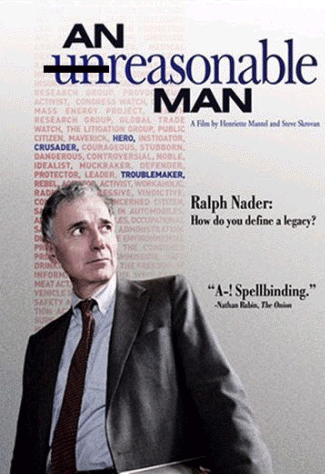
CLICK HERE TO SEE "AN unREASONABLE MAN" -- Illustrated Screenplay
[Joe Tom Easley, Former Nader's Raider] Imagine, his own former associates have turned against him.
[Ralph Nader] You know, that always makes for [good] newspaper copy.
***
[Ralph Nader] These corporate think tanks go through their daily life thinking that their glass is only 97% full.
***
[James Ridgeway, Journalist] The Democrats just totally trashed the guy, and they have been trashing him for four years. They're the meanest bunch of motherfuckers I have ever run across.
***
[Gregory Kafoury, Nader Campaign Organizer] Let me tell you, there were carrots and there were sticks. Nader was told, "If you don't run, we will lavish money on your organizations. We will lavish money anywhere you want it." Very extravagant sums of money were mentioned, and he was told face to face, "This is just the beginning."
[Ralph Nader] Oh, yes. I mean, I --through third parties, millions of dollars were offered for our programs and projects if I would drop out, or if I would not decide to run.
[Gregory Kafoury, Nader Campaign Organizer] And at the same time he was told, "If you do run, we will strangle your organizations. We will smother them. Your people will scream in pain at you for what we're gonna do to you."
-- AN unREASONABLE MAN, directed by Henriette Mantel
HENRIETTE MANTEL: We would have loved to get more reactions of people that were, you know, adamantly spreading rumors about Ralph and everything else, but Eric Alterman and Todd Gitlin, my hat’s off to them, because they would go on camera and voice their opinion opposing Ralph. A lot of people would not go on camera. They just wouldn’t. Like, they would talk, you know, to us, but then when we turned on the camera, "Oh, I’m not going to be on camera."
-- Ralph Nader on Why He Might Run in 2008, the Iraq War & the New Documentary "An Unreasonable Man", by DemocracyNow!
Statistics: Posted by admin — Sat Apr 05, 2014 12:46 am
]]>