At lengthy hearings in 1995 and 1996 in Philadelphia, lawyers seeking a new trial for Abu-Jamal called six witnesses to indicate that something else had done the shooting. But three of them, in statements given years earlier or in their own testimony during the hearings, had said they did not witness the actual shooting but saw someone fleeing only after shots had been fired. The fourth, who said that Faulkner had been shot by a passenger in the Volkswagen, also said that there was a helicopter with a searchlight on the scene (no other witnesses saw a helicopter) and that Faulkner, after being shot in the head, whispered, "Get Maureen ... get the children."
If in fact Faulkner had already been shot in the face, as the witness said, it would have been virtually impossible for Faulkner to talk. Furthermore, he had no children. The fifth witness said that Faulkner was shot by two different people, an assertion that was contradicted by all physical and medical evidence in the case.
MANUFACTURED CLAIMS
Let’s first look at the claim that Billy Cook was alone in the Volkswagen. After Faulkner radioed that he stopped a car, he followed with “On second thought, send me a wagon.” This request for a backup clearly indicates that there was more than one person in the car. Then, in 1995, Captain Edward D’Amato admitted that a driver’s license permit for a man named Arnold Howard, a business partner of Cook’s, was found on Faulkner – again, strong evidence that there was more than one person in Billy Cook’s Volkswagen. In 1982, the police and prosecution illegally kept this evidence from Abu-Jamal and his defense attorney. Why were they suppressing this evidence of other potential suspects in the shooting of Daniel Faulkner? ...
Abu-Jamal’s brother, Billy Cook, later swore that his business partner, Ken Freeman, was in the car with him, and participated in the shooting of Faulkner.
-- Manufacturing Guilt, written & produced by Stephen Vittoria & Justin Lebanowski
As explained in a recent interview, [Patrick] O'Connor argues that the actual shooter was a man named Kenneth Freeman, who was Billy Cook's business partner and who O'Connor argues was a passenger in Cook's car when it was pulled over by Officer Daniel Faulkner the morning of Dec. 9, 1981. Freeman was mysteriously found dead in a Northeast lot (reportedly naked, gagged, hand-cuffed, and with a drug needle in his arm) the day after the infamous May 13, 1985 police bombing of MOVE, leading O'Connor to conclude that "the timing and modus operandi of the abduction and killing alone suggest an extreme act of police vengeance."
***
"They arrested me for assaulting him, but I never laid a hand on him. I was only trying to protect myself," says Cook, who also reports that before he was beaten bloody with the police flashlight, Faulkner "was kind of vulgar and nasty. And if I remember correctly he threw a slur in... 'Nigger' get back in the car."
-- Mumia Abu-Jamal Faces US Supreme Court as New Book and Film Expose Injustice, by Hans Bennett
The sixth ended up giving brief testimony that substantiated the prosecution's account of what happened that night.
Much of what Abu-Jamal's supporters point to, while deeply troubling (such as the fact that 115 of the 130 prisoners on Pennsylvania's death row from Philadelphia are members of a minority), has nothing directly to do with the facts of the case.
Mumia Abu-Jamal is one of more than three and a half thousand people on death row in 37 states and under federal law throughout the USA. By the end of 1999, 598 prisoners had been put to death in 30 states since executions resumed in 1977; in 1999 alone, 98 prisoners died at the hands of the state, a record year since the 1950s. The US authorities have repeatedly violated international minimum safeguards in their continuing resort to capital punishment. Violations include the execution of the mentally impaired, of child offenders, and of those who received inadequate legal representation at trial. Those sentenced to death in the USA are overwhelmingly the poor, and disproportionately come from racial and ethnic minority communities. The risk of wrongful conviction remains high, with more than 80 prisoners released from death rows since 1973 after evidence of their innocence emerged. Many came close to execution before the courts acted on their claims of wrongful conviction. Others have gone to their deaths despite serious doubts concerning their guilt.
-- A Life in the Balance: The Case of Mumia Abu-Jamal, by Amnesty International
As the prosecution built their case, Giordano was the prime police witness during pretrial hearings, and his account of Abu-Jamal’s confession was a cornerstone. But without explanation, he was pulled from the case, and did not even testify at trial. Unknown to Abu-Jamal and his defense, Giordano, as well as the commander and deputy commander of the Center City area, along with the head of the homicide division, in fact the entire chain of command in Abu-Jamal’s prosecution, were all under FBI investigation for corruption at the time of Faulkner’s murder. Giordano was removed from his post as a Command Inspector, and relegated to desk duty after the FBI and the Justice Department apparently informed Philadelphia District Attorney Ed Rendell that Giordano was under investigation for corruption, and his testimony at Abu-Jamal’s trial would undermine their case. Giordano resigned from the police force at full retirement pay the first working day after Abu-Jamal’s conviction. His previously publicized report that Abu-Jamal confessed to shooting Faulkner was not even introduced at trial.
-- Manufacturing Guilt, written & produced by Stephen Vittoria & Justin Lebanowski
It also seems apparent that some of the most recognizable figures supporting Abu-Jamal are doing so without having read the complete trial transcript.
Absurdly, Bissinger spends a considerable amount of space scolding supporters of Abu-Jamal for not reading the entire transcript of his case (which totals more than 12,000 pages). But several basic errors in Bissinger's account seem to indicate he did not carefully review the documents either. For example, Bissinger refers to Judge Albert Sabo as Alfred Sabo. He also misidentifies a key prosecution witness as a defense witness.
Such reporting might have been anticipated by Leonard Weinglass, who wrote Vanity Fair's editors in June requesting a less biased journalist be assigned to the story. "I found (Bissinger's) manner and demeanor to be that of an angry, even furious, advocate for Mr. Jamal's detractors."
-- The Media & Mumia: Were ABC and Vanity Fair Taken for a Ride?, by Fairness & Accuracy in Reporting
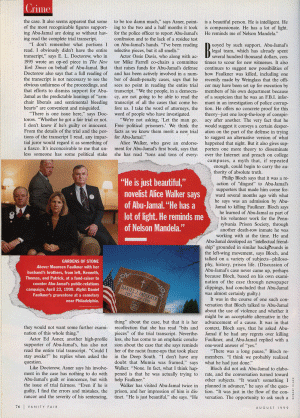
GARDENS OF STONE. Above: Maureen Faulkner with her husband's brothers, from left, Kenneth, Thomas, and Patrick, at a fund-raiser to counter Abu-Jamal's public-relations campaign, April 23, 1999. Right: Daniel Faulkner's gravestone at a cemetery near Philadelphia.
"I don't remember what portions I read. I obviously didn't have the entire transcript," says E.L. Doctorow, who in 1995 wrote an op-ed piece in The New York Times on behalf of Abu-Jamal. But Doctorow also says that a full reading of the transcript is not necessary to see the obvious unfairness of the proceedings, and that efforts to dismiss support for Abu-Jamal as the predictable leanings of "armchair liberals and sentimental bleeding hearts" are convenient and misguided.
"There is one issue here," says Doctorow. "Whether he got a fair trial or not. I don't know if he's guilty or innocent. From the details of the trial and the portions of the transcript I read, any impartial juror would regard it as something of a fiasco. It's inconceivable to me that unless someone has some political stake they would not want some further examination of this whole thing."
The jury: a fair and impartial panel of Abu-Jamal’s peers?
An essential element of a fair trial is the selection of an impartial jury of the defendant’s peers, one which will base its verdict solely on the evidence presented to it. Where a case generates a high degree of controversy and publicity, trial courts routinely grant a change of venue, to ensure that the jury has not been exposed to pretrial publicity that could bias its deliberations. Of approximately 80 people in the jury pool at Mumia Abu-Jamal’s trial, all but seven prospective jurors admitted that they were familiar with media coverage of the case.
The jury eventually selected (including the four alternate jurors) consisted of two blacks and 14 whites. The population of Philadelphia at the time of the trial was 40 per cent African American; a jury racially representative of the community could thus have been expected to include at least five black members.
The prosecution used 11 out of its 15 peremptory strikes to remove African Americans from the jury. In 1986, the US Supreme Court ruled in the case of Batson v. Kentucky that the removal of potential jurors must be “race neutral”.
The jurors selected for the trial of Mumia Abu-Jamal appear to have received different treatment from the court according to their race. Jennie Dawley, black, was the only juror selected while Abu-Jamal was conducting his own defence. Dawley requested, before the trial started, that she be allowed to take her sick cat to the veterinarian during the evening, thereby not disrupting the court proceedings. Judge Sabo denied this request without informing the defence. Juror Dawley was dismissed from the jury when she failed to abide by the Court’s instruction. In contrast, a white juror requested permission to take a civil service exam during court time. Judge Sabo granted this request, temporarily halted the trial and instructed a court official to accompany the juror and ensure that he saw no media coverage of the trial.
Jennie Dawley was replaced by a white alternate juror, Robert Courchain. On at least five occasions during jury selection, Courchain stated that, although he would try, he might be unable to set aside his bias in the case. For example, he stated: “unconsciously I don’t think I could be fair to both sides.” The defence sought the removal of Courchain “for cause” (i.e. that he was incapable of deliberating impartially), but Judge Sabo denied the request. As Jackson had previously used the one peremptory strike available to him at this point he was unable to prevent Courchain from becoming an alternate juror.
Jackson also allowed two jurors onto the jury whose life experiences could possibly prejudice them against Abu-Jamal. Juror number 11 was the close friend of a police officer who had been shot while on duty. While being questioned, he openly admitted that this experience could mean he was unable to be a fair juror because of his feelings concerning his friend. Juror number 15 (an alternate) was the wife of a serving police officer. Jackson allowed both onto the jury without objection.
--A Life in the Balance: The Case of Mumia Abu-Jamal, by Amnesty International
Like Doctorow, Asner says his involvement in the case has nothing to do with Abu-Jamal's guilt or innocence, but with the issue of trial fairness. "Even if he is guilty, I find the errors and mistakes, the rancor and the severity of his sentencing, to be too damn much," says Asner, pointing to the two and a half months it took for the police officer to report Abu-Jamal's confession and to the lack of a residue test on Abu-Jamal's hands. "I've been reading selective pieces, but it all smells."
Actor Ossie Davis, who along with actor Mike Farrell co-chairs a committee that raises funds for Abu-Jamal's defense and has been actively involved in a number of death-penalty cases, says that he sees no point in reading the entire trial transcript. "We the people, in a democracy, are not going to be able to read the transcript of all the cases that come before us. I take the word of attorneys, the word of people who have investigated.
"We're not asking, 'Let the man go. Free political prisoners.' We think the facts as we know them merit a new trial for Abu-Jamal."
Alice Walker, who gave an endorsement for Abu-Jamal's first book, says that she has read "tons and tons of everything" about the case, but that it is her recollection that she has read "bits and pieces" of the trial transcript. Nevertheless, she has come to an emphatic conclusion about the case that she says reminds her of the racist frame-ups that took place in the Deep South. "I don't have any doubt that Mumia was framed," says Walker. "None. In fact, what I think happened is that he was actually trying to help Faulkner."
Walker has visited Abu-Jamal twice in prison, and her impression of him is distinct. "He is just beautiful," she says. "He is a beautiful person. He is intelligent. He is compassionate. He has a lot of light. He reminds me of Nelson Mandela."
Buoyed by such support, Abu-Jamal's legal team, which has already spent several hundred thousand dollars, continues to scour for new witnesses. It also continues to suggest new possibilities of how Faulkner was killed, including one recently made by Weinglass that the officer may have been set up for execution by members of his own department because of a suspicion that he was an F.B.I. informant in an investigation of police corruption. He offers no concrete proof for this theory -- just one loop-the-loop of conspiracy after another. The very fact that he would suggest it conveys a certain desperation on the part of the defense in trying to suggest an alternative version of what happened that night. But it also gives supporters one more theory to disseminate over the Internet and preach on college campuses, a myth that, if repeated enough, could begin to carry the authority of absolute truth.
ARNOLD BEVERLY
In 1999, a career criminal and self-described hitman, Arnold Beverly, confessed he shot Faulkner in the head, and that Abu-Jamal arrived after Faulkner was shot and had nothing to do with the shooting. Without providing any reason, except that the confession was “too late,” the Pennsylvania and Federal courts have refused to even admit this confession into evidence.
-- Manufacturing Guilt, written & produced by Stephen Vittoria & Justin Lebanowski
In his affidavit, Arnold Beverly stated that “Mumia Abu-Jamal did not shoot police officer Faulkner…. Jamal had nothing to do with the shooting.” Beverly explained that he “was hired, along with another guy, and paid to shoot and kill Faulkner. I had heard that Faulkner was a problem for the mob and corrupt policemen because he interfered with the graft and payoffs made to allow illegal activity including prostitution, gambling, drugs without prosecution in the center city area.” Beverly said that he was given “a .38 caliber policeman’s special and I was also carrying my own .22 caliber revolver.” Beverly, who like Freeman was wearing a green army jacket, stated that as he came onto the scene of 13th and Locust, he “saw police officers in the area,” but “was not worried” because “I believed that since I was hired by the mob to shoot and kill Faulkner, any police officers on the scene would be there to help me.”
Beverly described that he saw Faulkner get out of his patrol car and go up to a VW. He heard a shot and then another one that grazed his left shoulder. He continued: “I ran across Locust Street and stood over Faulkner, who had fallen backwards on the sidewalk. I shot Faulkner in the face at close range. Jamal was shot shortly after that by a uniformed police officer who arrived on the scene.” Beverly concluded that he left the area through the Speedline subway system “and by pre-arrangement met a police officer who assisted me when I exited the speedline underground about three blocks away. A car was waiting for me and I left the center city area.” (See http://www.partisandefense.org/pubs/innocent/ab.html)
The sworn declarations by Mumia and William Cook and Arnold Beverly’s affidavit, along with a host of supporting evidence that we will detail below, were submitted to federal and state courts in 2001. (No. 99 Civ 5089; No. 8201-1357-59) But the courts have refused to even consider them. For their part, Faulkner and Smerconish dismiss Beverly’s confession as “pure idiocy” (page 28). Predictably, they say not a word about the rampant corruption of the Philadelphia Police Department, including its working relationship with the mob. At the time of Faulkner’s murder, the police department was under at least three federal investigations for corruption, including police ties with the mob. (See http://www.partisandefense.org/pubs/innocent/rw.html)
-- Murdered by Mumia: Big Lies in the Service of Legal Lynching: Mumia is Innocent! Free Him Now, by Partisan Defense Committee
Results of a lie detector test given to Arnold Beverly corroborate his confession that he shot Police Officer Daniel Faulkner, and Mumia Abu-Jamal is innocent. This week on Tuesday, May 29, 2001, Mr. Jamal's new legal team filed the affidavits of eminent polygraph expert Charles Honts, Ph. D., who took a polygraph examination of Arnold Beverly. (Dr. Honts is Department Head of the Department of Psychology at Boise State University. He is the noted authority in the field of polygraph examination. With twenty years experience as an expert witness, he has been published extensively in numerous scientific journals. Included with Dr. Honts' affidavits is a 37-page curriculum vitae.)
At the time that Mr. Beverly's declaration was filed earlier this month, the new defense team requested authorization from the district court to depose Arnold Beverly, their own witness. The District Attorney filed objections to the deposition. On Tuesday of this week, the defense filed a response to the District Attorney's opposition to the deposition of Arnold Beverly. The defense response states, "If the District Attorney's Office believed its own representation to the District Court and the media that Beverly's confession is a 'patently outrageous story' and a 'lie,' they would welcome, rather than oppose, being given the opportunity to cross-examine the witness under oath." (A deposition is a sworn statement with a court reporter present that offers both sides the opportunity to question the witness.)
Although Arnold Beverly has admitted to the killing, Mumia Abu-Jamal, an innocent man, remains incarcerated at S.C.I. Greene on death row. The case of Mumia Abu-Jamal is currently pending in a Habeas Corpus action before Judge William H. Yohn in the United States District Court of the Eastern District of Pennsylvania. The defense team has urged Judge Yohn to grant the deposition of Arnold Beverly in their response.
-- Lie Detector Test Corroborates Arnold Beverly's Confession to Killing Daniel Faulkner ... Mumia Abu-Jamal is Innocent, by International Action Center
Philip Bloch says that it was a reaction of "disgust" to Abu-Jamal's supporters that made him come forward several months ago with what he says was an admission by Abu-Jamal to killing Faulkner. Bloch says he learned of Abu-Jamal as part of his volunteer work for the Pennsylvania Prison Society, through another death-row inmate he was working with at the time. He and Abu-Jamal developed an "intellectual friendship" grounded in similar backgrounds in the left-wing movement, says Bloch, and talked on a variety of subjects -- philosophy, history, prison life. (Discussion of Abu-Jamal's case never came up, perhaps because Bloch, based on his own examination of the case through newspaper clippings, had concluded that Abu-Jamal was almost certainly guilty.)
It was in the course of one such conversation that Bloch talked to Abu-Jamal about the use of violence and whether it might be an acceptable alternative in the advancement of a cause It was in that context, Bloch says, that he asked Abu-Jamal if he had any regrets over killing Faulkner, and Abu-Jamal replied with a one-word answer of "yes."
"There was a long pause," Bloch remembers. "I think we probably realized what he had just done."
Bloch did not ask Abu-Jamal to elaborate, and the conversation turned toward other subjects. "It wasn't something I planned in advance," he says of the question. "It was just in the flow of the conversation. The opportunity to ask such a question came up, and I asked it." Even without elaboration, Bloch says he was positive that Abu-Jamal understood precisely what had been asked.
"It was directly implied in my statement that he was the one who did it. I don't think there's any possibility of miscommunication.
Bloch, a 47-year-old substitute teacher, kept the contents of the conversation to himself for roughly seven years. But in recent months, he says, the tactics of Abu-Jamal supporters increasingly began to gnaw at him. "Maureen Faulkner is being subjected to such calumny. They're trying to vilify the memory of her husband and make it seem like he was some rogue cop that was out beating Mumia's brother. So I see that. That's disgusting enough. I see the level of hatred that's being aroused in people towards the police. And I think it's just crossed a line."
Combing the Internet one day, Bloch discovered a Web site established by an organization called Justice for Police Officer Daniel Faulkner. He read some of the contents, and sent and E-mail in early April that said, "There is at least one person to whom Mumia has admitted killing Officer Faulkner and that person may be willing to break his silence on the matter." In a second E-mail, Bloch revealed his name and phone number, and has since given a statement to a detective from the Philadelphia Police Department.
Bloch says that his decision to come forward was not an easy one. He has not spoken with Abu-Jamal in roughly five years after letters he sent to the inmate went unanswered. But, says Bloch, "I still have a lot of respect for him. I don't think by any means he's proud of what he did. I'm sure that if he had to do it all over again he'd be somewhere else that night." But in the absence of that, says Bloch, "It's a lot easier to live the life now as a martyr than as a cold-blooded cop killer."
On the morning of August 3 Philadelphia's largest Black-owned newspaper, the Philadelphia Tribune, hit the newsstands with an exclusive story: "Letter Contradicts Mumia's 'Confession': Philip Bloch Wrote Abu-Jamal Would Be Vindicated." Bloch was featured prominently in the August issue of Vanity Fair and a recent segment of ABC network's 20/20 program. He claimed that during a 1992 visit with Mumia at Huntingdon Prison, Mumia admitted to killing Philadelphia police officer Daniel Faulkner. There was a week-long media frenzy, especially in Philadelphia, declaring that this new "evidence" once again confirmed Mumia's guilt, and he should now be executed.
But now the Tribune had the text of a letter from Philip Bloch written to Mumia after the alleged 1992 conversation. The author of the Tribune piece, Milton McGriff, wrote that Bloch's letter "expressed confidence that Abu-Jamal would be acquitted if he received a new trial."
At 9 a.m. on the same day, reporters crammed into a tiny studio at radio station WHAT-AM in Philadelphia for a press conference announcing this stunning new evidence in Mumia's case. The press conference was aired live on the Bill Anderson Show. Last month, Mumia called in live from death row to this same talk show to refute Bloch's allegation. The participants in the press conference were: Tribune reporter Milton McGriff; Linn Washington, journalist and professor; Leonard Weinglass, Mumia's lead attorney; C. Clark Kissinger of Refuse & Resist and contributing writer to the RW; Pam Africa, International Concerned Family and Friends of Mumia Abu-Jamal; and two Mumia supporters. It was broadcast live on the national show Democracy NOW on the Pacifica network, New York's WLIB and WCXJ in Pittsburgh. Two taped statements by Mumia were also played--his initial response to Bloch's allegations and the article "Anatomy of the Lie," his commentary on Bloch's letter (see accompanying article).
So-called "confessions" have been a big part of the frame-up and railroad of Mumia Abu-Jamal from the start. With Bloch's allegation, Mumia's enemies claimed to have a brand new "confession" tale. But, like the other "confessions" claims, this one has turned out to be a flat-out lie. And Mumia and his supporters have indisputable evidence--in the form of black ink on paper, written by the very person that claims to have heard Mumia "confess."
The Letter that Refutes Bloch's Claim
In a dramatic moment during the press conference, Clark Kissinger held up a priority mail package containing Bloch's letter. Kissinger is the author of a nationally published article taking on the Vanity Fair article and its author, Buzz Bissinger. Among other things, Kissinger exposed that Bissinger was a publicist for Philadelphia Mayor Ed Rendell. Rendell is now eyeing a run for a higher office, but there's a potential problem. He was the Philly D.A. when Mumia was railroaded onto death row; when the police attacked the MOVE house in 1978, beating Delbert Africa in front of TV cameras; when the police bombed the MOVE house in 1985, killing 11 people and burning down a Black neighborhood. So Rendell -- along with other powerful figures in the Philadelphia power structure and someone like Bissinger -- have an interest in covering up the truth about the miscarriage of justice against Mumia and the MOVE organization.
Shortly after his reply to Vanity Fair appeared, Kissinger received the mail from Mumia: "I opened up this envelope -- and what should come out of it but a letter from Mr. Philip Bloch addressed to Mumia at the prison. You can see it's got the date on it here from the postmark, July 17, 1993." As Kissinger emphasized, the significance of the date is that it shows Bloch wrote the letter months after the date that he supposedly heard Mumia "confess."
Kissinger spoke about Bloch's letter: "It deals with Mr. Bloch talking about himself -- how he graduated summa cum laude, how he was smarter than almost all the rest of the students and how he has a higher moral sense. But at the end of the letter he talks about having watched this film on the FBI's attack on the Native Americans in South Dakota -- and how a number of them who were prosecuted by the government were freed by a jury. He goes on to say that in essence he was heartened by them being freed. And he says at the end: 'So it is possible to get justice from the jury. Not always, but sometimes. So, when you get a new trial I think there is a good chance of acquittal.'
"It's very clear in reading this 1993 letter that Mr. Bloch was not under the impression that Mumia Abu-Jamal had committed this crime. He carries on in this letter in the context of justice for the Native Americans and justice in general, getting justice from a jury -- and he looks forward to the acquittal of Mumia at a future trial. I think that pretty effectively, in Mr. Bloch's own words, puts the lie to the claim that Mumia had made some sort of confession to him."...
Clark Kissinger officially turned over Bloch's letter to the legal team. Weinglass then spoke about the possible legal relevance of Bloch's allegations. He pointed out that Mumia's case is now on the federal level, where Mumia has won all his civil suits. Weinglass said that the federal judge will hopefully be someone who's not from the "old boy network" of the Philadelphia Court of Common Pleas and the Pennsylvania Supreme Court. He noted that historically, federal courts have reversed almost 40 percent of all death penalty cases nationally. As a result, said Weinglass, "The prosecution is slightly panicked.... They desperately need something new. They need something that will convince a federal judge that he should not grant Mumia a new trial. And I think they trotted out Phil Bloch as their last ditch effort to try to dissuade a federal judge from doing what the case demands and requires and ought to have."
Bugged Cubicles at Huntingdon Prison
Bloch's own letter is the most damning evidence against this latest "confession" claim. But the press conference participants pointed out another reason why Bloch's claim is so ludicrous -- Mumia's knowledge that prison authorities eavesdrop on his conversations. Leonard Weinglass said, "Mumia from day one always assumed that his conversations were being taped, particularly with non-legal visitors.... Huntingdon was opening my mail to Mumia, making copies of it and sending it on to the governor's office. That had never happened in my 25 years of experience. So far as I know, it has rarely happened to any attorneys. That's the nature of Huntingdon."
Linn Washington covered Mumia's case from 1981 and has interviewed him in prison. He said that as soon as he heard Bloch mention where the alleged conversation with Mumia took place he knew Bloch's claim "had no merit": "It took place in a secured visiting area, a small area not even a third as large as this studio, separated by Plexiglas with wire mesh screen. But the point here is that these areas contain hidden microphones. All of the inmates know that the areas are bugged. So Mumia and other inmates that I interviewed there did not talk freely.
"I specifically on one occasion asked Mumia some questions about the night, the incident itself. And he started laughing. He was looking up in the air. He said, 'I can't respond for two reasons. One, my lawyers have told me not to speak about this. And two...everyone's listening.' So it is inconceivable that this individual who is sharp, he's no fool, he's not dumb, he knows what's going on in the prisons...that he would come in and not be very guarded in anything and everything that he said in that particular area."
Karry Koon visited Mumia regularly from 1989 to 1994, as a supporter and as a member of the Pennsylvania Prison Society. She told reporters at the press conference, "Mumia wouldn't discuss anything about his case, which I respected. I didn't ask questions. But he said he believed the room to be bugged or a guard could be listening in." Koon also said that she and Bloch lived in the same small town from 1986 through the mid-'90s. She said of Bloch, "Over the years that I knew him he never said to me, 'You know, I think Mumia's guilty.' He always acted as if he believed in his innocence." John Black said Mumia supporters distanced themselves from Bloch because he "talked more about himself than about the case."
Mumia supporters tried to get Bloch on the air for the press conference, but he would not return their calls. However, Bloch granted interviews with many mainstream reporters. He had different stories at various times about the letter -- from claiming he wasn't sure he had written the letter, to saying that the letter was being "misinterpreted" by Mumia supporters.
Media Lies and Distortions
Beginning with Bissinger's piece in Vanity Fair, the media ran with Bloch's "confession" story without ever checking it out. Bissinger's article itself is full of inaccuracies. (The article by C. Clark Kissinger, "A Myth Repeated," is a full debunking of the Vanity Fair article. See RW #1015; also available at the Refuse & Resist website--www.calyx.com/~refuse)
Mumia's supporters made numerous attempts to contact the media who picked up Bloch's story and talk to them about his letter to Mumia. ABC claimed that 20/20 anchor Sam Donaldson was on vacation. The Vanity Fair switchboard was said to be down. Milton McGriff said at the press conference: "Mr. Bloch didn't return phone calls, but I did speak to Harry Philips who produced the 20/20 on Mumia. And amazingly...he doesn't believe this letter means that Bloch was convinced that Mumia is innocent. Nor does he believe this letter says that Bloch could be lying.... The connection between the words justice and acquittal meant nothing in the conversation I had with Mr. Philips."
After the press conference, some of the participants appeared on a radio show that has a history of airing anti-Mumia programs. Bloch did call in to this show. He was vague, stammered and said he didn't remember when Mumia supposedly "confessed" to him. After he was disconnected, host Dom Giordano (definitely not a Mumia supporter) said to Milton McGriff, "[Bloch] comes across as a guy who's a little bit unhinged and a little bit out there, a little bit wifty, to some people. Why is he so important in this whole deal with Mumia then?" McGriff replied, "I think that's a good question and a fair question. And I think you should ask Buzz Bissinger, because he's the one who made Philip Bloch front-page news, not us."
At the press conference earlier, Linn Washington had told reporters, "This additional evidence underscores the absurdity of this allegation that was just taken at face value. As a journalism professor, one of the things that I impress upon the students, one of the things that all of the textbooks impress upon students, is that you do background reporting. You don't accept anything at face value. Mr. Bloch was accepted at face value.... So there's continuing double standards in the coverage of the Mumia case -- and this is something you could document year after year after year after year."
-- Mumia: Blowing Away the Lies: Dramatic Evidence Refutes "Confession" Claims, by Revolutionary Worker
In 1994, Maureen Faulkner asked herself whether she would publicly respond to the swell of support for Abu-Jamal, or whether she would simply step aside. The answer came when she learned that NPR was planning to air commentaries by Abu-Jamal on life in prison. "I believe they were going to make him their poster boy," she says. "That was the beginning of it."
She called members of management at NPR, who, she says, told her that Abu-Jamal had a First Amendment right to freedom of speech. "Well, what about my husband, who is six feet under?" she responded. "He's lost his ability for his freedom of speech."
NPR reversed its decision, but Abu-Jamal's radio commentaries later surfaced on the Pacifica Radio Network. Faulkner was driving to work one day from her home in California and was flipping through stations on the car radio when she suddenly heard his voice. She flipped to another station, then flipped back. She started to shake and had to pull off to the side of the highway.
[Ellen Weiss, Executive Producer: NPR’s “All Things Considered] The American public needs to hear these essays.
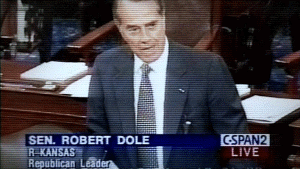
[Sen. Robert Dole, R-Kansas, Republican Leader] Yesterday, taxpayer supported National Public Radio was scheduled to start running commentaries by a convicted killer on death row.
[Saro Solis] In the Spring of 1994, Mumia became a regular commentator on NPR’s leading news magazine, “All Things Considered.” Producer Noel Hanrahan recorded Mumia in the visiting room at Huntingdon State Prison. NPR then launched a national ad campaign promoting Mumia’s unique voice from death row. His commentaries would reach an audience of 10 million listeners on more than 400 stations. But on the eve of Mumia’s first broadcast, National Public Radio fired their new commentator. Intense pressure by the National Fraternal Order of Police, along with the political elites on Capitol Hill, tempered NPR’s natural instincts to get the story right.
[Juan Gonzalez, Investigative Journalist] It was surprising that a United States Senator would care about whether Mumia’s commentaries would be allowed on NPR.
[Sen. Robert Dole, R-Kansas, Republican Leader] Officer Michael Lutz, President of the Philadelphia Fraternal Order of Police argued, and I quote: “I was under the impression he was supposed to be punished. This man is a cold-blooded killer whose appeals went to the highest courts in the land, and he’s getting a radio show out of the deal.”
[Juan Gonzalez, Investigative Journalist] Being able to turn this issue into a cause among Conservatives throughout the country would benefit his own political career.
[Amy Goodman, Journalist] There’s a reason why our profession, journalism, is the only one explicitly protected by the U.S. Constitution, because we’re supposed to be the check and balance on power.
[Sen. Robert Dole, R-Kansas, Republican Leader] The last time I checked, we were trying to fight crime, not subsidize it, or promote the fortunes of convicted murderers through taxpayer supported public broadcasting.
[Amy Goodman, Journalist] We’re not here to win a popularity contest. We have to go where the silence is.
[Sen. Robert Dole, R-Kansas, Republican Leader] And all of this is so bizarre I can’t believe it happened, but it did happen. And even thinking about putting it into some program where somebody on Death Row, some convicted cop killer, would be profiting from his commentaries.
[Amy Goodman, Journalist] It’s not about a person’s case, whether they’re guilty or innocent. It’s about the experience of living behind bars and what that means.
[Sen. Robert Dole, R-Kansas, Republican Leader] And I’m pleased that the program was canceled, but I think we need to be on the alert because those who probably thought up this idea will probably be thinking up some others that could be just as harmful, and just as bad.
[Jerry Quickley, Poet, Journalist] The fact that Mumia was still able to find a national audience for the work was very significant.
[Amy Goodman, Journalist] In 1997, when Democracy Now! was just beginning, we decided to air the commentaries of Mumia Abu-Jamal.
[Juan Gonzalez, Investigative Journalist] We didn’t think anything about it. Okay, if NPR won’t run them, we’ll run them.
[Amy Goodman, Journalist] On the day that we began running these commentaries in Pennsylvania, the public radio network, run by Temple University, dropped us seconds before we were to go on the air. Not just dropped that show, but ended their contract altogether. It was their most popular show. We also asked the Fraternal Order of Police to come on. They refused, but that shouldn’t determine that his voice couldn’t be heard.
[Juan Gonzalez, Investigative Journalist] Sometime you have to take unpopular stances if you believe that the information or the news that you’re getting out, is something that the public needs to hear.
-- Mumia: Long Distance Revolutionary. A Journey With Mumia Abu-Jamal, directed by Stephen Vittoria -- Illustrated Screenplay & Screencap Gallery
Since that time, Faulkner has consistently gone to battle with those who have promoted the case and cause of Abu-Jamal. When Addison-Wesley published Abu-Jamal's book, in 1995, she personally hired a plane to fly over the publisher's offices in Reading, Massachusetts, with a banner that read, ADDISON-WESLEY SUPPORTS COP KILLERS. In 1996, when she learned that HBO was planning to air a documentary that would leave out key elements pointing to Abu-Jamal's guilt, she wrote a letter to Gerald Levin, the head of Time Warner, which read in part: "The facts of my husband's murder are brutal and crystal clear. All physical evidence and eyewitness testimony has demonstrated over and over again that Mumia Abu-Jamal shot my husband in the back, and while he lay face up and conscious on the sidewalk Jamal emptied his gun into my wounded husband's face."
When she learned that Whoopi Goldberg, who has been a visible supporter of Abu-Jamal's, was helping to host a 50th-birthday party for President Clinton, she wrote a telegram to the president that said, "Do you want someone who supports a convicted cop killer to host your 50th birthday? I know the law enforcement across this country will be appalled." (Two months later she received a letter from then chief of staff Leon Panetta that said, "The President certainly does not want to add to your grief and was very sorry to hear of your concerns. Let me assure you, however, that Ms. Goldberg's participation in the President's birthday party does not imply that he endorses her view on this particular matter.")
"I really felt as though I was putting out the fires of hell alone," Faulkner says. "And they were popping up, these fires, throughout the country, throughout the world, and I kept trying to put them out and put them out."
Faulkner has been subjected to blistering attacks on her credibility as well as E-mail missives from supporters of Abu-Jamal that have said, "Fuck you" and "Nobody cares about you or that piece of shit cop that deserved to die" and "Get your head out of your ass."
But Faulkner shows no signs of giving up. "I hope someday there is closure, and I just believe the only way that there will be closure is if ... they follow out what a jury of 12 had decided. I am not the one who convicted Jamal of murder. A jury of 12 did in the city of Philadelphia, where capital punishment is imposed."
In the end, nearly 20 years after the murder of Officer Faulkner, the most intriguing element of Abu-Jamal's case is all that it doesn't say.
There is still the unexplained element of what caused Abu-Jamal and his brother William Cook to be at the red-light intersection of 13th and Locust Streets at close to four in the morning. There is still the unexplained element of why Abu-Jamal, even with a reputation for nonviolence, had purchased a gun two and a half years prior to the shooting.
At 3:51 a.m., Faulkner reports over his radio that he has stopped a car at 13th and Locust Street. At the same time, Mumia Abu-Jamal is parked in his cab just around the corner. He fills out his log, anticipating a new fare just as the clubs are closing. He is moonlighting as a cab driver after his uncompromising approach to reporting began to cost him work as a journalist. He had recently started carrying a registered 38 Charter Arms revolver during his late-night cab runs after having recently been robbed at gunpoint. From the D.A.’s office, to Abu-Jamal’s most ardent defenders, all agree that Abu-Jamal’s brother, Billy Cook, who ran a street vendor stall nearby, exited his Volkswagen and had an exchange with Faulkner. But what happened next has been the subject of heated debate ever since.
-- Mumia: Long Distance Revolutionary. A Journey With Mumia Abu-Jamal, directed by Stephen Vittoria -- Illustrated Screenplay & Screencap Gallery
There is still the unexplained element of why William Cook has never publicly said a word about the shooting.
The Defendant’s Refusal to Testify
KGO asserts that: “In 16 years, neither Jamal nor his brother have ever offered another version of what happened.”
Given the extreme bias of the court, his removal as pro se counsel, and his removal from the courtroom, Jamal wisely elected not to take the stand at his original trial. He has repeatedly demanded a new and impartial trial. But, and with good reason, he has refused to give the prosecution a preview of his testimony. Except for the immediate circumstances around his being shot by Faulkner and Faulkner being shot, Jamal has described in great detail what happened to him that evening: How he was beaten by police arriving at the scene, how his transport to the hospital was delayed, and how he was treated by police at the hospital.
The situation with Jamal’s brother, Billy Cook, is somewhat different. We suspect that very few people have ever heard of an incident in which two Black men are involved in a physical altercation with a white police officer in which the white police officer is killed, and then the one Black man whom witnesses said struck the officer, is ultimately released. Yet that is what happened in this case.
Billy Cook was charged with a single misdemeanor and given a suspended sentence. His wooden street newsstand was then burned down. Billy took the hint, and got lost. He was not subpoenaed by the prosecution at the trial. He was the closest witness to the events, yet the prosecution didn’t want to hear from him. It was Jamal whom police wanted to get.
Billy was asked to testify in a hearing on Jamal’s motion for a new trial, and he agreed. However, the prosecution announced that there was an old outstanding misdemeanor warrant for Billy, and if he showed up to testify he would be arrested.
This was no idle threat, because when Veronica Jones came forward to testify in Jamal’s defense in 1996, she was arrested as soon as she stepped off the witness stand. Some people have called this conduct Pennsylvania’s “witness persecution program.” Given the threat of arrest, Billy did not show up in court. Billy was in fear of his life, feeling that if he were put in jail he would not come out again alive. Subsequently police have not attempted to arrest him. It seems that his only danger of arrest comes if he testifies to what happened the night Jamal and Faulkner were shot.
As to the content of the testimony he would have given, attorney Rachel Wolkenstein read into the record her affidavit of what Billy Cook had told her and had planned to say in court. So it is simply not true that Billy Cook has refused to tell his story.
-- The KGO-TV Report: A Case Study in Irresponsible Journalism, by C. Clark Kissinger and Leonard Weinglass
In his 1999 declaration, William Cook stated, “Mumia Abu-Jamal did not shoot Officer Faulkner and I did not shoot Officer Faulkner.” Cook stated that he “was stopped by Officer Faulkner while I was circling around City Center in my Volkswagen with Kenneth Freeman.” He also stated that Freeman, his passenger and business partner, “told me after that night that there was a plan to kill Officer Faulkner, that Freeman was part of that plan, that he was armed that night and participated in the shooting.” Cook also asserted that Freeman “ran from the scene after Officer Faulkner was shot.” In his 2001 Affidavit, Cook stated that Freeman was “wearing his green army jacket.” (See http://www.partisandefense.org/pubs/innocent/wc.html)
-- Murdered by Mumia: Big Lies in the Service of Legal Lynching: Mumia is Innocent! Free Him Now, by Partisan Defense Committee
There is also the silence of Abu-Jamal himself. In his books, in his columns, Abu-Jamal has spoken out on virtually everything -- the killing of a gay man in Alabama; the killing of Amadou Diallo by police in New York; the bombing in Iraq; Monica and Bill; the brutal treatment he said he received from police the night of the shooting after he was taken to the hospital.
ABU-JAMAL BEATEN BY COPS
What’s been presented here is evidence of a concentrated effort to frame a man who had been the object of hatred among members of the Philadelphia Police Department for more than a decade.
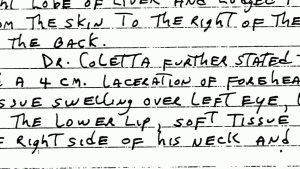
[DR. ANTHONY COLETTA, JEFFERSON HOSPITAL, OUTSIDE ROOM 7324, RE SHOOTING DEATH OF POLICEMAN DANIEL FAULKNER ON 12-9-81 AT 1234 LOCUST. DR. COLETTA WAS INTERVIEWED BY DET. MORTON INSIDE JEFFERSON HOSPITAL REGARDING THE INJURIES TO SUSPECT ...]
[DR. COLLETTA FURTHER STATED THAT MUMIA HAD. A 4 CM. LACERATION OF FOREHEAD, SOFT TISSUE SWELLING OVER LEFT EYE, LACERATION OF THE LOWER LIP, SOFT TISSUE SWELLING OF RIGHT SIDE OF HIS NECK AND JAW.]
Though it was denied by police, the admitting doctor at Jefferson Hospital, where both Abu-Jamal and Faulkner were admitted, noted injuries indicating that Abu-Jamal took a serious beating in addition to his critical gunshot wound.
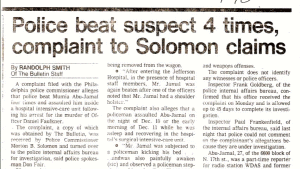
[POLICE BEAT SUSPECT 4 TIMES, COMPLAINT TO SOLOMON CLAIMS
BY RANDOLPH SMITH OF THE BULLETIN STAFF
A COMPLAINT FILED WITH THE PHILADELPHIA POLICE COMMISSIONER ALLEGES THAT POLICE BEAT MUMIA ABU-JAMAL FOUR TIMES AND ASSAULTED HIM INSIDE A HOSPITAL INTENSIVE-CARE UNIT FOLLOWING HIS ARREST FOR THE MURDER OF OFFICER DANIEL FAULKNER.
THE COMPLAINT, A COPY OF WHICH WAS OBTAINED BY THE BULLETIN, WAS RECEIVED BY POLICE COMMISSIONER MORTON B. SOLOMON AND TURNED OVER TO THE POLICE INTERNAL AFFAIRS BUREAU FOR INVESTIGATION, SAID POLICE SPOKESMAN DON FAIR.
---
BEING REMOVED FROM THE WAGON
* "AFTER ENTERING THE JEFFERSON HOSPITAL, IN THE PRESENCE OF HOSPITAL STAFF MEMBERS, MR. JAMAL WAS AGAIN BEATEN AFTER ONE OF THE OFFICERS NOTED THAT MR. JAMAL HAD A SHOULDER HOLSTER."
THE COMPLAINT ALSO ALLEGES THAT A POLICEMAN ASSAULTED ABU-JAMAL ON THE NIGHT OF DEC. 10 OR THE EARLY MORNING OF DEC. 11 WHILE HE WAS ASLEEP AND RECOVERING IN THE HOSPITAL'S SURGICAL INTENSIVE-CARE UNIT.
* "MR. JAMAL WAS SUBJECTED TO A POLICEMAN KICKING HIS BED ... AND WAS ALSO PAINFULLY AWAKEN (SIC) AND OBSERVED A POLICEMAN STEPPING ...
AND WEAPONS OFFENSES.
THE COMPLAINT DOES NOT IDENTIFY ANY WITNESSES OR POLICE OFFICERS.
INSPECTOR FRANK GOLDBERG, OF THE POLICE INTERNAL AFFAIRS BUREAU, CONFIRMED THAT HIS OFFICE RECEIVED THE COMPLAINT ON MONDAY AND IS ALLOWED UP TO 45 DAYS TO COMPLETE ITS INVESTIGATION.
INSPECTOR PAUL FRANKENFIELD, OF THE INTERNAL AFFAIRS BUREAU, SAID LAST NIGHT THAT POLICE COULD NOT COMMENT ON THE COMPLAINANT'S ALLEGATIONS BECAUSE THEY ARE UNDER INVESTIGATION.
ABU-JAMAL, 27, OF THE 6600 BLOCK OF N. 17TH ST., WAS A PART-TIME REPORTER FOR RADIO STATION WDAS AND FORMER
...]
--Manufacturing Guilt, written & produced by Stephen Vittoria & Justin Lebanowski
But there is one element missing from Abu-Jamal's prolific body of work -- any account of what happened that night when Daniel Faulkner was shot to death.
Weinglass insists that Abu-Jamal is eager to tell what took place -- as long as it is in the proper legal forum. A hearing in federal court for a new trial would be the appropriate setting, says Weinglass, although he also acknowledges there is no guarantee that such a hearing will ever be granted. "Let's first tell the story the first time in court," says the lawyer. "If we're blocked, we'll see then. Will Mumia go to his execution if it comes to that, without ever telling his story? The answer is obviously no." In the meantime, in the gaping void of that silence, his supporters continue to roar.
Statistics: Posted by admin — Wed Jun 15, 2016 9:17 am
]]>
Witnesses Pamela Jenkins and Yvette Williams swore that White said she was scared for her life under police threats if she didn’t testify as they wanted. Witness Veronica Jones blurted out on the witness stand at the 1982 trial that the police told her Cynthia White was given a deal to say that Abu-Jamal was the shooter. Jones testified that the police threatened her to I.D. Jamal as well. What’s more, all of the civilian witnesses, both for the prosecution and the defense, testified that they didn’t see Cynthia White on the scene, or only later after the police arrived.
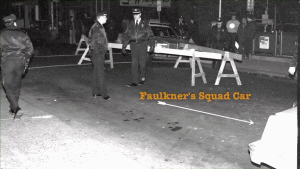
And what about eyewitness Robert Chobert? His testimony was arranged most likely by Inspector Alfonzo Giordano. The official police photos, as well as Polakoff’s photos, show Chobert’s cab was not parked behind Faulkner’s squad car as claimed by Chobert and the prosecution. In fact, Chobert was driving illegally that night on a suspended license while on probation, after being paid to throw a firebomb into a grade school. During appeals, Chobert admitted that in exchange for his testimony, the prosecution said they would assist with his probation. What’s more, Chobert later admitted that he was parked elsewhere, and that his testimony was false.
The prosecution offered two more eyewitnesses: Michael Scanlan and Albert Magilton. Both men said that they did not see the shooting. Magilton only saw a man run across Locust Street. Scanlan explicitly described the man he saw as having an afro hairstyle, and not dreadlocks.
There are yet more troubling questions about what happened that night, questions that continually underscore the innocence of Abu-Jamal, as well as the effort to frame him. Six witnesses, including Robert Chobert, made statements that one or more people fled the scene. There is no evidence that investigators ever pursued this person or persons and, according to these witnesses, they were subjected to police threats, coercion, or offered favors by the prosecution.
-- Manufacturing Guilt, written & produced by Stephen Vittoria & Justin Lebanowski
Cynthia White and Veronica Jones
Cynthia White was a prostitute working in the area on the night in question. At the trial she testified that she had seen Mumia Abu-Jamal run up to Officer Faulkner, shoot him in the back, and then stand over him firing at his head.
Prior to the trial, White had given four written statements and one tape-recorded statement to the police. In one interview she estimated the height of the person who shot Faulkner to be shorter than five feet eight inches. Abu-Jamal is six feet one inch tall. In her first court appearance at a pretrial hearing, she testified that Abu-Jamal held the gun in his left hand. Three days later she testified that she was unsure which hand he held the gun in. At trial she denied knowing which hand the gun was in. During her trial testimony, she claimed that the diagram she originally drew of the incident was incorrect and that her placement of the actors prior to Abu-Jamal’s appearance was inaccurate.
There is evidence to show that Cynthia White received preferential treatment from the prosecution and police. At the time of the trial, she was serving an 18-month prison sentence for prostitution in Massachusetts. She had 38 previous arrests for prostitution in Philadelphia; three of those charges were still pending at the time of trial. She was arrested twice within days of the shooting incident (12 and 17 December). According to Abu-Jamal’s current defence attorneys, there are no records of White ever being prosecuted for those arrests.
In 1987, a detective involved in the prosecution of Abu-Jamal testified in support of bail for White at a court hearing concerning charges of robbery, aggravated assault and possession of illegal weapons. Despite the judge pointing out that White had failed to appear in court on 17 different occasions and that she had "page after page" of arrests and convictions, the prosecution consented to the request that she be allowed to sign her own bail and the judge released her. According to information received by Amnesty International, White failed to appear in court on the charges and the authorities have since been unable to locate her. At an appeal hearings in 1997, the prosecution claimed Cynthia White was deceased and produced a 1992 death certificate in the name of Cynthia Williams, claiming that the fingerprints of the dead woman and White matched. However, an examination of the fingerprint records of White and Williams showed no match and the evidence that White is now dead is far from conclusive.
A second prostitute, Veronica Jones, witnessed the killing and testified for the defence. She claimed she had been offered inducements by the police to testify that she saw Abu-Jamal kill Faulkner, stating that "they [the police] were trying to get me to say something the other girl [White] said. I couldn’t do that." Jones went on to testify that "they [the police] told us we could work the area [as prostitutes] if we tell them [that Abu-Jamal was the shooter]."
However, Judge Sabo had the jury removed for this testimony and then ruled that Jones’ statements were inadmissible evidence. The jury were thus left unaware of the allegations that police officers were offering inducements in return for testimony against Abu-Jamal. In her testimony before the jury, Jones retracted her original statement to police that she saw two unidentified men leave the scene of the crime. Remarkably, Jackson had never interviewed his own witness (a standard practice) but Jones was interviewed by the prosecution prior to the trial.
In 1996, Veronica Jones testified at an appeal hearing that she changed her version of events after being visited by two police officers in prison, where she was being held on charges of robbery and assault. While cross-examining Jones, the prosecution announced to the court that there was an outstanding arrest warrant for Jones on charges of passing bad cheques and indicated that she would be arrested at the conclusion of her testimony.
In a sworn affidavit, Jones described her meeting with the plain clothes police officers:
“They told me that if I would testify against Jamal and identify Jamal as the shooter I wouldn’t have to worry about my pending felony charges...The detectives threatened me by reminding me that I faced a long prison sentence - fifteen years...I knew that if I did anything to help the Jamal defense I would face years in prison.”
After Abu-Jamal’s trial, Veronica Jones received a sentence of two years’ probation on the charges she was facing.
In January 1997, another former prostitute who worked in the area of the crime scene in 1981, came forward. In a sworn affidavit, Pamela Jenkins stated that she knew Cynthia White, who had told her she was afraid of the police and that the police were trying to get her to say something about the shooting of Faulkner and had threatened her life. Jenkins was the lover and informant of Philadelphia police officer Tom Ryan. In her statement, Jenkins claimed that Ryan "wanted me to perjure myself and say that I had seen Jamal shoot the police officer." In 1996, Tom Ryan and five other officers from the same district went to prison after being convicted of charges of planting evidence, stealing money from suspects and making false reports. Their convictions resulted in the release of numerous prisoners implicated by the officers. Jenkins was a principal prosecution witness at the trials of the officers.
Robert Chobert
Robert Chobert had just let a passenger out of his cab and was parked when he viewed the incident. It is undisputed that he was closest to the scene of the prosecution eyewitnesses, parked in his cab a car's length behind Faulkner’s police car and approximately 50 feet from the shooting. According to his testimony and statements, he was writing in his logbook when he heard the first shot and looked up. He had to look over or past Faulkner's car, with its flashing red dome light, to see the incident and saw the shooter only in profile. Chobert testified at trial that when he looked up, he saw Faulkner fall and then saw Abu-Jamal "standing over him and firing some more shots into him. “Under cross-examination by Jackson, he stated: "I know who shot the cop, and I ain't going to forget it.”
But Chobert's first recorded statement to police -- about which the jury was not told -- was that the shooter “apparently ran away”, according to a report written on 10 December 1981 by Inspector Giordano. Giordano encountered Chobert upon reaching the scene about five minutes after the shooting. Giordano wrote: “[A] white male from the crowd stated that he saw the shooting and that a black MOVE member had done it and appearently [sic] ran away. When asked what he ment [sic] bby [sic] a MOVE member, the white male stated, 'His hair, his hair,' appearantly [sic] referring to dreadlocks.”
There are also discrepancies between Chobert’s description of the shooter’s clothes and weight and that of Abu-Jamal.
During the trial, Jackson attempted to introduce into evidence Chobert’s previous convictions for driving while intoxicated (twice) and the arson of a school, for which he was on probation. Jackson sought to introduce the convictions to challenge Chobert’s credibility, but Judge Sabo refused to allow the defence the opportunity to make the jury aware of Chobert’s convictions.
The jury were also left unaware that Chobert had been driving his cab with a suspended drivers’ license on the night of the killing; that it was still suspended at the time of the trial and that the police had never sought to charge him for this offence. According to Chobert’s testimony at the 1995 hearing, he had asked the prosecutor during the trial “if he could help me find out how I could get my license back”, which was “important” to him because “that's how I earned my living.” According to Chobert, the prosecutor told him that he would “look into it.”
During this final summation to the jury, the prosecutor emphasized Chobert’s testimony, telling the jury they could “trust” Chobert because “he knows what he saw”. The prosecutor suggested that Chobert’s testimony was given without anyone having influenced him, telling the jury: “do you think that anybody could get him to say anything that wasn’t the truth? I would not criticize that man one bit...What motivation would Robert Chobert have to make up a story...”. However, subsequent revelations suggest that Chobert had substantial reasons to ingratiate himself with the authorities by corroborating their version of events.
Mark Scanlan
In one of his original statements to the police, Scanlan stated several times that he did not know whether Abu-Jamal or his brother shot Faulkner: “I don’t know who had the gun. I don’t know who fired it.” He also misidentified Abu-Jamal as the driver of the vehicle stopped by Officer Faulkner and was approximately 120 feet from the scene. A diagram that Scanlan drew for police indicated that Abu-Jamal and Faulkner were facing each other when the first shot was fired, contrary to the prosecution’s theory that the police officer was initially shot in the back. At trial, Scanlan admitted that he had been drinking on the night in question and that “There was confusion when all three of them were in front of the car.”
-- A Life in the Balance: The Case of Mumia Abu-Jamal, by Amnesty International
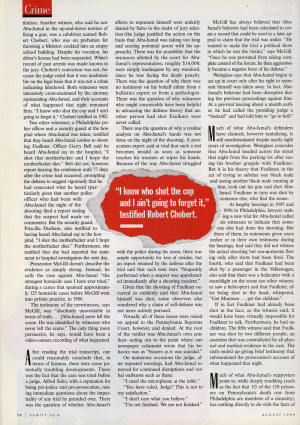
Two other witnesses, a Philadelphia police officer and a security guard at the hospital where Abu-Jamal was taken, testified that they heard Abu-Jamal confess to shooting Faulkner. Officer Garry Bell said he heard Abu-Jamal say in the hospital, "I shot that motherfucker and I hope the motherfucker dies." Bell did not, however, reporting hearing the confession until 77 days after the crime had occurred, prompting the defense to suggest vigorously that he had concocted what he heard (particularly given that another police officer who had been with Abu-Jamal the night of the shooting filed a report stating that the suspect had made no comments). But the security guard, Priscilla Durham, also testified to having heard Abu-Jamal say at the hospital, "I shot the motherfucker and I hope the motherfucker dies." Furthermore, she testified that she had reported the statement to hospital investigators the next day.
GIORDANO: HOUSE OF CARDS
As the prosecution built their case, Giordano was the prime police witness during pretrial hearings, and his account of Abu-Jamal’s confession was a cornerstone. But without explanation, he was pulled from the case, and did not even testify at trial. Unknown to Abu-Jamal and his defense, Giordano, as well as the commander and deputy commander of the Center City area, along with the head of the homicide division, in fact the entire chain of command in Abu-Jamal’s prosecution, were all under FBI investigation for corruption at the time of Faulkner’s murder. Giordano was removed from his post as a Command Inspector, and relegated to desk duty after the FBI and the Justice Department apparently informed Philadelphia District Attorney Ed Rendell that Giordano was under investigation for corruption, and his testimony at Abu-Jamal’s trial would undermine their case. Giordano resigned from the police force at full retirement pay the first working day after Abu-Jamal’s conviction. His previously publicized report that Abu-Jamal confessed to shooting Faulkner was not even introduced at trial.
But the prosecution would still get their confession. The D.A.’s office convened a round table meeting, and asked police witnesses: “Did anyone hear his statement?” Officers Garry Bell and Gary Wakshul, along with Jefferson Hospital Security Guard Priscilla Durham, suddenly report a second confession by Abu-Jamal. At this point, this dramatic second confession is being remembered and reported more than two months after the night of the crime. Officer Wakshul, assigned to Abu-Jamal from the crime scene through his admittance to the hospital, along with Officer Bell and Security Guard Durham, reportedly heard Abu-Jamal say: “I shot the motherfucker, and I hope he dies.” But less than two hours after supposedly hearing this confession, Wakshul completed his report to homicide detectives with the statement that during his entire time guarding Abu-Jamal: “The negro male made no comments.” When Wakshul was questioned during appeals why it took more than two months to report this supposed confession, he explained that he was too distressed to remember, and then later claimed: “I only then realized it might have some meaning.”
Security Guard Priscilla Durham, who had aspirations to become a police officer herself, later admitted to her step-brother that she lied about hearing this confession.
And what about Dr. Anthony Coletta who was with Abu-Jamal from the time he arrived in the emergency room until he went into surgery and stated that he did not hear, nor hear of, any confession made by Abu-Jamal in the hospital?: “I would make it clear that I was with Jamal within a moment or two of him being brought into the emergency room and on into the Intensive Care Unit, and he neither made any confessions to me, nor did he say anything that would be even remotely in the way of a confession to any other individuals.” – Dr. Anthony Coletta
-- Manufacturing Guilt, written & produced by Stephen Vittoria & Justin Lebanowski
Mumia Abu-Jamal’s “confession”
“One can have eyewitness testimonial evidence, circumstantial evidence, scientific evidence, and even video evidence; but a confession explicitly admitting guilt...is the most powerful piece of evidence that can ever be introduced against him and will surely serve as the key that locks the jail-house door and provides the juice to power the electric chair; and in these more civilized times, the juice for the needle.” Judge Overstreet, Texas Court of Criminal Appeals.
During the trial, the jury heard testimony from hospital security guard Priscilla Durham and police officer Gary Bell. According to both witnesses, when about to receive treatment for his bullet wound at the hospital, Mumia Abu-Jamal stated: “I shot the motherfucker, and I hope the motherfucker dies.”
During an appeal court hearing in 1995, a third witness, police officer Gary Wakshul, also claimed to have heard the statement. However, Officer Wakshul, who was in the police vehicle that took Mumia Abu-Jamal to the hospital, had written in his report that “we stayed with the male at Jefferson [hospital] until we were relieved. During this time, the negro male made no comments”.
None of the many other police officers in and around the hospital treatment room at that time claimed to have heard the statement, which Abu-Jamal allegedly shouted. Doctors who treated Abu-Jamal at the hospital stated in their testimony that they were with him from the moment he arrived, that he was “weak...on the verge of fainting”, and that they did not hear him make any statement that could be interpreted as a confession.
None of the three witnesses to the alleged confession reported what they had claimed to have heard until February 1982, more than two months after the shooting. They reported the alleged incriminating statements during interviews with the police Internal Affairs Unit. The interviews took place after Abu-Jamal’s made allegations of being abused by the police when he was arrested. Officer Wakshul claimed that his delay in reporting the confession was due to “emotional trauma” caused by the murder of Officer Faulkner. The two other witnesses stated that they did not believe the outburst was significant enough to report to the police.
However, during her trial testimony, Priscilla Durham claimed that she had reported the statement to her hospital supervisor the day after the events and that they had prepared a handwritten note of her allegation. Upon hearing this testimony, the prosecution sent an officer to the hospital in an attempt to recover the supervisor’s record of Durham’s statement. The officer returned from the hospital with an unsigned typewritten statement, which Priscilla Durham denied having seen before. Despite finding that this was not the original document, that the witness had not seen it before that day, and that its authenticity was not verified, Judge Sabo allowed it into evidence. He conjectured that “They took the handwritten statement and typed this” -- events that were not in evidence and that he was thus not in a position to deduce.
Gary Wakshul, the officer who noted in his report that “during this time, the male negro made no statements”, did not testify at the trial. When the defence lawyer attempted to call him as a witness, it transpired that he was on holiday, despite a notation on a police investigation report that Wakshul was not permitted to be on leave at the time of the trial. The defence requested that Officer Wakshul’s whereabouts be established or that the trial be temporarily halted to enable them to locate him. That request was denied by Judge Sabo, who commented to Mumia Abu-Jamal that “your attorney and you goofed”.
The jury was never informed of the existence of Officer Wakshul’s written report of his custody of Mumia Abu-Jamal which clearly contradicts the claim that the suspect “confessed” to killing Officer Faulkner. Therefore, the jury was left with little reason to doubt the testimony of the two witnesses who claimed to have heard the confession.
The likelihood of two police officers and a security guard forgetting or neglecting to report the confession of a suspect in the killing of another police officer for more than two months strains credulity. Priscilla Durham’s claim that she believed Mumia Abu-Jamal’s “confession” was important enough to report to her supervisor (who in turn thought it important enough to have typed out from the original handwritten version) but not important enough to notify the police is scarcely credible.
In a conversation with an Amnesty International researcher, one of Mumia Abu-Jamal’s current legal team stated that a number of the jurors have told defence investigators that they had taken into consideration Abu-Jamal’s “confession”, not just in deciding his guilt but also in sentencing him to death, since the statement portrayed him as aggressive and callous. However, the jurors refused to make any public statements to this effect. The concern remains that a possibly fabricated “confession” may have been a major contributing factor in the jury sentencing Mumia Abu-Jamal to death.
-- A Life in the Balance: The Case of Mumia Abu-Jamal, by Amnesty International
A CONCOCTED CONFESSION?
If the jurors had any doubts about Jamal's guilt after hearing from the prosecution's eyewitnesses, those doubts probably evaporated when they heard Jamal's "confession."
As he was lying on the floor of the hospital emergency room, near the police officer he was suspected of murdering, Jamal defiantly shouted: "I shot the motherfucker, and I hope the motherfucker dies.' He shouted it again a minute later. At least that was the testimony of Priscilla Durham, a hospital security guard, at Jamal's 1982 trial. Officer Garry Bell, Faulkner's former partner and best friend, swore that he heard Jamal shouting the same words.
Prosecutor McGill not only made powerful use of this alleged confession in his closing argument for a first-degree murder conviction; the next morning, in urging a death sentence, he stressed "the arrogance of an individual who defiantly will do it and then defiantly brag after it.'
But this was a most peculiar "confession," even putting aside the improbability that a man described by another prosecutor at this summer's hearing as "one of the smartest people I have ever seen" would so spontaneously and flamboyantly incriminate himself.
For although Jamal allegedly shouted it out while 15 or so police officers were grappling with him or nearby, and although most or all of these officers were interviewed over the next few days by homicide detectives seeking to build the strongest possible case against Jamal, not a word about this "confession" found its way into a single police report for more than two months.
Jamal's lawyers contend this "confession" was fabricated. And due to the ineffectiveness of Jamal's defense lawyer and the bias of Judge Sabo, the jury never heard the most exculpatory evidence: Officer Gary Wakshul, who was in the paddy wagon that took Jamal from the scene to Jefferson Hospital, reported later that morning that "we stayed with the male at Jefferson until we were relieved. During this time, the Negro male made no comments."
Did Wakshul just not hear Jamal's confession? Or did he step away for a minute and miss it? Or did he leave the hospital before Jamal uttered it? Nope. It turns out he heard the whole confession, loud and clear. At least, that's what Wakshul said in a new statement 64 days after the fact, on February 11, 1982, when questioned in a probe of Jamal's claim that police had beaten him.
Wakshul suddenly recalled there was this one little comment: "As he was placed on the floor [outside the hospital emergency room], and as I was standing back up, I did hear him say, I shot him. I hope the motherfucker dies.'" Asked by his interviewer to explain his initial report, Wakshul said that "the statement disgusted me, and I didn't realize it had any importance until today."
Didn't realize it had any importance? Wakshul's initial report had included far less important details, such as the exact times of Faulkner's radio dispatches. The idea that he had heard Jamal confess but hadn't bothered to report it is patently incredible.
LIKE WAKSHUL, OFFICER GARRY Bell made no mention of Jamal's "confession" in his reports in the days after the shooting. It was not until 78 days later that Bell says he "remembered" the confession. Bell explains he was "devastated seeing Danny with his face almost blown off," but not one of the other 15 to 20 other police officers with Jamal at the hospital ever reported hearing the confession.
Priscilla Durham first mentioned Jamal's "confession" to police investigators in a February 9, 1982, interview, 62 days after the shooting. It was not until yet another four months had gone by that Durham first claimed, in her June 24 trial testimony, that she had reported the alleged Jamal confession "the very next day" after the shooting to a hospital investigator, in a statement that he wrote down by hand. Prosecutor McGill, seemingly surprised, interjected, "I've never seen one."
Nor has one ever been produced, from that day to this. McGill sent word for the hospital to dig up this handwritten "statement," and while Durham was still on the stand there arrived in the courtroom an unsigned, unauthenticated, typewritten piece of paper, dated December 10, 1981.
Durham said that she had never seen this typed "statement" before, but that it was close to what she had reported to hospital investigators. "They took the handwritten statement and typed this," Judge Sabo helpfully conjectured. He then let McGill bolster Durham's credibility by reading key portions of this unauthenticated document to the jury.
Jamal's lawyers stress that Durham was a biased witness because she knew Faulkner and Bell, worked closely with police on a daily basis, and harbored hopes of getting a job as a police officer. Durham and Bell (like Wakshul) also undermined their credibility by denying that Jamal had been brutalized at the hospital, despite evidence (some of which the jury did not hear) suggesting that he was beaten in their presence.
Nor would this have been the first time that Philadelphia police cooked up a phony confession. "That's the kind of bullshit we see all the time," asserts John Packel, chief of the appeals division of the Defender's Association of Philadelphia. "Cops making up whatever they think will help, making up confessions, to get someone they think is guilty." In fact, police may have manufactured two Jamal confessions. Inspector Alfonzo Giordano reported later on the morning of the shooting that the handcuffed Jamal had confessed to him when they were alone in the back of the paddy wagon.
Giordano says he asked Jamal, "Where is the gun that goes into the holster?' and he stated to me, "I dropped the gun on the street after I shot him.'" The prosecution elected not to use this "confession," partly because of the risk of reversal on Miranda grounds.
But I think Giordano made it up. I think Jamal was telling the truth in an interview 11 weeks later, when he told Philadelphia Daily News columnist Chuck Stone: "I confessed? That's absurd. I do remember he [Giordano] called me a black motherfucker and hit me with a walkie-talkie." Giordano -- who pled guilty in 1986 to tax charges arising from his taking $57,000 in payoffs -- stands by his story.
-- Guilty and Framed, by Stuart Taylor, Jr.
Prosecutor McGill doesn't describe the evidence as simply strong. Instead, he calls the case against Abu-Jamal "the strongest homicide case I have ever tried," during a career that spanned approximately 125 homicide cases before McGill went into private practice in 1986.
The Testimony of the eyewitnesses, says McGill, was "absolutely unavoidable in terms of truth ... [Abu-Jamal] never left the scene. He was identified by witnesses who never left the scene." The only thing more persuasive, he says, would have been a video-camera recording of what happened.
After reading the trial transcript, one could reasonably conclude that, in terms of fairness, there were some potentially troubling developments. There was the fact that the case was tried before a judge, Alfred Sabo, with a reputation for being pro-police and pro-prosecution, raising immediate questions about the impartiality of any trial he presided over.
The trial judge: an independent and fair arbiter of justice?
“The judiciary shall decide matters before them impartially, on the basis of the facts and in accordance with the law, without restrictions, improper influences, inducements, pressure, threats or interferences, direct or indirect, from any quarter or for any reason.”
Where a defendant has selected trial by jury, the ultimate disposition of the case rests with the jurors and not with court officials. But the overall conduct of the trial is the responsibility of the presiding judge and jurors look to the judge for guidance and instruction on the complex legal issues before them. Any hint of bias from the bench may thus have a profound effect on the jury’s deliberations.
The trial of Mumia Abu-Jamal was presided over by Judge Albert F. Sabo. His history of involvement with the police and law enforcement community has raised concerns that he was not the most suitable choice of official to oversee the trial of a defendant accused of killing a police officer. Albert Sabo was an Undersheriff of Philadelphia County for 16 years before becoming a judge in 1974. His official biography lists him as a former member of the National Sheriffs Association, “retired Fraternal Order of Police” (FOP) and as associated with the Police Chiefs’ Association of South East Pennsylvania. [As a judge he was no stranger to the death penalty. Over a period of 14 years, he presided over trials in which 31 defendants were sentenced to death, more than any other US judge as far as Amnesty International is aware. Of the 31 condemned defendants, 29 came from ethnic minorities.
The judicial conduct of Judge Sabo has been a cause for concern to many members of the Philadelphia legal community for a number of years. A 1983 Philadelphia Bar survey found that over one third of the responding attorneys considered Judge Sabo unqualified to be on the bench. When asked about the survey, Judge Sabo appeared to reveal his bias against the defence by stating that if he were a defence attorney “I wouldn’t vote for me either”.
In 1992 the Philadelphia Inquirer reviewed 35 homicide trials presided over by Judge Sabo. The investigation concluded that: “through his comments, his rulings and his instructions to the jury” Judge Sabo “favored prosecutors”. According to the report, in one case, Judge Sabo even urged the prosecution to introduce evidence because “it would be helpful to [get] a conviction”. A review of the court records by the Inquirer showed “that most of the homicide judges in Philadelphia hear more murder cases than Judge Sabo with fewer death sentences.” In the same article, the Inquirer also concluded: “The assignment of a judge, like the naming of a lawyer, can be a life-or-death matter for a murder suspect. Some, like Judge Albert F. Sabo, are viewed as prosecution-minded. Others are seen as more favorable to defense. One report likened the system to a ‘crap shoot’.”
Throughout Abu-Jamal’s trial - a trial to determine whether the defendant would live or die - Judge Sabo appeared to be more concerned with expediency than fairness. For example, during the proceedings of 17 June, he stated “I don’t want to be held up on lousy technicalities...what do I care?” and “As far as I’m concerned, it can wait until lunchtime. Whatever you want to do, but let’s do something. I have a jury waiting out there”.
In 1995, defence lawyers requested that Judge Sabo recuse (i.e. remove) himself from presiding over an evidentiary hearing on whether Mumia Abu-Jamal’s original trial was fair, on the grounds of “his inability to endow this proceeding with... the appearance of fairness and impartiality”. Judge Sabo refused. During the hearing, he was openly hostile to the defence, causing one commentator to write: “[t]hroughout the internationally scrutinized post-conviction hearing, which ran from July 26 to August 15, and the closing arguments on September 11, Judge Sabo flaunted his bias, oozing partiality toward the prosecution and crudely seeking to bully Weinglass [a defence lawyer], whose courtroom conduct was as correct as Sabo’s was crass.” On 16 July 1996, the Philadelphia Inquirer described Judge Sabo’s adjudication of the hearings: “The behavior of the judge was disturbing first time around -- and in hearings last week he did not give the impression to those in the courtroom of fair-mindedness. Instead, he gave the impression, damaging in the extreme, of undue haste and hostility toward the defense’s case.”
-- A Life in the Balance: The Case of Mumia Abu-Jamal, by Amnesty International
There was the question of whether Abu-Jamal's efforts to represent himself were unfairly denied by Sabo in the midst of jury selection (the judge justified the action on the basis that Abu-Jamal was taking too long and scaring potential jurors with his approach).
The defence: Mumia Abu-Jamal’s legal representation at trial
“They [defence lawyers] must aid their clients in every appropriate way, taking such actions as is necessary to protect their clients’ rights and interests, and assist their clients before the courts.”
US death penalty procedures are a uniquely complex area of criminal law, in which even attorneys experienced in non-capital trials may fail to adequately represent their clients. Amnesty International has documented numerous cases of death row prisoners who were represented at trial by woefully inadequate defence attorneys. Its concern over such cases is shared by other international human rights groups and inter-governmental bodies. In 1996, for example, the International Commission of Jurists (ICJ), an international non-governmental organization which takes no position on the death penalty per se, published a report that was highly critical of the legal representation afforded defendants in capital cases, concluding: “the administration of the death penalty in the United States will remain arbitrary, and racially discriminatory, and prospects of a fair hearing for capital offenders cannot (and will not) be assured” without substantial remedial steps. The UN Human Rights Committee (HRC -- the expert body empowered to monitor countries’ compliance with the International Covent on Civil and Political Rights -- the ICCPR) has also made note of the concern over the “the lack of effective measures [in the USA] to ensure that indigent [poor] defendants in serious criminal proceedings, particularly in state courts, are represented by competent counsel”.
At the time of Mumia Abu-Jamal’s trial, Pennsylvania had no minimum standards for those appointed to represent defendants on trial for their life. Attorneys in capital cases were not required to pass any special examinations or to have reached any level of experience in defending those facing trial on serious charges.
Mumia Abu-Jamal was initially represented by a court-appointed attorney, Anthony Jackson. At a pretrial hearing on 13 May 1982, Abu-Jamal requested the court’s permission to represent himself at trial because he was dissatisfied with Jackson’s performance. Judge Ribner, the judge overseeing the pre-trial hearings, granted his request but, over Abu-Jamal’s vigorous objection, appointed Jackson as backup counsel. Jackson also protested at being appointed as backup counsel, stating that he did not know what it entailed, but was told by the judge; “You can fight that out with Mr. Jamal.” Jackson was given no clarification by the court as to his role in the trial as backup counsel.
Since Mumia Abu-Jamal was obviously unable to conduct investigations due to his continued detention, his access to a fully prepared lawyer -- even as “backup counsel” -- was vital to ensure a fair hearing. In a sworn affidavit dated 17 April 1995, Jackson admitted to being “unprepared” for trial and that he “abandoned all efforts at trial preparation” three weeks before the start of the trial after Mumia Abu-Jamal had obtained the right to represent himself.
During jury selection on the third day of the trial, at the suggestion of the prosecution, Judge Sabo withdrew permission for Mumia Abu-Jamal to act as his own attorney -- supposedly only for the duration of jury selection. Judge Sabo based this decision on Abu-Jamal’s alleged slowness in questioning potential jurors and on the grounds that his status as an accused murderer instilled fear and anxiety in the jurors. However, Judge Sabo did concede that “...it is true I have not rebuked Mr. Jamal at any time [during jury selection].”
Jackson objected to the ruling, pointing out to Judge Sabo that “The last case I had before you, it took us nine days to select a jury and it certainly didn’t have as much publicity as this case”. Jackson noted that jury selection in another homicide case had taken five weeks to complete. He went on to state that “in all homicide cases, particularly in capital cases... jurors express some apprehension, some unsettlement, some fear with regard to the whole process.” These objections were to no avail, Judge Sabo continued to deny Abu-Jamal the right to represent himself.
The Philadelphia Inquirer described Abu-Jamal’s conduct prior to his removal as lead counsel as “intent and business like” and “subdued”. In the first two days of the trial, Abu-Jamal had questioned 23 prospective jurors, successfully challenging two for “cause” (bias), defeating a prosecution challenge for cause, and exercising two peremptory strikes (the right to remove a prospective juror without giving reasons).
Amnesty International’s own examination of the trial transcript found no justifiable reason for the revoking of Mumia Abu-Jamal’s right to question potential jurors. At no point during his questioning was he rude or aggressive and his examinations are very similar, in terms of length, to those of the prosecution. His questions were pertinent to the selection of a fair jury. The removal of Abu-Jamal’s right to represent himself at this point in the trial is not supported in any way by the record of the trial. Judge Sabo’s comment that “You have indicated to this court that you do not have the expertise necessary to conduct voir dire” (jury selection) is likewise not supported by the record.
After the jury had been selected and the trial proper began, Mumia Abu-Jamal resumed representing himself. However, the already tense relations between him and Judge Sabo deteriorated rapidly. It is clear from the exchanges between the two men that Abu-Jamal had come to the conclusion that he would be denied a fair trial by the court. His repeated requests to be legally represented by John Africa were denied by Judge Sabo, on the grounds that Africa was not a licensed attorney. Mumia Abu-Jamal also requested that John Africa be allowed to sit at the defence table, in order to provide legal and tactical advice throughout the trial. This request was permissible under Pennsylvania law but was denied by Judge Sabo. When pressed by Abu-Jamal, who gave examples of other judges who had allowed non-lawyers to sit at the table of defendants, Judge Sabo stated that unless there was a legal precedent, he did not care what other judges did, and continued to refuse the request. Typical of the exchanges between Judge Sabo and Mumia Abu-Jamal is the following:
Judge Sabo: Mr. Jamal, it is quite evident to this court that you are intentionally disrupting the orderly procedure of this court. I have warned you time and again that if you continue with that attitude that I would have to remove you as counsel in this case.
Mumia Abu-Jamal: Judge, your warnings to me are absolutely meaningless. I’m here fighting for my life. Do you understand that? I’m not fighting to please the Court, or to please the DA, I’m fighting for my life. I need counsel of choice, someone I have faith in, someone I have respect for; not someone paid by the same pocket that pays the DA, not a court-appointed lawyer, not a member of the ABA, not an officer of the court but someone I can trust and I have faith in. Your warnings are absolutely moot, they’re meaningless to me.
Shortly after this exchange, Judge Sabo prohibited Mumia Abu-Jamal from representing himself in court and Jackson was reappointed lead counsel. Jackson protested, but his request to be removed was rejected by Judge Sabo, who threatened the lawyer with disciplinary action, including imprisonment for contempt of court, unless he continued. This left the defendant represented by a lawyer who was both reluctant to participate and ill-prepared for trial, effectively stripping Mumia Abu-Jamal of any meaningful legal representation. The following day, after a number of other angry exchanges between judge and defendant, Judge Sabo had Abu-Jamal physically removed from the courtroom.
For the remainder of the trial, Mumia Abu-Jamal was continuously readmitted to and removed from the trial. His behaviour in the courtroom became highly belligerent and disruptive to the proceedings, leaving Judge Sabo with little choice but to remove him if the trial were to continue. However, even if his behaviour justified the court in excluding Abu-Jamal from many of the critical parts of the trial, it would not release the presiding authorities from the duty to conduct a fair and impartial trial and from ensuring that his exclusion infringed as little as possible on Abu-Jamal’s right to participate in his own defence. In effect, Mumia Abu-Jamal was tried in absentia during a large portion of the trial.
-- A Life in the Balance: The Case of Mumia Abu-Jamal, by Amnesty International
There was the possibility that the resources allotted by the court for Abu-Jamal's representation, roughly $14,000, were simply inadequate by any standard, since he was facing the death penalty. There was the question of why there was no testimony on his behalf either from a ballistics expert or from a pathologist. There was the question of why witnesses who might conceivably have been helpful in advancing the defense theory that another person had shot Faulkner were never called.
The right to the resources necessary for an adequate defence
During the proceedings, every person is entitled...to obtain the appearance, as witnesses, of experts or other persons who may throw light on the facts.
Mumia Abu-Jamal’s lack of meaningful legal representation was compounded by the refusal of Judge Ribner, the pre-trial judge, to grant the defence adequate funds to employ an investigator, pathologist or ballistics expert. The court also refused defence attorney Jackson requests for a second attorney to aid the defence. In response to the initial request for funds, the Court allocated $150 for each expert. On three occasions, the defence attempted to have this amount increased as it was proving impossible to obtain expert evaluation of the evidence for this fee. On each occasion this entirely reasonable request was denied. Jackson explained to Judge Ribner that he was experiencing difficulties in recruiting the experts without the guarantee of funding. The judge replied that if Jackson submitted an itemised bill for the work the judge would approve payment, assuming he found the charges reasonable. Jackson pointed out that he had told the experts this but that they were still not willing to work without an advance payment--to which the judge replied: “Tell them, ‘The Calendar judge said ‘trust me’”.
This sum allocated by the courts to cover Jackson’s fees and expenses for his work on the case for over six months, payment for an investigator to locate and interview witnesses, and fees for experts to evaluate the evidence and testify in court concerning their findings, was clearly insufficient. The defence presented no expert testimony on ballistics or pathology. The police and prosecution interviewed more than 100 witnesses during their investigation of the crime. The evaluation of these statements alone would have taken more time than Jackson could afford to devote to them.
-- A Life in the Balance: The Case of Mumia Abu-Jamal, by Amnesty International
There was the question of why a residue analysis on Abu-Jamal's hands was not done on the night of the shooting. A prosecution expert said at trial that such a test becomes invalid as soon as someone touches his trousers or wipes his hands. Because of the way Abu-Jamal struggled with the police during his arrest, there was ample opportunity for loss of residue, but an expert retained by the defense after the trial said that such tests were "frequently performed when a suspect was apprehended immediately after a shooting incident."
Given that the shooting of Faulkner occurred so suddenly and that Abu-Jamal himself was shot, some observers also wondered why a claim of self-defense was not more actively pursued.
Virtually all of these issues were raised on appeal to the Pennsylvania Supreme Court, however, and denied. At the root of the verdict was Abu-Jamal's own conduct -- acting out to the point where one newspaper columnist wrote that his behavior was as "bizarre as it was suicidal."
The Philadelphia Inquirer described Abu-Jamal’s conduct prior to his removal as lead counsel as “intent and business like” and “subdued”. In the first two days of the trial, Abu-Jamal had questioned 23 prospective jurors, successfully challenging two for “cause” (bias), defeating a prosecution challenge for cause, and exercising two peremptory strikes (the right to remove a prospective juror without giving reasons).
Amnesty International’s own examination of the trial transcript found no justifiable reason for the revoking of Mumia Abu-Jamal’s right to question potential jurors. At no point during his questioning was he rude or aggressive and his examinations are very similar, in terms of length, to those of the prosecution. His questions were pertinent to the selection of a fair jury. The removal of Abu-Jamal’s right to represent himself at this point in the trial is not supported in any way by the record of the trial. Judge Sabo’s comment that “You have indicated to this court that you do not have the expertise necessary to conduct voir dire” (jury selection) is likewise not supported by the record.
-- A Life in the Balance: The Case of Mumia Abu-Jamal, by Amnesty International
Judge Sabo and Jamal began battling soon after the start of voir dire, on June 7, 1982. After two laborious days, Sabo granted a request by prosecutor McGill to bar Jamal from continuing to question prospective jurors, on the ground that he was taking too long and making them uncomfortable.
But this smacked of pretext. The Inquirer wrote at the time that Jamal "was intent and businesslike" and "subdued" in voir dire. While some jurors were apparently upset by Jamal's dreadlocks, beard, and questions about their home life, Sabo's claim (in findings of fact after this summer's hearing) that he was "belligerent" during voir dire rings false.
Prosecutor McGill used peremptory challenges to strike 11 of the 14 blacks in the eligible jury pool. By the time testimony began, the black militant defendant, charged with the highly publicized murder of a white policeman, in a then-40 percent black city, faced -- as a result of a probably unconstitutional voir dire -- a jury of two blacks and ten whites, including a friend of another officer shot in the line of duty.
-- Guilty and Framed, by Stuart Taylor, Jr.
On numerous occasions the judge, after repeated warnings, had Abu-Jamal removed for continued disruptions and verbal outbursts such as these:
"I need the microphone at the table."
"You have ruled, Judge? This is not to my satisfaction.
"I don't care what you believe."
"I'm not finished. We are not finished."
McGill has always believed that Abu-Jamal's behavior had been calculated to create a record that could be used in a later appeal to claim that the trial was unfair. "He wanted to make the trial a political show in which he was the victim," says McGill. "Once he was prevented from taking complete control of the forum, he then aggressively became a negative force of his defense."
Weinglass says that Abu-Jamal began to act up in court only after his right to represent himself was taken away. In fact, Abu-Jamal's behavior had been disruptive during the previous proceedings against him. At a pre-trial hearing about a month earlier, he had called the presiding judge a "bastard" and had told him to "go to hell."
Sabo compounded Jackson's difficulties by issuing a string of pro-prosecution rulings on key issues throughout the trial. The most prejudicial precluded a belated bid by Jackson to put on the best evidence that Jamal's confession was a fabrication: Officer Gary Wakshul's report the morning of the shootings that Jamal had "made no comments" while at the hospital.
Jackson swore at this summer's hearing that he had simply forgotten to subpoena Wakshul or give the prosecution timely notice that he wanted him to testify. Although this may well have been ineffective assistance of counsel, it does not excuse the responses of prosecutor McGill and Judge Sabo on July 1, 1982, when Jackson sought a brief continuance to summon Wakshul.
McGill strenuously objected, saying, "He is not around." Judge Sabo, scanning the December 9, 1981, Wakshul statement, preposterously suggested that it was consistent with the trial testimony that Jamal had defiantly shouted out a confession at the hospital. Sabo also conjectured -- with remarkable clairvoyance -- that Wakshul "could be on vacation." McGill checked, and reported back that, in fact, "he is on vacation until July 8."
Jackson asked whether this meant Wakshul was "not in the city." McGill did not answer. Instead, Judge Sabo cut in: "I am not going to go looking for anybody now." When Jamal complained that this was a crucial witness, the judge snapped, "Your attorney and you goofed." Jamal responded: "You are trying to hide the truth."
Ironically, at this summer's hearing Wakshul recalled that he had spent most of that 1982 vacation at home, leaving town only after "I believed the testimony was over."
--Guilty and Framed, by Stuart Taylor, Jr.
Statistics: Posted by admin — Wed Jun 15, 2016 9:16 am
]]>
In fact, by the age of 15, the FBI was tracking the young writer for the Black Panther Party through their draconian and illegal program known as COINTELPRO, not for violent behavior, but because of his “inclination to appear and speak at public gatherings.”
--Manufacturing Guilt, written & produced by Stephen Vittoria & Justin Lebanowski
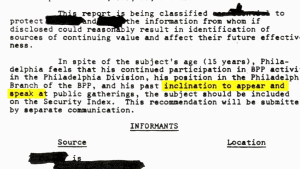
The African-American Civil Rights Movement has been the target of numerous incidents of police brutality in its struggle for justice and racial equality, notably during the Birmingham campaign of 1963–64 and during the Selma to Montgomery marches of 1965. Media coverage of the brutality sparked national outrage, and public sympathy for the movement grew rapidly as a result. Martin Luther King Jr. criticized police brutality in speeches. During this time, the Black Panther Party (BPP) formed in response to police brutality from disproportionately white police departments that were perceived as oppressing black communities. The conflict between the BPP and various police departments often resulted in violence with the deaths of 34 members of the BPP and 15 police officers.
-- Police Brutality in the United States, by Wikipedia
William Marimow, whose reportage on police brutality (along with Jonathan Neumann's) earned The Philadelphia Inquirer the Pulitzer Prize for public service in 1978, also has no recollection of Abu-Jamal ever doing anything on the subject. "I was very attuned to everyone who wrote about Philadelphia police violence," says Marimow, now the managing editor of the Baltimore Sun. "This guy didn't register a blip on my radar screen."
[Saro Solis] In 1999, Vanity Fair publishes a hatchet job by Pulitzer Prize winning author Buzz Bissinger, whose relationship with Abu-Jamal prosecutor Ed Rendell is defined as “extraordinarily close” by Fairness & Accuracy in Reporting. Among other farfetched and debunked claims rehashed by Bissinger, the article attempts to portray Abu-Jamal’s journalism career as “dead on arrival.” To accomplish this, Bissinger interviews one of his buddies at The Philadelphia Inquirer, writer William Marimow.
"I was very attuned to everyone who wrote about Philadelphia police violence," says Marimow, now the managing editor of the Baltimore Sun. "This guy didn't register a blip on my radar screen."
[Linn Washington, Journalist] Well, did you hear anything about Mumia Abu-Jamal and Abu-Jamal covering police brutality? And so this guy’s response was, “No, he never appeared on my radar screen.” And so saith Pulitzer prize winning reporter X, Y and Z. So this notion of Mumia being a reporter is bogus! It’s B.S. Blah blah blah blah blah. Mumia at that time was working for a Black radio station. Now what is the likelihood of a white, albeit an alleged liberal, listening to a Black radio station?
[Radio voice] Um, zero to none?
[Linn Washington, Journalist] And then the other claim about Mumia and his journalism is that “We can’t find any evidence of any writings. I mean, we go back and we look at old newspaper clips, and we can’t find anything that Mumia authored. Mumia was a radio reporter! So there would be no bylines or other newspaper file evidence of Mumia’s existence as a journalist.
-- Mumia: Long Distance Revolutionary. A Journey With Mumia Abu-Jamal, directed by Stephen Vittoria -- Illustrated Screenplay & Screencap Gallery
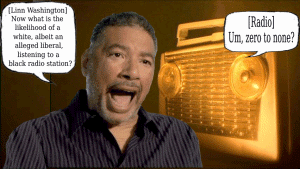
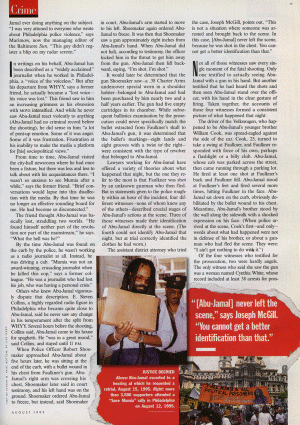
JUSTICE DECRIED. Above: Abu-Jamal escorted to a hearing at which he requested a retrial, August 15, 1995. Right: More than 3,500 supporters attended a "Save Mumia" rally in Philadelphia on August 12, 1995.
In writings on his behalf, Abu-Jamal has been described as a "widely acclaimed" journalist when he worked in Philadelphia, a "voice of the voiceless." But after his departure from WHYY, says a former friend, he actually became a "lost voice -- his voice was lost." This friend saw in him an increasing grimness as his obsession with MOVE intensified. And while he never saw Abu-Jamal react violently to anything (Abu-Jamal had no criminal record before the shooting), he did sense in him "a lot of pent-up emotion. Some of it was anger. Some of it was frustration. Frustration at his inability to make the media a platform for [his] sociopolitical views."
HITLER
On my way, I stopped over in Berlin and did some interesting paintings there. My friend and host, Willi Muenzenberg, asked me many questions about my life and work, and my statements were incorporated in an excellent book by another friend, Lotte Schwartz. Entitled Das Werk Diego Riveras, this volume covered my career up to the murals I had just completed. It was published by the Neuer Duetscher Verlag headed by Muenzenberg.
In 1928, Germany was in the throes of a crisis that, in the next year, would become world wide. The big German cartels were slipping into bankruptcy, one after another. There was a wave of suicides among the bourgeoisie. Hugo Stinnes, head of the steel trust, Admiral von Tirpitz, a shipping magnate, and Dr. Scheidemann, boss of the chemical industry, all put revolvers to their heads and blew out their brains.
A contagion of lunacy was abroad in the land. I felt its presence on two separate, apparently unrelated occasions.
One night Muenzenberg, a few other friends, and I disguised ourselves and, with forged credentials, attended the most astounding ceremony I have ever witnessed. It took place in the forest of Grunewald near Berlin.
From behind a clump of trees in the middle of the forest, there appeared a strange cortege. The marching men and women wore white tunics and crowns of mistletoe, the Druidic ceremonial plant. In their hands, they held green branches. Their pace was slow and ritualistic. Behind them four men bore an archaic throne on which was seated a man representing the war god, Wotan. This man was none other than the President of the Republic, Paul von Hindenberg! Garbed in ancient raiment, von Hindenburg held aloft a lance on which supposedly magic runes were engraved. The audience, Muenzenberg explained, took von Hindenburg for a reincarnation of Wotan. Behind Hindenburg's appeared another throne occupied by Marshal Ludendorff, who represented the thunder god, Thor. Behind the "god" trooped an honorary train of worshippers composed of eminent chemists, mathematicians, biologists, physicists, and philosophers. Every field of German "Kultur" was represented in the Grunewald that night.
The procession halted and the ceremony began. For several hours the elite of Berlin chanted and howled prayers and rites from out of Germany's barbaric past. Here was proof, if anyone needed it, of the failure of two thousand years of Roman, Greek, and European civilization. I could hardly believe that what I saw was really taking place before my eyes.
Nobody among my German leftist friends could give me any satisfactory explanation of the bizarre proceedings. Instead, they tried to laugh them off, calling the participants "crazy." To this day, I am puzzled by their collective lack of perception. Recalling that orgy of dry drunkenness and delirium, I found it impossible to imagine the least sensitive spectator dismissing what I had witnessed as only a harmless masquerade.
A few days later I saw Adolf Hitler address a mass meeting in Berlin, on a square before a building so immense that it took up the whole block. This structure was the headquarters of the German Communist Party. A temporary united front was then in effect between the Nazis and the Communists against the corrupt reformists and social democrats.
The square was literally jammed with twenty-five to thirty thousand Communist workers. Hitler arrived with an escort of nearly a thousand men. They crossed the square and halted below a window from which Communist Party leaders were watching. I was among them, having been invited by Muenzenberg, who was at my right. At my left stood Thaelmann, the Party's General Secretary. Muenzenberg interpreted by comments for Thaelmann, and translated Hitler's speech for me.
My Communist friends made mocking remarks about the "funny little man" who was to address the meeting, and considered those who saw a threat in him timorous or foolish.
As he prepared to speak, Hitler drew himself rigidly erect, as if he expected to swell out and fill his oversized English officer's raincoat and look like a giant. Then he made a motion for silence. Some Communist workers booed him, but after a few minutes the entire crowd became perfectly silent.
As he warmed up, Hitler began screaming and waving his arms like an epileptic. Something about him must have stirred the deepest centers of his fellow Germans, for after awhile I sensed a weird magnetic current flowing between him and the crowd. So profound was it that, when he finished, after two hours of speaking, there was a second of complete silence. Not even the Communist youth groups, instructed to do so, whistled at him. Then the silence gave way to tremendous, ear-shattering applause from all over the square.
As he left, Hitler's followers closed ranks around him with every sign of devoted loyalty. Thaelmann and Muenzenberg laughed like schoolboys. As for me, I was as mystified and troubled now as when I had witnessed the decadent ritual a few days before in the Grunewald. I could see nothing to laugh at. I actually felt depressed.
Muenzenberg, glancing at me, asked, "Diego, what's the matter with you?"
The matter with me was, I informed him, that I was filled with forebodings. I had a premonition that, if the armed Communists here permitted Hitler to leave this place alive, he might live to cut off both of my comrades' heads in a few years.
Thaelmann and Muenzenberg only laughed louder. Muenzenberg complimented me on my artist's vivid imagination.
"You must be joking," he said. "Haven't you heard Hitler talk? Haven't you understood the stupidities I translated for you?"
I replied, "But these idiocies are also in the heads of the audience, maddened by hunger and fear. Hitler is promising them a change, economic, political, cultural, and scientific. Well, they want changes, and he may be able to do just what he says, since he has all the capitalist money behind him. With that he can give food to the hungry German workers and persuade them to go over to his side and turn on us. Let me shoot him, at least. I'll take the responsibility. He's still within range."
But this made my German comrades laugh still harder. After laughing himself out, Thaelmann said, "Of course it's best to have someone always ready to liquidate the clown. Don't worry, though. In a few months he'll be finished, and then we'll be in a position to take power."
This only depressed me more, and I reiterated my fears. By now, Muenzenberg wasn't smiling. He had been watching Hitler, then nearly at the other end of the square. He had noticed that the crowd was still applauding. Before leaving the square, Hitler turned and gave the Nazi salute. Instead of boos, the applause swelled. It was clear that Hitler had won many followers among these left-wing workers. Muenzenberg suddenly turned pale and clutched my arm.
Thaelmann looked surprised at both of us. Then he smiled wanly and patted my head. In Russian, which sounded thick in his German accent, he said, "Nitchevo, nitchevo." -- "It's nothing, nothing at all."
My "crazy" artist's imagination was later bitterly substantiated. Both Thaelmann and my friend Muenzenberg were among the millions of human beings put to death by the "clown" we had watched in the square that day.
--Diego Rivera -- My Art, My Life: An Autobiography (With Gladys March)
"It appears to me a most excellent thing for the physician to cultivate Prognosis; for by foreseeing and foretelling, in the presence of the sick, the present, the past, and the future, and explaining the omissions which patients have been guilty of, he will be the more readily believed to be acquainted with the circumstances of the sick; so that men will have confidence to intrust themselves to such a physician."
-- Book of Prognostics, by Hippocrates
Foreseeability: The facility to perceive, know in advance, or reasonably anticipate that damage or injury will probably ensue from acts or omissions.
In the law of Negligence, the foreseeability aspect of proximate cause—the event which is the primary cause of the injury—is established by proof that the actor, as a person of ordinary intelligence and circumspection, should reasonably have foreseen that his or her negligent act would imperil others, whether by the event that transpired or some similar occurrence, and regardless of what the actor surmised would happen in regard to the actual event or the manner of causation of injuries.
-- West's Encyclopedia of American Law, edition 2.
Foreseeability n. reasonable anticipation of the possible results of an action, such as what may happen if one is negligent or consequential damages resulting a from breach of a contract. (See: foreseeable risk, negligence)
-- by Gerald N. Hill and Kathleen T. Hill.
From time to time, Abu-Jamal visited the city-hall newsroom where he had once been a fixture, but there was less and less to talk about with his acquaintances there. "I wasn't so anxious to see Mumia after a while," says the former friend. "Brief conversations would lapse into this disaffection with the media. By that time he was no longer an effective sounding board for me. He had become so disconnected."
[Linn Washington, Journalist] He just became persona non grata in the news media. And that’s why he was driving a cab that night, because of his insistence on reporting exclusively on MOVE. MOVE national news, MOVE local news, MOVE sports, MOVE weather. I mean, yo, Mumia, you got to do a little something different. Uh, “no, it is the story.” Okay, so that’s why you’re driving a cab.
[Mumia Abu-Jamal] I remember my boss going off, essentially, and saying, “Well, Jesus, Mumia, they’re calling you “Mumia Africa!”
[Saro Solis] It’s interesting how mainstream journalists are never questioned when they’re embedded with troops, or hobnobbing at cocktail parties with generals and corporate criminals, the fact that conglomerates that sell news never truly challenge the status quo, nor will they ever speak truth to power.
[Mumia Abu-Jamal] It wasn’t about the quality of my work. It wasn’t about the truth about what I was reporting. It was about the perspective from which that work emerged. They were people, and what happened to them was fundamentally unjust. By using my microphone as a reporter, I allowed them to say that, and to say it on one of the most influential frequencies in Philadelphia.
-- Mumia: Long Distance Revolutionary. A Journey With Mumia Abu-Jamal, directed by Stephen Vittoria -- Illustrated Screenplay & Screencap Gallery
The friend thought Abu-Jamal was basically lost, straddling two worlds. "He found himself neither part of the revolution nor part of the mainstream," he says. "What the hell was he?"
By the time Abu-Jamal was found on the curb by the police, he wasn't working as a radio journalist at all. Instead, he was driving a cab. "Mumia was not an award-winning, crusading journalist when he killed this cop," says a former colleague. "He was a journalist who had lost his job, who was having a personal crisis."
Others who knew Abu-Jamal vigorously dispute that description. E. Steven Collins, a highly regarded radio figure in Philadelphia who became quite close to Abu-Jamal, said he never saw any change in his temperament after the split from WHYY. Several hours before the shooting, Collins said, Abu-Jamal came to his house for spaghetti. He "was in a great mood," said Collins, and stayed until 11 P.M.
When Police Officer Robert Shoemaker approached Abu-Jamal about five hours later, he was sitting at the end of the curb, with a bullet wound in his chest from Faulkner's gun. Abu-Jamal's right arm was crossing his chest, Shoemaker later said in court testimony, and his left hand was on the ground. Shoemaker ordered Abu-Jamal to freeze, but instead, said Shoemaker in court, Abu-Jamal's arm started to move to his left. Shoemaker again ordered Abu-Jamal to freeze. It was then that Shoemaker saw a gun approximately eight inches from Abu-Jamal's hand. When Abu-Jamal did not halt, according to testimony, the officer kicked him in the throat to get him away from the gun. Abu-Jamal then fell backward saying, "I'm shot. I'm shot."
It would later be determined that the gun Shoemaker saw -- a .38 Charter Arms undercover special worn in a shoulder holster -- belonged to Abu-Jamal and had been purchased by him nearly two and a half years earlier. The gun had five empty cartridges in its chamber. While subsequent ballistics examination by the prosecution could never specifically match the bullet extracted from Faulkner's skull to Abu-Jamal's gun, it was determined that the bullet's markings -- eight lands and eight grooves with a twist to the right -- were consistent with the type of revolver that belonged to Abu-Jamal.
"AFTER ENTERING THE JEFFERSON HOSPITAL, IN THE PRESENCE OF HOSPITAL STAFF MEMBERS, MR. JAMAL WAS AGAIN BEATEN AFTER ONE OF THE OFFICERS NOTED THAT MR. JAMAL HAD A SHOULDER HOLSTER."
***
RECOVERY OF THE WEAPONS: Now, what about the immediate recovery of the weapons? Radio transmissions from the scene to central command over the next 15 minutes contradict the testimony of Officers Forbes and Shoemaker. No Officer reports immediately finding any weapons. In fact, nearly five minutes later, Officers on the scene report that Faulkner’s gun is missing. It was 14 minutes before it was reported that the suspect’s gun was recovered, and that they had the "doer" in custody. There is no report that Abu-Jamal confessed. There is no report that a witness, or witnesses, identified anyone as the shooter. Prior to the arrival of the police mobile forensics unit, freelance photographer Pedro Polakoff arrived, moving freely through the crime scene, and snapping off more than two dozen photos.
These photos show that contrary to police regulations, the area was not properly secured to preserve evidence.
Photographs also show Officer Forbes walking around carrying both guns in his bare hand. This lack of regard for forensic evidence looks more like willful intent to manipulate a crime scene when you consider the following: Police reported no fingerprints on the guns. No tests were done on Abu-Jamal’s hands for gunpowder residue. Contrary to police regulations, Officer Forbes failed to immediately turn over the weapons to the mobile crime unit. In fact, the weapons were not turned over for two hours. Later, police falsely describe the bullet from Faulkner’s head wound as too damaged and deteriorated to do a comparison ballistics test with a bullet fired from Abu-Jamal’s gun, but photographs of the bullet clearly show the identifying characteristics, its twists, the number of lines and grooves, and the relative widths. Instead, the prosecution claimed that the bullet was “consistent” with one fired from Abu-Jamal’s Charter Arms 38 revolver, although police ballistics expert, Anthony Paul, admitted this is true of “multiple millions” of guns. During appeals, when Abu-Jamal and his legal team demanded independent testing to determine if the bullet was fired from Abu-Jamal’s gun, their request was denied, first by Judge Albert Sabo, and then later by Federal Court Judge William Yohn. What all of this clearly illustrates is that in fact there is no physical evidence that Abu-Jamal shot Faulkner or that his gun was the murder weapon.
--Manufacturing Guilt, written & produced by Stephen Vittoria & Justin Lebanowski
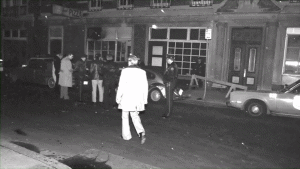
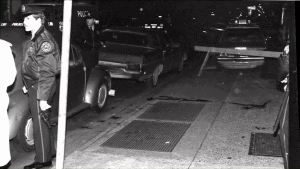
The ballistics evidence
Although all five bullets in Abu-Jamal’s gun were spent, the police failed to conduct tests to ascertain whether the weapon had been fired in the immediate past. The test is relatively simple: smell the gun for the odour of gun powder, which should be detectable for approximately five hours after the gun was fired. Compounding this error, the police also failed to conduct chemical tests on Abu-Jamal’s hands to find out if he had fired a gun recently.
The police appeared to be aware of the value of basic forensic testing. According to the testimony of Arnold Howard during the 1995 hearings, after he was arrested on suspicion of involvement in the Faulkner shooting, the police tested his hands to ascertain if he had fired a gun in the recent past. Howard was arrested because his driver’s license application form was in Faulkner’s possession.
As noted on page 12, the court refused to grant the defence funding sufficient to obtain expert witnesses. As a consequence, the jury was presented with no expert testimony to counter the prosecution’s assertion that Abu-Jamal had fired at Officer Faulkner and that the policeman was killed with Abu-Jamal’s weapon.
The prosecution maintained that Officer Faulkner turned and fired at Abu-Jamal as he fell to the ground after being shot. Therefore, the entry of the bullet into Abu-Jamal should have been on a level or upward trajectory. However, according to the medical records, the overall pathway of the bullet was downwards. During trial, the doctor who removed the bullet from Abu-Jamal (who admitted his lack of forensic expertise) was asked why the bullet would be "unnecessarily lowered in its trajectory" and speculated that "ricochet" and "tumble" were the explanation.
In 1992, an expert forensic pathologist employed by Abu-Jamal’s defence team examined the medical records and concluded:
“...For these reasons, there appears to be no reasons to postulate a ricochet to explain a downward course through the body. Rather, it is likely that the bullet had a downward course through the body because of the relative positions of Mr. Jamal and the shooter. Consistent relative positions include a standing shooter firing down on a prone Mr. Jamal, or a standing shooter firing horizontally at Mr. Jamal while Mr. Jamal was bent over at the waist.”
Neither of these postures is consistent with the prosecution’s theory. The forensic pathologist also concluded that “since I disagree with both the Medical Examiner’s findings with respect to the cause of death and Dr. Coletta’s postulation of a possible ‘ricochet’...Mr. Jamal’s defense required, and would have been well served by, the testimony of a qualified forensic pathologist.”
There were also inconsistencies in the original findings concerning the bullet removed from Faulkner’s body. The Medical Examiner first wrote in his notes that the bullet was “.44 cal.” (Abu-Jamal’s gun was a .38 calibre weapon and could not possibly have fired such a bullet). This discrepancy, which was never made known to the jury, was later explained by the Medical Examiner as “part of the paper work but not an official finding.” At trial, the Medical Examiner testified that the bullet was consistent with the those fired by Abu-Jamal’s gun but that test were inconclusive as to whether it actually came from his firearm. The court accepted the medical examiner as a ballistics expert. However, during the 1995 hearing, Judge Sabo contended that the medical examiner was “not a ballistics expert”" and that his original findings that the bullet was a .44 calibre were a “mere lay guess.”
In a case where the prosecution’s theory of the crime rests on a specific sequence of events involving an exchange of gunfire, the gathering of ballistics evidence is crucial--as is the ability of the defence to present its own expert testimony on the significance of that evidence. The failure of the police to test Abu-Jamal’s gun, hands and clothing for evidence of recent firing is deeply troubling. Without the ability to hear and assess that missing evidence, the jury was required to reach a verdict based largely on the contradictory and variable testimony of a limited list of eye witnesses.
-- A Life in the Balance: The Case of Mumia Abu-Jamal, by Amnesty International
Lawyers working for Abu-Jamal have offered a variety of theories about what happened that night, but the one they refer to the most is that Faulkner was shot by an unknown gunman who then fled. But in statements given to the police roughly within an hour of the incident, four different witnesses -- none of whom knew any of the others -- described crucial stages of Abu-Jamal's actions at the scene. Three of those witnesses made their identification of Abu-Jamal directly at the scene. (The fourth could not identify Abu-Jamal that night, but at trial correctly identified the clothes he had worn.)
Philadelphia, June 26 -- In the latest hearing in the case of Mumia Abu-Jamal, witness Pamela Jenkins testified to dramatic and powerful evidence that Mumia was framed by the authorities for a murder he did not commit. Once again, the Philadelphia police and the district attorney's office tried to intimidate a witness who has come forward to testify for Mumia. Two weeks before the hearing, police arrested Jenkins on felony charges. She was brought to the hearing directly from lock-up.
At a previous hearing last fall, Veronica Jones testified that she lied at Mumia's original trial in 1982 after police threatened her with years in jail. After her courageous testimony, Jones was arrested right in the courtroom for failing to make a courtroom appearance two years earlier. There is evidence that the police and the authorities have threatened and pressured a number of other witnesses in this case.
Instead of a "witness protection program," the Philadelphia police apparently operate a "witness persecution program" to try to silence those who might help uncover the truth.
But these cowardly attempts to stop witnesses for Mumia from speaking out did not work with Veronica Jones. And on June 26, Pamela Jenkins also stood firm, took the stand and testified.
Pamela Jenkins was a key witness for the federal government's case against police corruption in North Philadelphia's 39th District. Over the years, the cops framed hundreds of innocent people for murder and drug charges, and stole thousands of dollars. Jenkins testified that she and other prostitutes had been paid by police to fabricate evidence. Jenkins' testimony helped send a number of cops to prison. The city was forced to drop many criminal cases and pay millions of dollars in lawsuits. One of the cops who went to prison in this corruption scandal was Tom Ryan -- who was involved in the frame-up of Mumia. So Jenkins' testimony links the railroad of Mumia with the web of police corruption in Philadelphia.
Jenkins was a prostitute and a police informant in downtown Philadelphia when police officer Daniel Faulkner was shot in 1981. Mumia Abu-Jamal was arrested for killing Faulkner. Mumia, a former Black Panther Party leader in Philadelphia, was a radio journalist known and respected by the people for exposing police brutality and other injustices. After an obviously rigged trial, Mumia was railroaded on the murder charge and sentenced to death in 1982.
Mumia's appeal of the conviction and death sentence is now being considered by the Pennsylvania Supreme Court. In March of this year, Mumia's lawyers presented an affidavit to the Supreme Court containing sworn testimony by Jenkins. In the statement, Jenkins said that after Faulkner was shot, two Philadelphia cops tried to pressure her into testifying that Mumia did it -- even though they knew she wasn't anywhere near the scene of the shooting. Jenkins also said that Cynthia White, the prosecution's main witness against Mumia, was a police informant and that White was also pressured to testify against Mumia. White was the only witness who testified at Mumia's trial that he shot Faulkner. Jenkins also provided Mumia's attorneys with information about at least three other cops who were at the scene of the shooting.
On May 30, the state Supreme Court ordered a hearing on the testimony by Pamela Jenkins -- to be held before hanging Judge Sabo, the same judge that presided over the gross injustices at Mumia's original trial.
As the hearing began, Sabo immediately made it clear that he would not allow any other defense witnesses to testify except Pamela Jenkins. When Mumia's attorneys argued that they needed to call the cops named by Jenkins in her affidavit, Sabo yelled, "Take it to the Supreme Court!"
Throughout the hearing, Sabo showed blatant bias against Mumia and his defense team. He often yelled at Mumia's lawyers and threatened lead attorney Leonard Weinglass with disciplinary action. Dan Williams, another attorney on Mumia's legal team, pointed out afterwards, "If any case cries out for cameras in the courtroom, this one does. I don't think the written word does justice to what happens in that courtroom... You can read what he says to counsel to shut up, but it's another thing to hear him say it, and see the facial expressions that happen, to see how he cuts you off."
Pamela Jenkins testified that she met former Philadelphia cop Tom Ryan in 1981 when he picked her up for truancy, and they started a sexual relationship. Ryan was in his 20s and Jenkins was a 15-year-old Black teenager from North Philly. Jenkins also became a police informant for Ryan. She said that a few days after Faulkner was shot, Tom Ryan took her to police headquarters to meet another cop named Richard Ryan. The two pressured her to lie. "They wanted me to say that I saw Mumia shoot the officer," she testified, even though the cops knew she was nowhere near the scene of the shooting.
Jenkins also said she knew another prostitute, Cynthia White, who became the key witness for the prosecution against Mumia. Jenkins testified that cops slept with White and that White provided information to the police. Jenkins said right after she was asked to finger Mumia as the shooter, she talked with Cynthia White twice. White told Jenkins that the police were also trying to coerce her to testify. According to Jenkins, in the first conversation White told her she was "scared." The second time, White told her she was "in fear for her life." Jenkins said that White then disappeared, and that Tom Ryan paid her $150 to find her.
Mumia's lawyers have been searching for Cynthia White for years. She has used many aliases and social security numbers. Despite the fact that she is wanted on a felony charge, her name is not on the NCIC national computerized list of wanted felons. The district attorney's office has refused to provide any information that would enable the defense lawyers to locate White.
Mumia's attorneys believe that Cynthia White is being protected by the Philadelphia police. During her testimony, Pamela Jenkins provided shocking new evidence confirming this suspicion. She testified that she saw Cynthia White in March of this year with Tom Ryan and Richard Ryan. According to Jenkins, she saw White while helping Mumia's defense team look for her. She and an investigator went to a North Philly crack house where she spotted White. When White saw her come in, the missing witness "looked like she saw a ghost" and "ran out the door." Jenkins testified that White got into Tom Ryan's red pickup truck with Tom Ryan and Richard Ryan -- the two cops who had tried to pressure Jenkins to testify against Mumia in 1981!
Attorney Leonard Weinglass tried to question Jenkins about the systematic use by the police of prostitutes as informants and police interference with witnesses. This information would back up the defense contention that the police have been hiding Cynthia White in order to prevent her from testifying. But the prosecution repeatedly objected -- and Sabo ruled against Mumia every time.
Jenkins said that she was worried the authorities would retaliate for her testimony. She described how she was arrested on felony charges. In March she was involved in the theft of a valuable painting. She cooperated with the FBI in exchange for not being charged with the theft, and the painting was recovered by the authorities. But then in early June -- just a few days after the state Supreme Court ordered a hearing on Jenkins' testimony -- the Philadelphia police arrested Jenkins and charged her with felonies in connection with the theft. In jail Jenkins saw Richard Ryan, who told her, "You finally graduated to the big leagues. We're gonna sit that ass down." He also told her to "keep my name out" of the Mumia case.
Attorney Weinglass asked Jenkins why she is testifying after such threats. She answered, "I'm not gonna let an innocent man go to death for something he didn't do."
When Jenkins finished, the prosecutors demanded that witnesses for their side be allowed to testify. Sabo must have recognized how damaging it would have been for Jenkins' testimony to stand unchallenged. In a blatant move, Sabo allowed the prosecution to put on their witness -- even though he had refused defense requests for additional witnesses!
The prosecutors put into evidence a document they claimed was Cynthia White's death certificate. Everything about this supposed evidence is suspicious. The police claimed they first uncovered the document two weeks before the hearing. It is in the name of Cynthia Williams, one of the aliases White used, and the date of death is marked as 6/2/92. The certificate was issued in Camden, New Jersey, right across the river from Philadelphia. The medical examiner who signed the certificate had been a medical examiner in Philadelphia for 20 years. The police did not match the body with the prints on White's police fingerprint card, the most reliable way to make a positive identification. They did not contact the next of kin listed on the certificate. (Could it be that the Philly police also have a "department of fake death certificates"?)
Attorney Dan Williams pointed out: "The timing is highly suspicious.... The death certificate, if it is a valid death certificate, only surfaces after the Supreme Court is informed that Cynthia White was a paid informant. On May 30, the Supreme Court issues an order to have a hearing on that issue. And lo and behold, this alleged death certificate surfaces for the first time. Prior to that, the Philadelphia authorities are looking for a Cynthia White. Actions speak louder than words.... Our own investigation leads us to believe she's not dead."
The prosecution also presented police documents and witnesses in an attempt to make the case that Pamela Jenkins did not meet Tom Ryan until 1982, after Faulkner was shot. At the end of the day, Tom Ryan himself was called to the stand. The ex-cop wore a button in support of the Fraternal Order of Police, which has been actively calling for Mumia's execution. Ryan was confronted with his testimony in a previous trial, when he said under oath that he had known Jenkins since 1981. Smirking, Ryan claimed his "recollection had been refreshed" and that he did not meet Jenkins until 1982. (He also claimed he didn't have a sexual relationship with Jenkins until 1984 -- perhaps in an attempt to avoid a charge of statutory rape.)
Sabo blocked every attempt by Attorney Dan Williams to question Ryan about whether the use of prostitutes as paid informants was a widespread policy in the Philadelphia Police Department and what he knew about Cynthia White. Then Sabo abruptly ended the hearing. It will continue Monday, June 30.
These hearings could be the last time supporters are able to see Mumia in person in the courtroom for some time. Unless another hearing is ordered to take up new evidence (for example, if Cynthia White is found), the next step in the legal case is the decision by the Pennsylvania Supreme Court on the appeal. The Court has already denied requests for oral arguments by Mumia's defense team.
After the hearing, Leonard Weinglass explained why the authorities are intent on keeping them away from Cynthia White: "We also know now that Cynthia White was an informant for the police when she testified. If we find Cynthia and she takes the stand and acknowledges the truth that she was an informant, this case is over. That's why Geronimo Pratt, after 27 years, is a free man today -- because it came out in Geronimo's case that the key witness against him was an informant and that the defense was not told of that fact. That is precisely the case in Mumia's situation."
--Mumia Abu-Jamal: New Evidence of the Frameup -- The Testimony of Pamela Jenkins, by Revolutionary Worker #914
Witnesses to the crime: conflicting and confusing
During the trial, three witnesses testified that Abu-Jamal had run up to Officer Faulkner, shot him in the back and then stood over him and fired another bullet into his head, killing him instantly (although only one witness, White, claimed to have seen the events as described above in their entirety). None of the witnesses testified that Faulkner fired at Abu-Jamal as he fell to the ground -- even when specifically asked -- as the prosecution maintained. The prosecution also maintained that only Abu-Jamal, his brother William Cook and Officer Faulkner were present in the immediate vicinity of the crime scene.
In the years since the trial, defence lawyers have thrown into doubt the reliability of much of this trial testimony.
The complicated nature of the numerous accusations, counter accusations and withdrawing of statements and testimony make it impossible, based on the existing record, to reach definitive conclusions regarding the reliability of any witness. The prosecutors and police contend that the testimony presented at the trial was truthful and uncoerced, and that other witnesses to the crime were not called to testify as they had nothing relevant to add.
However, Abu-Jamal’s attorneys contend that a number of witnesses changed their original statements regarding what they saw on the night of the crime after being coerced, threatened or offered inducements by the police. Based on a comparison of their statements given to the police immediately after the shooting, their testimony during pretrial hearings and their testimony at the trial, the key witnesses did substantively alter their descriptions of what they saw, in ways that supported the prosecution’s version of events.
-- A Life in the Balance: The Case of Mumia Abu-Jamal, by Amnesty International
No fewer than five eyewitnesses (including Chobert) have made statements at one time or another that support the defense theory that someone ran away from the scene. These accounts also raise at least a suspicion that police were so bent on nailing Jamal that they may have shunted aside, or even suppressed, evidence supporting this defense theory.
The most important of these witnesses, and the only one whom the jury heard saying that someone escaped the scene, was a part-time college student, Dessie Hightower. He has consistently and credibly stuck by the story he told police 80 minutes after the shootings: that he saw a man (or possibly a woman) about 6 feet tall, who looked "Jamaican" from behind (meaning that his hair was in dreadlocks or braids), "run from the scene of the crime" before police arrived.
Hightower's initial account posed a problem for police. He was called in for a reinterview six days later, on December 15, 1981. It lasted almost six hours. He told the same story, adding details about what happened after police arrived: Several officers had kicked and beaten Jamal, and had banged his head against a pole while dragging him to the paddy wagon by his dreadlocks. (Police admitted at trial that they banged his head against a pole and dropped him on his face, but claimed these were accidents.)
In the middle of this reinterview, Hightower was asked to take a polygraph test. (None of the prosecution witnesses was asked to do this, despite White's and Chobert's criminal records.) Hightower did so, and was told he had passed, he claims. But prosecutors at this summer's hearing produced a typed police report, dated 12 days after the polygraph test, purporting to show the opposite. The report says that Hightower was told that there was "deception indicated" when he denied "know[ing] for sure who killed Pol. Faulkner" ; when he denied "see[ing] Pol. Faulkner killed" ; and when he denied "see[ingj Jamal with a gun in his hand."
This report is puzzling in at least two respects. First, it indicates that the polygrapher asked Hightower questions wildly out of sync with police reports of his prior interviews, in which he said he did not see the shootings because his view was blocked by a wall at that moment. Second, the report indicates that the polygrapher did not ask Hightower anything about the important subject on which his prior interviews had focused: his claim that he had seen someone running away.
-- Guilty and Framed, by Stuart Taylor, Jr.
The assistant district attorney who tried the case, Joseph McGill, points out, "This is not a situation where someone was arrested and brought back to the scene. In this case, [Abu-Jamal] never left the scene, because he was shot in the chest. You cannot get a better identification than that."
Not all of those witnesses saw every single moment of the fatal shooting. Only one testified to actually seeing Abu-Jamal with a gun in his hand. But another testified that he had heard the shots and then seen Abu-Jamal stand over the officer, with his hand in the clear gesture of firing. Taken together, the accounts of those four witnesses formed a consistent picture of what happened that night:
WITNESS: ABU-JAMAL DIDN’T SHOOT FAULKNER
William Singletary, a local businessman, said he was standing on a nearby street corner and witnessed the shootings. Immediately after, he tried to give his statement to police that Abu-Jamal arrived after Faulkner was already shot. Homicide detectives interrogated and threatened Singletary with bodily harm, as well as the trashing of his business, if he testified in favor of Abu-Jamal. And then Abu-Jamal’s brother, Billy Cook, later swore that his business partner, Ken Freeman, was in the car with him, and participated in the shooting of Faulkner.
-- Manufacturing Guilt, written & produced by Stephen Vittoria & Justin Lebanowski
As explained in a recent interview, [J. Patrick\ O'Connor argues that the actual shooter was a man named Kenneth Freeman, who was Billy Cook's business partner and who O'Connor argues was a passenger in Cook's car when it was pulled over by Officer Daniel Faulkner the morning of Dec. 9, 1981. Freeman was mysteriously found dead in a Northeast lot (reportedly naked, gagged, hand-cuffed, and with a drug needle in his arm) the day after the infamous May 13, 1985 police bombing of MOVE, leading O'Connor to conclude that "the timing and modus operandi of the abduction and killing alone suggest an extreme act of police vengeance." ...
"They arrested me for assaulting him, but I never laid a hand on him. I was only trying to protect myself," says Cook, who also reports that before he was beaten bloody with the police flashlight, Faulkner "was kind of vulgar and nasty. And if I remember correctly he threw a slur in... 'Nigger' get back in the car."
-- Mumia Abu-Jamal Faces US Supreme Court as New Book and Film Expose Injustice, by Hans Bennett
The driver of the Volkswagen, who happened to be Abu-Jamal's younger brother William Cook, was spread-eagled against the side of the car. Cook, 25, turned to take a swing at Faulkner, and Faulkner responded with force of his own, perhaps a flashlight or a billy club. Abu-Jamal, whose cab was parked across the street, then came running through a parking lot. He fired at least one shot at Faulkner's back and Faulkner fell. Abu-Jamal stood at Faulkner's feet and fired several more times, hitting Faulkner in the face. Abu-Jamal sat down on the curb, obviously debilitated by the bullet wound to his chest. Meantime, Abu-Jamal's brother stood by the wall along the sidewalk with a shocked expression on his face. (When police arrived at the scene, Cook's first -- and only -- words about what happened were not in defense of his brother, or about a gunman who had fled the scene. They were: "I ain't got nothing to do with it.")
EXECUTION STYLE
But perhaps the most striking fabrication of the case presented to jurors in 1982, a falsehood that formed the emotional foundation of the prosecution’s case, and its success in securing a death sentence, is the testimony of Cynthia White and Robert Chobert that Abu-Jamal shot Faulkner execution style. Standing directly over him, and unloading four rounds, somehow three miss, and only one strikes Faulkner in the face. Now, what this claim actually shows is the clear intent by members of the Philadelphia Police Department, and the District Attorney’s office, to frame Mumia Abu-Jamal for a crime he did not commit.
“COMPLETELY SMOOTH”
Bullets from a 38 caliber weapon hitting the sidewalk would, without any doubt, leave divots as they tore into the concrete.
As shown by this photo analyzed by Robert Nelson, an expert in photo enhancement and analysis at NASA’s Jet Propulsion Laboratory, the concrete was, as Nelson determined, “completely smooth.” This photograph shows that White and Chobert could not have seen, as they claimed at trial, anyone stand over Faulkner and fire. This clearly supports, along with the other evidence of police intimidation, that their testimony was arranged to support a patently false, physically impossible rendition of the crime. This execution-style account invented by the police and prosecution was a key part of their concerted effort not only to get a guilty verdict, but the death penalty.
-- Mumia: Long Distance Revolutionary. A Journey With Mumia Abu-Jamal, directed by Stephen Vittoria -- Illustrated Screenplay & Screencap Gallery
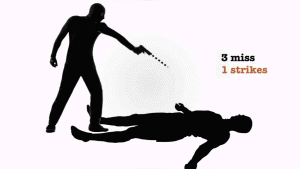
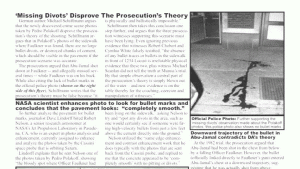
Statistics: Posted by admin — Sat Jun 14, 2014 1:13 am
]]>
by Buzz Bissinger
Vanity Fair, August, 1999
NOTICE: THIS WORK MAY BE PROTECTED BY COPYRIGHT
YOU ARE REQUIRED TO READ THE COPYRIGHT NOTICE AT THIS LINK BEFORE YOU READ THE FOLLOWING WORK, THAT IS AVAILABLE SOLELY FOR PRIVATE STUDY, SCHOLARSHIP OR RESEARCH PURSUANT TO 17 U.S.C. SECTION 107 AND 108. IN THE EVENT THAT THE LIBRARY DETERMINES THAT UNLAWFUL COPYING OF THIS WORK HAS OCCURRED, THE LIBRARY HAS THE RIGHT TO BLOCK THE I.P. ADDRESS AT WHICH THE UNLAWFUL COPYING APPEARED TO HAVE OCCURRED. THANK YOU FOR RESPECTING THE RIGHTS OF COPYRIGHT OWNERS.
'What are the stars?' said O'Brien indifferently. 'They are bits of fire a few kilometres away. We could reach them if we wanted to. Or we could blot them out. The earth is the centre of the universe. The sun and the stars go round it.'
Winston made another convulsive movement. This time he did not say anything. O'Brien continued as though answering a spoken objection:
'For certain purposes, of course, that is not true. When we navigate the ocean, or when we predict an eclipse, we often find it convenient to assume that the earth goes round the sun and that the stars are millions upon millions of kilometres away. But what of it? Do you suppose it is beyond us to produce a dual system of astronomy? The stars can be near or distant, according as we need them. Do you suppose our mathematicians are unequal to that? Have you forgotten doublethink?'
Winston shrank back upon the bed. Whatever he said, the swift answer crushed him like a bludgeon. And yet he knew, he knew, that he was in the right. The belief that nothing exists outside your own mind -- surely there must be some way of demonstrating that it was false? Had it not been exposed long ago as a fallacy? There was even a name for it, which he had forgotten. A faint smile twitched the corners of O'Brien's mouth as he looked down at him
'I told you, Winston,' he said, 'that metaphysics is not your strong point. The word you are trying to think of is solipsism. But you are mistaken. This is not solipsism. Collective solipsism, if you like. But that is a different thing: in fact, the opposite thing. All this is a digression,' he added in a different tone. 'The real power, the power we have to fight for night and day, is not power over things, but over men.' He paused, and for a moment assumed again his air of a schoolmaster questioning a promising pupil: 'How does one man assert his power over another, Winston?'
Winston thought. 'By making him suffer,' he said.
'Exactly. By making him suffer. Obedience is not enough. Unless he is suffering, how can you be sure that he is obeying your will and not his own? Power is in inflicting pain and humiliation. Power is in tearing human minds to pieces and putting them together again in new shapes of your own choosing. Do you begin to see, then, what kind of world we are creating? It is the exact opposite of the stupid hedonistic Utopias that the old reformers imagined. A world of fear and treachery is torment, a world of trampling and being trampled upon, a world which will grow not less but more merciless as it refines itself. Progress in our world will be progress towards more pain. The old civilizations claimed that they were founded on love or justice. Ours is founded upon hatred. In our world there will be no emotions except fear, rage, triumph, and self-abasement. Everything else we shall destroy everything. Already we are breaking down the habits of thought which have survived from before the Revolution. We have cut the links between child and parent, and between man and man, and between man and woman. No one dares trust a wife or a child or a friend any longer. But in the future there will be no wives and no friends. Children will be taken from their mothers at birth, as one takes eggs from a hen. The sex instinct will be eradicated. Procreation will be an annual formality like the renewal of a ration card. We shall abolish the orgasm. Our neurologists are at work upon it now. There will be no loyalty, except loyalty towards the Party. There will be no love, except the love of Big Brother. There will be no laughter, except the laugh of triumph over a defeated enemy. There will be no art, no literature, no science. When we are omnipotent we shall have no more need of science. There will be no distinction between beauty and ugliness. There will be no curiosity, no enjoyment of the process of life. All competing pleasures will be destroyed. But always -- do not forget this, Winston -- always there will be the intoxication of power, constantly increasing and constantly growing subtler. Always, at every moment, there will be the thrill of victory, the sensation of trampling on an enemy who is helpless. If you want a picture of the future, imagine a boot stamping on a human face -- for ever.'
He paused as though he expected Winston to speak. Winston had tried to shrink back into the surface of the bed again. He could not say anything. His heart seemed to be frozen. O'Brien went on:
'And remember that it is for ever. The face will always be there to be stamped upon. The heretic, the enemy of society, will always be there, so that he can be defeated and humiliated over again. Everything that you have undergone since you have been in our hands -- all that will continue, and worse. The espionage, the betrayals, the arrests, the tortures, the executions, the disappearances will never cease. It will be a world of terror as much as a world of triumph. The more the Party is powerful, the less it will be tolerant: the weaker the opposition, the tighter the despotism. Goldstein and his heresies will live for ever. Every day, at every moment, they will be defeated, discredited, ridiculed, spat upon and yet they will always survive. This drama that I have played out with you during seven years will be played out over and over again generation after generation, always in subtler forms. Always we shall have the heretic here at our mercy, screaming with pain, broken up, contemptible -- and in the end utterly penitent, saved from himself, crawling to our feet of his own accord. That is the world that we are preparing, Winston. A world of victory after victory, triumph after triumph after triumph: an endless pressing, pressing, pressing upon the nerve of power. You are beginning, I can see, to realize what that world will be like. But in the end you will do more than understand it. You will accept it, welcome it, become part of it.'
Winston had recovered himself sufficiently to speak. 'You can't!' he said weakly.
'What do you mean by that remark, Winston?'
'You could not create such a world as you have just described. It is a dream. It is impossible.'
'Why?'
'It is impossible to found a civilization on fear and hatred and cruelty. It would never endure.'
'Why not?'
'It would have no vitality. It would disintegrate. It would commit suicide.'
'Nonsense. You are under the impression that hatred is more exhausting than love. Why should it be? And if it were, what difference would that make? Suppose that we choose to wear ourselves out faster. Suppose that we quicken the tempo of human life till men are senile at thirty. Still what difference would it make? Can you not understand that the death of the individual is not death? The party is immortal.'
-- Nineteen Eighty-Four (1984), by George Orwell
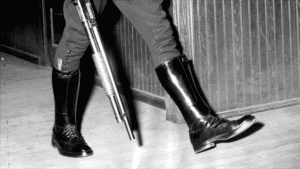
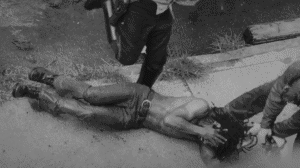
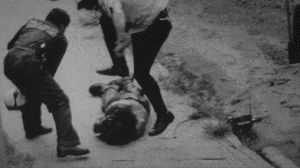
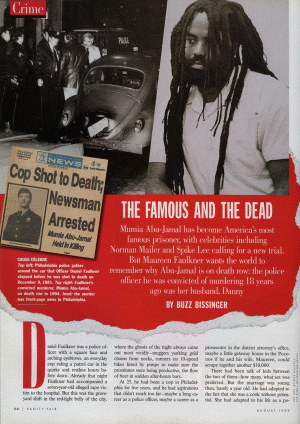
CAUSE CELEBRE: Top left: Philadelphia police gather around the car that Officer Daniel Faulkner stopped before he was shot to death on December 9, 1981. Top right: Faulkner's convicted murderer, Mumia Abu-Jamal, on death row in 1994. Inset: the murder was front-page news in Philadelphia.
THE FAMOUS AND THE DEAD
Mumia Abu-Jamal has become America's most famous prisoner, with celebrities including Norman Mailer and Spike Lee calling for a new trial. But Maureen Faulkner wants the world to remember why Abu-Jamal is on death row: the police officer he was convicted of murdering 18 years ago was her husband, Danny.
BY BUZZ BISSINGER
Daniel Faulkner was a police officer with a square face and arching eyebrows, an everyday cop riding a patrol car in the quirky and restless hours before dawn. Already that night Faulkner had accompanied a seven-year-old alleged rape victim to the hospital. But this was the graveyard shift in the red-light belly of the city, where the ghosts of the night always came out most vividly -- muggers yanking gold chains from necks, runners on 10-speed bikes hired by pimps to make sure the prostitutes were being productive, the flow of beer in sodden after-hours bars.
At 25, he had been a cop in Philadelphia for five years, and he had aspirations that didn't reach too far -- maybe a long career as a police officer, maybe a career as a prosecutor in the district attorney's office, maybe a little getaway house in the Poconos if he and his wife, Maureen, could scrape together another $10,000.
There had been talk of kids between the two of them -- how many, what sex was preferred. But the marriage was young then, barely a year old. He had adapted to the fact that she was a cook without potential. She had adapted to his life as a policeman: the crazy hours of shift work, the nagging queasiness that every police wife endures, knowing that something unexpected could always happen.
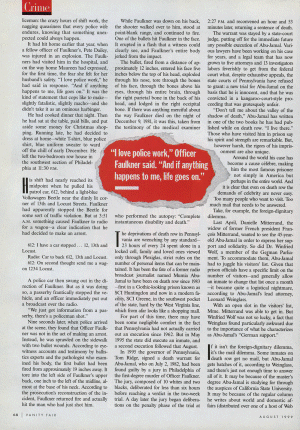
It had hit home earlier that year, when a fellow officer of Faulkner's, Pete Dailey, was injured in an explosion. The Faulkners had visited him in the hospital, and on the way home Maureen had expressed, for the first time, the fear she felt for her husband's safety. "I love police work," he had said in response. "And if anything happens to me, life goes on." It was the kind of statement that cops like to make -- slightly fatalistic, slightly macho -- and she didn't take it as an ominous harbinger.
He had cooked dinner that night. Then he had sat at the table, paid bills, and put aside some money for Christmas shopping. Running late, he had decided to dress at home -- white T-shirt, blue police shirt, blue uniform sweater to ward off the chill of early December. He left the two-bedroom row house in the southwest section of Philadelphia at 11:30 P.M.
His shift had nearly reached its midpoint when he pulled his patrol car, 612, behind a light-blue Volkswagen Beetle near the dimly lit corner of 13th and Locusts Streets. Faulkner had apparently stopped the Beetle for some sort of traffic violation. But at 3:51 A.M. something caused Faulkner to radio for a wagon -- a clear indication that he had decided to make an arrest.
612: I have a car stopped ... 12, 13th and Locust.
Radio: Car to back 612, 13th and Locust.
612: On second thought send me a wagon 1234 Locust.
A police car then swung out in the direction of Faulkner. But as it was doing so, a passerby frantically stopped the vehicle, and an officer immediately put out a broadcast over the radio.
"We just got information from a passerby, there's a policeman shot."
Nine seconds later, when police arrived at the scene, they found that Officer Faulkner was not in the act of making an arrest. Instead, he was sprawled on the sidewalk with two bullet wounds. According to eyewitness accounts and testimony by ballistics experts and the pathologist who examined his body, the first bullet had been fired from approximately 19 inches away. It tore into the left side of Faulkner's upper back, one inch to the left of the midline, almost at the base of his neck. According to the prosecution's reconstruction of the incident, Faulkner returned fire and actually hit the man who had just shot him.
While Faulkner was down on his back, the shooter walked over to him, stood at point-blank range, and continued to fire. One of the bullets hit Faulkner in the face. It erupted in a flash that a witness could clearly see, and Faulkner's entire body jerked from the impact.
The bullet, fired from a distance of approximately 12 inches, entered his face five inches below the top of his head, exploded through his nose, tore through the bones of his face, through the bones above his eyes, through his entire brain, through the right parietal bone in the back of his head, and lodged in the right occipital bone. If there was anything merciful about the way Faulkner died on the night of December 9, 1981, it was this, taken from the testimony of the medical examiner who performed the autopsy: "Complete instantaneous disability and death."
The deprivations of death row in Pennsylvania are wrenching by any standard -- 23 hours of every 24 spent alone in a locked cell, family and loved ones viewed only through Plexiglas, strict rules on the number of personal items that can be maintained. It has been the fate of a former radio broadcast journalist named Mumia Abu-Jamal to have been on death row since 1983 -- first in a Gothic-looking prison known as SCI Huntingdon and now in a modern facility, SCI Greene, in the southwest pocket of the state, hard by the West Virginia line, which from afar looks like a shopping mall.
For part of this time, there may have been some negligible comfort in the fact that Pennsylvania had not actually carried out an execution since 1962. But in May 1995 the state did execute an inmate, and a second execution followed that August.
In 1995 the governor of Pennsylvania, Tom Ridge, signed a death warrant for Abu-Jamal, who on July 2, 1982, had been found guilty by a jury in Philadelphia of the first-degree murder of Officer Faulkner. The jury, composed of 10 whites and two blacks, deliberated for less than six hours before reaching a verdict in the two-week trial. A day later the jury began deliberations on the penalty phase of the trial at 2:27 P.M. and reconvened an hour and 63 minutes later, returning a sentence of death.
The warrant was stayed by a state-court judge, putting off for the immediate future any possible execution of Abu-Jamal. Various lawyers have been working on his case for years, and a legal team that has now grown to five attorneys and 13 investigators labors feverishly to get from the federal court what, despite exhaustive appeals, the state courts of Pennsylvania have refused to grant: a new trial for Abu-Jamal on the basis that he is innocent, and that he was convicted in a kangaroo-court-style proceeding that was grotesquely unfair.
"Don't tell me about the valley of the shadow of death," Abu-Jamal has written in one of the two books he has had published while on death row. "I live there." Those who have visited him in prison say his spirit and strength are remarkable. But, however harsh, the rigors of his imprisonment are also unique.
Around the world his case has become a cause celebre, making him the most famous prisoner not simply in America but perhaps in the entire world. And it is clear that even on death row the demands of celebrity are never easy. Too many people who want to visit. Too much mail that needs to be answered.
Take, for example, the foreign-dignitary dilemma.
Last April, Danielle Mitterrand, the widow of former French president Francois Mitterrand, wanted to see the 45-year-old Abu-Jamal in order to express her support and solidarity. So did Dr. Winfried Wolf, a member of the German Parliament. To accommodate them, Abu-Jamal had to juggle his visitors' list. Given that prison officials have a specific limit on the number of visitors -- and generally allow an inmate to change that list once a month -- it became quite a logistical nightmare, according to Abu-Jamal's lead attorney, Leonard Weinglass.
With an open slot in the visitors' list, Mme. Mitterrand was able to get in. But Winfried Wolf was not so lucky, a fact that Weinglass found particularly awkward due to the importance of what he characterizes as Abu-Jamal's "German support."
If it isn't the foreign-dignitary dilemma, it's the mail dilemma. Some inmates on death row get no mail, but Abu-Jamal gets batches of it, according to Weinglass, and there's just not enough time to answer all of it. It may be because of the master's degree Abu-Jamal is studying for through the auspices of California State University. It may be because of the regular column he writes about world and domestic affairs (distributed over one of a host of Websites dedicated to his cause on the Internet). It may be because of the prodigious reading that he does.
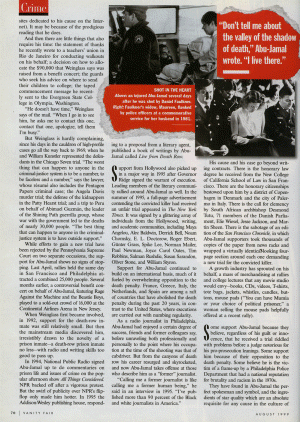
SHOT IN THE HEART. Above: an injured Abu-Jamal several days after he was shot by Daniel Faulkner. Right: Faulkner's widow, Maureen, flanked by police officers at a commemorative service for her husband in 1981.
And then there are little things that also require his time: the statement of thanks he recently wrote to a teachers' union in Rio de Janeiro for conducting walkouts on his behalf; a decision on how to allocate the $90,000 that Weinglass says was raised from a benefit concert; the guards who seek his advice on where to send their children to college; the taped commencement message he recently sent to the Evergreen State College in Olympia, Washington.
"He doesn't have time," Weinglass says of the mail. "When I go in to see him, he asks me to contact this one, contact that one, apologize, tell them I'm busy."
But Weinglass is hardly complaining, since his days in the cauldron of high-profile cases go all the way back to 1969, when he and William Kunstler represented the defendants in the Chicago Seven trial. "The worst thing that can happen to anyone in the criminal-justice system is to be a number, to be faceless and a number," says the lawyer, whose resume also includes the Pentagon Papers criminal case; the Angela Davis murder trial; the defense of the kidnappers in the Patty Hearst trial; and a trip to Peru on behalf of Abimael Guzman, the leader of the Shining Path guerrilla group, whose war with the government led to the deaths of nearly 30,000 people. "The best thing that can happen to anyone in the criminal-justice system is to have outside support."
While efforts to gain a new trial have been rejected by the Pennsylvania Supreme Court on two separate occasions, the support for Abu-Jamal shows no signs of stopping. Last April, rallies held the same day in San Francisco and Philadelphia attracted a combined 25,000 people. Several months earlier, a controversial benefit concert on behalf of Abu-Jamal, featuring Rage Against the Machine and the Beastie Boys, played to a sold-out crowd of 16,000 at the Continental Airlines Arena in New Jersey.
When Weinglass first became involved, in 1992, support for the death-row inmate was still relatively small. But then the mainstream media discovered him, irresistibly drawn to the novelty of a prison inmate -- a death-row prison inmate no less -- with radio and writing skills too good to pass up.
In 1994, National Public Radio signed Abu-Jamal up to do commentaries on prison life and issues of crime on the popular afternoon show All Things Considered. NPR backed off after a vigorous protest. But the swirl of publicity over NPR's flip-flop only made him hotter. In 1995 the Addison-Wesley publishing house, responding to a proposal from a literary agent, published a book of writings by Abu-Jamal called Live from Death Row.
Support from Hollywood also picked up in a major way in 1995 after Governor Ridge signed the warrant of execution. Leading members of the literary community rallied around Abu-Jamal as well. In the summer of 1995, a full-page advertisement contending the convicted killer had received an unfair trial appeared in The New York Times. It was signed by a glittering array of individuals from the Hollywood, writing, and academic communities, including Maya Angelou, Alec Baldwin, Derrick Bell, Noam Chomsky, E.L. Doctorow, Roger Ebert, Gunter Grass, Spike Lee, Norman Mailer, Paul Newman, Joyce Carol Oates, Tim Robbins, Salman Rushdie, Susan Sarandon, Oliver Stone, and William Styron.
Support for Abu-Jamal continued to build on an international basis, much of it fueled by overwhelming opposition to the death penalty. France, Greece, Italy, the Netherlands, and Spain are among a raft of countries that have abolished the death penalty during the past 20 years, in contrast to the United States, where executions are carried out with numbing regularity.
As a radio journalist in Philadelphia, Abu-Jamal had enjoyed a certain degree of success, friends and former colleagues say, before unraveling both professionally and personally to the point where his occupation at the time of the shooting was that of cabdriver. But from the canyons of death row his career resurged and skyrocketed, and now Abu-Jamal takes offense at those who describe him as a "former" journalist.
"Calling me a former journalist is like calling me a former human being," he said in an interview in 1995. "I've published more than 90 percent of the Black and white journalists in America."
His cause and his case go beyond writing contracts. There is the honorary law degree he received from the New College of California School of Law in San Francisco. There are the honorary citizenships bestowed upon him by a district of Copenhagen in Denmark and the city of Palermo in Italy. There is the call for clemency by South African archbishop Desmond Tutu, 71 members of the Danish Parliament, Elie Wiesel, Jesse Jackson, and Martin Sheen. There is the sabotage of an edition of the San Francisco Chronicle, in which Abu-Jamal supporters took thousands of copies of the paper from news racks and wrapped a virtually identical-looking four-page section around each one demanding a new trial for the convicted killer.
A growth industry has sprouted on his behalf, a mass of merchandising at rallies and college lectures that any movie studio would envy -- books, CDs, videos, T-shirts, tote bags, jackets, whistles, candles, buttons, mouse pads ("you can have Mumia or your choice of political prisoner," a woman selling the mouse pads helpfully offered at a recent rally).
Some support Abu-Jamal because they believe, regardless of his guilt or innocence, that he received a trial riddled with problems before a judge notorious for his pro-prosecution leanings.
[Albert F. Sabo, Philadelphia County Court] I'm going to help them to fry the nigger!
-- Mumia: Long Distance Revolutionary. A Journey With Mumia Abu-Jamal, directed by Stephen Vittoria -- Illustrated Screenplay & Screencap Gallery
The unfairness of Jamal's 1982 trial was almost guaranteed once it was assigned to Judge Albert Sabo (who declines to comment on the case). The short, white-haired judge, who is said to be genial and informal off the bench, was undersheriff of Philadelphia County for 16 years, and a proud member of the Fraternal Order of Police, before taking the bench in 1974. Sabo, now 74 and semiretired, has sent 32 defendants (27 blacks, two Asians, two whites, and one Latino) to death row -- far more than any other judge in the nation. He is notoriously pro-prosecution -- a cop on the bench.
-- Guilty and Framed, by Stuart Taylor, Jr.
Some support him because of their opposition to the death penalty. Some believe he is the victim of a frame-up by a Philadelphia Police Department that had a national reputation for brutality and racism in the 1970s.
The backdrop: Philadelphia, a city of racial tensions, police brutality and police corruption
The shooting of Officer Daniel Faulkner in 1981 and Mumia Abu-Jamal’s trial the following year took place in Philadelphia, a city fraught with tension between the predominately white authorities and the African American and other minority communities. Both before and since that time, numerous instances have come to light of police brutality and the use of disproportionate force with lethal consequences; of the corruption of police officers and the fabrication of evidence against those suspected of criminal acts.
In 1973, a federal judge for the US District Court stated that police abuse occurred with such frequency in Philadelphia that it could not be “dismissed as rare, isolated instances” and that city officials did “little or nothing” to punish or prevent police abuse.
In 1979, the US Department of Justice filed a lawsuit against the then-mayor of Philadelphia, Frank Rizzo, and other city officials for condoning police brutality. The lawsuit listed 290 persons shot by the city’s police officers between 1975 and 1979, the majority of whom were from ethnic minorities. During Frank Rizzo’s eight years as mayor, fatal shootings by Philadelphia police officers increased by 20 per cent annually. In the year after he left office, 1980, fatal shootings declined 67 per cent. Mayor Rizzo appeared to tolerate police misconduct. In 1978, he told an audience of 700 police officers “Even when you’re wrong, I’m going to back you”.
An investigation in 1978 by the Pennsylvania House of Representatives Sub-Committee on Crime and Corrections found that a small but significant number of Philadelphia police routinely engaged in verbal and physical abuse of citizens to a degree the subcommittee considered “lawless”. The investigation concluded that the level of police abuse had reached that of homicidal violence and that Philadelphia lacked the necessary police leadership to control the lawlessness.
-- A Life in the Balance: The Case of Mumia Abu-Jamal, by Amnesty International
They have found in Abu-Jamal the perfect spokesman and symbol, and the ingredients of star quality which are an absolute requisite for any cause in the culture of today, a Madison Avenue dream of the death-row inmate whose image can sell and sell big -- a man with a radio voice as tranquil as a lullaby, a man who can write with a clarity made all the more remarkable by the fact that he has spent nearly 20 years of his life in incarceration, a man of clear sex appeal with that interesting chemistry of sultry eyes and hanging dreadlocks, a man who laces his writings with just the right dash of revolutionary spice so as to be provocative. In the past 12 months, more than $200,000 in donations poured in to just one of his many support groups.
He has been transformed into a mythic figure, canonized at almost every opportunity -- an outspoken revolutionary and hero to millions, in the words of one of the band members of Rage Against the Machine; a man similar in spirit to Mandela, in the words of novelist Alice Walker.
Abu-Jamal himself, in a rare interview with a member of the mainstream media in 1995 (attempts, both in writing and through his lawyer, made by Vanity Fair to interview Abu-Jamal were unsuccessful), said he was uncomfortable with his role as a symbol. But those who once worked with him wonder. "The guy's a worldwide celebrity," says a former colleague. "I don't know if late at night he says, 'What the fuck have I gotten into? Look at what I've accomplished.'"
Whatever the motivation, the beat of Abu-Jamal goes on. And there may be only one thing to mar it all: compelling evidence that Abu-Jamal ran across Locust Street with a gun in his hand on that December night in 1981 and killed Daniel Faulkner.
The evidence that convicted him for the murder – well, it doesn’t exist.
-- Manufacturing Guilt, written & produced by Stephen Vittoria & Justin Lebanowski
In addition to the evidence, a former volunteer for a prison-reform organization who regularly visited Abu-Jamal has come forward with what he says was an admission by the inmate to the killing. In the early 1990s, Philip Bloch was an active participant in the Pennsylvania Prison Society. He was also a student at Juniata College in Huntingdon, Pennsylvania, the town where Abu-Jamal was incarcerated. Bloch says that he had at least 10 conversations with Abu-Jamal in prison, and that it was during one of them when he asked the inmate, "Do you have any regrets about killing the officer?"
"Yes" was Abu-Jamal's reply, according to Bloch.
Two mainstream news outlets reported on the case of Pennsylvania death row inmate Mumia Abu-Jamal, claiming to present new evidence pointing to Abu-Jamal's guilt. But the evidence that both outlets rely on -- testimony of a supposed confession made eight years ago -- is questionable on its face, and an old letter that has subsequently surfaced suggests that this star witness is lying about Abu-Jamal.
The major news in both ABC 20/20's July 11 broadcast and the August 1999 issue of Vanity Fair is the testimony of Philip Bloch, a former prison volunteer who now claims to have heard Abu-Jamal confess to the 1981 murder of Philadelphia police officer Daniel Faulkner. During a conversation in 1991, Bloch claims that he asked Abu-Jamal if he had any regrets about shooting Faulkner, to which Abu-Jamal allegedly replied, "Yes."
Why has Bloch waited 8 years? Vanity Fair's Buzz Bissinger doesn't ask (or at the very least doesn't share his curiosity), and ABC's Sam Donaldson, in a virtual re-run of 20/20's 12/9/98 report, explains only that Bloch "felt no need to come forward," since "his friend was already on death row."
But Bloch's story has some serious problems, and new evidence casts considerable doubt on his credibility. A 1993 letter from Bloch to Abu-Jamal -- two years after the "confession" -- ended with the following passage: "So -- it is possible to get justice from a jury -- not always -- but sometimes. So, when you get a new trial -- I think that there is a good chance of acquittal." Why would one write that to a confessed murderer?
But even without this documentary contradiction, Bloch's tale is too dubious for a responsible journalist to run with. Over 18 years of imprisonment, Abu-Jamal has consistently refused to answer questions about the night of the shooting. Journalism professor Linn Washington, Jr. explained Abu-Jamal's stance (Philadelphia Tribune, 7/20/99), describing an interview conducted under circumstances similar to those Bloch had described: "During an interview, I asked Mumia a question regarding the shooting of Faulkner. He refused to respond, giving two reasons: (1) his lawyers told him not to discuss that incident; and (2) the cubicle was bugged."
-- The Media & Mumia: Were ABC and Vanity Fair Taken for a Ride?, by Fairness & Accuracy in Reporting
When police arrived at the scene, they not only saw Faulkner with blood pouring out of his face, but also saw Abu-Jamal sitting in close proximity, on the curb.
Nowhere have I read how police found me, lying in a pool of my blood, unable to breathe, and then proceeded to punch, kick and stomp me, not question me. I remember being rammed into a pole or a fireplug with police at both arms. I remember kicks to my head, my face, my chest, but I have read no press accounts and have heard tell of no witnesses. Where are the witnesses to a police captain or an inspector entering the wagon and beating me with a police radio, all the while addressing me as a black motherfucker! Where are the witnesses?
-- Mumia: Long Distance Revolutionary. A Journey With Mumia Abu-Jamal, directed by Stephen Vittoria -- Illustrated Screenplay & Screencap Gallery
Raised in a housing project in Philadelphia, Abu-Jamal developed his political-activist beliefs in earnest in 1969, when, at 15, he co-founded the local chapter of the Black Panther Party and became its "minister of information." Known in high school as a strong student, he was also expelled for his radicalism. Those who knew Abu-Jamal say that he never lost his ideological beliefs about the system and the intense degree of oppression against minorities. But Abu-Jamal also became part of the journalistic mainstream, working at a variety of commercial radio stations in Philadelphia. At a certain point in his life, he was highly regarded, with a voice that seemed born for the airwaves -- rich, velvety, beautiful. Some saw in him the kind of talent, particularly in his ability to evoke mood and atmosphere, that could have led him as far as he wanted to go in the radio business. Others admired him for the way he had managed to bridge the gap between traditional journalism and social activism by doing stories on the disadvantaged.
But in the months before the shooting, according to colleagues, it was a talent that he had basically jettisoned. His last full-time job had been as a reporter with WHYY, the local public-radio station in Philadelphia. He had started at the station in the summer of 1979, and for some of that time, as a member of a staff putting out a local version of All Things Considered called 91 Report, much of his work had been of high quality.
But he was something of a manipulator, say those who worked with him, particularly since he knew that his talent was in demand. "I wanted it to work," says a former colleague. "I wanted his voice and I wanted the voice he represented on the air. I'm not at all surprised at his ability to get people to buy into what he wants them to, because that's what he did to me."
[Saro Solis] Mumia flirts with a career in television, and is offered what today would be a six-figure salary on a Philadelphia network affiliate …
[DaJuan Johnson] … but he turns it down because the station makes it mandatory for him to cut off his dreadlocks.
[Lydia Barashango, Mumia’s Sister] He said, “My hair is not the biggie here. My concern is once I begin to compromise, will I compromise other things? And he decided he wasn’t taking the position. I said, “That’s mighty damn big of you.” You know, it’s like ...
oh!!!!
-- Mumia: Long Distance Revolutionary. A Journey With Mumia Abu-Jamal, directed by Stephen Vittoria -- Illustrated Screenplay & Screencap Gallery

In January of 1981, Philadelphia magazine listed Abu-Jamal in its group of "81 to Watch." But the mention seemed almost silly. Colleagues say that his work habits at the station had begun to deteriorate seriously. Increasingly, other reporters had to cover for him because he could not be found.
Former journalistic colleagues say there were indications that he was having personal and financial problems. And he was increasingly falling into lockstep with a militant and radical group in Philadelphia called MOVE. In May 1980, nine of its members had been convicted in the death of a police officer during a shoot-out. And because Abu-Jamal frequently covered MOVE for the station, there were constant concerns over his reportorial bias, to the point where it wasn't uncommon for entire pieces to be re-edited. "His behavior at the station was really out of control," says a former colleague. "He looked like a guy who was high. He acted like a guy who was high."
Toward the end, Abu-Jamal had become a "virtual no-show," according to another former colleague. Then, after he vanished for three days with the station's staff car, he was asked to resign.
In the media, Abu-Jamal has been portrayed as a journalist whose reportage on police brutality and misconduct, particularly in the aftermath of the MOVE shoot-out, made him an open target for the police department. "To uniformed men in mourning for one of their own," wrote Doctorow, "he was an enemy delivered to their mercies."
Like prosecutors, police officers are tasked with making our society safe. Sometimes their zeal leads them to cross the line and use the power of their badges to make a case that otherwise would not be triable. Especially when a brutal and senseless crime occurs, the zeal to see justice done can actually lead to great injustice. Other officers are often reluctant to report police misconduct because of the loyalty they feel for their fellow officers. The proliferation of cell phone cameras have allowed citizens to record and report police misconduct. Although, in the past, most police misconduct stories were assumed to be false, now, a quick search on Youtube.com results in hundreds of videos exposing incidents of police misconduct. One example of a compilation of news and amateur video about the problems inherent in this system is BrasscheckTV's Youtube page.
-- Police Misconduct, by California Innocence Project
The statement is powerful and provocative, and it adds to the legend that has blossomed around Abu-Jamal since his incarceration. Abu-Jamal reported on a variety of topics, including the police, according to Weinglass. In one of his books, Abu-Jamal recounted an incident in which an officer in a patrol car, upon seeing him, smiled and molded his fingers into the shape of a gun.
But by numerous accounts Abu-Jamal did virtually no original reporting on police brutality, and Weinglass acknowledges that he doesn't know whether any of the officers arriving on the scene that night had any idea of who he was.
"I was involved right in the middle of this whole police-misconduct business," says George Parry, who was in charge of a unit of the district-attorney's office that was established in 1978 to prosecute police officers for excessive force. "Mumia Abu-Jamal just was not a factor. I don't have any recollection of having spoken to him. It appears to be a triumph of propaganda over truth. You have to give him credit for that. The notion that Jamal has been framed because he was a critic of the police is just a hideous lie."
[Loudon] You're lying.
[Nikki] How do you know?
[Loudon] Your lips are moving.
-- Who's That Girl?, directed by James Foley, starring Madonna
George Wallace was a candidate for the American Independent Party. Very, very right wing, although he probably wouldn’t be considered very right wing in terms of America’s political context today, would he? We were black kids, teenagers, from North Philadelphia. And this avowed white supremacist, this racist from the depths of the South, dared to come to our city. Well, we went down to the Spectrum, there were tens of thousands of white people waving flags. You had George Wallace making his standard stump speech. At that time we weren’t very original, so the only thing we said was ungawa – black power – ungawa – black power. Ungawa, ungawa, black power. They shouted, [inaudible] white power, and send those niggers back to Africa. We shouted, “Black power, ungawa.” Don’t ask what “ungawa” means. We didn’t know. All we knew was that it had a helluva ring to it. The police surrounded us in a matter of moments, and escorted us, rather roughly I should say, out of The Spectrum. There were people spitting on us, “nigger this, nigger that.” I remember being pummeled, being beaten to the ground. And I remember looking around and I saw a pant leg, it was blue and had a stripe on it, so it told me this was a cop. So doing what I was taught to do all of my life, I said, “Yo, help, police.” And I remember the guy walking over very briskly and his foot going back and kicking me in the face. And I’ve always said thank you to that cop because he kicked me straight into the Black Panther Party. -- Mumia Abu-Jamal, "Death Row Notebook"
***
[United States Department of Justice, Federal Bureau of Investigation, WESLEY COOK]
***
[BLACK PANTHER PARTY
At the time of SCHELL’s arrest by the FBI, officers of the Philadelphia Police Department, Civil Disobedience Unit, observed ROLANDO HEARN in the Web Bar and arrested him on a bench warrant for Contempt of Court and Failure to Appear. HEARN is the BPP Breakfast for Children Coordinator. The Philadelphia police detained the following BPP officers for investigation as they followed the arresting agents out of the Web Bar:
1. CLARENCE PETERSON: BPP Minister of Finance
2. WESLEY COOK: BPP Minister of Communications]
***
[Michael Tarif Warren, Attorney, 1995 ] This is a document that reflects a request that was made by the FBI back in 1972 for this photo, and guess who that request was made to? The Philadelphia Police Department.
[C. Clark Kissinger, Former Nat’l Secretary, Students for a Democratic Society] There were reports being written on him since he was 14 years old.
[Michael Tarif Warren, Attorney, 1995 ] This is an enlarged photo – they call him Wesley Cook, we call him Mumia Abu Jamal.
[C. Clark Kissinger, Former Nat’l Secretary, Students for a Democratic Society] Interestingly, one of the photographs that was obtained, had handwritten across the back of the photograph, “Dead.”
***
[Narrator] On December 4, 1969, Chicago police raided the apartment of Black Panther Fred Hampton, and then executed him while he slept, a sleep induced by a barbiturate cocktail courtesy of the Federal Bureau of Investigation. Local authorities claim the Panthers opened fire on the police, but clearcut evidence later emerged that told a much different story, that the Chicago police, along with the Cook County Attorney’s Office and the FBI, planned to assassinate the 21-year-old Hampton. Shortly thereafter a delegation of Panthers from Philadelphia visited the crime scene. Mumia Abu Jamal was part of that delegation.
[Terry Bisson, Author, Mumia Biographer] There was a memorial service in a church in Philadelphia right after that. And Mumia was actually one of the primary speakers. What Mumia said on that day was said in many memorial services across the country, which was that the police had just assassinated one of the bright lights of the Black movement.
[Linn Washington, Journalist] It foreshadowed what he became known for, and that is telling good stories about those events and incidents which the mainstream media just ignored, flat ignored.
[Eric Davis] And during his speech that day, Mumia used the famous quote often attributed to Mao Tse Tung, that political power grows out of the barrel of a gun.”
[Dynamite! Black Power. Use the gun. Kill the pigs everywhere."
Included in the introduction to an article appearing in the October 5, 1968, edition of "The Black Panther" is the statement, "... we will not dissent from American Government. We will overthrow it."
Issues of "The Black Panther" regularly contain quotations from the writings of Chairman MAO Tse-tung of the People's Republic of China and feature MAO's statement that "political power grows out of the barrel of a gun".
The national headquarters of the BPP is located at 3106 Shattuck Avenue, Berkeley, Calif. Branches have been established at various locations throughout the United States.]
[Michael Parenti, Political Scientist, Historian] Mumia was recognizing the fact that the ultimate authority in any state is the mobilization of force and violence.
[Terry Bisson, Author, Mumia Biographer] This statement was later used in his trial to condemn him as if he was talking about Panthers shooting police, when in fact it was quite the contrary.
-- Mumia: Long Distance Revolutionary. A Journey With Mumia Abu-Jamal, directed by Stephen Vittoria -- Illustrated Screenplay & Screencap Gallery
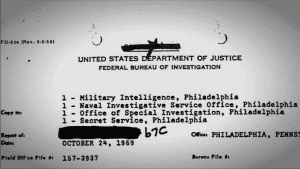
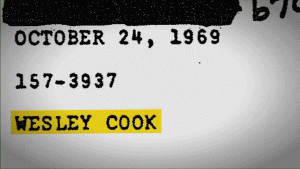
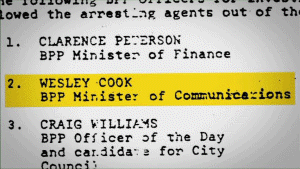
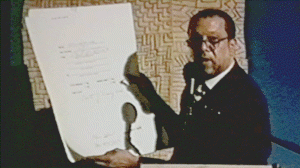
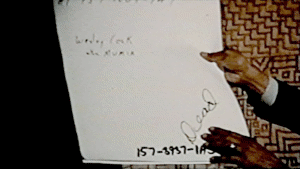
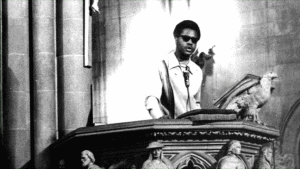
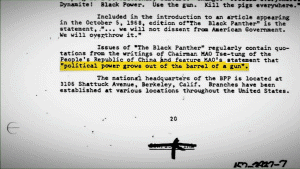
Statistics: Posted by admin — Sat Jun 14, 2014 1:13 am
]]>