As an American, I gotta say this all seemed kind of strange ...
until I looked up at the TV in the bar ...
and noticed what they watch for their evening news.
[Official] They're friends of ours. We'll certainly listen to them courteously and carefully.
But you don't just make war just because someone says so.
[Michael Moore] Night after night, the Canadians weren't being pumped full of fear.
And their politicians seemed to talk kind of funny.
***
[Mayor Mike Bradley, Sarnia, Ontario Canada] And the way to do that is making sure they have proper daycare, that they have assistance for their parents when they are elderly ...
and need to be in an old-age home. That they have proper health care ...
that insures that they won't lose their business or their house ...
because they can't afford their medical bills. That's how you build a good society.
No one wins unless everyone wins.
And you don't win by beating up on people who can't defend themselves.
And that's been the approach, unfortunately, that's been spreading with some of the right-wing governments across North America.
They pick on the people that can't defend themselves ...
and at the same time they are turning around and giving financial support ...
and tax breaks and tax benefits to people that don't need them.
***
[Michael Moore] Where are the indigents in this city? Where do they live?
[Man] Uh... indigent? Uh...
[Michael Moore] You act like you've never heard the word before.
[Man] We don't have that problem here, really. It's...
[Michael Moore] So I asked him, well, "Could you at least take me to a Canadian slum?"
And well... this is what a ghetto looks like in Canada.
[Michael Moore] Is this the same mentality that says, with Canadians ...
you think if somebody gets sick, they should actually be able to have health care?
[Girl] Yes.
[Boy 2] Oh, definitely.
[Girl] Yeah.
[Boy 1] Yeah. Yeah.
[Michael Moore] Why?
[Girl] Because!
[Boy 1] Human rights. Everyone's got the right to live.
***
[Michael Moore] Did you just come out of the emergency room?
[Man] Yes, I did.
[Michael Moore] And how much did you have to pay for your treatment?
[Man] Uh, I wouldn't know what the bill is. It's covered by our hospital plan.
[Michael Moore] So you're telling me you didn't have to pay anything?
[Man] No, I don't.
***
[Woman] I have family that lives in the States.
They used to live in Canada and moved over there. And it's so different.
[Michael Moore] They get afraid more easily.
[Woman] Oh, yeah.
Yeah, very much so.
Because everybody reacts over there, [snaps her fingers] just like that ...
They don't stop and think.
First reaction is pull the gun out. "You're on my property."
You know, like...
I don't know. It's just different over here.
***
[Windsor, Canada]
[Michael Moore] Where do you live?
[Black Man] Detroit.
[Michael Moore] Detroit? Come over to Canada here for the night?
[Black Man] Right.
[Michael Moore] Uh huh.
***
[Middle Eastern Man] People are a little bit more open-minded over here, a little more welcoming.
[Michael Moore] Yeah.
***
[Michael Moore] Feel any difference when you cross over to this country? Be honest, now. Come on.
[Black Man] It's a lot lighter.
***
[Middle Eastern Man] The segregation over there is definitely much more intensified ...
[Michael Moore] In the States?
[Middle Eastern Man] Intensified in the States. Yeah.
So you can feel it.
***
[Black Man] Almost like they just let you be.
[Michael Moore] That's Canada for you.
***
[Boy 1] Every time I turn on the TV in the States, it's always about a murder here ...
a gunfight, hostile position...
[Girl] I just think the States, their view of things is fighting.
That's how they resolve everything.
If there's something going on in another country ...
they send people over to fight it.
[Boy 2] But they're the most powerful country in the world, though.
[Girl] And Canada's more just like "Let's negotiate ...
let's work something out," where the States is "Well we'll just kill you and that'll be the end of that."
***
[Man] Um, if guns were...
If more guns made people safer ...
then America would be one of the safest countries in the world.
It isn't. It's the opposite.
***
[Genesee County 911] Genesee County 911.
[Teacher] I have a student at Buell School that has been downed.
I need an ambulance immediately.
[911 Operator] Where is the child that's been shot?
[Teacher] Right here on the floor of my class. Oh God, please! She's getting white.
[911 Operator] She's getting white? Is she breathing?
[Teacher] Yes, the little girl is getting white.
[911 Operator] Is she breathing?
[Teacher] No, she's not!
[911 Operator] Where is the child that shot her, Ma'am. Do you have any idea?
[Teacher] He's in the office.
[911 Operator] He's in the office?
[Teacher] Yes.
[911 Operator] Where was she shot?
[Teacher] I can't tell. I'm too scared to turn her body.
Please, Lord! Please, Lord! Please, Lord!
***
[Michael Moore] I heard that 911 call, you know, on TV someplace. It was horrible. It was just...
[Jimmie Hughes, Principal, Buell Elementary School] She kept asking, "Where's the shooter?" She said, "He's gone. I need some help."
[Michael Moore] And the little girl was in there, too?
[Jimmie Hughes, Principal, Buell Elementary School] She was on the floor. Yes.
[Michael Moore] She was on the floor.
And the police and the medics came?
[Jimmie Hughes, Principal, Buell Elementary School] By that time, the medics were here. The medics had just come in ...
and I remember him stepping in and taking over the room.
He says, "You have to leave."
And then when the medics come in, when the police come in ...
you're no longer in control.
[Michael Moore] Was she still alive then?
[Jimmie Hughes, Principal, Buell Elementary School] Her lips had become totally blue.
***
[THEO J. BUELL ELEMENTARY SCHOOL]
[Michael Moore] Back in my hometown of Flint, Michigan ...
a 6-year-old, 1st-grade boy, at Buell Elementary ...
had found a gun at his uncle's house ...
where he was staying because his mother was being evicted.
He brought the gun to school and shot another 1st grader ...
6-year-old Kayla Rolland.
With one bullet that passed through her body ...
she fell to the floor and lay there dying ...
while her teacher called 911 for help.
No one knew why the little boy wanted to shoot the little girl.
As if the city had not been through enough horror and tragedy ...
in the past two decades, it was now home to a new record.
The youngest school shooting ever in the United States.
On the morning of the shooting ...
it only took the news helicopters and satellite trucks ...
a half-hour to show up on the scene.
[Newsman] ... leave your mike on.
They're checking the truck.
You know, we're doing one in 30 minutes again.
[Newswoman] This evening, about 7:00, will be a public memorial service.
We are expecting hundreds of people. They will mourn the loss of little Kayla ...
a tiny little girl who loved pizza, teddy bears ...
and who was taken away from us much too soon.
[Jeff Rossen] Good morning, Christine.
The funeral home now passing out thousands, tens of thousands of these pink ribbons ...
to support the young girl's family.
Today will be an emotional day. It has been already, remembering little Kayla.
Jeff Rossen, Fox 2 News.
[Photographer] Nice job.
[Jeff Rossen] [Angrily] Yeah, Michelle, we're having technical problems, okay?
Well, don't talk to me about it, call our sat truck.
I need a haircut, man. I'm a pig. A rug.
Here we go.
Some too choked up even to speak about it ...
there's a memorial service scheduled here for 7:00 tonight.
We're live in Flint, Michigan, this afternoon.
Jeff Rossen, Q-13 Reports.
Thank you.
[Woman] Thank you.
[Photographer] Want some hairspray?
[Jeff Rossen] I kind of need it, don't I?
[Woman] Yeah, you do.
[Photographer] I got some...
[Jeff Rossen] I have some. I just didn't put it in.
I didn't have a chance.
[Photographer] I have hurricane-proof hairspray.
[Jeff Rossen] This man prayed for Kayla, then let the balloon go.
[Technician] I asked you.
[Jeff Rossen] I say we have the colour picture, not the black-and-white one.
There's plenty of media here that covered Columbine.
You know, there are some networks, especially ...
that go from, unfortunately, tragedy to tragedy.
And, uh, I feel bad for them, because that's all they see.
The tragedies.
We're just trying to crunch right now for the 5:00 and the 6:00.
Today, we're feeding CNN and Fox.
***
[Michael Moore] The national media had never visited Buell Elementary ...
or the Beecher School District in which it sat ...
or this part of Flint, ever before.
And few, if any, of these reporters bothered to visit it ...
even when they were here now.
If they had ventured just a block away from the school or the funeral home ...
they might have seen a different kind of tragedy ...
that perhaps would contain some answers as to why this little girl was dead.
For over 20 years, this impoverished area ...
in the hometown of the world's largest corporation ...
had been ignored as completely as it had been destroyed.
With 87 percent of the students living below the official poverty line ...
Buell and Beecher, and Flint ...
did not fit into the accepted and widely circulated story line ...
put forth by the nation's media.
That being the one about America ...
and its invincible economy.
Hegemony’s Achilles heel is the US economy. The fairy tale of American economic recovery supports America’s image as the safe haven, an image that keeps the dollar’s value up, the stock market up, and interest rates down. However, there is no economic information that supports this fairy tale.
Real median household income has not grown for years and is below the levels of the early 1970s. There has been no growth in real retail sales for six years. The labor force is shrinking. The labor force participation rate has declined since 2007 as has the civilian employment to population ratio. The 5.7 percent reported unemployment rate is achieved by not counting discouraged workers as part of the work force. (A discouraged worker is a person who is unable to find a job and has given up looking.)
A second official unemployment rate, which counts short-term (less than one year) discouraged workers and is seldom reported, stands at 11.2 percent. The US government stopped including long-term discouraged workers (discouraged for more than one year) in 1994. If the long-term discouraged are counted, the current unemployment rate in the US stands at 23.2 percent.
The offshoring of American manufacturing and professional service jobs such as software engineering and Information Technology has decimated the middle class. The middle class has not found jobs with incomes comparable to those moved abroad. The labor cost savings from offshoring the jobs to Asia has boosted corporate profits, the performance bonuses of executives and capital gains of shareholders. Thus all income and wealth gains are concentrated in a few hands at the top of the income distribution. The number of billionaires grows as destitution reaches from the lower economic class into the middle class. American university graduates unable to find jobs return to their childhood rooms in their parents’ homes and work as waitresses and bartenders in part-time jobs that will not support an independent existence.
With a large percentage of the young economically unable to form households, residential construction, home furnishings, and home appliances suffer economic weakness. Cars can still be sold only because the purchaser can obtain 100 percent financing in a six-year loan. The lenders sell the loans, which are securitized and sold to gullible investors, just as were the mortgage-backed financial instruments that precipitated the 2007 US financial crash.
None of the problems that created the 2008 recession, and that were created by the 2008 recession, have been addressed. Instead, policymakers have used an expansion of debt and money to paper over the problems. Money and debt have grown much more than US GDP, which raises questions about the value of the US dollar and the credit worthiness of the US government. On July 8, 2014, my colleagues and I pointed out that when correctly measured, US national debt stands at 185 percent of GDP.
-- The Neoconservative Threat to International Order, by Paul Craig Roberts
The number one cause of death among young people ...
in this part of Flint was homicide.
The football field at Flint-Beecher, was sponsored by a funeral home.
The kids at Beecher have won 13 state-track championships.
But they've never had a home track meet ...
Because around the football field, all they have is this dirt ring.
Years ago, someone here named the streets in this part of town ...
after all the Ivy League schools ...
as if they had dreamed of better days ...
and something greater for themselves.
***
[Jimmie Hughes, Principal, Buell Elementary School] The children are doing well.
Faculty and staff are doing well. But we don't forget.
We don't forget.
We just don't want this happening to anybody else, you know? It's...
[Michael Moore] I know.
I know. I don't want it to happen to anybody else either.
[Jimmie Hughes, Principal, Buell Elementary School] I thought it would ... [Choking up]
[Michael Moore] It's okay. It's okay.
It's okay. It's okay.
I'm sorry.
[Jimmie Hughes, Principal, Buell Elementary School] That's all right.
***
[Charlton Heston] "From my cold, dead hands!"
[Michael Moore] Just as he did after the Columbine shooting ...
Charlton Heston showed up in Flint to have a big, pro-gun rally.
[The experts agree ... Gun control works! (Hitler, Castro, Qaddafi, Stalin]
[Charlton Heston] Freedom has never seen greater peril ...
nor needed you more urgently ...
to come to her defence than now.
[THE HOYA: Heston on Political Life, Gun Violence. The Hoya's Tim Sullivan sat down with acclaimed actor and NRA head Charlton Heston on Wednesday.
Students, Community, Politicians Gather to Rally for Gun Control
The Hoya: Six-year-old Kayla Rolland was shot to death by a fellow first grader last month with a gun his guardian had left errantly loaded. Dylan Klebold and Eric Harris killed 12 fellow students with guns they weren't licensed to carry. Over the last couple of years they're have been countless headlines about violence in schools, gun violence. How does the NRA respond to these kinds of crimes committed with guns?
Heston: Well, after the Columbine shooting, I wanted to talk to one of the parents, and I was able to reach a man who's daughter had been killed. And we talked. And he said Mr. Heston I don't use guns. I'm not a hunter." But he said ...]
[Michael Moore] Before he came to Flint ...
Heston was interviewed by the Georgetown Hoya about Kayla's death ...
and even his own NRA website talked about it.
[The Gloves Come Off, The Fight Is On!
A Chronicle of Fraud: Clinton-Gore vs. the NRA
(June 2000)
TUESDAY, FEBRUARY 29 On this cold Michigan morning, a six-year-old boy crawls out of his makeshift bed in the shabby crack house where he lives with his 21-year-old uncle, another man and a passing parade of strangers. The boy finds a stolen .32 caliber pistol hidden beneath a pile of blankets, stuffs the loaded gun in his trousers and walks to blocks to Buell Elementary School. He finds the first-grade schoolmate he argued with the day before, points the gun at her and yanks the trigger.
DAY ONE
48 hours after Kayla Rolland is pronounced dead Clinton is on The Today show telling a sympathetic Katie Couric, "May this tragic death will help."
"We need the public aroused on this," Clinton says. "If we had passed the child trigger lock provision, those guns would not be used by six-year-olds ... Of course, I think ultimately what we ought to do is license handgun owners. That is the critical next step."]
[Woman] We wanted to let the NRA know that we haven't forgotten about Kayla Rolland.
[MILLION MOM MARCH]
How could they come here? To me, it's like they're rubbing our nose in it.
I was shocked and appalled that they were coming.
[Michael Moore] Heston was asked by a local reporter why he came to Flint ...
after the tragedy of Buell ...
and what did the NRA have to say ...
about 6-year-olds using guns?
[Charlton Heston] We spend $21 million every year.
And we teach it to 5- and 6-year-olds.
We say, if you see a gun, don't touch it.
Leave the room. Call an adult.
***
[Arthur Busch, County Prosecutor, Flint, Michigan] And then Moses himself showed up.
[Michael Moore] Right here in the city of Flint?
[Arthur Busch, County Prosecutor, Flint, Michigan] Right here in Flint.
[Michael Moore] Were there people that wanted you to try this child or even to try him as an adult?
[Arthur Busch, County Prosecutor, Flint, Michigan] Oh... Oh, yeah.
There were people from all over America that wrote ...
and called and sent mail. What was amazing to me ...
um, groups that were affiliated with the NRA ...
groups, you know, people that I call "gun nuts" ...
writing me and telling me what a horrible thing it was ...
that I had admonished homeowners in our country ...
to be careful about bringing weapons into their home.
They wanted this little boy hung from the highest tree.
I mean, there was such an undercurrent ...
of racism and hate and anger.
It was ugly.
***
[Michael Caldwell, Police Detective] That's a picture that the little boy that was involved in the Buell-school shooting...
once he was brought back here to our office ...
about 15 minutes after the shooting took place, I gave him some crayons and stuff ...
to kind of occupy him a little bit ...
And he came over and drew that picture for me ...
because at the time, I had pictures right behind my desk ...
that my children had drew for me, and he wanted to draw me one to hang behind my desk.
[Michael Moore] This is what he drew for you. What did he say this was?
[Michael Caldwell, Police Detective] That's him at his house.
[Michael Moore] That's him at his house, right here.
And why did you decide to hang onto it?
[Michael Caldwell, Police Detective] Because of the gravity of the situation ...
and what had occurred. And he asked me to hang that behind my desk ...
so I put it in a frame, and that's where it will stay.
***
Michael Moore] Tamarla Owens was the mother of the 6-year-old boy.
In order to get food stamps and health care for her children ...
Tamarla was forced to work as part of the state of Michigan's Welfare-to-Work Program.
This program was so successful in tossing poor people off welfare ...
that it's founder, Gerald Miller ...
was soon hired by the number-one firm in the country ...
that states turn to to privatize their welfare systems.
That firm was Lockheed Martin.
With the cold war over and no enemy left to frighten the public ...
[Lockheed chosen to run welfare-to-work]
[Aerospace giant to run region's welfare: A division of Lockheed Martin won the 9-month, $1.5 million welfare-management contract]
Lockheed had found the perfect way to diversify ...
and the perfect way to profit from people's fears ...
with an enemy much closer to home ...
poor Black mothers like Tamarla Owens.
[Sheriff Robert Pickell, Flint, Michigan] So you've got a one-parent family ...
and the mother's travelling 60 miles, an hour, an hour and a half away to go to work ...
an hour, an hour and a half to come home. How does that help a community?
But that's part of the state, you know, making parents responsible ...
making them work for --
[Michael Moore] Welfare-to-Work.
[Sheriff Robert Pickell, Flint, Michigan] Welfare-to-Work.
That's a program that ought to be stopped ...
because it really has no merit.
I think it adds more to the problem than it does to solve it.
[Michael Moore] Really?
[Sheriff Robert Pickell, Flint, Michigan] I do.
[Michael Moore] You're the sheriff, and you feel this way?
[Sheriff Robert Pickell, Flint, Michigan] I do. I do.
I wish I could put two parents in every home ...
and make every parent equally responsible, but I can't do that.
But we're not doing anything by taking the one parent and putting them on a bus ...
and sending them out of town to make $5.50 an hour.
[Michael Moore] This is the bus that she was forced to ride every day ...
in order to work off the welfare money the state had given her.
She and many others from Flint who were poor ...
would make the 80-mile roundtrip journey every day ...
from Flint to Auburn Hills in Oakland County ...
one of the wealthiest areas in the country.
Tamarla would leave early in the morning and return late at night ...
rarely seeing her young children.
[Sheriff Robert Pickell, Flint, Michigan] What's the point in doing that?
Where does the state benefit?
Where does Flint and Genesee County benefit from that?
We have a child dead. I think that may be, in part, part of the problem.
We drove the one parent out.
Now, you or anybody else that can tell me ...
that that best serves a community ...
I shake my head and wonder why.
[Michael Moore] How long have you been riding the bus?
[Man] I've been working here just about three years now.
[Michael Moore] About three years?
[Man] Yeah.
My brother, I got my brother working here.
Half of my neighbourhood works out here.
Just about everybody I know personally works out here in the mall.
In Flint, doing the same thing I'm doing now ...
they only pay minimum wage. I come 40 miles ...
to make $3 or $4 more an hour.
[Michael Moore] How much do you make an hour here?
[Man] I make $8.50 an hour.
[Michael Moore] $8.50?
Is that enough to pay the bills?
[Man] No.
[Michael Moore] So did you know Tamarla Owens, the woman whose son shot the little girl?
I think she rode this bus.
[Man] I knew her a little bit.
Not real good.
[Michael Moore] Nice lady?
[Man] Yeah, she was okay.
She came to work every day. She did her job.
She worked two jobs.
[Michael Moore] Two jobs?
[Man] She was trying to make ends meet.
***
[Music] We're going hopping
We're going hopping today
Where things are popping...
On the Bandstand
Bandstand
[Michael Moore] This is Dick Clark's American Bandstand Grill ...
where Tamarla worked one of her two jobs.
[Manager] She worked in this room here, as a bartender ...
a fountain-person making drinks, making shakes, desserts.
[Michael Moore] Was she a good employee?
[Manager] Yeah, she was.
She also worked at the Fudgery in the mall here.
[Michael Moore] Right. Where the state had placed her.
***
[Michael Moore] Dick Clark is an American icon.
The man who brought rock 'n' roll into our homes ...
every week on American Bandstand.
[Manager] Every part of your life you can link up to a part of music, usually.
So, as Dick says, "It's the soundtrack of our lives."
Music is the soundtrack of our lives.
[Michael Moore] His restaurant and the Fudgery here in Auburn Hills ...
applied for special tax breaks, because they were using welfare people as employees.
Even though Tamarla worked up to 70 hours a week at these two jobs in the mall ...
she did not earn enough to pay her rent.
And one week before the shooting ...
was told by her landlord that he was evicting her.
With nowhere to go, and not wanting to take her two children out of school ...
Tamarla asked her brother if they could stay with him for a few weeks.
It was there that Tamarla's son found a small, .32 calibre gun ...
and took it to school.
Tamarla did not see him take the gun to school ...
because she was on a state bus to go serve drinks and make fudge ...
for rich people.
[Music] Bandstand!
[Michael Moore] I decided to fly out to California ...
to ask Dick Clark what he thought about a system ...
that forces poor, single mothers ...
to work two low-wage jobs to survive.
[Michael Moore] I'm doing a documentary ...
on these school shootings and, you know, guns and all that.
And in my hometown of Flint, Michigan, which you know ...
this little 6-year-old shot a 6-year-old.
[Dick Clark] Get in the car, Dave! Watch your arm! Watch your arm!
[Michael Moore] Oh, I'm sorry. Sorry.
[Dick Clark] I'm sorry. We're really late.
[Michael Moore] Anyways, but the mother of the kid who did the shooting ...
works at Dick Clark's All-American Grill...
[Dick Clark] Forget it!
[Michael Moore] in Oakland County.
[Dick Clark] Close the door.
[Michael Moore] It's a Welfare-to-Work program ...
[Dick Clark] Close the door. Close the door.
[Michael Moore] These people are forced to ...
[Dick Clark] Goodbye! [Waves goodbye]
[Michael Moore] No, no, no, no.
[Dick Clark] Come on!
[Michael Moore] I want you to help me convince the governor of Michigan...
It's a Welfare-to-work ... These women are forced to work!
They've got kids at home! Dick!
Ah, Jeez!
***
[President George W. Bush] [Blows a raspberry at the crowd]
[Michael Moore] In George Bush's America, the poor were not a priority.
And after September 11, 2001 ...
correcting America's social problems ...
took a back seat to fear ...
panic, and a new set of priorities.
[President George W. Bush] One way to express our unity ...
is for Congress to set the military budget ...
the defense of the United States, as the number-one priority ...
and fully fund my request.
***
[Clerk] We've been selling a lot of chemical suits with the gloves and the hoods.
And we've been selling a lot of gas masks.
[Woman] I'm trying to get one for myself and my puppy.
[Newswoman] Dennis Marks and his wife have been stocking up supplies.
[Dennis Marks] Weapons. Ammunition.
[Newsman] Wal-Mart says after September 11, gun sales surged 70 percent ...
ammunition up 140 percent.
In Dallas, they're already taking potshots at Osama bin Laden.
[Michael Moore] In the months following the 9-11 attacks ...
we Americans were gripped in a state of fear.
None of us knew if we, too, would die at the hands of the evildoers ...
or who might be sitting next to some crazy guy trying to light his shoes on fire.
The threat seemed very real.
[Man] It's probably a little paranoia, but I'm not going to take the chance. That's all.
Just trying to protect myself and my family.
[Michael Moore] Our growing fears were turned into a handsome profit for many.
[Newsman] Mike Blake has seen a 30 percent increase in sales at ADT over the last month.
Most of the people he talks to are still a little uneasy over the September 11 terrorist attacks.
[Prof. Barry Glassner, Author of "The Culture of Fear"] How are we afraid of all these things? It's because a lot of people ...
are making a lot of money off of it ...
and a lot of careers off of it.
And so, there's vested interests ...
a lot of activity to keep us afraid.
[Lockheed Wins $200 Billion Deal to Build Fighter Jet
The New York Times NATIONAL Saturday, October 27, 2001]
[Michael Moore] And what better way to fight box-cutter-wielding terrorists ...
than to order a record number of fighter jets from Lockheed?
Yes, everyone felt safer.
Especially with the Army doing garbage detail on Park Avenue.
And the greatest benefit of all of a terrorized public ...
is that the corporate and political leaders can get away with just about anything.
[Senator Fritz Hollings (D-SC), ENRON IN CONGRESS] I've never seen a better example of cash-and-carry government ...
than this Bush administration ...
and Enron.
[Michael Moore] There were a lot of things that I didn't know after the World Trade Center attack ...
but one thing was clear.
Whether it was before or after September 11 ...
a public that's this out of control with fear ...
should not have a lot of guns or ammo laying around.
***
[Richard Costaldo] Well, I was shot with a Tec-9.
[Michael Moore] 9 mm?
[Richard Costaldo] Yeah. Yeah, it was a ...
I guess it was supposed to be semi-automatic, but it kind of seemed like fully automatic to me ...
from what I remember.
[Michael Moore] This is Richard Costaldo.
And this is Mark Taylor.
Both of these boys were shot the day of the Columbine massacre.
Richard is paralyzed for life and in a wheelchair.
And Mark is barely standing after numerous operations.
[Mark Taylor] The kids at Columbine had to pay a penalty.
We paid a penalty that day for this nation, the way we look at it.
[Michael Moore] Mark and Richard were disabled ...
and suffering from the 17-cent Kmart bullets still embedded in their bodies.
As they showed me the various entry points for the bullets ...
I thought of one way we could reduce the number of guns and bullets laying around.
I asked the boys if they'd like to go to Kmart ...
to return the merchandise.
***
[K-Mart Headquarters, Troy, Michigan]
[Richard Costaldo] Ready?
[Michael Moore] You go.
[Richard Costaldo] Me?
[Mark Taylor] Cool.
[The Dickies] [singing] pt barnum said it so long ago
there's one born every minute don't you know
some make us laugh, some make us cry
these klowns honey gonna make you die
everybody's running when the circus comes into their towns
everybody's gunning for the likes of the killer klowns
from outer space
Killer Klowns from outer space
Jocko!
Ringmaster shouts let the show begin
Send in the klowns, let them do you in
See a rubber nose on a painted face
Bringing genocide to the human race
It's time to take a ride on the nightmare merry-go-round
You'll be dead on arrival from the likes of the killer klowns
from outer space
killer klowns from outer space
There's cotton candy in their hands
Says a polka-dotted man with a stalk of jacaranda
They're all diabolical bozos
Oh look around what do you see
tell me what's become of humanity?
From California shores to New York Times Square
Barnum and Bailey everywhere
If you've ever wondered why the population's going down
blame it on the plunder from the likes of the killer klowns
from outer space
Killer klowns from outer space
Killer klowns killer klowns killer klowns killer klowns killer klowns
from outer space
Killer klowns from outer space
Killer klowns killer klowns
-- Killer Klowns, by the Dickies
-- Killer Klowns From Outer Space, directed by Stephen Chiodo
[Michael Moore] Hi.
[Security] Can you turn the camera off, please?
[Michael Moore] Oh, no, we're here to see Mr. Conaway.
[Security] Okay. Turn the camera off in the building until I get clearance for you, sir.
[Michael Moore] Oh, okay. All right. All right.
Just turn it off. Yeah.
[One Hour Later]
[Mary Lorencz, Director of Media Relations for Kmart] Hey, Michael.
[Michael Moore] Hi. How are you?
[Mary Lorencz, Director of Media Relations for Kmart] I'm Mary Lorenz. I'm director of Media Relations for Kmart.
[Michael Moore] Oh, good. All right. Good.
[Mary Lorencz, Director of Media Relations for Kmart] How can I help you today?
[Michael Moore] Well, I'm here today. This is Richard Costaldo.
[Mary Lorencz, Director of Media Relations for Kmart] Richard, nice to meet you.
[Michael Moore] And this is Mark Taylor.
[Mary Lorencz, Director of Media Relations for Kmart] Mark.
[Michael Moore] And they're students from Columbine High School.
They were shot at Columbine in the massacre ...
with bullets from Kmart.
[Mary Lorencz, Director of Media Relations for Kmart] You came a long way, all the way from Colorado!
[Richard Costaldo] Yeah, I was just thinking that...
since you stopped selling the handguns and all ...
it would kind of make sense to stop selling bullets too.
[Mark Taylor] Our request is that you get rid of the 9 mm bullets ...
and that you don't sell them in the store completely.
BRAVE: having or showing courage; making a fine show: colorful; excellent, splendid
HERO: a mythological or legendary figure often of divine descent endowed with great strength or ability; an illustrious warrior; a man admired for his achievements and noble qualities; one who shows great courage; the principal male character in a literary or dramatic work; the central figure in an event, period, or movement; an object of extreme admiration and devotion: idol
-- by Merriam Webster Dictionary
[Mary Lorencz, Director of Media Relations for Kmart] We do carry... You probably are aware of Kmart.
Hopefully, you're shoppers at our stores ...
that we do only carry, you know, sporting firearms ...
and the accessories that go with the hunting sport.
And we'll certainly take your message to our Chairman and CEO, Chuck Conaway.
He's not here today.
[Michael Moore] He's not here today?
[Mary Lorencz, Director of Media Relations for Kmart] No. He's not here, actually, this whole week.
[Michael Moore] Because I -- not at all during the week?
Do you have a limit on the number of bullets, ammunition, that people can purchase?
[Mary Lorencz, Director of Media Relations for Kmart] You know, I can't answer these questions for you.
I'm not the merchandiser who places those products in our stores.
[Michael Moore] Can we speak to that person?
[Mary Lorencz, Director of Media Relations for Kmart] But I can get answers to those questions for you ...
if you would like to leave your card. And I can get those answers for you.
[Michael Moore] Well, we don't want to leave a card.
Just let me be blunt. The reason why we can't take a card and come back ...
is because Mark here, he's got a Kmart bullet just an inch away...
right?
[Mark Taylor] Yep.
[Michael Moore] from your aorta.
[Mark Taylor] In between my aorta and spine.
[Michael Moore] Inbetween your aorta and spine.
[Mary Lorencz, Director of Media Relations for Kmart] I'm glad to see that you're still able to stand.
DISGUSTING: so unpleasant to see, smell, taste, consider, etc., that you feel slightly sick; so bad, unfair, inappropriate, etc., that you feel annoyed and angry.
-- by Merriam Webster Dictionary
[Michael Moore] And I told him that somebody here would listen ...
somebody here ...
would, would, would take the request seriously.
Not just a PR person, but somebody who has some authority ...
and can answer some of the questions that they want answered.
[Mary Lorencz, Director of Media Relations for Kmart] Kmart does care about this, but I can't go any further right now.
So until I make a call ...
[To her homies] um, I'm gonna go back to the office ...
and see if there's anyone in merchandising.
[Michael Moore] Mary went back upstairs, and two hours later ...
she brought down this guy whose job it is to buy the bullets for Kmart.
[Bullet-buying Man] Stay out of trouble.
[Michael Moore] We're not the ones in trouble, guys.
[Bullet-Buying Man] [Laughing]
[Michael Moore] Mark thought he'd show him his bullet wounds.
Those are his bullet holes from your bullets.
That's where the Kmart bullets went in.
[Bullet-Buying Man] Well, take care.
[Shakes Michael's hand and leaves]
[Michael Moore] Is anybody else going to come down?
Is anybody else going to come down? Is that it?
[Bullet-Buying Man] Let me check.
[Michael Moore] Okay. Thank you.
We waited around a couple more hours, but no one else came down.
As we left the building, Mark came up with an idea.
He suggested that we go to the nearest Kmart ...
and buy out all their bullets.
Peaceful Warrior Comes for Peace
[Mark Taylor] Just take as many of those as you can.
[Craig, Clerk] Yeah, you can come around here to look.
[Mark Taylor] What else do we have over here?
You got 357s? Sure, I'll take them all, take everything you got.
[Craig, Clerk] So you're 17 and you're what?
[Mark Taylor] 16.
[Craig, Clerk] [Drops bullets] Oh, shit!
[Clerk] Oh, my God, Craig.
[Michael Moore] Mark pretty much cleaned them out of their ammunition.
And the next day, we decided to go back to Kmart headquarters with all the bullets.
This time we brought the press.
[Newswoman] Our local first coverage of Southeastern Michigan continues now with all new stories.
[Newsman] Coming up here on our 6:00 report, a warning to everyone this summer to watch out for snakes.
You'll hear from a mom who was bitten by a rattlesnake.
And also new, students who survived the Columbine massacre ...
are in town.
They are very angry with Kmart.
ANGRY: filled with anger; having a strong feeling of being upset or annoyed; showing anger; seeming to show anger; threatening or menacing.
-- by Merriam Webster Dictionary
[Michael Moore] We're here to see Chuck Conaway, the chairman of Kmart.
[Security Man] How are you doing, sir?
[Michael Moore] How you doing?
[Security Man] It's always a pleasure to see you.
Okay, uh... They would like to speak to Mr. Conaway.
[Michael Moore] Here's the 9 mms.
These are the bullets that are in both Richard ...
and in Mark's body right now.
[Mark Taylor] Want to put those back? I don't want to touch those.
[Woman] [Never looking at him once] I will do that for you, sir.
[Security Man 2] Move your group outside. I'll have somebody here in 5 minutes.
Do me a favour. Don't block the door. Just off to the side, if you would.
[Michael Moore] We'll go outside and somebody will come out.
[Lori McTavish] My name's Laurie McTavish. I'm the Vice President of Communications for Kmart.
I'm happy to deliver a statement on behalf of the company.
What happened in Columbine, Colorado, was truly tragic ...
and touched every American. And we're sorry ....
for the disadvantage to this young man.
Kmart is phasing out the sale of handgun ammunition.
The business plan calls for this to be complete ...
in the continental U.S. within the next 90 days.
[Michael Moore] Wow! Wow!
[Lori McTavish] Kmart representatives met with Mr. Moore ...
and the students from Columbine, Colorado, yesterday ...
and listened to their concerns ...
about the product carried in Kmart stores.
The company committed, at the end of that meeting ...
that Kmart would have an answer for them within a week's time.
[Michael Moore] Well, the first thing we want to do is thank you ...
for committing to no longer selling handgun ammunition ...
in your stores. And within 90 days.
[Lori McTavish] The process will be phased out within 90 days.
BILLY THE KID. $500 Reward. I will pay $500 reward to any person or persons who will capture MICHAEL MOORE alias BILLY THE KID. Deliver him to any sheriff of New Mexico. Satisfactory proofs of identity will be required for reward. LEW. WALLACE, Governor of New Mexico.
[Michael Moore] And after 90 days, there will be no more selling of ammunition ...
that can go into handguns or assault weapons.
[Lori McTavish] Firearm ammunition, we will not sell it after 90 days in our stores.
[Michael Moore] Well, we greatly appreciate that.
[Lori McTavish] Thank you.
[Michael Moore] Thank you very much. Thank you. That's really great.
[Everyone clapping]
[Michael Moore] Thank you. Wow! That blows my mind.
That's more than what we asked for.
[Mark Taylor] It's remarkable.
[Michael Moore] Yeah. Well, like I told you ... Did you think?
[Mark Taylor] No!
[Michael Moore] We're just getting ready to go to the airport.
[Mark Taylor] We were ready to go home!
"Warriors are not what you think of as warriors. The warrior is not someone who fights, because no one has the right to take another life. The warrior, for us, is one who sacrifices himself for the good of others. His task is to take care of the elderly, the defenseless, those who can not provide for themselves, and above all, the children, the future of humanity."
-- Sitting Bull
ANGRY: filled with anger; having a strong feeling of being upset or annoyed; showing anger; seeming to show anger; threatening or menacing.
-- by Merriam Webster Dictionary
[Michael Moore] The kids from Columbine had scored an overwhelming victory against Kmart ...
and it inspired me to do something that I knew I had to do.
All I needed was a star map.
***
[Michael Moore] [Ringing the bell at Charlton Heston's Mansion]
[Charlton Heston] Hello?
[Michael Moore] Mr. Heston?
[Charlton Heston] Yeah.
[Michael Moore] This is Michael Moore.
[Charlton Heston] Yes.
[Michael Moore] The filmmaker?
[Charlton Heston] Yes, of course.
[Michael Moore] Yes. How you doing?
[Charlton Heston] Fine, thank you.
[Michael Moore] Uh, listen, I was wondering if maybe I could talk to you. We're making a documentary ...
about the whole gun issue. And I'm a member of the NRA.
I thought maybe we could talk a little bit about --
[Charlton Heston] I'll tell you what, let me look at my calendar. I may be able to give you some time tomorrow.
I have some people here now.
[Michael Moore] Okay, how can I --
[Charlton Heston] Hold the phone.
[Michael Moore] Okay, thank you.
[Charlton Heston] Okay.
I can give you a little time tomorrow morning. I think that's Thursday.
[Michael Moore] Yes.
[Charlton Heston] Let's say 8:30.
[Michael Moore] 8:30 in the morning?
[Charlton Heston] Yeah. Okay?
[Michael Moore] And just come here?
[Charlton Heston] Here.
[Michael Moore] Yes.
[Charlton Heston] Yep.
[Michael Moore] Okay, good.
***
[The Next Morning]
[Michael Moore] [Ringing the bell again]
[Man] Hello?
[Michael Moore] Hi. It's Michael Moore here to see Charlton Heston.
[Man] Okay.
[Music] It's a beautiful day in the neighborhood
[Michael Moore] Hi. Good morning.
How are you?
[Charlton Heston] Fine.
[Michael Moore] Thank you very much for agreeing to see me.
***
Ten years ago this past week, Clint Eastwood stood in front of the National Board of Review awards dinner and announced to me and to the crowd that he would "kill" me if I ever came to his house with my camera for an interview.
"I'll kill you," he declared.
The crowd laughed nervously. As for me, having just experienced a half-dozen assaults in the previous year from crazies upset at 'Fahrenheit 9/11' and my anti-war Oscar speech ...Thank you very much. On behalf of our producers Kathleen Glynn and Michael Donovan from Canada, I’d like to thank the Academy for this. I’ve invited my fellow documentary nominees on the stage with us, and we would like to — they are here — they are here in solidarity with me because we like non-fiction.
We like nonfiction and we live in fictitious times.
We live in the time where we have fictitious election results that elects a fictitious President.
We — We live in a time where we have a man sending us to war for fictitious reasons.
Whether it’s the fiction of duct tape or the fiction of orange alerts, we are against this war, Mr. Bush. Shame on you, Mr. Bush, shame on you.
And any time you’ve got the Pope and the Dixie Chicks against you, your time is up.
Thank you very much.
... plus the attempt by a right wing extremist to blow up my house (he was caught in time and went to prison), I was a bit stunned to hear Eastwood, out of the blue, make such a violent statement. But I instantly decided he was just trying to be funny, so I laughed the same nervous laugh everyone else did. Clint, though, didn't seem to like all that laughter.
"I mean it," he barked, and the audience grew more quiet. "I'll shoot you."
-- The Day Clint Eastwood Said He Would "Kill" Me, 10 Years Ago This Week, by Michael Moore
[Michael Moore] He took me out to his pool and tennis house so we could have a chat.
I told him that I was a lifetime member of the NRA ...
and showed him my membership card.
[Charlton Heston] Good for you. Well done.
[Michael Moore] I assume you have guns in the house here?
[Charlton Heston] Indeed, I do.
[Michael Moore] Uh huh.
[Charlton Heston] Bad guys, take notice. [Laughing]
[Michael Moore] So you have them for protection?
[Charlton Heston] Yeah. Sure.
[Michael Moore] Have you ever been a victim of crime?
[Charlton Heston] No. No. [Knocks on wood]
[Michael Moore] Never been assaulted?
[Charlton Heston] No.
[Michael Moore] No violence toward you, but you have guns in the house.
[Charlton Heston] Loaded.
[Michael Moore] They're loaded?
[Charlton Heston] Well, if you really need a weapon for self-defence ...
you need it loaded.
[Michael Moore] Okay, but why do you need it for self-defence?
[Charlton Heston] I don't.
[Michael Moore] Yeah, you've never been a victim of crime. You haven't been assaulted.
[Charlton Heston] No, that's true.
[Michael Moore] So why don't you unload the gun?
[Charlton Heston] Because the Second Amendment gives me the right to have it loaded.
[Michael Moore] Oh, I agree.
I totally agree with that.
I'm just saying, the Second Amendment gives me ...
[Charlton Heston] Let's say it's a comfort factor, you know?
[Michael Moore] It gives you comfort to know that there's a loaded gun?
[Charlton Heston] Yeah.
[Michael Moore] Well, comfort meaning that it allows you to relax and feel safe?
[Charlton Heston] Not worry about it.
[Michael Moore] Not worry. Not be afraid.
[Charlton Heston] And I'm not really, but, uh...
I'm exercising one of the rights ...
passed on down to me ...
from those wise, old, dead White guys that invented this country.
If it was good enough for them, it's good enough for me.
[Michael Moore] But you could still exercise the right just by having the gun unloaded and locked away somewhere.
[Charlton Heston] I know that. I choose to have it.
[Michael Moore] What sort of strikes me as interesting ...
is that in other countries, where they don't have the murder rate, the gun-murder rate that we have ...
that many people say, "Well, that's because they don't have guns around.
It's hard to get a gun in Britain or Germany, or whatever."
But we went to Canada ...
and there's 7 million guns in 10 million homes.
[Charlton Heston] There won't be, very long.
[Michael Moore] But hear me out, though.
[Charlton Heston] Okay.
[Michael Moore] Canada is a nation of hunters ...
millions of guns ...
and yet they had just a few murders last year.
That's it. A country of 30 million people. Then why -- here's my question --
Why is it that they've got all these guns laying around ...
yet they don't kill each other at the level that we kill each other?
[Charlton Heston] I think American history ...
has a lot of blood on its hands.
[Michael Moore] Oh, and Germany history doesn't?
[Charlton Heston] No.
[Michael Moore] And British history?
[Charlton Heston] I don't think as much.
[Michael Moore] Oh, Germans don't have as much blood on their hands?
[Charlton Heston] Uh, they do, yes.
[Michael Moore] The Brits? They ruled the world for 300 years at the barrel of a gun.
They're all violent people. They have bad guys, they have crime.
They have lots of guns in the past.
[Charlton Heston] Well, that's an interesting point which can be explored, and you're good to explore it ...
at great length, but I think that's about all I have to say on it.
[Michael Moore] You don't have any opinion as to why that is that we are the unique country ...
the only country, that does this? That kills each other on this level with guns?
[Charlton Heston] Well, we have probably, a more mixed ethnicity ...
than other countries, some other countries.
[Michael Moore] You think it's an ethnic thing?
[Charlton Heston] No, I don't. It's... I wouldn't go so far as to say that.
We had enough problems with civil rights in the beginning.
And it's... But, uh, I have no answer for that.
[Michael Moore] Well, what do you mean, you think it's a mixed ethnicity? I don't understand.
[Charlton Heston] You said how is it that...
[Michael Moore] That we're unique.
[Charlton Heston] so many Americans ...
kill each other? I don't know that that's true, but even ...
[Michael Moore] Well, no, you know that.
We know we have the highest murder rate with guns.
It's way higher than any other country.
[Charlton Heston] The only answer I can give you is the one I already gave you.
[Michael Moore] Which is?
[Charlton Heston] Which is that we have a history ...
[Michael Moore] Historically?
[Charlton Heston] of violence, perhaps more than most countries.
Not more than Russia, not more than Japan or China.
[Michael Moore] Not more than Germany.
[Charlton Heston] Not more than Germany, but certainly more than Canada.
[Michael Moore] I come from Flint, Michigan, and last year a little 6-year-old boy ...
took a gun into a classroom and shot and killed a 6-year-old girl.
[Charlton Heston] [Raises his eyebrows]
[Michael Moore] And it was really a tragic thing.
[Charlton Heston] This was kids, though.
[Michael Moore] A 6-year-old, yeah. Did you hear about this?
[Charlton Heston] Yeah.
[Michael Moore] A 6-year-old shooting a 6-year-old?
[Charlton Heston] Yeah.
[Michael Moore] Well, here's my question.
After that happened, you came to Flint and held a big rally.
[Charlton Heston] Mm-hmm.
[Michael Moore] And, you know, I just--
[Charlton Heston] So did the Vice President. [Laughs]
[Michael Moore] Yeah, but did you feel it was being at all insensitive ...
to the fact that this community had just gone through ...
[Charlton Heston] Actually, I wasn't aware of that at the time we came.
We came and did an early morning rally ...
and went on to wherever we were going.
[Michael Moore] You didn't know at the time when you were there that this killing had happened?
[Charlton Heston] No.
[Michael Moore] Had you known, would you have not come?
[Charlton Heston] Would I have cancelled the, uh...
[Michael Moore] Yeah.
[Charlton Heston] I don't... It's hard to say.
[Michael Moore] It wasn't like it was already planned.
I mean, the choice to come there was made after this horrible killing took place.
[Charlton Heston] Yeah. Mm-hmm.
[Michael Moore] You know, had you known that, would you have come?
[Charlton Heston] I don't know. I have no idea.
[Michael Moore] Maybe not.
[Charlton Heston] Yeah.
[Michael Moore] Maybe not.
[Charlton Heston] Okay. Thank you.
[Michael Moore] Do you think you'd like to just maybe apologize to the people in Flint for coming and doing that at that time?
[Charlton Heston] [Unbelievingly] You want me to apologize -- ME to apologize to the people in Flint?
[Michael Moore] Or the people in Columbine for coming after their horrible tragedy.
And why do you go to the places after they have these horrible tragedies?
You know, I'm a member of your group here and I'm ...
[Charlton Heston] Well, I'm afraid we don't agree on that.
[Michael Moore] You think it's okay to just come and show up at these events.
[Charlton Heston] [Pats Michael on the shoulder and leaves] Yeah.
[Following Charlton Heston down the walkway]
Mr. Heston, just one more thing.
This is who she is, or was. This is her.
[Charlton Heston] [Looks, then turns around and leaves.]
[Michael Moore] Mr. Heston, please don't leave.
Mr. Heston, please. Take a look at her.
This is the girl.
[Charlton Heston] [Keeps walking away, goes in his front door and shuts it]
ARROGANT: exaggerating or disposed to exaggerate one's own worth or importance often by an overbearing manner; showing an offensive attitude of superiority; proceeding from or characterized by arrogance.
-- by Merriam Webster Dictionary
[Michael Moore] Hmm.
[Puts the picture down near the front door]
[Music]
[Michael Moore] I left the Heston estate atop Beverly Hills, and walked back into the real world,
an America living and breathing in fear.
***
[Michael Moore] [Talking to man with a "Fuck Everybody" hat on] In your mind, you imagine somebody
who might break into your house ...
to harm you or your family. What does that person look like?
[Fuck Everybody Man] You. Her. Him. The camera guy. Anybody.
There could be a gun in the camera. I don't know.
[Michael Moore] Gun sales were now at an all-time high.
[Gun Salesman] You can shoot as fast as with a semi-automatic.
[Michael Moore] And where, in the end ...
it all comes back to bowling for Columbine.
[TRIPLE HOMICIDE]
[Newswoman] Three bowling alley employees shot to death ...
Sunday night at the AMF Broadway Lanes.
[Employee] There's nothing I really know. I mean, I really don't know anything.
[Michael Moore] Just that three people died ...
[Employee] Right.
[Michael Moore] in Littleton, in a bowling alley.
I'm sorry.
[Employee] Have a nice day.
[Michael Moore] Yes, it was a glorious time to be an American.
[Throws the bowling ball and knocks ALL the pins down]
***
[Music] What a Wonderful World, by Joey Ramone
I see trees of green
Red roses too
I see them bloom
For me and you
And I say to myself
What a wonderful world
I see skies of blue
and clouds of white
Bright sunny days
Dark sacred nights
And I think to myself
What a wonderful world
The colors of the rainbow
Are so pretty in the sky
And also on the faces
of people walking by
I see friends shaking hands
Saying how do you do?
They're really saying
I love you
A Film by Michael Moore
Produced by Kathleen Glynn
Jim Czarnecki
Producers: Charles Bishop
Michael Donovan
Co-Producer/Editor: Kurt Engfehr
Supervising Producer: Tia Lessin
Line Producer: Siobhan Oldham
Coordinating Producer: Rehya Young
Executive Producer: Wolfram Tichy
Executives in Charge of Production: Jenipher Ritchie, Salter Street Films
Dirk Wilutzki, VIF 2
Field Producers: Jeff Gibbs
Meghan O'Hara
Gillian Aldrich
Chris Aldred
Charlie Siskel
Camera: Brian Danitz
Michael McDonough
Sound: Francisco Latorre
James Demer
Associate Editor: T. Woody Richman
Original Music: Jeff Gibbs
Additional Camera: Chris Bell
Mike Casey
Michasel Desjarlais
Craig Hymson
Edward C. Kukla
Additional Sound: Brian Foley
Assistant Camera: Mikey Jackson
Chief Archivist: Carl Deal
Archival Researchers: Amy McCampbell
Aneetha Rajan
Archival Staff: Lana Garland
Donna Lee
Katy Mostoller
Gina Kim
Nancy Swartz
Research: Elizabeth Marcus
Nicky Lazar
David Schankula
Catherine Johnston
Special thanks to: Prof. Barry Glassner, USC
Post Production Supervisor: David Coole
Technical Finishing Supervisor: Jason E. Stoff
Assistant Editors: Luis Ortiz Guillen
David S. Tung
Shannon Guirl
Kristine Smith
Laura Weinberg
Supervising Sound Editor: Joe Caterini
Dialogue and Effects Editing: Patrick Donahue
Rob Daly
Matt Haasch
Re-recording Mixers: Reilly Steele
Peter Waggoner
Mixed at: Caterini Studios and Sound One
Music Recording and Editing: David Wilson
Additional Sound Editing: Elizabeth Marcus
Online Editor: Bob Gleason
Engineer: Charles Suydam
Additional Online Editor: Jon Budine
Assistant Online Editors: Frederick O'Neill
Karl George
Lou Acosta
Animation by: Harold Moss
FlickerLab
Character Design: Ryan Sias
Animators: Aneurin Wright
Matthew Bookbinder
David Concepcion
Gaia Cornwall
Miguel Hernandez
Kareem Thompson
Animation Sound: Tom Lino
Business and Legal Affairs, Salter Street Films
Kelly Bray
Floyd Kane
Legal Services provided by
Andrew Hurwitz
Sue Bodine
Legal Affairs VIF 2
Alexandra Bauermeister
Music Clearances: Christine Bergren
Production Office Manager: Maureen McCarron
Assistant to Mr. Moore: Jonathan Irvin
Production Accountants: Sandy Green
Beth Schniebolk
Reneira Wolff
Dave MacDougall
Debra Beck
Heike Guenther
Production Assistants: Josh Fifarek
Gregory A. Fortner
Karen Herron
Craig Hymson
John Kazlauskas
Jayne Laube-Nelson
Monika Lohrbeer
Lizzy McCarron
Donald McCloskey
Kenna McHugh
Shawn Miles
Huttenberg Nassar
Hamid Razik
Rich Rinker
Natalie Rose
Anne Sullivan
Alex Van Nortwick
David Michael Waszak
Interns: Rebecca Cohen
Phaea Crede
Christina DiCerbo
Jessica Hunkele
Bryn Neuenschwander
Alexandra Posada
Daniel Rivera
Haim Samuels
Mara Sanchez
Daniella Spinat
Caitlin Taylor
Chris Yaffes
Video Supervisor: Joe Monge
Technical Supervisor: Lloyd Forcellini
Digital Supervisor: Markus Janner
Arri Laser Transfer: George Rubacky
Color Timer: David Pultz
Colorists: Mike Maguire
Jane Tolmachy
Walter Lefler
8 mm Film Transfer: Brodsky & Treadway
Negative Matching: JG Films
Frame for Frame Accurate
Archival Footage
"Chris Rock: Bigger and Blacker", Courtesy of Home Box Office
"South Park: Bigger, Longer & Uncut", Courtesy of Paramount Pictures and Courtesy Warner Bros.
Stills Courtesy of:
"Take the Skinheads Bowling," Written by Victor Krummenacher, David Lowery, Christopher Molla, Jonathan Segel, Performed by Teenage Fanclub
"I Want to Go Back to Michigan", Written by Irving Berlin, Performed by Billy Murray
"Happiness is a Warm Gun," Written by John Lennon and Paul McCartney, Performed by The Beatles, Courtesy of EMI-Capitol Music Group under license from EMI Film & Television Music
"What a Wonderful World," Written by Robert Thiele and George Weiss, Performed by Louis Armstrong, Courtesy of MCA Records under license from Universal Music Enterprises
"The Nobodies," Written by John Lowery and Brian Warner, Performed by Kurt Engfehr
"Mountain Town," Written by Trey Parker and Marc Shaiman, Performed by Trey Parker, Matt Stone and Mary Kay Bergman, Courtesy of Paramount Pictures
"Fight Song," Written by John Lowry and Brian Warner, Performed by Marilyn Manson, Courtesy of Interscope Records under license from Universal Music Enterprises
"Corporation Man," Written by Donald McCloskey, Bob Golden & Lance Doss, Performed by Bob Golden & Lance Doss, Sung by Daryl Pediford, Courtesy of Saavy Kat Music
"How the West Was Won And Where It Got Us," Written by Bill Berry, Peter Buck, Mike Mills, Michael Stipe, Performed by R.E.M., Courtesy of Warner Brothers Records by arrangement with Warner Special Products
"Bandstand Boogie," Written by Charles Albertine, Larry Elgart, Les Elgart, Bob Horn, Barry Manilow, Bruce Sussman, Performed by Barry Manilow, Courtesy of Arista Records under license from BMG Special Products
"Americana," Written by Bryan Keith Holland, Performed by The Offspring, Courtesy of Sony Music Entertainment by arrangement with Sony Music Licensing
"Won't You Be My Neighbour," Written by Fred Rogers, Performed by David Reid & Adam Morrison, Courtesy of Family Communications and Record Company
"What a Wonderful World," Written by Robert Thiele and George Weiss, Performed by Joey Ramone, Courtesy of Sanctuary Records
Special Thanks to:
Special thanks to our parents Frank & Veronica Moore and James & Donna Glynn
In memory of John Alberts, Herb Cleaves, Jr. and Laura Wilcox
Contact the filmmakers at http://www.michaelmoore.com
© 2002 Iconolatry Productions Inc., an Alliance Atlantis Company and FIB Babelsberger Filmproduktion GmbH & Co. Zweite KG are the author and creator of this motion picture for the purpose of copyright and other laws in all countries throughout the world.
BOWLING FOR COLUMBINE
Statistics: Posted by admin — Sat Jun 20, 2015 3:31 am
]]>
[Prof. Barry Glassner, Author of "The Culture of Fear"] I just love these boulevards down here, though.
[Michael Moore] Yeah.
[Prof. Barry Glassner, Author of "The Culture of Fear"] You don't get this in most of L.A.
[South Central Los Angeles]
[Michael Moore] How come whenever I'm out here, though, I turn on the 11-o'clock news ...
and I hear, you know, "Tonight in South Central, a drive-by shooting."
Or "Tonight in South Central..."
this, that or whatever.
I mean, they're not making that up, are they?
[Prof. Barry Glassner, Author of "The Culture of Fear"] No, they're not making it up, but they're choosing what they're covering.
If you turn on TV, on the news ...
what are you gonna hear about? Dangerous Black guys, right?
An unnamed Black guy who, you know ...
accused of some crime.
[Michael Moore] Right.
[Prof. Barry Glassner, Author of "The Culture of Fear"] You're gonna see pictures of Black guys doing bad things ...
and hearing stories about Black guys doing bad things. And we've heard this our whole lives.
[Newswoman] Now, the suspect is a Black male in his 20s.
We are told he has a large Afro, sideburns, he was wearing a silver chain at the time.
[Newsman] Police say the suspect is a Black man ...
6'1", 160 to 180 pounds ...
about 35 years in age.
[Newsman] The suspect is a Black male aged 16 to 18.
[Newswoman] The suspect is African-American. Police believe ...
[Newsman] Police say that a ...
[Newswoman] Black man ...
[Newswoman] Suspect ...
[Newswoman] Suspect ...
[Newsman] Suspect ...
[Newsman] Suspect ...
[Newsman] A Suspect ...
[Newswoman] The suspect is a Black male ...
[Newsman] A Black man.
[Newsman] A Black man.
[Newsman] Black ...
[Newsman] Black ...
[Newsman] Black ...
[Newsman] Black ...
[Newswoman] male ...
[Newswoman] male ...
[Newswoman] male ...
[Newswoman] man ...
[Newswoman] A Black man.
[Michael Moore] Susan Smith drowns her two children ...
and she tells people a Black guy ...
[Prof. Barry Glassner, Author of "The Culture of Fear"] Right.
[Michael Moore] Stole the car and stole the kids.
[Prof. Barry Glassner, Author of "The Culture of Fear"] Right.
[Michael Moore] And everyone, at first, bought it.
[911 CALL]
[Man] Some guy jumped, at a red light, into her car ...
with her two kids in it, and he took off.
"It's a Black guy, she says.
[911 Operator] Black male?
[Man] Yes, Ma'am.
[Susan Smith] And I told them I loved them.
I hollered "I loved them."
And it's just a tragedy.
[Prof. Barry Glassner, Author of "The Culture of Fear"] The anonymous urban ...
which means, usually," Black," male comes by and does this ...
is the excuse for all kinds of things.
[Michael Moore] Charles Stewart, the lawyer in Boston...
[Prof. Barry Glassner, Author of "The Culture of Fear"] Right, exactly.
[Michael Moore] He kills his pregnant wife, says a Black guy did it. Everybody buys it.
[Newsman] The suspect described as a Black male, about 6 feet tall.
[Newsman] Chuck and Carol Stewart were robbed at gunpoint as they left a Lamaze class.
It seemed the ultimate urban nightmare.
[WILLIE HORTON RELEASED. THEN RAPES A WOMAN.
Paid for by Bush-Quayle88]
[Michael Moore] You know, the thing I love about this country of mine ...
is that whether you're a psychotic killer or running for president of the United States ...
the one thing you can always count on ...
is White America's fear of the Black man.
["Africanized" Bees]
[Newsman] We've heard the stories on the news and in the papers.
And they have killed people. Killer bees ...
also known as Africanized bees.
[Rosemary Shibley] I'm scared. I'm really worried.
[Newsman] Rose Shibley never expected a nest of Africanized killer bees ...
to shack up across the street from her.
[Rosemary Shibley] But I'm terribly allergic to them, and so are my grandkids.
[Newsman] They're originally from southern and eastern Africa.
Dr. Warrick Kerr brought some to Brazil in 1956 ...
and tried to mate them with the European bee, the kind that we're used to.
But they got loose, took over, and moved all the way to the southern United States.
[Beekeeper] The main difference between a traditional honey bee ...
and an Africanized bee is the bee's aggressiveness.
If I was to do this to an Africanized bee's hive ...
I could have several hundred stings in a matter of minutes.
[Newsman] Danny Self raises the kinder, gentler European bees.
And he's done the research.
[Danny Self] The only way that you can tell the two of them, is by doing measurements on the body parts.
Pliny (VIII,29) tells us that the ape-men were in evidence at the Roman games, although earlier the Senate had been against this kind of nonsense and had forbidden the import of "Africans." Pliny (XI,44) describes this ape genus as "a perfect imitation of the human." It is only in the genital member that there exists a difference. "Protect yourself," thus warns Ignatius in his epistle to the Smyrnans IV, "from the beasts in the form of men" (apo ton therion anthropomorphon!).
-- Theozoology, or the Science of the Sodomite Apelings and the Divine Electron, by Dr. Jorg Lanz von Liebenfels
[Arthur Busch, County Prosecutor, Flint, Michigan] Quite frankly, the Black community has become entertainment ...
for the rest of the community.
[Michael Moore] Meaning what?
[Arthur Busch, County Prosecutor, Flint, Michigan] The entertainment being that the crime of the day ...
you know, "If it bleeds, it leads," gets to be the front story ...
and then that becomes the perception ...
and the image of an entire people ...
which couldn't be further from the truth, in my opinion.
In fact, you'll find, I think, most African-Americans ...
are quite adverse to gun possession.
In suburbia, I think there's some notion ...
that there's going to be an invading horde ...
come from either the city or from some place unknown ...
to savage their suburban community.
To me, not only is it bizarre ...
but it's totally, uh ...
unfounded.
And these pistols, curiously enough ...
weren't being taken off of kids in the city of Flint ...
but were being taken off of kids out in the out-county area ...
in the suburban communities.
[Michael Moore] I didn't think that's what you were going to say.
I thought you were going to say ...
it's all these Black kids in the inner-city schools that had these guns.
[Arthur Busch, County Prosecutor, Flint, Michigan] No, I ... that's...
We've never really had many problems ...
with the guns in the city.
And not to say that we haven't, we've had some.
But that's never been the biggest problem. The biggest problem has been the gun possession ...
by these adolescents ...
in suburbia.
***
[Michael Moore] How'd you get a gun?
[Brent] I stole mine.
[Michael Moore] Where did you steal it from?
[Brent] I stole it from a friend of mine.
[Michael Moore] Where did he get it?
[Brent] His dad owns a bunch of guns.
[Michael Moore] What we're you doing with the stolen guns?
[Brent] We went down to Detroit to try and sell them.
Because I can get, like, a $1.50 a pop for a 9 mm.
[Michael Moore] Oh, really? Who were you trying to sell them to?
[Brent] Anybody that would really want them. Mostly gangs and stuff like that.
[Michael Moore] Gangs in the city of Detroit?
[Brent] Yeah.
[Michael Moore] Black?
[Brent] Yeah, predominantly.
[Michael Moore] Yeah.
So you're out now, you're okay?
[Brent] Yeah, I'm free now. I'm completely clear.
[Michael Moore] You keep selling guns?
[Brent] Well, I can't really keep selling guns.
It's getting too risky. Everybody knows me up here.
You know, people want guns or drugs or alcohol, they come to my house.
And that's just too much.
[Michael Moore] Yeah, too much hassle.
[Brent] Yeah.
***
[Prof. Barry Glassner, Author of "The Culture of Fear"] My favourite statistic, in all the research I did ...
was to discover that the murder rate had gone down by 20 percent.
The coverage ...
that is, how many murders are on the evening news ...
went up by 600 percent.
***
[Arthur Busch, County Prosecutor, Flint, Michigan] The American people are conditioned ...
by network TV ...
by local news ...
to believe that their communities are much more dangerous than they actually are.
For example, here in this community ...
crime has decreased every year for the past eight years.
Yet gun ownership, particularly handgun ownership, is on the increase.
***
[Prof. Barry Glassner, Author of "The Culture of Fear"] Crime rates have been dropping, dropping, dropping.
Fear of crime has been going up, up, up.
How can that be possible? It doesn't make any sense.
But it makes perfect sense ...
when you see what we're hearing from politicians ...
and seeing in the news media.
***
[Michael Moore] So we're, uh, we're right here on the corner of Florence and Normandie.
So it's kind of ground zero for the L.A. riots.
[Prof. Barry Glassner, Author of "The Culture of Fear"] Right. "You know ...
if a couple of white guys go down and walk around South Central ...
they are going to get killed," which I can tell you is a common perception.
The odds that something's going to happen to us are really, really slight.
Minuscule.
[Michael Moore] Right. Okay.
[Prof. Barry Glassner, Author of "The Culture of Fear"] But you know, if you look up there, you get a different symbol
of the Hollywood sign, it means something very different ...
than the corner of Florence and Normandie for most Americans and most of the world.
You know, it means glamour and Hollywood, except that we can't see it.
[Michael Moore] I can't see the Hollywood sign. Where is it?
[Prof. Barry Glassner, Author of "The Culture of Fear"] Right. You can't see it because of something ...
that's probably much more dangerous for us right now, which is the stuff we're breathing ...
[Michael Moore] The pollution that's blocking the Hollywood sign, we're breathing this ...
[Prof. Barry Glassner, Author of "The Culture of Fear"] Right. That's far more dangerous than all the other stuff the media's telling us to be afraid of.
[Michael Moore] Right.
As we left the corner of Florence and Normandie ...
I noticed that a number of helicopters had appeared in the sky.
Within seconds, the news media started to arrive.
[Michael Moore] So what's the story here?
[Newsman] I'm waiting. I thought you would know.
[Michael Moore] No, I don't know anything.
[Newsman] A Sergeant just told me there's a guy with a gun.
But they're not sure. That's all they told me.
[Michael Moore] Right.
[Newsman] So it's no action, not worth getting the camera down.
[Newsman 2] Unless I see the chopper, I'm going to another story.
[Michael Moore] What story are you going to?
[Newsman 2] It's a near-drowning.
[Michael Moore] It's a drowning?
[Newsman 2] A near-drowning.
How about the story about how you can't see the Hollywood Hills ...
because of the pollution?
[Newsman 2] [Laughs]
[Michael Moore] Could you maybe do a story on that tonight?
[Newsman 2] Pollution. I probably could.
I probably could. You can't see it. You can't see anything around here.
[Michael Moore] If you have to choose between a guy with a gun and a near-drowning of a baby ...
-- you can only be one place at one time -- which ...
[Newsman 1] Go with the gun.
[Michael Moore] You go with the gun, always?
[Newsman 1] Yeah.
[Michael Moore] Go with the gun.
***
Is it all over, here?
It's all over? All over?
[Policeman 1] Not yet.
[Policeman 2] Looks like it.
[Policeman 1] Not yet.
[Michael Moore] Not yet?
[Policeman 2] Can't say. Just waiting for these sergeants down here to come down, because they got all the details.
[Michael Moore] Hey, I was just wondering, I just got here to L.A. today.
I can't see the Hollywood sign down on the hills there, down Normandie.
I can't see the sign because of the pollution.
[Policeman 2] Right.
[Michael Moore] Is there anybody you can go and like arrest for polluting up the air?
[Policeman 2] Absolutely not.
[Michael Moore] Nobody?
[Policeman 2] No.
[Michael Moore] Why's that?
Why is that, Sergeant?
[Policeman 2] [Walks away]
***
[COPS]
[Policeman 3] Oh, he's fighting him!
[Michael Moore] For over a decade, there has been one show on American television ...
that has consistently brought Black and White people together ...
in an effort to reduce our fears and celebrate our diversity.
That show is Cops.
I went to see a former producer of "Cops" ...
and executive producer of World's Wildest Police Videos ...
Mr. Dick Herlan.
[Dick Herlan] Look "liberal" up in the dictionary, and I think my picture's in there somewhere. Yeah.
LIBERAL: of, relating to, or based on the liberal arts; of or befitting a man of free birth; marked by generosity; openhanded; given or provided in a generous and openhanded way; ample, full; broad-minded; especially; not bound by authoritarianism, orthodoxy, or traditional forms; of, favoring, or based upon the principles of liberalism; of or constituting a political party advocating or associated with the principles of political liberalism; especially of or constituting a political party in the United Kingdom associated with ideals of individual especially economic freedom, greater individual participation in government, and constitutional, political, and administrative reforms designed to secure these objectives.
-- by Merriam Webster Dictionary
[Michael Moore] So then, you know ...
why not be compelled to do, you know, a show ...
that focuses on ...
you know, what's causing the crime, as opposed to just chasing the criminals down?
[Dick Herlan] Because I think it's harder to do that show.
I don't know what that show would be.
Anger does well. Hate does well. Violence does well.
Tolerance and understanding ...
and trying to learn to be a little different than you were last year, does less well.
[Michael Moore] Does less well in the ratings.
[Dick Herlan] Oh yeah.
[Michael Moore] Maybe because we, in the television business ...
because we tend to demonize ...
Black and Hispanic people ...
because we tend to demonize Black and Hispanic people ...
then those watching it at home are going:
"I don't want to help those people. I'm not going to do anything to help them.
"Because I hate them now, because they may hurt me."
You know what I'm saying?
[Dick Herlan] I know what you're saying. I'm not sure that's what we're doing.
I'm not sure we're demonizing ...
Black and Hispanic people ...
uh particularly.
I don't think we show Black and Hispanic people as being criminals ...
I'd like to say not more often, but probably they are more often.
But ...
I certainly don't think, we're certainly not trying to demonize Black and Hispanic people.
[Michael Moore] We show them on the news, we show them on TV ...
as pretty scary people.
[Dick Herlan] Yeah.
And I agree. I'd like to see that reversed as much as possible. I...
[Michael Moore] Start tonight.
[Dick Herlan] Well, the thing is, I don't know how to start tonight.
I don't know how to tell that story.
If I was smart enough to do that ---
[Michael Moore] I'll pitch you one.
[Dick Herlan] Okay. All right.
[Michael Moore] Um... um... Do a show called ... not Cops ...
but Corporate Cops.
[CORPORATE COPS]
[Music] Corporation man
Hey Corporate man
We're coming out to get you
Better run while you can
We're coming out to get you
Better run while you can
[Dick Herlan] Uh... I love the idea.
I don't think it would make very interesting reality TV ...
unless we can get those people ...
to get in their SUVs and drive really fast, down the road, away from the police.
[Michael Moore] But I'm telling you, everyone in America who's got just your basic, everyday job ...
is going to love watching the boss being chased down the street with his shirt off,
thrown to the ground and a knee to the neck.
I'm telling you, that is going to get ratings.
[Dick Herlan] Yes. I'm with you. And if I can find a police outfit ...
that would prosecute corporate criminals appropriately ...
and would go after them appropriately... In other words ...
what you do to a man who's just stolen a lady's purse with $85 to it ...
then you need to do an appropriate response to a man ...
who has just stolen $ 85 million from indigent people.
Then, boy, we're going to be out there filming that. But as a matter of fact ...
when police go after the guy who's just stolen $85 million ...
they treat him like he was a member of the city council.
As he may or may not be. And it's not exciting television.
If you could get that guy to take his shirt off...
[Michael Moore] Right. Yeah.
[Dick Herlan] and throw his cellular phone at the police as they come through the door ...
try to jump out that window, then we'd have a show.
You watch violence on TV in a place like Canada ...
and you know it's not happening next door.
You watch it here, and you know it is happening next door.
[Michael Moore] Right.
[Dick Herlan] I think that's... I don't know what the difference is, but there's a big difference.
[Michael Moore] Yeah, but why isn't it happening in Canada?
Why aren't there, you know, 10,000 murders a year?
[Dick Herlan] I don't know, but I want to go to Canada to retire, or something ...
because it sounds like where we want to be.
I'd like to find out what that difference is. Wouldn't you?
[Michael Moore] Yeah. Yeah, I'm trying to find out.
***
[Taco Bell, Sarnia, Ontario Canada]
[Michael Moore] Where are you supposed to be right now?
[Boy] School.
[Boy 2] School.
[Girl] School.
[Michael Moore] Aren't you worried about what you're not learning?
[Boy 2] Nah, I'm mostly helping everybody else in the class.
Then I barely get to do my work, period. [Laughs]
[Michael Moore] [To Girl] How about you? You're not worried about your education?
[Girl] Well, I've got the textbook.
[Michael Moore] Why do you think we have so many, uh, so many gun murders in America?
[Boy 2] Uh, I have no idea.
People must hate each other there, or something.
[Michael Moore] Oh, you mean Canadians don't hate each other?
[Boy 2] Well, we do but we don't go to the point of shooting somebody just to get revenge.
[Michael Moore] What do you do?
[Boy 2] I don't know. Tease them, maybe. [Laughs]
Make fun of them, ridicule them.
[Boy 1] Throw eggs at them. Eggs.
[Girl] Eggs.
***
[Michael Moore] How many gun murders in Sarnia this year?
[Policeman] None.
[Michael Moore] Last year?
[Policeman] I believe we had one at the time.
[Michael Moore] The year before that?
[Policeman] I can't recall what we had in the way of ...
[Michael Moore] Maybe one in the last three years?
[Policeman] Probably. Yes.
[Michael Moore] Mm-hm.
[Policeman] Very low. Very low for this city.
***
[Michael Moore] Well, of course, there's no murders here, because there's only 70,000 people ...
and it's the "Kissing Capital of the World."
So I went down the river to another Canadian city that was five times as large as Sarnia.
Windsor, Ontario, just across the river from Detroit.
I was sure there would be more murders in Windsor.
***
[Michael Moore] Ever hear of anyone being shot by a gun in Windsor?
[Man] No. No.
[Michael Moore] You remember any murders here?
[Man 2] Uh, there was one a long time ago, probably ...
[Michael Moore] How long ago?
[Man 2] Oh...
[Michael Moore] In your lifetime?
[Man 2] In my lifetime, probably around 15 or 20 years ago, there was one murder.
***
[Michael Moore] In fact, this Windsor policeman told me ...
the only gun murder he could recall in Windsor in the last three years ...
was committed by a guy from Detroit ...
who had a stolen gun from Minnesota.
With nearly people 400,000 people in the Windsor area ...
there were simply no Canadians shooting other Canadians.
***
[Fun Facts About Canada!]
I thought it might be time for some fun facts about Canada.
I hit the streets of New York to find out what the average American thought ...
about our friendly neighbour to the north.
[Man 1] Canadians don't watch as much violent movies as Americans do.
[Michael Moore] That's wrong. Hordes of young boys all throughout Canada ...
eagerly await the next Hollywood bloodbath.
[All boys speaking at once]
[Boy] And then one of the guy gets his leg taken off.
[Michael Moore] Oh, wow!
[Boy 2] And there was a lot of girls ---
[Boy 3] Showing cleavage.
[Boy 2] Yeah, and naked at one point.
[Boy 1] I like that stuff.
***
[Michael Moore] What movie did you guys see tonight?
[Boy] 6th Day.
[Michael Moore] 6th Day with Arnold Schwarzenegger?
[Boy] Yeah.
[Michael Moore] Did it make you want to come out here and play this shoot-'em-up game?
[Boy] Well...
[Boy 2] Yeah.
***
[Girl] There's no poverty in Canada like there is here...
in the States.
[Michael Moore] Wrong again.
[Mayor Mike Bradley, Sarnia, Ontario Canada] Actually, we've also had a much higher unemployment rate.
When Michigan rate was running at 4%, we were still at 8 or 9 percent.
We seem to have an institutional unemployment rate.
***
[Girl] I think there'd mostly be White people in Canada.
[Michael Moore] Hmm. That's strange.
Because when I'm in Canada, I see Black people everywhere.
And yellow people and brown people...
and 13 percent of the country is non-White.
So the Canadians are pretty much just like us.
[Toronto, Canada]
[Michael Moore] And the reason that they have so few murders ...
has to be because they've got so few guns.
***
[Windsor, Canada]
[GENERAL GUN & SUPPLY, Shooting Centre & Store]
[Michael Moore] What kind of guns do you own?
[Man 1] Uh, I hunt ...
I own rifles and shotguns. I own pistols.
[Michael Moore] Mm-hm. So how many guns total?
[Man 1] Uh... Probably about seven.
[Michael Moore] Seven guns?
***
[Michael Moore] Do you have a gun?
[Man 2] I have a few guns.
[Michael Moore] Really? How many guns do you have?
[Man 2] Half a dozen.
***
[Michael Moore] You could name how many people right now that own guns, that you know?
Two, three, a dozen?
[Man 1] More than that.
[Mayor Mike Bradley, Sarnia, Ontario Canada] Well, there's a tremendous amount of gun ownership, being the nature of the country that we are.
We're a large country geographically. We grew up with hunting and fishing being a tradition.
[Man] In Canada, with a population of just around about 30 million ...
there's about 10 million families ...
and the best estimate is somewhere in the region of 7 million guns.
[Sarnia, Canada]
[Michael Moore] Wow, Canada was one gun-loving ...
gun-toting, gun-crazy country.
***
[Michael Moore] Where can I get a gun?
[Man] I can buy a gun uptown, anytime I want.
[Michael Moore] I see you're a Glock owner.
Where can I get a Glock in Canada?
[Man 2] Most gun stores will sell them to you if you have the proper permits and stuff.
[Michael Moore] In fact, despite all their tough gun laws ...
take a look at what I, a foreign citizen ...
was able to do at the local Canadian Wal-Mart.
***
[Michael Moore] Where's the ammunition at?
[Clerk] Where's the ammunition?
[Michael Moore] Yeah.
[Clerk] Back here.
What kind are you looking for?
[Michael Moore] You know, like, bullets.
***
[Michael Moore] That's right. I could buy as much live ammunition as I wanted to, in Canada.
***
[Michael Moore] Do you take American?
***
[Sarnia, Canada]
[Michael Moore] Do you lock your doors?
[Man] No.
[Michael Moore] Are you afraid of anything?
[Man] No, not normally. No.
[Michael Moore] Do you lock your doors at night?
[Woman] No.
[Michael Moore] You don't lock your doors?
[Woman] No.
[Michael Moore] Well, are you afraid of anything?
[Woman] Not really.
[Michael Moore] Have you ever been broken into?
[Man] Yes, I have. Yeah.
[Michael Moore] What happened?
[Man] They broke into my home. I wasn't there.
They broke in, they stole some booze, some cigarettes and they left.
So I figure it must have been some teenagers out to have a little bit of fun.
And that's all they took, though. Just some booze and some cigarettes.
[Michael Moore] Have you ever been a victim of crime?
[Woman] Yes.
[Michael Moore] What kind of crime?
[Woman] Uh, I've had people walk in while I've been sleeping ...
and vandalize my home and steal from me.
[Michael Moore] And that didn't want to make you lock your doors at night?
[Woman] Nope. No.
***
[Michael Moore] As an American with three locks on his doors ...
I found this all a bit confusing.
Even here in Toronto, a city of millions, people just didn't lock their doors.
***
[Michael Moore] So you don't lock your doors but we Americans do. Why is that?
[Man] You must be afraid of your neighbour.
***
[Michael Moore] Do you ever leave your doors unlocked at home?
[Woman 1] Yeah.
[Woman 2] Yeah.
[Woman 3] Yes.
[Man 1] Yes.
[Man 2] Yes.
[Michael Moore] Yeah, you do? Where do you live?
[Man 1] Right around here.
[Woman 1] Right around here.
[Michael Moore] Toronto? And you leave your doors unlocked?
[Woman 1] Yeah.
***
[Man] You think, as Americans, that the lock is keeping people out of your place.
We as Canadians see it more as, uh...
when we lock the door, we're imprisoning ourselves inside.
[Michael Moore] And you don't want to do that?
[Man] Not really. No.
We don't want to... No.
***
[Michael Moore] I decided to go unannounced to a neighbourhood in Toronto ...
to see if this unlocked-door thing was true.
[Opens door]
Oh, hi. Sorry. Just checking.
[Opens door]
Oh, hello!
[Opens door]
Oh, hi.
[Man] Hi.
[Michael Moore] Nobody locks their doors. Nobody locks their doors in this town.
[Man] You want it locked?
[Michael Moore] No, no, no.
Do you like living here?
[Man] I like it very much.
[Michael Moore] Yeah? And the T-shirt?
[Man] The T-shirt too.
[Michael Moore] This door was wide open. And you're not afraid?
[Woman] Should I be afraid?
[Michael Moore] Oh, I don't know. You live here.
[Woman] I don't think I'm afraid.
[Michael Moore] You're not, are you?
[Woman] No.
***
[Michael Moore] Thank you very much.
[Man] All right. No problem.
[Michael Moore] I'm sorry about the intrusion.
[Man] No, no problem.
[Michael Moore] And thank you for not shooting me.
[Man] No problem at all.
[Michael Moore] Bye-bye.
Statistics: Posted by admin — Sat Jun 20, 2015 2:39 am
]]>
The implication of my argument so far is that the occurrence of sanctioned massacres cannot be adequately explained by the existence of psychological forces -- whether these be characterological dispositions to engage in murderous violence or profound hostility against the target -- so powerful that they must find expression in violent acts unhampered by moral restraints. The major instigators for this class of violence derive from the policy process, rather than from impulses toward violence as such. The question that really calls for psychological analysis is why so many people are willing to formulate, participate in, and condone policies that call for the mass killings of defenseless victims. In seeking answers to this question, I submit, we can learn more by looking, not at the motives for violence, but at the conditions under which the usual moral inhibitions against violence become weakened. To put it in Lewinian terms, we need to focus not so much on factors increasing the strength of driving forces toward violence, as on factors reducing the strength of restraining forces against violence. It is the weakening of such restraining forces that I shall address the remainder of my remarks.
THE LOSS OF RESTRAINT
I would like to discuss three interrelated processes that lead to the weakening of moral restraints against violence: authorization, routinization, and dehumanization. Through processes of authorization, the situation becomes so defined that standard moral principles do not apply and the individual is absolved of responsibility to make personal moral choices. Through processes of routinization, the action becomes so organized that there is no opportunity for raising moral questions and making moral decisions. Through processes of dehumanization, the actor's attitudes toward the target and toward himself become so structured that it is neither necessary nor possible for him to view the relationship in moral terms.
Authorization
Sanctioned massacres by definition occur in the context of an authority situation. The structure of an authority situation is such that, at least for many of the participants, the moral principles that generally govern human relationships do not apply. Thus when acts of violence are explicitly ordered, implicitly encouraged, tacitly approved, or at least permitted by legitimate authorities, people's readiness to commit or condone them is considerably enhanced. The fact that such acts are authorized seems to carry automatic justification for them. Behaviorally, authorization obviates the necessity of making judgments or choices. Not only do normal moral principles become inoperative, but -- particularly when the actions are explicitly ordered -- a different kind of morality, linked to the duty to obey superior orders, tends to take over.
An individual in an authority situation characteristically feels obligated to obey the orders of the authorities, whether or not these correspond with his personal preferences. He sees himself as having no choice as long as he accepts the legitimacy of the orders and of the authorities who give them. Individuals differ considerably in the degree to which -- and the conditions under which -- they are prepared to challenge the legitimacy of an order on the grounds that the order itself is illegal, or that those giving it have overstepped their authority, or that it stems from a policy that violates fundamental societal values. Regardless of such individual differences, however, the basic structure of a situation of legitimate authority requires the individual to respond in terms of authoritative demands rather than personal preferences; he can disobey only by challenging the legitimacy of the authority. Often people obey without question even though the behavior they engage in may entail great personal sacrifice or great harm to others.
An important corollary of the basic structure of the authority situation is that the individual does not see himself as personally responsible for the consequences of his action. Again, there are individual differences, depending on one's capacity and readiness to evaluate the legitimacy of orders received. Insofar as the person sees himself, however, as having had no choice in the action, he does not feel personally responsible for it. He was not a personal agent but merely an extension of the authority. Thus when his action causes harm to others, he can feel relatively free of guilt. A similar mechanism operates when a person engages in antisocial behavior that was not ordered by the authorities but tacitly encouraged and approved by them, even if only by making it quite clear that such behavior will not be punished. In this situation, behavior that was formerly illegitimate is legitimized by the authorities' acquiescence.
In the My Lai massacre, it is likely that the structure of the authority situation contributed to the massive violence in the two ways just described, that is, by conveying both the message that acts of violence against Vietnamese villagers were required and the message that such acts, even if not ordered, were permitted by the authorities in charge. The actions at My Lai represented, at least in some respects, responses to explicit or implicit orders. Everyone agrees that Lt. Calley, the officer in immediate charge of the operation, ordered his men to shoot all of the inhabitants of the village. Whether Calley himself had been ordered by his superiors to "waste" the whole area, as he claimed, is a matter of controversy. Even if we assume, however, that he was not explicitly ordered to wipe out the village, he had reason to believe that such actions were expected by his superior officers. Indeed the very nature of the war conveyed this expectation: The principal measure of military success as the "body count" -- the number of enemy soldiers killed -- and any Vietnamese killed by the U.S. military was commonly defined as a "Viet Cong." Thus it was not totally bizarre for Calley to believe that what he was doing at My Lai was to increase his body count, as any good officer was expected to do.
Even to the extent that the actions at My Lai occurred spontaneously, without reference to superior orders, those committing them had ample reason to assume that such actions would not be punished and might even be tacitly approved by the military authorities. Actions similar to those at My Lai, though perhaps not on the same scale, were not uncommon in Vietnam, and the authorities had quite clearly shown a permissive attitude toward them. Not only had they failed to punish such acts in most cases, but the very strategies and tactics that they themselves consistently devised were based on the proposition that the civilian population of South Vietnam -- regardless of whether it involved "hostile" or "friendly" elements -- was totally expendable. Such policies as search-and-destroy missions, the establishment of free-shooting zones, the use of anti-personnel weapons, the bombing of entire villages if they were suspected of harboring guerrillas, the forced migration of masses of the rural population, and the defoliation of vast forest areas helped to legitimize acts of massive violence of the kind that occurred at My Lai.
The events at My Lai suggest an orientation to authority based on unquestioning obedience to superior orders no matter how destructive the actions called for by these orders. Such obedience is specifically fostered in the course of military training and reinforced by the structure of the military authority situation. It also reflects, however, an ideological orientation that may be widespread in general populations. It seems that such an ideology -- similar to though obviously rooted in different historical experiences and probably differing in many nuances from that suggested for Nazi Germany -- is accepted by large numbers of Americans. In a national survey of public reactions to the Calley trial (Kelman & Lawrence, 1972), conducted a few weeks after the conviction of Lt. Calley had been announced, we asked respondents what they thought they would do if they were soldiers in Vietnam and were ordered by their superior officers to shoot all inhabitants of a village suspected of aiding the enemy, including old men, women, and children. Fifty-one percent of our sample said they would follow orders and shoot; 33% said that they would refuse to shoot. We cannot infer, of course, from their responses to a hypothetical question what these individuals would actually do if they found themselves in the situation described. Our data do suggest, however, that they are prepared, in principle, to engage in mass violence if faced with authoritative orders to do so. They are certainly prepared to condone such actions; they regard obedience to orders under these circumstances -- even if that means shooting unarmed civilians -- as the normatively expected, the required, indeed the right and moral thing for the good citizen to do. In short, the cognitive and ideological grounding for mass violence in an authority situation seems to be present in large segments of the U.S. population (and very probably of other populations as well; see, for example, Mann, 1973).
From the pattern of their responses to a variety of questions, we can gain some understanding of the differences between those who say they would follow orders and shoot in the hypothetical situation and those who say they would refuse to shoot (Kelman, 1973). Those who say they would shoot seem to feel, by and large, that the individual has no choice in the face of authoritative orders; he has neither the responsibility nor the right to question such orders. They make a sharp separation between authority situations and interpersonal situations in daily life. The moral norms that apply in the latter are, in their view, irrelevant in the former. Within authority situations, they feel unable to differentiate between circumstances under which it would be right and those under which it would be wrong to obey superior orders. Those who say they would refuse to shoot would generally agree that legitimate orders must be obeyed, but their view of the authority situation is more flexible: Obedience is less automatic; the individual has both the right and the duty to make certain judgments and choices. Thus they are prepared to make certain moral distinctions even in an authority situation; they are more inclined to see that situation as continuous with normal interpersonal relationships.
Respondents who say they would follow orders and shoot, seeing themselves as totally devoid of choices in the face of authority, feel strongly that the individual cannot be held personally responsible for actions that he takes under these conditions. They seem to conceive the relationship between citizens and authorities as governed by an implicit contract. According to this contract, the citizen -- at least in such areas as foreign and military policy -- obeys without question. In return, the authorities accept full responsibility for the consequences of his actions. This view is consistent with a pattern of involvement in the political system that I have described elsewhere (Kelman, 1969) as normative integration, i.e., integration based primarily on adherence to system rules. Normatively integrated individuals do feel included in the system, but their inclusion is tenuous. They do not see themselves as "owners" of the system and independent agents with regard to national policy, but rather as "pawns" who are obligated to support these policies regardless of their personal preferences.
Theoretically, we would expect normative integration and the conception of the citizen-authority relationship associated with it to be most prevalent among members of the working class and perhaps the lower middle class. Given their socialization experiences and the realities of their life situations, they are not likely to develop a sense of ownership of the system and a sense of power and personal agency within it, even though they are generally integrated in the society. Our survey data are consistent with this interpretation. Respondents who say they would follow orders and shoot Vietnamese civilians and who feel the individual should not be held responsible for actions taken under authoritative orders tend to be lower on several indicators of social class, especially on educational level. Though statistically significant, these relationships are not strong and must be interpreted very cautiously (Lawrence & Kelman, 1973). In any event, our data suggest that, within the population at large, the ideology of unquestioning obedience is related to a sense of political powerlessness.
Powerlessness within the system, conducive to an attitude of unquestioning obedience to authoritative orders, may help to explain the readiness to condone sanctioned massacres among large segments of the general population and the readiness to participate in such massacres among the lower echelons of the military or bureaucratic organizations involved. Sanctioned massacres, however, require the collaboration of organizational levels across the entire chain of command. What is often striking is the degree of unquestioning obedience to orders shown by officers and functionaries at high levels in the organizational hierarchy, who certain do not belong to the more powerless segments of the society. When asked to play their part in the murderous enterprise, they seem ready to do so without claiming the right or even feeling the need to raise questions. They too seem to assume that superior orders override the moral considerations that might apply in other situations and free them of personal responsibility for their actions.
The Senate hearings on Watergate have provided some insight into the dynamics of unquestioning obedience among those at middle or moderately high levels within an authority system. Watergate of course was not a sanctioned massacre, but it provides a vivid demonstration of the way in which processes of authorization sweep aside the usual moral restrains against participation in criminal acts. People who should have known better automatically carried out what they saw as authoritative orders without questioning the moral or legal implications. Similar processes can account for the unquestioning participation of large numbers of people, many of them clearly belonging to highly educated and powerful segments of American society, in the formulation and execution of Indochina policy.
There are, of course, many reasons why officers and officials are motivated to go along with policies prescribed by higher authorities. These have to do with holding on to or advancing in their jobs, with protecting or expanding their areas of jurisdiction, with nurturing ambitions for higher office or larger duties. In tightly managed authority systems, success often depends on being a good team player and refraining from rocking the boat. Granting the importance of such considerations, we still need to ask how the voice of conscience is subdued, why the moral restraints that would normally inhibit participation in murderous violence are so hopelessly weak in these cases. I would propose that, in the case of organizational functionaries, there are two ways in which processes of authorization help to make moral restrains inoperative, and that these may act either jointly or independently. Authoritative demands may elicit an overriding obligation or invoke a transcendent mission.
In certain authority systems, the governing ideology or the operating style places the highest value on the loyalty of functionaries -- to the leader as a person or to the organization. Those who are committed to such a system may well see it as their duty to follow authoritative orders regardless of their personal preferences. Within their value system, the order calls forth what they would consider a moral obligation that overrides any other moral scruples they might have. Their reaction is similar to that of the normatively integrated citizen, which I described earlier, in the sense that they also see themselves in a no-choice situation once an authoritative order has been given. The difference, however, is that they have chosen to be in that situation by making a personal commitment to the organization and its leadership. The net effect, of course, is the same in that the usual standards of morality are considered inapplicable. Like the normatively integrated, these functionaries also do not expect to be held personally responsible for the consequences of their actions, but again for a different reason: They seem themselves not as helpless pawns, but as agents and extensions of the authorities and thus by definition assured of their protection. Both groups believe they have no choice but to obey: the normatively integrated because they are so far removed from the centers of power that they feel overwhelmed by the authorities; the functionaries because they are so close to the centers of power that they identify with the authority system and are caught up in its glory and mystique. The functionaries thus tend to exaggerate the moral claim that the authorities have on their loyalties. What is interesting, if this analysis is correct, is that the tendency toward unquestioning obedience is most pronounced among two extreme groups: those far removed from the centers of power and those relatively close to them.
The second way in which processes of authorization may counteract the moral scruples of functionaries is by invoking a transcendent mission. By virtue of their relative closeness to the centers of power, the functionaries may share, to a certain extent, a view sometimes held by those in power. According to this view, the authorities are agents of a larger set of corporate purposes that transcend the rules of standard morality. Thus, their actions -- and their orders -- cannot be judged according to the usual moral or legal criteria. In acting on these orders, the functionaries become part of that transcendent enterprise. They feel justified in overcoming their moral scruples, indeed they feel obligated to do so. The nature of the transcendent mission may be quite vague. Himmler, in giving pep talks to the men in charge of extermination procedures, emphasized that they were "involved in something historic, grandiose, unique ('a great task that occurs once in two thousand years') [Arendt, 1963, p. 93]" without much further specification. He also, incidentally, praised them for their courage and devotion to duty in carrying out regugnant acts. However vague the transcendent mission may be (other examples of vague missions are "national security" or "the containment of Communist aggression"), once the authorities invoke them, the functionaries no longer feel bound by standard moral constraints.
The notion of a transcendent mission brings me directly to the authorities themselves, those who make the decisions and formulate the policies and plans that constitute or lead to sanctioned massacres. I would argue that they too, in their own way, may feel freed of moral restraints through the process of authorization. By virtue of their positions and of the popular mandate that has presumably placed them in those positions, they are authorized to speak for the state. According to a view that is widely held (although it has been challenged by the Nuremberg principles), the state itself is an entity that is not subject to the moral law; it is free to do anything it deems necessary to protect or promote its national interests. The central authorities, in acting for the state, are similarly not subject to moral restraints that might be operative in their personal lives. What is important to note is that, according to this view, the freedom from all restraints devolves on the central decision maker from a higher authority, the state, of which he is merely the servant. (See Kren and Rappoport, 1972, for a discussion of Bismarck's formulation of this issue.) The state is conceived as external to the decision maker, making demands that must be heeded without question. Since his authority derives from the state, whose pursuit of national interests transcends standard morality, everyday moral considerations do not apply.
According to the logic of this view, justification for the decision maker's actions parallels the justifications used by those lower in the hierarchy. He too claims that he had no choice in that he was responding to authoritative demands. He too makes a sharp separation between personal morality and the overriding requirements of authority situations. He too expects to be absolved of personal responsibility because, as head of state, he was acting under higher authority. It is interesting, in this connection, that the Nuremberg principles challenged both the claim of "superior orders" and that of "head of state" as ways of avoiding personal responsibility for war crimes (Bosch, 1970). This whole doctrine is, of course, extremely dangerous because of its total circularity. The decision makers themselves determine what the national interests are that are making unchallengeable demands on them. It becomes easy to identify their own interests and inclinations -- or at least their own views of the national interest -- with "the" national interest, which then acquires an independent status and can be pursued without reference to moral considerations. In effect, this doctrine authorizes central decision makers to use their power without restraint by invoking a transcendent mission that is not subject to principles of personal morality.
Routinization
Authorization processes create a situation in which the person becomes involved in an action without considering the implications of that action and without really making a decision. Once he has taken the initial step, he is in a new psychological and social situation in which the pressures to continue are quite powerful. As Lewin (1947) has pointed out, many forces that might originally have kept him out of the situation reverse direction once he has made a commitment (once he has gone through the gate region, in Lewin's terms) and now help to keep him in the situation. For example, concern about the criminal nature of the action, which might originally have inhibited him from becoming involved, may now lead to deeper involvement in efforts to justify the action and to avoid negative consequences.
Despite these forces, however, given the nature of the action involved in sanctioned massacres, one might expect moral scruples and revulsions to arise at any step of the way. To deal with such resistances, repeated authorization providing renewed justification is usually necessary. Furthermore, and very importantly, the likelihood of such resistances cropping up is greatly reduced by processes of routinization -- by transforming the action into routine, mechanical, highly programmed operations. Routinization fulfills two functions. First, it reduces the necessity of making decisions, thus minimizing occasions in which moral questions may arise. Second, it makes it easier to avoid the implications of the action since the actor focuses on the details of his job rather than on its meaning. The latter effect is more easily achieved among those who participate in sanctioned massacres from a distance, that is, from the desks of their bureaus or even from the cockpits of their bombers.
Routinization operates both at the level of the individual actor and at the organizational level. At the individual level, performance of the job is broken down into a series of discrete steps, most of them carried out in automatic, regularized fashion. The bureaucrat or officer concerns himself with making out schedules, keeping accounts, writing reports, assigning personnel, and dozens of other details and trivia that are part of his normal job. It becomes easy to forget the nature of the product that emerges from this process. Even those who cannot fail to see the product may come to see their actions as routine. When Calley said of My Lai that it was "no great deal," he probably implied that it was all in a day's work.
At the organizational level, the task is divided across different offices, each of which has responsibility for a small portion of it. Not only does this arrangement result in a diffusion of responsibility, but it reduces the amount and limits the scope of decision making that is necessary. The work flows from office to office, with each automatically setting the agenda for the one next in line (hierarchically or functionally). At each point, the only decisions that generally have to be made are operational ones. There is no expectation that the moral implications will be considered at any of these points, nor is there any opportunity to do so.
The organizational processes also help further legitimize the actions of each participant. By proceeding in routine fashion -- processing papers, exchanging memos, diligently carrying out their assigned tasks -- the different units mutually reinforce each other in the view that what is going on must be perfectly normal, correct, and legitimate. The shared illusion that they are engaged in a legitimate enterprise helps the participants to assimilate their activities to other purposes, thus further normalizing them. For example, they may concern themselves with the efficiency of their performance, the productivity of their unit, the prospects for personal recognition and advancement, or the cohesiveness of their group (Janis, 1971). The nature of the task becomes completely dissociated from their performance of it. As they become habituated to their assignment in a supportive organizational context, they come to treat it more and more as if it were a normal job in which one can take pride, hope to achieve success, and engage in collaborative effort.
Normalization of atrocities is more difficult to the extent that there are constant reminders of the true meaning of the enterprise. Moral inhibitions are less easily subdued if the functionaries, in their own thinking and in their communications with one another, have to face the fact that they are engaged in organized murder. Such moral constraints are augmented by prudential ones when it comes to the writing of memoranda and the issuing of communiques. The difficulty is handled by the well-known bureaucratic inventiveness in the use of language. The SS had a set of Sprachregelungen or "language rules" to govern descriptions of their extermination program. As Arendt (1963) points out, the term "language rule" in itself was "a code name; it meant what in ordinary language would be called a lie (p. 80]." The code names for killing and liquidation were "final solution," "evacuation," and "special treatment." The war in Indochina has produced its own set of euphemisms: "protective reactions," "pacification," "forced-draft urbanization and modernization." Whatever terms they use, participants in the sanctioned massacres are of course usually aware of what they are actually doing. The euphemisms allow them to differentiate these actions from ordinary killing and destruction and thus to avoid confrontation with their true meaning. The moral revulsion that the ordinary labels would arouse can be more readily suppressed and the enterprise can proceed on its routine course.
Dehumanization
Authorization processes override standard moral considerations; routinization processes reduce the likelihood that such considerations will arise. Still, the inhibitions against murdering fellow human beings are generally so strong that the victims must be deprived of their human status if systematic killing is to proceed in a smooth and orderly fashion. To the extent that the victims are dehumanized, principles of morality no longer apply to them and moral restraints against killing are more readily overcome.
To understand the processes of dehumanization, we must first ask what it means to perceive another person as fully human, in the sense of being included in the moral compact that governs human relationships. I would propose that to perceive another as human we must accord him identity and community, concepts that closely resemble the two fundamental modalities of existence terms "agency" and "communion" by Bakan (1966). To accord a person identity is to perceive him as an individual, independent and distinguishable from others, capable of making choices, and entitled to live his own life on the basis of his own goals and values. To accord a person community is to perceive him -- along with one's self -- as part of an interconnected network of individuals who care for each other, who recognize each other's individuality, and who respect each other's rights. These two features together constitute the basis for individual worth -- for the acceptance of the individual as an end in himself, rather than a means toward some extraneous end. Individual worth, of necessity, has both a personal and a social referent; it implies that the individual has value and that he is valued by others.
To perceive others as fully human means to be saddened by the death of every single person, regardless of the population group or the part of the world from which he comes, and regardless of our own personal acquaintance with him. If we accord him identity, then we must individualize his death, a sentiment epitomized in the words of the Talmud:
Therefore was a single man only first created to teach thee that whosoever destroys a single soul from the children of man, Scripture charges him as though he had destroyed the whole world, and whosoever rescues a single soul from the children of man, Scripture credits him as though he had saved the whole world [Sanhedrin, Chapter 4, Mishnah 5].
If we accord him community, then we must experience his death as a personal loss, a sentiment expressed with beautiful simplicity by John Donne's Any man's death diminishes me, because I am involved in mankind.
Sanctioned massacres become possible to the extent that we deprive fellow human beings of identity and community. It is difficult to have compassion for those who lack identity and who are excluded from our community; their death does not move us in a personal way. Thus when a group of people is defined entirely in terms of a category to which they belong, and when this category is excluded from the human family, then the moral restraints against killing them are more readily overcome.
Dehumanization of the enemy is a common phenomenon in any war situation. Sanctioned massacres, however, presuppose a degree of dehumanization that is considerably more extreme. People may fear and hate an enemy; they may be sufficiently angered, provoked, or threatened by him to be prepared to take his life. They may still be reacting to him, however, as a human being; in fact, they may even respect him and feel a sense of kinship with him, regretting that clashing interests have brought them into conflict. If they kill him, it is because they perceive him as a personal threat. By contrast, in sanctioned massacres as I have characterized them the killing is not in response to the target's threats or provocations. It is not what he has done that marks him for death, but what he is -- the category to which he happens to belong.
In keeping with my characterization of sanctioned massacres as occurring in the context of a genocidal policy, the victims are converted into means in the most ultimate sense possible. They are killed because their deaths serve the policy purposes of their executioners. They are the victims of policies that regard their systematic destruction as a desirable end or a fully acceptable means. They are totally expendable.
Such extreme dehumanization, as I mentioned earlier, becomes possible when the target group can readily be identified as a separate category of people who have historically been stigmatized for one or another reason. There may be a long history of exclusion, distrust, and contempt of the victims by the victimizers. Or the victims may belong to a distinct racial, religious, ethnic, or political group which is commonly regarded by the victimizers as inferior, sinister, or uncivilized. The traditions, the habits, the images, and the vocabularies for dehumanizing such groups are already well established and these can be drawn upon when the groups are selected for massacre. The use of labels helps to deprive the victims of identity and community. Terms like "gook" help to define them as subhuman, despicable, and certain incapable of evoking empathy. Terms like "Communist" allow their total identity to be absorbed by a single category, and one that is identified by the perpetrators of the massacre as totally evil.
The dynamics of the massacre process itself further increase the participants' tendency to dehumanize their victims. Those who participate as part of the bureaucratic apparatus increasingly come to see their victims as bodies to count and enter into their reports, as faceless figures that will determine their productivity rates and promotions. Those who participate in the massacre directly -- in the field, as it were -- are reinforced in their perception of the victims as less than human by observing their very victimization. The only way they can justify what is being done to these people, both by others and by themselves, and the only way they can extract some degree of meaning out of the absurd events in which they find themselves participating (Lifton, 1971, 1973) is by coming to believe that the victims are subhuman and deserve to be rooted out. And thus the process of dehumanization feeds on itself.
Continuing participating in sanctioned massacres not only increases the tendency to dehumanize the victim, but it also increases the dehumanization of the victimizer himself. Dehumanization of the victimizer is a gradual process that develops out of the act of victimization itself. Zimbardo, Haney, Banks, and Jaffe (1973) have dramatically demonstrated, in a simulated prison study, the way in which subjects who were randomly assigned to a victimizer role tend to become brutalized by virtue of the situational forces to which they are subjected. In sanctioned massacres, as the victimizer becomes increasingly dehumanized through the enactment of his role, moral restraints against murder are further weakened. To the extent that he is dehumanized, he loses the capacity to act as a moral being.
The actions of the victimizer make his own dehumanization an inescapable condition of his life (Sanford & Comstock, 1971). Following my earlier distinction between identity and community, I would propose that the victimizer loses both his sense of personal identity and his sense of community.
Through his unquestioning obedience to authority and through the routinization of his job, he is deprived of personal agency. He is not an independent actor making judgments and choices on the basis of his own values and assessment of the consequences. Rather, he allows himself to be buffeted about by external forces. He becomes alienated within his task -- to adapt a concept developed by Pravaz (1959) for the analysis of task groups -- he is unable to distance himself from the task, to reflect about it, to recognize himself as a responsible agent. He is so caught up in the routine performance of his authorized task that he automatically slides into actions without stopping to make value decisions about them. He does of course make certain decisions, particularly if he is at a moderately high level in the hierarchy, but these focus on details of procedure and on the costs and benefits of various ways of carrying out the task. What they conspicuously fail to focus on are the truly important criteria for human decision making: What effects will these actions have on the human beings involved? From this point of view, even the high-level decision makers are alienated within their task and deprived of a sense of identity. They seem themselves as personal agents, often in fact as powerful actors on a global stage, participating in a historical drama, and to a certain extent this perception may well be true. Yet insofar as they operate without consideration of the human consequences of their decisions, their agency is stunted and illusory.
This brings me to the second source of the victimizer's dehumanization: his loss of the sense of community. In dehumanizing his victims, he loses his capacity to care for them, to have compassion for them, to treat them as human beings. He develops a state of psychic numbing (Lifton, 1971, 1973) and a sense of detachment (Opton, 1971) which sharply reduce his capacity to feel. Insofar as he excludes a whole group of people from his network of shared empathy, his own community becomes more constricted and his sense of involvement in humankind declines.
In sum, processes of authorization, routinization, and dehumanization of the victim contribute to the weakening of moral restraints, not only directly, but also by furthering the dehumanization of the victimizer. As he gradually discards personal responsibility and human empathy, he loses his capacity to act as a moral being.
-- Violence Without Moral Restraint: Reflections on the Dehumanization of Victims and Victimizers, by Herbert C. Kelman
[Tom Mauser, Father of Columbine Victim] But that, to me, brings up an important question:
Then what is so different about Americans?
Are we homicidal in nature?
Because in Europe ...
and Australia ...
most other free-world countries, they don't have this.
They don't have people who snap and go on murderous rampages.
[Michael Moore] Well, they're just like us. I mean, they have the occasional person that snaps and kills a lot of people.
Or how about a British soccer riot? Those aren't Quakers there.
[Tom Mauser, Father of Columbine Victim] Every time that I bring up comparisons with other free-world countries ...
what I hear is, "Oh, our culture is so different. We're so different."
And as you said, they have violent video games, they have violent movies ...
they have alienated youth.
They, like us, don't have prayer in schools.
What is so radically different? What is it about us?
[Michael Moore] What is it?
[Tom Mauser, Father of Columbine Victim] What is it?
[Michael Moore] What is it?
[Tom Mauser, Father of Columbine Victim] What is it?
I don't know.
***
[Southpark Bullet] Now, it's time for a brief history of the United States of America.
Hi, boys and girls. Ready to get started?
Once upon a time, there were these people in Europe called Pilgrims.
And they were afraid of being persecuted.
So they all got in a boat and sailed to the New World ...
where they wouldn't have to be scared, ever again.
[Pilgrim 1] Oh, I'm so relaxed.
[Pilgrim 2] I feel so much safer.
[Southpark Bullet] But as soon as they arrived, they were greeted by savages, and they got scared all over again.
[Pilgrim 1] Injuns!
[Southpark Bullet] So they killed them all.
Now, you'd think wiping out a race of people would calm them down, but no!
Instead, they started getting frightened of each other.
[Pilgrim 1] Witch!
[Pilgrim 2] Witch!
[Southpark Bullet] So they burned witches.
In 1775, they started killing the British so they could be free
And it worked, but they still didn't feel safe.
Fellow Citizens: Pardon me, and allow me to ask, why am I called upon to speak here today? What have I or those I represent to do with your national independence? Are the great principles of political freedom and of natural justice, embodied in that Declaration of Independence, extended to us? And am I, therefore, called upon to bring our humble offering to the national altar, and to confess the benefits, and express devout gratitude for the blessings resulting from your independence to us?....
What to the American slave is your Fourth of July? I answer, a day that reveals to him more than all other days of the year, the gross injustice and cruelty to which he is the constant victim. To him your celebration is a sham; your boasted liberty an unholy license; your national greatness, swelling of vanity; your sounds of rejoicing are empty and heartless; your denunciation of tyrants, brass-fronted impudence; your shouts of liberty and equality, hollow mockery; your prayers and hymns, your sermons and thanksgivings, with all your religious parade and solemnity, are to him mere bombast, fraud, deception, impiety, and hypocrisy -- a thin veil to cover up crimes which would disgrace a nation of savages. There is not a nation of the earth guilty of practices more shocking and bloody than are the people of these United States at this very hour.
Go where you may, search where you will, roam through all the monarchies and despotisms of the Old World, travel through South America, search out every abuse and when you have found the last, lay your facts by the side of the everyday practices of this nation, and you will say with me that, for revolting barbarity and shameless hypocrisy, America reigns without a rival....
-- Frederick Douglass, from "People's History of the United States: 1492-Present," by Howard Zinn
So they passed a Second Amendment, which said every white man could keep his gun.
[Pilgrim 1] I loves my gun, loves my gun.
[Southpark Bullet] Which brings us to the genius idea of slavery!
[Pilgrim 1] You see, boys and girls, the White people back then were also afraid of doing any work.
So they went to Africa, kidnapped thousands of Black people ...
brought them back to America and forced them to work very hard for no money.
And I don't mean no money like ...
[Wal-Mart Employee] I work at Wal-Mart and make no money.
[Southpark Bullet] I mean zero dollars. Nothing! Nada! Zip!
Doing it that way made the USA the richest country in the world.
So, did having all that money and free help calm the white people down?
No way! They got even more afraid! That's because after 200 years of slavery ...
the Black people outnumbered the White people in many parts of the South.
While most slaves were concentrated on the plantations, there were many slaves living in urban areas or working in rural industry. Although over 90% of American slaves lived in rural areas, slaves made up at least 20% of the populations of most Southern cities. In Charleston, South Carolina, slaves and free blacks outnumbered whites.
-- Conditions of Antebellum Slavery, by PBS.org
Outnumbered by their slaves, South Carolina planters had lived for generations in fear of bloody revolt. In 1739, the Stono Rebellion may have involved as many as one hundred slaves....
General Butler had been a successful lawyer and politician in civilian life. A few months earlier, Secretary of War Stanton, another lawyer, had urged him to exercise his “accustomed skill and discretion” in dealing with the abolitionist General Phelps. Butler now set out to allay his subordinate’s lack of confidence in the Native Guards. He pointed out that Weitzel had not complained that the Native Guards were unable to protect the railroad, the duty to which he had assigned them; neither had Weitzel given them a chance to test his privately expressed belief “that colored men will not fight.” As for the Native Guards’ unsettling influence on local black residents, the regiments had arrived at the same time as the rest of Weitzel’s force. Was it the presence of the Native Guards, Butler asked, “or is it the arrival of United States troops, carrying, by the act of Congress, freedom to this servile race? . . . You are in a country where now the negroes outnumber the whites ten to one, and these whites are in rebellion against the Government or in terror seeking its protection.” The solution, Butler told Weitzel, was to tell white Louisianans to lay down their arms, take the oath of allegiance, and pursue their private affairs. Then, U.S. troops would offer them “the same protection against negro or other violence” that had been available without interruption in states that had not seceded. It was the same course of action Butler had taken in the spring of 1861 when he arrived in Maryland, where white residents feared a slave rebellion. These remarks apparently placated Weitzel, for he remained in command of the La Fourche District and the Native Guards continued to protect the railroad ....
[T]he four Florida and Alabama counties on the line of march produced less than half as much cotton, on average, as neighboring counties did. Consequently, whites outnumbered black slaves by more than 50 percent.....
Across the Mississippi River from Arkansas lay the states of Mississippi and Tennessee. Mississippi had followed South Carolina out of the Union on 9 January 1861. Some of its richest farmland, including the Yazoo River country, had belonged to the Choctaw Indians as recently as 1834 and was becoming one of the nation’s great cotton-producing regions. The so-called Yazoo Delta really consisted of soil deposited by the Mississippi River during its annual floods, which planters sought to mitigate by building levees. In the Yazoo country, black slaves outnumbered the region’s white population by more than four to one. Farther south along the Mississippi in Warren County, of which Vicksburg was the seat, the ratio was smaller, but still more than three to one. As the land rose away from the river, the soil became too poor to support cotton plantations.
-- Freedom By the Sword: The U.S. Colored Troops, 1862-1867, by William A. Dobak
Well, you can pretty much guess what came next. The slaves started rebelling ...
there were uprisings, and old masters' heads got chopped off.
Nat Turner (October 2, 1800 – November 11, 1831) was an African-American slave who led a slave rebellion of slaves and free blacks in Southampton County, Virginia on August 21, 1831 that resulted in 60 white deaths. He led a group of other slave followers carrying farm implements on a killing spree. As they went from Plantation to Plantation they gathered horses, guns, freed other slaves along the way, and recruited other blacks that wanted to join their revolt. At the end of their rebellion they were accused of the deaths of fifty white people. Virginia legislators also targeted free blacks with a colonization bill, which allocated new funding to remove them, and a police bill that denied free black’s trials by jury and made any free blacks convicted of a crime subject to sale and relocation. Whites organized militias and called out regular troops to suppress the rising. In addition, mobs attacked blacks in the area killing an estimated total of 100-200, many not involved at all with the revolt. ...
The rebellion was suppressed within two days, but Turner eluded capture by hiding in the woods until October 30, when he was discovered by a farmer named Benjamin Phipps, where he was hiding in a hole covered with fence rails. While awaiting his trial, Turner confessed his knowledge of the rebellion to attorney Thomas Ruffin Gray. On November 5, 1831, he was tried for "conspiring to rebel and making insurrection", convicted and sentenced to death. Turner was hanged on November 11 in Jerusalem, Virginia. His body was flayed, beheaded and quartered. Turner received no formal burial; his headless remains were either buried unmarked or kept for scientific use. His skull is said to have passed through many hands, last being reported in the collection of a planned civil rights museum for Gary, Indiana, despite calls for its burial.
-- Nat Turner, by Wikipedia
In a dramatic battle in the cane fields, the slave army faced off against the twin forces of the American military and a hastily assembled planter militia. “The blacks were not intimidated by this army and formed themselves in line and fired for as long as they had ammunition,” wrote one observer. But the slaves’ ammunition did not last long, and the battle was brief. Soon the planter militia broke the slave line and the slaughter began.
The planters, supported by the U.S. military, captured Charles Deslondes, chopped off his hands, broke his thighs, and then roasted him on a pile of straw. Over the next few days, they executed and beheaded more than 100 slaves, putting their heads on poles and dangling their dismembered corpses from the gates of New Orleans. “Their Heads, which decorate our Levee, all the way up the coast… look like crows sitting on long poles,” wrote one traveler. The rotting corpses were grim reminders of who owned who—and just where true power resided.
-- America's Forgotten Slave Revolt, by Daniel Rasmussen
Black men convicted of raping white women in the antebellum South could legally be treated with brutality. In 1801, for example, when a slave was sentenced to death in western North Carolina, the court ordered the man decapitated and his head displayed to deter "evil doers and all persons in like cases offending."
-- White Women, Black Men: Illicit Sex in the 19th Century South, by Martha Hodes
At least 21 insurgent black slaves executed (1811) after the German Coast Uprising near New Orleans, Louisiana. Their heads were displayed on pikes and gates as a warning.
-- List of People Who Were Beheaded, by Wikipedia
[B]eheading is as old as human civilization itself. So it also reminds us how close we remain to savagery, which is what makes decapitation so repulsive and alluring at the same time. We don't want to behold our own brutal natures. But we also can't look away, as the millions of YouTube hits illustrate.
The ancient Celts hung enemies' severed heads from horses' necks or nailed them to the front of their homes. The heads of important rival leaders were preserved in cedar oil and displayed to admiring guests.
To the conquering Romans, such rituals marked the Celts as uncivilized. But that gave the Romans license to behead Celts, who allegedly lay so far outside of human decency that its norms did not apply to them.
With the rise of nation-states, meanwhile, beheading became a force of political repression as well as revolution. As Scottish nationalists reminded voters in the recent failed referendum for independence, English monarchs routinely beheaded Irish and Scottish challengers to their rule. But in 1649, King Charles I was himself beheaded. By decapitating the sovereign head of state, the people proclaimed their own sovereignty.
That's also what happened in the French Revolution, of course, when Louis XVI and Marie Antoinette were both executed by a new beheading machine: the guillotine. Named after the French doctor who suggested it, the guillotine promised a more "humane" and efficient method of decapitation than the ax.
To horrified observers like England's Edmund Burke, however, the guillotine symbolized the brutality and instability that popular revolt unleashed. Marching in parades with their victims' heads on spikes, the French crowds reminded Burke of nothing so much as "a procession of American savages" — that is, of Native Americans — displaying enemy scalps.
By the late 1800s, as empires spread their reach, white Europeans and North Americans came to associate beheading almost exclusively with the racial or cultural "other." Never mind that Indians were themselves beheaded by whites, or that the French didn't outlaw the guillotine until 1977.
Americans continued to decapitate its foes too, using the same rationale as the Romans did: Some people are so savage that the rules of civilization don't apply to them. American troops decapitated a Japanese soldier in 1945 and propped his head on their tank for a picture. Troops did the same thing to an Iraqi soldier in 1991. But this time, Life magazine — which had declined to publish the World War II photo — put the new picture on its cover.
And the victim's eyes were pointed at us. Condemning Islamic State on Wednesday, President Obama said it "forces us to look into the heart of darkness." The allusion was to Joseph Conrad's classic 1899 novel, in which a deranged white colonist in Africa erects human heads on the fence around his house.
To Conrad, writing at the height of imperialism, the heads showed how whites could regress into the barbarism of the lesser races. Today, we know better — or we should. The savagery that you see on those YouTube videos isn't just in Islamic State, or in some other enemy that you fear and despise. It's in you too.
-- Practice of Beheading Not Limited to Islamic State, by Jonathan Zimmerman
[Note: No beheadings of White Masters by their slaves was found in a Google search on 3/6/15]
And when white people heard of this, they were freaking out.
And going: I want to live! Don't kill me, big Black man!
Well, just in the nick of time came Samuel Colt ...
who, in 1836, invented the first weapon ever ...
that could be fired over and over without having to reload.
And all the Southern Whites were like, "Yee-haw!"
But it was too late. The North soon won the Civil War ...
and the slaves were freed. Yep, they were free now to go chop all the old masters' heads off.
And everybody was like ...
Oh, no. We're gonna die!
But the freed slaves took no revenge. They just wanted to live in peace.
But you couldn't convince the White people of this.
So they formed the Ku Klux Klan. And in 1871 ...
the same year the Klan became an illegal terrorist organization ...
Another group was founded, the National Rifle Association.
Soon, politicians passed one of the first gun laws ...
making it illegal for any Black person to own one.
It was a great year for America, the KKK and the NRA!
Of course, they had nothing to do with each other, and this was a coincidence.
One group legally promoted responsible gun ownership ...
and the other group shot and lynched Black people.
And that's the way it was all the way to 1955 ...
when a Black woman broke the law by refusing to move to the back of the bus.
White people just couldn't believe it.
[White Man 1] Huh? Why won't she move?
[White Man 2] What's going on?
[Southpark Bullet] Man, all hell broke loose!
Black people everywhere started demanding their rights.
And White people had a major-freaky fear meltdown.
And they were all like ...
[White Man 3] Run away!
Run away!
[Southpark Bullet] And they did. They all ran fleeing to the suburbs where it was all White and safe and clean.
And they went out and bought a quarter-of-a-billion guns ...
and put locks on their doors, alarms in their houses, and gates around the neighbourhoods.
And finally, they were all safe and secure and snug as a bug.
And everyone lived happily ever after.
SLAVERY WITHOUT SUBMISSION, EMANCIPATION WITHOUT FREEDOM
-- A People's History of the United States: 1492-Present, by Howard Zinn
***
[THIS HOME IS PREPARED]
[Michael Moore] Or did they?
Because if you turn on the evening news ...
America still seems like a pretty scary place.
[Newsman] Who is he? Is he dangerous? What's he up to?
What are you trying to pull, man?
Why are people scared?
[Michael Moore] Remember all the Y2K scares?
Weren't we told that our very society was about to collapse ...
because somebody forgot to type in a couple of digits on the computer?
[Woman] There's going be mass chaos and confusion.
[Newswoman] Tonight, the countdown begins.
All day, store director Rick Smith watched consumers get Y2K-ready.
[Rick Smith, Store Director] Batteries sell extremely well, the lamp oil, generators.
[Michael Moore] After sending the country into a panic, the clock struck midnight...
and nothing happened.
Or how about those killer bees that were going to attack America?
[Schmidt, Beekeeper] We're almost certain they'll arrive this year.
[Newswoman] Schmidt expects the Africanized bees to reach Texas this year ...
cross into Arizona in about two to three years.
He's concerned because the killer bee is overly aggressive.
[Schmidt, Beekeeper] They will follow you for half a mile.
[Michael Moore] The bees never came.
Remember the first time you heard that someone had hidden a razor blade ...
in an apple at Halloween? Before long ...
kids were not permitted to go out in the dark on Halloween ...
and go trick-or-treating at strangers' homes.
[Newsman] A lot of people say they won't give out candy treats on Halloween.
It's too dangerous and they're too scared.
[Michael Moore] Well, guess what?
There never was any razor blade in the apple.
In fact, only two kids in the past 40 years have been killed by Halloween candy.
And both of them were poisoned on purpose by relatives.
[Child] Bye.
[Newswoman] It was like a scene from a horror movie.
This Hooksett man was mowing his lawn when a fox darted out of the woods ...
and attacked his riding-mower.
[Newswoman] A warning about a popular weight-loss supplement.
What you don't know may kill you.
[Newsman] You ride them every day, but in an instant ...
that escalator can mangle you or a loved one.
7 on Your Side reveals why you may be riding a stairway to danger.
[Newsman] You might want to take some extra precautions:
Keep a low profile. Don't go around dancing with a bunch of Americans in the streets.
Make sure that you don't draw a lot of attention to yourself and the fact that you're American.
[Newsman] Nation's top doctor says one in five Americans suffers some form of mental disorder.
The surgeon general, David Satcher, pleads with people to seek help now.
[AIR RAGE TRIAL]
[BOMB THREAT]
[TRAPPED IN TRUNK]
[BACTERIA OUTBREAK]
[SNAKE SCARE]
[SUBWAY SLASHER]
[SUMMER OF THE SHARK]
[Michael Moore] The media, the corporations, the politicians,
have all done such a good job of scaring the American public ...
it's come to the point where they don't need to give any reason at all.
[President George W. Bush] Today, the Justice Department did issue ...
a blanket alert.
It was in recognition of a general threat we received.
Uh, this is not the first time the Justice Department have acted like this.
I hope it's the last.
But given the attitude of the evildoers, it may not be.
[Actress] [Screaming]
Statistics: Posted by admin — Sat Jun 20, 2015 2:38 am
]]>
[Marilyn Manson] I definitely can see why they would pick me ...
because I think it's easy to throw my face on a TV ...
because I'm ...
in the end, sort of a poster boy for fear.
Because I represent what everyone's afraid of.
Because I do and say what I want.
[Christian Man] If Marilyn Manson can walk into our town ...
and promote hate, violence, suicide, death ...
drug use and Columbine-like behaviour ...
I can say, "Not without a fight, you can't."
Sodom & Gomorrah; Abraham & Isaac
Then we got to stories like Sodom and Gomorrah. All I remembered about that story is that they were these two sinful cities, like Las Vegas and Reno or something, and God got mad and wiped them out. And Lot's wife looked back when she was told not to and she got turned into a pillar of salt.
But the nuns of my grade school didn't explain to us about what happens right before they flee. Right before they flee, Lot is visited by these two angels, who are masquerading as two men, and they come and stay overnight at his house. And this mob forms outside and they yell, "Send out those two angel-like men to us so we can have sex with them!" And Lot yells "No!" (Which I think is a basic rule of hospitality: don't give up your guests to be raped by the angry mob outside.)
But then, what does he say next? He says, "Why don't you take my daughters and rape and do what you will with them? They're virgins!"
Okay, so Lot is evil, right? How is it that the story we know about him is about his wife getting turned into a pillar of salt? Maybe that was her only way out. Maybe being a big pillar of salt is preferable to being married to Lot!
Anyway, after Lot and his two traumatized daughters flee Sodom and Gomorra, they all go up to a cave in the mountains. And during the night, Lot's two daughters get Lot drunk and then rape him. Do they do this in revenge of what their father did to them? No. The Bible says it's because there aren't any other men around. Even though, the Bible also says that they're not that far from a city named Zoar. So, I guess no men around for maybe a few miles?
And wait a minute, so Lot's two daughters just had to drug and rape somebody? And then I guess if you're their dad and you're the only one there....
Okay, I knew the Bible had nutty stories, but I thought they'd be wedged in amongst an ocean of inspiration and history. But instead, the stories just got darker and even more convoluted.
This Old Testament God makes the grizzliest tests of people's loyalty. Like when he asks Abraham to murder his son, Isaac. As a kid, we were taught to admire it. I caught my breath reading it. We were taught to admire it?
What kind of sadistic test of loyalty is that, to ask someone to kill his or her own child? And isn't the proper answer, "No! I will not kill my child, or any child, even if it means eternal punishment in hell!"?
At the next Bible study class Father Tom reminded us, "That Isaac represents what matters to Abraham most. And that's what God asks us to give up for him."
I said, "But loving and protecting and caring for the welfare of your child is such a deep ethical, loving instinct and act. So, what if what matters to you most is your own loving behavior? Should we be willing to give up our ethics for God?"
And he said, "No! No, it's because your ethics, because your ethics IS your love and faith in God." That confused me a little bit, but I decided to just let that one go. But then, I found out that Abraham is not the only person willing to murder his own child for God. They're all over the place in the Bible.
For example, in the book of Judges, this guy named Jephtheh tells God that if he can win this battle, he will kill the first person who greets him when he comes home as a burnt offering. And who is the first person he sees? His only child, his beloved daughter, who runs up to him playing with tambourines and singing. "Hi daddy... what?"
And does God say, "No, don't kill your only child as a burnt offering to me!" Or even, "Jephtheh, who did you expect to be the first person to greet you when you came home?"
No, it appears the most important point of this story is that Jephtheh allows his beautiful daughter to go off into the woods for two months to mourn her virginity (I kept thinking, "Run! Run!") before she comes back and he kills her... by lighting her on fire.
Even if you leave aside the creepy sacrifice-your-own-offspring stories, the laws of the Old Testament were really hard to take. Leviticus and Deuteronomy are filled with archaic, just hard to imagine laws. Like if a man has sex with an animal, both the man and the animal should be killed. Which I could almost understand for the man, but the animal? Because the animal was a willing participant? Because now the animal's had the taste of human sex and won't be satisfied without it?
Or my personal favorite law in the Bible: in Deuteronomy, it says if you're a woman, married to a man, who gets into a fight with another man, and you try to help him out by grabbing onto the genitals of his opponent, the Bible says you immediately have to have your hand chopped off.
-- Letting Go of God, by Julia Sweeney
[Marilyn Manson] The two by-products ...
of that whole tragedy ...
were violence in entertainment, and gun control.
And how perfect that that was the two things that we were gonna talk about ...
with the upcoming election.
And also, then we forgot about Monica Lewinsky.
And we forgot about how the president was shooting bombs overseas.
Yet I'm a bad guy ...
because I sing some rock 'n' roll songs.
And who's a bigger influence, the president or Marilyn Manson?
I mean, I'd like to think me, but I'm going to go with the president.
[Michael Moore] Do you know that the day that Columbine happened ...
the United States dropped more bombs on Kosovo than any other time during that war?
[Marilyn Manson] I do know that, and I think that's really ironic, you know, that nobody said:
"Well, maybe the president had an influence on this violent behaviour."
No, because that's not the way the media wants to take it and spin it ...
and turn it into fear. Because then you're watching television ...
you're watching the news; you're being pumped full of fear.
There's floods, there's AIDS, there's murder.
Cut to commercial, buy the Acura.
Buy the Colgate. If you have bad breath, they're not gonna talk to you.
If you got pimples, the girl's not gonna fuck you.
And it's just this, it's a campaign ...
of fear and consumption.
And that's what I think that's it's all based on,
is the whole idea that, "Keep everyone afraid and they'll consume."
And that's really as simple as it can be boiled down to.
[Michael Moore] Right.
If you were to talk directly to the kids at Columbine ...
and the people in that community, what would you say to them if they here right now?
[Marilyn Manson] I wouldn't say a single word to them. I would listen to what they have to say.
And that's what no one did.
Marilyn Manson, "The Golden Age of Grotesque" (MP3s)
***
[Nicole Schlieve] I'm Nicole Schlieve.
[Amanda Lamontagne] And I'm Amanda Lamontagne.
[Michael Moore] And you went to Columbine?
[Both] Yes.
[Michael Moore] And you were with Eric and Dylan? In their class?
[Both] Yes.
[Nicole Schlieve] We were in their bowling class.
[Michael Moore] You were in their bowling class?
[Both] Yes.
[Michael Moore] What's bowling class?
[Nicole Schlieve] Um, it's just an elective you can take for a gym credit.
[Michael Moore] Where's the educational value of this, though?
[Nicole Schliesve] Um... I guess there isn't really any.
[Amanda Lamontagne] No. There's none.
[Michael Moore] Is there any --
[Nicole Schlieve] I learned how to bowl a lot better. That's for sure.
[Michael Moore] What were Eric Harris and Dylan Klebold like?
[Amanda Lamontagne] Weird.
[Michael Moore] Yeah?
[Nicole Schlieve] Not very social.
[Amanda Lamontagne] I mean, I didn't really know who they were.
Not very social. Just kind of kept to themselves.
[Michael Moore] How good a bowlers were Eric and Dylan?
[Nicole Schlieve] When we played them, all I remember is they were just, like, crazy, they would just like chuck the ball.
[Amanda Lamontagne] Chuck it down there.
[Nicole Schlieve] Throw the ball down there.
They didn't really care too much how they bowled.
[Amanda Lamontagne] Yeah, they didn't really care about their scores.
***
[Deputy Sheriff Steve Davis] What were the suspects doing the morning of attack?
I told you that I'd heard that they were bowling.
That's the only thing I'm aware of.
[Michael Moore] So did Dylan and Eric show up that morning and bowl two games ...
before moving on to shoot up the school?
And did they just chuck the balls down the lane?
Did this mean something?
[Boy] Um, well, I guess they went to their favourite class.
[Michael Moore] Why wasn't anyone blaming bowling for warping the minds of Eric and Dylan ...
to commit their evil deeds?
Was it not just as plausible as blaming Marilyn Manson?
After all, it was apparently the last thing they did before the massacre.
But wait a minute.
There's lots of bowling going on in other countries.
And don't they listen to Marilyn Manson in Germany ...
the home of sinister Goth music?
[Goth] Some Gothic festival.
[Michael Moore] Don't they watch the same violent movies in France?
[Matrix Villain] No. (Non!)
Four Common Flaws in Critiques of Media Violence Research
Let us now turn to a discussion of a few of the most frequently repeated errors of reasoning that have been made by critics who challenge the conclusion that exposing children to media violence puts them more at risk to behave aggressively in the short run and in the long run.
1. Assuming that the question is whether TV violence is the "only" cause of aggression, and arguing that TV violence can't matter because people who see the same TV shows differ in aggressiveness. For example, critics say that "Detroit, Michigan and Windsor, Ontario see essentially the same TV shows. But the murder rate is much higher in Detroit. Consequently TV violence cannot be increasing serious aggression." This argument has been repeated over many years by intelligent people ranging from social scientists criticizing the research to politicians to network vice-presidents. Of course, this argument would only make sense if nothing except TV violence influenced murder -- not guns, not poverty, not social support, not peer attitudes, not child rearing, not biological predispositions. The murder rate in Detroit has been higher for a lot of these reasons. It's puzzling how anyone could seriously offer this as an argument that TV violence has no effect. No reputable researcher of media violence has ever suggested that media violence is the only cause or even the most important cause of aggression. Serious aggressive behavior only occurs when there is a convergence of multiple predisposing and precipitating factors (Huesmann, 1998).
2. Ignoring laboratory experiments. It has been common among the naysayers (e.g., Freedman, 1984) to ignore completely the well-done laboratory experiments that have shown that exposure to violence stimulates aggressive behavior in the short run. Ignoring any of the different types of research (e.g., experiments, cross-sectional surveys, longitudinal studies) on media violence would be risky, but ignoring laboratory experiments is particularly inappropriate because it is the kind of study that most clearly tests causation. One typical rationale for ignoring laboratory experiments is the supposed artificiality of the aggression measures used in the laboratory, such as giving shocks to another person. The critics most often mention only the measures with the least face validity and never offer any empirical evidence that the lab measures are not valid indices of real-world aggression. The truth is that there is substantial empirical evidence that the measures of aggression used in laboratory studies are quite valid indices of how aggressively the person would behave outside the laboratory (Anderson & Bushman, 1997; Berkowitz & Donnerstein, 1982).
The other common complaint used against experiments without any justification offered is that "laboratory work suffers from strong experimenter demands" that bias the results in the direction of showing effects of media violence (Freedman, 1984). In fact, this criticism runs counter to the empirical evidence that suggests that participants in aggression experiments are likely to inhibit aggressive impulses because they fear being negatively evaluated by the experimenter (Turner & Simons, 1974). Finally, excluding laboratory experiments in favor of focusing only on field research reflects critics' misplaced confidence in such studies. While field studies may often (but not always -- see Berkowitz & Donnerstein, 1982) have greater external validity, it is much harder to confirm the internal validity of the conclusions of field studies. And causation can never be tested as conclusively with field research as with a well-controlled laboratory experiment. The critics who ignore experiments conveniently overlook this fact.
3. Selective reporting of negative results and changing criteria for accepting results. Another common flaw in the critics' analyses of the research is their tendency to change the criteria for reporting a study or evaluating it depending on how the results came out. One study with positive results is discounted because of supposed demand characteristics on participants to behave aggressively, while a study with negative results is praised despite the fact that there were clear demands placed on the participants not to aggress. Another study with positive results is discounted because the stimulus films may have differed in attractiveness to the viewers, while a similar study with negative results is praised even though differential attractiveness of the films could have accounted for the negative effects. While meta-analyses that systematically combine all studies on a topic uniformly show positive and significant effect sizes for media violence on aggression (see Comstock & Scharrer, chapter 11, this volume), the reviews of the naysayers often convey the impression that most studies do not have positive effects simply because, for one flimsy reason or another, they exclude many studies with positive results and include every study with no results.
4. Analyzing studies in a theoretical vacuum. Perhaps the most egregious common error made by the naysayers is to evaluate the research on media violence as if it is completely disconnected from our existing knowledge about learning, social cognition, and aggression. We have outlined earlier in this chapter the established theory that explains how media violence influences aggression. The psychological processes that account for the effect were not invented to account for the effect; they had been established independently. Given what we know about priming of social cognitions (Bargh, 1982), it would be incredibly surprising if media violence did not prime aggressive cognitions. Given what we know about arousal processes and excitation transfer (Zillmann, 1983a, 1983b), it would be startling if media violence did not produce such effects. Given what we know about the innate propensity of primates to imitate (Meltzoff & Moore, 1977, 2000) and the developmental course of observational learning in the real world (Bandura, 1977, 1986), it would be a shock if children did not acquire social scripts, world schemas, and normative beliefs from the mass media. Given the research on how hostile attributional bias (Dodge, 1980, 1985) and normative beliefs promoting aggression (Huesmann & Guerra, 1997) influence children's behavior, it would be surprising if such cognitions acquired from the mass media did not influence the children's behavior. And finally, given the established continuity of aggression from childhood to adulthood (Huesmann et al., 1984), it would be very surprising if the effects of media violence on children were not detectable when they were adults years later. Yet, the naysayers seem totally unaware of such psychological facts.
-- The Case Against the Case Against Media Violence, by L. Rowell Huesmann and Laramie D. Taylor
[Michael Moore] Most of the violent video games are from Japan.
Greece: Film is regulated by the Commission Responsible for the Supervision and Control of Publications Destined to Children and Adolescents, under the authority of the Minister of Justice: "Publications (...) must not contain any illustration, article, story, title or insert presenting in a favourable light banditry, lying, thievery, laziness, cowardice, hate, any criminal act, or act that demoralises children or juveniles (...) or inspires or instils ethnic prejudice."
***
Portugal: The transmission of pornographic or obscene programmes or programmes which incite violence, the practice of crimes or whatever in a general way violates rights, liberties or fundamental guarantees is not permitted, according to the Television Law.
***
Spain: The classifications are recommendations but cannot be used to deny persons younger than the classified age to entry cinemas. X-rated films depicting pornography or extreme violence can be shown only in X-rated cinemas, where persons under the age of 18 are not allowed entry. The X classification is valid for video, as well. (Law 6/28, March 1995, prohibits the sale or rent to minors of video games and other audio-visual materials that contain messages contravening rights recognised in the Constitution or containing violence, delinquency or pornography.)
***
Sweden: According to the Examination and Control of Films and Videos Act (SFS 1990:886), all films shall be examined and approved by Statens Biografbyra, the national Board of Film Classification, prior to exhibition. For videos intended for sale or hire, the advance examination is voluntary. The Board does not take any action on religious or political grounds. Its task is to judge whether films or sequences are liable to have a brutalising effect on the audience. The distribution of certain scenes of violence is a criminal offence under the law on freedom of expression.
***
Norway: The Norwegian Broadcasting Act is in accordance with the EU Television Directive. According to the Act relating to Films and Videos, 1987, films shown in cinema shall be classified by the Norwegian Board of Film Classification and must not violate public decency or have a brutalising or morally corruptive influence. Computer games including moving photographic images are covered by the Film and Video Act. [38] Regarding Cable transmissions, the Statens Medieforvaltning can ban the local distribution of emissions from other countries sent from Norwegian soil, which regularly show pornography or violence in defiance of Norwegian law. Pornography is defined as 'sexual depictions which are offensive or which could otherwise be perceived as being humanly degrading or debasing, including sexual depictions involving children, animals, violence, enforcement or sadism."
***
Australia: The film/video (since 1984) and computer game (since 1994) industries are required to submit material to the OFLC, Office of Film and Literature Classification, for classification before they can be shown or sold." The ratings include Consumer Advice, which informs the public as to the rationale for a given rating. This consumer information is required by law to appear in advertisements for videos or films, and on the covers of video tapes for sale or rental. Rating categories are: G8 + for interactive electronic games suitable for children 8 years or older; M for media suitable for persons 15 years and over; MA for more advanced media content and titles with this classification may not be sold, rented or demonstrated to persons under 15 years of age. R -- restricted to persons 18 years or older -- is for films or other media and is not allowed for television broadcasting.
***
Japan: The Broadcast Law of Japan regulates both the public service television and radio, NHK, and the commercial stations " ... to make broadcasting contribute to the development of healthy democracy". The law requires broadcasters to establish standards for programming and to set up broadcast programme consultative committees to ensure that programmes satisfy the stated standards. The NHK Standards of Domestic Broadcast Programmes from 1959 says in article 1. Section 6-3: 'Under no circumstances shall acts of violence be permitted."
***
Azerbaijan: The Penal Code 1982, article 228-1 (adopted 1996) says: "For public protection, the distribution of films promoting violence and cruelty is liable for a prison term of up to two years or a fine of the equivalent of 700-800 times minimum wage."
***
Belarus: The Law of the Republic of Belarus Concerning Media and Other Means of Public Information contains an article prohibiting the use of media for the presentation of pornography or anything else against any violation of morality, honour and dignity of the citizens. The Law Concerning Television and Radio currently under consideration contains certain regulations aimed at protecting the rights of young viewers and listeners.
**
Ukraine: The Ukrainian Law on Television and Radio Broadcasting, 1993, Section V, article 4.1 states: "Programmes (films) that can damage the physical, psychological or moral development of minors are forbidden."
-- Children and Media Violence: Yearbook From the UNESCO International Clearinghouse on Children and Violence on the Screen, 1998, edited by Ulla Carlsson and Cecilia von Feilitzen
Many people in America believe that it's the break-up of the family unit ...
that's caused so many wayward youth to turn to violence.
[Daughter] [Pointing at her father] I'll save you the trouble. I'll run away and kill myself.
How would you like that? You can't keep me here!
[Michael Moore] But statistics show that there are more broken homes and divorce ...
in Great Britain than in the U.S.
[Newspaperman] It's official. Fergie's marriage has ended.
Marriage & Divorce
by American Psychological Association
3/6/15
Marriage and divorce are both common experiences. In Western cultures, more than 90 percent of people marry by age 50. Healthy marriages are good for couples’ mental and physical health. They are also good for children; growing up in a happy home protects children from mental, physical, educational and social problems. However, about 40 to 50 percent of married couples in the United States divorce. The divorce rate for subsequent marriages is even higher. (Adapted from the Encyclopedia of Psychology)
Britain has highest divorce rate in EU
by DailyMail.co.uk
3/6/15
Britain has the highest divorce rate in the European Union, a survey reveals today.
The number of divorces throughout the EU is on the increase, with an average of 1.8 divorces for every 1,000 people.
But in Britain and in Finland the rate is 2.8 divorces per 1,000, compared with just 0.6 per 1,000 in Luxembourg.
What is the divorce rate? [For England and Wales]
by Harry Benson, The Marriage Foundation
February, 2013
Based on current rates of divorce, 39% of couples marrying today will divorce.
[Michael Moore] Liberals contend that it's all the poverty we have in America ...
that causes all this violence.
But the unemployment rate in Canada is twice what it is here.
Alternate Unemployment Charts
The seasonally-adjusted SGS [Shadow Government Statistics] Alternate Unemployment Rate reflects current unemployment reporting methodology adjusted for SGS-estimated long-term discouraged workers, who were defined out of official existence in 1994. That estimate is added to the BLS estimate of U-6 unemployment, which includes short-term discouraged workers.
The U-3 unemployment rate is the monthly headline number. The U-6 unemployment rate is the Bureau of Labor Statistics’ (BLS) broadest unemployment measure, including short-term discouraged and other marginally-attached workers as well as those forced to work part-time because they cannot find full-time employment.
Updated: March 6th, 2015
The ShadowStats Alternate Unemployment Rate for January 2015 is 23.2%.
-- by John Williams, shadowstats.com
Canada's Unemployment Rate Steady At 6.6% As Economy Loses 4,300 Jobs
by CP/HuffPost Canada
01/09/2015
Canada lost 4,300 jobs in December, adding to the more than 10,000 lost in November, Statistics Canada reported Friday.
The unemployment rate stood pat at 6.6 per cent, with employment little changed in most provinces.
There was some good news behind the headline number: The country gained 53,500 full-time jobs last month. And while those were offset by 57,700 lost part-time jobs, the trend towards full-time work is encouraging, especially as economists had recently worried that Canada is turning into a nation of part-timers.
Ontario lost some 3,500 jobs in the month, while Quebec lost 6,700. Despite falling oil prices, Alberta still recorded a strong month, adding 5,700 jobs while British Columbia added 2,200.
Employment in natural resources was up by 10,200, suggesting the slowdown in energy investment hadn't yet impacted the job market significantly. But thanks to weakness earlier in 2014, natural resources employment for the year is up only 5,000.
The burden of unemployment is worse than Statistics Canada’s official number suggests
by Miles Corak
February 3, 2012
This morning Statistics Canada reported that the unemployment rate increased to 7.6%, confirming a rising trend since July of last year and still significantly above the low of about 6% just before the recession took hold in the autumn of 2008.
This statistic is probably the closest a number can come to having a human face; it relates directly to the hardship Canadians experience in providing for their families, saving for their retirement, and just meeting their day-to-day needs.
But in the end we can’t clearly see the faces of real people behind this number, which at best is an incomplete picture of waste and hardship.
Statistics Canada measures unemployment in a very specific way, asking a representative sample of Canadians if they did anything during a four-week period to look for a job.
If you are not actively looking, then you are not considered unemployed.
Incorporating those who are not looking for work, but certainly want a job, into the calculations—those who are waiting for a recall from a previous employer or waiting for a reply to applications already made; those who have given up looking for jobs because they believe none are available; and those who are working part-time but want and can’t get more hours of work—leads to a much higher unemployment rate.
According to official calculations the average monthly unemployment rate during 2011 was 7.4%, but the more comprehensive measure implies 10.6%.
The official rate understates the waste of human resources, but it also doesn’t tell us about the hardship being experienced.
A given unemployment rate could be due to rapid turnover in the labour market, with any one person experiencing a short spell of job search, with a different group next month going through the same experience and also finding a job within a couple of weeks. Or it could reflect the same individuals being jobless each and every month of the year, and suffering very long spells of unemployment.
In the first case unemployment does not entail much hardship; in the second it does.
In fact, the job losses triggered by the recession have led to much longer spells of unemployment.
Only 12% of all the unemployed in 2008 had spent six or more months looking for a job. But in 2011 more than one-in-five, fully 21%, were in this situation. Between these years the average length of an unemployment spell jumped by a month and half, from 14.8 weeks to 21.1 weeks.
All this said, the official unemployment rate is calculated using accepted international principles, and offers a good sense of how the job market is changing from month-to-month and year-to-year.
It also offers a basis for comparing the situation in our country to that in others.
While all statistical agencies follow the same principles in calculating these numbers, there remain subtle but important differences in how they are put into practice. This is the case in the comparison that is of most relevance to Canadians, that with the United States.
During 2011 the official unemployment rate in Canada was 1 1/2 percentage points lower than the American (7.4% versus 8.9%).
But Statistics Canada offers an alternative calculation that follows as best as it can the procedures used by the Bureau of Labor Statistics, and when this alternative is used the gap in the unemployment rates is even larger: almost 2 1/2 percentage points (6.5% versus 8.9%).
This is one case in which the official measure is painting a less rosy picture than it should.
Statistics Canada is certainly aware of the fact that no one number can offer a full portrait of the unemployed even though it never presents a more nuanced analysis in any of its monthly reports. In fact the text of today’s press release mentions the word “unemployment” only once.
The official measure is no doubt central to any story about unemployment, but if you look hard you will find this well written article on its website, “Inside the labour market downturn“, that uses all eight unemployment rates that Statistics Canada in fact calculates every month.
Of course, most people say it's because we Americans have a violent history ...
a violent past. Cowboys and Indians ...
the Wild West, a history of conquering and bloodshed.
Well, if that's all it takes to end up with such a violent society ...
like we have in America, how do you explain this?
[GERMANS EXTERMINATE 12 MILLION]
[JAPANESE OCCUPATION OF CHINA]
[FRENCH MASSACRE IN ALGIERS]
[BRITISH SLAUGHTER IN INDIA]
[Michael Moore] Yet in spite of all this, how many people are killed by guns each year?
In Germany, 381.
In France, 255.
In Canada, 165.
In the United Kingdom, 68.
In Australia, 65.
In Japan, 39.
In the United States, 11,127.
Statistics: Posted by admin — Sat Jun 20, 2015 2:38 am
]]>
[LOCKHEED MARTIN]
[World's Largest Weapons Maker]
[Evan McCollum, Lockheed Martin Public Relations] This facility, where we're located right now, and two other major facilities ...
where our employees work ...
are either in or very near Littleton. So we have over 5,000 employees ...
at these facilities, quite a number of whom live in Littleton ...
many of whom have children who attend Columbine High School.
I suppose in one way you could say that what happened at Columbine High School ...
is a microcosm, uh...
of what happens throughout the world.
[Michael Moore] You know the signs that we see around here ...
the ones that say, We Are Columbine." Is that how you, Lockheed Martin, feels?
That you're the biggest employer here in Littleton ...
you're the biggest weapons-maker? "We Are Columbine."
[Evan McCollum, Lockheed Martin Public Relations] I think we probably embody that spirit ...
that, yeah, we're all members of this community ...
and that it behooves us to help one another, and to reach out to assist one another, yeah.
A limited hangout is a form of deception, misdirection, or coverup often associated with intelligence agencies involving a release or "mea culpa" type of confession of only part of a set of previously hidden sensitive information, that establishes credibility for the one releasing the information who by the very act of confession appears to be "coming clean" and acting with integrity; but in actuality by withholding key facts is protecting a deeper crime and those who could be exposed if the whole truth came out. In effect, if an array of offenses or misdeeds is suspected, this confession admits to a lesser offense while covering up the greater ones.
A limited hangout typically is a response to lower the pressure felt from inquisitive investigators pursuing clues that threaten to expose everything, and the disclosure is often combined with red herrings or propaganda elements that lead to false trails, distractions, or ideological disinformation; thus allowing covert or criminal elements to continue in their improper activities.
Victor Marchetti wrote: "A 'limited hangout' is spy jargon for a favorite and frequently used gimmick of the clandestine professionals. When their veil of secrecy is shredded and they can no longer rely on a phony cover story to misinform the public, they resort to admitting - sometimes even volunteering - some of the truth while still managing to withhold the key and damaging facts in the case. The public, however, is usually so intrigued by the new information that it never thinks to pursue the matter further."
-- Limited Hangout, by Wikipedia
[Michael Moore] He told us that no one in Littleton, including the executives at Lockheed ...
could figure out why the boys at Columbine had resorted to violence.
[Evan McCollum, Lockheed Martin Public Relations] Why would kids do this?
Uh, some of the root of that probably has to do with their anger about various issues.
And we became aware of a program that provides anger-management training.
And so we made a $100,000 contribution to the Jefferson County schools ...
to use this training in the schools.
We hope to help both teachers and students ...
learn alternative ways to deal with anger.
[Michael Moore] So you don't think our kids say to themselves:
"Well, gee, Dad goes off to the factory every day and, you know, he built missiles.
"These are weapons of mass destruction.
"What's the difference between that mass destruction ...
"and the mass destruction over at Columbine High School?"
[Evan McCollum, Lockheed Martin Public Relations] I guess I don't see that connection, that specific connection ...
because the missiles that you're talking about were built and designed ...
to defend us from somebody else who would be aggressors against us.
Societies, and countries and governments do things that annoy one another.
But we have to learn to deal with that annoyance ...
or that anger or that frustration in appropriate ways.
We don't get irritated with somebody, and just 'cause we're mad at them ...
drop a bomb or shoot at them, or fire a missile at them.
Routinization
Authorization processes create a situation in which the person becomes involved in an action without considering the implications of that action and without really making a decision. Once he has taken the initial step, he is in a new psychological and social situation in which the pressures to continue are quite powerful. As Lewin (1947) has pointed out, many forces that might originally have kept him out of the situation reverse direction once he has made a commitment (once he has gone through the gate region, in Lewin's terms) and now help to keep him in the situation. For example, concern about the criminal nature of the action, which might originally have inhibited him from becoming involved, may now lead to deeper involvement in efforts to justify the action and to avoid negative consequences.
Despite these forces, however, given the nature of the action involved in sanctioned massacres, one might expect moral scruples and revulsions to arise at any step of the way. To deal with such resistances, repeated authorization providing renewed justification is usually necessary. Furthermore, and very importantly, the likelihood of such resistances cropping up is greatly reduced by processes of routinization -- by transforming the action into routine, mechanical, highly programmed operations. Routinization fulfills two functions. First, it reduces the necessity of making decisions, thus minimizing occasions in which moral questions may arise. Second, it makes it easier to avoid the implications of the action since the actor focuses on the details of his job rather than on its meaning. The latter effect is more easily achieved among those who participate in sanctioned massacres from a distance, that is, from the desks of their bureaus or even from the cockpits of their bombers.
Routinization operates both at the level of the individual actor and at the organizational level. At the individual level, performance of the job is broken down into a series of discrete steps, most of them carried out in automatic, regularized fashion. The bureaucrat or officer concerns himself with making out schedules, keeping accounts, writing reports, assigning personnel, and dozens of other details and trivia that are part of his normal job. It becomes easy to forget the nature of the product that emerges from this process. Even those who cannot fail to see the product may come to see their actions as routine. When Calley said of My Lai that it was "no great deal," he probably implied that it was all in a day's work.
At the organizational level, the task is divided across different offices, each of which has responsibility for a small portion of it. Not only does this arrangement result in a diffusion of responsibility, but it reduces the amount and limits the scope of decision making that is necessary. The work flows from office to office, with each automatically setting the agenda for the one next in line (hierarchically or functionally). At each point, the only decisions that generally have to be made are operational ones. There is no expectation that the moral implications will be considered at any of these points, nor is there any opportunity to do so.
The organizational processes also help further legitimize the actions of each participant. By proceeding in routine fashion -- processing papers, exchanging memos, diligently carrying out their assigned tasks -- the different units mutually reinforce each other in the view that what is going on must be perfectly normal, correct, and legitimate. The shared illusion that they are engaged in a legitimate enterprise helps the participants to assimilate their activities to other purposes, thus further normalizing them. For example, they may concern themselves with the efficiency of their performance, the productivity of their unit, the prospects for personal recognition and advancement, or the cohesiveness of their group (Janis, 1971). The nature of the task becomes completely dissociated from their performance of it. As they become habituated to their assignment in a supportive organizational context, they come to treat it more and more as if it were a normal job in which one can take pride, hope to achieve success, and engage in collaborative effort.
Normalization of atrocities is more difficult to the extent that there are constant reminders of the true meaning of the enterprise. Moral inhibitions are less easily subdued if the functionaries, in their own thinking and in their communications with one another, have to face the fact that they are engaged in organized murder. Such moral constraints are augmented by prudential ones when it comes to the writing of memoranda and the issuing of communiques. The difficulty is handled by the well-known bureaucratic inventiveness in the use of language. The SS had a set of Sprachregelungen or "language rules" to govern descriptions of their extermination program. As Arendt (1963) points out, the term "language rule" in itself was "a code name; it meant what in ordinary language would be called a lie (p. 80]." The code names for killing and liquidation were "final solution," "evacuation," and "special treatment." The war in Indochina has produced its own set of euphemisms: "protective reactions," "pacification," "forced-draft urbanization and modernization." Whatever terms they use, participants in the sanctioned massacres are of course usually aware of what they are actually doing. The euphemisms allow them to differentiate these actions from ordinary killing and destruction and thus to avoid confrontation with their true meaning. The moral revulsion that the ordinary labels would arouse can be more readily suppressed and the enterprise can proceed on its routine course....
The more often we associate killing with honor, with justice, or with sport, the easier we find it to perceive massacres as acceptable and socially approved forms of conduct. Paradoxically, some of the highly selective official pronouncements against violence to which our national leaders occasionally resort only contribute to the perversion of language that helps to dissociate actions from their meaning. When the architects of mass violence in Indochina say (in criticizing Ghetto riots) that there is never an excuse for violence in our society, or (in decrying abortion) that it violates the sacredness of human life, they destroy the utility of these words as aids to moral judgment. People learn to look to official definitions of actions rather than to their human consequences in assessing their legitimacy.
-- Violence Without Moral Restraint: Reflections on the Dehumanization of Victims and Victimizers, by Herbert C. Kelman
[Music] What a Wonderful World, by Louis Armstrong
I see trees of green, red roses too
I see them bloom for me and you
And I think to myself what a wonderful world.
I see skies of blue and clouds of white
The bright blessed the day, the dark sacred night
And I think to myself what a wonderful world.
The colors of the rainbow so pretty in the sky
Are also on the faces of people going by
I see friends shaking hands saying how do you do
But they're really saying is I love you.
I hear baby's crying and I watched them grow
They'll learn much more than I'll ever know
And I think to myself what a wonderful world.
Yes, I think to myself what a wonderful world.
[1953: U.S. Overthrows Prime Minister Mossadeq of Iran]
[U.S. Installs Shah as Dictator]
[1954: U.S. Overthrows Democratically-Elected President Arbenz of Guatemala ...
[200,000 civilians killed]
[1963: U.S. Backs Assassination of South Vietnamese President Diem]
[1963-1975: American Military Kills 4 Million People in Southeast Asia]
[September 11, 1973: U.S. Stages Coup in Chile.
Democratically-elected President Salvador Allende assassinated.]
[Dictator August Pinochet installed.
[5,000 Chileans Murdered.]
[1977: U.S. Backs Military Rulers of El Salvador.
[70,000 Salvadorans and four American nuns killed.]
[1980's: U.S. Trains Osama bin Laden and Fellow Terrorists to Kill Soviets.
[CIA Gives Them $3 Billion.]
[1981: Reagan Administration Trains and Funds "Contras." 30,000 Nicaraguans Die.]
[1982: U.S. Provides Billions in Aid to Saddam Hussein for Weapons to Kill Iranians.]
[1983: White House Secretly Gives Iran Weapons to Kill Iraqis.]
[1989: CIA Agent Manuel Noriega (also serving as President of Panama) disobeys orders from Washington.
U.S. Invades Panama and Removes Noriega.
[3,000 Panamanian Civilian Casualties.]
[1990: Iraq Invades Kuwait With Weapons From U.S.]
[1991: U.S. Enters Iraq.
[Bush Reinstates Dictator of Kuwait.]
[1998: Clinton Bombs "Weapons Factor" in Sudan.
[Factory Turns Out to Be Making Aspirin.]
[1991 to Present: American Planes Bomb Iraq on a Weekly Basis.
[U.N. Estimates 500,000 Iraqi Children Die From Bombing and Sanctions.]
[2000-01: U.S. Gives Taliban-Ruled Afghanistan $245 Million in "Aid."]
[Sept. 11, 2001: Osama bin Laden Uses His Expert CIA Training to Murder 3,000 People.]
[Plane hits the World Trade Center]
[Woman] Oh my goodness!
[Woman 2] Oh my word! Oh my word!
***
[Michael Moore] South of Denver in Littleton, on the grounds of the U.S. Air Force Academy ...
there sits an actual B-52 bomber.
The plaque underneath it proudly proclaims ...
that this plane killed Vietnamese people ...
on Christmas Eve, 1972.
It was the largest bombing campaign of the Vietnam War.
***
Just outside Denver is Rocky Flats ...
the largest plutonium weapons-making factory in the world ...
and now a massive radioactive dump.
A few miles away, buried inside a mountain, is NORAD ...
which oversees our nuclear missiles ...
many of which dot the Colorado landscape.
And once a month, Lockheed transports one of its rockets ...
with its Pentagon payload, through the streets of Littleton ...
passing nearby Columbine High School ...
on its way to an Air Force base on the other side of Denver.
The rockets are transported in the middle of the night ...
while the children of Columbine are asleep.
[April 20, 1999] [Machine gun fire, bombing]
[Largest One Day Bombing by U.S. in Kosovo War]
[Newscaster] Twenty-two NATO missiles fell on the village of Bogutovac, near Kraljevo.
Deadly cargo was dropped upon the residential part of the village.
[President Bill Clinton] We're striking hard at Serbia's machinery of repression ...
while making a deliberate effort to minimize harm to innocent people.
[Newscaster] On the hit list were a local hospital and primary school.
[One Hour Later]
[President Bill Clinton] We all know there has been a terrible shooting ...
at a high school in Littleton, Colorado.
I hope the American people ...
will be praying for the students, the parents and the teachers.
And we'll wait for events to unfold, and then there'll be more to say.
***
[Jefferson County 911] Jefferson County 911.
[Woman] There's something going on at Columbine High School.
Someone's shooting a gun.
[Jefferson County 911] Do you know if anybody is injured?
[Woman] Yes. They've got pipe bombs, pipe bombs, Uzi's ... You name it, buddy.
[Jefferson County 911] You're shitting me.
[Woman] I'm not.
A student hit in the spine at Columbine.
[Jefferson County 911] Okay.
[Woman] We've got another kid on line. Shot in the head.
[Jefferson County 911] He's shot in the head?
[Jefferson County Sheriff's Office] Jefferson County Sheriff's Office.
[Man] We have automatic weapons, okay?
[Jefferson County Sheriff's Office] Yes.
[Man] All right. Can you guys send lots and lots of paramedics?
[Jefferson County Sheriff's Office] So, you're still under attack?
[Man] Yes, sir. The school is still under attack.
We got a couple of kids out in the hall that are shot, so they're trying to get to them.
Do not let anybody else in until we tell them.
[Jefferson County 911] Jefferson County 911.
[Izzy Povich, NBC News] Hi, it's Izzy Povich at NBC News.
We're calling about the school shooting. We're on the air live right now on MSNBC.
Can you -- Is that something you could just, literally ...
I could patch through to, or you could tell us on the air?
I mean, literally, I could put you through right now.
[Jefferson County 911] I understand that.
[Woman] Now they said he's gone to the library. He's in the building.
He's gone into the library. He's in the building.
[Stephanie Phillips] Hi, this is Stephanie Phillips from Dateline. How are you doing?
[Woman] Good, how are you?
[Stephanie Phillips] Fine, thanks.
[Woman] I love your show.
[Stephanie Phillips] Oh, I'm so glad, thank you.
[Woman] I watch it every night.
[Stephanie Phillips] Thank you.
[Woman] You're welcome.
[Jefferson County 911] Jefferson County 911.
[Woman] Yes, I am a teacher at Columbine High School. There is a student here with a gun.
He has shot out a window.
[Jefferson County 911] Okay, has anybody been injured, ma'am?
[Woman] Yes! And the school is in a panic.
And I am in the library. I've got students down ...
[To the kids] Under the tables, kids! Heads under the tables!
I saw a student outside ... Oh, dear God.
Okay, I was on hall duty. I saw a gun. I said, "What's going on out there?!"
And he turned the gun straight at us and shot.
And my God, the window went out. And the kid standing there with me, I think he got hit.
[Jefferson County 911] We've got help on the way, ma'am.
[Woman] Okay.
Oh God!
[Jefferson County 911] Stay on line with me.
[Woman] Oh God!
[Gunshots]
[Woman] He's shooting in the library, right now. He's firing shots from the library.
[Jefferson County 911] He's firing shots in the library.
[Woman] Do we need to leave?
[Jefferson County 911] Okay, hold on, here.
[Woman] They just shot shots inside the cafeteria
I may have to try and get out of here, and call you back.
[Jefferson County 911] Okay.
[Woman] I called in before trying to find out where I'm supposed to go and they put me on hold for freaking ever!
[Wendy at CNN] Hi, it's Wendy at CNN still.
[Jefferson County 911] Oh, hi, Wendy. We're just taking names and numbers right now for the press. We'll get back to you.
[Wendy at CNN] Fox has somebody from your office --
[Jefferson County 911] I know. We talked to a whole bunch of people and it's just --
They can only do so many because we've got so many more calls coming in.
[Woman] I've got to get to my daughter at Columbine.
I've been trying for an hour. I can't get anywhere near there...
I'm getting quite concerned.
[Jefferson County 911] Okay, calm down, okay?
[Woman] Well, I think we're entitled to information as parents on where our children are!
[Jefferson County 911] We have a lot of units out there right now.
[Woman] Tell me! I can't get anywhere near it. I want to find out how to get in touch with my daughter.
How do I get information on my daughter?
[Jefferson County 911] I don't have any of that information right now.
[Woman] Why in the hell not? It's been over an hour!
[Mr. Harris] My son is Eric Harris.
You know, I'm afraid that he might be involved in the shooting at Columbine High School.
[Jefferson County 911] Involved? How?
[Mr. Harris] Uh, he's a member of what they're calling the "Trench Coat Mafia."
[Jefferson County 911] Have you spoken to your son today, Mr. Harris?
[Mr. Harris] No, I haven't. Have they picked up anybody yet?
[Jefferson County 911] They're still looking for suspects.
Your son is with who? What gang?
[Mr. Harris] Well, they are calling them the "Trench Coat Mafia". I just heard that term on TV.
[Woman] Stay low, because if you try to leave, I don't want you to get shot, okay?
[Woman] Okay.
[Woman] Stay very low and quiet. Stay low and quiet.
Everybody be very quiet.
[Michael Moore] When the shooting was over, Eric Harris and Dylan Klebold ...
had killed 12 students and 1 teacher.
Dozens of others were wounded ...
by the over 900 rounds of ammo that were fired.
It is believed that the guns that they used ...
were all legally purchased at stores and gun shows.
And many of the bullets were bought at the Littleton KMart, just down the street.
[News Reporter] Harris's diary also detailed ideas about hijacking an airplane ...
and crashing it into New York City.
Some may characterize that as fantasy.
[Michael Moore] In the end, they turned the guns on themselves.
[Girl Student 1] And then he came into the library, and shot everybody around me ...
then put a gun to my head and said, asked if we all wanted to die and...
[Girl Student 2] We started hearing shots in the hall...
and then they came in and [inaudible] told us to get under the desk.
And we all got under the desks ...
and then they started coming in the library and opening fire.
[Girl Student 1] I just started screaming and crying and telling them not to shoot me.
And so he shot the girl . He shot her in the head, in front of me.
And he shot the Black kid, because he was Black.
***
[Charlton Heston] I have only five words for you:
"From my cold, dead hands!"
Cold Dead Hand, with Jim Carrey
[Old Man] Why did the ventriloquist quit drinking?
[Farm Boy] Because he was acting like a real drunk!
[Everyone laughing]
[Dick] Well, hi, ho and howdy, fine folks. And welcome back to Hee Haw! We want to thank our special guest, Charlton Heston, for joining us
[Charlton Heston] Well, Dick, it's an absolute pleasure to be here ...
in the sight of God on Hee Haw!
[Applause]
But who would be laughing if it weren't for The Patriots who answer the call of freedom?
[Applause]
The aliens who would exploit our every weakness ...
and suck the brains out of every living soul.
They'd be laughing! But not like you and me.
They'd go "beep beep beep beep beep.
"Beep beep beep beep beep beep beep beep."
[Making vibrating, electrical, whistling sounds.]
[Applause]
[Dick] Well, we want to lead here
with the sweetest, molasses sounds
of a man I'm sure you're all going to like.
Hens and roosters, lend an ear
to Lonesome Earl and the ClutterBusters.
[Clapping]
[Lonesome Earl & The Clutterbusters] Ah ... Ah ... Ah ...
Some folks ride
like the wind
With the whispering pines
to guide them
And the burning light inside them
Keeps them warm
in the snow
Others fear the sounds they hear
Make banditos
out of mole-hills
Fill their hearts
with porcupine quills
They’re dead and buried
long before they go
Charlton Heston movies
are no longer in demand
His immortal soul
may lay
forever in the sand
The angels wouldn’t take
him up to heaven like he planned
‘Cause they couldn’t pry that gun
from his cold dead hand
[Charlton Heston] What did he say?
[Lonesome Earl & The Clutterbusters] It takes a cold dead hand
to decide to pull the trigger
It takes a cold dead heart
and as near as I can figure
With your cold dead aim
you’re trying to prove your dick is bigger
But we know your chariot
may not be swinging low
[Coyote] [Howling]
Cold dead hand
cold dead hand
Cold dead hand
cold dead hand
You’re a big big man with an little bitty gland
So you need something bigger just to fill
Your cold dead hand
[Charlton Heston] They're making fun of everything
I hold dear! What was that?
[Lonesome Earl & The Clutterbusters] Imagine if the lord were here
And he knew what
you’ve been thinkin’
Would his sacred
heart be sinkin’
Into the canyon
of dismay
And on the ones
who sell the guns
He’d sick the vultures
and coyotes
Only the devil’s
true devotees
Could profiteer
from pain
and fear
[Charlton Heston] [Shaking his gun]
Charlton Heston movies
are no longer in demand
His immortal soul may lay
forever in the sand
The angels wouldn’t take him up
to heaven like he planned
‘Cause they couldn’t pry that gun
from his cold
dead hand
[Security pulling his rifle backwards, and Charlton Heston along with it, since he can't let go of it)
[Charlton Heston gains control of his rifle again]
It takes a cold dead hand
to decide to pull the trigger
It takes a cold dead heart
and as near as I can figure
With your cold dead aim you’re trying to prove your junk is bigger
But we know your chariot may not be swinging low
[Sam Elliot] Hi. I am Clearly Sam Elliot
Pay attention hombre. This boy's got something to say! Budding social satire. It goes down smooth. Enjoy the show! I'm going to watch that sunset.
Cold dead hands
cold dead hands
Cold dead hands
cold dead hands
Cold dead hands
cold dead hands
You’re a big big man
with an little bitty gland
So you need something bigger
with a hair-pin trigger
You don’t want to get caught
with your trousers down
When the psycho killer comes around
So you make your home like a thunderdome
And you’re always packin’ everywhere you roam
But the psychos win no matter what you do
‘Cause they’re gonna buy way more guns than you
[Big breath!]
And while you’re stumbling out of bed
They put five rounds in the back of your head
Or you get depressed ‘cause the money runs out
Then you put your own shotgun in your mouth
And your kids walk in and they find you there
Like a headless stump in your underwear
And they move the gun and it kills them too
And your wife just doesn’t know what to do
So she takes a hand grenade from her shoe
And she pulls the pin...
And it’s all
on
you
And your cold, dead
hand
[Gun cocks
and fires]
[Girl] Well, what in the heck was that?
[Charlton Heston] I accidentally
shot my foot off
[Ellie Mae] Awwwwww,
shoooot!
[Everybody laughs]
[Old Man] [Spits out his beer]
-- Cold Dead Hand, with Jim Carrey
[Michael Moore] Just 10 days after the Columbine killings ...
despite the pleas of a community in mourning ...
Charlton Heston came to Denver ...
and held a large, pro-gun rally for the National Rifle Association.
The appeal of doctrines (on the right or the left of the political spectrum) that glorify violence can be understood more readily if we recognize their close relationship to commonly held stereotypes of masculinity. In our culture, as in many others, violence is often taken as evidence of the toughness and aggressiveness, the lack of sentimentality, and the emotional stoicism that males are expected to demonstrate. Thus the readiness to proclaim or endorse the glories of violence is often a response to the perceived requirements of the male sex role; to shy away from violence is to fail a challenge to prove one's manliness. Similarly, those who feel particularly oppressed by their powerlessness and lack of personal agency may resort to violence because they see it as a way of regaining their lost manhood.
-- Violence Without Moral Restraint: Reflections on the Dehumanization of Victims and Victimizers, by Herbert C. Kelman
[WORLD-CLASS GUNS & GEAR EXPO. NRA ANNUAL MEETINGS APRIL 30-MAY 2. COLORADO CONVENTION CENTER. Charlton Heston: "Join Me."]
[Charlton Heston] Good morning.
[Crowd] Good morning.
[Charlton Heston] Thank you all for coming, and thank you for supporting your organization.
I also want to applaud your courage in coming here today.
I have a message from the Mayor ...
Mr. Wellington Webb, the Mayor of Denver.
[Crowd] [Booing!]
[Charlton Heston] No, no, no, no, no.
He sent me this ...
and it says: "Don't come here. We don't want you here."
[GO AWAY NRA
STOP THE MADNESS!
NO WAY NRA
NO MORE GUNS]
I said to the Mayor, this is our country.
As Americans, we're free to travel wherever we want in our broad land.
[Crowd] [Cheering & clapping]
[Charlton Heston] "Don't come here?" We're already here!
[Crowd] [Cheering & clapping]
***
[Tom Mauser, Father of Columbine Victim] I am here today...
because my son, Daniel, would want me to be here today.
[Crowd] [Clapping]
[Tom Mauser, Father of Columbine Victim] If my son Daniel was not one of the victims ...
he would be here with me today.
[Crowd] [Clapping]
[SHAME ON THE NRA.
STOP GUN VIOLENCE! KIDS & GUNS: A DEADLY EQUATION]
[Tom Mauser, Father of Columbine Victim] Something is wrong in this country...
when a child...
can grab a gun, grab a gun so easily...
and shoot a bullet...
into the middle of a child's face ...
as my son experienced.
Something is wrong.
But the time has come ...
to come to understand ...
that a Tec-9, semi-automatic ...
thirty-bullet weapon like that that killed my son ...
is not used to kill deer.
It has no useful purpose.
It is time to address this problem.
***
[Charlton Heston] We have work to do, hearts to heal ...
evil to defeat, and a country to unite.
We may have differences, yes.
And we will, again, suffer tragedy almost beyond description.
But when the sun sets on Denver tonight, and forevermore ...
let it always set on "We the People" ...
secure in our "land of the free and home of the brave."
I, for one, plan to do my part.
Thank you.
[Crowd] [Cheering & Clapping & Whistling]
***
[Matt Stone] Like when they had their convention in Colorado ...
a week or whatever, the month after Columbine.
[Michael Moore] The NRA.
[Matt Stone] Yeah, that was just stupid. Just don't do that. I mean, of course you have the "right" to.
But what are you doing? That's upsetting a whole city full of people. Why would you do that?
[Michael Moore] This is Matt Stone.
He grew up in Littleton, and has fond memories of Columbine.
[Matt Stone] Yeah, Columbine, it's just like a crappy school in the middle of a bunch of crappy houses.
[Michael Moore] Matt and his friend, Trey Parker ...
found a way to take out their anger of being different in Littleton ...
and turn it, not into carnage ...
but into a cartoon.
[Peter Jennings] Tom, it looks like filmmaker Michael Moore
is also jumping on the "Fuck Team America" bandwagon.
["Michael Moore"] Protesting is not enough.
We must take radical action against the fascists in our own country.
Bring it down! Bring it all down!
***
["Michael Moore"] Hey, Team America.
I got something for you.
[Spottswoode/Nihilist Penis] What the hell?
["Michael Moore"] Prepare to die.
[Spottswoode/Nihilist Penis] Jesus titty-fucking ...
-- Team America, directed by Trey Parker, Written by Trey Parker, Matt Stone and Pam Brady. Puppets by Charles, Edward and Stephen Chiodo
-- Team America? -- One Sick Movie! by Charles Carreon
[GLENN BECK] Hang on, let me just tell you what I'm thinking. I'm thinking about killing Michael Moore, and I'm wondering if I could kill him myself, or if I would need to hire somebody to do it. No, I think I could. I think he could be looking me in the eye, you know, and I could just be choking the life out -- is this wrong? I stopped wearing my What Would Jesus -- band -- Do, and I've lost all sense of right and wrong now. I used to be able to say, "Yeah, I'd kill Michael Moore," and then I'd see the little band: What Would Jesus Do? And then I'd realize, "Oh, you wouldn't kill Michael Moore. Or at least you wouldn't choke him to death." And you know, well, I'm not sure.
-- Radio Host Glenn Beck "Thinking About Killing Michael Moore", by Media Matters Staff
And then there was Bill O'Reilly talking to Rudy Giuliani on his show:
"Well, I want to kill Michael Moore, is that right? All right? And I don't believe in capital punishment. That's a joke on Moore." (Source: Entertainment Weekly)
-- The Day Clint Eastwood Said He Would "Kill" Me, 10 Years Ago This Week, by Michael Moore
[Music] Just another Sunday morning
in my quiet
mountain town
You can see your breath hanging in the air
You see homeless people but you just don't care
It's a sea of smiles In which we'd be glad to drown
It's Sunday morning in our quiet little, white-bread, redneck mountain town
***
[Michael Moore] Columbine is a normal high school in a normal suburb, basically.
[Matt Stone] Yeah, painfully, painfully, painfully normal.
Just absolutely, painfully, horribly average.
Littleton in general is.
I remember being in 6th grade ...
and I had to take the math test to get into Honors Math in 7th grade.
And they're, like, "Don't screw this up.
Because if you screw this up, you won't get into Honors Math in 7th grade.
And of course if you don't get into Honors Math in 7th grade, you won't get into Honors Math in 8th grade ...
and then not in 9th grade, and 10th grade and 11th grade and then you'll just die poor and lonely."
And that's it.
I mean, you believe, in high school, and a lot of it is kids ...
but the teachers and counsellors and principals don't help things.
They scare you into conforming and doing good in school ...
by saying: "If you're a loser now, you're going to be a loser forever."
So that with Eric and Dylan -- right? -- people called them "fag."
They were like, "You know what? If I'm a fag now, I'm a fag forever."
And you wish someone just could have grabbed them, and gone,
"Dude, high school's not the end of..."
A year and a half? Or a year, was it? I don't even know.
[Michael Moore] Yeah.
[Matt Stone] "Just a year you can move out, cut your hair."
[Michael Moore] They were weeks away from graduation.
[Matt Stone] "Yeah, you're done."
It's amazing how fast you lose touch with all those people.
They just beat it in your head as early as 6th grade:
"Don't fuck up, because if you do, you're going to die poor and lonely.
And you don't want to do that."
And you're, like, "Fuck, whatever I am now, I'm that forever."
And of course, it's completely opposite.
All the dorks in high school go on to do great things ...
and all the really cool guys are all like living back in Littleton as insurance agents.
Almost person to person, it's completely that way.
And you see, if somebody could have told them that, maybe they wouldn't have done it.
But, yeah.
***
[Michael Moore] I guess we'll never know why they did it.
But one thing adults should never forget, it still sucks being a teenager.
And it really sucks going to school.
[Columbine Student Video]
[Student Interviewer] What's your view on high school?
[Boy] Uh, I love it. Uh, I learn.
I get picked on by bastards who hate me ...
and the principal's a dick.
[Student Interviewer] All right. What causes school violence?
[Boy] [Pointing to another boy] Uh... him.
[Student Interviewer] Him?
***
[Michael Moore] Yea, and after Columbine ...
it really sucked being a student in America.
[Newscaster] Since last spring's shooting at Columbine High ...
schools nationwide have extended zero-tolerance policies ...
suspending and expelling students for all kinds of behaviour ...
considered unruly or warning signs of violence to come.
This 2nd grader in Illinois was suspended for 10 days ...
for bringing a nail clipper to class. "That's a weapon," his school said.
[SOUTH ELEMENTARY SCHOOL]
[Newscaster 2] An elementary school suspended a 1st grader ...
for pointing a chicken strip at a teacher in the cafeteria.
The 8-year-old was fooling around with a friend at lunch last week ...
when he pointed a breaded-chicken finger at a teacher and then said "Pow pow."
[Newscaster 3] He pointed a folded piece of paper like this one, shaped like a gun ...
and told his classmates he was going to kill them during a game of cops and robbers.
[AUGUSTA STREET ELEMENTARY SCHOOL]
[Man] If this isn't a warning sign, then what is it?
[Newscaster 4] This Virginia high-school student spent a month out of classes ...
originally sent home for dying his hair blue.
[Newscaster 5] A high-school honour student from Michigan could be expelled later today in a school-board hearing.
17-year-old Jeremy Hicks wore a Scottish bagpiper's outfit ...
to his junior prom ...
that included a plaid kilt, a feathered hat ...
and a traditional knife, known as a "skein dhu."
[Newscaster 6] This T-shirt landed a high-school student in court.
She wanted to start an anarchy club.
[Patriarch] There are little time-bombs that are out there ticking, waiting to go off.
And there are many of them in every community.
[Newscaster 7] Students in at least seven different states have been suspended or arrested ...
for talking about or planning plots of their own.
[Joe Farmer, Yonkers Schools Superintendent] It's almost like guerrilla warfare.
You don't know from which direction the enemy will be coming.
***
[Marketing Video From Garrett Metal Detectors]
[Saleslady] Having a well-conceived and strictly enforced dress code ...
can dramatically improve the safety of a school ...
and can ensure a positive learning environment for everyone.
As this student's appearance demonstrates ...
having a lax policy about dress ...
makes it easy for a student to conceal a weapon ...
and makes it difficult to identify intruders on campus.
A dress code can reduce weapons violations ...
relieve tensions between gangs ...
reduce disciplinary infractions ...
and generally improve the atmosphere of the school.
Our policy requires that students tuck in their shirts ...
making the belt line visible at all times.
Our students may not wear baggy pants ...
or colours or insignias that are commonly associated with gang activity.
This policy was a collaborative effort.
***
[Michael Moore] Yes, our children were indeed something to fear.
They had turned into little monsters.
I first met Weev in an online chat room that I visited while staying at Fortuny’s house. “I hack, I ruin, I make piles of money,” he boasted. “I make people afraid for their lives.” On the phone that night, Weev displayed a misanthropy far harsher than Fortuny’s. “Trolling is basically Internet eugenics,” he said, his voice pitching up like a jet engine on the runway. “I want everyone off the Internet. Bloggers are filth. They need to be destroyed. Blogging gives the illusion of participation to a bunch of retards .... We need to put these people in the oven!”
I listened for a few more minutes as Weev held forth on the Federal Reserve and about Jews. Unlike Fortuny, he made no attempt to reconcile his trolling with conventional social norms. Two days later, I flew to Los Angeles and met Weev at a train station in Fullerton, a sleepy bungalow town folded into the vast Orange County grid. He is in his early 20s with full lips, darting eyes and a nest of hair falling back from his temples. He has a way of leaning in as he makes a point, inviting you to share what might or might not be a joke.
As we walked through Fullerton’s downtown, Weev told me about his day — he’d lost $10,000 on the commodities market, he claimed — and summarized his philosophy of “global ruin.” “We are headed for a Malthusian crisis,” he said, with professorial confidence. “Plankton levels are dropping. Bees are dying. There are tortilla riots in Mexico, the highest wheat prices in 30-odd years.” He paused. “The question we have to answer is: How do we kill four of the world’s six billion people in the most just way possible?” He seemed excited to have said this aloud.
Ideas like these bring trouble. Almost a year ago, while in the midst of an LSD-and-methamphetamine bender, a longer-haired, wilder-eyed Weev gave a talk called “Internet Crime” at a San Diego hacker convention. He expounded on diverse topics like hacking the Firefox browser, online trade in illegal weaponry and assassination markets — untraceable online betting pools that pay whoever predicts the exact date of a political leader’s demise. The talk led to two uncomfortable interviews with federal agents and the decision to shed his legal identity altogether. Weev now espouses “the ruin lifestyle” — moving from condo to condo, living out of three bags, no name, no possessions, all assets held offshore. As a member of a group of hackers called “the organization,” which, he says, bring in upward of $10 million annually, he says he can wreak ruin from anywhere....
I asked about the status of Weev’s campaign against humanity. Things seemed rather stable, I said, even with all this talk of trolling and hacking.
“We’re waiting,” Weev said. “We need someone to show us the way. The messiah.”
“How do you know it’s not you?” I asked.
“If it were me, I would know,” he said. “I would receive a sign.”
Zeno of Elea, Socrates and Jesus, Weev said, are his all-time favorite trolls. He also identifies with Coyote and Loki, the trickster gods, and especially with Kali, the Hindu goddess of destruction. “Loki was a hacker. The other gods feared him, but they needed his tools.”
-- The Trolls Among Us, by Mattathias Schwartz
But who was to blame? All the experts had an answer.
[Newscaster 8] Angry, heavy-metal subculture.
-- Insane Clown Posse Juggalos: Responsible for Massachusetts Gay Bar Massacre?, by Doink
[Newscaster 9] Where were the parents?
-- Columbine Families Sue Computer Game Makers, by Mark Ward
[Newscaster 10] Violent movies.
-- Stop Teaching Our Kids to Kill: A Call to Action Against TV, Movie & Video Game Violence, by Lt. Col. Dave Grossman and Gloria DeGaetano
-- The Case Against the Case Against Media Violence, by L. Rowell Huesmann and Laramie D. Taylor
[Partriarch 2] South Park.
SHUT UP AND ACT!
[George Clooney decapitated]
[Janeane Garofolo's head blown off]
[Susan Sarandon splat on the pavement]
[Sean Penn killed by a giant cat]
[Danny Glover killed by a giant cat]
[Helen Hunt cut in half]
[Samuel Jackson decapitated]
[Tim Robbins burned to death]
[Alec Baldwin decapitated]
-- Team America, directed by Trey Parker
[Matron 1] Video games.
-- Nailing the Coffin Shut on Doubts That Violent Video Games Stimulate Aggression: Comment on Anderson et al., by L. Rowell Huesmann
[Patriarch 3] Television.
BE ALL YOU CAN KILL, by Tara Carreon
-- Children and Media Violence: Yearbook From the UNESCO International Clearinghouse on Children and Violence on the Screen, 1998, edited by Ulla Carlsson and Cecilia von Feilitzen
[Patriarch 4] Entertainment.
-- The Effects of Prosocial Video Games on Prosocial Behaviors: International Evidence From Correlational, Longitudinal, and Experimental Studies, by Douglas A. Gentile, et al.
[Patriarch 5] Satan.
-- The Satanic Roots of Rock, by Donald Phau
[Patriarch 6] Cartoons.
-- Seduction of the Innocent, by Fredric Wertham, M.D.
-- The Immediate Impact of Aggressive Cartoons on Emotionally Disturbed and Learning Disabled Children, by Joyce Sprafkin & Kenneth D. Gadow
-- Necessary Evil, by DC Comics
[Patriarch 7] Films.
-- Television and Growing Up: The Impact of Televised Violence, Report to the Surgeon General
[Senator John Kerry] Society.
-- The Contagion of Violence: The Extent, the Processes, and the Outcomes, by L. Rowell Huesmann
-- Addicted to War: Why the U.S. Can't Kick Militarism, an illustrated expose by Joel Andreas
-- War Comes Home: The Excessive Militarization of American Policing, by ACLU
-- Border Communities Under Siege: Border Patrol Agents Ride Roughshod Over Civil Rights, by ACLU
-- A Society of Captives, by Chris Hedges
[Matron 2] Toy guns.
-- The Only Time It Makes Sense to Blame Video Games Instead of Guns, by Tom Tomorrow
-- LAPD Shoot 15-Year-Old in Back for Standing Near Friend Holding Toy Gun, by Andrew Emett
[Matron 3] Drugs.
-- The City of New York: Commission Report: Commission to Investigate Allegations of Police Corruption and the Anti-Corruption Procedures of the Police Department, by Milton Mollen (1994)
-- The Knapp Commission Report on Police Corruption, by Whitman Knapp, Chairman (1972)
-- Graft Paid to Police Here Said to Run Into Millions: Survey Links Payoffs to Gambling and Narcotics -- Some on Force Accuse Officials of Failure to Act, by David Burnham
[Senator Joseph Lieberman] Shock-rocker Marilyn Manson.
[Patriarch 8] Marilyn Manson.
[Patriarch 9] Marilyn Manson.
[Patriarch 10] Marilyn Manson.
[Patriarch 11] Marilyn Manson.
[Newscaster] Marilyn Manson has cancelled the last five dates of his U.S. tour ...
out of respect for those lost in Littleton.
But the singer says artists like himself are not the ones to blame.
[Senator Joseph Lieberman] This is perhaps the sickest group ever promoted ...
by a mainstream record company.
[Marilyn Manson] [Singing] I'm not a slave
to a god that doesn't exist
[Michael Moore] After Columbine, it seemed that the entire focus on why the shootings occurred ...
was because the killers listened to Marilyn Manson.
Two years after Columbine ...
Manson finally returned to Denver.
[Newscaster] The Ozzfest at Mile High Stadium brings shock-rocker Marilyn Manson to Denver tomorrow.
[Michael Moore] There were protests from the religious right ...
But I thought I'd go and talk with him myself.
***
[Marilyn Manson] When I was a kid growing up, music was the escape.
That's the only thing that had no judgments.
You know, you'd put on a record and it's not gonna yell at you for dressing the way you do.
It's gonna make you feel better about it.
[Michael Moore] Uh huh.
[Christian Man] Some will be so brash to ask ...
if we believe that all who hear Manson tomorrow night ...
will go out and commit violent acts. The answer is no.
But does everybody who watches a Lexus ad go and buy a Lexus?
No, but a few do.
Statistics: Posted by admin — Sat Jun 20, 2015 2:25 am
]]>
SCREENPLAY
[Transcribed from the movie by Tara Carreon]
[General] The National Rifle Association has produced a film ...
which you are sure to find of great interest. Let's look at it.
[Michael Moore] It was the morning of April 20, 1999
and it was pretty much like any other morning in America.
The farmer did his chores.
The milkman made his deliveries.
The President bombed another country whose name we couldn't pronounce.
Out in Fargo, North Dakota, Kerry McWilliams went on his morning walk.
Back in Michigan, Mrs. Hughes welcomed her students for another day of school.
And out in a little town in Colorado,
two boys went bowling at six in the morning.
Yes, it was a typical day in the United States of America.
[North Country Bank and Trust]
[Bank Teller] Can I help you?
[Michael Moore] Uh, yeah, I'm here to open up an account.
[Bank Teller] Okay, what type of account would you like?
[Michael Moore] Um, I want the account where I can, uh, get the free gun.
[Bank Teller] Okay.
[MORE BANG FOR YOUR BUCK!: Receive a world-famous Weatherby firearm now and your money back when you invest in a Weatherby Certificate of Deposit. FREE CATALOG of "Instant Interest" products includes:
Dozens more rifles and shotguns listed, as well as Callaway Golf Clubs and other items. Keep your money safe while you enjoy the hunt! FREE CATALOG, PHONE TOLL-FREE: 1-800-236-2219. NORTH COUNTRY Bank and Trust. Imagine What We Can Do For You!. http://www.northcountrybank.com. Member of FDIC.]
[Michael Moore] I'd spotted an ad in the local Michigan paper ...
that said if you opened an account at North Country Bank ...
the bank would give you a gun.
[Bank Teller 2] You do a C.D., and we'll hand you a gun.
We have a whole brochure here that you can look at.
Once we do the background check and everything, it's yours to go.
[Michael Moore] Okay. Well, all right. That's the account I'd like to open.
[Bank Teller 2] We have a vault in which, at all times we keep at least 500 firearms.
[Michael Moore] 500 of these, you have in your vault?
[Bank Teller 2] In our vault.
[Michael Moore] Wow.
[Bank Teller 2] We have to do a background check.
[Michael Moore] At the bank here?
[Bank Teller 2] At the bank, which we are a licensed firearm dealer.
[Michael Moore] Oh, you are? You're a bank and a licensed firearm dealer.
[Bank Teller 2] Uh hmmm.
[Michael Moore] What do I put for "race"? White or Caucasian or ---
[Bank Teller 2] Caucasian.
[Michael Moore] Caucasian. Caucasian. I knew you were gonna make me spell the...
"Caucasion." Is that right?
[Bank Teller 2] Yes. I don't think that's the part they're gonna be worried about.
[Michael Moore] Um, "Have you ever been adjudicated mentally defective ...
or have you ever been committed to a mental institution?"
I've never been committed to a mental institution.
What does that mean, "Have I ever been adjudicated mentally defective"?
[Bank Teller 2] It would be something involved with a crime.
[Michael Moore] Oh, with a crime. So if I'm just normally mentally defective, but not criminal...
[Bank Teller 2] Yeah, exactly.
[Bank Teller 3] There you go, Mike.
[Michael Moore] Okay. Thank you very much. Wow.
[Bank Teller 3] I have one personally.
[Michael Moore] That's a nice tension.
[Bank Teller 3] It is, and it's a straight-shooter, a straight-shooter, let me tell ya.
[Michael Moore] Wow. Sweet.
Well, here's my first question:
Do you think it's a little dangerous handing out guns in a bank?
UNITED ARTISTS AND ALLIANCE ATLANTIS PRESENT
[Music] "Take the Skinheads Bowling," by Camper Van Beethoveen
from Telephone Free Landslide Victory
Everyday I get up and pray to Jah
And he increases the number of clocks by exactly one
Everybody's coming home for lunch these days
Last night there were skinheads on my lawn
Chorus: Take the skinheads bowling, take them bowling.
Take the skinheads bowling, take them bowling.
Some people say that bowling alleys got big lanes (got big lanes X 2)
Some people say that bowling alleys all look the same (look the same X 2)
There's not a line that goes here that rhymes with anything (anything X 2)
Had a dream last night but i forgot what it was (what it was X 2)
(chorus)
Had a dream last night about you my friend
Had a dream I wanted to sleep next to plastic
Had a dream I wanted to lick your knees
Had a dream about nothing
(chorus)
(chorus)
A SALTER STREET FILMS VIF 2 PRODUCTION
A DOG EAT DOG FILMS PRODUCTION
BOWLING FOR COLUMBINE
Written, Produced and Directed by MICHAEL MOORE
***
[Play Soldier] Gung ho!
[Gun Firing]
[Toy gun Salesman] Each gun makes lots of battle sounds. Just press the trigger, and listen!
[BATTERIES NOT INCLUDED]
[Cop 1] That sounds like a gun battle over there!
[Cop 2] Is it real?
[Cop 1] It looks like real.
[Cop 2] Hey, it sounds like real!
[Toy gun Salesman] Right! The Sound-O-Power!
Military and western rifles by Marx!
A 12-year-old boy died this weekend after a Cleveland police officer shot him in the stomach on Saturday. Responding to a 911 call concerning a possible juvenile aiming a probably fake gun at people, a first-year rookie and a 10-year department veteran arrived at the playground and shot the 12-year-old. The officers later realized the boy had been playing with a toy BB gun.
While visiting his friends in the playground area outside Cuddell Recreation Center around 3:30pm on Saturday, 12-year-old Tamir Rice acquired an airsoft pistol with the orange safety indicator removed. As Tamir sat on the swings, he pulled the toy gun out of his waistband pretending to shoot people. A Cleveland resident called 911 to report “a guy with a gun pointing it at people.”
“I don’t know if it’s real or not,” the caller admitted.
Police officials released an audio recording of the 911 call in which the caller stated twice that the gun was “probably fake” and told the dispatcher that the person with the gun was “probably a juvenile.” According to Cleveland Police Patrolmen’s Association president Jeff Follmer, police dispatchers failed to inform the responding officers of the caller’s doubts. Instead of confronting a crazed gunman, the officers were responding to a child playing with an airsoft pistol.
According to Follmer, the rookie officer witnessed Tamir picking up the BB gun at a park bench and placing it inside his waistband. After ordering the child to put his hands in the air, the rookie claims Tamir reached for the toy gun instead. The rookie fired two shots hitting Tamir at least once in the abdomen.
-- Rookie Cop Guns Down 12-Year-Old Child on Playground, by Andrew Emett
LAPD officers shot a 15-year-old student on Tuesday morning because his friend was playing with a replica gun as they were walking to school. Although the police claim the officers issued multiple warnings to drop the gun, nearby residents do not recall hearing any warnings before the shooting.
Around 7:45am on Tuesday, 15-year-old Jamar Nicholson and a small group of friends were walking to school dressed in their uniforms and khaki pants. As they entered an alley, one of Jamar’s friends pulled out a BB gun. Following up an investigation in the area, LAPD Criminal Gang Homicide Group officers noticed the replica gun mistaking it for a real firearm.
According to a police statement, the officers ordered Jamar’s friend to drop the weapon multiple times before opening fire. But nearby residents who heard the gunshots reportedly did not hear the officers issue any warnings. A moment before a bullet entered his upper back, Jamar heard someone yelling, “Freeze!”
Instead of dropping the BB gun, Jamar’s friend allegedly turned toward the officers. Although Jamar was not holding the replica gun, the officers recklessly opened fired shooting him in the back. None of their bullets hit Jamar’s friend, who had been standing next to him.
-- LAPD Shoot 15-Year-Old in Back for Standing Near Friend Holding Toy Gun, by Andrew Emett
[Michael Moore] This was my first gun.
I couldn't wait to go outside and shoot up the neighbourhood.
[Chuckles] Those were the days.
[Music] I was born in Michigan,
and I wish and wish again
that I was back in the town where I was born.
There's a farm in Michigan,
and I'd like to fish again,
in the river that flows beside the field of waving corn.
A lonesome soul am I...here's the reason why.
I want to go back, I want to go back, .
I want to go back to the farm..
Far away from harm, with a milk pail on my arm. .
I miss the rooster, the one that use-ter wake me up at 4am..
I think your great big cities very pretty...nevertheless
I want to be there,
I want to see there a certain someone full of charm. .
That's why I wish again that I was in Michigan, down on the farm.
I want to go back, I want to go back,
I want to go back to that old farm.
Far away from harm, with a milk pail on my arm.
I miss the rooster, the rooster that use-ter wake me up at 4am.
I think your great big cities very pretty...nevertheless
I want to be there,
I want to see there a certain someone full of charm.
Thats why I wish again,
that I was in Michigan, down on the farm.
[Michael Moore] By the time I was a teenager, I was such a good shot ...
I won the National Rifle Association's Marksman award.
You see, I grew up in Michigan, a gun-lover's paradise.
And so did this man.
The Oscar-winning actor, and president of the National Rifle Association ...
Mr. Charlton Heston.
[Gun Battle With Zombie]
We come from a state where everyone loves to go hunting.
[Michael Moore and Charlton Heston face off and shoot each other. [BANG, BANG!]
[Charlton Heston] Hah!
[Michael Moore] Even the dogs.
[Affectless Cop] There were actually two of the hunters at camp.
They thought they'd get a few pictures of the dog...
dressed up as a hunter, to kind of just have some fun around camp.
And one of the guys had the idea that, "Why don't we sling a rifle on the dog's back ...
to make the pictures a little more interesting?"
The victim was kneeling down in front of the dog ...
when the weapon slipped.
The one round went through the victim's shin ...
the right part of his shin ...
and came out through the back of his calf.
[Michael Moore] Was the dog held at all, for any period of time by the police?
[Affectless Cop] No, it wasn't. No.
Um, in Michigan, the law basically states that people can commit crimes ...
that animals aren't some form ...
of, uh, you know, whatever that can commit a crime.
[Michael Moore] An animal cannot commit a crime or be charged with a crime in this state.
[Affectless Cop] Exactly.
[Michael Moore] Is it possible that the dog ...
knew what it was doing?
[Affectless Cop] That, I don't know. I really wouldn't be able to tell you that.
The dog was cute dressed up as a hunter, there's no doubt about it.
I mean, it was a funny picture.
Um, you know, to look at, It was kind of neat.
***
[Michael Moore] Yep, this was the kind of place I was from.
[To the Barber] A box of 270s.
[Barber] Coming up.
There you go.
[Michael Moore] Perfect.
[Spills a few shotgun shells on the floor when he's opening up the box of ammo]
Oh, whoa, whoa, whoa, whoa.
Sorry about that.
Sorry.
[Barber 2] It's all right. It didn't discharge.
***
[Chris Rock] You don't need no gun control. You know what you need?
We need some bullet control.
We need to control the bullets, that's right.
I think all bullets should cost $5,000.
$5,000 for a bullet. You know why?
Because if a bullet cost $5,000, there'd be no more innocent bystanders.
Every time somebody gets shot, people be like, "Damn, he must have did something."
Shit, they put $50,000 worth of bullets in his ass!"
And people would think before they killed somebody, if a bullet cost $5,000.
"Man, I would blow your fucking head off, if I could afford it."
"I'm gonna get me another job. I'm gonna start saving some money ...
"and you're a dead man.
"You better hope I can't get no bullets on layaway."
***
[Michael Moore] Not far from where Charlton Heston and I grew up ...
is a training ground for the Michigan Militia.
Why do you use bowling pins?
[Militiaman 1] From a self-defence or whatever tactical standpoint, it's a small target ...
that also represents the vitals ...
on a, on a human being, should you ever have to shoot at one.
[Michael Moore] The Michigan Militia became known around the world ...
when, on April 19, 1995 ...
two guys living in Michigan who had attended Militia meetings ...
Timothy McVeigh and Terry Nichols ...
blew up the federal building in Oklahoma City ...
killing 168 people.
The Michigan Militia wanted everyone to know ...
that they were nothing like McVeigh and Nichols.
[Militiaman 2] This is an American tradition. It's an American responsibility to be armed.
If you're not armed, you're not responsible.
Who's gonna defend your kids? The cops? The federal government?
[Michael Moore] No, none of them.
[Militiaman 2] It's your job to defend you and yours.
If you don't do it, you're in dereliction of duty as an American.
Period.
[Militiaman 3] And we're just here to let them know that, hey, we're here to help.
We're not the bogeymen that we're made out to be.
We're here to help and defend the people in this country.
[Michael Moore] I'm sure you guys are the kind of people that people would like to have as their neighbour.
If somebody's in need, you're there to help them.
[Militiaman 3] Yeah, pretty much. And we're all normal people. We all have regular jobs and professions. And this is what we do on our own time.
[Michael Moore] What kind of a job do you have?
[Militiaman 3] I'm a draftsman.
[Michael Moore] How about you?
[Militiaman 4] Unemployed right now.
[Michael Moore] Frank, what do you do for a living?
[Frank] I work for a heat-treating company. I drive a truck for them.
[Michael Moore] Uh, huh. Okay. How about you?
[Militiaman 2] I'm a real-estate negotiator.
[Michael Moore] Real-estate negotiator?
[Militiaman 2] White collar, all the way.
[Michael Moore] You don't bring that with you, though, do you, when you're negotiating the real estate?
[Militiaman 2] No.
[Michael Moore] All right.
Where do you live, suburban Detroit?
[Frank] Westland.
[Michael Moore] So what do you have in your home?
[Frank] A Smith & Wesson 9mm.
[Michael Moore] 9 mm?
[Frank] Yeah.
[Michael Moore] And how about you?
[Frank] With hollow points.
[Militiaman 4] Twelve gauge.
[Michael Moore] Twelve gauge at home?
[Militiaman 4] Yep.
[Michael Moore] How about you?
[Militiaman 3] M16.
[Michael Moore] At home?
[Militiaman 3] Yep.
[Michael Moore] Yeah.
[Militiaman 3] At the ready.
[Frank] I don't agree with that, because you gotta worry about where your rounds are going.
Do you have frangibles in it?
[Militiaman 3] I know where they're gonna go when I aim and shoot.
[Michael Moore] Whose idea was the calendar?
[All speaking at once] That would probably be Kristen.
[Militiaman 2] A picture's worth a thousand words.
I mean, "A", it demonstrates a level of sophistication that you wouldn't expect out of Militia.
"B," you know, we're people too.
[Michael Moore] Right.
[Militiaman 2] And we have a lot of fun with it.
[Michael Moore] Right.
[Frank] It was a fundraiser, and it showed, um, that we're not so serious, you know.
We're not these conspiracy nuts who wouldn't want our pictures to get out.
And at the end it was a fun fundraiser, you know.
[Militiawoman 1] I've had guns, um, pretty much since I was old enough to have them.
[Michael Moore] Yeah.
[Militiawoman 1] And I learned how to use them ...
[Militiadaughter] [To her mother] Wheeee!
[Militiawoman 1] [To her daughter] You're silly!
Because, because being a female, number one ...
I felt it was important to be able to protect myself with the best means possible.
And one of those means is having a gun.
When a criminal breaks into your house, who's the first person you're gonna call?
Most people will call the police, because they have guns.
Cut out the middleman. Take care of your own family, yourself.
If you're not going to protect your family, who is?
***
[Militiaman 3] We're not racist. We're not extremist.
We're not fundamentalist. We're not terrorists or militants ...
or other such nonsense.
[Frank] We're citizens.
[Militiaman 3] We're just concerned citizens.
We have a desire to fulfill our responsibilities and duties as Americans ...
and an armed citizenry is part of that.
***
[Michael Moore] What do you grow here?
[James Nichols] Right now, there's tofu beans. Soybeans.
Tofu soybeans.
[Michael Moore] You're a tofu farmer.
[James Nichols] Yeah. Yeah, food farmer. I'm a food farmer. I grow food ...
for people to eat. No herbicides, no pesticides on that stuff.
[Michael Moore] Right. All natural.
[James Nichols] Right.
[Michael Moore] Yeah. Better.
[James Nichols] Certified organic.
[Michael Moore] Uh-huh. Healthier.
[James Nichols] Yeah.
[Michael Moore] Basically, yeah.
This is James Nichols, the brother of Terry Nichols.
James graduated from high school the same year I did ...
in the district next to mine.
On this farm in Decker, Michigan ...
McVeigh and the Nichols brothers made practice bombs, before Oklahoma City.
Terry and James were both arrested in connection to the bombing.
[Newscaster] U.S. attorneys formally linked the Nichols brothers of Michigan ...
with Oklahoma bomb suspect Timothy McVeigh.
Officials charged James, who was at the hearing, and Terry, who was not ...
with conspiring to make and possess small bombs.
[Michael Moore] Terry Nichols was convicted and received a life sentence.
Timothy McVeigh was executed.
But the feds didn't have the goods on James, so the charges were dropped.
[James Nichols] I'm just glad to be out and free, so I can get on with my life.
***
[Michael Moore] Did Timothy McVeigh ever stay here?
[James Nichols] Yes. Yes.
He stayed here several times. For the longest period, about three months or so. I don't know With the --
But he was a nice guy.
[Michael Moore] Decent guy.
[James Nichols] Oh, yeah.
[Michael Moore] So they didn't find anything on this farm?
[James Nichols] As to what, bomb-making material?
[Michael Moore] Any kind of explosives.
[James Nichols] Uh, yeah, I had blasting caps, dynamite blasting caps ...
dynamite fuse, black powder, you know, for muzzleloaders ...
And sure, diesel fuel, fertilizer ... But that is normal farm stuff.
That is in no way connected in any way whatsoever ...
to the Oklahoma City bombing, or bomb making.
***
Them people, law enforcement, if you want to call them that ...
were here, and they were shaking in their shoes.
They were physically shaking.
Scared to death.
[Michael Moore] Of?
[James Nichols] Because they thought this was going to be another Waco.
Because certain people...
namely my ex-wife and other people ...
said I'm a radical. I'm a wild man.
I got a gun under every arm, down every leg ...
in every shoe, every corner of the house.
You say anything to me, I'll shoot you.
[Laughs]
If the people find out how they've been ripped off ...
and enslaved in this country by the government ...
by the powers-to-be...
they will revolt with anger ...
with merciless anger. There will be blood running in the streets.
When a government turns tyrannical, it is your duty to overthrow it.
[Michael Moore] Well, why not use Gandhi's way?
He didn't have any guns, and he beat the British empire.
[James Nichols] I'm not familiar with that.
***
[Brent] Oscoda has a bad habit of raising psychos.
A bad habit of it.
***
[Michael Moore] This is Brent, and this is his buddy DJ.
They live in Oscoda, Michigan, across the bay from the Nichols' farm.
Eric Harris, who would later go on to commit the massacre ...
at Columbine High School in Colorado, spent part of his childhood here.
Eric lived on the Air Force base in Oscoda ...
where his dad flew planes during the Gulf War.
Twenty percent of all the bombs dropped in that war ...
were from planes that took off from Oscoda.
***
I asked Brent if he remembered anything about Eric.
[Brent] I never knew him, but I knew of him. He left here before I got here.
I've only lived here about seven years, off and on.
[Michael Moore] He was about the same age as you, so you must have people in your class --
[Brent] Yeah. Like a friend of mine, he knows him. He was in class with him. He's lived up here all of his life.
***
[DJ] I went to school with him, and it shocked me to hear it on the news ...
you know that especially a kid from here would be doing that.
***
[Brent] I didn't last too long in this high school, up here. I got kicked out. I got expelled.
[Michael Moore] Why was that?
[Brent] I had a run-in with a kid one time...
and I pulled a weapon on him, I pulled a gun on him.
[Michael Moore] A gun?
[Brent] Yeah.
[Michael Moore] What kind of gun?
[Brent] 9 mm. I could have made a mess out of that situation.
[Michael Moore] Could've been worse.
[Brent] It could have been a lot worse.
[Michael Moore] You could have been Eric Harris.
[Brent] I could have been.
[Michael Moore] So they kicked you out of school?
[Brent] Yeah, they kicked me out for 380 days ...
or 165 days, whatever a full school year is.
***
[DJ] A matter of fact, for the longest time that's what my plan was, was to move out to Colorado.
[Michael Moore] Colorado?
[DJ] Because I've got family out there.
And as a matter of fact, one of my uncles is a janitor for Columbine School.
[Michael Moore] Really?
[DJ] Yeah.
[Michael Moore] Well, after Columbine, what was it like here in Oscoda?
[DJ] My name was second-highest on the bomb list ...
because of the reputation you get in this town.
[Michael Moore] Why? Why was your name ... You mean they did a list of --
[DJ] Of suspects.
[Michael Moore] Of students who potentially --
[DJ] Yeah.
[Michael Moore] would call in a bomb threat after Columbine?
[DJ] Yes.
[Michael Moore] And you were number two on the list?
[DJ] I was pretty much like second or third on the list, yeah.
[Michael Moore] Why is that?
[DJ] Because the whole fact is, like I said, this town really gets people down.
[Michael Moore] Yeah, but why did they single you out?
[DJ] Because I was a troubled kid and --
[Michael Moore] Were you in trouble in school?
[DJ] Oh, yeah.
[Michael Moore] But why did they put you at number two on their list after Columbine ...
of the students that could be a threat?
[DJ] [Shrugs his shoulders]
[Michael Moore] There must -- come on, there must be a reason.
[DJ] Well, okay. The thing is, I have a thing, it's called the "Anarchist Cookbook."
It shows you how to make bombs and stuff like that in it.
If there's anything that went wrong, they are gonna come to me first.
And I don't need that.
I have recently been made aware of several websites that focus on The Anarchist Cookbook. As the author of the original publication some 30 plus years ago, it is appropriate for me to comment.
The Anarchist Cookbook was written during 1968 and part of 1969 soon after I graduated from high school. At the time, I was 19 years old and the Vietnam War and the so-called "counter culture movement" were at their height. I was involved in the anti-war movement and attended numerous peace rallies and demonstrations. The book, in many respects, was a misguided product of my adolescent anger at the prospect of being drafted and sent to Vietnam to fight in a war that I did not believe in.
I conducted the research for the manuscript on my own, primarily at the New York City Public Library. Most of the contents were gleaned from Military and Special Forces Manuals. I was not member of any radical group of either a left or right wing persuasion.
I submitted the manuscript directly to a number of publishers without the help or advice of an agent. Ultimately, it was accepted by Lyle Stuart Inc. and was published verbatim, without editing, in early 1970. Contrary to what is the normal custom, the copyright for the book was taken out in the name of the publisher rather than the author. I did not appreciate the significance of this at the time and would only come to understand it some years later when I requested that the book be taken out of print.
The central idea to the book was that violence is an acceptable means to bring about political change. I no longer agree with this.
Apparently in recent years, The Anarchist Cookbook has seen a number of "copy cat" type publications, some with remarkably similar titles (Anarchist Cookbook II, III, etc). I am not familiar with these publications and cannot comment upon them. I can say that the original Anarchist Cookbook has not been revised or updated in any way by me since it was first published.
During the years that followed its publication, I went to university, married, became a father and a teacher of adolescents. These developments had a profound moral and spiritual effect on me. I found that I no longer agreed with what I had written earlier and I was becoming increasingly uncomfortable with the ideas that I had put my name to. In 1976 I became a confirmed Anglican Christian and shortly thereafter I wrote to Lyle Stuart Inc. explaining that I no longer held the views that were expressed in the book and requested that The Anarchist Cookbook be taken out of print. The response from the publisher was that the copyright was in his name and therefore such a decision was his to make, not the author's. In the early 1980's, the rights for the book were sold to another publisher. I have had no contact with that publisher (other than to request that the book be taken out of print) and I receive no royalties.
Unfortunately, the book continues to be in print and with the advent of the Internet several websites dealing with it have emerged. I want to state categorically that I am not in agreement with the contents of The Anarchist Cookbook and I would be very pleased (and relieved) to see its publication discontinued. I consider it to be a misguided and potentially dangerous publication which should be taken out of print.
-- A Repentant Anarchist, by William Powell
[Michael Moore] Just 'cause you owned a copy of the book?
[DJ] Just because I own a copy --
[Michael Moore] You never made a bomb yourself?
[DJ] Nope. Oh, I've made 'em.
It was nothing big. It wasn't even as big as a pipe bomb.
It was just... maybe like a little tennis-ball bomb, or something like that.
Out of the "Anarchist Cookbook," the latest thing I built...
I think, would have to be, I think I made it, like, about a good five-gallon drum of napalm.
You know, homemade napalm.
T
he Terror of War, or Napalm Girl, by Nick UT
It was a lucky shot, some say of Nick Ut's famous Vietnam War photo The Terror of War, or Napalm Girl, as it is more commonly known. Less lucky, of course, was the little girl in the photo, Kim Phuc. She was running down the street, naked, after a napalm attack on her village. Her skin was melting off in strips. Her home was burning in the background. It was June 8, 1972. Ut was 21 years old. "When I pressed the button, I knew," Ut says. "This picture will stop the war." It has been 42 years since then. But that moment still consumes him.
He is 63 now, agile and white-haired, save for bushy black eyebrows that have a life of their own. He is still a photographer, still for the Associated Press — only in Los Angeles instead of Saigon. Here in L.A., he has settled into a schedule that has been much the same for decades: Arrive at AP's downtown offices by 7 a.m., check messages, read the newspaper, shoot a feature assignment. If breaking news happens, or he can find something else to shoot, he does. He's done by 4:30 p.m.
Today's assignment is a pet cemetery in sleepy, upscale Calabasas — birds chirping, leaves rustling, the thrum of a lawnmower. "Boring," Ut says, with an apologetic sigh.
Ut grew up in Long An, a village near Saigon, the second youngest of 11 siblings. As a teenager, he lived with his older brother La, a photographer with AP's Saigon bureau. Before that, La had been a movie star. "Every Vietnamese actress knew who he is," Ut says. "He was handsome. Very tall. And the women with him? Always beautiful."
La was obsessed with taking a picture that would stop the war. In October 1965, however, he was shot and killed by Viet Cong while waiting for a helicopter.
Three months after La's funeral, Ut asked his brother's editor, Horst Faas, for a job. What use did Faas have for a skinny 15-year-old kid? "Go to school," he told Ut. "Go home."
"AP is my home now," Ut insisted.
Faas reluctantly hired Ut to work the darkroom. He'd make prints, process film, be a gopher. Soon he was shooting feature photos around Saigon City — urchins, the black market, politics.
"Then, all of a sudden, in 1968, Tet breaks out," recalls Hal Buell, former AP photography director. "Nick had a scooter by then. He scooted around making these pictures of battle scenes. He showed the adeptness and smarts you have to have to be a good combat photographer." The quest to take a picture that would stop the war became Ut's.
The moment came in late spring, 1972. Ut had heard there was fighting near the North Vietnamese–occupied village of Trang Bang and went to cover it. Refugees had clogged the road into the village. He stopped at a bridge with several soldiers and other journalists. Around 1 p.m., a South Vietnamese plane dipped low on a run aligned with the highway and released its napalm payload onto the village — an accident, it would turn out.
Dark smoke filled the air. Ut heard screaming. Then, the running villagers — women, children, a dog. An old lady with a burned boy in her arms. The photographers shot until they had no film left, then turned to the cumbersome business of reloading. The horror, however, wasn't over yet. Lagging behind, 9-year-old Kim Phuc emerged out of the smoke, naked, arms raised, melted flesh falling off her back.
"Too hot! Too hot!" she cried.
Ut reached for his spare camera and took the shot. Then he covered Phuc with a raincoat from a nearby soldier, trundled her into his car and drove her to the hospital, saving her life.
Later, Ut would say that when he pressed the shutter button, he thought of his brother. That he actually heard La's voice whispering, "Stop the war."
"I told him, 'I have the picture you are thinking about,' " Ut recalls now. "And everything came true."
Six months later, the war did stop. In January 1973, the United States, North Vietnam and South Vietnam signed the Paris cease-fire agreement. By March 30, the last American personnel left Saigon. By April, Ut had won the Pulitzer Prize. He was 22. His photo ran on the front page of practically every newspaper and magazine in the world, and is credited with swaying public opinion against the war. Time has proven it to be not only the iconic photo of the Vietnam era but also one of the most haunting and memorable of the entire 20th century.
As editor Faas once said, "It's a picture that doesn't rest."
-- Nick UT's Napalm Girl Helped End the Vietnam War. Today in L.A., He's Still Shooting, by Gendy Alimurung
[Michael Moore] Kids knew that you were doing this?
[DJ] Yeah.
Explosions and Fire
About mid-way through its route our bus passed along an explosives factory which produced dynamite for removing tree stumps and other small demolition projects. When this factory caught fire, they had to evacuate an area a few square miles around our route because the resulting explosion was supposed to be on par with a poor man's nuclear bomb -- one or two kilotons. When normal people are informed that there's a very real possibility that everything they've ever known and loved will be burned alive, their typical reaction is fear or sorrow. When they announced it to the kids on our bus, however, everyone began cheering and throwing their backpacks into the air. It seemed appropriate that these soulless little shitheads would erupt in celebration upon learning that our little Idahoan middle-earth was going to be engulfed in an all consuming fireball.
It's the end of times ... SO BRIGHT ... SO BEAUTIFUL
The end of days for Hayden Lake, Idaho
The fire was put out, however, and no one died. Years later, however, my brother and I took an interest in building explosives ourselves and we began building bombs using supplies purchased from a local sporting goods store. You had to be 18 to buy a gun, but you could buy smokeless black powder and waterproof cannon fuses without getting carded. We'd spend our summers creating new and exciting pipe bombs and detonating them in the woods. We weren't hurting anybody, we just liked creating craters where old trees used to be and producing massive fireballs and brain-trauma-inducing concussive shockwaves. Shrapnel was a problem too, but most of the time we'd just stand near a tree or crouch down a little to avoid the bits of metal that whizzed by our heads.
[Man] When it detonates you're gonna want to squat down a bit that way the shrapnel doesn't hit you. Don't squat down too far though or you won't be able to see the awesome explosion. Just squat a little -- yeah, just like that. PERFECT! **
** Author's note: These were the actual instructions we gave our friend for avoiding shrapnel wounds.
Shrapnel safety 101 with the Inman brothers
We eventually decided to teach one of our friends how to build bombs so he could also take part in our fun blow-shit-up-to-smithereens adventures. He'd come over and we'd all build bombs together and then go find an old shed or dead animal to splatter into unrecognizable bits. One particularly popular type of bomb we'd make is what we called a "crater maker," which involved filling an empty CO2 cartridge with black powder and sealing it with a fuse. One Christmas this friend of ours decided it would be a good idea to give these to his friends as gifts so they could take them home and have fun blowing things up like we did. He wrapped them in adorably festive Christmas wrapping paper and applied an equally adorable Christmas bow. He then handed them out to all his buddies as they boarded the school bus. He specifically instructed them NOT to open them until they got home from school, and I clearly remember one kid shaking the box next to his head and saying "What's inside? I can hear it rattling."
[Boy] Oh boy. I wonder what it is!
SHAKE SHAKE RATTLE RATTLE
[Boy 2] You'll just have to wait until Christmas!:):)
Explosives for Christmas
Perspective
Nowadays when I see a school bus I don't think of homework, pencils, academia, or the children of today being responsible for the future of tomorrow. I think of fascism, rage, and the moral compass we all have which can bend completely backwards when packed into a sweaty, motorized box full of Nazis and overly-caffeinated, puberty-stricken howler monkeys.
***
EXPLODING KITTENS
A CARD GAME
FOR PEOPLE WHO ARE INTO KITTENS AND EXPLOSIONS AND LASER BEAMS AND SOMETIMES GOATS
CREATED BY: ELAN LEE + THE OATMEAL + SHANE SMALL
-- Why I Didn't Like Riding the Bus As A Kid, by Matthew Inman of The Oatmeal
Exploding Kittens card game raises $8.8m on Kickstarter
by Stuart Dredge
February 23, 2015
Blend of ‘kittens and explosions and laser beams and sometimes goats’ becomes third-biggest campaign of all-time on crowdfunding site
The Exploding Kittens card game raised $8.8m on Kickstarter.
Card game Exploding Kittens has become the third biggest Kickstarter campaign of all-time, raising $8.8m (£5.7m) on the crowdfunding website.
The game’s initial funding goal was just $10k, but it attracted 219,382 backers for its promised mix of “kittens and explosions and laser beams and sometimes goats” during its 30-day campaign.
That put Exploding Kittens behind only drinks cooler Coolest and smartwatchPebble in Kickstarter’s most-funded list, with those projects having raised $13.3m and $10.3m respectively.
However, Exploding Kittens is the most popular project ever in terms of the number of backers, according to Kickstarter, more than doubling the previous record of 105,857 backers held by children’s literacy project Reading Rainbow.
The card game was created by former Xbox executives Elan Lee and Shane Small, and Matthew Inman, creator of popular online comics site The Oatmeal.
“On the very first day of this campaign, we hit our funding goal. That was a big deal. But after that, the campaign stopped being about money, and started being about a community,” they wrote in an update to backers as the crowdfunding campaign ended.
“We decided that everything we did from that point on would be to celebrate you guys, and help you celebrate each other. In the last 30 days, you’ve broken a lot of records, but we wanted to highlight our favourite one: you made this the most fun Kickstarter to run of all time.”
The first run of Exploding Kittens is due to ship in July, with 15,505 backers paying $20 or more for its basic deck, but 202,934 paying more than $35 for the “NSFW Deck” which includes bonus cards that aren’t “kid friendly”.
“Exploding Kittens is a highly strategic kitty-powered version of Russian Roulette. Players take turns drawing cards until someone draws an exploding kitten and loses the game,” explained its Kickstarter pitch.
“The deck is made up of cards that let you avoid exploding by peeking at cards before you draw, forcing your opponent to draw multiple cards, or shuffling the deck.
The game gets more and more intense with each card you draw because fewer cards left in the deck means a greater chance of drawing the kitten and exploding in a fiery ball of feline hyperbole.”
The Exploding Kittens team have been taking advice from the creators of Cards Against Humanity – a $15.6k Kickstarter success in 2011, which went on to sell more than 500,000 copies by mid-2013 – to ensure that “no matter how many people pledge, everyone gets their Exploding Kittens quickly after the campaign ends”.
-- Exploding Kittens Card Game Raises $8.8m on Kickstarter, by Stuart Dredge
[Michael Moore] So you were number two, then, on the list.
[DJ] Right.
[Michael Moore] Who was number one?
[DJ] I don't know. They never told me that name, which kind of made me mad.
[Michael Moore] Because you didn't make it to number one?
[DJ] Because I didn't make it to number one. I know it's kind of silly ...
I guess it had been kind of like an ego thing there
knowing that I was number one at something in Oscoda ...
even if, you know, it was the bomb-threat list.
***
[Michael Moore] Do you believe it was right to blow up the building in Oklahoma City?
I'm not saying you did it.
[James Nichols] No. No, no.
[Michael Moore] I'm just saying, was it right?
[James Nichols] Why was it blowed up? That's a good question.
Why was that building blowed up?
And who blew it up?
[Michael Moore] But if someone did it, it would be wrong.
[James Nichols] Yeah.
[Michael Moore] It is wrong to take the lives of those people.
[James Nichols] Yeah.
I use the pen...
because the pen is mightier than the sword.
But you always must keep a sword handy for when the pen fails.
I sleep with a .44 Magnum under my pillow.
[Michael Moore] Come on, that's what everyone says.
Is that true?
[James Nichols] It's true.
[Michael Moore] If we were to go --
[James Nichols] The whole world knows that.
[Michael Moore] If we were to go and look under your pillow right now, would we see a .44 magnum?
[James Nichols] Yeah.
[Michael Moore] Honestly? Would you take us and show us right now?
[James Nichols] [Laughs]
[Michael Moore] He took me into his bedroom, but told the cameraman to stay out.
Sure enough, there was a .44 magnum under his pillow.
There it is. Okay. Is it loaded?
[James Nichols] Ay-ay-ay.
[Michael Moore] Okay. I believe you.
[NICHOLS HAS COCKED THE GUN AND PUT IT TO HIS TEMPLE]
[James Nichols] [Laughs]
[Michael Moore] Quit that! Don't do that! Don't put the gun to your head. Jeez.
[James Nichols] I'm not gonna get hurt!
[Michael Moore] This is loaded.
[James Nichols] It's loaded. It's safe.
You've got to pull the trigger, pull the hammer and shoot it.
[Michael Moore] Mm, put the hammer back.
***
[James Nichols] No one has a right to tell me that I can't have it. That is protected ...
under our Constitution.
[Michael Moore] Where's it say a handgun is protected?
[James Nichols] No. "Gun."
We should... Every citizen --
[Michael Moore] It doesn't say "gun"! It says "arms."
[James Nichols] Arms. What is "arms"? Not --
[Michael Moore] It could be a nuclear weapon.
[James Nichols] It's not [Waves his arm up and down]
That's right. It could be a nuclear weapon!
[Michael Moore] You think you should have the right to have weapons-grade plutonium here on the farm?
[James Nichols] We should be able to have anything.
[Michael Moore] Should you have weapons-grade plutonium?
[James Nichols] I don't want it.
[Michael Moore] But should you have the right to have it if you did want it?
[James Nichols] That should be restricted.
[Michael Moore] Oh, oh, so you do believe in some restrictions?
[James Nichols] Well, there's wackos out there.
***
[Music] Happiness is a warm gun ...
Happiness is a warm gun ...
When I hold you ...
When I feel my finger on your trigger ...
I know nobody can do me no harm ...
[AM I NEXT?]
[Newscaster] The town of Virgin, Utah ...
has passed a law requiring all residents to own guns.
[ORDINANCE NO. 2000-06-15: ORDINANCE FOR CIVIL EMERGENCIES AND ESTABLISHING RIGHT TO MAINTAIN FIREARMS]
[SHOOT THE GEEK]
[Boy] [Shooting a gun] I'm gonna kill that monkey.
***
[Newscaster] Kerry McWilliams proudly displays the target he used to pass his shooting test.
But the thing is, he can't see it. He's blind.
Kerry has had a love affair with guns ...
since he first got his hands on an M16 as a teenager.
[Kerry McWilliams] I'm actually most comfortable with assault rifles.
***
[Woman] This is a great place to raise your children ...
a really great place to raise your kids.
Very close-knit community we have here.
Everybody looks out for everybody.
[Michael Moore] Good people.
[Woman] Good people.
***
[Evan McCollum, Lockheed Martin Public Relations] This just happens to be a place ...
where two young men made very bad, very wrong decisions ...
and there's been international notoriety as a result of it.
Other than that, I don't know that Littleton is a lot different ...
than a whole lot of other suburban communities.
[Economic Development P.R. Video] Littleton, Colorado
The Perfect Location
[Salesman] Good morning, Mr. Edwards, members of the board.
I'd like to report that I've found the perfect location ...
for our new corporate office, South Metro Denver.
[Takes off his neck scarf and sweater] You can see, I don't need these ...
because South Metro Denver has about the same amount of sunshine ...
and precipitation as Southern California.
It's so incredible, you're just going to have to see it for yourselves.
How's this look, Mr. Edwards?
[Hits the golf ball into the hole]
[Board members nod their heads happily]
***
[Denny Fennel, Home Security Consultant] We're south of Denver, in a community called Littleton,
And this house is pretty much ...
your average, middle-class, suburban home.
The burglar or the rapist is still here in the neighbourhood somewhere.
And so citizens sometimes think that...
You know, I have people tell me all the time --
[Michael Moore] Where exactly is the burglar or rapist right now?
If I was to try and stab you through this, right here,
you're going to have to be really close. Right?
[Danny Fennel, Home Security Consultant] Right. And here's the bottom line on this --
[Michael Moore] What if I had a spear?
[Danny Fennel, Home Security Consultant] Now, downstairs is where the safe-room was constructed.
And this is a solid-core door, a very heavy door.
And now, the criminal has to break through this door.
So you've created another barrier.
[Michael Moore] An ax would do it.
[Danny Fennel] An ax would do it.
***
I think that a couple of things, Columbine did a couple of things.
One is that it changed how we talk.
That's the first thing.
[Michael Moore] How's that?
[Danny Fennel] Well, for instance, if I say "Columbine," everybody knows what it means.
I don't have to explain to you that Columbine...
[Chokes up]
[Michael Moore] What's wrong?
[Danny Fennel] Nothing, I just...
[Michael Moore] What's wrong?
[Danny Fennel] I -- I just...
Sometimes, Columbine bothers me.
I'll be fine. Just a minute.
[Michael Moore] That's okay, that's okay.
[Danny Fennel] Um...
There, there's something, um...
something overwhelming about that kind ...
of viciousness, that kind of predatory action ...
that kind of indiscriminate ...
uh, killing.
Statistics: Posted by admin — Sat Jun 20, 2015 2:14 am
]]>
directed by Michael Moore
© 2002 Iconolatry Productions, Inc. and VIF Babelsburger Filmproduktion GmBh & Co. Zweite KG
Package Design © 2003 MGM Home Entertainment LLC
NOTICE: THIS WORK MAY BE PROTECTED BY COPYRIGHT
YOU ARE REQUIRED TO READ THE COPYRIGHT NOTICE AT THIS LINK BEFORE YOU READ THE FOLLOWING WORK, THAT IS AVAILABLE SOLELY FOR PRIVATE STUDY, SCHOLARSHIP OR RESEARCH PURSUANT TO 17 U.S.C. SECTION 107 AND 108. IN THE EVENT THAT THE LIBRARY DETERMINES THAT UNLAWFUL COPYING OF THIS WORK HAS OCCURRED, THE LIBRARY HAS THE RIGHT TO BLOCK THE I.P. ADDRESS AT WHICH THE UNLAWFUL COPYING APPEARED TO HAVE OCCURRED. THANK YOU FOR RESPECTING THE RIGHTS OF COPYRIGHT OWNERS.
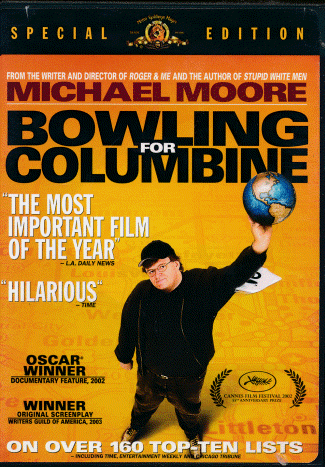
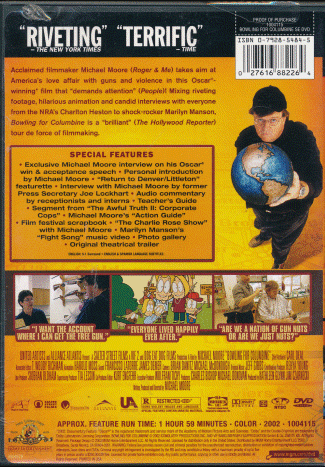
CLICK HERE TO SEE BOWLING FOR COLUMBINE -- ILLUSTRATED SCREENPLAY
CLICK HERE TO LISTEN TO "WHAT A WONDERFUL WORLD," BY LOUIS ARMSTRONG
CLICK HERE TO LISTEN TO "THE GOLDEN AGE OF GROTESQUE," BY MARILYN MANSON
Statistics: Posted by admin — Thu Jun 18, 2015 2:12 am
]]>