Subject: Did Courtney kill El Duce too?
From: me2poopon!aol.com (Me2PoopOn)
Date: 30 Apr 1997 15:53:04 GMT
Don't believe that El Duce, singer for the Mentors, was run over by a train in Riverside California while passed out on the tracks. This is the biggest piece of crap I've ever heard. First Mia Zapata, then Kurt, now El Duce (who had passed a lie detector test regarding Courtney's offer to pay him $50,000 to kill Kurt). Just a week before, El Duce stated his story to British TV cameras doing a documentary on Cobain's death. This is all too much ...
***
I was beginning to doubt everything. We went back to see Amy, but photos of her with Kurt and Courtney, which she'd been promising, never arrived.
Sorry, I've come to the wrong apartment. Sorry.
Hello.
[Man] Come on in.
[Nick Broomfield] Hi, how are you doing? Oh, is Amy in there?
[Amy] You guys can't do things like that without letting me know.
[Nick Broomfield] Your hair's changed color.
[Amy] Yeah, I colored it.
[Nick Broomfield] Nice to see you.
[Amy] Where's your girlfriend?
[Nick Broomfield] My girlfriend? You mean Alex?
[Amy] Oh, yeah.
Hi, honey. You cut your hair.
So you guys all feeling better now?
[Nick Broomfield] Yeah.
I was at the stage where I wondered how much of anything anybody had been telling me was true.
And I wanted to get the photos of Amy with Kurt and Courtney, as a kind of proof that she really knew them.
Did you manage to get those photos?
[Amy] I'm picking them up on Sunday from my parents. They are out of town. My little brother has come to visit from school. He's on his spring break.
So I'm going over there for Easter Sunday.
[Nick Broomfield] And do you know that they've actually got the photos?
[Amy] Yeah. Well, my mom says that the boxes say, "Amy's photos" on them. So they're mine. I just made her promise not to look at them. I didn't want her to see what was in there. She might not be too happy. I'm just hoping she hasn't looked at them yet.
[Nick Broomfield] Unfortunately the photos never arrived.
***
But the person I had the biggest problem understanding was Hank, Courtney's father. I wondered why he hadn't tried to support and defend his daughter.
[Hank Harrison] Here we are again: cinema verite.
[Nick Broomfield] How are you?
[Hank Harrison] No time to talk, just filming. Good, How are you?
[Nick Broomfield] Good.
[Hank Harrison] You've got a nice car this time.
[Nick Broomfield] Yeah, we received BBC's best.
[Hank Harrison] Yeah, well I didn't get any of it, but that's okay.
[Nick Broomfield] I asked him if it was true he'd gotten rottweilers to discipline Courtney as a child.
[Hank Harrison] No, pittbulls. No, originally -- this was way back in 1982 when I first got the pittbulls -- it was primarily to put some peace into our house.
I got the dogs because I like that particular kind of dog. And then when Courtney came around, she wouldn't play with the dogs anymore. She never came back after that. So it did the job that it was supposed to do. And that was designed so that Courtney would have to either learn to deal with these kinds of dogs and me -- because you know they say people are like their dogs --
[Nick Broomfield] You're kind of a pit bull?
[Hank Harrison] Yeah.
[Nick Broomfield] But I mean, then maybe it's not surprising that you and Courtney don't have such a great relationship.
[Hank Harrison] Well, I told her what the rules were -- tough love rules -- that she was a minor, she couldn't smoke in the house, she couldn't do heroin, she couldn't turn tricks, and she couldn't bring her weird heroin buddies around anymore. Those are the rules I laid down. And that she was welcome there any time. And she broke every one of those rules right away. That's when she was only 16, 17. So the reason she's alienated from me is because of the "tough love" that we tried to use on her. And she didn't want it.
[Nick Broomfield] She's hardly going to like you any more with all the theories that she might somehow be involved in Kurt's death and stuff.
[Hank Harrison] Well, I'm not in the business of getting Courtney to love me, or even like me. I'm in the business of trying to look out for my granddaughter and myself --
[Nick Broomfield] I mean, I don't know, it just seems strange that, you know, with one's own daughter that you wouldn't want to help.
[Hank Harrison] Well I do. I mean, I would like to have a relationship with Courtney, but --
[Nick Broomfield] But it seems you're going about it in just a strange way.
[Hank Harrison] Yeah, it is. It's very strange. I admit that it's very strange. And most people don't understand it. But what course have I got?
[Nick Broomfield] Well, I don't understand it really either.
[Hank Harrison] No. What course have I got? Ask yourself, what course is open to me? There is no other course. She has made the escalated battle; I have not. There's been many --
[Nick Broomfield] But the two of you are kind of at war.
[Hank Harrison] Yeah, it's a great war. I hope the public watches it. I want the public to see --
[Nick Broomfield] Yeah, but what's the point? I mean, she's your daughter?
[Hank Harrison] Well, but husbands and daughters, I mean, you saw the War of the Roses. You've seen husbands and wives fighting. You've seen daughters and fathers and sons and daughters -- families fight all the time. Why isn't our feud as interesting as the Hatfields and the McCoys? It's a family feud. It happens to be a public family feud.
[Nick Broomfield] It's a fairly incredible state when someone's own father is saying that maybe his daughter is the murderer, or murderess in particular.
[Hank Harrison] That's correct.
[Nick Broomfield] Instead of saying, "Look, if you've got a problem, you know, maybe I can help you with it."
[Hank Harrison] I have done that. That's all been done. Those are exhausted remedies that have been taken care of, or exhausted long, long ago. Those are remedies that were exhausted long, long ago. And there's no chance in the world that those are going to be patched up.
[Nick Broomfield] But is this the best way of telling her you love her?
[Hank Harrison] No. I'm not telling her I love her. That's not what I'm trying to say.
[Nick Broomfield] What are you trying to say?
[Hank Harrison] I've got her number. Hang it. I've got her figured out. She can't get away. I got her nailed. That's what I'm trying to say. It's still "tough love," and I'm still the father. Period. Cop out to me, maybe we can work something out. But keep on bad rapping me, I'll keep kicking your ass. I told her that from the beginning: "I'll keep kicking your ass. Don't take me on. I'll kick your ass. I don't care how big a show it is. I don't care if you have $177 million. I'll kick your ass." Because of one achilles heel that she has: I know how she thinks.
I know how she works inside. I've got an inside track on her mindset. You can take all the LSD, and do all the cosmetic surgery you want, but you can't fool me, because I know what her next thought is going to be.
***
[Nick Broomfield] But the information that I regarded as being closest to the reality of the situation came to us completely by chance. Someone stuck this note on our windscreen.
If you want to talk to someone about C. Love I have plenty! I'll be at the Jolly Inn corner of [illegible] & Harrison.
-- Chelsea
We arranged to meet a woman called Chelsea late at night at this house.
She lived in a room in the basement.
Chelsea knew the nanny who had been with Kurt and Courtney in the last months. I asked about Kurt.
[Chelsea] He loved her unconditionally, but I think they had a very sick love, you know?
[Nick Broomfield] How?
[Chelsea] I think it wasn't a very productive love.
Well, it was based on, from what I hear, again ...
based on drugs, and then once that, perhaps, got old ...
Courtney was infatuated with the idea of Sid and Nancy. And they often checked into hotels as Sid and Nancy.
And she told the nanny, who was a friend of mine, that they weren't going to be Bonnie & Clyde, they were going to be Sid and Nancy.
And I think that once that wore thin, I think that the only thing that Kurt had left -- again, this is all conjecture -- but I believe that Kurt's only interest at that point was Frances.
I know one incident when Kurt had been gone for a long time, and he came back, and the nanny was holding -- she was outside with Eric Erlandson and some other people --
and Kurt came back to the house. He'd been gone for a while.
And Frances had always been "Daddy, Daddy, Daddy." Everything was "Daddy."
And she, upon his arrival ...
she didn't react that way.
And she sort of turned around to the nanny, and hung on to the nanny. And this was probably a week before Kurt committed suicide.
And he said, "My own daughter doesn't even know me anymore." And he looked really sad, and went into the house.
[Nick Broomfield] Her friend, the nanny, had never been interviewed before.
[Chelsea] She might come here. She's really scared. She's always been afraid to talk about this.
[Nick Broomfield] How long was she the nanny?
[Chelsea] Four or five months. They go through nannies like people go through kleenex.
[Nick Broomfield] Really?
[Chelsea] Yeah.
[Nick Broomfield] And she's really frightened?
[Chelsea] [Nods her head yes.]
[Nick Broomfield] What's she frightened of?
[Chelsea] Courtney.
[Nick Broomfield] She had become very depressed and withdrawn following her time at the house just before Kurt died. I asked her what was so strange in those last weeks.
[Nanny] There was always just way too much Will talk.
A few different times. Major Will talk.
Just talking about his Will, and --
[Nick Broomfield] What kind of points?
[Nanny] Courtney talking about his Will. I mean, what a thing to talk about!
[Nick Broomfield] And was this just sort of prior to his --
[Nanny]Yeah. I mean, the month that I was up there was like --
[To Chelsea] I came home for what, a week? And then he died?
[To Nick] I quit. I had quit for like a week.
[Nick Broomfield] Why did you quit?
[Nanny] Because I couldn't stand it up there.
[Nick Broomfield] What did you think of Kurt himself? I heard he was a very caring father.
[Nanny] Yeah! More caring than he was let to be.
[Chelsea] What do you mean?
[Nanny] She just totally controlled him every second that she could.
[Nick Broomfield] What do you think he wanted?
[Nanny] To get away from Courtney.
[Nick Broomfield] Really?
[Nanny] And I think he just didn't have a way, because she --
[Nick Broomfield] Why do you think, if he loved Frances so much, why do you think he killed himself?
[Nanny] I'm not sure that he killed himself.
[Chelsea] There you go.
[Nick Broomfield] What do you think? Do you think that someone else might have killed him?
[Nanny] No. I don't know.
I think if he wasn't murdered, he was driven to murdering himself.
***
[Man on phone] Well, unfortunately I got --
[Nick Broomfield] As I suspected, under pressure from Courtney's people, our co-funders pulled out.
It didn't pan out?
[Man on phone] Yeah, trying to keep this project moving, I think the subtle, internal pressures, we were forced to bend to them. It's not easy for me to tell you that well, my head of programming basically asked me to bow out of the project. You know, as I mentioned it was concerns from our colleagues at MTV, because of their relationship with Courtney and Nirvana ,and everything else.
So I think we're going to have to bow out. And I extremely regret having to tell you this, but there's nothing I can do. I tried.
[Nick Broomfield] It is this control, or attempts to control, if the means dominated the whole story, then the control extended to the media.
Courtney Love
ROB SPILLMAN
BETH KSEMIAK
VANITY FAIR
CONDE NASTY
PAGE 1
RE FUCKERS
YOU ARE SO DUMB
PAGE 2
ROB SPILLMAN -- BETH KSEMIAK
VANITY FAIR -- CONDE NASTY
OH MY GOD! YOUR SO PUNK!
NEVER EVER EVER EVER
MENTION MY NAME
IN YOUR EVIL FUCKING MAGAZINE
EVER AGAIN UNTIL
LYNN HIRSHBERG IS STRUNG UP
BY HER FUCKING TOES. AND
MS. KSEMIAK IF YOU WANT TO
KEEP REFERRING TO MY WIFE
AS "NUTTY" AND "NUTTIER AND NUTTIER"
WHY DONT YOU JUST PUT THAT IN
YOUR PRESS RELEASE. INSTEAD OF TELLING
IT TO OUR ACTUAL FRIENDS IN THE MEDIA.
FUCK YOU. GRUNGE IT UP
REAGAN ASSHOLES.
Kurt Kobain
P.S. WE THINK ITS FUNNY THAT YOU WOULD
CHOOSE TO NOMINATE SUSAN FACUDI FOR
ANYTHING SINCE YOU
FUCK YOU FUCK YOU FUCK YOU "RAPEME" is dedicated --
I might have lost a bit of funding, but a lot worse has happened to other journalists.
Lynn Hirshberg, the respected and esteemed writer ...
received death threats, and threats to cut her dog, up after writing an article in Vanity Fair, which mentioned Courtney's heroin use while pregnant.
By the time he proposed ("I just knew he should ask me if he had any brains at all"), she was pregnant. The wedding was in Hawaii: Kurt, who once planned to wear a dress, wore pajamas, and Courtney wore ‘‘a white diaphanous item that had dry rot. It had been Frances Farmer’s in a movie." She signed a pre-nuptial agreement (her idea) and they did not go on a honeymoon. "Life is like a perennial honeymoon right now," she says. "I get to go to the bank machine every day."
All this would he perfect, except for the drugs. Twenty different sources throughout the record industry maintain that the Cobains have been heavily into heroin. Earlier this year, Kurt told Rolling Stone that he was not taking heroin, but Courtney presents another, extremely disturbing picture. "We went on a binge," she says, referring to a period last January when Nirvana was in New York to appear on Saturday Night Live. We did a lot of drugs. We got pills, and then we went down to Alphabet City and we copped some dope. Then we got high and went to S.N.L.. After that, I did heroin for a couple of months."
"It was horrible," recalls a business associate who was travelling with them at the time. "Courtney was pregnant and she was shooting up. Kurt was throwing up on people in the cab. They were both out of it."
Courtney has a long history with drugs. She loves Percodans ("They make me vacuum"), and has dabbled with heroin off and on since she was eighteen, once even snorting it in Room 101 of the Chelsea Hotel, where Nancy Spungen died. Reportedly, Kurt didn’t do much more than drink until he met Courtney. "He tried to be an alcoholic for a long time," she says. "But it didn’t sit right with him."
After their New York binge, it was suggested to Courtney that she have an abortion. She refused and, reportedly, had a battery of tests that indicated the fetus was fine. "She wanted to get off drugs," says Boyle. "I brought her herbs to ease the kick, so she wouldn’t freak out so badly. I was bringing stuff over to her house every day because it’s a whacked-out thing to do to a kid."
According in several sources, Courtney and Kurt went to separate detox hospitals in March. "After a few days, she left and went and got him," says one insider. "They never went back."
Whether or not they are using now is not clear. "It’s a sick scene in that apartment," says a close friend. "But lately, Courtney’s been asking for help."
She is definite about one thing: she wants the baby. And so does Kurt. In the living room is a painting he made using the sonogram of the fetus as a centerpiece. They know it’s a girl and have picked out a name: Frances Bean Cobain.
-- Strange Love, by by Lynn Hirschberg
Things reached a crazed dimension at the 1995 Oscar ceremonies when Courtney tried to bludgeon Lynn Hirshberg with Quentin Tarantino's Oscar.
I asked Lynn Hirshberg to be interviewed for this film ...
but she said she'd been terrified for her life, and wouldn't go there again.
***
Alice Wheeler, the photographer, likewise felt intimidated by Courtney.
[Alice Wheeler] ... because she has, like I said before, kind of punched out a couple of my friends. And after that book from England came out -- in England but not in the States yet -- she hired private detectives to interview at length Kurt's old friends, which was very intimidating.
[Nick Broomfield] But it's amazing they went to that trouble.
[Alice Wheeler] Oh yes. And they had a list of about 70 people that they were looking to interview. And so it was costing quite a bit of money. And I just perceived the whole idea of the private detective calling all of Kurt's old friends as a veiled threat not to talk to anyone.
And you know, I don't know what will happen as a result of doing this interview with you. I mean, I'll let you know.
***
[Nick Broomfield] Other journalists have received similar treatment. This is a phone call from Courtney to Victoria Clarke, who was writing a book on Nirvana.
[Courtney Love] I will never fucking forgive you. As a matter of fact, I will haunt you two fucking cunts for the rest of your goddamned life. Going and interviewing Lynn Hirshberg is called rape, that's what that is fucking called. That's called "rape." Fucking bitch! Only somebody on the Bitch Family Values Administration would think that Lynn Hirshberg had any kind of sucking hot interview at all. While you two goddamned idiots don't even fucking know about punk rock. I don't even know what your fucking problem is, or why you got this wild hair up your ass, because you're going to pay and pay and pay and pay out your ass. And that's a fact. Your fucking list of enemies is going to be longer than you can wrap your fucking finger around. And you're gonna be so fucking humiliated this time next week, you're gonna wish you'd never been born.
[Nick Broomfield] Courtney later physically attacked Victoria in a bar.
[Victoria Clarke] What happened was that I was in a club in Hollywood, and Courtney appeared.
And this was before I'd finished writing the book.
And she appeared, and had a go at me, basically. Physically.
[Nick Broomfield] What do you mean, had a go at you?
[Victoria Clarke] Well, she sort of grabbed me ...
and attacked me with something.
I think it was a glass or something.
And I ended up covered in beer, and on the ground.
And she pulled me along the floor by my hair, and tried to get me outside.
[Nick Broomfield] What, for some distance?
[Victoria Clarke] Yeah, for quite a long way. Yeah. It was quite a scary thing.
[Nick Broomfield] But what I found most disturbing was that Kurt, sounding psychotic and crazed, joined in all of this, in an attempt to protect Courtney.
[Kurt Cobain] This is Kurt Cobain. If anything comes out in this book that hurts my wife, I'll fucking hurt you. I don't care if this is a recorded threat. I'm at the end of my ropes. You'll understand when you see me in person. I've never been more fucking serious in my life. I suppose I could throw out a few thousand dollars to have you snuffed, but maybe I'll try it the legal way first.
William S. Burroughs and Cobain at Burrough's Lawrence, Kansas, home. Kurt later said they mostly talked about Leadbelly
-- Rolling Stone
To the left of the manor‘s grand staircase is a rather formal dining room lorded over by a dark and bedeviling Robert Hawkins painting titled The Drug Dealer’s Horse. To the right is a parlor containing three overstuffed sofas. A giant framed needlepoint angel is on one wall. On another hangs a gift to Cobain from the writer William Burroughs, a sketch, primitively rendered by the grizzled author’s apparently shaky hand, of a slit-eyed, slightly evil, alien-looking creature—an E.T. with the D.T.’s. What appear to be bullet holes riddle the portrait. The inscription from Burroughs reads. “The Priest, they called him.”
“Burroughs shot it,” a bleary Love, now standing in the room, tells me when she sees me looking at the holes. Her mottled blond hair is matted, and a white silk robe is thrown matter-of-factly over her blowsy body. “That’s what he does—he shoots up his art. Kurt would go into a Burroughs imitation when he was on drugs, or in bed. ‘All riiiight, baaaaby . . . arrrgggrrr,’” she growls, imitating Cobain imitating Burroughs.
-- Love Child, by Kevin Sessums
[Victoria Clarke] I was scared enough to leave the house I lived in and move like 3,000 miles away.
[Nick Broomfield] Seriously?
[Victoria Clarke] Yeah. Oh yeah. I had to. I mean, I left there and then. The minute I heard the messages I left. I packed my bag and left. I called the police from L.A. I didn't call them from Seattle.
[Nick Broomfield] And at that time you were living in Seattle?
[Victoria Clarke] Yeah, but I was living alone in Seattle at that time.
[Nick Broomfield] And you were really, really frightened?
[Victoria Clark] Oh, absolutely terrified. Because I knew they weren't joking. It was like serious.
***
[Nick Broomfield] I'm traveling to the ACLU Awards Dinner, the American Council for Civil Liberties, which protects First Amendment rights ...
such as freedom of speech, and freedom of the press ...
and at which Courtney Love will be the Special Guest, presenting the Torch of Freedom Award.
It's being held at the Century Plaza Hotel in Century City, Los Angeles. It was a huge Hollywood event. Everyone was there.
Al and Jack were there, too. Here's Al shaking hands with Larry Flynt.
They had prepared a whole list of special questions for Courtney.
Being somewhat taken aback by the whole occasion, I let Al go first.
[Courtney Love] Hi there.
[Al] I caught a little of your rehearsal at SIR. You sounded really good.
[Courtney Love] How did you catch my rehearsal at SIR?
What were you doing there?
You weren't supposed to do that.
[Al] It was some other business.
But what I wanted to know is I heard you do ...
"Lets let the Sun Shine In."
Did I hear that?
[Courtney Love] No, no. Did it have like a lyric about the sun or something?
[Al] Yes.
[Courtney Love] We're doing this whole ...
California record ...
"Malibu." It's called "Malibu." That's probably what you heard.
[Al] Are there a lot of new members in your band?
[Courtney Love] We've had the same members for years!
[Al] So it's not a new band?
[Courtney Love] [Shakes her head no]
[Al] I got some bad information.
[Courtney Love] Yeah, I love my band.
They're great.
[Nick Broomfield] Al's nerve had obviously failed him, too.
"El Duce. Killing Kurt." This was your big chance.
[Al] But you didn't want me to do that, did you?
Hey, I was overwhelmed by the moment.
I had her there, and she got pissed about the Ed Norton thing, and I thought "Jesus --
[Nick Broomfield] You were going to ask her finally about El Duce, or about --
[Al] So now I'm the guy on the spot now? All of a sudden --
[Nick Broomfield] I thought you were going to ask her about --
[Al] You know, I was overwhelmed by her beauty!
[Nick Broomfield] Courtney!
[Courtney Love] Hi, Nick.
[Nick Broomfield] Courtney, what does the ACLU mean to you?
[Courtney Love] Well, it's a lot like my parents.
Very liberal.
It's very good that it's around. It protects everybody.
It kind of keeps the American ideal very much alive.
It's really important.
It's not very glamorous, for a political organization, which is what I like about it.
It's very, very, very liberal.
And it's about everything, from the anti-death penalty ...
I mean it favors, sometimes, thing we don't all like.
[Nick Broomfield] But Courtney, why have you personally threatened journalists in the past?
[Courtney Love] Have I threatened them?
Well, because it's my right to do it. It's not against the law.
But that doesn't mean I'm going to take them to court! Unless they lie.
Don't lie.
And when I was really young, you know, I didn't know that like I was weird.
I grew up with hippies, so I never knew that I was bugging anybody.
So when I kind of got crap for it, it freaked me out.
But I don't want to talk about it, because I'm so happy.
[Nick Broomfield] But what about death threats?
[Courtney Love] [Puts card up to her ear and walks away]
***
[Audience] [Clapping]
[Nick Broomfield] I wanted to pursue the question further, but the next thing I knew Courtney was onstage.
[Courtney Love] There's so many people in this room tonight that have really taught me a lot about ...
integrity.
And in a time when the Bill of Rights is being attacked a lot, and precious few people, especially from my generation, are standing up to say, "Stop!", all forms of media, the lowest and the highest, have their absolute right to that First Amendment right as well.
[Nick Broomfield] I couldn't actually quite believe what I was hearing. But I decided to do something I've never done before: to ask a question in public that I considered well worth asking. Unfortunately, Alex started having a panic attack behind the camera.
I don't want to appear to be a party poop, but in the interests of free speech, I wanted to ask a couple of questions. I think Hollywood always has a problem distinguishing reality from myth or image.
And unless it is considered appropriate behavior to threaten, or cajole, or manipulate journalists, esteemed journalists, who have written unflattering reviews, I find it a strange decision on the part of the ACLU to choose Courtney Love as a Special Guest here tonight. And to Courtney Love, I would just like to ask what you'd feel --
[Danny Goldberg] Hey, get off the fucking stage!
[Nick Broomfield] That's the president of the ACLU you can hear shouting.
[Danny Goldberg] Excuse me, but you're not part of the program. Get the fuck out of here.
[Nick Broomfield] He's a good friend of Courtney's.
This clearly wasn't going to be my entree into the world of [inaudible] speakers.
But I also wondered what kinds of things might be done to try and control this film in the future, and Courtney [inaudible] as a kind of epilogue in any such attempts.
FAVORITE MOMENT - The ACLU Banquet
Freedom of speech is what this film was really all about. Broomfield has succeeded in exposing the cowardice and hypocrisy of Courtney Love and A.C.L.U. President Danny Goldberg. The film audience is allowed to watch as concealed cameras record Broomfield being physically removed from the stage by Goldberg himself.
What was Nick's unforgivable sin?
He criticized Courtney Love and the A.C.L.U.!
This moment in the film is hilarious, outrageous, and shocking to say the least. I mentioned the ACLU incident in a previous update when I first heard about it several months ago. I'm going to reprint it here for those who haven't read through the entire website.
DANNY GOLDBERG - EXPOSED
Audacity and hypocrisy have been clearly defined by the recent actions of Danny Goldberg, President of the Southern California A.C.L.U. Foundation.
In addition to his position with the A.C.L.U., Goldberg is the entertainment industry executive who is married to Rosemary Carroll, Courtney Love's entertainment attorney. If you're not familiar with the "special relationship" Danny Goldberg has with Courtney Love, you may want to study the investigation material in the Cobain Case Study Manual.
Rosemary Carroll
Grant spoke to Cobain's attorney, Rosemary Carroll, at her office on April 13, 1994. He says that she pressed him to investigate Cobain's death, and claimed that Cobain was not suicidal. Grant also claims that Cobain had asked her to draw up a will excluding Love because he was planning to file for divorce. Grant claims that this was the motive for Cobain's death. Carroll has not confirmed Grant's allegations or commented publicly on the matter.
-- Death of Kurt Cobain, by WikipediaNo matter how lonely or broke, Love has always maintained her survival instincts and steeled herself against the vagaries of life with an innate stoicism. It is a stoicism, in fact, that she has passed on to Frances Bean, who displays it in all her alarming, lovely innocence. “Frances is an amazing little kid,” says Rosemary Carroll (no relation to Love’s mother), who is not only Love’s lawyer but also the wife of Warner’s Danny Goldberg. “She’s so prematurely adult. My daughter, Katie, is about two years older than Frances. At Christmastime, Danny and I took Katie and Frances to see A Christmas Carrol. We came home, and the kids were playing, and they got in a fight, as kids do. My daughter tends to be a . . . well, ‘brat’ is one word that other people have used,” Carroll says, laughing. “Anyway, she said, ‘Frances, I hate you!’ She threw down a doll and stormed out of the room. The normal reaction is for the kid who is left standing there to start crying, especially if your mom or your nanny isn’t there. Frances did not bat an eye.”
-- Love Child, by Kevin Sessums, Vanity FairLinda Carroll (born 1944, San Francisco) is an American author and a marriage and family therapist. She is the mother of singer and musician Courtney Love, and the daughter of author Paula Fox.
Linda was born to Paula Fox when she was 20, the result of a one night stand. However, given the tumultuous relationship with Paula's own biological parents, she gave the child up for adoption. Linda was adopted into an Italian Catholic family, and raised in Pacific Heights by Jack and Louella Risi.
Of course, "Her Mother's Daughter" also has the undeniable draw of Love's celebrity. Carroll hasn't spoken to her famous daughter in years, though she remains in touch with her granddaughter, Frances Bean Love-Cobain. In many ways, Carroll and Love's relationship hasn't changed much in 30 years. Carroll found her mercurial first daughter intimidating in childhood. She still does.
"What's our relationship?" she asks, poking at a plate of fried rice. "It's complicated. I haven't talked to her in a long time, but even when I did, it was horrible -- a lot of screaming, yelling, accusations. I would react to her volatility by distancing myself because it scared me so much, and I didn't know what to do. I didn't want to engage in it with her. For her, it came across as coldness. But it wasn't really coldness; I was freaked out. People ask if I'm at peace with our relationship. Of course I'm not. She's my child."
Relations with her own biological mother have fared better. Carroll, now a therapist in Corvallis, Ore. (her clients have included political fugitive Katherine Ann Power), decided to track down Fox in the early '90s after Love became pregnant with her own daughter. Fox later wrote of their reunion in San Francisco in her 2001 autobiography, "Borrowed Finery."
"It was so weird to see so many ways that she's like me," says Carroll. "Kids need a certain kind of mirroring when they're growing up, and my adoptive parents didn't know how to mirror me because I was so different from them. But with Paula, I saw so much of myself, so much of my own history in her story."
Fox's life, which Carroll describes as "Dickensian," was at least as colorful as her daughter's. Sent to an orphanage as a child, she had Carroll at 20 after a one-night stand. In an echo of her own abandonment, Fox gave her child up for adoption, and Carroll was raised in Pacific Heights by Jack and Louella Risi. It was no storybook girlhood: Her father, she writes, was sexually transgressive; her mother, distant.
-- Mothers & Daughters, by Neva Chonin, SFGate.com
Linda took her surname after her friend Judy Carroll, after Judy's death. Linda graduated from high school in 1961. She married writer and one time-Grateful Dead manager Hank Harrison in Reno, and gave birth to Courtney Love in 1964. Within years of Courtney's birth, both Carroll's adoptive parents died. Also, Carroll's three-month-old baby died of a heart defect. She divorced Harrison in 1969, alleging that he had given Love LSD, and brought her daughter with her to Marcola, Oregon.
After high school, Carroll's fascination with odd characters led her to the Haight's hippie community and finally to Hank Harrison, an early Grateful Dead associate who threatened to kill himself unless Carroll slept with him. At a loss, she did. They later married in Reno and Carroll became pregnant with Courtney. The two divorced, Carroll says, after Harrison's behavior grew increasingly violent and erratic.
Courtney Love's childhood was blighted from the start. She returned from visits with Hank covered in paint, talking about drugs and suffering from nightmares. Expelled from school after school, interviewed by psychiatrist after psychiatrist, she was prone to fits of rage and feelings of persecution.
-- Mothers & Daughters, by Neva Chonin, SFGate.com
She had two other daughters with the second husband, and settled on a hippie commune in Oregon. She divorced and married Frank Rodriguez.
After finishing her bachelors degree in Oregon in the 1970s, she moved to New Zealand. She returned to Oregon in the 1980s and received a masters in counseling, and began practicing as a therapist. In the nineties, she and her veterinarian husband, Tim Barraud, began to teach a couples course based on the Imago work of Harville Hendrix, the PAIRS training of Dr. Lori Gordon, and their own insights, study, and practices.
As an adult, Carroll found that her birth mother is the novelist Paula Fox (her grandmother was screenwriter Elsie Fox). In 2006, her memoir Her Mother's Daughter: A Memoir of the Mother I Never Knew and of My Daughter, Courtney Love, was published by Doubleday. Carroll has not spoken to her daughter in years and remains estranged. Love's agent called the book a work of "vicious and greedy fiction", and said, "We find it astonishing that any mother should write such a book. This is especially true in the case of Ms Carroll, who abandoned her daughter when she was a seven-year-old and whom Ms Love thus barely knows at all." In 2008, Remember Who You Are was published by Conari Press, and she is currently working on a book about relationships entitled Love Cycles.
-- Linda Carroll, by Wikipedia
I recently came across a web site containing Goldberg's bio. As we were already aware, his connections and influence within the music industry are noteworthy and go far beyond the minor details mentioned here. The bio reads in part:
"Goldberg began his career in the late 1960s as a journalist, working for the music trade publications Billboard and Record World. His byline also appeared in Rolling Stone, the Village Voice, and Circus, where he served as editor.
"In 1984 Goldberg went on to form Gold Mountain Entertainment, an artist management company that counted Bonnie Raitt, Nirvana, and the Beastie Boys among its clients. As a political activist, Goldberg chaired the American Civil Liberties Union Foundation of Southern California and now serves as its president. He is an eloquent advocate of free speech issues, especially in the arts and entertainment."
Danny Goldberg, husband of Rosemary Carroll and founder of Nirvana's management agency Gold Mountain Entertainment, refers in his book Dispatches From The Culture Wars: How The Left Lost Teen Spirit to "the crazy Internet rumors that Kurt Cobain had not committed suicide but had been murdered" and states that Cobain's suicide "haunts me every day".
-- Death of Kurt Cobain, by Wikipedia
AN ADVOCATE OF FREE SPEECH ISSUES?
On May 21, 1997, the A.C.L.U. Foundation of Southern California held their Torch of Liberty Awards banquet. Courtney Love, of all people, was there to present director Milos Forman with a "Freedom Of Speech" award.
Following the presentation, film journalist Nick Broomfield walked to the podium and criticized the A.C.L.U. for including Courtney Love in the program.
During a recent phone conversation, I asked Broomfield what he said to the audience at the A.C.L.U. event. Here's what he told me:
"I said that I didn't mean to be a party poop, but I've had some questions about Hollywood having a problem distinguishing reality from myth or image and unless it was now considered appropriate to threaten to kill members of the press who had written unflattering articles about you, I consider it extremely poor judgment to have Courtney Love as a special guest. And I didn't get much further than that because Danny Goldberg removed me from the podium."
"Did he actually physically push you away?" I asked Broomfield.
"Yeah, he pushed me away." Broomfield responded. "He came up screaming, 'You can't talk. You weren't invited to speak,' which I thought was interesting [coming] from the President of the A.C.L.U."
The incident was also documented by reporters attending the event. The following day, Reuters news service reported:
... Soon Mercury Records chief, Danny Goldberg, grabbed him and whisked him off stage, saying: "Excuse me sir, you were not invited. You were not part of the program.''
Later, Broomfield said that he has been doing a documentary on the way in which the media has been controlled. "I am looking at the case of Courtney Love, who has been so abusive and threatening to journalists,'' he said.
Said Love's spokeswoman: "This person apparently has some sort of personal agenda. Courtney generally has a good relationship with the press."
Courtney's spokeswoman was partially right. Film journalist Nick Broomfield does have an agenda, one that I support wholeheartedly. Broomfield has interviewed me on several different occasions. While many of the issues regarding the events surrounding Cobain's death will be discussed in his upcoming documentary, Broomfield indicated the primary focus of the project is going to be Courtney Love's manipulation, suppression and control of the media.
Does Courtney Love have a good relationship with the press? Sure she does... as long as they serve her purposes, aren't too critical of her, and don't ask specific questions about the suspicious circumstances of her husband's death!
And what's Danny Goldberg afraid of here? When did the A.C.L.U. start getting physical with people who simply exercise their right to free speech?
Is Goldberg really an advocate of free speech... or a controller of approved speech? Someone needs to tell this man his fly is open.
-- Nick Broomfield's Kurt and Courtney, by Tom Grant
***
But the person who has used all this so positively was Mary, Kurt's aunt.
We went to meet her at Kurt's old primary school in Aberdeen.
[Aunt Mary] Is there anybody here who does not know who Kurt Cobain was?
Okay, I just had to ask.
[Nick Broomfield] Mary, using Kurt's life as an example ...
has devoted herself to teaching in schools about drugs and addictions.
She introduces herself with a song dedicated to Kurt.
[Aunt Mary] There's a message of life in this song.
And it's a lot like you and me, when we're going through hard things in our lives. And losing Kurt was one of the hardest things I've ever been through in my life. And I'm still going through it. I still cry. I still hurt from time to time. I miss him. And all of us go through painful things in our lives. It's just part of life. Nobody is exempt from pain.
[Nick Broomfield] I remembered this footage that Mary had given me of Kurt.
***
Co-Producers
Tine Van Den Brande
Michele D'Acosta
Editors
Mark Atkins (UK)
Harley Escudier (US)
Director of Photography
Joan Churchill
Alex Vender
Production Co-ordinator
Daniel Harris
Post-Production Supervisor
Annabel Leech
Special Thanks To
Alan Barker
Detective Barth
Al Bowman
Jack Briggs
Dylan Carlson
Jan Celt
Chelsea
Victoria Clarke
Mikey Dees
El Duce
David Duet
Mari Earle
Fitz of Depression
Emily Freshwater
Annie Girgich
Tom Grant
Ian Halperin
Hank Harrison
Jo Lapping
Tracy Marander
The Moore Hotel
Napalm Beach
Rozz Rezabek
Claire Rogers MCPS
Seattle Police Department
Gwen Sessions
The Tattoo Centre
Vidiots
Max Wallace
Ken -- Westside Mercedes
Additional Photography
Kimona Longinotto
Al Bowman
Rostrum
Ken Morse
Sound
Sarah Jeans
Sound Mixer
Mark Rozett
Sound Mix
Cinesound
Sound Transfer
Document
De Lane Lea
Production Assistant
Elsie Pearlstein
Post Production Assistants
Ursula Burton
Stephanie Schwam
Accounting
Lena McKenzie
Mark Proffer
Alan Cooper
Legal Consultant
Peter Dally
Marriott Harrison
Consultants
Melissa Rossi
Mike Romano
Dr. Colin Brewer
Stills
Alice Wheeler
Tracy Marander
Michael Kabiner
Hank Harrison
Rex Features
Retna
Sub Pop
Titles
Cinematte
Title Design
Robert E. Dohrendorf
Video Transfer
TVP (London)
Video Editing
Postbox
Neg Cutter
J&G Films
Danny O'Grady
Prints
Duart
Transcripts
Sound Transcriptions
Steenbeck Maintenance
Roy Calver
Archive Footage
BBC Television
KTLA
King TV
Much Music
NBC
Sub Pop
Mari Earle
Jan Celt
Rozz Rezabek
Music
"Pyramid's Babylon"
Written and Performed by Theatre of Sheep
"Shake"
Written and Performed by Theatre of Sheep
"Potential Suicide"
Written by Greg Sage
Performed by Napalm Beach
'Tallahasse"
Written by Dylan Carlson
Performed by Earth
"Crooked Axis for String Quartet"
Written by Sean Mcelligot
Performed by Earth
"Smack City"
Written by Blag Dahlia
Performed by The Dwarves
"302 Cubic Inch V8 Powered Blues"
Written by Blind Marky Felchtone
Performed by Zeke
"You Are My Sex Slave"
Written by El Duce
Performed by The Mentors
Executive Producer
Nick Fraser
Produced and Directed by
Nick Broomfield
Copyright © 1987 Strength Ltd. All rights reserved.
_______________
Notes:
Celebrity Deathmatch "Brandy vs. Courtney Love"
Celebrity Deathmatch "Billy Corgan vs. David Grohl vs. Courtney Love"
Statistics: Posted by admin — Sat Jun 20, 2015 11:18 pm
]]>
[Tom Grant] Here we go!
[Nick Broomfield] This is the actual recording of Dylan and Tom Grant searching for Kurt on April 7 in the middle of the night.
[Tom Grant] Now you can just open the door for me. Kurt? Kurt? Kurt? Kurt? Hello? Hello, Kurt?
I'm going to follow you, too, here because you know where everything is. Kurt?
Does this go up another story?
[Dylan Carlson] Yeah, there's an attic.
[Nick Broomfield] Kurt's body was in the greenhouse above the garage. Tom Grant believes Dylan deliberately avoided showing him the greenhouse.
The first night we went to the Lake Washington house, I sent Dylan up alone first. Kurt would not have known who I was and we knew he had that shotgun for protection, so I didn't want to take a chance that Kurt might see me before he saw Dylan and shoot, thinking I was an intruder. Now that I know more about Kurt, I doubt he would have done that, but at the time I didn't know what to expect from him, based on fake information I had been given by Courtney.
But Dylan took much longer to return to my parked car in front of the house than I anticipated. And when he did, he simply told me no one was home.
That is the only thing I am suspicious about. Dylan was gone too long to have simply gone to the door or walk around the house looking for Kurt. That causes me to speculate that Dylan may have walked up the stairs that led to the back entrance to the greenhouse, looked through the glass entrance doors and saw Kurt lying on the floor, obviously dead.
This may have stunned and confused Dylan. When we heard on the radio that a body was found at the Lake Washington house, he had no reaction at all. He just stared straight forward as I began asking him questions about the "greenhouse."
I believe Dylan cared about Kurt as a friend and fellow heroin addict. I don't believe he would have wanted Kurt dead. I suspect Dylan's only role was that he may have discovered Kurt's body and didn't know what to say or do. He was dazed and confused as was being used and manipulated by Courtney every time we stopped so he could call her for instructions."I think he's just a dipshit. A total incompetent. I was with him for three days when he came up here. He is a total incompetent. He couldn't find his ass with a map."
-- Dylan Carlson, Death of Kurt Cobain, by Wikipedia
I believe Courtney was trying to get us to find Kurt's body through the instructions she was giving Dylan over the phone. But no one can convince me that Dylan knew Kurt was going to be killed. Once that happened, Courtney immediately became Dylan's only source for getting the heroin he needed.
Like I said earlier, a heroin addict is mainly concerned about getting their next fix.
-- Was Dylan Carlson Involved in Kurt's Death?, by Tom Grant
I don't know what I think about the whole murder conspiracy.
[Dylan Carlson] Let me put it this way, if I seriously thought Kurt had been murdered, if I thought Courtney was involved, or someone else, they would be dead now. Flat out. I would kill them if I thought that was the case.
[Nick Broomfield] But don't you think it's curious that if Courtney, as you said, loved Kurt so much, and she was really so worried about him, she knew he had a gun, and thought he was suicidal, that she didn't come up to Seattle to look for him?
OXFORD, Ohio (AP) -- Miami University men have been asked to paint their fingernails red to mark the one-year anniversary of the massacre at Virginia Tech.
The project conceived by a professor and students in his men's health class is meant to raise awareness about senseless violence committed by men.
Miami junior Tyler Topel is co-chairing the project, dubbed Operation Jungle Red. Topel says they want to make Miami a leader in getting college men to speak out against violence.
The goal is to have 1,600 men on the Oxford campus paint at least one of their nails with red polish.
Wednesday will be one year to the day that a disturbed gunman killed 32 students and himself at Virginia Tech.
-- Miami Students to Paint Fingernails Red for Va. Tech Anniversary, by Snickering Hound (4/15/08)
***
We were still trying to get in touch with Courtney Love. We returned to Los Angeles to see Al and Jack. Al and Jack call themselves "Stalkarazzis."
They work for the tabloids, and live under the main LAX flight path.
What do you see yourselves doing?
[Al] Well, as far as you're concerned, you know, you want to find Courtney Love. And she is in a lockout with her band at the rehearsal facility in Hollywood for the next several weeks, preparing for Hole's upcoming tour.
And so it would be quite easy for you to get this question into her.
[Nick Broomfield] Like stalking.
[Al] Well, I mean we have a specific studio where she is at, where you will be able to find her.
[Jack] We'll have to be like stalkarazzis, which I like to call these people. We'll have to sit there, wait till she comes out one morning -- they are there for 6 hours a day -- so you want to be out there probably with a smaller camera than the one you have here just in case something does happen, and we can whisk it away.
[Al] And we could always go covert, too. You know, don't forget I could dress as an electrician in jumpsuit and workbelt, and kind of mosey on in there under the guise of some other reason for being there.
[Nick Broomfield] Al and Jack also wanted to put me in touch with this man, El Duce, who they claim was offered $50,000 by Courtney to kill Kurt.
I think what we should do is go and visit El Duce out in Riverside, or whatever.
[Jack] Yeah, we've got to find him out in Riverside, because that's where he's at.
[Nick Broomfield] Do you know where he is?
[Jack] Yeah, we know his location. He's not afraid of Courtney, but he doesn't like to come into Los Angeles that much. He likes to have his little hangout.
[Nick Broomfield] Why doesn't he like coming to Los Angeles?
[Jack] Uh, just because a lot of times he has been hassled by the authorities. Pretty much a lot of people know him out here.
[Nick Broomfield] The police?
[Jack] Yes.
[Al] You gotta consider that parents of young children who like the Mentors, absolutely hate this man. Because he is a debaucherous sort of fellow who --
[Nick Broomfield] Debaucherous?
[Al] Debaucherous. Very. You know, he wears an executioner's mask. [To Jack] And hasn't he had sex acts on stage?
[Jack] Yes. And there's no doubt that Courtney, knowing him well, would know, "Hey, if I wanted to hire somebody to kill somebody, El Duce would be the man."
He'd be liable to do it like that [snaps his fingers].
***
[Nick Broomfield] And this is the promo for El Duce's band, "The Mentors."
[El Duce] The lady on the street.
Your ass looks so sweet. [Inaudible]
Your body looks so fine ...
I want to make it mine.
You are my personal whore.
You are my sex slave.
You do whatever I crave.
Your ass, I love the beat --
another piece of meat --
[Nick Broomfield] The following day we drove out to Riverside with Divine Brown's pimp, a close personal friend of El Duce's, who said he could put us in touch.
[Alvin C. Gangsta Brown] Want to give it a try?
[Nick Broomfield] Okay.
[Gangsta Brown] Back, Vixen! That looks like him right there, actually!
That's the one. There he is: El Duce. There he is right there. Hey, I got some Courtney Love there.
There it is. This is him: El Duce.
[El Duce] Where's the booze?
[Gangsta Brown] He's just perverted.
[El Duce] Yeah, warped, and intoxicated most of the time.
[Nick Broomfield] But you did some deal with Courtney, right?
[El Duce] Yeah! She offered me $50 grand to whack Kurt Cobain.
[Nick Broomfield] She what?
[El Duce] 50 grand to whack Kurt Cobain.
[Nick Broomfield] And that's a fact, is it?
People might think you're not the most reliable witness.
[El Duce] Well, that's too bad. You might not be the reliable witness your own self.
Now think about that one.
[Nick Broomfield] Yeah.
[El Duce] You know, when she offered me money ...
gawd dang, I wish I would have taken it, man.
But I know who whacked him.
[Nick Broomfield] But how were you going to whack him? Did she tell you how to do it?
[El Duce] Yep! Blow his fucking head off.
[Nick Broomfield] But where were you going to find him to do it?
[El Duce] Well, up there in, she gave me, you know, mapped it out. I mean, up there in Bellevue. Wherever they live, right outside Seattle. I know right where the house is. I know what garden to pop him in.
I just didn't think she was serious!
[Nick Broomfield] But did she tell you how she wanted you to accomplish it?
[El Duce] Yeah, blow his fucking head off.
I got the shotgun.
[Nick Broomfield] But she didn't say anything about making it look like a suicide?
[El Duce] And make it look like a suicide.
[Nick Broomfield] Yeah, well, but if you just blew his brains out like you said, it wouldn't look like a suicide, it would look like you blew his brains out.
[El Duce] Right. But I told Alan -- I mean, my friend -- who ...
[laughing] ...
uh, I'll let the FBI catch him.
But that's just the way it's done. End of story.
Hey, $50 grand does a lot of talking.
Buy me a beer, and I might do some more talking. [Laughing]
[Growling]
[Nick Broomfield] And that seemed to be the end of the interview. I didn't know quite what to think.
El Duce had passed a polygraph test ...
even though his main witness had nodded off before its completion.
The April '96 edition of High Times featured an article called "Who Killed Kurt Cobain?" written by Tim Kenneally and Steve Bloom. In this article the authors aired the views of Tom Grant, El Duce and Hank Harrison (Courtney's father.)
El Duce was a first degree beer gut. He was the singer for a notorious band called the Mentors, who, strangely enough, played their debut gig at a club called The Bird in Spring Street, Seattle, on March 4 1978. Courtney met El Duce in the late 80's.
A founder member of her band Hole was Caroline Rue who was going out with Eric Carlson, aka Sickie Wifebeater, who was the Mentors guitarist.
The fact that El Duce had some knowledge of/connection with Seattle would be useful.
During the High Times article El Duce claimed that in the last day's of December 1993, Courtney Love pulled up outside The Rock Shop, a Hollywood record shop, at 1644 Wilcox Ave, Hollywood, and spoke to him. The conversation went:
C Love: "El, I need a favour of you. My old man's been a real asshole lately, I need you to blow his fucking head off."
El Duce: "Are you serious"?
C Love: "Yeah, I'll give you $50,000 to blow his fucking head off."
El Duce: "I'm serious if you are".
C Love: "Where can I reach you"?
El Duce: "You can reach me here".
They then went into the store and he handed her a business card. The manager of the shop, Karush Sepedjian remembers the visit. He said: "El was kicking it out on the bench in front of the store and she came up. I overheard her saying, "Can you handle doing this? Can you get this done? What do you want for it"? They were talking about knocking off Kurt Cobain. Then El brought her inside and said to me quietly, "She offered me $50,000".
Love then took a business card and left. Sepedjian then went on to say that in March 1994 Love contacted the shop asking for El Duce, who at the time was on tour. Courtney was screaming: "That son of a bitch, we made an agreement. What am I going to do"? Sepedjian replied: "I don't know, I've got a business to run. Goodbye."
Ten days later Kurt's body was found. This would imply that she spoke to Sepedjian around March 30th 1994. Could this be the "business" she told Carroll and Grant that she had to attend to, rather than going back to Seattle to look for Kurt?
Sepedjian went on to say: "I was like Whoa! I wonder if she actually did pay some sucker to blow off his head"? El Duce said; "Maybe she got somebody else. I think Kurt was getting ready to divorce her for adultery charges. She had to have him whacked right away so she could get the money."
-- Eldon Hoke, aka El Duce, by Frances Barnett
***
This is Al and Jack rehearsing questions for Courtney.
[Al] Courtney, hey!
[Jack] What's this motherfucker! Just like that. Be ready, because she's going to fucking try to grab that camera.
The first thing she's going to see is that camera.
[Al] The old Sony handicam. We know this will do the job.
[Nick Broomfield] This is Al shooting at Courtney's rehearsal studio, where they're posing as record producers.
[Al] I like that stage. It's killer. That's perfect.
[Nick Broomfield] And here's Courtney's studio door.
[Al] I can hear her in there. I can hear her in there talking now.
Here's Jack buying soda pop, trying to pluck up courage.
And here's Al making his way over to join him.
Unfortunately, the battery ran out.
***
I found the closest we could get was to watch her at the Oscars.
[Newsman] Courtney Love, have you been embraced by the Hollywood community in the last year?
I think so.
[Courtney Love] I mean, if you mean like treated really nicely ...
and not having to dive into mosh-pits ...
Oh my God!
So nice.
So nice.
[Newsman] And to that end, there are so many fans of Hole, and of your musical work, are you going to give it up for movies?
[Courtney Love] Three days I have to start. And I'm excited.
But it's another: see these?
These symbolize that I am not playing guitar. They're taking meetings.
When these come off, it's about the grunge.
I was going to wear a flannel tonight.
[Newsman] Well, maybe next time. Maybe when we see you next year.
Ah, Courtney schmoozing with directors. We have more to schmooze with you as we continue.
Lots of stars are here.
[Newswoman] I'm just jumping all over. We are live from the Academy Awards!
***
[Nick Broomfield] I didn't quite know what to make of the various conspiracy theories, but I found that the more I went into the details of them, the closer I got to what actually went on.
We went back to see Kurt's Aunt Mary.
Did you feel that Kurt was quite unstable?
[Aunt Mary] Yes, I did. I do feel that Kurt was an unstable person before he ever got into the music business. And when he was here recording in this room, this very room, when he was 17 years old, he and his friend, the drummer that he brought along, took off for lunch or something. And I kind of sneaked in here. And I was looking at his lyrics. And there was a song that was in amongst his lyrics that he never did record on that particular tape that I remember, but it was called "Seaside Suicide." And I remember that it left me with the impression that he had possibly tried suicide before.
[Nick Broomfield] Really?
[Aunt Mary] So I cannot even remember the words or anything, but I do remember that impression that it left with me. And I was kind of like, "Whoa," you know?
[Nick Broomfield] "Seaside Suicide"?
[Aunt Mary] Yeah. So anyway, I don't believe in the conspiracy theory that he was murdered. I don't believe in it. His suicide note, from what I understand, was written to his imaginary childhood friend named "Baddah."
Two handwriting experts found that there were two different sets of handwriting on the "suicide note". The interesting point here is that the part that Kurt definitely wrote didn't say that he was going to kill himself. It implied that he was leaving the music business: A note for his fans rather than for his wife and child.
-- http://www.angelfire.com/nv/boddah/facts.html
That was his little imaginary friend that he had. And we used to do these recordings in my bedroom at home. My brother had a tape deck, and he brought it over. And it had this thing called "sound on sound." And it had this reverb unit in it. And he'd go, "Baddah," and it would go "baddah baddah baddah" in reverb.
[Kurt Cobain as a 2-year-old] What baddah? He did it.
What baddah? He did it again.
What baddah? He did it again.
What baddah? He did that again.
[Aunt Mary] All this stuff on this earth isn't all that great. There's a lot of great things. I watched the Academy Awards last night and, you know, it's so full of glamour and all that stuff. But it's so phony. I could have never seen Kurt sitting at something like that. It's just too phony. And maybe that's what he was really feeling in his life too, is that it is so phony. It's not real. It's not true. It's all put up there as a big, I can't even think of the word -- a mirage.
[Nick Broomfield] Towards the end, Kurt's life had become one of endlessly touring.
In particular, he resented having to sing, "Smells Like Teen Spirit," at every performance.
Mary, Kurt's aunt, felt that the patterns of his childhood had been recreated in his adult life.
As Kurt's relationship with Courtney floundered, all the worst horrors of his childhood resurfaced.
The loneliness, the betrayal ...
and the sense of abandonment.
***
Tom Grant told me that two fans of Kurt, ages 12 and 14, had committed suicide in France that day. He sincerely believes that if he can prove Kurt was murdered, there will be fewer suicides. The case has bankrupted Tom Grant, and he has had to give up his office. We arranged to meet him at the Westwood Golf Club.
Hi! How are you?
[Tom Grant] Pretty good.
[Nick Broomfield] I told him that a lot of people disagreed with his theories.
[Tom Grant] When you talk about a man that had 1.52 milligrams of heroin in his system when his body was found, and the fact that that has never happened in any other recorded case that we've been able to find, after researching thousands of cases in several countries around the world for the last 20 years --
[Nick Broomfield] But isn't that an indication that he could be suicidal, too? I mean, there's no proof that somebody else put it --
Kurt used the phrase "I hate myself and want to die" often, which some people now point to as proof he was suicidal. The fact of the matter is Kurt was being sarcastic. He is quoted in many interviews as mentioning that he almost named Nirvana's "In Utero" CD, "I hate myself and want to die", but he didn't because he knew people wouldn't get the joke.
-- http://www.angelfire.com/nv/boddah/facts.html
[Tom Grant] No, no, no. We're talking about evidence indicating it would have been impossible for him to pick up the shotgun.
Now, for anybody to just continually say, "Well, he had a high tolerance level; it's possible he was suicidal," you're just denying and ignoring some real basic facts here. If it was possible, there would certainly be some other cases to be found where this has happened before.
With all these facts established, this is the scenario that would have had to take place: Kurt would have had to survived the overdose (or at least still be conscious), rolled down his sleeves, tucked all his drugs etc. neatly away in his box, wipe the fingerprints off of that AND the pen used to write his "suicide" note, pick up his gun, locate his mouth, pull the trigger, wipe all the finger prints off of the gun, and then place it on his chest. Not only is that EXTREMELY unlikely, but it's also physically IMPOSSIBLE. Certainly there are arguments such as, "He could've wiped fingerprints etc. before he shot up," but that would still leave fingerprints on the gun. And why the hell would he do that anyway? Why would he bother to wipe any of the fingerprints off of anything? In fact, why would he do any of the things that make this so obviously a murder case?
-- http://www.angelfire.com/nv/boddah/facts.html
[Nick Broomfield] But he also had a gigantic habit, didn't he?
[Tom Grant] Again, you can say that until you are blue in the face, but show me another case where it's ever happened. You'd have to believe that Kurt Cobain was the biggest heroin user that had ever existed --
[Nick Broomfield] Well, he was pretty big.
[Tom Grant] But he was just a typical heroin user. He's not that unique.
[Nick Broomfield] But it's possible that he managed still to operate the shotgun.
[Tom Grant] Well, it's possible if you believe that it's possible to stand on a rooftop and flap your arms and fly. Show me a case where it's ever happened before, and I'll believe it's possible.
[Nick Broomfield] I mean, I'm not a specialist on the amount of heroin one can take. All I know is, you know, in making the film, time and time again, people who knew him very well, said that he was suicidal. He was extremely depressed. His career was at a crossroads. His relationship with Courtney was at a crossroads. And that he was withdrawn, and he felt he had nowhere to go.
[Tom Grant] Well, let's just assume for a second Kurt Cobain was suicidal, okay? Strictly based on that premise alone, that this man was suicidal, you tell me what difference that makes in light of the real evidence of this case? It doesn't matter. Just because a person's suicidal doesn't give somebody the right to kill them. And just because a person may be suicidal, which I don't believe he was, but if he was, that doesn't mean that the police don't have to do a thorough investigation once his body is found.
[Nick Broomfield] Tom Grant's assertion that 1.52 mg. of heroin per liter of blood would have incapacitated Kurt were discounted by Dr. Colin Brewer, formerly director at Westminster Hospital.
Dr. Colin Brewer MB,MRCS.DPM.MRCPsych.
Medical Director
He gave us this color slide of a patient balancing easily on one leg, who had taken the equivalent of over twice the amount taken by Kurt.
White Horse Whisky
I watched as the Lamb opened the first of the seven seals. Then I heard one of the four living creatures say in a voice like thunder, "Come and see!" I looked, and there before me was a white horse! Its rider held a bow, and he was given a crown, and he rode out as a conqueror bent on conquest.
— Revelation 6:1-2˄ NIV
Due to the above passage (the most common translation into English), the white rider is referred to as Conquest[1] (not Pestilence, see below). The name could also be construed as "Victory," per the translation found in the Jerusalem Bible (the Greek words are derived from the verb νικάω, to conquer or vanquish). He carries a bow, and wears a victor's crown.
As evil
Artwork which shows the horsemen as a group, such as the famous woodcut by Albrecht Dürer, suggests an interpretation where all four horsemen represent different aspects of the same tribulation.[5]
The first horseman is often associated with military conquest.[3] One interpretation, which was held by evangelist Billy Graham, casts the rider of the white horse as the Antichrist,[6] or a representation of false prophets, citing differences between the white horse in Revelation 6 and Jesus on the white Horse in Revelation 19.[7] In Revelation 19,[8] Jesus has many crowns, but in Revelation 6 the rider has just one.
As righteous
Irenaeus, an influential Christian theologian of the 2nd century, was among the first to interpret this horseman as Christ himself, his white horse representing the successful spread of the gospel.[3] Various scholars have since supported this notion,[9] citing the later appearance, in Revelation 19, of Christ mounted on a white horse, appearing as The Word of God. Furthermore, earlier in the New Testament, the Book of Mark indicates that the advance of the gospel may indeed precede and foretell the apocalypse.[3][10] The color white also tends to represent righteousness in the Bible, and Christ is in other instances portrayed as a conqueror.[3][10] However, opposing interpretations argue that the first of the four horsemen is probably not the horseman of Revelation 19. They are described in significantly different ways, and Christ's role as the Lamb who opens the seven seals makes it unlikely that he would also be one of the forces released by the seals.[3][10]
Besides Christ, the horseman could represent the Holy Spirit. The Holy Spirit was understood to have come upon the Apostles at Pentecost after Jesus' departure from Earth. The appearance of the Lamb in Revelation 5 shows the triumphant arrival of Jesus in Heaven, and the white horseman could represent the sending of the Holy Spirit by Jesus and the advance of the gospel of Jesus Christ.[11]
-- White Horse, from Four Horsemen of the Apocalypse, by Wikipedia
In any event, Dr. Brewer said it would take 30 seconds to one minute for the heroin to circulate and take effect, leaving ample time to fire a gun.
Before I tell you how much I admire Broomfield's courage and tenacity in developing and producing this project, I want to clarify an extremely important issue. During one of my interviews in the film, I discussed Cobain's heroin blood level. The research we've done indicates Kurt would have been immediately incapacitated, therefore unable to pick up the shotgun and shoot himself.
Nick Broomfield argues that Cobain had a gigantic habit and therefore may have had a high tolerance level.
As I've done with so many other reporters and journalists, I challenged Broomfield, on camera, to show me just one similar case where it can be demonstrated that any person, including a hard core heroin addict, would be able to withstand this same heroin dosage without being immediately incapacitated.
Broomfield later appears to refute our medical evidence by displaying a photograph of a man balancing on one leg as he narrates:
"Tom Grant's assertion that 1.52 milligrams of heroin per litre of blood would have incapacitated Kurt was discounted by Dr. Colin Brewer, formerly director of Westminster Hospital. He gave us this color slide of a patient balancing easily on one leg, who had taken the equivalent of over twice the amount taken by Kurt. In any event, Dr. Brewer said it would take 30 seconds to one minute for the heroin to circulate to take effect, leaving ample time to fire a gun."
In case you misunderstood the blood level figures, we're talking about 1.52 mgs per litre. To reach this blood level, Cobain would have had to inject an amount of heroin in excess of 225 mgs, all at one time. This is three times a lethal, (deadly) dose!
If you've seen the film, I hope you paid close attention to the wording in Broomfield's statements:
Note here that Broomfield did not say anything about this patient INJECTING any substance directly into a vein. Also note he did not say that HEROIN was the drug this patient had "taken."
The audience is left to assume Broomfield was talking about a patient who had injected twice the amount of heroin as Cobain had injected.
The fact is, the man seen in Broomfield's film balancing on one leg had swallowed 1000 mgs of methadone. He did not inject anything, much less heroin, directly into his veins as did Kurt Cobain!!
Furthermore, Dr. Brewer's comments about the circulation time being 30 seconds to 1 minute were in reference to morphine, not heroin!
Prior to the completion of his film, Broomfield faxed me a copy of Dr. Brewer's response to our medical research. I wrote a response to Dr. Brewer's comments and later sent it back to Broomfield. Following are excerpts from Broomfield's fax as well as excerpts from my rather lengthy response.
Nick,
I can understand a person with little or no knowledge of the effects of heroin having a hard time understanding this, but it's difficult for me to understand how any competent doctor could be so confused. Dr. Brewer's response to these very simple issues borders on the absurd.
(You wrote) "For instance, he, (Dr. Brewer), has a slide of a patient balancing on one leg an hour after swallowing 1,000 mg of methadone at a time when his blood level was 4,000 meg/litre."
The key words here are METHADONE and SWALLOWING.
This kind of response to a serious inquiry is offensive. Any doctor should know there's a huge difference between heroin and methadone. Methadone is even weaker than morphine! Methadone use is totally irrelevant to this case.
Any reputable doctor should also know that the ingestion of almost any drug, by swallowing, produces nowhere near the immediate results that injecting the same drug intravenously will produce. The simple fact that Dr. Brewer is even comparing these criteria indicates he lacks a fundamental understanding of the matters in question.
(In another reference to Dr. Brewer's response, you wrote): (i) it takes two circulations for morphine to affect the body, that is 30 seconds to 1 min. This would give Kurt enough time to be able to pull a gun on himself;
The circulation time of morphine has nothing to do with this case. In fact, once injected, it takes 7 to 9 minutes for heroin to even become morphine! We're talking about heroin injected intravenously here, not morphine which is often swallowed or injected subcutaneously, (not in a vein). Therefore discussions pertaining to morphine and/or methadone are not only irrelevant but also terribly misleading.
While a massive dose of morphine may take a sufficient amount of time to display effects, a massive dose of heroin, injected directly into a vein, will incapacitate within seconds. Bodies with needles still in their arms are a common phenomenon in heroin overdoses. In other words, they're knocked out before they even finished the injection! . . .
The intravenous injection of heroin is stronger, faster, deadlier. . . and different than morphine! . . .
Apple with apples. Oranges with oranges. That's all we're asking here. . .
Tom
READERS, PLEASE NOTE: The results of the toxicology report are examined and discussed thoroughly in the Cobain Case Study Manual. See page #110, "Dead Men Don't Pull Triggers").
Unfortunately, Broomfield appears to discredit some very strong medical evidence with his inaccurate and misleading statements about Cobain's heroin blood level. Then he uses this misinformation as his basis to state that he no longer believes in the conspiracy theory!
Why did Broomfield do this? I can't say for sure. There are many possibilities including several that are understandable and innocent of any deliberate deception. Other than this one issue, Nick did such a great job with this film that I'm going to give him the benefit of doubt. I'm going to believe he didn't understand the medical evidence and didn't have the time to do adequate research. I was out of town a lot during the time we were communicating on this so it took some time for me to get back to Nick with my response to Dr. Brewer's comments. It's possible the film had already been edited and it was too late to make the corrections.
LET'S KEEP THIS SIMPLE
When it comes to so-called "expert" opinions,
DON'T TELL US. . . SHOW US!
During one of my interviews in the Broomfield film, Nick commented, "But it's possible that he would have been able to operate the shotgun."
I replied, "Well, it's possible if you believe that a man can stand on a roof top, flap his arms and fly! But you're going to have to show me that it's actually been done, before I'll believe it!" (Please see the "The Film" link on the investigation website for further details of this very misleading interview).
Expert medical "opinions" about what's "possible" make for interesting conversation, but they don't prove a thing thing unless the expert's opinion can be backed with documented facts, experiences and examples. In fact, so-called "medical experts" are hired by prosecution and defense attorneys, every day in courtrooms around the country. And...they usually disagree!
Using similar cases as "examples," however, CAN prove whether or not something is possible. So, all I've ever asked is for someone to prove I'm wrong. Show me where it's happened before. If there are no examples or cases with heroin blood levels similar to the Cobain case, the medical evidence uncovered must be so unusual, so rare, that Cobain's alleged "suicide" would have to be called "miraculous" rather than "typical" as the Seattle authorities would lead us to believe.
What do I mean by an "example" or "similar case"?
For more than 13 years now, I've challenged doctors, nurses, paramedics, police detectives and even journalists to provide just one documented case that meets the following criteria:
1. The heroin blood level was determined AFTER the person was found dead.
2. The person had INJECTED the heroin, (or had been injected by someone else), directly into the veins of his or her arm(s). Ingesting, (swallowing) any drug is totally irrelevant here due to the prolonged drug reaction time when compared to an injection directly into a vein.
3. The heroin blood level of the deceased person was found to be equal to or higher than 1.53 mgs per liter.
4. There is evidence within the documentation, regarding the circumstances surrounding the death, that establishes this person was not immediately incapacitated and would have been capable of voluntary physical activity for the time required to do what Cobain was alleged to have done.
IT DOESN'T TAKE A GENIUS!
If you examine the criteria carefully you'll see that what I'm asking for is not a complex set of circumstances at all. I don't care if the "similar case" involves a murder, a suicide, an accidental overdose or even a car accident!
There are literally hundreds of thousands of well documented cases in the U.S. and around the world where the victim was found dead and heroin was later found to be in his or her blood system. Hundreds of thousands of cases that meet the criteria of items 1 and 2!
There are also thousands of documented cases which would meet the criteria of items 1, 2, AND 3! These would be deaths involving heroin blood levels equaling or even surpassing the level found in Kurt Cobain. Remember though, these people died from the heroin.
Now, out of the thousands of those deaths meeting the first three criteria, just try to find ONE that also meets criteria #4 - Evidence within the documentation that establishes this person was not immediately incapacitated. That he or she would have been capable of voluntary physical activity over the time period required to do what Cobain was alleged to have done.
Here's a very simple example:
A group of guys are sitting around watching a football game on TV. One man gets up to go to the bathroom. He comes back after a period of time, sits down on the couch, then falls over dead.
An autopsy is performed, (as usual under these circumstances), and the Medical Examiner determines the victim's heroin blood level was 1.52 mgs or higher.
Now there would be real proof that suicide may have been possible!
Show us something similar and you will have proven Kurt Cobain could have shot himself. Why? Because we have witnesses that can describe what happened. If a man can inject that much heroin, then walk into another room, sit down and fall over -- he certainly would had the time and capability to have picked up a shotgun, (after the injection in the bathroom), and shoot himself.
This simple request for "proof" apparently mystifies writers and investigative journalists around the world. Not one has ever followed through! If they did and if they reported their findings, I would either look like a total fool OR this case would soon be reopened and reinvestigated by a new team of impartial investigators.
To this date, not a single "similar case" has been provided or even offered for the purpose of legitimate debate. To the contrary, every letter we've received from medical professionals or those in law enforcement has been supportive of this investigation and extremely skeptical of the "suicide" ruling based on Cobain's heroin blood levels.
"Impossible" is the word most often used.
I think I've made my point. Consider the odds? It's really just a matter of simple mathematics. The medical evidence alone proves beyond a reasonable doubt that Kurt Cobain was murdered.
-- Nick Broomfield's Kurt and Courtney, by Tom Grant
***
I no longer believed in the conspiracy theories, but Tom Grant, despite our medical evidence, remains convinced to this day.
The other news was that El Duce had been killed by a train near where he lived. We learned his real name was Eldon Hoke. He was 35 years old.
Birth name Eldon Wayne Hoke
Also known as El Duce
Born (1958-03-23)March 23, 1958
Seattle, Washington, US
Died April 19, 1997(1997-04-19) (aged 39)
Riverside, California, US
-- Eldon Hoke, by Wikipedia
El Duce, an LA musician featured in Nick Broomfield's documentary, claimed that he was offered $50,000 by Courtney to kill Kurt just a couple of months before Kurt's body was found. He passed two lie detector tests by the world's top polygraph expert when questioned about that offer. Just a week after he was interviewed by Nick Broomfield, he was found dead. A train hit him while he was going to buy some beers with a friend he had just made whom nobody had ever seen before. The police stated that his death was an accident. Nobody ever saw the person he was with again. That's totally useless information except that he had just revealed a somewhat large piece of evidence against Courtney to a video documentary that a great deal of people were going to see. Some believe it looks like Courtney covering her tracks. Just a week before Kurt's death Courtney called the place where El Duce worked and said that she needed him for something they had arranged. At that time El Duce was on tour with his band. Courtney went ballistic (again) according to the person that answered the phone.
-- http://www.angelfire.com/nv/boddah/facts.html
Obituary for Eldon Hoke (aka El Duce )
Eldon Hoke, also know as El Duce, a fixture on the Los Angeles Entertainment scene for the last 20 years was killed Saturday evening, April 19, in Riverside, CA. His death was the result of being hit by a train in a state of alcoholic intoxication.
Mr. Hoke was best known as the drummer and lead singer of the rock group the Mentors. He rose to national prominence in 1985 as a result of the U.S. Senate (P.M.R.C.) hearings regarding “obscene lyrics” in rock music, which named publicly the Mentors as the worst exponent of such lyrics in music. In addition to his musical career Mr. Hoke also was employed frequently as a bit player or extra in many motion picture, music video, and television productions. His comic visage and friendly manner made him a show business natural.
Recently Mr. Hoke had appeared on the Jerry Springer Show in a show devoted to Shock Rock, and in the National Enquirer and other tabloids domestically and internationally regarding his claim that he was approached by Courtney Love to kill Kurt Cobain.
The last musical performance by Mr. Hoke was given on Friday, April 18th, at Al’s Bar in Downtown Los Angeles.
Mr. Hoke was born on March 24, 1958 in Seattle, Washington. He is survived by his mother and father, Mr. and Mrs. Walter Hoke of Seattle, Wa, a brother, Steven Hoke, of Seattle, a sister, Mrs. Christina Sherrod, of Renton, WA, a sister, Mrs. Annetta Boggs, of Los Angeles, an uncle, David Hoke, an uncle, Charles Saltviet, or Portland, and an aunt, Esther Moreland, of Woodland Hills. The loss is also grieved by his lifelong friends and group members of the Mentors, Eric Carlson of Hollywood, CA and Steve Broy, of Riverside, CA. Donations in his memory can be made to the Salvation Army.
http://mindmelt.com/ripelduc.htm
The official version was accidental death, but people had other ideas.
We too had also become part of the conspiracy theory.
Statistics: Posted by admin — Sat Jun 20, 2015 11:17 pm
]]>
Courtney, like Kurt, was from the age of 5 shunted between family members, friends, and foster parents.
She spent a brief spell in New Zealand ...
in hippie communes in California ...
and a re-parenting center in Montana.
She eventually ended up in reform school where she wrote ...
[Courtney Love] I've been on my way here all my life.
[Nick Broomfield] She then moved into the world of rock and roll, and got into the glamour of drugs.
I contacted Courtney's publicist, her manager, and lawyers to arrange an interview ...
but without success.
Her current new image is amazing.
But she doesn't like talking about her past, she revealed in a recent interview.
[Today Show Host] You've been a stripper..
There is the drug use, and the heroin thing.
[Courtney Love] Where are you going with that? You can't do this.
I'll walk off. I mean, I really will. I'm not going to do this on the Today Show. I just am not.
[Today Show Host] Well, you've been asked a lot about it before --
[Courtney Love] Not on television.
[Today Show Host] And what's the difference with television?
[Courtney Love] I'm just not going to do this now.
I want to talk about the movie.
If you don't want to talk about the movie, it's fine.
[Today Show Host] I do want to talk about the movie.
And one of the things in the movie, that is in every single article -- and it would be odd not to ask you about -- is that I've read you didn't want to do the heroin scenes.
[Courtney Love] I'm not going to talk about it on the Today Show. It's not a demographic that I feel like talking about.
Are you filming at all?
Okay, well then ...
[Today Show Host] For a moment we thought the interview was over.
In the past, Love has talked openly about her own heroin use, but this is the new Courtney Love ...
the edgy rock queen now looks and acts more like a movie star.
[Nick Broomfield] We traveled to Portland, Oregon.
I wanted to know more about the music scene Courtney had grown up in before meeting Kurt.
And this is the music of one of her earlier main loves, Rozz Rezabak, The Theatre of Sheep.
Courtney had had high ambitions for Rozz.
She used to dress him in other rock stars' clothes.
He was a local teen idol in Portland in the late 1980s.
Today, Rozz lives on this street with his wife and child.
So, um, how did you and Courtney originally meet?
[Rozz Rezabak] She came up and threw a drink in my face after we were playing a gig.
She came up and just, "psshhhh," a drink in my face, and started screeching out ...
"Who do you think you are, David Bowie with all your mock rock star poses, and those atrocious green checkered pants?
If you ever want to make it you better lose the green-checkered pants. And cut out the Rod Stewart poses." And blah blah blah blah blah.
And she started to give me this scathing review. And I'm like, "Who are you?" But she did the whole thing in an English accent.
And she had this dyed-black hair, everything dyed black.
She was just back from England where she was a groupie in all the bands of that time.
To the basement.
[Nick Broomfield] Rozz, now retired from the band, keeps his rock and roll memories in the basement.
[Rozz Rezabak] You can play music so loud down here. This is all solid concrete. Every one of these is filled with concrete.
This box here is just general. This is from the time. This is the main Courtney stuff, sort of. A lot of this is the Courtney stuff. Oh, she might want this back. "Property of Courtney." Now see, this is kind of odd. She's got "Courtney owns" on this, and that didn't really start until about '87 or so. But this is where she would always like steal -- these are my journals -- and she would always go through them when she would break in.
Oct 2003: Concerned that her now ex-boyfriend, Jim Barber, might be doing the nasty with her ex-assistant, Love broke the windows of his home in an apparent attempt to enter it and confront him. Barber's neighbors called the police, and the police arrived and arrested the rock celebrity. This is how Love described the incident in Us magazine: "[I was trying to get into my now ex-boyfriend's place, then] bam! Apocalypse Now! Helicopters, cops, megaphones. It was Die Hard With a Vengeance!" The police took Love to the precinct and booked her for "being under the influence of a controlled substance." Courtney posted the $2,500 bail and was released. Shortly after arriving at her $3.3 million Beverly Hills home, Love, according to Us, called Barber and left this message on his answering machine: "I want to die, I want to jump off the Empire State Building," which might have been a real suicide threat or the lyrics to a new rock song she's working on. It seems it might have been the former rather than the latter, because moments after the call Love overdosed on the painkiller OxyContin while in the presence of her 11-year-old daughter, Frances Bean. As Love recovered at the hospital, the state assumed custody of her daughter.
-- Courtney's Criminal History, by Dylan
These are all just letters and crap. I figured someday it would be worth something. I don't know why I kept them. These are my journals, and here we go!
[Courtney Love] Here's How Courtney Will Make It.
Gig locally tons
Stop working at jobs.
Be financed.
Get a deal using the new connections and the old ones.
Movie comes out.
Tour with Furs or REM
Courtney Goes to Nicaragua for [illegible] in Sept.
[Rozz Rezabak] I've got this one list -- it's so funny -- where she says, "Become friends with Michael Stipe." And what does she do? She goes out and does it!
I mean, you've got to give her credit for that. I love Courtney.
You've got to love Courtney. No you don't.
[Nick Broomfield] I wondered if there must have been some inextricable glue bonding them together, like they were great lovers.
[Rozz Rezabak] Oh, she's going to hate me for saying this, but no.
Because with her, that's why I can say she probably really should win an Academy Award.
She would find out what your kink was ...
or what your peccadillo was ...
and she would expound on it. But it was always just like overdramatic. It wasn't sincere. It wasn't felt. I mean, you can see with my wife and I. We fight. It goes back and forth. But it's real. With Courtney it was always ...
"Rezabak, it's I. It's Baby Doll. I need a place to lay and sleep.
I have champagne." She would jump out of a cab, you know, and I'd be like, for the first two or three years, I mean, I didn't even sleep with her for the first 8 months. Or maybe it was more than that. A year. I mean, I was just like, "Go away, go away, go away, go away!"
[Nick Broomfield] Rozz had found out that day that Courtney had belittled him in the press.
[Rozz Rezabak] No, Courtney. You're not that good in bed. None of us are.
Sex is mainly up here. Mainly up here.
And a kinder, gentler Charlie Manson is still fucking Charlie Manson.
So don't fuck with me, Courtney. I don't care if you are Jesus, and your lawyers are the 12 disciples.
Don't fuck with me. If I have to strap on a guitar, and get up on stage, and take you down myself, I will. Because don't fuck with me.
I've never crossed you, and you've crossed me now. You didn't give me what was due me. You stole my career, and made me run away from it. You'll get yours. You'll get yours.
You'll either be Frances Farmer, or you'll be June Cleaver.
But I don't care.
Just stay away.
I don't know, I'm getting worked up here.
[Nick Broomfield] Rozz blamed Courtney's ambitions for him as the reason he gave up his career.
He said she wanted him to be what Kurt later became.
[Rozz Rezabak] She at that time thought that it was a male dominated world. And she thought the only way she could achieve stardom was through a man. And she had all these ideas. She started dressing me in Julian Cope's clothes, Ian McCulloch's clothes, everybody's clothes. And finally I got her to agree to this thing of like, "you'll lay off; you'll let me do my band, and become famous on my own."
She had an agenda for me.
And that is what is in most of those letters, is that she wanted to make me into a rock star, to the point where I stopped wanting to be a rock star.
I wanted to do anything to get away from it. Because I would have ended up like Kurt. I mean, I would have ended up fucking shoving a gun down my throat, you know? What else could you do?
***
[Nick Broomfield] Hello?
I went to see Amy, who claimed to have known Kurt and Courtney.
[Amy] Hi.
[Nick Broomfield] Hi.
[Amy] You guys weren't intending to come upstairs were you?
[Nick Broomfield] Yeah.
[Amy] Oh no, no, no. My boyfriend is sleeping.
[Nick Broomfield] So how did you know like Kurt and Courtney?
[Amy] Um, they used to, I met them actually through my ex-husband.
And when we were living up in Seattle, we had like the same drug connection.
It was just down the street from us.
So they used to come over, and use our apartment to fix. And he's very, very nice, very well-mannered -- or he was well-mannered -- very nice, very courteous. And she's a harpie.
[Nick Broomfield] What do you think they drew from each other?
[Amy] He was just really quiet. And I'm trying to think of like the right adjective for his personality.
Um, she's like a little ball of energy. Like a name-dropper, you know?
Like just gets off on like talking so much ...
and kind of like sucking the spotlight from everybody else.
And he was like happy to kind of sit there ...
and not have anybody pay attention to him.
So I think he kind of like enjoyed that in her.
It was something that he couldn't do.
To be like a vampire of sorts ...
the way she was with people.
[Nick Broomfield] Have some coffee.
Amy said she would send me some photos of her shooting up with Kurt and Courtney.
Later that night, Amy took us to some clubs where Nirvana played.
Zeke, who were playing that night, were one of the many bands inspired by Nirvana's music.
The bands all hang out in a funny little room up these stairs.
[Amy] Nick, this is where when Nirvana, when "Bleach" was still out, it was New Year's Eve, and there were 50 people here. And we came up here to do big lines of coke on this table for New Year's Eve. Yeah.
But there were only 50 people. It was a New Year's Eve show.
Nobody even knew who Nirvana was.
This is a cartoon that Kurt did when he was up here, when he was so personable, and so fucking cool.
I mean, there's not very many people that I can actually say -- I was talking about that earlier to someone -- Kurt was like totally a listener. I mean, so many people wait for the chance to talk when you talk to them. He's one of the few people I've ever met who actually listened to what you had to say.
[Nick Broomfield] Also playing were the Dwarves, one of the more violent bands who used to headline for Nirvana.
[Jeff Matz] When the pussy get fucked, that's what I always say.
***
[Nick Broomfield] It was around this stage that the financing began to drop out of the film.
My co-funders started to get pressure from Courtney's people to pull out. I'd been required to fax my intentions, particularly with regard to the various conspiracy theories implicating Courtney in Kurt's death.
[Man on phone] I got the thing you faxed me last week --
[Nick Broomfield] Well good.
[Man on phone] which I forwarded on to the appropriate parties. And hopefully we'll have a chance to talk about it tomorrow.
[Nick Broomfield] Okay. So who were the appropriate parties?
[Man on phone] Well, just our internal, you know, attorneys, and business affairs people. Make them feel comfortable with, you know, exactly what your angle on the documentary is going to be. So hopefully we'll have a discussion about that tomorrow.
[Nick Broomfield] Okay. And was it roughly okay?
[Man on phone] Yeah, it was exactly what, you know, I think we needed to have down on paper.
[Nick Broomfield] Was it actually Courtney herself who called MTV?
[Man on phone] No, no. I have no idea. I don't know if she called MTV. I know she has in the past. And I hear, you know, she kind of raised holy hell. Yeah, I'm not sure exactly who called, but they are clearly very sensitive to this issue. I mean, to the point where the head of MTV is calling. It clearly is a sensitive subject.
But as of today we're still alive.
[Nick Broomfield] I didn't have an angle on the story. I was just trying to find my way through it.
And it was from this hotel in Los Angeles that the Courtney conspiracy theory started.
On Easter Sunday, April 3, 1994, Courtney called a private detective. The previous day, on Saturday, April 2, Kurt had climbed over the wall of the Exodus Rehab Clinic in Los Angeles, and flown back to Seattle.
When Kurt checked in to Exodus Recovery Center to try to get over his heroin addiction, he called his grandmother and made a date to go fishing with his grandfather the following week. Kurt's grandmother, Iris Cobain, recalls that he sounded very happy when he called her. Kurt loved his daughter Frances Bean too much to leave her alone. He said "Holding my baby is the best drug in the world". Frances was what he lived for, so why would he kill himself
?
-- http://www.angelfire.com/nv/boddah/facts.html
Cobain's grandfather, Leland Cobain, has publicly said that he believes Kurt was the victim of murder, and not suicide. He explicitly stated that he thinks Kurt "was murdered."
-- Death of Kurt Cobain, by Wikipedia
A musical hero of Cobain's, Greg Sage, said about him in an interview:
Well, I can’t really speculate other than what he said to me, which was, he wasn’t at all happy about it, success to him seemed like, I think, a brick wall. There was nowhere else to go but down, it was too artificial for him, and he wasn’t an artificial person at all. He was actually, two weeks after he died, he was supposed to come here and he wanted to record a bunch of Leadbelly covers. It was kind of in secret, because, I mean, people would definitely not allow him to do that. You also have to wonder, he was a billion-dollar industry at the time, and if the industry had any idea at all of him wishing or wanting to get out, they couldn’t have allowed that, you know, in life, because if he was just to get out of the scene, he’d be totally forgotten, but if he was to die, he’d be immortalized.
-- Death of Kurt Cobain, by Wikipedia
Five days later, on April 8, Kurt's body would be found at their Seattle residence, having lain undiscovered for four days. The month previously, Kurt had overdosed, and possibly attempted suicide in Rome.
Rome incident
After Cobain's death, Love claimed that Cobain's overdose in Rome was a suicide attempt. Love told Rolling Stone's David Fricke, "He took 50 pills. He probably forgot how many he took. But there was a definite suicidal urge, to be gobbling and gobbling and gobbling."
In studying the Rome incident, journalists Ian Halperin and Max Wallace contacted Dr. Osvaldo Galletta, who treated Cobain after the incident. Galletta contested the claim that the Rome overdose was a suicide attempt, telling Halperin and Wallace, "We can usually tell a suicide attempt. This didn't look like one to me." Galletta also specifically denied Love's claim that fifty Rohypnol pills were removed from Cobain's stomach.
-- Death of Kurt Cobain, by Wikipedia
The private detective that Courtney called on April 3 was Tom Grant.
Courtney found his name in the yellow pages.
Tom Grant is an ex-L.A. County sheriff of 8 years standing.
We went with him to the cheaper Ramada Inn around the corner.
Tom Grant is convinced that Kurt was murdered.
I asked Tom Grant why he thought Courtney had employed him.
[Tom Grant] Uh, to make it appear that she was trying to find him, that she was doing everything that she could to locate him when he was missing. Even hiring a private investigator. And of course, that's what came out in the media as soon as the body ended up dead: "Courtney Love did everything she could, hires a private investigator," you know.
[Nick Broomfield] So I wanted to ask you, what do you think that the overall scheme of the murder was, and how do you think you fit it in to that scheme?
[Tom Grant] Well, first of all, I think this was something that was in Courtney's mind for a long time.
I think even the word "suicide" entered Kurt's life a whole lot more after Courtney came into it. That word was bantered around and, I mean, she was constantly saying things to him like, "Oh, what are you going to do? Go kill yourself? Are you going to commit suicide?" I think Courtney used Kurt from the beginning. I think she married him for the sole purpose of furthering her career, and obtaining some wealth. And I think that there was a plan that was formulated quite a while back how this was going to end up some day. The day arose when Kurt finally made up his mind he was getting out of this marriage, and he was leaving her.
[Nick Broomfield] He was going to divorce her?
[Tom Grant] Yeah. I don't think there was an exact date that was ever set for this to happen. But when the time came, and everything came to a head, it had to happen.
[Nick Broomfield] Did he plan to leave the house?
[Tom Grant] Yeah. He was going to leave Seattle.
Evidence directly related to Courtney as the murderer: A month or two before Kurt was found dead he had suffered from a drug overdose in Rome while on tour with his band. Courtney Love referred to it as an accident. However, just after Kurt's death she said it was a suicide attempt. If she thought it was a suicide attempt, why didn't she do anything to protect Kurt from trying again? Why didn't she say anything to Dylan Carlson before he bought another gun with Kurt? Kurt was in the midst of divorcing Courtney. He had also made a new will, which he hadn't yet signed. According to several insiders, he excluded Courtney from his new will. What it meant for Courtney was that once he had divorced her, she would no longer have access to all his money. Kurt had stated that his band Nirvana was not going to take part in Lollapalooza, for which they would make millions. "Courtney went ballistic", says Dylan Carlson. She was totally pissed off that Kurt was giving up so much money. When Courtney hired PI Tom Grant to locate Kurt, she failed to mention that Cali had seen Kurt at the Lake Washington home (the Cobain Mansion) the day before. Wouldn't that be the first thing you would tell someone if they were looking for your missing husband? Furthermore, Courtney asked Tom Grant to setup surveillance at various points, but NOT at their house at Lake Washington, the last place he had been seen.
-- http://www.angelfire.com/nv/boddah/facts.html
[Nick Broomfield] Tom Grant searched for Kurt at their Lake Washington house in Seattle on April 7, at 2:45 a.m. and 9:45 p.m. ...
but failed to find Kurt's body, which was in the greenhouse above the garage.
This is Dylan Carlson, Kurt's best friend, who helped Tom Grant search for Kurt. I asked if Dylan had said anything about why the marriage went wrong.
[Tom Grant] Yeah, we didn't talk about that a whole lot, other than the fact that they were always fighting. They didn't get along. Courtney had bought a Lexus, apparently, and Kurt was really angry about that. He didn't want to be seen in a big fancy car. He finally forced Courtney to take it back. It was embarrassing to him. You know, they were constantly fighting over things like that. Which goes back to what Dylan was saying about them being total opposites. Courtney wanted the mansion; Kurt was embarrassed about the mansion. Courtney wanted a big fancy car; Kurt was embarrassed about the big fancy car.
So they were in constant turmoil over these things. They had different priorities in life.
[Nick Broomfield] And so it was a lot of sort of money issues, and that kind of thing between them?
[Tom Grant] Sure.
[Nick Broomfield] And you basically think that the motive, obviously, of his possible murder was money, too?
[Tom Grant] Yeah. I think that's pretty obvious. And it's a motive that's as old as time. And this was a great deal of money. Kurt was worth millions of dollars. If there's a divorce in the works, Courtney is going to get half of everything at best. If he ends up committing suicide, Courtney ends up with everything. And she only knew him for a little over two years at the time. So here's a woman that came into this man's life, and in less than a three-year period, owned everything that he had accumulated through his own talents.
[Nick Broomfield] Tom Grant worked for Courtney Love for about 7 months.
He has written about his murder theories ...
It's highly unlikely that he would shoot himself up in both arms, put the needle away in his little kit and then have the mental capacity to sit there and manipulate this shotgun and shoot himself."
-- Tom Grant
and has an extensive website on the Internet.
He also has many hours of phone calls that he has recorded both with Courtney Love and her lawyers.
Kurt Cobain left a drug rehab center in Marina Del Rey California on April 1, 1994 and was later reported missing. As you probably know, he was found dead just seven days later.
My name is Tom Grant. I'm a California state licensed private investigator and former detective with the Los Angeles County Sheriff's Department.
On April 3, 1994, I was hired by Courtney Love, (who was in Los Angeles at the time), to locate her husband after he left a drug rehab center in Marina Del Rey, California. Ms. Love stayed in Los Angeles while I flew to Seattle to search for Cobain with his best friend Dylan Carlson. In fact, Carlson and I had been in the Cobain residence the night before Kurt's body was discovered in the room above the garage.
The police immediately concluded "suicide." I wasn't so sure. Neither was Rosemary Carroll, Courtney Love's own entertainment attorney. Ms. Carroll was also a close friend to both Courtney and Kurt. We both knew something was terribly wrong here.
After several months of intensive investigation, including dozens of taped interviews with Cobain's closest friends and family members, I reached the conclusion that Courtney Love and Michael Dewitt, (the male nanny who lived at the Cobain residence), were involved in a conspiracy that resulted in the murder of Kurt Cobain.
It appears this was not the first attempt on Cobain's life by Courtney Love, however, it was obviously the first to succeed.
I should point out here that the term, "conspiracy," is merely a legal term describing the planning or plotting of a crime by two or more people. If I had reached the conclusion that only one person was involved in planning and carrying out the murder of Kurt Cobain, we would be discussing a "Murder Theory," not a "Conspiracy Theory".
My job is to call it as I see it. I don't change legal terminology simply to avoid criticism in order to make my conclusions easier for the reading or viewing public to swallow.
It is what it is.
In December of 1994, I began speaking publicly about the suspicious circumstances surrounding Cobain's death.
Facing the potential consequences of exposure, Courtney Love, her wealthy and powerful friends, her attorney's and the symbiotic "rock press" have engaged in an effort to keep the public from learning the true facts about Kurt's death.
These are people who are motivated by profit rather than truth. Courtney's attorneys have consistently threatened those in various media outlets with "potential lawsuits" if these journalists were to give me a platform from which to discuss my investigation of the Cobain Case.
As I predicted when I first began telling the public about the details of my investigation more than 17 years ago, no legal, criminal or civil, action has ever been taken against myself or anyone in the media who has covered this story.
In spite of the hot air they've been blowing all these years, this investigation has received coverage in hundreds of major newspapers, magazines, television and radio talk shows around the globe.
The pathetic cowards of this world can only blow smoke. Once they've been exposed, they run and hide.
The events surrounding the death of Kurt Cobain are filled with lies, contradictions in logic, and countless inconsistencies.
Here is just some of WHAT YOU WERE NEVER TOLD:
COURTNEY LOVE WAS FACING A DIVORCE
Kurt was in the process of leaving Seattle and his wife Courtney, when he was found dead.
Courtney knew Kurt wanted out of the marriage. Just weeks prior to his death, she asked one of her attorneys to get the "meanest, most vicious divorce lawyer" she could find.
SOMEONE WAS USING KURT'S CREDIT CARD
One of Kurt's credit cards was missing when his body was discovered.
Someone was attempting to use the missing credit card after Cobain died, but the attempts stopped when his body was discovered.
COBAIN WAS IN FEAR OF HIS LIFE
The shotgun found at the scene was purchased BEFORE Cobain left for rehab in Los Angeles, NOT AFTER he fled the rehab as reported by misinformed media sources.
The shotgun was fully loaded with three shells. It was purchased and loaded for protection, not suicide.
The police claim there were no legible fingerprints on this shotgun!
The truth is, the shotgun wasn't even checked for fingerprints until May 6th, nearly one month after Cobain's body was found.
THERE WAS NO "SUICIDE" NOTE!
The note found at the scene by the police was immediately labeled as a "suicide note." The police report states it was "apparently written by Cobain to his wife and daughter, explaining why he had killed himself."
But this note was not addressed to Kurt's wife and daughter and it says nothing about "killing himself!" This note was clearly written to Cobain's fans telling them he was quitting the music business. There was only a short footnote to Courtney and Frances and the handwriting contained in those lines has been questioned by several handwriting experts.
COURTNEY HAD ANOTHER NOTE SHE KEPT IN SECRET.
Courtney was in possession of a second note after Kurt's body was found! SHE DIDN'T TELL ANYONE about this second note until several months later when information about it slipped out during an interview with Rolling Stone Magazine.
The second note, the one that Courtney kept in secret, clearly defines the first note which was found at the scene of Cobain's death. The "second note" from Kurt plainly states he was leaving Courtney and he was leaving Seattle. He was NOT leaving the planet.
COBAIN WAS INJECTED WITH 3 TIMES A LETHAL DOSE OF HEROIN!
Cobain's heroin, (morphine), blood level was 1.52 mgs per liter. This would require a minimum injection of 225 mgs of heroin, three times a lethal dose, even for a hardcore heroin addict. The drug Diazepam, was also found in Cobain's blood system.
THE OBVIOUS QUESTIONS:
1. IF Cobain injected three times a lethal dose of heroin, COULD he then pick up a shotgun and shoot himself? Wouldn't he have been immediately incapacitated?
Based on the heroin, (morphine), blood levels found in Cobain's body, preliminary research indicates Kurt Cobain would have been almost immediately incapacitated. He could not have picked up that shotgun. He could not have pulled that trigger!
2. If Cobain injected himself with a deliberate heroin overdose, why would he ALSO shoot himself in the head with a shotgun, leaving his baby daughter - the love of his life - with horrific visual images to remember him by? Why not just "go to sleep" on the overdose and never wake up?
IN ADDITION...
Cobain was not barricaded inside the room as reported by misinformed media sources.
The stool which was supposedly wedged" against the door was actually just sitting in front of the two unlocked doors that only led out to a balcony.
Cobain did not leave his Driver's License out for identification as reported by misinformed media sources.
The first police officer on the scene found Cobain's closed wallet, opened it to remove Kurt's driver's license, and displayed it in order to take a photograph.
THE FACT IS... The police and the Medical Examiner have no forensic evidence that proves Cobain's death was a suicide. On the other hand, there's a substantial amount of evidence for murder.
The official verdict of "suicide" was simply a rush to judgement which eventually painted the authorities into a corner as reports of so-called "copy-cat" suicides began making the news.
As you examine this case carefully, you're going to discover there's much more to the events surrounding Cobain's death than what you've been told.
"CONSPIRACY" defined:
Criminal conspiracy is defined as an agreement between two or more people to commit a crime or to perpetrate an illegal act.
Conspiracy crimes that are federal can include conspiracy to engage in criminal activity such as money laundering, conspiracy to violate federal laws, or conspiracy to manufacture drugs or weapons.
Conspiracy charges in state court are very similar, but there are many more crimes that will give rise to state conspiracy charges. While intent is key in any federal conspiracy case, only general intent to violate the law is necessary. Proof of the defendant's specific intent to violate the law is not needed, only an agreement to engage in an illegal act.
The end may be legal, but the planned means are illegal. For example, two persons making a plan to steal bread from a supermarket (illegal) to donate to a local food bank (legal) would be guilty of conspiracy.
The fact is, according to the legal definition described above, there are literally thousands of true "conspiracies" committed every single day of every single year across the United States alone, plus many more thousands around the world.
"Conspiracies" are real. Ask any police officer or prosecuting attorney.
-- Cobain Case Audio Introduction, by Tom Grant
His other evidence is that there were no fingerprints on the gun or bullets, suggesting someone wiped them.
No legible fingerprints were found on the shotgun Kurt used to "kill" himself, the pen used to write the note, or the box of drug paraphernalia sitting next to Kurt that had the needles he had shot up with in it. Wouldn't there be fingerprints on the trigger though? The gun that killed Kurt was lain across his chest. It would be nearly impossible to achieve that unless someone else placed it.
-- http://www.angelfire.com/nv/boddah/facts.html
That the police work was shoddy, and they had predetermined the case as suicide.
They even wrote that this stool was used by Kurt to block a door that in fact had no access from the outside.
That the suicide note was in fact a farewell note announcing Kurt's intention to leave Nirvana ...
To Boddah:
Speaking from the tongue of an experienced simpleton who obviously would rather be an emasculated, infantile complain-ee. This note should be pretty easy to understand.
All the warnings from the punk rock 101 courses over the years, since my first introduction to the, shall we say, ethics involved with independence and the embracement of your community had proven to be very true. I haven't felt the excitement of listening to as well as creating music along with reading and writing for too many years now. I feel guilty beyond words about these things.
For example, when we're backstage and the lights go out and the manic roar of the crowds begin, it doesn't affect me the way in which it did for Freddie Mercury, who seemed to love, relish in the love and adoration from the crowd which is something I totally admire and envy. The fact is, I can't fool you, any one of you. It simply isn't fair to you or me. The worst crime I can think of would be to rip people off by faking it and pretending as if I'm having 100% fun.
Sometimes I feel as if I should have a punch-in time clock before I walk out on stage. I've tried everything within my power to appreciate it (and I do, God, believe me I do, but it's not enough). I appreciate the fact that I and we have affected and entertained a lot of people. It must be one of those narcissists who only appreciate things when they're gone. I'm too sensitive. I need to be slightly numb in order to regain the enthusiasms I once had as a child.
On our last 3 tours, I've had a much better appreciation for all the people I've known personally, and as fans of our music, but I still can't get over the frustration, the guilt and empathy I have for everyone. There's good in all of us and I think I simply love people too much, so much that it makes me feel too fucking sad. The sad little, sensitive, unappreciative, Pisces, Jesus man. Why don't you just enjoy it? I don't know!
I have a goddess of a wife who sweats ambition and empathy and a daughter who reminds me too much of what I used to be, full of love and joy, kissing every person she meets because everyone is good and will do her no harm. And that terrifies me to the point to where I can barely function. I can't stand the thought of Frances becoming the miserable, self-destructive, death rocker that I've become.
I have it good, very good, and I'm grateful, but since the age of seven, I've become hateful towards all humans in general. Only because it seems so easy for people to get along that have empathy. Only because I love and feel sorry for people too much, I guess.
Thank you all from the pit of my burning, nauseous stomach for your letters and concern during the past years. I'm too much of an erratic, moody baby! I don't have the passion anymore, and so remember, it's better to burn out than to fade away.
Peace, love, empathy,
Kurt Cobain
Frances and Courtney, I'll be at your altar.
Please keep going Courtney, for Frances.
For her life, which will be so much happier without me.
I love you, I love you!
the last four lines having been added by someone else.
***
And of course, Hank, Courtney's dad, had various theories of his own. I asked him to explain his murder theory in light of the Rome suicide attempt.
[Hank Harrison] But even if he did try to kill himself, it was a fake suicide. He was just trying to get attention. Somebody used that to make it look like it.
[Nick Broomfield] Why do you think he was trying to get attention?
[Hank Harrison] Well, because Courtney didn't love him anymore. And Courtney was cheating on him. And he had a big problem with Courtney going out with Billy Corgan from Smashing Pumpkins, and Evan Dando from Lemonheads. And he had a number of other people --
[Nick Broomfield] But is all that proved?
[Hank Harrison] It's well established that she was having an affair with Billy Corgan in London when she was supposed to be meeting him [Kurt] for his birthday in Rome.
***
[Nick Broomfield] We wanted to find out more about Kurt's last days from Dylan Carlson, who had bought the gun that killed Kurt.
This is the pop promo for Dylan's band, "Earth."
This is "Crooked Access for String Quartet," from Dylan's new album. We eventually arranged to meet Dylan.
We were told he was living with a dealer who had an Uzi, that we should wait on the street.
Dylan himself was immortalized in Kurt's song, "In Bloom."
I found Dylan to be evasive, and in a very defensive position.
As Kurt's best friend, it was crazy for him to have bought the gun if he thought Kurt was suicidal. And yet, at the same time, he didn't want to appear to be supporting Tom Grant's murder theory.
And what about his relationship with Courtney?
[Dylan Carlson] I mean, obviously it was going through some turbulence.
Whether it was going to end or not, we don't know. And I don't think we ever will. But I mean, all marriages go through their ups and downs.
[Nick Broomfield] Did he ever say anything to you about, I mean it seems that plenty of other people said --
[Dylan Carlson] Said what?
[Nick Broomfield] that he was going to finish the relationship.
[Dylan Carlson] Divorce? I mean, he never flat-out said anything like that, or any implications about that to me. I mean, he didn't even make any hints as far as I know, about a divorce or anything like that.
[Nick Broomfield] I mean, if you were his best friend, and he didn't say anything about being depressed or being suicidal, and he just wanted the gun for prowlers, and Rome was just an accident, you know, maybe you think also he could have been murdered.
[Dylan Carlson] Why? Who? I mean, it's like --
[Nick Broomfield] Well, if you were his best friend, and he never said anything about anything being wrong, and he'd seen you just before, maybe Tom Grant's right. Maybe he was murdered.
[Dylan Carlson] But, I mean, he doesn't have to say anything about it being wrong. You know, when you're friends with someone, there's like subtler forms of information transfer than just flat out, you know?
[Nick Broomfield] So what did he subtly communicate to you?
[Dylan Carlson] I mean, I'm just saying it's like, why --
[Nick Broomfield] I'm just trying to get a sense of what he did communicate to you, and what you understood.
[Dylan Carlson] I mean, the thing is, it's like the timing would have been communicating any sort of sense that he wanted to kill himself was already out, when he came back from Exodus when I didn't see him. [??]
[Nick Broomfield] But if you bought the gun before he went, and you think he was now suicidal --
[Dylan Carlson] I don't think he was necessarily like planning to kill himself at that point necessarily. I mean, I don't know, though.
[Nick Broomfield] It was just a coincidence?
[Dylan Carlson] I mean, it's like, if he had been totally suicidal from the outset, he would have used the gun that day probably. You know what I mean? Why did he like go down and try and go through treatment?
[Nick Broomfield] Why do you think?
[Dylan Carlson] Well, because there was all the fucking pressure on him to go through treatment. His wife's telling him that he needs to go through treatment, his record company, his management. They are all like, "Oh, you have to get off drugs." So he goes and he tries to get off drugs. And he can't, or he doesn't want to. I mean, it's like basically he doesn't want to because there's no reason for him to get off drugs. It's not like he's poverty-stricken, and robbing grocery stores to supply his habit.
[Nick Broomfield] But how was Courtney telling him to be off drugs when she was on them anyway?
[Dylan Carlson] I don't know, because she was all gung ho for him to quit.
I mean, they were both constantly like, you know, trying to hide it from one another. The most ridiculous example is one time Kurt called me up to get him some speed, and then the other line rang, and I answered the other line, and it was Courtney asking me to get her dope.
And both of them were like, "Oh, don't let the other one know."
On Monday April 4, a Michigan investment counselor says that he met Kurt in a park near Kurt's house. During their lengthy conversation, Kurt said that he feared for his life due to his refusal to have Nirvana in Lollapalooza. A lot of people were losing a lot of money as a result of that.
-- http://www.angelfire.com/nv/boddah/facts.html
Statistics: Posted by admin — Sat Jun 20, 2015 11:17 pm
]]>
Screenplay:
[Nick Broomfield] At 8:40 a.m. on April 8, 1994, Kurt Cobain's body was found. He had been killed by a shotgun wound to the head. The verdict was suicide.
The medical examiner in Kurt's case knew Courtney well before she got married to Kurt. In fact, they were pretty good friends and used to go out barhopping together. This should be reason for someone else to handle the examination. Shortly after this potential conflict of interest was revealed, he left the King County medical examiner's office and took a job in a small town in Florida. Coincidence? I think not.
-- http://www.angelfire.com/nv/boddah/facts.html
The Seattle medical examiner who examined Cobain's body, Dr. Nicholas Hartshorne, insisted that all of the evidence pointed to a suicide. However, many have questioned his opinion because he once promoted concerts for Nirvana, to which he replied, "It's leap of faith, that someone who once promoted concerts for bands would now risk his job, prison, and public disgrace, in order to cover up a murder. I have promoted numerous concerts. Would I aid in covering up a murder? No. As a promoter you don't have that type of relationship with the bands you promote."
-- Death of Kurt Cobain, by Wikipedia
According to the police report, there was a cigar box to the right containing narcotics paraphernalia, syringes, burnt spoons, and small pieces of black tar.
[Gary Smith, Veca Electric ] I noticed something on the floor. I thought it was a mannequin.
[News Person] An electrician arrived at Kurt Cobain's luxurious home early in the morning to install security lighting.
What he discovered in this apartment ....
above the home's garage was horrible.
[Gary Smith, Veca Electric] And I looked a little closer, and I could see blood in the ear, and a weapon laying on his chest.
The electrician that found Kurt's body was sent out by Courtney to make sure everything was working correctly at the Cobain Mansion. No one was going to be at the mansion any time soon. This random task for the electrician leads me to believe that he was sent out to discover Kurt.
-- http://www.angelfire.com/nv/boddah/facts.html
[News Woman] 27-year-old Kurt Cobain ...
an international music star ...
and lead singer of the group "Nirvana" ...
had taken his own life, shooting himself in the head.
Beside him lay a suicide note. Sources close to the police investigation say it was addressed to family, friends, and fans, and describes how he was riding a wave of success, and dealing with a lot of the difficulties that go along with that.
[Nick Broomfield] Kurt Cobain was an icon, an inspiration to millions.
The news of his death was devastating.
The traffic literally stopped in his hometown Seattle ...
and thousands gathered to pay homage and to comfort one another. There have been many copycat suicides throughout the world.
He died at the peak of his career ...
and many people have found it hard to accept ...
that he could have killed himself.
Various conspiracy theories have grown up.
"Who Killed Kurt Cobain?"
On the morning of April 8, 1994, Electrician Gary Smith entered an unfurnished greenhouse in suburban Seattle to install a security system. What he found would put a premature end to his workday and make him the answer to a morbid trivia question. Peering through the window of the locked garret, he saw the --
Kurt was like a folk hero, a god in his own right.
He popularized punk rock, and experienced incredible success.
But people loved him not only for his music, Kurt also remained true to his roots.
This is what he said about his newfound wealth and money.
[Kurt Cobain] Yeah, you can't buy happiness.
I mean, that made me happy for a little while. [Laughs]
But I mean, I was just probably almost just as happy --
I don't know. I look back on going to second-hand stores, and stuff like that, and finding a little treasure like that, and that actually meant more to me. Because it was more of a stab in the dark in a way, you know. Because you didn't know if you were going to be able to afford it. And you don't know what you're really looking for. And when you find it, it's more special to you. Rather than, you know, having a thousand dollars, and going into a store like that, and just buying the whole store, you know. It's not as special.
[Nick Broomfield] Kurt Cobain's story is the story of a brilliant artist, a tragic love story. It's also a story that some people have not wanted told in their various attempts to control the journalists, writers, and filmmakers that have tried to tell it. This control, I discovered, made even the financing of this film very difficult.
We traveled up to Seattle, Washington, where Kurt had spent his last years, to find that wall. He was seemingly happily married to Courtney Love, with a young daughter.
In this street, Kurt's Aunt Mary lives who gave him his first guitar ...
and with whom he did his first recordings.
[Aunt Mary] The first recording that he did, it was on like a great big old board.
I had this great big old PV7 channel mixer, you know, And eventually I ended up selling it to him. I sold him the old PV mixer that I had because he wanted it for his band that he was getting into. Gosh, I'm not even sure exactly when that was.
[Nick Broomfield] What kind of music did he like then?
[Aunt Mary] Punk.
[Nick Broomfield] Once he got over the Monkees.
[Aunt Mary] Yeah, right.
You want to hear some of that stuff?
[Nick Broomfield] The Monkees one?
[Aunt Mary] Oh, yeah. He used to sing a lot of Beatles stuff.
[Nick Broomfield] Yeah, that would be great.
[Aunt Mary] I think I can get it on here.
[Kurt Cobain] [Making baby sounds and singing punk rock] Mama-mama-mama. I can do it by myself, 1, 2, 3, 4, 5, 6, 7, 8, 9, 10. Yeah, go.
[Nick Broomfield] How old is he?
[Aunt Mary] He's probably about two, something like that.
He was a pretty loud little guy. See, he was the center of attention.
Early nirvana.
[Nick Broomfield] Mary also played Kurt's very first tracks that she'd helped him record as a teenager.
[Aunt Mary] He was like 15 years old when he did this stuff. And he was banging on his suitcase. I asked him, or I told him, "Kurt, you're totally welcome to use my computer drummer that I have down here." And he says, "Oh, yeah, I don't want to use a computer," he says, "I want to keep my music pure." [Laughs] So he wouldn't take my offer.
[Nick Broomfield] Did he record it on that machine, too?
[Aunt Mary] Yeah, he did. So we can hear a little bit of it here.
[Nick Broomfield] Just play it.
[Aunt Mary] "Just play it."
[Nick Broomfield] Courtney Love has threatened legal actions, so I removed the song.
Instead, this song is by Kurt's best friend, Dylan, and his band Earth.
We traveled up to Aberdeen where Kurt was born on the 20th of February, 1967, a small red-neck logging town in upstate Washington that has become rundown.
Punk rock was an escape. It offered Kurt his way out.
Kurt lived in this house with his parents and sister, but his life changed enormously after the age of 8 when his parents divorced.
Kurt's childhood was anything but glamorous. We went to see Kurt's old schoolmaster with whom he lived for a while.
[Schoolmaster] Speak to me. Who are you? What are you doing? Fill me in. I'm not sure.
[Nick Broomfield] We're from the BBC, and we're doing probably the same film everybody else does who comes to Aberdeen: a film about Kurt Cobain.
[Schoolmaster] He had been kicked out of his own home. My two eldest sons brought him home one evening with the request, "Dad, Kurt has been kicked out of his house, and he needs a place to sleep for tonight. Would it be okay if he spent the night on our couch?" And our response was, "Sure." I mean, we have taken in a number of kids who needed a place to stay. And he spent the first night there, and then that first morning he got up and asked what he could do to help around the house, what he could do to be of service and fit in. He asked if he could spend the second night. And then the second night stretched to a week, and the week stretched to a month, and he kept his sleeping bag behind the couch. He was put into the rotation of family chores. He washed dishes when it was his turn, vacuumed when it was his turn.
[Nick Broomfield] And did he have much contact with either of his parents?
[Schoolmaster] I don't believe that we ever made contact with the mother or the step-father the whole time he was there.
[Nick Broomfield] Really?
[Schoolmaster] I don't think they ever contacted us.
[Nick Broomfield] So they didn't come around very much.
[Schoolmaster] I don't think we ever made contact with them once. No.
[Nick Broomfield] In the whole year?
[Schoolmaster] No.
[Nick Broomfield] At other times, Kurt would go and live under the bridge at the end of his street, a bridge immortalized by Kurt in his song, "Something in the Way."
Kurt never lived underneath that bridge!!! That's a fact, we drank at the bridge many a times. Yes he was "homeless" a few times but always had a floor or a couch to crash on. All you people on here from everywhere but here where he lived and grew up talking like you all knew him, how??? My sister in law went to school with Kurt from elementary through high school. I used to smoke out with him at Mikey Dees' house, drinking good ol' Reinlander and Oly beer with them in the 80's. Kurt didn't commit suicide and I will not say who killed him, don't believe everything you read!!Courtney was/is a conniving bitch and paid to have him killed and no it wasn't El Duce who did it. Yes he passed the lie detector test when asked if Courtney offered him $50,000 to off Kurt. Everyone on here should just quit assuming things and get on with their lives. -- Derek, Olympia, WA
http://www.songfacts.com/detail.php?id=2505
We were told by one of the locals that when MTV filmed here, they repainted it and removed all the syringes.
At the age of eleven, Kurt Cobain was the subject of a description to be published in his school's newspaper, the Puppy Press, under the headline, "Meatball of the Month":
Kurt is a seventh grader at our school. He has blonde hair and blue eyes. He thinks school is alright. Kurt's favorite class is band and his favorite teacher is Mr. Hepp. His favorite food and drink are pizza and coke. His favorite saying is, "excuse you." His favorite song is "Don't Bring Me Down" by E.L.O. and his favorite rock group is Meatloaf. His favorite TV show is "Taxi" and his favorite actor is Burt Reynolds.
Kurt's biographer Charles R. Cross writes, "his doodles mostly were of cars, trucks, and guitars, but he also began to craft his own crude pornography." He had many pets. He loved animals, taking care of strays.
When he was eight his grandparents took him to Disneyland for the first time. His mother drove him from Aberdeen to Seattle where he took a plane to Arizona. It was a whirlwind, stretching his experience of the world.
In the second grade, Red Dye Number Two was removed from his diet. He could not concentrate on any one thing for long, and this was thought to be the culprit. A doctor prescribed Ritalin to remedy the problem. Kurt possessed an overactive mind.
The Cobains
Almost every time someone writes about Kurt's childhood, they invent a different way from the last person who tried it. One biography of Kurt describes him "a kind of menace," another paints him as a sensitive artist. It is as if the person talking about Kurt was never themselves young. He was without doubt his family's horcrux: he simply was not very interested in being anything they were.
at age fourteen
He was artistically gifted from the first, but he could not inure himself from criticism. When a peer could not understand one of his paintings, he lashed out at the willfully obtuse fourteen-year-old girl. His mother divorced Kurt's father when he was nine. She later said, "Everybody was telling him how much they loved his art and he was never satisfied with it."
Later, his worried parents would decide to finally send him to a child psychiatrist. He told Kurt to fit in more.
As soon as his parents got divorced, Kurt stopped eating. At the age of ten, he transferred to a new elementary school in Montesano closer to his father. Girls began noticing him for the first time, his blue eyes. He loved television, never found himself without something fascinating to absorb in silence. His favorite shows were Taxi and Saturday Night Live.
He was not happy in his town, and wanted to live with his mother again. She had moved on to an even worse relationship. Later, when Kurt confronted his mother about why she'd forced him to stay with his father, she told him, "Kurt, you don't even know what it was like. You would have ended up in juvie or jail."
His sketches became more advanced. He once showed a sketch of a vagina to a friend, and when his friend asked him what it was, he laughed.
1989
He was probably not ADHD, but he was still on a pill regimen: not just Ritalin, but sedatives, too. When something was wrong he knew where to go. He felt he could not really depend on anyone else. In junior high, he called his teachers racist and got high whenever he could. He avoided school to be alone, not to hang out with friends.
LSD, marijuana, mushrooms and amyl nitrate. Plus whatever he was taking on script.
His parents became even more concerned when, at the age of fifteen, Kurt composed his first short film, Kurt Commits Bloody Suicide, which featured fake blood pouring out of his wrists. He had thought Jimi Hendrix killed himself and wanted to evade the world in a similar fashion.
He stayed with his uncle for awhile, but the man and his wife had an infant daughter and for space reasons, they made Kurt move out. He was shuttled around between other relatives for a time. No one seemed to take much of an interest in the boy. Back in Aberdeen for high school, he was picked on more than he was admired. His still beautiful mother started dating younger men before she married a longshoreman who regarded Kurt as a kind of pestilence or plague.
In his new art class, one assignment encouraged the students to show an object as it developed. Kurt drew sperm. A classmate said, "It was such a different mental attitude. People began to talk about him, wondering, 'What does he think of?'"
When he moved back in with his father, the man made Kurt pawn his only guitar. Kurt left after he had redeemed the instrument, and turned down the Navy. Out of desperation his mother put down a $100 deposit on an abandoned house for her son. One of Kurt's first ideas was to install a tank full of turtles. One of his other ideas was to change music forever.
Ellen Copperfield is the senior contributor to This Recording. She is a writer living in San Francisco. You can find an archive of her writing on This Recording here. She last wrote in these pages about Madonna's adolescence.
-- Description of Kurt Cobain, by Ellen Copperfield
Kurt Cobain was born on February 20, 1967, to Donald Cobain and Wendy Fradenburg in Aberdeen, Washington. He took an early interest in music; at the age of two he was singing along to Beatles songs. At the age of eight, Kurt was profoundly affected when his parents divorced. According to his mother, after the divorce, her son’s personality dramatically changed. Not knowing how to cope with his parents divorce, the once charismatic Kurt became withdrawn and distant. Cobain recalled this period of his life in a 1993 interview saying, “I remember feeling ashamed, for some reason. I was ashamed of my parents. I couldn’t face some of my friends at school anymore, because I desperately wanted to have the classic, you know, typical family. Mother, father. I wanted that security, so I resented my parents for quite a few years because of that.”
Kurt lived with his mother directly after the divorce, but after a year moved from Aberdeen to Montesano to live with his father. For the first few years, father and son lived in a trailer park, however, the family moved into a house when his father remarried in 1978. In the years that followed, Kurt grew more and more rebellious, despite his still introverted nature. During this tumultuous time, the elder Cobain didn’t know how to handle his son’s rebellion and Kurt was shuffled between friends and other relatives.
When Kurt turned 14, his uncle gave him a choice of birthday presents: a guitar or a bicycle. By this time Kurt was finding escape in strong punk scene of the Pacific northwest, frequently going to see punk shows and even hanging out at the practice sessions of local area band, The Melvins. Owing to this interest in music, he chose the guitar and began to learn a few cover songs.
By the middle of his tenth grade year, Kurt was living back in Aberdeen with his mother. He would remain with his mother until two weeks before graduation, when he dropped out of school after realizing he did not have enough credits to graduate. His mother, angry at her son’s decision, gave him the ultimatum of getting a job or getting out of her house. Shortly after Kurt found all of his clothes boxed up. Without a steady home, Kurt stayed at various friends houses and occasionally would sneak into his mother’s basement to sleep. When he could not find any other place to go, Cobain hung out under a bridge on the Wishkah River.
In 1985, Kurt Cobain’s first serious attempt at forming a band resulted in a project with Melvins’ bassist, Dale Crover, entitled ‘Fecal Matter’. The band recorded it’s demo tape, ‘Illiteracy Will Prevail’, at Cobain’s aunt’s house. Kurt would play guitar and vocals, and Dale would handle bass and drum duties. In Early 1986, Buzz Osborne, also of The Melvins, joined the band on bass followed later by Greg Hokanson on drums. Shortly after, however, the group would disband. Buzz and Dale went on to record The Melvins debut album and Kurt began his search for a new band.
Kurt had long wanted to form a band with Krist Novoselic, whom he had met while hanging out at The Melvins’ practice sessions. Proud of his talent on the demo he recorded with Crover, Kurt gave it to Krist and asked him to join him in forming a band. Krist agreed and the beginnings of Nirvana were in place. In their early days, the duo played host to a revolving list of drummers before settling on Chad Channing, with whom they would record the band’s debut album, ‘Bleach’. Chad didn’t last long, however, and by the time the band recorded their major label debut, ‘Nevermind’, he had been replaced by Dave Grohl.
‘Nevermind’ was, unexpectedly, a huge commercial success. Kurt had a hard time dealing with the newfound fame, which clashed with his underground roots. Being on the national stage meant that Nirvana gained a lot of people who claimed to be fans, but did not acknowledge the band’s political message. Kurt’s lyrics were his outlet, and were deeply personal, he harbored resentment for those followers who called themselves fans but didn’t bother to listen to the band’s message.
Cobain’s future wife, Courtney Love, first met him briefly at a Nirvana show in 1989 and developed a crush on him. After being formally introduced in 1991 and told by Dave Grohl that the two shared interests, Courtney began pursuing Kurt. By late 1991 the two were spending a lot of time together, bonding over their mutual affinity for drugs. In early 1992, the couple discovered that they were expecting a baby, and were married on February 24 of that year. Their daughter, Frances Bean Cobain, was born on August 18.
A 1992 article in Vanity Fair revealed that Courtney admitted to using heroin while she was pregnant with Frances. Courtney claims that she was misquoted, but nevertheless, the incident created a big problem for the family as the Los Angeles Department of Children’s Services claimed that the two were unfit parents because of their drug use. Frances was taken from the couple and placed in the care of Courtney’s sister for several weeks. The couple regained custody, but had to submit to drug tests and random visits from a social worker.
By 1994, Kurt’s drug use was becoming an increasing problem for his health, and the band. Love organized an intervention on March 25 of that year. Following the intervention, Cobain agreed to enter a detox program and on March 30 entered the Exodus Recovery Center in Los Angeles. The next day, Kurt climbed a six foot fence and left the facility. On April 3, having not heard from her husband, Love called in a private detective to find him.
On April 8, 1994, Kurt Cobain’s dead body was found in his Lake Washington home by an electrician who had come to the house to install a security system. A suicide note was found with the body that read “I haven’t felt the excitement of listening to as well as creating music, along with really writing . . . for too many years now.” On April 10 a public vigil was held for the musician at the Seattle Center. It drew nearly seven thousand mourners.
-- Kurt Cobain Biography, Videos & Pictures
This is Kurt at the family Christmas party in 1987. And there's his Aunt Mary.
Kurt was then currently working on songs for the "Bleach" album.
The girl with Kurt is Tracy Marander, his one and only real love before he became famous.
[Tracy Marander] This is the living room down here.
[Nick Broomfield] We went 'round to visit Tracy who lived with Kurt for about 3 years.
Kurt was also a talented artist.
He gave Tracy these dolls, which he baked with plaster.
He also gave Tracy this self-portrait.
[Tracy Marander] It's a very skinny skeleton at that.
[Nick Broomfield] Did it reflect him at all?
[Tracy Marander] I think somewhat, in the way that he felt about his body size.
[Nick Broomfield] Why, what did he feel?
[Tracy Marander] He always felt like he was too skinny.
[Nick Broomfield] He thought he was too skinny?
[Tracy Marander] Yeah, and he tried to gain weight, and tried to work out a little bit. But he just couldn't gain any weight, just sort of stayed, I think about, 120 what he weighed.
[Nick Broomfield] Really?
[Tracy Marander] Yeah.
[Nick Broomfield] Did he get teased about it at all?
[Tracy Marander] He got teased about it in high school. You know, guys would think he was gay because he looked sort of feminine.
[Nick Broomfield] Is that why he wore so many layers of clothing?
[Tracy Marander] I think so, yeah. Because there's no way you could wear that many layers of clothing and still be comfortable. But yeah, it added extra padding.
[Nick Broomfield] So he used to wear how many layers of clothing?
[Tracy Marander] Sometimes he'd wear like a pair or two of long-johns, and then wear a pair of jeans with a pair of ripped up jeans over it, and then a couple of T-shirts, and a sweatshirt, and a flannel shirt, and a jacket.
[Nick Broomfield] Really?
[Tracy Marander] Yeah.
[Nick Broomfield] So are there any other paintings somewhere else?
[Tracy Marander] Yes, in the bedroom.
[Nick Broomfield] Do you mind if we go in there?
[Tracy Marander] No. You want to go this way?
[Nick Broomfield] Sure.
[Tracy Marander] Okay. More room.
[Nick Broomfield] There's Elvis.
Did he like Elvis?
[Tracy Marander] You know, I'm not really sure if he liked Elvis, or he liked the whole idea of Elvis and Graceland.
Um, this way.
He did this painting right here.
[Nick Broomfield] What's that?
[Tracy Marander] That looks to me like a fetus, or an embryo.
[Nick Broomfield] An embryo. Was he sort of fascinated with fetuses?
[Tracy Marander] He didn't really seem to be, except for in his artwork. Other than that, not really.
[Nick Broomfield] But wasn't he sort of somewhat fascinated by the whole birth process?
[Tracy Marander] I think to him the whole thing was kind of gross, in a way. And I think he was sort of fascinated by things that were gross.
[Nick Broomfield] Did he find the birth process gross?
[Tracy Marander] Well, all the blood, and mucus, and tissue, and stuff didn't really appeal to him. He had made this collage painting. I mean I don't have it. But it was a collage of diseased vaginas, and pieces of meat and stuff. And he pieced it all together.
[Nick Broomfield] Really?
[Tracy Marander] Uh huh.
[Nick Broomfield] Diseased vaginas?
[Tracy Marander] Yeah, he found that when he worked at a doctor's office as a janitor.
[Nick Broomfield] So what was it like living with Kurt?
[Tracy Marander] Um, it was fun. I liked it. He had a good sense of humor. I mean, we had some problems with him not cleaning the house, and that kind of stuff. But generally he had a really good sense of humor, and liked to play jokes. He liked to cook a lot.
In the kitchen, Courtney has taped lists all over the cabinets. "Kurt’s ex-girlfriend made these," she says. "I found them when I went through his stuff." She reads aloud from one: "1. Good Morning! 2. Will you fill up my car with unleaded gas. 3. Sweep kitchen floor. 4. Clean tub. 5. Go to Kmart. 6. Get one dollar in quarters." This last one seems to crack her up. "He never did any of that stuff."
-- Strange Love, by by Lynn Hirschberg
[Nick Broomfield] Do you think you mothered him quite a lot?
[Tracy Marander] Probably, yeah, without really meaning to. But yes.
[Nick Broomfield] Do you think he kind of looked for a mother in a way?
[Tracy Marander] I think a little bit. I think he sort of missed that.
When I first started going out with him, he was just getting friendly with his mother again. For quite a few years they were not on good terms.
[Nick Broomfield] Is it true that you said at one point that, "You've got to get a job," and he said he would move into his car?
[Tracy Marander] Yeah. And then I said, "Well, you don't have to live in your car, you can just stay here." But that was good. I mean, he wrote a lot of songs. He was always playing.
[Nick Broomfield] So in a way you were the patron of Nirvana?
[Tracy Marander] Sort of. Yeah, I guess you could say that. I mean, I don't want to say that for sure. But yeah, in a way -- of Kurt anyway. I mean, that helped him, I think, get successful a little faster than if he would have had to work at a real job and support himself.
[Nick Broomfield] Is it true that he wrote that song about a girl, he said, "I can't spend every night with you for free"?
[Tracy Marander] He never told me directly that song was about me. Michael Azerrad said that Kurt said that it was. It's a beautiful song, actually. I mean, I love that song.
[Nick Broomfield] I had hoped to play the song about a girl over these stills that Tracy had taken of Kurt, but the music is tightly controlled.
I was told by the record company that Courtney now owned the rights, and unless she approved of this film, it would be impossible to license the song.
Here's Kurt standing outside the house he shared with Tracy in Olympia.
It was said that he particularly enjoyed firing pellets from his BB gun across the street ...
into the Washington State Lottery.
Hi. I'm sorry to bother you. I'm doing this film about Kurt Cobain, and I heard that he used to fire his rifle at this building.
[Lottery Lady] I'm sorry, sir, but you're not allowed to come in here. I'll have to call Security. Are you authorized to be in the building with the camera?
[Nick Broomfield] No, it's a little question.
[Alarm Sounds]
[Nick Broomfield] Good grief!
[Lottery Lady] Do you want to shut the camera off, please?
[Nick Broomfield] Okay, we can go.
[Lottery Lady] Do you want to turn the camera off?
[Nick Broomfield] Okay, we're going.
[Lottery Lady] Just stay here. Just a minute.
[Nick Broomfield] Let's go. No, we're going to go now.
But the fame really changed things. Kurt grumbled about yuppies in BMWs singing along to his songs. His privacy was invaded.
This is Alice Wheeler, a friend of Kurt's.
[Alice Wheeler] You know, after he got famous, like he was hard to hang out with then.
[Nick Broomfield] Why?
[Alice Wheeler] Because you could never just go walk up to him and say, "Hey dude, how's it going?" which was always my past --
[Nick Broomfield] Well, why couldn't you?
[Alice Wheeler] Because there were a lot of bodyguards, and people in the way. And he had handlers, that even when you did see him, and you started to hang out with him, as soon as he'd like turn his back, the handlers would try to get rid of you. Like that happened to me. They kicked me out. They tried to kick me out a couple of times. And then he'd turn around and say, "No, don't kick her out, she's my friend. It's okay." And then as soon as he went off to the bathroom, or whatever, they kicked me out.
[Nick Broomfield] I asked why they isolated him.
[Alice Wheeler] Well, I think that fame is a process of isolation. And I think that none of us knew that that's what it was. I mean, I think when you're a kid, and you're growing up, and you see rock stars and things like that, you always think, "Oh, wow, wouldn't it be great to be famous?" But the reality of being famous is kind of frightening in a certain way. Especially if you're a kid that was used to being picked on by other people anyway. It's almost the same feeling, like kids chasing you in high school, who beat you up because you're a geek, or fans chasing you to get your autograph. I mean it's still --
[Nick Broomfield] Did he deal with that very badly?
[Alice Wheeler] I think he was embarrassed by it. I mean, that's the impression that I got from my direct experience.
[Nick Broomfield] He was embarrassed by the fame?
[Alice Wheeler] By the fame, and by the trappings of fame. I mean, once I was riding in a limo with him, and we were talking, and we were having a really nice talk, and he was very embarrassed that he was in a limo. He said, "Oh, usually we take a van." Like he made a big point of telling me that, you know, that usually they take a van. And I said, "Hey, it's fun for me, I've never ridden in a limo before. I'm kind of excited."
[Nick Broomfield] Alice Wheeler took these photos of Kurt and Courtney.
By the time Kurt married Courtney Love in 1992 ...
he had become a serious heroin user.
He said that heroin helped his stomach pains that often left him doubled up for days on end ...
and which were caused by the stresses of his life.
Courtney Love is quoted as saying they bonded pharmaceutically over drugs, like battery acid and Evian water.
Courtney, when she first met Kurt, had been on the periphery of the music scene for years.
She had recently formed the band "Hole," who achieved their first major success with the album "Live Through This," released the week Kurt died.
Kurt took the relationship very seriously.
This is what he said when asked whether he'd changed his mind about having a child.
[Kurt Cobain] Oh, yeah, absolutely. Um, I really can't describe what changed our attitudes so fast.
I think, you know, I really was a lot more negative and angry, and everything else, a few years ago.
But that had a lot to do with not having a mate, not having a steady girlfriend, and stuff like that. You know, that was one of the main things that was bothering me that I wouldn't admit at the time, you know. So now that I've found that, the world seems a lot better for some reason, you know.
It really does change your attitude about things. I mean, four years ago I would have said the classic thing like, you know, "How dare someone bring a child into this life? It's completely a terrible way to go. And the world's going to explode any day." And stuff like that. But once you fall in love, it's a bit different.
[Nick Broomfield] I wanted to try and talk to Courtney, but had no idea at this stage how long it was going to take before I would eventually meet her.
The thing that most surprised me was the strength of feeling directed against her. Even Courtney's own father, Hank Harrison, who lives on this housing estate outside Sacramento, has publicly come out to criticize Courtney for in some way, possibly being involved in Kurt's death.
Hank Harrison was for a short time the manager of the Grateful Dead.
Harrison was no hippy drug addict pothead burnout. He always looked clean. In fact he was a trained shrink. The first time I saw him he was wearing a Searsucker suit and a bow tie and was carrying an attaché case. I could venture a guess that Harrison was a CIA operative or a Saul Alinsky graduate in charge of organizing bands like the Grateful Dead.
-- David Crosby, Crosby, Stills & Nash
He's written two books about Kurt: "Kurt Cobain Beyond Nirvana," and "Who Killed Kurt?"
There he is.
Hi, how do you do?
[Hank Harrison] Nick?
[Nick Broomfield] Yeah.
[Hank Harrison] Hank Harrison. Good to meet you, Nick.
[Nick Broomfield] Good to meet you, too.
[Hank Harrison] Wow, we're on already, huh?
[Nick Broomfield] Yeah. So when did you last hear from Courtney?
[Hank Harrison] Well, mother heard from her last week, and she said she's getting married.
[Nick Broomfield] You're kidding.
[Hank Harrison] Yeah, but I don't think she's really going to go through with it. I think she's just trying to get into the ... you want to come into the house?
[Nick Broomfield] Sure. And who's she marrying?
[Hank Harrison] Uh, Edward Norton.
This is the galley proof of the book, just to prove that it actually is finished.
[Nick Broomfield] And what does it say on the front there?
[Hank Harrison] "Kurt Cobain, Beyond Nirvana." You might get some gloss off of the sun, so maybe we should sort of shadow it a little bit.
[Nick Broomfield] What's your general feeling?
[Hank Harrison] About Kurt? Well, I don't think he killed himself. I think that somebody killed him. I have never said that Courtney killed him. I don't know if that's the case or not.
[Nick Broomfield] Do you think she might be involved in his death, or even murder?
[Hank Harrison] I can't say one way or the other. I mean, I have no idea, really. I didn't say I know who did it. All I know is that the evidence is so strong towards the possibility that he was murdered.
[Nick Broomfield] But in the thing I read, your book, your other book, which I think is "Who Killed Kurt Cobain?" you say something about the fact that he was going to leave --
[Hank Harrison] They were definitely going to get a divorce. That's correct. I mean, that's a well-established fact.
[Nick Broomfield] What about the Will?
[Hank Harrison] He was going to change his Will, that's correct. And that's only one of the many, many points that are in that book. And also in this book.
[Nick Broomfield] So look, one of the things I was interested in here was this book you wrote here about "Who Killed Kurt Cobain?" And I was wondering if I could get you to read -- there's a poem in here somewhere -- yeah this one. Yeah, I was wondering if you could read that out loud.
[Hank Harrison] "Future Date." The reason I did this in Courtney's handwriting is so that people wouldn't think I was making this up. This is a poem that Courtney wrote, probably in Ireland in 1980, when she lived with me over there. Now she's told a number of people that she only lived with me for three or four days, but the truth is it was about 4-1/2 months. And during that time she threw away a lot of poetry. And I salvaged it out of the garbage or the fireplace. And one of the things she wrote was "Future Date."
[Courtney Love] I love you forever. I'm going to be your wife. I'm going to keep you around for the rest of my life. I finally got all these flies off of me, and now I can see a future date. A future date right over the horizon, right on the tip of your tongue --
[Hank Harrison] Which is a reference to LSD I think, but anyway.
[Courtney Love] I'll destroy anyone in my way. I'll kill everyone, every lousy lay. 'Cause I got my eye on a future date.
[Hank Harrison] And you know, it didn't make sense to me when I read it years ago. But after Kurt died I read it again, and often wondered if she didn't have that extraordinary sense of commitment and determination that nothing is going to stand in her way under any circumstances. Nobody's ever going to put her down, you know. And she felt, I guess, that she had to have that kind of determination to make it as a success in the rock world, or in the movie industry, you know, which I'm sure you do have to have that kind of commitment. But putting this in context with a number of other elements, you start to see a kind of almost deranged thinking process underlying a lot of this obsession that she has. It's almost a compulsion to succeed no matter what. That the means justify the ends.
[T]hey came back to a buzz in the States. By then, she was together with Kurt and the Madonna thing happened and everything was falling into place. "It wasn’t surprising," Courtney says. "I mean, I wasn’t surprised. I always knew ...
Things are really good. It’s all coming true."
-- Strange Love, by by Lynn Hirschberg
[Nick Broomfield] You're not like exaggerating the violence and so on?
[Hank Harrison] No, not at all. If anything, I'm downplaying the violence. I mean, Courtney has had a reputation for being extraordinarily violent for a great many years. And after I lost track of her -- she was taken away from me when she was only 5 or 6 years old, so I have no idea what went on -- but she's been notoriously violent. She's written me a number of letters where she said she stabbed a kid on the school ground. She'd been in juvenile hall, and had a number of fights. It's all documented. She's punched out other rock stars like Kate Hanna. She's had fights with Tad Doyle's girlfriend. She's had fights backstage with a number of men and women. Some of it is kind of lightweight. But when she was pregnant with the baby in Ireland, a friend of mine called me and said Courtney got in a punch-out in the street, on Grafton Street, in front of Bewley's Restaurant. So I mean, I know that Courtney has a well-documented violent outburst pattern.
[Nick Broomfield] For a father, Hank seemed unsympathetic to the life Courtney had led.
Born Courtney Love Michelle Harrison on July 9, 1965 ...
It was autumn in San Francisco, the season of the witch, 1964. Somebody in the Haight was giving a party for jazz legend Dizzy Gillespie, and Hank Harrison was invited. Hank believed himself to have a standing invitation to any party in San Francisco, whether anyone had actually invited him or not; his music connections got him in everywhere.
Hank was going places. His old college buddy Phil Lesh played bass with a hot band called the Warlocks, and Hank was always bragging that Phil could get him a gig in the music business anytime. He would later claim to have managed the Warlocks, who in 1965 would change their name to the Grateful Dead.
Heavy-set and round-faced, with a humped nose, a scruffy black mustache, and a hairline that was beginning to recede, Hank was nobody's pretty boy. But he was a loquacious charmer. His gift of gab and his music connections got him plenty of girls, and that night at Dizzy Gillespie's party, they got him Linda Risi.
Linda was a naive rich girl on her own for the first time. A San Francisco native, she had grown up on ritzy Nob Hill and gone to Catholic school. Now she was nineteen and adrift in the city, swayed by the burgeoning vibes of the sixties. Blonde and slender, neat and WASPish, she didn't blend into the Haight-Ashbury crowd. That was why she caught Hank's attention.
The adopted daughter of an optician (and an heiress to the Bausch optical fortune), raised in the Catholic church, Linda had come to San Francisco upon reaching her majority. Like so many other young people in that city, in that year, she was looking for something she couldn't identify or explain. She didn't find it in Hank Harrison, but for a while she thought she had. They left the party together that night, and staggered up and down the steep sidewalks of the magically lit, carnival-like Haight until they reached Hank's dingy apartment.
Linda was already pregnant when she married Hank in Reno a few months after they met. Hank kept feeding her a line about how the combination of their genes -- his brains and her looks -- would produce the perfect child. Linda had no way of knowing that half of Hank's genes came from a violently alcoholic father, and, being adopted, she knew nothing about her own genes. (Linda would later allegedly discover that her biological father had been a psychiatrist from New York, and his father had been a Jewish psychoanalyst from Vienna, but since she was a well known therapist herself by the time of this "discovery," it must be taken with a grain of salt.)
Hank has since claimed that Linda refused to use birth control because of her religious beliefs. Whatever the case, Linda could not have given up the baby even if Hank had wanted her to. Her own adoptive father had been an abusive drunk, and Linda considered herself an outcast, a person with no family at all. This baby would be the first blood relative she had ever known.
Linda Harrison nurtured her fetus in a heady broth of fear and sugar: she constantly craved candy, cookies, any kind of sweets. She gained weight, vomited all the time, felt that pregnancy had made her hideously ugly. Hank, already getting bored with the relationship, did nothing to allay her fears.
At 9:15 A.M. on July 9, 1965, at St. Francis Memorial Hospital, Linda gave birth to a daughter whose birth certificate read Love Michelle Harrison. The labor had been long and wrenchingly painful. Linda tried to imagine what her baby must have felt, expelled from the cradling womb, constricted for hours in the tight tube of muscle. She imagined that the child had been frightened and furious, and had taken out every ounce of it on her.
Hank was not in attendance at the birth. Sleeping late after a Warlocks gig, possibly. Who knew? But Linda and the other freaks made an occasion of the birth anyway: Courtney would later claim that they had stewed Linda's placenta with onions and eaten it.
Linda, now twenty, adored her daughter helplessly. She had no idea how to care for a baby, though she was sure she had the good "instincts" of every hippie mama. That hungry pink mouth tugging on her heavy breasts, those fierce eyes staring up at her with disquieting awareness -- these quickly became the most important things in Linda's life. No child ever had a needier mother, and the baby must have sensed the chasm of Linda's emotional dependence.
Even then, though, Linda's feelings toward her daughter were ambivalent. Love Michelle didn't always act like a normal baby. She did frightening things: stiffened and screamed upon being cuddled; cried until she all but passed out from lack of oxygen. A photograph taken of the Harrison family at Christmas 1965 shows Linda sitting stiffly with a strained smile on her pretty face, legs crossed at the knee, ignoring the arm Hank has draped around her shoulders; she is distinctly looking away from the baby and does not appear to be touching her. The baby has a lost look, and her hands are reaching toward Linda.
The Harrisons lived in a big Victorian house that Linda's parents had paid for. As well as supporting Hank, Linda often cooked for a ragtag assortment of musicians, groupies, and street urchins. The baby grew up in a fantasy world partly of her own design, partly sketched in by the freaks and artists around her. None of these happy hippie dreamers, though, suspected how dark the child's own inner world was. The earliest dreams she remembered were nightmares of skeletal wraiths, deformed internal organs, poisoned milk (the latter a motif that would recur in her poetry and her later songwriting).
Meanwhile, the people around her wanted her to "act like a flower," to "dance like springtime." She was encouraged to stretch her imagination, and occasionally was helped along with a bit too much zeal. When she was four years old, she has said, her father gave her LSD. (She has no memory of this, but later, during the Harrisons' divorce, Linda and one of Hank's girlfriends would testify that it was so in child-custody court.)
The effects of LSD on a four-year-old are difficult to speculate upon. LSD is best known for causing hallucinations, which may have been especially frightening to an already disturbed child. But LSD also causes introspection and heady flights of imagination. How different would the experience have seemed from her usual highly subjective reality? Did she have a bad trip, and what would a four-year-old's bad trip be like? Did she tap into some well of preconsciousness that adults could never hope to access? Did she even notice?
She has said that her father was involved in the manufacture and sale of LSD in those days, and that he may have supplied the Dead. If so, his acid was probably clean and pure. Though the experience can be psychologically damaging, LSD itself causes no physical harm to the brain or body. Perhaps she just saw colors and pretty lights; perhaps it was even a temporary escape from the confusion of her everyday life.
Although everything was supposed to be peace and love, her parents fought all the time and her father scared her. She was glad when Linda told her that Hank would be moving out for good.
Linda and Hank divorced in 1970, and both sued for custody of their daughter. In the ensuing trial, the charges of Hank's having dosed the child were brought out, and custody was awarded to Linda, who promptly changed her five-year-old daughter's first name to Courtney after a woman she'd known during her pregnancy. "Love" apparently no longer applied to the product of her union with Hank.
Soon after the divorce, Hank disappeared with a Deadhead girl and Linda married again. Love's father had been horrible, but it looked as if Courtney's stepfather might be a nice man.
Frank Rodriguez was a schoolteacher from Portland, and the organizer of that city's Kite Day. He talked to Courtney like a real adult talking to a real child, not in the unfiltered hippie psychobabble she was used to hearing. He also legally adopted her and gave her his surname. Frank was the first (and possibly the only) benevolent authority figure in her life. Tellingly, she began calling him "Daddy" as soon as he and Linda were married, and Hank became "BioDad."
"Courtney was a wonderful child," Frank told Premiere years later. "She had a strong will. There were things she didn't want to do. I wanted her to dress in saddle shoes. But she hated them. She wanted Mary Janes. We went round and round about that kind of stuff. Boy, she sure has gotten them now."
The Rodriguez family relocated to Eugene, Oregon, where Linda started attending psychology classes at the university. Soon she had decided psychological work was her true calling, and the entire family underwent therapy at her behest.
Linda and Frank had two daughters together, Jaimee and Nicole. With other children around, even babies, Courtney felt like the outcast again. Her behavior became increasingly moody, even violent. She made disturbing crayon drawings of terrible things happening to her baby half sisters. Linda apparently became resentful because coping with Courtney's problems began to encroach on her time with her two younger daughters. Linda and Frank were having problems, too. They both began seeing other people, and the marriage split up. Though Courtney would keep in touch with Frank, and her own daughter would eventually call him Grandpa, she must have felt that she was losing the only father she'd ever known.
He was soon replaced by David Menely, a sportswriter and outdoor-expedition leader Linda met on a river-rafting trip. She brought him home, married him, and asked him to adopt her daughters, giving Courtney her third surname in eight years.
David was not as nice as Frank. He had a cynical wit that Courtney admired -- something she recognized in herself -- but he could be vicious. He smoked pot constantly, but it didn't seem to mellow his acerbic personality any, and Courtney associated the smell of pot smoke with BioDad.
In 1973, the Menelys moved from Eugene to a nearby commune in Marcola, where they lived in what Courtney later described as a "tepee." It was a large hut with rough-hewn timbers and a packed-earth floor, full of smoke and shared by many other people. The commune discouraged gender "stereotyping," and Courtney was no longer allowed to wear girly clothes or play with dolls, not that she'd ever had many of either. As she had been in the San Francisco house, she was exhorted by the hippies around her to express herself and be creative.
But the commune's facilities were worse than primitive. Courtney still talks about how the kids at her school called her "Pee Girl" because no one ever thought to wash her clothes. The photograph on the back of her second album, Live Through This, dates from this period. It shows a little girl standing barefoot on a gravel road, her skin shockingly pale, her long hair golden-brown and stringy. Her plaid shirt is too large, and unbuttoned farther than might be considered appropriate for, say, a school picture. Her expression is indecipherable.
In school, Courtney had always performed poorly despite her obvious level of intelligence. Most of the other children shied away from her, and she from them. She was diagnosed by one of her therapists as mildly autistic. To Linda, Courtney seemed to be in pain most of the time: hating to be touched, seething with silent rages, withdrawing into a world where no one else could go. Linda knew something was wrong with her oldest daughter, but no one could tell her exactly what.
Now a well-known therapist, Linda recently broke her longstanding silence about her famous daughter to speak to Vanity Fair. "I think that Courtney came with a tremendous sense of pain in her," she told writer Kevin Sessums in 1995. "She's not any different than she was when she was two years old...yet there were times, even as a small child, she would be really, deeply touched by something. And when that would happen, it was as though every part of her went soft for a little while -- including her heart.
"When she was in the second grade in Eugene, Oregon, she was having a lot of nightmares. I had no idea what to do. I took her to a psychiatrist just to try to find some way to bring her some solace. The psychiatrist said part of the problem with her was that she needed to join Girl Scouts. She needed to be involved in ordinary kid activities. I dutifully went to a Brownies meeting with her...I could tell it was really hard for her to be in the same room with all these kids. The Brownies leader suggested they have an art show. She asked all the kids to draw something. The things that Courtney drew were always startling. She didn't draw sunsets and apple trees. She would draw sort of...wounded figures. I can still see her that day -- her little face so intense with those crayons. At the end of that, the teacher told the troop that they were going to see what drawing they liked the most by holding them up one by one and everyone applauding. I knew that this would be terrible for her. When it got to hers, she just grabbed it and ran over to me, and we left.
"At that time, when a child was exhibiting the kind of pain Courtney was exhibiting -- a lot of nightmares and a lot of crying and hating school and hating everything -- the treatment was pretty much to try and make that child what they called 'normalized' rather than saying, 'What kind of creature is this, and how can we make her be okay with who she is?' That whole belief system was really awful for her."
Courtney's old friend Robin Bradbury offers a different perspective. "I don't know how much of it is true, but she told me stuff like they thought she was a bad influence on her sisters, so they would make her sleep in the shed, and they tried to have her put in a psychiatric place and they did some tests on her and found out that she had a genius IQ, but they [Linda and David] were trying to say she was crazy and keep her away from her sisters...She was a little kid, for God's sake. I just don't think they had time for her."
Courtney tells of auditioning for a school production of Snow White around this same time, certain that she was destined to play the lead. "I studied the part of Snow White forever and had it down," she recalls. "And they gave me, without even auditioning me, the part of the Evil Witch." It was clear that school was never going to be a happy experience for her.
When Courtney was eight, Linda and David Menely made the surprising decision to move to New Zealand and start a sheep ranch with Linda's Bausch money. It would be a fresh, uncluttered life, Linda thought. She and Courtney had begun to have hysterical fights about trivial matters, fights that sometimes made Linda feel younger and weaker than her own daughter. In keeping with her new, uncluttered life, she arranged to leave Courtney with a therapist friend back in the States.
Courtney escaped this abandonment by dreaming of fame, of a time when people would cry and swoon in her very presence. One day she made a clay model of herself and contemplated it with something approaching awe: she had absolute control over this thing, this icon of herself. But control was only a fantasy; in real life she had no say in where she lived, with whom she lived, or even how she was treated. She could mold and crush the clay doll just as the adults in her life could do to her.
School had become an active source of terror. Courtney dreamed about keeping tiny people in jars and starving them, about starting a farm for women where she would beat them and make them beautiful. She sneaked Dorals from the therapist friend's purse and invented witchy little rituals in her room. The friend had a son who called Courtney ugly and fat, then tried to do other things when no one was looking -- grabbing at her, touching her with dirty fingers. Courtney sneaked into his bedroom one day, pricked her finger with a pin, and dabbed blood on his pillow. Soon afterward, the friend dispatched Courtney to her family in Nelson, New Zealand, on the north end of the southern island.
Even there, Courtney was too much trouble. Though Jaimee and Nicole were living with them on the ranch, Linda and David sent Courtney to stay with another friend. Shirley, though, was nothing like the therapist friend with the beastly son. She was a self-proclaimed spinster with a wonderful collection of books and a garden, and she acted as if she didn't mind having Courtney around, maybe even loved her a little. School in New Zealand wasn't as bad as it had been in the States. For the first time she could remember, Courtney let herself believe that her short, sad life was getting better.
But Linda came for a visit and everything went back to hell. Shirley, Linda claimed, had begged her to take Courtney away. Courtney was driving Shirley "crazy" and she "couldn't handle it." Courtney had no idea what she might have done to make Shirley so mad.
Was there any truth to Linda's claim? Shirley was a person who valued her privacy; she might well have found the sudden responsibility of caring for a young child overwhelming. Then again, Linda may have been jealous of her daughter's relationship with Shirley, which was obviously more important to Courtney than her relationship with Linda.
Whatever the reason, Courtney had to go live on the sheep farm with Linda and David. By this time they had adopted an emotionally disturbed boy. Courtney was not allowed to play with her siblings, and was forced to sleep alone in a tiny hut behind the main house. Courtney spent much of her time sitting in the pasture, daydreaming about being a witch, making little slits in her skin with sharp blades of grass until the blood ran down her inner arms.
Linda and David had a son. Courtney found the baby ugly, and thought he had a mean look. When her half brother got sick and died in the hospital before ever coming home, Courtney was afraid she would get blamed for the death somehow. Still, she couldn't help wishing all Linda's babies had died -- all except her. Then Linda would have to love her.
"I feel like not being here all the time," Courtney told author Amy Raphael in 1994. "I've felt it since I was six or seven. I remember the first time it hit me. I was on a cliff in New Zealand. But I never do anything about it because it's my responsibility not to. If I don't outgrow it in this lifetime, I'm not ever gonna outgrow it."
She had a long, long way to go.
-- Courtney Love: The Real Story, by Poppy Z. Brite
Copyright © 1997 by Poppy Z. Brite
Statistics: Posted by admin — Sat Jun 20, 2015 11:16 pm
]]>
directed by Nick Broomfield
© 1997 Strength Ltd.
[Transcribed from the movie by Tara Carreon]
NOTICE: THIS WORK MAY BE PROTECTED BY COPYRIGHT
YOU ARE REQUIRED TO READ THE COPYRIGHT NOTICE AT THIS LINK BEFORE YOU READ THE FOLLOWING WORK, THAT IS AVAILABLE SOLELY FOR PRIVATE STUDY, SCHOLARSHIP OR RESEARCH PURSUANT TO 17 U.S.C. SECTION 107 AND 108. IN THE EVENT THAT THE LIBRARY DETERMINES THAT UNLAWFUL COPYING OF THIS WORK HAS OCCURRED, THE LIBRARY HAS THE RIGHT TO BLOCK THE I.P. ADDRESS AT WHICH THE UNLAWFUL COPYING APPEARED TO HAVE OCCURRED. THANK YOU FOR RESPECTING THE RIGHTS OF COPYRIGHT OWNERS.
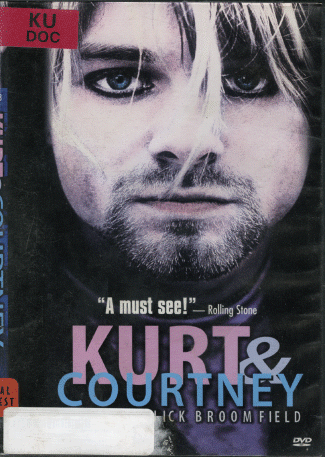
CLICK HERE TO SEE "KURT & COURTNEY" -- ILLUSTRATED SCREENPLAY
Statistics: Posted by admin — Sat Jun 20, 2015 11:16 pm
]]>