Chapter Three: The Embroidered Cushion
The Hampstead Buddhist Vihara was situated on Haverstock Hill, opposite a public house and within easy reach of Belsize Park Underground Station. It was a narrow, three-storey terrace property with a basement, and it was permeated by a peculiar smell which I subsequently identified as that of a combination of dry rot and boiled cabbage.
At the time of my arrival the Vihara’s only occupants were Ananda Bodhi and the three novices. The latter had all been ordained by Venerable Saddhatissa, the incumbent of the Sinhalese Vihara at Chiswick...
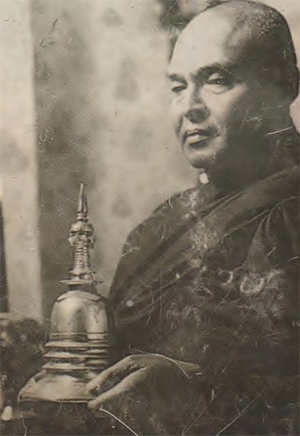
Hammalawa Saddhatissa Maha Thera (1914–1990) was an ordained Buddhist monk, missionary and author from Sri Lanka, educated in Varanasi, London, and Edinburgh. He was a contemporary of Walpola Rahula, also of Sri Lanka...
The Maha Bodhi Society invited Saddhatissa to become a missionary (dharmaduta) monk in India like his contemporary Henepola Gunaratana.
In order to teach to Indians he learnt Indian languages such as Hindi, Urdu and Punjabi. While in India, he came to know B. R. Ambedkar, who reportedly obtained advice from him on how to draft the Indian constitution along the lines of the vinaya. He also obtained an M.A. Degree from the Banaras Hindu University and then became a lecturer there.
In 1957 he traveled to London at the request of the Maha Bodhi Society and lived the rest of his life in the West.
He obtained his PhD from the University of Edinburgh and held academic appointments at a number of universities. He was a visiting lecturer in Buddhist studies at Oxford University; a lecturer in Sinhala at the University of London; and Professor of Pali and Buddhism at the University of Toronto. He was a Buddhist Chaplain at the London University and a vice president of the Pali Text Society.
At the time of his death he was the head of the London Buddhist Vihara and the Head of the Sangha (Sanghanayaka) of the United Kingdom and Europe of the Siam Nikaya of Sri Lanka."
He was posthumously honored in 2005 by Sri Lanka with a postage stamp bearing his image.
-- Hammalawa Saddhatissa, by Wikipedia
(
Ananda Bodhi as a junior bhikkhu was not competent to ordain), but it was
Ananda Bodhi with whom they actually lived. Two of the novices were English and one was German (
Ananda Bodhi himself was a Canadian), and all three wore dark brown habits girt about the waist with a cord, so that they looked more like Franciscan friars than Buddhist monks. When they went out they donned voluminous cloaks of the same colour, as did
Ananda Bodhi whenever he did not want his yellow robes to be seen.
As none of them spent much time at the Vihara I usually saw them only at breakfast and lunch (there was of course no evening meal), and not always even then.On those occasions when we did eat together neither Ananda Bodhi nor the novices made the slightest attempt to include me in the conversation, or to let me know what was going on, and any question I put received no more than a perfunctory reply. The novices were totally wrapped up in Ananda Bodhi, and Ananda Bodhi clearly was wrapped up in himself and in his own schemes. Considering that I was a senior monk, their behaviour was a violation of monastic etiquette: it was deplorable even by the most elementary standards of decency; but I said nothing, kept my ears open, and bided my time.
One day the conversation over lunch was more than usually animated. Ananda Bodhi and the novices were all wildly excited; even the rather saturnine orderer of the more expensive kind of salmon was affected by the general mood. I gathered that they had spent the morning at Hampstead Town Hall, where an international psychiatric congress was being held that week. It was not clear in what capacity Ananda Bodhi himself had been present (he was not a psychiatrist), but he had intervened in the morning’s debate, apparently speaking from the gallery, and after criticizing the current methods of treating schizophrenia had confidently assured the assembled psychiatrists that the condition was curable and that it could be cured by means of Buddhist meditation. The kind of meditation he had in mind was the controversial Burmese ‘insight meditation’, his teaching of which was a principal cause of the differences that had arisen between the Sangha Association, as represented by him, and the Buddhist Society, as represented by Christmas Humphreys – differences with which I would soon be having to deal. How the psychiatrists had responded to the intervention – whether with interest, or astonishment, or amusement – did not transpire. Ananda Bodhi obviously was elated by what he had done, while the three novices gazed at him more admiringly than ever. The Master had spoken, their shining eyes seemed to say, and a new era was about to dawn for the world.
In the midst of the jubilation the telephone rang, and Ananda Bodhi answered it. The caller was Beth, whose name I had already heard bandied about. It seemed she telephoned the Vihara frequently, sometimes twice or thrice a day, to ask if she had the permission of ‘the Sangha’ to open a window, or wash her hair, or do one of a number of other quite ordinary things. Whether or not she was a schizophrenic, and whether or not Ananda Bodhi was treating her, I do not know, but the novices regarded poor Beth as a great joke, and talked about her in the most unfeeling manner. Later I inherited her, so to speak, and the telephone calls turned into a series of long, rambling letters that eventually petered out.
More than once, during those first few days of mine at the Hampstead Buddhist Vihara, the conversation at mealtimes revolved round various schemes of Ananda Bodhi’s. These were referred to, as often as not, in an allusive manner that was obviously intended to keep me in the dark as to what was going on, but I gathered that Ananda Bodhi had purchased, or was about to purchase, a large country house in Scotland. The project was being funded by one of his supporters, an elderly spinster, and the place was to serve as his personal headquarters and be quite separate from, and independent of, the Hampstead Buddhist Vihara. I also gathered that two other members of the English Sangha (or rather, of the Sangha in England) would shortly be arriving in England. They would be arriving from Burma, where they had been undergoing training as meditation teachers.
Mangalo and Vimalo were much more friendly than Ananda Bodhi, and much more communicative, so that I soon had a better understanding of what was going on, not only at the Vihara itself but also within the wider British Buddhist movement. Like Ananda Bodhi, both were considerably junior to me, in years as well as in respect of monastic ordination, and like Ananda Bodhi both were, of course, Theravãdins. Mangalo was English, and evidently from an upper middle-class family. He was tall and thin, with a round, monkey-like head and protruding ears, and though not really ill-natured he was much given to indulging in ridicule. As I afterwards discovered, he had given up a promising career at the Foreign Office – and left a fiancée – in order to become a Buddhist monk. Vimalo, who was German, presented a more robust appearance. Pink-faced and smiling, he bore himself stiffly, and was somewhat slow of speech. I never learned anything about his background, but he had a twin brother who also had become a bhikkhu and who for a while had lived at the Vihara with him and Mangalo. This brother had returned to Germany, where he had disrobed and married and was now a yoga teacher.
Different though the English and the German bhikkhu were in character and background, they had much in common. Both of course were monks, and both were Theravãdins, in addition to which both were inclined to attach more importance to the practice of meditation than to doctrinal study. Their position to this extent was unexceptionable; but they also shared, unfortunately, an attitude that I later on found to be characteristic of a certain kind of Western Theravãdin, whether member of the monastic order or lay supporter. While unsympathetic and even hostile to the Mahãyãna, they at the same time were strongly drawn to Christianity, especially in its more mystical aspects. Theravãda Buddhism and Christianity, they seemed to believe, had more in common with each other than had Theravãda Buddhism and the Mahãyãna. It was as though one could be a Theravãdin Buddhist without ceasing to be a Christian, whereas if one was a Theravãdin it was not possible for one to be a Mahãyãnist or even to accept the Mahãyãna as a genuinely Buddhist tradition. My own position was clean contrary to this. For me, theistic Christianity and non-theistic Buddhism were radically incompatible, so that it was impossible for a Buddhist to be at the same time a Christian, or a Christian a Buddhist, even though it might be possible for them to appreciate some of the more peripheral features of the religion to which they did not belong. During the period of my acquaintance with Mangalo and Vimalo (we were never close friends) the three of us therefore had some interesting discussions, and the differences between me and my two colleagues sometimes had amusing consequences.
I once happened to refer to the fact that for orthodox Christians the dogmas of Christianity were true in the literal sense, citing as an example their belief that Christ ascended bodily into heaven after his death on the cross. Mangalo emphatically denied this. According to him, the ascension was a purely spiritual event; its significance was symbolic, and no Christian believed otherwise. To this I replied that the doctrine of the bodily ascension of Christ was one of the Thirty-nine Articles of the Church of England. But this too Mangalo refused to accept, declaring that it was just another example of the way in which I misrepresented Christianity. Fortunately in the Vihara library there was a copy of the Book of Common Prayer bound up in one volume with the Bible. Turning to the Thirty-nine Articles, I read out Article 4, Of the Resurrection of Christ:
Christ did truly rise again from death, and took again his body, with flesh, bones, and all things appertaining to the perfection of Man’s nature; wherewith he ascended into Heaven, and there sitteth, until he return to judge all Men at the last day.
For once Mangalo ‘had not what to say’. On another occasion I returned from a short stay at the Sangha Trust’s meditation centre at Biddulph, in Staffordshire, to find people expressing their dissatisfaction with the previous Sunday’s lecture, which I had asked Vimalo to give in my place. All the German bhikkhu had done, they complained, was to read out a series of extracts – more than thirty of them – from the writings of Meister Eckhart. ‘We come to the Vihara to hear the Dharma,’ some of them told me, ‘not to learn about Christian mysticism.’ The two incidents lay in the future, but I mention them in this place, partly because they revealed something about the state of Buddhism in Britain at the time and partly because Mangalo and Vimalo play little further part in my story. (Mangalo disrobed a few years later and became an Anglican priest.) Meanwhile the two of them were there at the Vihara with me, and shortly after their arrival we agreed that since four Western bhikkhus were now living under the same roof we ought to hold a chapter meeting.
We met in the front room on the first floor, where lectures were held and where a green-and-gold Thai shrine, complete with shining brass Buddha image, stood against the far wall. To the left of the shrine, and to the right, two chairs had been placed, and on one of the chairs next to the shrine there was an embroidered cushion. When Ananda Bodhi at last swept in, he straightway plumped himself down on the chair with the embroidered cushion, as if it were his by right. Vimalo at once objected. ‘We ought to let Venerable Sangharakshita sit there,’ he said bluntly, ‘as he is senior to us.’ Whereupon the Canadian monk vacated the chair with a very ill grace, I took my seat on it, and our meeting began. I do not remember what we discussed. Probably it was on this occasion that it was agreed between us that during the winter Mangalo and Vimalo would take it in turns to live for a month at a time at the Biddulph centre and be available for individual instruction in meditation. Ananda Bodhi took very little part in the proceedings. His being compelled to relinquish the seat of honour seemed to have shaken him badly, and he may have been thinking that the incident represented a deposition from the throne of his hitherto unquestioned supremacy at the Vihara and within the English Sangha Association. Whether this was actually the case or not, I noticed that whereas when surrounded by the admiring novices he was quite bumptious, in the presence of his fellow bhikkhus he was more like a pricked balloon. No wonder he avoided our company as much as he could! I also noticed that Vimalo did not take him very seriously, and at times spoke of him slightingly.
After the chapter meeting none of us saw much of Ananda Bodhi. When in London he usually stayed at the English Sangha’s old home in Swiss Cottage, the lease on which had not quite run out. I therefore took possession of his room at the Vihara. It was situated on the second floor of the building, immediately above the meeting room, and was known as ‘the abbot’s room’. Beside the bed I found a crystal ball, together with half a dozen yards of black velvet.