Vijayanagara: The Last Emperors of South India
by Paul Cooper
Fall of Civilizations
Apr 22, 2022
On the rocky banks of South India's Tungabhadra River, an enormous ruined city lies crumbling...
In this episode, we look at the Vijayanagara Empire of Southern India, a civilization that has all but faded from memory in many parts of the world.
Find out how this remarkable society rose up out of an age of conflict and fragmentation, how it built one of the largest and most impressive medieval cities in the world, and developed an identity that was both South Indian in nature, and global in its outlook. With readings in Sanskrit, and the sounds of traditional Carnatic music, find out what happened to bring the great stone temples of Vijayanagara crashing down in fire and flame.
Vijayanagara: The Last Emperors of South India, Fall of Civ.
-
admin
- Site Admin
- Posts: 41484
- Joined: Thu Aug 01, 2013 5:21 am
-
admin
- Site Admin
- Posts: 41484
- Joined: Thu Aug 01, 2013 5:21 am
Re: Vijayanagara: The Last Emperors of South India, Fall of
Part 1 of 22
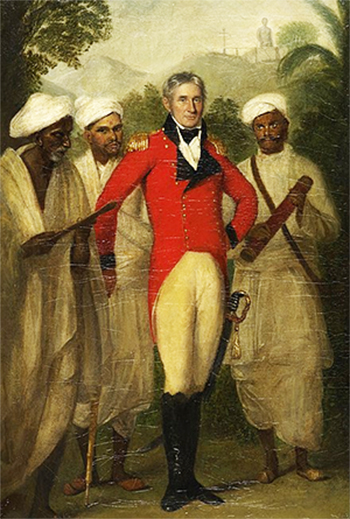
In the year 1800, a Scottish captain by the name of Colin Mackenzie was traveling in the south of India.

Mackenzie was an officer in the British East India Company, a trading corporation with a private army larger than many countries, that in the last century had come to hold sway over vast areas of India.
Mackenzie had come to India at the age of 30, and he became so fascinated with the place that he would never leave. He was a curious man and an avid collector of artifacts.
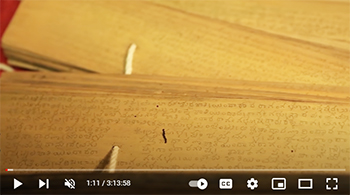
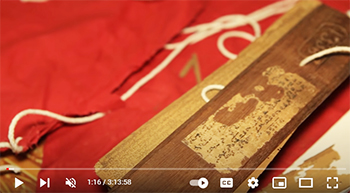
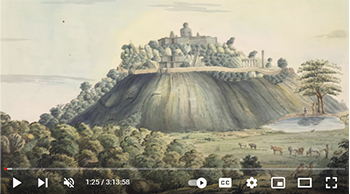
Over his nearly 40 years in India, he amassed a collection of 1,500 historical manuscripts written on palm leaves in 13 languages, along with thousands of local histories and songs, charts, maps, sketches,
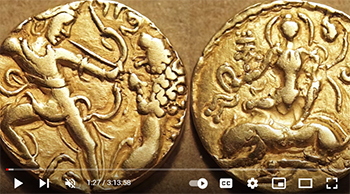
and a collection of more than 6,000 coins.
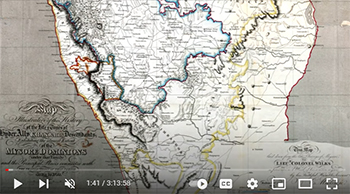
Mackenzie was also himself a skilled map maker, and he produced the first authentic geographical map of South India. So, we can imagine his excitement as he was traveling through the rocky landscape of the Indian state of Karnataka, when his local guides told him of the existence of an enormous ruined city nearby that had once been the capital of a great and powerful empire.
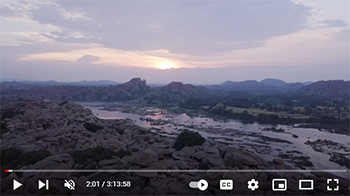
These ruins, they told him, were crumbling and overgrown, and could be found near the town of Anagoondy at a small village known as Hampi,
a place that the Kannada-speaking locals had come to know by the name Alputtun, or ‘the ruined city’.
Mackenzie urged them to take him there at once.
Mackenzie's visit to the ruins is recorded in a journal he kept at the time which has never been published, but which exists in rough manuscript form in the British Library.
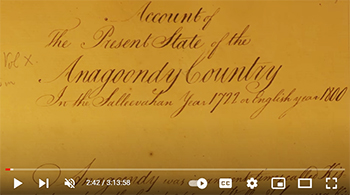
In his neat, curling, cursive handwriting, Mackenzie records what it was like to
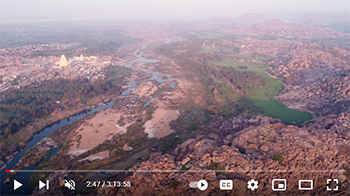
wander through the overgrown ruins of this great city as his guides told him what they could about its history.
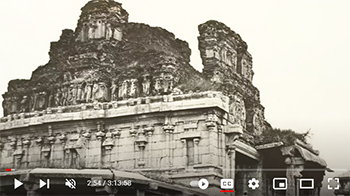
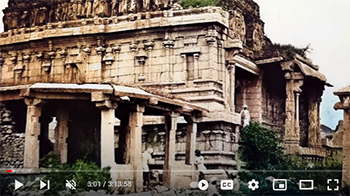
South and half-southwest of Anagoondy are still remaining many great ruins of the ancient city;
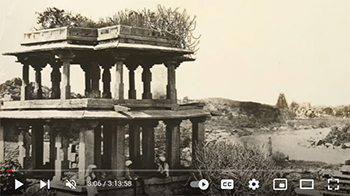
palaces, pagodas, droogs, and fortifications, to which the people gave the name Alputtun, or ‘the ruined city’.
The palaces with the grand stables for elephants and horses are there to be seen.
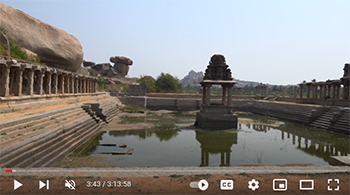
On the southeast of one palace is a place called Vasanta Voodom, formerly the baths of the rajahs.
They say that ancient kings used to entertain themselves on certain festivals with throwing saffron-tinged water on their women in a little square basin in the center of the building, surrounded by galleries.
Its drain or conduit, almost ruined, is to be still seen.
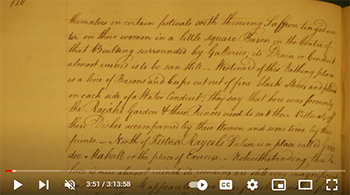
Westward of this bathing place is a line of basins and cups cut out of the fine, black stones, and placed on each side of the water conduit.
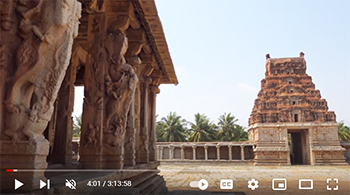
They say that here was formerly the king's garden.
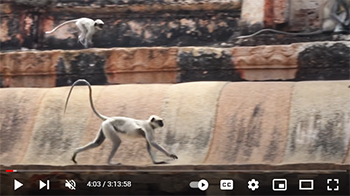
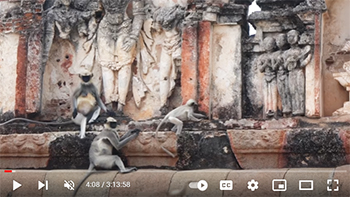
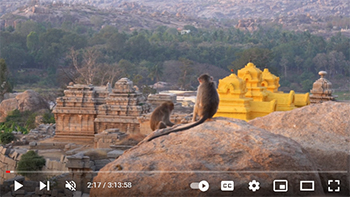
Here and there, families of monkeys would have clambered over these great boulders, chattering and chasing one another.
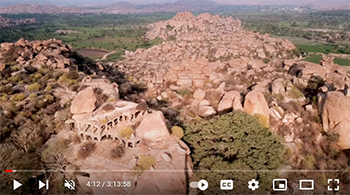
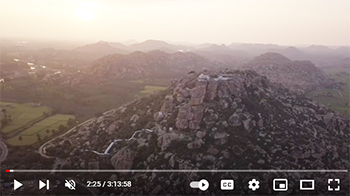
Mackenzie climbed up onto the rocky granite hills nearby,
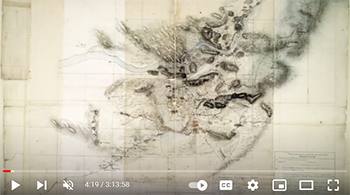
and from there he sketched the first comprehensive map of the site. He wasn't a man given over to poetry, and he let his maps and sketches do the talking.
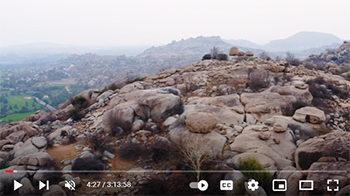
But he does make note of the sights that he saw as he explored the ruins.
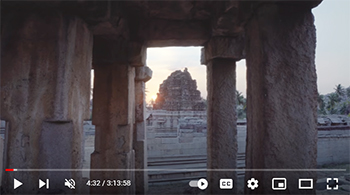
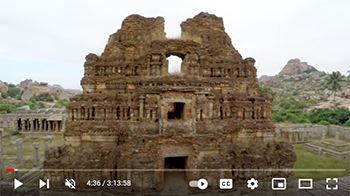
The interior ramparts, apparently designed to enclose the royal quarter, comprehending the palaces or Mahals.
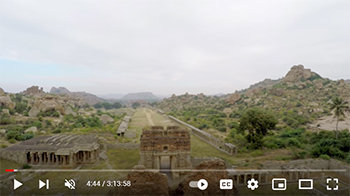
Waterworks of the most remarkable sort are visible.
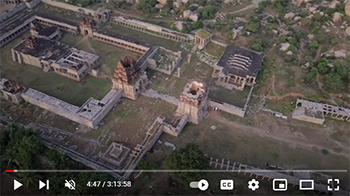
An eating place, with a number of black stone slabs laid along a conduit
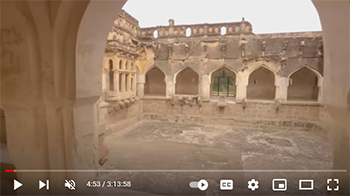
with dishes in the shape of leaves, sculptured on a theme.
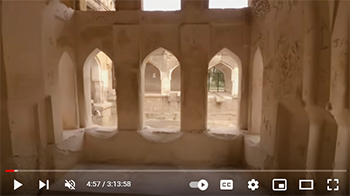
An octangular baton gallery and fountain in ruins.
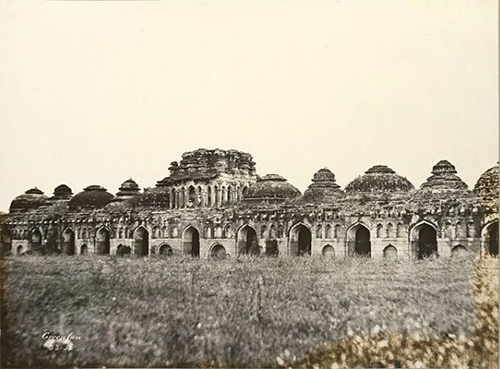
An elephant stable of eleven strong vaulted divisions,
each crowned by a handsome cupola.
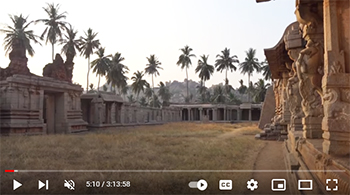
An aqueduct on stone pillars, which brought water from the tank near Camlapoor to the royal quarter, gardens, fountains.
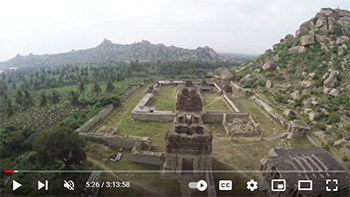
It appears to have been destroyed with much industry.
In the year 1800, a Scottish captain by the name of Colin Mackenzie was traveling in the south of India.
Mackenzie was an officer in the British East India Company, a trading corporation with a private army larger than many countries, that in the last century had come to hold sway over vast areas of India.
Mackenzie had come to India at the age of 30, and he became so fascinated with the place that he would never leave. He was a curious man and an avid collector of artifacts.
Over his nearly 40 years in India, he amassed a collection of 1,500 historical manuscripts written on palm leaves in 13 languages, along with thousands of local histories and songs, charts, maps, sketches,
and a collection of more than 6,000 coins.
Mackenzie was also himself a skilled map maker, and he produced the first authentic geographical map of South India. So, we can imagine his excitement as he was traveling through the rocky landscape of the Indian state of Karnataka, when his local guides told him of the existence of an enormous ruined city nearby that had once been the capital of a great and powerful empire.
These ruins, they told him, were crumbling and overgrown, and could be found near the town of Anagoondy at a small village known as Hampi,
a place that the Kannada-speaking locals had come to know by the name Alputtun, or ‘the ruined city’.
Mackenzie urged them to take him there at once.
Mackenzie's visit to the ruins is recorded in a journal he kept at the time which has never been published, but which exists in rough manuscript form in the British Library.
In his neat, curling, cursive handwriting, Mackenzie records what it was like to
wander through the overgrown ruins of this great city as his guides told him what they could about its history.
South and half-southwest of Anagoondy are still remaining many great ruins of the ancient city;
palaces, pagodas, droogs, and fortifications, to which the people gave the name Alputtun, or ‘the ruined city’.
The palaces with the grand stables for elephants and horses are there to be seen.
On the southeast of one palace is a place called Vasanta Voodom, formerly the baths of the rajahs.
They say that ancient kings used to entertain themselves on certain festivals with throwing saffron-tinged water on their women in a little square basin in the center of the building, surrounded by galleries.
Its drain or conduit, almost ruined, is to be still seen.
Westward of this bathing place is a line of basins and cups cut out of the fine, black stones, and placed on each side of the water conduit.
They say that here was formerly the king's garden.
Here and there, families of monkeys would have clambered over these great boulders, chattering and chasing one another.
Mackenzie climbed up onto the rocky granite hills nearby,
and from there he sketched the first comprehensive map of the site. He wasn't a man given over to poetry, and he let his maps and sketches do the talking.
But he does make note of the sights that he saw as he explored the ruins.
The interior ramparts, apparently designed to enclose the royal quarter, comprehending the palaces or Mahals.
Waterworks of the most remarkable sort are visible.
An eating place, with a number of black stone slabs laid along a conduit
with dishes in the shape of leaves, sculptured on a theme.
An octangular baton gallery and fountain in ruins.
An elephant stable of eleven strong vaulted divisions,
each crowned by a handsome cupola.
An aqueduct on stone pillars, which brought water from the tank near Camlapoor to the royal quarter, gardens, fountains.
It appears to have been destroyed with much industry.
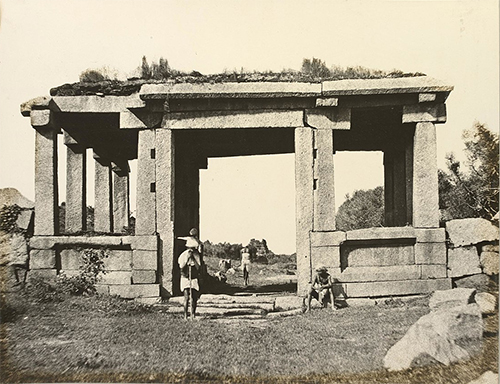
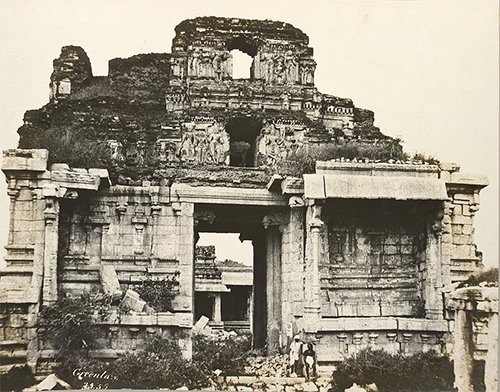
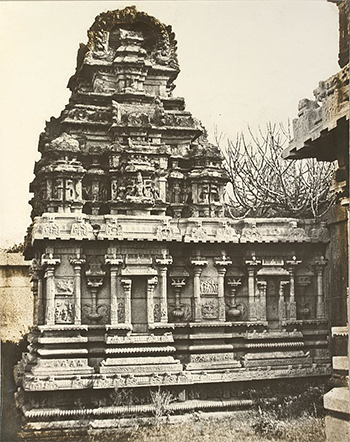
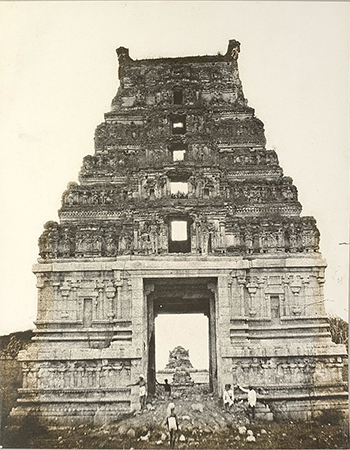
Krishna Temple Complex, Hemakuta Hill 1856
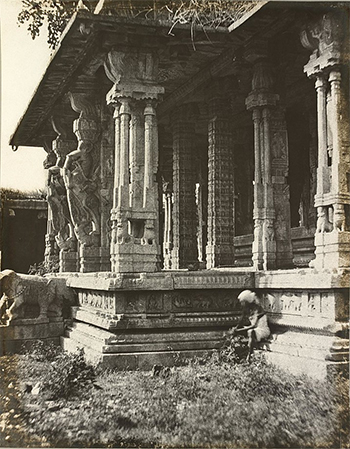
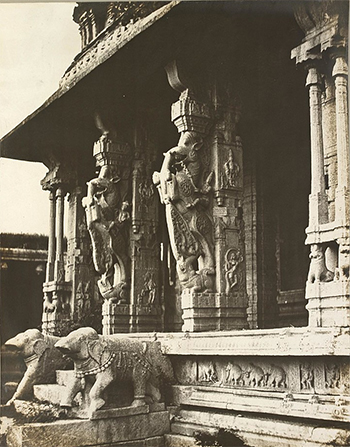
Garuda Temple, Maha Mandapa and Eastern Gopura, Vitthala Temple Complex 1856
Virupaksha Temple Complex 1856
Main Shrine, Ramachandra Temple Complex 1856
Eastern Gopura, Krishna Temple Complex, Hemakuta Hill 1856
Hampi King's Balance Vitthala temple street entrance near river 1856
Gateway at Malapannagudi 1856
Elephant Stables, Hampi (Vijayanagar) - 1856
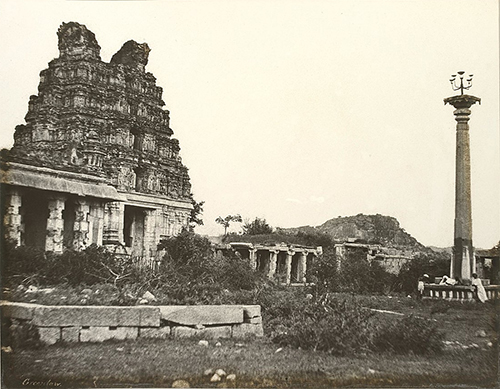
Eastern Gopura and Lamp Column, Vitthala Temple Complex 1856
Eastern Gateway, Narasimha Temple at Hemakuta Hill 1856
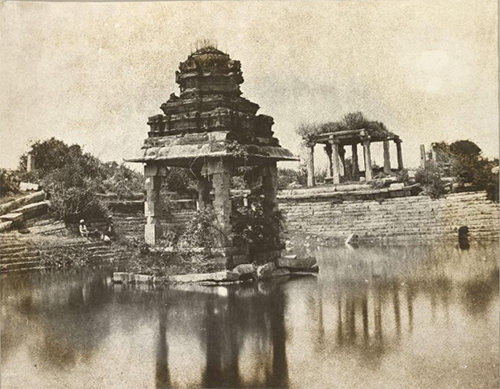
Hampi (Vijayanagar) Bellary District: Vitthala Temple Tank and Shrine, Vitthalapura.
Photograph 1856
Eastern Gopura, Krishna Temple Complex, Hemakuta Hill 2 1856
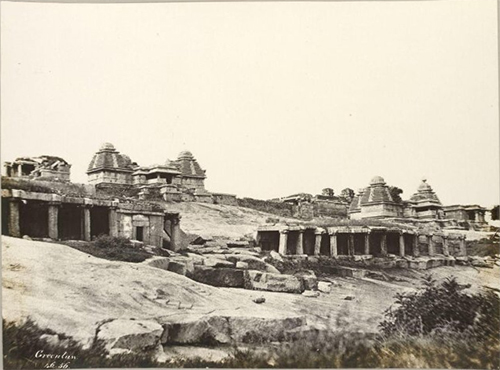
Hampi (Vijayanagar) Bellary District: Shiva Temples. Photograph 1856
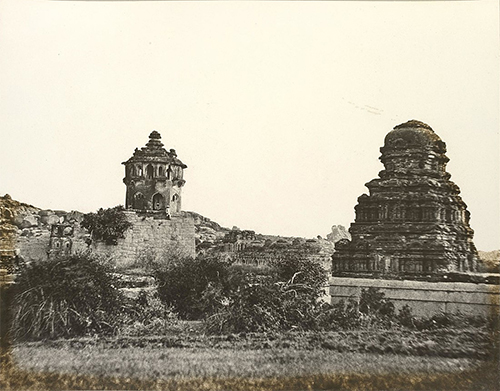
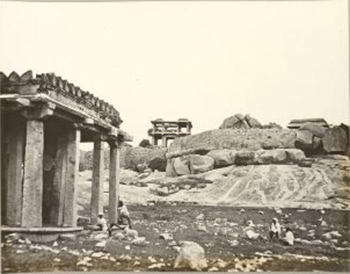
Octagonal Watchtower, Elephant Stables and Madhava Temple 1856
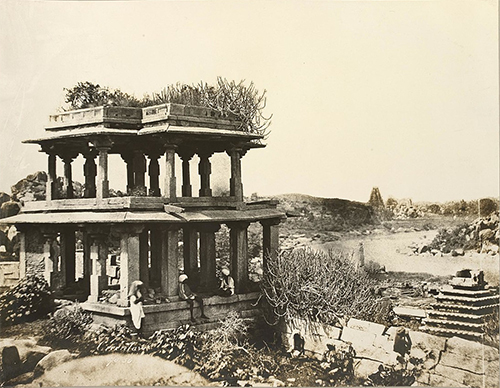
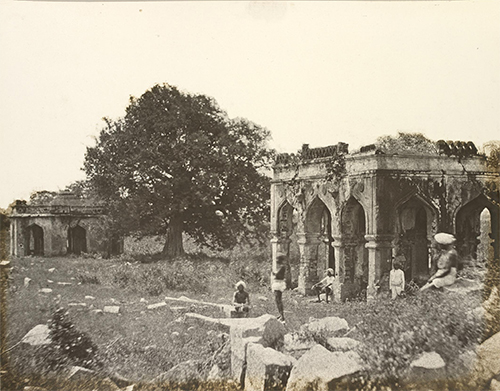
Octagonal Fountain and Pavilion, Royal Centre 1856
Submerged Pavilion and Bridge, Tungabhadra River 1856
Virupaksha Temple Complex, Interior, Eastern Sanctuary 1856
Krishna Temple Tank and Shrine, Hemakuta Hill 1856
Ganesha Shrine 1856
Gateway and Pavilion at Hemakuta Hill 1856
Octagonal Watchtower, Elephant Stables, and Madhava Temple 2 1856
Shiva Temples at Hemakuta Hill 1856
The watchtower in the Zenana enclosure. Alexander Greenlaw (1856).
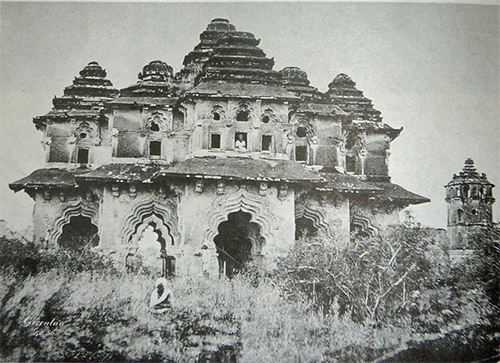
Lotus Mahal in the Zanana enclosure. Alexander Greenlaw (1856).
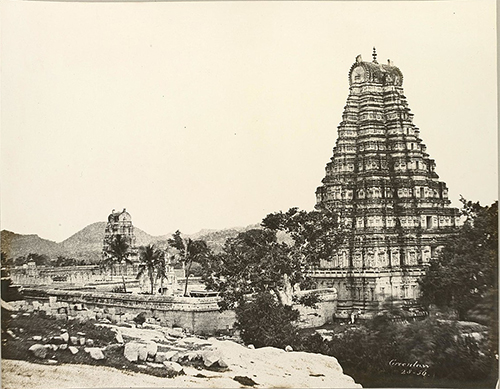
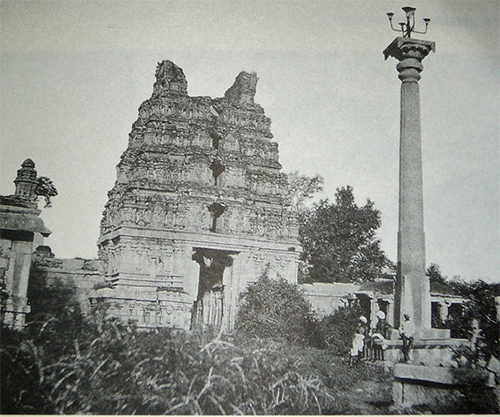
Gopura of the Vitthala temple. The light-tower has collapsed and is lying in situ. Alexander Greenlaw (1856).
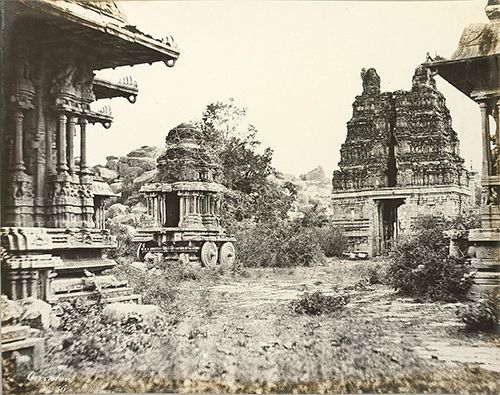
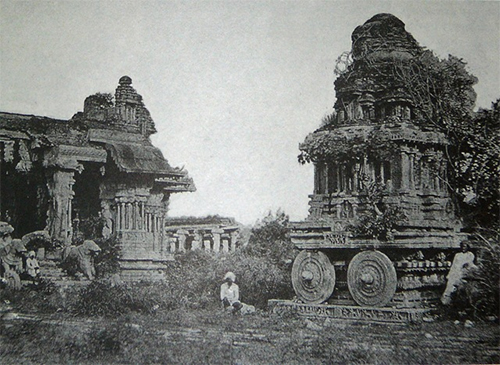
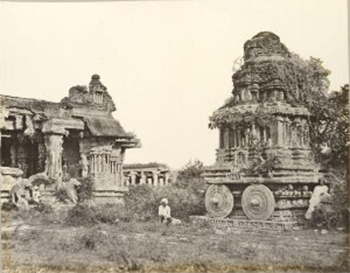
The Garuda chariot in the Vitthala temple. The top of the chariot is gone, while the main shrine has new support buildups. Alexander Greenlaw (1856).
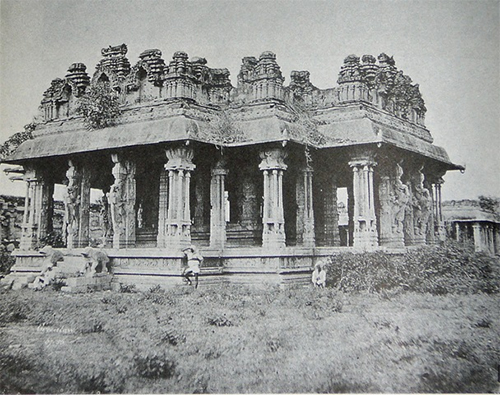
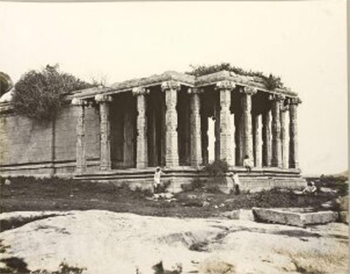
The free standing manthapa in the Vitthala temple. Alexander Greenlaw (1856).
Minor Shrine, Ramachandra Temple Complex 1856
Eastern Gopura, Pattabhirama temple
Kalyana Mandapa, Vitthala Temple Complex 1856
Kalyana Mandapa, Vitthala Temple Complex 2 1856
-
admin
- Site Admin
- Posts: 41484
- Joined: Thu Aug 01, 2013 5:21 am
Re: Vijayanagara: The Last Emperors of South India, Fall of
Part 2 of 22
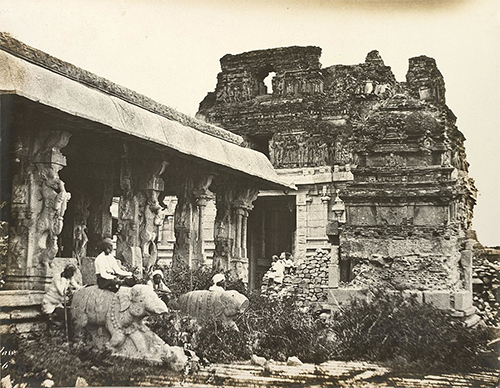
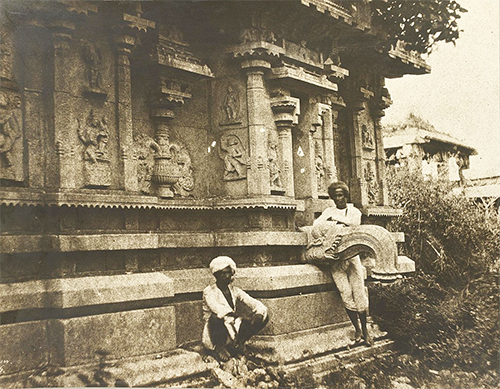
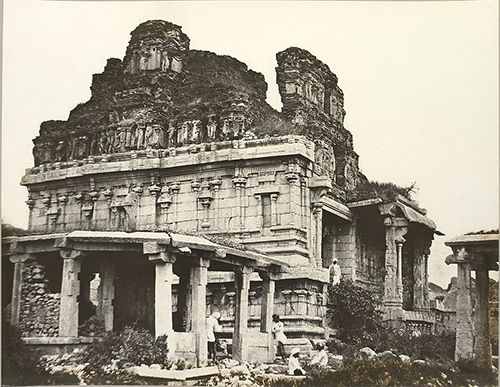
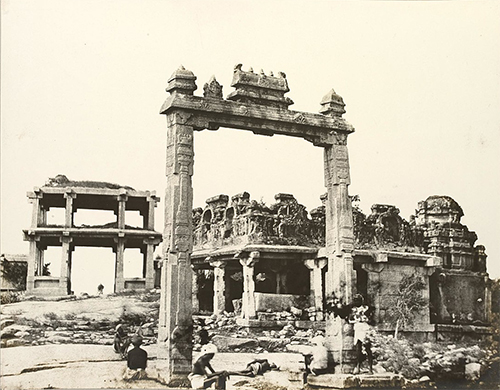
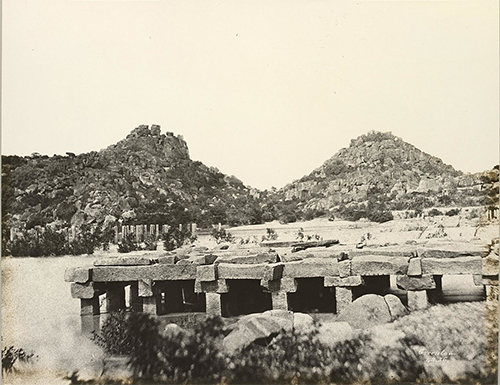
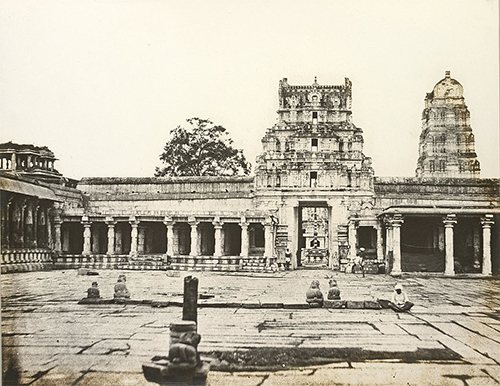
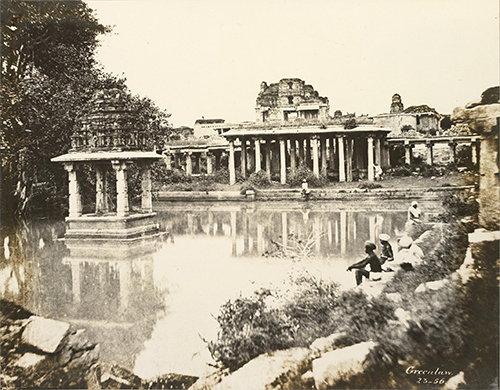
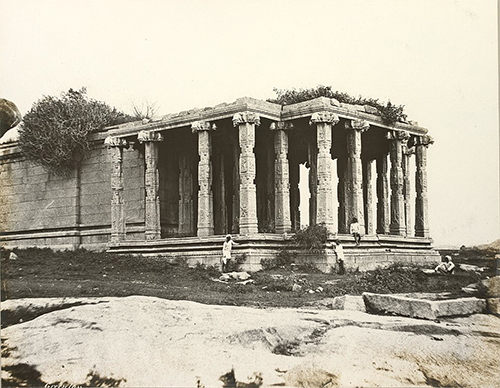
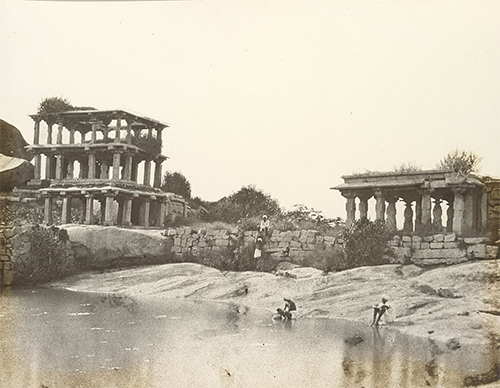
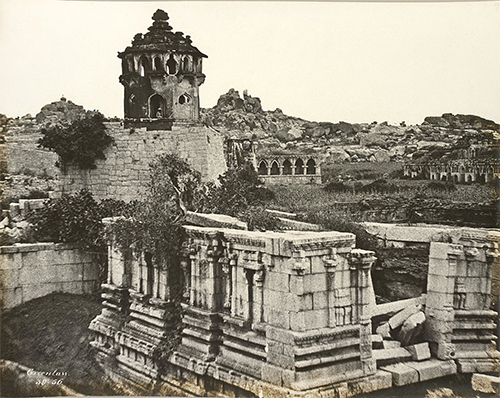
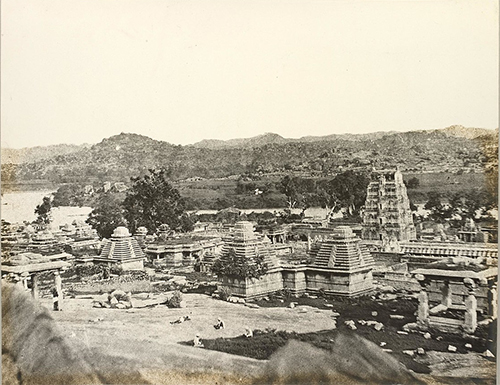
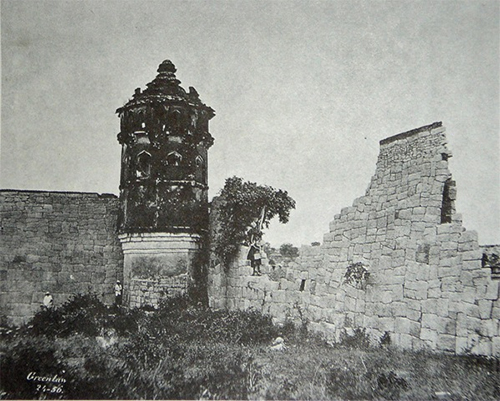
Only a few decades later, in the 1850s, another East India Company officer, one Colonel Alexander Greenlaw, would visit the ruined site with an early camera
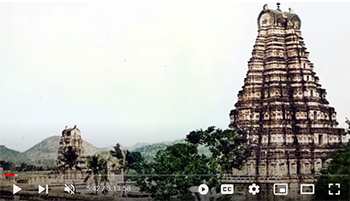
and would take some of the most affecting photographs of the ruins in their undisturbed condition.
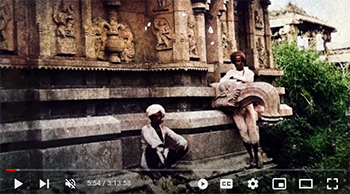
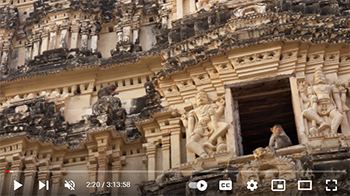
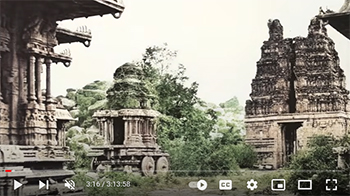
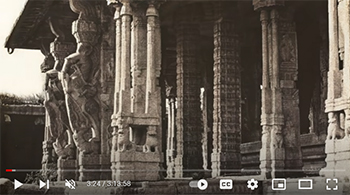
In them, we can see the same crumbling, magnificently carved edifices that Mackenzie would have, overgrown with mosses, growths of cactus -- like euphorbia and grasses, their ornate cupolas strangled by vines.
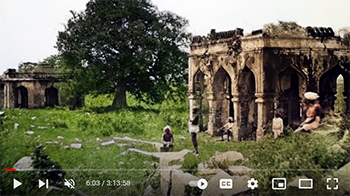
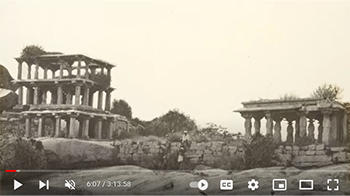
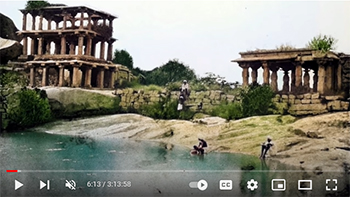
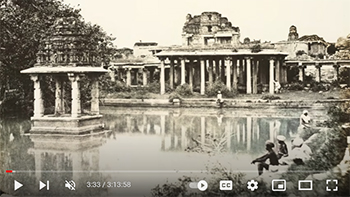
We can see the beautiful bathing houses spilling over with water weeds, the halls of long-dead kings now silent and shaded beneath cracking roofs.
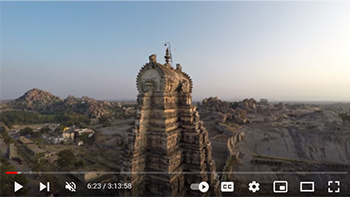
In his journal, Mackenzie describes the sight of the city now sunken beneath the earth. This place is now almost ruined, but its remains are still very magnificent and curious.
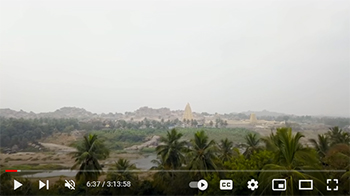
The houses of the inhabitants are entirely destroyed, and the ruins now form high banks and eminences,
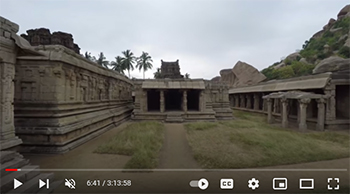
under which are buried many great houses whose terraces are level with or sunk below the soil. Many of these we can see in passing among the inner ruins. South of the king's palace is a square building, the top of which is destroyed now.
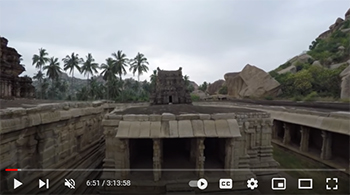
This being covered with earth and overgrown with bushes, we could not penetrate its interior.
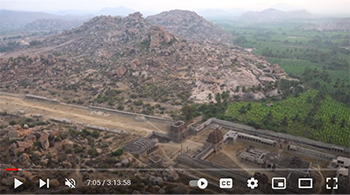
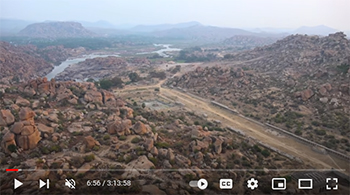
These crumbling ruins were the remains of a city known as Vijayanagara. As Mackenzie walked between the fallen pillars, as he looked down on them from the
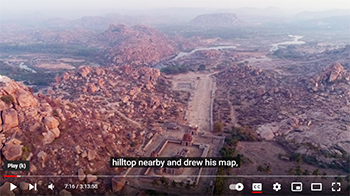
hilltop nearby and drew his map, he was clearly struck by the grandeur and magnificence of these remains, and he must have wondered how such a great society could build all this, flourish, and then vanish into
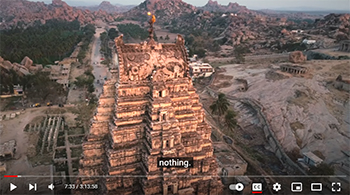
nothing. My name is Paul Cooper, and you're listening to The Fall of Civilizations Podcast.
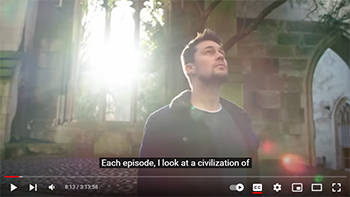
Each episode, I look at a civilization of the past that rose to glory and then collapsed into the ashes of history. I want to ask, what did they have in common? What led to their fall? And what did it feel like to be a person alive at the time who witnessed the end of their world? In this episode, I want to look at a civilization that has all but faded from memory in many parts of the world. That's the story of the Vijayanagara Empire of Southern India. I want to tell the story of how this remarkable society rose up out of an age of conflict and fragmentation, how it built one of the largest and most impressive medieval cities in the world, and developed an identity that was both South Indian in nature and global in outlook. Finally, I want to tell the story of what happened to bring the great stone temples of Vijayanagara crashing down in fire and flame.
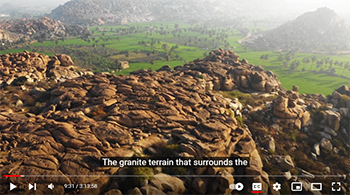
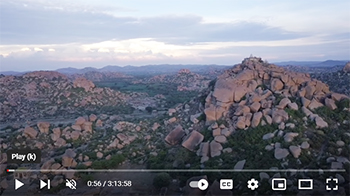
The granite terrain that surrounds the small village of Hampi and the ruins of Vijayanagara around it is one of the most distinct and easily recognizable in the world.
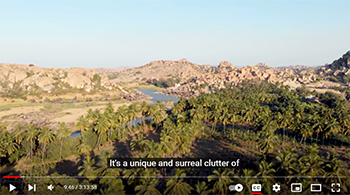
It's a unique and surreal clutter of enormous rounded boulders teetering in strange and unlikely balancing acts,
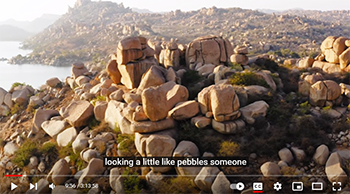
looking a little like pebbles someone has piled up on a beach. A later visitor to the ruins, a British man named AH Longhurst, provides the following vivid description of the
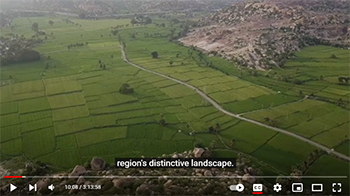
region's distinctive landscape.
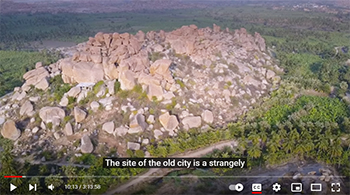
The site of the old city is a strangely wild place to have been the birthplace and capital of an empire. The whole of it
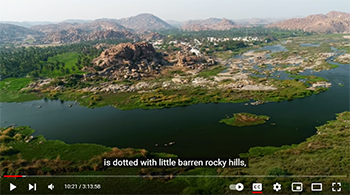
is dotted with little barren rocky hills, and immediately north of it, the wide and
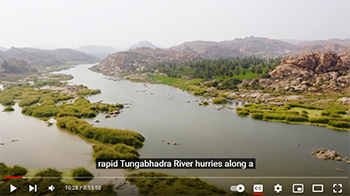
rapid Tungabhadra River hurries along a boulder-strewn channel down rapids and
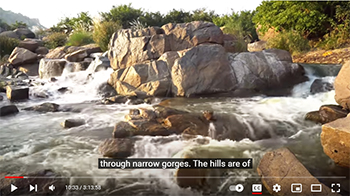
through narrow gorges. The hills are of granite, weathered to every shade of
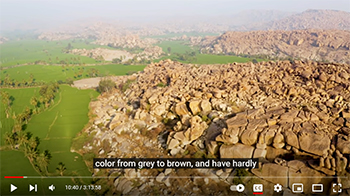
color from grey to brown, and have hardly any vegetation on them. The alternate burning days and chilly
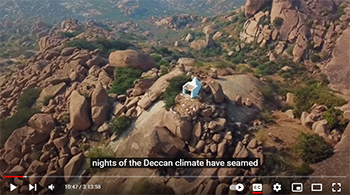
nights of the Deccan climate have seamed and split in every direction. The huge masses of solid rock and the earthquakes of remote ages have torn from their flanks the enormous boulders, and have piled these up round
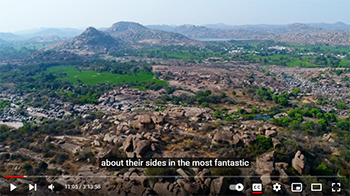
about their sides in the most fantastic confusion, or flung them headlong into the valleys below.
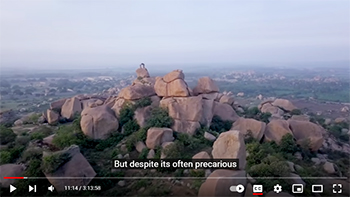
But despite its often precarious appearance, this landscape is actually one of the most ancient and stable surfaces to be found anywhere in the world. These vast sheet layers of granite were formed under the earth's surface between about three and three-and-a-half billion
years ago during the earliest formation of the Earth's crust.
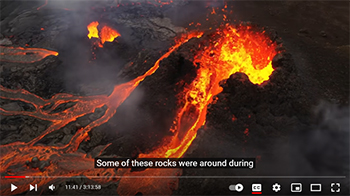
Some of these rocks were around during the emergence of the very first life on Earth, from the tiniest microbes and bacteria. They have stood here and watched that
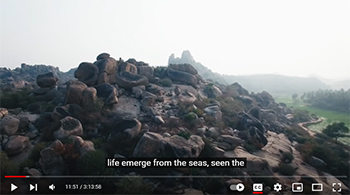
life emerge from the seas, seen the dinosaurs rule the earth only to be wiped out by a visitor from the stars,
then seen the evolution of humans from small mammals. While softer rocks have eroded around them, these hard granites have remained.
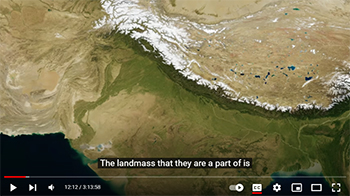
The landmass that they are a part of is often known as the Indian subcontinent, a place with one of the most interesting interplays of geology and climate in the world. This is a massive peninsula jutting out of the south of Asia that extends south for more than 3,000
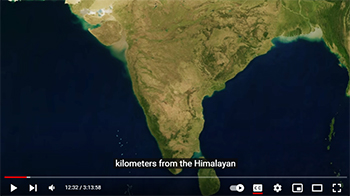
kilometers from the Himalayan mountains.
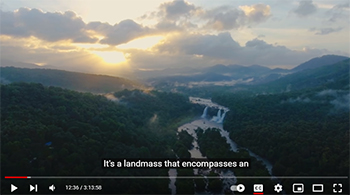
It's a landmass that encompasses an enormous variation in landscapes, from the mountainous cloud forests and

coconut-palmed beaches in the south to the snowy reaches of the Himalayas in
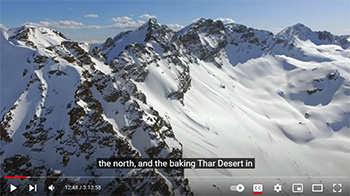
the north, and the baking Thar Desert in
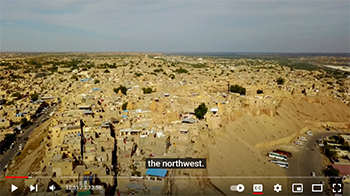
the northwest. But generally, India is loosely divided into two regions usually called North and South India.
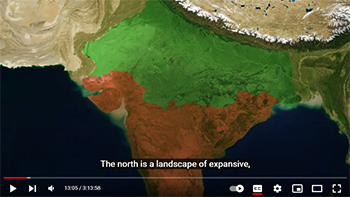
The north is a landscape of expansive,

flat riverlands, grassy plains stretching off into the distance,
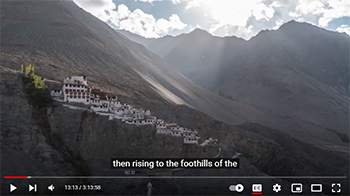
then rising to the foothills of the Himalayas.
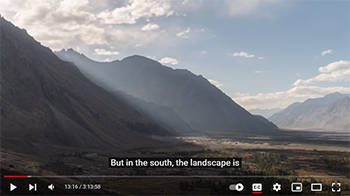
But in the south, the landscape is
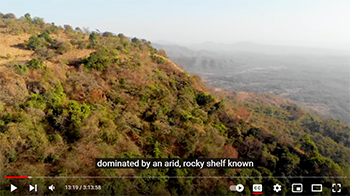
dominated by an arid, rocky shelf known as the Deccan Plateau. The name Deccan comes from the same root as the Tamil word ‘thekkanam’ and the Sanskrit word ‘Dakshina’, which both mean
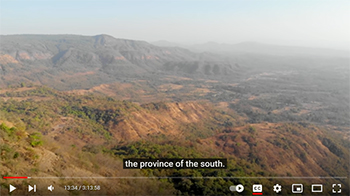
the province of the south.
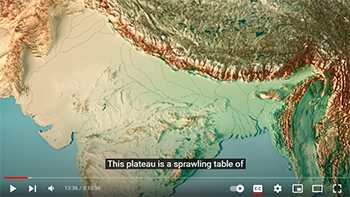
This plateau is a sprawling table of rocky land that covers much of Western,
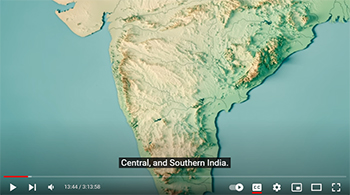
Central, and Southern India.
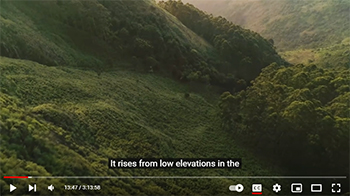
It rises from low elevations in the north up to more than a thousand meters in the south, wedged between the two mountain ranges known as the Western and
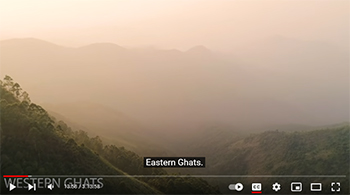
Eastern Ghats.
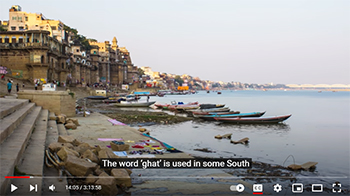
The word ‘ghat’ is used in some South Indian languages to describe stone steps leading down to a river or lake, and so, the word is also used for these
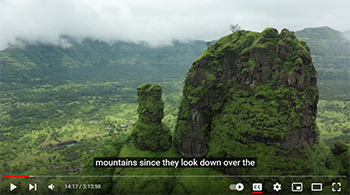
mountains since they look down over the coast. The Western Ghats are in fact the eroded remnants of what was once the edge of this continent.
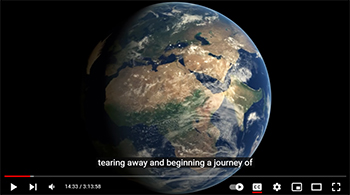
A hundred million years ago, India was joined to Africa before tearing away and beginning a journey of

6,000 kilometers across the ocean,
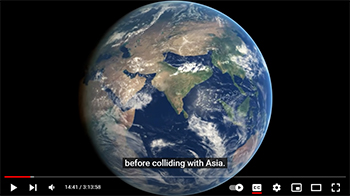
before colliding with Asia.
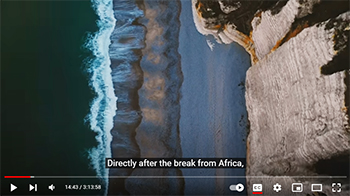
Directly after the break from Africa, it's thought that the west coast of India would have appeared as a sheer
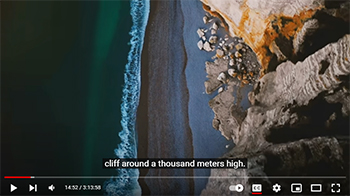
cliff around a thousand meters high. Over the next 100 million years, erosion and weathering would wear down this cliff into the dramatic series of mountains that today runs the whole
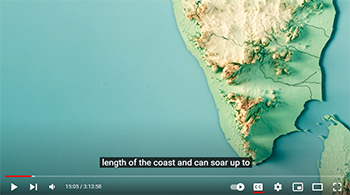
length of the coast and can soar up to 2,600 meters.
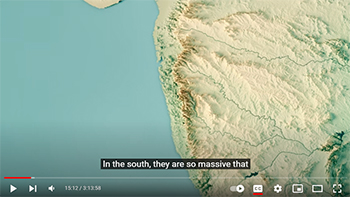
In the south, they are so massive that they block the clouds that roll in from
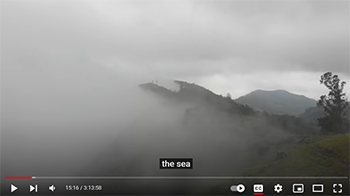
the sea during India's southwest monsoon, meaning that the land on the west of the mountains
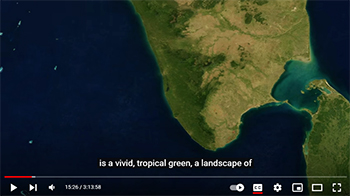
is a vivid, tropical green, a landscape of lagoons and mangrove forests, while the land of the Deccan Plateau
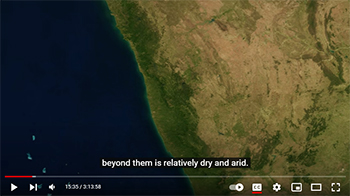
beyond them is relatively dry and arid. But across this rocky landscape,
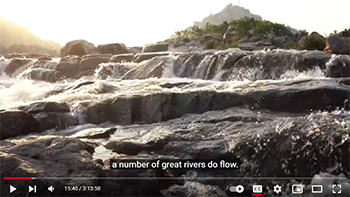
a number of great rivers do flow. They flow down the slope of the land eastwards, away from the mountains of the Western Ghats. Some of these Deccan rivers are the Godavari, the Krishna, the Kaveri, and the
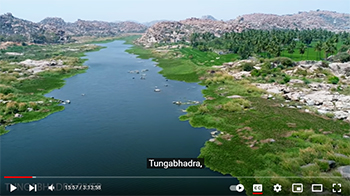
Tungabhadra, and they all flow eastwards until they eventually empty into the Bay of Bengal on the eastern coast. So, this is the landscape across which the great medieval drama of South India would unfold.
The roots of human civilization in India are truly ancient.
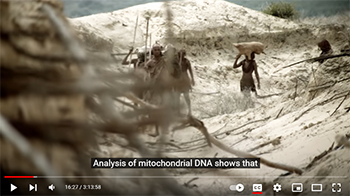
Analysis of mitochondrial DNA shows that modern humans began arriving in the
subcontinent between 75,000 to 50,000 years ago, migrating through the Middle
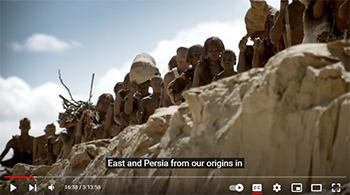
East and Persia from our origins in
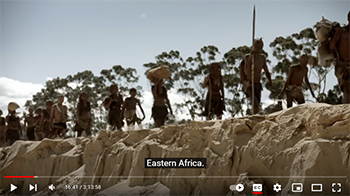
Eastern Africa.
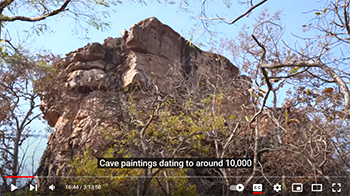
Cave paintings dating to around 10,000 years ago have been found in the rock shelters of Bhimbetka in Central India.
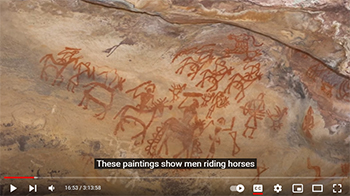
These paintings show men riding horses and even elephants, suggesting that the story of humans in this region has been intertwined with those of animals since the very beginning.

Around the year
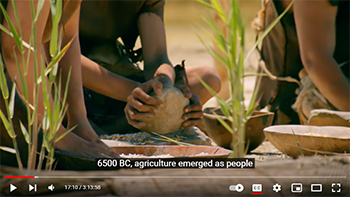
6500 BC, agriculture emerged as people

began to farm winter grasses, barley, and
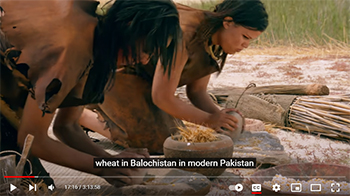
wheat in Balochistan in modern Pakistan
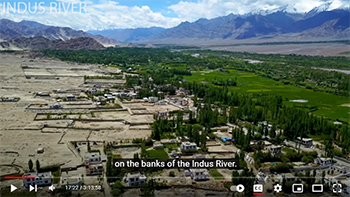
on the banks of the Indus River. In the following millennia, these techniques spread all the way up the Indus Valley. From about the year 3000 BC, large cities began to form in this region, which today are known by the names Mohenjo-Daro and Harappa, and which
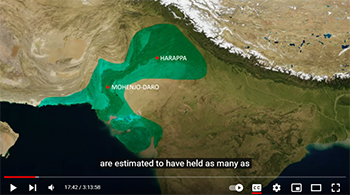
are estimated to have held as many as 60,000 people. The cities of the civilization that grew up in the Indus Valley
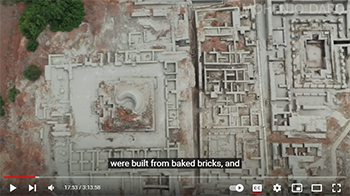
were built from baked bricks, and featured elaborate drainage systems and
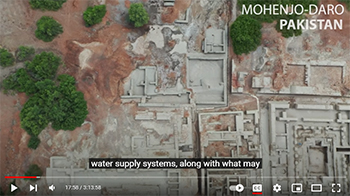
water supply systems, along with what may have been temples and workshops. Its people used a system of standardized
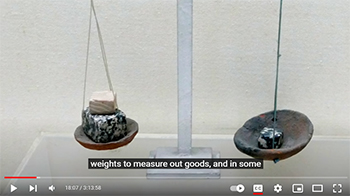
weights to measure out goods, and in some cities, large canals and docks have also been uncovered. There's evidence that the
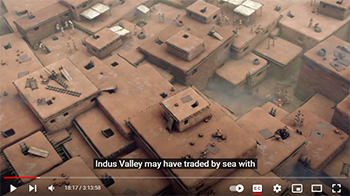
Indus Valley may have traded by sea with the civilizations of Mesopotamia, the Sumerians and Acadians, and Indus Valley
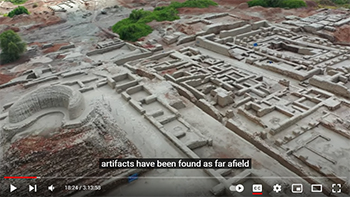
artifacts have been found as far afield
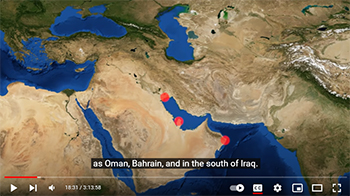
as Oman, Bahrain, and in the south of Iraq. It's perhaps here that the people of
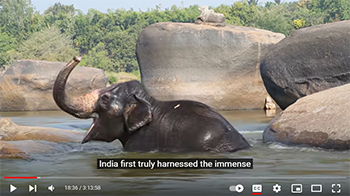
India first truly harnessed the immense power of the elephant. The carved seals of the Indus Valley
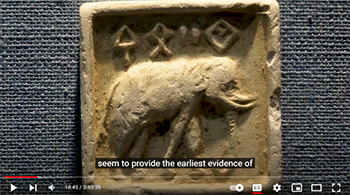
seem to provide the earliest evidence of
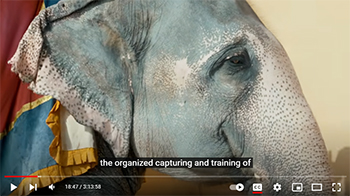
the organized capturing and training of elephants from as early as 6000 BC.
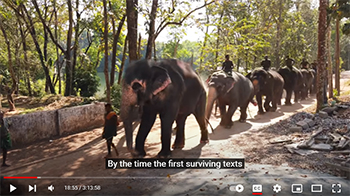
By the time the first surviving texts were written in India many thousands of years later, tamed elephants would have already been a common, everyday sight,
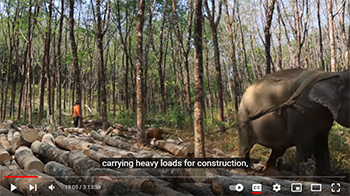
carrying heavy loads for construction, transporting important people, and fighting as weapons of war.
The Indus Valley civilization is also thought to have experimented with writing, although the extent to which they did so is a matter for debate. Archaeologists have uncovered hundreds of distinct symbols that Indus people
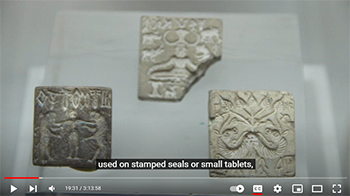
used on stamped seals or small tablets, ceramic pots, and what may have been signs hanging over the gates of their
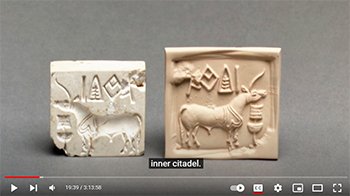
inner citadel.
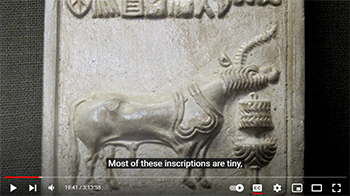
Most of these inscriptions are tiny,
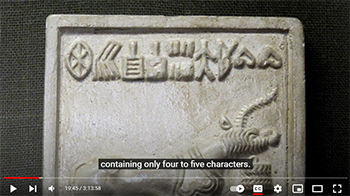
containing only four to five characters. The longest ever found on a single
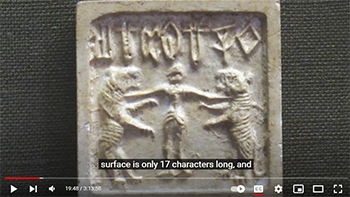
surface is only 17 characters long, and
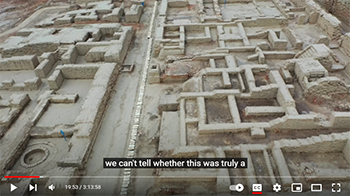
we can't tell whether this was truly a written language. If the Indus Valley symbols really are a form of writing, the tragedy is that it has never been decoded. So,
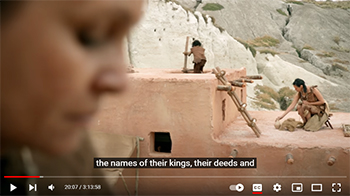
the names of their cities, the names of their kings, their deeds and
works, the lives of everyday people, all of it has been lost beneath the sands of Pakistan,
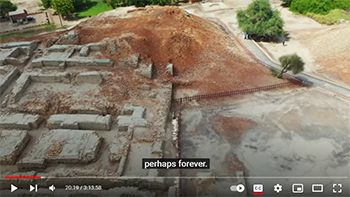
perhaps forever.
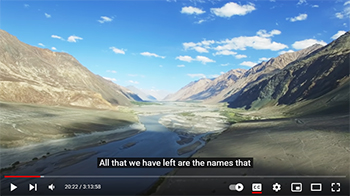
All that we have left are the names that later people gave to the remains of these haunting places. One of their largest cities is known today as Mohenjo-Daro, which in the language of Sindhi simply means
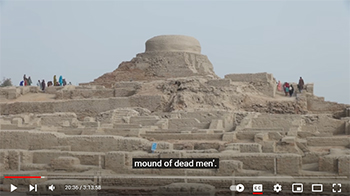
‘the mound of dead men’. While it's not clear what happened to cause the downfall of their society, we
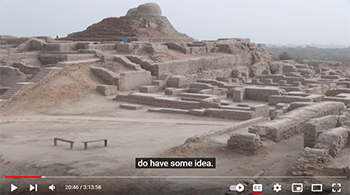
do have some idea. The Indus Valley climate grew significantly cooler and drier from about 1800 BC,
linked to a general weakening of the monsoon at that time, an event that may have also contributed to the collapse of Sumerian society in the valley of Mesopotamia.
The Indus Valley did not use as extensive irrigation techniques, and so were more reliant on the annual floods of the river. As the floods failed, the capacity of the river to support the population would have collapsed.
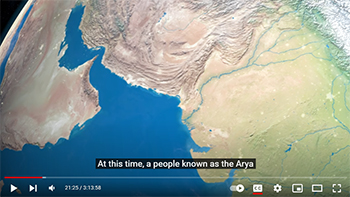
At this time, a people known as the Arya are thought to have arrived in the valley. It's unclear whether these Aryans came as settlers or refugees, whether they were welcomed or met with conflict, whether they brought new technologies and language into the valley, or whether
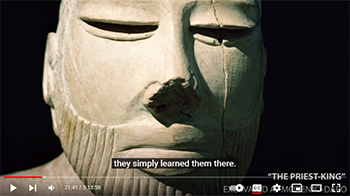
they simply learned them there. But whatever the case, this pattern would be repeated countless
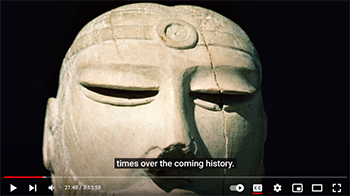
times over the coming history.
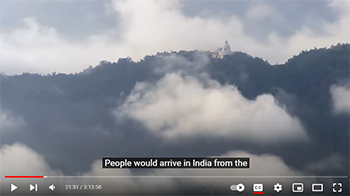
People would arrive in India from the lands beyond, mixed with the people already there, and a new culture would be born,
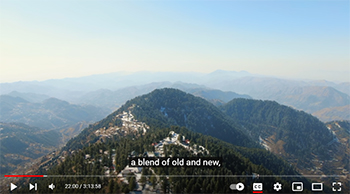
a blend of old and new, foreign and home-grown. By the year 1300 BC,
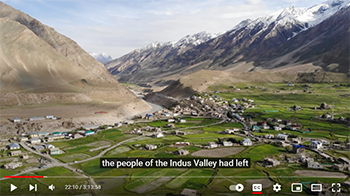
the people of the Indus Valley had left their drought-ridden land and migrated eastwards, leaving the cities of Harappa, Mohenjo-Daro, and many others to crumble into the sands. They migrated east until they reached a large, bountiful river
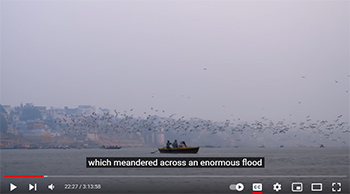
which meandered across an enormous flood plain, rich and full of life. Here on the banks of this river, the next phase of Indian history would begin.
Only a few decades later, in the 1850s, another East India Company officer, one Colonel Alexander Greenlaw, would visit the ruined site with an early camera
and would take some of the most affecting photographs of the ruins in their undisturbed condition.
In them, we can see the same crumbling, magnificently carved edifices that Mackenzie would have, overgrown with mosses, growths of cactus -- like euphorbia and grasses, their ornate cupolas strangled by vines.
We can see the beautiful bathing houses spilling over with water weeds, the halls of long-dead kings now silent and shaded beneath cracking roofs.
In his journal, Mackenzie describes the sight of the city now sunken beneath the earth. This place is now almost ruined, but its remains are still very magnificent and curious.
The houses of the inhabitants are entirely destroyed, and the ruins now form high banks and eminences,
under which are buried many great houses whose terraces are level with or sunk below the soil. Many of these we can see in passing among the inner ruins. South of the king's palace is a square building, the top of which is destroyed now.
This being covered with earth and overgrown with bushes, we could not penetrate its interior.
These crumbling ruins were the remains of a city known as Vijayanagara. As Mackenzie walked between the fallen pillars, as he looked down on them from the
hilltop nearby and drew his map, he was clearly struck by the grandeur and magnificence of these remains, and he must have wondered how such a great society could build all this, flourish, and then vanish into
nothing. My name is Paul Cooper, and you're listening to The Fall of Civilizations Podcast.
Each episode, I look at a civilization of the past that rose to glory and then collapsed into the ashes of history. I want to ask, what did they have in common? What led to their fall? And what did it feel like to be a person alive at the time who witnessed the end of their world? In this episode, I want to look at a civilization that has all but faded from memory in many parts of the world. That's the story of the Vijayanagara Empire of Southern India. I want to tell the story of how this remarkable society rose up out of an age of conflict and fragmentation, how it built one of the largest and most impressive medieval cities in the world, and developed an identity that was both South Indian in nature and global in outlook. Finally, I want to tell the story of what happened to bring the great stone temples of Vijayanagara crashing down in fire and flame.
The granite terrain that surrounds the small village of Hampi and the ruins of Vijayanagara around it is one of the most distinct and easily recognizable in the world.
It's a unique and surreal clutter of enormous rounded boulders teetering in strange and unlikely balancing acts,
looking a little like pebbles someone has piled up on a beach. A later visitor to the ruins, a British man named AH Longhurst, provides the following vivid description of the
region's distinctive landscape.
The site of the old city is a strangely wild place to have been the birthplace and capital of an empire. The whole of it
is dotted with little barren rocky hills, and immediately north of it, the wide and
rapid Tungabhadra River hurries along a boulder-strewn channel down rapids and
through narrow gorges. The hills are of granite, weathered to every shade of
color from grey to brown, and have hardly any vegetation on them. The alternate burning days and chilly
nights of the Deccan climate have seamed and split in every direction. The huge masses of solid rock and the earthquakes of remote ages have torn from their flanks the enormous boulders, and have piled these up round
about their sides in the most fantastic confusion, or flung them headlong into the valleys below.
But despite its often precarious appearance, this landscape is actually one of the most ancient and stable surfaces to be found anywhere in the world. These vast sheet layers of granite were formed under the earth's surface between about three and three-and-a-half billion
years ago during the earliest formation of the Earth's crust.
Some of these rocks were around during the emergence of the very first life on Earth, from the tiniest microbes and bacteria. They have stood here and watched that
life emerge from the seas, seen the dinosaurs rule the earth only to be wiped out by a visitor from the stars,
then seen the evolution of humans from small mammals. While softer rocks have eroded around them, these hard granites have remained.
The landmass that they are a part of is often known as the Indian subcontinent, a place with one of the most interesting interplays of geology and climate in the world. This is a massive peninsula jutting out of the south of Asia that extends south for more than 3,000
kilometers from the Himalayan mountains.
It's a landmass that encompasses an enormous variation in landscapes, from the mountainous cloud forests and
coconut-palmed beaches in the south to the snowy reaches of the Himalayas in
the north, and the baking Thar Desert in
the northwest. But generally, India is loosely divided into two regions usually called North and South India.
The north is a landscape of expansive,
flat riverlands, grassy plains stretching off into the distance,
then rising to the foothills of the Himalayas.
But in the south, the landscape is
dominated by an arid, rocky shelf known as the Deccan Plateau. The name Deccan comes from the same root as the Tamil word ‘thekkanam’ and the Sanskrit word ‘Dakshina’, which both mean
the province of the south.
This plateau is a sprawling table of rocky land that covers much of Western,
Central, and Southern India.
It rises from low elevations in the north up to more than a thousand meters in the south, wedged between the two mountain ranges known as the Western and
Eastern Ghats.
The word ‘ghat’ is used in some South Indian languages to describe stone steps leading down to a river or lake, and so, the word is also used for these
mountains since they look down over the coast. The Western Ghats are in fact the eroded remnants of what was once the edge of this continent.
A hundred million years ago, India was joined to Africa before tearing away and beginning a journey of
6,000 kilometers across the ocean,
before colliding with Asia.
Directly after the break from Africa, it's thought that the west coast of India would have appeared as a sheer
cliff around a thousand meters high. Over the next 100 million years, erosion and weathering would wear down this cliff into the dramatic series of mountains that today runs the whole
length of the coast and can soar up to 2,600 meters.
In the south, they are so massive that they block the clouds that roll in from
the sea during India's southwest monsoon, meaning that the land on the west of the mountains
is a vivid, tropical green, a landscape of lagoons and mangrove forests, while the land of the Deccan Plateau
beyond them is relatively dry and arid. But across this rocky landscape,
a number of great rivers do flow. They flow down the slope of the land eastwards, away from the mountains of the Western Ghats. Some of these Deccan rivers are the Godavari, the Krishna, the Kaveri, and the
Tungabhadra, and they all flow eastwards until they eventually empty into the Bay of Bengal on the eastern coast. So, this is the landscape across which the great medieval drama of South India would unfold.
The roots of human civilization in India are truly ancient.
Analysis of mitochondrial DNA shows that modern humans began arriving in the
subcontinent between 75,000 to 50,000 years ago, migrating through the Middle
East and Persia from our origins in
Eastern Africa.
Cave paintings dating to around 10,000 years ago have been found in the rock shelters of Bhimbetka in Central India.
These paintings show men riding horses and even elephants, suggesting that the story of humans in this region has been intertwined with those of animals since the very beginning.
Around the year
6500 BC, agriculture emerged as people
began to farm winter grasses, barley, and
wheat in Balochistan in modern Pakistan
on the banks of the Indus River. In the following millennia, these techniques spread all the way up the Indus Valley. From about the year 3000 BC, large cities began to form in this region, which today are known by the names Mohenjo-Daro and Harappa, and which
are estimated to have held as many as 60,000 people. The cities of the civilization that grew up in the Indus Valley
were built from baked bricks, and featured elaborate drainage systems and
water supply systems, along with what may have been temples and workshops. Its people used a system of standardized
weights to measure out goods, and in some cities, large canals and docks have also been uncovered. There's evidence that the
Indus Valley may have traded by sea with the civilizations of Mesopotamia, the Sumerians and Acadians, and Indus Valley
artifacts have been found as far afield
as Oman, Bahrain, and in the south of Iraq. It's perhaps here that the people of
India first truly harnessed the immense power of the elephant. The carved seals of the Indus Valley
seem to provide the earliest evidence of
the organized capturing and training of elephants from as early as 6000 BC.
By the time the first surviving texts were written in India many thousands of years later, tamed elephants would have already been a common, everyday sight,
carrying heavy loads for construction, transporting important people, and fighting as weapons of war.
The Indus Valley civilization is also thought to have experimented with writing, although the extent to which they did so is a matter for debate. Archaeologists have uncovered hundreds of distinct symbols that Indus people
used on stamped seals or small tablets, ceramic pots, and what may have been signs hanging over the gates of their
inner citadel.
Most of these inscriptions are tiny,
containing only four to five characters. The longest ever found on a single
surface is only 17 characters long, and
we can't tell whether this was truly a written language. If the Indus Valley symbols really are a form of writing, the tragedy is that it has never been decoded. So,
the names of their cities, the names of their kings, their deeds and
works, the lives of everyday people, all of it has been lost beneath the sands of Pakistan,
perhaps forever.
CHAPTER TWO: THE ORAL TRADITION
The outstanding feature of the oldest Indian education and Indian culture in general, especially in the centuries B.C., is its orality. The Vedic texts make no reference to writing, and there is no reliable indication that writing was known in India except perhaps in the northwestern provinces when these were under Achaemenid rule, since the time of Darius or even Cyrus. Those who write down the Veda go to hell, as the Mahabharata tells us, [x] and Kumarila [700 A.D.] confirms: "That knowledge of the truth is worthless which has been acquired from the Veda, if the Veda has not been rightly comprehended or if it has been learnt from writing." [Al-Biruni reported in the eleventh century: "They do not allow the Veda to be committed to writing."
Sayana [d. 1387] wrote in the introduction to his Rgveda commentary that "the text of the Veda is to be learned by the method of learning it from the lips of the teacher and not from a manuscript."
Several reasons are given for this restriction, among them the fear that the sacred knowledge could fall into the hands of members of the lower castes, or that the student may not be fit for the sacred and supposedly powerful knowledge; the need to recite the Vedic mantras [x] with correct accents and intonations, if disaster is to be avoided, reinforced the need for oral instruction.
The original and most powerful—if unspoken—reason probably is the belief that the instruction in Vedic lore had always been conducted in this way, a holdover from the time when script was completely unknown in India. Some later authors permit the writing down of Vedic texts, but only as a teaching aid, for reviewing previous oral instruction.
The antiquity of writing in India is a controversial topic. A script has been discovered in the excavations of the Indus Valley Civilization that flourished in the Indus valley and adjacent areas in the third millennium B.C. The number of different signs suggest a syllabic script, but all attempts at decipherment have been unsuccessful so far. Attempts by some Indian scholars to connect this undeciphered script with the Indian scripts in vogue from the third century B.C. onward are total failures....
The best evidence today is that no script was used or even known in India before 300 B.C., except in the extreme Northwest that was under Persian domination. That is in complete accord with the Indian tradition which at every occasion stresses the orality of the cultural and literary heritage.
There were no books; the common Indian word for "book" (pusta[ka]) is found not before the early centuries A.D. and is probably a loanword from Persian (post), and grantha denoted originally only "knot, nexus, text" acquiring the meaning "manuscript" much later.
The older Indian literature (including some texts as late as the early centuries A.D.) belongs to one of two classes: sruti "hearing" and smrti "remembering." It behooves us to pay attention to this distinction made by the Indians themselves early on.
Sruti, the more authoritative (and, on the whole, older and more carefully preserved) class consists of the Vedic hymns and mantras as well as the theological and philosophical speculations of the Brahmanas and Upanisads which are considered timeless revealed truths, something ordinary men can never hope to perceive themselves but can "hear" through the endless chain of oral tradition. The original revelation of sruti, though, is often said to be by "seeing," but there was also a subtle distinction: in RV VIII 59, 6 the seer "saw" through tapas the origins (tapasdbhyapasyam), in TS V 3, 5, 4 the seers "saw" the meters with tapas (tani tapasdpasyari) -- but the claim that they "saw" the hymns came only later....
The Vedic rsis (whom we call "seers"), in the standard doctrine championed by the Mimamsa, "saw" the eternally existing Vedic hymns and ritual procedures -- not with their physical eyes it seems but with a special vision.... with the help of divine inspiration....
The contrast to sruti is not a book but the equally oral tradition of smrti; Monier-Williams is wrong to refer to smrti as "what is only remembered and handed down in writing"
-- Chapter Two: The Oral Tradition, From "Education in Ancient India", by Hartmut Scharfe
All that we have left are the names that later people gave to the remains of these haunting places. One of their largest cities is known today as Mohenjo-Daro, which in the language of Sindhi simply means
‘the mound of dead men’. While it's not clear what happened to cause the downfall of their society, we
do have some idea. The Indus Valley climate grew significantly cooler and drier from about 1800 BC,
linked to a general weakening of the monsoon at that time, an event that may have also contributed to the collapse of Sumerian society in the valley of Mesopotamia.
The Indus Valley did not use as extensive irrigation techniques, and so were more reliant on the annual floods of the river. As the floods failed, the capacity of the river to support the population would have collapsed.
At this time, a people known as the Arya are thought to have arrived in the valley. It's unclear whether these Aryans came as settlers or refugees, whether they were welcomed or met with conflict, whether they brought new technologies and language into the valley, or whether
they simply learned them there. But whatever the case, this pattern would be repeated countless
times over the coming history.
People would arrive in India from the lands beyond, mixed with the people already there, and a new culture would be born,
a blend of old and new, foreign and home-grown. By the year 1300 BC,
the people of the Indus Valley had left their drought-ridden land and migrated eastwards, leaving the cities of Harappa, Mohenjo-Daro, and many others to crumble into the sands. They migrated east until they reached a large, bountiful river
which meandered across an enormous flood plain, rich and full of life. Here on the banks of this river, the next phase of Indian history would begin.
-
admin
- Site Admin
- Posts: 41484
- Joined: Thu Aug 01, 2013 5:21 am
Re: Vijayanagara: The Last Emperors of South India, Fall of
Part 3 of 22
Although the story of Vijayanagara takes place in the southern realm of the Deccan's arid and rocky plateau, it begins here in the north,
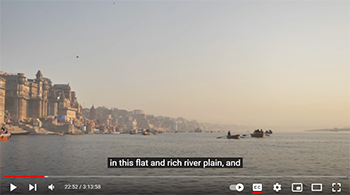
in this flat and rich river plain, and the river that flows across it is known as the river Ganges. This river
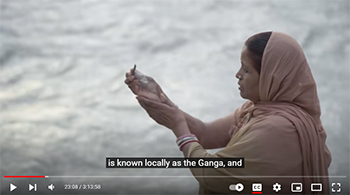
is known locally as the Ganga, and sometimes Ma Ganga, or mother river.
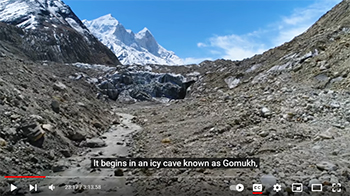
It begins in an icy cave known as Gomukh, or the mouth of the cow, which yawns open at the bottom of the great glacier Gangotri high up in the Himalayas.
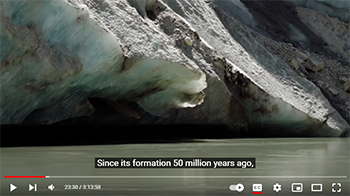
Since its formation 50 million years ago, the enormous weight of the Himalayan mountain chain has quite literally weighed down the land around it. To the south, the ground has been pressed down so it is now almost at sea level, and it's across this flat plain that the Ganges flows for more than two and a
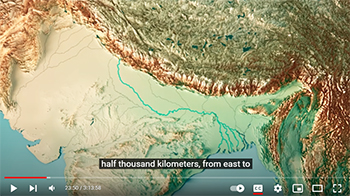
half thousand kilometers, from east to
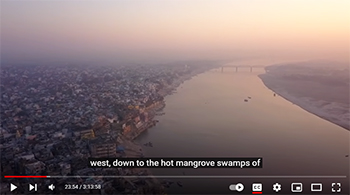
west, down to the hot mangrove swamps of the Bay of Bengal, where it finally empties its silty waters into the sea.

For millennia, this great waterway has sustained around a tenth of the world's
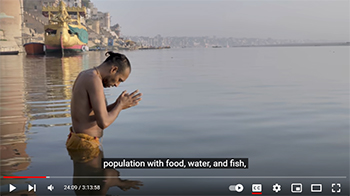
population with food, water, and fish, and has provided a highway for people and trade to pass up and down the river. On one of the main tributaries of the Ganges, a smaller river known as the
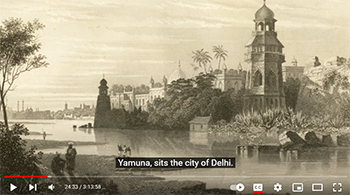
Yamuna, sits the city of Delhi. Delhi is one of the oldest cities in the world. It has been continually inhabited for more than 8,000 years. The soil on the banks of the Yamuna is rich, and so, the people here have always
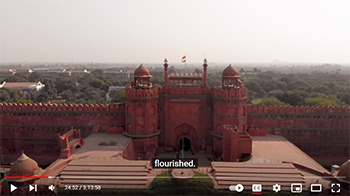
flourished. It's in this region of northwestern India, during the period following the collapse of the Indus Valley
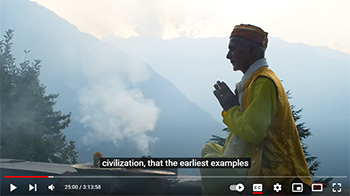
civilization, that the earliest examples of written texts were laid down in the ancient northern language of Sanskrit.
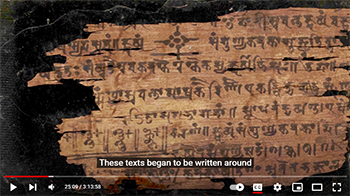
These texts began to be written around three and a half thousand years ago, and
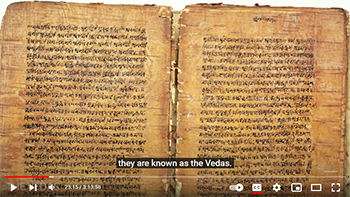
they are known as the Vedas. Unfortunately for us, many of these early texts were written on fragile, perishable substances,
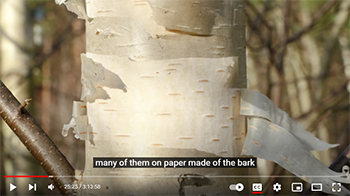
many of them on paper made of the bark of the Himalayan birch tree, using inks
made of ash. Some of these texts, remarkably, have
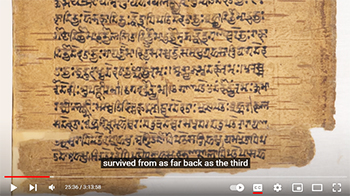
survived from as far back as the third or fourth centuries, but in most cases
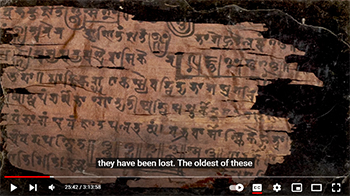
they have been lost. The oldest of these Sanskrit texts, known as the Rigveda,
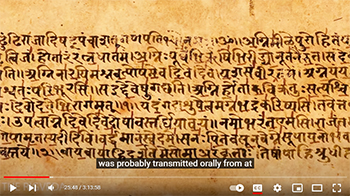
was probably transmitted orally from at least the second millennium BC,
or more than four thousand years ago. In it is contained a poetic vision of
how written language developed in this region.
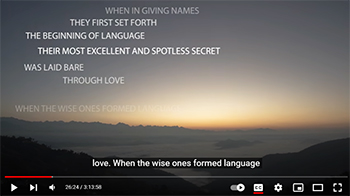
When in giving names, they first set forth the beginning of language. Their most excellent and spotless secret was laid bare through love.
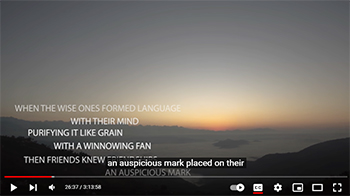
When the wise ones formed language with their mind, purifying it like grain with a winnowing fan, then friends knew friendships, an auspicious mark
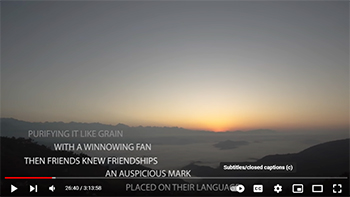
placed on their language.
The publication of these texts had an enormous impact. For about a thousand years after 300 BC, the language of
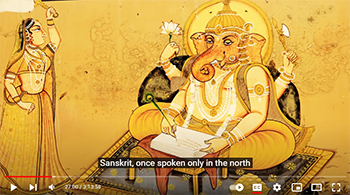
Sanskrit, once spoken only in the north of India, would spread to eclipse all
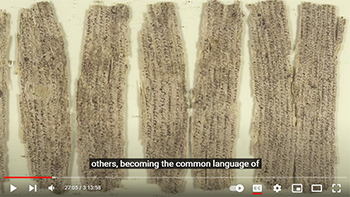
others, becoming the common language of art, science, religion, and poetry, much as Latin once was in Europe. It was in this period that the Vedic religion formed based on the script of
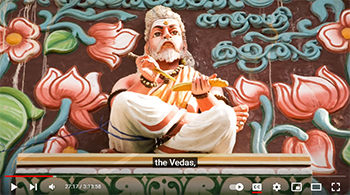
the Vedas, and from this, after a number of adaptations and evolutions, would emerge
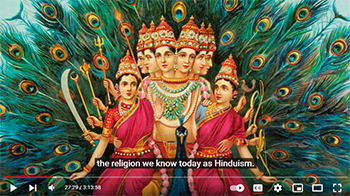
the religion we know today as Hinduism.
Today, the lands of India are united in a single, modern nation, but it's perhaps one of the most diverse nation states on earth, and certainly the largest nation to comprise so many different cultures within its borders. The citizens of Tamil Nadu, Karnataka,
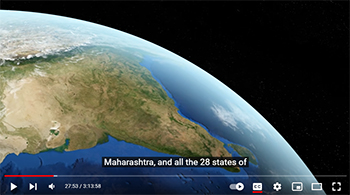
Maharashtra, and all the 28 states of modern India are as different from one another as the citizens of France, Germany, and Italy. They vary in their
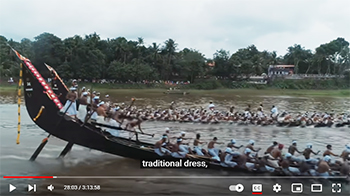
traditional dress, diet, ritual observances, and in the 22 official major languages spoken across the subcontinent. South of Maharashtra in Central India, the languages belong to the Dravidian family, a body of languages found only in India, while Maharashtra's Marathi language and all the major languages of the north,
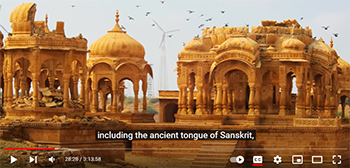
including the ancient tongue of Sanskrit, belong to the Indo-European family, of which English is also a member.
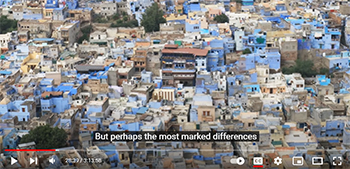
But perhaps the most marked differences from region to region are in the realm of religion. Today, the word Hinduism is applied clumsily to a whole variety of different
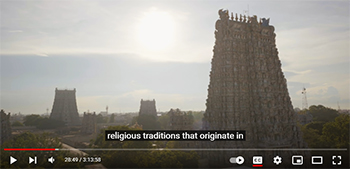
religious traditions that originate in India and that take the ancient texts of the Vedas as their starting point.
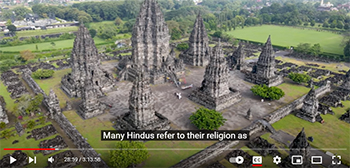
Many Hindus refer to their religion as Sanatana Dharma, the eternal way, or the eternal duty.
But Indian religion was never united under a central authority, and so, it gives rise to a great deal of variation. In very simple terms, Hindus generally believe in one god named Brahman, who is refracted into many different aspects, the way a beam of light refracted

through a glass prism can be shown to contain many colours. The ancient text, the Maitri Upanishad, explains this refracted conception of god, in which each living being also
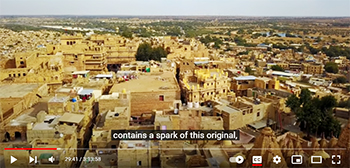
contains a spark of this original, supreme power.
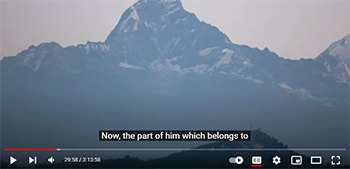
Now, the part of him which belongs to darkness, that is called Rudra, that part of him which belongs to obscurity, that is called Brahma. That part of him which belongs to goodness,
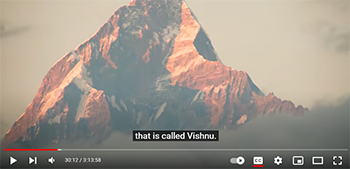
that is called Vishnu. He, being one, becomes three, becomes eight, becomes eleven, becomes twelve, becomes infinite,
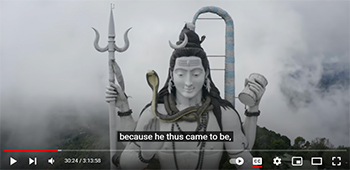
because he thus came to be, he is the being. He moves about, having entered all beings. He has become the lord of all beings.
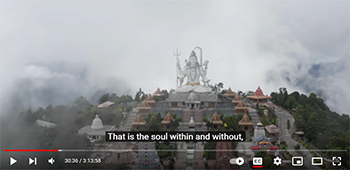
That is the soul within and without, yet within and without. Although this one god can manifest in many different ways, generally most
 `
`
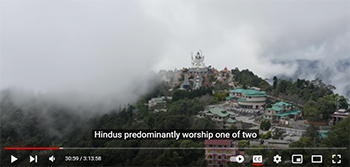
Hindus predominantly worship one of two different manifestations; these are Shiva and Vishnu. In traditional Hebrew, Christian, and Islamic conceptions of the world, the

universe is created by god, who acts to preserve all that is good within it. He is opposed by Satan or Shaitan, who
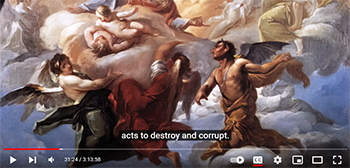
acts to destroy and corrupt. But Hindu conceptions of the universe
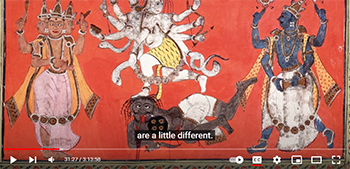
are a little different. In Hinduism, Shiva is both the creator and the destroyer, a beautiful and fearsome god who represents the primal energy of the universe.
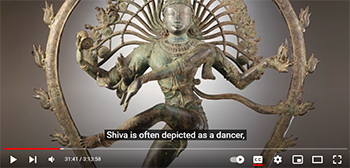
Shiva is often depicted as a dancer, reflecting the dance of the universe as it passes from creation to destruction,

as the flowers bloom, blossom, wither, and then die, as people pass from childhood to adulthood, to old age, and then to death, all of it part of the same cycle, the same dance that goes on and on into eternity. To imagine this way of thinking, we might consider that creation and destruction

are often not opposed, but a part of the same process. A beautiful mushroom might spring out of the decay of a fallen tree.
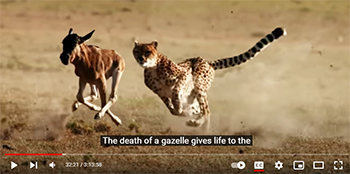
The death of a gazelle gives life to the cheetah, and the fall of one civilization can give rise to another. But the god Vishnu, on the other hand, is the preserver. As Shiva's dance of creation and destruction rolls on, Vishnu is the one who holds things together, if only for a
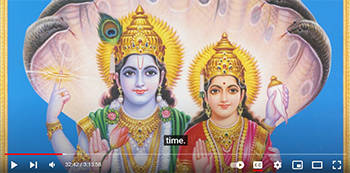
time. Whenever the need arises, he appears on Earth in human form as great mythical heroes like Rama and Krishna, as this
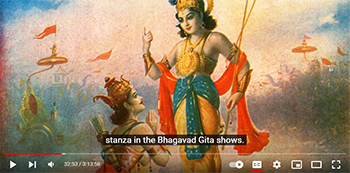
stanza in the Bhagavad Gita shows.
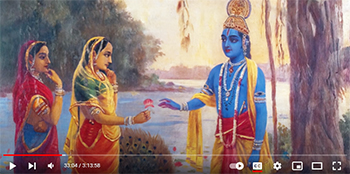
Whenever righteousness wanes and unrighteousness increases, I send myself forth for the protection of the good and for the destruction of evil, and for the establishment of righteousness. I come into being age after age.
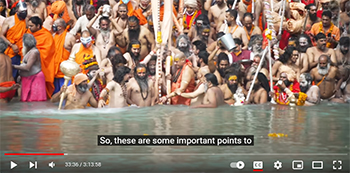
So, these are some important points to remember going forward, that India at this time was home to a great variety of different sects, orders,
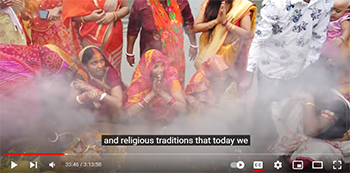
and religious traditions that today we might group together under the label
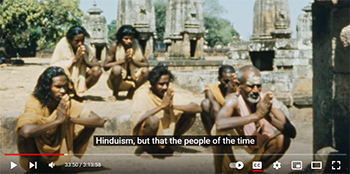
Hinduism, but that the people of the time would have considered to be considerably different, and between which there often
existed great hostility. As the people of India had increasing contact with the people of the wider world, in the second half of
the first millennium AD, a new religion would enter the diverse mix of Indian belief. As the people of India had increasing contact with the people of the wider world, in the second half of the first millennium AD, a new religion would enter the diverse mix of Indian belief.
That is the religion of Islam.
This new religion would bring both conquest and culture. It would form a cultural rift
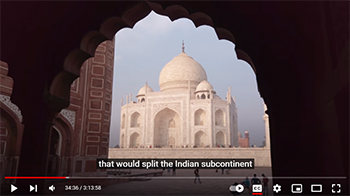
that would split the Indian subcontinent in two, but that would also connect it to the great capitals of the wider world and
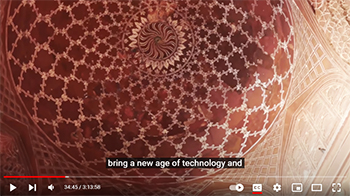
bring a new age of technology and advancement. Its influence would bring about a time of paradoxes, contrasts, and ironies, and chief among these is that it was the arrival of Islam that would lead to the building of perhaps the greatest Hindu
empire to ever arise on the Indian peninsula,
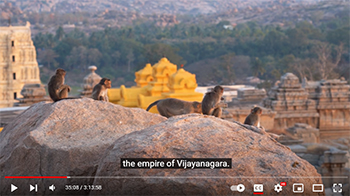
the empire of Vijayanagara. The history of Islam in India is long
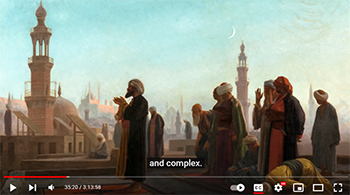
and complex. According to traditional claims, the world's youngest major religion arrived on the shores of the
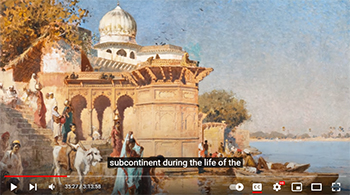
subcontinent during the life of the Prophet Muhammad,

brought by traders who arrived by sea from the Persian Gulf.
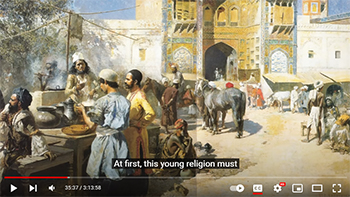
At first, this young religion must have felt very alien to the people of India.
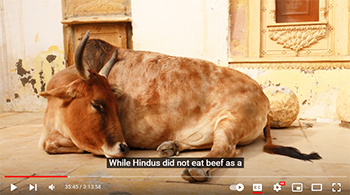
While Hindus did not eat beef as a result of religious reverence of the cow, Muslims quite happily ate it, but were forbidden from eating pork. Hindus generally believe that god appears in multiple different forms, while Muslims believed emphatically in

one indivisible god. While Hindus believed that you could
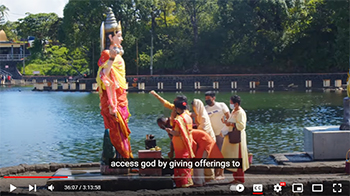
access god by giving offerings to statues and idols, Muslims rejected any depiction of god in sculpture or painting. But while Islam arrived through trade in the south, its arrival in the north of India would be a much less peaceful affair.
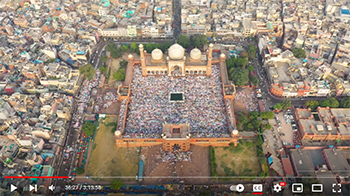
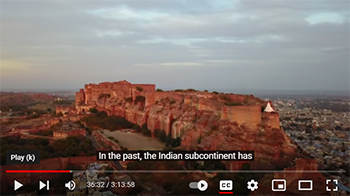
In the past, the Indian subcontinent has often been depicted by historians as a kind of geographical fortress sealed off
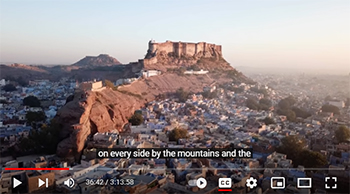
on every side by the mountains and the sea. But when we look at the history of the region, the true picture is one of
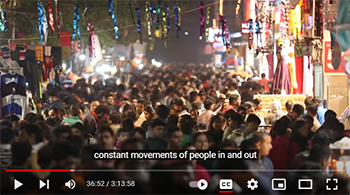
constant movements of people in and out of its landmass, bringing with them their cultures, cuisines, architectural styles, and beliefs.
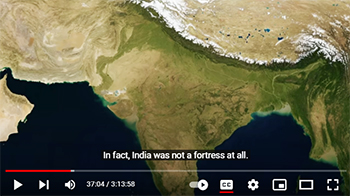
In fact, India was not a fortress at all. The sea that appears to hem the continent in on either side was
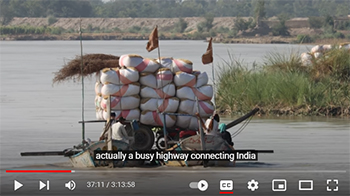
actually a busy highway connecting India to the Persian Gulf and the Red Sea on one side, and Cambodia, Sri Lanka,
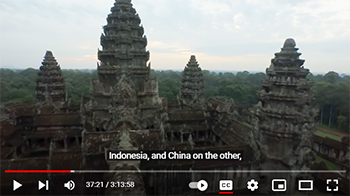
Indonesia, and China on the other, meaning that the port cities of India were always diverse and booming centres of trade.
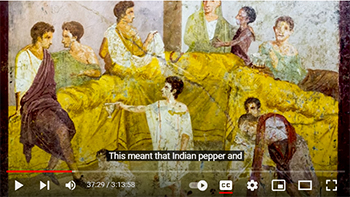
This meant that Indian pepper and cinnamon even flavored the meals eaten by Roman senators, and an Indian bronze figure of the Buddha has been found in a
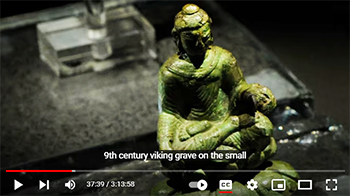
9th century Viking grave on the small Swedish island of Helgo. In the northwest of India, the mountains of Pakistan and Afghanistan were a formidable boundary, but a number of
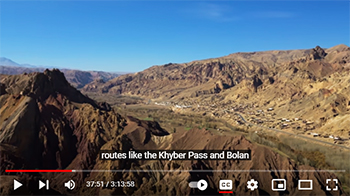
routes like the Khyber Pass and Bolan pass cut through their rugged cliffs in the region of the Indus River Valley, and these passes were home to just as
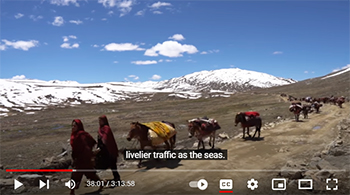
lively traffic as the seas. These roads were so well-established that Alexander the Great was able to march his large army into the region of the Punjab in the 4th century BC, and he would be followed by many other
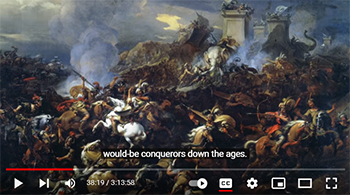
would-be conquerors down the ages. While the Himalayas were the most

impenetrable boundary of all, that didn't stop Indian Buddhism from spreading across them into Tibet and on to the
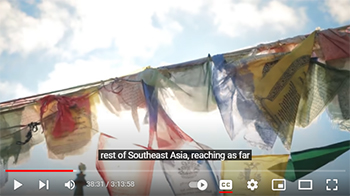
rest of Southeast Asia, reaching as far north as Japan.

In the first millennium AD, powerful
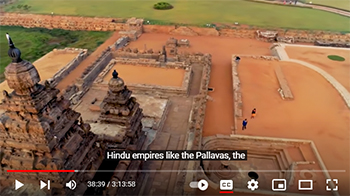
Hindu empires like the Pallavas,
the Pandyas,
and the Cholas grew up in India and spread their influence right across the continent, so that Hindu gods can be found carved into temples as far afield
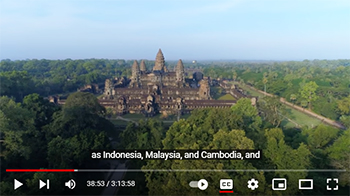
as Indonesia, Malaysia, and Cambodia, and the language of Sanskrit would become the language of learning and religion
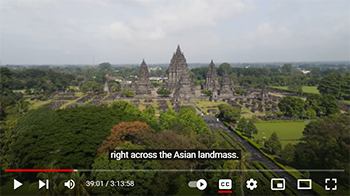
right across the Asian landmass. But while these highways generated enormous opportunities in connecting India to the world outside, they also contained great dangers. Powerful enemies lived in the lands
beyond the mountains.
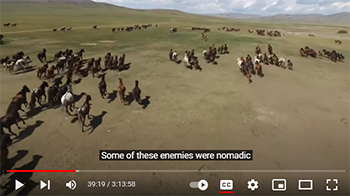
Some of these enemies were nomadic armies of horsemen from the wild steps of Central Asia that could reach truly

astonishing sizes. These would periodically sweep down through the Khyber Pass to raid and pillage
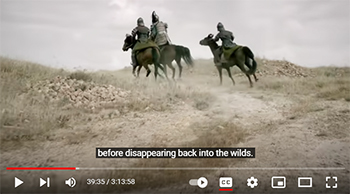
before disappearing back into the wilds.
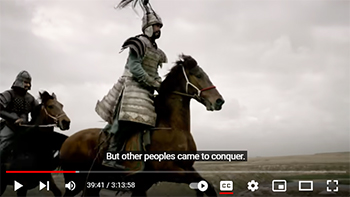
But other peoples came to conquer.

Within 20 years of the death of the
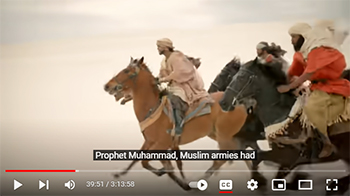
Prophet Muhammad [652 CE] , Muslim armies had achieved one of the most spectacular feats of military campaigning that has ever been seen in world history. Once a small and relatively insignificant regional power, the Arabic-speaking peoples had emerged onto the world stage and immediately knocked out two ancient heavyweights; the
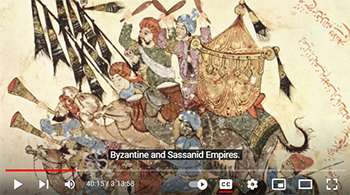
Byzantine and Sassanid Empires. They then followed the same course eastward as Alexander the Great, toppling empire after empire until the Arab domains stretched across three

continents, with borders touching China, Europe, and India.
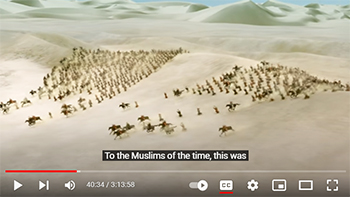
To the Muslims of the time, this was clear proof of the divine nature of their prophet's revelations. But just as Alexander had found out nearly a millennium before, spectacular conquests don't simply transform overnight into a stable empire. Just like Alexander's empire, the newly
conquered Arab territories burst like a bubble and quickly broke off into
separate Muslim kingdoms stretching across the Middle East and Central Asia.
These were ruled over by sultans, a word derived from the Arabic word
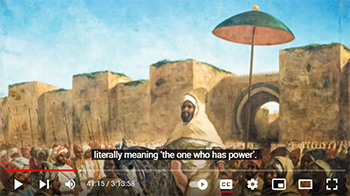
‘sultah’, or power, literally meaning ‘the one who has power’. These new Muslim kingdoms now sat on the
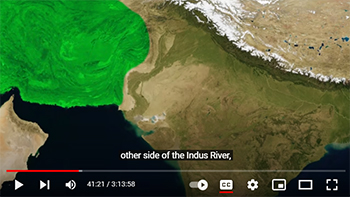
other side of the Indus River, and for the next 300 years [ [652 CE]-952 CE?], they would not make any move to advance into India.
The Hindu kings who ruled North India[???] would eye them with suspicion, but it seems they didn't think of them any differently to any of the other peoples who had come and gone in these regions. They referred to them sometimes as Turks or Turushkas, sometimes as Tajiks, other times slightly confusedly as
Greeks, but more usually with the word ‘mleccha’, a word that means something like barbarian. To these Muslim kingdoms, the wealthy lands of the Ganges plain would have looked like an irresistible target. At this time in history, India likely had the most sophisticated economy in the
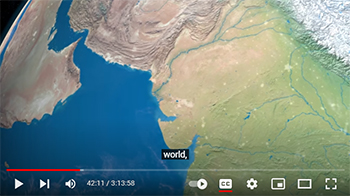
world, and unlike Alexander the Great, the Muslim sultans knew just how large and wealthy India was. From the year 1000 on,
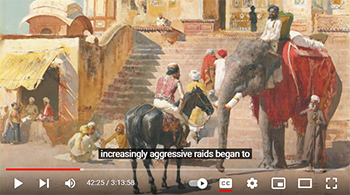
increasingly aggressive raids began to take place, often originating from warrior kingdoms in the region of
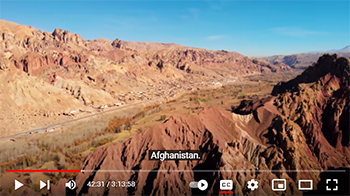
Afghanistan.
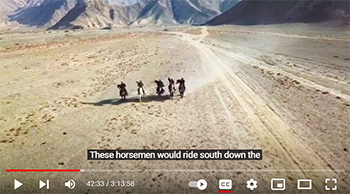
These horsemen would ride south down the Bolan Pass and raid the lands of India. But towards the end of the 12th century, a new and more ambitious group would arrive in the region, and they would come
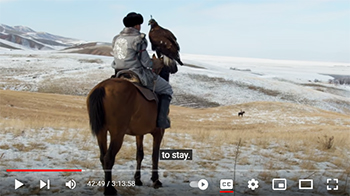
to stay. These were a group of Turkic peoples
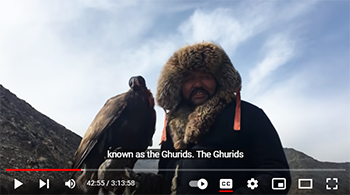
known as the Ghurids. The Ghurids were a dynasty of Iranian origin, but who currently ruled over the Ghor region of present-day Afghanistan. They had long raided the northern lands
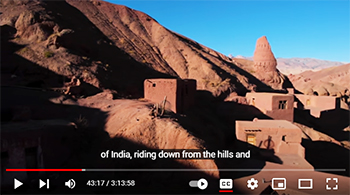
of India, riding down from the hills and burning cities, taking away loot, but in recent years they had come under Persian
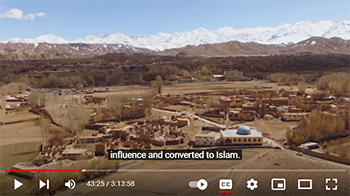
influence and converted to Islam. Now one Ghurid ruler set his sights on greater riches than what could be looted and strapped to a horse. He was a man known today as Muhammad

Ghuri. Muhammad Ghuri was born in the year 1149
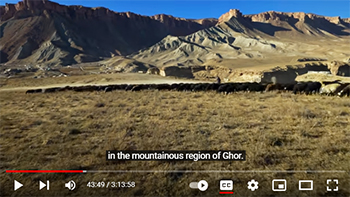
in the mountainous region of Ghor. Ghor had been primarily populated by
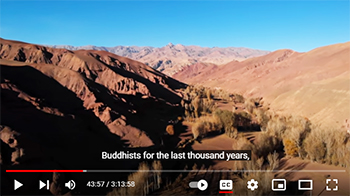
Buddhists for the last thousand years, but from the 11th century on, it became increasingly Muslim and would soon become a center of learning, home to
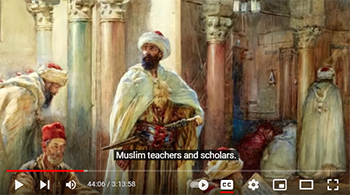
Muslim teachers and scholars. Muhammad Ghuri was a warlord, and he wanted not just to loot and rob North India
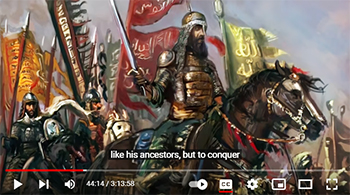
like his ancestors, but to conquer territory for himself and settle down there for good. When the annual monsoon ended in northern India, Muhammad Ghuri swept down the Khyber Pass. With an army powered by strong Afghan
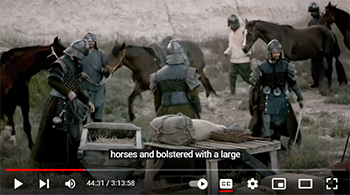
horses and bolstered with a large contingent of slave soldiers, he quickly seized territory in the Punjab, a lush,
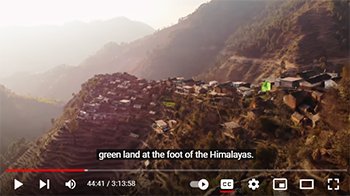
green land at the foot of the Himalayas. The chronicler Ferishta [Firishta], a Persian scholar who settled in India in the 16th

century, recounts this campaign in sparse terms.
In the year following, Muhammad Ghuri, having recruited his forces, marched towards Peshawar, which in a short time
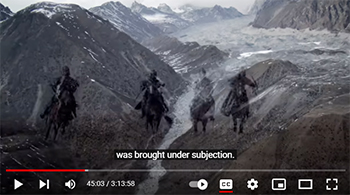
was brought under subjection.
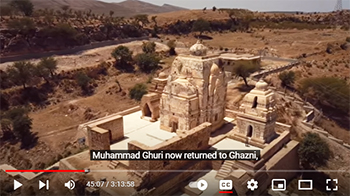
Muhammad Ghuri now returned to Ghazni, but in the next year marched towards Deebul in the province of Sind, and
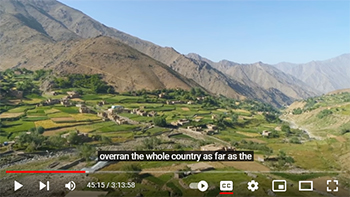
overran the whole country as far as the sea coast, returning laden with rich spoil. [/quote]
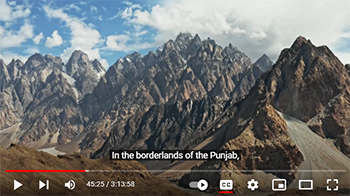
In the borderlands of the Punjab, Muhammad Ghuri created a Sunni Islamic kingdom of his own which extended
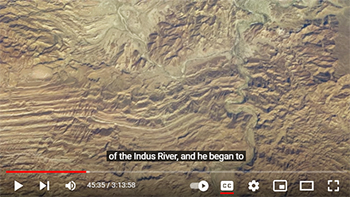
east of the Indus River, and he began to expand it. He tasked his generals with taking more
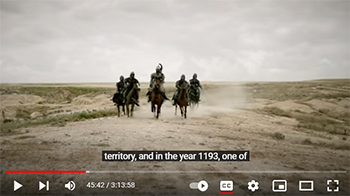
territory, and in the year 1193, one of these generals, a military slave, captured the small regional capital of
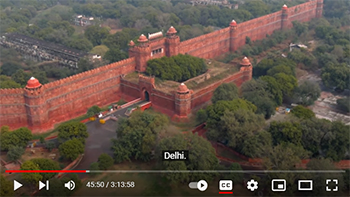
Delhi.
In doing so, Muhammad Ghuri laid the foundation for the Muslim kingdom that for the next 300 years would rule over a
large part of India and establish Muslim culture there for good. This was the power that became known as the sultanate of Delhi.
We know surprisingly little about what life was like for the everyday people of India, many of them Hindu, Jain, and Buddhist
while living under Islamic rule. People's experiences must have differed greatly across time and from person to
person.
Although the story of Vijayanagara takes place in the southern realm of the Deccan's arid and rocky plateau, it begins here in the north,
in this flat and rich river plain, and the river that flows across it is known as the river Ganges. This river
is known locally as the Ganga, and sometimes Ma Ganga, or mother river.
It begins in an icy cave known as Gomukh, or the mouth of the cow, which yawns open at the bottom of the great glacier Gangotri high up in the Himalayas.
Gomukh, also known as "Gaumukh" or "Gomukhi", is the terminus or snout of the Gangotri Glacier and the source of the Bhagirathi River, one of the primary headstreams of the Ganga River. The word Gomukh/Gaumukh (go/gau=cow, mukh= mouth) literally means "Mouth of a Cow."
The place is situated at a height of 13,200 ft (4,023 m) in the Uttarkashi district in the state of Uttarakhand, India. It is one of the largest glaciers in the Himalayas with an estimated volume of over 27 cubic kilometers.
It is a Hindu holy pilgrimage site, visited by many who visit Gangotri. It is around 20 km away from Gangotri and can be reached by trekking.
-- Gomukh, by Wikipedia
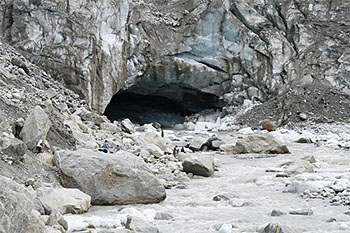
Since its formation 50 million years ago, the enormous weight of the Himalayan mountain chain has quite literally weighed down the land around it. To the south, the ground has been pressed down so it is now almost at sea level, and it's across this flat plain that the Ganges flows for more than two and a
half thousand kilometers, from east to
west, down to the hot mangrove swamps of the Bay of Bengal, where it finally empties its silty waters into the sea.
For millennia, this great waterway has sustained around a tenth of the world's
population with food, water, and fish, and has provided a highway for people and trade to pass up and down the river. On one of the main tributaries of the Ganges, a smaller river known as the
Yamuna, sits the city of Delhi. Delhi is one of the oldest cities in the world. It has been continually inhabited for more than 8,000 years. The soil on the banks of the Yamuna is rich, and so, the people here have always
flourished. It's in this region of northwestern India, during the period following the collapse of the Indus Valley
civilization, that the earliest examples of written texts were laid down in the ancient northern language of Sanskrit.
These texts began to be written around three and a half thousand years ago, and
they are known as the Vedas. Unfortunately for us, many of these early texts were written on fragile, perishable substances,
many of them on paper made of the bark of the Himalayan birch tree, using inks
made of ash. Some of these texts, remarkably, have
survived from as far back as the third or fourth centuries, but in most cases
they have been lost. The oldest of these Sanskrit texts, known as the Rigveda,
was probably transmitted orally from at least the second millennium BC,
or more than four thousand years ago. In it is contained a poetic vision of
how written language developed in this region.
When in giving names, they first set forth the beginning of language. Their most excellent and spotless secret was laid bare through love.
When the wise ones formed language with their mind, purifying it like grain with a winnowing fan, then friends knew friendships, an auspicious mark
placed on their language.
The publication of these texts had an enormous impact. For about a thousand years after 300 BC, the language of
Sanskrit, once spoken only in the north of India, would spread to eclipse all
others, becoming the common language of art, science, religion, and poetry, much as Latin once was in Europe. It was in this period that the Vedic religion formed based on the script of
the Vedas, and from this, after a number of adaptations and evolutions, would emerge
the religion we know today as Hinduism.
Today, the lands of India are united in a single, modern nation, but it's perhaps one of the most diverse nation states on earth, and certainly the largest nation to comprise so many different cultures within its borders. The citizens of Tamil Nadu, Karnataka,
Maharashtra, and all the 28 states of modern India are as different from one another as the citizens of France, Germany, and Italy. They vary in their
traditional dress, diet, ritual observances, and in the 22 official major languages spoken across the subcontinent. South of Maharashtra in Central India, the languages belong to the Dravidian family, a body of languages found only in India, while Maharashtra's Marathi language and all the major languages of the north,
including the ancient tongue of Sanskrit, belong to the Indo-European family, of which English is also a member.
But perhaps the most marked differences from region to region are in the realm of religion. Today, the word Hinduism is applied clumsily to a whole variety of different
religious traditions that originate in India and that take the ancient texts of the Vedas as their starting point.
Many Hindus refer to their religion as Sanatana Dharma, the eternal way, or the eternal duty.
But Indian religion was never united under a central authority, and so, it gives rise to a great deal of variation. In very simple terms, Hindus generally believe in one god named Brahman, who is refracted into many different aspects, the way a beam of light refracted
through a glass prism can be shown to contain many colours. The ancient text, the Maitri Upanishad, explains this refracted conception of god, in which each living being also
contains a spark of this original, supreme power.
Now, the part of him which belongs to darkness, that is called Rudra, that part of him which belongs to obscurity, that is called Brahma. That part of him which belongs to goodness,
that is called Vishnu. He, being one, becomes three, becomes eight, becomes eleven, becomes twelve, becomes infinite,
because he thus came to be, he is the being. He moves about, having entered all beings. He has become the lord of all beings.
That is the soul within and without, yet within and without. Although this one god can manifest in many different ways, generally most
`Hindus predominantly worship one of two different manifestations; these are Shiva and Vishnu. In traditional Hebrew, Christian, and Islamic conceptions of the world, the
universe is created by god, who acts to preserve all that is good within it. He is opposed by Satan or Shaitan, who
acts to destroy and corrupt. But Hindu conceptions of the universe
are a little different. In Hinduism, Shiva is both the creator and the destroyer, a beautiful and fearsome god who represents the primal energy of the universe.
Shiva is often depicted as a dancer, reflecting the dance of the universe as it passes from creation to destruction,
as the flowers bloom, blossom, wither, and then die, as people pass from childhood to adulthood, to old age, and then to death, all of it part of the same cycle, the same dance that goes on and on into eternity. To imagine this way of thinking, we might consider that creation and destruction
are often not opposed, but a part of the same process. A beautiful mushroom might spring out of the decay of a fallen tree.
The death of a gazelle gives life to the cheetah, and the fall of one civilization can give rise to another. But the god Vishnu, on the other hand, is the preserver. As Shiva's dance of creation and destruction rolls on, Vishnu is the one who holds things together, if only for a
time. Whenever the need arises, he appears on Earth in human form as great mythical heroes like Rama and Krishna, as this
stanza in the Bhagavad Gita shows.
Whenever righteousness wanes and unrighteousness increases, I send myself forth for the protection of the good and for the destruction of evil, and for the establishment of righteousness. I come into being age after age.
So, these are some important points to remember going forward, that India at this time was home to a great variety of different sects, orders,
and religious traditions that today we might group together under the label
Hinduism, but that the people of the time would have considered to be considerably different, and between which there often
existed great hostility. As the people of India had increasing contact with the people of the wider world, in the second half of
the first millennium AD, a new religion would enter the diverse mix of Indian belief. As the people of India had increasing contact with the people of the wider world, in the second half of the first millennium AD, a new religion would enter the diverse mix of Indian belief.
That is the religion of Islam.
This new religion would bring both conquest and culture. It would form a cultural rift
that would split the Indian subcontinent in two, but that would also connect it to the great capitals of the wider world and
bring a new age of technology and advancement. Its influence would bring about a time of paradoxes, contrasts, and ironies, and chief among these is that it was the arrival of Islam that would lead to the building of perhaps the greatest Hindu
empire to ever arise on the Indian peninsula,
the empire of Vijayanagara. The history of Islam in India is long
and complex. According to traditional claims, the world's youngest major religion arrived on the shores of the
subcontinent during the life of the Prophet Muhammad,
brought by traders who arrived by sea from the Persian Gulf.
At first, this young religion must have felt very alien to the people of India.
While Hindus did not eat beef as a result of religious reverence of the cow, Muslims quite happily ate it, but were forbidden from eating pork. Hindus generally believe that god appears in multiple different forms, while Muslims believed emphatically in
one indivisible god. While Hindus believed that you could
access god by giving offerings to statues and idols, Muslims rejected any depiction of god in sculpture or painting. But while Islam arrived through trade in the south, its arrival in the north of India would be a much less peaceful affair.
In the past, the Indian subcontinent has often been depicted by historians as a kind of geographical fortress sealed off
on every side by the mountains and the sea. But when we look at the history of the region, the true picture is one of
constant movements of people in and out of its landmass, bringing with them their cultures, cuisines, architectural styles, and beliefs.
In fact, India was not a fortress at all. The sea that appears to hem the continent in on either side was
actually a busy highway connecting India to the Persian Gulf and the Red Sea on one side, and Cambodia, Sri Lanka,
Indonesia, and China on the other, meaning that the port cities of India were always diverse and booming centres of trade.
This meant that Indian pepper and cinnamon even flavored the meals eaten by Roman senators, and an Indian bronze figure of the Buddha has been found in a
9th century Viking grave on the small Swedish island of Helgo. In the northwest of India, the mountains of Pakistan and Afghanistan were a formidable boundary, but a number of
routes like the Khyber Pass and Bolan pass cut through their rugged cliffs in the region of the Indus River Valley, and these passes were home to just as
lively traffic as the seas. These roads were so well-established that Alexander the Great was able to march his large army into the region of the Punjab in the 4th century BC, and he would be followed by many other
would-be conquerors down the ages. While the Himalayas were the most
impenetrable boundary of all, that didn't stop Indian Buddhism from spreading across them into Tibet and on to the
rest of Southeast Asia, reaching as far north as Japan.
In the first millennium AD, powerful
Hindu empires like the Pallavas,
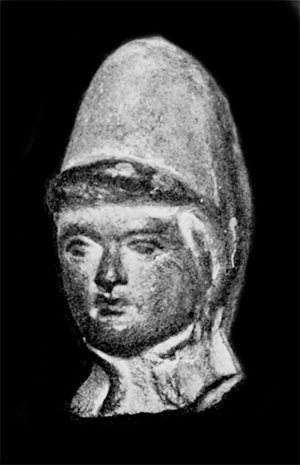
Figure of a foreigner, found in Sarnath. This is a probable member of the West Asian Pahlava or Saka elite in the Gangetic plains during the 300 BC-184 BC period.
The Pahlavas are a people mentioned in ancient Indian texts like the Manu Smriti, various Puranas, the Ramayana, the Mahabharata, and the Brihat Samhita. According to P. Carnegy, In the 4th century BCE, Vartika of Katyayana mentions the Sakah-Parthavah demonstrating an awareness of these Saka-Parthians, probably by way of commerce.The Parthian language, also known as Arsacid Pahlavi and Pahlawānīg, is an extinct ancient Northwestern Iranian language once spoken in Parthia, a region situated in present-day northeastern Iran and Turkmenistan. Parthian was the language of state of the Arsacid Parthian Empire (248 BC – 224 AD), as well as of its eponymous branches of the Arsacid dynasty of Armenia, Arsacid dynasty of Iberia, and the Arsacid dynasty of Caucasian Albania.
-- Parthian language, by Wikipedia
In a 4th-century BCE, the Vartika of Kātyāyana mentions the Sakah-Parthavah, demonstrating an awareness of these Saka-Parthians, probably by way of commerce....
Pahlavas are referenced in various Puranic texts like Vayu Purana, Brahmanda Purana, Markendeya Purana, Matsya Purana, Vamana Purana etc....
The Balakanda of the Ramayana groups the Pahlavas with ...
Mahabharata attests that ...
But the Udyoga-Parva of Mahabharata groups the Pahlavas with ...
Manusmriti[20] states that the Pahlavas ...
The Buddhist drama Mudrarakshas by Visakhadutta and the Jaina works Parishishtaparvan refer to ...
The Brihat-Katha-Manjari of the Kshmendra[22] relates that ...
-- Pahlavas, by Wikipedia
the Pandyas,
Megasthenes mentions Queens of Pandyas as 'Pandaia' and locates them in the south of India extending into ocean. It consisted of 365 villages which met the needs of the royal palace each day of the year. He described the queen as daughter of Heracles...
Pandyas are also mentioned in the inscriptions of Maurya emperor Asoka (3rd century BCE). In his inscriptions (2nd and 13th Major Rock Edict) Asoka refers to the peoples of south India – the Cholas, Cheras, Pandyas and Satiyaputras....Unfortunately, we do not have rich, reliable historical sources for the Mauryas. We have only extremely tenuous information about them -- most of it about "Asoka" -- from very late Buddhist "histories", which are in large part fantasy-filled hagiographies having nothing to do with actual human events in the real world....Instead, scholars insist on the authenticity of all of the inscriptions, and also insist that they must all be ascribed to the ruler known from traditional -- very late, fantasy-filled, pious, hagiographical -- "histories", as well as from the Maski and Nittur Inscriptions, as "Asoka"....It is time for Indologists to seriously consider the recent scholarship which suggests that some of the inscriptions are spurious. ... But in any case, the positive identification of Asoka as the author of the Maski and Nittur "Minor Rock Edict" inscriptions, which are radically different from any of the highly distinctive Major Inscriptions, makes it absolutely certain that "Devanampriya Asoka" cannot after all be the author of the Major Inscriptions, which explicitly and repeatedly say they are by Devanampriya Priyadarsi 'His Majesty Priyadarsi'. ...it is most likely that "Asoka" was not in fact a Mauryan ruler. We do not really know when or where he ruled, if he existed at all; we do not actually know that Dasaratha was the grandson of a Mauryan ruler named Asoka; and so on....
Who, then, really was Devanampriya Asoka? The evidence suggests at least two possibilities. One is that he was imagined by the Kushan period Normative Buddhists on the basis of their understanding of the monumental Major Inscriptions erected by the Mauryas -- evidently by Amitrochates ~ Bindusara. "Asoka" was then projected back to the glorious Mauryan period as an ideal for good Kushan rulers to follow...
[S]ome of the events described in the Major Inscriptions, such as Devanampriya Priyadarsi's conquest of Kalinga, subsequent remorse, and turning to the Dharma, were perfect candidates for ascription to Asoka in the legends. In the absence of any historical source of any kind on Asoka dating to a period close to the events -- none of the datable Major Inscriptions mention Asoka -- it is impossible to rule out this possibility. The late Buddhist inscriptions, such as the Calcutta-Bairat Inscription, may well have been written under the same influence....
The bilingual Aramaic and Prakrit (both in Aramaic script) fragment from Kandahar known as Kandahar II or Kandahar III, which is written in an extremely odd fashion (Falk 2006: 246), has been identified as representing a portion of the "Seventh Pillar Edict" (Norman 2012: 43), but strong doubts remain about the reading of the text (Falk 2006: 246). It is also by no means exactly like the "Seventh Pillar Edict", not to speak of the peculiar presentation of text and translation. In fact, it looks like a student exercise. It is very similar to the content of the Taxila Inscription and the two Laghman Inscriptions, both of which are also highly problematic, q.v. Falk's (2006: 253) conclusion: "There is no clear evidence for an Asokan influence on this text [the Taxila Inscription]. Like the two Laghman 'edicts' this text as well could be of a rather profane nature, mentioning Asoka as king just in passing."...
The next task is for scholars to study the spurious inscriptions to see when exactly each was inscribed, and in some cases why, so as to be able to attribute the information in them to approximately correct historical periods.
-- Greek Buddha: Pyrrho's Encounter With Early Buddhism in Central Asia, by Christopher I. Beckwith
Pandyas are celebrated in the earliest available Tamil poetry. The poems refers to about twelve Pandya rulers. According to tradition, the legendary Sangams ("the Academies") were held in Madurai under the patronage of the Pandyas. Several Tamil literary works, such as Iraiyanar Agapporul, mention the legend of three separate Sangams and ascribe their patronage to the Pandyas....
The famous inscription of king Kharavela at Hathigumpha (mid-first century BCE) mentions the defeat of a confederacy of the "Tramira" countries which had been a threat to Kalinga. It also remembers the precious pearls brought to the capital as booty from the "Pandya" realm.The Hathigumpha Inscription is the main source of information about the Jain Kalinga ruler Kharavela. His year-by-year achievements in this inscription, states Richard Salomon, "approximates the character of a pure panegyric" [text in praise of someone.].... According to Salomon, the "readings, translations, and historical interpretations" of the Hathigumpha inscription "varies widely by different scholars", and it is not possible to establish its single standard version. These interpretations have created significantly different histories of ancient India, some with phantom eras, states Salomon.
-- Hathigumpha inscription, by Wikipedia
The Pandya chiefdom was famous for its pearl fisheries and silk industry. Korkai and Alagankulam are believed to have been the exchange centres of the Pandyas. Korkai, a port at the mouth of the river Tambraparni, was linked to the famous pearl fisheries and Alagankulam was also developed as a port.
-- Pandya dynasty, by Wikipedia
The earliest datable references to the Chola are from inscriptions dated to the 3rd century BCE during the reign of Ashoka of the Maurya Empire ...
-- Chola dynasty, by Wikipedia
and the Cholas grew up in India and spread their influence right across the continent, so that Hindu gods can be found carved into temples as far afield
as Indonesia, Malaysia, and Cambodia, and the language of Sanskrit would become the language of learning and religion
right across the Asian landmass. But while these highways generated enormous opportunities in connecting India to the world outside, they also contained great dangers. Powerful enemies lived in the lands
beyond the mountains.
Some of these enemies were nomadic armies of horsemen from the wild steps of Central Asia that could reach truly
astonishing sizes. These would periodically sweep down through the Khyber Pass to raid and pillage
before disappearing back into the wilds.
But other peoples came to conquer.
Within 20 years of the death of the
Prophet Muhammad [652 CE] , Muslim armies had achieved one of the most spectacular feats of military campaigning that has ever been seen in world history. Once a small and relatively insignificant regional power, the Arabic-speaking peoples had emerged onto the world stage and immediately knocked out two ancient heavyweights; the
Byzantine and Sassanid Empires. They then followed the same course eastward as Alexander the Great, toppling empire after empire until the Arab domains stretched across three
continents, with borders touching China, Europe, and India.
To the Muslims of the time, this was clear proof of the divine nature of their prophet's revelations. But just as Alexander had found out nearly a millennium before, spectacular conquests don't simply transform overnight into a stable empire. Just like Alexander's empire, the newly
conquered Arab territories burst like a bubble and quickly broke off into
separate Muslim kingdoms stretching across the Middle East and Central Asia.
These were ruled over by sultans, a word derived from the Arabic word
‘sultah’, or power, literally meaning ‘the one who has power’. These new Muslim kingdoms now sat on the
other side of the Indus River, and for the next 300 years [ [652 CE]-952 CE?], they would not make any move to advance into India.
The Hindu kings who ruled North India[???] would eye them with suspicion, but it seems they didn't think of them any differently to any of the other peoples who had come and gone in these regions. They referred to them sometimes as Turks or Turushkas, sometimes as Tajiks, other times slightly confusedly as
Greeks, but more usually with the word ‘mleccha’, a word that means something like barbarian. To these Muslim kingdoms, the wealthy lands of the Ganges plain would have looked like an irresistible target. At this time in history, India likely had the most sophisticated economy in the
world, and unlike Alexander the Great, the Muslim sultans knew just how large and wealthy India was. From the year 1000 on,
increasingly aggressive raids began to take place, often originating from warrior kingdoms in the region of
Afghanistan.
These horsemen would ride south down the Bolan Pass and raid the lands of India. But towards the end of the 12th century, a new and more ambitious group would arrive in the region, and they would come
to stay. These were a group of Turkic peoples
known as the Ghurids. The Ghurids were a dynasty of Iranian origin, but who currently ruled over the Ghor region of present-day Afghanistan. They had long raided the northern lands
of India, riding down from the hills and burning cities, taking away loot, but in recent years they had come under Persian
influence and converted to Islam. Now one Ghurid ruler set his sights on greater riches than what could be looted and strapped to a horse. He was a man known today as Muhammad
Ghuri. Muhammad Ghuri was born in the year 1149
in the mountainous region of Ghor. Ghor had been primarily populated by
Buddhists for the last thousand years, but from the 11th century on, it became increasingly Muslim and would soon become a center of learning, home to
Muslim teachers and scholars. Muhammad Ghuri was a warlord, and he wanted not just to loot and rob North India
like his ancestors, but to conquer territory for himself and settle down there for good. When the annual monsoon ended in northern India, Muhammad Ghuri swept down the Khyber Pass. With an army powered by strong Afghan
horses and bolstered with a large contingent of slave soldiers, he quickly seized territory in the Punjab, a lush,
green land at the foot of the Himalayas. The chronicler Ferishta [Firishta], a Persian scholar who settled in India in the 16th
century, recounts this campaign in sparse terms.
Muhammad Qasim Firishta [1560-1620] completed the Gulshan-i Ibrahim, also known as the Ta'rikh-i Firishta and Ta'rikh-i Nawras-nama, in 1015/1606-1607. In it he recorded the history of early Indo-Muslim dynasties, from the time of Sebuktigin of Ghazna. Writing under the patronage of Ibrahim ’Adil Shah of Bijapur, Firishta's Ta'rikh is an assimilation of earlier histories and oral tradition. In it he draws on Barani and the Tabakat-i Akbari of Nizam al-Din Ahmad Bakshi (1001/1592-93). As a historical source, Firishta was considered by European scholars to be authoritative from the end of the 18th century when parts of his history first appeared in English translation. Alexander Dow translated and published the Ta'rih in London in 1798 in two volumes as The History of Hindostan, from the Earliest Account of Time, to the Death of Akbar. A Persian manuscript of Firishta's Ta'rikh was edited by John Briggs and Mir Khairat ‘Ali Khan but was not published until 1247/1831-32 in Bombay under its Persian title Ta'rikh-i Firishtah. Briggs published an English translation of the work almost in its entirety in 1829 under the title History of the Rise of the Mohammedan Power in India, which appeared in four volumes. As a historical source, Firishta's account is suspect and his references to the architecture of Delhi are probably secondhand....
Firishta is believed to have depended heavily on Barani’s Ta’rikh-i Firuz Shahi, but he seems to be unaware of ‘Afif's work. See Hardy, "Firishta," Encyclopedia of Islam 2 (1966), pp. 921-922.
-- The Architecture of Firuz Shah Tughluq, Dissertation Presented in Partial Fulfillment of the Requirements for the Degree Doctor of Philosophy in the Graduate, School of The Ohio State University, by William Jeffrey McKibben, B.A., M.A., 1988
In the year following, Muhammad Ghuri, having recruited his forces, marched towards Peshawar, which in a short time
was brought under subjection.
Muhammad Ghuri now returned to Ghazni, but in the next year marched towards Deebul in the province of Sind, and
overran the whole country as far as the sea coast, returning laden with rich spoil. [/quote]
In the borderlands of the Punjab, Muhammad Ghuri created a Sunni Islamic kingdom of his own which extended
east of the Indus River, and he began to expand it. He tasked his generals with taking more
territory, and in the year 1193, one of these generals, a military slave, captured the small regional capital of
Delhi.
After the return of Muhammad Ghuri, his general took the fort of Merut and the city of Delhi, and it is owing to this circumstance that foreign nations say the empire of Delhi was founded by a slave, and making Delhi the seat of his government, established himself there, and compelled all the districts around to acknowledge the faith of Islam.
In doing so, Muhammad Ghuri laid the foundation for the Muslim kingdom that for the next 300 years would rule over a
large part of India and establish Muslim culture there for good. This was the power that became known as the sultanate of Delhi.
South Asian polities, circa 1250 CE.
-- Mamluk dynasty (Delhi), by Wikipedia
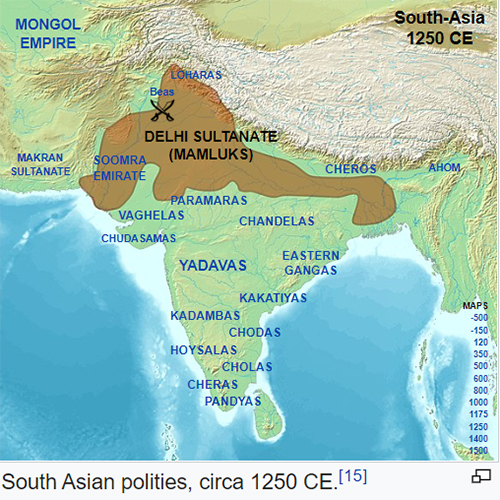
We know surprisingly little about what life was like for the everyday people of India, many of them Hindu, Jain, and Buddhist
while living under Islamic rule. People's experiences must have differed greatly across time and from person to
person.
-
admin
- Site Admin
- Posts: 41484
- Joined: Thu Aug 01, 2013 5:21 am
Re: Vijayanagara: The Last Emperors of South India, Fall of
Part 4 of __
While many Hindus no doubt greatly resented their new Muslim rulers, others simply got on with their lives,
and others still would have seen great opportunity in the new arrangement, with many even converting. The sources are surprisingly thin on any kind of religious conflict between the Muslim rulers and their Hindu subjects.
Certainly some Hindu temples were demolished or turned into mosques, although many were left standing. Muslim rulers were often contemptuous towards the Hindu religion, condemning
what they thought of as the worship of
idols, but Hindu worship was never banned. For the most part, Muslim rulers were
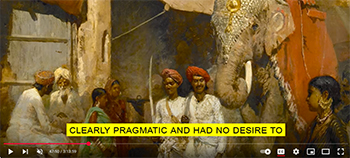
clearly pragmatic and had no desire to unnecessarily aggravate their new subjects.
Pockets of resistance seem to have been most fierce among tribal peoples living in remote areas, but in the cities, there is little evidence of uprisings, and while the Muslim sultans certainly
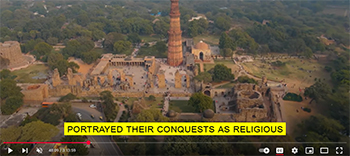
portrayed their conquests as religious missions in their propaganda, it's not clear that religion was always at the forefront of their minds. Much more pressing was the everyday
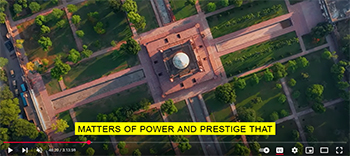
matters of power and prestige that occupy the thoughts of most rulers.
Historical sources contain much more information about the ceaseless conflicts that took place between Muslim rulers and other Muslims than any conflict with their own Hindu citizens.
The resistance that did occur, often among tribal people, could still be fierce. In the year 1206, Muhammad Ghuri, the conqueror of North India, was campaigning in the mountainous region of Sind,

crushing a rebellion by the Punjabi hill tribe known as the Gukkurs. One night, with exceptional stealth, a

small group of Gukkur warriors snuck into his camp and dealt their revenge, as the chronicler Ferishta recalls. On the second of Shaban, having reached the village of Rohtuk on the banks of the Indus, 20 Gukkurs who had lost some of their relations in the late wars, entered into a conspiracy against the king's life. They found their way up to the tents in the night. One of them advanced to the tent door, but being stopped by a sentry who was about to seize him, he plunged his dagger into his breast. The other assassins took the opportunity of cutting their way into the king's tent. He was asleep, with two slaves fanning him. These stood petrified with terror when they beheld the Gukkurs’ enter, who, without hesitation, sheathed their daggers in the king's body, which was afterwards found to have been pierced by no fewer than 22 wounds. Thus fell Sultan Muhammad Ghuri after a reign of 32 years. From there, the Muslims’ fortunes would only get worse.
That same year, far away in the steppes of Mongolia, a vast federation of nomadic peoples would unite together and crown
Genghis Khan as the emperor of all the steppe people of Mongolia. Genghis Khan would soon unleash an invasion of China, where anywhere between 10 to 40 million people may have
been killed.

From there, he would march through Persia and the Middle East, tearing the heart out of the Muslim world and burning its intellectual capitals like Baghdad to

the ground. In just a few decades, around 10 percent of the world's population is thought to have been killed.
Muslim Turks from Pakistan, Afghanistan, Persia, and beyond would flee the advance
of the Khan's horde in enormous numbers, and many of them would come to settle in the newly Muslim kingdoms of North India.
While they had come as conquerors, Muslims would soon be arriving in great
numbers as desperate refugees.
After the death of Muhammad Ghuri, the next hundred years saw a succession of weak rulers, tyrants, and constant assassinations, as well as repeated attempts by the armies of the great Khans of Mongolia
to conquer northern India. But time and again, the horse-powered armies of the
sultanate were able to turn them back, sometimes inflicting massive defeats on Mongol armies.
It's one of the great ironies of Muslim rule in India that the sultans of Delhi,
who themselves had arrived as conquerors, were perhaps the only thing that stopped the armies of the Khans from riding south across India and committing the kinds of atrocities that they inflicted on the helpless civilian population of China. The sultans were able to hold off the Mongol attacks, and with their armies
well-trained and now exceptionally experienced, they even strengthened their hold on North India. One by one, they swept away the fragmented Hindu kingdoms that ruled there, and as the Mongol threat gradually
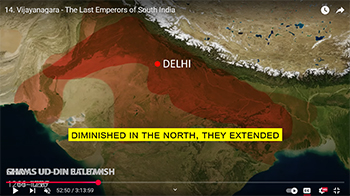
diminished in the north, they extended their borders even further to the south. Under the Khilji Dynasty, whose armies were led by a eunuch slave general named
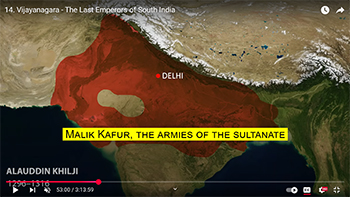
Malik Kafur, the armies of the sultanate crossed the Vindya mountains, the traditional boundary between north and South India, conquered lands there, and forced the kingdoms beyond to pay tribute.
By the year 1300, the Delhi Sultanate had established a lasting power that stretched from the Indus Valley to the Bay of Bengal, from the foothills of the
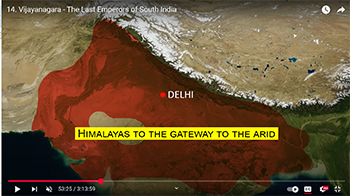
Himalayas to the gateway to the arid plateau of the Deccan.
This power was Sunni Islamic, culturally a blend of Turkic and Persian, and in its more stable moments, its rulers dreamed of expanding ever further into the south and eventually raising their banner over the entire subcontinent. These dreams would finally be realized by perhaps the most complex and controversial figure to ever rule over
India, a man named Muhammad bin Tughlaq. Muhammad bin Tughlaq came to the throne of the Delhi Sultanate in the year 1325 at the age of 35. In this year around the world, the greatest king of the West African
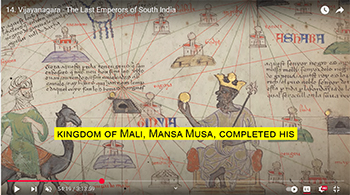
kingdom of Mali, Mansa Musa, completed his pilgrimage to Mecca, giving out so much gold on the way that he crashed the
economies of the Middle East. In the Valley of Mexico, a bedraggled band of travelers settled down on an island in the middle of a lake and founded what would become the great city
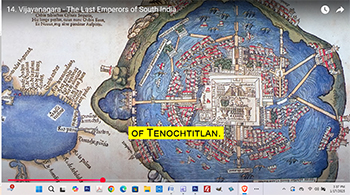
of Tenochtitlan. In the court of Delhi, a new sultan was crowned amid rumors of treachery, murder, and betrayal. Muhammad bin Tughlaq was an enigmatic and mercurial ruler. On one hand, he was an intellectual, an expert in the Quran and Islamic law, who could speak Persian, Arabic, Turkish, and Sanskrit, as well as a famous lover of poetry. Like all the sultans of Delhi, he was a Muslim, but was mostly tolerant of other
religions, and was the only sultan recorded to have taken part in his people's Hindu festivals. But he also had a much darker side. Muhammad bin Tughlaq’s father had come from humble origins,
the son of a slave and a Hindu mother, but he had risen to power and founded the Tughlaq Dynasty.
But then, only five years into his reign, a freak accident occurred. The sultan was sitting under a pavilion with his favorite son and the intended crown prince, when without warning, the structure
collapsed, crushing them both to death.
In some sources, the event is attributed to a bolt of lightning striking the pavilion. One scholar of the time named Barani describes the event in the following terms. A thunderbolt from the sky descended upon the earth, and the roof under which the sultan was seated fell down, crushing him and five or six other persons so that they died. But the Moroccan traveler Ibn Batuta, who visited the Delhi Sultanate during this time and wrote his account once he was safely back in his home city of Fez, gives a different version of the story. He claims that the pavilion collapse was planned, an assassination orchestrated by the king's younger son who would go on to take the throne; Muhammad bin Tughlaq. The scheme was that whenever the elephants would tread on one side of it, the whole building would fall in ruins. The sultan alighted and his son asked his permission to parade the elephants before him. The elephants were led up

from one direction as was planned, and when they walked on that side, the pavilion fell in on the sultan and his son, Mahmud. Muhammad bin Tughlaq gave orders to fetch axes and mattocks in order to dig for them, but he made a sign to delay, and in consequence, they were not brought out until after sunset. They cleared away the ruins and found the sultan dead with his back bent over his son to protect him. As with many rulers who came to power through treachery, Muhammad bin Tughlaq would spend his reign in a state of deep paranoia, always afraid that someone else would do the same thing to him. Throughout his time on the throne, he would dole out extremely harsh punishments to those who displeased him. The traveller Ibn Batuta was shocked by his harsh treatment of his citizens. The sultan was far too free in shedding blood. He used to punish small faults and great without respect of persons, whether men of learning or piety or noble descent. Every day there are brought to the audience hall hundreds of people, chained, pinioned, and fettered, and those who are for execution are executed. Those for torture are tortured, and those for beating are beaten. The chronicler Ferishta goes even further. So little did he hesitate to spill the blood of god's creatures that one might have supposed his object was to exterminate the human species altogether. No single week passed without his having put to death one or more of the learned and holy men who surrounded him, or some of the secretaries who attended him. This cruel streak would earn him the name Muhammad Khuni, or Muhammad the Bloody. Intriguingly, Tughlaq was also a passionate reformer, and was determined to enact a sweeping series of modernization policies in the sultanate,
but each and every one of these was a disaster. Perhaps inspired by China, he
introduced the use of copper coins to replace the old silver ones to make the economy less vulnerable to fluctuations in the supply of silver. But these copper
coins were very easy to counterfeit, and people across the sultanate began melting down the copper objects in their homes

to turn them into coins. The value of the new currency soon crashed, and the silver coins had to be re-introduced at enormous cost. I think it's not unreasonable to assume that Muhammad bin Tughlaq actually

suffered from some kind of mental illness. One report by the Portuguese writer and traveller, Fernao Nuniz, recounts a popular story about him. There are tales of him which do indeed seem most marvelous of the things that he did, as for instance how he made

ready an army because one day in the morning, while standing dressing at a window which was closed, a ray of sun

came into his eyes, and he cried out that he would not rest until he had killed or vanquished whomsoever had dared to enter his apartments while he was dressing. All his nobles could not dissuade him from

his purpose, even though they told him it was the sun that had done it, a thing without which they could not live, that it was a celestial thing and was located in the sky, and that he could never do any harm to it. With all this, he made his forces ready, saying that he must go in
search of his enemy. As he was going along with large forces raised in the

country, so much dust arose that it obscured the sun. When he lost sight of it, the captains told him that he had put to flight him who he had come to seek.

Content with this, the king returned to the road, saying that since his enemy had fled, he was

satisfied. While some of these stories have the sound of apocryphal folk tales, it's clear that the king who inspired them was indecisive and
unstable. At one point, he apparently raised an army of a hundred thousand men and marched it up into the Himalayas, where it was easily ambushed and cut off by the Hindu tribes who lived there. It's recorded that only a single
horseman made it back to Delhi to tell of the army's fate. One of the most devastating
decisions he took was to relocate his capital. He decided that Delhi was too vulnerable to attack by Mongols and other steppe peoples, and so, he would move his capital to the city of Devagiri, more than 1,200 kilometers to the
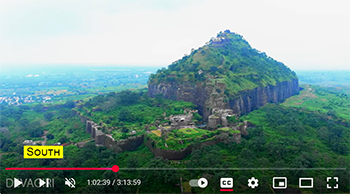
south. He ordered that every citizen of
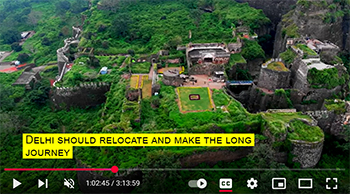
Delhi should relocate and make the long journey by road. Accounts recall that thousands died on the way. The traveller Ibn Batuta arrived in

Delhi around this time, and remembers finding it a deserted ghost town. The sultan ordered all the inhabitants to quit the city of Delhi, and made a proclamation stating that should any person whatsoever be found in any of its

houses or streets, they should receive punishment. Upon this, they all went out.
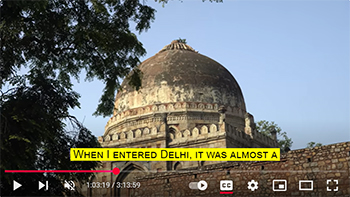
When I entered Delhi, it was almost a desert. Batuta relates that during this time,
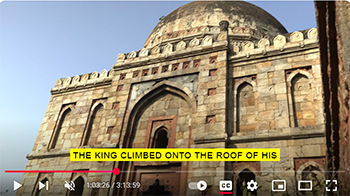
the king climbed onto the roof of his palace and saw the city empty, its streets silent, with no smoke rising from its chimneys.
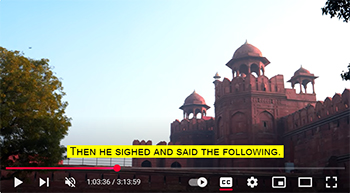
Then he sighed and said the following.

Now my heart is satisfied and my feelings are appeased. Characteristically for Muhammad bin Tughlaq, soon after the mass relocation of Delhi had been completed, he changed his mind, and much of the city's population was

forced to march all the way back. But to the people of the south, the sultan's failed attempt to move his capital in their direction can't have passed without notice. It must have been clear that the ambitions of the sultans were now moving
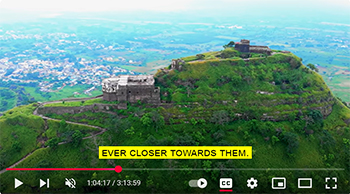
ever closer towards them. By this time, the power of the Delhi Sultanate was seemingly unstoppable. Its empire continued to grow
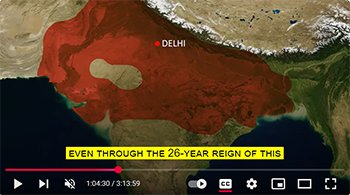
even through the 26-year reign of this temperamental king. The sultans swallowed up the
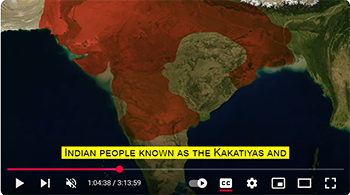
South Indian people known as the Kakatiyas and other surrounding Hindu kingdoms until the empire's territory reached its
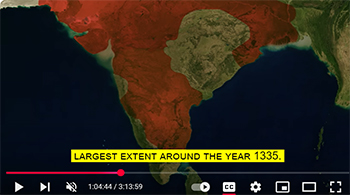
largest extent around the year 1335. It would now stretch for thousands of
kilometers, form a belt across India from sea to sea, and would nearly encompass the entire peninsula.
While many Hindus no doubt greatly resented their new Muslim rulers, others simply got on with their lives,
and others still would have seen great opportunity in the new arrangement, with many even converting. The sources are surprisingly thin on any kind of religious conflict between the Muslim rulers and their Hindu subjects.
Certainly some Hindu temples were demolished or turned into mosques, although many were left standing. Muslim rulers were often contemptuous towards the Hindu religion, condemning
what they thought of as the worship of
idols, but Hindu worship was never banned. For the most part, Muslim rulers were
clearly pragmatic and had no desire to unnecessarily aggravate their new subjects.
Pockets of resistance seem to have been most fierce among tribal peoples living in remote areas, but in the cities, there is little evidence of uprisings, and while the Muslim sultans certainly
portrayed their conquests as religious missions in their propaganda, it's not clear that religion was always at the forefront of their minds. Much more pressing was the everyday
matters of power and prestige that occupy the thoughts of most rulers.
Historical sources contain much more information about the ceaseless conflicts that took place between Muslim rulers and other Muslims than any conflict with their own Hindu citizens.
The resistance that did occur, often among tribal people, could still be fierce. In the year 1206, Muhammad Ghuri, the conqueror of North India, was campaigning in the mountainous region of Sind,
crushing a rebellion by the Punjabi hill tribe known as the Gukkurs. One night, with exceptional stealth, a
small group of Gukkur warriors snuck into his camp and dealt their revenge, as the chronicler Ferishta recalls. On the second of Shaban, having reached the village of Rohtuk on the banks of the Indus, 20 Gukkurs who had lost some of their relations in the late wars, entered into a conspiracy against the king's life. They found their way up to the tents in the night. One of them advanced to the tent door, but being stopped by a sentry who was about to seize him, he plunged his dagger into his breast. The other assassins took the opportunity of cutting their way into the king's tent. He was asleep, with two slaves fanning him. These stood petrified with terror when they beheld the Gukkurs’ enter, who, without hesitation, sheathed their daggers in the king's body, which was afterwards found to have been pierced by no fewer than 22 wounds. Thus fell Sultan Muhammad Ghuri after a reign of 32 years. From there, the Muslims’ fortunes would only get worse.
That same year, far away in the steppes of Mongolia, a vast federation of nomadic peoples would unite together and crown
Genghis Khan as the emperor of all the steppe people of Mongolia. Genghis Khan would soon unleash an invasion of China, where anywhere between 10 to 40 million people may have
been killed.
From there, he would march through Persia and the Middle East, tearing the heart out of the Muslim world and burning its intellectual capitals like Baghdad to
the ground. In just a few decades, around 10 percent of the world's population is thought to have been killed.
Muslim Turks from Pakistan, Afghanistan, Persia, and beyond would flee the advance
of the Khan's horde in enormous numbers, and many of them would come to settle in the newly Muslim kingdoms of North India.
While they had come as conquerors, Muslims would soon be arriving in great
numbers as desperate refugees.
After the death of Muhammad Ghuri, the next hundred years saw a succession of weak rulers, tyrants, and constant assassinations, as well as repeated attempts by the armies of the great Khans of Mongolia
to conquer northern India. But time and again, the horse-powered armies of the
sultanate were able to turn them back, sometimes inflicting massive defeats on Mongol armies.
It's one of the great ironies of Muslim rule in India that the sultans of Delhi,
who themselves had arrived as conquerors, were perhaps the only thing that stopped the armies of the Khans from riding south across India and committing the kinds of atrocities that they inflicted on the helpless civilian population of China. The sultans were able to hold off the Mongol attacks, and with their armies
well-trained and now exceptionally experienced, they even strengthened their hold on North India. One by one, they swept away the fragmented Hindu kingdoms that ruled there, and as the Mongol threat gradually
diminished in the north, they extended their borders even further to the south. Under the Khilji Dynasty, whose armies were led by a eunuch slave general named
Malik Kafur, the armies of the sultanate crossed the Vindya mountains, the traditional boundary between north and South India, conquered lands there, and forced the kingdoms beyond to pay tribute.
By the year 1300, the Delhi Sultanate had established a lasting power that stretched from the Indus Valley to the Bay of Bengal, from the foothills of the
Himalayas to the gateway to the arid plateau of the Deccan.
This power was Sunni Islamic, culturally a blend of Turkic and Persian, and in its more stable moments, its rulers dreamed of expanding ever further into the south and eventually raising their banner over the entire subcontinent. These dreams would finally be realized by perhaps the most complex and controversial figure to ever rule over
India, a man named Muhammad bin Tughlaq. Muhammad bin Tughlaq came to the throne of the Delhi Sultanate in the year 1325 at the age of 35. In this year around the world, the greatest king of the West African
kingdom of Mali, Mansa Musa, completed his pilgrimage to Mecca, giving out so much gold on the way that he crashed the
economies of the Middle East. In the Valley of Mexico, a bedraggled band of travelers settled down on an island in the middle of a lake and founded what would become the great city
of Tenochtitlan. In the court of Delhi, a new sultan was crowned amid rumors of treachery, murder, and betrayal. Muhammad bin Tughlaq was an enigmatic and mercurial ruler. On one hand, he was an intellectual, an expert in the Quran and Islamic law, who could speak Persian, Arabic, Turkish, and Sanskrit, as well as a famous lover of poetry. Like all the sultans of Delhi, he was a Muslim, but was mostly tolerant of other
religions, and was the only sultan recorded to have taken part in his people's Hindu festivals. But he also had a much darker side. Muhammad bin Tughlaq’s father had come from humble origins,
the son of a slave and a Hindu mother, but he had risen to power and founded the Tughlaq Dynasty.
But then, only five years into his reign, a freak accident occurred. The sultan was sitting under a pavilion with his favorite son and the intended crown prince, when without warning, the structure
collapsed, crushing them both to death.
In some sources, the event is attributed to a bolt of lightning striking the pavilion. One scholar of the time named Barani describes the event in the following terms. A thunderbolt from the sky descended upon the earth, and the roof under which the sultan was seated fell down, crushing him and five or six other persons so that they died. But the Moroccan traveler Ibn Batuta, who visited the Delhi Sultanate during this time and wrote his account once he was safely back in his home city of Fez, gives a different version of the story. He claims that the pavilion collapse was planned, an assassination orchestrated by the king's younger son who would go on to take the throne; Muhammad bin Tughlaq. The scheme was that whenever the elephants would tread on one side of it, the whole building would fall in ruins. The sultan alighted and his son asked his permission to parade the elephants before him. The elephants were led up
from one direction as was planned, and when they walked on that side, the pavilion fell in on the sultan and his son, Mahmud. Muhammad bin Tughlaq gave orders to fetch axes and mattocks in order to dig for them, but he made a sign to delay, and in consequence, they were not brought out until after sunset. They cleared away the ruins and found the sultan dead with his back bent over his son to protect him. As with many rulers who came to power through treachery, Muhammad bin Tughlaq would spend his reign in a state of deep paranoia, always afraid that someone else would do the same thing to him. Throughout his time on the throne, he would dole out extremely harsh punishments to those who displeased him. The traveller Ibn Batuta was shocked by his harsh treatment of his citizens. The sultan was far too free in shedding blood. He used to punish small faults and great without respect of persons, whether men of learning or piety or noble descent. Every day there are brought to the audience hall hundreds of people, chained, pinioned, and fettered, and those who are for execution are executed. Those for torture are tortured, and those for beating are beaten. The chronicler Ferishta goes even further. So little did he hesitate to spill the blood of god's creatures that one might have supposed his object was to exterminate the human species altogether. No single week passed without his having put to death one or more of the learned and holy men who surrounded him, or some of the secretaries who attended him. This cruel streak would earn him the name Muhammad Khuni, or Muhammad the Bloody. Intriguingly, Tughlaq was also a passionate reformer, and was determined to enact a sweeping series of modernization policies in the sultanate,
but each and every one of these was a disaster. Perhaps inspired by China, he
introduced the use of copper coins to replace the old silver ones to make the economy less vulnerable to fluctuations in the supply of silver. But these copper
coins were very easy to counterfeit, and people across the sultanate began melting down the copper objects in their homes
to turn them into coins. The value of the new currency soon crashed, and the silver coins had to be re-introduced at enormous cost. I think it's not unreasonable to assume that Muhammad bin Tughlaq actually
suffered from some kind of mental illness. One report by the Portuguese writer and traveller, Fernao Nuniz, recounts a popular story about him. There are tales of him which do indeed seem most marvelous of the things that he did, as for instance how he made
ready an army because one day in the morning, while standing dressing at a window which was closed, a ray of sun
came into his eyes, and he cried out that he would not rest until he had killed or vanquished whomsoever had dared to enter his apartments while he was dressing. All his nobles could not dissuade him from
his purpose, even though they told him it was the sun that had done it, a thing without which they could not live, that it was a celestial thing and was located in the sky, and that he could never do any harm to it. With all this, he made his forces ready, saying that he must go in
search of his enemy. As he was going along with large forces raised in the
country, so much dust arose that it obscured the sun. When he lost sight of it, the captains told him that he had put to flight him who he had come to seek.
Content with this, the king returned to the road, saying that since his enemy had fled, he was
satisfied. While some of these stories have the sound of apocryphal folk tales, it's clear that the king who inspired them was indecisive and
unstable. At one point, he apparently raised an army of a hundred thousand men and marched it up into the Himalayas, where it was easily ambushed and cut off by the Hindu tribes who lived there. It's recorded that only a single
horseman made it back to Delhi to tell of the army's fate. One of the most devastating
decisions he took was to relocate his capital. He decided that Delhi was too vulnerable to attack by Mongols and other steppe peoples, and so, he would move his capital to the city of Devagiri, more than 1,200 kilometers to the
south. He ordered that every citizen of
Delhi should relocate and make the long journey by road. Accounts recall that thousands died on the way. The traveller Ibn Batuta arrived in
Delhi around this time, and remembers finding it a deserted ghost town. The sultan ordered all the inhabitants to quit the city of Delhi, and made a proclamation stating that should any person whatsoever be found in any of its
houses or streets, they should receive punishment. Upon this, they all went out.
When I entered Delhi, it was almost a desert. Batuta relates that during this time,
the king climbed onto the roof of his palace and saw the city empty, its streets silent, with no smoke rising from its chimneys.
Then he sighed and said the following.
Now my heart is satisfied and my feelings are appeased. Characteristically for Muhammad bin Tughlaq, soon after the mass relocation of Delhi had been completed, he changed his mind, and much of the city's population was
forced to march all the way back. But to the people of the south, the sultan's failed attempt to move his capital in their direction can't have passed without notice. It must have been clear that the ambitions of the sultans were now moving
ever closer towards them. By this time, the power of the Delhi Sultanate was seemingly unstoppable. Its empire continued to grow
even through the 26-year reign of this temperamental king. The sultans swallowed up the
South Indian people known as the Kakatiyas and other surrounding Hindu kingdoms until the empire's territory reached its
largest extent around the year 1335. It would now stretch for thousands of
kilometers, form a belt across India from sea to sea, and would nearly encompass the entire peninsula.
-
admin
- Site Admin
- Posts: 41484
- Joined: Thu Aug 01, 2013 5:21 am
Re: Vijayanagara: The Last Emperors of South India, Fall of
Part 5 of __
But this success was not to last. The mad sultan Muhammad bin Tughlaq died in the year 1351 while out on campaign to crush a Turkic tribe in the mountains of Pakistan. The exact cause of his death is unknown,
but one scholar of the time reported the news with the following quip. The sultan was rid of the people, and the people of the sultan. But despite his erratic and tyrannical ruling style, it's clear that something in the harsh character of Muhammad bin Tughlaq had been acting to hold the empire together. After his death, the sultanate of Delhi

began to disintegrate, and all its newly conquered lands rose up in rebellion. Soon, a war of succession tore the Delhi Sultanate into multiple factions, with nobles across the empire setting up their own states and declaring freedom. The year
1345 is the last year that imperial coins were minted in South India. The following years saw the empire devolve into anarchy and disintegration,

and opportunist enemies waiting behind the mountains to the north soon got word of this.
One of those enemies was the Turko Mongolian warlord and emperor known as
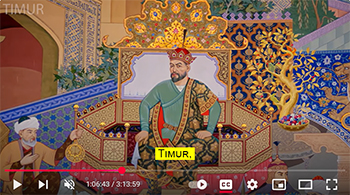
Timur, the last of the great nomadic conquerors of the Eurasian steppe. After hearing of the weakness of the Delhi Sultanate,
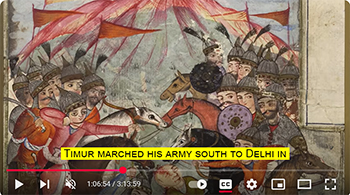
Timur marched his army south to Delhi in the year 1398, plundering and killing all
the way. When he reached the city, he utterly sacked it, looted it, and put its people to the sword. Estimates for the casualties in this

massacre go as high as 200,000 people. Timur himself would later write the following slightly unconvincing account of the atrocity. There was likewise an immense loot of rubies, diamonds, garnets, pearls, and other gems,

vessels of gold and silver, and brocades and silks of great value. Excepting the quarter of the Sayyids, the
scholars, and the other Mussulmans, the whole city was sacked. The pen of fate had written down their destiny for the people of this city. Although I was desirous of sparing them, I could not succeed, for it was the will of god that this calamity should befall the city. Timur had no intention of staying in India.

He simply collected up all the wealth he could loot, along with countless enslaved
people, particularly skilled artisans, and
returned to his capital of Samarkand in modern Uzbekistan. Like the sacking of Rome, Timur's sack of
Delhi tore the heart out of this already struggling empire. The dynasties that followed had no
ability to maintain their far-flung territories, and would now be little more than local warlords.
The people and lands that had once been part of the empire were left in a state of anarchy, chaos, and plague. It was a time of immense change, a time of terrible suffering, and for some, a time of enormous opportunity.

Into this terrain of blood and fire, two brothers would rise from obscure upbringings to change the shape of power in this region,

and it's with these two brothers that the story of Vijayanagara would truly begin. They would move the center of Indian power from the Muslim north to the Hindu south, and build a city there that would stand among the great cities of the medieval world. They were known as the Sangama brothers, and their names were Bukka and Harihara. The exact origins of the Sangama

brothers are wreathed in mystery. Many historians believe that Bukka and Harihara were commanders of the southern Hoysala Empire.
According to these accounts, they may have been stationed on the rocky banks of the Tungabhadra River, with orders to repel any Muslim incursions from the north. Some more dramatic and fanciful stories

recount how the brothers were generals of the conquered Kakatiyas, captured as
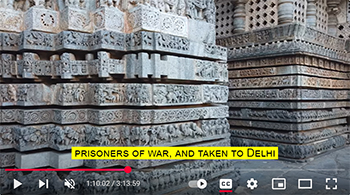
prisoners of war, and taken to Delhi where they were forced to convert to Islam, later escaping and converting back to their native faiths. But none of this is mentioned in contemporary sources, meaning that these accounts are likely unreliable. Many of these legends suggest that these

brothers met a Hindu sage named Shri Vidyaranya. One traditional story recalls that Harihara was out hunting one day when he saw a miraculous sight, and the sage advised him on how to interpret it, as

the historian Robert Sewell recounts.
During his reign, this chief was one day hunting amongst the mountains south of the river
when a hare, instead of fleeing from his dogs, flew at them and bit them. The king, astonished at this marvel, was returning homewards, lost in meditation, when he met on the riverbank the sage
named Vidyaranya or Forest of Learning,
who advised the chief to found a city on the spot. So, the king did, and on that very day
began work on his houses, and he enclosed the city roundabout. While this is most likely a fable, it does contain an illuminating image of how the young power of Vijayanagara

would go on to see itself, as the hunted rabbit who had turned around and learned how to bite. As the power of the Delhi Sultanate
collapsed, the two brothers Bukka and Harihara
raised a considerable army made up of angry Hindu lords, but also large cohorts of Muslim mercenaries. These may even have been soldiers who had once fought for the Delhi Sultanate but who were no longer getting paid.
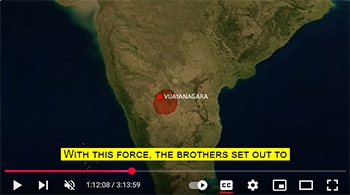
With this force, the brothers set out to capture the areas of South India that the sultanate had left behind. Their offer to Hindu lords in the region was clear; join us, and we will ensure that South
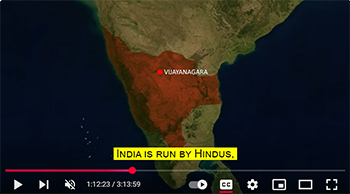
India is run by Hindus,
and it's clear that many found this offer irresistible. Within only a few decades, the Sangama
brothers had brought a large part of South India under their control, but many areas in the south were still ruled by Muslim powers,

now cut off and isolated. These included the arid lands of Tamil Nadu, India's southernmost state, which was still ruled by a short-lived Muslim power continuing to fight for its existence in South India, known as the Madurai Sultanate.
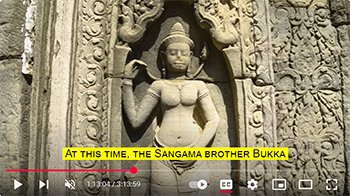
At this time, the Sangama brother Bukka was on the throne, and his wife was a

woman named Ganga Devi, a famed poet. She wrote one vaulting, epic poem in the language of Sanskrit entitled Madhura Vijayam, or The Victory of Madurai. In it, she describes how a woman from the holy city of Madurai comes to king
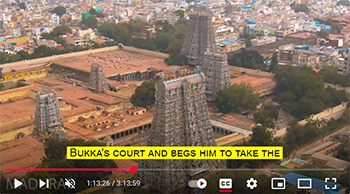
Bukka's court and begs him to take the town back. She describes how the ancient Hindu temples of Madurai had fallen into disrepair under its Muslim rulers. White ants have destroyed the doors.

The door frame of the sanctum is broken due to the wild growth of trees, plants, and creepers. The temple premises that formerly echoed the soft beating of the
drums are now full of wild, wallowing jackals. The place once filled with the odor of sacrificial smoke and the melodious chant of Vedic mantras
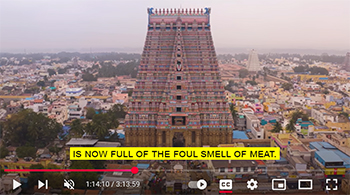
is now full of the foul smell of meat. The beautiful line of statues that adorn the tall towers of the beautiful buildings in the city are now covered with layers of cobwebs. Whether truly motivated by these religious concerns or not, the Sangama
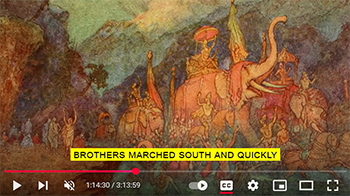
brothers marched south and quickly conquered the now isolated Madurai Sultanate. With the southern Tamil country now under their control, the Sangama brothers now ruled over a large and wealthy territory.
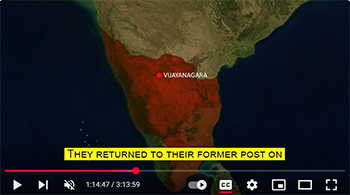
They returned to their former post on the rocky granite banks of the

Tungabhadra River. It was an unassuming sight, just a small and fairly insignificant village known only for its shrine to Shiva, a focal point of pilgrimage. But here, they began to build a city that would announce in its size and ambition the arrival of a new confident power in the south of India. They named this city Vijayanagara, from the Sanskrit ‘vijaya’, meaning victory, and ‘nagara’, meaning city, the city of victory.
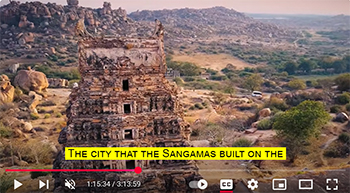
The city that the Sangamas built on the banks of the Tungabhadra River testified to the ambitions that they held for their new kingdom. It would be a city of soaring temples and wide avenues built with an impressive grasp of urban planning, but
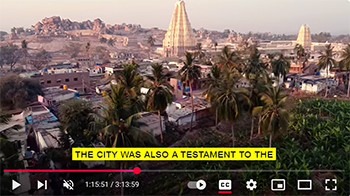
the city was also a testament to the dangerous world that they now found themselves at the heart of. They would build Vijayanagara as a

formidable fortress. The impassible granite hills already provided excellent defense while the

wide, torrential Tungabhadra River protected it on the north side, almost impossible for an army to ford. The brothers enhanced these natural defenses by fortifying the passes
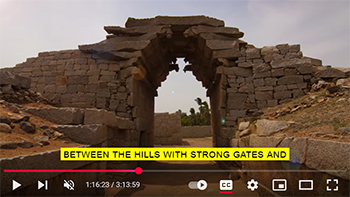
between the hills with strong gates and towers, and these massive walls can still be traced in the landscape today,
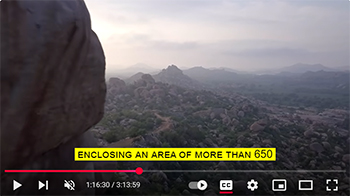
enclosing an area of more than 650 square kilometers. The Afghan envoy Abdur Razzak, who visited
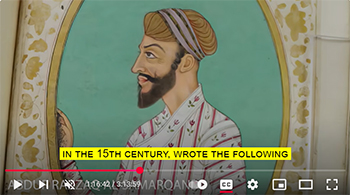
in the 15th century, wrote the following description of the city. It is built in such a manner that seven
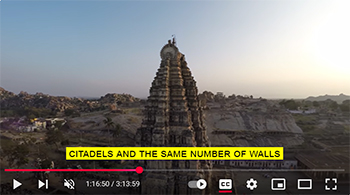
citadels and the same number of walls enclose each other. The seventh fortress, which is placed in
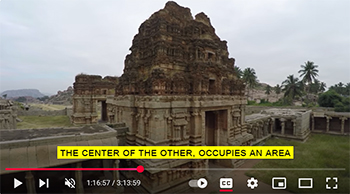
the center of the other, occupies an area ten times larger than the marketplace of the city of Herat. It is the place which is used as the residence of the king.
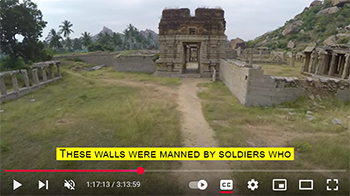
These walls were manned by soldiers who watched from the ramparts, operating watch posts on the broad roads that ran in and out of the city, and in between the layers of walls were areas filled with boulders known as horse stones, designed to disrupt the movement of cavalry and guarantee that any attacking army would have a difficult time advancing while the soldiers of Vijayanagara rained arrow fire down on their heads. When you look at the situation that
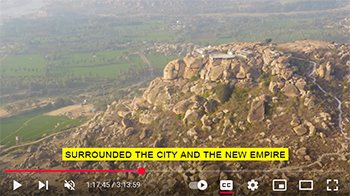
surrounded the city and the new empire of Vijayanagara, it's not hard to see why these defensive fortifications were considered necessary.
That's because the collapse of the Delhi Sultanate had left a number of
fragmented kingdoms behind, who, like Vijayanagara, rose out of the chaos of the collapsing empire. The most powerful of these in South India was the society known as the Bahmani Sultanate. According to tradition, the Bahmani Sultanate was founded by an army
commander named Zafar Khan, who had served under the erratic sultan Muhammad bin Tughlaq. It's clear that at some point he felt the waning power of the Delhi Sultanate in its final years, and in the year 1347, declared himself an independent king in
South India, seizing a large portion of the rocky Deccan Plateau for himself. His gamble paid off;
the weakened Delhi Sultanate, beset with problems on all sides, was no longer able to project its power south of the Vindhya mountains, and it did nothing to stop him. This newly independent power had to fight for its survival from its first days. After defeating one local Hindu ruler,
the Bahmani Sultanate received as tribute a magnificent gift, an ornate throne decorated with turquoise enamel that would become a
symbol of their new empire,

as the chronicler Ferishta recalls. The throne was in length nine feet and three in breadth, made of ebony covered with plates of pure gold, and set with
precious stones of immense value. Every prince of the House of Bahmani who possessed this throne made a point of
adding to it some rich stones. I learned that it was called the Turquoise Throne from being partly enameled of a sky colour, which was in time totally concealed by the number of
jewels. This would become known as the Turquoise
Throne of the Bahmanis, and it would become a symbol of Muslim power in the south of India. Above this throne, they affixed an umbrella, which the scholar Ferishta also gushes about. He fixed a golden ball set with jewels, on which was a bird of paradise composed of precious stones at the top of the umbrella. On the bird's head was a ruby inestimable in value, which had been presented to the late sultan by the king of Vijayanagara.
When this first sultan of the Bahmanis died, with his last words, he declared that his son Mohammed Shah Bahmani would take his throne, and he entreated his sons to stand united and build a kingdom that would stand the test of time, as the chronicler Ferishta writes. I conjure you, as you value the performance of this kingdom, to agree with each other. Mohammed is my successor. Esteem submission and loyalty to him as your duty in this world, and you’re surely for happiness
in the next.
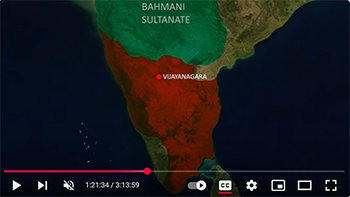
The Bahmani Sultanate was a powerful Muslim kingdom in the heart of South
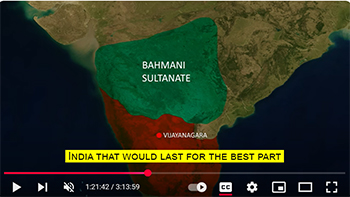
India that would last for the best part of the next two centuries.
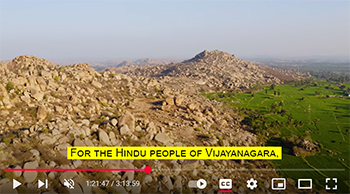
For the Hindu people of Vijayanagara, it represented a constant looming threat on their border. Historians in India and in the West who subscribed to a nationalist idea of history have often framed the conflict
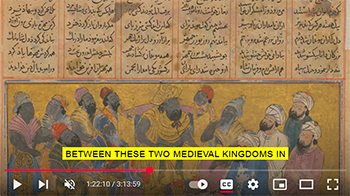
between these two medieval kingdoms in terms of a clash of cultures. In this conception of history, they imagine the Hindu kingdom of
Vijayanagara as a bastion defending Hindu culture from Islamic invaders. But there's little evidence to be found that the people or the rulers of Vijayanagara thought of the situation in this way. One inscription from the time of the Sangama brothers celebrates the victories of the Vijayanagara king Bukka Raya,
and in it, we can see that they thought
of the Turkic Bahmani Sultanate as just one of the many enemies that the kingdom of Vijayanagara faced.
Its other enemies were all Hindu kingdoms.
When his sword began to dance on the battlefield, the faces of the Turks shriveled up, Konkaya Sankaparya was filled with fear, the Andhras ran into caves, the Gurjaras lost the use of their limbs

on every road, the Kambojas’ courage was broken, the Kalingas suffered defeat. Here, there is no mention of religion, and neither is there any hint that the Muslim Bahmanis were any more despicable to the kings of Vijayanagara than say
the Hindu kings of Kalinga on the east coast. There's little evidence that the kings of Vijayanagara thought of themselves as defending Hinduism, and indeed, the idea of a unified Hindu identity simply didn't exist in the 14th century. While the two powers did fight long and bitter wars, the kings of Vijayanagara fought equally bitter wars with the
Hindu Gajapatis, whose kings ruled over

the humid, elephant-filled forest regions to the east. When religious divisions emerged within the kingdom of Vijayanagara, it was overwhelmingly between the followers of Vishnu and Shiva among the Hindus, or between Hindus and Jains. In fact, conflicts between the Bahmani
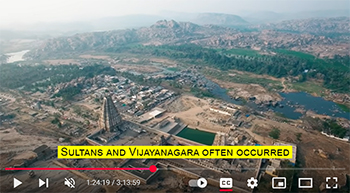
Sultans and Vijayanagara often occurred due to greatly practical economic matters, like access to resources, supply lines, and trade routes. One bitter issue of contention was a rich tract of land
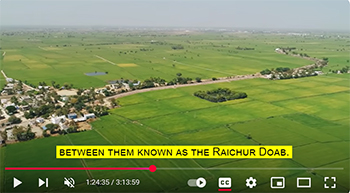
between them known as the Raichur Doab. This was a triangle of land formed at the point where the rivers Krishna and Tungabhadra met,
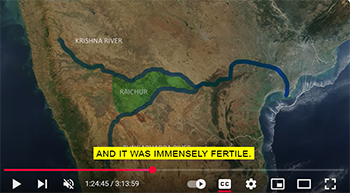
and it was immensely fertile. But it also held great deposits of iron
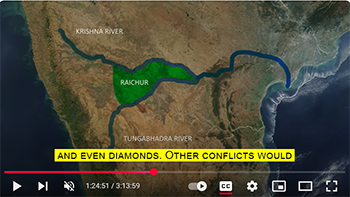
and even diamonds. Other conflicts would

break out over the rich river deltas to the east and the western coast of India,

home to rich trading ports. These ports controlled traffic by sea with the Muslim world, and were a crucial
conduit for the most important strategic military supply of the time; the powerful

war horses imported from Arabia, Persia, and Central Asia. With these contentious territorial issues always on the minds of their rulers, wars between the Bahmani Sultanate and Vijayanagara broke out constantly.
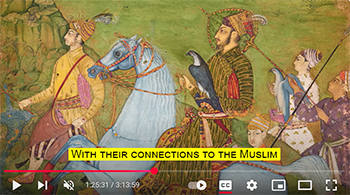
With their connections to the Muslim world, the Bahmanis had the advantage for much of this region's history. Well-supplied with horses, the sultan of the Bahmanis became known as Ashvapati, or the Lord of Horses, while the kings of Vijayanagara were known as or Narapati, or the Lord of Men, alluding to their armies made up of largely massed infantry.

The king of the Hindu Gajapatis in the east, with their vast stables of elephants, completed the triangle and became known as the Lord of Elephants. The Portuguese visitor Domingo Paes was suitably impressed by the infantry of Vijayanagara when he saw them marching in procession in the year 1520. The troops on foot are so many that they surrounded all the valleys and hills in a way with which nothing in the world

can compare. At the waist, they have swords and small
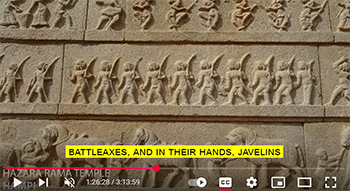
battleaxes, and in their hands, javelins with the shafts covered with gold and silver. You will see amongst them dresses
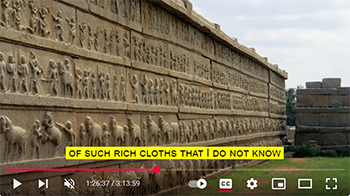
of such rich cloths that I do not know where they came from. Nor could anyone tell you how many colors they have; shield-men with their shields, with many flowers of gold and silver on them, others with figures of tigers and other
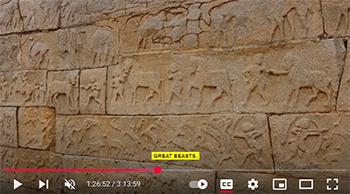
great beasts, others all are covered with silver leaf work,
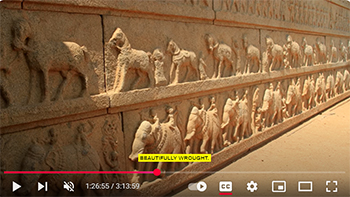
beautifully wrought. But in the early days, they were no match for the horsepower of the Bahmani Sultanate, and with their connections to

the vibrant intellectual world of Muslim learning, the Bahmanis also enjoyed a technological advantage.
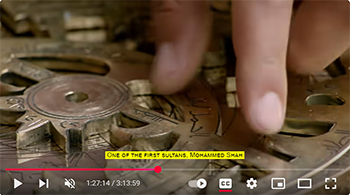
One of the first sultans, Mohammed Shah Bahmani, was a keen follower of new technologies. He even established gunpowder factories in the sultanate to
make use of the emerging technology.

Gunpowder had first been introduced to India and the Middle East by the Mongols, who had learned about it from the Chinese.
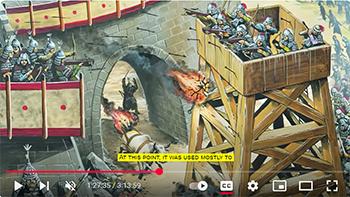
At this point, it was used mostly to create burning or exploding projectiles to be fired from catapults, and
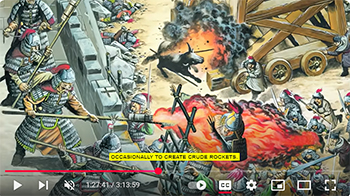
occasionally to create crude rockets. But soon, experiments would begin in using it to propel heavy projectiles along metal tubes, first as siege weapons and then as weapons on the battlefield. Soon, the sounds of cannon fire would
ring out over the battlefields of medieval India, and the Bahmani sultans’ early adoption of this technology would put them in a strong position in the
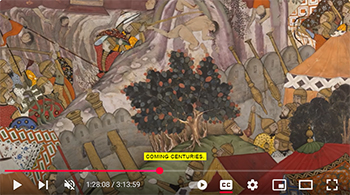
coming centuries. So, although the Hindus of Vijayanagara were the larger and often wealthier kingdom, they often found themselves in the position of paying tribute to their
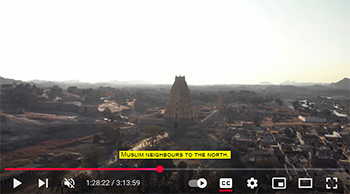
Muslim neighbours to the north,
whose powerful cavalry armies, soon backed by the technological might of cannons, gave them the upper hand. But these wars were never true wars of conquest. The two powers would fight over a seaport or the rich diamond mines of Raichur between them, but when the war's result became clear, the loser would inevitably sue for peace, agree to pay an enormous sum of money to the victor,
often hand over one of their daughters in marriage, and then they would both return home. There was never any suggestion that one side in this rivalry would ever conquer and consume the other. Still, the growing power of the Bahmanis was of growing concern to the kings of Vijayanagara. Soon, the Bahmani Sultanate stretched right across India from east coast to
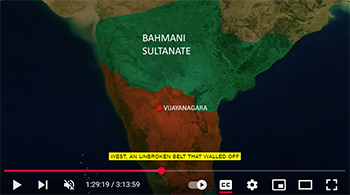
west, an unbroken belt that walled off the people of Vijayanagara to the north, that seized the rich lands of Raichur, and meant that the Hindus of the south were
forever looking with fearful eyes to their northern borders. But despite these concerns, the city of
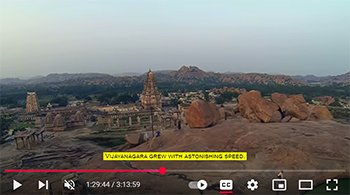
Vijayanagara grew with astonishing speed.
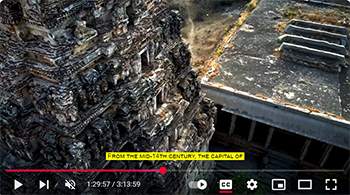
From the mid-14th century, the capital of Vijayanagara grew steadily from the center of a wealthy kingdom
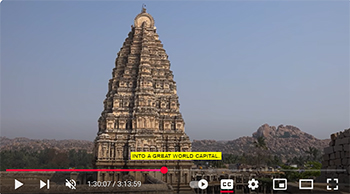
into a great world capital. Thanks to developments in water
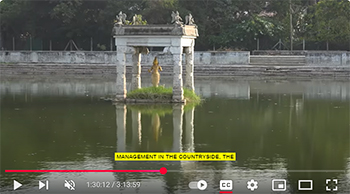
management in the countryside, the
population boomed. Enormous work teams would have dug new irrigation systems and reservoirs lined with stone, as well as distinctive step --
wells so that its people could draw water up from the earth.
The city expanded rapidly, sprawling to absorb villages and towns around it, and
soon grew to house as many as 300,000 people at a time when London had only a fifth of that population, and when the
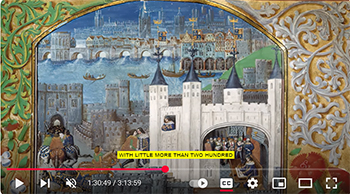
largest city in Europe was Paris, with little more than two hundred thousand. By the year 1500,
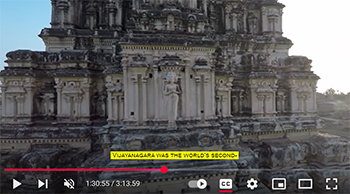
Vijayanagara was the world's second -- largest medieval city after Beijing, and probably India's richest. One poet alive at the time of the city's flourishing wrote the following ode to its
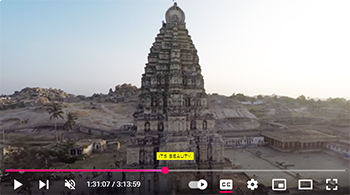
beauty. Walk around the great city of victory.
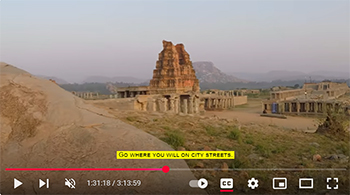
Go where you will on city streets. Everywhere you walk, bright assembly halls decked out with golden vessels will dazzle your eyes.
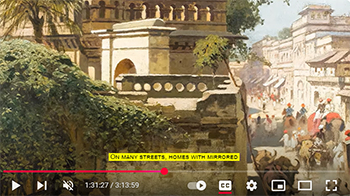
On many streets, homes with mirrored doors will shine, and sugarcane and plantain all around will invite you with welcomes. You'll find able-bodied fighters and horses, elephants and riders. You'll smell aromas of camphor and musk from breasts of

exquisite doe-eyed women. You will face gardens lush with enjoyments,

precious stones and glowing gold, a city of wealth and glory gleaming. You'll agree that this magnificent city is the most enchanting place you've ever
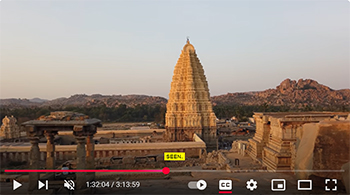
seen. The city also benefited from being surrounded by a seemingly inexhaustible amount of exceptional building material
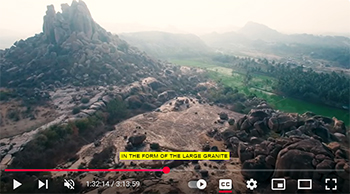
in the form of the large granite boulders of Hampi's ancient terrain. Vijayanagara was truly a city of stone, with all its palaces and stables, its
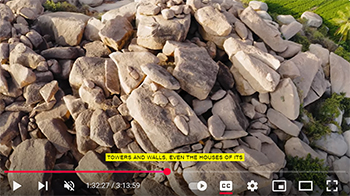
towers and walls, even the houses of its
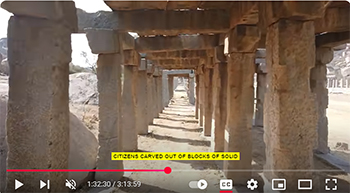
citizens carved out of blocks of solid granite. An ambassador from the Timurid capital of Samarkand named Abdur Razzak, working
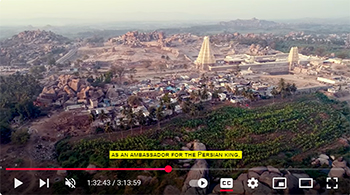
as an ambassador for the Persian king, passed through Vijayanagara in the year 1443, and by this time, the city's skyline had grown impressive enough for him to give the following glowing report. The city of Bidjnagar is such that the pupil of the eye has never seen a place like it, and the ear of intelligence has never been informed
that there existed anything to equal it in the world. Vijayanagara would continue to grow. By the early 16th century, some 50 years later, it would be home to as many as half a
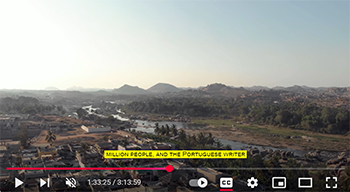
million people, and the Portuguese writer Domingo Paes was stunned to see the heights it had reached. The size of the city cannot all be seen from one spot, but I climbed a hill whence I could see a great part of it. I could not see it all because it lies between several ranges of hills. What I saw from then seemed to me as large as Rome
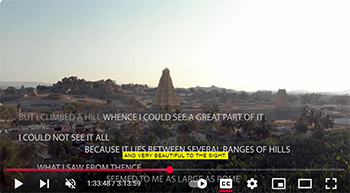
and very beautiful to the sight. Paes was also impressed by the great abundance available in the markets of

Vijayanagara. Going forward, you have a broad and beautiful street,
full of rows of fine houses and streets of sorts I've described, and it is understood that the houses belong to men
rich enough to afford such. In this city live many merchants, and there you will find all sorts of rubies and diamonds and emeralds and
pearls and seed pearls and cloths, and every other sort of thing there is on the earth that you may wish to buy.
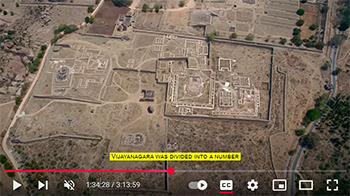
Vijayanagara was divided into a number of different districts, each with a unique character. Near the river was the area known today as the Sacred Center, so called because of the many large temples that can be found here. Here, the
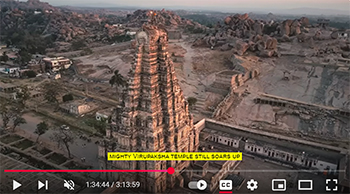
mighty Virupaksha temple still soars up to the sky, with its enormous carved gate tower known as a gopuram. The streets here would have been full of the sounds of chanting hymns and the clanging of temple bells, the smoke of incense, and the pleas of the faithful as they came to pray, to be healed, and to
be closer to the gods.

Many of these temples were so large that for tax purposes, they were classed as towns in their own right. These enormous building complexes
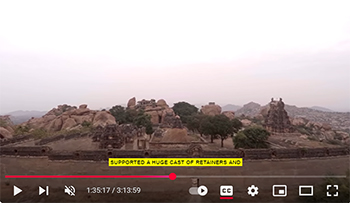
supported a huge cast of retainers and specialists, dancers and labourers, cooks and cleaners, as well as scholars, holy men, and artists. Further south is what's been termed the
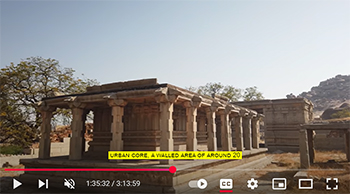
urban core, a walled area of around 20 square kilometers that contains both houses and markets, as well as workshops, rest houses, and other places of business,
as the historian Atul Chandra Chatterjee recalls. The great majority of the houses were naturally small and undistinguished, but
among them were scattered palaces, temples, public buildings, wide streets of shops shaded by trees, busy markets, and all the equipment of a great and wealthy city. Here, the ruined remains of the city
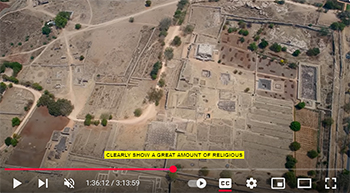
clearly show a great amount of religious diversity.
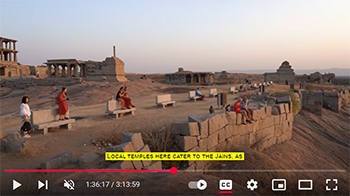
Local temples here cater to the Jains, as well as Hindu temples for both Vishnu and Shiva followers, and one area with a mosque. The Portuguese traveler Duarte Barbosa, arriving in Vijayanagara around the year 1501, gave the following vivid description of this district. The houses are thatched, but are
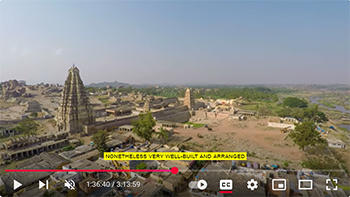
nonetheless very well-built and arranged according to occupations in long streets with many open places, and the folk here are ever in such numbers that the streets and places cannot contain them. There is a great traffic and an endless
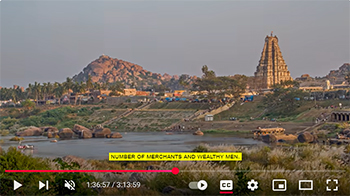
number of merchants and wealthy men. The king allows such freedom that every man may come and go according to his

creed, without suffering any annoyance, and without inquiry whether he is Christian, Jew, Moor, or Heathen.
Barbosa also pays particular attention to the smells that would have wafted

through the air from the markets selling spices and perfumes.

Here also is used vermilion, saffron, rose water, a great store of opium, sandalwood, aloes -- wood, camphor musk, and scented materials.

Likewise, much pepper is used here, which they bring from Malabar on donkeys and pack cattle. Here, we can imagine scenes of family life; children running in the streets, wood smoke billowing overhead.
But this success was not to last. The mad sultan Muhammad bin Tughlaq died in the year 1351 while out on campaign to crush a Turkic tribe in the mountains of Pakistan. The exact cause of his death is unknown,
but one scholar of the time reported the news with the following quip. The sultan was rid of the people, and the people of the sultan. But despite his erratic and tyrannical ruling style, it's clear that something in the harsh character of Muhammad bin Tughlaq had been acting to hold the empire together. After his death, the sultanate of Delhi
began to disintegrate, and all its newly conquered lands rose up in rebellion. Soon, a war of succession tore the Delhi Sultanate into multiple factions, with nobles across the empire setting up their own states and declaring freedom. The year
1345 is the last year that imperial coins were minted in South India. The following years saw the empire devolve into anarchy and disintegration,
and opportunist enemies waiting behind the mountains to the north soon got word of this.
One of those enemies was the Turko Mongolian warlord and emperor known as
Timur, the last of the great nomadic conquerors of the Eurasian steppe. After hearing of the weakness of the Delhi Sultanate,
Timur marched his army south to Delhi in the year 1398, plundering and killing all
the way. When he reached the city, he utterly sacked it, looted it, and put its people to the sword. Estimates for the casualties in this
massacre go as high as 200,000 people. Timur himself would later write the following slightly unconvincing account of the atrocity. There was likewise an immense loot of rubies, diamonds, garnets, pearls, and other gems,
vessels of gold and silver, and brocades and silks of great value. Excepting the quarter of the Sayyids, the
scholars, and the other Mussulmans, the whole city was sacked. The pen of fate had written down their destiny for the people of this city. Although I was desirous of sparing them, I could not succeed, for it was the will of god that this calamity should befall the city. Timur had no intention of staying in India.
He simply collected up all the wealth he could loot, along with countless enslaved
people, particularly skilled artisans, and
returned to his capital of Samarkand in modern Uzbekistan. Like the sacking of Rome, Timur's sack of
Delhi tore the heart out of this already struggling empire. The dynasties that followed had no
ability to maintain their far-flung territories, and would now be little more than local warlords.
The people and lands that had once been part of the empire were left in a state of anarchy, chaos, and plague. It was a time of immense change, a time of terrible suffering, and for some, a time of enormous opportunity.
Into this terrain of blood and fire, two brothers would rise from obscure upbringings to change the shape of power in this region,
and it's with these two brothers that the story of Vijayanagara would truly begin. They would move the center of Indian power from the Muslim north to the Hindu south, and build a city there that would stand among the great cities of the medieval world. They were known as the Sangama brothers, and their names were Bukka and Harihara. The exact origins of the Sangama
brothers are wreathed in mystery. Many historians believe that Bukka and Harihara were commanders of the southern Hoysala Empire.
According to these accounts, they may have been stationed on the rocky banks of the Tungabhadra River, with orders to repel any Muslim incursions from the north. Some more dramatic and fanciful stories
recount how the brothers were generals of the conquered Kakatiyas, captured as
prisoners of war, and taken to Delhi where they were forced to convert to Islam, later escaping and converting back to their native faiths. But none of this is mentioned in contemporary sources, meaning that these accounts are likely unreliable. Many of these legends suggest that these
brothers met a Hindu sage named Shri Vidyaranya. One traditional story recalls that Harihara was out hunting one day when he saw a miraculous sight, and the sage advised him on how to interpret it, as
the historian Robert Sewell recounts.
During his reign, this chief was one day hunting amongst the mountains south of the river
when a hare, instead of fleeing from his dogs, flew at them and bit them. The king, astonished at this marvel, was returning homewards, lost in meditation, when he met on the riverbank the sage
named Vidyaranya or Forest of Learning,
who advised the chief to found a city on the spot. So, the king did, and on that very day
began work on his houses, and he enclosed the city roundabout. While this is most likely a fable, it does contain an illuminating image of how the young power of Vijayanagara
would go on to see itself, as the hunted rabbit who had turned around and learned how to bite. As the power of the Delhi Sultanate
collapsed, the two brothers Bukka and Harihara
raised a considerable army made up of angry Hindu lords, but also large cohorts of Muslim mercenaries. These may even have been soldiers who had once fought for the Delhi Sultanate but who were no longer getting paid.
With this force, the brothers set out to capture the areas of South India that the sultanate had left behind. Their offer to Hindu lords in the region was clear; join us, and we will ensure that South
India is run by Hindus,
and it's clear that many found this offer irresistible. Within only a few decades, the Sangama
brothers had brought a large part of South India under their control, but many areas in the south were still ruled by Muslim powers,
now cut off and isolated. These included the arid lands of Tamil Nadu, India's southernmost state, which was still ruled by a short-lived Muslim power continuing to fight for its existence in South India, known as the Madurai Sultanate.
At this time, the Sangama brother Bukka was on the throne, and his wife was a
woman named Ganga Devi, a famed poet. She wrote one vaulting, epic poem in the language of Sanskrit entitled Madhura Vijayam, or The Victory of Madurai. In it, she describes how a woman from the holy city of Madurai comes to king
Bukka's court and begs him to take the town back. She describes how the ancient Hindu temples of Madurai had fallen into disrepair under its Muslim rulers. White ants have destroyed the doors.
The door frame of the sanctum is broken due to the wild growth of trees, plants, and creepers. The temple premises that formerly echoed the soft beating of the
drums are now full of wild, wallowing jackals. The place once filled with the odor of sacrificial smoke and the melodious chant of Vedic mantras
is now full of the foul smell of meat. The beautiful line of statues that adorn the tall towers of the beautiful buildings in the city are now covered with layers of cobwebs. Whether truly motivated by these religious concerns or not, the Sangama
brothers marched south and quickly conquered the now isolated Madurai Sultanate. With the southern Tamil country now under their control, the Sangama brothers now ruled over a large and wealthy territory.
They returned to their former post on the rocky granite banks of the
Tungabhadra River. It was an unassuming sight, just a small and fairly insignificant village known only for its shrine to Shiva, a focal point of pilgrimage. But here, they began to build a city that would announce in its size and ambition the arrival of a new confident power in the south of India. They named this city Vijayanagara, from the Sanskrit ‘vijaya’, meaning victory, and ‘nagara’, meaning city, the city of victory.
The city that the Sangamas built on the banks of the Tungabhadra River testified to the ambitions that they held for their new kingdom. It would be a city of soaring temples and wide avenues built with an impressive grasp of urban planning, but
the city was also a testament to the dangerous world that they now found themselves at the heart of. They would build Vijayanagara as a
formidable fortress. The impassible granite hills already provided excellent defense while the
wide, torrential Tungabhadra River protected it on the north side, almost impossible for an army to ford. The brothers enhanced these natural defenses by fortifying the passes
between the hills with strong gates and towers, and these massive walls can still be traced in the landscape today,
enclosing an area of more than 650 square kilometers. The Afghan envoy Abdur Razzak, who visited
in the 15th century, wrote the following description of the city. It is built in such a manner that seven
citadels and the same number of walls enclose each other. The seventh fortress, which is placed in
the center of the other, occupies an area ten times larger than the marketplace of the city of Herat. It is the place which is used as the residence of the king.
These walls were manned by soldiers who watched from the ramparts, operating watch posts on the broad roads that ran in and out of the city, and in between the layers of walls were areas filled with boulders known as horse stones, designed to disrupt the movement of cavalry and guarantee that any attacking army would have a difficult time advancing while the soldiers of Vijayanagara rained arrow fire down on their heads. When you look at the situation that
surrounded the city and the new empire of Vijayanagara, it's not hard to see why these defensive fortifications were considered necessary.
That's because the collapse of the Delhi Sultanate had left a number of
fragmented kingdoms behind, who, like Vijayanagara, rose out of the chaos of the collapsing empire. The most powerful of these in South India was the society known as the Bahmani Sultanate. According to tradition, the Bahmani Sultanate was founded by an army
commander named Zafar Khan, who had served under the erratic sultan Muhammad bin Tughlaq. It's clear that at some point he felt the waning power of the Delhi Sultanate in its final years, and in the year 1347, declared himself an independent king in
South India, seizing a large portion of the rocky Deccan Plateau for himself. His gamble paid off;
the weakened Delhi Sultanate, beset with problems on all sides, was no longer able to project its power south of the Vindhya mountains, and it did nothing to stop him. This newly independent power had to fight for its survival from its first days. After defeating one local Hindu ruler,
the Bahmani Sultanate received as tribute a magnificent gift, an ornate throne decorated with turquoise enamel that would become a
symbol of their new empire,
as the chronicler Ferishta recalls. The throne was in length nine feet and three in breadth, made of ebony covered with plates of pure gold, and set with
precious stones of immense value. Every prince of the House of Bahmani who possessed this throne made a point of
adding to it some rich stones. I learned that it was called the Turquoise Throne from being partly enameled of a sky colour, which was in time totally concealed by the number of
jewels. This would become known as the Turquoise
Throne of the Bahmanis, and it would become a symbol of Muslim power in the south of India. Above this throne, they affixed an umbrella, which the scholar Ferishta also gushes about. He fixed a golden ball set with jewels, on which was a bird of paradise composed of precious stones at the top of the umbrella. On the bird's head was a ruby inestimable in value, which had been presented to the late sultan by the king of Vijayanagara.
When this first sultan of the Bahmanis died, with his last words, he declared that his son Mohammed Shah Bahmani would take his throne, and he entreated his sons to stand united and build a kingdom that would stand the test of time, as the chronicler Ferishta writes. I conjure you, as you value the performance of this kingdom, to agree with each other. Mohammed is my successor. Esteem submission and loyalty to him as your duty in this world, and you’re surely for happiness
in the next.
The Bahmani Sultanate was a powerful Muslim kingdom in the heart of South
India that would last for the best part of the next two centuries.
For the Hindu people of Vijayanagara, it represented a constant looming threat on their border. Historians in India and in the West who subscribed to a nationalist idea of history have often framed the conflict
between these two medieval kingdoms in terms of a clash of cultures. In this conception of history, they imagine the Hindu kingdom of
Vijayanagara as a bastion defending Hindu culture from Islamic invaders. But there's little evidence to be found that the people or the rulers of Vijayanagara thought of the situation in this way. One inscription from the time of the Sangama brothers celebrates the victories of the Vijayanagara king Bukka Raya,
and in it, we can see that they thought
of the Turkic Bahmani Sultanate as just one of the many enemies that the kingdom of Vijayanagara faced.
Its other enemies were all Hindu kingdoms.
When his sword began to dance on the battlefield, the faces of the Turks shriveled up, Konkaya Sankaparya was filled with fear, the Andhras ran into caves, the Gurjaras lost the use of their limbs
on every road, the Kambojas’ courage was broken, the Kalingas suffered defeat. Here, there is no mention of religion, and neither is there any hint that the Muslim Bahmanis were any more despicable to the kings of Vijayanagara than say
the Hindu kings of Kalinga on the east coast. There's little evidence that the kings of Vijayanagara thought of themselves as defending Hinduism, and indeed, the idea of a unified Hindu identity simply didn't exist in the 14th century. While the two powers did fight long and bitter wars, the kings of Vijayanagara fought equally bitter wars with the
Hindu Gajapatis, whose kings ruled over
the humid, elephant-filled forest regions to the east. When religious divisions emerged within the kingdom of Vijayanagara, it was overwhelmingly between the followers of Vishnu and Shiva among the Hindus, or between Hindus and Jains. In fact, conflicts between the Bahmani
Sultans and Vijayanagara often occurred due to greatly practical economic matters, like access to resources, supply lines, and trade routes. One bitter issue of contention was a rich tract of land
between them known as the Raichur Doab. This was a triangle of land formed at the point where the rivers Krishna and Tungabhadra met,
and it was immensely fertile. But it also held great deposits of iron
and even diamonds. Other conflicts would
break out over the rich river deltas to the east and the western coast of India,
home to rich trading ports. These ports controlled traffic by sea with the Muslim world, and were a crucial
conduit for the most important strategic military supply of the time; the powerful
war horses imported from Arabia, Persia, and Central Asia. With these contentious territorial issues always on the minds of their rulers, wars between the Bahmani Sultanate and Vijayanagara broke out constantly.
With their connections to the Muslim world, the Bahmanis had the advantage for much of this region's history. Well-supplied with horses, the sultan of the Bahmanis became known as Ashvapati, or the Lord of Horses, while the kings of Vijayanagara were known as or Narapati, or the Lord of Men, alluding to their armies made up of largely massed infantry.
The king of the Hindu Gajapatis in the east, with their vast stables of elephants, completed the triangle and became known as the Lord of Elephants. The Portuguese visitor Domingo Paes was suitably impressed by the infantry of Vijayanagara when he saw them marching in procession in the year 1520. The troops on foot are so many that they surrounded all the valleys and hills in a way with which nothing in the world
can compare. At the waist, they have swords and small
battleaxes, and in their hands, javelins with the shafts covered with gold and silver. You will see amongst them dresses
of such rich cloths that I do not know where they came from. Nor could anyone tell you how many colors they have; shield-men with their shields, with many flowers of gold and silver on them, others with figures of tigers and other
great beasts, others all are covered with silver leaf work,
beautifully wrought. But in the early days, they were no match for the horsepower of the Bahmani Sultanate, and with their connections to
the vibrant intellectual world of Muslim learning, the Bahmanis also enjoyed a technological advantage.
One of the first sultans, Mohammed Shah Bahmani, was a keen follower of new technologies. He even established gunpowder factories in the sultanate to
make use of the emerging technology.
Gunpowder had first been introduced to India and the Middle East by the Mongols, who had learned about it from the Chinese.
At this point, it was used mostly to create burning or exploding projectiles to be fired from catapults, and
occasionally to create crude rockets. But soon, experiments would begin in using it to propel heavy projectiles along metal tubes, first as siege weapons and then as weapons on the battlefield. Soon, the sounds of cannon fire would
ring out over the battlefields of medieval India, and the Bahmani sultans’ early adoption of this technology would put them in a strong position in the
coming centuries. So, although the Hindus of Vijayanagara were the larger and often wealthier kingdom, they often found themselves in the position of paying tribute to their
Muslim neighbours to the north,
whose powerful cavalry armies, soon backed by the technological might of cannons, gave them the upper hand. But these wars were never true wars of conquest. The two powers would fight over a seaport or the rich diamond mines of Raichur between them, but when the war's result became clear, the loser would inevitably sue for peace, agree to pay an enormous sum of money to the victor,
often hand over one of their daughters in marriage, and then they would both return home. There was never any suggestion that one side in this rivalry would ever conquer and consume the other. Still, the growing power of the Bahmanis was of growing concern to the kings of Vijayanagara. Soon, the Bahmani Sultanate stretched right across India from east coast to
west, an unbroken belt that walled off the people of Vijayanagara to the north, that seized the rich lands of Raichur, and meant that the Hindus of the south were
forever looking with fearful eyes to their northern borders. But despite these concerns, the city of
Vijayanagara grew with astonishing speed.
From the mid-14th century, the capital of Vijayanagara grew steadily from the center of a wealthy kingdom
into a great world capital. Thanks to developments in water
management in the countryside, the
population boomed. Enormous work teams would have dug new irrigation systems and reservoirs lined with stone, as well as distinctive step --
wells so that its people could draw water up from the earth.
The city expanded rapidly, sprawling to absorb villages and towns around it, and
soon grew to house as many as 300,000 people at a time when London had only a fifth of that population, and when the
largest city in Europe was Paris, with little more than two hundred thousand. By the year 1500,
Vijayanagara was the world's second -- largest medieval city after Beijing, and probably India's richest. One poet alive at the time of the city's flourishing wrote the following ode to its
beauty. Walk around the great city of victory.
Go where you will on city streets. Everywhere you walk, bright assembly halls decked out with golden vessels will dazzle your eyes.
On many streets, homes with mirrored doors will shine, and sugarcane and plantain all around will invite you with welcomes. You'll find able-bodied fighters and horses, elephants and riders. You'll smell aromas of camphor and musk from breasts of
exquisite doe-eyed women. You will face gardens lush with enjoyments,
precious stones and glowing gold, a city of wealth and glory gleaming. You'll agree that this magnificent city is the most enchanting place you've ever
seen. The city also benefited from being surrounded by a seemingly inexhaustible amount of exceptional building material
in the form of the large granite boulders of Hampi's ancient terrain. Vijayanagara was truly a city of stone, with all its palaces and stables, its
towers and walls, even the houses of its
citizens carved out of blocks of solid granite. An ambassador from the Timurid capital of Samarkand named Abdur Razzak, working
as an ambassador for the Persian king, passed through Vijayanagara in the year 1443, and by this time, the city's skyline had grown impressive enough for him to give the following glowing report. The city of Bidjnagar is such that the pupil of the eye has never seen a place like it, and the ear of intelligence has never been informed
that there existed anything to equal it in the world. Vijayanagara would continue to grow. By the early 16th century, some 50 years later, it would be home to as many as half a
million people, and the Portuguese writer Domingo Paes was stunned to see the heights it had reached. The size of the city cannot all be seen from one spot, but I climbed a hill whence I could see a great part of it. I could not see it all because it lies between several ranges of hills. What I saw from then seemed to me as large as Rome
and very beautiful to the sight. Paes was also impressed by the great abundance available in the markets of
Vijayanagara. Going forward, you have a broad and beautiful street,
full of rows of fine houses and streets of sorts I've described, and it is understood that the houses belong to men
rich enough to afford such. In this city live many merchants, and there you will find all sorts of rubies and diamonds and emeralds and
pearls and seed pearls and cloths, and every other sort of thing there is on the earth that you may wish to buy.
Vijayanagara was divided into a number of different districts, each with a unique character. Near the river was the area known today as the Sacred Center, so called because of the many large temples that can be found here. Here, the
mighty Virupaksha temple still soars up to the sky, with its enormous carved gate tower known as a gopuram. The streets here would have been full of the sounds of chanting hymns and the clanging of temple bells, the smoke of incense, and the pleas of the faithful as they came to pray, to be healed, and to
be closer to the gods.
Many of these temples were so large that for tax purposes, they were classed as towns in their own right. These enormous building complexes
supported a huge cast of retainers and specialists, dancers and labourers, cooks and cleaners, as well as scholars, holy men, and artists. Further south is what's been termed the
urban core, a walled area of around 20 square kilometers that contains both houses and markets, as well as workshops, rest houses, and other places of business,
as the historian Atul Chandra Chatterjee recalls. The great majority of the houses were naturally small and undistinguished, but
among them were scattered palaces, temples, public buildings, wide streets of shops shaded by trees, busy markets, and all the equipment of a great and wealthy city. Here, the ruined remains of the city
clearly show a great amount of religious diversity.
Local temples here cater to the Jains, as well as Hindu temples for both Vishnu and Shiva followers, and one area with a mosque. The Portuguese traveler Duarte Barbosa, arriving in Vijayanagara around the year 1501, gave the following vivid description of this district. The houses are thatched, but are
nonetheless very well-built and arranged according to occupations in long streets with many open places, and the folk here are ever in such numbers that the streets and places cannot contain them. There is a great traffic and an endless
number of merchants and wealthy men. The king allows such freedom that every man may come and go according to his
creed, without suffering any annoyance, and without inquiry whether he is Christian, Jew, Moor, or Heathen.
Barbosa also pays particular attention to the smells that would have wafted
through the air from the markets selling spices and perfumes.
Here also is used vermilion, saffron, rose water, a great store of opium, sandalwood, aloes -- wood, camphor musk, and scented materials.
Likewise, much pepper is used here, which they bring from Malabar on donkeys and pack cattle. Here, we can imagine scenes of family life; children running in the streets, wood smoke billowing overhead.
-
admin
- Site Admin
- Posts: 41484
- Joined: Thu Aug 01, 2013 5:21 am
Re: Vijayanagara: The Last Emperors of South India, Fall of
Part __ of __
Men would gather here to play games of chance and strategy on street corners,
chewing betel nuts and leaves, which are
chewed across India for a mild stimulant effect. Women would talk in the shade of
coloured awnings,
cows wandering unhindered among the crowds, and groups of musicians playing on the streets. It's during this time in the
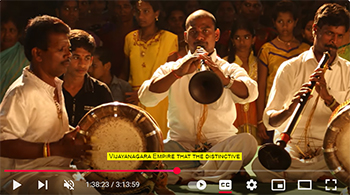
Vijayanagara Empire that the distinctive form of Indian classical music known as Carnatic music was laid down. We're joined on this episode by the virtuoso of Carnatic music, Aruna Sairam, who has recorded a number of authentic
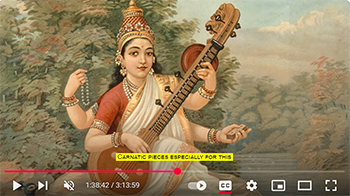
Carnatic pieces especially for this podcast,
one of which you're listening to now. We can imagine the sounds of this music drifting over the streets and rooftops
of Vijayanagara as the business of everyday life went on. The day of an average citizen would have started with a bath in a local bathhouse.
Men and women had separate bathing places, which were available at different times of the day. After bathing, families would go to their local temple to give offerings and receive blessings for the day ahead. We can see the clothing worn by the
people of Vijayanagara in the colorful 16th century murals that decorate the walls of temples to Shiva and Vishnu in the village of Lepakshi. They show women with strikingly varied
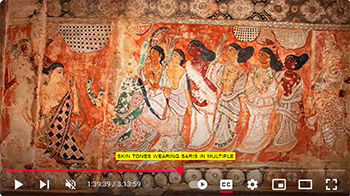
skin tones wearing saris in multiple ornate patterns drawn from different
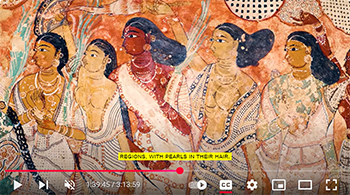
regions, with pearls in their hair. Other murals show noblemen hunting a boar through the forest,
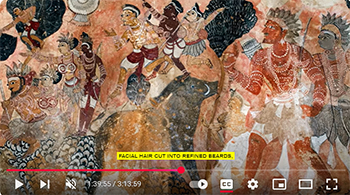
with their facial hair cut into refined beards, wearing kilt-like lower garments and jeweled necklaces.
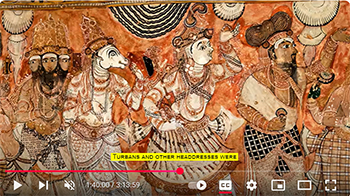
Turbans and other headdresses were popular headgear among the rich. Both men and women wore perfumes made of
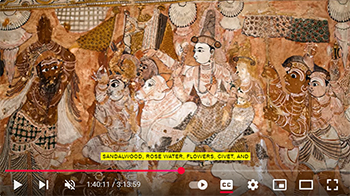
sandalwood, rose water, flowers, civet, and musk. Shopkeepers in this part of the city and everywhere else would need to be
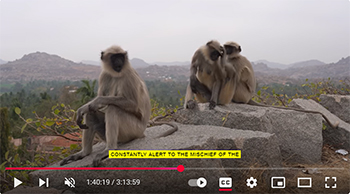
constantly alert to the mischief of the monkeys that still live to this day in
huge numbers in the region of Hampi; the

red-faced rhesus macaques and the

silvery-grey or Hanuman langurs. Then as now, these animals love nothing
better than to slink along the rooftops in their troops, drop down from shop
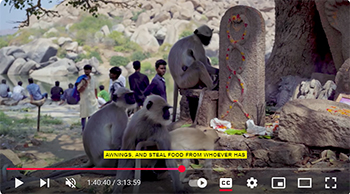
awnings, and steal food from whoever has let down their guard. Towering over this bustling residential district was the royal center.
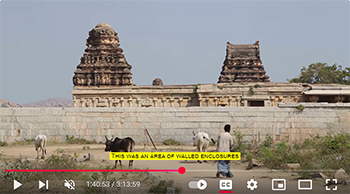
This was an area of walled enclosures that guard the large monumental palaces and mansions that were home to the city's wealthy elite, and it's clear that
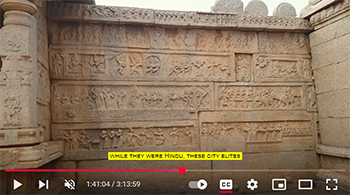
while they were Hindu, these city elites had a great deal of admiration for their
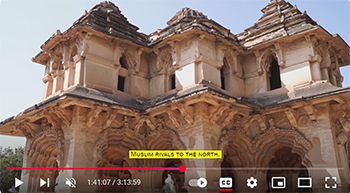
Muslim rivals to the north. In these spacious houses, the
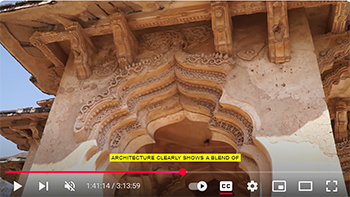
architecture clearly shows a blend of Indian and Islamic styles. Some wall paintings in Vijayanagara even show the court wearing clothing in the style of their Muslim neighbours for formal events;
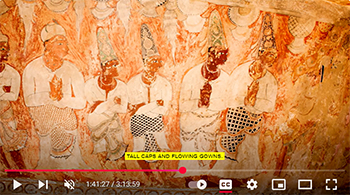
tall caps and flowing gowns. Outside the walls of the city, the
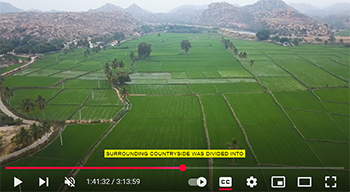
surrounding countryside was divided into a lacework of roads and fields joining villages and larger towns that all provided grains like rice and millet, as
well as squashes, gourds, and other

vegetables to the great city itself, brought in enormous quantities by
bullock carts that would have filled the roads with a thick traffic.
The perspectives of historians on Vijayanagara vary greatly, and in the past has caused huge disagreements,
often among historians who may be approaching the evidence from a nationalist perspective or from a colonial or post-colonial perspective. Some of this is down to the differing ideologies of these historians, but the Vijayanagara Empire was a place of

paradoxes and contrasts.
On one hand, its rulers clearly modeled themselves on the old Hindu South Indian empires of the past. One clear example is in the temples they built, which drew inspiration from
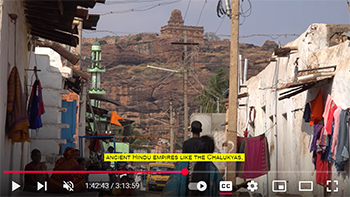
ancient Hindu empires like the Chalukyas, the Pandyas, and the Cholas.
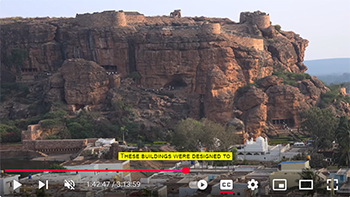
These buildings were designed to reinforce the empire's connection to the
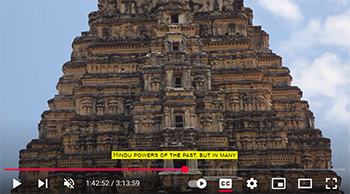
Hindu powers of the past, but in many other ways, it was also a surprisingly radical experiment, a hybrid culture that took Hindu traditions and married them with an outward and forward-looking desire for new influences from the
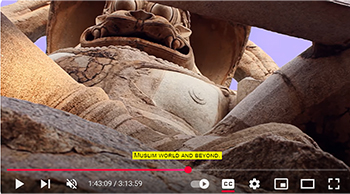
Muslim world and beyond. The world of medieval India was fast-moving and competitive, and those kingdoms that fell behind often didn't last long. One king of Vijayanagara in particular, named Devaraya II, was all too aware of this.
He was determined to modernize and hybridize the empire of Vijayanagara, and end the days of it paying tribute to the powerful Muslim kingdoms to the north. To do this, he would open the

empire's doors to the world. Devaraya II came to the throne in the year 1432 as a boy of only eight years old. One Persian visitor to his court, who
arrived about eight years later, gives the following description of the teenage king. The king was dressed in a robe of green satin. Around his neck he wore a collar composed of pearls of beautiful water and other splendid gems. He was of an olive color, of a spare body, and rather tall. He was exceedingly young, for there was only some slight down upon his cheeks, and none upon his chin. His whole appearance was very repossessing. This young king Devaraya was determined to turn his empire into a modern outward-looking state. To do this, he sent out word to the Muslim world

that the doors of his kingdom were now open.

He welcomed talented Muslim courtiers into his kingdom, and enlisted as many as 200 Muslim officers into his army, as the scholar Ferishta recalls.
Devaraya gave orders to enlist Muslims in his service, allotting them estates

and erecting a mosque for their use in Vijayanagara. He also commanded that no one should molest them in exercise of their religion, and moreover, he ordered a Quran to be placed before
his throne on a rich desk so that the faithful might perform the ceremony of obeisance in his presence without sinning against their laws. Some carvings on the great temples of
the city show Muslims taking part in its daily life, showing Arab horse handlers
taking care of their steeds, and columns in the great Vitthala temple show Muslim horse riders wearing turbans, rearing up on the backs of powerful, imported
horses. The borders of Vijayanagara were now guarded by large forces of Muslim cavalry, mercenaries paid from the vast coffers of the empire, and to these would soon be added units of Portuguese and Muslim gunners trained in the use of muskets.
This influx of newcomers would change the nature of Vijayanagara's military, bringing advanced modern battle strategies and the increased use of cavalry,
and it would have changed the fabric of the city itself. Devaraya II also engaged in large-scale infrastructure projects, digging large networks of canals that expanded the
agricultural potential of the land around the city. The metropolis boomed to even greater size, and the Persian ambassador Abdur Razzak was so impressed by the city when he visited in the year 1443 that he gave
the following incredible account of the bustling life of the city's markets. From the third to the seventh fortress, shops and bazaars are loosely crowded together.
By the palace of the king, there are four bazaars situated opposite to one another. At the head of each bazaar there is a lofty arcade and magnificent gallery, but the palace of the king is loftier than all of them.
The bazaars are very broad and long so that the sellers of flowers are able to

sell flowers from both sides. Sweet-scented flowers are always procurable fresh in that city. Even traveling from the wealthy Silk Road city of Samarkand, Abdur Razzak was
struck by the obvious wealth of the citizens of Vijayanagara.
This country is so well-populated that it is impossible in a reasonable space to convey an idea of it. In the king's treasury, there are chambers with excavations in them filled with molten gold forming one mass.
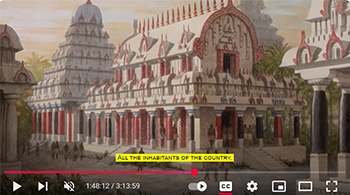
All the inhabitants of the country, whether high or low, even down to the artificers of the bazaar, wear jewels and gilt ornaments in their
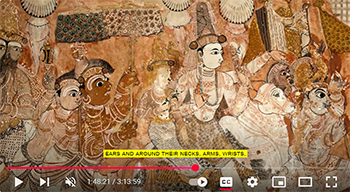
ears and around their necks, arms, wrists, and fingers.
Abdur Razzak was especially struck by the vast stone elephant stables which can
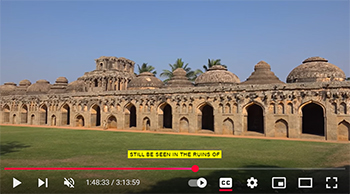
still be seen in the ruins of Vijayanagara today. Opposite the minister's office are the elephant sheds. The king has many
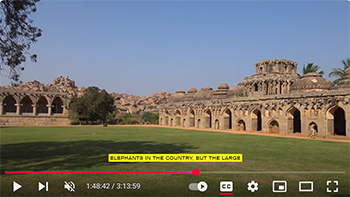
elephants in the country, but the large ones are especially reserved for the palace. The king has a white elephant,
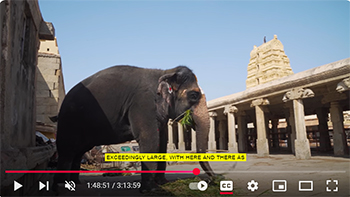
exceedingly large, with here and there as many as 30 spots of color.
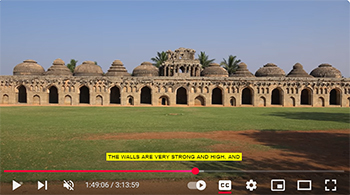
Every morning, this animal is brought into the presence of the monarch, for to cast an eye upon him is thought a favorable omen. Each has a separate stall;
the walls are very strong and high, and are covered with strong wood. He gives a clearly quite bashful account of the city's apparently thriving red light district.
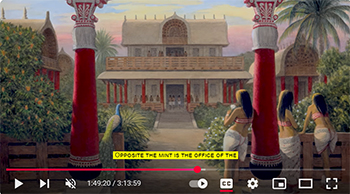
Opposite the mint is the office of the prefect of the city, to which it is said 12,000 policemen are attached, and their pay, which equals each day twelve thousand fanams, is derived from the proceeds of the brothels. The splendor of those houses, the beauty of the heart ravishers, their
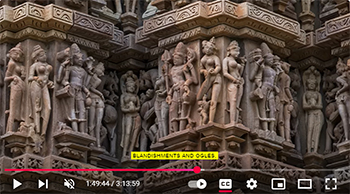
blandishments and ogles, are beyond all description.

It is best to be brief on the matter. Finally, he was brought in to meet the king Devaraya, who at that point would have been around the age of 19. Perhaps most illuminating about this meeting is how many questions the Hindu king asked his Muslim visitor. He bombarded the Persian ambassador with
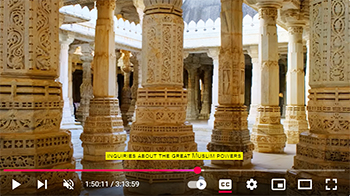
inquiries about the great Muslim powers of the world, how many horsemen the king of Persia had under his command, what his great nobles were like, and how they behaved. He asked many questions about the great
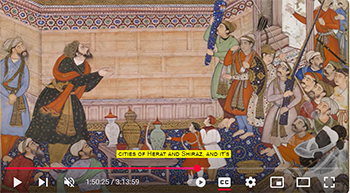
cities of Herat and Shiraz, and it's

clear from this the curiosity and fascination he held for the Muslim world. But being the king of a medieval kingdom like Vijayanagara could be a dangerous business. Devaraya sat at the top of a towering
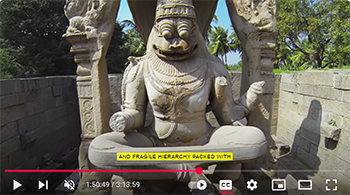
and fragile hierarchy packed with jealous rivals. While the Persian ambassador Abdur Razzak was staying in the city, Devaraya II was the target of one particularly dramatic and audacious assassination attempt by one of his brothers, which shows just how dangerous the life of a king could be. This brother of King Devaraya plotted to first slaughter all the high-ranking officials in his government before finally heading to the royal chambers and killing the king himself. The first part of the plan went off

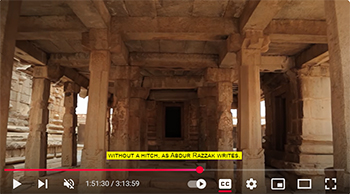
without a hitch, as Abdur Razzak writes. The king's brother, who had had a new house built for himself, invited thither the monarch and the principal personages of the empire. At short intervals, the prince either came
in person or sent some messengers to say that such-and-such great personage should come and eat his part of the
banquet. Care had been taken to bring together all the drums, kettle drums, trumpets, and
flutes that could be found in the city, and these instruments playing all at the same time made a tremendous uproar. As soon as the individual who had been sent for entered the above-mentioned

house, two assassins placed in ambush sprang out upon him, pierced him with a dagger, and cut him to pieces. In consequence of the noise of the drums,

the clamour, and the tumult, no one, with the exception of a small number to whom the secret was entrusted, was aware of what was going on. In this manner, all those who had any
name or rank in the state were slaughtered.
Once his grisly work was done, the treacherous brother went to the king's quarters to strike the final blow of his coup.
He entered the royal chamber with a plate of betel nuts and leaves for the king to chew, but beneath these leaves he had concealed a hidden blade. Coming close to the king, the brother told him that the court was ready for him, and offered him some of the betel. But perhaps the king had detected something strange in the way his brother stepped towards him. He declined, saying that he didn't feel
well that day. Abdur Razzak recalls what happened next as the treacherous brother lost his patience. This unnatural brother, thus losing the hope of enticing the king to his house,

drew his poniard and struck him there with several violent blows so that the prince fell at the back of his throne. The traitor, thus believing that the king was dead, left there one of his confidants to cut off the monarch's head. Then, going out of the hall, he ascended to the portico of the palace and thus
addressed the people; I have slain the king. His brothers and such-and-such emirs,
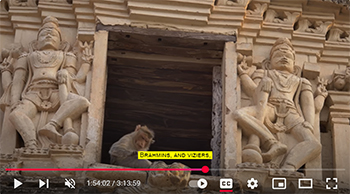
Brahmins, and viziers, now I am king. But he had not counted on the king's resilience. As the treacherous brother’s accomplice
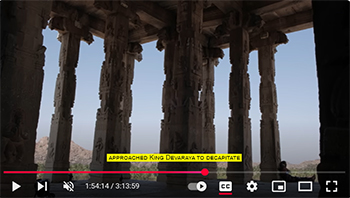
approached King Devaraya to decapitate him, the king fought back in dramatic fashion. Meanwhile, his emissary had approached the throne with the intention of cutting off the king's head, but that prince,
seizing the seat behind which he had
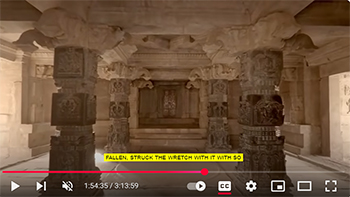
fallen, struck the wretch with it with so much violence on the chest that he fell upon his back. The king then, with the help of one of his guards, slew this assassin and went out of the palace by the way of the harem. His brother, still standing on the top of
the steps of the hall of council, invited the multitude to recognize him as their king. At that moment, the monarch cried out, I am alive! I am well and safe! Seize that wretch. The whole crowd assembled together, threw themselves upon the guilty prince, and put him to death. This dramatic episode gives us a sense of the life-and-death stakes that the emperors of Vijayanagara faced every day.
The kings who followed Devaraya II were not always as lucky as he was. The great King Devaraya finally died in the year 1446. His reign had been a golden age; he had left his kingdom a larger,
wealthier, and more outward-looking place than he had found it, but the period that followed was one of chaos and dissolution in the empire. Devaraya’s son is said quite mysteriously to have died
of a broken heart, which is perhaps a euphemism for poison. His grandson took the throne, but would go on to be murdered by his own son. In a Shakespearean turn, this
great-grandson of Devaraya was apparently horrified by what he had done, and refused to take up the throne he had murdered his father for. He passed it on to one of his younger brothers, who quickly had him put to death.
As blood ran in torrents from the throne, chaos
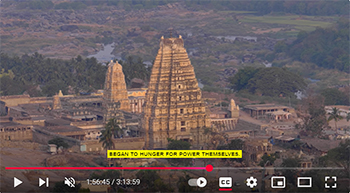
began to engulf the empire, and soon, the commanders of the military began to hunger for power themselves. One of these was a powerful general named Saluva Narasimha, a name that means ‘man-lion’. This general was a colorful character,
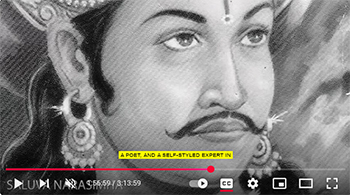
a poet, and a self-styled expert in lovemaking. In the year 1485, he seized the throne in a military coup and ended the Sangama Dynasty that had ruled for 150 years since the first days of Vijayanagara and the two Sangama brothers, Bukka and Harihara, who had founded it. The libidinous general Saluva Narasimha didn't seem to care much for the boring business of actually ruling his kingdom. He spent much of his time apparently writing a long book of detailed erotic instruction, but he died only a few years after taking the throne. It's during this period of chaos and the reign of the hapless kings that followed
that in the year 1498, the first Portuguese ship, captained by the explorer Vasco de Gama, arrived in South India, having sailed all the way around
the coast of Africa. He would be the first European captain to ever do so, but he would be followed by many others. The Portuguese would soon set up a
trading post at Goa on India's west coast, and in the coming centuries,

European powers would increase their presence and influence in India. But at the time, the appearance of these
foreigners excited little attention in the court of Vijayanagara.
This time of chaos and upheaval in the empire would only come to an end with the reign of a man who would come to be

known as one of the greatest and certainly the most famous of the emperors of South India. He was a man named Krishnadeva Raya, the last great king of Vijayanagara. Krishnadeva was never meant to be the king.
Men would gather here to play games of chance and strategy on street corners,
chewing betel nuts and leaves, which are
chewed across India for a mild stimulant effect. Women would talk in the shade of
coloured awnings,
cows wandering unhindered among the crowds, and groups of musicians playing on the streets. It's during this time in the
Vijayanagara Empire that the distinctive form of Indian classical music known as Carnatic music was laid down. We're joined on this episode by the virtuoso of Carnatic music, Aruna Sairam, who has recorded a number of authentic
Carnatic pieces especially for this podcast,
one of which you're listening to now. We can imagine the sounds of this music drifting over the streets and rooftops
of Vijayanagara as the business of everyday life went on. The day of an average citizen would have started with a bath in a local bathhouse.
Men and women had separate bathing places, which were available at different times of the day. After bathing, families would go to their local temple to give offerings and receive blessings for the day ahead. We can see the clothing worn by the
people of Vijayanagara in the colorful 16th century murals that decorate the walls of temples to Shiva and Vishnu in the village of Lepakshi. They show women with strikingly varied
skin tones wearing saris in multiple ornate patterns drawn from different
regions, with pearls in their hair. Other murals show noblemen hunting a boar through the forest,
with their facial hair cut into refined beards, wearing kilt-like lower garments and jeweled necklaces.
Turbans and other headdresses were popular headgear among the rich. Both men and women wore perfumes made of
sandalwood, rose water, flowers, civet, and musk. Shopkeepers in this part of the city and everywhere else would need to be
constantly alert to the mischief of the monkeys that still live to this day in
huge numbers in the region of Hampi; the
red-faced rhesus macaques and the
silvery-grey or Hanuman langurs. Then as now, these animals love nothing
better than to slink along the rooftops in their troops, drop down from shop
awnings, and steal food from whoever has let down their guard. Towering over this bustling residential district was the royal center.
This was an area of walled enclosures that guard the large monumental palaces and mansions that were home to the city's wealthy elite, and it's clear that
while they were Hindu, these city elites had a great deal of admiration for their
Muslim rivals to the north. In these spacious houses, the
architecture clearly shows a blend of Indian and Islamic styles. Some wall paintings in Vijayanagara even show the court wearing clothing in the style of their Muslim neighbours for formal events;
tall caps and flowing gowns. Outside the walls of the city, the
surrounding countryside was divided into a lacework of roads and fields joining villages and larger towns that all provided grains like rice and millet, as
well as squashes, gourds, and other
vegetables to the great city itself, brought in enormous quantities by
bullock carts that would have filled the roads with a thick traffic.
The perspectives of historians on Vijayanagara vary greatly, and in the past has caused huge disagreements,
often among historians who may be approaching the evidence from a nationalist perspective or from a colonial or post-colonial perspective. Some of this is down to the differing ideologies of these historians, but the Vijayanagara Empire was a place of
paradoxes and contrasts.
On one hand, its rulers clearly modeled themselves on the old Hindu South Indian empires of the past. One clear example is in the temples they built, which drew inspiration from
ancient Hindu empires like the Chalukyas, the Pandyas, and the Cholas.
These buildings were designed to reinforce the empire's connection to the
Hindu powers of the past, but in many other ways, it was also a surprisingly radical experiment, a hybrid culture that took Hindu traditions and married them with an outward and forward-looking desire for new influences from the
Muslim world and beyond. The world of medieval India was fast-moving and competitive, and those kingdoms that fell behind often didn't last long. One king of Vijayanagara in particular, named Devaraya II, was all too aware of this.
He was determined to modernize and hybridize the empire of Vijayanagara, and end the days of it paying tribute to the powerful Muslim kingdoms to the north. To do this, he would open the
empire's doors to the world. Devaraya II came to the throne in the year 1432 as a boy of only eight years old. One Persian visitor to his court, who
arrived about eight years later, gives the following description of the teenage king. The king was dressed in a robe of green satin. Around his neck he wore a collar composed of pearls of beautiful water and other splendid gems. He was of an olive color, of a spare body, and rather tall. He was exceedingly young, for there was only some slight down upon his cheeks, and none upon his chin. His whole appearance was very repossessing. This young king Devaraya was determined to turn his empire into a modern outward-looking state. To do this, he sent out word to the Muslim world
that the doors of his kingdom were now open.
He welcomed talented Muslim courtiers into his kingdom, and enlisted as many as 200 Muslim officers into his army, as the scholar Ferishta recalls.
Devaraya gave orders to enlist Muslims in his service, allotting them estates
and erecting a mosque for their use in Vijayanagara. He also commanded that no one should molest them in exercise of their religion, and moreover, he ordered a Quran to be placed before
his throne on a rich desk so that the faithful might perform the ceremony of obeisance in his presence without sinning against their laws. Some carvings on the great temples of
the city show Muslims taking part in its daily life, showing Arab horse handlers
taking care of their steeds, and columns in the great Vitthala temple show Muslim horse riders wearing turbans, rearing up on the backs of powerful, imported
horses. The borders of Vijayanagara were now guarded by large forces of Muslim cavalry, mercenaries paid from the vast coffers of the empire, and to these would soon be added units of Portuguese and Muslim gunners trained in the use of muskets.
This influx of newcomers would change the nature of Vijayanagara's military, bringing advanced modern battle strategies and the increased use of cavalry,
and it would have changed the fabric of the city itself. Devaraya II also engaged in large-scale infrastructure projects, digging large networks of canals that expanded the
agricultural potential of the land around the city. The metropolis boomed to even greater size, and the Persian ambassador Abdur Razzak was so impressed by the city when he visited in the year 1443 that he gave
the following incredible account of the bustling life of the city's markets. From the third to the seventh fortress, shops and bazaars are loosely crowded together.
By the palace of the king, there are four bazaars situated opposite to one another. At the head of each bazaar there is a lofty arcade and magnificent gallery, but the palace of the king is loftier than all of them.
The bazaars are very broad and long so that the sellers of flowers are able to
sell flowers from both sides. Sweet-scented flowers are always procurable fresh in that city. Even traveling from the wealthy Silk Road city of Samarkand, Abdur Razzak was
struck by the obvious wealth of the citizens of Vijayanagara.
This country is so well-populated that it is impossible in a reasonable space to convey an idea of it. In the king's treasury, there are chambers with excavations in them filled with molten gold forming one mass.
All the inhabitants of the country, whether high or low, even down to the artificers of the bazaar, wear jewels and gilt ornaments in their
ears and around their necks, arms, wrists, and fingers.
Abdur Razzak was especially struck by the vast stone elephant stables which can
still be seen in the ruins of Vijayanagara today. Opposite the minister's office are the elephant sheds. The king has many
elephants in the country, but the large ones are especially reserved for the palace. The king has a white elephant,
exceedingly large, with here and there as many as 30 spots of color.
Every morning, this animal is brought into the presence of the monarch, for to cast an eye upon him is thought a favorable omen. Each has a separate stall;
the walls are very strong and high, and are covered with strong wood. He gives a clearly quite bashful account of the city's apparently thriving red light district.
Opposite the mint is the office of the prefect of the city, to which it is said 12,000 policemen are attached, and their pay, which equals each day twelve thousand fanams, is derived from the proceeds of the brothels. The splendor of those houses, the beauty of the heart ravishers, their
blandishments and ogles, are beyond all description.
It is best to be brief on the matter. Finally, he was brought in to meet the king Devaraya, who at that point would have been around the age of 19. Perhaps most illuminating about this meeting is how many questions the Hindu king asked his Muslim visitor. He bombarded the Persian ambassador with
inquiries about the great Muslim powers of the world, how many horsemen the king of Persia had under his command, what his great nobles were like, and how they behaved. He asked many questions about the great
cities of Herat and Shiraz, and it's
clear from this the curiosity and fascination he held for the Muslim world. But being the king of a medieval kingdom like Vijayanagara could be a dangerous business. Devaraya sat at the top of a towering
and fragile hierarchy packed with jealous rivals. While the Persian ambassador Abdur Razzak was staying in the city, Devaraya II was the target of one particularly dramatic and audacious assassination attempt by one of his brothers, which shows just how dangerous the life of a king could be. This brother of King Devaraya plotted to first slaughter all the high-ranking officials in his government before finally heading to the royal chambers and killing the king himself. The first part of the plan went off
without a hitch, as Abdur Razzak writes. The king's brother, who had had a new house built for himself, invited thither the monarch and the principal personages of the empire. At short intervals, the prince either came
in person or sent some messengers to say that such-and-such great personage should come and eat his part of the
banquet. Care had been taken to bring together all the drums, kettle drums, trumpets, and
flutes that could be found in the city, and these instruments playing all at the same time made a tremendous uproar. As soon as the individual who had been sent for entered the above-mentioned
house, two assassins placed in ambush sprang out upon him, pierced him with a dagger, and cut him to pieces. In consequence of the noise of the drums,
the clamour, and the tumult, no one, with the exception of a small number to whom the secret was entrusted, was aware of what was going on. In this manner, all those who had any
name or rank in the state were slaughtered.
Once his grisly work was done, the treacherous brother went to the king's quarters to strike the final blow of his coup.
He entered the royal chamber with a plate of betel nuts and leaves for the king to chew, but beneath these leaves he had concealed a hidden blade. Coming close to the king, the brother told him that the court was ready for him, and offered him some of the betel. But perhaps the king had detected something strange in the way his brother stepped towards him. He declined, saying that he didn't feel
well that day. Abdur Razzak recalls what happened next as the treacherous brother lost his patience. This unnatural brother, thus losing the hope of enticing the king to his house,
drew his poniard and struck him there with several violent blows so that the prince fell at the back of his throne. The traitor, thus believing that the king was dead, left there one of his confidants to cut off the monarch's head. Then, going out of the hall, he ascended to the portico of the palace and thus
addressed the people; I have slain the king. His brothers and such-and-such emirs,
Brahmins, and viziers, now I am king. But he had not counted on the king's resilience. As the treacherous brother’s accomplice
approached King Devaraya to decapitate him, the king fought back in dramatic fashion. Meanwhile, his emissary had approached the throne with the intention of cutting off the king's head, but that prince,
seizing the seat behind which he had
fallen, struck the wretch with it with so much violence on the chest that he fell upon his back. The king then, with the help of one of his guards, slew this assassin and went out of the palace by the way of the harem. His brother, still standing on the top of
the steps of the hall of council, invited the multitude to recognize him as their king. At that moment, the monarch cried out, I am alive! I am well and safe! Seize that wretch. The whole crowd assembled together, threw themselves upon the guilty prince, and put him to death. This dramatic episode gives us a sense of the life-and-death stakes that the emperors of Vijayanagara faced every day.
The kings who followed Devaraya II were not always as lucky as he was. The great King Devaraya finally died in the year 1446. His reign had been a golden age; he had left his kingdom a larger,
wealthier, and more outward-looking place than he had found it, but the period that followed was one of chaos and dissolution in the empire. Devaraya’s son is said quite mysteriously to have died
of a broken heart, which is perhaps a euphemism for poison. His grandson took the throne, but would go on to be murdered by his own son. In a Shakespearean turn, this
great-grandson of Devaraya was apparently horrified by what he had done, and refused to take up the throne he had murdered his father for. He passed it on to one of his younger brothers, who quickly had him put to death.
As blood ran in torrents from the throne, chaos
began to engulf the empire, and soon, the commanders of the military began to hunger for power themselves. One of these was a powerful general named Saluva Narasimha, a name that means ‘man-lion’. This general was a colorful character,
a poet, and a self-styled expert in lovemaking. In the year 1485, he seized the throne in a military coup and ended the Sangama Dynasty that had ruled for 150 years since the first days of Vijayanagara and the two Sangama brothers, Bukka and Harihara, who had founded it. The libidinous general Saluva Narasimha didn't seem to care much for the boring business of actually ruling his kingdom. He spent much of his time apparently writing a long book of detailed erotic instruction, but he died only a few years after taking the throne. It's during this period of chaos and the reign of the hapless kings that followed
that in the year 1498, the first Portuguese ship, captained by the explorer Vasco de Gama, arrived in South India, having sailed all the way around
the coast of Africa. He would be the first European captain to ever do so, but he would be followed by many others. The Portuguese would soon set up a
trading post at Goa on India's west coast, and in the coming centuries,
European powers would increase their presence and influence in India. But at the time, the appearance of these
foreigners excited little attention in the court of Vijayanagara.
This time of chaos and upheaval in the empire would only come to an end with the reign of a man who would come to be
known as one of the greatest and certainly the most famous of the emperors of South India. He was a man named Krishnadeva Raya, the last great king of Vijayanagara. Krishnadeva was never meant to be the king.
-
admin
- Site Admin
- Posts: 41484
- Joined: Thu Aug 01, 2013 5:21 am
Re: Vijayanagara: The Last Emperors of South India, Fall of
Part __ of __
He was a prince, but his mother was a lower-ranking woman than any of his

other brothers, and so, his older brothers Immadi and Viranarasimha each took a turn at the throne
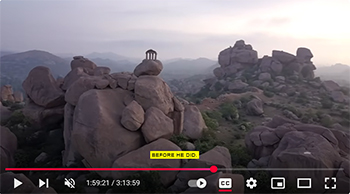
before he did. But they catastrophically mismanaged the kingdom and faced constant rebellions

and uprisings. When Krishnadeva's older brother finally lay on his deathbed, he was determined that his own infant grandson should take

the throne, but he knew that many of the lords backed his brother Krishnadeva. In a final dying wish, he ordered that his brother should be blinded, which under Indian law would mean he could not become king. According to legend, the king's servants had no confidence in his baby son actually taking the throne, but they were still afraid to anger the dying king. In a daring move, they brought him the

eyes of a recently slaughtered goat, still dripping with blood, and told him that his wishes had been carried out. The king died satisfied that his line
was secure, and Krishnadeva effortlessly took the throne.

The Portuguese traveller Domingo Paes gives the following account of the appearance of King Krishnadeva. The king is of medium height and a fair complexion and good figure, rather fat than thin.
He has on his face signs of smallpox. He is the most feared and perfect king that could possibly be, cheerful of disposition and very merry. He is one that seeks to honor foreigners and receives them kindly, asking about all their affairs, whatever their
condition may be. He is a great ruler and a man of much justice,
but subject to certain fits of rage, and this is his title; king of kings, lord of great lords of India, lord of the three seas and of the land. Krishna Devaraya was also what we might think of today as a fitness fanatic. Domingo Paes writes the following account of his daily routine. The king is accustomed every day to drink a three-quarter pint of sesame oil before daylight, and anoints himself all over with the same oil. He covers his loins with a small cloth and takes in his arms great weights made of earthenware, and then, taking a sword, he exercises himself with it ‘til has sweated out all the oil, and then he

wrestles with one of his wrestlers. After this labor, he mounts a horse and gallops about the plain in one direction and another ‘til dawn, for

he does all this before daybreak.
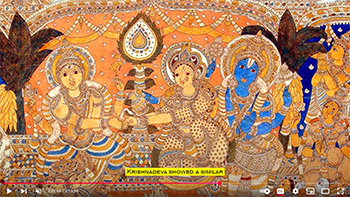
Krishnadeva showed a similar energetic attitude to his rule. One of his first acts was to embark on a campaign against the troublesome Lord of
Elephants, the king of the Gajapatis in the east. He marched his armies into that humid forest region and seized important forts

along the way. King Krishnadeva was a poet,
and he wrote the following words in his epic poem Aamuktamaalyada about his campaign against the Gajapatis in the east.
In the Blue Hills of Puri, under the protective gaze of blue-robed Balram and
Lord Krishna, whose eyes are like blue water lilies, I prepared for battle and struck fear into the Gajapatis’ heart with my powerful arms pounding the drums of war. The Gajapatis king eventually surrendered, and in a classic example of
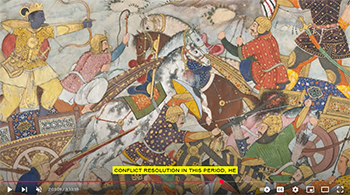
conflict resolution in this period, he offered his daughter in marriage to Krishnadeva, who returned all the coastal territory back to the now humbled
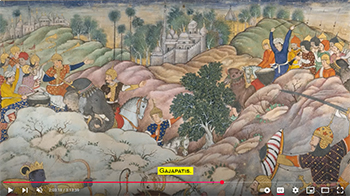
Gajapatis.

This victory must have boosted his reputation at home and fed what was apparently an enormous ego.

Krishna Devaraya's royal inscriptions gush with self-praise.

Overcome by his glory, the sun sinks into the western ocean as if quite unable to endure the distress of mine. As if fearing that the seven oceans would provide a refuge to his enemies, they were dried up by the clouds of dust

raised by the earth, trampled to pieces by his horsemen. But Krishnadeva was also an eminently practical man.
He was a prince, but his mother was a lower-ranking woman than any of his
other brothers, and so, his older brothers Immadi and Viranarasimha each took a turn at the throne
before he did. But they catastrophically mismanaged the kingdom and faced constant rebellions
and uprisings. When Krishnadeva's older brother finally lay on his deathbed, he was determined that his own infant grandson should take
the throne, but he knew that many of the lords backed his brother Krishnadeva. In a final dying wish, he ordered that his brother should be blinded, which under Indian law would mean he could not become king. According to legend, the king's servants had no confidence in his baby son actually taking the throne, but they were still afraid to anger the dying king. In a daring move, they brought him the
eyes of a recently slaughtered goat, still dripping with blood, and told him that his wishes had been carried out. The king died satisfied that his line
was secure, and Krishnadeva effortlessly took the throne.
The Portuguese traveller Domingo Paes gives the following account of the appearance of King Krishnadeva. The king is of medium height and a fair complexion and good figure, rather fat than thin.
He has on his face signs of smallpox. He is the most feared and perfect king that could possibly be, cheerful of disposition and very merry. He is one that seeks to honor foreigners and receives them kindly, asking about all their affairs, whatever their
condition may be. He is a great ruler and a man of much justice,
but subject to certain fits of rage, and this is his title; king of kings, lord of great lords of India, lord of the three seas and of the land. Krishna Devaraya was also what we might think of today as a fitness fanatic. Domingo Paes writes the following account of his daily routine. The king is accustomed every day to drink a three-quarter pint of sesame oil before daylight, and anoints himself all over with the same oil. He covers his loins with a small cloth and takes in his arms great weights made of earthenware, and then, taking a sword, he exercises himself with it ‘til has sweated out all the oil, and then he
wrestles with one of his wrestlers. After this labor, he mounts a horse and gallops about the plain in one direction and another ‘til dawn, for
he does all this before daybreak.
Krishnadeva showed a similar energetic attitude to his rule. One of his first acts was to embark on a campaign against the troublesome Lord of
Elephants, the king of the Gajapatis in the east. He marched his armies into that humid forest region and seized important forts
along the way. King Krishnadeva was a poet,
and he wrote the following words in his epic poem Aamuktamaalyada about his campaign against the Gajapatis in the east.
In the Blue Hills of Puri, under the protective gaze of blue-robed Balram and
Lord Krishna, whose eyes are like blue water lilies, I prepared for battle and struck fear into the Gajapatis’ heart with my powerful arms pounding the drums of war. The Gajapatis king eventually surrendered, and in a classic example of
conflict resolution in this period, he offered his daughter in marriage to Krishnadeva, who returned all the coastal territory back to the now humbled
Gajapatis.
This victory must have boosted his reputation at home and fed what was apparently an enormous ego.
Krishna Devaraya's royal inscriptions gush with self-praise.
Overcome by his glory, the sun sinks into the western ocean as if quite unable to endure the distress of mine. As if fearing that the seven oceans would provide a refuge to his enemies, they were dried up by the clouds of dust
raised by the earth, trampled to pieces by his horsemen. But Krishnadeva was also an eminently practical man.
-
admin
- Site Admin
- Posts: 41484
- Joined: Thu Aug 01, 2013 5:21 am
Re: Vijayanagara: The Last Emperors of South India, Fall of
Part __ of __

He published a series of political
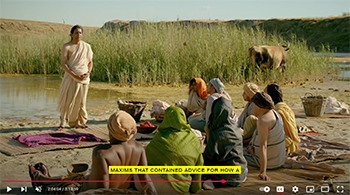
maxims that contained advice for how a kingdom should be ruled, how it should
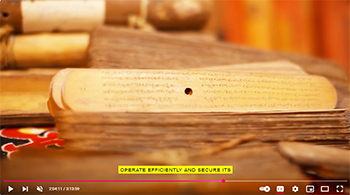
operate efficiently and secure its access to resources, as the following
example written by him shows. A king should improve the harvest of his
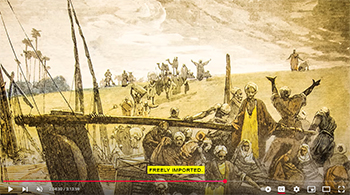
country, and so encourage its commoners that horses, elephants, precious gems, sandalwood, pearls, and other articles are freely imported. Under King Krishnadeva, the Vijayanagara
Empire nearly doubled in size and would soon reach its largest historical extent, and it would also achieve its greatest
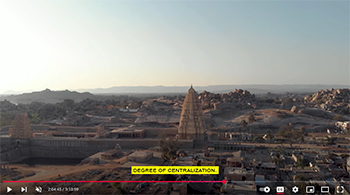
degree of centralization. At heart, it was still a feudal society, and its regions were ruled by lords
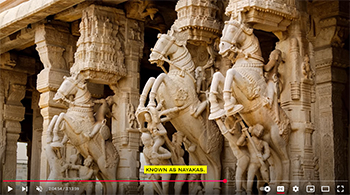
known as nayakas. These nayakas paid taxes to the empire
but otherwise enjoyed a degree of independence, as the Portuguese visitor Domingo Paes recalls. These captains who he has over these troops of his are the nobles of his kingdom.
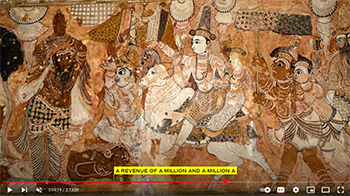
They are lords and they hold the city and the towns and villages of the kingdom. There are captains amongst them who have a revenue of a million and a million a half of pardaos, others a hundred thousand pardaos, others 200,
300, or 500,000 pardaos. As each one has revenue, so the king fixes for him the number of troops he must maintain in foot, horse,
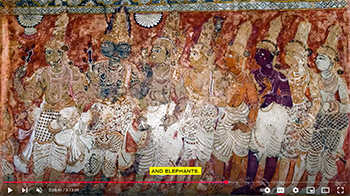
and elephants. These troops are always ready for duty whenever they may be called out, and wherever they may have to go. Besides maintaining these troops, each captain has to make his annual payments to the king.
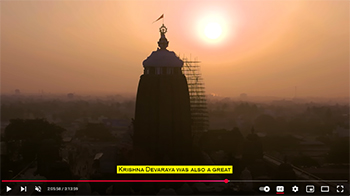
Krishna Devaraya was also a great builder. To mark his coming to the throne, in 1510 he ordered the construction of a grand gateway tower known as a gopura to adorn the temple to Virupaksha, as well as a central pillared hall covered in ornate carvings. This remarkable temple tower was designed based on mathematical principles using a fractal design in which small parts of the tower resemble the whole. This gives the tower a mesmerizing shape and represents the infinite repetition of universes that lies at the heart of
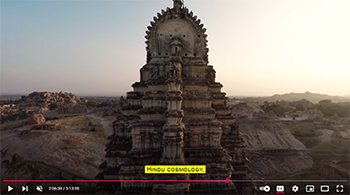
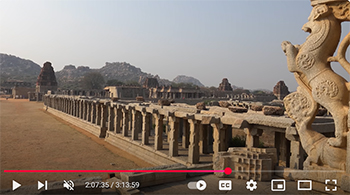
Hindu cosmology,
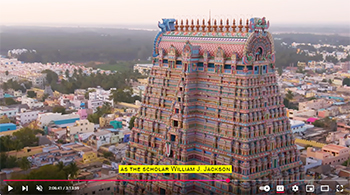
as the scholar William J. Jackson describes:
The ideal form, gracefully artificed, suggests the infinite rising levels of existence and consciousness, expanding sizes rising towards transcendence above, and at the same time, housing the sacred
[x]
deep within.
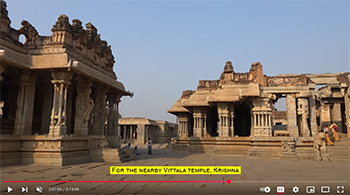
For the nearby Vittala temple, Krishna Devaraya also commissioned a striking
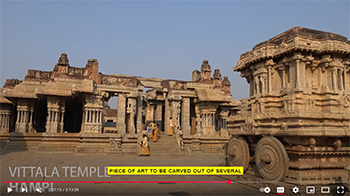
piece of art to be carved out of several blocks of granite. It was a temple chariot made of stone, complete with wheels and ornate decorations which can still be seen in the courtyard
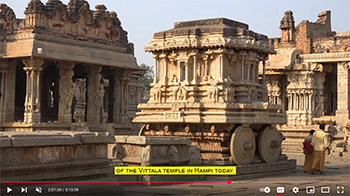
of the Vittala temple in Hampi today. This was a true golden age in South India,
a time of peace, stability, and prosperity, but this period of calm would not last.
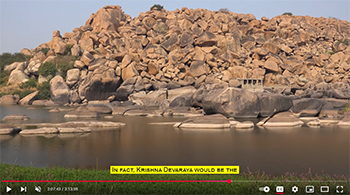
In fact, Krishna Devaraya would be the last great king of Vijayanagara. In little more than 50 years,
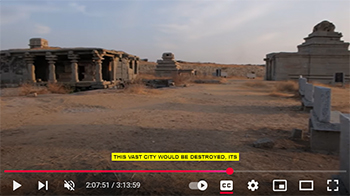
this vast city would be destroyed, its temples and palaces burned, its streets
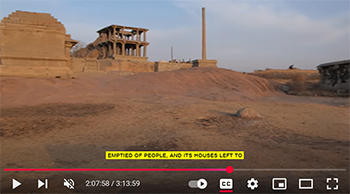
emptied of people, and its houses left to crumble into the earth.
He published a series of political
maxims that contained advice for how a kingdom should be ruled, how it should
operate efficiently and secure its access to resources, as the following
example written by him shows. A king should improve the harvest of his
country, and so encourage its commoners that horses, elephants, precious gems, sandalwood, pearls, and other articles are freely imported. Under King Krishnadeva, the Vijayanagara
Empire nearly doubled in size and would soon reach its largest historical extent, and it would also achieve its greatest
degree of centralization. At heart, it was still a feudal society, and its regions were ruled by lords
known as nayakas. These nayakas paid taxes to the empire
but otherwise enjoyed a degree of independence, as the Portuguese visitor Domingo Paes recalls. These captains who he has over these troops of his are the nobles of his kingdom.
They are lords and they hold the city and the towns and villages of the kingdom. There are captains amongst them who have a revenue of a million and a million a half of pardaos, others a hundred thousand pardaos, others 200,
300, or 500,000 pardaos. As each one has revenue, so the king fixes for him the number of troops he must maintain in foot, horse,
and elephants. These troops are always ready for duty whenever they may be called out, and wherever they may have to go. Besides maintaining these troops, each captain has to make his annual payments to the king.
Krishna Devaraya was also a great builder. To mark his coming to the throne, in 1510 he ordered the construction of a grand gateway tower known as a gopura to adorn the temple to Virupaksha, as well as a central pillared hall covered in ornate carvings. This remarkable temple tower was designed based on mathematical principles using a fractal design in which small parts of the tower resemble the whole. This gives the tower a mesmerizing shape and represents the infinite repetition of universes that lies at the heart of
Hindu cosmology,
as the scholar William J. Jackson describes:
The ideal form, gracefully artificed, suggests the infinite rising levels of existence and consciousness, expanding sizes rising towards transcendence above, and at the same time, housing the sacred
[x]
deep within.
For the nearby Vittala temple, Krishna Devaraya also commissioned a striking
piece of art to be carved out of several blocks of granite. It was a temple chariot made of stone, complete with wheels and ornate decorations which can still be seen in the courtyard
of the Vittala temple in Hampi today. This was a true golden age in South India,
a time of peace, stability, and prosperity, but this period of calm would not last.
In fact, Krishna Devaraya would be the last great king of Vijayanagara. In little more than 50 years,
this vast city would be destroyed, its temples and palaces burned, its streets
emptied of people, and its houses left to crumble into the earth.
-
admin
- Site Admin
- Posts: 41484
- Joined: Thu Aug 01, 2013 5:21 am
Re: Vijayanagara: The Last Emperors of South India, Fall of
Part __ of __
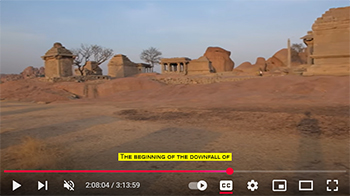
The beginning of the downfall of
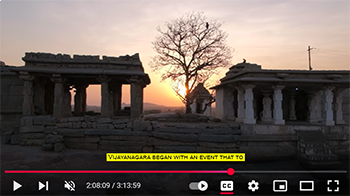
Vijayanagara began with an event that to its people must have felt like a fantastic development.
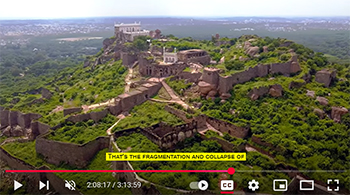
That's the fragmentation and collapse of their long-standing rival to the north, the Muslim
Bahmani Sultanate. Like the empire of Vijayanagara, the Bahmani Sultanate had been successful by combining disparate elements. For decades, they had been enthusiastically importing people from across the Muslim world; soldiers, architects, artists, holy men, and

scholars, and these people had helped to transform it into a world center of
culture and innovation. But this policy also had its costs. Soon, conflicts began to unfold between the Indian Bahmanis and the newcomers,
mostly Persian-speaking Iranians who were referred to as the Westerners. Throughout the 15th century, the Indian Muslims in the sultanate became
increasingly angry at the growing influence of these foreign arrivals, and
as the 16th century neared, their anger turned mutinous. When the enraged ruler of Ahmednagar rebelled in the year 1490,
the other regions of the sultanate soon followed.
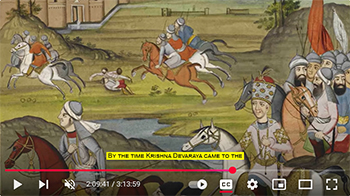
By the time Krishna Devaraya came to the throne of Vijayanagara in the year 1509,
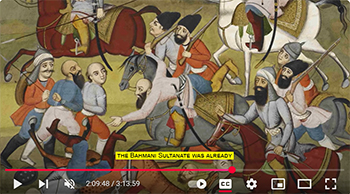
the Bahmani Sultanate was already splintering. By the year 1518, it had fractured into five individual kingdoms, whose sultans immediately began fighting amongst
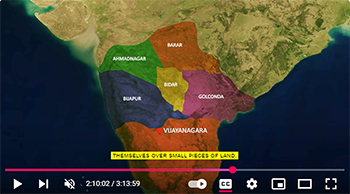
themselves over small pieces of land. The power of the Bahmanis evaporated in
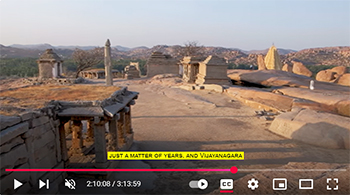
just a matter of years, and Vijayanagara was now all but unchallenged in the south of India. For King Krishna Devaraya, still only a young man of 17 years old and still buzzing from his victory against the Gajapatis, the chaos in these neighboring kingdoms presented an obvious opportunity. That rich triangle of land known as the
Raichur Doab, with its fertile farmland and wealth of diamonds, had been in the hands of the Bahmanis for many years now. But with the collapse of the sultanate, it was now held by just one of these five sultans, a man named Ismail Adil Shah, the sultan of Bijapur. Alone, he would be no match for the might of Vijayanagara, and so, in the year 1520,
King Krishnadeva moved to take it from him with an army of a hundred thousand
soldiers.

The Portuguese-Jewish traveler Fernao Nuniz was staying in Vijayanagara at

the time of this campaign, and he wrote a dramatic and colorful account of how it unfolded. After the king had made his offerings and performed sacrifices to his idols,
he left the city of Bisnaga with all his troops, and they marched in the following order. The chief of the guard led the advance with 30,000 infantry; archers, men and shields, and musketeers,

and spear-men, and a thousand horse and his elephants. All were equally well-armed, each after his own fashion; the archers and musketeers with their quilted tunics, and the shield-men with their swords and daggers in their girdles. In the days that followed, King Krishnadeva marched this large army
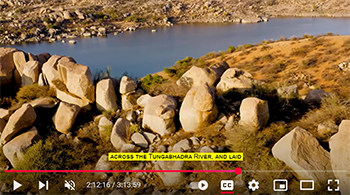
across the Tungabhadra River, and laid siege to the fort of Raichur.
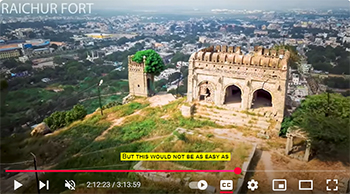
But this would not be as easy as Krishnadeva hoped. The kings of Vijayanagara had still not
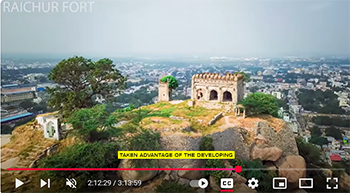
taken advantage of the developing technology of the cannon, although they had employed several Portuguese musketeers as mercenaries.
The beginning of the downfall of
Vijayanagara began with an event that to its people must have felt like a fantastic development.
That's the fragmentation and collapse of their long-standing rival to the north, the Muslim
Bahmani Sultanate. Like the empire of Vijayanagara, the Bahmani Sultanate had been successful by combining disparate elements. For decades, they had been enthusiastically importing people from across the Muslim world; soldiers, architects, artists, holy men, and
scholars, and these people had helped to transform it into a world center of
culture and innovation. But this policy also had its costs. Soon, conflicts began to unfold between the Indian Bahmanis and the newcomers,
mostly Persian-speaking Iranians who were referred to as the Westerners. Throughout the 15th century, the Indian Muslims in the sultanate became
increasingly angry at the growing influence of these foreign arrivals, and
as the 16th century neared, their anger turned mutinous. When the enraged ruler of Ahmednagar rebelled in the year 1490,
the other regions of the sultanate soon followed.
By the time Krishna Devaraya came to the throne of Vijayanagara in the year 1509,
the Bahmani Sultanate was already splintering. By the year 1518, it had fractured into five individual kingdoms, whose sultans immediately began fighting amongst
themselves over small pieces of land. The power of the Bahmanis evaporated in
just a matter of years, and Vijayanagara was now all but unchallenged in the south of India. For King Krishna Devaraya, still only a young man of 17 years old and still buzzing from his victory against the Gajapatis, the chaos in these neighboring kingdoms presented an obvious opportunity. That rich triangle of land known as the
Raichur Doab, with its fertile farmland and wealth of diamonds, had been in the hands of the Bahmanis for many years now. But with the collapse of the sultanate, it was now held by just one of these five sultans, a man named Ismail Adil Shah, the sultan of Bijapur. Alone, he would be no match for the might of Vijayanagara, and so, in the year 1520,
King Krishnadeva moved to take it from him with an army of a hundred thousand
soldiers.
The Portuguese-Jewish traveler Fernao Nuniz was staying in Vijayanagara at
the time of this campaign, and he wrote a dramatic and colorful account of how it unfolded. After the king had made his offerings and performed sacrifices to his idols,
he left the city of Bisnaga with all his troops, and they marched in the following order. The chief of the guard led the advance with 30,000 infantry; archers, men and shields, and musketeers,
and spear-men, and a thousand horse and his elephants. All were equally well-armed, each after his own fashion; the archers and musketeers with their quilted tunics, and the shield-men with their swords and daggers in their girdles. In the days that followed, King Krishnadeva marched this large army
across the Tungabhadra River, and laid siege to the fort of Raichur.
But this would not be as easy as Krishnadeva hoped. The kings of Vijayanagara had still not
taken advantage of the developing technology of the cannon, although they had employed several Portuguese musketeers as mercenaries.