YOU ARE REQUIRED TO READ THE COPYRIGHT NOTICE AT THIS LINK BEFORE YOU READ THE FOLLOWING WORK, THAT IS AVAILABLE SOLELY FOR PRIVATE STUDY, SCHOLARSHIP OR RESEARCH PURSUANT TO 17 U.S.C. SECTION 107 AND 108. IN THE EVENT THAT THE LIBRARY DETERMINES THAT UNLAWFUL COPYING OF THIS WORK HAS OCCURRED, THE LIBRARY HAS THE RIGHT TO BLOCK THE I.P. ADDRESS AT WHICH THE UNLAWFUL COPYING APPEARED TO HAVE OCCURRED. THANK YOU FOR RESPECTING THE RIGHTS OF COPYRIGHT OWNERS.
[Loreta Velazquez] There is a secret history of this war which exists only in memory. Reader, I will tell you my tale as I lived it … May my words convey what war really is, such that good people will hesitate to solve anything with war again.
REBEL
Writer & Director: Maria Agui Carter
Producers: Maria Agui Carter, Calvin A. Lindsay, Jr.
Editor: Bernice Schneider
[Loreta Velazquez] There are times I forget who I’m supposed to be. I am compelled to sink my sex entirely. The least inadvertence could be my ruin. I must learn to act, to talk, to almost think like a man.
[Horse neighs]
I am known as Harry T. Buford, Confederate Soldier. But I am not who I appear. If my identity is revealed, I could be tried for treason.
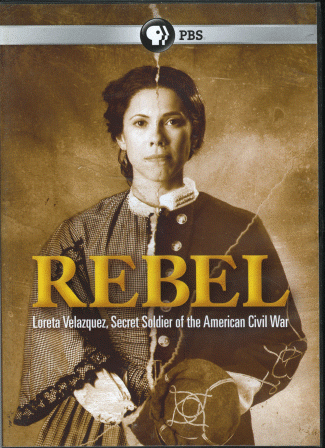
[Narrator] Only one photo of Loreta Janeta Velazquez has been identified although it is not certain this is her picture. We really don’t know what she looked like. What we do know is that records indicate she was one of hundreds of women who fought in the American Civil War. Her memoir, “The Woman in Battle,” caused a sensation.
DREAMS OF GLORY
[Catherine Clinton, Women and Civil War Scholar] Growing up a young woman in Cuba, her parents wanted her to be educated to the dictates of ladyhood. That would be to learn the fine arts of sewing, music, dance. She would be someone who would be expected to be the lady to entertain.
[Loreta Velazquez] Even as a child, I have been disposed to rail against the Creator for making me a woman in a world that favors men. Joan of Arc, the Maid of Orleans, was my heroine. An example of what a woman may do if she only dares, and dares to do greatly.
[Indistinct conversation]
[Jesse Aleman, American and Latino Literatures Scholar] Loreta’s father idolizes her. She is on the one hand daddy’s little girl. At the same time she is constantly testing his boundaries.
[Renee Sentilles, Gender Studies Scholar] Loreta’s father sends her from Cuba to New Orleans to become a refined lady. [Loreta Velazquez] All I understood at the time was he was sending me away.
[Bells Ringing]
[Kirsten Silva Gruesz] When she arrived in the U.S. in 1849, it was just at the close of the Mexican War, and Mexicans had been painted as barbaric, backwards, savage people. And that racist way of thinking extended to most Latinos. And this would have been shocking for her, because as the child of wealthy, educated elites, she saw herself as white.
[Loreta Velazquez] New Orleans was a new place with new rules, but I desperately wanted to fit in.
[Kirsten Silva Gruesz, Scholar of Early U.S. Latino Culture] When Loreta encountered stereotypes like this, she must have seen it as a self-protective gesture to pass herself off as a dark-skinned wealthy white person.
[Renee Sentilles, Gender Studies Scholar] White does not mean “white” in New Orleans. It means a paler person -- of some kind of racially mixed background. Americans are never quite clear If the people who look white in New Orleans are actually white. You can have a really large old, established, wealthy population of free people of color who are Spanish, French, a little African, and this is the old world New Orleans that she’s entering.
[Whistle blows]
[Background Chatter]
[Kirsten Silva Gruesz, Scholar of Early U.S. Latino Culture] Many Spanish-speaking people came to New Orleans from Cuba, from the coastlines of South America, of Central America, and there was a real Spanish speaking population there. There were newspapers; there were cafes and clubs and mutual aid societies.
[Loreta Velazquez] The streets bustled with many Spanish peoples … reminding me of home. I lived in the Creole quarter with my mother’s sister, whom I called Madame R. My aunt instructed me on a relentless set of rules. Everyone was determined I should be a proper lady, except me.
[Piano music]
It was my habit to dress myself in my cousin’s clothes and –
[Madame R] Loreta, por Dios! Que estas hacienda? Tue res una senorita. Pongase su vestido, por favor.
[Renee Sentilles, Gender Studies Scholar] She’s not getting reshaped the way they want.
[Loreta Velazquez] I was sent to the school conducted by the Sisters of Charity.
[Renee Sentilles, Gender Studies Scholar] And they are raised in very strict confines to be refined Catholic daughters.
[Catherine Clinton, Women and Civil War Scholar] Her parents were educating her to ladyhood to make her more worthy on the marriage market, not an education to do something in the wider world but an ability to snag a husband.
[Loreta Velazquez] By 1856, I was no longer a child, and my parents were becoming anxious that I should take my place in society. From Cuba, my parents arranged that I should marry a Spanish boy. But I had my heart set on an American boy -- a dashing and fair young officer from Texas named William.
[Renee Sentilles, Gender Studies Scholar] There’s a real fear among white Americans, certainly, that there are a lot of people of color passing. And our children will marry them and have children with them. But a Cuban ancestry -- Many Americans see this as not quite white but possibly white. There’s a belief that if your family’s old, it’s been in Cuba for a long time. It’s much more likely that there’s a little bit of race mixing in there, and there’s a real effort on the part of White Cubans to dispel this, to talk about pure ancestry.
[Christina Vella, U.S. and Modern European History Scholar] Loreta claims that she descended from an aristocratic background; every starveling in New Orleans claimed the same thing. Everybody wanted to be aristocratic, particularly among the Spanish. They would empty their purses in order to have these genealogical studies made that would link them to some minor nobility.
[Vicki L. Ruiz, Scholar of U.S. History and Latino Studies] There’s a whole performance of race. Someone could go from being Mestizo to being Espanol with the acquisition of money and respect.
[Jesse Aleman, American and Latino Literatures Scholar] Loreta was a rebel from the start. In fact, she steals her best friend’s boyfriend. William is everything that her father despises. And here comes Loreta. And the first person that she falls in love with is, in fact, an American.
[Virginia Sanchez-Korrol, Scholar of American Latinas in History] She goes against the person that her father had chosen for her to marry. No self-respecting young Spanish woman of the elite would do such a thing.
[Loreta Velazquez] My family had strictly forbidden our seeing one another any longer. On the 5th of April, 1856, we were clandestinely married. I expected over time father would accept our romance, but I was mistaken.
[Horse neighs]
We made the best of things at William’s Military outposts. As summers came, I braced for the fevers, and found myself in constant vigilance for the children’s safety.
[Catherine Clinton, Women and Civil War Scholar] Women had a lot to fear. All kinds of diseases were in much, much higher proportion in the south than in the North. Childhood death was staggering. The 19th century woman was expected to marry and produce a family. That was her role in life.
[Loreta Velazquez] I entered as far as possible into my husband’s thoughts and wishes. William and the children were my entire world. My father would have been proud.
[Photographer speaking indistinctly]
[Loreta Velazquez] In course of time, I became a good American in thought and manner.
[Mother and kids] Ashes, ashes we all fall down!
[Child speaking indistinctly]
[Virginia Sanchez-Korrol, Scholar of American Latinas in History] She has two children means that between the age of 15, when she’s a child herself, to 18 when she grows into young womanhood, she’s already the mother of two children, and a third on the way. And she loves these children.
[Loreta Velazquez] Our family was a source of great happiness, but that Spring my husband was sent to dangerous Indian territory. I took the children to St. Louis. I spent the days with the children and preparing for our new babe. We had few callers as we were new to the area.
[GASPS] Our infant came into this world for but a brief moment. I sought comfort in my children, and my husband came as soon as he heard.
[Renee Sentilles, Gender Studies Scholar] In the Fall, fever comes to the City of St. Louis.
[Loreta Velazquez] We were not prepared for what happened next. No one is.
[Kids] Ring around the Rosie … ashes, ashes we all fall down
[Children, Loreta laughing]
[Loreta Velazquez] [Sobs] Sometimes I would direct myself toward the nursery to check on the children, forgetting. It seemed against all nature to survive one’s children. April 5, 1861, burst with Spring, and William and I spent the day together quietly. We marked our fifth anniversary preparing for my husband’s departure. There had been barely time enough to mourn, as each week’s news indicated that the country was tearing apart.
[Fort Moultrie Opens Fire on Fort Sumter, At Four O’Clock Friday Morning. Maj. Anderson Returns the Fire, when the Other Forts and Batteries Engage in the Conflict.]
[Loreta Velazquez] Since the recent presidential elections, the Northern and Southern states had split and everyone had been forced to take sides.
[Renee Sentilles, Gender Studies Scholar] Lincoln is elected without a single Southern electoral vote. And now the place that she calls home has been essentially disenfranchised. In December, the Southern states start to secede.
[SOUTH CAROLINA SECEDES!, DECEMBER 20, 1860 MISSISSIPPI SECEDES!, JANUARY 9, 1861 FLORIDA SECEDES!, JANUARY 10, 1861 ALABAMA SECEDES, JANUARY 10, 1861 GEORGIA SECEDES!, JANUARY 19, 1861 LOUISIANA SECEDES!, JANUARY 26, 1861]
[Christina Vella, U.S. and Modern European History Scholar] Everybody in New Orleans, though they didn’t own slaves themselves, joined the Confederacy, were wholeheartedly for the Confederacy.
[TEXAS SECEDES!, JANUARY 10, 1861]
[Loreta Velazquez] When William’s home state of Texas determined to secede, he resigned his commission in the United States Army.
[UNION IS DISSOLVED!]
[Camera flash]
[Loreta Velazquez] It was a great grief
for him to forsake the uniform he had worn so long with honor. William was appointed to Pensacola, Florida, to train new recruits. I sought to convince him that I should go, too.
[Renee Sentilles, Gender Studies Scholar She wants to be with her husband. She’s lost her childhood family, she’s lost her adult family; all she has left is William.
[Loreta Velazquez] On the 8th of April, he headed out, and my heart went with him. It was not long after that I received the dispatch. A chill went through my spine as I read … there had been a terrible accident. I arranged for William’s funeral and settled his affairs numb with shock.
[Camera flashes]
[Loreta Velazquez] I was now alone in the world. Ow!
[Horse neighs]
[Bugle playing]
[DeAnne Blanton, Senior Military Archivist, National Archives] When the Civil War came and shook up the social structure just enough, women came pouring out out of their houses. They came pouring out of their farms directly into the public arena as if to say, “We can make a difference, We will make a difference.”
[Renee Sentilles, Gender Studies Scholar] There were many, many women who wrote in their diaries, “I wish I could put on men’s clothing and go to war.”
[Elizabeth D. Leonard, Civil War Scholar] Recent scholarship has indicated that between 500 and 1,000 women went into military service, some of them for very short blocks of time and some for two or three years, depending on what led to their discovery or whether they were able to maintain anonymity throughout.
[DeAnne Blanton, Senior Military Archivist, National Archives] There are a number of cases of women going to war with their husbands or their fiancés. And a number of girls went to war with their brothers.
[Catherine Clinton, Women and Civil War Scholar] How could they pass the medical inspection? Well, reading about a medical inspection was: you had two feet and you could walk, and therefore you were inducted into the army.
[Elizabeth D. Leonard, Civil War Scholar] The Civil War armies were very different from our modern armies. They lived outside almost all the time. Large proportions of the soldiers were young, which meant it wasn’t that unusual to have a soldier who had a higher pitched voice or who had not yet sprouted an obvious beard. So women who looked like clean-shaven or beardless young men found it easier to hide. They didn’t take their clothes off; it helped that the uniforms were very baggy. In the 19th century, notions about gender were so clearly associated with particular forms of dress that if you saw someone in pants, it simply didn’t occur to you that that person was anything but a man.
BETWEEN TWO FIRES
[Loreta Velazquez] I wake at dawn. I force myself to bury all thought of my old life. I am ready to play my part in a great drama. It is strangely simple to array myself in my soldier’s uniform. And no one thinks to stop me.
[Richard Hall, Scholar of Civil War Women Soldiers] She was sort of a freelance soldier, and this was not that unusual either. Early in the war, there were militia soldiers in the regular army, which was very, very small -- North and South. The South didn’t even really have a regular army, and so it was not unusual for people to come in and sort of appoint themselves or be accepted -- sort of a volunteer officer.
[Vicki L. Ruiz, Scholar of U.S. History and Latino Studies] She donned the uniform and became Buford. She is passing.
[Cannon shot in distance]
[Narrator] In July 1861, Loreta would fight in the first major battle of the Civil War – Bull Run, also known as Manassas.
[Rifle shots]
What she thought would be a short skirmish would turn into four long years of bloody civil strife.
[Gunshots, men yelling]
[Loreta Velazquez] There was horror in battle.
[Man screams]
But I was bent upon showing I was as good as any man.
[Elizabeth D. Leonard, Civil War Scholar] She’s not just a woman soldier in that world, she’s a Hispanic woman in that white brothers’ war.
[Jesse Aleman, American and Latino Literatures Scholar] How does someone who is Hispanic and different right, try to assimilate, or cross, or pass into sameness? And what does that do? How does it pit her against racial others?
[Train whistle in distance]
After donning her outfit as Buford, Loreta also buys a slave named Bob. And Bob always struck me as a very important character in this narrative. Bob becomes part of the way Loreta Janeta Velazquez, Cuban woman, passes as Harry T. Buford, Confederate soldier.
[Vicki L. Ruiz, Scholar of U.S. History and Latino Studies] Here she is trying to have her own, expand her own boundaries of the possible while enslaving another human being.
[Loreta Velazquez] My colored boy Bob is a better soldier than some of the white men, who think themselves immensely his superiors.
[Renee Sentilles, Gender Studies Scholar] When Loreta makes him a comrade in arms and really to the same level as a warrior as the white soldiers and as herself, it’s really fascinating what she’s doing. She’s essentially humanizing the slaves.
[Loreta Velazquez] He fights as well as he knows how, like the rest of us. I confess that I am proud.
[Renee Sentilles, Gender Studies Scholar] You only allow citizens who have all the full rights of citizenship to fight. And women and African Americans don’t really own this country. They’re not – they’re not citizens in the same way. They don’t have full rights of citizenship. And once you allow someone to fight and put their life on the line, can you deny them those rights anymore?
[Jesse Aleman, American and Latino Literatures Scholar] For someone like Loreta Velazquez, you have an immigrant trying to find a sense of identity within this country, and the way she does it is by fighting for it.
[Horse neighs]
[Elizabeth D. Leonard, Civil War Scholar] This has been, certainly in American history a way in which people who have been subordinated themselves have advanced their status through doing the nation’s work, whatever that work is. And the Confederacy’s work was defending slavery. Ironically, it doesn’t always mean that you get the prize at the end.
[Indistinct chatter]
[Loreta Velazquez] I have learned much concerning the weakness of human nature: self-seeking is more common that patriotism. And in camp, a spirit of petty jealousy is even more prevalent than it is at a girl’s boarding school.
[Soldier] Yes.
[Indistinct chatter]
[Bob] [accidentally kicks over a soldier’s cup]
[Soldier] Oh!
[Bob] Sorry, sir. I’m sorry … [Loreta Velazquez] Bob, go take care of them horses … go on.
[Bob] I didn’t mean it, sir.
[Loreta Velazquez] Go on!
[To soldier] Come on. Do I have a problem with you? [To Bob] Go on, like I told you.
[Bob] Yes, sir. Yes, sir.
There is a question about the relationship between Buford and Bob.
[Soldier] You better watch him.
[Loreta Velazquez] Go on, now.
[Loreta Velazquez] You better take care of him.
[Loreta Velazquez] He’s a good boy. Come on.
[Jesse Aleman, American and Latino Literatures Scholar] They fight alongside each other. They ride together. So if anyone is in the know about Buford’s secret, it would be Bob.
[Loreta Velazquez] My life depends on his keeping my secret.
[Men singing indistinctly]
[Chapter IX. The Battle of Ball’s Bluff. The Fight at Woodsonville.
Chapter XVII. The Battle of Shiloh.]
[Man shouts commands]
[Loreta Velazquez] Killing sends a thrill of horror, even in war. There is one incident I cannot shake. I fire my revolver at another officer, who is in the act of jumping into the river. I see him spring into the air and fall, and turn my head away, shuddering at what I have done.
[Rifle shots]
To be a second Joan of Arc is a girlish fancy …
[Man screams]
Which my experiences as a soldier dissipated forever.
[Jesse Aleman, American and Latino Literatures Scholar] After the battle of Shiloh, Buford takes a left, Bob takes a right and runs smack into the middle of union forces. He claims he gets “lost.” He escapes and ends up in federal territory a free man.
[Man shouting commands]
[Loreta Velazquez] I make half-hearted enquiries but do not pursue him. I am worn out. The great conflict is far from its close, and my original enthusiasm is long gone. This business of war is a fearful thing. Would that I could stop the slaughter, but who am I to affect the plans of generals?
[Rifle fire]
[Soldier] [coughs]
[Loreta Velazquez] [breathing heavily]
[Gunshot]
[Loreta Velazquez] I wake to the rattle of the tracks and pain shooting through my body. The sick and the wounded surround me. I am in imminent danger of being discovered. I shun medical attention, protecting my secret. It is now the summer of 1863, and martial law is in force in the capital, Richmond, Virginia.
[Horse neighs]
The confederacy is becoming desperate, and I realize I will be under more scrutiny than ever. General Winder, the head of our secret service, is suspicious of everyone.
[Indistinct conversation]
[Carman Cumming, Journalist and Civil War Scholar] Yes, a very interesting time in the Civil War, because this is after the Battle of Gettysburg and after the fall of Vicksburg, and it’s a time of great deprivation, of course, in the South and a time of great angst.
[Loreta Velazquez] This is no place for strangers. Detectives are everywhere. Perhaps it was a mistake to come.
[Man] Yes. We’re going to go upstairs.
[Loreta Velazquez] I have just begun to unpack when a knock comes to my door. Someone has noted my feminine ways.
[Daily Richmond Examiner, July 2, 1863: She was a second Joan of Arc … charged with unsexing herself …]
[Loreta Velazquez] I stand accused of disguising my sex and serving as a federal spy.
[Lynchburg Daily Virginian, July 4, 1863: An investigation into the suspicious character revealed “he” was a woman …
[DeAnne Blanton, Senior Military Archivist, National Archives] Spies were at risk of being executed. There were spies shot during the war, shot for treason.
[Man coughs]
[Carriage approaching]
[Carman Cumming, Journalist and Civil War Scholar] Castle Thunder was packed with all kinds of suspects, disloyal suspects, deserters, and so forth and so on. The loyalty suspects were allowed to mingle in a second floor citizens’ room they called it. And one person who wrote about it said he could see at least twenty other Union spies, or Northern spies, in the room at the same time.
[Loreta Velazquez] Each day is an eternity of dreading what will happen next. I must find a way out. My fate lies in General Winder’s hands, and I beg for an audience with him. He offers me a Devil’s deal I do not trust. But I have run out of options.
[Daily Richmond Examiner, July 11, 1863: “Lieutenant Buford” … has been released by General Winder …]
[Loreta Velazquez] General Winder thinks I may have some value in his secret service corps and decides to test my abilities. A woman labors under some disadvantage in an attempt to find her own way in the world.
[Door opens]
And at the same time, she can often do things that a man cannot.
[Narrator] Loreta writes little of her motivations, and Civil War records of spying are difficult to verify. What we know is that now boundaries blurred, loyalties were uncertain, and deception became her trade.
[Loreta Velazquez] According to all[/img] military law, I am now an outlaw, and liable to be hung if detected, the death of a soldier even being denied me. I am willing to take my chances.
[Carman Cumming, Journalist and Civil War Scholar] She was Laura Williams, she was Anne Williams, she was Alice Williams very often. She changed her name it seems, almost as often as she changed her clothes.
[Richard Hall, Scholar of Civil War Women Soldiers] Women just didn’t do this sort of thing … or so men thought. They would go out on scouting expeditions, scouting behind enemy lines, searching out where are the enemy troops, what are they doing, how well equipped are they, how many are there. They would report back. Smugglers, contraband. There was a huge smuggling operation involving women. Loreta did most of the above.
[Loreta Velazquez] I pass through the lines in the North and the South, inventing my past as needed. Officials publicly denounce the rebellion while privately profiting from their corruption.
[Confederate States of America Loan]
[Richard Hall, Scholar of Civil War Women Soldiers] She thrived economically because she was transporting large amounts of confederate money around to support various spying operations, carrying money around in suitcases sort of like a modern CIA operative.
[Loreta Velazquez] With each succeeding month, speculation seems to increase, and men become more eager to make money and less particular how they make it.
[Jesse Aleman, American and Latino Literatures Scholar] Loreta begins to understand that money seems to be the heart of this thing called the Civil War, not the issues of state rights, maybe not even the issues of upholding slavery.
[Loreta Velazquez] After three years of service, I deeply understand, war corrupts and few are innocent.
[Jesse Aleman, American and Latino Literatures Scholar] She sees the entire underside of war, and that is some people profit from it grossly. This leads to her disillusionment with the idea of warfare.
[Carman Cumming, Journalist and Civil War Scholar] Then she disappears from the South. And according to her story, she’s crossed the lines, come North to spy.
[DeAnne Blanton, Senior Military Archivist, National Archives] At one point, using the alias Alice Williams, she actually came to Baltimore and went to work for the Union Secret Service as a double agent.
[Chapter XXXIV. Playing a Double Game]
[Carman Cumming, Journalist and Civil War Scholar] It appears that she works at the Baltimore Provost Marshal’s office, keeping watch on spies and smugglers and so forth. And the records seem to indicate that her job there was to turn in disloyal people or to search female suspects. And the big question is, was she spying on the North or was she defecting? The records in the North have to do with the Baltimore hiring of Alice Williams. They seem to suggest that instead of spying in the North, she was actually defecting.
[Loreta Velazquez] I love the South and its people with a greater intensity than ever. At the same time, many of my prejudices against the North have been proven wrong in the 18 months that I have spent with them. All the dreams of four years ago have vanished.
Jesse Aleman, American and Latino Literatures Scholar] She has no home. No family, no nation.
[chimes clanging]
ROMANCE AND REALITY
[indistinct chatter]
[Jesse Aleman, American and Latino Literatures Scholar] The Confederates lost. They didn’t just barely lose, they were overwhelmed; they were decisively defeated. And they lost their entire social system, their entire slave-based social system as a result of this war.
[Loreta Velazquez] On every side is ruin and poverty, on every side disgust of the present and despair of the future. I am haunted by the war. It will be a decade before I am able to make sense of what I witnessed.
Jesse Aleman, American and Latino Literatures Scholar] In 1875, a handbill is published and circulated announcing “The Woman in Battle, The Greatest Civil War Book ever written.
[DeAnne Blanton, Senior Military Archivist, National Archives] The way I view Loreta’s book is that she took her life story and she made it a little better.
[Narrator] Loreta had spent years reinventing herself. Now she admitted to the world who she was – a Cuban woman. But the world was not ready to hear what she had to say.
[Elizabeth D. Leonard, Civil War Scholar] Her story is not a story that glorifies the war, it’s a story that talks about war as a very harsh, gory, bloody, corrupt reality. And she doesn’t tell the story of the event in a way we like to hear it.
[Catherine Clinton, Women and Civil War Scholar] She talks about the brutality and roughness of Confederate men -- the honored veterans. And she’s talking about them as being ungentlemanly, rough, vulgar.
[Richard Hall, Scholar of Civil War Women Soldiers] People criticized it. Social commentators at the time thought it was tawdry and unreal.
[Lieutenant General Jubal Anderson Early, C.S.A.] I came across Madame Velazquez’s book, entitled “Woman in Battle,” and gave it a cursory examination, from which I was satisfied that the writer of that book, whether man or woman, had never had the adventures therein narrated. And I have expressed the same opinion to several presses in the city.
[Gary Gallagher, Civil War Scholar] Jubal Early became one of the main arbiters of how the war would be remembered. And he acquired a great deal of power … If he disagreed with something that someone wrote and they didn’t make the changes that he wanted, he could be very effective in attacking them or having others attack them in various print forms.
[Vicki L. Ruiz, Scholar of U.S. History and Latino Studies] How could this woman have infiltrated his ranks? Not only how could this woman have infiltrated his ranks, but how dare she write about his troops in that manner?
[Southern Historical Society Papers.]
[Jesse Aleman, American and Latino Literatures Scholar] He himself is at the start of an entire print culture that is remembering the Confederate cause through an ideological lens, we now know of as
“The Lost Cause.”
[Lieutenant General Jubal Anderson Early, C.S.A., Autobiographical Sketch and Narrative of the War Between the States]
[Renee Sentilles, Gender Studies Scholar] Loreta is incredibly dangerous to the creation of a Confederate nationalism.
[Lieutenant General Jubal Anderson Early, C.S.A.] Madame Velazquez might have been a follower of one or the other army in some capacity, but the book cannot be a truthful narrative of the adventures of an army person.
A female camp follower was a laundress or a sutler, but the subcontext of the term “camp follower” was his way of saying she was a prostitute.
[Loreta Velazquez] I write the general, offering to clear up any confusions. My appeal goes unanswered. It has become clear to me that General Early needs straightening out.
[Jesse Aleman, American and Latino Literatures Scholar] They met in the foyer of the hotel where Early lived, in Lynchburg. There was potentially a significant penalty for crossing Early in any serious way.
[Lieutenant General Jubal Anderson Early, C.S.A.] You are no true type of Southern woman.
[Loreta Velazquez] All –
[Lieutenant General Jubal Anderson Early, C.S.A.] I have the right to speak my opinion, and I will speak it, whether the author be a man or a woman!
HISTORY & MEMORY
[Catherine Clinton, Women and Civil War Scholar] Jubal Early was an old soldier – glorious – and here was this woman coming along, making up stories. He felt it was very easy; she was Hispanic, she was marginal, she was someone who he could easily attack and discredit, and he did. So effectively that I think this label of “hoax” stuck with her book for almost a century.
[Richard Hall, Scholar of Civil War Women Soldiers] A lot of people were skeptical of her and didn’t know what to make of her. She started acquiring a bad reputation. She was accused of being a prostitute or a woman of loose morals and all sorts of things. And so she had to live with that.
[Jesse Aleman, American and Latino Literatures Scholar] She disappears into obscurity. Erasure would be the good way of putting it, erased in history.
[DeAnne Blanton, Senior Military Archivist, National Archives] When General Early was criticizing Velazquez and her book and proclaiming loudly to anyone who would listen that she was a fraud, one of the things he specifically critiqued was her time she spent as a double agent in Washington, D.C. But what General Early couldn’t have known is that in the files of the Provost Marshal … there was this document:
“THIS CERTIFIES THAT THE BEARER, MRS. ALICE WILLIAMS, ON THIS DAY HAS BEEN APPOINTED AS A U.S. SPECIAL AGENT IN THE MIDDLE DEPARTMENT UNTIL FURTHER ORDERS.” This Alice Williams is indeed Loreta Velazquez. While we may not know everything we’d like to know about her today, we can corroborate quite a bit of what she writes in her book.
[The Female Lieutenant: The public will remember the numerous paragraphs published concerning one “Lieutenant Harry Buford,” nee Mrs. Williams, with a history romantic in war as that of Joan of Arc. Last summer the Lieutenant got into Castle Thunder, her sex not corresponding with the dashing uniform she wore. She was released, and went from Richmond to Chattanooga, where she joined Gen. Bragg’s army, got upon the staff of Gen. A.P. Stewart, and for a time was employed in the secret service, effecting important arrest of spies, and doing some very daring things. The other day she visited Richmond again, not as the gay Lieutenant, but in the garments more becoming her sex, and bearing the name of Jeruth DeCaulp, she having, in the interval, married an officer of the Confederate States Provisional army of …]
[The Female Lieutenant. “Lieutenant Buford,” the female Lieutenant from the South, arrested in this city, and sent to Castle Thunder, has been released by General Winder. The charge of being a Yankee spy was never alleged against her, and she is indignant that such a thing was ever insinuated. She persists in sporting her military costume, and it was this that got her into trouble with the Richmond authorities. Her real name is Mrs. S.T. Williams, and her husband is a 1st Lieutenant in Company E. 13th Connecticut regiment, under Banks, in Louisiana. Her father is Major J.B. Roche of Mississippi, but she was born in the West Indies. Her people were wealthy, and her annual income before the war was $20,000, most of which she spent in getting medicines for the Confederate Government. Her penchant was to follow the army in a private ambulance with medicines, bandages and servant, and has been known to lend a helping hand with the …]
[PERSONAL – Mrs. T.C. De Camp, better known as Lieut. H. T. Buford of the late C.S.A. is at the St. James Hotel. As Lieut. Buford, she was wounded four times during her military career. She has also been blow up by a steamboat, being the only lady passenger saved. Mrs. De Camp now appears as a lady.]
[At the opening of the late war, having donned male attire, she vaulted into the saddle of a 1st lieutenancy of a Texas cavalry company, and saw service in the first battle of Manassas. Subsequently she was transferred to the Western army and was wounded in the battle of Shiloh, in which memorable engagement she claims to have performed splendid service.]
[… It appears that she resided in this city several years ago in a house of questionable character, but managed by some defective arts, which are best known to women, to win the affections of an Arkansas planter, who married her. She soon tired of married life, however, left him, and next appeared with our army at Utah, where she became acquainted with many under the name of Mrs. Arnold. The rebellion broke out and Mrs. Arnold – Mrs. Williams was next found doing the duty of a private soldier in the battle of Manassas as a member of the 7th Louisiana regiment. She was brought into public notice again last spring just after the battle of Shiloh, having been wounded in the engagement as a member of the 11th Louisiana. On that occasion she visited this city and was arrested for appearing in male attire but on account of what was then called her patriotic conduct she was dismissed with honor.]
[Jesse Aleman, American and Latino Literatures Scholar] “The Woman in Battle,” has never escaped its charge of inauthenticity. Authenticity has always been a way of challenging narratives that somehow challenge the mainstream notion of what is truth.
[Elizabeth D. Leonard, Civil War Scholar] The absolute truth of one thing or another in the book is not the most important contribution that the book makes. It’s the presence of the book, the fury that it provoked, the claims that it makes, the reality that it tries to portray.
[Vicki L. Ruiz, Scholar of U.S. History and Latino Studies] Her willingness to live life on her own terms, and completely on her own terms, is something that is exceptional for any woman during this period.
[Narrator] Loreta appears in public records through 1902, marrying again, and embracing one final cause, Cuban independence. She lies in an unknown grave. Her memoir, “The Woman in Battle,” remains in print.
[Loreta Velazquez] What a woman may do if only she dares, and dares to do greatly.
Starring Romi Dias: Loreta Velazquez (adult) Isabel Carter: Loreta Velazquez (child) Narrator: Llewelyn Smith On-camera Experts: Jesse Aleman, DeAnne Blanton, Catherine Clinton, Carman Cumming, Gary Gallagher, Kirsten Silva Gruesz, Richard Hall, Elizabeth D. Leonard, Vicki L. Ruiz, Virginia Sanchez-Korrol, Renee Sentilles, Christina Vella
Additional Cast:
Beresford Bennett: Bob Will Le Bow: Jubal A. Early Ed Rivera: Sr. Velazquez Sofia Rivera: Loreta’s daughter Noah Selden: Loreta’s son Caty Moore: Loreta’s baby Frank Romano: Printer Joseph Zamparelli, Jr.: Southern Gent & Conf. soldier Mark Zagaoski: Innkeeper Fernanda Hess: Victorian lady Julie Dansker: Victorian girl Jane Karol: Romi’s Riding Double Joseph Pereira: Major Alexander Stephen Kirpatrick: William and Cpt. Thomas DeCaulp Living History Reenactment Advisors: Kevin Herschberger Joseph Pereira