Re: Tarikh-i Firoz Shahi, of Ziaud Din Barni
Posted: Sat Nov 06, 2021 5:33 am
by admin
Sultanu-L Ghazi Ghiyasu-D Dunya Wau-D Din Tughlik Shahu-S Sultan.
Sultan Ghiyasu-d din Tughlik Shah ascended the throne in the palace of Siri in the year 720 H. (1320 A.D.) *** In the course of one week the business of the State was brought into order, and the disorders and evils occasioned by Khusru and his unholy followers were remedied. *** The people in all parts of the country were delighted at his accession. Rebellion and disaffection ceased, peace and obedience prevailed. * * * On the day of his accession, he ordered all the surviving relatives of 'Alau-d din and Kutbu-d din to be sought out, and he treated these ladies with all due respect and honour. The daughters of 'Alau-d din he married into suitable families. He severely punished the men who unlawfully married Khusru to the widow of Kutbu-d din three days after her husband's murder. The maliks, amirs, and other officers of his predecessors, he confirmed in their possessions and appointments. When he attained the throne, his nobleness and generosity of character made him distinguish and reward all those whom he had known and been connected with, and all those who in former days had showed him kindness or rendered him a service. No act of kindness was passed over. * * * His eldest son1 [Barni follows the general practice of using the regal title by anticipation.] showed great elevation of character. To him he gave the title of Ulugh Khan, with a royal canopy, and he declared him his heir apparent. To his four other sons he gave the titles respectively of Bahram Khan, Zafar Khan, Mahmud Khan, and Nusrat Khan. Bahram Abiya he honoured with the name of brother, and the title Kishlu Khan. To him also he entrusted Multan and Sindh. Malik Bahau-d din, his brother's son, he made Naib Barbak, and Malik Bahau-d din, his sister's son, he made 'ariz-i mamalik (muster- master), with the territory of Samana. * * * The excellence of his government is said to hare inspired this verse of Amir Khusru's —
"He never did anything that was not replete with wisdom and sense.
He might be said to wear a hundred doctors' hoods under his crown."
*** In the generosity of his nature, he ordered that the land revenues of the country should be settled upon just principles with reference to the produce. *** The officers of the Exchequer were ordered not to assess more than one in ten, or one in eleven upon the ikta's, and other lands, either by guess or computation, whether upon the reports of informers or the statements of valuers. They were to be careful that cultivation increased year by year. Something was to be left over and above the tribute, so that the country might not be ruined by the weight of taxation, and the way to improvement be barred. The revenue was to be collected in such a way that the raiyats should increase their cultivation; that the lands already in cultivation might be kept so, and some little be added to them every year. So much was not to be exacted at once that the cultivation should fall off, and no increase be made in future.
Countries are ruined and are kept in poverty by excessive taxation and the exorbitant demands of kings. The Hindus were to be taxed so that they might not be blinded with wealth, and so become discontented and rebellions; nor, on the other hand, be so reduced to poverty and destitution as to be unable to pursue their husbandry.1 [Many pages follow in eulogy of the character and government of Ghiyasu-d din, but these are expressed in such general terms as not to be of much interest.] * * *
In the year 721 H. (1321 A.D.) the Sultan sent his eldest son, Ulugh2 [The printed text and one of the two MSS. here fall into the error of writing this title, "Alaf Khan," as it always appears in Briggs and Elphinstone.]
Khan, with a canopy and an army against Arangal and Tilang. Several of the nobles and officers, both of the old and new dynasty, were sent with him. The prince set out with great pomp, and when he arrived in Deogir, the officers and forces of that place joined, and marched with him to Tilang. Awe of the majesty of the Sultan, and fear of Ulugh Khan, drove Laddar Deo and all the rais and mukaddims to seek shelter in the fortresses; they never dreamed of opposing the Khan (in the field). He arrived at Arangal, and invested the mud fort. He then sent some of his officers to spoil the land of Tilang, to collect plunder, and bring in forage. They brought in spoil and fodder in abundance, and the army pushed on the siege in full confidence.
The mud fort and the stone fort of Arangal were both garrisoned with numerous Hindus, who had gathered in muniments from all quarters. Maghribis, 'aradas, and manjaniks were brought into use. Sharp conflicts daily occurred. Fire was discharged3 [Atashha mi-rekhtand.] from the fort, and many were killed on both sides; but the army of Islam had the advantage, the garrison was reduced to distress, and the mud fort was on the point of being taken. They resolved to surrender, and Laddar Deo the Rai, with mukaddims, sent basiths to Ulugh Khan to make terms. They offered treasure and elephants and jewels and valuables, and begged that the Khan would accept these with tribute, as Malik Naib Kafur had done in the reign of 'Alau-d din, and would then retire. The Khan would grant no terms, but resolutely determined to reduce the fort and capture the Rai. So the basiths returned disappointed and dejected.
When the besieged were thus reduced to extremities, and were suing for peace, very nearly a month had passed since any couriers had arrived from the Sultan, although the Khan had previously received two or three letters every week. This want of intelligence from the court caused some uneasiness in the minds of the Khan and his officers; they imagined that some of the posts on the road had been destroyed, and that consequently the couriers had been unable to prosecute their journeys with the news. It also caused apprehension and misgivings to spread among the troops, and stories were carried from one to another. 'Ubaid the poet, and Shaikh Zada-i Dimashki, two evil-disposed, turbulent fellows, who by some means had been introduced to the Khan, formed the strife, and spread false reports among the soldiers, to the effect that the Sultan was dead, that the government had been overthrown, that a new prince now sat upon the throne of Dehli, and that the way was quite closed against all couriers and messengers. So every man took his own course. These two malicious men trumped up another false story. They went to Malik Tamar, Malik Tigin, Malik Mall Afghan, and Malik Kafur, keeper of the seal, and told these nobles that Ulugh Khan looked upon them with envy and suspicion, as generals and nobles of the reign of Alau-d din, and as obstacles to his attaining the throne; that their names were written down in a list as men to be disposed of, and that they would be all seized at once and beheaded.
These nobles were aware that these two treacherous men were constantly about Ulugh Khan, and so they credited their statements. They therefore agreed to take flight, and, joining together their followers, they left the camp. Through this defection a panic fell upon the army, trouble and tumult arose, and no man thought of another. This event was very opportune for the besieged Hindus, and saved them. They sallied forth and plundered the baggage of the army, and Ulugh Khan with his immediate followers retreated to Deogir. The soldiers were worn out, and fell in all directions. As they retreated, couriers arrived from the court, bringing news of the health and safety of the Sultan.
Differences arose among those 'Alai nobles who had fled from the army, each of them pursued his own course. Their soldiers and servants perished, and their horses and arms fell into the hands of the Hindus. Ulugh Khan reached Deogir in safety. Malik Tamar, with a few horsemen, plunged into the Hindu territories, and there perished. Malik Tigin of Oudh was killed by the Hindus, and his skin was sent to Ulugh Khan at Deogir. Malik Mall Afghan, 'Ubaid the poet, and other revolters, were made prisoners, and were also sent to Deogir. The prince sent them on alive to his father. The wives and children of the revolters had been already seized. The Sultan held a public darbar in the plain of Siri, when 'Ubaid, the poet, and Kafur, the seal-keeper, and other rebels, were impaled alive;1 [Zindah bardar kardand, — that is, crucified or impaled alive. Firishta says they were buried alive.] some of the others, with their wives and children, were thrown under the feet of elephants. Such a terrible punishment was inflicted as long inspired terror in the breasts of the beholders. All the city trembled at the vengeance taken by the Sultan.
Four months afterwards the Sultan sent strong reinforcements to the prince, and directed him to march against Arangal once more. He accordingly entered the country of Tilang, took the fort of Bidr, and made its chief prisoner. From thence he proceeded to Arangal for the second time. He invested the mud fort, and after plying it for a few days with arrows from the nawaks, and stones from the maghribis, he captured the whole place. Rai Laddar Deo, with all his rais and mukaddims, their wives and children, elephants and horses, fell into the hands of the victors. A despatch of victory was sent to Dehli, and at Tughlikabad and Siri there were great rejoicings. The prince sent Laddar Deo Rai, of Arangal, with his elephants and treasures, relations and dependents, to the Sultan, under the charge of Malik Bedar, who had been created Kadar Khan, and Khwaja Haji, naib of the 'ariz-i mamalik. The name of Arangal was changed to Sultanpur, and all the country of Tilang was conquered. Officers were appointed to manage the country, and one year's tribute was taken. The prince then marched towards Jajnagar,1 [The Jajnagar on the Mahanadi in Cuttack referred to by Briggs. Firishta, I., 260.] and there took forty elephants, with which he returned to Tilang. These he sent on to his father.
At the time when Arangal was taken, and the elephants arrived from Jajnagar, several Mughal armies attacked the frontiers, but the armies of Islam defeated them and sent their two generals as prisoners to the court.
The Sultan had made Tughlikabad his capital, and the nobles and officials, with their wives and families, had taken up their abode there, and had built houses.
About this time certain noblemen came from Lakhnauti, complaining of the oppressive laws under which they were suffering, and informing the Sultan of the distress and tyranny under which they and other Musulmans laboured. So the Sultan resolved to march against Lakhnauti, and he sent couriers to summon Ulugh Khan from Arangal. He made him his vice-gerent, and placed all the affairs of the kingdom under his management during his own absence. He then marched to Lakhnauti, and so conducted his forces through the deep waters and mire and dirt, on this distant march, that not a hair of any man's head was hurt. Fear and respect for the Sultan had spread through Khurasan and Hindustan, and all the countries of Hind and Sindh, and the chiefs and generals of east and west, had trembled in fear of him for many a year (karn). When the Sultan reached Tirhut, the ruler of Lakhnauti, Sultan Nasiru-d din, came forth with great respect to pay homage to the Sultan; and without the sword being called into requisition, all the rais and ranas of the country made their submission. Tatar Khan, foster-son (pisar i khwanda) of the Sultan, held the territory of Zafarabad; and a force having been assigned to him, he brought the whole country under the imperial rule. Bahadur Shah, the ruler of Sunar-ganw made some resistance; but a cord was thrown upon his neck, and he was conducted to the Sultan. All the elephants of the country were sent to the royal stables, and the army acquired great spoil in the campaign. Sultan Nasiru-d din had shown great respect and submission, so the Sultan gave him a canopy and a baton, sent him back, and placed Lakhnauti under his rule. Bahadur Shah, the ruler of Sunar-ganw, was sent to Dehli with a rope round his neck, and the Sultan returned towards his capital triumphant. * * *
When Ulugh Khan received information of the Sultan's hastening homewards to Tughlikabad, he ordered a temporary erection to be raised at Afghanpur, about three or four kos from the city, where the Sultan might stay for the night and take rest, before marching on the following day into the city with pomp and triumph. *** Sultan Tughlik Shah arrived in the afternoon and stopped. Ulugh Khan, and all the great nobles and officers, had gone forth to meet him, and had conducted him thither with great ceremony. The Sultan's table had been spread, and he took food; the nobles came out to wash their hands. A thunderbolt from the sky descended upon the earth, and the roof under which the Sultan was seated fell down, crushing him and five or six other persons, so that they died.1 [The reticence of Barni upon this catastrophe favours the suspicion that it was the work of design; not an accident. Firishta, however, notices this suspicion, but to discredit it.]
Re: Tarikh-i Firoz Shahi, of Ziaud Din Barni
Posted: Sat Nov 06, 2021 5:37 am
by admin
Part 1 of 2
Sultanu-L Mujahid Abu-L Fath Muhammad Shah Ibn Tughlik Shah
Sultan Muhammad bin Tughlik Shah, the heir apparent, succeeded his father, and ascended the throne at Tughlikabad in the year 725 H. (1325 A.D.). On the fortieth day after, he proceeded from Tughlikabad to Dehli, and there in the ancient palace took his seat upon the throne of the old Sultans. *** 2 [A long strain of eulogy follows, from which one or two passages have been selected.]
In the calligraphy of books and letters Sultan Muhammad abashed the most accomplished scribes. The excellence of his hand-writing, the ease of his composition, the sublimity of his style, and the play of his fancy, left the most accomplished teachers and professors far behind. He was an adept in the use of metaphor. If any teacher of composition had sought to rival him, he would have failed. He knew by heart a good deal of Persian poetry, and understood it well. In his epistles he showed himself skilled in metaphor, and frequently quoted Persian verse. He was well acquainted with the Sikandar nama, and also with the Bum-i salim Namah and the Tarikh-i Mahmudi. *** No learned or scientific man, or scribe, or poet, or wit, or physician, could have had the presumption to argue with him about his own special pursuit, nor would he have been able to maintain his position against the throttling arguments of the Sultan. ***
The dogmas of philosophers, which are productive of indifference and hardness of heart, had a powerful influence over him. But the declarations of the holy books, and the utterances, of the Prophets, which inculcate benevolence and humility, and hold out the prospect of future punishment, were not deemed worthy of attention. The punishment of Musulmans, and the execution of true believers, with him became a practice and a passion. Numbers of doctors, and elders, and saiyids, and sufis, and kalandars, and clerks, and soldiers, received punishment by his order. Not a day or week passed without the spilling of much Musulman blood, and the running of streams of gore before the entrance of his palace. * * *
In the course of twenty-seven years, a complete karn, the King of Kings and Lord of Lords made him to prevail over the dominions of several kings, and brought the people of many countries under his rule in Hindustan, Gujarat, Malwa, the Mahratta (country), Tilang, Kampila, Dhur-samundar, Ma'bar, Lakhnauti, Sat-ganw (Chittagong), Sunar-ganw, and Tirhut. If I were to write a full account of all the affairs of his reign, and of all that passed, with his faults and shortcomings, I should fill many volumes. In this history I have recorded all the great and important matters of his reign, and the beginning and the end of every conquest; but the rise and termination of every mutiny, and of events (of minor importance), I have passed over. ***
Sultan Muhammad planned in his own breast three or four projects by which the whole of the habitable world was to be brought under the rule of his servants, but he never talked over these projects with any of his councillors and friends. Whatever he conceived he considered to be good, but in promulgating and enforcing his schemes he lost his hold upon the territories he possessed, disgusted his people, and emptied his treasury. Embarrassment followed embarrassment, and confusion became worse confounded. The ill feeling of the people gave rise to outbreaks and revolts. The rules for enforcing the royal schemes became daily more oppressive to the people. More and more the people became disaffected, more and more the mind of the king was set against them, and the numbers of those brought to punishment increased. The tribute of most of the distant countries and districts was lost, and many of the soldiers and servants were scattered and left in distant lands. Deficiencies appeared in the treasury. The mind of the Sultan lost its equilibrium. In the extreme weakness and harshness1 [[x].] of his temper he gave himself up to severity. Gujarat and Deogir were the only (distant) possessions that remained. In the old territories, dependent on Dehli, the capital, disaffection and rebellion sprung up. By the will of fate many different projects occurred to the mind of the Sultan, which appeared to him moderate and suitable, and were enforced for several years, but the people could not endure them.2 [The two MSS. differ slightly from each other, but both contain many words not in the printed text. I have taken what appears to be the general sense of what was evidently deemed an obscure and doubtful passage.] These schemes effected the ruin of the Sultan's empire, and the decay of the people. Every one of them that was enforced wrought some wrong and mischief, and the minds of all men, high and low, were disgusted with their ruler. Territories and districts which had been securely settled were lost. When the Sultan found that his orders did not work so well as he desired, he became still more embittered against his people. He cut them down like weeds and punished them. So many wretches were ready to slaughter true and orthodox Musalmans as had never before been created from the days of Adam. * * * If the twenty prophets had been given into the hands of these minions, I verily believe that they would not have allowed them to live one night. ***
The first project which the Sultan formed, and which operated to the ruin of the country and the decay of the people, was that he thought he ought to get ten or five per cent, more tribute from the lands in the Doab. To accomplish this he invented some oppressive abwabs1 [This is the first time that this word, since so well known, as come under my observation in these histories.] (cesses), and made stoppages from the land- revenues until the backs of the raiyats were broken. The cesses were collected so rigorously that the raiyats were impoverished and reduced to beggary. Those who were rich and had property became rebels; the lands were ruined, and cultivation was entirely arrested. When the raiyat in distant countries heard of the distress and ruin of the raiyats in the Doab, through fear of the same evil befalling them, they threw off their allegiance and betook themselves to the jungles. The decline of cultivation, and the distress of the raiyats in the Doab, and the failure of convoys of corn from Hindustan, produced a fatal famine in Dehli and its environs, and throughout the Doab, Grain became dear. There was a deficiency of rain, so the famine became general. It continued for some years, and thousands upon thousands of people perished of want. Communities were reduced to distress, and families were broken up. The glory of the State, and the power of the government of Sultan Muhammad, from this time withered and decayed.
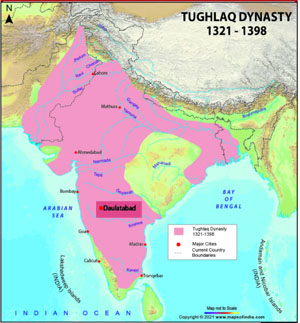
The second project of Sultan Muhammad, which was ruinous to the capital of the empire, and distressing to the chief men of the country, was that of making Deogir his capital, under the title of Daulatabad. This place held a central situation: Dehli, Gujarat, Lakhnauti, Sat-ganw, Sunar-gauw, Tilang, Ma'bar, Dhur-samundar, and Kampila were about equi-distant from thence, there being but a slight difference in the distances. Without any consultation, and without carefully looking into the advantages and disadvantages on every side, he brought ruin upon Dehli, that city which, for 170 or 180 years, had grown in prosperity, and rivaled Baghdad and Cairo. The city, with its sarais and its suburbs and villages, spread over four or five kos. All was destroyed. So complete was the ruin, that not a cat or a dog was left among the buildings of the city, in its palaces or in its suburbs. Troops of the natives, with their families and dependents, wives and children, men-servants and maid-servants, were forced to remove. The people, who for many years and for generations had been natives and inhabitants of the land, were broken-hearted. Many, from the toils of the long journey, perished on the road, and those who arrived at Deogir could not endure the pain of exile. In despondency they pined to death. All around Deogir, which is an infidel land, there sprung up graveyards of Musulmans. The Sultan was bounteous in his liberality and favours to the emigrants, both on their journey and on their arrival; but they were tender, and they could not endure the exile and suffering. They laid down their heads in that heathen land, and of all the multitudes of emigrants, few only survived to return to their home. Thus this city, the envy of the cities of the inhabited world, was reduced to ruin. The Sultan brought learned men and gentlemen, tradesmen and landholders, into the city (Dehli) from certain towns in his territory, and made them reside there. But this importation of strangers did not populate the city; many of them died there, and more returned to their native homes. These changes and alterations were the cause of great injury to the country.
The third project also did great harm to the country. It increased the daring and arrogance of the disaffected in Hindustan, and augmented the pride and prosperity of all the Hindus. This was the issue of copper money.1 [The printed text adds, "his interference with buying and selling," but this is not to be found in either of my MSS., and is certainly superfluous.] The Sultan, in his lofty ambition, had conceived it to be his work to subdue the whole habitable world and bring it under his rule. To accomplish this impossible design, an army of countless numbers was necessary, and this could not be obtained without plenty of money. The Sultan's bounty and munificence had caused a great deficiency in the treasury, so he introduced his copper money, and gave orders that it should be used in buying and selling, and should pass current, just as the gold and silver coins had passed. The promulgation of this edict turned the house of every Hindu into a mint, and the Hindus of the various provinces coined krors and lacs of copper coins. With these they paid their tribute, and with these they purchased horses, arms, and fine things of all kinds. The rais, the village headmen and landowners, grew rich and strong upon these copper coins, but the State was impoverished. No long time passed before distant countries would take the copper tanka only as copper. In those places where fear of the Sultan's edict prevailed, the gold tanka rose to be worth a hundred of (the copper) tankas. Every goldsmith struck copper coins in his workshop, and the treasury was filled with these copper coins. So low did they fall that they were not valued more than pebbles or potsherds. The old coin, from its great scarcity, rose four-fold and five-fold in value. When trade was interrupted on every side, and when the copper tankas had become more worthless than clods, and of no use, the Sultan repealed his edict, and in great wrath he proclaimed that whoever possessed copper coins should bring them to the treasury, and receive the old gold coins in exchange. Thousands of men from various quarters, who possessed thousands of these copper coins, and caring nothing for them, had flung them into corners along with their copper pots, now brought them to the treasury, and received in exchange gold tankas and silver tankas, shash-ganis and du-ganis, which they carried to their homes. So many of these copper tankas were brought to the treasury, that heaps of them rose up in Tughlikabad like mountains. Great sums went out of the treasury in exchange for the copper, and a great deficiency was caused. When the Sultan found that his project had failed, and that great loss had been entailed upon the treasury through his copper coins, he more than ever turned against his subjects.
The fourth project which diminished his treasury, and so brought distress upon the country, was his design of conquering Khurasan and 'Irak. In pursuance of this object, vast sums were lavished upon the officials and leading men of those countries. These great men came to him with insinuating proposals and deceitful representations, and as far as they knew how, or were able, they robbed the throne of its wealth. The coveted countries were not acquired, but those which he possessed were lost; and his treasure, which is the true source of political power, was expended.
The fifth project * * * was the rising of an immense army for the campaign against Khurasan. * * * In that year three hundred and seventy thousand horse were enrolled in the muster- master's office. For a whole year these were supported and paid; but as they were not employed in war and conquest and enabled to maintain themselves on plunder, when the next year came round, there was not sufficient in the treasury or in the feudal estates (ikta) to support them. The army broke up; each man took his own course and engaged in his own occupations. But lacs and krors had been expended by the treasury.
The sixth project, which inflicted a heavy loss upon the army, was the design which he formed of capturing the mountain of Kara-jal.1 [The printed text as "Farajal," and this is favoured to some extent by one MS., but the other is consistent in reading Kara-jal. See supra, Vol. I., p. 46, note 2.]
His conception was that, as he had undertaken the conquest of Khurasan, he would (first) bring under the dominion of Islam this mountain, which lies between the territories of Hind and those of China, so that the passage for horses and soldiers and the march of the army might be rendered easy. To effect this object a large force, under distinguished amirs and generals, was sent to the mountain of Kara-jal, with orders to subdue the whole mountain. In obedience to orders, it marched into the mountains and encamped in various places, but the Hindus closed the passes and cut off its retreat. The whole force was thus destroyed at one stroke, and out of all this chosen body of men only ten horsemen returned to Delhi to spread the news of its discomfiture. * * *
Revolts. —
* * The first revolt was that of Bahram Abiya at Multan. This broke out while the Sultan was at Deogir. As soon as he heard of it he hastened back to his capital, and collecting an army he marched against Multan. When the opposing forces met, Bahram Abiya was defeated. His head was cut off and was brought to the Sultan, and his army was cut to pieces and dispersed. * * * The Sultan returned victorious to Dehli, where he stayed for two years. He did not proceed to Deogir, whither the citizens and their families had removed. Whilst he remained at Dehli the nobles and soldiers continued with him, but their wives and children were at Deogir.
At this time the country of the Doab was brought to ruin by the heavy taxation and the numerous cesses. The Hindus burnt their corn stacks and turned their cattle out to roam at large. Under the orders of the Sultan, the collectors and magistrates laid waste the country, and they killed some landholders and village chiefs and blinded others. Such of these unhappy inhabitants as escaped formed themselves into bands and took refuge in the jungles. So the country was ruined. The Sultan then proceeded on a hunting excursion to Baran, where, under his directions, the whole of that country was plundered and laid waste, and the heads of the Hindus were brought in and hung upon the ramparts of the fort of Baran.
About this time the rebellion of Fakhra broke out in Bengal, after the death of Bahram Khan (Governor of Sunar-ganw). Fakhra and his Bengali forces killed Kadar Khan (Governor of Lakhnauti), and cut his wives and family and dependents to pieces. He then plundered the treasures of Lakhnauti, and secured possession of that place, and of Sat-ganw and Sunar- ganw. These places were thus lost to the imperial throne, and, falling into the hands of Fakhra and other rebels, were not recovered.
At the same period the Sultan led forth his army to ravage Hindustan. He laid the country waste from Kanauj to Dalamu, and every person that fell into his hands he slew. Many of the inhabitants fled and took refuge in the jungles, but the Sultan had the jungles surrounded, and every individual that was captured was killed.
While he was engaged in the neighbourhood of Kanauj a third revolt broke out. Saiyid Hasan, father of Ibrahim, the pursebearer, broke out into rebellion in Ma'bar, killed the nobles, and seized upon the government. The army sent from Dehli to recover Ma'bar, remained there. When the Sultan heard of the revolt he seized Ibrahim and all his relations. He then returned to Dehli for reinforcements, and started from thence to Deogir, in order to prepare for a campaign against Ma'bar. He had only marched three or four stages from Dehli when the price of grain rose, and famine began to be felt. Highway robberies also became frequent in the neighbourhood.
When the Sultan arrived at Deogir he made heavy demands upon the Musulman chiefs and collectors of the Mahratta country, and his oppressive exactions drove many persons to kill themselves. Heavy abwabs also were imposed on the country, and persons were specially appointed to levy them. After a short time he sent Ahmad Ayyaz (as lieutenant) to Dehli, and he marched to Tilang. When Ayyaz arrived in Dehli he found that a disturbance had broken out in Lahor, but he suppressed it. The Sultan arrived at Arangal, where cholera (waba) was prevalent. Several nobles and many other persons died of it. The Sultan also was attacked. He then appointed Malik Kabul, the naib-wazir, to be ruler over Tilang, and himself returned homewards with all speed. He was ill when he reached Deogir, and remained there some days under treatment. He there gave Shahab Sultani the title of Nusrat Khan, and made him governor of Bidar and the neighbourhood, with a fief of a lac of tankas. The Mahratta country was entrusted to Katlagh Khan, The Sultan, still ill, then set off for Dehli, and on his way he gave general permission for the return home of those people whom he had removed from Dehli to Deogir, Two or three caravans were formed which returned to Dehli, but those with whom the Mahratta country agreed remained at Deogir with their wives and children.
The Sultan proceeded to Dhar, and being still indisposed, he rested a few days, and then pursued his journey through Malwa. Famine prevailed there, the posts were all gone off the road, and distress and anarchy reigned in all the country and towns along the route. When the Sultan reached Dehli, not a thousandth part of the population remained. He found the country desolate, a deadly famine raging, and all cultivation abandoned. He employed himself some time in restoring cultivation and agriculture, but the rains fell short that year, and no success followed. At length no horses or cattle were left; grain rose to 16 or 17 jitals a sir, and the people starved. The Sultan advanced loans from the treasury to promote cultivation, but men had been brought to a state of helplessness and weakness. Want of rain prevented cultivation, and the people perished. The Sultan soon recovered his health at Dehli.
Whilst the Sultan was thus engaged in endeavouring to restore cultivation, the news was brought that Shahu Afghan had rebelled in Multan, and had killed Bihzad, the naib. Malik Nawa fled from Multan to Dehli. Shahu had collected a party of Afghans, and had taken possession of the city. The Sultan prepared his forces and marched towards Multan, but he had made only a few marches when Makhduma-i Jahan, his mother, died in Dehli. ** The Sultan was much grieved. ** He pursued his march, and when he was only a few marches from Multan, Shahu submitted, and sent to say that he repented of what he had done. He fled with his Afghans to Afghanistan, and the Sultan proceeded to Sannam.
From thence he went to Agroha, where he rested awhile, and afterwards to Dehli, where the famine was very severe, and man was devouring man. The Sultan strove to restore cultivation, and had wells dug, but the people could do nothing. No word issued from their mouths, and they continued inactive and negligent. This brought many of them to punishment.
The Sultan again marched to Sannam and Samana, to put down the rebels, who had formed mandals (strongholds?), withheld the tribute, created disturbances, and plundered on the roads. The Sultan destroyed their mandals, dispersed their followers, and carried their chiefs prisoners to Dehli. Many of them became Musulmans, and some of them were placed in the service of noblemen, and, with their wives and children, became residents of the city.1 [The work is not divided into chapters, or other divisions, systematically, in a way useful for reference, so the occasional headings have not been given in the translation. But the heading of the section in which this passage occurs is more explicit than the narrative; it says — "Campaign of Sultan Muhammad in Sannam, Samana, Kaithal and Kuhram, and devastation of those countries which had all become rebellious. Departure of the Sultan to the hills; subjugation of the ranas of the hills; the carrying away of the village chiefs and head men, Birahas, Mandahars, Jats, Bhats, and Manhis to Dehli. Their conversion to Islam, and their being placed in the charge of the nobles in the capital."] They were torn from their old lands, the troubles they had caused were stopped, and travellers could proceed without fear of robbery.
While this was going on a revolt broke out among the Hindus at Arangal. Kanya Naik had gathered strength in the country. Malik Makbul, the naib-wazir, fled to Dehli, and the Hindus took possession of Arangal, which was thus entirely lost. About the same time one of the relations of Kanya Naik, whom the Sultan had sent to Kambala,2 [Kampala is the name given in the print, but both MSS. read ''Kambala," making it identical with the place mentioned directly afterwards. I have not been able to discover the place. The author probably took the name to be identical with that of Kampila in the Doab.] apostatized from Islam and stirred up a revolt.
The land of Kambala also was thus lost, and fell into the hands of the Hindus. Deogir and Gujarat alone remained secure. Disaffection and disturbances arose on every side, and as they gathered strength the Sultan became more exasperated and more severe with his subjects. But his severities only increased the disgust and distress of the people. He stayed for some time in Dehli, making loans and encouraging cultivation; but the rain did not fall, and the raiyats did not apply themselves to work, so prices rose yet higher, and men and beasts died of starvation. *** Through the famine no business of the State could go on to the Sultan's satisfaction.
The Sultan perceived that there was no means of providing against the scarcity of grain and fodder in the capital, and no possibility of restoring cultivation without the fall of rain. He saw also that the inhabitants were daily becoming more wretched; so he allowed the people to pass the gates of the city and to remove with their families towards Hindustan, * * * so many proceeded thither. The Sultan also left the city, and, passing by Pattiali and Kampila,1 [Towns in Farrukhabad.] he halted a little beyond the town of Khor, on the banks of the Ganges, where he remained for a while with his army. The men built thatched huts, and took up their abode near the cultivated land. The place was called Sargdwari [Heaven's gate). Grain was brought thither from Karra and Oudh, and, compared with the price at Dehli, it was cheap. While the Sultan was staying at this place 'Ainu-l Mulk held the territory of Oudh and Zafarabad. His brothers had fought against and put down the rebels, thus securing these territories, * * and the Malik and his brothers sent to Sargdwari and to Dehli money, grain and goods, to the value of from seventy to eighty lacs of tankas. This greatly increased the Sultan's confidence in 'Ainu-l Mulk, and confirmed his opinion of his ability. The Sultan had just before been apprized that the officials of Katlagh Khan at Deogir had, by their rapacity, reduced the revenues; he therefore proposed to make 'Ainu-l Mulk governor of Deogir, and to send him there with his brothers and all their wives and families, and to recall Katlagh Khan with his adherents. When 'Ainu-l Mulk and his brothers heard of this design, they were filled with apprehension, and attributed it to the treachery of the Sultan. They had held their present territories for many years, and many nobles and officials of Dehli, through fear of the Sultan's severity, had left the city, alleging the dearness of grain as the reason, and had come to Oudh and Zafarabad, with their wives and families. Some of them became connected with the Malik and his brothers, and some of them received villages. * * The Sultan was repeatedly informed of this, and it made him very angry, but he kept this feeling to himself, until one day, while at Sarg-dwari, he sent a message to 'Ainu-l Mulk, ordering that all the people of note and ability, and all those who had fled from Dehli to escape punishment, should be arrested and sent bound to Dehli. *** This message, so characteristic of the Sultan's cruelty, enhanced the fears of the Malik and his brothers, and they felt assured that the Sultan's intention was to send them to Deogir and there perfidiously destroy them. They were filled with abhorrence, and began to organize a revolt.
About this time, during the Sultan's stay at Dehli and his temporary residence at Sarg-dwari, four revolts were quickly repressed. First. That of Nizam Ma-in at Karra. *** 'Ainu-l Mulk and his brothers marched against this rebel, and having put down the revolt and made him prisoner, they flayed him and sent his skin to Dehli. Second, That of Shahab Sultani, or Nusrat Khan, at Bidar. * * * In the course of three years he had misappropriated about a kror of tankas from the revenue. * * The news of the Sultan's vengeance reached him and he rebelled, but he was besieged in the fort of Bidar, *** which was captured, and he was sent prisoner to Dehli. Third, That of 'Alisha, nephew of Zafar Khan, which broke out a few months afterwards in the same district. *** He had been sent from Deogir to Kulbarga to collect the revenues, but finding the country without soldiers and without any great men, he and his brothers rebelled, treacherously killed Bhairan, chief of Kulbarga, and plundered his treasures. He then proceeded to Bidar and killed the naib, after which he held both Bidar and Kulbarga, and pushed his revolt. The Sultan sent Katlagh Khan against him *** from Deogir, and the rebel met him and was defeated. * * * He then fled to Bidar, where he was besieged and captured. He and his brothers were sent to the Sultan, *** who ordered them to Ghazni. They returned from thence, and the two brothers received punishment. Fourth. The revolt of 'Ainu-l Mulk and his brothers at Sarg-dwari. The Malik was an old courtier and associate of the Sultan, so he feared the weakness of his character and the ferocity of his temper. Considering himself on the verge of destruction, he, by permission of the Sultan, brought his brothers and the armies of Oudh and Zafarabad with him when he went to Sargdwari, and they remained a few kos distant. One night be suddenly left Sarg-dwari and joined them. His brothers then passed over the river with three or four hundred horse, and, proceeding towards Sarg-dwari, they seized the elephants and horses which were grazing there, and carried them off. A serious revolt thus arose at Sarg-dwari. The Sultan summoned forces from Samana, Amroha, Baran, and Kol, and a force came in from Ahmadabad. He remained a while at Sarg-dwari to arrange his forces, and then marched to Kanauj and encamped in its suburbs. 'Ainu-l Mulk and his brothers knew nothing of war and fighting, and had no courage and experience. They were opposed by Sultan Muhammad, *** who had been victorious in twenty battles with the Mughals. In their extreme ignorance and folly they crossed the Ganges below Bangarmu, *** and thinking that the Sultan's severity would cause many to desert him, they drew near to offer battle. *** In the rooming one division of the Sultan's forces charged and defeated them at the first attack. 'Ainu-l Mulk was taken prisoner, and the routed forces were pursued for twelve or thirteen kos with great loss. The Malik's two brothers, who were the commanders, were killed in the fight.
Many of the fugitives, in their panic, cast themselves into the river and were drowned. The pursuers obtained great booty. Those who escaped from the river fell into the hands of the Hindus in the Mawas and lost their horses and arms. The Sultan did not punish 'Ainu-l Mulk, for he thought that he was not wilfully rebellious, but had acted through mistake. *** After a while he sent for him, treated him kindly, gave him a robe, promoted him to high employment, and showed him great indulgence. His children and all his family were restored to him.
After the suppression of this revolt, the Sultan resolved on going to Hindustan, and proceeded to Bahraich, where he paid a visit, and devoutly made offerings to the shrine of the martyr Sipah-salar Mas'ud,1 [The tomb of Mas'ud had thus become a place of sanctity at this time. See Vol. II. App., pp. 513, 549.] one of the heroes of Sultan Mahmud Subuktigin. ***
Re: Tarikh-i Firoz Shahi, of Ziaud Din Barni
Posted: Sat Nov 06, 2021 5:39 am
by admin
Part 2 of 2
When the Sultan returned to Dehli, it occurred to his mind that no king or prince could exercise regal power without confirmation by the Khalifa of the race of 'Abbas, and that every king who had, or should hereafter reign, without such confirmation, had been or would be overpowered. The Sultan made diligent inquiries from many travellers about the Khalifas of the line of 'Abbas, and he learned that the representatives of the line of 'Abbas were the Khalifas of Egypt. So he and his ministers and advisers came to an understanding with the Khalifa that was in Egypt, and while the Sultan was at Sarg-dwari he sent despatches to Egypt about many things. When he returned to the city he stopped2 [Dar tawakkuf ddsht, probably meaning that he substituted the name of the Khalifa of Egypt for that of the Khalifa of Baghdad.] the prayers of the Sabbath and the 'I'ds. He had his own name and style removed from his coins, and that of the Khalifa substituted; and his flatteries of the Khalifa were so fulsome that they cannot be reduced to writing. In the year 744 H. (1343 A.D.) Haji Sa'id Sarsari came to Dehli, from Egypt, bringing to the Sultan honours and a robe from the Khalifa. The Sultan, with all his nobles and saiyids and * * *, went forth to meet the Haji with great ceremony, *** and he walked before him barefoot for the distance of some long bow-shots. * * * From that date permission was given, that out of respect the Khalifats name should be repeated in the prayers for Sabbaths and holydays, * * * and it was also ordered that in mentioning the names of the kings in the khutba, they should be declared to have reigned under the authority and confirmation of the 'Abbasi Khalifaa. The names of those kings who had not received such confirmation were to be removed from the khutba, and the kings were to be declared to be superseded (mutaghallab). *** The name of the Khalifa was ordered to be inscribed on lofty buildings, and no other name besides. * * * The Sultan directed that a letter acknowledging his subordination to the Khalifa should be sent by the hands of Haji Rajab Barka'i, * * * and after two years of correspondence the Haji returned from Egypt, bringing a diploma in the name of the Sultan, as deputy of the Khalifa.1 [In the translation of Firishta it is made to appear that it was the Khalifa of Arabia who was thus recognized: the text, however, says correctly that it was he of Egypt.] **
After the Sultan returned from Sarg-dwari, he remained for three or four years at Dehli, where he devoted himself to sundry matters which he considered to be for the good of the State. Firstly. He did his best for the promotion of agriculture, and for the encouragement of building. * * * The officers entrusted with the distribution of the loans from the public treasury took care of themselves, and appropriated the money to their own wants and necessities. Much of the pasture land being unfit for cultivation remained uncultivated, and the superintendents were in dread of punishment. In the course of two years about seventy lacs of tankas had been issued from the treasury to the superintendents of the cultivation of waste lands, and not one hundredth or a thousandth part of what was disbursed was reproduced in agriculture. If the Sultan had returned from his campaign against Thatta, not one of these superintendents and managers would have remained alive. Secondly. The Sultan supported and patronized the Mughals. Every year at the approach of winter, the amirs of tumans (of men) and of thousands etc., etc., received krors and lacs, and robes, and horses, and pearls. During the whole period of two or three years, the Sultan was intent upon patronizing and favouring the Mughals. Thirdly, *** He was diligently engaged in drawing out plans and schemes for increasing his revenue and army, and for promoting agriculture. Fourthly, He applied himself excessively to the business of punishment, and this was the cause of many of the acquired territories slipping from his grasp, and of troubles and disturbances in those which remained in his power. *** The more severe the punishments that were inflicted in the city, the more disgusted were the people in the neighbourhood, insurrections spread, and the loss and injury to the State increased. Every one that was punished spoke evil of him. *** Fifthly, The exertions which he made in the latter part of these years to promote the settlement and prosperity of Deogir and the country of the Mahrattas. The Sultan and the evil counsellors who found favour in his sight came to the conclusion that vast sums of the revenues of Deogir were lost through the peculations of Katlagh Khan's officials. *** He divided the Mahratta country into four provinces [shikk). *** The officers who were sent thither received orders to exterminate all those who had revolted or were inimical to the Sultan's rule. *** Towards the end of the year Katlagh Khan, with his family and suite, were recalled to Dehli, and 'Aziz Himar, a low fellow, depraved and foolish, was sent to Dhar, and made governor of all Malwa. The recall of Katlagh Khan quite disheartened the people of Deogir, and they saw themselves upon the very brink of ruin. They had enjoyed tranquility under the just and benevolent rule of that nobleman, and they had looked to him as their defence against the cruel punishments of the Sultan. The accounts which they heard of his severity had disgusted all the people of Deogir, both Hindus and Musulmans, and many of them broke out into rebellion. * * * Maulana Nizama-d din, a simple inexperienced man, and brother of Katlagh Khan, was sent from Bahruj (Broach) to succeed him. * * * The cash raised from the revenues under Katlagh Khan had been accumulated at Deogir, for it was not possible to convey it to Dehli in consequence of the badness of the roads, the distress in Malwa, and the disaffection of the village chiefs. Orders were therefore given to secure it in Dharagir, a strong fort. ***
The Sultan having thus appointed the base-born 'Aziz Himar to Dhar and Malwa, gave him several lacs of tankas on his departure, in order that he might proceed thither with befitting state and dignity. * * * He said to him, "Thou seest how that revolts and disturbances are breaking out on every side, and I am told that whoever creates a disturbance does so with the aid of the foreign amirs.1 [The printed text, the MSS., and the text of Firishta all agree in this word [x], in the plural [x]. It is the Mughal title for a centurion or commander of a hundred. Briggs converts it into "Amir Judeeda," and translates it "foreign chiefs." He is probably not far wrong in the popular meaning he has assigned to it, but he is not justified in his alteration of the original word.] *** Revolts are possible, because these amirs are ready to join any one for the sake of disturbance and plunder. If you find at Dhar any of these amirs, who are disaffected and ready to rebel, you must get rid of them in the best way you can." 'Aziz arrived at Dhar, and in all his native ignorance applied himself to business. The vile whoreson one day got together about eighty of the foreign amirs and chiefs of the soldiery, and, upbraiding them with having been the cause of every misfortune and disturbance, he had them all beheaded in front of the palace. * * * This slaughter of the foreign amirs of Dhar, on the mere ground of their being foreigners, caused those of Deogir, and Gujarat, and every other place to unite and to break out into insurrection. *** When the Sultan was informed of this punishment, he sent 'Aziz a robe of honour and a complimentary letter. ***
I, the author of this work, have been for seventeen years and three months at the court of Sultan Muhammad, and have received many favours and gifts from him, *** and I have often heard him speak with contempt of low-born, mean men. *** Now when I see him promoting and honouring low and unworthy persons, I am lost in amazement. ***
About the time when this horrid tragedy was perpetrated by 'Aziz Himar, the naib-wazir of Gujarat, Mukbil by name, having with him the treasure and horses which had been procured in Gujarat for the royal stables, was proceeding by way of Dihui and Baroda to the presence of the Sultan. When he came near Dihui and Baroda, the foreign amirs of those places, who, alarmed by the act of 'Aziz, had been impelled into rebellion, attacked Mukbil, and carried off all the horses and treasure. They also destroyed all the goods and stuffs which the merchants of Gujarat were carrying under his convoy. Mukbil returned to Nahrwala, and his party was dispersed. The amirs having acquired so many horses and so much property grew in power and importance. Stirring up the flames of insurrection, they gathered together a force and proceeded to Kanhayat (Cambay). The news of their revolt spread throughout Gujarat, and the whole country was falling into utter confusion. At the end of the month of Ramazan, 745 H. (Feb. 1345), the intelligence of this revolt and of the defeat and plunder of Mukbil was brought to the Sultan. It caused him much anxiety, and he determined to proceed to Gujarat in person to repress the revolt.
Katlagh Khan, who had been his preceptor, sent a communication to the Sultan by Zia Barni, the author of this history, saying, "What are these amirs of Dihui and Baroda, and in what position are they that the Sultan should proceed in person against them?" ** "If permission is granted I am willing to raise an array from the resources which I have received through the Sultan's bounty, and to march to Gujarat, to repress this revolt." * * * The author of this work delivered the letter, *** but it did not meet with the Sultan's approval, and he vouchsafed no answer. He gave orders, however, for pressing on the preparations for his campaign. Before the news of the revolt arrived, he had appointed Shaikh Ma'izza-d din, son of Shaikh 'Alau-d din Ajodhani, to be naib of Gujarat. He now ordered three lacs of tankas to be given to the Shaikh for enabling him to raise in two or three days a thousand horse to accompany the royal army. He appointed Firoz, afterwards Sultan, Malik Kabir, and Ahmad Ayyaz to be vicegerents in the capital during his absence. He commenced his march and proceeded to Sultanpur, about fifteen kos from Dehli, where he remained a short time. This was just at the end of Ramazan. Here a letter reached him from Dhar from 'Aziz Himar, stating that *** as he was nearer to the rebels, and was ready with the forces of Dhar, he had marched against them. The Sultan was not very pleased with this movement, and became very anxious, for 'Aziz knew nothing of warfare, and the Sultan feared that he might be cut up by the rebels. This letter was followed immediately by the news that 'Aziz had engaged the enemy, and, having lost his head during the battle, he had fallen from his horse, and being senseless and helpless he had been taken by the rebels and put to an ignominious death.
Insurrection followed upon insurrection. During the four or five days of Ramazan that the Sultan halted at Sultanpur, late one evening he sent for the author of this work, Zia Barni. When he arrived the Sultan said, "Thou seeest how many revolts spring up. I have no pleasure in them, although men will say that they have all been caused by my excessive severity. But I am not to be turned aside from punishment by observations and by revolts. You have read many histories; hast thou found that kings inflict punishments under certain circumstances?" I replied, "I have read in royal histories that a king cannot carry on his government without punishments, for if he were not an avenger God knows what evils would arise from the insurrections of the disaffected, and how many thousand crimes would be committed by his subjects. Jamshid was asked under what circumstances punishment is approved.1 ["Siydsat." Capital punishment is evidently meant, in a limited sense of the word.] He replied, 'under seven circumstances, and whatever goes beyond or in excess of these causes, produces disturbances, trouble, and insurrection, and inflicts injury on the country: 1. Apostasy from the true religion, and persistence therein; 2. Wilful murder; 3. Adultery of a married man with another's wife; 4. Conspiracy against the king; 5. Heading a revolt, or assisting rebels; 6. Joining the enemies or rivals of the king, conveying news to them, or aiding and abetting them in any way; 7. Disobedience, productive of injury to the State. But for no other disobedience, as detriment to the realm is an essential. The servants of God are disobedient to him when they are disobedient to the king, who is his vicegerent; and the State would go to ruin, if the king were to refrain from inflicting punishment in such cases of disobedience as are injurious to the realm.'" The Sultan then asked me if the Prophet had said anything about these seven offences in respect of their punishment by kings. I replied "that the Prophet had declared his opinion upon three offences out of these seven — viz., apostasy, murder of a Musulman, and adultery with a married woman. The punishment of the other four offences is a matter rather of policy and good government. Referring to the benefits derivable from the punishments prescribed by Jamshid, it has been remarked that kings appoint wazirs, advance them to high dignity, and place the management of their kingdoms in their hands in order that these wazirs may frame regulations and keep the country in such good order that the king may be saved from having to stain himself with the blood of any mortal."The Sultan replied, ''Those punishments which Jamshid prescribed were suited to the early ages of the world, but in these days many wicked and turbulent men are to be found. I visit them with chastisement upon the suspicion or presumption of their rebellious and treacherous designs, and I punish the most trifling act of contumacy with death. This I will do until I die, or until the people act honestly, and give up rebellion and contumacy. I have no such wazir as will make rules to obviate my shedding blood. I punish the people because they have all at once become my enemies and opponents. I have dispensed great wealth among them, but they have not become friendly and loyal. Their temper is well known to me, and I see that they are disaffected and inimical to me."
The Sultan marched from Sultanpur towards Gujarat, and when he arrived at Nahrwala he sent Shaikh Ma'izzu-d din, with some officials, into the city, whilst he, leaving it on the left, proceeded into the mountains of Abhu,1 [Mount Abu. Print [x]. MS. 1. caret; 2. [x]. Firishta, Aboogur.] to which Dihui and Baroda were near. The Sultan then sent an officer with a force against the rebels, and these being unable to cope with the royal army, were defeated. Many of their horsemen were killed, the rest were dispersed, and with their wives and children fled to Deogir. The Sultan then proceeded from the mountains of Abhu to Broach, from whence he sent Malik Makbul,'2 [He is called Kabul in page 243 and Mukbil in page 253.] naib-wazir-i mamalik, with some of the soldiers from Dehli, some of the foreign amirs of Broach, and the soldiers of Broach, in pursuit of the fugitives. Malik Makbul accordingly followed the fugitives as far as the Nerbudda, where he attacked and utterly routed them. Most of them were killed, and their wives, children, and goods fell into the hands of the victors. Some of the most noted of the rebels fled upon bare-backed horses to Man Deo, chief of the mountains of Salir and Malir. Man Deo made them prisoners, and plundered them of all the valuables they possessed. Their evil influence in Gujarat was thus put an end to. Malik Makbul remained for some days on the banks of the Nerbudda, and under royal commands he seized most of the foreign amirs of Broach who had been sent to him, and put them to death. Of those who escaped the sword, some fled to Deogir, others to the chiefs (mukaddims) of Gujarat.
The Sultan remained for some time at Broach, busily engaged in collecting the dues of Broach, Kanhayat (Cambay), and Gujarat, which were several years in arrear. He appointed sharp collectors, and rigorously exacted large sums. At this period his anger was still more inflamed against the people, and revenge filled his bosom. Those persons at Broach and Cambay, who had disputed with Malik Makbul, or had in any way encouraged insurrection, were seized and consigned to punishment. Many persons of all descriptions thus met their ends.
While the Sultan was at Broach he appointed Zin-banda and the middle son of Rukn Thanesari, two men who were leaders in iniquity and the most depraved men in the world, to inquire into the matters of the disaffected at Deogir. Pisar Thanesari, the vilest of men, went to Deogir; and Zin-banda, a wicked iniquitous character, who was called Majdu-l Mulk, was on the road thither. A murmuring arose among the Musulmans at Deogir that two vile odious men had been deputed to investigate the disaffection, and to bring its movers to destruction. One of them was before their eyes, and they heard that the other had arrived at Dhar. It so happened that just about the same time the Sultan sent two well-known noblemen to Deogir with an order to the brother of Katlagh Khan, directing him to send to Broach fifteen hundred horsemen from Deogir with the most noted of the "foreign amirs." They accordingly proceeded to Deogir, and presented the order to Nizamu-d din, brother of Katlagh Khan. In accordance therewith, he commissioned fifteen hundred horse, and despatched with them the chief foreign amirs under the conduct of the two nobles who had been sent for them. They marched toward Broach, but at the end of the first stage the foreign amirs, who were attended by their own horsemen, considered that they had been summoned to Broach in order to be executed, and if they proceeded thither not one would return. So they consulted together and broke out into open resistance, and the two nobles who had been sent for them were killed in that first march. They then turned back with loud clamour and entered the royal palace, where they seized Maulana Nizamu-d din, the governor, and put him in confinement. The officials, who had been sent by the Sultan to Deogir, were taken and beheaded. They cut Pisar Thanesari to pieces, and brought down the treasure from (the fort of) Dharagir. Then they made Makh Afghan, brother of Malik Yak Afghan, one of the foreign amirs, their leader, and placed him on the throne. The money and treasure were distributed among the soldiers. The Mahratta country was apportioned among these foreign amirs, and several disaffected persons joined the Afghans. The foreign amirs of Dihui and Baroda left Man Deo and proceeded to Deogir, where the revolt had increased and had become established. The people of the country joined them.
The Sultan, on hearing of this revolt, made ready a large force and arrived at Deogir, where the rebels and traitors confronted him. He attacked them and defeated them. Most of the horsemen were slain in the action. Makh Afghan, their commander, who had received a royal canopy, and had called himself Sultan, escaped, with his confederates and his wives and children, to the fort of Dharagir, and there took refuge. Hasan Kangu, and the rebels of Bidar, and the brethren of Makh Afghan, fled before the royal forces to their own countries. The inhabitants of Deogir, Hindus and Musulmans, traders and soldiers, were plundered. 'Imidu-l Mulk, Sar-tez i Sultani, with several other amirs, was sent by the Sultan to Kulbarga, with instructions to occupy that place and to secure the neighbouring country. He was also directed to hunt up the fugitives who had fled before the royal forces, and to put a stop to their machinations. The Sultan stayed for a while at Deogir, in the royal palace, and on New Year's Day all the Musulmans in the place went to wait upon him. ***
While the Sultan was engaged at Deogir in settling the affairs of that place and in providing for the settlement of the Mahratta country, and before he had finished the business of the amirs and the army, news arrived of the revolt, excited by the traitor Taghi, in Gujarat. This man was a cobbler, and had been a slave of the general, Malik Sultani. He had won over the foreign amirs of Gujarat, and had broken out into rebellion. Many of the mukaddims of Gujarat joined him. He marched to Nahrwala, killed Malik Muzaffar, the assistant of Shaikh Ma'izzu-d din (the governor), and made the latter and his officers prisoners. Taghi then proceeded, at the head of his rebels, to Cambay, and, after plundering that place, he proceeded with a body of Hindus and Musulmans to the fort of Broach. They attacked the fort, and every day had conflicts with the defenders. The Sultan, upon receiving intelligence of this rising, left the affairs of Deogir half settled, and placing certain officers in charge, departed with all speed towards Broach to meet the rebels. All the Musulmans of that place who had remained in Deogir, high and low, marched with the royal army to Broach. Grain was very dear, and the army suffered great privations. I, Zia Barni, the author of this history, just at this time joined the Sultan, after he had made one or two marches from Ghati-sakun towards Broach. I had been sent from the capital by the present Sultan (Firoz), Malik Kabir, and Ahmad Ayyaz, with letters of congratulation on the conquest of Deogir. The Sultan received me with great favour. One day, as I was riding in his suite, the Sultan conversed with me, and the conversation turned upon rebellion. He then said, "Thou seest what troubles these traitorous foreign amirs have excited on every side. When I collect my forces and put them down in one direction, they excite disturbances in some other quarter. If I had at the first given orders for the destruction of all the foreign amirs of Deogir, Gujarat, and Broach, I should not have been so troubled by them. This rebel, Taghi, is my slave; if I had executed him or had sent him as a memorial to the King of Eden, this revolt would never have broken out." I could not help feeling a desire to tell the Sultan that the troubles and revolts which were breaking out on every side, and this general disaffection, all arose from the excessive severity of his Majesty, and that if punishments were suspended for a while, a better feeling might spring up, and mistrust be removed from the hearts of the people. But I dreaded the temper of the king, and could not say what I desired, so I said to myself, What is the good of pointing out to the Sultan the causes of the troubles and disturbances in his country, for it will have no effect upon him?
The Sultan arrived at Broach, and encamped on the banks of the Nerbadda, which flows by the town. When the rebel Taghi was apprized of the approach of the Sultan, he abandoned the town, with a party of his adherents not numbering more than three hundred horse. The Sultan then placed Malik Yusuf Baghra in command of two thousand horse, and sent him with some other amirs to Cambay. In four or five days he drew near to that place and encountered Taghi, when he and several other amirs were slain, and the army being routed, fled to Broach. Instantly upon hearing this, the Sultan crossed the river, and remained two or three days in Broach. Although he made every exertion to get to Cambay, Taghi heard of his advance and fled from that place to Asawal.1 [Ahmadabad.] Thither the Sultan pursued him, but the rebel again fled and went to Nahrwala. Before the Sultan left Broach, Taghi had executed Shaikh Mu'izzu-d din and several other officials whom he had made prisoners. * * *
The Sultan arrived at Asawal and had to stay there about a month, on account of the ill-condition of his horses and the fall of rain. While the rains were still prevailing, news came from Nahrwala that Taghi had marched from thence with a party of horse towards Asawal and had arrived at the town of Karra. The Sultan marched from Asawal in the very height of the rains, and on the third or fourth day reached Karra. Next day he drew out his forces and attacked the rebel. Taghi, on seeing the approach of the royal force, plied his men with wine and made them drunk. The foreign horsemen (sawari sadi) then made an impetuous and reckless charge with their drawn swords on the royal forces, but they were encountered by the elephants and overthrown. They then ran among the trees, dispersed and fled towards Nahrwala. Several were made prisoners, and all the baggage fell into the hands of the victors. Four or five hundred men, combatants and non-combatants1 [As tar o khusk.] were taken with the baggage, and were all put to the sword. The Sultan then placed the son of Malik Yusuf Baghra at the head of a force, and sent him in pursuit of the fugitives, but night came on, so he and his troops halted to rest. Taghi, with his remaining horsemen, reached Nahrwala; there he collected all his family and dependents, and proceeded to Kant-barahi,2 [So the print. One MS. has "Katab and Barai," the other "Kanhan and Barahi."] where he stayed some days. From thence he wrote to the Rai of Karnal, imploring assistance in his flight, and proceeded to Karnal. Then he went to Thatta and Damrila, where he found refuge.
Two or three days after, the Sultan arrived at Nahrwala, and alighted at the garden of the reservoir of Sahsilang. There he applied himself to settling the affairs of Gujarat. The mukaddims, the ranas, and the mahants of Gujarat, came in and paid their homage, and received robes and rewards. In a short time the inhabitants who had been scattered abroad returned to their homes and were delivered from the ravages of the rebels. Several of Taghi's chief supporters left him and went to the Rana of Mandal and Teri,3 [So the print. One MS. says "Mandal Tabri," the other "Mandal Pari."] but that chief slew them and sent their heads to the Sultan. He also seized upon all their wives and children. For this service he received robes and rewards, and being so favoured he came to the Court.
While the Sultan was engaged in settling the affairs of the country, and was about to enter Nahrwala, news came from Deogir that Hasan Kangu and other rebels, who had fled before the royal army in the day of battle, had since attacked 'Imadu-l Mulk, and had slain him and scattered his army. Kiwamu-d din and other nobles left Deogir and went towards Dhar. Hasan Kangu then proceeded to Deogir and assumed royal dignity. Those rebels who had fled before the Sultan's army to the summit of Dharagir, now came down, and a revolution was effected in Deogir. When intelligence of this reached the Sultan's ears, he was very disheartened, for he saw very well that the people were alienated. No place remained secure, all order and regularity were lost, and the throne was tottering to its fall.
During the months of the Sultan's stay at Nahrwala no one was sent to execution (siyasat). He summoned Ahmad Ayyaz and other nobles, with an army, from the capital, with the intention of sending them to Deogir, and they, having made every preparation, came to the Sultan. But news now arrived that Hasan Kangu had drawn together a large force at Deogir. The Sultan therefore did not deem it advisable to send them there, and gave up the idea of attacking it. He determined that he would free Gujarat, take Karnal, and put down the traitor Taghi; after which he would march to Deogir, overthrow the rebels, and remove every cause of trouble and anxiety. In pursuance of this plan he first directed his attention to the taking of Karnal and the fort of Shankar.'1 [This is a personal name, see infra. The spelling is that of one of the MSS. The print has "Kanhgar" and "Khankar."] The mukaddims of Deogir, who had come from that place to wait upon the Sultan, now saw that the business of their country was postponed; so they went off by ones and twos, and, meeting at a rendezvous, they returned to Deogir.
The success of the rebels, and the loss of Deogir, greatly troubled the king. One day, while he was thus distressed, he sent for me, the author of this work, and, addressing me, said: "My kingdom is diseased, and no treatment cures it. The physician cures the headache, and fever follows; he strives to allay the fever, and something else2 ["Sadah" in the print and in one MS., "chize digar" in the other.] supervenes. So in my kingdom disorders have broken out; if I suppress them in one place they appear in another; if I allay them in one district another becomes disturbed. What have former kings said about these disorders?" I replied, "Histories record many remedies which kings have employed in these disorders. Some kings, when they have perceived that they do not retain the confidence of their people, and have become the objects of general dislike, have abdicated their thrones and have given over the government to the most worthy of their sons. Retiring into privacy, and occupying themselves in innocent pursuits, they have passed their time in the society of sympathizing friends, without troubling themselves about matters of government. Other kings, when they have found themselves the objects of general aversion, have taken to hunting, pleasure, and wine, leaving all the business of the State to their wazirs and officers, and throwing off all concern in them. If this course seems good1 [The text has a negative here, which seems to mar the sense.] to the people, and the king is not given to revenge, the disorders of the State may be cured. Of all political ills, the greatest and most dire is a general feeling of aversion and a want of confidence among all ranks of the people." The Sultan replied, "If I can settle the affairs of my kingdom according to my wish, I will consign my realm of Dehli to three persons, Firoz Shah, Malik Kabir, and Ahmad Ayyaz, and I will then proceed on the pilgrimage to the holy temple. At present I am angry with my subjects, and they are aggrieved with me. The people are acquainted with my feelings, and I am aware of their misery and wretchedness. No treatment that I employ is of any benefit. My remedy for rebels, insurgents, opponents, and disaffected people is the sword. I employ punishment and use the sword, so that a cure may be effected by suffering. The more the people resist, the more I inflict chastisement."
When the Sultan gave up Deogir and applied himself to the settlement of Gujarat, he passed three rainy seasons in that country. The first he passed at Mandal and Teri,2 ["Mandal ba Teri." "Mandal pari" in one MS.] devoting his time to the affairs of the country and the equipment of his army. The second he passed near the fort of Karnal. When the mukaddim of that place saw the numbers and strength of the royal army, he resolved to make Taghi prisoner and deliver him up; but the rebel got notice of his intention, and fled to Thatta, where he found refuge with the Jam. After the rains were over, the Sultan took Karnal, and brought all the coast into subjection. The ranas and mukaddims came in and made submission, whereupon they received robes and rewards. A commissioner was sent to take charge of Karnal. Khankar and the Rana of Karnal, being taken prisoners, were brought to the court, and all that country was completely subdued. The third rainy season the Sultan passed at Kondal. This is a place in the direction of Thatta, Sumargan,1 [Var: "Siyumgan" and "Siyumragan."] and Damrila. At Kondal the Sultan fell sick with fever, which obliged him to remain there for some time. Before the Sultan went to Kondal he received from Dehli the intelligence of the death of Malik Kabir, which deeply grieved him. Thereupon he sent Ahmad Ayyaz and Malik Makbul from the army to take charge of the affairs of the capital. He summoned Khudawand-zada,2 [See page 276 infra.] Makhdum-zada, and many elders, learned men and others, with their wives and families, to Kondal. Every one that was summoned hastened with horse and foot to join the Sultan at Kondal, so that a large force was gathered there and was formed into an army. Boats were brought from Deobalpur, Multan, Uch, and Siwistan to the river. The Sultan recovered from his disorder, and marched with his army to the Indus. He crossed that river in ease and safety with his army and elephants. He was there joined by Altun Bahadur, with four or five thousand Mughal horse, sent by the Amir of Farghan. The Sultan showed great attention to this leader and his followers, and bestowed many gifts upon them. He then advanced along the banks of the Indus towards Thatta, with an army as numerous as a swarm of ants or locusts, with the intention of humbling the Sumras and the rebel Taghi, whom they had sheltered.
As he was thus marching with his countless army, and was thirty kos from Thatta, the ''ashura or fast of the 10th of Muharram happened. He kept the fast, and when it was over he ate some fish. The fish did not agree with him, his illness returned and fever increased. He was placed in a boat and continued his journey on the second and third days, until he came to within fourteen kos of Thatta. He then rested, and his army was fully prepared, only awaiting the royal command to take Thatta, and to crush the Sumras of Thatta and the rebel Taghi in a single day, and to utterly annihilate them. But fate ruled it otherwise. During the last two or three days that he was encamped near Thatta, the Sultan's malady had grown worse, and his army was in great trouble, for they were a thousand kos distant from Dehli and their wives and children, they were near the enemy and in a wilderness and desert, so they were sorely distressed, and looking upon the Sultan's expected death as preliminary to their own, they quite despaired of returning home. On the 21st Muharram, 752 H. (1350 A.D.), Sultan Muhammad bin Tughlik departed this life on the banks of the Indus, at fourteen kos from Thatta. ***
Re: Tarikh-i Firoz Shahi, of Ziaud Din Barni
Posted: Sat Nov 06, 2021 5:44 am
by admin
Sultan Firoz Shah
I, the author of this Tarikh-i Firoz Shahi, have written all that I have witnessed during six years of the personal character of the reigning sovereign, and of the events which have occurred during that time. I have included these in eleven chapters, and if I live some years longer I intend to write ninety more chapters, so that the complete history of the reign may consist of one hundred and one chapters (mukaddamas). * * *
Chapter 1. Account of the Accession of Firoz Shah.
Chapter 2. March of the Sultan from Siwistan to Dehli.
Chapter 3. Eulogy of the personal character of the Sultan.
Chapter 4. His bounty in the grant of pensions and in'ams.
Chapter 5. His buildings.
Chapter 6. Formation of Canals.
Chapter 7. Rules of Government.
Chapter 8. Conquest of Lakhnauti.
Chapter 9. Arrival of letters and robes from the Khalifa.
Chapter 10. Hunting matters.
Chapter 11. Defeat of the attacks of the Mughals.
1. — Accession of Firoz Shah.
* * * On the third day after the death of Mahammad Tughlik, the army marched from (its position) fourteen kos from Thatta towards Siwistan, on its return homewards. Every division of the army marched without leader, rule, or route, in the greatest disorder. No one heeded or listened to what any one said, but continued the march like careless caravans. So when they had proceeded a kos or two, the Mughals, eager for booty, assailed them in front, and the rebels of Thatta attacked them in the rear. Cries of dismay arose upon every side. The Mughals fell to plundering, and carried off women, maids, horses, camels, troopers, baggage, and whatever else had been sent on in advance. They had very nearly captured the royal harem and the treasure with the camels which carried it. The villagers (who had been pressed into the service) of the army, and expected the attack, took to flight. They pillaged various lots of baggage on the right and left of the army, and then joined the rebels of Thatta in attacking the baggage train. The people of the army, horse and foot, women and men, stood their ground; for when they marched, if any advanced in front, they were assailed by the Mughals; if they lagged behind, they were plundered by the rebels of Thatta. Those who resisted and put their trust in God reached the next stage, but those who had gone forward with the women, maids, and baggage, were cut to pieces. The army continued its march along the river without any order or regularity, and every man was in despair for his life and goods, his wife and children. Anxiety and distress would allow no one to sleep that night, and, in their dismay, men remained with their eyes fixed upon heaven. On the second day, by stratagem and foresight, they reached their halting ground, assailed, as on the first day, by the Mughals in front and the men of Thatta in the rear. They rested on the banks of the river in the greatest possible distress, and in fear for their lives and goods. The women and children had perished. Makhdum Zada 'Abbasi, the Shaikhu-s Shaiyukh of Egypt, Shaikh Nasiru-d din Mahmud Oudhi, and the chief men, assembled and went to Firoz Shah, and with one voice said, "Thou art the heir apparent and legatee of the late Sultan; he had no son, and thou art his brother's son; there is no one in the city or in the army enjoying the confidence of the people, or possessing the ability to reign. For God's sake save these wretched people, ascend the throne, and deliver us and many thousand other miserable men. Redeem the women and children of the soldiers from the hands of the Mughals, and purchase the prayers of two lacs of people." Firoz Shah made objections, which the leaders would not listen to. All ranks, young and old, Musulmans and Hindus, horse and foot, women and children, assembled, and with one acclaim declared that Firoz Shah alone was worthy of the crown. "If he does not assume it to-day and let the Mughals hear of his doing so, not one of us will escape from the hands of the Mughals and the Thatta men." So on the 24th Muharram, 752 H. (1351 A.D.), the Sultan ascended the throne.
On the day of his accession the Sultan got some horse in order and sent them out to protect the army, for whenever the Mughal horse came down they killed and wounded many, and carried off prisoners. On the same day he named some amirs to guard the rear of the army, and these attacked the men of Thatta when they fell upon the baggage. Several of the assailants were put to the sword, and they, terrified with this lesson, gave up the pursuit and returned home. On the third day he ordered certain amirs to attack the Mughals, and they accordingly made several of the Mughal commanders of thousands and of hundreds prisoners, and brought them before the Sultan. The Mughals from that very day ceased their annoyance; they moved thirty or forty kos away, and then departed for their own country.
II. — Stoppage of the evils inflicted by the Mughals of Changiz Khan.
All men of intelligence in Hind and Sind have seen and remarked he stop which has been put to the inroads of the Mughals of Changiz Khan in this auspicious reign. They have not been able to attack and ravage the frontier territories, nor have they been permitted to come in with professions of friendship and employ their arts to carry off the wealth of the country. They had the presumption to make two attacks. Once they crossed the Sodra and came into the neighbouring country. There they were met by the forces of Islam and were defeated. Many were killed and many were taken prisoners. These latter were placed upon camels, and were paraded in derision 'round Dehli, with wooden collars on their necks. Those who escaped from the battle fled in the greatest precipitation and confusion, and many were drowned in the passage of the Sodra. On the other occasion they made a rapid dash into Gujarat. Some perished from thirst, some died by the hands of the soldiers, and some fell in a night attack which the natives of the country made upon them. Not one-tenth of these accursed followers of Changiz Khan reached their own country.