Re: FREDA BEDI CONT'D (#4)
Posted: Wed Jun 19, 2024 7:31 am
Part 1 of 3
On the edge of empire: form and substance in the Satavahana dynasty
by Carla M. Sinopoli
from "Empires: Perspectives from Archaeology and History, edited by Susan E. Alcock, Terence N. D'Altroy, Kathleen D. Morrison, Carla M. Sinopoli
© Cambridge University Press 2001
NOTICE: THIS WORK MAY BE PROTECTED BY COPYRIGHT
INTRODUCTION
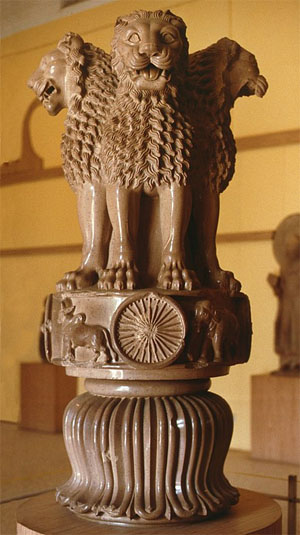
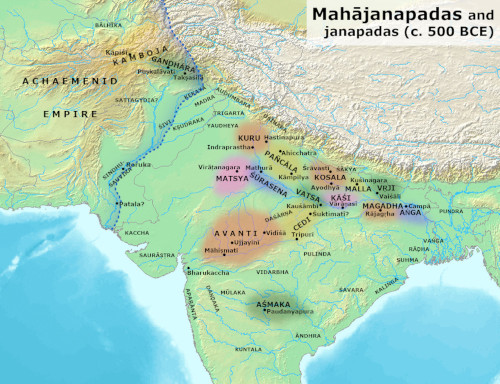
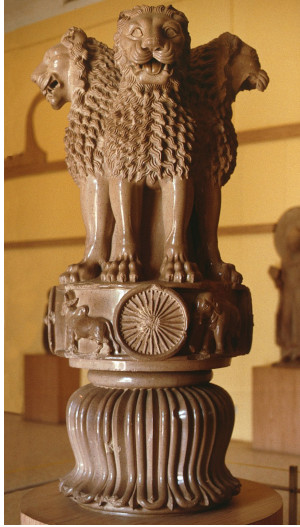
Historical understandings of the structure and history of the Mauryan empire of northern India (c. 321-180 BCE) weigh heavily on contemporary constructions of the Indian nation. Portrayed as the first precolonial exemplar of a unified subcontintental polity, a Mauryan sculpted column is the emblem of modern India, printed on its currency to display essential continuities (or aspirations) between past and present (e.g., Sen 1997: 36). While many questions remain concerning the nature, extent, and impact of the Mauryan polity, here I consider its legacy in a more proximate context -- the Satavahana dynasty of the Deccan of central and southern India (c. first century BCE to second century CE). As with the Mauryas (albeit with considerably more debate), scholars have viewed the Satavahanas as rulers of a geographically extensive and politically centralized imperial polity (e.g., Mirashi 1981: 1; Margabandhu 1985; Shastri 1991: 45), heirs to the political and economic frameworks developed by their Mauryan predecessors. Yet in both cases, historical and material evidence for these polities is limited, suggesting that these empires were both less pervasive and more ephemeral than the claims made about them by both their rulers and the historians and archaeologists who have studied them.
In this chapter, I consider that evidence and examine the complex relations between political forms and ideological claims during the South Asian Early Historic period (c. 300 BCE-400 CE). I begin with a brief introduction to the Mauryan empire considering both archaeological and textual evidence for imperial organization and extent and the place of the Mauryas in South Asian historiography. I then turn to the Satavahana successors of the Mauryas and consider Satavahana imperial structure, origins, and royal ideology. In particular, I situate the Satavahanas in their broader pan-regional historical and ideological processes and cultural frameworks, including the development and spread of ideological systems, economic networks, and categories of material culture whose distribution extended well beyond the range of individual polities and regions. I will argue that, to a considerable extent, Satavahana success derived from their ability to lay claim to some of these broader developments through a combination of ideological practices, disposition of economic resources, and short-lived military successes.
THE MAURYAN EMPIRE
In the late fourth century BCE Candragupta Maurya, king of the Ganges Basin state of Magadha, founded South Asia's first empire.
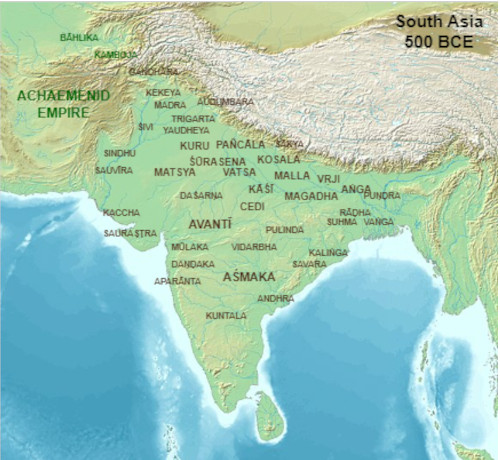
Rulers of one of more than a dozen contemporary city-states, the Mauryan kings of Magadha combined military conquest with agricultural intensification and control of long-distance riverine trade routes to forge a polity that ruled the entire Indo-Gangetic Plain and areas beyond (Thapar 1997). Their empire was relatively short-lived, dating from c. 322 to 187 BCE, and reached its maximal extent under its most renowned ruler, the king Asoka (c. 273-232 BCE). Territories were rapidly lost under Asoka's successors and within thirty-five years of Asoka's death the empire had disappeared. The main focus of this chapter, the Satavahana empire, was one of a series of states and empires that came to the fore in South Asia following the Mauryan collapse. Indeed, Thapar (1997: 320) has suggested that the emergence of states and empires "in Orissa, Andhra and the western Deccan [was] ... virtually impelled by the break-up of the Mauryan state."
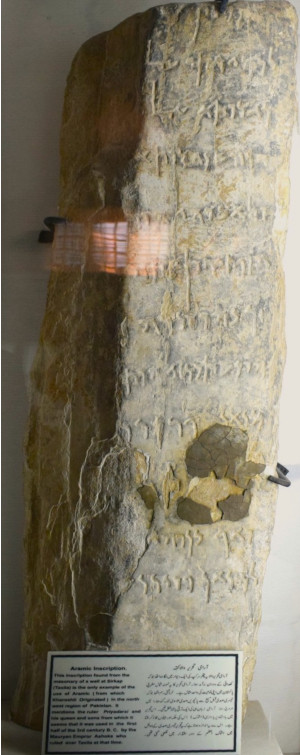
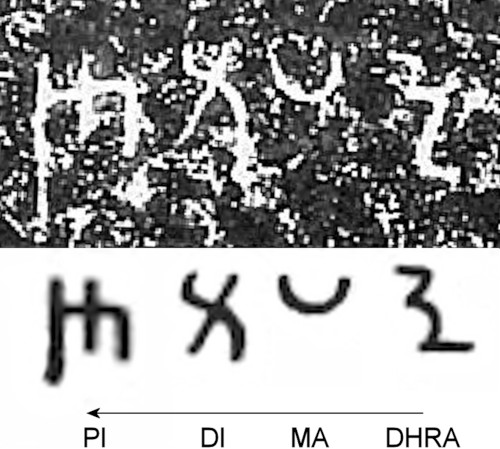
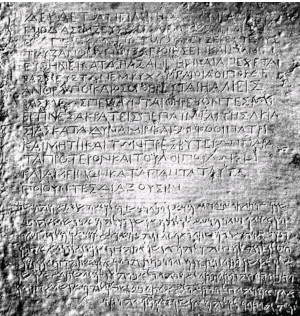
Scholars know of the Mauryans through the lithic inscriptions of Asoka, in Prakrit (Brahmi script), Aramaic, and Greek. These would presumably have been the primary spoken languages in the regions where the inscriptions were located. Prakrit, an Indo-European language, is believed to have been preferred over the more scholarly Sanskrit because it was "the language spoken by the people at large, and not ... the language of culture" (Thapar 1997: 7). Literacy was no doubt quite restricted during the Early Historic period, and it is likely that the texts inscribed on stone (and probably also on non-durable materials) were intended to be read aloud to a non-literate public. Asokan inscriptions are among the earliest securely dated written sources in South Asia (the much earlier Indus Valley script of the third millennium BCE remains undecoded).
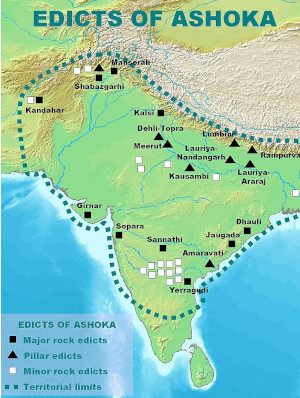
The inscriptions, made over some twenty years (from Asoka's eighth through twenty-seventh regnal years), span the period of Asoka's conversion to Buddhism in c. 260 BCE. As recorded in the thirteenth major rock edict (Thapar 1997: 255-6), his conversion was a consequence of the great remorse Asoka experienced for the massacres that followed upon the Mauryan conquest of the Kalinga state of eastern India. 1 ["A hundred and fifty thousand people were deported, a hundred thousand were killed and many times that number perished. Afterwards, now that Kalinga was annexed, the Beloved of the Gods very earnestly practiced Dhamma, desired Dhamma, and taught Dhamma. On conquering Kalinga, the Beloved of the Gods felt remorse, for, when an independent country is conquered the slaughter, death, and deportation of the people is extremely grievous to me Beloved of the Gods, and weighs heavily on his mind ... " (13th Major rock edict, Thapar 1997: 255).] Referred to as the major and minor rock edicts and pillar edicts, Asokan inscriptions were engraved on stone columns in urban centers in the Ganges basin (Fig. 6.1) and on rock outcrops across the broad territories over which Asoka claimed sovereignty. They thus had a material dimension visible even to non-readers that may have made them important symbols of political authority. Asokan inscriptions were typically located in or near settlements or along trade routes (though not always in highly visible locales).
Some three dozen unique Asokan texts have been identified at approximately fifty sites (Fig. 6.2; Allchin 1995: 199). In many contexts, texts co-occur; for example, most or all of the fourteen rock edicts are found together in several locales (Chaudhary 1983: 44-5).2 [As a result, it is difficult to estimate precisely how many inscriptions there are, since different scholars have recorded and counted inscriptions in quite different ways.] As a key source of primary data, Asokan inscriptions have come to play a tremendously important role in interpretations of the Mauryan polity. Although considerable caution needs to be exercised in reading these propagandistic texts, they do provide a great deal of important information. They seem to result from a conscious imperial policy to communicate information and instructions about Asoka's religious values and right behavior (dhamma) as well as his understandings of South Asia's political structure (including mention of border states, administrative offices, and revenue collection, among other things). They are thus by and large prescriptive texts, written in a paternalistic voice to instruct imperial subjects on behavior and values.
On the edge of empire: form and substance in the Satavahana dynasty
by Carla M. Sinopoli
from "Empires: Perspectives from Archaeology and History, edited by Susan E. Alcock, Terence N. D'Altroy, Kathleen D. Morrison, Carla M. Sinopoli
© Cambridge University Press 2001
NOTICE: THIS WORK MAY BE PROTECTED BY COPYRIGHT
YOU ARE REQUIRED TO READ THE COPYRIGHT NOTICE AT THIS LINK BEFORE YOU READ THE FOLLOWING WORK, THAT IS AVAILABLE SOLELY FOR PRIVATE STUDY, SCHOLARSHIP OR RESEARCH PURSUANT TO 17 U.S.C. SECTION 107 AND 108. IN THE EVENT THAT THE LIBRARY DETERMINES THAT UNLAWFUL COPYING OF THIS WORK HAS OCCURRED, THE LIBRARY HAS THE RIGHT TO BLOCK THE I.P. ADDRESS AT WHICH THE UNLAWFUL COPYING APPEARED TO HAVE OCCURRED. THANK YOU FOR RESPECTING THE RIGHTS OF COPYRIGHT OWNERS.
INTRODUCTION
Historical understandings of the structure and history of the Mauryan empire of northern India (c. 321-180 BCE) weigh heavily on contemporary constructions of the Indian nation. Portrayed as the first precolonial exemplar of a unified subcontintental polity, a Mauryan sculpted column is the emblem of modern India, printed on its currency to display essential continuities (or aspirations) between past and present (e.g., Sen 1997: 36). While many questions remain concerning the nature, extent, and impact of the Mauryan polity, here I consider its legacy in a more proximate context -- the Satavahana dynasty of the Deccan of central and southern India (c. first century BCE to second century CE). As with the Mauryas (albeit with considerably more debate), scholars have viewed the Satavahanas as rulers of a geographically extensive and politically centralized imperial polity (e.g., Mirashi 1981: 1; Margabandhu 1985; Shastri 1991: 45), heirs to the political and economic frameworks developed by their Mauryan predecessors. Yet in both cases, historical and material evidence for these polities is limited, suggesting that these empires were both less pervasive and more ephemeral than the claims made about them by both their rulers and the historians and archaeologists who have studied them.
In this chapter, I consider that evidence and examine the complex relations between political forms and ideological claims during the South Asian Early Historic period (c. 300 BCE-400 CE). I begin with a brief introduction to the Mauryan empire considering both archaeological and textual evidence for imperial organization and extent and the place of the Mauryas in South Asian historiography. I then turn to the Satavahana successors of the Mauryas and consider Satavahana imperial structure, origins, and royal ideology. In particular, I situate the Satavahanas in their broader pan-regional historical and ideological processes and cultural frameworks, including the development and spread of ideological systems, economic networks, and categories of material culture whose distribution extended well beyond the range of individual polities and regions. I will argue that, to a considerable extent, Satavahana success derived from their ability to lay claim to some of these broader developments through a combination of ideological practices, disposition of economic resources, and short-lived military successes.
THE MAURYAN EMPIRE
Thus speaks the Beloved of the Gods, the king Piyadassi: When I had been consecrated twelve years I commanded as follows: Everywhere in my empire, the yuktas [subordinate officers] with the rajuka [rural administrators] and the pradisekas [heads of the district] shall go on tour every five years, in order to instruct people in the Dhamma as well as for other purposes. It is good to be obedient to one's mother and father, friends and relatives, to be generous to brahmans and sramanas [Buddhist or Jain monks], it is good not to kill living beings, it is good not only to spend little but to own the minimum of property. The council will instruct the officials to record the above, making it both manifest to the public and explaining why,
-- (Third major rock edict of Asoka; Thapar 1997: 251)
[I would like at this point to pay belated acknowledgement to my respected friend and colleague, Karl Khandalawala, which whom I have sometimes expressed differences of interpretation, in this case in opposing his view (which on hindsight appears to be entirely correct) that the Sarnath pillar reveals the influences of foreign (Achaemenid) influence. I hope this eminent art historian will now accept my personal apology and withdrawal. On this particular issue I am ready to admit that he was right, though I reserve my differences on other issues involving Asokan pillars. A further issue reflecting his correctness is embodied in the self-styled title Asoka used as the opening words of many of his inscriptions (Devanampiya Piyadassi), often translated as 'Beloved of the Gods." A century ago, this term was rightly recognised by the brilliant French Indologist Emile Senart, as borrowed from earlier Achaemenid inscriptions in Persia, yet since then ignored by all authorities writing on Asoka in English.]
-- -- The True Chronology of Aśokan Pillars, by John Irwin
In the late fourth century BCE Candragupta Maurya, king of the Ganges Basin state of Magadha, founded South Asia's first empire.
Chandragupta's life and accomplishments are described in ancient … Hindu, Buddhist and Jain texts, though they significantly vary in detail… His main biographical sources in chronological order are:
• Hindu texts such as the Puranas and Arthashastra; later composed Hindu sources include legends in Vishakhadatta's Mudrarakshasa, Somadeva's Kathasaritsagara and Kshemendra's Brihatkathamanjari.
• Buddhist sources are those dated in 4th-century or after, including the Sri Lankan Pali texts Dipavamsa (Rajavamsa section), Mahavamsa, Mahavamsa tika and Mahabodhivamsa.
• 7th to 10th century Jain inscriptions at Shravanabelgola; these are disputed by scholars as well as the Svetambara Jain tradition. The second Digambara text interpreted to be mentioning the Maurya emperor is dated to about the 10th-century such as in the Brhatkathakosa of Harisena (Jain monk), while the complete Jain legend about Chandragupta is found in the 12th-century Parisishtaparvan by Hemachandra…. The Greek and Roman texts do not mention Chandragupta directly… Hindu sources are inconsistent...
The Buddhist texts such as Mahavamsa [were] ... written about seven centuries after his dynasty ended.... The 12th-century Digambara text Parishishtaparvan by Hemachandra is the main and earliest Jain source of the complete legend of Chandragupta. It was written nearly 1,400 years after Chandragupta's death....
None of the ancient texts mention when Chandragupta was born….
The texts do not include the start or end year of Chandragupta's reign...
The early life of Chandragupta Maurya is unclear and varies by source...
Historically reliable details of Chandragupta's campaign into Pataliputra are unavailable and legends written centuries later are inconsistent...
The king's epithets mentioned in the Sanskrit play Mudrarakshasa include "Chanda-siri" (Chandra-shri), "Piadamsana" (Priya-darshana), and Vrishala. Piadamsana is similar to Piyadasi, an epithet of his grandson Ashoka…
There are no records of Chandragupta's military conquests and the reach of his empire. It is based on inferences from … the religious Indian texts written centuries after his death….
The circumstances and year of Chandragupta's death are unclear and disputed...
-- Chandragupta Maurya, by Wikipedia
Rulers of one of more than a dozen contemporary city-states, the Mauryan kings of Magadha combined military conquest with agricultural intensification and control of long-distance riverine trade routes to forge a polity that ruled the entire Indo-Gangetic Plain and areas beyond (Thapar 1997). Their empire was relatively short-lived, dating from c. 322 to 187 BCE, and reached its maximal extent under its most renowned ruler, the king Asoka (c. 273-232 BCE). Territories were rapidly lost under Asoka's successors and within thirty-five years of Asoka's death the empire had disappeared. The main focus of this chapter, the Satavahana empire, was one of a series of states and empires that came to the fore in South Asia following the Mauryan collapse. Indeed, Thapar (1997: 320) has suggested that the emergence of states and empires "in Orissa, Andhra and the western Deccan [was] ... virtually impelled by the break-up of the Mauryan state."
Scholars know of the Mauryans through the lithic inscriptions of Asoka, in Prakrit (Brahmi script), Aramaic, and Greek. These would presumably have been the primary spoken languages in the regions where the inscriptions were located. Prakrit, an Indo-European language, is believed to have been preferred over the more scholarly Sanskrit because it was "the language spoken by the people at large, and not ... the language of culture" (Thapar 1997: 7). Literacy was no doubt quite restricted during the Early Historic period, and it is likely that the texts inscribed on stone (and probably also on non-durable materials) were intended to be read aloud to a non-literate public. Asokan inscriptions are among the earliest securely dated written sources in South Asia (the much earlier Indus Valley script of the third millennium BCE remains undecoded).
Beyond the Edicts of Ashoka, biographical information about him relies on legends written centuries later, such as the 2nd-century CE Ashokavadana ("Narrative of Ashoka", a part of the Divyavadana), and in the Sri Lankan text Mahavamsa ("Great Chronicle")…. Information about Ashoka comes from his own inscriptions; other inscriptions that mention him or are possibly from his reign; and ancient literature, especially Buddhist texts. These sources often contradict each other…
Ashoka's own inscriptions ... provide little information regarding ... the Maurya state and society....
Much of the information about Ashoka comes from Buddhist legends, which present him as a great, ideal king. These legends appear in texts that are not contemporary to Ashoka, and were composed by Buddhist authors, who used various stories to illustrate the impact of their faith on Ashoka...
Ashoka's name appears in the lists of Mauryan kings in the various Puranas, but these texts do not provide further details about him…
For some scholars such as Christopher I. Beckwith, Ashoka, whose name only appears in the Minor Rock Edicts, should be differentiated from the ruler Piyadasi, or Devanampiya Piyadasi (i.e. "Beloved of the Gods Piyadasi", "Beloved of the Gods" being a fairly widespread title for "King"), who is named as the author of the Major Pillar Edicts and the Major Rock Edicts. This inscriptional evidence may suggest that these were two different rulers...
Ashoka's own inscriptions do not describe his early life, and much of the information on this topic comes from apocryphal legends written hundreds of years after him.… these legends include obviously fictitious details such as narratives of Ashoka's past lives…
The exact date of Ashoka's birth is not certain, as the extant contemporary Indian texts did not record such details….
According to the Sri Lankan texts Mahavamsa and the Dipavamsa, Ashoka ascended the throne 218 years after the death of Gautama Buddha, and ruled for 37 years. The date of the Buddha's death is itself a matter of debate, and the North Indian tradition states that Ashoka ruled a hundred years after the Buddha's death, which has led to further debates about the date….
The 5th century Chinese traveller Faxian states that Ashoka personally visited the underworld to study the methods of torture there, and then invented his own methods.…
Such descriptions of Ashoka as an evil person before his conversion to Buddhism appear to be a fabrication of the Buddhist authors, who attempted to present the change that Buddhism brought to him as a miracle. In an attempt to dramatise this change, such legends exaggerate Ashoka's past wickedness and his piousness after the conversion….
According to Ashoka's Major Rock Edict 13, he conquered Kalinga 8 years after his ascension to the throne. The edict states that during his conquest of Kalinga, 100,000 men and animals were killed in action; many times that number "perished"; and 150,000 men and animals were carried away from Kalinga as captives. Ashoka states that the repentance of these sufferings caused him to devote himself to the practice and propagation of dharma. He proclaims that he now considered the slaughter, death and deportation caused during the conquest of a country painful and deplorable; and that he considered the suffering caused to the religious people and householders even more deplorable.
This edict has been found inscribed at several places, including Erragudi, Girnar, Kalsi, Maneshra, Shahbazgarhi and Kandahar. However, [it] is omitted in Ashoka's inscriptions found in the Kalinga region, where the Rock Edicts 13 and 14 have been replaced by two separate edicts that make no mention of Ashoka's remorse...
Taranatha claims that Ashoka conquered the entire Jambudvipa...
The A-yu-wang-chuan states that a 7-year-old Buddhist converted Ashoka. Another story claims that the young boy ate 500 Brahmanas who were harassing Ashoka for being interested in Buddhism; these Brahmanas later miraculously turned into Buddhist bhikkus at the Kukkutarama monastery, where Ashoka paid a visit….
The Ashokavadana states that Ashoka collected seven out of the eight relics of Gautama Buddha, and had their portions kept in 84,000 boxes made of gold, silver, cat's eye, and crystal. He ordered the construction of 84,000 stupas throughout the earth, in towns that had a population of 100,000 or more. He told Elder Yashas, a monk at the Kukkutarama monastery, that he wanted these stupas to be completed on the same day. Yashas stated that he would signal the completion time by eclipsing the sun with his hand. When he did so, the 84,000 stupas were completed at once....
The number 84,000 is an obvious exaggeration, and it appears that in the later period, the construction of almost every old stupa was attributed to Ashoka….
The Sri Lankan tradition presents a greater role for Ashoka in the Buddhist community. In this tradition, Ashoka starts feeding monks on a large scale. His lavish patronage to the state patronage leads to many fake monks joining the sangha. The true Buddhist monks refuse to co-operate with these fake monks, and therefore, no uposatha ceremony is held for seven years. The king attempts to eradicate the fake monks, but during this attempt, an over-zealous minister ends up killing some real monks. The king then invites the elder monk Moggaliputta-Tissa, to help him expel non-Buddhists from the monastery founded by him at Pataliputra. 60,000 monks (bhikkhus) convicted of being heretical are de-frocked in the ensuing process. The uposatha ceremony is then held, and Tissa subsequently organises the Third Buddhist council, during the 17th regnal year of Ashoka. Tissa compiles Kathavatthu, a text that reaffirms Theravadin orthodoxy on several points.
The North Indian tradition makes no mention of these events, which has led to doubts about the historicity of the Third Buddhist council….
The Rock Edict XIII states that Ashoka won a "dhamma victory" by sending messengers to five kings and several other kingdoms... the lists of destinations of the missions and the dates of the missions mentioned in the inscriptions do not tally [with] the ones mentioned in the Buddhist legends….
Ashoka's last dated inscription -- the Pillar Edict 4 is from his 26th regnal year. The only source of information about Ashoka's later years are the Buddhist legends….
Various sources mention five consorts of Ashoka: Devi (or Vedisa-Mahadevi-Shakyakumari), Karuvaki, Asandhimitra (Pali: Asandhimitta), Padmavati, and Tishyarakshita (Pali: Tissarakkha).
Kaurvaki is the only queen of Ashoka known from his own inscriptions: she is mentioned in an edict inscribed on a pillar at Allahabad. The inscription names her as the mother of prince Tivara, and orders the royal officers (mahamattas) to record her religious and charitable donations….
According to the Mahavamsa, Ashoka's chief queen was Asandhimitta, who died four years before him....
Tivara, the son of Ashoka and Karuvaki, is the only of Ashoka's sons to be mentioned by name in the inscriptions.
According to North Indian tradition, Ashoka had a son named Kunala. Kunala had a son named Samprati.
The Sri Lankan tradition mentions a son called Mahinda, who was sent to Sri Lanka as a Buddhist missionary; this son is not mentioned at all in the North Indian tradition. The Chinese pilgrim Xuanzang states that Mahinda was Ashoka's younger brother (Vitashoka or Vigatashoka) rather than his illegitimate son....
According to Sri Lankan tradition, Ashoka had a daughter named Sanghamitta, who became a Buddhist nun....
Another source mentions that Ashoka had a daughter named Charumati, who married a kshatriya named Devapala.
According to the Ashokavadana, Ashoka had an elder half-brother named Susima. According to the Sri Lankan tradition, Ashoka killed his 99 half-brothers....
Various sources mention that one of Ashoka's brothers survived his ascension, and narrate stories about his role in the Buddhist community....
According to Sri Lankan tradition, this brother was Tissa...
The Theragatha commentary calls this brother Vitashoka....
Faxian calls the younger brother Mahendra ...
A legend in the Buddhist text Vamsatthapakasini states that an Ajivika ascetic invited to interpret a dream of Ashoka's mother had predicted that he would patronise Buddhism and destroy 96 heretical sects. However, such assertions are directly contradicted by Ashoka's own inscriptions. Ashoka's edicts, such as the Rock Edicts 6, 7, and 12, emphasise tolerance of all sects. Similarly, in his Rock Edict 12, Ashoka honours people of all faiths. In his inscriptions, Ashoka dedicates caves to non-Buddhist ascetics, and repeatedly states that both Brahmins and shramanas deserved respect. He also tells people "not to denigrate other sects, but to inform themselves about them".
In fact, there is no evidence that Buddhism was a state religion under Ashoka. None of Ashoka's extant edicts record his direct donations to the Buddhists….
Historically, the image of Ashoka in the global Buddhist circles was based on legends (such as those mentioned in the Ashokavadana) rather than his rock edicts. This was because the Brahmi script in which these edicts were written was forgotten soon and remained undeciphered until its study by James Prinsep in the 19th century. The writings of the Chinese Buddhist pilgrims such as Faxian and Xuanzang suggest that Ashoka's inscriptions mark the important sites associated with Gautama Buddha. These writers attribute Buddhism-related content to Ashoka's edicts, but this content does not match with the actual text of the inscriptions as determined by modern scholars after the decipherment of the Brahmi script. It is likely that the script was forgotten by the time of Faxian, who probably relied on local guides; these guides may have made up some Buddhism-related interpretations to gratify him, or may have themselves relied on faulty translations based on oral traditions...
Some Greeks (Yavana) may have played an administrative role in the territories ruled by Ashoka. The Girnar inscription of Rudradaman records that during the rule of Ashoka, a Yavana Governor was in charge in the area of Girnar, Gujarat, mentioning his role in the construction of a water reservoir....
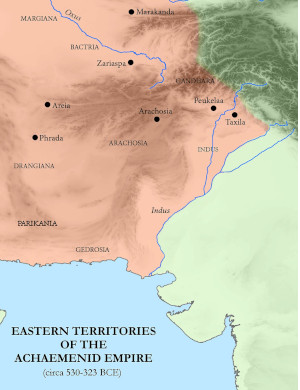
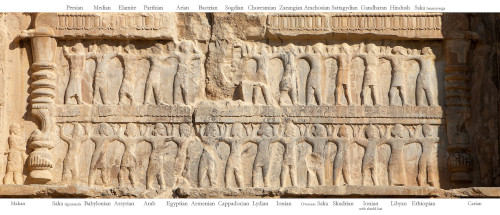
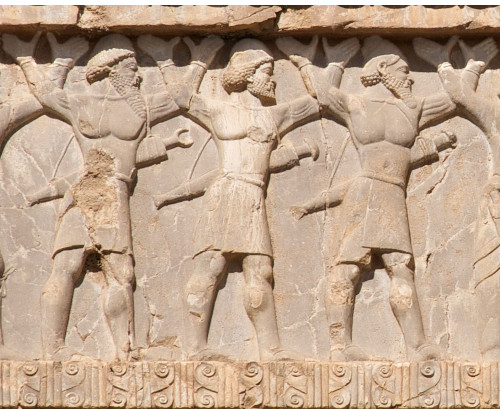
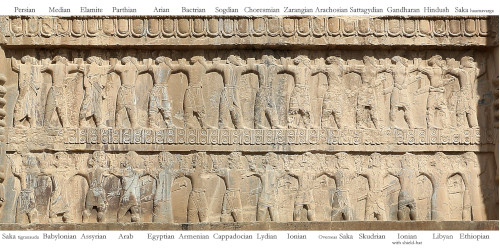
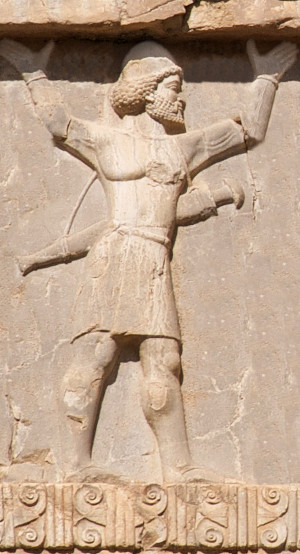
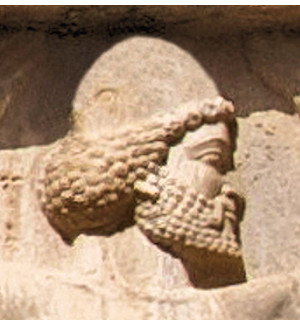
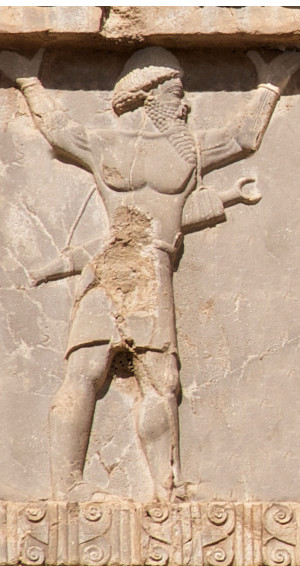
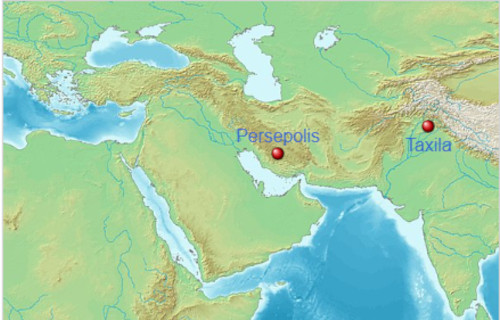
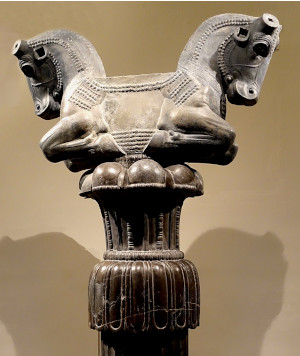
It is thought that Ashoka's palace at Patna was modelled after the Achaemenid palace of Persepolis….
Ashoka probably got the idea of putting up these inscriptions from the neighbouring Achaemenid empire….
Ashoka's inscriptions have not been found at major cities of the Maurya empire, such as Pataliputra, Vidisha, Ujjayini, and Taxila…. the 7th century Chinese pilgrim Xuanzang refers to some of Ashoka's pillar edicts, which have not been discovered by modern researchers….
Ashoka had almost been forgotten, but in the 19th century James Prinsep contributed in the revelation of historical sources. After deciphering the Brahmi script, Prinsep had originally identified the "Priyadasi" of the inscriptions he found with the King of Ceylon Devanampiya Tissa. However, in 1837, George Turnour discovered an important Sri Lankan manuscript (Dipavamsa, or "Island Chronicle") associating Piyadasi with Ashoka:
"Two hundred and eighteen years after the beatitude of the Buddha, was the inauguration of Piyadassi, .... who, the grandson of Chandragupta, and the son of Bindusara, was at the time Governor of Ujjayani."
— Dipavamsa.
-- Ashoka, by Wikipedia
The identification of Raja Priyadarsin with Raja Asoka was based entirely upon url=http://survivorbb.rapeutation.com/viewtopic.php?f=60&t=4204&start=99]Ceylonese Buddhist chronicles.[/url] Talboys Wheeler wrote in 1874, "The identification of Raja Priyadarsin of the Edicts with Raja Asoka of the Buddhist chronicles was first pointed out by Mr. Turnour who rested it upon a passage in the Dipavamsa. The late Prof. [Horace Hayman] Wilson objected to this identification."1 [History of India, Hindu, Buddhist and Brahmanical, 280.] Prof. Rhys Davids declared, "It is not too much to say that without the help of the Ceylon Books, the striking identification of the King Piyadassi of the edicts with the king Asoka of history would never have been made."2 [Buddhist India, 273.] But the Ceylon chronicles are admitted to be utterly worthless as history, and according to Wheeler, "the Buddhist chronicles might be dismissed as a monkish jumble of myths and names,3 [EHI, 171] and even Vincent Smith in the preface to his Asoka himself said, "I reject absolutely the Ceylonese chronology...... The undeserved credit given to the monks of Ceylon has been a great hindrance to the right understanding of ancient Indian history." And yet it is on such undeserved credit that the identity of Priyadarsin with Asoka Maurya rests to this day.
-- History of Classical Sanskrit Literature, by Kavyavinoda, Sahityaratnakara M. Krishnamachariar, M.A., M.I., Ph.D., Member of the Royal Asiatic Society of London (Of the Madras Judicial Service), Assisted by His Son M. Srinivasachariar, B.A., B.L., Advocate, Madras, 1937
The inscriptions, made over some twenty years (from Asoka's eighth through twenty-seventh regnal years), span the period of Asoka's conversion to Buddhism in c. 260 BCE. As recorded in the thirteenth major rock edict (Thapar 1997: 255-6), his conversion was a consequence of the great remorse Asoka experienced for the massacres that followed upon the Mauryan conquest of the Kalinga state of eastern India. 1 ["A hundred and fifty thousand people were deported, a hundred thousand were killed and many times that number perished. Afterwards, now that Kalinga was annexed, the Beloved of the Gods very earnestly practiced Dhamma, desired Dhamma, and taught Dhamma. On conquering Kalinga, the Beloved of the Gods felt remorse, for, when an independent country is conquered the slaughter, death, and deportation of the people is extremely grievous to me Beloved of the Gods, and weighs heavily on his mind ... " (13th Major rock edict, Thapar 1997: 255).] Referred to as the major and minor rock edicts and pillar edicts, Asokan inscriptions were engraved on stone columns in urban centers in the Ganges basin (Fig. 6.1) and on rock outcrops across the broad territories over which Asoka claimed sovereignty. They thus had a material dimension visible even to non-readers that may have made them important symbols of political authority. Asokan inscriptions were typically located in or near settlements or along trade routes (though not always in highly visible locales).
Some three dozen unique Asokan texts have been identified at approximately fifty sites (Fig. 6.2; Allchin 1995: 199). In many contexts, texts co-occur; for example, most or all of the fourteen rock edicts are found together in several locales (Chaudhary 1983: 44-5).2 [As a result, it is difficult to estimate precisely how many inscriptions there are, since different scholars have recorded and counted inscriptions in quite different ways.] As a key source of primary data, Asokan inscriptions have come to play a tremendously important role in interpretations of the Mauryan polity. Although considerable caution needs to be exercised in reading these propagandistic texts, they do provide a great deal of important information. They seem to result from a conscious imperial policy to communicate information and instructions about Asoka's religious values and right behavior (dhamma) as well as his understandings of South Asia's political structure (including mention of border states, administrative offices, and revenue collection, among other things). They are thus by and large prescriptive texts, written in a paternalistic voice to instruct imperial subjects on behavior and values.