Re: Leaves of Grass, by Walt Whitman
Posted: Sun Sep 20, 2015 6:35 am
BOOK 18
A Broadway Pageant
1
Over the Western sea hither from Niphon come,
Courteous, the swart-cheek'd two-sworded envoys,
Leaning back in their open barouches, bare-headed, impassive,
Ride to-day through Manhattan.
Libertad! I do not know whether others behold what I behold,
In the procession along with the nobles of Niphon, the errand-bearers,
Bringing up the rear, hovering above, around, or in the ranks marching,
But I will sing you a song of what I behold Libertad.
When million-footed Manhattan unpent descends to her pavements,
When the thunder-cracking guns arouse me with the proud roar love,
When the round-mouth'd guns out of the smoke and smell I love
spit their salutes,
When the fire-flashing guns have fully alerted me, and
heaven-clouds canopy my city with a delicate thin haze,
When gorgeous the countless straight stems, the forests at the
wharves, thicken with colors,
When every ship richly drest carries her flag at the peak,
When pennants trail and street-festoons hang from the windows,
When Broadway is entirely given up to foot-passengers and
foot-standers, when the mass is densest,
When the facades of the houses are alive with people, when eyes
gaze riveted tens of thousands at a time,
When the guests from the islands advance, when the pageant moves
forward visible,
When the summons is made, when the answer that waited thousands
of years answers,
I too arising, answering, descend to the pavements, merge with the
crowd, and gaze with them.
2
Superb-faced Manhattan!
Comrade Americanos! to us, then at last the Orient comes.
To us, my city,
Where our tall-topt marble and iron beauties range on opposite
sides, to walk in the space between,
To-day our Antipodes comes.
The Originatress comes,
The nest of languages, the bequeather of poems, the race of eld,
Florid with blood, pensive, rapt with musings, hot with passion,
Sultry with perfume, with ample and flowing garments,
With sunburnt visage, with intense soul and glittering eyes,
The race of Brahma comes.
See my cantabile! these and more are flashing to us from the procession,
As it moves changing, a kaleidoscope divine it moves changing before us.
For not the envoys nor the tann'd Japanee from his island only,
Lithe and silent the Hindoo appears, the Asiatic continent itself
appears, the past, the dead,
The murky night-morning of wonder and fable inscrutable,
The envelop'd mysteries, the old and unknown hive-bees,
The north, the sweltering south, eastern Assyria, the Hebrews, the
ancient of ancients,
Vast desolated cities, the gliding present, all of these and more
are in the pageant-procession.
Geography, the world, is in it,
The Great Sea, the brood of islands, Polynesia, the coast beyond,
The coast you henceforth are facing—you Libertad! from your Western
golden shores,
The countries there with their populations, the millions en-masse
are curiously here,
The swarming market-places, the temples with idols ranged along the
sides or at the end, bonze, brahmin, and llama,
Mandarin, farmer, merchant, mechanic, and fisherman,
The singing-girl and the dancing-girl, the ecstatic persons, the
secluded emperors,
Confucius himself, the great poets and heroes, the warriors, the castes,
all,
Trooping up, crowding from all directions, from the Altay mountains,
From Thibet, from the four winding and far-flowing rivers of China,
From the southern peninsulas and the demi-continental islands, from
Malaysia,
These and whatever belongs to them palpable show forth to me, and
are seiz'd by me,
And I am seiz'd by them, and friendlily held by them,
Till as here them all I chant, Libertad! for themselves and for you.
For I too raising my voice join the ranks of this pageant,
I am the chanter, I chant aloud over the pageant,
I chant the world on my Western sea,
I chant copious the islands beyond, thick as stars in the sky,
I chant the new empire grander than any before, as in a vision it
comes to me,
I chant America the mistress, I chant a greater supremacy,
I chant projected a thousand blooming cities yet in time on those
groups of sea-islands,
My sail-ships and steam-ships threading the archipelagoes,
My stars and stripes fluttering in the wind,
Commerce opening, the sleep of ages having done its work, races
reborn, refresh'd,
Lives, works resumed—the object I know not—but the old, the Asiatic
renew'd as it must be,
Commencing from this day surrounded by the world.
3
And you Libertad of the world!
You shall sit in the middle well-pois'd thousands and thousands of years,
As to-day from one side the nobles of Asia come to you,
As to-morrow from the other side the queen of England sends her
eldest son to you.
The sign is reversing, the orb is enclosed,
The ring is circled, the journey is done,
The box-lid is but perceptibly open'd, nevertheless the perfume
pours copiously out of the whole box.
Young Libertad! with the venerable Asia, the all-mother,
Be considerate with her now and ever hot Libertad, for you are all,
Bend your proud neck to the long-off mother now sending messages
over the archipelagoes to you,
Bend your proud neck low for once, young Libertad.
Here the children straying westward so long? so wide the tramping?
Were the precedent dim ages debouching westward from Paradise so long?
Were the centuries steadily footing it that way, all the while
unknown, for you, for reasons?
They are justified, they are accomplish'd, they shall now be turn'd
the other way also, to travel toward you thence,
They shall now also march obediently eastward for your sake Libertad.
A Broadway Pageant
1
Over the Western sea hither from Niphon come,
Courteous, the swart-cheek'd two-sworded envoys,
Leaning back in their open barouches, bare-headed, impassive,
Ride to-day through Manhattan.
Libertad! I do not know whether others behold what I behold,
In the procession along with the nobles of Niphon, the errand-bearers,
Bringing up the rear, hovering above, around, or in the ranks marching,
But I will sing you a song of what I behold Libertad.
When million-footed Manhattan unpent descends to her pavements,
When the thunder-cracking guns arouse me with the proud roar love,
When the round-mouth'd guns out of the smoke and smell I love
spit their salutes,
When the fire-flashing guns have fully alerted me, and
heaven-clouds canopy my city with a delicate thin haze,
When gorgeous the countless straight stems, the forests at the
wharves, thicken with colors,
When every ship richly drest carries her flag at the peak,
When pennants trail and street-festoons hang from the windows,
When Broadway is entirely given up to foot-passengers and
foot-standers, when the mass is densest,
When the facades of the houses are alive with people, when eyes
gaze riveted tens of thousands at a time,
When the guests from the islands advance, when the pageant moves
forward visible,
When the summons is made, when the answer that waited thousands
of years answers,
I too arising, answering, descend to the pavements, merge with the
crowd, and gaze with them.
"I perceive that Freemasonry has something quite military and Jesuitical about it."
"And your perceptions are perfectly correct," Naphta responded. "Your divining-rod twitches, and knocks. The idea of the society is rooted in and inseparably bound up with the absolute. By consequence, it is terroristic; that is to say, anti-liberal. It lifts the burden from the individual conscience, and consecrates in the name of the Absolute every means even to bloodshed, even to crime. There is some support for the view that the vows of the brotherhood were once symbolically sealed in blood. A brotherhood can never be purely contemplative. By its very nature it must be executive, must organize. You probably do not know that the founder of the Illuminati, a society which for a long time was nearly identified with Freemasonry, was a former member of the Society of Jesus?"
"No, that is certainly news to me."
"Adam Weishaupt formed his secret benevolent order entirely upon the model of the Society of Jesus. He himself was a Mason, and the most reputable lodge members of the time were Illuminati. I am speaking of the second half of the eighteenth century, which Settembrini would not hesitate to characterize as the period of the degeneration of his fraternity. Actually it was the period of its highest flower, as of all secret societies in general, a time when Masonry attained to a higher life, of which it was later ‘purged’ by men of the stamp of our friend of humanity here. In that time he would certainly have belonged to those who reproached it with Jesuitry and obscurantism."
"Were there grounds for the reproach?"
"Yes—if you choose to call it that. The shallow free-thinking of the day was of that opinion. It was the period when the Fathers of our faith sought to animate the society by breathing into it Catholic-hierarchical ideas—at that time there was actually a Jesuit lodge of Freemasonry at Clermont, in France. And it was the time when Rosicrucianism made its entrance into the lodges, that remarkable brotherhood, which, you will note, was a peculiar union of purely rational ideas of political and social improvement and a millennial programme, with elements distinctly oriental, Indian and Arabic philosophy and magical nature-lore. The reform and revision of the lodges which then took place was in the direction of strict observance in a definitely irrational and mystical, magical-alchemical sense, to which the Scottish Rite owes its existence. These are degrees of knighthood which were added to the old military ranks of apprentice, journeyman, and master; upper ranks which issued in the hieratical, and were full of Rosicrucian mysticism. There ensued a sort of casting-back to certain spiritual and knightly orders which existed in the Middle Ages, for instance the Templars, you know, who took the vows of poverty, chastity, and obedience before the Patriarch of Jerusalem. Even to-day there is an upper degree in Freemasonry which bears the title ‘Grand Duke of Jerusalem.’"
"It’s all news to me, Herr Naphta. But I’m getting to know Herr Settembrini’s tricks. ‘Grand Duke of Jerusalem’—that’s not bad, not bad at all. You ought to call him that some time, by way of a joke. The other day he called you ‘doctor angelicus.’ Why not take your revenge?"
"Oh, there are a host more such titles in the upper reaches of the Knights Templars. There are a Past Grand Master, a Knight of the East, a Grand High-priest—the thirty-first degree is called Noble Prince of the Royal Mysteries. You observe that all these names have reference to oriental mysticism. The reappearance of the Templars, indeed, means nothing else than the entrance of such conceptions, the presence of irrational ferments in a world given over to rational-utilitarian ideas of social improvement. This it was which lent Freemasonry a new brilliance and charm, and explains the great number of recruits to it at that period of its history. It drew to itself all the elements which were weary of the rationalistic twaddle of the century, and thirsting for a stronger draught of life. The success of the order was such that the Philistine complained of it for estranging men from domestic happiness and destroying their reverence for women."
-- The Magic Mountain [Der Zauberberg], by Thomas Mann
2
Superb-faced Manhattan!
Comrade Americanos! to us, then at last the Orient comes.
To us, my city,
Where our tall-topt marble and iron beauties range on opposite
sides, to walk in the space between,
To-day our Antipodes comes.
The Originatress comes,
The nest of languages, the bequeather of poems, the race of eld,
Florid with blood, pensive, rapt with musings, hot with passion,
Sultry with perfume, with ample and flowing garments,
With sunburnt visage, with intense soul and glittering eyes,
The race of Brahma comes.
See my cantabile! these and more are flashing to us from the procession,
As it moves changing, a kaleidoscope divine it moves changing before us.
For not the envoys nor the tann'd Japanee from his island only,
Lithe and silent the Hindoo appears, the Asiatic continent itself
appears, the past, the dead,
The murky night-morning of wonder and fable inscrutable,
The envelop'd mysteries, the old and unknown hive-bees,
The north, the sweltering south, eastern Assyria, the Hebrews, the
ancient of ancients,
Vast desolated cities, the gliding present, all of these and more
are in the pageant-procession.
By November 8, 1923, "this man" had made his presence known to all Germany. Hitler had already seized control of the Nazi party and now planned to seize control of the Bavarian government as well. Hess, intoxicated with his newly discovered Messiah, marched along with Hitler in the Munich Beer Hall Putsch of 1923. Despite its dramatic effect, the Putsch was a fiasco. When police opened fire on the marching Storm Troopers, Hitler was the first to flee. He did not mention this in Mein Kampf, but said of the meeting: "my Storm Troopers -- as they became from that day forth -- attacked. Like wolves they flung themselves upon the enemy in packs of eight and ten. How many of these men I never really knew until that day. And at their head was gallant Rudolf, my personal secretary, Hess."
Hess escaped across the border into Austria over a mountain pass. Hitler was imprisoned at Landsberg, a town just west of Munich. The punishment was very mild, lasting less than nine months, and Hitler spoke of it afterward as a much-needed vacation.
Hess proved his devotion to Hitler by coming back from Austria, giving himself up, and joining Hitler in prison, in room No. 7. So steadfast was that devotion, in fact, that Ernst Hanfstaengl hints at an unnatural relationship: "It is probably not true to say there was a physical homosexual relationship between the two, but in a passive way the attraction was there. I certainly did not trust the manhood of either...."
Shared prison life served to bind the two men together until a later fiasco severed the bond. Hess became Hitler's secretary and helped him with Mein Kampf. Hess did more than take dictation and type the manuscript. As the best educated of Hitler's disciples, he was able to provide Hitler with useful information, particularly on a new study which was called geopolitics. He introduced Hitler to the professor (and ex-general) from whom he had learned about geopolitics, and, in fact, the professor was a frequent visitor to Landsberg prison. Some people, indeed, believe that the professor, Karl Haushofer, was Hitler's guiding brain.
Writing in Current History and Forum in June 1941, Frederic Sondern, Jr., who had personal knowledge of the subject, reported:Dr. Haushofer and his men dominate Hitler's thinking. That domination began 17 years ago when the World War general flattered the ex-corporal by paying him visits in prison. Haushofer saw possibilities in the hysterical agitator who had launched an unsuccessful beer-hall revolution. The prison visits became frequent; the distinguished soldier-scientist fascinated Hitler, then finally made him a disciple. The ascendancy has grown as Dr. Haushofer again and again has proved the accuracy of his knowledge and the wisdom of his advice....
It was Haushofer who taught the hysterical, planless agitator in a Munich jail to think in terms of continents and empires. Haushofer virtually dictated the famous Chapter XVI of Mein Kampf which outlined the foreign policy Hitler has since followed to the letter.
Haushofer's Lebensraum ("living space") theory sought to justify Germany's world conquest by claiming that it was necessary to insure the German people room to preserve and expand their racial community. He developed an intelligence-gathering organization which became the envy and model for all others. He was called everything from "Hitler's idea man" to "the man who will in the end take the Fuhrer's place," yet he seems to have kept a very low profile. But there is apparently much more to Haushofer than the geopolitician.
A love affair with the Orient began in 1908, when, as a field artillery officer in the Bavarian army, he was sent to Tokyo to study the Japanese army and to advise it as an artillery instructor. The assignment changed the course of his life. He traveled extensively in the Far East, and added the Japanese, Chinese, and Korean languages to his repertoire of English, French, and Russian. He could not be accused -- as other leading Nazis were -- of having a provincial background.
His four-year sojourn in the Far East also changed the course of German history. Haushofer was able to make the acquaintance of influential Japanese and to develop a rapport for the culture which helped account later for the German-Japanese alliance. When he returned to Germany in 1912, he had no reason at all to know that the Chinese proverb of which he was so fond, "He who rides a tiger cannot get off," would one day have particular relevance for him.
Haushofer was introduced to Oriental teachings during his stay in the Far East. He had been a devout student of Schopenhauer, and now he could drink directly from the source. He became sufficiently conversant in Sanskrit to translate several Hindu and Buddhist texts, and according to Ravenscroft, he was "an authority on Oriental mysticism ... concealing the other side of his nature and activities as a leader of a secret community of Initiates, and an authority on every aspect of the 'Secret Doctrine.' [He was] in the esoteric stream of satanism through which he sought to raise Germany to the pinnacle of world power."
(The king of Satanists in America today is Anton LaVey, a former circus lion-tamer who greatly admires the Nazis. LaVey's book, The Satanic Bible, published in 1969, is dedicated to a puzzling mixture of people, with one entry reading: "To Karl Haushofer, a teacher without a classroom.")
A number of unsupported theories about Haushofer's occult connections are all rejected by his son Heinz. Haushofer is known to have had a reputation for precognition, and a belief in astrology. Johannes Tautz adds to these the belief that he belonged to George Gurdjieff's esoteric circle, which was as well versed in the difficult exercises of the Order of Bektashi Dervishes as Sebotlendorff was, and that he was also a secret member of the Thule Society. List's publishing house made a German translation of Gurdjieff's biography. Gurdjieff traveled extensively through Asia, and may have met Haushofer there. A former disciple of Gurdjieff, Louis Pauwels, believes that Haushofer was a member of "one of the most important secret Buddhist societies" and was on a mission to restore the Indo-Germanic race, which he believed had originated in Central Asia, to its former greatness. If he failed in the mission, he would commit suicide in the traditional Japanese manner.
-- Gods & Beasts -- The Nazis & the Occult, by Dusty Sklar
Geography, the world, is in it,
The Great Sea, the brood of islands, Polynesia, the coast beyond,
The coast you henceforth are facing—you Libertad! from your Western
golden shores,
The countries there with their populations, the millions en-masse
are curiously here,
The swarming market-places, the temples with idols ranged along the
sides or at the end, bonze, brahmin, and llama,
Mandarin, farmer, merchant, mechanic, and fisherman,
The singing-girl and the dancing-girl, the ecstatic persons, the
secluded emperors,
Confucius himself, the great poets and heroes, the warriors, the castes,
all,
Trooping up, crowding from all directions, from the Altay mountains,
From Thibet, from the four winding and far-flowing rivers of China,
From the southern peninsulas and the demi-continental islands, from
Malaysia,
These and whatever belongs to them palpable show forth to me, and
are seiz'd by me,
And I am seiz'd by them, and friendlily held by them,
Till as here them all I chant, Libertad! for themselves and for you.
For I too raising my voice join the ranks of this pageant,
I am the chanter, I chant aloud over the pageant,
I chant the world on my Western sea,
I chant copious the islands beyond, thick as stars in the sky,
I chant the new empire grander than any before, as in a vision it
comes to me,
I chant America the mistress, I chant a greater supremacy,
I chant projected a thousand blooming cities yet in time on those
groups of sea-islands,
My sail-ships and steam-ships threading the archipelagoes,
My stars and stripes fluttering in the wind,
Commerce opening, the sleep of ages having done its work, races
reborn, refresh'd,
Lives, works resumed—the object I know not—but the old, the Asiatic
renew'd as it must be,
Commencing from this day surrounded by the world.
3
And you Libertad of the world!
You shall sit in the middle well-pois'd thousands and thousands of years,
As to-day from one side the nobles of Asia come to you,
As to-morrow from the other side the queen of England sends her
eldest son to you.
The sign is reversing, the orb is enclosed,
The ring is circled, the journey is done,
The box-lid is but perceptibly open'd, nevertheless the perfume
pours copiously out of the whole box.
Young Libertad! with the venerable Asia, the all-mother,
Be considerate with her now and ever hot Libertad, for you are all,
Bend your proud neck to the long-off mother now sending messages
over the archipelagoes to you,
Bend your proud neck low for once, young Libertad.
Here the children straying westward so long? so wide the tramping?
Were the precedent dim ages debouching westward from Paradise so long?
Were the centuries steadily footing it that way, all the while
unknown, for you, for reasons?
They are justified, they are accomplish'd, they shall now be turn'd
the other way also, to travel toward you thence,
They shall now also march obediently eastward for your sake Libertad.
It must be shown that Oriental Freemasonry still retains faithfully even today the ancient teachings of wisdom forgotten by modern Freemasonry, whose Constitution of 1717 was a departure from the true way.
-- Gods & Beasts -- The Nazis & the Occult, by Dusty Sklar
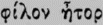 , is attributed to the heart. Accordingly, we say: He has a bad heart; his heart is in this business; it comes from his heart; it cut him to the heart; it breaks his heart; his heart bleeds; the heart leaps for joy; who can read a man's heart? it is heart-rending, heart-crushing, heart-breaking, heart-inspiring, heart-stirring; he is good-hearted, hard-hearted; heartless, stout-hearted, faint-hearted, and so on. Quite especially, however, love affairs are called affairs of the heart, affaires du coeur; because the sexual impulse is the focus of the will, and the selection with reference thereto constitutes the principal concern of natural, human willing, the ground of which I shall discuss at length in a chapter supplementary to the fourth book. In Don Juan (canto 11, v. 34) Byron is satirical about love being to women an affair of the head instead of an affair of the heart. On the other hand, the head denotes everything that is the business of knowledge. Hence a man of brains, a good head, a clever head, a fine head, a bad head, to lose one's head, to keep one's head, and so on. Heart and head indicate the whole person. But the head is always the secondary, the derived; for it is not the centre of the body, but its highest efflorescence. When a hero dies, his heart is embalmed, not his brain. On the other hand, we like to preserve the skulls of poets, artists, and philosophers. Thus Raphael's skull was preserved in the Accademia di S. Luca in Rome, though recently it was shown to be not genuine; in 1820 Descartes' skull was sold by auction in Stockholm.
 ; the will, on the other hand, is animus, which comes from anima, and this from
  . Anima is life itself, the breath,
  ; but animus is the life-giving principle and at the same time the will, the subject of inclinations, likings, purposes, passions, and emotions; hence also est mihi animus, fert animus, for "I feel inclined to," "I should like to," as well as animi causa, and so on; it is the Greek
  , the German Gemut, and thus heart, not head. Animi perturbatio is emotion; mentis perturbatio would signify madness or craziness. The predicate immortalis is attributed to animus, not to mens. All this is the rule based on the great majority of passages, although, with concepts so closely related, it is bound to happen that the words are sometimes confused. By
  , Topica, iii, 2). From this it might be inferred, by twofold contraposition, that not to live is better than to live badly. This is evident to the intellect; yet the great majority live very badly rather than not at all. Therefore this attachment to life cannot have its ground in its own object, for life, as was shown in the fourth book, is really a constant suffering, or at any rate, as will be shown later in chapter 28, a business that does not cover the cost; hence that attachment can be founded only in its own subject. But it is not founded in the intellect, it is no result of reflection, and generally is not a matter of choice; on the contrary, this willing of life is something that is taken for granted; it is a prius of the intellect itself. We ourselves are the will-to-live; hence we must live, well or badly. Only from the fact that this attachment or clinging to a life so little worthy of it is entirely a priori and not a posteriori, can we explain the excessive fear of death inherent in every living thing. La Rochefoucauld expressed this fear with rare frankness and naivety in his last reflection; on it ultimately rests the effectiveness of all tragedies and heroic deeds. Such effectiveness would be lost if we assessed life only according to its objective worth. On this inexpressible horror mortis rests also the favourite principle of all ordinary minds that whoever takes his own life must be insane; yet no less is the astonishment, mingled with a certain admiration, which this action always provokes even in thinking minds, since such action is so much opposed to the nature of every living thing that in a certain sense we are forced to admire the man who is able to perform it. Indeed, we even find a certain consolation in the fact that, in the worst cases, this way out is actually open to us, and we might doubt it if it were not confirmed by experience. For suicide comes from a resolve of the intellect, but our willing of life is a prius of the intellect. Therefore this consideration, that will be discussed in detail in chapter 28, also confirms the primacy of the will in self-consciousness.
 ; (noxae est etiam multus somnus). [Odyssey, 15, 394.] The need for sleep is accordingly directly proportional to the intensity of the brain-life, and thus to clearness of consciousness. Those animals whose brain-life is feeble and dull, reptiles and fishes for instance, sleep little and lightly. Here I remind the reader that the winter-sleep is a sleep almost in name only, since it is not an inactivity of the brain alone, but of the whole organism, and so a kind of suspended animation. Animals of considerable intelligence sleep soundly and long. Even human beings require more sleep the more developed, as regards quantity and quality, and the more active their brain is. Montaigne relates of himself that he had always been a heavy sleeper; that he had spent a large part of his life in sleeping; and that at an advanced age he still slept from eight to nine hours at a stretch (Bk. iii, ch. 13). It is also reported of Descartes that he slept a great deal (Baillet, Vie de Descartes (1693), p. 288). Kant allowed himself seven hours for sleep, but it became so difficult for him to manage with this that he ordered his servant to force him, against his will and without listening to his remonstrances, to get up at a fixed time (Jachmann, Immanuel Kant, p. 162). For the more completely awake a man is, in other words the clearer and more wide-awake his consciousness, the greater is his necessity for sleep, and thus the more soundly and longer he sleeps. Accordingly, much thinking or strenuous head-work will increase the need for sleep. That sustained muscular exertion also makes us sleepy can be explained from the fact that in such exertion the brain, by means of the medulla oblongata, the spinal marrow, and the motor nerves, continuously imparts to the muscles the stimulus affecting their irritability, and in this way its strength is exhausted. Accordingly the fatigue we feel in our arms and legs has its real seat in the brain, just as the pain felt in these parts is really experienced in the brain; for the brain is connected with the motor nerves just as it is with the nerves of sense. The muscles not actuated by the brain, e.g., those of the heart, therefore do not become tired. From the same reason we can explain why we cannot think acutely either during or after great muscular exertion. That we have far less mental energy in summer than in winter is partly explained by the fact that in summer we sleep less; for the more soundly we have slept, the more completely wakeful, the more wide awake are we afterwards. But this must not lead us astray into lengthening our sleep unduly, since it then loses in intension, in other words, in depth and in soundness, what it gains in extension, and thus it becomes a mere waste of time. Goethe means this when he says (in the second part of Faust) of morning slumber: "Sleep's a shell, to break and spurn!" In general, therefore, the phenomenon of sleep most admirably confirms that consciousness, apprehension, perception, knowing, and thinking are not something original in us, but a conditioned, secondary state. It is a luxury of nature, and indeed her highest, which she is therefore the less able to continue without interruption, the higher the pitch to which it has been brought. It is the product, the efflorescence, of the cerebral nerve-system, which is itself nourished like a parasite by the rest of the organism. This is also connected with what is shown in our third book, that knowing is the purer and more perfect the more it has freed and severed itself from willing, whereby the purely objective, the aesthetic apprehension appears. In just the same way, an extract is so much the purer, the more it has been separated from that from which it has been extracted, and the more it has been refined and clarified of all sediment. The contrast is shown by the will, whose most immediate manifestation is the whole organic life, and primarily the untiring heart.