"Science," the Greek word for knowledge, when appended to the word "political," creates what seems like an oxymoron. For who could claim to know politics? More complicated than any game, most people who play it become addicts and die without understanding what they were addicted to. The rest of us suffer under their malpractice as our "leaders." A truer case of the blind leading the blind could not be found. Plumb the depths of confusion here.
I am often asked how I came to write this book. One answer is that my wife Roslyn urged me to write it, and continued to urge me at those times when, daunted by the magnitude of the project, I wanted to abandon it. Another is that the circumstances of my own life (which, as I now write, has spanned a fourth of the nation's history -- a startling thought) demanded of me that I try to fashion a new kind of history. By that I mean a history different from what I had learned in college and in graduate school and from what I saw in the history texts given to students all over the country.
When I set out to write the book, I had been teaching history and what is grandiosely called "political science" for twenty years. Half of that time I was involved in the civil rights movement in the South (mostly while teaching at Spelman College in Atlanta, Georgia). And then there were ten years of activity against the war in Vietnam. These experiences were hardly a recipe for neutrality in the teaching and writing of history.
But my partisanship was undoubtedly shaped even earlier, by my upbringing in a family of working-class immigrants in New York, by my three years as a shipyard worker, and by my Air Force duty as a bombardier in the European theater (a strange word for that -- "theater") in the second World War. That was all before I went to college under the GI Bill of Rights and began to study history.
By the time I began teaching and writing, I had no illusions about "objectivity," if that meant avoiding a point of view. I knew that a historian (or a journalist, or anyone telling a story) was forced to choose, out of an infinite number of facts, what to present, what to omit. And that decision inevitably would reflect, whether consciously or not, the interests of the historian.
There is a certain drumbeat of scolding one hears these days, about the need for students to learn facts. "Our young people are not being taught facts," said presidential candidate Robert Dole (and candidates are always so scrupulous about facts) to a gathering of American Legionnaires. I was reminded of the character in Dickens' Hard Times, the pedant Gradgrind, who admonished a younger teacher: "Teach nothing but facts, facts, facts."
But there is no such thing as a pure fact, innocent of interpretation. Behind every fact presented to the world -- by a teacher, a writer, anyone -- is a judgment. The judgment that has been made is that this fact is important, and that other facts, omitted, are not important.
There were themes of profound importance to me which I found missing in the orthodox histories that dominated American culture. The consequence of those omissions has been not simply to give a distorted view of the past but, more important, to mislead us all about the present.
For instance, there is the issue of class. It is pretended that, as in the Preamble to the Constitution, it is "we the people" who wrote that document, rather than fifty-five privileged white males whose class interest required a strong central government. That use of government for class purposes, to serve the needs of the wealthy and powerful, has continued throughout American history, down to the present day. It is disguised by language that suggests all of us -- rich and poor and middle class -- have a common interest.
Thus, the state of the nation is described in universal terms. The novelist Kurt Vonnegut invented the term "granfalloon" to describe a great bubble that must be punctured to see the complexity inside. When the president declares happily that "our economy is sound," he will not acknowledge that it is not at all sound for 40 or 50 million people who are struggling to survive, although it may be moderately sound for many in the middle class, and extremely sound for the richest 1 percent of the nation who own 40 percent of the nation's wealth.
Labels are given to periods in our history which reflect the well-being of one class and ignore the rest. When I was going through the files of Fiorello LaGuardia, who as a Congressman in the twenties represented East Harlem, I read the letters of desperate housewives, their husbands out of work, their children hungry, unable to pay their rent -- all this in that period known as "the Jazz Age," the "Roaring Twenties."
What we learn about the past does not give us absolute truth about the present, but it may cause us to look deeper than the glib statements made by political leaders and the "experts" quoted in the press.
Class interest has always been obscured behind an all-encompassing veil called "the national interest." My own war experience, and the history of all those military interventions in which the United States was engaged, made me skeptical when I heard people in high political office invoke "the national interest" or "national security" to justify their policies. It was with such justifications that Truman initiated a "police action" in Korea that killed several million people, that Johnson and Nixon carried out a war in Indochina in which perhaps 3 million people died, that Reagan invaded Grenada, Bush attacked Panama and then Iraq, and Clinton bombed Iraq again and again.
Is there a "national interest" when a few people decide on war, and huge numbers of others -- here and abroad -- are killed or crippled as a result of such a decision? Should citizens not ask in whose interest are we doing what we are doing? Then why not, I came to think, tell the story of wars not through the eyes of the generals and diplomats but from the viewpoints of the GIs, of the parents who received the black-bordered telegrams, even of "the enemy."
What struck me as I began to study history was how nationalist fervor -- inculcated from childhood on by pledges of allegiance, national anthems, flags waving and rhetoric blowing -- permeated the educational systems of all countries, including our own. I wonder now how the foreign policies of the United States would look if we wiped out the national boundaries of the world, at least in our minds, and thought of all children everywhere as our own. Then we could never drop an atomic bomb on Hiroshima, or napalm on Vietnam, or wage war anywhere, because wars, especially in our time, are always wars against children, indeed our children.
And then there is, much as we would want to erase it, the ineradicable issue of race. It did not occur to me, when I first began to immerse myself in history, how badly twisted was the teaching and writing of history by its submersion of nonwhite people. Yes, Indians were there, and then gone. Black people were visible when slaves, then free and invisible. It was a white man's history.
From first grade to graduate school, I was given no inkling that the landing of Christopher Columbus in the New World initiated a genocide, in which the indigenous population of Hispaniola was annihilated. Or that this was just the first stage of what was presented as a benign expansion of the new nation (Louisiana "Purchase," Florida "Purchase," Mexican "Cession"), but which involved the violent expulsion of Indians, accompanied by unspeakable atrocities, from every square mile of the continent, until there was nothing to do with them but herd them into reservations.
I was invited, sometime in 1998, to speak at a symposium in Boston's historic Faneuil Hall, on the Boston Massacre. I said I would be glad to do that, so long as I did not have to deal with the Boston Massacre. And so my talk was not about the killing of five colonists by British troops in 1770. I thought that had been given an inordinate amount of attention for over two hundred years, because it served a certain patriotic function. Instead, I wanted to talk about the many massacres of nonwhite people in our history, which would not reinforce patriotic pride but remind us of the long legacy of racism in our country, still smoldering and needing attention.
Every American schoolchild learns about the Boston Massacre. But who learns about the massacre of 600 men, women, and children of the Pequot tribe in New England in 1637? Or the massacre -- in the midst of the Civil War -- of hundreds of Indian families at Sand Creek, Colorado, by U.S. soldiers? Or the military attack by 200 U.S. cavalrymen in 1870 which wiped out a sleeping camp of Piegan Indians in Montana?
It was not until I joined the faculty of Spelman College, a college for black women in Atlanta, Georgia, that I began to read the African-American historians who never appeared on my reading lists in graduate school (W.E.B. DuBois, Rayford Logan, Lawrence Reddick, Horace Mann Bond, John Hope Franklin). Nowhere in my history education had I learned about the massacres of black people that took place again and again, amid the silence of a national government pledged, by the Constitution, to protect equal rights for all.
For instance, in East St. Louis in 1917 there occurred one of the many "race riots" that took place in what our white-oriented history books called the "Progressive Era." There, white workers, angered by the influx of black workers, killed perhaps 200 people, provoking an angry article by W.E.B. DuBois called "The Massacre of East St. Louis," and causing the performing artist Josephine Baker to say: "The very idea of America makes me shake and tremble and gives me nightmares."
I wanted, in writing this book, to awaken a greater consciousness of class conflict, racial injustice, sexual inequality, and national arrogance. But even as I tried to make up for what I saw as serious omissions, I nevertheless neglected groups in American society that had always been missing from orthodox histories. I became aware of this, and embarrassed by it, when people wrote to me after reading A People's History, praising the book but pointing gently (sometimes not so gently) to its shortcomings.
It was perhaps my stronger connection to the East Coast of the United States that caused me to ignore the large numbers of Latino and Latina people who lived in California and the Southwest, and their struggles for justice. Readers who want to learn more about that might look into these extraordinary books: De Colores Means All of Us by Elizabeth Martinez; Zapata's Disciple: Essays by Martin Espada; Aztlan and Viet Nam: Chicano and Chicana Experiences of the War, edited by George Mariscal.
And I suppose, it was my own sexual orientation that accounted for my minimal treatment of the issue of gay and lesbian rights. I tried, when a new edition appeared in 1995, to make up for this. But readers will have to look further to get a more substantial account of the remarkable change in the national culture that took place when men and women who were "queer" (a pejorative term for some people; an honorable one for others) asserted their humanity boldly, courageously, to the larger society.
As we pass from one century to another, one millennium to another, we would like to think that history itself is transformed as dramatically as the calendar. However, it rushes on, as it always did, with two forces racing toward the future, one splendidly uniformed, the other ragged but inspired.
There is the past and its continuing horrors: violence, war, prejudices against those who are different, outrageous monopolization of the good earth's wealth by a few, political power in the hands of liars and murderers, the building of prisons instead of schools, the poisoning of the press and the entire culture by money. It is easy to become discouraged observing this, especially since this is what the press and television insist that we look at, and nothing more.
But there is also (though much of this is kept from us, to keep us intimidated and without hope) the bubbling of change under the surface of obedience: the growing revulsion against the endless wars (I think of the Russian women in the nineties, demanding their country end its military intervention in Chechnya, as did Americans during the Vietnam war); the insistence of women all over the world that they will no longer tolerate abuse and subordination -- we see, for instance, the new international movement against female genital mutilation, and the militancy of welfare mothers against punitive laws. There is civil disobedience against the military machine, protest against police brutality directed especially at people of color.
In the United States, we see the educational system, a burgeoning new literature, alternative radio stations, a wealth of documentary films outside the mainstream, even Hollywood itself and sometimes television -- compelled to recognize the growing multiracial character of the nation. Yes, we have in this country, dominated by corporate wealth and military power and two antiquated political parties, what a fearful conservative characterized as "a permanent adversarial culture" challenging the present, demanding a new future.
It is a race in which we can all choose to participate, or just to watch. But we should know that our choice will help determine the outcome.
I think of the words of the poet Shelley, recited by women garment workers in New York to one another at the start of the twentieth century.
Rise like lions after slumber In unvanquishable number! Shake your chains to earth, like dew Which in sleep had fallen on you -- Ye are many; they are few!
This book, written in a few years, is based on twenty years of teaching and research in American history, and as many years of involvement in social movements. But it could not have been written without the work of several generations of scholars, and especially the current generation of historians who have done immense work in the history of blacks, Indians, women, and working people of all kinds. It also could not have been written without the work of many people, not professional historians, who were stimulated by the social struggles around them to put together material about the lives and activities of ordinary people trying to make a better world, or just trying to survive.
To indicate every source of information in the text would have meant a book impossibly cluttered with footnotes, and yet I know the curiosity of the reader about where a startling fact or pungent quote comes from. Therefore, as often as I can, I mention in the text authors and titles of books for which the full information is in this bibliography. Where you cannot tell the source of a quotation right from the text, you can probably figure it out by looking at the asterisked books for that chapter. The asterisked books are those I found especially useful and often indispensable.
I have gone through the following standard scholarly periodicals: American Historical Review, Mississippi Valley Historical Review, Journal of American History, Journal of Southern History, Journal of Negro History, Labor History, William and Mary Quarterly, Phylon, The Crisis, American Political Science Review, Journal of Social History.
Also, some less orthodox but important periodicals for a work like this: Monthly Review, Science and Society, Radical America, Akwesasne Notes, Signs: Journal of Women in Culture and Society, The Black Scholar, Bulletin of Concerned Asian Scholars, The Review of Radical Political Economics, Socialist Revolution, Radical History Review.
1. COLUMBUS, THE INDIANS, AND HUMAN PROGRESS
Brandon, William. The Last Americans: The Indian in American Culture. New York: McGraw-Hill, 1974.
*Collier, John. Indians of the Americas. New York: W.W. Norton, 1947.
*de las Casas, Bartolome. History of the Indies. New York: Harper & Row, 1971.
*Jennings, Francis. The Invasion of America: Indians, Colonialism, and the Cant of Conquest. Chapel Hill: University of North Carolina Press, 1975.
*Koning, Hans. Columbus: His Enterprise. New York: Monthly Review Press, 1976.
*Morgan, Edmund S. American Slavery, American Freedom: The Ordeal of Colonial Virginia. New York: W.W. Norton, 1975.
Morison, Samuel Eliot. Admiral of the Ocean Sea. Boston: Little, Brown, 1942.
---. Christopher Columbus, Mariner. Boston: Little, Brown, 1955.
*Nash, Gary B. Red, White, and Black: The Peoples of Early America. Englewood Cliffs: Prentice-Hall, 1970.
Vogel, Virgil, ed. This Country Was Ours. New York: Harper & Row, 1972.
2. DRAWING THE COLOR LINE
*Aptheker, Herbert, ed. A Documentary History of the Negro People in the United States. Secaucus, N.J.: Citadel, 1974.
Baskin, Joseph. Into Slavery: Radical Decisions in the Virginia Colony. Philadelphia, Lippincott, 1966.
Catterall, Helen. Judicial Cases Concerning American Slavery and the Negro. 5 vols. Washington, Negro University Press, 1937.
Davidson, Basil. The African Slave Trade. Boston: Little, Brown, 1961.
Donnan, Elizabeth, ed. Documents Illustrative of the History of the Slave Trade to America. 4 vols. New York: Octagon, 1965.
Elkins, Stanley. Slavery: A Problem in American Institutional and Intellectual Life. Chicago: University of Chicago Press, 1976.
Federal Writers Project. The Negro in Virginia. New York: Arno, 1969.
Franklin, John Hope. From Slavery to Freedom: A History of American Negroes. New York Knopf, 1974.
*Jordan, Winthrop. White Over Black: American Attitudes Toward the Negro, 1550-1812. Chapel Hill: University of North Carolina Press, 1968.
*Morgan, Edmund S. American Slavery, American Freedom: The Ordeal of Colonial Virginia. New York: W.W. Norton, 1975.
Mullin, Gerald. Flight and Rebellion: Slave Resistance in Eighteenth-Century Virginia. New York: Oxford University Press, 1974.
Mullin, Michael, ed. American Negro Slavery: A Documentary History. New York: Harper & Row, 1975.
Phillips, Ulrich B. American Negro Slavery: A Survey of the Supply, Employment and Control of Negro Labor as Determined by the Plantation Regime. Baton Rouge: Louisiana State University Press, 1966.
Redding, J. Saunders. They Came in Chains. Philadelphia: Lippincott, 1973.
Stampp, Kenneth M. The Peculiar Institution. New York: Knopf, 1956.
Tannenbaum, Frank. Slave and Citizen: The Negro in the Americas. New York: Random House, 1963.
3. PERSONS OF MEAN AND VILE CONDITION
Andrews, Charles, ed. Narratives of the Insurrections 1675-1690. New York: Barnes & Noble, 1915.
*Bridenbaugh, Carl. Cities in the Wilderness: The First Century of Urban Life in America. New York: Oxford University Press, 1971.
Henretta, James. "Economic Development and Social Structure in Colonial Boston." William and Mary Quarterly, 3rd Series, Vol. 22, January 1965.
Herrick, Cheesman. "White Servitude in Pennsylvania: Indentured and Redemption Labor in Colony and Commonwealth. Washington: Negro University Press, 1926.
Hofstadter, Richard. America at 1750: A Social History. New York: Knopf, 1971.
Hofstadter, Richard, and Wallace, Michael, eds. American Violence: A Documentary History. New York: Knopf, 1970.
Mohl, Raymond. Poverty in New York, 1783-1825. New York: Oxford University Press, 1971.
*Morgan, Edward S. American Slavery, American Freedom: The Ordeal of Colonial Virginia. New York: W.W. Norton, 1975.
*Morris, Richard B. Government and Labor in Early America. New York: Harper & Row, 1965.
*Nash, Gary B., ed. Class and Society in Early America. Englewood Cliffs: Prentice-Hall, 1970.
*---. Red, White, and Black: The Peoples of Early America. Englewood Cliffs: Prentice-Hall,1974.
*---. "Social Change and the Growth of Prerevolutionary Urban Radicalism," The American Revolution, ed. Alfred Young. DeKalb: Northern Illinois University Press, 1976.
*Smith, Abbot E. Colonists in Bondage: White Servitude and Convict Labor in America. New York: W.W. Norton, 1971.
*Washburn, Wilcomb E. The Governor and the Rebel: A History of Bacon's Rebellion in Virginia. New York: W.W. Norton, 1972.
4. TYRANNY IS TYRANNY
Bailyn, Bernard, and Garrett, N., eds. Pamphlets of the American Revolution. Cambridge: Harvard University Press, 1965.
Becker, Carl. The Declaration of Independence: A Study in the History of Political Ideas. New York: Random House, 1958.
Brown, Richard Maxwell. "Violence and the American Revolution," Essays on the American Revolution, ed. Stephen G. Kurtz and James H. Hutson. Chapel Hill: University of North Carolina Press, 1973.
Countryman, Edward, " 'Out of the Bounds of the Law': Northern Land Rioters in the Eighteenth Century," The American Revolution: Explorations in the History of American Radicalism, ed. Alfred F. Young. DeKalb: Northern Illinois University Press, 1976.
Ernst, Joseph. " 'Ideology' and an Economic Interpretation of the Revolution," The American Revolution: Explorations in the History of American Radicalism, ed. Alfred F. Young. DeKalb: Northern Illinois University Press, 1976.
Foner, Eric. "Tom Paine's Republic: Radical Ideology and Social Change," The American Revolution: Explorations in the History of American Radicalism, ed. Alfred F. Young. DeKalb: Northern Illinois University Press, 1976.
Fox-Bourne, H. R. The Life of John Locke, 2 vols. New York: King, 1876.
Greene, Jack P. "An Uneasy Connection: An Analysis of the Preconditions of the American Revolution," Essays on the American Revolution, ed. Stephen G. Kurtz and James H. Hutson. Chapel Hill: University of North Carolina Press, 1973.
Hill, Christopher. Puritanism and Revolution. New York: Schocken, 1964.
*Hoerder, Dirk. "Boston Leaders and Boston Crowds, 1765-1776," The American Revolution: Explorations in the History of American Radicalism, ed. Alfred F. Young. DeKalb: Northern Illinois University Press, 1976.
Lemisch, Jesse. "Jack Tar in the Streets: Merchant Seamen in the Politics of Revolutionary America," William and Mary Quarterly, July 1968.
Maier, Pauline. From Resistance to Revolution: Colonial Radicals and the Development of American Opposition to Britain, 1765-1776. New York: Knopf, 1972.
5. A KIND OF REVOLUTION
Aptheker, Herbert, ed. A Documentary History of the Negro People in the United States. Secaucus, N.J.: Citadel Press, 1974.
Bailyn, Bernard. "Central Themes of the Revolution," Essays on the American Revolution, ed. Stephen G. Kurtz and James H. Hutson. Chapel Hill: University of North Carolina Press, 1973.
---. The Ideological Origins of the American Revolution. Cambridge, Mass.: Harvard University Press, 1967.
*Beard, Charles. An Economic Interpretation of the Constitution of the United States. New York: Macmillan, 1935.
Berlin, Ira. "The Negro in the American Revolution," The American Revolution: Explorations in the History of American Radicalism, ed. Alfred F. Young. DeKalb: Northern Illinois University Press, 1976.
Berthoff, Rowland, and Murrin, John. "Feudalism, Communalism, and the Yeoman Freeholder, Essays on the American Revolution, ed. Stephen G. Kurtz and James H. Hutson. Chapel Hill: University of North Carolina Press, 1973.
Brown, Robert E. Charles Beard and the Constitution. New York: W.W. Norton, 1965.
Degler, Carl. Out of Our Past. Harper & Row, 1970.
Henderson, H. James. "The Structure of Politics in the Continental Congress," Essays on the American Revolution, ed. Stephen G. Kurtz and James H. Hutson. Chapel Hill: University of North Carolina Press, 1973.
*Hoffman, Ronald. "The 'Disaffected' in the Revolutionary South," The American Revolution: Explorations in the History of American Radicalism, ed. Alfred f. Young. DeKalb: Northern Illinois University Press, 1976.
Jennings, Francis. "The Indians' Revolution," The American Revolution: Explorations in the History of American Radicalism, ed. Alfred F. Young. DeKalb: Northern Illinois University Press, 1976.
Levy, Leonard W Freedom of Speech and Press in Early American History. New York: Harper & Row, 1963.
*Lynd, Staughton. Anti-Federalism in Dutchess County, New York. Chicago: Loyola University Press, 1962.
---. Class Conflict, Slavery, and the Constitution. Indianapolis: Bobbs-Merrill, 1967.
---. "Freedom Now: The Intellectual Origins of American Radicalism, The American Revolution: Explorations in the History of American Radicalism, ed. Alfred R Young. DeKalb: Northern Illinois University Press, 1976.
McLoughlin, William G. "The Role of Religion in the Revolution," Essays on the American Revolution, ed. Stephen G. Kurtz and James H. Hutson. Chapel Hill: University of North Carolina Press, 1973.
Morgan, Edmund S. "Conflict and Consensus in Revolution," Essays on the American Revolution, ed. Stephen G. Kurtz and James H. Hutson. Chapel Hill: University of North Carolina Press, 1973.
Morris, Richard B. "We the People of the United States." Presidential address, American Historical Association, 1976.
*Shy, John. A People Numerous and Armed: Reflections on the Military Struggle for American Independence. New York: Oxford University Press, 1976.
Smith, Page. A New Age Now Begins: A Peoples History of the American Revolution. New York: McGraw-Hill, 1976.
Starkey, Marion. A Little Rebellion. New York: Knopf, 1949.
Van Doren, Carl. Mutiny in January. New York: Viking, 1943.
*Young, Alfred, ed. The American Revolution: Explorations in the History of American Radicalism. DeKalb: Northern Illinois University Press, 1976.
6. THE INTIMATELY OPPRESSED
Barker-Benfield, G. J. The Horrors of the Half-Known Life. New York: Harper & Row, 1976.
*Baxandall, Rosalyn, Gordon, Linda, and Reverby, Susan, eds. Americas Working Women. New York: Random House, 1976.
*Cott, Nancy. The Bonds of Womanhood. New Haven: Yale University Press, 1977.
*---, ed. Root of Bitterness. New York: Dutton, 1972.
Farb, Peter. "The Pueblos of the Southwest," Women in American Life, ed. Anne Scott. Boston: Honghton Mifflin, 1970.
*Flexner, Eleanor. A Century of Struggle. Cambridge, Mass.: Harvard University Press, 1975.
Gordon, Ann, and Buhle, Mary Jo. "Sex and Class in Colonial and Nineteenth Century America," Liberating Women's History, ed. Berenice Carroll. Urbana: University of Illinois Press, 1975.
*Lerner, Gerda, ed. The Female Experience: An American Documentary. Indianapolis: Bobbs-Merrill, 1977.
Sandoz, Mari. "These Were the Sioux," Women in American Life, ed. Anne Scott. Boston: Houghton Mifflin, 1970.
Spruill, Julia Cherry. Women, Life and Work in the Southern Colonies. Chapel Hill: University of North Carolina, 1938.
Tyler, Alice Felt. Freedoms Ferment. Minneapolis: University of Minnesota Press, 1944.
Vogel, Lise. "Factory Tracts," Signs: Journal of Women in Culture and Society, Spring 1976.
Welter, Barbara. Dimity Convictions: The American Woman in the Nineteenth Century. Athens, Ohio, Ohio University Press, 1976.
"Wilson, Joan Hoff. "The Illusion of Change: Women in the American Revolution," The American Revolution: Explorations in the History of American Radicalism, ed. Alfred F. Young. DeKalb, Northern Illinois University Press, 1976.
7. AS LONG AS GRASS GROWS OR WATER RUNS
Drinnon, Richard. Violence in the American Experience: Winning the West. New York: New American Library, 1979.
Filler, Louis E., and Guttmann, Allen, eds. The Removal of the Cherokee Nation. Huntington, N.Y.: R. E. Krieger, 1977.
Foreman, Grant. Indian Removal. Norman: University of Oklahoma Press, 1972.
*McLuhan, T.C., ed. Touch the Earth: A Self-Portrait of Indian Existence. New York: Simon & Schuster, 1976.
*Rogin, Michael. Fathers and Children: Andrew Jackson and the Subjugation of the American Indian. New York: Knopf, 1975.
*Van Every, Dale. The Disinherited: The Lost Birthright of the American Indian. New York Morrow, 1976.
Vogel, Virgil, ed. This Country Was Ours. New York Harper & Row, 1972.
8. WE TAKE NOTHING BY CONQUEST, THANK GOD
*Foner, Philip. A History of the Labor Movement in the United States. 4 vols. New York, International Publishers, 1947-1965.
Graebner, Norman A. "Empire in the Pacific: A Study in American Continental Expansion," The Mexican war: Crisis for American Democracy, ed. Archie P. McDonald.
Jay, William. A Review of the Causes and Consequences of the Mexican war. Boston: B. B. Mussey & Co., 1849.
McDonald, Archie P., ed. The Mexican war: Crisis for American Democracy. Lexington, Mass, D. C. Heath, 1969.
Morison, Samuel Eliot, Merk, Frederick, and Friedel, Frank. Dissent in Three American Wars. Cambridge, Mass.: Harvard University Press, 1970.
O'Sullivan, John, and Meckler, Alan. The Draft and Its Enemies: A Documentary History. Urbana: University of Illinois Press, 1974.
Perry, Bliss, ed. Lincoln: Speeches and Letters. Garden City, N.Y., Doubleday, 1923.
*Schroeder, John H. Mr. Polk's War: American Opposition and Dissent 1846-1848. Madison: University of Wisconsin Press, 1973. *Smith, George Winston, and Judah, Charles, eds. Chronicles of the Gringos: The U.S. Army in the Mexican war 1846-1848. Albuquerque: University of New Mexico Press, 1966.
*Smith, Justin. The War with Mexico. 2 vols. New York: Macmillan, 1919.
*Weems, John Edward. To Conquer a Peace. New York: Doubleday, 1974.
Weinberg, Albert K. Manifest Destiny: A Study of Nationalist Expansion in American History. Baltimore: Johns Hopkins Press, 1935.
9. SLAVERY WITHOUT SUBMISSION, EMANCIPATION WITHOUT FREEDOM
Allen, Robert. The Reluctant Reformers. New York: Anchor, 1975.
*Aptheker, Herbert. American Negro Slave Revolts. New York: International Publishers, 1969.
'--, ed. A Documentary History of the Negro People in the United States. New York: Citadel, 1974.
---. Nat Turners Slave Rebellion. New York: Grove Press, 1968.
Bond, Horace Mann. "Social and Economic Forces In Alabama Reconstruction," Journal of Negro History, July 1938.
Cox, LaWanda and John, eds. Reconstruction, the Negro, and the Old South. New York: Harper & Row, 1973.
Douglass, Frederick. Narrative of the Life of Frederick Douglass, ed. Benjamin Quarles. Cambridge, Mass.: Harvard University Press, 1960.
Du Bois, W.E.B. John Brown. New York: International Publishers, 1962.
Fogel, Roben, and Engerman, Stanley. Time on the Cross: The Economics of American Negro Slavery. Boston: Little, Brown, 1974.
Foner, Philip, ed. The Life and Writings of Frederick Douglass. 5 vols. New York: International Publishers, 1975.
*Franklin, John Hope. From Slavery to Freedom. New York: Knopf, 1974.
*Genovese, Eugene. Roll, Jordan, Roll: The "World the Slaves Made. New York: Pantheon, 1974.
*Gutman, Herbert. The Black Family in Slavery and Freedom, 1750-1925. New York: Pantheon, 1976.
*---. Slavery and the Numbers Game: A Critique of "Time on the Cross." Urbana: University of Illinois Press, 1975.
Herschfield, Marilyn. "Women in the Civil War." Unpublished paper, 1977.
*Hofstadter, Richard. The American Political Tradition. New York: Knopf, 1973.
Killens, John O., ed. The Trial Record of Denmark Vesey. Boston: Beacon Press, 1970.
Kolchin, Peter. First Freedom: The Response of Alabama's Blacks to Emancipation and Reconstruction. New York: Greenwood, 1972.
*Lerner, Gerda, ed. Black "Women in White America: A Documentary History. New York: Random House, 1973.
Lester, Julius, ed. To Be a Slave. New York: Dial Press, 1968.
*Levine, Lawrence J. Black Culture and Black Consciousness: Afro-American Folk Thought from Slavery to Freedom. New York: Oxford University Press, 1977.
*Logan, Rayford. The Betrayal of the Negro: From Rutherford B. Hayes to Woodrow Wilson. New York: Macmillan, 1965.
*MacPherson, James. The Negros Civil War. New York: Pantheon, 1965.
*---. The Struggle for Equality. Princeton: Princeton University Press, 1964.
*Meltzer, Milton, ed. In Their Own "Words: A History of the American Negro. New York: T. Y. Crowell, 1964-1967.
Mullin, Michael, ed. American Negro Slavery: A Documentary History. New York: Harper & Row, 1975.
Osofsky, Gilbert. Puttin' on Ole Massa. New York: Harper & Row, 1969.
Painter, Nell Irvin. Exodusters: Black Migration to Kansas After Reconstruction. New York: Knopf, 1977.
Phillips, Ulrich B. American Negro Slavery: A Survey of the Supply. Employment and Control of Negro Labor as Determined by the Plantation Regime. Baton Rouge: Louisiana State University Press, 1966.
Rawick, George P. From Sundown to Sunup: The Making of the Black Community. Westport, Conn.: Greenwood Press, 1972.
*Rosengarten, Theodore. All God's Dangers: The Life of Nate Shaw. New York: Knopf, 1974.
Starobin, Robert S., ed. Blacks in Bondage: Letters of American Slaves. New York: Franklin Watts, 1974.
TragIe, Henry I. The Southampton Slave Revolt of 1831. Amherst, Mass.: University of Massachusetts Press, 1971.
Wiltse, Charles M., ed. David Walker; Appeal. New York: Hill & Wang, 1965.
*Woodward, C. Vann. Reunion and Reaction: The Compromise of 1877 and the End of Reconstruction. Boston: Little, Brown, 1966.
Works Progress Administration. The Negro in Virginia. New York:. Arno Press, 1969.
10. THE OTHER CIVIL WAR
Bimba, Anthony. The Molly Maguires. New York: International Publishers, 1970.
Brecher, Jeremy. Strike! Boston: South End Press, 1979.
*Bruce, Robert V 1877: Year of Violence. New York: Franklin Watts, 1959.
Burbank, David. Reign of Rabble: The St. Louis General Strike of 1877. Fairfield, N.J.: Augustus Kelley, 1966.
*Christman, Henry. Tin Horns and Calico. New York: Holt, 1945.
*Cochran, Thomas, and Miller, William. The Age of Enterprise. New York: Macmillan, 1942.
Coulter, E. Merton, The Confederate States of America 1861-1865. Baton Rouge: Louisiana State University Press, 1950.
Dacus, Joseph A. "Annals of the Great Strikes of the United States," Except to Walk Free: Documents and Notes in the History of American Labor, ed. Albert Fried. New York: Anchor, 1974.
*Dawley, Alan. Class and Community: The Industrial Revolution in Lynn. Cambridge, Mass.: Harvard University Press, 1976.
*Feldstein, Stanley, and Costello, Lawrence, eds. The Ordeal of Assimilation: A Documentary History of the White Working Class, 1830's to the 1970's. New York: Anchor, 1974.
Fite, Emerson. Social and Industrial Conditions in the North During the Civil War. New York: Macmillan, 1910.
*Foner, Philip. A History of the Labor Movement in the United States. 4 vols. New York: International Publishers, 1947-1964.
*---, ed. we, the Other People. Urbana: University of Illinois Press, 1976.
Fried, Albert, ed. Except to Walk Free: Documents and Notes in the History of American Labor. New York: Anchor, 1974.
*Gettleman, Marvin. The Dorr Rebellion. New York: Random House, 1973.
Gutman, Herbert. "The Buena Vista Affair, 1874-1875," Workers in the Industrial Revolution: Recent Studies of Labor in the United States and Europe, ed. Peter N. Steams and Daniel Walkowitz. New Brunswick, NJ.: Transaction, 1974.
---. "Work, Culture and Society in Industrializing America. New York: Random House, 1977.
---. "Work, Culture and Society in Industrialising America, 1815-1919," American Historical Review, June 1973.
Headley, Joel Tyler. The Great Riots of New York, 1712-1873. Indianapolis: Bobbs-Merrill, 1970.
*Hofstadter, Richard, and Wallace, Michael, eds. American Violence: A Documentary History. New York: Knopf, 1970.
*Horwitz, Morton. The Transformation of American Law, 1780-1860. Cambridge, Mass.: Harvard University Press, 1977.
Knights, Peter R. The Plain People of Boston 1830-1860: A Study in City Growth. New York: Oxford University Press, 1973.
Meyer, Marvin. The Jacksonian Persuasion. New York: Vintage, 1960.
Miller, Douglas T .The Birth of Modern America. Indianapolis: Bobbs-Merrill, 1970.
Montgomery, David. "The Shuttle and the Cross: Weavers and Artisans in the Kensington Riots of 1844," Journal of Social History, Summer 1972.
*Myers, Gustavus. History of the Great American Fortunes. New York: Modern Library, 1936.
---. Most Uncommon Jacksonians. Albany: State University of New York Press, 1967.
Remini, Raben V. The Age of Jackson. New York: Harper & Row, 1972.
Schlesinger, Arthur M., Jr. The Age of Jackson. Boston: Little, Brown, 1945.
Stearns, Peter N., and Walkowitz, Daniel, eds. Workers in the Industrial Revolution: Recent Studies of Labor in the United States and Europe. New Brunswick, NJ.: Transaction, 1974.
Tatum, Georgia Lee. Disloyalty in the Confederacy. New York A.M.S. Press, 1970.
*Wertheimer, Barbara. We Were There: The Story of Working Women in America. New York: Pantheon, 1977.
Wilson, Edmund. Patriotic Gore: Studies in the Literature of the American Civil War. New York: Oxford University Press, 1962.
Yellen, Samuel. American Labor Struggles. New York: Pathfinder, 1974.
Zinn, Howard. "The Conspiracy of Law," The Rule of Law, ed. Robert Paul Wolff. New York Simon & Schuster, 1971.
11. ROBBER BARONS AND REBELS
Allen, Robert. Reluctant Reformers: Racism and Social Reform Movements in the United States. New York: Anchor, 1975.
Bellamy, Edward. Looking Backward. Cambridge: Harvard University Press, 1967.
Bowles, Samuel, and Gintis, Herbert. Schooling in Capitalist America. New York: Basic Books, 1976.
Brandeis, Louis. Other People's Money. New York: Frederick Stokes, 1914.
Brecher, Jeremy. Strike Boston, South End Press, 1979.
Carwardine, William. The Pullman Strike. Chicago, Charles Kerr, 1973.
*Cochran, Thomas, and Miller, William. The Age of Enterprise. New York: Macmillan, 1942.
Conwell, Russell H. Acres of Diamonds. New York Harper & Row, 1915.
Crowe, Charles. "Tom Watson, Populists, and Blacks Reconsidered," Journal of Negro History, April 1970.
David, Henry. A History of the Haymarket Affair New York, Collier, 1963.
Feldstein, Stanley, and Costello, Lawrence, eds. The Ordeal of Assimilation: A Documentary History of the White Working Class, 1830's to the 1970's. Garden City, N.Y., Anchor, 1974.
*Foner, Philip. A History of the Labor Movement in the United States. 4 vols. New York: International Publishers, 1947-1964.
---. Organized Labor and the Black Worker 1619-1973. New York: International Publishers, 1974.
George, Henry. Progress and Poverty. New York: Robert Scholkenbach Foundation, 1937.
Ginger, Ray. The Age of Excess: The U.S. from 1877 to 1914. New York Macmillan, 1975.
*---. The Bending Cross: A Biography of Eugene Victor Debs. New Brunswick: Rutgers University Press, 1949.
*Goodwyn, Lawrence. Democratic Promise: The Populist Movement in America. New York: Oxford University Press, 1976.
Hair, William Ivy. Bourbonism and Agrarian Protest: Louisiana Politics, 1877-1900. Baton Rouge: Louisiana State University Press, 1969.
Heilbroner, Robert, and Singer, Aaron. The Economic Transformation of America. New York: Harcourt Brace Jovanovich, 1977.
Hofstadter, Richard, and Wallace, Michael, eds. American Violence: A Documentary History. New York: Knopf, 1970.
*Josephson, Matthew. The Politicos. New York: Harcourt Brace Jovanovich, 1963.
*---. The Robber Barons. New York Harcourt Brace Jovanovich, 1962. Mason, Alpheus T, and Beaney, "William M. American Constitutional Law. Englewood Cliffs, N.J.: Prentice-Hall, 1972.
*Myers, Gustavus. History of the Great American Fortunes. New York: Modern Library, 1936.
Pierce, Bessie L. Public Opinion and the Teaching of History in the United States. New York DaCapo, 1970.
Pollack, Norman. The Populist Response to Industrial America. Cambridge, Mass.: Harvard University Press, 1976.
Smith, Henry Nash. Virgin Land. Cambridge, Mass.: Harvard University Press, 1970.
Spring, Joel H. Education and the Rise of the Corporate State. Boston: Beacon Press, 1973.
Wasserman, Harvey. Harvey Wasserman's History of the United States. New York: Harper & Row, 1972.
*Wertheimer, Barbara. We Were There: The Story of Working Women in America. New York: Pantheon, 1977.
*Woodward, C. Vann. Origins of the New South. Baton Rouge: Louisiana State University Press, 1972.
*---. Tom Watson, Agrarian Rebel. New York: Oxford University Press, 1963.
*Yellen, Samuel. American Labor Struggles. New York: Pathfinder, 1974.
12. THE EMPIRE AND THE PEOPLE
Aptheker, Herbert, ed. A Documentary History of the Negro People in the United States. New York: Citadel, 1973.
Beale, Howard K. Theodore Roosevelt and the Rise of America to World Power. New York: Macmillan, 1962.
Beisner, Robert. Twelve Against Empire: The Anti-Imperialists, 1898-1902. New York: McGraw-Hill, 1968.
*Foner, Philip. A History of the Labor Movement in the United States. 4 vols. New York: International Publishers, 1947-1964.
*---. The Spanish-Cuban-American War and the Birth of American Imperialism. 2 vols. New York: Monthly Review Press, 1972.
Francisco, Luzviminda. "The First Vietnam: The Philippine-American War, 1899-1902," Bulletin of Concerned Asian Scholars, 1973.
*Gatewood, "Willard B. "Smoked Yankees" and the Struggle for Empire: Letters from Negro Soldiers, 1898-1902. Urbana: University of Illinois Press, 1971.
Lafeber, Walter. The New Empire: An Interpretation of American Expansion. Ithaca, N.Y.: Cornell University Press, 1963.
Pratt, Julius. "American Business and the Spanish-American War," Hispanic-American Historical Review, 1934.
Schirmer, Daniel Boone. Republic or Empire: American Resistance to the Philippine War. Cambridge, Mass.: Schenkman, 1972.
Williams, William Appleman. The Roots of the Modern American Empire. New York: Random House, 1969.
---. The Tragedy of American Diplomacy. New York: Dell, 1972.
Wolff, Leon. Little Brown Brother. Garden City, N.Y.: Doubleday, 1961.
Young, Marilyn. The Rhetoric of Empire. Cambridge, Mass.: Harvard University Press, 1968.
*Aptheker, Herbert. A Documentary History of the Negro People in the United States. New York Citadel, 1974.
*Baxandall, Rosalyn, Gordon, Linda, and Reverby, Susan, eds. America's Working Women. New York: Random House, 1976.
Braverman, Harry. Labor and Monopoly Capital: The Degradation of Work in the Twentieth Century. New York Monthly Review, 1975.
Brody, David. Steelworkers in America: The Non-Union Era. Cambridge, Mass.: Harvard University Press, 1960.
Chafe, William. Women and Equality: Changing Patterns in American Culture. New York: Oxford University Press, 1977.
Cochran, Thomas, and Miller, William. The Age of Enterprise. New York: Macmillan, 1942.
Dancis, Bruce. "Socialism and Women," Socialist Revolution, January-March 1976.
Dubofsky, Melvyn. We Shall Be All: A History of the Industrial Workers of the World. New York, Quadrangle, 1974.
Du Bois, W E. B. The Souls of Black Folk. New York Fawcett, 1961.
Faulkner, Harold. The Decline of Laissez Faire 1897-1917. White Plains, N.Y., M. E. Sharpe, 1977.
*Flexner, Eleanor. A Century of Struggle. Cambridge, Mass.: Harvard University Press, 1975.
Flynn, Elizabeth Gurley. The Rebel Girl. New York: International Publishers, 1973.
Foner, Philip, ed. Helen Keller: Her Socialist Years. New York: International Publishers, 1967.
*---. A History of the Labor Movement in the United States. 4 vols. New York: International Publishers, 1947-1964.
Gilman, Charlotte Perkins. Women and Economics. New York: Harper & Row, 1966.
*Ginger, Ray. The Bending Cross: A Biography of Eugene Victor Debs. New Brunswick: Rutgers University Press, 1969.
Goldman, Emma. Anarchism and Other Essays. New York: Dover, 1970.
Green, James. Grass-Roots Socialism: Radical Movements in the Southwest, 1895-1943. Baton Rouge: Louisiana State University Press, 1978.
Hays, Samuel. "The Politics of Reform in Municipal Government in the Progressive Era," Pacific Northwest Quarterly, October 1964. (Reprinted by New England Free Press.)
Haywood, Bill. The Autobiography of Big Bill Haywood. New York International Publishers, 1929.
Hofstadter, Richard. The American Political Tradition. New York: Random House, 1954.
James, Henry. The American Scene. Bloomington: Indiana University Press, 1968.
Jones, Mary. The Autobiography of Mother Jones. Chicago, Charles Kerr, 1925.
Kaplan, Justin. Mr. Clemens and Mark Twain: A Biography. New York: Simon & Schuster, 1966.
*Kolko, Gabriel. The Triumph of Conservatism. New York: Free Press, 1977.
*Kornbluh, Joyce, ed. Rebel Voices: An I.W.W. Anthology. Ann Arbor: University of Michigan Press, 1964.
*Lerner, Gerda, ed. Black Women in White America. New York: Random House, 1973.
*---. The Female Experience: An American Documentary. Indianapolis: Bobbs-Merrill, 1977.
London, Jack. The Iron Heel. New York: Bantam, 1971.
Naden, Corinne J. The Triangle Shirtwaist Fire, March 25, 1911. New York: Franklin Watts, 1971.
Sanger, Margaret. Woman and the New Race. New York: Brentano's, 1920.
Schoener, Allon, ed. Portal to America: The Lower East Side, 1870-1925. New York: Holt, Rinehart and Winston, 1967.
Sinclair, Upton. The Jungle. New York: Harper & Row, 1951.
Sochen, June. Movers and Shakers: American Women Thinkers and Activists, 1900-1970. New York: Quadrangle, 1974.
Stein, Leon. The Triangle Fire. Philadelphia: Lippincott, 1965.
Wasserman, Harvey. Harvey Wasserman's History of the United States. New York: Harper & Row, 1972.
*Weinstein, James. The Corporate Ideal in the Liberal State, 1900-1918. Boston: Beacon Press, 1968.
*Wertheimer, Barbara. We Were There: The Story of Working Women in America. New York: Pantheon, 1977.
Wiebe, Robert H. The Search for Order, 1877-1920. New York: Hill & Wang, 1966.
*Yellen, Samuel. American Labor Struggles. New York: Pathfinder, 1974.
Zinn, Howard. The Politics of History. Boston: Beacon Press, 1970.
14. WAR IS THE HEALTH OF THE STATE
Baritz, Loren, ed. The American Left. New York: Basic Books, 1971.
*Chafee, Zechariah, Jr. Free Speech in the United States. New York: Atheneum, 1969.
Dos Passos, john. 1919. New York: Signet, 1969.
Du Bois, W E. B. "The African Roots of War," Atlantic Monthly, May 1915.
Fleming, D. F. The Origins and Legacies of World War I. Garden City, N.Y.: Doubleday, 1968.
*Fussell, Paul. The Great War and Modern Memory. New York: Oxford University Press, 1975.
*Ginger, Ray. The Bending Cross: A Biography of Eugene Victor Debs. New Brunswick: Rutgers University Press, 1969.
Goldman, Eric. Rendezvous with Destiny. New York: Random House, 1956.
Gruber, Carol S. Mars and Minerva: World War I and the Uses of Higher Learning in America. Baton Rouge: Louisiana State University Press, 1975.
Joughin, Louis, and Morgan, Edmund. The Legacy of Sacco and Vanzetti. New York: Quadrangle, 1964.
Knightley, Philip. The First Casualty: The War Correspondent as Hero, Propagandist, and Myth Maker. New York: Harcourt Brace Jovanovich, 1975.
Kornbluh, Joyce, ed. Rebel Voices: An I.W.W. Anthology. Ann Arbor: University of Michigan Press, 1964.
Levin, Murray. Political Hysteria in America. New York: Basic Books, 1971.
Mayer, Arno J. The Politics and Diplomacy of Peace-Making 1918-1919. New York: Knopf, 1967.
*Peterson, H. C., and Fite, Gilbert C. Opponents of War, 1917-1918. Seattle University of Washington Press, 1968.
Curti, Merle. The Growth of American Thought. New York: Harper & Row, 1943.
*Fine, Sidney. Sit-Down: The General Motors Strike of 1936-1937. Ann Arbor: University of Michigan Press, 1969.
Galbraith, John Kenneth. The Great Crash: 1929. Boston: Houghton Mifflin, 1972.
General Strike Committee. The Seattle General Strike. Charlestown, Mass.: gum press, 1972.
*Hallgren, Mauritz. Seeds of Revolt. New York: Knopf, 1934.
*Lerner, Gerda, ed. Black Women in "White America: A Documentary History. New York: Random House, 1977.
Lewis, Sinclair. Babbitt. New York: Harcourt Brace Jovanovich, 1949.
Lynd, Alice and Staughton, eds. Rank and File: Personal Histories by Working Class Organizers. Boston: Beacon Press, 1974.
Lynd, Robert and Helen. Middletown. New York: Harcourt Brace Jovanovich, 1959.
Mangione. Jerre. The Dream and the Deal: The Federal Writers Project, 1935-1943. Boston: Little, Brown, 1972.
Mills, Frederick C. Economic Tendencies in the United States: Aspects of Pre-War and Post-War Changes. New York: National Bureau of Economic Research, 1932.
Ottley, Roi, and Weatherby, William J. "The Negro in New York: An Informal History," Justice Denied: The Black Man in "White America, ed. William Chace and Peter Collier. New York: Harcourt Brace Jovanovich, 1970.
Painter, Nell, and Hudson, Hosea. "A Negro Communist in the Deep South," Radical America. July-August 1977.
Renshaw, Patrick. The Wobblies. New York: Anchor, 1968.
*Rosengarten, Theodore. All God's Dangers: The Life of Nate Shaw. New York: Knopf, 1974.
Steinbeck, John. The Grapes of Wrath. New York: Viking, 1939.
Swados, Harvey, ed. The American Writer and the Great Depression. Indianapolis: Bobbs-Merrill, 1966.
*Terkel, Studs. Hard Times: An Oral History of the Great Depression in America. New York: Pantheon, 1970.
Wright, Richard. Black Boy. New York: Harper & Row, 1937.
Zinn, Howard. La Guardia in Congress. Ithaca, N.Y.: Cornell University Press, 1959.
16. A PEOPLE'S WAR?
Alperovitz, Ga. Atomic Diplomacy. New York: Vintage, 1967.
Aronson, James. The Press and the Cold War. Indianapolis: Bobbs-Merrill, 1970.
Barnet, Richard J. Intervention and Revolution: The U.S. and the Third World. New York: New American Library, 1969.
Blackett, P. M. S. Fear, War and the Bomb: Military and Political Consequences of Atomic Energy. New York: McGraw-Hill, 1948.
Bottome, Edgar. The Balance of Terror: A Guide to the Arms Race. Boston: Beacon Press, 1972.
Butow, Robert. Japan's Decision to Surrender. Stanford: Stanford University Press, 1954. Catton, Bruce. The War Lords of Washington. New York: Harcourt Brace, 1948.
Chomsky, Noam. American Power and the New Mandarins, New York: Pantheon, 1969.
Cook, Blanche Wiesen. The Declassified Eisenhauer. New York: Doubleday, 1981.
Davidson, Basil. Let Freedom Come: Africa in Modern History. Boston, Little, Brown, 1978.
Feingold, Henry L. The Politics of Rescue: The Roosevelt Administration and the Holocaust. New Brunswick, N.J.: Rutgers University Press, 1970.
Freeland, Richard M. The Truman Doctrine and the Origins of McCarthyism. New York, Knopf, 1971.
Gardner, Lloyd. Economic Aspects of New Deal Diplomacy. Madison, University of Wisconsin Press, 1964.
Griffith, Robert W. The Politics of Fear: Joseph R. McCarthy and the Senate. Rochelle Park, N.J., Hayden, 1971.
Hamby, Alonzo L. Beyond the New Deal: Harry S. Truman and American Liberalism. New York: Columbia University Press, 1953.
Irving, David. The Destruction of Dresden. New York Ballantine, 1965.
Kahn, Herman. On Thermonuclear War. New York: Free Press, 1969.
*Kolko, Gabriel. The Politics of War: The World and United States Foreign Policy, 1943-1945. New York: Random House, 1968.
Lemisch, Jesse. On Active Service in War and Peace: Politics and Ideology in the American Historical Profession. Toronto: New Hogtown Press, 1975.
Mailer, Norman. The Naked and the Dead. New York: Holt, Rinehart and Winston, 1948.
Miller, Douglas, and Nowak, Marion. The Fifties: The Way We Really Were. New York, Doubleday, 1977.
Miller, Marc. "The Irony of Victory: Lowell During World War II." Unpublished doctoral dissertation. Boston University, 1977.
Mills, C. Wright. The Power Elite. New York, Oxford University Press, 1970.
Minear, Richard H. Victors Justice: The Tokyo War Crimes Trial. Princeton, N.J.: Princeton University Press, 1973.
Offner, Arnold. American Appeasement: U.S. Foreign Policy and Germany, 1933-1938. New York, W. W. Norton, 1976.
Rostow, Eugene V. "Our Worst Wartime Mistake," Harper's, September 1945.
Russett, Bruce. No Clear and Present Danger. New York: Harper & Row, 1972.
Sampson, Anthony. The Seven Sisters: The Great Oil Companies and the World They Shaped. New York: Viking, 1975.
Schneir, Walter and Miriam. Invitation to an Inquest. New York: Doubleday, 1965.
*Sherwin, Martin. A World Destroyed: The Atom Bomb and the Grand Alliance. New York Knopf, 1975.
Stone, I.F. The Hidden History of the Korean War. New York Monthly Review Press, 1969.
United States Strategic Bombing Survey. Japan's Struggle to End the war. Washington: Government Printing Office, 1946.
Weglyn, Michi. Years of Infamy: The Untold Story of America's Concentration Camps. New York: William Morrow, 1976.
Wittner, Lawrence S. Rebels Against War: The American Peace Movement, 1941-1960. New York: Columbia University Press, 1969.
---. SNCC: The New Abolitionists. Boston: Beacon Press, 1964.
18. THE IMPOSSIBLE VICTORY: VIETNAM
*Branfman, Fred. Voices from the Plain of Jars. New York: Harper & Row, 1972.
Green, Philip, and Levinson, Sanford. Power and Community: Dissenting Essays in Political Science. New York: Pantheon, 1970.
Hersch, Seymour. My Lai 4: A Report on the Massacre and Its Aftermath. New York: Random House, 1970.
Kovic, Ron. Born on the Fourth of July. New York: McGraw-Hill, 1976.
Lipsitz, Lewis. "On Political Belief: The Grievances of the Poor," Power and Community: Dissenting Essays in Political Science, ed. Philip Green and Sanford Levinson. New York: Pantheon, 1970.
Modigliani, Andrew. "Hawks and Doves, Isolationism and Political Distrust: An Analysis of Public Opinion on Military Policy," American Political Science Review, September 1972.
Baxandall, Rosalyn, Gordon, Linda, and Reverby, Susan, eds. Americas Working Women. New York: Random House, 1976.
Benston, Margaret. "The Political Economy of Women's Liberation," Monthly Review, Fall 1969.
Boston Women's Health Book Collective. Our Bodies, Ourselves. New York: Simon & Schuster, 1976.
Brandon, William. The Last Americans. McGraw-Hill, 1974.
*Brown, Dee. Bury My Heart at Wounded Knee. New York: Holt, Rinehart and Winston, 1971.
Brownmiller, Susan. Against Our Will: Men, Women and Rape. New York: Simon & Schuster, 1975.
Coles, Robert. Children of Crisis. Boston: Little, Brown, 1967.
Cottle, Thomas J. Children in Jail. Boston: Beacon Press, 1977.
The Council on Interracial Books for Children, ed. Chronicles of American Indian Protest. New York: Fawcett, 1971.
Deloria, Vine, Jr. Custer Died for Your Sins. New York: Macmillan, 1969.
---. We Talk, You Listen. New York Macmillan, 1970.
Firestone, Shulamith. The Dialectics of Sex. New York: Bantam, 1970.
20. THE SEVENTIES: UNDER CONTROL?
Blair, John M. The Control of Oil. New York Pantheon, 1977.
Dommergues, Pierre. "L'Essor Du conservatisme Americain," Le Monde Diplomatique, May 1978.
*Evans, Les, and Myers, Allen. Watergate and the Myth of American Democracy. New York: Pathfinder Press, 1974.
Frieden, Jess. "The Trilateral Commission," Monthly Review, December 1977.
Gardner, Richard. Alternative America: A Directory of 5000 Alternative Lifestyle Groups and Organizations. Cambridge: Richard Gardner, 1976.
Glazer, Nathan, and Kristol, Irving. The American Commonwealth 1976. New York Basic Books, 1976.
New York Times. The Watergate Hearings. Bantam, 1973.
*U.S., Congress, Senate Committee to Study Governmental Operations with Respect to Intelligence Activities. Hearings. 94th Congress. 1976.
21. CARTER-REAGAN-BUSH: THE BIPARTISAN CONSENSUS
Barlett, Donald, and Steele, James. America: What Went Wrong? Kansas City, Andrews & MeMeel, 1992.
Barlett, Donald, and Steele, James. America: Who Really Pays the Taxes? New York: Simon & Schuster, 1994.
Chomsky, Noam. World Orders Old and New. New York: Columbia University Press, 1994.
Croteau, David, and Hoynes, William. By Invitation Only: How the Media Limit the Political Debate. Monroe, Maine: Common Courage Press, 1994.
Danaher, Kevin, ed. 50 Years Is Enough: The Case Against the World Bank. Boston: South End Press, 1994.
Derber, Charles. Money, Murder and the American Dream. Boston: Faber & Faber, 1992.
Edsall, Thomas and Mary. Chain Reaction. New York: W W Norton, 1992.
Ehrenreich, Barbara. The Worst Years of Our Lives. New York: HarperCollins, 1990.
Greider, William. Who Will Tell the People? New York: Simon & Schuster, 1992.
Grover, William F. The President as Prisoner. Albany: State University of New York, 1989.
Hellinger, Daniel, and Judd, Dennis. The Democratic Facade. Pacific Grove, California, Brooks/Cole Publishing Company, 1991.
Hofstadter, Richard. The American Political Tradition. New York: Vintage, 1974.
Kozol, Jonathan. Savage Inequalities: Children in America's Schools. New York: Crown Publishers, 1991.
Piven, Frances Fox, and Cloward, Richard. Regulating the Poor. New York: Vintage Books, 1993.
Rosenberg, Gerald N. The Hollow Hope. Chicago: University of Chicago Press, 1992.
Savage, David. Turning Right: The Making oft he Rehnquist Supreme Court. New York. John Wiley & Sons, 1992.
Sexton, Patricia Cayo. The War on Labor and the Left. Boulder: Westview Press, 1991.
Shalom, Stephen. Imperial Alibis. Boston: South End Press, 1993.
22. THE UNREPORTED RESISTANCE
Ewen, Alexander, ed. Voice of Indigenous Peoples. Santa Fe, New Mexico: Clear Light Publishers, 1994.
Grover, William, and Peschek, Joseph, ed. Voices of Dissent. New York: HarperCollins, 1993.
Loeb, Paul. Generations at the Crossroads. New Brunswick: Rutgers University Press, 1994.
Lofland, John. Polite Protesters: The American Peace Movement of the 1980s. Syracuse: Syracuse University Press, 1993.
Lynd, Staughton and Alice. J. Nonviolence in America: A Documentary History. Maryknoll, New York, Orbis Books, 1995.
Martinez, Elizabeth, ed. 500 Jean of Chicano History. Albuquerque: Southwest Organizing Project, 1991.
Piven, Frances, and Cloward, Richard. U7hy Americans Don't Vote. New York: Pantheon Books, 1988.
Vanneman, Reeve, and Cannon, Lynn. The American Perception of Class. Philadelphia, Temple University Press, 1987.
NOTE: Much of the material in this chapter comes from my own files of social action by organizations around the country, from my collection of news clippings, and from publications outside the mainstream, including: The Nation. In These Times, The Nuclear Resister, Peacework, The Resist Newsletter, Rethinking Schools, Indigenous Thought.
23. THE COMING REVOLT OF THE GUARDS
Bryan, C. D. B. Friendly Fire. New York Putnam, 1976.
Levin, Murray B. The Alienated Voter. New York: Irvington, 1971.
Warren, Donald I. The Radical Center: Middle America and the Politics of Alienation. Notre Dame, Ind.: University of Notre Dame Press, 1976.
Weizenbaum, Joseph. Computer Power and Human Reason. San Francisco: Freeman, 1976.
24. THE CLINTON PRESIDENCY
Bagdikian, Ben. The Media Monopoly. Boston: Beacon Press, 1992.
Chomsky, Noam. World Orders, Old and New. New York: Columbia University Press, 1994.
Dowd, Doug. Blues for America. New York: Monthly Review Press, 1997.
Garrow, David. Bearing the Cross. New York: Morrow, 1986.
Greider, William. One World or Not. New York: Simon & Schuster, 1997.
Kuttner, Robert. Everything/or Sale. New York Knopf, 1997.
Smith, Sam. Shadows of Hope: A Freethinker's Guide to Politics in the Time of Clinton. Bloomington: Indiana University Press, 1994.
Solomon, Norman. False Hope: The Politics of Illusion in the Clinton Era. Monroe, Maine: Common Courage Press, 1994.
The State of America's Children. Washington, D.C.: Children's Defense Fund, 1994.
Tirman, John. Spoils of War: The Human Cost of the Arms Trade. New York: Free Press, 1997.
25. THE 2000 ELECTION AND THE "WAR ON TERRORISM"
Ahmad, Eqbal. Terrorism, Theirs and Ours. (Interviews with David Barsamian). New York: Seven Stories Press, 2001.
Brecher, Jeremy, Costello, Tim, and Smith, Brendan. Globalization from Below. Boston: South End Press, 2002.
Chomsky, Noam. 9-11. New York: Seven Stories Press, 2002.
Ehrenreich, Barbara. Nickeled and Dimed. New York: Henry Holt, 2001.
Kaplan, Daniel. The Accidental President. New York: HarperCoIlins, 2000.
Lapham, Lewis. Theater of War. New York: The New Press, 2002.
Nader, Ralph. Crashing the Party. New York: St. Martin's Press, 2001.
Zinn, Howard. Terrorism and War. (Interviews with Anthony Arnove). New York: Seven Stories Press, 2002.
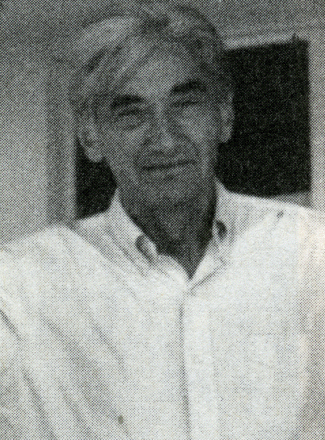
HOWARD ZINN is a historian, playwright, and social activist. He came of age in the slums of Brooklyn. His working-class immigrant home lacked even a modest library; he managed, however, to find his first book on the street. Upon reading that book, Tarzan and the Jewels of Opar, he resolved to read a great many more books, and possibly to write a few as well-he was eight, maybe nine years old. As a young adult, he worked in a shipyard for three years. He flew bomber missions during World War II, after which he returned to Brooklyn, got married, and occupied a basement apartment.
He went to college under the GI Bill and received his Ph.D. from Columbia University. He has taught at Spelman College and Boston University, and has been a visiting professor at the University of Paris and the University of Bologna. He has received the Thomas Merton Award, the Eugene V. Debs Award, the Upton Sinclair Award, and the Lannan Literary Award.
He enjoys "old, good films like Bridge on the River Kwai, and half-old, funny films like Midnight Run." He likes dramatic and political movies "if they're well done." He likes Oliver Stone "when he's doing something like Salvador." He "sneaks out" to Dunkin' Donuts for a cup of coffee (small with cream and sugar), and complements the beverage with a powdered doughnut. Once a devoted tennis player, , he now maintains his physique on daily walks. He has no pets ("they would tie me down"). He lives with his wife, painter Roslyn Zinn, in Auburndale, Massachusetts. They have two children and five grandchildren.
Is it true that you'd have preferred to write romance novels?
[laughs] Where did you get that? It's true that I'd rather write plays, which I have done. It's more fun to write for the theater because it's not as isolated an occupation.
A People's History of the United States has found its way into many places. Describe its proliferation among various languages, along with its curious development into a cartoon.
It's been translated by now into a dozen languages -- into Spanish, French, Italian, German, Turkish, Arabic, Japanese, Chinese, Korean, Swedish, Norwegian. Czech, Portuguese, and it's being translated into Russian, Greek, and Hebrew. I don't know if it will happen, but there's a group in Canada that wants to do an animated version of A People's History. And there's a group in New York that is planning a documentary series for television and schools. This would be a series of films based on A People's History, maybe six to eight hours.
A March 1999 article in The Nation opened: "The contracts are signed, the treatment is being written, and Fox Television plans to fast-track production on a ten- to twelve-hour miniseries based on lefty historian Howard Zinn's A People's History of the United States, scheduled to run early next year." Br, what happened, Howard?
That was something of an exaggeration. Maybe the writer was anticipating too much. [laughs] There was a contract with Fox Television, and Fox was at one point planning a series of films based on A People's History, and then after a few years of back and forth. they dropped the idea, after which it was taken up by HBO. We were under contract with HBO for a couple years and they actually hired a number of writers to write movie scripts -- John Sayles wrote one, Howard Fast did another, several other scripts were written -- then HBO decided against going ahead.
Do you think Fox and HBO were influenced by cultural transformations in the wake of 9/11?
It's hard to tell. When people in the film industry drop things, they don't give you explanations. And so, in the case of Fox we don't know. After all, Fox is owned by Rupert Murdoch [laughs]. Well, come to think of it, Murdoch owns HarperCollins too, and that hasn't interfered with HarperCollins's handling of the book. But did political considerations enter into it? Fox dropped it before 9/11. No, 1don't think 9/11 1had anything to do with it. They may have found that it was too difficult and complicated a project. When John Sayles's script was turned down by HBO, he said, "Well, I think HBO probably doesn't consider it sexy enough." It may be that the television medium is a very difficult form for transforming history into feature films. In 2003, A People's History sold its one millionth copy. Dick Cheney threw you a big shindig, right?
Yes it was. I recall that it took place in Dunkin' Donuts [laughs].
Seriously, though, there was a celebration at the 92nd Street YMHA, right?
Yes. We had a great cast of actors who agreed to read. We had James Earl Jones and Danny Glover and Marisa Tomei and Harris Yulin and Alfre Woodard. A number of the things they read were from the book, and a number of things were connected with the spirit of A People's History. A little book called The People Speak came out of that. We didn't just have actors reading; we had other people in the arts as well. We had Kurt Vonnegut reading Eugene Debs, Alice Walker reading a poem by Langston Hughes, and we had my son, Jeff, reading the voice of an IWW (Industrial Workers of the World) organizer and poet, Arturo Giovannitti. I can tell you that as soon as they announced the event, it was sold out almost immediately.
It's a mite unsettling to reread your account of the first Gulf War. You argue, in this account, that the United States acted in order to revive Bush Sr.'s approval ratings, and to achieve greater sway over OPEC. "But those motives," you conclude, "were not presented to the American public. It was told that the United States wanted to liberate Kuwait from Iraqi control." So, too, do you argue: "The justification for war that seemed most compelling was that Iraq was on its way to building a nuclear bomb, but the evidence for this was very weak." Care to reflect on this?
Our own intelligence agency, the CIA, had no clear evidence that Iraq could build a bomb for several years. So the evidence indeed was weak. Can you really believe that Bush Sr. was anguished over the takeover of Kuwait by Iraq? Other countries have occupied parts of other countries, and we didn't go to war over that. We didn't go to war over the Israeli occupation of Palestinian lands. So Bush's rationale for the war against Iraq was very hard to believe, given the long history of the United States's interest in Middle Eastern oil, especially since the end of World War II. For instance, the covert action to overthrow the government of Iran in 1953 came about because Iran was nationalizing oil. Iraq is the second largest possessor of oil reserves in the world. The oil motive is a far, far more likely one than the motive of liberating Kuwait.
What comparison. then, would you make between Gulf Wars I and II?
The comparison is very strong in that in both cases false reasons were given for the invasion. In the case of Gulf War I, the false reason was the takeover of Kuwait. In the case of Gulf War II, the false reason was weapons of mass destruction. Neither argument is believable. With weapons of mass destruction, it's already been shown that it was simply a deception practiced on the American people. The Bush administration was determined to go to war, and again. behind it all was oil, and the control of oil.
You don't cotton to ''just war" theories. This very likely represents your most controversial posture, and it's a real hot potato. How, though, has the present war in Iraq failed or satisfied the traditional "just war" theory?
Michael Walzer, who wrote the standard modern book on just war theory, [Just and Unjust Wars], has supported some wars. But even he says the current war doesn't meet the requirement of just cause, doesn't meet the requirement of a war for defense, doesn't meet the requirement of proportionality -- because the killing of huge numbers of Iraqi civilians, and the destruction of cities is far, far out of proportion to any possible gain in human rights that has come out of this war.
How would you critique the moral ''justification'' for, say, the war in Korea? You don't seem all that affectionate toward Truman's decision to intervene there.
Well, Korea is an example of a situation that I have described as pointing to an important difference between just cause and just war. A cause may be just -- in other words, the defense of South Korea against an invasion by North Korea may be a just cause -- but a just cause is not necessarily corrected by war. And so it maybe wrong for North Korea to invade South Korea, but it's pretty hard to justify the killing of several million people in order to prevent one half of a divided country's military action to unify that country, even though that action maybe unjust. So I think it was a misguided, immoral decision to go to war in Korea. We spent three years at war -- where were we at the end of it, with three million people dead? We still had dictatorial regimes in both North Korea and South Korea.
You persistently focus on the impact of war upon civilians. In the U.S. invasion of Panama, for instance, you note that "hundreds, perhaps thousands of civilians were killed" and upward of fourteen thousand were left homeless. How well do you think the media have reported the effects of war upon the people of Iraq?
Well, the media have been shamefully negligent in reporting the effect of the war on the civilian population of Iraq. I'm sure that if you took a poll of Americans to see how much they knew about civilian death in Iraq, you would get a blank. The British medical journal The Lancet published a report saying that up to one hundred thousand civilians in Iraq have died as a result of this war. This was in some of the newspapers for a day and then disappeared. It was not reported on any major television station. And certainly while the numbers are given of American dead, there are no numbers given of Iraqi dead. In fact, the Pentagon says it doesn't keep such records. Aside from the neglect of the reporting of Iraqi dead, the American press doesn't even give an adequate report of terrible injuries done to Americans. Maybe ten thousand to fifteen thousand Americans have been badly wounded in the war. Thousands have lost limbs or been blinded, and there has been no adequate coverage of this in the American press.
The 9/11 Commission Report was a finalist for the National Book Award. What are your thoughts about its vaguely bizarre nomination? And what, in your view, is the dominant lesson contained in this report?
Well, I think the report misses the crucial issues connected with 9/11. I think the report mostly focuses on intelligence failures, failures to anticipate 9/11, the bureaucratic inefficiency -- the FBI and the CIA and the lack of sufficient communication between them. It seems the main proposals that came out of this report were proposals for reorganizing intelligence agencies. Now all of this is very superficial. All of this ignores fundamental questions about 9/11. The most fundamental questions being: What were the motives behind those attacks, and to what extent were those motives connected with American foreign policy? The 9/11 Commission dodges the issue of relationships between American foreign policy and the creation of enormous anger in the Middle East -- an anger which is felt by millions of people in the Middle East, which then leads to a small number of fanatics engaging in terrorist attacks. To point to the way in which American foreign policy has inflamed people against us and therefore led to terrorist attacks is not therefore to justify, of course, the terrorist attack; it's simply to say we need to look for more profound causes of 9/11 than intelligence failures.
President Clinton -- what do you consider his greatest achievement and his biggest disappointment?
His greatest achievement ... well, the truth is, I don't believe that Bill Clinton had any great achievements in office. If you can begin to talk about a greatest achievement, you can say it was a negative one. It was a negative one meaning he did not plunge his country into war the way his successor did. On the other hand, his foreign policy was an aggressive one. His maintenance of sanctions against Iraq was responsible for the deaths of hundreds of thousands of people, according to United Nations officials. He was the first to raise the specter of weapons of mass destruction, and used that in order to bomb Iraq again and again while not engaging in major war. He continued what Reagan had started, and that is the attempt to dismantle FDR's social reform program by doing away with aid to families with dependent children. So I think his administration only did good in relation to the administration that followed him. At one point, Clinton's secretary of state, Madeleine Albright, was questioned about the deaths of all the people in Iraq as the result of sanctions, and she said, "It was worth it, we had to pay that price." Well, of course, we didn't pay that price; the children of Iraq paid that price. One of the first things Clinton did when he came into office was to bomb Baghdad -- supposedly because Baghdad was responsible for a failed assassination attempt on George Bush, Sr., but there was no proof for that. He was obviously trying to show that he was a tough guy. a tough president who would be willing to use military means to boost his standing with the public. So Bill Clinton is to my mind one of the most overrated presidents of the last several decades.
What do you admire most about the United States?
Let me make it clear that when I say "admire the United States, " the United States is not the government. There is very little in the government that I admire -- certainly not in the present, and certainly not in recent years -- but there is much that I admire in the United States, and what I admire is the spirit of independence and thought, which has allowed so many Americans to protest against policies they disagreed with. What I admire most in the United States is the spirit of those people who have protested against the war in Iraq, those black people in the South who demonstrated and protested and risked so much to do away with racial segregation. That is what is most admirable about this country. Working people who have been trying in every possible way against great odds to improve conditions in their lives. I read about hotel workers going out on strike, or the United Parcel workers going out on strike to better their conditions that is part of the noble tradition in America of working people getting together and doing what the government will not do for them, trying to create a modicum of economic justice.
You are frequently called a "radical" historian. Do you accept this label?
I like it. I accept it. Because I believe radical solutions are needed. "Radical" means getting to the roots, means going to fundamental things. and I believe we need fundamental changes in our society, fundamental changes in ending policies of war and expansion, fundamental changes in our economic system. fundamental changes in dealing with the environment -- all of those are radical, you might say.
How might this term, radical, correspond to your actions off the page throughout your lifetime?
Well, I suppose the civil rights movement was considered a radical movement in the South until it sparked the national movement of support. The young people in the SNCC (Student Nonviolent Coordinating Committee, pronounced "snick"), mostly young black people in the South, were considered the radical part of the civil rights movement, and I was involved with them. I was on their executive committee. They did what were considered radical things: sit-ins and demonstrations and acts of civil disobedience.
And you participated in sit-ins?
That's right. I was teaching in the South, and living with my family in Atlanta, Georgia, teaching at Spelman College, a black women's college, and became involved with the SNCC, and went around the South from Atlanta to Albany, Georgia. and Selma, Alabama, and various towns in Mississippi, and participated in what the movement was doing.
How did being there, at that time, influence your approach to writing and communicating history?
Being involved in the southern movement, and being aware that what was happening at the grass roots in the South was not being recorded, made me very conscious of the idea of a people's history. Most history skims the surface and records things from the top; tells us what presidents did, or Congress, or the Supreme Court. What was happening below, in the South -- the church meetings, the things that ordinary black people were doing to struggle against segregation -- these things were not being recorded. So what that experience of being involved in the southern movement did for me was to give me a different idea of what democracy is. Because in junior high school, and in our schools in general, democracy is presented as the structure of government: the Constitution. the three branches of government. What I realized is that democracy does not come through these institutions. These institutions are very often obstacles to democracy. and democracy comes alive when ordinary people get together and create a social movement for change, as they did in the civil rights movement and the antiwar movement and the women's movement. That was probably the most important thing I learned while teaching and being active in the South for seven years.
Have you ever broken down and posted a copy of your book to, say, a reactionary president or senator?
I've never done anything like that. Other people have. When I wrote a book during the early years of the Vietnam War, a book called Vietnam: The Logic of Withdrawal, there was a businessman in Ohio who bought up five hundred copies and sent one to every congressman, and to President Johnson.
Did you ever learn whether this approach achieved an impact?
Well, let's put it this way, the war continued. The last chapter in the book was a speech I'd written for Johnson -- not ordered by him [laughs] -- announcing our withdrawal from Vietnam. Of course Johnson never delivered that speech, although the following year he did refuse to run again, and began peace negotiations. I don't want to claim that my book led to that. I don't think my book had a direct effect on people in office. That book went through seven or eight printings, and I think it had its effect mostly on people who joined the peace movement.
More and more, the Left seems hell-bent on reclaiming the religious high ground. This effort commenced before the installation of George W. Bush, but the effort spiked somewhat after his reelection. How do you view this trend?
I think it's a good thing for the Right-wing capture of the Bible to be challenged, and for people who are progressive and religious -- like Jim Wallis, like Harvey Cox, like Daniel Berrigan -- to point out statements in the Bible that support the idea of peace and equality, and serving the poor rather than the rich. Theological doctrines and the Bible are susceptible to all sorts of interpretations, and therefore it is wrong to allow one political group to monopolize the interpretation of the Bible, and it is right to offer a challenge that will cause Christians to think about whether Jesus would approve of war, would approve of siphoning off the wealth of the country for the rich.
Is there anything you would like to add, Howard?
I think that it's extremely important for young people to learn a different history that will make them skeptical of what they hear from authority. I think if young people knew, for instance, the history of lies and violence that have accompanied American foreign policy, they would not be enticed into joining the armed forces.