Re: Freda Bedi Cont'd (#3)
Posted: Mon Oct 25, 2021 5:21 am
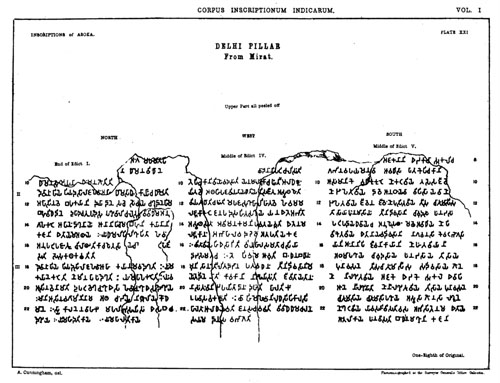
XXI. Inscriptions on the Staff of Firuz Shah, translated from the Sanscrit, as explained by Radha Canta Sarman. Excerpt from Asiatic Researches, Volume 1
P. 315-317.
1788
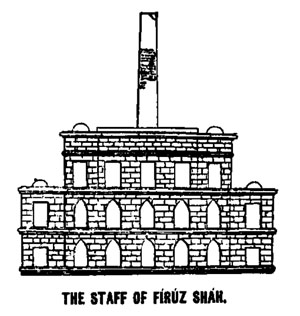
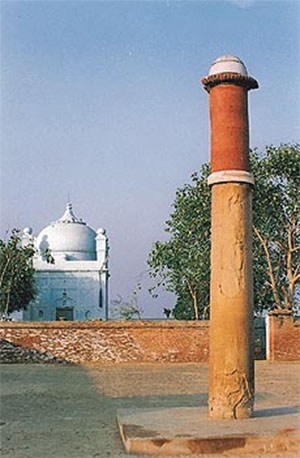
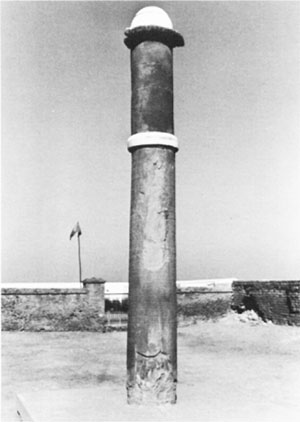
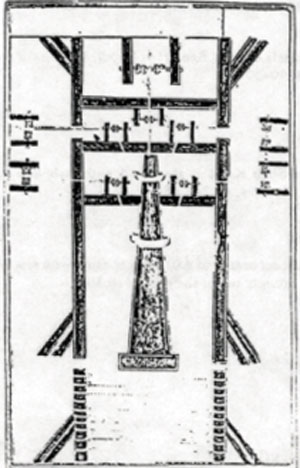
The Staff of Firuz Shah.
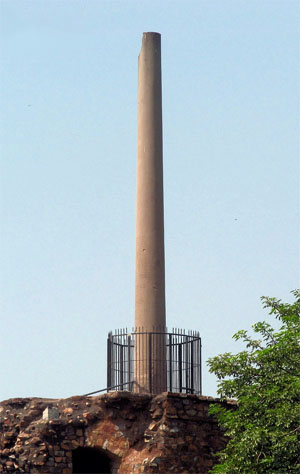
[10'4" circumference at base / 37' tall / red]
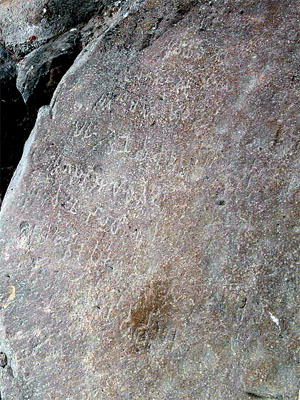
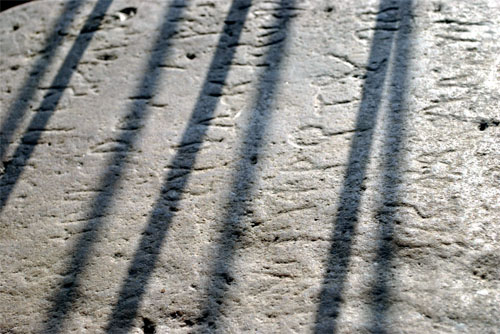
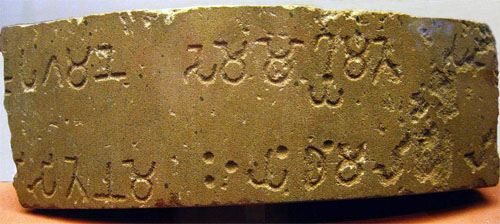
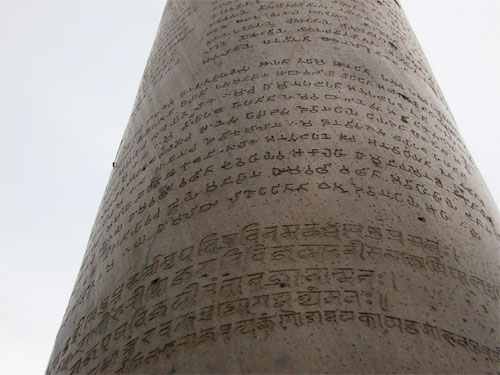
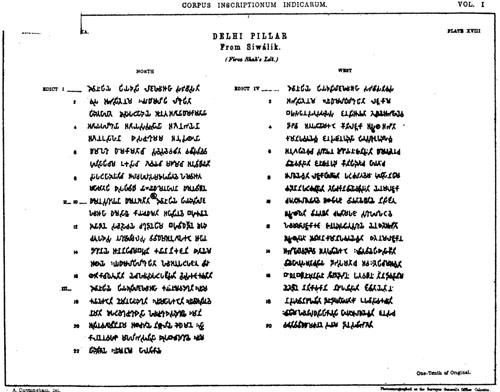
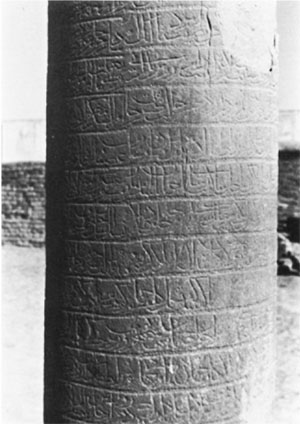
In a very singular monument near Delhi, an outline of which is here exhibited, and which the natives call the Staff of Firuz Shah, are several old inscriptions partly in ancient Nagari letters, and partly in a character yet unknown; and Lieutenant Colonel Polier, having procured exact impressions of them, presents the Society with an accurate Copy of all the Inscriptions. Five of them are in Sanscrit, and, for the most part, intelligible; but it will require great attention and leisure to decypher the others. If the language be Sanscrit, the powers of the unknown letters may, perhaps, hereafter be discovered by the usual mode of decyphering; and that mode, carefully applied even at first, may lead to a discovery of the language. In the mean time, a literal version of the legible Inscriptions is laid before you. They are, on the whole, sufficiently clear; but the sense of one or two passages is at present inexplicable.
I.
The first, on the southwest side of the pillar, is perfectly detached from the rest: it is about seventeen feet from the base, and two feet higher than the other inscriptions.
OM.
In the year 1230, on the first day of the bright half of the month Vaisach (a monument) of the Fortunate Visala Deva Son of the Fortunate Amilla Deva, King of Sacambhari.
II.
The next, which is engraved as a specimen of the character, consists of two stanzas in four lines; but each hemistich is imperfect at the end, the two first wanting seven, and the two last five, syllables. The word Sacambhari in the former inscription enables us to supply the close of the third hemistich.
OM.
As far as Vindhya, as far as Hsinadri, (the Mountain of Snow,) he was not deficient in celebrity ... making Aryaverta (the Land of Virtue, or India) even once more what its name signifies ... He having departed, Prativahaamana Tilaca (is) king of Sacambhari: (Sacam only remains on the monument.) By us (the region between) Himawat and Vindhya has been made tributary.
In the year from Sri Vicramaditta 123 [A.D. 67], in the bright half of the month Vaisach ... at that time the Rajaputra Sri Sallaca was Prime Minister.
The second stanza, supplied from the last inscription, and partly by conjecture, will run thus:
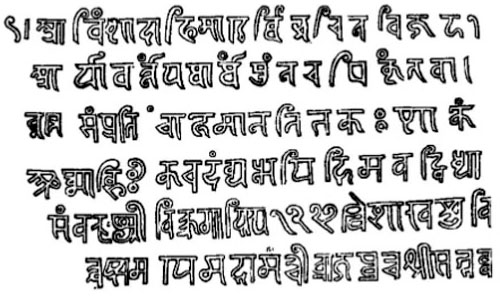
The date 123 [A.D. 67] is here perfectly clear; at least it is clear that only three figures are written, without even room for a cypher after them; whence we may guess that the double circle in the former inscription was only an ornament, or the neutral terminal am; if so, the date of both is the year of Christ sixty-seven; but if the double circle be a Zero, the monument of Visala Deva is as modern as the year 1174, or nineteen years before the conquest of Delhi by Shihabuddin.
III and IV.
The two next inscriptions were in the same words, but the stanzas, which in the fourth are extremely mutilated, are tolerably perfect in the third, wanting only a few syllables at the beginning of the hemistichs:
This inscription was engraved, in the presence of Sri Tilaca Raja, by Sripati, the son of Mahava, a Cayastha, of a family in Gauda, or Bengal.
V.
The fifth seems to be an elegy on the death of a king named Vigraha, who is represented as only slumbering. The last hemistich is hardly legible, and very obscure; but the send of both stanzas appears to be this.
OM.
1. An offence to the eyes of (thy) enemy's consort (thou) by whom fortune was given to every suppliant, thy fame, joined to extensive dominion, shines, as we desire, before us. The heart of (thy) foes was vacant, even as a path in a desert, where men are hindred from passing, O fortunate Vigraha Rajadeva, in the jubilee occasioned by thy march.
2. May thy abode, O Vigraha, sovereign of the world, be fixed, as in reason, (it ought) in the bosoms, embellished with love's allurements, and full of dignity, of the women with beautiful eyebrows, who were married to thy enemies! Whether thou art Indra, or Vishnu, or Siva, there is even no deciding: thy foes (are) fallen, like descending water. Oh! why dost thou through delusion, continue sleeping?
P. 315-317.
1788
I now proceed to lay before the Society the results of my application of the alphabet, developed by the simple records of Bhilsa, to the celebrated inscription on Feroz's column, of which facsimiles have been in the Society's possession since its very foundation, without any successful attempt having been made to decipher them. This is the less to be wondered at when we find that 500 years before, on the re-erection of the pillar, perhaps for the second or third time, by the emperor Feroz [r. 1351–1388)], the unknown characters were just as much a mystery to the learned as they have proved at a later period — "Round it" says the author of the Haftaklim, "have been engraved literal characters which the most intelligent of all religions have been unable to explain. Report says, this pillar is a monument of renown to the rajas or Hindu princes, and that Feroz Shah set it up within his hunting place: but on this head there are various traditions which it would be tedious to relate."
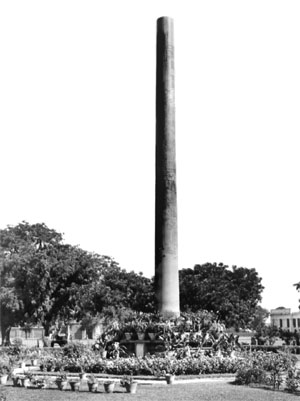
Neither Muhammed Ami'n the author of the Haftaklim [Muhammad Amin Razi, [x], vide Amin Ahmad, author of the Haft Aklim -- The Oriental Biographical Dictionary], nor Ferishteh, in his account of Feroz's works alludes to the comparatively modern inscription on the same pillar recording the victories of Visala Deva king of Sacambhari (or Sambhar) in the 12th century, of which Sir William Jones first, and Mr. Colebrooke afterwards, published translations in the first and seventh volumes of the Researches. This was in quite a modern type of Nagari; differing about as much from the character employed on the Allahabad pillar to record the victories of Chanara and Samudra-gupta, as that type is now perceived to vary from the more ancient form originally engraven on both of these pillars; so that (placing Chandra-gupta, in the third or fourth century, midway between Visala, in the Samvat year 1220, and the oldest inscription) we might have roughly deduced an antiquity of fourteen or fifteen centuries anterior to Visala's reign for the original lat alphabet, from the gradual change of form in the alphabetical symbols, had we no better foundation for fixing the period of these monuments.
But in my preceding notice, I trust that this point has been set at rest, and that it has been satisfactorily proved that the several pillars of Delhi, Allahabad, Mattiah and Radhia were erected under the orders of king Devanampiya Piyadasi of Ceylon, about three hundred years before the Christian era.
VI.—Interpretation of the most ancient of the inscriptions on the pillar called the lat of Feroz Shah, near Delhi, and of the Allahabad, Radhia [Lauriya-Araraj (Radiah)] and Mattiah [Lauriya-Nandangarh (Mathia)] pillar, or lat, inscriptions which agree therewith., by James Prinsep, Sec. As. Soc. &c.
I have the pleasure of presenting to the Society a Book of Drawings and Inscriptions prepared under the inspection of their late member, Captain James Hoare, and intended by him (I have reason to believe) for the life of the Society.
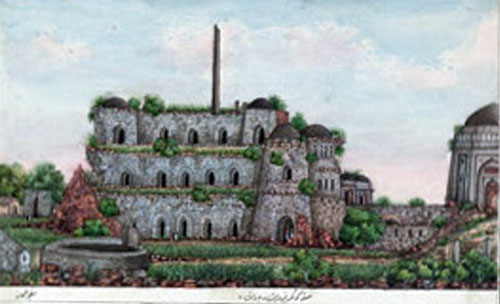
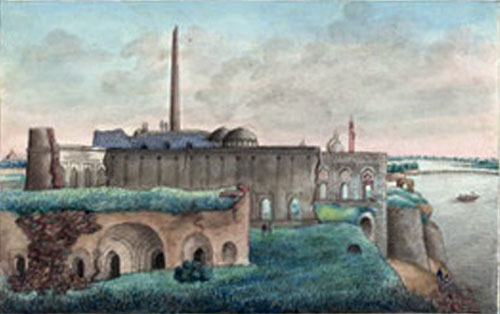
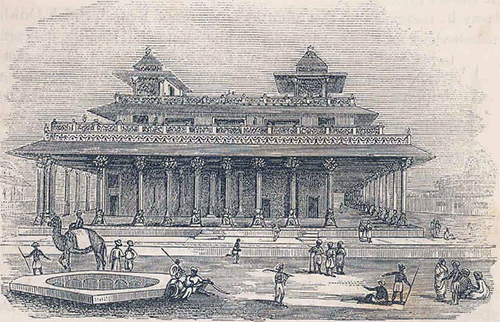
Two of the drawings represent elevations, taken on the spot, of the stone building near Dehlee, called the Shikargah, or hunting place, of Feeroz Shah; with the pillar in the center, and above the summit of it, commonly known by the designation of Feeroz Shah’s Lat; and described, with an outline of the building and pillar, in the 21st paper of the 1st Vol. of the Society’s Transactions. The copy of the inscriptions on this pillar, which was received by our revered President and Founder from Colonel Polier, enabled him to exhibit a translation of one of them, as accurate as the imperfect state of the transcript would admit; but on comparing it with a more perfect copy made by Captain Hoare, it was found in several parts defective and inaccurate; and the date, instead of being 123 of the era of Vicramaditya, or A.D. 67, as appeared from the former copy, was clearly ascertained, from the present, to be 1220 of the above era, or A.D. 1164. An accurate translation of this inscription has therefore been furnished by Mr. Henry Colebrooke, (who has distinguished himself as a Sanscrit scholar by his version of the Hindoo Law Digest, compiled under the superintendence of Sir William Jones,) and is now submitted to the Society, with the original Sanscrit in Roman letters.
-- Translation of one of the Inscriptions on the Pillar At Dehlee, called the Lat of Feeroz Shah, Excerpt from Asiatic Researches, Volume 7, by Henry Colebrooke, Esq., With Introductory Remarks by Mr. Harington.
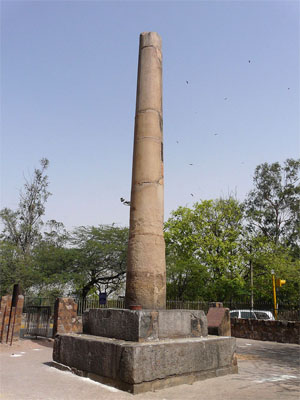
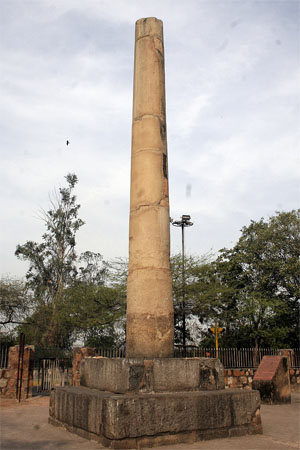
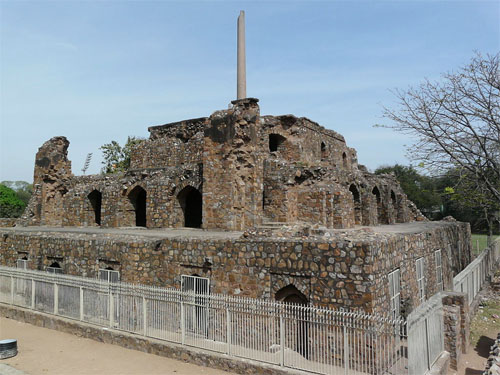
Ashoka Pillar at Feroze Shah Kotla, Delhi, 1861.
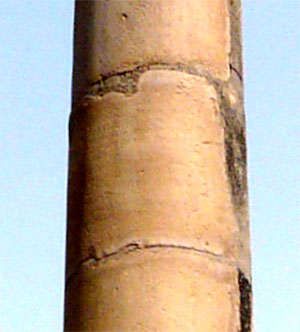
A pristine polished sandstone Topra Ashokan pillar from the 3rd century BC rises from the palace's crumbling remains, one of many pillars of Ashoka left by the Mauryan emperor; it was moved from Topra Kalan in Pong Ghati of Yamunanagar district in Haryana to Delhi under orders of Firoz Shah Tughlaq of Delhi Sultanate, and re-erected in its present location in 1356. The original inscription on the obelisk is primarily in Brahmi script but language was Prakrit, with some Pali and Sanskrit added later. The inscription was successfully translated in 1837 by James Prinsep. This and other ancient lats (pillars, obelisk) have earned Firoz Shah Tughlaq and Delhi Sultanate fame for its architectural patronage....
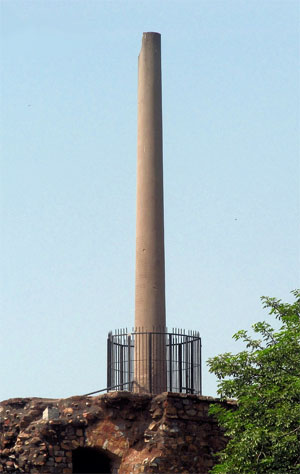
Feroz Shah Tughlaq (r. 1351–1388), the Sultan of Delhi, established the fortified city of Firozabad in 1354, as the new capital of the Delhi Sultanate, and included in it the site of the present Feroz Shah Kotla. Kotla literally means fortress or citadel. The pillar, also called obelisk or Lat is an Ashoka Column, attributed to Mauryan ruler Ashoka. The 13.1 meters high column, made of polished sandstone and dating from the 3rd century BC, was brought from Ambala in the 14th century under orders of Feroz Shah. It was installed on a three-tiered arcaded pavilion near the congregational mosque, inside the Sultanate's fort. In centuries that followed, much of the structure and buildings near it were destroyed as subsequent rulers dismantled them and reused the spolia as building materials....
The Ashokan Pillar which is now within Feroz Shah Kotla is towards the north of Jama Masjid [Mosque]. The Pillar was first erected by King Ashoka between 273 and 236 BC in Topra Kalan, Yamunanagar district, Haryana.
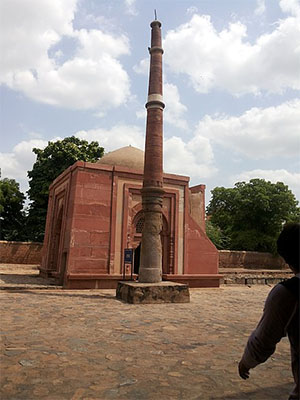
Of note, there is another Ashokan Pillar, that is seen installed near the Hindu Rao Hospital, also erected by King Ashoka in Meerut. This pillar, however, was unfortunately broken into five pieces after it was damaged during an explosion. The pillar was neglected for a century up till 1838 when after the Revolt of 1857 Raja Hindu Rao took charge to transfer the Ashokan Pillar's broken pieces to Kolkata's Asiatic Society. Within a year, the structure was put together and re-established.
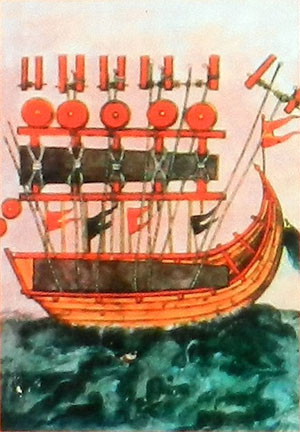
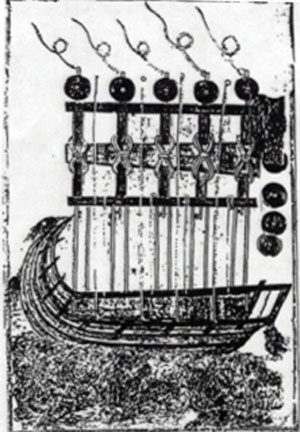
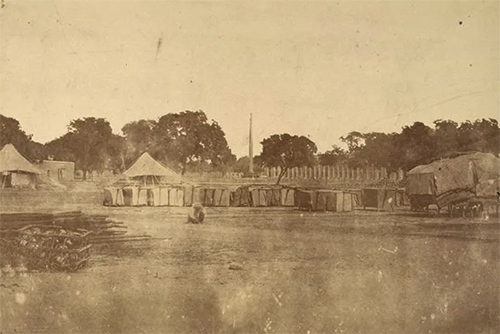
Both the Ashokan Pillars were carefully wrapped with cotton silk and were kept on a bed of reed made of raw silk. These were hence transported on a massive carriage attached with 42 wheels and drawn meticulously by 200 men from their original places to Delhi by Feroz Shah Tughlaq to avoid any damage during the journey. Upon reaching Delhi, they were then transported on huge boats to their final destination, one within Feroz Shah Kotla and the other on the ridge near Delhi University and Bara Hindu Rao Hospital.
-- Feroz Shah Kotla, by Wikipedia
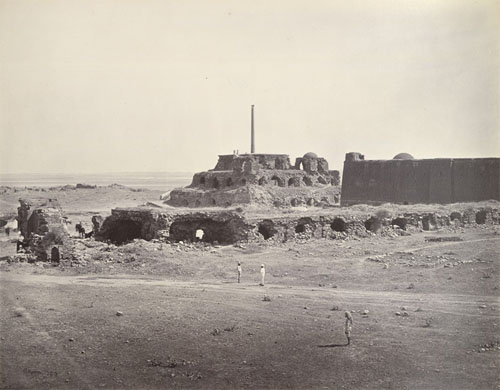
The Staff of Firuz Shah.
[10'4" circumference at base / 37' tall / red]
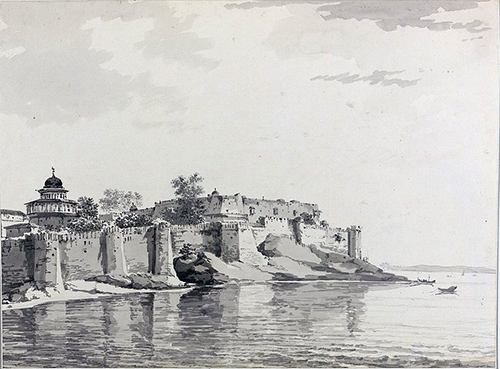
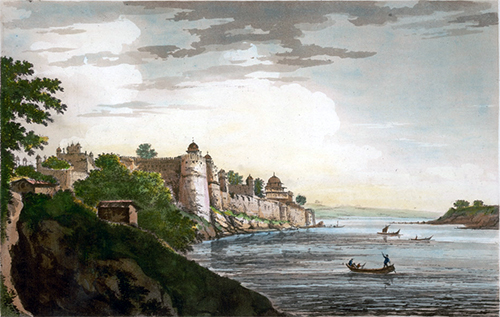
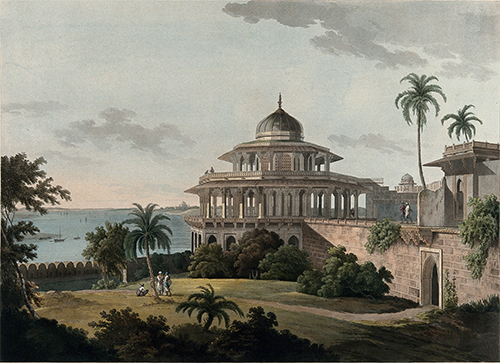
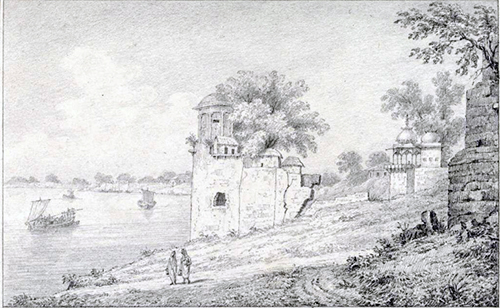
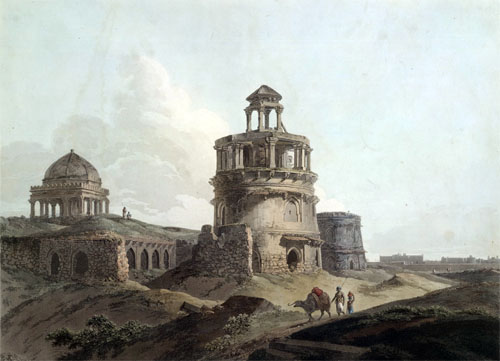
Remains of an Ancient Building near Firoz Shah's Cotilla
Artist and engraver: Daniell, Thomas (1749-1840)
Date: 1795
Plate 7 from the first set of Thomas Daniell's 'Oriental Scenery.' In the 14th Century Delhi was the capital of the Tughluqs, powerful rulers whose kingdom encompassed almost all of the subcontinent. The citadel (Daniell's Cotilla or kotla) of Firuz Shah, on the river Jumna, was built by Firuz Shah Tughluq, who ruled between 1351 and 1388. The buildings in this aquatint no longer exist and the citadel is now in the south-east of modern Delhi. The course of the Jumna has now shifted eastwards. This view was reproduced on a Staffordshire earthenware dish around 1810-20.
-- British Library Online Gallery, bl.uk
He had a large personal library of manuscripts in Persian, Arabic and other languages. He brought 2 Ashokan Pillars from Meerut, and Topra near Radaur in Yamunanagar district of Haryana, carefully cut and wrapped in silk, to Delhi in bullock cart trains. He re-erected one of them on the roof of his palace at Firoz Shah Kotla.
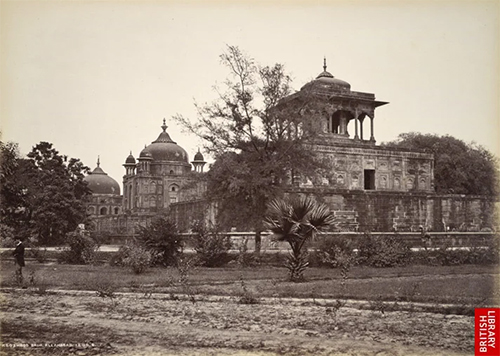
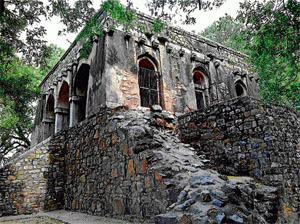
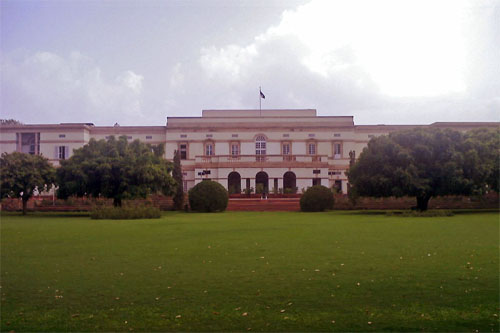
... When the Qutb Minar struck by lightning in 1368 AD, knocking off its top storey, he replaced them with the existing two floors, faced with red sandstone and white marble. One of his hunting lodges, Shikargah, also known as Kushak Mahal, is situated within the Teen Murti Bhavan complex, Delhi.
Sikargah or Kushak Mahal, 14th-century hunting lodge built by Firoz Shah Tughlaq.
Teen Murti Bhavan: Residence of India's first Prime minister, Pt. Jawaharlal Nehru
-- Teen Murti Bhavan, by Wikipedia
-- Firuz Shah Tughlaq, by Wikipedia
In a very singular monument near Delhi, an outline of which is here exhibited, and which the natives call the Staff of Firuz Shah, are several old inscriptions partly in ancient Nagari letters, and partly in a character yet unknown; and Lieutenant Colonel Polier, having procured exact impressions of them, presents the Society with an accurate Copy of all the Inscriptions. Five of them are in Sanscrit, and, for the most part, intelligible; but it will require great attention and leisure to decypher the others. If the language be Sanscrit, the powers of the unknown letters may, perhaps, hereafter be discovered by the usual mode of decyphering; and that mode, carefully applied even at first, may lead to a discovery of the language. In the mean time, a literal version of the legible Inscriptions is laid before you. They are, on the whole, sufficiently clear; but the sense of one or two passages is at present inexplicable.
I.
The first, on the southwest side of the pillar, is perfectly detached from the rest: it is about seventeen feet from the base, and two feet higher than the other inscriptions.
OM.
In the year 1230, on the first day of the bright half of the month Vaisach (a monument) of the Fortunate Visala Deva Son of the Fortunate Amilla Deva, King of Sacambhari.
II.
The next, which is engraved as a specimen of the character, consists of two stanzas in four lines; but each hemistich is imperfect at the end, the two first wanting seven, and the two last five, syllables. The word Sacambhari in the former inscription enables us to supply the close of the third hemistich.
OM.
As far as Vindhya, as far as Hsinadri, (the Mountain of Snow,) he was not deficient in celebrity ... making Aryaverta (the Land of Virtue, or India) even once more what its name signifies ... He having departed, Prativahaamana Tilaca (is) king of Sacambhari: (Sacam only remains on the monument.) By us (the region between) Himawat and Vindhya has been made tributary.
In the year from Sri Vicramaditta 123 [A.D. 67], in the bright half of the month Vaisach ... at that time the Rajaputra Sri Sallaca was Prime Minister.
The second stanza, supplied from the last inscription, and partly by conjecture, will run thus:
vritte sa prativahamana tilacah sacambharibhupatik
aswabhik caradam vyadhayi himawadvinahyatavimana alam.
The date 123 [A.D. 67] is here perfectly clear; at least it is clear that only three figures are written, without even room for a cypher after them; whence we may guess that the double circle in the former inscription was only an ornament, or the neutral terminal am; if so, the date of both is the year of Christ sixty-seven; but if the double circle be a Zero, the monument of Visala Deva is as modern as the year 1174, or nineteen years before the conquest of Delhi by Shihabuddin.
III and IV.
The two next inscriptions were in the same words, but the stanzas, which in the fourth are extremely mutilated, are tolerably perfect in the third, wanting only a few syllables at the beginning of the hemistichs:
He who is resentful to kings intoxicated with pride, indulgent to those whose necks are humbled, an INDRA in the city of Causambi (I suspect Causambi, a city near Hastinapur, to be the true reading,) who is victorious in the world, Visala, sovereign of the earth: he gives ... his commands being obeyed, he is a conqueror, the son of Santanajana, whose mind, when his foes say, 'Let there be mercy,' is free from further hostility.yak cshiveshu praharta nripatishu vinamatcandhareshu prasannah
--vah sambi purindrah jagata vijayate visala cahonipalah
... da sajnya esha vijayl santanajanatmajah
... punan cshemastu bruvatamudyogasunyanmanah
This inscription was engraved, in the presence of Sri Tilaca Raja, by Sripati, the son of Mahava, a Cayastha, of a family in Gauda, or Bengal.
V.
The fifth seems to be an elegy on the death of a king named Vigraha, who is represented as only slumbering. The last hemistich is hardly legible, and very obscure; but the send of both stanzas appears to be this.
OM.
1. An offence to the eyes of (thy) enemy's consort (thou) by whom fortune was given to every suppliant, thy fame, joined to extensive dominion, shines, as we desire, before us. The heart of (thy) foes was vacant, even as a path in a desert, where men are hindred from passing, O fortunate Vigraha Rajadeva, in the jubilee occasioned by thy march.
2. May thy abode, O Vigraha, sovereign of the world, be fixed, as in reason, (it ought) in the bosoms, embellished with love's allurements, and full of dignity, of the women with beautiful eyebrows, who were married to thy enemies! Whether thou art Indra, or Vishnu, or Siva, there is even no deciding: thy foes (are) fallen, like descending water. Oh! why dost thou through delusion, continue sleeping?