"Science," the Greek word for knowledge, when appended to the word "political," creates what seems like an oxymoron. For who could claim to know politics? More complicated than any game, most people who play it become addicts and die without understanding what they were addicted to. The rest of us suffer under their malpractice as our "leaders." A truer case of the blind leading the blind could not be found. Plumb the depths of confusion here.
YOU ARE REQUIRED TO READ THE COPYRIGHT NOTICE AT THIS LINK BEFORE YOU READ THE FOLLOWING WORK, THAT IS AVAILABLE SOLELY FOR PRIVATE STUDY, SCHOLARSHIP OR RESEARCH PURSUANT TO 17 U.S.C. SECTION 107 AND 108. IN THE EVENT THAT THE LIBRARY DETERMINES THAT UNLAWFUL COPYING OF THIS WORK HAS OCCURRED, THE LIBRARY HAS THE RIGHT TO BLOCK THE I.P. ADDRESS AT WHICH THE UNLAWFUL COPYING APPEARED TO HAVE OCCURRED. THANK YOU FOR RESPECTING THE RIGHTS OF COPYRIGHT OWNERS.
For Lawrence G. Barrett, whose life of character and courage ended halfway through this project but who won the distribution rights in heaven
Table of Contents:
• Inside Cover • Preface • 1. Millennial Man • 2. "Aggressive Traits" and "Haphazard Associations" • 3. All in the Family: Crooks, Cops and a Junkie • 4. Launching a Legend • 5. A Star Rises on the Potomac • 6. Heat Stroke: Delusions About Duvalier • 7. Mr. Untouchable • 8. The War Against Greed • 9. Looking for Love: The Ed Koch Investigation • 10. In John Lindsay's Footsteps • 11. Blood Feud: The Fight with the Fonz • 12. Political Possession of Stolen Property • 13. A Season of Compromise: Preparing for 1993 • 14. Seizing City Hall • 15. Metamorphosis of a Mayoralty • 16. Brutal Blindside: No Benefits, No Doubts • 17. These Statistics Are a Crime • 18. Soap Opera Schools • 19. Sex and the City • 20. More Sex and the City • 21. Soiling Mr. Clean • Notes • Acknowledgments • Index
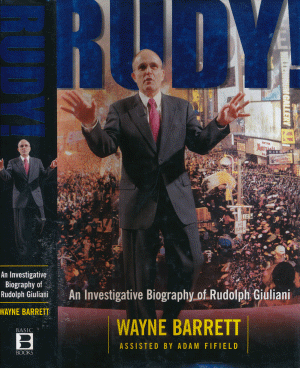
Rudy Giuliani. New York City's Mayor. America's Number One Cop. A municipal superhero who needs no phone booth. A politician of astonishing complexity whose full story has never been told. Until now.
Giuliani has assumed mythic proportions, the can-do emblem of the new urban politics. He has been heralded as the ultimate turn-around artist -- projecting himself as the reformer who single-handedly salvaged a crime-ridden and blighted New York. From his days in the eighties as the Michael Milken-busting U.S. Attorney of Manhattan to his current purge of hundreds of thousands from his city's welfare rolls, Giuliani has targeted rich and poor with the same relentless certitude.
This investigative biography starts with the college kid who confided his presidential dream to his girlfriend and practiced future campaign speeches in front of her at home. It analyzes his substantial impact as U.S. Attorney, badly wounding the Mafia, storming the white collared halls of Wall Street and forever changing the face of New York politics. It looks at his celebrated crime reduction and other achievements through a new lens, highlighting the single-mindedness that has made Giuliani one of America's most important and controversial figures.
With two marriages as troubled and secretive as his family history, Giuliani is on every New Yorker's therapeutic couch, stirring feelings as intense as the ones that visibly boil inside of him. Though he has become a national legend, his re-election total in 1997 was the lowest in seventy-four years.
Wayne Barrett, co-author of the best-selling City for Sale, draws on twenty years of reporting on Giuliani to bring us the most comprehensive and news-breaking biography of a man of giant contradictions and unpredictable expectations.
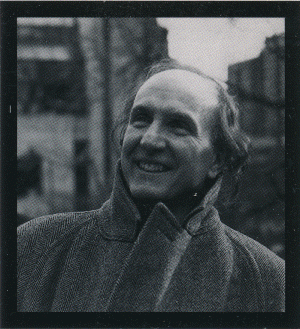
WAYNE BARRETT (above) is a senior editor at the Village Voice, where he's been covering politics for twenty-two years. He is the author of Trump: The Deals and the Downfall and co-author of City for Sale. He was awarded the 1990 Columbia University Graduate School of Journalism Alumni Award as well as numerous other journalism prizes.
ADAM FIFIELD, who assisted Barrett, recently published his own first book, A Blessing over Ashes (William Morrow).
Jacket design: Rick Pracher; jacket photograph: Ruby Washington; NYT Pictures; author photograph: Catherine Dodge-Smith.
I FIRST MET RUDY GIULIANI IN 1979 WHILE REPORTING A NEW YORK magazine cover story critical of the public corruption record of the u.s. Attorney's Office in the Southern District of New York. Rudy was a babyfaced, thirty-five-year-old partner at Patterson Belknap, and Tom Puccio, the Abscam prosecutor from the competing Eastern District office across the river, steered me to him to get the SDNY's best defense. I wasn't disappointed. Not surprisingly, all the examples of effective corruption prosecutions Giuliani described over the prior decade involved the same young former assistant-the one apparently born with a comb-over.
Puccio was also responsible for our second meeting more than three years later, when Giuliani returned to New York from a second stint in Washington, where he was associate attorney general. I had written a series of stories that led to a grand jury probe of then-congressman Chuck Schumer. The U.S. attorney in the Eastern District and several high-level Justice Department officials had approved his indictment based on an arguable interpretation of the mail fraud statutes. Giuliani helped kill it. So Puccio arranged a clear-the-air lunch with my Village Voice colleague Jack Newfield and myself.
I got to know Rudy well during his five-and-a-half-year term as U.S. attorney. We had periodic dinners and countless conversations. When he tried the municipal corruption case against Democratic powerhouse Stanley Friedman and several other defendants in 1986-a trial moved to New Haven, Connecticut, in search of an untainted jury-I saw him every day for ten weeks. Puccio, Friedman's lawyer, was responsible once again: It was his change of venue motion that created the closed-colony effect of the trial.
Giuliani was the hero of my first book, City for Sale, the 1989 chronicle of the corruption scandals of Mayor Ed Koch's administration, which I co-authored with Newfield. He celebrated with us at the book party.
When he left law enforcement for politics, our relationship changed. I never had another meal with him. We still talked often-mostly by phone-though I went to his law offices and campaign headquarters for periodic head-to-heads. In 1989, I was the first reporter on the Inner City Broadcasting story-a scandal involving stock owned by Rudy's opponent in the New York City mayor's racethat helped him close an eighteen-point gap. He wound up losing by the closest margin in modern city history.
We stayed in frequent contact through the next four years, during which he functioned as a kind of mayor-in-exile and I lifted one rock after another, exposing the administration he hoped to topple. When I banged him hard as well, though, in the 1993 campaign, our relationship changed again. After he won, he told me in a whisper that "Donna thinks you betrayed us" -a reference to his wife, Donna Hanover, the professional journalist in the family. We had a few conversations and interviews in 1994, his first year as mayor, but he was suspicious and highly circumspect. I would never see again the open side of him-which I had seen so often before, a side he turns off and on with an inner, early-alert switch.
When he took a sharp rightward turn with the times in 1995, I wrote plaintive stories appealing to the Rudy I once knew. From then on, as the policies and ethics of his administration disappointed, I became more and more critical. He refused, of course, to talk to me for this book. City commissioners like Henry Stern, whom I have known for almost twenty-five years, told me he asked them not to, and that they were abiding by his rule. His best friend and former deputy, Peter Powers, as decent a public servant as I have known in decades of reporting, talked with me several times about sitting down but finally passed. I kept making it clear that these sources could restrict themselves to telling me only the good news about him, yet they wouldn't meet.
It got so bad that Sunny Mindel, the mayor's press secretary, refused to give me press releases. She twice told me to put the request in writing, then ignored two letters. She earns six figures a year as the top public information officer in city government. She knew a lawsuit would never get resolved before the book would be published.
The book, no doubt, suffers from this recent stonewall. I have never met a thoughtful subject who couldn't change my mind about some element of a story. So could his friends. But for everyone who wouldn't talk, many did. Six of Rudy's relatives sat down, one for eighteen hours. Associates from every phase of his premayoral life did. And so much about any government, no matter how secretive, is by definition available that efforts like Mindel's are silly. (I got most of the releases elsewhere anyway.)
People who are or were inside his government-with courageous exceptions like Lilliam Paoli-talked to me off the record, but in Rudvland that is common. In 1999, the Sunday New York Times Magazine published a favorable profile of Giuliani called "Introducing Mr. Nice Guy" that set an all-time Times record for blind quotes. People who were praising him insisted on being quoted anonymously, apparently fearful he might be upset that they'd talked at all, to say nothing of what might happen if they got a nuance wrong. Only Rudy's concern about boosting the 6 percent rise in the murder rate in 1999 could have kept them safe.
There is, in any event, just one anonymous source who plays a large role in two chapters-the fly on the wall in Harold Giuliani's bar. His reasons for anonymity lie in the life of criminality he described. I did not decide to use any quotes from him until we verified an extraordinary list of pivotal facts he first told us, ranging from the criminal records of Giuliani family members to the names of their partners, in-laws and lawyers. He even correctly identified what prisons they'd gone to, as well as locations of crimes and other vital events later confirmed by court and property records. As unfailingly accurate as this source was, I chose not to use his most shocking information about Harold and the Brooklyn bar.
The book clearly has a point of view. I lived for fifteen years in Ocean Hill- Brownsville, perhaps the city's poorest neighborhood, a white man in a black world. When Rudy ran for re-election in 1997 against a little-known white woman, he got 14 percent of the vote in myoid Brownsville district, a record of rejection unparalleled by any incumbent mayor in identifiable history, including other Republicans. With four years and extraordinary resources to make a friend here or there, exit polls said more than eight out of ten black voters citywide voted for Anybody But Rudy.
Though I left Brownsville many years ago, the experience still frames much of how I see New York politics and government. Through that lens, race is at the heart of Rudy's story; references to it can be found inside almost every chapter. It has also been one of the prime themes of my nearly twenty-three years of Voice work.
The other theme has always been public integrity. It is what drew me to Rudy in the first place. My investigative work knows no ideological or partisan limitations- every major Democrat on my beat has taken a hit on my keyboard. Particularly in the 1989 mayoral election, the choice between Rudy and his black opponent, David Dinkins, was a choice between these two motivating values of my journalism and my life. It was the only time I drew the curtain behind me in a voting booth still undecided about which lever to pull.
I identified with Rudy in so many ways in the '80s. He is only a year older than I am, so we shared the same eras. We are both products of sixteen years of Catholic school, and both of us have spent our adult lives in an uneasy truce with the church, never turning our backs on it but keeping our distance. Partly because of that background, no doubt, we shared a strong sense of good and evil, and for a time we chased the same bad guys.
Bill Bastone, who until recently occupied an office with me at the Voice, installed a red phone on the wall above my desk in the '80s with a sign that said: "The Rudy Hotline." I imagined myself always on it. My wife, Fran-whose sainthood-qualifying miracle will be her patience during this last mad year-used to scowl at me in my Rudy heyday, always a few senses ahead of me in recognizing the self-serving.
I was seen in liberal circles, where Giuliani became anathema long before he was mayor, as a Rudy man-so much so that to this day when I make appearances before such audiences and talk about him, a questioner will invariably blame me for helping to create him.
I did not know, when I started this book, if I'd misjudged him in the early days or if he had changed. Having learned more about him in the last year than I did in the first twenty years I knew him, I've concluded it's a bit of both. I willfully ignored the stories that surfaced in 1989 about his 1982 war against the Haitians, though I see them now as a predictor of his mayoralty. On the other hand, this book suggests that as mayor he may have lost the moral compass that guided him as a prosecutor. In a Hoop Dreams-like metamorphosis, the game of politics has diminished him.
Of course, by the time I finished the book, he was no longer morphing on any level. Changes were coming at a gallop. In each of the four weeks before this book closed, he shocked the city, state and nation with one rapid-fire revelation after another. "The Wonder Bread son of the '50s" suddenly was unraveling as if he were on some kind of speed. Keeping up with him was a psychedelic experience. The New York Post even published a piece-on its cover no less-quoting unnamed City Hall sources as saying that he'd decided to go public about his new significant" other," Judi Nathan, because he thought she would appear in these pages. If so, the book had bizarrely become a slice of its own story line, evoking events it could barely keep up with.
The last biography I wrote was of Donald Trump, and the king of the hill nearly went broke, got divorced, hid Marla Maples like a fugitive and became something of a joke in the year and a half I was on the reporting trail. My friend Nick Von Hoffman now greets me on the phone with his motto: "Only Do Dead Men."
With this hex record, I advise my next living subject to pay me not to write.
There are a few items of business the reader should be aware of before getting started:
Throughout the book there are references to a "vulnerability study." It is explained in detail two-thirds of the way through when, at Rudy's insistence, it is destroyed. This five-inch-thick opus was commissioned by Giuliani during the 1993 campaign to assess the weaknesses in his life and record, suggesting responses to every possible blot. I was handed a copy of it in the dead of night on a state turnpike last fall. I was told Rudy had the other copies deep-sixed, even the computer files.
The early chapters contain references to quotes from unpublished interviews that took place in 1988 and 1989. Virtually all these quotes-from Rudy, Helen Giuliani, Alan Placa, Peter Powers, Lloyd MacMahon, Donna Hanover, Regina Peruggi, Kathy Livermore and Joe Jaffe-are on tape; a handful appeared in transcribed form, but the tapes were lost. At first, the quotes are identified as coming from these unpublished interviews. Then, to avoid repeating the phrase, they appear just as quotes, without referring to their "unpublished" origin.
I have detailed the many people indispensable to this book in the acknowledgements at the end, but one person must be named here, just as he is on the cover. Adam Fifield actually wrote drafts of several chapters in this book, influencing Chapters 2 and 3 particularly. He was also a superb research assistant, again especially with those two chapters. His writing and reporting efforts were certainly not limited to those chapters-he also made a major contribution to Chapters 4, 5, 7 and 8. It would be impossible to find a single chapter that he didn't help make better.
This is not said to make him in any way accountable for the sometimes-controversial contents of the early chapters. The buck starts and stops here, and every chapter eventually passed through my computer.
At twenty-eight, Adam is a gifted journalist and a caring friend who was once my Voice intern, but from whom I now often take lessons myself-professional and personal. Completing a full biography of a complicated figure like Rudy in a year would have been impossible without Adam. I will always be thankful to him for helping me meet what turned out to be the most demanding challenge of my life.
WITH TWENTY-EIGHT TELEVISION NETWORKS BEAMING LIVE TO AN estimated billion viewers in the world's two dozen time zones, the fifty-five-year-old grandson of Italian immigrants stood center stage at Times Square a minute before midnight, his finger on the trigger of a new millenmum.
Rudy Giuliani, the lOlth mayor of New York and the first to put himself at the helm of its New Year's ritual, was literally, for the single moment that the Time Ball took its seventy-seven-foot fall, at the Crossroads of the World. In the midst of an historic run for the US. Senate against First Lady Hillary Rodham Clinton-a race that could catapult him to Washington stardom- Giuliani was also at the crossroads of his life. Though no one would have believed it that night, just four months into the new millennium, the private world of this steely, moralist would detonate in four successive, pyrotechnic, press conferences, blowing apart, at least temporarily, a career of meticulously mythic measure.
After six years as mayor and five as US. Attorney, he'd become a municipal superhero without a cape, a media avenger who embodied the will to vanquish wrongs ranging from the greed of Wall Street to the infamy of common criminality.
He was the best-known law enforcement figure in America since J. Edgar Hoover, and his federal cases were epic: "Fat Tony" Salerno and the heads of the five mob families; Drexel Burnham and its colossus Michael Milken; the Philippines' Imelda Marcos, hotel queen Leona Helmsley and former Miss America Bess Myerson; the Democratic potentate of New York Stanley Friedman; and even the closest advisor to his own boss at the time, Attorney General Ed Meese. He became the model for the network television series, Michael Hayes, the story of a big-city US. Attorney, and the series star David Caruso came to New York to study him close-up.
The best-known mayor in America since the first Richard Daley, he'd taken aim at the blameless and the notorious: squeegees, the "fake homeless," pan- handlers, sex shop purveyors, cabbies, jaywalkers, street vendors, cop-bashers, unreconstructed liberals, black radicals, black moderates, anti-Catholic art exhibitors, drunk drivers, methadone users, graffiti artists, public school bureaucrats and, of course, welfare freeloaders. Even as crime plummeted almost everywhere across the nation, he'd managed to make himself the country's top cop, a legend whose zero tolerance stopped criminals in their tracks and tamed the toughest tribal streets. Booming Times Square itself, with glut replacing smut, was a symbol of the New York he'd re-created, an electric urban theme park as safe and, some said, sterile as a suburban mall.
America's mayor was atop the giant, thirty-five-foot-high "Temple of Time" riser in the middle of Broadway that night, his face alight with giddy joy, rubbing his hands together again and again in anticipation of hitting the one-foot crystal button, dancing to the pounding music and hugging his three handpicked companions.
With him were Ron Silver, the actor who'd hosted so many of his campaign fundraisers and now chaired the mayor's NYC 2000 Committee; Dr. Mary Ann Hopkins" the millennial honoree whose war-zone work with Doctors Without Borders won the Nobel Prize; and Brendan Sexton, the president of the Times Square Business Improvement District (BID), the city-supported sponsor of the ninety-four-year-old ball-drop spectacle. Hopkins was a stand-in for Giuliani's first choice, Elian Gonzalez, the six-year-old Cuban posterboy of the right.
When midnight struck, three tons of multicolored confetti was fired from thirteen buildings around the square by crews with hand-held cannons. A computergenerated fifty-piece symphony orchestra blasted through eighteen speakers attached to eighteen buildings. Seven minutes of fireworks lit up the sky. Sixtyone spotlights panned the scene, alive with seven giant Astrovision screens and seven-foot-tall numerals bursting into view atop One Times Square. The thousand- pound, six-foot-tall ball of Waterford Crystal, with 786 lights and mirrors, hit ground zero. Eight thousand cops barricaded off the fifty blocks of midtown filled with 700,000 penned-up celebrants, magically transformed into two million by a mayor who regularly breaks records by statistical fiat.
As soon as the climactic instant passed, Giuliani, his chiseled teeth flashing, rushed off the platform to the camera crews below, while his three companions remained. He had known the joy of two electoral wins and two inaugurals, two weddings and the birth of two children, two swearing-ins for powerful Justice Department posts and two for junior, career-building jobs. But this was the golden moment of his life and still he knew it was all prelude.
He had sensed since he was a boy at a Brooklyn high school that he was destined for greatness, maybe even the presidency. He rebuffed reporters now who asked him whether he would serve out his six-year Senate term should he beat Hillary. He did it because he believed that if George W. Bush lost in 2000, he could run and win in 2004. The millennial stage-with him coolly handling both the terrorist and the tipsy-offered a giant but fleeting box office, a chance to briefly insinuate himself into the subconscious of tens of millions of Americans.
Within twenty minutes of the celebration, Giuliani was on the phone with Jerry Hauer, the director of his Office of Emergency Management. The steadiest crisis hand in Rudy's administration, Hauer was already in the midst of a press conference at the city's downtown command center. Hauer and Deputy Mayor Joe Lhota, two Giuliani managers widely respected by the press corps, had agreed to appear for a post-midnight briefing with the seventy-five reporters and cameras waiting in the room right off the newly constructed emergency center. They were in the middle of describing an uneventful evening when an aide interrupted to tell Hauer: "The mayor wants to talk to you." While Hauer listened on a cell, Lhota smiled and said: "I hope this is a sanctioned press conference." Apparently it wasn't. In midsentence, the two left the press room and retreated to the command facility.
Giuliani shared face time on camera with no one. He ran an administration of media midgets and statues; when a camera was on, the most they could be was part of the set. Though Rudy would not get back to the command center until nearly 2 A.M., he wanted to have the final word on the successful management of a night that had actually managed itself. It was one of the warmer January nights, so the city's medical stations were underused. There were far fewer arrests than on a typical night, and no serious crime. Bomb threats went up slightly-one of Rudy's first, personally delivered, bulletins-but they were all bogus.
The biggest daylight story was a steam leak on the West Side that reporters in the command center heard about from their editorial desks. When they tried to get confirmation and details, no one at the emergency center would answer their questions. Mary Gaye Taylor, a usually staid radio reporter, had to call outside the compound to find out what had happened and went on the air reporting that there was only one person in this administration who could answer a question. And the mayor had not shown up yet.
In fact, the assembled press horde could not even see into the command center until Giuliani arrived, since a white screen was drawn over the large soundproof window that separated the press room from the center. Just before Rudy entered the room to handshakes and applause early in the evening, the curtain was lifted. That way there was nothing to shoot unless he was in the picture. Asked about the closed screen at his 5:30 press briefing, he attributed it with characteristic humor to the comfort of the staff: "Who knows what they might want to scratch 7" he said of the mostly male emergency crew. When he left, a stooped, six-foot bundle of intensity and command shuffling face down in the direction of his next performance, the screen was dropped again, to the grumbles of reporters.
u.s. Senator Chuck Schumer, a Democrat whose wife was a deputy commissioner in her third successive city administration, appeared at the command center with their children shortly before midnight. His wife had to be there, so he joined her. Reporters lured him into the press room for a brief conference shortly after midnight. The screen was momentarily up. He was asked how the mayor had handled the night's events and he delivered one laudatory quote after another. "Excellently" was the starter. Suddenly the screen was drawn and reporters discovered that the mayor's staff had apparently pulled the plug on the senator's audio feed, unaware of what he was saying but sure that Rudy wanted no one speaking from his podium but himself.
Reporters didn't ask Giuliani where his wife of fifteen years, television personality Donna Hanover, and two children, ten-year-old Caroline and thirteen-yearold Andrew, were that night, though the kids would certainly have enjoyed the Times Square extravaganza, if not the high-tech emergency center. Donna had come with him for the 1994 ball-drop. She'd come again in 1995, though this time in a separate car. That was her last appearance at his side at Times Square-inside or outside the camera lens. The press had become so used to Donna's absence at this and other major events, and his annoyance with any question about it, that it had stopped asking. Photos of the kids were half-expected to appear on milk cartons any day novv, they'd been missing so long.
As big as the night was, his forgotten family did not attract a sentence of ink, though Giuliani had just positioned himself in national fundraising letters as a champion of school prayer, the posting of the Ten Commandments in schools and more religious "faith" in American public life. Unbeknownst to the press, Donna and the kids had actually gone to a party she hosted for a dozen or more friends in the 20-something floor of the new Conde Nast building on 42nd Street, right next to the descending ball. The children could look down on their father's balding head, watch his stiff and mechanical waves and see him on a giant screen just as they often saw him on smaller ones at home in Gracie Mansion.
His family crisis, rumbling just beneath the surface for half a decade, was one of the earthquakes that would erupt a few months into the new millennium. Another was the woman who shuttled back and forth with him all night-from command center to Times Square. Judi Nathan, just turned forty-five but looking much younger, had become his constant companion. The glacial barriers that divided his home sent him looking for warmth elsewhere, he rationalized, though it was looking for warmth elsewhere that had prompted the barriers in the first place.
He loved living on the edge and even as he plunged into the hottest Senate race in modern history, he dared the media to expose him. When he walked into the Times Square facility to flashbulbs that night, she was two steps behind him, looking down and away, bejeweled and decked out in a low-cut dark dress and a brocadetrimmed coat, a gold necklace, locket and pendant framing a beaming face. The mayor hosted his own party-minus Donna-at the All Star Cafe and Nathan was there, sparkling. His secret life on display gave him a personal power surge to complement the 225 million watts of power flowing through the square that night.
A third woman made a stunningly brief appearance at the Broadway press island underneath the platform. Cristyne Lategano, only seven months after stepping down as the second most powerful person in Rudy's government, had to call the Times Square BID to get access passes. Though appointed two years earlier to the four-member executive committee of Giuliani's NYC 2000 apparatus, she apparently could not get any kind of committee or NYPD pass. The new president of the Convention and Visitors Bureau, an independent but city-supported tourism booster, Lategano said she had to do a couple of interviews at the event.
Only a year earlier she'd run the 1999 ball-drop press arrangements. She was then a special woman in Rudy's life, the subject of scandalous surmise for so long that her presence with the mayor was as much an assumption as Donna's absence. She, too, at thirty-three, about to marry a golf writer she'd just met, was a time bomb set to rock Rudy's ambitions.
Around him that night were not just reminders of his personal disarray. Ragtime, the big musical that had opened a new theater on revived 42nd Street, was headlined by Alton Fitzgerald White, a black actor playing a victim of official misconduct at the turn of the century who was suing the NYPD for the real thing in 1999. On his way out of his Harlem apartment building to do a matinee performance that July, White was grabbed by cops looking for an Hispanic man, stripsearched and incarcerated for five hours.
If Giuliani was to bask in the glory of the city's plummeting crime rate, he also had to live with the sting of nationally spotlighted cases of NYPD brutality and rising indexes of cop misconduct. Other major cities-like San Diego and Boston-showed that it was possible to get one without the other.
The new $13 million command center the mayor visited twice that night was freely referred to in the Times's January 1 coverage as a "bunker," a symbol of Giuliani's weakness for gadgetry, secrecy and militarist overkill. Located on the twenty-third floor of the World Trade Center and equipped with a video confer- encing/hotline hookup to the White House, the facility had displaced an existing, state-of-the-art, emergency center.
Combined with the deployment of an astonishingly excessive 37,000 cops citywide that night, the bunker was emblematic of an administration that had unconstitutionally closed City Hall Park to all but mayorally sanctioned public spectacle, blockaded bridges to kill a cab protest, barricaded midtown crosswalks to regulate pedestrians and yanked the homeless out of shelter beds on the coldest night of the year to enforce ancient bench warrants for open beer can violations.
"Freedom," said the mayor who put snipers on the roof of City Hall for an AIDS demonstration, "is the willingness of every single human being to cede to lawful authority a great deal of discretion about what you do and how you do it." He had a new rule a day for everyone in New York-blocking thousands more than necessary from a view of the ball that night, for example-but defied the most basic social precepts himself.
Times Square itself was a metaphor for Rudy's government-brash, self-serving claims of transforming achievement with little or no substance. As often as he cited the comeback of this seedy midtown core as one of the prime accomplishments of his administration, no one outside his hype office could cite a single development decision jump-started by his team.
He grabbed credit for Disney's pivotal determination to rebuild an old 42nd Street theater by announcing it at a grandiose City Hall press conference with Governor Mario Cuomo. The announcement came a month into his first year. In fact, Disney, the state and the administration of the previous mayor, David Dinkins, had signed the memo of understanding (MOD) celebrated at that press conference on December 31, 1993, the final day of David Dinkins's term.
Barry Sullivan, a Dinkins deputy mayor, signed the memo and three other agreements with Disney on a metal detector at City Hall as he was leaving the building for the last time. Dinkins, who'd lost to Giuliani a month earlier in a nasty rerun of their 1989 mayoral campaign, wanted to announce the Disney deal, but the savvy Michael Eisner, CEO of the globe's master myth-making monopoly, preferred to wait. He wanted the new mayor to make the deal his own by letting him announce it. So while Disney signed the December memo, it also insisted on a confidentiality agreement.
The side-letter explicitly stated that the parties would not "issue any press release, hold any press conference or make any other public statement" regarding the MOD. In the event of press inquiries, the parties pledged to respond: "There are still some open issues; no further comment at this time" or "no comment."
Though Eisner had been lured to New York by an architectural consultant retained by the Dinkins and Cuomo administrations, Robert A. M. Stern, and by a member of the New York Times's Sulzberger family, Marian Heiskell, he did not announce the decision until February 2, 1994, when he could do it at Giuliani's side. The confidentiality agreement never became public. The press release for the announcement said the parties "have entered into an MOU" without saying when they did or mentioning the role of Dinkins, already the Invisible Mayor.
As crucial as Disney's arrival was, the Square's rebound was rooted in other events that had long preceded it. Cuomo and Mayor Ed Koch approved the creation of a development project for the area a decade before Giuliani took office, targeting unique tax abatements for redevelopers of the strip and authorizing massive condemnation of the porn palaces and other marginal operators that dominated it. Turning over control of the thirteen-acre site to a developer, George Klein, and Prudential, the city and state traded the abatements for Prudential's willingness to spend hundreds of millions of dollars to acquire and clear it. The Dinkins administration threw in an extra $35 million from its capital budget for additional condemnation in 1993.
Encouraged no doubt by this unprecedented public and private undertaking, Bertelsmann, Viacom and Morgan Stanley made major investments in the area just off 42nd Street before Rudy took office. Viacom signed its first lease at 1515 Broadway in 1990 and gradually took over twenty-six floors in the building at 45th Street, moving much of its MTV operations there. Aided by an $11 million incentive package from the Dinkins administration, Bertelsmann bought 1540 Broadway in 1992 for its Bantam Doubleday Dell Publishing Group and RCA Records divisions. Morgan Stanley acquired 1585 Broadway for its own use in 1993, and later closed on a second building in the area (750 Seventh Avenue), bolstered by $100 million in city and state incentives.
Bertelsmann and Morgan bought vacant, bankrupt buildings and added thousands of upscale pedestrians to Times Square streets. Bertelsmann also began negotiating with Virgin Records in 1993 to open the largest music store in the world on the commercial floors of its new tower.
Another turning point was the redesign of the Times Square plan completed by Yale's Robert Stern in 1993, replacing the Rockefeller Center vision of George Klein with what critics called "the honky-tonk diversity" of a "jumbled, kinetic, dazzling and loud" street featuring entertainment and retail uses. With tourist traps, hip outlets, amusements, theaters, a rooftop billboard park, garish signage and name-brand superstores, the Stern plan recognized the area's" genius," said a Times critic, and encouraged it "to shine." Prudential vowed to invest an immediate $20 million to make it happen.
Shortly after the release of the Stern plan and two weeks before Giuliani was elected, New 42nd Street, a not-far-profit founded by the city and state to develop new theaters, announced an $11 million renovation of the Victory Theater, paid for by Prudential. Chaired by Marian Heiskell, New 42nd Street was another Times-connected effort to spur development in the area around its 43rd Street flagship property.
Arthur Sulzberger Jr., the current Times publisher, also founded and chaired the Times Square BID, which began operations in January 1992. Funded primarily through special tax assessments approved by the Dinkins administration, the BID brought together majar business interests in the area and added an annual average of $7 million to the sanitation, security and other services already provided by the city. The BID was another pre-Giuliani building block re-energizing the area, opening a visitor center in January 1993 and launching a $1.4 million sidewalk lighting project.
Madame Tussaud's and American Multi Cinema did not actually close Times Square deals until the summer of 1995, but both began looking at the square in the Dinkins era. Dinkins deputies went to London to lure Tussaud's, but two early near-deals fell apart. The wax museum and AMC's massive twenty-six-screen theater were part of a 335,000-square-foot complex built by developer Bruce Ratner. But the Giuliani administration resisted state efforts to push the project until Ratner, Mayor Giuliani's top campaign fundraiser, was chosen to develop it without the usual competitive bidding process. Also forcing the city to end its recalcitrance was Disney, which retained a right to withdraw from the project if two other major entertainment companies didn't commit to it by that July.
Similarly, the other post-1994 linchpin to the Square's resurgence was developer Douglas Durst's decision to finally build one of the four office towers long planned for the strip. Durst, too, faced city resistance to okaying Prudential's sale of the site: "To our surprise the administration was initially cold to our attempt to build a new building." Charles Millard, the head of the city's economic development corporation, said the administration wanted stares, not a skyscraper, at the key corner of Broadway and 42nd Street. John Dyson, another deputy mayor, demanded Durst instantly produce a signed term sheet with a major tenant even though Durst, one of the city's most prominent developers, was willing to build at least a retail center if he couldn't get office tenants.
So Durst met Dyson's deadline-signing up Conde Nast, a major media company. The day before a planned three-party press conference announcing the $1.5 billion tower, City Hall leaked the story, taking credit for producing a deal that had started with state officials.
Other skyscrapers followed Durst-with the Rudin family developing an office tower for Reuters and Daily News owner Mort Zuckerman building one for Ernst & Young. A Canadian firm, Livent, built the Ford Center for the Performing Arts, and the Tishman Urban Development Corporation was designated to develop a hotel/entertainment center with a thirteen-screen SONY theater. The All Star Cafe moved into the Bertelsmann building, Warner Brothers opened a major store and ABC opened a studio for their morning show over the street. By then, the market needed no assistance from government to get developments off the ground.
As little as the Giuliani administration had to do with rebuilding the Square, it was always the first at the scene when a new development was celebrated. Its leak of the Conde Nast deal sabotaged the Durst press conference but put Rudy in the project's driver's seat. In the spirit of the Disney announcement, he was center stage at the opening of the New Victory Theatre in 1995, as irrelevant as he was to its restoration. When Governor George Pataki was late for the announcement of the Bruce Ratner complex with Madame Tussaud's and AMC, Giuliani's staff tried to start the press conference without him. Rudy dominated the announcement of the Reuters tower deal just days before his re-election, using it as campaign grist. His annual ball-drop appearance and simultaneous interviews merged him and the revival in the public mind.
Rudy was so concerned about maintaining that illusion that when a Times story in January 2000 noted that Dinkins "made the deal with Disney that led to the new Times Square," Giuliani, choking on his own mythology, denounced the simple statement of fact. "The deal that was made to bring Disney to Times Square was made in my office and announced by me," he declared. The Times assertion, he said, was the product of" either incompetence or political ideology." Giuliani berated top Times brass in phone calls but never made his reasoning clear. It was true that Disney did not sign a final contract with the city and state until 1995, though its essential terms were virtually identical to the Dinkins MOD. Giuliani apparently believed that any deal he didn't blow belonged on his scorecard.
In fact, the only arguable contribution that the Giuliani administration might have made to the Square's renaissance was the local effect of its general crime and sanitation service improvements, and the anti-porn zoning legislation the mayor steered through the City Council. But the BID reported that crime fell in the area 23 percent from January 1993 to January 1994-the year before Giuliani took of- fice. That was a bigger drop than in any Giuliani year except 1994, when it fell 24 percent.
Sidewalk cleanliness soared from a 54.8 percent rating in the city's sanitation scorecard in 1991 to 93.3 percent in Dinkins's last year. Porn dropped from a peak of 140 outlets to twenty-one in 1998 before Giuliani's new law went into effect, with most of the shops eliminated in condemnation. In fact, Giuliani's law was a response to the growing number of porn palaces in residential Queens and was spearheaded not by him, but by a Queens city councilman.
Crime in the area continued to drop slightly, it got marginally cleaner and porn shops fell to seventeen by the end of 1999. The BID's sanitation and security crews clearly contributed to these improvements. In fact, the BID objected when Giuliani actually tried in his initial budget to cut sanitation services to all BID-covered neighborhoods, an illegal redirection of citywide resources.
Instead of Times Square savior, he was its beneficiary, the almost accidental heir to the glory of a booming new street, propelled by two mayors he maligned and a governor who shared the Disney catalyst with him. Its misappropriated saga was a familiar story in Rudy Giuliani's life.
***
There is little question but that New York City has become a better place to live on Rudy Giuliani's watch. It recovered all the private-sector jobs lost in the most recent national recession. It got dramatically safer and cleaner. The tax load dipped and the budget surplus soared. The fraudulent were forced off welfare. Medical coverage for gay city workers was extended to their domestic partners. There is also little doubt but that the Giuliani administration had something to do with these improvements, but "something" isn't enough for Rudy.
What says it better than Giuliani's rage about a playful ad planted on the side of city buses by New York magazine shortly after his re-election in 1997? The magazine described itself as: "Possibly the only good thing in New York Rudy hasn't taken credit for." Rudy forced the Transit Authority to remove the ad. The magazine sued and won. Rudy appealed. He lost again, and even a third time when the Supreme Court refused to hear it. The public cost of defending his ego skyrocketed.
Giuliani mythology doesn't permit recognition of any possible cause other than himself of the city's good fortune. Just as the recession, for example, decimated the city's economy under Dinkins, the national recovery belatedly restored it. The biggest boom in Wall Street history spurred the city's job growth. These are axioms everywhere but City Hall. He points endlessly to the upsurge in the hotel industry and credits it to his minuscule cut in the city hotel tax. The state cut in the same tax, announced before his, was far greater. Who thinks that the millions of international tourists who have flooded New York in recent years came because they saved a tax buck a night on room costs that skyrocketed anyway?
Giuliani mythology also permits no admission of downsides. The soaring budget surpluses, for example, were not used by the mayor to lower the city's awesome debt burden, as practically every fiscal overseer urged. Instead, while posing as a fiscal conservative, Giuliani dumped one year's surplus into the next year's budget, hiking expenditures and deepening the budget gaps projected for the years after he left office.
The city did get cleaner under Giuliani because he was the first mayor to appoint a commissioner who had once hauled garbage himself. The still-obscure John Doherty was Giuliani's finest appointee and the mayor showed the good sense to leave him alone. In Rudy's first year, Randy Levine, the labor commissioner, negotiated the only real productivity improvements achieved with a municipal union and the contract caused the cost of collections to drop from $121 per ton in 1994 to $108 a ton in 1997, in sharp contrast with rising costs in other major cities. But when Doherty left, Giuliani bowed to political pressure from his Staten Island GOP ally, Borough President Guy Molinari, and put a cop from the island on top of the agency. The new commissioner, who was criticized once because he campaigned for Molinari while still a top cop, brought in another expolice executive. Led by patronage appointees, the place started stinking worse than the garbage.
Staten Island had to control the department to make sure it shut down the giant city dump located there. Giuliani was closing the landfill years before it was necessary to satisfy the borough that gave him his margin of victory in 1993 and would be key to a 2000 Senate race. It did not matter that an anti-recycling and anti-incinerator administration had nowhere else to get rid of the waste. He's now locked the city into spending hundreds of millions a year trucking the garbage to New Jersey, Virginia and anywhere else that will take it.
Similarly, his celebrated welfare cutbacks have harmed tens of thousands of the legitimate poor in a feverish hunt for the illegitimate. His police department has frisked and embittered a generation of minority youth.
Rudy the Mayor could be no better than Rudy the Man, whose life was a mesh of half-truths, double agendas and secrets, wins that had to be transformed into records, losses that had to be imagined as wins, flaws that were depicted as misunderstood strengths, opponents who could only be explained as evil. His rigid will had put him on the millennial stage, made him a national political force on every Sunday morning news show and every major national cover. It was a daunting determination with him since childhood, a blessing of birth.
He had caravaned in the open back of a school bus across the city for ninety-six hours, almost without sleep, before his re-election victory in 1997 though polls showed him leading by eighteen points, scratching in the dead of night for the votes that would help him exceed Fiorello La Guardia's record margin. He missed, and actually ran up the lowest winning total vote in a two-person mayoral race in seventy-four years. He got 172,000 fewer votes than he had four years earlier, a 22 percent drop. The other two citywide officials, Comptroller Alan Hevesi and Public Advocate Mark Green, got 70,000 more votes apiece than he did. One in ten New Yorkers voted to give him a second term. But he declared it a landslide and the media agreed.
Hoarse and exhausted, he waited to give his victory speech that night while a couple thousand supporters in the Hilton ballroom watched the debut of a fiveminute video with him. It depicted the city he claimed he'd resurrected. A majestic soundtrack accompanied scenes of glittering Gotham, shot mostly from a hovering helicopter. New towers reached for the sky. Children beamed on spotless sidewalks. Parks flowered. The campaign camera rushed past images of every slice of the city-except its vast neighborhoods of pain. The only recurrent face was Giuliani's. Without a syllable of voiceover, the pulsating message was nonetheless clear: Rudy is the rising city, the rising city is Rudy.
When it was done, he told his almost all-white crowd of donors and bureaucrats, that he would, in his second term, "reach out" to the very people left out of the video, the ballroom and the first term. Then he launched a thank-you tour the next morning.
In the city that never slept, he was omnipresent for years, at the hospital beds of cops and firemen, at sewer main breaks in the early hours of the morning, dispatching trucks from a morning command post at the first sign of an inch of snow.
Try to keep up with me, he sneered at the ordinary.
I am going places no one will believe, he smiled at those who smiled with him.
Two: "Aggressive Traits" and "Haphazard Associations"
HAROLD GIULIANI AND HELEN D'AVANZO MET AT A PARTY IN 1929 or 1930. The roaring twenties had tapered to a whisper, the Great Depression had recently cast its vast and wretched shadow and Prohibition had long ago confined much of the American social scene to speakeasies. It was not an auspicious time for romance, and Harold and Helen's dating life was typically austere: picnics in the park, moonlight strolls, home-based dance parties and get-togethers. Occasionally, they would splurge on a movie at Times Square-tickets were only 35 cents, if you bought them before 5:30 P.M.
At 5'11", with a solid frame and big-knuckled hands, Harold was a thickset ruffian, who squinted at the world through cumbersome, Coke-bottle-thick glasses. He had been trained as a part-time plumber's assistant but had remained financially dependent on his parents into early adulthood. Much of his childhood had been spent on the streets of East Harlem, staving off boredom with stickball and other games. At age fifteen, he dropped out of high school and was soon arrested for burglary and sentenced to probation in New York City Children's' Court. Emboldened by regular beatings from his father, he took up boxing, and through a demonstration of sheer feral aggression, persuaded a local trainer to condition him for a professional career. But due to poor vision, Harold was kept out of the ring. Instead, he took his pugilistic prowess to the streets, engaging in countless scuffles. Blinking behind his halfinch- thick lenses, he would fling a flurry of punches, landing them anywhere and everywhere, mercilessly hammering his opponent into submission. The vision problem only compounded his volcanic temper, mixed in with it, to create a sort of unalloyed, inexorable ferocity. Taunting Harold with a typical teenage gibe like "four eyes" would guarantee an immediate pummeling.
Shy and proper, Helen was the perfect antidote to Harold. She was an excellent student, who skipped two grades and graduated from high school at the age of sixteen. A dark-featured Southern Italian, she would often bleach her blond hair for social occasions and loved dancing the Charleston.
Throughout their seven-year courtship, Harold was a persistent suitor and Helen a hesitant target. Most of her five brothers, at first, turned their noses at her inelegant beau, regarding him as a poor match for their little sister. Helen harbored doubts of her own, she later admitted, particularly when it came to Harold's "terrible temper." She recalled one such incident early in their courtship. "It was about six months after we met and we were walking up 123rd Street," she said. "He had his arm around me and when a car passed by, somebody in it yelled, 'Ain't love grand!' The car stopped for a light and Harold ran to the corner, pulled the guy out of the car and boom! I yelled, 'Harold, what are you doing, you savage?'"
But it was not just Helen's honor he was protecting. If Harold overheard a man on the street utter what he perceived to be a disparaging remark about a woman, "Harold would smack the guy," Helen said. These incidents became so common that Harold would affectionately sign all his love letters with the sobriquet "your savage."
At least four years after they began dating, Harold truly earned his nickname. In the spring of 1934, just a week after his twenty-sixth birthday, jobless and restless, he resorted to desperate measures.
On AprilS, the "savage" was arraigned on armed robbery and assault charges in the Magistrates Court for the City of New York and ordered held on $5,000 bail. Before Magistrate Alfred Lindau, Harold Giuliani lied about his age and address, claiming he was twenty-four and lived on East 84th Street. He also lied about his occupation, saying that he was an electrician. When asked to identify himself, he told the court that his name was Joseph Starrett.
On that day, Harold Giuliani (aka Joseph Starrett) pled not guilty.
On April 12, in the case of the People v. Harold Giuliani indicted as Joseph Starrett, Giuliani was charged with four felonies: robbery in the first degree, assault in the first degree, grand larceny in the second degree, and criminally receiving stolen property.
The crime occurred on April 2, 1934 at 12:05 P.M. in the unlit first-floor corridor of a ten-family residential building at 130 East 96th Street in Manhattan. Shortly before noon, Harold Giuliani and an accomplice positioned themselves in shadowy recesses near the stairwell. Within ten or fifteen minutes Harold Hall, a milkman for Borden's Farms, entered the building to make routine payment collections. As he began to make his way up the stairs, Giuliani emerged from the shadows and, according to the indictment, pressed the muzzle of a pistol against Hall's stomach. "You know what it is," he reportedly said. He forced the man into a nook behind the stairwell, where his counterpart was waiting. The other man plunged his hand into Hall's pants pocket and fished out $128.82 in cash.
As Giuliani's accomplice frantically stuffed the money into his own pockets, either he or Giuliani-or both-commanded Hall to "pull down your pants."
Hall refused.
Giuliani grabbed Hall's pants and yanked them down to his ankles. He told Hall to sit down. He grabbed the man's hands, pulled them behind his back and bound them with cord. Squatting, his back to the wall, Giuliani leaned over his victim, and began tying his feet together. Before he was finished, a police officer, Edward Schmitt, burst in the front door of the building.
"Throw them up!" yelled Schmitt. Giuliani obeyed.
His accomplice, who, at this point, had the gun and the money, fled down the stairs to the basement and escaped onto the street.
Schmitt collared Giuliani and took him to the 23rd Precinct. The officer later told the judge assigned to that case that he had been "tipped off by a citizen that a couple of fellows were hanging around 130 East 96th Street for about half an hour, and he finally saw them going into the hallway. After they went in, a milkman went in, and the citizen suspected that there was something wrong and he called me and told me about it."
Although Giuliani's family didn't have the means to help him, he had friends with resources. Three days after he was arrested, a man named Valentine Spielman put up $5,000 to bail him out. Spielman listed his address as 351 East 60th in Manhattan.
On April 19, a week after the indictment was filed, Hall changed his statement, telling a markedly different story. This time, he said, it was Giuliani's accomplice who pressed the gun to his stomach and said: "You know what it is."
During a hearing on May 23, Louis Capozzoli, an assistant district attorney, told the judge that Hall only altered his story after he was threatened. "This milkman tried to change his statement," noted Capozzoli, "after he was visited at about four 0' clock that morning by several people who threatened him. Then he said he thought this fellow [Giuliani] ought to get a break."
Hall's coerced reversal may have been effective in reducing his assailant's prison time. On May 9, before Judge Owen Bohan in the Court of General Sessions, Giuliani switched his plea to guilty. He was allowed, in light of Hall's altered statement, to plead to one count of armed robbery in the third degree. While still a serious felony conviction, armed robbery drew less prison time than a guilty plea on anyone of the original charges.
At Giuliani's sentencing hearing, his attorney, Robert J. Fitzsimmons appealed for leniency. "1 believe this is the case that warrants extreme clemency," said Fitzsimmons, who later explained: "The defendant realizes his mistake. His home life has been of the finest and he comes from a wonderful family."
Judge Bohan firmly replied: "1 am a very sympathetic judge, but I have no sympathy for robbers with guns."
Fitzsimmons, yielding, acknowledged that his client "should get some punishment to make him realize the seriousness of his act."
The judge then addressed Giuliani, bluntly asking: "Who is the other man that was in this thing with you?"
Officer Schmitt spoke up, telling the judge that Giuliani" gave a fictitious name and address" and "refused to give us the name and address of the other man."
Suddenly, Fitzsimmons announced the name of Giuliani's supposed accomplice- Joseph Podemo. (No one named Joseph Podemo, however, was charged in connection with this, or any other, crime between 1929 and 1935.)
The judge was suspicious of Fitzsimmons's remark. He wanted a name from Giuliani. "1 will commit this defendant," he said. "If he wants to help himself, let him tell us the name of the man who had the gun."
On May 29, less than a week later, Judge Bohan sentenced Harold Giuliani to two to five years at Sing Sing State Prison.
According to Giuliani's "Receiving Blotter," obtained from Sing Sing Prison, he started serving his time on May 31. The blotter form requires answers to standard questions, such as height, weight and address. His address is listed as 313 E. 123rd Street, across the street from his parents' building at 354 East 123rd. The criminal act for which Giuliani was sentenced is described as follows: "Held up man, hallway, daytime, gun, money." The form indicates that his "habits" are "temperate" and include "tobacco." He speaks "good" English, the interviewer observed, and is also semi-fluent in Italian. His religion is noted as Catholic and his church attendance is described as "occasional." His alias is listed as Joseph Starrett.
When asked by the interviewer to what he "attributed" his criminal acts, Giuliani's answer was "unemployment." He listed two employers under his "Employment Record." The first mentioned was Koch Plumbing, where he earned a weekly wage of $30 as a "plumber's helper." But his 1934 employment at Koch only lasted two weeks. The second employer, John N. Kapp, also a plumber, hired Giuliani at a weekly wage of $24 and kept him on from 1929-around the time he met Helen-until 1932. Giuliani describes no other employment.
Two weeks before he was committed to Sing Sing, Giuliani underwent a psychiatric exam. Benjamin Apfelberg, a psychiatrist with the city's Department of Hospitals, sent his report to Judge Bohan on May 18. Although Apfelberg found that Giuliani was "not mentally defective" and displayed "no psychotic symptoms at the present time,lI the report painted a troubling portrait.
"A study of this individual's makeup, II wrote Apfelberg, "reveals that he is a personality deviate of the aggressive, egocentric type. This aggressivity is pathological in nature and has shown itself from time to time even as far back as his childhood. He is egocentric to an extent where he has failed to consider the feelings and rights of others."
As a result of this physical handicap, especially because of taunts in his boyhood years, he has developed a sense of inferiority which, in recent years, has become accentuated on account of his prolonged idleness and dependence on his parents .... His school life was marked by retardation on account of the mischievous and unruly conduct. Due to his aggressive traits and through his excessive aimless idleness, he has been attracted to haphazard associations which apparently were the direct precipitating factors in bringing about the present offense. He is anxious about his predicament on account of a feeling of guilt. He rationalizes the motives of his offense in a self-pitying way in order to obtain sympathy.
Apfelberg concluded his report with this recommendation and caveat: "From a purely and strictly psychiatric standpoint, without considering the social, environmental and other factors in this case, the findings indicate that the social rehabilitation possibilities are favorable for eventual readjustment but are rather dubious as to the prognosis in regard to improvement in personality."
After a year and four months at Sing Sing State Prison, Harold Giuliani was released on September 24, 1935. A year later, while on parole, he married his longcourted sweetheart, Helen D' Avanzo, at St. Francis of Assisi Church in Brooklyn. On May 5, 1939, more than two years after he and his new wife had moved into a house they shared with her mother, he completed his parole.
***
Harold Giuliani's father Rodolfo, a tailor, was seventeen years old when he emigrated to New York in the 1880s from Montecatini, a village in Italy's Tuscany region northwest of Florence. In New York, he married a dressmaker, Evangelina, whose surname, Giuliani, happened, conveniently, to be the same as his own. The young couple moved into a six-room apartment on the third floor of a wooden building on East 123rd Street in Italian-American Harlem. There they raised five children, Harold, Charles, Marie, Olga and Rudolph.
Shown in a photo provided by his future daughter-in-law, Evelyn Giuliani, Rodolfo sits erect in a high-backed leather-upholstered chair, sternly regarding the camera. He is wearing a stiff suit. An ample mustache divides his handsome face into two angular, vaguely scowling halves. Evangelina stands behind him, propping herself on his shoulder, holding a flower. Wearing an ornate dress with a belt and long lacy gloves, she is soft-featured, pretty, serious-although she was reputed, say some relatives, to have had a wide smile and dazzling teeth.
A seamstress working grueling shifts in a garment industry sweatshop, Evangelina didn't spend much time at home. Because Rodolfo worked at home, stitching custom-made suits for a cadre of wealthy customers, he largely raised their children. He often sent his eldest, Harold, to deliver a finished suit. But the boy was easily distracted, often stopping en route to play ball. When Rodolfo learned from neighbors of his son's dallying, young Harold got a stern beating.
A passionate man and an ardent lover of opera, Rodolfo would play his records at top volume, singing along with the recitatives and arias. But he was also a stubborn man. When he found out he had cancer, according to his son's future sisterin- law, Anna D' Avanzo, he "turned his bed against the wall and wouldn't speak to anyone until he died." The day of Rodolfo's death, February 8, 1946, was three and half months before his grandson Rudy's second birthday.
Rudy's maternal grandmother Adelina Stanchi came to America with her family from Naples in 1884 when she was two years old. Her mother died young, when she was thirteen, leaving her with the responsibility of raising her younger brother and sister, Andrew and Louise. Her father, Vincenzo Stanchi, who would eventually remarry, was a cigar manufacturer in Brooklyn. A tall, husky man, who favored pipes over cigars, Vincenzo owned the building at 206 Skillman Street where his family lived. He also owned a bar in the basement, as well as a stable in the backyard that housed ten horses, which he rented out to coach drivers.
In 1903, when she was twenty-one, Adelina married Luigi (Louis) D' Avanzo, a barber who had emigrated from Avellino, a town outside of Naples. Adelina, who was "built like an Amazon," according to her half brother, Ralph Stanchi, dwarfed her short, cherubic husband. The young couple lived together at 181 Jackson Street in Brooklyn, a two-family frame house Luigi had bought, where they raised seven children, Vincent, Fanny, William, Helen, Leo, Edward and Roberto.
Although 206 Skillman was only two blocks from the Church of St. Francis of Paola, the D' Avanzo children were not baptized until they were much older than customary. Vincent was four when he was baptized, and Roberto was nine. Helen, Leo and Edward were all baptized on the same day, April 2, 1921, when their mother brought them en masse to St. Francis of Paola; they were eleven, nine and six, respectively.
When the family went to Sunday Mass, Luigi did so begrudgingly. He had harbored a contempt for priests ever since he discovered that his uncle, a bishop in Italy, had secretly fathered three children with a hidden wife. "He had no use for priests," Helen would later say. "He used to say, 'They're all a bunch of fakers.'"
When Luigi died in June 1925, Adelina was a "pauper," according to her future daughter-in-law, Anna D' Avanzo. Forty-three years old, she was once again shouldered with the responsibility of caring for young children largely by herself. Vincent, her eldest son who was twenty at the time, shared part of the burden, becoming a father figure to his younger siblings. Luigi's estate totaled $4,814.79 in cash left in his bank account. After funeral and related expenses, that amount had been whittled to a fixed sum of $2,795.21. Adelina and her seven children continued living at 181 Jackson Street, surviving off the dwindling remainder of Luigi's estate. The $60 per month in rent collected from the occupants of the other half of the house just barely covered taxes, insurance, repairs and the interest on the mortgage. Fortunately, Luigi's friends, who still owed him money, honored their debt by paying Adelina. As commanded by Luigi's will, each of his children received a portion of his estate-money that had been put in Adelina's trust-on their twenty-first birthdays.
The Italy from which the D' Avanzos and Giulianis had emigrated was even then fractured by an ancient cultural and economic fault line separating the north and south. Northerners, many of whom identified culturally with Germany and Switzerland, were lighter-skinned, often blue-eyed, while southerners were darker-skinned, with thick shocks of black hair and deep brown eyes. Comparatively impoverished, southerners were looked down on and branded with racially laden stereotypes. Southern Italy, referred to in some circles as the Africa of Italy, was populated, some Northerners would have told you, with dirty peasants, boisterous drunks and conniving criminals. This divide even ran along culinary lines, with northerners eschewing red-sauced southern cuisine in favor of their cream-and-butter-based dishes.
Italy's cultural chasm, immortalized in Carlo Levi's Christ Stopped at Ehali, was bridged by some families who married across it. The D' Avanzos, from the Naples area, and the Giulianis, from Tuscany, were two such families, their lineages braided together by two marriages, not just one. Given almost Nordicsounding names by their northern parents, Harold Giuliani and his sister, Olga, both married members of the southern D' Avanzo clan. In fact, Olga and William met at Harold and Helen's wedding in 1936.
It took the Giulianis six years and one miscarriage to have a baby. "Helen had the miscarriage early in the marriage," recalled Anna D' Avanzo. "The next time I saw her, she was crying. Harold always looked at the good side-'We'll have another one.'" Eventually, Harold was right. On Sunday May 28, 1944, Helen, age thirty-five, gave birth to her long-awaited and only child, Rudolph William Louis Giuliani. After receiving the news, Harold frantically ran up and down the steps of every building on his block, handing out cigars. Named after his grandfather Rodolfo, little Rudy (then spelled Rudi) was considered by his verging-on-middleage parents to be a blessing from God, an answer to countless prayers.
The Giulianis smothered their son with attention. Helen stayed home to raise Rudy and, on many afternoons, would read out loud to him from biographies and history books. Years later, she would put off buying a dining room set, so her son could have a $400 tape recorder to record Saturday afternoon opera broadcasts from the Metropolitan Opera in Manhattan. Harold tried to teach his son how to box. When Rudy was just two, his father gave him a pair of boxing gloves and later hung a punching bag for him in the basement. To toughen his chubby toddler, Harold ordered Rudy to try to punch him in the face, to hit him as hard as he could.
It was Helen's mother, Adelina D' Avanzo, who spent the most time with "the little prince," as some relatives referred to him. Known to Rudy as Nana, Adelina never refrained from issuing her opinions in a flurry of gesticulation and embracing those she loved with forceful affection. She cooked voluminous four- and fivecourse dinners and, at night, kept an eye on her restless grandson, who had a tic in one eye and often remained awake throughout the night. "She practically brought him up," said Anna D' Avanzo.
Adelina was not only the Giulianis' emotional bedrock; she was also the family's financial foundation. She owned 419 Hawthorne Street, the building in East Flatbush, Brooklyn to which Harold and Helen had returned that Sunday with their newborn. A modest, two-family red and tan brick house, 419 was indistinguishable from all the others in the unbroken, block-long row of fused-together buildings between New York and Brooklyn Avenues. Like most other houses on the block, it featured a cozy brick archway under which the front door was set, a rippled-roofed awning shading the stoop and a low iron gate out front.
Harold, Helen, Adelina and Rudy lived on the second floor, in a narrow, sixroom apartment with parquet floors, decorative moldings in the plaster walls and high ceilings. There were three bedrooms, a dining room, kitchen and bathroom. The close-quartered living room was anchored by an overstuffed blue sofa, flanked by three armchairs and a few mahogany end tables. A Philco radio stood snugly in a corner.
The downstairs apartment at 419 Hawthorne was occupied by the other Giuliani-D' Avanzo marital link, William and Olga D' Avanzo. William was Rudy's godfather and then wore the badge of the New York City Police Department. A detective sharing the 67th Precinct on Snyder Avenue with his older brother Vincent and younger brother Roberto, William was thick-jawed, quiet and given to taking long, solitary walks in a nearby park. His wife, Olga, was a full-figured and big-lipped woman and drew stares when she sauntered down the street.
William and Olga's daughters, Evangeline and Joan Ellen, were like older sisters to toddler Rudy, playing with him and looking after him. "Rudy and Joan were very close," recalled their aunt Anna. "They grew up together." A shy, pretty girl who smiled brightly for the camera, Joan Ellen was forced to wear gauze bandages on her arms, from shoulder to wrist, because of severe eczema. "She always wanted to scratch her arms," said Anna. "And they wouldn't let her scratch her arms. She was very hard to manage."
Three doors down from 419 Hawthorne was Helen's sister Fanny, who rented an apartment with her husband John Visconti and their children, Assunta and Frederick. "1 changed Rudy's first diaper," recalled Assunta, his cousin, who was fourteen years older. "Helen was putting the fold in the back, and 1said, 'No, Aunt Helen, the fold always goes in the front.'"
At the time of Rudy's birth, World War II had lasted more than four and a half years. D-Day was just nine days away. The only member of either the Giuliani or D' Avanzo families who served in the war was Harold's brother Charles, stationed in New Guinea for four years until 1948. Harold's younger brother, Rudolph, born on December 13, 1926, was too young to be drafted. Four of Helen's brothers were excused from service because they were cops; her youngest brother, Roberto, entered the police force on November 21, 1942, in the middle of the war.
Harold told relatives and friends that he wasn't drafted because of his poor eyesight and ulcers. What, in truth, protected him from military service, however, was his criminal record. The record was almost impossible to find-then and now-because it is filed in the name of Joseph Starrett, his alias. Harold apparently helped the local draft board locate it.
On April 18, 1941, Morris S. Ganchrow, secretary of the Selective Service System's Local Board #217 in Brooklyn, wrote a letter to the Court of General Sessions, inquiring into Harold's criminal background. The letter read:
Dear Gentlemen:
We understand that Harold Angelo Giuliani, using the alias "Joseph Starrett," a registrant in this Board, was convicted of Attempted Robbery, 3rd degree, on April 24, 1934.
In order that he may be properly classified by members of this Board, will you please give us the details of his Court Record, as to the charge-whether a misdemeanor or a felony, and if sentenced, the period he was confined.
Enclosed is self-addressed envelope for reply.
The charge was, of course, a felony, and anyone guilty of a felony was barred from wartime service.
The D' Avanzos and Giulianis still discussed the Allies' great campaign over dinner. The fact that their homeland was an Axis country did not diminish Helen Giuliani's sense of patriotism. "Helen was a little sticking up for the Italians, a little on the Italian side," recalled Anna. "She liked Mussolini and things like that."
On July 2, 1944, just a few days over a month old, Rudy was baptized at St. Francis of Assisi Church on the corner of Lincoln and Nostrand Avenues, just six blocks away from his home. Sturdy, utilitarian, built of tan bricks, St. Francis of Assisi, at first glance, might have looked more like a fortress than a church. The tallest structure in sight, it was enclosed by a tall iron gate and abutted a shady yard with a small flower garden growing up around a statue of the Virgin Mary.
Although Rudy's father was reputed to pray every night before a small altar on the dresser top in his room, his wife and mother-in-law were not as enthusiastic or routine about their worship. On Sunday mornings, Helen would escort Rudy to Mass-but allegedly only on Harold's orders. Adelina and her daughter, perhaps still taking cues from the embittered, late Luigi, were tepid about their faith. "1 don't remember Nanny ever going to church," remarked Anna D' Avanzo. Harold's sister-in-law Evelyn Giuliani recalled that Helen was "not very religious."
At five years old, Rudy was nonetheless enrolled in kindergarten at St. Francis of Assisi Catholic elementary, if not solely for the religion, then for a generous dose of discipline. Founded in 1909, the school served children of the parish, providing stern, regimented instruction from kindergarten through eighth grade. Wrist rappings and ear boxings were as commonplace then as detentions and demerits. When Rudy enrolled, the student population was 1,400 and the teachers were both priests and lay educators.
The most fabled story of Rudy's Brooklyn boyhood, one its protagonist has shared on many occasions, involves baseball. It was the height of the Brooklyn Dodgers' era, and the Giulianis lived only a ten-minute walk from Dodgers Central, Ebbets Field. The Dodgers' star player-and the breaker of racial barriers- was Jackie Robinson, who had joined the team in 1947 and would remain until 1956. From his bedroom window, Rudy could see the lights of Ebbets Field beaming into the Brooklyn night. He could even hear the impassioned cheering of Dodgers' fans. But the Giulianis, as per Harlem Harold, remained stubbornly devoted Yankee fans. Rudy's famous boyhood baseball story has Harold dressing his young son, who was playing Little League on a local team, in a mini-Yankees outfit. The gruff, uncompromising man then sent Rudy into the streets, into the heart of Dodger country. "The first thing they did was throw me in the mud," Rudy recounted during a 1993 campaign commercial. Then the bloodthirsty Dodgers fans were reported to have looped a makeshift noose around toddler Rudy's neck. Adelina, hurtling out of the house screaming, as the story was told, drove the little terrors away, back into the enveloping environs of Ebbets Field. "I kept telling them, 'I'm a Yankee fan,'" Rudy said. "'I'm gonna stay a Yankee fan.' To my father it was a joke. Put a Yankee uniform on the kid, and it'll irritate all my friends and relatives and it'll be fun. But to me it was like being a martyr. I'm not gonna give up my religion. You're not going to change me."
Rudy's aunt Anna recalled the story a little differently. "Harold just put a Yankees hat on Rudy," she said.
Rudy may have inherited his storytelling abilities from his grandmother, who was an animated yarn spinner, regaling anyone who would listen with tales of the past. She plied her grandson with stories of the American Civil War she had heard decades after the war from families of veterans. Nana also told little Rudy about an insidious, real-life monster called the Mafia. Rudy learned about the terrifying time his maternal great-grandfather, Vincenzo Stanchi, received a note from the Black Hand signed with the ominous coal-smeared handprint demanding money or tribute. His grandmother impressed upon him how these stealthy extortionists blended into the community, living by their own law.
Another story handed down to the family by Adelina involved her late husband Luigi's relative, a baker who was also shaken down by the Mafia. His family had been threatened. After deciding he couldn't pay what they were asking, he took his own life.
***
One afternoon in 1948 as cab driver Leo (aka Tullio) D'Avanzo coasted down Kingston Avenue in Brooklyn in his taxi, hunting for customers, he noticed that an old neighborhood bar on the corner of Kingston and Rutland had been closed. He talked to the owner of the building, Philomena Mandelino, and within a few months, made a bold new career move: He bought the bar and reopened it. The deed to the property wasn't filed in his name; it was listed under his wife's, Veronica "Betty" D' Avanzo. The business license wasn't in his name either; that was conveniently registered under the name of his brother Vincent D' Avanzo, who happened to be a patrolman in the 67th Precinct and after whom the reincarnated watering hole was named. Nothing was ever in Leo's name.
With ornate tin ceilings and a commodious dining area that stretched nearly half a block, Vincent's Restaurant could accommodate upwards of 150 revelers. A twelve-block walk from Ebbets Field, it was located in what was known in the '30s as "pig town," a densely populated area in which many poor Italian immigrants raised pigs in the yards of their often ramshackle, makeshift homes. Convenient and familiar, Vincent's soon became a neighborhood social hub, a place to eat dinner and playa few songs on the jukebox on Friday night. It drew a hearty clientele of firemen, fishermen, bookies, sanitation workers and others. The bar was also a roost for a roster of wizened regulars, sardonic old Italian and Irish guys who drank rye whisky with rock candy and had nicknames like Ippy and Stumpy.
Most importantly, Vincent's Restaurant became the headquarters of Leo's loansharking and gambling operations, ventures he ran with a partner, Jimmy Dano, who was a made man. Dano had once worked as a runner for the powerful numbers- racket operator and narcotics distributor James (Jimmy the Clam) Eppolito. Dano and Leo had a secret wire room tucked in the back of Vincent's and employed a small army of as many as fifteen runners. "There was a lot of booking and numbers and all that nonsense," said Leo's former mistress of nearly thirty years, Elizabeth Mandelino, who was the daughter of the prior owner, Philomena. (The Mandelinos were related by marriage to the Eppolitos.) "That's how they survived."
And in East Flatbush, Brooklyn, it was Leo's show. If you needed money, you went to Leo. If you wanted to place a bet on a horse, he was the man to see. "Everybody in Flatbush knew Leo," said Mandelino, who had lived in an apartment above Vincent's with her mother and would later move into a nearby eightfamily apartment building Leo bought on Beverly Road.
Tall and thin with fingernails as white as piano keys, Leo D' Avanzo was an immaculate dresser, hair never out of place, shoes always freshly shined. Often taking drags on a cigarette-he smoked a pack a day easily-he would tell his mistress about his loan-sharking business and extorting people and having to "break their legs." But he'd never kill anyone, he assured the woman sixteen years his junior. He'd never kill for money.
In family circles, Uncle Leo was the shadowy black sheep. "Everybody in the family said, 'Don't be like Leo,'" recalled Rudy's second cousin, Gina Gialoreta. "Leo was Mafia, bad, bad .... Uncle Leo lived by his wits-that's what my grandmother used to say."
On August 17, 1951, at age thirty-eight, Leo was arraigned in Brooklyn Criminal Court on felony "criminal receiving" charges, but the case was eventually dismissed. Seven years later, in April 1958, he appeared in Brooklyn Gambler's Court, arraigned on bets and book-making charges; he put up a $500 bond and was discharged by Judge Anthony Livoti. Even Leo's cop brother, Vincent, found himself on the receiving end of an arrest on a few occasions. On October 15, 1954, he was arraigned in Gambler's Court on minor charges related to the Alcohol Beverage Control Act, but was discharged. On February 14, 1961, Vincent was arrested with twelve other defendants by an officer from his brother Roberto's precinct, the 71st, for a violation of the New York City Administrative Code that appeared to be related to gambling; given a choice in district court between one day in jail and a $2 fine, Vincent paid the fine. Since New York State criminal records before 1970 are not computerized and, therefore, are either unavailable or extremely hard to locate, these incidents may not represent the totality of Leo D' Avanzo's criminal career.
Behind the mahogany bar at Vincent's Restaurant, puffing on a cigar while he drew pints and fixed cocktails, was Harold Giuliani. The forty-year-old father of a four-year-old son had a patchwork employment history of a few on-again, offagain jobs. When Rudy was born, his father was working at the Brooklyn Navy Yard as a plumber's assistant, the trade he had learned before prison. Nearly two years after prison, in July of 1937, at the age of twenty-nine, Harold had applied for a Social Security number, listing his job status as "unemployed." At some point in the late 1930s or early 1940s, he tried his hand at door-to-door sales, hawking tablecloths and bedspreads. Now what Harold needed most was security and a weekly paycheck. The one man who could provide both was his brother-inlaw, whose illegal operations were fronted by his other brother-in-law, the cop. "My father-in-law [Leo] was kind of close with Harold," noted Lois D' Avanzo, who would later marry Leo's infamous son Lewis.
Like his brothers-in-law, Harold was a snappy dresser, usually attired in a starched shirt, tie and hat. Relatives described him as an affectionate man, who hugged as tight as a vise and kissed old ladies and children. Due to his stomach ulcers, the gray-eyed, bespectacled bartender often drank milk while his customers knocked back scotch. In case anyone got too rowdy, he kept a baseball bat behind the bar and a .38 caliber pistol next to the cash register. An opinionated and voluble Yankees fan in Dodgers land, a man who reputedly hated most politicians, Harold would engage in heated arguments with his customers, his voice booming sometimes out into the street. If there was a bar fight, it was Harold who broke it up. If a customer had let his tab go for too long, it was Harold who went with his baseball bat to collect.
But bar tabs weren't the only debts Harold collected. He had come a long way since the spring day more than fourteen years ago when he mugged a milkman. Now, the crimes he committed were part of an organized criminal enterprise. Known as the "muscle" behind the loan-sharking operation, Harold was Leo's collection agent, recouping money that had been loaned out and was now overdue.
Most debtors would pay at the bar, slipping an envelope to Harold across the counter. In the mid to late '50s, Harold collected as much as $15,000 a week, tapping dozens of debtors. The "vig" usually began at a stifling 150 percent and rose with the passing of each week. Many people borrowed money to pay rent or foot a business expense and would pay back four or five times the amount they borrowed. There were no excuses for being late.
One afternoon, a man reluctantly entered the bar to apologize to Harold that he didn't have the money-could he have just one more week? Frowning, Harold reached under the bar and, out of sight, gripped his baseball bat. As the man before him continued pleading for an extension, Harold swung the bat, cracking him flat across the face, sending him back a few feet, according to an eyewitness. "Don't be late again," Harold said.
That was the gist of Harold's job: Enforce Leo's law through threats or violence. He shoved people against walls, broke legs, smashed kneecaps, crunched noses. He gave nearby Kings County Hospital a lot of business.
"People in the neighborhood were terrified of him," said a frequent customer at Vincent's, who was one of Leo's son Lewis's best friends and whose family borrowed money from Leo.
He remembers what happened early one Saturday morning after his own father failed to make a payment. "When I was a kid, my father borrowed money from Leo," he said. "He couldn't pay, so Harold came to collect. He knocked on the door and yelled, 'I want the money now, or I'm going to break both your arms!'"
After Harold calmed down, an agreement was worked out. "They talked to Leo and straightened it out," he said.
While in high school, Lewis's friend did occasional chores around the bar, and his brother took a job in the wire room, charting bets on the numbers boards. Many years later, after opening his own business, Lewis's friend borrowed $90,000 from Leo and paid back $160,000-a fairly modest repayment total. "It would only take me four to five weeks to pay him back," he says, adding that his brother once borrowed $5,000 and ended up paying back $20,000.
Gambling, loan-sharking and booze weren't the only sources of income at Vincent's. A black man who worked in the payroll office at a local hospital would stop by the bar every week or so to give Harold several dozen fake paychecks. The checks were made to out to a host of fictitious employees and were drawn on the hospital's bank account. "Harold would cash them in the bar," said Lewis's friend. "There would be several thousand dollars worth of checks every week. Harold would get half, and the black guy would get the other half."
***
Vincent's Restaurant was frequented, from time to time, by a few prizefighters, and Harold grew friendly with several. By some accounts, Harold even managed a fighter or two. He once "bought fifty-fifty" into a boxer, according to Gina Gialoreta. Robert D' Avanzo's son Steven recalled that "Harold managed several fighters over the years." Elizabeth Mandelino also remembered Leo in a managerial role. "Leo was going to help some guy who was going into training," said Mandelino. But that venture never worked out.
Leo wasn't the only "connected" guy in Harold Giuliani's life who had a hand in the boxing business. The burly bartender's lifelong best friend from his East Harlem days, Louis Carbonetti, was a cutman for fighters-one of whom was Italian boxer Vic Dellicurti. A middleweight fighter who went to the mat with Sugar Ray Robinson four times, Dellicurti was widely known as a human punching bag, a magnet for blows. Living on the third floor of Carbonetti's building at 325 East 10Sth Street, the thick-skulled palooka likely landed more blows on his wife than on any opponent in the ring. "He would beat the shit out of her," recalled Carbonetti's son, Lou Carbonetti Jr.
Dellicurti was controlled by Jimmy White, a notorious mob manager with an impressive arrest record. Charged, at various times, with murder, robbery, larceny and white slavery, White did a healthy dose of time and broke out of prison twice.
Carbonetti, whose tentacles extended into several spheres of influence, was also the personal secretary to State Supreme Court Judge Thomas Aurelio, the most notorious mob-tied judge on the bench in Manhattan. Aurelio's name hit the headlines when his voice was picked up on one of the first wiretaps, placed on the phone of the city's most famous mobster, Frank Costello, known as the Prime Minister of the Underworld. Clad in custom-made suits, chomping on English Oval cigars, Costello engineered Aurelio's 1943 nomination to the Supreme Court. When Aurelio called Costello at home to thank him, Costello offered his congratulations and then added: "When I tell you something is in the bag, you can rest assured." District Attorney Frank Hogan made the tape public-an extraordinary revelation at the time of how thoroughly mob influence had penetrated the judiciary.
Carbonetti was Aurelio's top aide-from the moment he took office-though not a lawyer himself. A Democratic district leader from East Harlem, Carbonetti was also a top supporter, in the early '50s, of Mayor Vincent Impelliteri, whose administration was swamped with mob and scandal allegations.
Lou Carbonetti Jr. recalls that Harold would usually swing by the Carbonetti residence for a beer and a weekend card game at the kitchen table. When Rudy was older, his father would take him to meet Lou Sr. and Jr. for a Yankees game. Lou Jr., not a baseball fan, often protested. "I hated it," he said. "But my father would say, 'You have to go. Harold's corning all the way from Brooklyn.'"
In the late '50s, Carbonetti remembered waiting with his father and Harold Giuliani outside a police precinct in Harlem late one night for Harold's younger brother Rudolph to get off duty. Rudolph had just started at the precinct, and the two were there to make sure he was OK.
Harold remained a close friend of Carbonetti's for most of his life. In 1952, more than fifteen years after he had left Harlem, Harold bought an ad in Carbonetti's clubhouse journal congratulating his buddy Lou on a good year. While most ads in the journal were a quarter or half page, Harold's was a full page and listed at the bottom not only his own name, but also Helen's and Rudy's.
***
In the early '50s, young white Brooklynites began flocking east to take part in the subdividing of the Long Island frontier. A nascent demographic shift, blacks moving into certain areas of Brooklyn, like Flatbush, spurred the migration. In August 1951, sixty-nine-year-old Adelina sold 419 Hawthorne, enabling her daughter, Harold and seven-year-old Rudy to live in a place of their own-far away from changing Brooklyn. With Adelina's money, the family bought a quaint two-bedroom Cape Cod house on Euston Road South, a somnolent, leafy street in Garden City, Long Island. The title was listed in Helen's name alone, though Adelina moved in with the Giulianis.
Rudy's new street was a changeless chain of nearly identical, squat, brick Cape Cods, each with a maple tree spaced two feet to the right of the driveway. In the summer the maples arched over the road, forming a lush canopy under which the neighborhood children played stickball. The road surface was not made of asphalt but rather of loose blue stone pebbles in which footprints and tire tracks were always visible.
When the town of Garden City was founded in 1869, Harper's Weekly predicted that it would become "the most beautiful suburb in the vicinity of New York." More than eighty years later, in 1951, Garden City, cozily nestled in the middle of Nassau County, had arguably earned that honor. A model "planned community," with both quiet, tree-shaded streets and a gauntlet of ritzy city department stores lining its main thoroughfare, it was a carefully manicured suburban Shangri-La, the residential jewel in Long Island's crown. What Garden City had also earned was a reputation for being one of the most elitist, homogeneous and exclusive villages in all of Long Island. It was a Caucasian Christian cocoon, with white Anglo-Saxon Protestants and Roman Catholics accounting for virtually its entire population. As late as 1968, there was not a single black family. Jews accounted for less than one percent of the population. The only two black students in the school system at that time were both imported from the South via the Urban League's Student Transfer Education Program-and, initially, the school board refused to accept them, citing overcrowding problems. At the village's three country clubs, there were no black or Jewish members. In 1970 when the Garden City Unitarian Universalist Church proposed starting a day-care center for poor minority children from neighboring areas, it was met with a fierce, visceral resistance by area residents, including legal challenges.
The Giulianis made one immediate change when they left Brooklyn. On the advice of his old East Harlem buddy, Lou Carbonetti, Harold and his wife switched their voter registration from Democratic to Republican. "Harold had a friend in Harlem who was a Democratic district leader," Helen said. "He told us that we'd better become Republicans if we were moving to Nassau County."
Now sheltered from the diversity of Brooklyn, young Rudy's world view was inevitably shaped by the uniformity of his new surroundings.
Unlike 419 Hawthorne, the Giulianis' new house had a basement in which Harold installed a Ping-Pong table and model train set and strung up a canvas punching bag filled with sand. In the living room, a new mahogany cabinet housed an RCA television set. There were only two bedrooms; Helen and Harold took one, and Rudy and Adelina shared the other. Soon after they moved in, Helen decided that Rudy needed his own room, and Adelina, whose largesse had made the purchase of this new house possible, was forced to sleep on the living room sofa.
The neighbors were friendly but kept to themselves. That was the unspoken code of Euston Road: Smile, say hello, mind your own business. Most Saturdays, the men of the neighborhood would nod to each other across their fences as they mowed their lawns or barbecued dinner.
From where the Giulianis lived, it was a convenient commute to Manhattan or Brooklyn. The LIRR station was only six blocks away, as was the bus station. But Harold, still tending bar at Vincent's, usually drove to work. Helen and her mother stayed home, cleaning the house, looking after Rudy.
Halfway through second grade, Rudy enrolled at a nearby Catholic school, St. Anne's, run by the nuns of the Order of the Sacred Heart of Mary. Built in 1950 to accommodate Long Island's recent influx of Catholic families, St. Anne's was a brand-new, utilitarian brick building with a statue of its saint displayed prominently out front. The student population was primarily Italian, Irish and German, kids from lower-middle- and upper-middle-class families. Everyone was required to wear uniforms, navy blue pants, a white shirt and blue tie. Each day began with a prayer and the Pledge of Allegiance. The Cold War was on, and the nuns instructed their pupils that Communists were godless and led them in prayers for the capitalist and democratic conversion of Russia. The neophytes also learned bible stories, studied the lives of the saints and memorized the ten commandments.
It was before Vatican II, and that meant meatless Fridays and Mass delivered in Latin. Goodness required diligence and discipline. From the catechism, Rudy learned a stark and unbending system that delineated venial sins and mortal sins, sanctifying grace and actual grace. There were several types of prayers to memorize; one could lessen your stay in Purgatory by five years, another, only by three. Rudy and his classmates once studied a sketch of three milk bottles meant to help convey the different levels of sin. The all-white bottle represented a soul free of sin and ready for heaven. The bottle mottled with black spots symbolized a soul blemished with venial sins and on the route to purgatory. Lastly, there was the bottle the color of black ink, which flagged a soul damned to eternal damnation.
Joan Lipp, Rudy's former classmate and neighbor, recalled him as charismatic and friendly, if a tad mischievous. "He was chubby and jolly," she said. "1 remember the nuns saying 'Mr. Giuliani,' so he must have done something wrong, for them to say that."
Rudy's newspaper route had taught him many of the roads in and around Garden City. That business venture, however, was a financial disaster-Rudy apparently routinely failed to collect his payments-and he eventually gave it up. Without an encumbering stack of newspapers, the young teenager was now free to peddle on his three-speed Schwinn bicycle wherever his fancy took him. One such place was Klein's department store. Fourteen years old, Rudy parked his bicycle outside one afternoon and ventured in. He thumbed through the 45 rpm singles, through records by groups like the Platters and Bill Haley and the Comets. Out of the corner of his eye, a sign proclaiming "SALE" beckoned him.
"1 saw a Julius Caesar album for 98 cents," recalled Rudy. Claiming that he thought it was Shakespeare-he had begun studying Shakespeare in school-he picked it up. He ended up buying George Frideric Handel's opera Julius Caesar and Peter Ilyich Tchaikovsky's The 1812 Overture. He peddled home with his new records and played them in his room. "1 followed the opera by reading the libretto printed on the back of the album jacket," Rudy said. "1 fell in love with the record. It was like a revelation."
Within a few days, he had bought Giuseppe Verdi's Rigoletto. An opera fan was born. Since his father eschewed opera in favor of baseball and boxing, young Rudy would usually sequester himself in his room and, like his grandfather Rodolfo, listen to his opera records alone.
In 1953, the building in which Vincent's was located-together with other parcels on the block-was condemned by court order and slated for demolition. Planning to build a high school on the site, the city bought up all the property. Real estate documents indicate that Leo's wife Veronica was paid $4,900 by the city for the property and his brother Vincent got $3,250 for the "fixtures." Leo's bar was relocated five blocks to the corner of Nostrand and Hawthorne, at 1203 Nostrand, just a block and half from 419 Hawthorne. The property, still in Vincent's name, was on the first floor of a three-story brick building that featured an incongruous Greek cornice trim above the door. The bar remained a front for Leo's gambling and loan-sharking.
By the mid and late '50s, Harold had become irritable and distracted, according to a few patrons at Vincent's. Sometimes, as a row of drinkers collected at the bar, the stooped, brooding bartender would be absently wiping down the counter while staring vacantly into the middle distance. When someone interrupted his daydreaming to ask for a refill, Harold might snap at the drunken nuisance and order him out of the bar.
Harold told his confidant, Brother Jack O'Leary, that one reason he left Brooklyn in 1951 was "to get away from my in-laws." He didn't want his son exposed to what went on at the bar, he explained. Rudy was at an impressionable age, when one begins to observe and emulate. Harold wanted him far away from the poisonous vicinity of Vincent's. He vowed that his boy would not end up like Lewis, Leo's boy, who hung around the bar, around the numbers charts, and lived with his family in the apartment above the new bar.
Sometime in the late '50s, Harold stopped tending bar full-time at Vincent's. On January 12, 1959, two and half months shy of his fifty-first birthday and shortly before Rudy's fifteenth, Harold Giuliani got an on-the-books, legit job. He was hired for $3,300 per year as a grounds keeper for Lynbrook Public High School in Lynbrook, Long Island, where Helen's younger brother Edward lived with his wife Anna and their three children.
Perhaps in connection with that job, Harold requested information about the cloud that had hung over him since 1934. A notation in the General Sessions Court file indicates he sought copies of the" complaint and certification" of the criminal case against Joseph Starrett. The notation lists Giuliani at his Garden City address, indicating that copies of the key documents were sent to him there.
As a member of the buildings and grounds crew for the Lynbrook district, Harold's day was spent maintaining sports equipment, buffing the terrazzo marble floors, grooming athletic fields and, in the winter, salting parking lots and driveways. Wearing his pants high over his hips, Harold would often tour the hallways looking for gum, which he would scrape up with a putty knife stowed in his back pocket. Michael Ortado, whose grandfather Bartolo Ortado worked with Harold and used to bring young Michael to work with him on Saturdays, remembered Harold as "huggy, very giving," adding, "just don't do something wrong. If you put the can down in the wrong place, [Harold would say] 'It belongs over here.'"
During lunch, Harold and his fellow custodians would engage in apple-peeling contests with their pen knives. Whoever could maintain the longest coil of peel won. They would often argue which apples were better, Macintosh or Golden Delicious, although, according to Ortado, Harold preferred tangerines. Often eating a sardine sandwich, Harold would regale the guys with stories about the bar, about the drunks who had poured their hearts out to him.
In October 1959, the Giulianis migrated once again. Harold, after only ten months on the job at Lynbrook High School, took out a $162-per-month mortgage on a new, comparably capacious split-level ranch house in North Bellmore, closer to Lynbrook. Fixed in a tidy row of similar houses on a short block called Pine Court, the Giuliani's new home, replete with a deck and a two-car garage, was Harold's castle. The new house also had a bay window and a fa~ade of large cedar shingles. Birches and silver maples lined the street out front, shimmering in the fall breeze. Vine-covered trellises and cleanly cut hedges separated one yard from another. The Giulianis had moved from a lower-middle class neighborhood to an upper-middle-class town. Harold and Helen, always eager to conform, switched their voter registrations back to the Democratic Party, because, in Helen's words, "Bellmore was more of a Jewish area, and Democrats were more prevalent."
Helen had recently taken a job as a doctor's receptionist in Garden City, the town from which she had just moved. Prior to this job, which she would only keep for about a year and a half, Helen had stayed at home with Rudy, even though Adelina was there. Helen had always wanted to be a teacher. Asthma, pneumonia, pleurisy and a hoarse voice were the various reasons offered by relatives and friends for her failure to realize that ambition. Over the prior fifteen years, her only other job known to a half dozen relatives was a brief, part-time hitch at a Brooklyn candle factory owned and run by the uncle of her sister Fanny's husband, Sylvester Visconti. Part of National Candle's staff of about thirty people, including her niece, Assunta, Helen had worked on the office side, typing up order forms and filing expenses. "She typed beautifully," recalled Assunta.
***
Built in 1933, Bishop Loughlin Memorial High School is a beige brick monolith, rising up from Clermont Avenue in Fort Greene, Brooklyn like a fourstory monument to unnamed war heroes. Run by the De La Salle Christian Brothers, it was the Exeter or Andover for working-class Catholic kids from Brooklyn, Queens and Long Island. Through competitive entrance exams, each parish from the two boroughs and the island selected its top two students to attend the elite school tuition-free. In the '50s and '60s, Bishop Loughlin was a gateway for the children of largely immigrant families to college and the middle class.
Life at Loughlin was firmly regimented, governed by a set of nonnegotiable rules: Always wear a suit coat and necktie, but no loud ties and no loosening of ties either; stand when your instructor enters the room; no ducktail haircuts; no pegged pants; no smoking within two blocks of the school; no reading of newspapers other than the New York Times; no lateness. The academic requirements were rigorous, unforgiving. If a student failed more than two subjects, he was expelled. There were forty-one teachers, all Christian Brothers attired in long black robes, who moved from classroom to classroom throughout the day. Students remained in the same room all day, except for lunch and gym, wedged into hard wooden desks that were bolted to the floor. Every class commenced with the teacher reminding his students "that we are in the holy presence of God." The bareness of the classroom walls was interrupted only by a crucifix and an American flag. At lunchtime, students would file down to the cafeteria, a basement room lined with wall-to-wall lockers, and eat standing up at abdomen-high tables.
Freshmen at the prestigious school were continually, paradoxically, reminded to humbly submit themselves to the will of Almighty God and also to strive for personal excellence, to compete full-tilt against their peers in sports and academics. Loughlin's wide corridors, walled with tiles, featured intimidating display cases packed with trophies and congratulatory plaques. Displayed prominently was a photo of the school's nationally renowned track team, which had appeared on the cover of Life magazine in 1945.
When Rudy enrolled in 1957, the school's student population was 1,500, the average class size, forty-five. The students were overwhelmingly Italian, Irish and Polish. In Rudy's class of 378, there were only four black students and one Hispanic.
"I remember Rudy as a very personable young man," said Peter Bonventri, a guidance counselor at Bishop Loughlin, who in Rudy's day, was the assistant principal. "There was nothing absolutely outstanding about him, though .... He was serious, but he enjoyed life."
Rudy would wake up before 6 A.M. every weekday morning and commute on the LIRR with stockbrokers bound for Wall Street. He would get off at Atlantic Avenue, walk eight blocks up a hill in Fort Greene and report for homeroom. His relatives recall him as a hardworking student, never unwilling to do his homework. Rudy himself would later state that one of his teachers had told his father that "my grades were very good-I was one of the brightest kids in the class ... " That teacher, Jack O'Leary, has a more accurate memory. "1 don't recall Rudy being on the honor roll," said O'Leary. "1 would not think of him as in the top ten percent of that school."
After seven semesters at Bishop Loughlin, Rudy's grade average of 84.8 earned him a ranking of 130, putting him in the class's second quintile. His report cards for those years show columns of mostly B's and Cs, a few Ns and one D. He scored a 65 in chemistry, a 74 in Latin and a 92 in American history. His combined College Board scores, 569 in verbal and 504 in math, were twenty-seven points shy of 1100, and quite ordinary.
Mr. Giuliani, as his teachers called him, might have been one of those extracurricular activities junkies whose attention was dispersed in too many directions. During his freshman year, Rudy, just thirteen years old, was chosen as homeroom president. He also signed up that year for the baseball team, afterschool intramurals and the LaSalle Club, which raised money for students who desired to become Christian Brothers. He had the top batting average on the intramural team his sophomore year. Junior year, he joined the weightlifting team and prom committee and founded an opera appreciation club. His activities accumulating each year, he was appointed senior year to the sixty-member student council. That year he also joined the catechism club, spurred by what he claims was an interest in becoming a priest, and visited schools in poor neighborhoods to give religious instruction. In a role he would later boast about in a major speech Rudy was given a badge and anointed as a hall monitor in his senior year, super- vising students standing on line for the cafeteria and handing out student court summonses to misbehavers. In his first taste of electoral politics, Rudy was the round-the-clock campaign manager for classmate George Schneider in his run for senior class president. In his yearbook, the '61 Loughlinite, Rudy's mug shows a serious, slightly chubby and eerily inscrutable young man.
Uncle Leo's gregarious son Lewis was a junior during Rudy's freshman year. But, since Harold had urged Rudy to avoid his older cousin, the two had little, if any, contact. Rather, Rudy began to assemble a coterie of loyal pals who shared his sense of morality and righteousness. Alan Placa, now a Catholic priest on Long Island, and Peter Powers, who would become Rudy's deputy mayor, were his two closest buddies. He spent hours with both in their parents' living rooms, discussing philosophy, religion and politics, sometimes until five in the morning.
Placa and Powers were early recruits to Rudy's opera club. The boys lured other members by inviting them to performances at the Metropolitan Opera in Manhattan and at the Brooklyn Academy of Music right down the street. For only $1.50, they were allowed to stand in the balcony. The club members went to see Verdi's La Traviata and Giacomo Puccini's La Boheme and Turandot.
The young opera aficionado was torn, he would later claim, between entering the religious life and becoming a doctor. Through all four years of high school, he vacillated between the two altruistic career options. He visited several prospective seminaries, including the Diocesan, Jesuit and Franciscan. Senior year was when his adolescent desire to become a priest allegedly hardened into adult intention. "I decided very firmly that I wanted to go into seminary," Rudy later said. "I don't remember what it was in the last year of high school that said to me, listen, I really want to do this. I am gonna do it. I'm going into the seminary."
On an application form for a scholarship from Italian Charities of America, Inc., dated February I, 1961-the beginning of his second semester senior year- Rudy's self-described passion for the priesthood, however, was nowhere evident. After the question, "Why do you desire a higher education?" Rudy wrote: "To study law or medicine."
(Italian Charities of America, Inc. eventually awarded the earnest young man a $100 scholarship. The President of Italian Charities, to whom Rudy addressed his cover letter, was Judge Anthony Livoti-the same judge who had discharged his uncle Leo from Brooklyn Gambler's Court three years earlier.)
When asked in an unpublished 1988 interview if, while considering the priesthood, he had ever chosen a favorite saint, Rudy, after a long pause and a laugh, replied, "No. No, I don't think I did." But the former scholarship recipient had no problems naming a favorite politician. When questioned about his "outlook on life," it became quite clear that this young man was obsessed, not with the religious oath nor the Hippocratic, but rather with a calling of a different color. "1 followed the 1960 election very, very thoroughly," said Rudy. "1 used to travel on the train, the Long Island Rail Road, and I can remember every morning getting two or three newspapers and reading about the primary campaigns .... I can remember the West Virginia primary, the questioning of [Hubert] Humphrey's war record, and that was the key, the key primary that Kennedy had to win, because [of] the absence of a Catholic vote in West Virginia and the predominance of a Protestant vote, and if you could win that it would be a real test, that he could be nominated as president. And I, I thought he was terrific. I thought Jack Kennedy was terrific."
During his senior year, Rudy convinced a few friends to skip class and sneak out of school to see JFK speak at a rally in the Garment district. The young fan shouldered his way to the front of the crowd so he could shake Jack Kennedy's hand. That fall, Loughlin held mock political conventions, and Rudy gave the nominating speech for Kennedy.
The Kennedy-Nixon debates were what motivated the Loughlin students to create their own electoral contest between the Purple, Gold and White parties. In the days preceding the school election, Rudy campaigned vociferously as the official manager and spokesman for White Party candidate George Schneider. The two drove around together in a station wagon with a hand-scrawled sign affixed to the back exhorting fellow students to "Jump on the White Wagon!" As the car coasted by the school grounds, Rudy pumped his fist out the window, shouting Schneider's name.
A few days later, all three candidates, Schneider, Anthony Shanley of the Gold Party and Joe Centrella of the Purple Party, gathered together on the stage of the school auditorium to give speeches. After the speeches, hands went up with questions for the nervous, neatly attired candidates sweating in their wool sports jackets. In the back a student called out: "A question for Mr. Shanley."
Rising from a squeaky wooden seat, he asked Shanley why he had attacked his opponents with the claim that they were too busy with extracurricular activities to be senior class president. Wasn't Shanley himself busy with his own extracurricular activities, such as theater?
Shanley peered into the audience to see that his questioner was none other than his opponent's campaign manager, Rudy Giuliani. "1 said to myself, 'Hey this is the other guy's mouthpiece,''' Shanley told the Daily News's Paul Schwartzman years later. "1 was had. He put me on the spot." In the '61 Loughlinite, while other students earned designations such as "Most Handsome" and "Most Popular," Rudy was awarded the distinction of being "Class Politician."
The class politician had, by his own estimation, maybe a half dozen dates in all of high school. "I had two or three crushes," Rudy admitted. "But [it was] really kind of retarded, certainly by modern standards."
***
When Jack O'Leary got a phone call at home one evening in the early. spring of 1960 from one of his students' parents, he thought nothing of it. Harold A. Giuliani frequently phoned the twenty-five- year-old Christian Brother for progress reports on his son Rudy, who was known to act up in O'Leary's homeroom at Loughlin. Sometimes, though, the coarse but courteous man, who was more than twice O'Leary's age, wanted to talk about other things, to seek counsel on matters in his own life.
This time Harold was calling about Rudy's cousin, Lewis Vincent D' Avanzo, who, although better behaved than Rudy, had not been a typical student at the somber Brooklyn boys' school. Plump, garrulous and jocular, Lewis would amble through the halls, showily thumbing through wads of cash, slapping other students on the back, extending his hand with bravado for his teachers to shake.
Harold asked O'Leary, then known as Brother Kevin, if it was okay if he came by the Brothers' House with Lewis's father, Leo D' Avanzo, to talk.
"What's wrong?" O'Leary asked.
"Lewis is in trouble," Harold Giuliani said.
O'Leary knew very little about Harold's brother-in-law Leo. But Harold was his friend, and O'Leary was not the kind of man to refuse a favor to a friend.
The three men met in the parlor of the Brothers' House, a large, spare room with chairs lining the walls and a wooden table in the center. On the wall hung stern portraits of Brooklyn bishops. O'Leary, a soft-spoken, prematurely balding man with a kindly smile framed by deep parentheses, shut and locked the door and then invited Harold and his anxious brother-in-law to sit down.
Stooped with humility, Harold Giuliani smiled and immediately lowered himself into one of the chairs O'Leary had arranged around the table. But Leo would not sit down. Shrouded in a camel hair coat with the collar turned up, wearing a fedora with both front and back brims turned down, forty-eightyear- old Leo D' Avanzo paced to and fro as his brother-in-law relayed his son's quandary.
After dropping out of St. John's University, Harold explained, Lewis signed up with the draft board to go Vietnam, but was rejected because of obesity (at his portliest, Lewis reportedly weighed well over 300 pounds). Looking for action, the restless young man decided to steal a car parked on a street in Brooklyn, said Harold. He then sold it to the first person he saw, a woman who happened to live on that very street. He had also stolen some New York State Department of Motor Vehicles license-making equipment out of a warehouse in Suffolk County, Harold said. Now the eighteen- year-old was facing grand larceny changes, his fate at the mercy of the unforgiving criminal justice system.
Striding about the room, Leo interjected that the cops had tortured his son. They had tried to extract a confession, he alleged, by plucking pubic hairs out of Lewis's groin.
Embarrassed by Leo's remark, Harold quickly asked O'Leary if he wouldn't mind speaking to the judge on Lewis's behalf.
Jack O'Leary took a minute to consider this. He had only known Lewis as Rudy's cousin and Harold's nephew. But Lewis was, after all, just a kid-in fact, only six years younger than O'Leary himself. And looking at the boy's father-a tall, lean man whose ominous bearing made the Catholic brother uncomfortable- O'Leary decided that Lewis probably wasn't to blame. And, again, he reminded himself, it was his friend Harold Giuliani who was asking the favor.
So Jack O'Leary agreed.
In few days, O'Leary sat down in the judge's spacious Brooklyn chambers. But before he could say anything, the judge, a diminutive Irishman dwarfed by his ample desk, pre-empted his appeal. "Don't bother telling me, Brother," the judge said. "I know what you're going to say. You're going to say Lewis was a good boy, and he did well in school, and he was good to his teachers and so on."
The judge then described Lewis's father as a "petty mafioso" whose main criminal venture was loan-sharking. As for Lewis-"I know how he grew up," the judge said. "He hardly had a chance."
So the judge promised O'Leary that he would suspend Lewis's sentence. Then he asked the young Christian Brother not to tell Harold Giuliani and Leo D' Avanzo, who were both standing out in the hall, what he had agreed to do, "because it would look like I was acting under undue influence," O'Leary recalls the judge saying.
A day after Lewis's trial, Harold Giuliani phoned O'Leary to thank him.
"You did it!" Harold said excitedly. "You did it!"
O'Leary, keeping his promise to the judge, laughed nervously. Then he modestly demurred: "Oh, right. I didn't do anything."
The staff at Loughlin were strict and exacting, but most of them also cared about these boys and were devoted to their education. Some brothers had been or would go on to become missionaries in third world countries as well as human rights activists. Brother Jack O'Leary, who would work as a missionary in Kenya after leaving Loughlin in 1963, was a deeply conscientious man whose belief in a thorough education even got him into trouble a couple of times. Bound by the strict Catholic curriculum, O'Leary taught the sanctioned English syllabus, which included Shakespeare and classic texts such as George Eliot's Silas Marner. Occasionally, though, he would weave, if only peripherally, other books into his class, books outside the Catholic canon. He once mentioned The Catcher in the Rye because J. D. Salinger's name kept popping up on the State Regents exam. That night one of his students' parents called, irate. "Boy, did I get in trouble for that," O'Leary recalled with a laugh. The ambitious teacher also organized a school-wide book fair, at which students could buy steeply discounted paperbacks like Lust for Life, Irving Stone's popular biography of Vincent van Gogh. Solely because that one title contained the word "lust," O'Leary was later rebuked by a senior brother, who publicly accused him during a staff meeting of leading the students astray.
Although open-minded and mild-mannered, Jack O'Leary was no softie when it came to discipline. When Rudy made a wisecrack in the middle of an afternoon lecture, his homeroom teacher marched over to the lisping upstart and cuffed him on the side of the head. In October 1959, the beginning of Rudy's junior year, at a Bishop Loughlin open house, O'Leary was surprised when Harold and Helen Giuliani tentatively approached him and thanked him for smacking their irreverent son. "They asked me if I remembered the time I punished Rudy. I said yes. They said, 'We want to thank you, because he became a much better student after that.'"
From that encounter, a relationship blossomed. Since Rudy and his friend Alan Placa were, in their earlier years, misbehaving to the detriment of other students, O'Leary "would report to my father on my conduct every week," Rudy said. This weekly check-in system soon evolved into a friendship with the Giuliani family. The young Christian Brother would join Rudy, his parents and his grandmother for spaghetti dinners at their split-level in North Bellmore. "There wasn't much furniture on the main floor," O'Leary recalled. "I think much of their resources had gone into buying the house. It was a nice house in a nice neighborhood."
With O'Leary, Rudy finally had an opera listening partner. Many nights after dinner, the two would retire to the basement and listen to Rudy's records, discussing their agreed-upon favorites, such as Verdi's Otel/o. It was O'Leary who helped Rudy found his opera club and served as its advisor. He also instilled in his emerging erudite pupil an appreciation for Shakespeare and poetry. The devoted, twenty-five-year-old Christian Brother would become one of the most important influences in Rudy's early life. "He was terrific," Rudy said. "He spent a lot of time with me, developing interests that I had that I wasn't comfortable about. Like reading and opera, things that I wouldn't talk to my friends about, because they would think I was a sissy."
Some evenings after dinner at the Giulianis, Harold, O'Leary and Rudy would excuse themselves and take a stroll in a nearby park. They would discuss news, politics, matters of religion. Rudy might prattle on about Jack Kennedy or jaw with his father and teacher about the Yankees. Sometimes the high school senior would tread a few paces ahead or lag a few paces behind, and when he was out of earshot, Harold might breach other, more serious, matters with O'Leary. In the spring of 1960, during one of these walks, while Rudy tagged behind them, Harold made a sudden, cryptic confession to his confidant.
"I've done things in the past that I've paid for," Rudy's father said.
The men continued walking, wordlessly, the sounds of their feet on the path suddenly loud in the wake of Harold's comment. Keeping silent, O'Leary waited. He would let Harold offer an explanation, pour his heart out if needed. And O'Leary was ready for whatever this hard, vexed man had to tell him.
But Harold Giuliani said nothing more. As dusk fell, Harold shunted the conversation back to generalities, and Rudy caught up with them and the three sauntered together through the dark back to the house.
The following winter, Harold Giuliani received a letter from Richard P. McLean, the assistant superintendent of the Lynbrook Public Schools. Dated December 7, 1961, the letter read:
"We have heard no word from you concerning your return to work in the Lynbrook Public Schools. The custodial staff is presently shorthanded one man. May I ask that we resolve this issue as soon as possible .... Your immediate response to this letter will be appreciated."
McLean was writing Harold because he hadn't been to work in months. Nearly two weeks after the first letter, the assistant superintendent sent the fifty-threeyear- old AWOL custodian a second letter:
"As yet I have received no response to my letter of December 7th. As explained in that letter our custodian staff is shorthanded one laborer.
"Please accept this as official notification of the termination of your employment in the Lynbrook Public Schools.
"May we take this opportunity to wish you good luck in the future."
Harold lost his job just as Rudy was finishing up his first semester at Manhattan College. Asked a few months earlier-in his February 1961 application for a scholarship from Italian American Charities-what he planned to do in the case that financial assistance was not granted, Rudy had written: "My father will, of course, help to pay towards my college education as much as he can. Then I expect to work this summer. However, this will not be enough. I must, of necessity, have some outside aid in order to complete my education." He had listed his father's job as a custodian.
With scorching ulcers and the beginnings of a heart problem, Harold Giuliani was no longer the swaggering, hearty man readily disposed to put the knuckles on someone for looking at his wife the wrong way. But the reason he had failed to report to work since the previous spring was not a physical one. "Harold had something of a nervous breakdown," explained his confidant Jack O'Leary. "He wasn't working at the time."
Harold told friends that one of the events that triggered his breakdown was an incident in a Long Island state park in the spring of 1961. For the first time in many years, he was arrested-a chilling, jolting experience that abruptly exhumed old memories. The offense was trivial but embarrassing. Harold had long suffered from severe constipation. One afternoon, while strolling in the park, he suddenly felt the need to go. When he found a public rest room, he pulled his pants down and began doing deep knee bends outside the stalls to expedite the process. A police officer happened to walk in right then. Harold was arrested for "loitering" and hauled down to the local police station. The charges were eventually dismissed, but the experience haunted the fifty-three-year-old.
"The last time I saw Harold," recalled O'Leary, "he was practically bed-ridden. He was sitting out on a lawn chair in the backyard all pale and terrible-looking."
Three: All in the Family. Crooks, Cops and a Junkie
RUDY'S GRANDMOTHERS WERE BOTH ROTUND, ENGULFING ITALIAN Mamas who had lost their husbands at an early age and had thereby assumed the mantle of matriarch. His paternal grandmother, however, was not as pronounced a presence in his life as the affable Adelina. Evangelina Giuliani, whose disarming smile revealed the same kind of bold, bright teeth that Rudy now occasionally, robotically, flashes for stilted photo ops, was a kindly, quiet woman who lived with her daughter and son-in-law, Marie and frank Scuderi, in Queens.
A seamstress schooled in the sweatshops of the Garment District, Evangelina was a one-woman dress factory. She prolifically stitched beautiful, elaborate dresses for all the women and girls in the Giuliani family, including bridal gowns for her daughters and daughters-in-law. "Eva made all our wedding dresses," recalled her daughter-in-law Evelyn Giuliani. "Every time we had an affair, we all had a dress."
Evangelina Giuliani's greatest gift to her large family was the small white wooden bungalow she rented each summer in Sound Beach, overlooking Long Island Sound. Starting in the late fifties, from early June to Labor Day, the cliffside cottage with the long set of ninety-seven steps down to the sand became the Giuliani clan's idyllic, ready bivouac away from the din of the city. Each family would stay at Sound Beach for two weeks at a time, but, on the weekends, everyone flocked out and nested en masse at the seaside house. "Sound Beach was heavenly," said Evelyn Giuliani. "It was a gift for all of us."
The weekends were cozy and communal. for the big evening feast, the formal mahogany table was dragged out to the driveway, ready to accommodate upwards of twenty-five diners. Over heaping pasta dishes, their tongues loosened by scotch and waters and Tom Collinses, the adults bantered about poli- tics. In his later teens, young Rudy Giuliani would join the fray, usually squaring off with his incurably conservative uncle Rudolph. They argued over civil rights, how the Russians should be dealt with, what kind of a president John F. Kennedy would make.
After dinner, the festivities migrated to the garage for a theme night party. There was Roman night, when everyone would dress up in togas. On Hawaiian night, the revelers were attired in Hawaiian shirts and festooned with homemade floral wreaths. At bedtime, most everyone sprawled out across the floor, some on mattresses, others on box springs. It was all part of the fun.
Most of all, Sound Beach was a time for all the Giuliani cousins to reacquaint themselves. (The D'Avanzos, with the exception of William and Olga's familywho were also Giulianis-did not go to Sound Beach.) The usual crew, in addition to Rudy himself, was comprised of Uncle Rudolph's kids, Debby and Rudolph Jr.; William and Olga's girls, Joan Ellen and Evangeline; Marie's son Robert and Charles's son Charles Jr. Often Rudy's second cousin Regina Peruggi, whose family had rented a summer house just up the road, would join in the festivities along with her brother and sister, Richard and Rita Marie. Regina's father, Salvatore, an executive at RCA Victor Records, was Harold's first cousin-Harold's father and Salvatore's mother had been brother and sister. Sal, as he was called, had been taking his family to their Sound Beach summer retreat years before the Giulianis ever went out there; Evangelina had, in fact, selected her cottage primarily because the Peruggis were already ensconced nearby. Regina, a shy, pretty plump girl who had then volunteered as a summer camp counselor at Wading River, once taught her cousins how to dance the funky chicken at one of the Saturday night theme parties.
Kathy Livermore, a college girlfriend Rudy brought out to Sound Beach remembers a romantic spark between Rudy and Regina. "I think she had a crush on Rudy," remarked Kathy. "I knew she had a crush on him. Isn't that funny?"
Rudy's uncle Charles, the organizer of many a theme night, was a Sound Beach staple. The only member of the Giuliani or D' Avanzo families to serve in World War II, he was a tall, neat man with a finely trimmed mustache and an incongruously gregarious disposition. Like his nephew Rudy, charles had inherited Rodolfo's love of opera and had even once mustered the mettle to audition for an opera company in New York. He was also an artist who transformed the basement of his house into a rec room for his kids by covering the cinderblock walls with cartoonish paintings of musical notes floating out of guitars and jukeboxes. With just a high school education, he logged twenty years at Queens County Savings Bank, starting as a teller and eventually ascending to assistant vice president in the mortgage department. After retiring from the bank, he bought and ran a gas station in Long Island City with his brother-in-law Frank Scuderi, who had married his sister Marie.
Uncle Rudolph, a patrolman in the New York City Police Department's Building and Repair Bureau, was a tall, lumbering man who would lead the kids on clamming expeditions amidst the tidal pools and jagged stretches of rock along the shore. "He was like a hero for me," Rudy would later say of the uncle with whom he had frequently engaged in political sparring matches. "Because he was very strong, very big man. He used to, when we would spend summers together, he would take all the kids swimming and put us on his shoulders. He was about 6'3" ... gigantic shoulders."
Rudy and his parents did not spend as much time at Sound Beach as the other families, according to Evelyn Giuliani. Unlike his brothers, Harold would rarely, if ever, go down to the beach. "Most of the time I saw him, he was in a [business] suit," said Evelyn. "I never saw him in shorts."
***
If uncle Rudolph Giuliani had an equivalent on the D' Avanzo side of the family, it was probably Helen's brother Edward. He was, by everyone's lights, the picture of a stand-up guy and would assume a major role in Harold's, Helen's and Rudy's lives. A ruggedly built man with slightly stooped shoulders, Edward, like three of his brothers, had started his working life as a police officer. In 1942, at age twenty-seven, he shunted his career to an arguably less taxing, but no less dangerous, track of civic service. After taking the admission test for the New York City Fire Department, he started in September with Ladder Company #103 on Sheffield Avenue in Brooklyn. Dutiful and driven, Edward was seriously injured in the line of duty several times; once he was thrown from a hook and ladder when a car hit the fire truck and spent six months in the hospital with broken ankles. After putting in more than thirty years of service with the department, he was promoted to captain in 1974 with an annual salary of $22,051.
Edward had married at the age of twenty-three, in 1938. A thin, polite blonde of German and Scottish extraction, his wife Anna was initially shunned by the D' Avanzo clan because she had a son from a previous marriage, was not Catholic and, most importantly, was not Italian. What also irked some members of the family was that for a period of time before her marriage to Edward, while they were dating, Anna was not yet legally divorced from her previous husband.
Nobody from Edward's family came to his and Anna's wedding, and Edward's mother, the obstinate Adelina, wouldn't speak to Anna for two full years. when the two were finally on speaking terms, Anna once phoned Adelina to apologize for missing a few bridge games, and Adelina replied dismissively that it was okay, her son was the one she wanted to see.
Anna and Edward lived in East New York on 284 Conklin Avenue, until their daughter Lois came home crying that a black girl had shoved her on the subway platform. This solitary incident prompted the family to precipitously pack up and move in December of 1953-shortly after Harold and Helen's departure for the suburbs-to the homogeneous safety of Lynbrook, Long Island.
***
In the early 1960s, Leo D' Avanzo was mulling a move upstate. His partner and brother, the eponymous Vincent, who had been as frequent a customer as any at his own bar, had succumbed to ill health and would soon be diagnosed with cirrhosis of the liver. But there was another factor nudging Leo northward.
As Leo's loan-sharking operation expanded, radiating into environs outside Flatbush, a conflict surfaced with the head of another loan-sharking and betting outfit based in Coney Island. Lewis D' Avanzo's friend remembers one summer evening in 1962 when Leo drove out to Coney Island to settle the dispute. Harold was with him. After suffering a breakdown and losing his Lynbrook job, Harold was back at Leo's side on a daily basis, once again a captive of Vincent's world. They traveled in Leo's new 1962 convertible Chevy, and Lewis and his friend tailed in another car.
They drove slowly down an avenue in Brighton Beach that was darkened by a raised subway platform. Mickey "Scans," the mobster who ran the Coney Island operation, was standing outside a restaurant smoking a cigarette. Leo parked across the street. Twenty-one-year-old Lewis and his friend had been instructed to park their car a half a block away and remain inside it. They watched the scene from behind the windshield.
Harold and Leo got out of the car. As they ambled across the shadowy avenue, Harold brusquely shouted something at "Scans." With almost mechanical nonchalance, "Scans" pulled a gun out of his coat and began firing. Staggering back, Leo and Harold drew their guns and returned fire. A car parked outside the restaurant apparently provided some cover. "Harold and Leo were standing there in the middle of the street, shooting at this guy," recalls Lewis's friend. "The guy stood there in front of the restaurant and kept shooting."
Finally, Harold and Leo bolted, fleeing back to Leo's Chevy. "Scans just walked back into the restaurant." Lewis and his friend followed Leo and Harold as they sped away.
Leo was later sanctioned by mob bosses for shooting at a made guy and venturing beyond his territory. He was threatened, frozen out of Coney Island and informed that he "would never be a made man." He eventually decided it was time to pick up and resettle far from Brooklyn.
In October 1964, the D' Avanzo duo, Leo and Vincent, sold the bar to their above-board younger brother Edward. When the transaction was completed, Edward had bought not only the bar, but the building that contained it. Vincent's Restaurant was reincarnated once again, this time into an ostensibly honest operation with no bets or back rooms.
Edward's hold-over brother-in-law, Harold Giuliani, without making any investment, became his business partner. Since he was fired by Lynbrook High School three years ago, Harold had had no other known employment. In interviews with six members of the family, no one could site a single job he had held in that time. Working "very little," according to Anna, Harold would show up around 1 P.M. to open Vincent's. Edward, after working all day as a lieutenant in the fire department, would get off duty at 5 or 6 P.M. and come in to relieve Harold. After closing up shop late in the evening, Edward would be left with the responsibility of cleaning up, mopping, sweeping, washing the tables. On some days Harold wouldn't show at all, claiming he was under the weather. "Harold was always getting sick with something," Anna recalled. "He always had something wrong with him. I think he was a hypochondriac." Edward would often gripe to his wife about how little Harold worked, how he obstinately refused to do menial tasks, like cleaning the floors. "Edward complained about it lots of times."
The new Vincent's, stripped of gambling and loan-sharking revenues, was not as profitable as before. Edward borrowed a batch of loans to pay for the place, to try to inject new life into it. While Harold drew a salary, primarily from the loaned money, Edward did not. The loans carried steep interest rates and would put Edward's family into debt for more than twenty years. Even after Edward's death in 1988, his wife Anna was still paying off the loans that had paid Harold Giuliani's salary.
Rudy would later describe his father as an ardent champion of hard work. In the 1997 campaign, in stumping on welfare reform, he regularly invoked Harold Giuliani's advice that there is no such thing as a menial job if it supports one's family. In August 1999, the mayor wistfully declared how happy he was in filing his tax return because his father "used to say it's small price to pay for the freedom that you have in America, and that people should stop complaining about that." But in the mid-sixties at Vincent's Restaurant in Brooklyn, what the allegedly proud promoter of principle had become was a burden on his brother-in-law's back.
Donald Slater, Anna's son from a previous marriage who worked in the bar for a brief period in the mid-sixties, remembers contentious conversations between his mother and Edward over Harold. "I heard my mother yelling at my stepfather, 'Why are you giving him money all the time ?'" Edward employed Harold partly out of a charitable impulse, partly because his mother and sister lived with the indolent man and, perhaps, partly even as a favor to his older brothers, Vincent and Leo. The full-time fire lieutenant with a business on the side even helped Harold with his mortgage payments. "He helped him with everything," said Slater.
Slater, who relieved Harold on a few occasions, described him as jittery and nervous. "He had some problems, I don't know what they were," he said. "He was the kind of guy, if an incident happened, it would affect him more than it would other people. . .. He was a born worrier-'What will happen if I do this or do that?' He worried all the time."
Harold and Edward had frequent quarrels. But as the years limped by, that wasn't the only problem. The price of beer was increasing. Loans were piling up. The tenants upstairs weren't paying rent. The gas burners were on the fritz. The plate-glass window out front had been smashed twice. As the neighborhood evolved-devolved in the eyes of some-from Italian to black, the clientele grew rougher, according to Anna. "We were getting a lot of low-class people," she said. "There were fights-it wasn't like it used to be."
And so in December 1971, Edward D' Avanzo decided it was time to sell Vincent's Restaurant as well as the building that housed it. Now, finally, the exhausted fire lieutenant could sit back on his porch on Saturday afternoons, overlooking the tranquil, tree-lined corridor of Lynbrook Avenue, instead of mopping beer-stained floors and repairing busted windows and trying to reason with his progressively unreasonable brother-in-law.
After the bar was taken over by its new owners, "it became a bucket of blood," according to Matthew Barrett, who owned a funeral home across the street. "We used to call it the Boom Boom Club. Shootings, fights, you name it."
***
In the fall of 1961, Rudy Giuliani, seventeen years old, was commuting from his parents' house in North Bellmore, Long Island to Manhattan College in the Riverdale section of the Bronx. The Long Island Rail Road took the serious young man, often sheathed in a formal suit, to Penn Station. There, he caught the No.1 subway. His stop was the last on the line, 242nd Street. When he walked off the train, the raised station platform afforded him a sweeping view of Manhattan's hillside campus studded with red-brick Georgian-style buildings.
The atmosphere at all-male Manhattan, run, like Loughlin, by the Christian Brothers, was familiar in the rigidity of its routines. There was a mandatory dress code, and minor infractions, such as tardiness, were treated harshly-being late to class six times amounted to a failing grade in the course. Liquor was banned from campus and women were not allowed in the dormitories. Each class began with the same prayer as at Loughlin: "Let us remember that we are in the holy presence of God."
What must also have felt familiar to Rudy was the cultural insularity of Manhattan's campus. Of the 744 students in his class, three were black and four were Hispanic. The overwhelming majority of the student population at that time were Italian and Irish, usually the first in their families to attend college. Dozens of Rudy's classmates were fellow Bishop Loughlin graduates.
Manhattan students, civilized while on campus, occasionally submitted to their baser instincts off campus, especially when loosened by alcohol. At a 1962 basketball game at the old Madison Square Garden, drunken Manhattan fans clashed with the fans of the opposition, New York University, throwing whisky bottles and beer cans. As the melee escalated, Manhattan fans shouted anti-Semitic slurs at the NYU team, whose star player, Barry Kramer, was Jewish.
The academic challenge at Manhattan was rigorous, with a hefty 148 credits necessary to obtain the bachelor of arts degree. A political philosophy major, Rudy slogged through the required literature, history and fine arts courses.
"I was a crammer in college," Rudy admitted. "I read very fast. This was during the era of President Kennedy's speed reading course, the Evelyn Wood speed reading course. I got all this material about the course, and it did increase my reading speed."
Neighbors in North Bellmore recall seeing the light in Rudy's room, which sat over the garage, remain on until 1 or 2 A.M. most weeknights throughout his college career. In the mornings at 5 A.M., other neighbors would see earnest occupant of that room, marching with certitude out of the house on the way to the bus that would take him to the train that would take him to Manhattan. "Rudy was always very intense," his mother said. "It used to annoy me. Everything to him was real. It wasn't for fun. He wouldn't do anything lightly. I used to say, 'Loosen up!'"
Cramming with the help of Evelyn Wood apparently paid off. Rudy's freshman year grades showed a marked improvement over his high school marks. In his first semester, Rudy earned four Ns, three B's and one C. His Ns were heavily concentrated in subjects relating to ancient Greece. The one subject for which he earned the C, however, was "Art in the Ancient Orient and in Greece." The B's were ob- tained in theology, French and biology. His second semester freshman grades, not as strong, were one A, seven Bs and one C. The A was in philosophy, the C in calculus. One of his Bs was awarded in "Dogmatic Theology."
As is his nostalgic tendency, Rudy later hyperbolized the level of his academic achievement at Manhattan, claiming to have graduated magna cum laude; records indicate that he only graduated with honors.
Unlike many of his peers, Rudy did not have a part-time job through most of his school years at Manhattan. His father had lost his custodial job the second semester of Rudy's freshman year. With mediocre high school grades, he did win a small scholarship, $100, from Italian American Charities. Additional, but probably not significant, sources of financial aid might have been the two other organizations to which Rudy applied for scholarships: the New York State Board of Regents and the Knights of Columbus. Neither organization keeps records dating back to Rudy's day. His average score on Regents exams, according to his high school transcript, was 79.25, certainly not a surefire snare for a monetary award. Rudy also joined the Air Force Reserve Officers Training Corps (AFROTC) in his freshman year, which paid a small stipend. But he got out of AFROTC in 1963 due to a "minor hearing problem." Though he did work summers, his known sources of financing didn't come close to paying the $990-peryear tuition bill.
Rudy immersed himself in extra curricular activities, testing Manhattan's political waters. In the spring of his freshman year, Rudy and his loyal sidekick Peter Powers, who had followed him from Bishop Loughlin, mounted a joint electoral bid for leadership of their sophomore class. Rudy would run for President; Powers, a business major, would contend for Treasurer.
Although they shared starkly different political views-Powers was a Goldwater Republican, Rudy a Kennedy Democrat-the two stood outside classrooms, pumping hands and passing out political pin-on buttons. They hatched their own party, the Eagle Party, assembling a slate of candidates from Manhattan's four schools, Liberal Arts, Science, Engineering and Business.
The duo's determination paid off. For the first time in his life, Rudy Giuliani won an electoral contest. He overcame his challenger by eighty-one votes; Powers won by fifty-six.
Galvanized by his victory, Rudy entered another, arguably more arduous, contest. He pledged at Alpha Sigma Beta, a fraternity brimming with jocks and other big men on campus. For several weeks in the fall of 1962, along with twelve other underclassmen, Rudy submitted himself to the mercy of the brothers at ASB. They carried shoeshine kits to buff their elders' shoes. They ate raw eggs and bowls of garlic. They dropped their drawers and allowed themselves to be struck with a large wooden paddle. On top of all this, they gladly tolerated a barrage of verbal insults.
But Rudy Giuliani didn't make the cut. He was blackballed in the first vote, held three weeks after the pledging began. Humiliated but defiant, Rudy responded by pledging at a near-defunct fraternity called Phi Rho Pi and taking over as its president or "praetor." With his ever-loyal buddies, Peter Powers and Alan Placa, Rudy's recruiting efforts reportedly swelled Phi Ro Pi's membership from less than half a dozen to as many as thirty.
In addition to running his class and his fraternity, Rudy wrote a weekly political column for Manhattan's student newspaper, the Quadrangle. His columns showcased the arguments and prognostications of an emerging and penetrating political intellect that was at times idealistic, at times pragmatic, but almost always decidedly progressive. In the October 9, 1964 installment of "Ars Politica," Rudy criticized Republican Senator Kenneth Keating for branding his out-of-state challenger, Robert F. Kennedy, as a carpetbagger. "The carpetbagger issue," Rudy wrote, "which is so far the only issue Sen. Keating has gotten any response on, is a truly ridiculous reason for not voting for a man in the year 1964." He went on to issue the following challenge to New York voters: "Let us hope that cosmopolitan New Yorkers can rise above the ridiculous, time-worn provincial attitude that has so disunified our nation. A Kennedy victory will bring about the assertion of a most valuable precedent; that a representative from a particular state must be able to think and vote in the light of national needs and not to be tied only to local and sectional pressures."
In another column, he condemned the John Birch Society, stating, "This is an organization whose fear of Communism has grown to such proportion that all become suspect and all that is needed to convict is allegation, not trial by jury." He described the writings of a John Birch Society extremist as the" disgusting, neurotic fantasy of a mind warped by fear and bigotry." In other installments, Rudy praised President Johnson's "war on poverty" and characterized Barry Goldwater as an "incompetent, confused and idiotic man."
During Rudy's sophomore year, his father bought him a used Plymouth Valiant, and he and a few of his frat brothers would squeeze into his car with their dates and drive to My Father's Mustache or the Village Gate. Rudy's girl, Kathy Livermore, was a tall, shapely and highly coveted blonde from Massapequa, Long Island, who, according to one of his former frat brothers, was "very sexy." They had met over the summer at a savings bank in Freeport, where Rudy had been a summer assistant and Kathy a clerk.
The portly young man with a pronounced lisp was perhaps a tad self-conscious about dating such an attractive girl. He was possessive and easily provoked to jealousy. On at least one occasion, taking cues from his palooka pop, Rudy dealt a blow to protect Kathy's honor. "1 think we were going to a dance," recalled Kathy Livermore. "We were in the city. The guy either said something, or made a remark, or whistled and Rudy just turned right around and punched him. His friends pulled him off the guy. They said, 'Don't do that, what's the matter with you?'"
Kathy's beau also harbored an occasional tendency to become pedantic. "1 remember one time, he was taken with Sartre and he used to quote Sartre a lot," said Livermore. "He loved to teach, he loved to explain things, and he'd really get-it would be almost like a lecture, like he was teaching a class, you only needed to be one person."
Livermore remembers going with Rudy up to his room in his parents' North Bellmore house and watching him deliver mock speeches as he sat behind an oversized walnut desk. He would tryout different hand gestures as he spoke, asking her how it looked, and would even rehearse pounding his fist on the desk for dramatic effect. Rudy discussed with his girlfriend the possible strategies for ascending the political ladder. In one conversation, he admitted that his allegedly die-hard devotion to the Democratic Party and the ideals of JFK might become a liability for him in the long run. The single-minded, square-jawed young man explained offhandedly that the Democratic Party was weighed down with an overabundance of other young men like himself. "The Republican Party had a lot less young men," Livermore recalls Rudy saying. "More stodgy and there might be more room to get farther that way. He discussed that with me."
He also described to his girlfriend the kind of wife he would need to become a successful politician. If possible, Rudy insisted, she should be a clone of Jackie Kennedy. "She was the perfect person for that position," Livermore remembers Rudy explaining to her. "She really never expressed strongly any opinions about anything. She stayed in the shadows, and that was the kind of ideal type of wife. She had the babies, she did things like redecorate the White House."
The aspiring politician also confided in his girlfriend his single greatest ambition- to be the first Italian Catholic President of the United States.
***
At New York University Law School in the fall of 1965, Rudy Giuliani sat quietly, attentively, in the back of the lecture hall, his eyes slowly rising and falling, moving between his notepad and the distant form of a gesturing instructor, his tensed fingers shimmying his pencil across the page.
"The thing about Rudy," said former classmate Stephen GiBers, now an NYU professor, "is that he was not prominent in the class. If you came into our class in 1968 and said 'I can see into the future and one of you will be mayor of New York-who do you think it would be? Write down the ten most likely candidates.' I don't think Rudy's name would have appeared on any lists." He was known, however, as a disciplined worker bee.
Although hardly, if ever, speaking up in class, Rudy did distinguish himself by making law review in his first year. "It was the highest honor for the first year of law school," recalls Steve Hoffman, Rudy's former roommate, who also made law review.
Before rooming with Steve, Rudy still lived with his parents in their North Bellmore house. The walls of his room were covered with law books that had been donated by Harold's friend from East Harlem, Louis Carbonetti. The books, which Carbonetti removed from the Supreme Court building in Manhattan and carted all the way to the Giulianis' house in Long Island, had expired. "Rather than tossing them," said Carbonetti's son, Lou Jr., "he passed them onto Rudy."
When Rudy left the house his second year, he and Steve were assigned a large room in Hayden Hall. They slept on Murphy beds that swung down from recesses in the wall and shared a refrigerator that was situated in an alcove off the main room. The roomies quickly became friends. Hoffman introduced Rudy to The Free Wheelin' Bob Dylan. Rudy, in turn, played opera records for his new pal.
During their third year, Rudy and Steve moved together into an L-shaped studio in the West Village. Decorating the walls were a Ronald Reagan movie poster and a dartboard with a photo of Richard Nixon's face affixed to it.
It was at the outset of Rudy's senior year at Manhattan that his uncle Edward had taken over Vincent's from Leo. Soon after, Rudy himself served behind the counter with his dad, pulling pints and mixing drinks. "One day Harold asked Rudy to serve at the bar," said Edward's wife, Anna D'Avanzo. "He did it for one day, then he would never do it again. He didn't want anything to do with it."
During his law school days, however, Rudy would spend a lot of time at another bar. After an exam at NYU, regardless of the time of day or night, he and his bleary-eyed buddies would ritually gather at Mc Sorley's Old Ale House, a dark, smoky Irish pub on 7th Street in the East Village with sawdust-covered floors, for some celebratory pints. "If anyone talked about exams, he had to buy everybody a round," recalled Hoffman. "One morning at 10 A.M., after Rudy and I had handed in a take-home exam, we banged on Mc Sorley's until they let us in."
Another Mc Sorley's regular, Chris McKenna, who edited the law review, remembers that Rudy was "very arrogant, the same as he is now," and a "real RFK democrat, a liberal, except on law and order."
Nonetheless, while Rudy pored over his law books in the NYU library, outside in the streets of Greenwich Village, the sixties raged. But the earnest law review student with the conscientious comb-over was not the type to join a march or a sit-in, according to his roommate. "We both wanted to become lawyers," Hoffman said. "And we both didn't want to get arrested."
The Kennedys' number one fan did, however, ally himself with the activists and protesters on two key issues of the time: civil rights and the Vietnam war. "It was the wrong war in the wrong place," said Rudy of Vietnam. "It was something I used to analyze morally. Vietnam didn't meet the conditions of what Catholics call a just war. It wasn't right to be sacrificing all these lives."
Toward the end of law school, Rudy's romantic life rekindled when he began dating a woman he'd known all his life. His second cousin Regina Peruggi was a cute, quiet young woman, and like Rudy, an ardent Kennedy supporter. The cousins had gone on one date years earlier, when Rudy took Regina to his high school junior prom. They were chaperoned by both their fathers, who jointly drove them to the dance. "I remember wearing a black and white dress, and Rudy brought me a baby orchid," Regina recalled. "Afterward, our two fathers picked us up and drove us to a Brooklyn restaurant. Quite a family affair!"
Now, as Rudy finished up law school and Regina worked as a counselor in a drug rehabilitation clinic, the nature of their relationship grew far more serious. And Helen Giuliani was none too pleased. Her objection was not that the two were cousins, but, rather, that their personalities were incompatible. "I think they were in love with the thought of being in love," Helen said. "My son is very affectionate, he's always hugging and kissing. Gina is lovely, but she is very quiet and shy. Sometimes you would try to hug her and she would pull away."
In late spring of 1968, despite his mother's opposition, Rudy proposed to Regina. His cousin accepted.
One night a week or so later, the newly engaged twenty-four- year-old was roused by his father. "You won't believe what happened," Harold whispered. And, at first, Rudy didn't.
Harold had just seen it on the news-Rudy's hero, Bobby Kennedy, had been shot. He died the next day, and the day after, in a state of shock, Rudy and Regina joined 120,000 other mourners who filed slowly past St. Patrick's Cathedral to view the mahogany casket that contained a man Rudy had once unequivocally described in his college column as "great and brilliant."
Rudy deeply admired Bobby Kennedy for pursuing the mob-infested Teamsters union as attorney general. But the depth of his affinity was far greater than that or his religious identity with the Catholic Democrat. "1 thought Robert Kennedy's presence in national politics was irreplaceable," said Rudy. "He had the support of the minority community in a way no other white politician did, and he had the ability to communicate with the white middle class. There was no one else with a foot in both camps."
***
The chameleonic Leo D' Avanzo, now in his early fifties, had once again reinvented his career. The former taxi driver cum bar owner cum loan shark was now a contractor. He and his wife Betty and their two daughters, Lee Ann and Helen, had nestled in the bucolic environs of Binghamton, in Broome County, New York, not far from the famously mob-saturated town of Apalachin.
An old, loyal associate from Brooklyn, Nicholas "Doc" Somma, who had run a demolition business in Flatbush, followed Leo to Binghamton. As did his longtime mistress, Elizabeth Mandelino. She moved into an apartment that Leo found for her and took a factory job at Kroehler, a furniture manufacturer.
D'Avanzo Contracting, a demolition company, was Leo's principal business venture in Broome County, founded soon after his arrival. A November 18, 1967, article in the Binghamton Press & Sun Bulletin reported that D' Avanzo Contracting had asked the town of Union for permission to use the DiAngelo gravel pit as a dumping site for the debris of demolished homes. The pit in question had been the scene of two tragic accidents: one child had drowned there and another had been asphyxiated after a bank of earth had collapsed. Somma, the treasurer of D' Avanzo Contracting, wrote the town: "We believe the filling of this area will be of mutual benefit to all parties concerned."
But the memory of two dead children and the debris from demolished homes may not have been the only things buried in that gravel pit.
Gina Gialoreta, the daughter of Leo's niece, Assunta, had lived in Binghamton with her family long before Leo settled there. She remembers watching one day as her uncle Leo and a few other men rolled several brand new Cadillacs into a pit. "They just drove them into the dirt," she said. "And covered them .... They had to be hot."
In September of 1970, after he had founded his own contracting firm, Somma was arrested on felony charges of criminal possession of twenty stolen dump trucks and other construction equipment. Some of the stolen trucks had also been used by D' Avanzo Contracting. Lewis D' Avanzo's friend from the bar said the trucks were stolen from the city and driven up to Binghamton on Leo's orders and that Somma "took the heat for it." Somma pled guilty and got five years' probation.
Leo's son Lewis didn't go to Binghamton with him. An instantly likable, contagiously easy-going fellow with a coarse charm, the Bishop Loughlin Memorial High School graduate and St. John's University drop-out had always been "book smart." Neighbors on Rockland Avenue in Staten Island remember a hulking man, who would always trot out to the ice cream truck when it stopped on his block and lumber back to the house carefully carrying a cluster of ice cream cones for his four kids. He was a doting father and husband, and, although some "associates" occasionally came over for dinner, he tried to separate his home and "work" life. "He treated my first children like they were his," recalled Lois D' Avanzo, who married Lewis with two kids from a previous marriage.
When not playing the part of suburban family man, Lewis D' Avanzo, however, was "Steve the Blond," a ruthless and widely feared mob associate in charge of a massive stolen car ring. Listed repeatedly on FBI bulletins as "armed and dangerous," D' Avanzo was characterized by a bureau informant in a November 1977 report as a "brutal individual who fancied guns." Suspected of taking part in several murders, the thug was also "known to be a very intelligent and versatile 'mover' in hoodlum circles and a real money maker," according to the FBI memo.
During their childhoods, Lewis and Rudy were not allowed to spend much time together, despite the fact that Rudy's father worked for Lewis's father. The two cousins grew up, however, in close proximity, attending the same elementary school and high school. Lewis enrolled at St. Francis of Assisi Roman Catholic Parochial School in July of 1947, two years before Rudy started there. A model student, Lewis maintained a 92 percent grade average at St. Francis of Assisi and earned an "N' in conduct. At Bishop Loughlin, he earned an 86 percent grade average. Rudy's academic performance at Loughlin was similar, with a slightly lower average of 84.8. But the future mayor's classroom behavior paled in comparison with his gangster cousin's: Lewis was rewarded at Loughlin for "good" conduct, while Rudy was routinely punished for acting out.
Despite Brother Jack O'Leary's attempt to help Lewis after his initial arrest for auto theft in 1960, the enterprising young man followed in his father's wayward footsteps. Two years later in January 1962, he was arrested again, this time for armed robbery, forgery and grand larceny; he pled guilty and got one and a half to three years' probation. In the mid to late '60s, as he ricocheted from one job to another, his crimes became increasingly more serious and calculated.
A brunette bombshell from Bensonhurst, Lois met Lewis in 1966 at her sister's wedding. The groom, a friend of Lewis's, introduced them. "He was very intelli- gent," said Lois, her voice softening with nostalgia. "Very quiet ... he was very romantic." Within a few months, they moved into an apartment on East 52nd Street in Brooklyn. A year later, in a strip-side chapel in Las Vegas, they were married.
In 1968, Lewis and his wife accepted an invitation to Rudy's wedding to Regina Peruggi. The twenty-seven-year-old felon walked up to his aspiring law-man cousin at his wedding reception and congratulated him. Lewis then introduced Rudy to his petite, polite wife Lois. That was the first and last time Lois D' Avanzo met Rudy Giuliani. "I think he stood away from Lewis because of their different lifestyles," she offered.
The D' Avanzos soon moved out of Brooklyn, taking out a mortgage in May of 1969 on a $38,000 two-story house with a garage on Rockland Avenue in Staten Island. Lewis landed a job at nearby Caton's Scrap Metal on Richmond Terrace, making $175 per week as a non-ferrous metals sorter. He woke early and got home early, around 4:30 P.M., to spend a little time with his kids. Later, in the evening, he often left to meet with "associates."
Lewis D' Avanzo's criminal career crystallized just one month after he and wife had moved into their new house. In June of 1969 at the age of twenty-eight, he was arrested for taking part in the armed hijacking of a truck containing $240,000 worth of mercury. On December 4, Lewis was sentenced to ten years at the federal penitentiary in Lewisburg, Pennsylvania, to be followed by five years' parole.
While serving his sentence for the hijacking, he was in indicted in March of 1972 on charges of running a document-forging operation that had furnished the paperwork to cover up the theft of $250 million in stolen luxury cars in New York City in 1971-roughly 60 percent of the 96,000 cars stolen that year. Brooklyn District Attorney Eugene Gold stated that the ring had also purloined $8 million in luxury cars, selling them for $1,500 each. Gold then identified Lewis D' Avanzo as the mastermind behind the operation.
Lewis's document forging and stolen car ring was a "big earner," according to Doug Levien, the detective in Gold's office who worked the case. Levien, who has also kept a file on Lewis's father, Leo, said the ring furnished clients with cars and fake licenses and registrations" all over the world," including the Middle East. When the state police raided the operation, they found a "mini motor vehicle department," said Levien. "It was like a license and registration shop." The "shop" included, among other things, a Vehicle Identification Number (VIN)-making machine and Department of Motor Vehicle typing balls that enabled the outfit to make documents indistinguishable from the real thing.
FBI head William Webster wrote a memo on the D' Avanzo crew: "Five ring members were murdered 'gangland style.' Informant information corroborated the murders." Webster also noted that the "sources" of many of the ring's counterfeit registration titles "were various organized crime associates and a Capo in the Luchese La Cosa Nostra Family."
The capo was later identified as Anthony Tortorello. The ring was also involved with Colombo crime family capo and FBI informant Greg Scarpa, according to Levien.
Lewis's partner, John Quinn, was a chop shop operator and car thief who delivered the ring's Cadillacs and Lincolns to the Gambino family's notorious numberone butcher, crew chief Roy DeMeo. A September 9, 1977 FBI report described Quinn and D' Avanzo as "the principal operators of a commercialized auto theft ring operating out of Brooklyn."
DeMeo's crew-the bloodiest in city history-was later convicted of executing Quinn and his nineteen-year-old mistress, Cherie Golden, with whom he had shared sensitive details of the ring's operation. A November 1977 FBI report notes that "D' Avanzo was rumored to have been behind the murders."
On August 30, 1977, Lewis's father Leo, sixty-five years-old, died of emphysema at Binghamton General Hospital. Leo D' Avanzo was lowered into a grave marked by a small brass name plate. His on-the-books estate, worth $202,403.56, was left to his wife Betty.
On October 31, almost exactly two months after his father's death, Lewis D' Avanzo was observed by FBI agents barreling through Brooklyn in a late-model luxury car, with two associates, brothers Ralph and Joseph Esposito. Lewis and the Esposito brothers were wanted on warrants accusing them of interstate transportation of 100 stolen late-model luxury cars. His FBI "armed and dangerous" profile had also been upgraded since the early 1970s. A 1977 FBI "administrative" report noted that "in addition to the Quinn and Golden murders, stories have been in circulation for years that D' Avanzo had knocked off a number of individuals he was associated with."
At the corner of 65th Street and Twelfth Avenue, adjacent to the Regina Pacis Church and Elementary School, agents watched the car, driven by one of the Esposito brothers, slow to a stop. Lewis got out and sank into another car, a 1975 green Ford Maverick. One agent drove his car behind the Maverick, blocking an escape. The other agents walked toward Lewis's car, shouting that he was under arrest and ordering him to get out of the car. Flustered, Lewis mumbled, "Okay, okay," but remained in the car.
Throwing the Maverick into reverse, Lewis backed up abruptly, smashing into the agent's car. Then, according to the FBI's report, he gunned his engine, accelerating forward, and tried to run down agent Richie Mika. Two other agents drew their guns, a .57 Magnum and a 12-gauge shotgun, and fired into the Maverick, shattering the windshield. As Lewis's car slowed to a stop and his ample body slumped over the driving wheel, the agents hauled the Esposito brothers out of their car and took them into custody. A half hour later, Lewis D' Avanzo, thirty-six, was dead on arrival at Maimonides Hospital.
Agents found three envelopes containing over $8,000 in cash on Lewis. In the glove compartment of the 1975 Maverick was an envelope with the car's registration and insurance, listed under the name, not of Lewis, but of his late father, Leo "Tullio" D' Avanzo.
Lewis's wake was held in a funeral home on Richmond Road in Staten Island. Harold Giuliani, who made it his credo to never miss a wake, missed this one. So did Helen and Rudy.
Elizabeth Mandelino, Leo's former mistress, was living in Binghamton when she found out about Lewis's death in a phone conversation with her brother Michael. As Elizabeth wept, Michael interrupted her. "Mona," he said to his sister. "Don't cry for Lewis. He had a hit on me."
Five months later, Michael Mandelino was ambushed outside his body shop by members of the DeMeo crew. Suspecting him of tipping off thieves who had robbed an associate of DeMeo's, the crew members shot Mandelino and a friend in the head, stuffed them into the trunk of a car parked in the lot and then set Mandelino's body shop on fire.
"We had Cambodia right here in Brooklyn," said Elizabeth. "The killing fields."
***
Ralph Stanchi Jr., another Rudy cousin, was the moral opposite of Lewis Vincent D' Avanzo. A patrolman for the 32nd Precinct in Harlem, he was a slight, soft-spoken, by-the-book cop, who, according to his former fellow officers, eschewed force in favor of talking things out. He had served two tours in Vietnam and won the Bronze Star with silver clusters. In his four years at the 32nd Precinct, he won four citations for outstanding work.
On Sunday, June 17, 1973, Stanchi and a fellow officer, Richard Chiappa, received a report that an armed man was terrorizing customers at the Capri Bar on Lenox Avenue and 135th Street in Harlem. Joined by a third officer, Carmine Morra, Stanchi and Chiappa arrived at the bar a little after 9:30 P.M. The bar- tender's son, lingering outside, warned them that the gunman was standing to the right inside the door. Stanchi entered first, stepping gingerly across the threshold. The bar was packed with fifty people, revelers at a Father's Day party.
"1 hear Ralph say, 'Drop the gun! '" recalled Chiappa. "Then I see the guy in front of us, the gun pointing down. Ralph says, 'Drop the gun!' again. The guy comes straigh t for us. I said, 'Drop the fucking gun! '"
When the gunman, fifty-six-year-old Boyce Russell, was within an arm's length of Stanchi, the conscientious cop finally drew his weapon. Russell then raised his .38 caliber revolver and fired almost point-blank into Stanchi's abdomen.
"Then my gun and Ralph's were going off," said Chiappa. "1 shot him twice. Ralph shot him twice. He shot at me. I looked down, and said 'How could he miss me?' Then I shot him four times."
Officer Morra finally killed Russell but not before the gunman's bullets had taken their toll. The bartender was dead and seven people were wounded, including Chiappa, who staggered over to Stanchi, now gasping on the floor. "Ralph was down," said Chiappa, holding back tears. "Eyes open, blood coming out of his mouth, blood coming out of his ears."
Stan chi was immediately rushed to Harlem Hospital. He died in the emergency room.
On June 21, just a few days after Father's Day, Ralph Stanchi Jr., the twentynine- year-old father of two young children, received a full inspector's funeral with sixty-four official pallbearers at Our Lady of the Snow Roman Catholic Church in Floral Park, Queens. In attendance were more than a thousand police officers, the seven borough commanders, the Police Commissioner and Mayor John Lindsay. Stanchi's father, Ralph Stanchi Sr., shook a lot of hands that day. He greeted William and Robert D' Avanzo as well as Harold and Helen Giuliani. He does not remember Rudy coming. Neither does Stanchi's widow Florence.
Several of Rudy's former friends and associates, many of whom were extremely close to him at the time of Ralph Stanchi's death in 1973, say the prosecutor never mentioned his hero cop cousin. Jeff Harris, who was Rudy's deputy at the U.S. Attorney's Office for the Southern District at the time, and a close personal friend, says Rudy never spoke about a cousin killed in the line of duty. "It doesn't ring a bell," said Harris. Ken Feinberg, who socialized with him often at the time, also never heard him mention Ralph Stanchi, Jr. Neither did undercover informant Bob Leuci, who spoke with Rudy on an almost daily basis in the summer of 1973, nor federal investigator Carl Bogan, who was Rudy's driver at that time. "Rudy and I were pretty good friends in those days," said Leuci. "1 never heard that." Harris, Leuci, Bogan and Feinberg worked with him on police corruption cases, making his failure to say anything about Stanchi puzzling.
Rudy did mention his cousin on July 30, 1992 in a campaign appearance at the Institute for Puerto Rican Policy that was not covered by the press. Buttressing his attack on David Dinkins's police policies, Rudy proclaimed: "The assault that the Mayor is presently conducting on the New York City Police Department is counter productive .... And I say that as somebody who comes from a background in which I have four uncles who were police officers, and two cousins, one of whom lost his life in the line of duty." (He actually has four cousins who were cops-Ralph and Edward Stanchi, Robert Scuderi and Robert D' Avanzo Jr.). Candidate Giuliani assailed Dinkins once for missing a cop's funeral, and was slammed himself by a group of police widows for campaigning "on the gravestones of our husbands" when he did a press conference endorsement at a ceremony honoring fallen officers.
When asked about Rudy's treatment of cops as mayor, Ralph Stanchi Sr., a retired airport stock clerk whose other son is still on the force, was blunt. "Koch, he was good to the cops," said Ralph Sr. "Rudy, he doesn't give the cops a hell of a lot of money. His gave himself a raise; he gave all his asshole buddies a raise."
Neither Ralph Stanchi Sr. nor his daughter-in-law Florence Vidicksis received any condolences, written or otherwise, from Rudy after the funeral. Florence said she didn't even know her late husband and Rudy were related until she read about it years after the funeral in a police magazine. Rudy and Ralph Jr. had known each other as boys, according to Ralph Sr., but drifted apart as they got older. "When Rudy went to college," said Ralph Sr., "Ralph Junior naturally didn't see him anymore." Regardless of whether or not he went to the funeral, Rudy was so distant from the Stanchi family that Ralph Sr. has only seen him in person once in the last thirty years.
That one occasion was the mayoral inaugural in 1998. It took the eighty-oneyear- old veteran three hours to get there from his home in Long Island, taking a car, bus and train. After the ceremonies, he found his niece, and Rudy's mother, Helen Giuliani. His famous nephew strode over at one point, hugged his uncle and left.
Ralph Sr. fished out of his pocket a 100-year-old rosary bead necklace that used to belong to Adelina D' Avanzo, his half-sister and Helen's mother. He explained to Helen that Adelina had brought the beads from Italy and that they had been passed down through the family to him. And now, he said, as he strung the bead necklace around Helen's neck, I'm giving them to you, so you can pass them on to Rudy. After all, said Stanchi, he was, at that time, Rudy's only surviving uncle on his mother's side of the family. 'Tm the only blood relative," he said. "The only uncle he has." After the inauguration, Ralph Stanchi Sr. took the same long, cold, three-hour commute home.
***
Rudy has never spoken publicly about Joan Ellen D' Avanzo, a cousin far closer to him than either Ralph Stan chi or Lewis D' Avanzo. A couple of years older than Rudy, she and he lived in the same horne until Adelina sold 419 Hawthorne when Rudy was seven. Many relatives described Joan-the daughter of William D' Avanzo and Olga Giuliani-as Rudy's surrogate sister.
In the summers, the two cousins vacationed together at the Giuliani clan's cottage in Sound Beach, Long Island. Helen was Joan Ellen's godmother. As with Stanchi, however, Rudy grew apart from Joan with age, and in adulthood, the two cousins took starkly divergent paths.
Rudy became chief of the U.S. Attorney's narcotics division, while Joan was a junkie, addicted since her late teens. Disappearing from her parents' Rego Park apartment for days at a time, Joan Ellen fed her addiction with "a smattering of everything," according to Gina Gialoreta, Joan Ellen and Rudy's second cousin. "Everyone knew Joan Ellen had a drug problem," recalled Gina. "She would stiff my grandmother with cab bills." Several other relatives confirmed Gina's account of Joan's life.
On September 28, 1973, just three months after Ralph Stanchi was gunned down, Joan Ellen D' Avanzo was found by police. "Joan was beaten in an alleyway," said Gina. "She probably owed someone money for drugs." Upon admission to Bellevue Hospital, Joan underwent a craniotomy that revealed a "purulent brain abscess of [the] cerebral hemisphere." In a coma for the next six months, she remained motionless in her hospital bed, until on April 22, 1974, just thirty-four years old, Joan Ellen D' Avanzo died.
Though the medical examiner had catalogued the cause of Joan Ellen's death as "undetermined," three family members said she was murdered-some of whom insisted on talking about it only if they weren't quoted, though they'd freely discussed much of the rest of the family history. The proper and polite Evelyn Giuliani produced the prayer card with her niece's date of death, but refused to speak about the circumstances of her death. When asked if she knew how Joan Ellen had died, Evelyn refused to say if she had been murdered.
The relationship between Harold Giuliani and Edward D' Avanzo wasn't the only family tie that unraveled. In the early 1970s, Adelina complained to her daughter-in-law, Anna D' Avanzo, that life with Harold Giuliani was becoming unbearable. The ailing octogenarian told Anna, to whom she had grown exceptionally close in her waning years, of her irascible son-in-Iaw's increasingly uncontrollable temper. He had once excoriated Adelina after she had accidentally set a fire in the kitchen at 2654 Pine Court.
Adelina, who had enabled Harold and Helen to buy their first house, compensated Harold for the damage caused by the fire. Anna said that since Rudy no longer lived in the house, Adelina hadn't been able to tell her grandson what a "bastard" his father had become. The desperate old woman was increasingly reliant on her new confidant; Anna even cut her toe nails when no one else would. At one point, Adelina said that "she couldn't stand Harold anymore" and asked her sympathetic daughter-in-Iaw-to whom, many years ago, she had once refused to speak-if she could live with her and Edward in Lynbrook. "She was very serious," recalled Anna.
Explaining that Edward had just been diagnosed with cancer, Anna told her mother-in-law that she was sorry, but that that would be impossible. In November 1976, Adelina, ninety-four years old, died of leukemia at Mercy Hospital.
Two years later, his prostate cancer advancing, Harold was making frequent visits to the hospital himself. In October 1978, he and Helen sold their split-level house in Bellmore for $52,000 and rented a three-bedroom apartment in Bayside, Queens for $600 per month. A sedate middle-class neighborhood, their section of Bayside was populated with clusters of retired Italians, Irish and Germans. The Giulianis' apartment building on the corner of 218th Street and Horace Harding Parkway would have been just as peaceful and quiet as Pine Court if not for the relentless roar of the Long Island Expressway less than fifty feet from the front door.
A friendly Italian couple, Joe and Lina Merli, owned the building, living in the first-floor apartment. The Giulianis, who lived upstairs, would often join the Merlis for dinner, bantering in Italian over Lina's sprawling pasta feasts.
"Harold, he was so funny man, a very familiar person," recalled Lina, an eightytwo- year-old retired hotel housekeeper, who still struggles at times with her English. On Saturday afternoons, Lina and Harold would often share stories, lolling in lawn chairs on her small garden patio, just a chain-link fence and a few lilac bushes away from the drone of the LIE. Harold proudly predicted that his lawyer son Rudy would go on one day to become President of the United States and, perhaps as evidence, carried with him a photo of Rudy standing next to President Ronald Reagan. He once told Lina how happy he would be if Rudy married her beautiful daughter, Luchana.
On one of these afternoons, Harold also shared with his new landlord his views on race. "Giuliani's father," recalls Lina, "was disturbed by colored people." The polite woman listened as Harold expounded on the differences between whites and blacks. "Harold say, 'God separate the colored and the white.' He say, 'Because all the world is white, except Africa."' Harold's explanation for why blacks are black? "God said the colored were not mature," Lina remembers Harold telling her. "So God put them in the oven to make them mature. But God, he forget to take them out, so colored people came out black."
Because of his progressing prostate cancer, Harold had to urinate frequently, and often while out in the garden with Lina, he would stagger into a corner, unzip his pants and moan with relief as he pissed into the weeds.
Rudy, then a full-time partner at Patterson, Belknap, earning $160,000 per year, frequently visited his parents in Bayside and even had his own room in their apartment. Lina remembers that the third bedroom in Harold and Helen's apartment had been made up for Rudy, who would occasionally stay for as long as a week at a time.
At seventy years old, Harold was commuting by bus to a part-time custodial job at the Gotham Building Maintenance Corporation on 28th Street in Manhattan. A man whose sporadic fifty-year work history was composed of largely off-thebooks jobs, was back on the books again, part of a 300-man fleet that, among other things, waxed floors, shampooed carpets and washed windows in city buildings.
Lina's husband, Joe, a decorated World War II veteran, was the cousin of legendary old-time Democratic district leader, John Merli, who ruled a swath of East Harlem adjacent to Lou Carbonetti's old district. Soon after Harold and Helen moved into his building in Bayside, Joe Merli became a close friend. "Helen say, 'Joseph Merli, he is not a landlord-he is my brother,''' recalled Lina.
Helen and Lina spent a lot of time together in the kitchen. In lamenting her age, Helen would joke to Lina how her mother "used to make the pots burn," adding, "now, I make the pots burn."
On the weekends and on Harold's off-days, he and Joe would usually walk three blocks down the Horace Harding to the Bayside Senior Citizens' Center, a flat, maroon- brick building where they would spend the afternoon playing pool and poker with the grumbling, ill-tempered old-timers. It was a familiar setting for Harold, its fluorescent lighting, dull salmon-colored linoleum floor tiles and bright multicolored plastic chairs reminiscent of a high school cafeteria. It was a place to hang out, chew the fat, get away from the house. Everybody had chores, though, and Harold and Joe would usually end up washing dishes. As they sponged plates one afternoon, Harold suggested to Joe that if they only did a so-so job washing these dishes, maybe they could escape dish duty in the future.
It was more than a year since they had moved to Bayside, and the pain from Harold's prostate cancer was becoming so severe that he had trouble walking. He quit Gotham Maintenance. His routine checkups became more frequent. Lina remembered Harold telling her about his doctor's warnings. "The doctor, he tell him-you have to be operated on/' she recalled. But when it came to surgery, the proud man was obstinate. "Nobody is going to touch my balls!" Harold declared to Lina one afternoon in the garden.
On some nights, wracked with pain, Harold would roll out of bed and fall onto the floor, helpless, unable to move. Helen would rush downstairs and rouse Joe Merli, who would help hoist the stubborn, tortured old man back into bed.
***
Three cousins killed within five years. A mob uncle and cousin. A cop uncle protecting the mob uncle. A family junkie. A father broken by a nervous breakdown, unable to hold a regular job, dependent on relatives. How did New York's champion of chastity manage to so deftly emboss his past, to sweep such a broad, wholesome stroke across it all? And how did these circumstances and events shape this man, this supposedly self-sculpted Goliath? Did they carve further flutes into his pillar of righteousness? Or snake cracks deep into its center? Or is he himself so buoyed by denial that it has all receded into a fog of dreams?
In 1989, Dan Collins, who was working on Giuliani's biography with the cooperation of the legendary prosecutor, was given Jack O'Leary's telephone number in California. Rudy suggested he call O'Leary, a longtime close friend of the family. O'Leary remembers getting several Collins messages on his machine. Even though Collins claimed Guiliani had suggested they talk, O'Leary decided not to call back. Next O'Leary heard Rudy's voice on the phone for the first time in years. The then mayoral candidate told O'Leary that Collins said O'Leary wasn't returning messages and urged the ex-brother to call Collins back. O'Leary expressed concern about how to handle questions about Harold.
"Do you remember the time your cousin Lewis stole a car?" O'Leary asked.
"Yes/' Rudy answered.
"Do you remember when you came with me and your father and your uncle Leo to a Brooklyn courthouse?"
"I wasn't there," Rudy interrupted, correcting O'Leary.
"Oh," O'Leary said. "Well, anyway, your father had asked me to speak to a judge-"
"I don't want to know," Rudy snapped. "I don't want to hear it."
"Okay," Jack O'Leary said.
"And don't tell Collins," Rudy instructed his former teacher.
IN THE SUMMER OF 1968, WHILE MANY MEMBERS OF HIS GENERATION worshipped the Rolling Stones and the Beatles, Rudy Giuliani was starstruck with a markedly more sober band of idols: the prosecutors in the office of the United States Attorney for the Southern District of New York. The young, driven legal talents who put away dope dealers, wise guys and corrupt public officials were, in Rudy's eyes, the equivalent of glamorous rock stars bathed in light on an elevated stage.
But the twenty-four-year-old aspiring lawman with an Italian afro and a little extra baby fat knew that he couldn't just walk into a job at the Southern District fresh out of law school. First he had to pay his dues, and his law school evidence professor, Irving Younger, had once advised him on how best to rack up real-world legal experience. "It was because of what he told me that I thought clerking for a federal judge would be a very good way to learn about being a trial lawyer," Rudy said.
Clerking for a judge in the Southern District, Rudy understood, would also improve his chances of landing a coveted job at the U.S. Attorney's Office. But the competition for clerkships was formidable. Rudy, who had to contend with applicants from Ivy League law schools like Harvard, Yale and Columbia, interviewed with several judges.
One of them was Lloyd F. MacMahon, chief judge of the Southern District of New York. Appointed by President Eisenhower in 1959, MacMahon was an irascible Republican warhorse with a magisterial bearing, who, when it came to selecting law clerks, valued street smarts and intuition over Ivy League pedigree. "Rudy was very intelligent and he had a great sense of humor," said MacMahon. "He hadn't come up with a silver spoon in his mouth. His parents were working-class people. I prefer well-rounded people."
In September 1968, Rudy made the cut and was clerking for MacMahon in his Manhattan chambers for an annual stipend of $7,000. He researched and wrote drafts of legal opinions and acted as an intermediary between MacMahon and lawyers. When MacMahon traveled upstate to try cases, Rudy often accompanied him. The judge encouraged his protege, with whom he soon grew close, to observe some of the country's best trial lawyers in action arguing cases at the courthouse in Foley Square-as long as Rudy returned to the chambers in the evening to research legal opinions and take care of other matters.
While this young RFK Democrat would cultivate relationships with many older, connected Republicans, none would influence his career like MacMahon. His first boss and most important mentor, MacMahon would open doors for Rudy, not only to the US. Attorney's Office, but to a top job on the national stage in Washington. "Judge MacMahon, as a teacher, was one of the four or five people who had the biggest impact on my life," Rudy said. "He would sit down and patiently explain to me the mistakes that were being made by lawyers who appeared before him. It was practical advice you could never get in law school."
The surly judge, whose clerkship applicants had mostly graduated from secondand third-tier law schools, displayed a clear penchant for helping young Catholic lawyers. MacMahon had made Tom Cahill, an Irish Catholic like himself, acting US. Attorney in November 1975. William Tendy, another Irish Catholic, also would receive MacMahon's help in becoming acting US. Attorney in March 1980.
But Lloyd MacMahon went even further with his clerk from Brooklyn. The gruff, stocky man developed an avuncular, if not fatherly, disposition toward Rudy and became a dominant force in his early life. After Harold Giuliani, it was the hoary MacMahon who molded young Rudy's view of the world. The judge even made an appearance at a party in Rudy's Queens apartment, slinging his arm snugly around his protege's shoulder. Like O'Leary, MacMahon developed a relationship with Rudy's father. Harold frequently phoned the judge to check up on his son's performance: "His parents would come to me like some parents would go to a kindergarten teacher," MacMahon recalled.
MacMahon was a federal judge for more than twenty years. On the bench, he was armed with a ready scowl, off the bench, with a guffaw and full-toothed grin. Before being made a federal judge, he was an assistant attorney for the US. Attorney for the Southern District whose reputation as a crackerjack prosecutor was, over the years, woven into the fabric of New York trial lore. In 1955, when he briefly served as the acting US. Attorney, he successfully prosecuted monolithic mob boss Frank Costello for tax evasion. Before Costello, he had won a case against Communist Party Secretary Robert Thompson, sending him to prison for four years for contempt and fleeing a court order. As part of the later stages of the Rosenberg espionage case, MacMahon successfully prosecuted Columbia University professor William Perl for perjury.
MacMahon's judicial record, however, was by no measure a uniformly illustrious one. His two greatest liabilities were his trip-wire temper and his knee-jerk belligerence toward trial lawyers. A former assistant who worked with Rudy and knew MacMahon described the judge as a "lunatic" who would "fly off the handle." The cantankerous chief judge, easily provoked to animated bursts of derision and vituperation from the bench, would call trial lawyers "stupid," "morons" and "boobs" and was known to throw memos back at lawyers in fits of disgust. He once told a defense attorney to "call your next liar." In a narcotics case, he referred to the assistant U.S. Attorney, who was black, as a "creampuff" and said to his court clerk-although loud enough for everyone else to hear-"this is how not to try a case." Court transcripts, however, were frequently found to be free of the invective, lawyers clearly remembered.
Trial delays enraged the impatient MacMahon to the extent that he sometimes picked juries himself, rather than wait a half hour for counsel to show up. He was also known to force parties to rest a case if they could not produce a crucial witness within hours. Occasionally he would announce that he was scheduling a trial within twenty-four hours' notice. To save time during trials, he often reduced every motion and piece of testimony to its barest minimum.
In July 1980, he was named one of the nation's "worst" judges in a survey conducted by the American Lawyer of a group of lawyers, professors, reporters, prosecutors and Court of Appeals judges. Every judge occasionally gets reversed, but young Rudy's favorite judge often got blasted by the U.S. Court of Appeals. For example, MacMahon's reversed rulings on a drug case were characterized by the appeals court as "arbitrary" and" capricious," and his refusal to grant an adjournment to a defense attorney was described as "a gross abuse of discretion." The Second Circuit also overruled MacMahon on his handling of a malicious prosecution case, stating in its opinion that the case was "an example of a trial court's permitting its zeal for clearing its calendar to overcome the right of a party to a full trial on the merits."
MacMahon was best known, however, for a case in which he was not reversed but acted so forcefully he earned a timeless reputation as an iron-fisted demagogue. The 1962 narcotics case involved the Bonanno crime family's Carmine Galante and crew, who were accused of running an international, multimilliondollar heroin ring. The two-and-half-month trial devolved at times into a madhouse. One defendant, Carmine Pancio, called MacMahon a "bastard" and" a lousy bum." His brother, Salvatore, climbed into the jury box and walked along the front rail, shoving jurors in the first row as he screamed at them. Another defendant, Anthony Mirra (aka Tony Bruno), as he was being cross-examined, hurled a fifteen- pound wooden chair from the witness stand at the prosecutor, John Rosner, who was trying the case with MacMahon protege William Tendy. The chair hit the jury box and landed a few feet away, convincing court officials to bolt all witness chairs in the Southern District to the floor ever since.
The FBI provided MacMahon with around-the-clock protection, guarding him in court as well as at his home in Westchester. Despite the constant guard, a severed dog's head was discovered one evening on the judge's porch.
MacMahon, whose heavy-handed handling of the case may have contributed to the circuslike atmosphere, ordered three of the defendants shackled and gagged with gauze and tape. The rattling of chains was as common a sound in the courtroom as the clearing of throats. Thirty deputy U.S. marshals were stationed in the courthouse, four flanking the jury box and two standing attentively on each side of MacMahon. The perimeter of the courtroom was lined with wall-towall marshals. The first two rows of seats were roped off and left empty. The defendants all sat behind an L-shaped desk, Mirra and the Pancio brother, of course, chained to their chairs. MacMahon also levied plenty of contempt sentences for the obstreperous bunch, including a year for the chair-throwing Tony Mirra. When one of the defense attorneys, Al Krieger, moved for a mistrial, MacMahon replied: "Your motion for a mistrial is denied, Mr. Krieger. It is obviously a putup job."
In July 1962, thirteen of the fourteen defendants were convicted. MacMahon gave John (Big John) Ormento, who ran the drug ring, a stiff forty-year sentence and called the 240-pound thug" an incurable cancer on society." Carmine Galante got twenty years, as did six other defendants. Nine of the thirteen convictions, including Ormento's and Galante's, were upheld on appeal.
The curmudgeonly courtroom colossus, who crushed Communists and mobsters, who favored the hard line over fine line, became the chief legal and life role model for his young Catholic clerk from Brooklyn. MacMahon was, in Rudy's eyes, an in-the-flesh incarnation of success, a man whose take-no-prisoners style would serve as a template for his own.
Clerking for MacMahon also afforded some practical perks, particularly when it came to a war in which Rudy wanted no part. After he had graduated from NYU law school in June 1968, the educational deferments that had kept Rudy out of the Vietnam War were no longer valid. He was classified lA, available for service. But Rudy was morally opposed to the war, believing it did not meet the muster of what Catholics considered a "just war." More than 14,500 American servicemen were killed that year in Vietnam, and America was aflame with protest.
Rudy applied to a draft board for a deferment but was promptly turned down. Deferments were usually only granted to students and those holding jobs deemed essential, such as police officers and public officials, like assistant U.S. Attorneys. Rudy appealed the decision. But it was only after MacMahon, himself a World War II veteran, wrote a letter to the draft board that Rudy won the coveted deferment.
In May 1970, Rudy was reclassified as 1A but picked a high number in the draft lottery and again escaped service in Vietnam. The MacMahon draft deferment, however, would dog him years later when he ran for mayor in 1989. Paul Crotty, the campaign manager for the incumbent in that race, Ed Koch, had clerked for Judge MacMahon alongside Rudy and knew about the unusual draft deferment letter. Stories about it were leaked by the Koch campaign to newspapers.
The consultants who wrote Rudy's 1993 "vulnerability study" anticipated that Giuliani could face what they called" draft-dodger" charges. The study said Rudy could be accused of "receiving special treatment from a friendly judge to avoid military service during the Vietnam War when thousands of less fortunate people were dying." The only argument offered in the study to rebut the charge was that Rudy had "joined the Air Force ROTC program," while a student at Manhattan College, "but was processed out because of an ear problem." The study insisted that this AFROTC service meant that he "did not avoid military service" during Vietnam. In fact, Rudy signed up for ROTC in 1961-before American troops were fighting in Vietnam. He got out of the officer training program in 1963, when thousands of American advisors were stationed in Vietnam and the budding war was starting to attract attention at home. He used an ear defect, which he later characterized as "a minor hearing problem," to cut short his four-year ROTC commitment. Had he remained in the ROTC, he would have been required to do several years of Air Force service during the war.
***
Rudy and Regina were married in October of 1968, a month after Rudy began clerking for MacMahon, at Gina's home parish, the majestic St. Philip Neri Roman Catholic Church on the Grand Concourse in the Bedford section of the Bronx. It was a traditional, Catholic wedding that drew a large crowd from the Giuliani and Peruggi families as well as friends.
The newlywed cousins rented a cramped apartment on East 58th Street in Manhattan for $500 per month. The place was so small that Regina could touch both walls in the kitchen by simply extending her arms. After the bed and dresser had been moved into the closet-sized bedroom, there was nowhere left to walk. With what space remained in the rest of the apartment, they installed hand-medown furniture donated by both their families.
After a year of close-quartered coziness, the Giulianis migrated east in October 1969 to Woodside, Queens. Their new one-bedroom apartment, located on the fourth floor of a large seven-story, red-brick building in a residential neighborhood was larger than their Manhattan grotto but by no means capacious. The apartment had dark hardwood floors and a large central room and bedroom. The bedroom window looked onto 41st Avenue, a small, bare, mostly treeless block.
Drowsy and antiseptic, the Woodside of the late '60s and early 70s was an overwhelmingly white neighborhood, peopled primarily with Irish working-class families, whose breadwinners were often doormen and chambermaids. With its hedge-lined streets, small neighborhood delis and absence of blaring horns and screeching bus brakes, it was a respite from the frenzy of Manhattan. When Rudy and Regina took up residence there, however, the neighborhood's sleepy serenity was steadily being corroded by the draft drain of the Vietnam War. What had increasingly enraged neighborhood residents, who had initially supported the war, was the disproportionate number of their sons, brothers and husbands returning home in body bags. According to its current city councilman, John Sabini, the neighborhood demarcated by the Woodside zip code, in fact, suffered more casualties, among its young male residents sucked into Vietnam, than any other zip code in the United States. "It got to the point," said Sabini, "where they lost so many of their boys, they decided they had enough."
For the Giulianis, however, Woodside was a quiet backdrop to the novelty of a fledgling marriage and the challenge of new careers. While her husband pored over legal briefs, Gina struggled with a demanding job as a narcotics counselor in a state jail, working with female drug addicts-an occupation she would later describe as "no picnic for someone from a middle-class home."
Rudy's long hours with MacMahon soon began to tax his relationship with his new wife. When she came home from work in the evening, Regina liked to make dinner. Often, though, she would be left to eat it alone.
On a hot August day in 1970, the dream that had burned like a pilot light inside Rudy Giuliani's head, the dream that had fueled his white-hot ambi- tion, was realized: He was sworn in as an assistant U.S. Attorney by Whitney North Seymour, the U.S. Attorney for the Southern District of New York. In the conference room adjacent to Seymour's office, all eighty assistant U.S. Attorneys (or AUSAs) gathered to watch the new guy inducted into their ranks. Standing between his wife and his father, twenty-six-year-old Rudy, wearing a seersucker suit and an ample mustache, listened as his new boss told a story.
Seymour, a tall, stately man, told Rudy about his own days as assistant working for none other than Lloyd MacMahon when he was prosecuting mob boss Frank Costello. The hours were onerous, and the assistants were so rarely home that their wives often packed lunches for them. On the day Costello was convicted, the women, to celebrate the victory, all gave their husbands lunch pails embossed with a gold American eagle.
The fact that Rudy had worked for MacMahon, noted Seymour, meant he knew what hard work was all about. MacMahon, who had recommended Rudy for the job, simply remarked: "Mike Seymour and I were good friends."
Refusing to be intimidated by the abundance of Ivy League degrees among his new colleagues, Rudy flourished at the Southern District, reveling in the generous mix of hard work, camaraderie and competition. The office was then headquartered on the third and fourth floors of the federal courthouse in Foley Square. The driven neophyte was given a modest interior office on the fourth floor, the walls of which he adorned with photos of the Kennedys and one of Judge MacMahon. Also affixed to the wall was a chart on which Rudy kept a daily log of the fluctuations in his weight.
Judging by what Rudy ate for lunch on most days, that chart must have, at first anyway, showed a steady incline. Often joining a few colleagues for lunch at a hamburger joint off Foley Square, Rudy would usually order the "sizzler," a giant, grease-oozing hamburger served on a metal platter. The "sizzler" would come with a complimentary napkin draped over it to soak up all the grease. Rudy would often wolf down two of them or more on his lunch break. With a perpetually pallid complexion and a tendency to dress like a math teacher on a date, Rudy was once told by a judge in open court that he "looked like shit" and was then advised to "sit at Coney Island and get some color."
The "short trials" unit, in which new prosecutors accrued experience by trying minor cases, was where Rudy got his start. Taking Judge MacMahon's advice to accumulate as many trials as possible, he actively hoarded cases others didn't want, collecting them the way a teacher's pet seeks extra credit assignments. "I enjoyed trying cases so much," said Rudy, "I would go out and take cases of my own. I mean, I would go ask other people .... I used to go around asking people for trials because I really enjoyed doing it."
In Rudy's first year at the Southern District, there was another chart to which he perhaps paid even more attention than the one in his own office. It was pinned to the wall of Seymour's office, and like a vast scroll, extended from the ceiling to the carpet. On the chart was a staggering list of backlog cases Seymour had inherited from his predecessor, Robert Morgenthau. On top of new cases, the assistants were saddled with a hefty share of backlog.
"When you disposed of an old case," recalled Rudy, "you'd go into Seymour's office, he'd shake your hand, and you'd cross the case off the chart."
Rudy crossed off more cases, he claims, than anyone else in the office. With his combination of backlog and short trials and extra cases he had begged for, Rudy worked long, punishing hours, often preparing trials up until midnight.
The very first case Rudy argued before a jury concerned a stabbing on a boat. The case landed in federal court, because the incident occurred on the "high seas," as Rudy put it, where no other court had jurisdiction. Rudy won a conviction.
Another early case, involving an illegal still in Harlem, was more memorable if only because, at one point, both the judge and defense attorney fell asleep at the same time. Rudy, not yet entirely familiar with trial procedure, was about to introduce a document into evidence when he realized that his counterparts were dozing. "1 didn't know what to do," he said. "1 had been trained by Judge MacMahon to do a lot of things, but I didn't quite know what to do. So I decided the thing to do was to get very close to the defense lawyer and just yell that I wanted to put it in evidence. And I did. I yelled. I startled him. He awakened. The jury laughed. He then said, ah, I don't care, I don't object." Rudy won the case.
In his five years at the Southern District, Rudy claimed to have tried thirty-two cases, both new and backlog, and to have won all but two. One of those two was a fraud case, U.S. v. U.S. Telephone & Paul A. Brown, that resulted in a hung jury. Rudy told his colleagues he lost because the jury didn't like his mustache. So he got rid of it. Cleanly shaved, he retried the case and won. The other was a small piece of the largest puzzle in Rudy's prosecutorial career.
Rudy's arrival at the Southern District coincided with a confluence of events that would point up one overriding social ill infecting government and ravaging public morale: police corruption. The magnitude of the problem was first revealed when Frank Serpico, an honest cop, came forward in late 1968 to disclose widespread graft within the police force. In the spring of 1970, spurred by Serpico's revelations, Mayor John v. Lindsay established the Knapp Commission, which conducted an investigation into the spreading cancer of crooked cops. The commission's public hear- ings in October 1971-held a year after Rudy started at the Southern District-uncovered an astonishing amount of crimes committed by the men in blue. Cops would pilfer cash off a corpse, take bribes, sell drugs. The notorious French Connection case-in which three hundred pounds of heroin had been stolen from the police property room-followed the Knapp Commission hearings, ripping into headlines in December 1972. It cast a citywide pall of public distrust over the NYPD.
The Knapp Commission's lead witness was a corrupt cop named William Phillips, who had been nabbed taking money and agreed to work undercover to escape prosecution. As criminal cases were prepared against the officers Phillips had exposed, it was Rudy's job to ready Phillips for trial. After eleven months of slogging through short trials and backlog cases, Rudy's moral meter was finally being put to good use: Seymour had offered him a spot in the Southern District's public corruption unit.
Phillips would admit to Rudy that he had followed in the footsteps of his father, a corrupt police detective. The wayward cop told the serious young prosecutor about police officers who were crooked the minute they graduated from the academy, men who had entered the force expressly to reap the unspoken fringe benefits. That's why Phillips had joined the department. That's why his father had joined. Phillips admitted to Rudy that he had even taken payoffs from a prominent East Harlem wise guy named "Fat Tony" Salerno, who ran a gambling operation and would later become head of the Genovese crime family.
"You had to do more than turn your back on gambling," said Rudy. "Every now and then a body would turn up, and you couldn't very well lean on a man who was paying you $25,000 a month. The mob wasn't paying that kind of money just to protect its gambling operations. They owned a piece of the cops."
Despite his family history, Rudy insisted his sheltered life had left him utterly unprepared for the likes of William Phillips, who was at one point convicted of killing a prostitute. "I had this youthful conviction that all human beings were basically good," said Rudy years later. "If you just turned on the right switch, goodness and rationality would flow forth." With William Phillips, Rudy claims to have experienced a significant epiphany, a tectonic shift in his view of humanity. "I came to realize that rationality does not necessarily rule and that some people were simply evil," Rudy concluded. "There was very little you could do to change them, and if you entertained the romantic notion that they could be changed, you would wind up endangering innocent people."
His first case with the corruption unit involved George Burkert, a twenty-threeyear- old tow-truck driver, who testified to standing ovations at the Knapp Commission hearings that vindictive cops had slapped him and another tow-truck driver with a slew of fourteen traffic tickets after they refused to make payoffs to the cops. Burkert told the Commission how the officers had, astonishingly enough, alleged that all fourteen violations had occurred within a span of twenty minutes. The officers, Charles Edmonds and Matthew Carr, who quickly became targets of a grand jury investigation, insisted that Burkert had led them on a high-speed chase and that all fourteen tickets were legitimate. No one believed the officers. The public had decided: Burkert was good, and the cops were bad. And at first, Rudy agreed.
Then two witnesses came forward backing up the cops. Aided by the FBI, Rudy initiated an investigation of the two officers and found not a single hint of corruption. Then he joined forces with a tough, legendary investigator named Carl Bogan, whose career would inspire the television series Kojak. At the age of fiftyeight, Bogan had moved onto the feds after a career as an NYPD detective assigned to the Manhattan District Attorney's Office. He took Rudy under his fatherly wing. The two men spent three hours one afternoon interviewing people in the neighborhood where the high speed chase was alleged to have occurred. Several witnesses recalled just such a chase, police cars tailing a tow truck, and corroborated the police officers' account.
The officers were cleared and Burkert was indicted for lying to a federal grand jury. But with the jurors voting ten to two for acquittal, the Burkert trial ended in August of 1972, as Paul Brown case had, with a hung jury.
Rudy vowed to retry the case. On January 12, 1973, in the midst of the French Connection scandal-when credibility of police officers was at an all-time low- Rudy won a conviction against Burkert. The accomplishment was not insignificant. The enterprising Bogan aided Rudy on several other cases, including a celebrated 1972 investigation of the Model Cities Administration, a federally funded antipoverty agency. Bogan learned from one of his informants that Model Cities officials were being bribed in exchange for giving out lucrative summer camp contracts and leases. He procured an incriminating undercover tape recording of the assistant director of Model Cities, Pedro Morales. That's where Rudy came in. Bogan played the tape for Rudy, and, in September 1972, Rudy drafted an arrest warrant for Morales. After his arrest, Morales sat with Rudy and Bogan and listened to the tape. The two men then asked the stunned Morales to cooperate with the government by going undercover and making tapes like the one they had just played for him. He told them he would think about it.
Bogan suggested that they let Morales go home and stew on the matter, let him steep in the guilt of facing his wife and kids. Rudy agreed, and Morales returned to Staten Island. "He seemed like a very decent guy," Rudy would later say, "after having been through all the police cases."
The next morning, a Saturday, Rudy got a call at 5:30 A.M. from Bogan, who proposed that the two men travel to Staten Island. With a laugh, Rudy recalled the conversation, which he says was the prelude to the best lesson he ever had on how to flip a witness. "He said, 'We're going to go have breakfast with Pedro.' I said, 'Are you crazy?' He said, 'No, no. We're gonna go have breakfast with Pedro'."
Bogan's car idled outside Rudy's apartment an hour later at 6:30 A.M. Rudy opened the passenger door, but there were two large packages stacked on the shotgun seat. Bogan told Rudy to put them in the back seat, and Rudy asked what was in them. Doughnuts, for the wife, Bogan replied. The other package? Rudy asked. Toys for the kids, Bogan said.
The two arrived at Morales's house at 7:15 A.M. and were welcomed warmly. They spent most of the day there, talking about the decision Morales would have to make. "We'd play with the kids," recalled Rudy. "And then Pete would say, well, what does it mean to cooperate. And it taught me a whole way of approaching people and dealing with people. The end result is, Pedro still wanted to think it out. He said, I'll come in on Monday and I'll tell you yes or no. He came in Monday. He said yes. He then became an undercover agent."
Bogan remembers the Staten Island visit but says it was neither he nor Rudy who finally persuaded Morales to cooperate. "Morvillo flipped Morales," Bogan insists, referring to Bob Morvillo, then head of the Southern District's criminal division and Rudy's boss.
Morales became an excellent undercover. He tape-recorded fifteen people, all of whom were convicted. He testified at three trials, including the trial of William Del Taro, the head of an East Harlem anti-poverty organization and brother of the local state assemblyman.
Later, Morales got a suspended sentence, and Rudy helped him land a job as an investigator in the special state prosecutor's office, as well as getting one for his daughter in the Southern District.
In his five years at the Southern District, Rudy would work for two influential U.S. Attorneys-Whitney North Seymour and Paul Curran-and serve as the head of two important units, narcotics and corruption. He would eventually earn the rank of executive assistant U.S. attorney, the third-highest-ranking attorney in the office. And all the while he would obsessively cultivate his reputation.
***
The case that shaped that reputation for years after Rudy left the Southern District revolved around another cop caught in the Knapp Commission storm, Bob Leuci. Involving himself in Leuci's Kafkaesque life was the best pub- lic relations move Rudy Giuliani ever made. The Leuci investigation cast Rudy in the limelight of a 1978 best-seller by Robert Daley called Prince of the City. It even put a fictionalized version of Rudy in his first movie, the 1981 screen version of the book, directed by Sidney Lumet. A heroic figure, particularly in the movie, Rudy truly became larger than life, immortalized in celluloid at the age of thirty-seven.
A charming, boyish detective, Leuci was a member of the NYPD's Special Investigating Unit (SIU), a cadre of about sixty detectives who worked major narcotics cases with virtually no supervision. Once labeled "princes of the city" by a judge, the coroneted cops had been selected for the elite unit because of distinguished investigative careers. The "princes" had one other thing in common: Nearly every single one of them was corrupt. They stole cash from dope dealers, provided informants with seized heroin, used illegal wiretaps and routinely committed perjury.
In February 1971, Leuci was summoned to the offices of the Knapp Commission to meet with Nicholas Scoppetta, one of the commission's lawyers. A former assistant district attorney, the thirty-eight-year-old, gravel-voiced Scoppetta, an Italian- American like Leuci, asked if Leuci knew anything about corrupt cops in the SIU. Leuci said he didn't. That night, over a few steaks in Scoppetta's West Side Manhattan apartment, the lawyer, who had no clear evidence of Leuci wrongdoing, pushed him nonetheless to reincarnate himself, to separate from his SIU friends and to wear a wire for the government. Bob Leuci said he would think about it.
He eventually agreed, taking his undercover venture into the deadly world of mob fixers, crooked lawyers and compromised law enforcement officials. Scoppetta convinced the federal government to make him a special assistant U.S. Attorney and foot the bill for the project, which would be run independently of the Knapp Commission.
Leuci, whose SIU nickname name had been "Babyface," quickly embarked on his new clandestine career. Always wired, the Southern District's secret star ventured out to these meetings long after rumors percolated throughout the police department that he was a rat. He reportedly came very close to death at least once.
Finally in June 1972, two years after the operation started, the New York Daily News broke the story, identifying Leuci as a federal operative and printing his photo. He and his family were moved to a house in the secluded Virginia woods and placed under the guard of federal marshals. The operation was over, the indictments were coming in, Scoppetta was leaving and Leuci was preparing to testify.
Bob Morvillo and an assistant named Elliot Sagor were scheduled to try the first case that was dependent on Leuci's tapes-a bribery charge against Edmund Rosner, a crooked defense lawyer. As Morvillo prepared Leuci for cross-examination, he pressed the cop to detail the crimes he had committed himself. Leuci told him the same thing he had told Scoppetta in the beginning: His criminal resume was negligible, consisting of only three minor incidents of misconduct.
Leuci was an adept liar. Before he had signed up with Scoppetta, he had habitually committed perjury in drug cases. Now, he insisted, he was telling the truth. Scoppetta first, and then Morvillo, believed him.
Morvillo put Leuci on the stand, and Edmund Rosner was found guilty on five of seven counts.
At the beginning of 1973, Morvillo and Sagor left the office, and Leuci was passed along to another prosecutor, Richard Ben Veniste. Ben Veniste, too, moved on quickly, and Leuci wound up in the hands of Rudolph W. Giuliani, the new twenty-nine year-old chief of the corruption unit.
Rudy and Leuci have different recollections of when and where they first met. Rudy has told reporters over the years that he became part of Bob Leuci's world at a late-night emergency meeting at the Southern District offices, right after the undercover surfaced in the Daily News. Leuci says, however, that he first met Rudy earlier in the case, during a meeting in the Brooklyn apartment of a former SDNY chief. Leuci remembers a young rookie in a rumpled suit, sitting in a corner, watching him. "He looked like he just stepped out of law school," said Leuci. "He kept staring at me, listening. Staring. I wasn't talking to him. He was sitting off on the side. He wasn't at the table. I got nervous."
After the meeting was over, Rudy introduced himself. "He told me he was U.S. attorney working on big drug cases," recalled Leuci. "He was an Italian guy who sounded like a WASP."
Rudy's first case with Leuci also involved a mob lawyer who offered the detective a bribe in a drug case, Benjamin Caiola. Rudy developed an immediate affinity for Leuci, though he was concerned about his credibility by his own account. "He identified with me," said Leuci.
Jeff Harris, a member of the corruption unit who was very close to Rudy, remembered the prosecutor's "soft spot" for the turned detective. "Leuci is a very charming guy," said Harris, "and Rudy was charmed by Leuci."
Before Rudy got the chance to put the great charmer on the stand, Caiola pled guilty. He was sentenced to three years in jail.
In the movie, Leuci's character was played by Treat Williams. As the indictments added up, suspicions arose that Leuci was himself always playing a part, not only during his taping performances, but with the very people who oversaw his investigation.
Assistant U.S. Attorney Joe Jaffe, who was a close friend of Rudy's, never believed Bob Leuci was telling the truth about his criminal past. "The first time I heard Leuci testify I was convinced beyond a doubt that he wasn't telling the truth," Jaffe said in an unpublished interview. "1 never met a cop who worked in junk who could get up and say he never did anything wrong or, if he did, it was only three things."
Whispers of doubt soon grew into a chorus of angry accusations. A notorious drug dealer nicknamed The Baron came forward with an affidavit providing detailed deals he and Leuci had done together. Another corrupt SID detective named Carl Aguiluz was indicted and agreed to cooperate. He confessed to a lengthy series of crimes and then told the prosecutors interviewing them that Bob Leuci had a history at least as illustrious as his own. He ridiculed them for letting their darling detective play them for fools.
As these charges engulfed him, Leuci drew closer and closer to Rudy. While prosecutors in and out of the Southern District were debriefing Leuci and using his tapes, the one who controlled him as a witness was Rudy Giuliani. Rudy would not tamper with his office's star. The Baron was forced to take a lie detector test, but the man who could have compelled Leuci to take one chose not to do so.
Thomas Puccio, chief of the criminal division for the U.S. Attorney for the Eastern District in Brooklyn, believed Aguiluz. He thought Leuci was a con man. There were two versions of what happened next: Puccio's description and the one depicted in the book and movie. The Prince of the City scenario was a byproduct of the Leuci and Giuliani bond. Puccio got two Drug Enforcement Administration agents to threaten Leuci, insisting that if he didn't divulge everything he knew, Puccio would indict him by five o'clock that afternoon. Leuci stormed out and drove down to Rudy's office. "1 was a wreck," recalled Leuci. "1 screamed at him." Rudy calmed Leuci, called Puccio on the phone and after a brief conversation, hung up. He told Leuci that there would be no indictment today. "Rudy said don't worry about this guy [Puccio]," said Leuci. "And then I went back to Virginia," where his wife and children still lived in a "safe house."
Leuci phoned Rudy the next day, a Saturday, and talked openly about a threat of suicide, which one SID detective caught in this web had already committed. Accompanied by Joe Jaffe, Rudy took the next available shuttle to Washington, where Leuci met him at the airport. Rudy tried to persuade Leuci to come clean all the way this time. No way, Leuci said, I can't turn in my partners. Rudy replied that Leuci couldn't do this thing halfway, he'd have to pick sides. This went on for hours, with Leuci at times, it seemed, closer than he had ever had been to a full confession. Leuci now remembers that Rudy, staring him dead in the eye, promised: "If you tell me, I'll never leave you .... I'm your partner now. We have a friendship." At four A.M., Leuci unwilling to talk further, showed Rudy and Jaffe beds in one of the kids' rooms. They slept for a few furtive hours. In the morning, Rudy pressed Leuci again, and finally at the airport, just before Rudy and Jaffe were about to board the plane, Leuci muttered that he would do it.
Rudy wanted to help Leuci, he said years later, but he also wanted to get him to talk. Carl Aguiluz's allegation had burrowed deep into Rudy's blind faith in the detective. "I realized that Aguiluz had to be absolutely right," said Rudy. "I now knew that Bob had a lot more to tell us, and that he had committed perjury in the Rosner case. We tried to figure out the best way to get him to talk."
Puccio's own memoir, In the Name of the Law, published seventeen years after Daley's book, counters this version. He claims that he and Rudy were playing good cop, bad cop all along. Puccio called Leuci into his office one Friday after another. Knowing Leuci was itching to catch the next shuttle to his family in Virginia, he locked him into long, meandering conversations, dropping hints of impending doom. Rudy then let the rattled man cry on his shoulder, while winking across the East River in Puccio's direction. Rudy's supposed deep concern for Leuci-projected in the book and movie-was, Puccio contends, an act.
Puccio also says that Leuci's decision to tell all was a lot less dramatic than its portrayal in The Prince of the City. Several days after Puccio's indictment threat, Leuci "called early in the morning, from his mother's house in Brooklyn," begging to see the prosecutor. After, at first, refusing, Puccio finally said he would see him at five o'clock. What ensued was one last round of good cop/bad cop, in which Rudy, in Leuci's presence, called Puccio. "You've played with this guy's mind for weeks," Rudy is alleged to have said. "And you've turned him into a total basket case!" This jointly coordinated ruse, claims Puccio, finally pushed Leuci to spill his guts.
"If that's true," says Bob Leuci, referring to the Puccio-Giuliani tag team, "Rudy Giuliani is a prick. I was within an inch of suicide. He knew that. If they had indicted me, I would have killed myself."
But the ex-cop, who has since become a best-selling crime novelist, still believes Rudy "was concerned for me personally."
Puccio writes: "I guess for once the star manipulator got manipulated himself." Whether it was Giuliani's coaxing or Puccio's threats that flipped the switch inside Bob Leuci, or a combination of both, he finally opened up. Jaffe and Rudy listened for hours as Leuci confessed to an eighty-four-page list of crimes, including supplying informants with dime bags of heroin and shakedowns of drug dealers for large sums of money. In all, Leuci estimated, he had illegally squirreled away between $20,000 and $30,000 dollars during his SID years. He had concealed this long litany of lawbreaking, he explained, to protect his former colleagues.
But, now, he had fingered them. As the roundup began, one of them, Dave Cody shot himself in the head.
In the movie version of The Prince of the City, Rudy's character, named Mario Vincente, is a sympathetic, mild-mannered prosecutor, with an almost ascetic bearing. His character is the one, ultimately, who saves Bob Leuci's life and soul. The movie even has the saintly Giuliani character threatening his resignation in the event of a Leuci indictment.
The book and movie spawned the legend of the converted cop and the capedcrusader lawman bringing down a legion of on-the-take police.
In reality, Rudy never prosecuted a single cop case Leuci brought in, and he never put Leuci on the witness stand. The only time he ever prepared him for the witness stand was the Caiola case, which ended in a plea. In July 1973, when Rudy took over the Southern District's corruption unit, many of Leuci's cases, like Rosner, had either been tried or led to pleas. Others were later transferred to the special state prosecutor, who, Leuci said, "put a lot more cops away than Giuliani."
Rudy has often boasted of convicting hordes of corrupt cops-forty-three is the number he cites. The total number of convicted cops listed in the Southern District's "Report of Activities" for the period Rudy ran the corruption unit-June 1973 to September 1975-is ten. The cases stemmed from the work not of Leuci but of other undercover detectives like Aguiluz.
Rudy tried the most celebrated one himself, the trial of Joe Novoa and Peter Daly. Working with Aguiluz, the two were involved in the seizure of 105 kilograms of heroin and cocaine, but they only turned in 100 kilograms. The rest was sold by the three cops and went back out on the streets. Novoa and Daly were both eventually sentenced to ten years in prison.
While Rudy and Leuci never teamed up to prosecute crooked cops, they did spend a lot of time together. They worked on the Caiola case. Rudy helped Leuci prepare for the important hearing that had been called into the Baron's affidavit, which could affect the conviction of Rosner. They also worked together on some of the cases sent to the state special prosecutor.
The two men, both products of working-class Italian families, became friends. As their relationship bled into the social, they were each afforded bay-window views into the tumult of the other's personal lives. They would remain close for many years. Leuci would visit Rudy at his apartment in Washington and attend his wedding to Donna Hanover in 1984. Leuci's own wife, when she wanted a divorce from him years later, approached Rudy for legal advice; Rudy sent her to his lawyer friend Mike Mukasey and then broke the news of the possible divorce to Leuci himself. As recently as March 2000, when Rudy was on a fundraising trip in Rhode Island, where Leuci currently lives, the two men met for drinks.
During the Leuci investigations, the two men often talked intimately late into the night. Leuci detected in Rudy a surprising capacity for empathy. When speaking about the families of drug dealers he had flipped while working in the narcotics unit, the young prosecutor was often overcome with emotion. "He'd talk to me," recalled Leuci, "and have tears in his eyes."
As he had with Peter Powers in high school, Rudy engaged his detective friend in long philosophical conversations about government, crime and law enforcement. The enterprising young prosecutor would tell the attentive, sometimes sycophantic detective that, in his mind, a great distinction existed between police misconduct and police corruption. "Police misconduct, he'd understand that," said Leuci. Rudy, he explained, could understand a cop telling a white lie to make an arrest work-but the prosecutor was intolerant, insists Leuci, when it came to cops who lied to cover up corruption.
Leuci learned that Rudy could be a good friend and a terrible enemy. "Either you were on his side or you weren't on his side," he said. "If you weren't, he'd come after you with both guns."
***
As Rudy adjusted to the rigors of his job and his new $12,OOO-a-year-salarynearly twice what he made with Judge MacMahon-he and Regina tired of Woodside, and in 1973 moved west again into a two-bedroom apartment on Manhattan's well-heeled West End Avenue, at 83rd Street. Not that Rudy had much time to enjoy his new home. While the ceaseless job demands at the Southern District fed his voracious appetite for work, they would also-he himself later suggested-smother his personal life and badly impair his marriage.
"I became an assistant in August 1970," Rudy said. "And I can remember waking up the day after my birthday the following May-it was the first weekend I had been home."
During the Leuci cases, the nights grew even longer. On some nights, Rudy would crash on the couches of close colleagues like Ken Feinberg, who lived in Greenwich Village and with whom Rudy shared an affinity for opera. "Rudy stayed with me a half dozen times," said Feinberg.
As it became clearer than ever that Rudy's number-one priority was not his wife, Regina withdrew further into her cocoon of reticence. When Rudy did come home, stumbling in late, often a buddy or two from the office would be with him. They would huddle around the kitchen table, rehashing cases, sometimes sharing leftovers from the meal Regina had prepared hours earlier.
Rudy's herculean Southern District hours, however, weren't only work-related. Bob Leuci, who was afforded an intimate view of the workaholic's crumbling marriage and active social life, saw a side of Rudy revealed to a privileged few. "Rudy Giuliani preferred WASPy women, blondes," said Leuci. "He hit on everybody. He hit on everybody, hit on them all, all the time. He bounced around the Village. He was pretty wild."
Regina's maid of honor, Pat Rufino, told two reporters in separate interviews years later that Rudy dated other women during his marriage. Rufino claimed that Regina had once discovered another woman's jewelry in their bedroom.
Even Carl Bogan, the detective who was once Rudy's driver and now sings his praises, when asked to describe the prosecutor's greatest weakness, remarked: "So what if he bounces around?"
In early 1974, the cousins separated. Rudy moved in with his Southern District pal John Gross, according to Feinberg. "He was closer to Gross than me," said Feinberg, who then remarked that "the marriage was rocky but survivable-I didn't think they would get a divorce."
Feinberg recalls that during what he thought was the separation, Rudy dated a Southern District law clerk named Nancy Friedman. ,iI think Rudy saw her a couple of times or had a relationship with her for a while," said Feinberg. "I remember going out with her and Rudy a couple times."
Years later, Rudy was still dating Nancy Friedman. On September 12, 1981, the two appeared together at the Manhattan wedding of Nancy's friends Sarah and Jim Moss, both Southern District veterans. Serving in a key Justice Department post at the time, Rudy traveled up from Washington to attend the wedding with Friedman, who was then an SONY assistant. "Nancy was our invitee," recalled Jim Moss, "and Rudy was her escort."
Another woman, a young legal assistant, confided in a colleague at the U.S. Attorney's office that Rudy used to pay her visits in the "middle of the night." Surprising her late one night, Rudy "rang her bell and asked if he could come up," said the colleague. The legal assistant buzzed him in. He returned again and again, usually without calling beforehand, and established a relationship that both embarrassed and pleased the woman.
Rudy and Regina were eventually reunited after this initial separation, but an unbridgeable distance yawned between them. Their marriage was a translucent formality, their intimacy a fading vestige. "Things just gradually deteriorated," was Rudy's benign summation. He then remarked that his wife was "very shy and private," adding that "I'm much more outgoing."
Rudy's marital malaise didn't diminish his perpetual Southern District high, and the majority of his social life involved fellow assistants from the office. They would congregate in bars and restaurants around the courthouse and jaw about trials. As he had in high school, Rudy organized an opera appreciation club; a half dozen Southern District assistants and their wives would meet monthly in one of their apartments to listen to and discuss Rudy's assigned pieces. Rudy joined fellow assistant Bart Schwartz in***
Congressman Bertram Podell's file landed on Rudy Giuliani's desk in 1972. The Brooklyn Democrat was under investigation by the FBI, which suspected that he had illegally accepted financial compensation from a small airline in return for trying to help it secure a lucrative flight route from Miami to the Bahamas. The FBI was considering closing the case, unable to substantiate the claims. Rudy was asked to look over the file one last time before the matter was finally dropped.
Rudy dissected the file. He found an ostensible pattern: Payments to Podell seemed to coincide with steps he had taken to help the airline. The young prosecutor also identified several witnesses the FBI had neglected to interview. As he reviewed the file's contents, Rudy Giuliani felt a strong jolt of possibility: This was his case, this was his chance to take down a connected crook. The conduct offended him, and the opportunity enticed him.
The U.S. Ambassador to Nicaragua at the time, a man named Shelton Turner, had formerly headed the U.S. mission in the Bahamas and had reportedly exercised his influence, at Podell's behest, to help the airline. One weekend, Rudy flew down to Nicaragua to interview Shelton.
The senior, aristocratic Turner was, at first, a hospitable host. He sent a car to the airport to pick up Rudy, arranged for him to stay at the embassy compound and invited him to dinner. But when the two sat down to chat, pleasantries evaporated fast. Turner refused to discuss Podell. Rudy, young enough to be Turner's son, pressed him. The ambassador was obstinate.
So Rudy handed him a grand jury subpoena and told him brusquely: "See you in New York on Monday."
The ambassador, after conferring with an on-site FBI agent, agreed to give Rudy a statement as long as he didn't have to travel to New York to do it. Rudy wrote up an affidavit by hand and, in the ambassador's residence on a hill overlooking Managua, he took a statement from Turner under oath.
Rudy lost his room at the embassy that night and his dinner invitation, but he had what he wanted: a statement under oath that was damaging to Podell.
Many years later, Rudy would admit that in issuing Turner the subpoena, he had "probably violated five rules of the Justice Department." He explained further: "I certainly had authority to subpoena him .... I was on American property .... But, as I subsequently learned, being in the Justice Department, there are all sorts of rules about how you coordinate getting officials from the State Department before a grand jury. I had coordinated none of that. Absolutely none of that. But, the principle was right."
The grand jury that took Turner's statement was impaneled in the spring of 1973. The specific allegations were that in 1968 and 1969, the Brooklyn congressman, who was also a lawyer, represented Florida Atlantic Airlines before the Civil Aeronautics Board in violation of a federal law barring members of Congress from representing clients before government agencies. Podell received $12,350 in "legal fees" and a $29,000 "campaign contribution" from the president of the airline's parent company. When the Wall Street Journal revealed the conflict two years before Rudy started taking testimony, Podell admitted he had "made a boo-boo."
In July 1973, Podell was indicted for accepting bribes to wield his influence with federal agencies and the Bahamian government to obtain the airline's coveted Caribbean route. The indictment also charged that he had hidden part of the bribe by channeling $12,350 in "legal fees" to a fake law firm.
The Watergate scandal was then engulfing Washington, and the Democratic congressman exploited it to the hilt. "I am the first," claimed Podell, "and, for sure, not the last congressman whose career is threatened by the corrupters, burglars, wiretappers, bagmen and psychopaths in and about the White House."
It only took two weeks for Rudy to present a government case that relied primarily on documents, agents and a description of accounting maneuvers. When the government rested, the defense started with character witness, including House Speaker Tip O'Neill and a freshmen congressman named Edward I. Koch. Though the government rarely cross-examines character witnesses, Giuliani even went after a monsignor who appeared.
Koch told the jury that he had known Podell for ten years and said his reputation for honesty was" excellent."
On cross-examination, Rudy began by saying, "I don't mean to be disrespectful." He then asked Koch whether or not he had provided the "same kind" of tes- timony for Congressman Frank Brasco, who had recently been convicted in another SDNY bribery case.
"I have," Koch replied.
"And in this case as in that case you didn't know the underlying facts, the testimony of the witnesses, the exhibits, the facts that were presented to the jury 1" Rudy asked.
"Absolutely correct," Koch said. "I knew nothing about the facts in either case."
In their first of many encounters, Rudy Giuliani had ambushed Edward I. Koch.
The climax of the trial was when Podell took the stand. Rudy's cross-examination was a defining moment under the stage lights, and although two of the defense attorneys recalled his cross as "unremarkable," Rudy's performance in the courtroom that day, over the years, accrued healthy dollops of drama. The supposedly searing, surgical interrogation of Bertram Podell, in fact, became one of the most invoked stories of Rudy's take-no-prisoners tack toward those who had abused their power.
"The cross-examination was something trial lawyers have fantasies about," Rudy proudly claimed. His boast was the opening salvo in what would become a lifelong pattern of inflating accomplishments into legends. But Podell's guilty plea in the middle of the cross had little to do with any Perry Mason-like performance by Giuliani.
The exchange was, no doubt, contentious.
Rudy, at one point, asked Podell if he had written in the name "Citizens Committee for B. L. Podell" as payee on the $29,000 check from Martin Miller, the president of Florida Atlantic's parent company.
After examining the check, Podell replied: "It looks like my handwriting."
"It sure does," Rudy snapped.
Rudy then asked whether the $29,000 was a de facto payment for Podell's work on behalf of Florida Atlantic Airlines.
"That's a lie!" Podell shouted.
"Who's telling the lie, Congressman 1" the fiery assistant U.S. attorney shot back.
"You are, sir," Podell retorted. "You are."
Rudy recounted in countless subsequent interviews what he regarded as a high point of the cross-examination, a moment when Podell either dropped his glasses or poked his finger through a lens-depending upon which version Rudy relayed to a variety of reporters. Podell's lawyer, Gerald Shargel, who has no recollection of his client doing anything notable with his glasses, suggests that if the incident did, in fact, occur, Rudy might be exaggerating the import of it. "I don't think Podell was particularly rattled by Rudy," he said. A veteran trial attorney, Shargel said that every defendant who takes the witness stand is nervous, regardless of the effectiveness of the cross-examination.
Another supposed Hollywood moment came when the testimony concerned payments to a phony law firm Podell had invented to hide the money. To showcase the transparency of Podell's ploy, Rudy resorted to a prop. After fellow prosecutor Joseph Jaffe handed him an enormous volume of Martindale Hubbell, a directory of lawyers and law firms, Rudy slammed it suddenly down on the witness stand before the stunned congressman. He told Podell to look up his so-called firm.
"I object to slamming the book on the desk," defense attorney James La Rossa interjected.
Agreeing with La Rossa, Judge Robert Carter warned: "No dramatics, Mr. Giuliani."
Dramatics or no, Podell could not find the law firm. It was perhaps the most effective moment in Rudy's questioning of the wayward lawmaker.
On the whole, however, the legendarily withering nature of Rudy's cross-examination and Podell's alleged unraveling on the stand are both apocryphal, likely more spin than substance. The New York Times described Podell as "composed" during testimony and the New York Daily News noted that he "seemed to lose his composure only once yesterday while he described his former hope of running for the u.s. Senate."
Both of the congressman's attorneys, Gerald Shargel and La Rossa, say now that before Rudy's alleged evisceration even began they had told the government of Podell's willingness to plead guilty to two counts. At the start of the trial, the lawyers contend, they told Rudy that Podell would admit his guilt to conflict of interest and conspiracy but not to bribery. The ruined politician's primary concern was losing his license to practice law. These two of the ten counts in the indictment, explained La Rossa, were federal felonies, but misdemeanors under state law. Consequently, conviction on these counts would not necessarily result in his disbarment. Podell only testified, La Rossa and Shargel explained, because they were waiting for approval from Washington for a plea to these counts.
"The pleas had been in motion and had been agreed to in principle before Podell took the stand," said Shargel. "Giuliani just told us he needed permission from Washington. This was just another staged Giuliani event. Even then he was a politician."
La Rossa recalled that "Rudy's cross-examination had nothing to do with [Podell's plea]." He added: "It wasn't that Podell was on his knees. Podell didn't say, 'This guy is killing me, let's do a deal.' There was great opposition in the Podell camp to taking the plea. Bert recognized the cross wasn't going anywhere .... We were attempting to settle the case before we put him on the stand."
The transcript implicitly supports this contention, with La Rossa informing the judge that he'd gone to see u.s. Attorney Paul Curran after the government rested. La Rossa says the purpose of that meeting was to push acceptance of the plea.
Rudy's fellow prosecutor, Joe Jaffe, confirmed Podell's plea efforts in an unusual post-trial hearing. On the stand in a pre-sentencing hearing as a sworn witness, and questioned by Rudy himself, Jaffe was asked if there had been "prior discussions" about Podell pleading guilty. "Yes," Jaffe replied. "Those discussions extended over the history of the case."
One close friend of Giuliani's from his Southern District days recalls that the Justice Department in Washington actually approved the plea before the crossexamination started, but Giuliani told no one until the lunch recess. That would make the entire cross an act. This extraordinary version of events is, however, unsupported by any corroborating references on the record.
In any event, during the afternoon break on October 1, 1974, Shargel recalls Giuliani approaching him and Podell in the stairwell off the main corridor to tell them that he had received permission from D.C. to accept the congressman's plea. The government would allow Podell to plead to the lesser non-bribery counts. Everyone sat down in a conference room and hammered out the details of the agreement.
Rudy promised La Rossa that if Podell pled guilty, the government would not recommend a prison sentence for him and that Rudy himself would testify, in the event of a disbarment proceeding, that Podell's offenses did not involve bribery or reflect "corrupt and criminal intent." Then they appeared before U.S. District Court Judge Robert Carter, and he accepted the deal, setting a sentencing date in January.
Shortly before sentencing, on January 2, 1975, Rudy's office sent a letter to the judge noting that "Podell pleaded guilty to conspiracy to defraud the United States and a substantive violation of conflict of interest statutes," adding that "both of these are serious violations of Federal Law and should be treated seriously at the time of sentence." The letter also urges that Podell's "history of lying is one the Court is fully entitled to consider in imposing punishment."
Outraged, Podell moved to withdraw his guilty plea-contending that his decision was based on the promises Rudy made to him. Judge Carter ordered a full hearing on Podell's motion, and everyone, including Rudy and Jaffe, testified under oath. In the end, Carter told Rudy directly that "this letter is a letter which does indicate that you are attempting to persuade the Court to a point of view," adding, "it seems to me you ought to admit that and be honest about it, that that is what you are doing." Rudy insisted it wasn't, and the judge firmly rebuked him: "I view the letter, in essence, as a violation of the spirit, if not the letter of the agreement." Carter ruled, however, that Podell was not allowed to withdraw his plea. He reasoned that the congressman had accepted the plea, not due to the government's position on prison time, but rather in hopes of avoiding disbarment.
On January 10, Carter told the crest-fallen congressman that he had been "trying in my own mind to justify not sending you to prison." But in a direct reference to Watergate, Carter said that there was "too much corruption in Government at the present time and Government officials who engage in corruption must at least be symbolically punished." Podell was sentenced to two years, all but six months suspended, and fined $5,000.
Rudy apparently thought it wasn't enough. Years later at a private dinner for twenty people honoring a federal judge, Rudy and his pal John Gross were seated next to a lawyer with a long and prestigious resume, Jack Bonomi.
A former assistant district attorney who prosecuted many early mob cases, Bonomi served in 1960 as the special counsel to the seminal u.s. Senate subcommittee, headed by Estes Kefauver, that conducted the first televised hearings investigating the influence of organized crime. One mob skell Bonomi uncovered in his probe of boxing was Jimmy White, the manager for Vie Dellicurti, the fighter so closely tied to Harold Giuliani's old friend Lou Carbonetti. From 1963 to 1976, he served as chief counsel to the Grievance Committee of the Association of the Bar of New York. In that capacity he brought cases that resulted in the disbarment of a number of powerful lawyers, including former President Richard Nixon and his attorney general, John Mitchell. In private practice in the late 1970s, Bonomi represented many lawyers before the committee he had once served as chief counsel. One of those lawyers was Bertram Podell.
After his guilty plea in 1974, Podell had been temporarily disbarred from practicing law. But Bonomi, arguing before the Grievance Committee, managed to get the disbarment permanently reversed.
Somehow at the dinner, Podell's name popped up. Bonomi mentioned offhand how he had represented the former Congressman and had won back his law license. Upon hearing this, Rudy's eyes narrowed and all the lines in his face were marshaled into a sharp scowl. Despite his pledge to aid Podell in his efforts to avoid disbarment, Rudy took this white linen opportunity to cross-examine the congressman one last time.
"Rudy Giuliani started in on me," said Bonomi. "He said, 'You should never have taken the case!' I told him to screw off."