Part 2 of 2
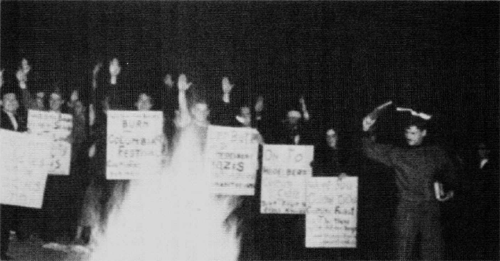
The Nazis' announcement that they would conduct public burnings of Jewish and other "un-German" books at universities across Germany on the night of May 10, 1933 (discussed in Chapter 3), led American Jewish organizations to schedule mass street demonstrations against Nazism in major American cities on that date. Surprisingly, university presidents and administrators did not organize any campus protests against the Nazi book burnings, a blatant display of anti-intellectualism and antisemitism. Nor did they publicly express support for the mass protest marches.
On May 14, the boycott movement againstNazi Germany, in which the JWV and many Jews at the grass roots were already engaged, received a significant boost when the newly founded American League for the Defense of Jewish Rights (ALDJR) held a conference to promote it at the Hotel Astor in New York City. The ALDJR's Samuel Untermyer, a very wealthy New York attorney and the most prominent Jewish boycott leader, had given a highly publicized address on May 7, entitled "Germany's Medieval Challenge to World Jewry and Civilization," asking Americans not to purchase goods manufactured in Germany, and not to sail in German ships or to visit Germany. The ALDJR proceeded to form district councils to organize the boycott at the neighborhood level throughout New York City. The persons participating invested considerable effort in investigating stores to determine whether they were selling German goods, and in identifying sources where substitute products could be obtained. The day after the Hotel Astor conference, the New York Times reported that the boycott call had assumed nationwide proportions, as the ALDJR was being "swamped with telegrams pledging support of the movement." [70]
Because it wanted to emphasize that it had a significant non-Jewish membership, the ALDJR changed its name later in the year to the on- Sectarian Anti-Nazi League to Champion Human Rights (NSANL), with Untermyer as president. It vigorously championed the boycott during the next several years, urging all Americans to "REMEMBER That every cent you spend on German steamers and in Germany is aiding Germany's war preparations and the spread of Nazism the world over." [71]
In New York City and its environs particularly, the boycott movement's impact was significant. By the end of March 1934, many of the nation's leading department stores, a majority of them Jewish-owned, had stopped importing German goods, including Macy's, Gimbel's, Saks, Bloomingdale's, Hearn, Best, Constable, Lord & Taylor, and Sears, Roebuck. That month the New York store of Wanamaker's, which was not Jewish owned, notified the SA L that it had not imported any German goods since November 1933 and maintained no offices in Germany. In April 1934, Kresge's department store in Newark, New Jersey, announced that it had terminated purchases from Germany when the Nazis assumed power. In July 1934, Bamberger's department store in Newark issued a statement proclaiming that "[t]he consumer boycott of German merchandise has been so effective that the store has not purchased a dollar's worth of German goods in many months. The old and broken stocks of German goods are probably as small as in any department store in the metropolitan area." [72]
From the beginning, the NSANL appealed to universities and to their students, urging them to participate in the boycott. In 1933, the NSANL sent out a circular letter to students asking them to notify it if their university was selling goods manufactured in Nazi Germany. The NSANL asked students to particularly check the source of goods in the following categories: stationery, pencils, art supplies, scientific and calculating instruments, chemicals and laboratory supplies, medical and dental supplies, musical supplies, sporting goods, and c1othing. [73]
University administrations showed no interest in the boycott against Nazi Germany but did provide Untermyer with an immediate specific opportunity to bring the boycott to wider public attention. Untermyer announced the day after the Hotel Astor conference that he and others were engaged in efforts to change the scheduled sailing of a group of nineteen Columbia University students, booked on a German ocean liner "in connection with their work in the university." The group included eight Jewish students, whom the university administration required to sail on the German ship with the rest of the party. Untermyer attempted to persuade the Columbia administration to transfer the students to an American liner. The New York Times reported that he had offered to pay the difference in cost himself for the entire group, to spare the Jewish students the indignity and humiliation of having to travel on a vessel flying the swastika flag and manned by a Nazi crew, as well as to deprive the Hitler government of much-needed foreign currency. [74]
University presidents themselves frequently traveled across the Atlantic on German liners flying the swastika flag, choosing to publicly violate the boycott. Newspapers such as the New York Times regularly published lists of prominent passengers making Atlantic Ocean voyages, on German and other ships. Those who traveled on Nazi Germany's vessels felt no shame about the public knowing what they were doing. President Nicholas Murray Butler, head of the Carnegie Foundation for International Peace, who attended numerous European conferences, often sailed on German vessels, as mentioned in Chapter 3. Harvard's newly inducted president James Bryant Conant traveled to Europe on Nazi Germany's North German Lloyd liner Europa in May 1933. When Robert Maynard Hutchins, president of the University of Chicago, sailed across the Atlantic on the Europa in August 1933, it "provoked much adverse comment." President Hutchins told Chicago attorney Leo F. Wormser upon his return to the United States that "the propriety or impropriety of the selection of a German ship under existing conditions had not occurred to him." [75] He continued to sail on the Europa, however, making trans-Atlantic trips on the German liner in July 1934 and in August 1937. [76]
College students regularly crossed the Atlantic on German vessels, most notably on their way to study at German universities, often as participants in Junior Year Abroad programs, as described in Chapter 4. Nazi Germany's North German Lloyd and Hamburg-American lines often placed advertisements in college newspapers. In May 1935, the Harvard Crimson reported that the Harvard student band, the Serenaders, was booked to perform on the Hamburg-American vessel S.S. Albert Ballin from June 27 through the end of the summer. Bands from six other American colleges signed agreements with the Hamburg-American line to play on its ships that summer. [77] In March 1936, the University of Chicago Daily Maroon ran an advertisement for Hamburg-American and North German Lloyd voyages to Europe on the Bremen, Europa, and St. Louis that proclaimed: "Your brothers and sisters are already booked, many with their cars, on the special student sailings - college orchestras aboard." The advertisement specifically appealed to students interested in taking summer courses at German universities, enrolling in Junior Year Abroad programs or pursuing graduate studies "at leading lGerman] universities," vacationing in the Third Reich, or attending that summer's Olympic games in Berlin. [78]
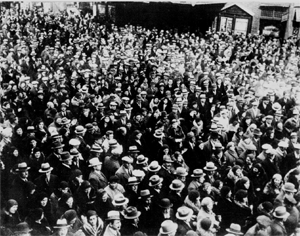
On May 10, 1933, massive numbers of people in New York City, Chicago, Philadelphia, Cleveland, Pittsburgh, and other cities answered the call of the AJCongress to join a second wave of nationally coordinated street demonstrations against Nazi persecution of Jews in Germany. In ew York, 100,000 marched for six hours, as thousands more lined the streets to show their support. In the history of the city until that time, the demonstration was equaled in size only by the victory parades that followed the Armistice. Mayor O'Brien reviewed the parade from the steps of City Hall. Jewish stores, offices, and other businesses shut down early in the afternoon to permit their employees to participate. The marchers included uniformed veterans of the World War, members of Zionist organizations, students at high schools, colleges, and Jewish religious institutions, "a labor contingent of many thousands, scores of rabbis in long black robes, bearded denizens of the East Side, dapper young men and women, professional men, and representatives of the literary, artistic, and theatrical worlds." Many carried placards that read "Hitler - This is Not the Period of the Dark Ages," and "Hitler - Remember What Happened to Spain." The undertakers' union marched with a sign that said "We Want Hitler." A large group of city officials and judges, led by the Manhattan borough president, also joined the procession. Major general John F. O'Ryan declared that he had accepted the AJCongress's invitation to lead the parade because "of the conviction that non-Jewish Americans owe it to our Jewish citizenry ... to indicate where we stand in relation to the insult by the Hitler Government to their race and before the world." There was no mention in the press of any college or university president or administrator participating. [79]
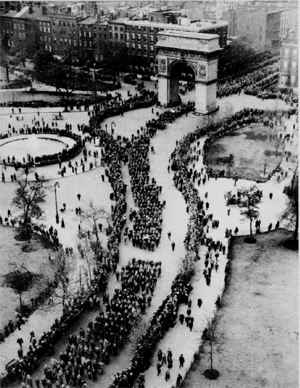 FIGURE 1.3. Anti-Nazi protesters march through New York City's Washington Square Park on their way to a mass rally in Battery Park against antisemitism in Germany, May 10, 1933. Courtesy of AP Images.
The demonstrations in other cities were equally enthusiastic and socially diverse. In Chicago, 25,000 marched to protest not onlyNazi antisemitism and the burning of books but Hitler's sending of an emissary to Chicago's Century of Progress exposition. The Chicago Tribune reported that "children and gray-bearded men with skullcaps marched side by side ... [and] all professions were represented." In Philadelphia, "patriarchal Jews with long, flowing beards, smooth-shaven shopkeepers and business men and hundreds of earnest housewives" marched together against Nazism. [80]
In early June 1933, the Anti-Defamation League (ADL), established in 1913 to combat antisemitism, began a sweeping investigation of "Nazi activities in American universities." Alarmed by numerous reports that exchange students from Nazi Germany were "making addresses justifying the anti-semitic methods of Hitler" on American campuses, the ADL sent a circular letter to its supporters in academia asking them to document such activity. It also requested information about efforts by German exchange students to organize pro-Nazi student groups at American colleges and universities. The ADL emphasized that the German exchange students were engaged in "extremely destructive" political activities on the American campus. Fearing that Nazi propaganda was already seriously impacting the campus, the ADL asked its contacts to transmit the information they gathered by airmail, so that it could immediately respond to it. [81]
That same month, Arturo Toscanini, conductor of the New York Philharmonic Orchestra, canceled his contract to direct the program of Wagnerian music at the annual Bayreuth festival in Bavaria to protest the Hitler government's antisemitic policies and, specifically, its persecution of Jewish musicians. Toscanini, an Italian, had been the only non-German ever asked to conduct at Bayreuth. The New York Times reported that the Hitler regime was worried about the impact on its image abroad of the refusal of one of the world's preeminent symphony conductors to perform at its most important music festival. [82]
The American Jewish press highlighted Toscanini's bold defiance of the Nazis, contrasting it with American universities' academic exchanges with the Third Reich, which they carried on until nearly the onset of World War II. Arthur Bodansky, former director of the Metropolitan Opera, had asked Toscanini shortly after the April 1, 1933, Nazi boycott of Jewish stores to join eleven other musicians in a cable of protest to Chancellor Hitler against Nazi antisemitism. The American Hebrew reported that "Toscanini not only gave his instant assent, but put his own name at the head of the list." Toscanini later refused to conduct at the Salzburg Festival in Austria because the performance would be broadcast into Germany. In 1936, he traveled to Palestine to conduct an orchestra of Jewish refugee musicians from Germany. [83]
On June 10, 1933, two of the most prominent members of the u.S. Senate, majority leader Joseph Robinson of Arkansas and Senator Robert Wagner of New York, forcefully condemned Nazi persecution of the Jews on the Senate floor. In a prepared speech, Robinson called Nazi antisemitism "sickening and terrifying" and warned that it would lead the United States to curtail its trade with Germany. He noted that the Nazis had barred Jews from nearly "every profession and vocation" in Germany, and from universities. Making the Jews' plight even more desperate were the Hitler regime's decrees prohibiting them from leaving the Reich. Senator Wagner declared that he was horrified by the reports of "intolerance, discrimination, and ... violence" against Jews in Germany. Four other senators rose to express support for Senator Robinson's remarks. [84]
America's higher education leaders' lack of insight into, or indifference to, Nazism's core tenets and objectives was strikingly revealed in early July 1933 in their first joint public protest about events in Germany, when many of them signed a deeply flawed statement circulated by the National Conference of Christians and Jews (NCCJ). The document, composed by a group of prominent social scientists, received the backing of 142 presidents of American colleges and universities, the vast majority of them minor institutions. Addressed to the heads of German universities, it asked them to recognize and respect the rights of Jews and all minorities "as essential to culture and civilization." But the document was undermined by its trivialization of the Nazis' antisemitic campaign.
Everett R. Clinchy, director of the NCCJ, who solicited signatures on the document from college and university presidents, identified it as a statement about "the hostility between Christian and Jewish groups in Germany" and emphasized that it was "in no sense a 'protest.'" Astonishingly, he declared that "the time for protest is past." The document did not provide any sense of the savagery of the Nazis' antisemitic violence or the extent of the damage they had already inflicted on Germany's Jews, and it was vague about who was responsible for the turmoil in Germany. It began by explaining that the signers were "fully aware that the recent happenings" in the Third Reich, which were not specified, were "in large part the result of the lack of fair play to Germany" on the part of the Western democracies, and their "slighting of German rights and needs." Refusing to characterize Nazi persecution as unique, or even highly unusual, the document emphasized "that minorities are suppressed and discriminated against to some degree in every land." The most prominent college and university presidents signing the document were James Rowland Angell of Yale, Ernest M. Hopkins of Dartmouth, Clarence A. Barbour of Brown, Ray Lyman Wilbur of Stanford, Robert G. Sproul of California, Frank P. Graham of North Carolina, Mary E. Woolley of Mount Holyoke, Henry N. MacCracken of Vassar, Ellen F. Pendleton of Wellesley, and Frank Aydelotte of Swarthmore. [85]
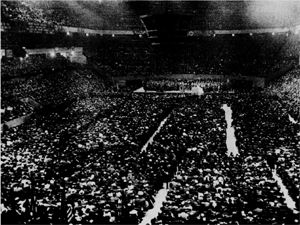
Opening at Chicago's Century of Progress exposition on July 2, 1933, the "mighty pageant" titled The Romance of a People rivaled the mass demonstrations of March and Mayas a spectacular display of grassroots opposition to Nazism. With a cast of 6,200 actors, singers, and dancers, the largest ever assembled in the United States, The Romance of a People depicted forty centuries of Jewish history, largely in pantomime. The pageant, performed in Chicago's enormous Soldiers Field stadium, included scenes about the Jews' enslavement in Egypt and their liberation under Moses, their exile in Babylon, and the Roman wars against Judaea. When Titus's legions attacked Jerusalem, "Judah's sons fight like lions; they die, but do not surrender." Then "2,000 years of wandering and exile are thrown upon the stage in a tapestry of motion," until Jews were once again able "to turn thoughts" to restoring their "ancient civilization in Palestine." The pageant was designed to stimulate an intense pride in Jewishness, and to instill respect for the Jews' vitally important contributions to world civilization and empathy for their centuries-long suffering. Proceeds from the pageant were earmarked for the settlement of German Jewish refugees in Palestine. [86]
More than 125,000 people were seated at the opening performance, a larger turnout than the Dempsey-Tunney heavyweight title fight in Chicago had attracted to Soldiers Field in 1927, one of the most heavily attended sports events in history. Because the stadium was filled to capacity and had to turn away thousands of people, a second performance was held a few days later, which attracted 55,000 more. The New York Times noted that the two-day attendance was enough "to give any Broadway [play] performance a lengthy run." [87]
In September, The Romance of a People opened in New York City, with Samuel Untermyer and New York governor Herbert Lehman as honorary chairs of the sponsoring committee and Senator Robert Wagner as honorary vice-chair. The New York Times strongly endorsed the pageant, editorializing that "[g]iven Hitler's efforts to stigmatize a great people as an aggregation of pariahs and public enemies, perhaps the best thing is to let the historic record speak for itself." Originally scheduled for the Polo Grounds, the production was shifted after several days of rain indoors to the nation's largest armory, in the Bronx. A series of about a dozen performances there attracted 400,000 people, including former governor Al Smith and his wife and Albert Einstein, who attended in October, the night after his ship arrived in the United States, as the personal guest of Mayor O'Brien. [88]
In February 1934, The Romance of a People moved to Philadelphia, where the Philadelphia Public Ledger called it "unquestionably ... the greatest spectacle ever presented" there. On opening night, Mayor Moore of Philadelphia declared to the audience at the Convention Hall before the performance that he was greatly pleased to be present to lend official recognition to the pageant. The Public Ledger reported that a packed house that included Albert Einstein sat "enthralled" for two hours by "the splendor and beauty of the pageant." When the "swelling rhythm of traditional Hebrew music filled the auditorium," many in the audience wept "openly and unashamed." The Public Ledger stated that "[t]hroughout the prologue and the seven breath-taking episodes ran the single, unifying thread of Jewish courage and aspiration, which has been the dominant trait of the race for the forty centuries of its existence." [89] About 70,000 people attended the eleven Philadelphia performances of The Romance of a People. [90]
In September 1934, The Romance of a People was revived at New York City's Roxy Theatre in abridged form, with a reduced cast. Sponsors of the new version included both of New York's U.S. senators, Mayor La Guardia, and former governor Smith. [91]
Although The Romance of a People drew very large audiences in three of the nation's leading metropolises, none of America's higher education leaders were mentioned in the press as sponsors of the pageant, as speaking favorably about it, or even as having been in attendance. Nor is there any evidence that university presidents or administrators made any effort to promote it on their campuses.
On July 21, 1933, the New York Times directed attention to the international dimension of Jewish grassroots protest against the Hitler regime when it reported that 20,000 Jews had staged a massive parade and rally in London against Nazi antisemitism. The Times called it the largest demonstration in the history of British Jewry. Most of the participants came from the East End Jewish quarter, which was deserted for the "day of mourning." Shops were shut down everywhere in the district and no business was conducted. In the famous Petticoat Lane pushcart section, guards were posted to ensure that outsiders did not attempt to operate there. The Times noted that the East End shopkeepers had been "carrying on an effective boycott of German goods for many weeks." Upon reaching Hyde Park, the marchers joined an immense crowd that had gathered to receive them, and resolutions calling for a "boycott of everything German" were "carried with roars of acclamation." The London Times stated that "a substantial part of the Jewish population of London" participated in the demonstration. [92]
Former suffragist leader Carrie Chapman Catt's announcement in August 1933 that 9,000 women across the United States had signed a petition to the League of Nations against Nazi antisemitism, and the refusal of permission for the display of the swastika flag in Chicago and San Francisco, provided further evidence of the breadth and intensity of protest in the United States against Germany's oppression of the Jews. Catt's petition stated that "the German pogrom against the Jews" was the most shocking event since the Great War. It denounced the Nazis' removal of Jews from university faculties, the bench and bar, medical practice, and many other occupations. [93] In Chicago that month, threats by Jewish women's organizations to boycott the Women's Day celebration at the Century of Progress Exposition resulted in assurances that the swastika flag would not be flown at the German-American building. [94] San Francisco's acting mayor, J. Emmet Hayden, would not allow the flying of the swastika flag at that city's German Day celebration in September 1933. As a result, the United German Societies, the sponsoring organization, which had planned to display it as a mark of respect for the German consul-general, the main speaker, had to celebrate German Day privately, without city sponsorship. In denying permission, Hayden noted that San Francisco's Board of City Supervisors had adopted a resolution denouncing Nazi policy toward Jews. [95]
At its annual convention in October 1933, the American Federation of Labor (AFL) announced it was joining the boycott of German goods and services, including shipping lines. AFL president William Green's "impassioned speech" against the Nazis' destruction of the German labor movement and persecution of Jews "brought the delegates to their feet in a spontaneous outburst of approval." Green declared that the AFL was determined to use the boycott "to strike a real blow" against Nazism. Selma M. Borchardt of the American Federation of Teachers, recently returned from a trip to Germany, told the delegates that she had seen a fifteen-year-old girl in Berlin forced to wear a placard stating "my father has sinned" because he, a Christian, had married a Jew, her mother. Senator James J. Davis of Pennsylvania, formerly U.S. Secretary of Labor, called Nazi Germany "an insult to civilization." [96]
Two months later, the boycott received strong endorsement from important professional associations representing physicians, dentists, and pharmacists at a meeting arranged by the Allied Dental Council in New York City. Its representatives, along with those of twenty-two other organizations representing those engaged in these occupations, whose combined membership totaled 15,000, declared their determination to combat Nazi intolerance with the boycott. [97]
The fiercest and most dramatic confrontation over Nazism in the United States during the first year of Hitler's rule occurred in Boston on November 26, 1933, as thousands protested the appearance at the Ford Hall Forum of one of Hitler's leading propagandists, Dr. Friedrich Schoenemann. The Forum had invited Schoenemann to speak on "Why I Believe in the Hitler Government." Professor of American literature at the University of Berlin, Schoenemann had been a German instructor at Harvard from 1913 to 1920. The Nazis considered him one of their top authorities on American affairs and culture. During the fall of 1933, Hitler sent Schoenemann on a speaking tour of the United States to promote the Nazi cause. [98]
Invited to deliver an address at Drew University in Madison, New Jersey, in late October 1933 by its treasurer, Noel Bensinger, Professor Schoenemann praised Hitler for achieving for Germany "a new dignity" and "a sense of social justice that it hard] lacked since the World War." Schoenemann told the campus audience that when he visited a German concentration camp, he found 1,800 men "living in cleanliness and order, almost as though they were in college." [99]
Boston's Ford Hall Forum, a public lecture hall, proved a far less inviting environment for Schoenemann than the campus. Frank W. Buxton, editor of the Boston Herald, one of the Hub's leading newspapers, had informed U.S. ambassador William E. Dodd in Berlin in July 1933 of an "anti-Hitler rage" in Boston. He noted that Boston's Jewish population "reads every word that comes from Berlin." Buxton was horrified by Nazism, which he believed denied "the fundamental truths of civilization." He considered Hitler's tactics "far more cruel than those of the Middle Ages." Hitler's objective was to make the Jews "a degraded race, condemned from birth to obscurity, inferiority, and contumely." Buxton told Dodd that an effective "quiet boycott" against German goods prevailed in Boston. [100]
Schoenemann's presentation at the Ford Hall Forum on Beacon Hill resulted in the most disorderly meeting in its twenty-five-year history, as those in attendance repeatedly challenged his statements from the floor, and thousands of anti-Nazi protestors clashed with the police outside. The Boston press emphasized the intensity of the anti-Nazi sentiment both inside and outside the hall. The Boston Globe considered the confrontations, which turned Beacon Hill "into an embattled area," the most violent to have occurred since the Sacco-Vanzetti case. The Boston Post stated that the demonstrations surpassed "the wildest of Boston's May Day riots." [101]
The highly engaged audience made clear it detested everything Schoenemann said and stood for from the moment Nazi Germany's consul-general in Boston, Baron Kurt von Tippelskirch, introduced him. It responded to Schoenemann's opening remark, that he was not at the Forum to dispense propaganda, "with laughter, hisses, and shouts of 'liar.'" More hisses and boos greeted his claim that the Nazi revolution was "among the most unbloody in history," and someone shouted, "Let's have some facts." Schoenemann's statement that he had noticed nothing "dirty, abnormal, or mean" during visits to concentration camps was greeted with derisive laughter. When he declared that the 1918 revolution in Germany was "started by a Jew named [Karl] Liebknecht," there were "a dozen cries of 'He was not a Jew. You're a liar.'" After Schoenemann claimed that the Nazis did not believe in confiscation, "'What about Einstein?' came from a dozen throats." A tremendous uproar broke out when Schoenemann asserted that the "genesis of the Jewish question" was Jewish involvement in corruption. The Boston Post reported that "liar" was the least of the epithets shouted at the speaker. Schoenemann concluded his speech "amid hisses and catcalls." [102]
As Schoenemann spoke, squads of police, many of them mounted, battled a crowd of demonstrators estimated at between 3,000 and 5,000 in the shadow of the State House. The police finally managed to drive the protestors, many of whom carried banners proclaiming "Down With Hitler" and "Down With the Nazi Butcher," down the steep slopes of Beacon Hill, chasing them a half-mile through the streets and "smashing heads right and left." The demonstrators, "fighting every inch of the way," pulled some policemen off their horses and pummeled them. Police reinforcements finally "lifted the siege of Beacon Hill." [103]
Prominent American opponents of Nazism formed the American Inquiry Commission to expand awareness of the Nazi terror by providing a platform for refugees from the Third Reich and others qualified to provide information about it by means of well-publicized hearings. On July 2 and 3, 1934, the Commission, chaired by Clarence Darrow and composed of seven notable Americans, including civil liberties attorney Arthur Garfield Hays and u.s. senator Edward P. Costigan of Colorado, heard testimony from nearly thirty individuals. Dr. Kurt Rosenfeld, former Prussian Minister of Justice and a Social Democrat, told the Commission that 165,000 persons were currently confined in Nazi concentration camps. He stated that the People's Courts, newly established to try political opponents of the regime and composed entirely of Nazis, offered the innocent "absolutely no chance of defense or acquittal." Rosenfeld told the Commission that the Nazis would take anyone into custody "if they don't like the shape of his nose ... and keep him indefinitely." Martin Plettl, formerly president of the German Federation of Clothing Workers, who had been a concentration camp inmate, described how the Nazis had destroyed Germany's trade unions. During a visit to New York City's mayor Fiorello La Guardia while the Commission was in recess, Clarence Darrow described Hitler as "very dangerous" and expressed the hope that he would be killed. [104]
Refugee Scholars: The Limits of University Assistance
In the spring of 1933, Americans alarmed by Nazi persecution of Germany's Jews created programs to find academic positions in the United States for professors whom German universities had discharged because they were Jews or political opponents of the Nazis. Their efforts were impeded by a longstanding tradition in American colleges and universities of excluding Jews from their faculties and by administrators' unwillingness to appoint refugees to anything but very short-term positions. American institutions of higher learning employed few Jews as professors through the 1930s.'05 Universities were also reluctant to recruit refugee scholars because of budgetary reductions during the Depression and concern about the impact of competition on the career prospects of younger American faculty members.
Some wealthy Jews privately communicated to university presidents their fear that granting faculty positions to Jewish refugees from Nazi Germany would provoke an antisemitic backlash in this country. When President Robert Maynard Hutchins of the University of Chicago approached Jewish philanthropist Albert D. Lasker about providing financial support for hiring refugee scholars, Lasker told him that "he was entirely opposed to bringing any Jewish professors to America" because "it might lead to a development of anti-Semitism." Hutchins noted that Lasker was "regarded as the key man" in Chicago for raising funds for Jewish victims of the Nazis and doubted he would be able to "unlock much money without him." [106]
The most significant achievement on behalf of refugee scholars from Nazi Germany was the opening of the University in Exile at the New School for Social Research in New York City in October 1933. In May 1933, Dr. Alvin Johnson announced plans to establish a university in exile that would employ a faculty of about fifteen "Jewish and liberal professors" in the social sciences whom the Nazis had forced out of German universities. They were to offer graduate courses only, in English. Established in 1919, the New School for Social Research in 1933 was a small adult education institution with only four or five full-time faculty members. Before Johnson announced the formation of the University in Exile, a Jewish businessman, Hiram Halle, had pledged to completely fund it. [107]
Alvin Johnson had decided to establish the University in Exile after encountering resistance from university administrators and department heads when he sounded them out about hiring Jewish refugee scholars. He had initially believed that "the appropriate thing to do was to induce every university faculty to extend its hospitality to one or more of the professors who have been dismissed [by German universities]." However, American academics' response to this proposal, which he had voiced in an article published in the American Scholar, suggested to him that advocating such a course would only provoke antisemitism inside the universities. As a result, he had decided to focus instead on placing refugee scholars in one small institution, his University in Exile, and to concentrate only on the social sciences. Because there was significant opposition to hiring refugee scholars, particularly Jews, both inside and outside of academia, Johnson was well aware that the University in Exile would only develop "inch by inch, painfully." [108]
Having secured the services of fourteen refugee scholars from Nazi Germany by August, Johnson described the University in Exile as "a most vigorous protest against the restrictions placed on scholarship by the Hitler government." The refugees were offered two-year appointments only, with the possibility that they might be extended. At the same time, Johnson emphasized that the University in Exile was designed "purely as a center of scholarship, instruction, and research." It would combat Nazism by providing an opportunity for talented scholars, mostly Jews, driven from their lecture halls and homes to conduct research and teach graduate seminars. [109] The University in Exile opened officially in October 1933 as the Graduate Faculty of Political and Social Science. Student enrollment was 92 for the fall semester of 1933 and increased to 520 by the fall of 1940. [110]
Perhaps to alleviate the concerns of business and higher education leaders unwilling to associate themselves with a project identified with Jewish rescue, Johnson informed the press that the University in Exile considered only scholarship, not "race," in selecting faculty. He emphasized that "[t]he University in Exile is not a charitable venture." The mostly Jewish faculty was hired strictly on the basis of merit. [111]
The faculty's largely Jewish composition, as well as the New School's marginality in American academia, provided refugee scholars with a far more supportive environment than could be found at any American university. As Dan A. Oren noted in a study of American university antisemitism: "Only on the graduate faculty of ... [the] New School for Social Research, founded in 1933 as the University in Exile, were refugee scholars truly welcome." [112]
Some university presidents appeared willing to endorse Johnson's plan for the University in Exile, at least privately, as an alternative to having a larger number of refugee scholars distributed among many American universities. President Isaiah Bowman of Johns Hopkins University, for example, while expressing support for the project, warned fellow academicians not "to bob up and down on waves of emotion." He urged them not to "load our university budget with burdens that are assumed because of sympathy." Moreover, he believed that universities' hiring of refugee professors undermined "the just claims of younger [American] men" to faculty positions, and their opportunities for promotion. Because American universities were experiencing financial distress, President Bowman recommended that those attempting to assist refugee scholars from Nazi Germany proceed "slowly and experimentally and on a small scale." [113] Johnson later informed Bowman that President James B. Conant of Harvard University had said the same thing to him. Indeed, Johnson indicated to Bowman that he himself shared the same outlook. [114]
In May 1933, the same month that Alvin Johnson founded the University in Exile, Jewish donors provided funding to establish and support the Emergency Committee in Aid of Displaced German Scholars (EC) to place refugee professors from Nazi Germany on the faculties of American universities. The EC covered half the salary (up to $2,000) of the refugee scholars the universities themselves appointed, for positions lasting up to two years. The EC recruited several gentiles to serve on its executive board, to downplay the uniqueness of the Jewish plight in Germany and to attract non-Jewish support. In part to offset fears that competition from refugees would reduce the job prospects in academia for younger American academics, the EC did not grant funds for displaced German scholars under the age of thirty. Unlike Alvin Johnson, who publicized the University in Exile in the press, the EC avoided newspaper coverage for fear of provoking antisemitism. [115]
The EC also disassociated itself from political protests against Nazism, such as the boycott of German goods and services, out of concern that they would drive away potential donors. Although Johnson believed that Nazism was strongly entrenched in Germany and hoped to establish the University in Exile on a permanent basis, the EC assumed that what it viewed as "Nazi excesses" would last only for a short time. As a result it lacked the sense of urgency shared by many anti-Nazi activists. Indeed, after only two years of Nazi rule, it considered the "emergency" to be "largely over," although it continued to operate until World War II. It refused the American Jewish Congress's invitation to become a sponsoring organization of its Madison Square Garden anti-Nazi mass rally in March 1934. [116]
Antisemitism and financial constraints seriously limited university assistance to refugee scholars, whose appointments were usually for two years or less. In December 1934, University of Chicago trustee James M. Stifler noted that although his institution, because of its large graduate school, was in a better position to hire refugee scholars than most universities, it had made no permanent appointments. It listed all German refugee appointees as visiting professors or lecturers. Most were hired for two years, and sometimes for only one. These positions were funded largely by the EC and the Rockefeller Foundation, which in 1933 established a special fund to provide matching grants to American universities that appointed displaced German scholars to their faculties. Individual Chicago Jews also contributed. Stifler stated that, given the University of Chicago's limited financial resources, "we would be quite unable to do anything else, nor have we any hope of doing more in the future." [117] By January 1938, the University of Chicago had managed to hire only ten displaced German scholars, on appointments ranging from one year to "indefinite tenure." [118]
Neither Harvard nor Yale, America's most prominent universities, displayed much interest in hiring refugee scholars from Nazi Germany. President James Rowland Angell of Yale was only "superficially concerned with the plight of the German refugees" and "reluctant to commit scarce university funds to provide them employment." Yale relied largely on EC grants in hiring six German refugee scholars, several of whom were not Jewish. Only two of the appointments lasted more than three years. The Yale faculty's attitude was "one of indifference." [119] During the 1930s, most of the university's departments were unwilling "to tolerate Jews on even a temporary basis." [120]
Harvard did not respond when the EC in May 1933 invited fifteen of America's leading universities to hire a displaced German scholar and promised to pay half the salary ($2,000), with the Rockefeller Foundation providing the other half. That month, President A. Lawrence Lowell declined the Schurz Memorial Foundation's offer to cover the salary if Harvard employed a refugee scholar as a visiting curator at the University's Germanic Museum. Lowell responded that the proposal "appeared as an attempt to use the College for purposes of propaganda." If Harvard hired a refugee scholar, "it would be trumpeted all over the country by Jewish organizations." At its May 29, 1933, meeting, the Harvard Corporation (equivalent to the board of trustees) decided to take no action on the EC's offer, and did not reply to it. [121] When James G. McDonald in March 1934 asked to talk to the newly retired Lowell about displaced German scholars, his secretary replied that the former president "wasn't interested in German refugees." [122]
Lowell's successor as Harvard's president, James Bryant Conant, who assumed office in September 1933, and the Harvard Corporation, indicated that the university was not interested in cooperating with the EC in hiring refugee scholars on its faculty. In January 1934, the New York Times reported that Harvard "adheres to the stand taken last year by Dr. A. Lawrence Lowell when president, that the university would not make a place on its faculty for any man because he was an emigre, or as a protest to theNazi removal of educators from German universities." [123] The next month, President Conant informed EC secretary Edward R. Murrow that "[n]o appointments have ever been made at the University by means of funds supplied by the Emergency Committee." [124]
Conclusion
During the early months of Nazi rule in Germany, many Americans recognized that the Hitler regime represented an unprecedented relapse into barbarism. James Waterman Wise declared in 1933, in one of the first books to be published about Germany under Nazi rule, that the Third Reich was conducting "[a] bloodless war of extermination" against the Jews, "which gives no quarter and recognizes no non-combatants." He emphasized that "[f]or what it has done, there is neither example nor parallel in the antiquity of primal brutality, in the Middle Ages of religious persecution, or in the darkest days of Tsarist Russia." [125] In May 1933, Lord Melchett described Germany as a death trap for its entire Jewish population. The Nazis had expelled Jews from the professions and university faculties, shut down their businesses, and brutally beat them in the streets, in torture cellars, and in concentration camps. They delighted in inflicting the most degrading and humiliating forms of punishment on Jews, often in full public view. Respected American and British journalists, reporting directly from Germany or drawing on interviews from refugees from the Third Reich in neighboring countries, regularly provided detailed accounts of Nazi antisemitic atrocities, discrimination, and harassment.
As succeeding chapters demonstrate, the leaders of America's colleges and universities remained for the most part uninvolved as others in this country forcefully protested the Nazis' barbaric treatment of Jews. The Nazis' antisemitic terror in 1933 precipitated demonstrations and boycotts on an unprecedented scale, often initiated at the grassroots level. Several U.S. senators and big-city mayors joined in these protests, which the American press widely publicized. But although academicians were the Americans most conversant with European affairs, few engaged in public anti-Nazi protest. As many working and lower-middle-class Americans marched in the streets and struggled to organize a nationwide boycott of German goods and services, American universities maintained amicable relations with the Third Reich, sending their students to study at Nazified universities while welcoming Nazi exchange students to their own campuses. America's most distinguished university presidents willingly crossed the Atlantic in ships flying the swastika flag, openly defying the anti-Nazi boycott, to the benefit of the Third Reich's economy. By warmly receiving Nazi diplomats and propagandists on campus, they helped Nazi Germany present itself to the American public as a civilized nation, unfairly maligned in the press. Influenced by their administrators' example, and that of many of their professors, college and university students for the most part adopted a similar outlook, although there was significant student protest against Nazism at some schools, such as Columbia, which is analyzed in Chapter 3.
Chapter 2 considers the role of America's most prestigious institution of higher learning, Harvard University, in legitimating the Hitler regime. It focuses particularly on President James Bryant Conant; on the undergraduate newspaper, the Harvard Crimson, which reflected the outlook of the most influential segment of student opinion; and on alumni. Chapter 3 examines the role of this nation's most prominent university president, Columbia's Nicholas Murray Butler, in enhancing the image of the Third Reich, and on his highly vocal student opponents, some of whom edited the undergraduate newspaper, the Columbia Spectator. The Columbia Spectator's outlook toward Germany and antisemitism differed significantly from that of the Harvard Crimson. Chapter 4 focuses on the Seven Sisters, the elite women's colleges, which were centrally involved in promoting student exchanges with Nazi Germany. Chapter 5 examines this nation's most prestigious foreign policy symposia, sponsored by the University of Virginia's Institute of Public Affairs. During the 1930s, these symposia provided an important forum that permitted apologists for Nazi Germany's domestic and foreign policies to reach American audiences. Chapter 6 explores the role of university German departments in the 1930s as disseminators of Nazi propaganda in the United States, and in hosting campus visits by Nazi Germany's diplomats. Chapter 7 analyzes the role of Catholic colleges and universities in promoting appeasement of Nazi Germany and providing a platform for propagandists for Mussolini and Franco. Chapter 8 examines the limits of protest against Nazism within academia during 1938, a year that culminated in the Kristallnacht, when German barbarity finally instilled widespread alarm. The Epilogue explores the role of former Harvard president James Bryant Conant in encouraging the parole of Nazi war criminals during the 1950s, as U.S. high commissioner for Germany and as ambassador to West Germany. It also focuses on the effusive praise and respect prominent American higher education leaders accorded Mircea Eliade during his long postwar career as a professor at the University of Chicago, despite his role as propagandist for Romania's antisemitic Iron Guard, enthusiastic collaborators with the Nazis during the 1930s and the Holocaust.
 ]
] ]
] ]
] ]
]