Part 2 of 4
Deist Mission and Universal History
Voltaire's Sermon des cinquante, the earliest print of which has been backdated to 1749,25 is something like a prayer book of a society of fifty "pious and reasonable learned people" who meet every Sunday, pray together, and then listen to a sermon before dining and collecting money for the poor. If one replaces "dining" by "breaking bread," one immediately gets Voltaire's point: this is the Sunday service of his religion for "reasonable learned people." After the initial prayer to the one unborn and undying God who rewards good and punishes evil, the president of the society begins his sermon as follows:
My brothers, religion is the secret voice of God who speaks to all human beings; it must unite them all, not divide them. Thus any religion that belongs only to a single people is false. Ours is in principle the religion of the entire universe; because we venerate a Supreme Being, like all nations do; we practice the justice which all nations teach, and we reject all the lies that the peoples accuse each other of. In agreement with them about the principle that unites them, we differ from them with regard to everything that makes them fight. The point that unites all people of all times must necessarily be the unique core of truth, and the points in which they differ, the standards of the religion must be in accordance with morality, and it must be universal like morality. Thus any religion that offends morality is necessarily false. It is under this double perspective of perversity and falsity that in this discourse we will examine the books of the Hebrews and those who have succeeded to them. (Voltaire 1749:4-5)
This pamphlet is Voltaire's deist manifesto, whose beginning already indicates that it entails a harsh indictment against Jewish and Christian exclusivism. It is an impassioned plea against the sects of Moses and Jesus and all their superstitions, divisions, hatred, persecutions, and brutality, and ends with a call to return to a pure, united religion:
Oh my brothers! can one commit such outrages against mankind? Have not our fathers already relieved the people from transubstantiation, the veneration of creatures and bones of the dead, and from oral confession, indulgences, exorcisms, false miracles, and ridiculous images? Have not the people become accustomed to be deprived of such superstition? One must have the courage to take some further steps. The people are not as idiotic as one might think. They will easily accept a wise and simple cult of a unique God that, we are told, the sons of Noah professed and all the sages of antiquity practiced, as all scholars in China accept. (p. 26)
Voltaire was a convinced deist, and the deists' creed was thoroughly inclusive: not just those born into a certain region or era or religion had received God's revelation but all humankind. True religion thus had to be natural religion, that is, the religion that God had poured into the heart of every human being. For this religion, the concept of universal consent was crucial, as the beginning of Voltaire's sermon shows: all nations and men belong to God's axis of good.
Voltaire was not only in search of a universal history but also of a universal religion; and as soon as he embarked on his quest for a universal history during the 1740s, he also began to examine the religions of the world, particularly those of ancient Asia.
Thanks to the writings of Ricci and his successors, he found that in China a pure veneration of God without any superstition and accompanied by excellent morality had once existed. However, as in other countries, this initial purity had become adversely affected through priestcraft and "the superstition of the bonzes" (Pomeau 1995:158). Voltaire was not interested in a simple extension of the biblical narrative to other countries, as was the case with the figurists in China or Father Bouchet in India who sought a link to a "good" son of Noah. That would have been tantamount to letting the Jews and their exclusivist divinity continue monopolizing human origins. For him it was not a question of the transmission of exclusively revealed truths or of the plagiarism of sacred scriptures in the sole possession of one people. Voltaire's eye was set on a true universal religion, a pure theism forming the root of all creeds. Already in a pamphlet of 1742 he had written,
Deism is a religion that is present in all religions; it is a metal that alloys with all others and whose veins run underground to the four corners of the world. This mine is more exposed, more dug in China; everywhere else it is hidden and the secret is only in the hands of the adepts. There is no land with more adepts than England. (p. 159)
One of these "adepts" was Edward HERBERT, Baron of Cherbury (c. 1600-1655), who had built his central argument on "universal consent," that is, a common (monotheist) denominator to all religions of past and present. Voltaire thought that a pure, uncluttered monotheism suited to the taste of modern deists had existed in the remote past and that traces of it could be found in the most ancient cultures. Like his teacher Tournemine, Voltaire had with much interest studied the observations of Thomas HYDE (1636- 1703) on the religion of Persia (1700) and found himself in agreement with the English scholar's argument that monotheism had anciently existed everywhere and left vestiges in the form of texts, myths, and rituals far older than those of Judaism. Of course he was also interested in such vestiges because they offered a chance to undermine biblical authority and its monopoly on ancient history. Was God less intolerant, cruel, and vindictive in texts other than the Old Testament -- texts that were potentially much older than the scribblings of Moses and far less offensive to a modern deist who believed in God's universal revelation in the form of natural law for all rather than a secret communication to an individual or tribe?
Voltaire's search for vestiges of ancient monotheism thus formed part and parcel of his quest for a universal history that began in earnest in the 1740s. "Universal histories" such as the pioneering work by Jacques-Benigne BOSSUET(1627-1704) tended to begin with the creation of the world in 4004 B.C.E. (Bossuet 1681:7) and to feature events such as Enoch's miraculous ascension in 3017 B.C.E. (pp. 8-9) and the universal deluge of 2348 B.C.E. For Bossuet, the time up to 1491 B.C.E., when Moses wrote down God's law, was "the period of natural law [Loy de Nature] when people had only natural reason [la raison naturelle] and the traditions of their ancestors to govern themselves" (pp. 17-18). From Bossuet's perspective, the histories and religions of all people were rooted in the events described in the Old Testament. Bossuet was well informed about the Chinese and had a hand in the campaign to condemn the Chinese Rites as idolatrous; indeed, it was through his offices that a "Letter to the Pope about the Chinese idolatries and superstitions" was printed (Hazard 1961:197). He was incensed that the Jesuits had dared to write of a "Chinese church" and thundered, "Strange kind of church without faith, without promise, without covenant, without sacraments, without the slightest sign of divine testimony .... After all, this is nothing but a confused pile of atheism, politics, irreligion, idolatry, magic, divination, and spells!" (p. 197). In the first edition of his universal history, Bossuet simply ignored this pile of refuse. But
when he published the third edition of his history in 1700, at the height of the Chinese Rites controversy, he was forced to add alternative year numbers from the Septuagint version of the Old Testament. The Jesuit China missionaries had long made use of Septuagint chronology because it added 959 years to the world's age and thus guaranteed that the starting shot of biblical history rang before that of the Chinese annals. Thus Bossuet's pupil, the French royal heir apparent, and his numerous other readers needed to be informed that there was a second biblically supported date for the world's creation, namely, 4963 B.C.E. Bossuet's twelve epochs of world history, which so beautifully show his biblical and Mediterranean bias (1. creation; 2. deluge; 3. Abraham; 4. Moses; 5. Troy; 6. Salomo; 7. Romulus and Rome; 8. Cyrus; 9. Scipio and Carthago; 10. Jesus; 11. Constantine; 12. Charlemagne), thus all received a second, alternative date. As Kaegi (1938:82) aptly put it, these double numbers exposed "a small crack in the royal edifice that within a few decades deepened and eventually led to its collapse." But Bossuet's universal history was not the only one that featured a staunchly biblical narrative of origins. Even some more recent works such as the gigantic English
An Universal History from the Earliest Accounts to the Present whose publication began in 1730 featured chapters titled "From the Creation to the Flood" and "From the Deluge to the Birth of Abraham" (Sale et al. 1741:I.I-153).
When Voltaire in the early 1740s set out to write his Essai sur les moeurs et l'esprit des nations et sur les principaux faits de l'histoire depuis Charlemagne jusqu'a Louis XIII (which in the following will simply be called Essai), he intended not to supplant Bossuet's history but rather to supplement it; but it irked him no end that a few rather insignificant nations around the Mediterranean Sea had hijacked the early history of humankind. In the introduction to the first fragments for his new beginning of universal history, Voltaire wrote,
Until now, the majority of Universal Histories treated other peoples as if they did not exist at all. Greece and the Romans have seized all of our attention, and when the famous Bossuet says a word about the Mohammedans, he speaks of them only as an inundation of barbarians, even though many of these nations possessed useful arts that we inherited from them .... We are neither just nor wise to ignore them. (Voltaire 1745:8)
While getting ready to remedy this state of affairs, Voltaire wanted to collect what his predecessors had neglected (p. 5) in order to furnish a truly universal history of "the customs of man and the revolutions of the human spirit" (p. 5). The first draft chapters of this new history dealt not with Adam and creation but with China and India, which pointed to a looming revolution in Europe's perception of origins. Voltaire's central and most influential work is without any doubt the Essai. With regard to his view of Asian religions and to the development of his vision of India and its religions, the Essai is most interesting because its different editions reflect different stages of Voltaire's outlook. We will thus focus on this central text of Voltaire and adduce other works as needed. Table 2 lists the stages of the Essai's genesis with brief remarks about the relevance for our inquiry.
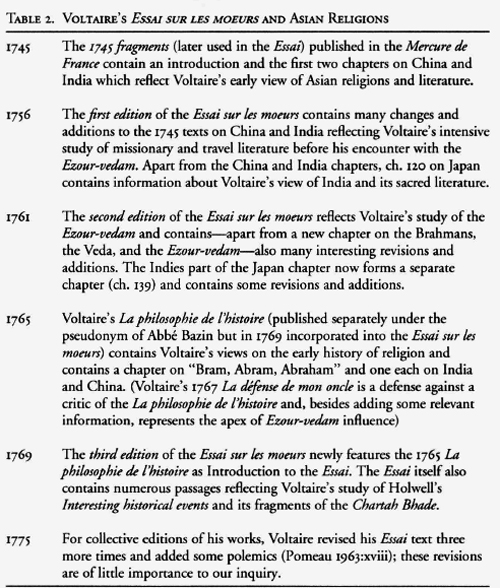 TABLE 2. VOLTAIRE'S ESSAI SUR LES MOEURS AND ASIAN RELIGIONS
1745 / The 1745 fragments (later used in the Essai) published in the Mercure de France contain an introduction and the first two chapters on China and India which reflect Voltaire's early view of Asian religions and literature.
1756 / The first edition of the Essai sur Les moeurs contains many changes and additions to the 1745 texts on China and India reflecting Voltaire's intensive study of missionary and travel literature before his encounter with the Ezour-vedam. Apart from the China and India chapters, ch. 120 on Japan contains information about Voltaire's view of India and its sacred literature.
1761 / The second edition of the Essai sur Les moeurs reflects Voltaire's study of the Ezour-vedam and contains -- apart from a new chapter on the Brahmans, the Veda, and the Ezour-vedam -- also many interesting revisions and additions. The Indies part of the Japan chapter now forms a separate chapter (ch. 139) and contains some revisions and additions.
1765 Voltaire's La philosophie de l'histoire (published separately under the pseudonym of Abbe Bazin but in 1769 incorporated into the Essai sur Les moeurs) contains Voltaire's views on the early history of religion and contains a chapter on "Bram, Abram, Abraham" and one each on India and China. (Voltaire's 1767 La defense de mon oncle is a defense against a critic of the La philosophie de l'histoire and, besides adding some relevant information, represents the apex of Ezour-vedam influence)
1769 / The third edition of the Essai sur Les moeurs newly features the 1765 La philosophie de l'histoire as Introduction to the Essai. The Essai itself also contains numerous passages reflecting Voltaire's study of Holwell's Interesting historical events and its fragments of the Chartah Bhade.
1775 / For collective editions of his works, Voltaire revised his Essai text three more times and added some polemics (Pomeau 1963:xviii); these revisions are of little importance to our inquiry.
China and India in 1745
Voltaire's admiration of India is often described in the context of his purported shift from a similar but earlier admiration of China. In the eyes of Wilhelm Halbfass, this transition from infatuation with China to indomania happened in 1760 on contact with the Ezour-vedam:
China at first appeared much more attractive and important than India in Voltaire's eyes, and he played an active role in helping to idealize the "practical philosophy" and civic institutions of the Chinese. However, after studying the manuscript of the Ezourvedam which the Chevalier de Maudave had given him in 1760, he became convinced that the world's oldest culture and most pristine religious thought was to be found in India and not in China. (Halbfass 1990:57)
However, Daniel Hawley detected some admiration for India already in the 1756 version of Voltaire's Essai. But in support of his thesis that until the encounter with the Ezour-vedam Voltaire's India was the "exotic India" of Bababee and the Fakirs (1750), Hawley states that "before 1756 the majority of references to India in the Essai were no more than exotic details" (1974:166). A closer look at Voltaire's 1745 Essai chapters on China and India, however, results in a completely different picture.
Since Voltaire took the revolutionary step of beginning his universal history not with the creation story and Adam but rather with a chapter on China, questions of chronology were of great importance. Voltaire used information furnished by the learned Father Antoine Gaubil of the Jesuit China mission to characterize the accuracy of Chinese historiography as "indisputable" because it is "the only one based on astronomical observations" (Voltaire 1745:9). As we have seen, Bossuet (1681:17-18) had Moses write down God's law in 1491 B.C.E. or, if one used the Septuagint-based calculation, in 2450 B.C.E. At the beginning of Voltaire's China chapter of 1745, Gaubil's information is used to show that China's first king reigned twenty-five centuries before Christ. The fact that he already united fifteen kingdoms, Voltaire wrote, "proves that several centuries earlier this region was very populated, governed, and partitioned in numerous sovereign countries" (p. 11). Voltaire adduced China's gigantic population and towns, the Great Wall, its ancient use of paper and printing, and many other facts to convince his readers of both the antiquity and excellence of Chinese civilization (pp. 11-18). But near the end of his litany comes the surprising statement that there is one thing that might merit more attention than all China's mentioned achievements: "that from time immemorial they partition the month in weeks of seven days" (p. 18). This statement persisted unrevised through all subsequent editions of the Essai, but an explanation added in the 1769 version clarifies its significance: "The Indians used this; Chaldea modeled its method on it and passed it on to the small country of Judea; but it was not adopted in Greece" (Voltaire 1829:15.268).26 The fact that Voltaire paid so much attention to this and mentioned it once more in his India chapter of 1745 ("their weeks always had seven days," Voltaire 1745:29) indicates that already in 1745 Voltaire was determined to use ancient India and China to destabilize biblical authority. The idea that the basic scheme of the Old Testament's creation story, the tale of seven days, was derived from far older peoples further east was a direct attack on Judeo-Christianity.
While Judea clearly was no more in competition for the oldest human culture, Voltaire was at this point still vacillating between India and China. Yet there were already signs that India was about to gain the upper hand. Voltaire mentioned that the ancient Greeks had traveled to India for instruction in the sciences and that the Arabs had adopted Indian numbers; but what most attracted his interest was the report that the Chinese emperor treasured Indian antiquities: "Perhaps the ancient Indian medals, which the Chinese make such a fuss about, are proof that the arts were cultivated in India before they became known to the Chinese" (p. 8). Regarding the other competitor, Egypt, Voltaire argued,
If one had to decide between the Indies and Egypt, I would think that the sciences are much older in the Indies; my conjecture is based on the fact that the land of the Indies is much easier to inhabit than that in the vicinity of the Nile River whose inundations doubtlessly deterred the first colonizers until they tamed this river by digging canals; besides, the soil of the Indies shows a much more varied fertility and must have stimulated human curiosity and industry to a greater degree. (p. 29)
Even though Voltaire as early as 1745 suspected that the earliest human civilization was in India, his idealization of China held up as he added to the above quotation that in India "the science of government and of morals does not seem to have been as sophisticated as with the Chinese" (p. 29). But the question of origins was far from solved in Voltaire's mind. Eleven years later, in the 1756 version, he was to replace this last sentence about Chinese sophistication with the following:
Some have believed that the human race originated from Hindustan, arguing that the weakest animal had to be born in the mildest climate; but all origin is veiled for us. Who is able to say that there were no insects, no grass, no trees in our climates when they were present in the orient? (p. 30)
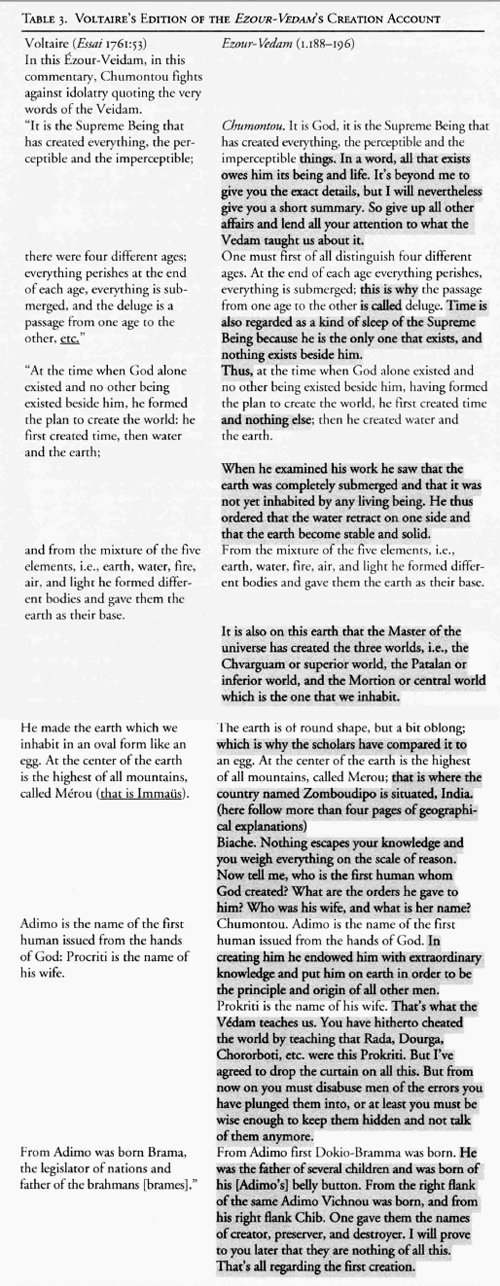
This argument about insects points to Voltaire's belief that human beings of different races could, just like insects, have originated anywhere on the globe. In the 1761 version, he added a long paragraph in which he mocked Bible-inspired monogenetic ideas, including that of the Ezour-vedam. Voltaire's dismissive attitude toward the Ezour-vedam is at odds with the kind of admiration and complete trust that Halbfass's and Hawley's narratives make readers expect. Voltaire's trenchant critique of the Ezour-vedam tale of Adimo (here misprinted Damo but later corrected) clearly shows his unwillingness to replace biblical monogenesis with an Indian equivalent:
All these considerations [about the fertility and easy life in India] seem to strengthen the old idea that mankind was born in a land where nature did everything for men and left them with almost nothing to do; but this only proves that the Indians are indigenous, and it does not prove at all that other kinds of people came from these regions. The whites, negroes, reds, Laplanders, Samoyedes, and Albinos certainly do not stem from the same land. The difference between all these species is as marked as that between a greyhound and a mullet; thus, only a badly instructed and pigheaded Brahman would pretend that all humans descend from the Indian Damo and his wife. (Voltaire 1761:1.44)
Returning to the 1745 India chapter after this foretaste of Voltaire's critical attitude toward the Ezour-vedam and his rejection of any monogenetic conception of origin, we note that in 1745, too, Indian religion was harshly criticized. From 1745 to the end of his life, Voltaire used the term "Bracmanes" or "Brachmanes" for the ancient clergy of India and "Bramins" for their modern successors. In 1745, he accused both the "Bonzes" (Buddhist clergy) and Brachmanes of fostering superstition, believing in metempsychosis or transmigration of souls and thus "spreading mindless stupidity [abrutissement] together with error" (Voltaire 1745:30): "Some of them are deceitful, others fanatic, and several of them are both;" and all "still prod, whenever they can, widows to immolate themselves on the body of their husbands" (p. 30).
We have already encountered several avatars of the idea that priests believe in a secret "inner" doctrine while misleading the people with "outer" lies and superstitious practices. This idea did not originate in the missions but already forms the basis of Plutarch's portrayal of Egyptian priests in his Isis and Osiris and runs like a thread via Lactantius, Augustine's City of God, and many other texts to the eighteenth century with its Jesuit figurists, John Toland's Letters to Serena (1704), and Ramsay's voyages de Cyrus (1728) to Voltaire's Essai. We will see in Chapters 2, 3, and 5 that one of these avatars, the Buddha's deathbed confession story, played an important role throughout the eighteenth century. Of course, the conception of an "inner" doctrine appreciated by the elite and an "outer" one for the ignorant masses was also fundamental for Ricci and other missionaries who portrayed Chinese or Indian religions in this manner and produced the reading material that inspired Voltaire. Thus, it is by no means surprising that he adopted this very scheme in his 1745 portrait of Indian and Chinese religions. With regard to the Indians, Voltaire wrote,
These Brahmins, who maintain the populace in the most stupid idolatry nevertheless have in their hands one of the most ancient books of the world, written by one of their earliest sages, in which only one Supreme Being is recognized. They preserve with great care this testimony that condemns them. (Voltaire 1745:30)
As Pomeau (1995:161) pointed out, Voltaire here probably amalgamated information about two Indian books from a letter of January 30, 1709, by Father Lalane included in the Lettres edifiantes et curieuses collection. The first concerns a book called Panjangan that proves the Indian recognition of one supreme being. Very much in the tracks of his Jesuit colleagues in China, Father Lalane wrote,
Based on the evidence from several of their books, it seems evident to me that they [the Indians] formerly had quite distinct knowledge of the true God. This is easy to see from the beginning of a book called Panjangan whose text I have translated word for word: "I venerate this Being that is subject neither to change nor anxiety [inquietude]; this Being whose nature is indivisible; this Being whose simplicity does not admit of any composition of qualities; this Being who is the origin and the cause of all beings and who surpasses all in excellence; this Being who is the support of the universe and the source of the three-fold power." (Le Gobien 1781-83:11.219)27
The second refers to the Veda, which Father Lalane described as follows:
The most ancient books, which contained a purer doctrine and were written in a very ancient language, were gradually neglected, and the use of this language has entirely disappeared. This is certain with regard to the book of religion called Vedam, which the scholars of the land understand no more; they limit themselves to reading it and to learning certain passages by heart, which they then pronounce in a mysterious manner to dupe the people more easily. (p. 220)
For Voltaire's China the same distinction applied. On one hand, he was enchanted with China's "morality, this obedience to the laws joined to the veneration of a supreme Being" that "form the religion of China, of its emperors and scholars [lettres]" (Voltaire 1745:22). In the 1745 Essai fragments, Confucius is said to have "established" this religion "which consists in being just and benevolent [bienfaisant]" (p. 22) and conveyed "the sanest ideas about the Divinity that the human spirit can form without revelation" (p. 23). As Voltaire did not believe in any divine revelation other than the laws of nature, reason, and the moral principles in everyone's heart, it is clear that in 1745 he regarded this idealized Confucianism as the model of a religion. On the ocher hand, China also had its superstitions for the masses. Sects like the cult of "Laokium" (Laozi; Daoism) that "believe in evil spirits and magic spells [enchantements]" and "the superstition of the Bonzes" who "offer the most ridiculous cult" to the Idol Fo (Buddha) (p. 23) are certainly not to the liking of the "magistrates and scholars who are altogether separate from the people." But these members of the elite who "nourish themselves with a purer substance" nevertheless insist that superstitious sects "be tolerated in China for use of the vulgar people, like coarse food apt to feed them" (p. 25). In Voltaire's religion there was no tolerance for intolerance.
The 1756 Essai and Dreams of the Veda
Unlike the scattered chapters published in 1745, the 1756 Essai was the first complete version that Voltaire submitted to the public. It resounded, as we will see in Chapter 7, not only throughout Europe but even elicited an interesting echo in far-away India.
The most striking change in the Essai's India chapter is found at its end where Voltaire eliminated two passages that were cited above. The first is about the bonzes and brachmanes who spread mindless stupidity and are deceitful, fanatic, or both; and the second is about the brahmins who maintain the populace in the most stupid idolatry even though they safeguard a book that recognizes a supreme being. In place of such critique, Voltaire in 1756 almost justifies the Brahmins:
It would still be difficult to reconcile the sublime ideas which the brahmins preserve about the supreme being with their garrulous mythology [mythologie fabuleuse] if history would not show us similar contradictions with the Greeks and Romans. (Voltaire 1756:1.32)
What had happened in the eleven years between 1745 and 1756? How did the Brahmins get rid of their superstitions, fanaticism, and evil instigation of the ritual suicide of widows (sati)? And how did the "most stupid idolatry" get transformed into a "garrulous" or "fabulous" mythology whose contradictions are not worse than those of the Greeks and Romans? A partial answer is not found in the India and China chapters at the beginning of the 1756 Essai but rather way back in chapter 120, "On Japan." For some reason, in this unlikely place Voltaire included new information on India, and here he also mentions a lesson learned through experience:
It is true that one must read almost all reports that arrive from faraway lands with a spirit of doubt. People are busier sending us goods from the coasts of Malabar than truths. A particular case is often portrayed as a general custom. (Voltaire 1756:3.203)
Voltaire was now informed about some of the most striking features of Asian religions. He saw "almost all peoples steeped in the opinion that their gods have frequently joined us on earth": Vishnu had gone through nine incarnations, and the god of the Siamese, Sammonocodom (Buddha), reportedly took human form no less than 150 times (p. 204). Voltaire noted that the ancient Egyptians, Greeks, and Romans had very similar ideas, and he sought to interpret this "error" amiably and monotheistically:
Such a rash, ridiculous, and universal error nevertheless comes from a reasonable feeling that is at the bottom of all hearts. One feels naturally one's dependence on a supreme being; and the error which always joins truth has almost everywhere caused people to regard the gods as lords who came at times to visit and reform their domains. (p. 205)
Another characteristic common to many religions is identified as atonement: "Man has always felt the need for clemency. This is the origin of the frightening penances to which the bonzes, brahmins, and fakirs subject themselves" (p. 205). For the Indian cult of the lingam, he also found Mediterranean counterparts in "the procession of the phallum of the Egyptians and the priapus of the Romans" (p. 205). Voltaire thought it "probable that this custom was introduced in times of simplicity and that at first people only thought of honoring the divinity through the symbol of the life it gave to us" (p. 205). These interpretations show how eager Voltaire was to find vestiges of monotheism even in ideas and cults that not so long ago would have elicited harsh words of condemnation or ridicule. Now he not only tried to interpret them as signs of ancient monotheism but also pointed to an ancient source:
Would you believe that among so many extravagant opinions and bizarre superstitions these Indian heathens all recognize, as we do, an infinitely perfect being? Whom they call the being of beings, the sovereign being, invisible, incomprehensible, formless, creator, and preserver, just and merciful, who deigns to impart himself to the people to guide them to eternal happiness? These ideas are contained in the Vedam, which is the book of the ancient brachmanes. They are spread in modern books of the brahmins. (p. 206)
Voltaire then hints at the source of this information:
"A learned Danish missionary on the coast of Tranquebar" who "cites several passages and several prayer formulae that seem to come from straightest reason and purest holiness." Had he finally found an alternative to the Jewish Old Testament? While in 1756 he had quoted only the first five words of a single prayer from a book called Varabadu -- "O sovereign of all beings, etc." (p. 206) -- the 1761 Essai features the whole prayer; and though the source is not further identified, it appears that Voltaire got all this information from the book published in 1724 by Mathurin Veyssiere de LA CROZE (1661-1739) that will be analyzed in the next chapter.
Voltaire already appears to have used La Croze's book when writing his brief 1745 portrayal of the cult of Fo or Foe (Ch. Buddha) that described its Indian origin around 1000 B.C.E. and its popularity in most of Asia (Voltaire mentions Japan, China, Tartary, Siam, and Tibet; 1745:23-25). Such information was found in La Croze's survey of "Indian idolatry" (1724:424-519) that contained an early synthesis of ancient and contemporary information about phenomena that we today associate with Buddhism. But it also featured much information on Indian religion that Voltaire used for the 1756 version of his Essai.
La Croze, a former Benedictine monk who had converted to Protestantism, had read early accounts of the sacred scriptures of India, the Vedas, and his status as Prussia's royal librarian helped him get access to a treasure trove of recent information on India's religions. These were the unpublished manuscripts of the German Lutheran missionary Bartholomaus ZIEGENBALG (1682-1719), who in 1706 had arrived in South India as India's first Protestant missionary and spent thirteen years in the Danish enclave of Tranquebar on India's southeastern coast (Tamil Nadu).
A New Manuscript: BN Fonds Francais 19117
In the meanwhile, no one seems to have noticed the existence, in the Bibliotheque Nationale, of a third manuscript of the EzV. The catalogue: Ancien Saint-Germain Francais III. Nos. 18677-20064 du Fonds Francais (by L Auvray and H. Omont, Paris: Leroux, 1900), has the following entry: "19117, 'Zozur Bedo'; traduction francaise du YADJOUR VEDA,4c livre des Vedas. En huit livres. XVIIe-XVIIIe. Papier. ) 58 pages. 208 sur 205 millimetres. Cartonne. (Saint-Germain, Harlay 515.)." This is, indeed, another copy of the EzV, in eight books.
The manuscripts of the Harlay family were donated, by Achille IV de Harlay (died 23 July 1717) to Louis-Germain de Chauvelin (1685-1762), on 11 August 1716. The condition attached to the donation said that the manuscripts should stay with de Chauvelin and his male descendants until one of them died without further male descendants "revetus de charge de judicature." [Google translate: load bearing judicature.] At that time the manuscripts were to become the property of the Benedictines of the abbey of Saint-Germain-des-Pres. Chauvelin not only allowed the members of the [Benedictine] Order to use the materials while he still held the usufruct; he also enriched the collection with documents which were his own full property. On 19 March 1755 he decided to transfer the collection to Saint-Germain, together with those manuscripts of which he himself was the owner. The manuscripts were transferred from the castle of Grosbois to the abbey. They remained a special fund while deposited there, until they were transferred, together with the other manuscripts of Saint-Germain, to the Bibliotheque Nationale, in 1865. There the entire collection was integrated into the "Troisieme Serie" of the Fonds Francais: manuscripts 15370 to 20064.[/b]
These data do not entirely solve the problem of the origin of the third EzV manuscript. The donation of 11 August 1716 was accompanied by a catalogue which is, however, lost, with the result that it is no longer possible to ascertain which particular manuscripts were added to the collection by de Chauvelin.90 We can only presume that the EzV did not belong to the original collection of 1716, and that it was one of the latest additions; it is no. 515 in a collection of altogether 519 items. But, even then, the third EzV manuscript must have belonged to the collection by 1755, five years before Maudave brought his copy to Europe.
The principal problem that remains unsolved in all this is that in two handwritten catalogues at the Bibliotheque Nationale, manuscript "Harlay 515" is described as "Melanges cont. 110. pieces": in the "Catalogue des manuscrits de Monsieur** [Chauvelin]",91 and in the "Catalogue des mss. de la bibliotheque de feu Mre Achilles de Harlay, premier president du Parlement de Paris, passes depuis dans la bibliotheque de feu messire Louis- Germain Chauvelin, ancien garde des sceaux, et actuellement dans la bibliotheque de l'abbaye de Saint-Germain-des-Pres, a Paris, 1762."92 [Google translate: Catalog of mss. of the library of the late Mre Achilles de Harlay, first Speaker of Parliament of Paris, since passed in the library of the late Messire Louis-Germain Chauvelin, former Keeper of the Seals, and currently in the library of the Abbey of Saint-Germain-des-Pres, in Paris, 1762.]
Even assuming that the EzV manuscript did belong to the private collection of Louis-Germain de Chauvelin on 19 March 1755, it is no longer possible to investigate how and when he acquired it. The important fact is that it is the oldest EzV manuscript in Europe, even though no one ever took notice of it. It also shows that the terminus ante quem [Google translate: term before he] for the composition of the EzV, which until now was 1759 -- the time when Maudave left India --, has to be advanced with at least five years and possibly by more than that.
-- Ezourvedam: A French Veda of the Eighteenth Century, Edited with an Introduction by Ludo Rocher
Just two months after his arrival, Ziegenbalg proclaimed in a letter what was to become the tenor of his extensive studies of Hinduism:
"They have many hundreds of gods yet recognize only a single divine Being as the origin of all gods and all other things" (Bergen 1708:19).28 This assertion of ancient Indian monotheism was not only repeated and documented in Ziegenbalg's manuscripts but also found its way into two of Voltaire's major sources, namely, La Croze (1724) and Niecamp (1745).
"I have often sent some Malabarick Writers a great way into the Country, in order to buy up Malabarian Books from the Widows of the deceased Brahmans. But there are a great many more of those Books, which being grown very scarce, are not so easily found out. However, I do what I can to get 'em into my Hands, and to purchase 'em at any rate, that so I may be able to unravel the better, the Mysteries and fundamental Principles of their Idolatrous Religion. Which I hope to lay open in time, in all its black and odious Colours, and to confute it out of their own Writings.
-- The Printing Press in India: It's Beginnings and Early Development Being a Quatercentenary Commemoration Study of the Advent of Printing in India (In 1556), by Anant Kakba Priolkar
Near the beginning of La Croze's investigation about the "idolatry of the Indies," Voltaire read that "in spite of the grossest idolatry, the existence of the infinitely perfect Being is so well established with them [the Indians] that there is no room for doubt that they have preserved this knowledge since their first establishment in the Indies" (La Croze 1724:425). Calling the Indians "one of the oldest people on earth," La Croze thought it "a very probable fact that in ancient times they had a quite distinct knowledge of the true God and that they offered an inner cult [culte interieur] to him which was not mixed with any profanation" (p. 426). To find out more about this, La Croze suggested, one would have to get access to the Vedam, "which is the collection of the ancient sacred scriptures of the Brachmanes" (p. 427). In the Vedam "in all likelihood one would find the antiquities [Antiquitez] which the superstitiously proud Brahmins conceal from the people of India whom they regard as profane" (p. 427). Consequently, the Brahmins (the modern successors of the ancient Brachmanes) introduce ordinary people only to "the exterior of religion enveloped in legends [fables] that are at least as extravagant as those of Greek paganism" (p. 428). According to La Croze, the Vedam, which can be read only by Brahmins who are its guardians, "enjoys the same authority with these idolaters as the Sacred Writ does with us" (p. 447). Always following Ziegenbalg's and his fellow missionaries' manuscripts, La Croze quoted a passage "from one of the [Indian] books" about God whom the Indians call "Barabara Vistou, that is, the Being of Beings" (p. 452).29 La Croze did not identify this book, but Voltaire must have been so impressed by the information about the monotheistic Vedas that, in the 1756 Essai, he jumped to the conclusion (Voltaire 1756:3.206): "These ideas are contained in the Vedam, which is the book of the ancient brachmanes."30 In fact, the ideas mentioned by Voltaire -- "
the being of beings, the sovereign being, invisible, incomprehensible, formless, creator, and preserver, just and merciful, who deigns to impart himself to the people to guide them to eternal happiness" -- were culled in almost identical sequence from a longer passage in La Croze, which reads as follows (words taken over by Voltaire are italicized):
The infinitely perfect Being is known to all these gentile pagans. They call it in their language Barabara Vastou, that is, the Being of Beings. Here is how they describe it in one of their books. "The Sovereign Being is invisible and incomprehensible, immobile and without shape or exterior form. Nobody has ever seen it; time has not included it: his essence fills all things, and all things have their origin from him. All power, all wisdom, all knowledge [science], all sanctity, and all truth are in him. He is infinitely good, just, and merciful. It is he who has created all, preserves all, and who enjoys to be among men in order to guide them to eternal happiness, the happiness that consists in loving and serving him." (La Croze 1724:452)
With regard to the
lingam cult Voltaire also followed La Croze and indirectly Ziegenbalg. La Croze had explained that "the
lingum ... is a symbolic representation of God ... but only represents God as he materializes himself in creation," (p. 455) while Voltaire speculated that this cult "was introduced in times of simplicity and that at first people only thought of honoring the divinity through the symbol of the life it gave to us" (Voltaire 1756:3.205).
At this point, Voltaire leaned toward India as the earliest human civilization (1756:1.30) and believed that the most ancient text of this civilization was called Vedam and contained a simple and pure monotheism. So he must have been elated when a reader of his 1756 Essai, Louis-Laurent de Federbe, Chevalier (later Comte) DE MAUDAVE (1725-77), wrote to him from India two or three years after publication of the Essai. Maudave had left in May 1757 for India and in 1758 participated in the capture of
Fort St. David and
the siege of Madras (Rocher 1984:77). While stationed in South India, Maudave had gotten hold of French translations from the Vedam and decided to write a letter to Voltaire. Having read the Japan chapter of the 1756 Essai, he knew how interested Voltaire was In finding documentation for ancient Indian monotheism through the Vedam. In the margin of a page of his Ezour-vedam manuscript (which he later passed on to Voltaire), Maudave scribbled next to two prayers to God: "Copy these prayers in the letter to M. de Voltaire" (p. 80).32 Though these prayers are not found in the extant fragment of Maudave's letter, it is likely that Maudave included them in order to document the existence of pure monotheism in the Vedam. The second major point of Voltaire's 1756 Essai that Maudave addressed in his letter was the cult of the lingam.33 In his discussion, Maudave quoted the Ezour-vedam as textual witness and offered to send Voltaire a replica of a Linga and a copy of the Ezour-vedam (Rocher 1984:48).