|
THE COVERT WAR AGAINST ROCK -- CHAPTER 9 |
|
Like Coffins in a Cage: The Baez Contras and the Death of Phil Ochs THE TEMPTATION FOR
POWER IS SO GREAT, AND UNFORTUNATELY, WHAT ONE'S
POWER HAS ALWAYS MEANT IS ONE'S ABILITY ... TO MURDER ONE'S NEIGHBOR. I STARTED OUT WITH INFORMATION KIND OF REMOTE. WHEN A PATRIOTIC MOTHER
DRAGGED ME DOWN BY THE THROAT. WHEN [HUAC INVESTIGATORS] ASK YOU A
QUESTION, THEY EXPECT A REPLY! DOESN'T MATTER IF YOU'RE FIXIN' TO DIE. Folk singer Joan Baez, a distinguished critic of the Sturm and Drang in Southeast Asia, survived the CHAOS backlash. Unlike many of the musicians who fell under the heel of the mammoth inter-agency operation, she fully understood that political assassination could be her reward for openly castigating military-industrial masters of war. Her close friend Martin Luther King, Jr. climbed to the "mountaintop." She met him on the descent. The world's most honored civil rights leader explained to Baez and a group of activist supporters before delivering the famed speech how he came to scale the "mountaintop." "[He] told us how it happened. It was when he was in solitary confinement in Alabama or someplace. [The police] had dumped him in the hole, and it was black, he couldn't see And they shoved food into the room, but he was afraid to eat it. Starving, afraid -- he said he got on his knees for hours. 'And when I stood up,' he said, 'it didn't matter anymore.'" King's entourage hid their pain "when we knew what he meant -- we knew he was going to die. And he was ready to die, and he was ready to make his commitment about Vietnam -- which is why he died. 'I've been to the mountaintop, and I've seen the promised land, and it doesn't matter anymore.'" [1] King's example left Baez with a personal and highly instructive vantage point to view the pathological drives of the intelligence sector's bloodhounds, but she already had a jump on most activists -- she was to the national security state born. Baez wrote in a memoir, And a Voice to Sing With (1987), of her childhood and her father, a "bright young Stanford scientist" who settled in Los Alamos, New Mexico, the incubation chamber of the atomic bomb. Albert Baez "recognized the potential destructive power of the unleashed atom even in those early days. So he took a job as a research physicist at Cornell University in Ithaca, New York: Cornell was the home base of the CIA's mind control experiments, and Joan Baez is a survivor of ritual child abuse and a multiple personality, according to letters she has written to researchers and other survivors, a common cover for trauma-based mind control programming (she has sung about it: "I'm paying for protection/Smoking out the truth/Chasing recollections/Nailing down the proof ..." [2]) Baez entertained no delusions about the CIA. In San Francisco, she once promoted State of Seige, a film, she said later, that "exposed, among other things, the corrupt element in the AID program which funded the teaching of torture techniques in Latin America. We solicited signatures against the use of torture." She informed these signatories, "Torture was more prevalent than it had been since the middle ages, thus the danger was its common use as government policy," and, "though at one remove, the hands of the US government were far from clean." [3] The psychological cost of ritual abuse/mind control experimentation as a child, and decades of civil rights activism, has been years of intensive therapy to confront her "inner demons," her fears, insomnias, panic attacks, phobias, and anxieties. Therapists kept Baez "glued together, to get me to the next gig, or to the next march." [4] Joan's father, a Quaker by religious conversion, "was invited to become Head of Operations Research at Cornell." This position and a security pass would almost certainly bring him into contact with the CIA's Human Ecology Fund, the contract base for all classified academic mind control studies sequestered behind the privet fences of Ivy League campuses across the country. "Exactly what the job entailed was classified information," Baez recalls, but her father was "offered a three-week cruise on an aircraft carrier as an introduction to the project and promised a huge salary. As it turned out, he would be overseeing Project Portrex, a vast amphibious exercise which among other things involved testing fighter jets, then a relatively new phenomenon. Millions of dollars would be poured into the project, about which he was to know little and say less." [5] After high school, her father moved on to MIT, another fount of classified military research. [6] At the age of ten, she lived in Baghdad, Iraq with her family. Upon their return to the U.S., the Baez family moved to California.
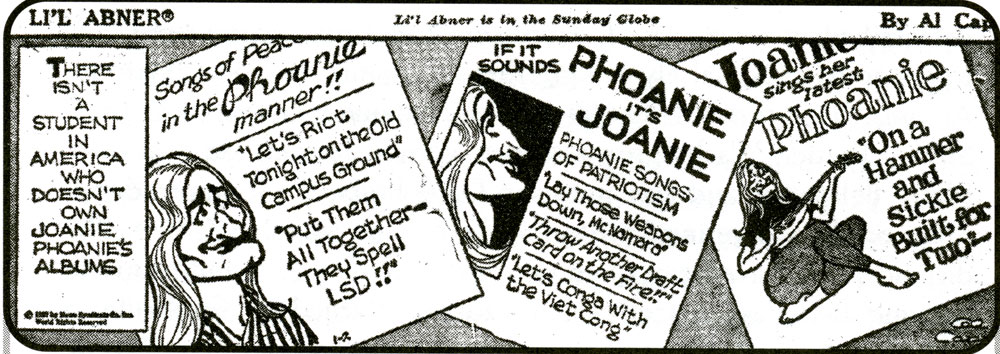
LI'L ABNER, BY AL CAPP: THERE ISN'T A STUDENT IN AMERICA WHO DOESN'T OWN JOANIE PHOANIE'S ALBUMS: SONGS OF PEACE IN THE PHOANIE MANNER!! "LET'S RIOT TONIGHT ON THE OLD CAMPUS GROUND." "PUT THEM ALL TOGETHER -- THEY SPELL LSD!!" IF IT SOUNDS PHOANIE IT'S JOANIE. PHOANIE SONGS OF PATRIOTISM. "LAY THOSE WEAPONS DOWN, MCNAMARA." "THROW ANOTHER DRAFT CARD ON THE FIRE!!" "LET'S CONGA WITH THE VIET CONG." JOANIE SINGS HER LATEST PHOANIE. "ON A HAMMER AND SICKLE BUILT FOR TWO" -- SOME RIGHT-WINGERS FOUND THE MUSIC OF JOAN BAEZ LESS THAN INSPIRATIONAL She was not buried by CHAOS, but she lived under its intolerant eye and it could silence her: "An American," the New York Times reported on February 21, 1967, "identifying himself as Harold Cooper, a CIA man, had ordered the Japanese interpreter, Ichiro Takasaki, to substitute an innocuous translation in Japanese for Miss Baez' remarks in English on Vietnam and Nagasaki's atom bomb survivors." Cooper asked Takasaki to revise political statements made by the folk singer, and warned, "If you don't cooperate, you will have trouble in your work in the future." The interpreter cooperated and mistranslated her statements. "It was a most strange case," Takasaki told reporters "I knew that Miss Baez was a marked person who was opposed to the Vietnam War and who had been tacitly boycotted by the broadcasting companies in the United States. American friends also repeatedly advised me not to take on the job, but I took it on as a business proposition, since the Japanese fans were coming not to hear her political statements, but her music. I met Mr. Cooper once in the presence of a Times reporter in Japan, but even in that meeting he openly demanded that I mistranslate. I tried to reject the absurd demands, but he knew the name of my child and the contents of my work very well. I became afraid and agreed." [7] A year later the European Exchange System announced that the sale of Joan Baez records had been banned from all Army PXs. And in 1969, Baez denounced the draft on The Smothers Brothers Comedy Hour. She was censored by CBS -- her comments cut from the video tape when the program aired. Shortly thereafter, CBS canceled the troublesome Smothers Brothers for good. This was the same year that David Harris, her then-husband, was sentenced to a three-year prison term for draft evasion. Baez also fell under the baleful eye of Mississippi's Sovereign Commission, a secret agency operating behind a pro- segregationist public relations facade, as revealed in 132,000 pages of documents declassified in 1998. The Commission spied on and smeared civil rights activists by falsely linking them to communist organizations. Among the estimated 80,000 names contained in the files: Baez, Sidney Poitier, Washington attorney Vernon Jordan, James Brown, Harry Belafonte, and jazz musician Dave Brubeck. "It's more disappointing than angering," Jordon told CNN on March 17, 1998. "It's disgraceful to have been spied on for doing your duty and trying to become first-class citizens." But Horace Harned of Starkville, a former state legislator and two-term member of the commission, defended the CIA-backed group. "We were under the threat of being overrun by an alien force led by the communists. ... This was a time when the Freedom Riders were marching and burning things from New Jersey to California. They threatened to march through Mississippi," Harned declaimed. "Whether it was legal or not never bothered me. We needed to have those spies ... A lot of [civil rights activists] were misguided, not realizing who was leading them and putting up the money." [8] In April 1961, Baez met Bob Dylan at Gerde's Folk City, then opening for bluesman John Lee Hooker. Dylan, writes rock historian Wayne Hampton, would lead "the surge of folk protest into the popular mainstream of American culture ... Never before had songs of such stark political intensity reached into the realm of popular culture." [9] Dylan, of course, nearly died in 1966 after a motorcycle accident. Three months earlier, Joan's brother-in-law, Richard Farina, a folksinger and novelist of Irish-Cuban descent, did die in a motorcycle accident on his way home from a promotional party for his book, Been Down So Long it Looks Like Up to Me. Farina died on April 30, 1966, his wife Mimi's birthday. "He'd been riding on the back of a motorcycle on Carmel Valley Road," his friend Thomas Pynchon -- who dedicated the labyrinthian Gravity's Rainbow to Farina -- wrote in a memoir, "where a prudent speed would have been thirty-five. Police estimated that they must have been doing ninety, and failed to make a curve." Farina was thrown and killed. Before his death he had been producing an album of contemporary songs performed by Joan Baez. The recording was shelved after Farina died. [10] Ninety miles per hour on a slow turn? How to account for the breakneck motorcycle ride? Was Farina in a reckless mood or had someone fiddled with the throttle? The government had no use for Richard Farina. The notorious HUAC Committee attempted to demonize him after a joyously rebellious trip to Cuba and his earthy political performances on college campuses. Farina's dissident lyrics -- "It was the red, white and blue making war on the poor / Lying mother [FATHER] justice on a pile of manure" -- undoubtedly cost him fans in the District of Columbia. Dylan nearly followed Farina through the mists of American Pie oblivion but took a hard turn instead. He dropped the broadside lyrics grating on the nerves of the establishment. In 1963, Dylan was informed by censors that he would not be allowed to sing a ditty lampooning the distant-right John Birch Society on the Ed Sullivan Show. [11] Three years later, rock critic Ralph J. Gleason, writing in Ramparts, could argue that the most serious threat to the American Order came "not from the armed might of a foreign power but from a frail, slender, elusive lad, whose weapons are words and music, a burning imagination and an apocalyptic vision of the world." [12] But after his motorcycle accident and a slow recovery from concussion and a number of broken vertebrae, Dylan underwent a political change. He retreated to Nashville and recorded John Wesley Harding, an allegoric collection of songs about his life situation, and in 1969 cut Nashville Skyline, a politically-innocuous country-and-western album. "He no longer wished to play radical politics with his music," observes Hampton. Dylan was suddenly apolitical. "Perhaps it was the accident, or perhaps he had already lost his nerve and used the accident as a cover." His sudden departure from radical politics outraged some critics and many of his fans. There were calls for a boycott. [13] Only five years after the accident did he appease his detractors with "George Jackson," a fiercely-driven ballad about the Black Panther leader viciously murdered by a prison guard. But by and large, he announced, "I don't want to write for people anymore. You know, be a spokesman." [14]
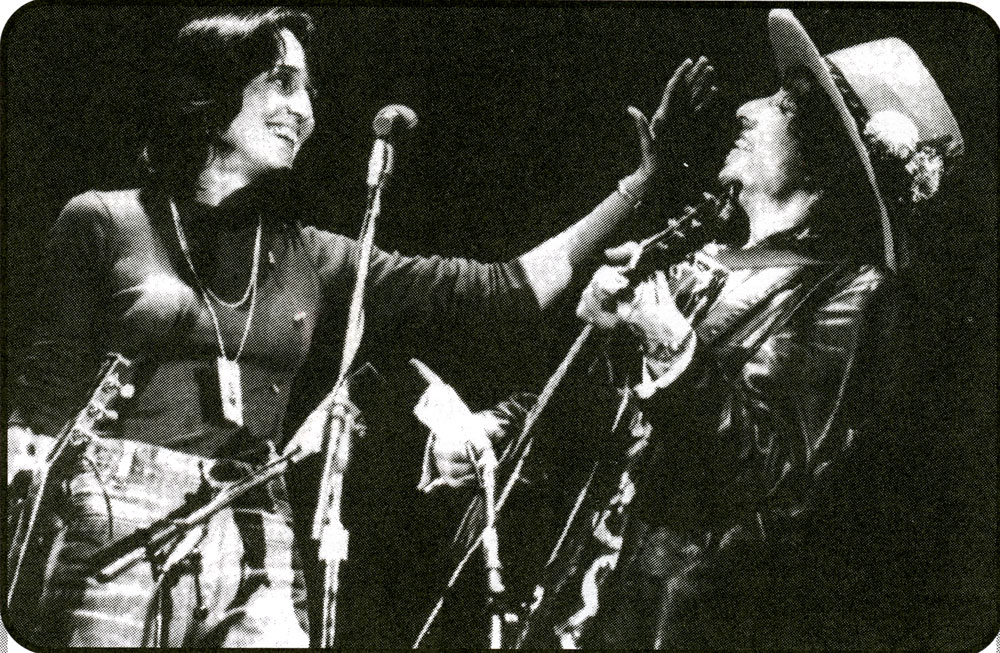
JOAN BAEZ AND BOB DYLAN COMPOSED THE NUCLEUS OF A FOLK MOVEMENT. THEY DID MUCH TO TRANSFORM AND MOVE THIS SUBCULTURE INTO DIRECT CONFRONTATION WITH EISENHOWER'S "COMPLEX." Dylan shied away from communal politics in general, preferring to align himself with the individual tormented by the evils of American culture. He was a symbol of the '60s. Mark Edmundson, in Civilization magazine, writes: He wasn't ruined by drugs or the lure of easy transcendence, though he never sneers at the prospect of happiness. Dylan's work combines art and politics, the drive for pleasure with the urge to know the harshest truth about the world and then to try doing something about it. And ultimately this is the 1960s idea that has been lost from view. The accounts we have that are unsympathetic to the 1960s tell the story of people who have been addicted to power or pleasure and were ruined by those addictions. But there was, and is, a middle ground, where Dylan's work unfolds. The Dylan who moved audiences in the 1960s and continues to do so is not a "protest singer," nor is he just another episode in the disposable culture of American pop. He is, in the major phase of his work, a visionary skeptic. Dylan, like the post- 1865 Whitman, loves the promise of America and yet is disgusted by much of its reality. [15] Dylan and Baez became intimate in 1963, a time, critic Tom Smucker wrote in the October 31, 1969 issue of Fusion, when, "due to factors I do not understand, having something to do with post WWII America, the breakdown of the socializing forces of schooling, affluence, the Cold War, and the beginnings of the Black revolt as a vital semi-alternative, some white kids began: 1. listening to black music on the radio, or eventually their own derivative of that Rock 'n' Roll; 2. participating in what was then called the Civil Rights movement." They met at the Monterey Folk Festival and joined forces. Farina ketched one of their performances a year later: "They claimed to be there not as virtuosos in the field of concretized folk music but as purveyors of an enjoined social consciousness and responsibility. They felt the intolerability of bigoted opposition to Civil Rights. When they left the stage to a whirlwind of enthusiastic cheers, it seemed that the previously unspoken word of protest, like the torch of President Kennedy's inaugural address, had most certainly been passed." [16] The stories that Dylan spun over his dangling harmonica were not traditional folk music, Farina -- his first wife launched Dylan's career -- observed. The songs "had nothing to do with unrequited Appalachian love affairs or idealized whorehouses in New Orleans. They told about the cane murder of Negro servant Hattie Carroll, the death of boxer Davey Moore, the unbroken chains of injustice waiting for the hammers of a crusading era. They went right to the heart of his decade's most recurring preoccupation, that in a time of irreversible technological progress, moral civilization has pathetically faltered; that no matter how much international attention is focused on macro-cosmic affairs, the plight of the individual must be considered." [17] Phil Ochs, the "Outlaw" and his Brain U.S. AGENTS WERE ABLE TO DESTROY ANY PERSON'S REPUTATION BY INDUCING HYSTERIA OR EXCESSIVE EMOTIONAL RESPONSES, TEMPORARY OR PERMANENT INSANITY, SUGGEST OR ENCOURAGE SUICIDE, ERASE MEMORY, INVENT DOUBLE OR TRIPLE PERSONALITIES INSIDE ONE MIND ... MAE BRUSSELL, "OPERATION CHAOS" Yippie cherub Phil Ochs, for instance. Ochs was a close chum of Dylan's, and the nearest competitor for the folk-rock mantle. Life in another's shadow stung him. Yet he considered Dylan the "greatest poet ever" and often talked about his songs. Dylan, Ochs and Farina set out on the folk minstrel's path in the Village of the early '60s at The Bitter End, the Gaslight, and other Greenwich Village clubs with Tom Paxton, Eric Anderson, Buffy Saint-Marie, John Sebastian, Eric Anderson, Dave Van Ronk, and a clutch of other then unknowns dubbed by Seeger "Woody's Children." There was an invigorating charge in the air, a sense of social rage finding and redefining itself after the cultural stagnation of the Eisenhower decade. Dylan crooned "Masters of War," Phil Ochs belted out an anguished "Too Many Martyrs." Together, they dragged folk music away from the migrant camps and union halls into direct confrontation with the boardroom of Eisenhower's looming "military-industrial complex." Dylan, Baez, and Ochs strummed a path to the bill of the 1963 Newport Festival. Folksinging made an overnight comeback and immediately altered course to meet the path of extreme resistance. Ochs denounced American geopolitics in "Cops of the World."
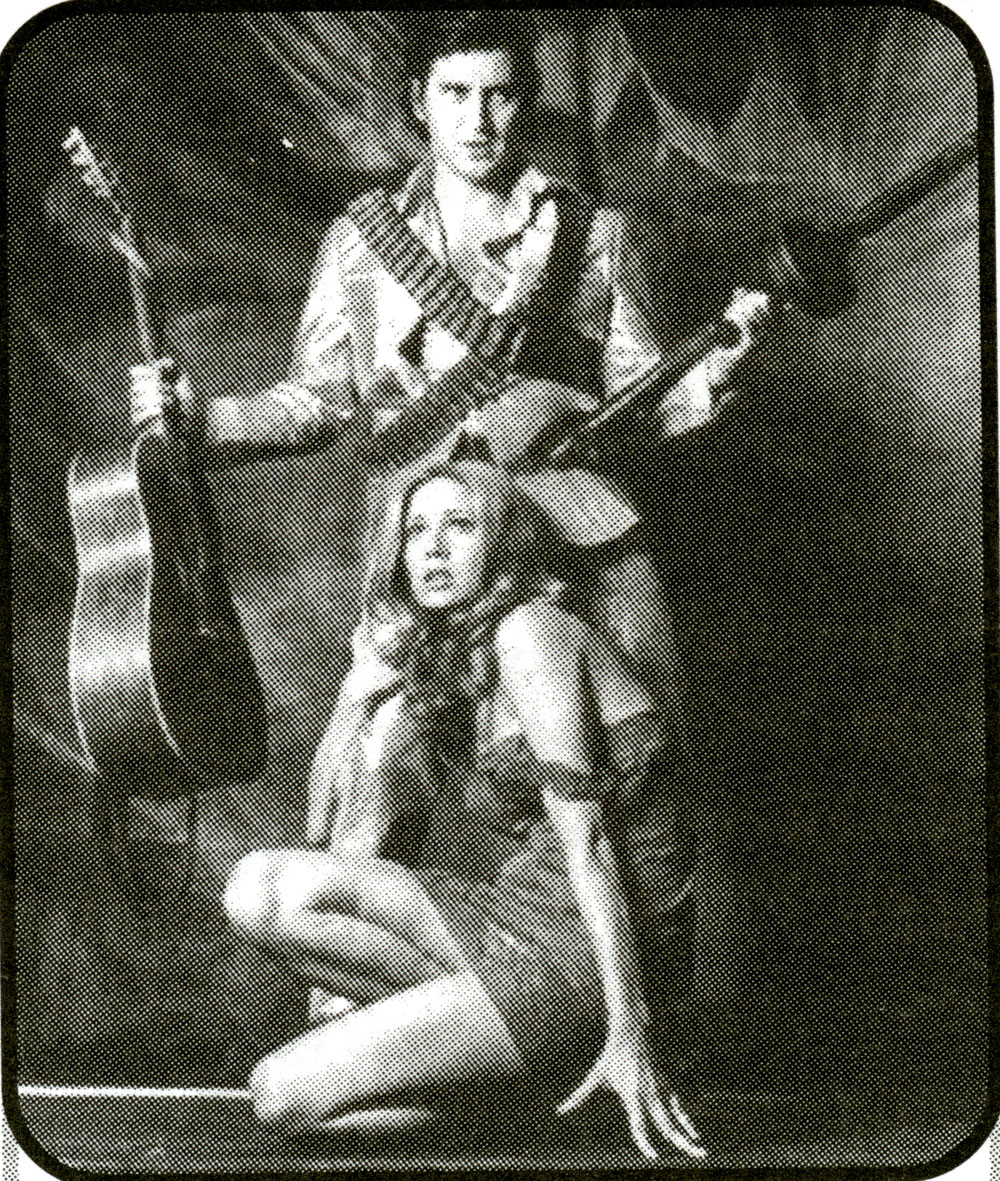
PHIL OCHS, FOLK REVOLUTIONARY AND MULTIPLE PERSONALITY
And when we've butchered your sons, boys, He was the ultimate dissident ...
The comic and the beauty queen are dancing on the stage. A prophet on the barricades ... Oh, we're fighting in a war we lost before the war began ... Ochs was appalled by the corruption flourishing in the District of Columbia under Richard Nixon. One evening toward the end of his life, at a concert on West Third Street, Ochs knocked back a few tumblers of rum and drew down on CIA Director William Colby, formerly director of the murderous Phoenix program in Vietnam. "I put out a contract on Colby," Ochs spat, "for a hundred thousand dollars. I told Colby he's got a half year to get out or he's dead. They can kill me but he's dead. He's a dead man now. William Colby is dead." Before the concert was over, sobriety was a distant memory, but he ranted on about his distrust of Patty Hearst ("Tanya ... it's like a CIA code word"), the execution of Che Guevara, the media ("That awful cunt paper Ms., run by that CIA agent -- what's her name? -- Steinem, CIA Steinem ..."). [18] Ochs rose to prominence as a performer with Baez and Dylan after the killing of John Kennedy. He was a founder of the Yippie Party, sang for the embattled ranks of protesters at the nightmarish 1968 Democratic convention in Chicago, appeared as a witness, guitar in tow, at the Chicago Seven Trial. His lyrics were considered so inflammatory that he was banned from the airwaves. Ochs despised Nixon and the war. Music conveyed his obsessions, and so "Here's to the State of Richard Nixon":
Nixon's gone and taught you lies The bursts of rage did not pass unnoticed by J. Edgar Hoover, who whipped off anxious memoranda to the executive branch implying that Ochs was gunning for Nixon. A recently declassified Justice Department memo, originating with the FBI office in Little Rock, Arkansas on October 22, 1969, reveals that "paranoia" was a two-way street. PHONOGRAPH RECORD ENTITLED "REHEARSALS FOR RETIREMENT" BY PHIL OCHS, THREAT AGAINST THE PRESIDENT [Name redacted] made available a phonograph record entitled, "Rehearsals for Retirement" by PHIL OCHS, distributed by A&M Records, 1416 North La Brea, Hollywood, California. The record was purchased by her 14-year-old son, Stanley Thomas, at Osco Drugs, Southwest Shopping Center, Little Rock, Arkansas. This record was monitored on October 20, 1969, and on side one the first song, entitled "Pretty Smart On My Part," states in song what appears to be "I can see them coming. They are training in the mountains. They talk Chinese and spread disease [the CIA]. They will hurt me, bring me down. Sometime later, when I feel a little better, we will assassinate the President and take over the government. We will fry them." A disclaimer attached to the memo notes, "this document contains neither recommendations nor conclusions of the FBI, and in keeping with that we will refrain from drawing conclusions." But the Bureau did not refrain from amassing a huge file on Ochs, and the feeling that he was never alone unnerved him. In "My Life," he addressed the federal agents shadowing him:
Take everything I own, But he wasn't left alone. The name Phil Ochs was listed on Hoover's Security Index, a catalogue of "subversives" considered a threat to national defense. He was tarred as a "Communist" [19] The fear, the "paranoia" that had gripped Brian Jones, Jimi Hendrix, and other ill-fated musicians before him took hold. His friend John Berendt recalls that Ochs was "convinced he would be assassinated, probably onstage. Once, while he was waiting in the wings in Baltimore, the performer ahead of him dropped his guitar on the floor with a bang. Ochs ducked, positive the shooting had begun." After the Chicago police riot, his life underwent an erratic, tormented decline. He was cursed by lengthy spells of depression. The tombstone on the cover of Rehearsals for Retirement (1969) was one of the many intimations of his pending death scattered around. [20] The album's title track reflected the despair that sank in after Chicago, a nagging sense of doom.
This then is the death of the American imprisoned by paranoia, He was driven to drink by the radio blackballing of his music, hounded by the authorities and a series of unexplained mishaps. His nerves gave out. He lived in a perpetual state of "paranoia." In Hong Kong, tagging along on a lecture tour with underground cartoonist Ron Cobb in 1971, Ochs returned to his hotel room to find that it had been forcibly entered and all of his cash stolen. Ochs was convinced the CIA had robbed him to prevent his entry to Vietnam, the ultimate destination of Cobb's tour, and had no choice but to catch the next flight back to the States on an American Express card. [21] And there was the crushing of his vocal chords by thugs in Tanzania. Ochs was drawn to Africa by its music, language, and political potential. While strolling on the beach at Dar es Salaam, Ochs was mugged by three black men. One of them held Ochs with a strangling forearm while another searched his pockets. The forearm compressed his throat so tightly that he was unable to scream or even breathe. He struggled, the arm tightened. Ochs passed out and the thieves beat him before they fled with his cash. The injuries were largely flesh wounds but his vocal chords were permanently damaged. [22] The muggers who quashed his career have never been identified. His injuries, the pressures of political confrontation, and the death of the movement may have conspired in his retreat to leave him with a right-wing pseudo-personality: "John Train." Or was he, like his friend Joan Baez, the victim of CIA mind control experimentation? What are the odds that two activists in a small circle of friends would develop dissociative identity disorder, multiple personalities? The transformation -- into a pathological CIA agent, no less -- is one of the most incredible declines of the American Pie mortality chart. "On the first day of summer 1975, Phil Ochs was murdered in the Chelsea Hotel by John Train," he claimed in a taped interview. "For the good of societies, public and secret, he needed to be gotten rid of." [23] Ochs made allusions to his pseudo-personality in song fragments of an album he planned, but never recorded.
Phil Ochs checked into the Chelsea Hotel "He actually believed he was a member of the CIA," writes biographer Marc Eliot. Ochs, reborn as Train, began compiling mysterious lists: "shellfish toxin, Fort Dietrich, cobra venom, Chantilly Race Track, hollow silver dollars, New York Cornell Hospital ... " [24] Ochs biographer Michael Schumacher interpreted the transformation as an escape from deep depression to living martyrdom. The singer's death at the hands of an alter-personality "assured him of the status of having a heroic figure in the mind of the 'public' society that admired his activism," and incidentally ended the harassment by the 'secret' societies (the FBI, CIA, Mafia, etc) that wanted him silenced. "Or so Train hoped." [25] John Train, a drinking, brawling right-wing thug, boasted in a filmed interview that he had "killed" Phil Ochs. The motive: Ochs was "some kind of genius but he drank too much and was a boring old fart." But Train hinted that if Ochs had been a commercial success, "they" [the CIA] would have killed his host personality. "Colby and Company would be more than happy to put a slug through his head at that point" [26] Colby did not have Ochs shot for "innocent inventions" but his slow death at the hand of a "CIA agent" alter-ego does raise the specter of mind control. Ochs committed suicide on April 9, 1976 by hanging. This was the same year The Control of Candy Jones, by Donald Bain, a case study of CIA mind control experimentation, was published. [27] Jones also had a dual personality. Psychiatrists on the Agency payroll, according to Bain, secretly drugged and hypnotized the professional model, transformed her into a civilian Manchurian Candidate, a marionette with an inner-Nazi personality who carried out covert assignments. Any memory of these adventures, some of them hazardous, was erased when the host personality was recalled under hypnosis. Candy Jones worked without her knowledge as a CIA operative for twelve years, throughout the '60s into the early '70s. Her final post-hypnotic command was suicide, and she might well have gone through with it if not for the intervention of her husband, talk-show host Long John Nebel. This was the same federal "thought control" program that columnist Dorothy Kilgallen had stumbled upon in 1965, shortly before her own murder was misinterpreted as an accidental overdose of barbiturates. The body of Phil Ochs was found but a few years after the culmination of the Candy Jones experiment. There was no evidence of foul play. It's very probable that Ochs did, in fact, end his life and that he, or rather "John Train," was programmed to kill Ochs, the host personality. The folksinger was left alone but for a few minutes, and clearly took the opportunity to end his own life. There was no evidence of foul play -- unless Candy Jones-style, programmed multiplicity is considered and explored. _______________ Notes: 1. Kurt Loder, "Joan Baez" (interview), The Rolling Stone Interviews New York: St. Martin's Press, 1989, p 90. 2. Lyrics to the title track of Baez's Play Me Backwards, LP, Virgin Records, 1992. The album was nominated for a Grammy. Baez has discussed the trauma-based programming she endured as a child with activists who subsequently contacted me, requesting anonymity. Another popular musician with repressed memories of childhood trauma was Who guitarist Pete Townshend. Townshend began "chasing recollections" and "nailing down the truth" himself in 1991, when it occurred to him that certain phrases from the band's rock opera Tommy were echoes of submerged memories of his childhood. He had broken an arm in a bicycle accident and recuperated at his mother's house. Biographer Geoffrey Giuliano described the musician's confrontation with his hidden past: "She had just started work on her autobiography, and Pete asked her about the time frame between the ages of four and six, which, except for a few isolated incidents, was a mystifying blank." She filled in the two-year maw in his memories. Townshend isn't specific about the missing years. "It didn't contain the kind of trauma Tommy went through, Townshend reported, "seeing his mother's lover shot by his father, but it was pretty damn close." The memories surfaced gradually. The culmination of his struggle to remember came while working with Tommy director Des McAnuff on Broadway. It dawned on Townshend in the middle of a script conference, "I hadn't written a fantasy at all. I'd written my own life story." McAnuff recalls Townshend "striding around the room, ranting about [his] childhood." The director used the backdrop of Townshend's youth, Giuliano notes, ''as fodder for [Tommy's] darkly surreal setting." Geoffrey Giuliano, Behind Blue Eyes: The Life of Pete Townshend, New York: Plume, 1996, p 4. 3. Joan Baez, And a Voice to Sing With, New York: New American Library, 1987, pp. 182-83. 4. Kevin Ransom, "Joan Baez brings her life and music into the '90s," Detroit News, February 22, 1996. 5. Baez, p. 22. 6. Ibid, p. 49. 7. Ibid, p.144. 8. Brian Cabell, AP, "Mississippi segregation spy agency records now public," CNN, March 17, 1998. 9. Wayne Hampton, Guerrilla Minstrels, Knoxville: University of Tennessee Press, 1986, p. 160. 10. Jeff Pike, The Death of Rock 'n' Roll: Untimely Demises, Morbid Preoccupations and Premature Forecasts of Doom in Popular Music, Boston: Faber and Faber, 1993, pp. 89-90. 11. Ralph J. Gleason, "The Children's Crusade," in Bob Dylan: The Early Years, Craig McGregor, ed., New York: Da Capo, 1972, p. 36. 12. Ibid, p. 173. 13. Hampton, pp. 185-89. 14. Anonymous, "The Genius Who Went Underground," 1967 Chicago Tribune story, reprinted in McGregor, p. 194. 15. Mark Edmundson, "Tangled Up In Truth," Civilization: The Magazine of the Library of Congress, October/November, 1997, p. 50. 16. Richard Farina, "Baez and Dylan: A Generation Singing Out," Mademoiselle, August 1964. 17. Ibid. 18. John Berendt, "Phil Ochs Ain't Marchin' Anymore," Esquire, vol. 86, October, 1976, p. 132. 19. Marc Eliot, Death of a Rebel: A Biography of Phil Ochs, New York: Carol, 1995, p. xi-xii. 20. Ibid, p. 334. 21. Eliot, pp. 234-35. 22. Ibid, p. 243. 23. Michael Schumacher, There But for Justice: The Life of Phil Ochs, New York: Hyperion, 1996, p. 313. 24. Eliot, pp. 295-96. 25. Schumacher, p. 314. 26. Eliot, pp. 179-80. 27. Donald Bain, The Control of Candy Jones, Chicago Playboy Press, 1976, p. 267.
|