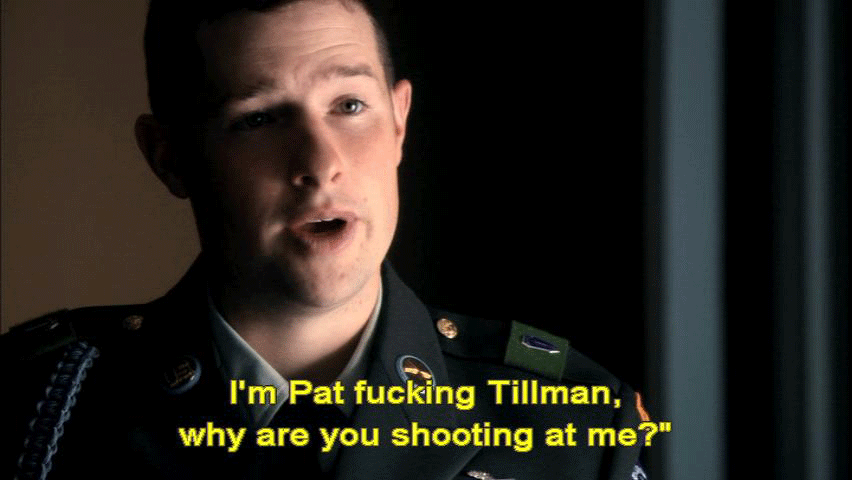
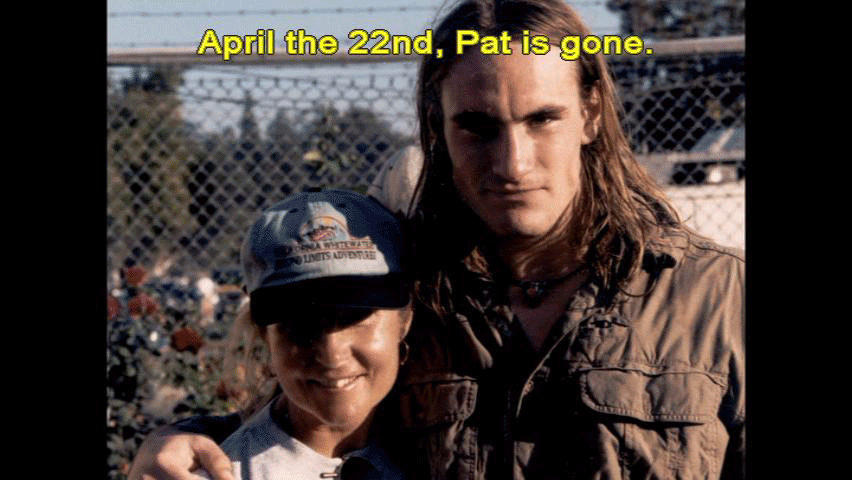
|
An Amir Bar-Lev Film
The Tillman Story, An Amir Bar-Lev Film
-- Illustrated Screenplay & Screencap Gallery
Boots on the Ground by
Dusk: My Tribute to Pat Tillman, by Mary Tillman with Narda Zacchino
The Tillman
Fratricide: What the Leadership of the Defense Department Knew --
Hearing before the Committee on Oversight and Government Reform, House
of Representatives, 110th Congress, August 1, 2007
Misleading
Information from the Battlefield: The Tillman and Lynch Episodes --
United States House of Representatives Committee on Oversight and
Government Reform, Proposed Committee Report, July 14, 2008
The Torture Papers: The Road
to Abu Ghraib, edited by Karen J. Greenberg, Joshua L. Dratel
Standard Operating
Procedure, directed by Errol Morris -- Illustrated Screenplay &
Screencap Gallery
Taxi to the Dark Side,
directed by Alex Gibney -- Illustrated Screenplay & Screencap Gallery
Interview with
Pat Tillman's Parents, by Larry King
Killing Pat
Tillman, by J. Bruce Campbell
Was the Pin-Up
Boy of Bush's War on Terror Assassinated?, by Charles Laurence
A & E IndieFilms
The Weinstein Company
and A & E IndieFilms present
a Passion Pictures / Axis Films
production
in association with Diamond Docs and
Embassy Row
produced by John Battsek
[Photographer] Quiet, please.
a film by Amir Bar-Lev
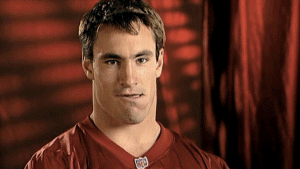
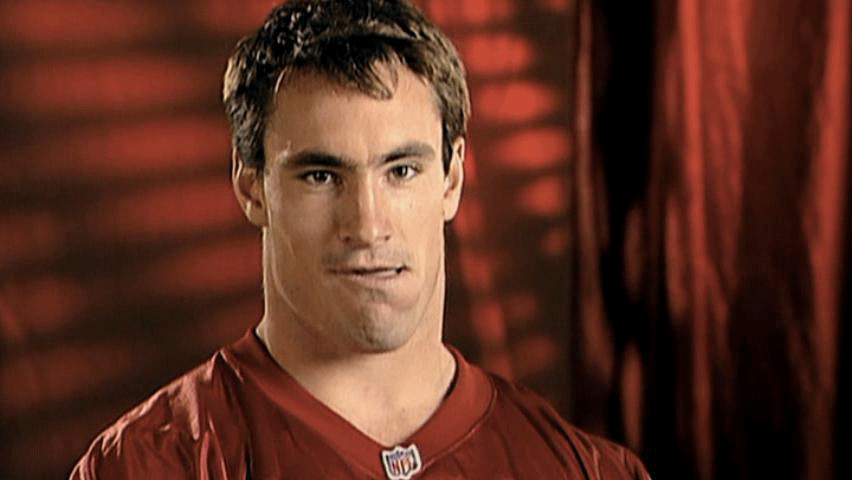
[Pat Tillman] Pat Tillman, safety,
Arizona State.
[Photographer] Good, keep looking. That's
good.
Pat, can we try that just one more time?
Make sure not to kind of even glance up or look around or anything.
[Pat Tillman] Okay. It's a long-ass time
to just sit there.
[Photographer] Yeah, it is.
Here we go.
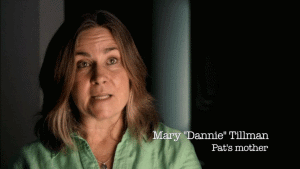
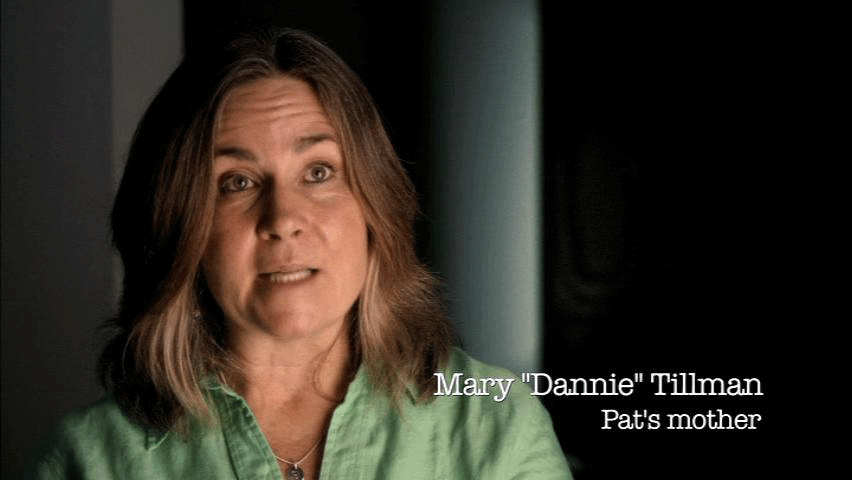
[Mary Tillman] If they knew anything
about my son, they wouldn't have done what they did.
[Pat Tillman] Pat Tillman, safety,
Arizona State.
[Mary Tillman] Because he didn't really
fit into that box that they would have liked.
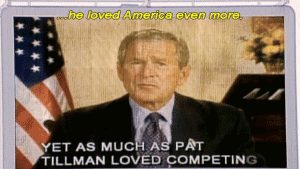
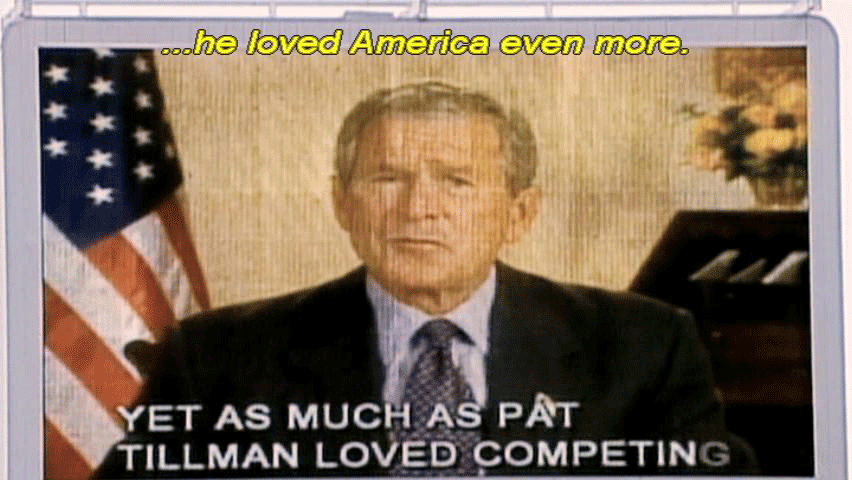
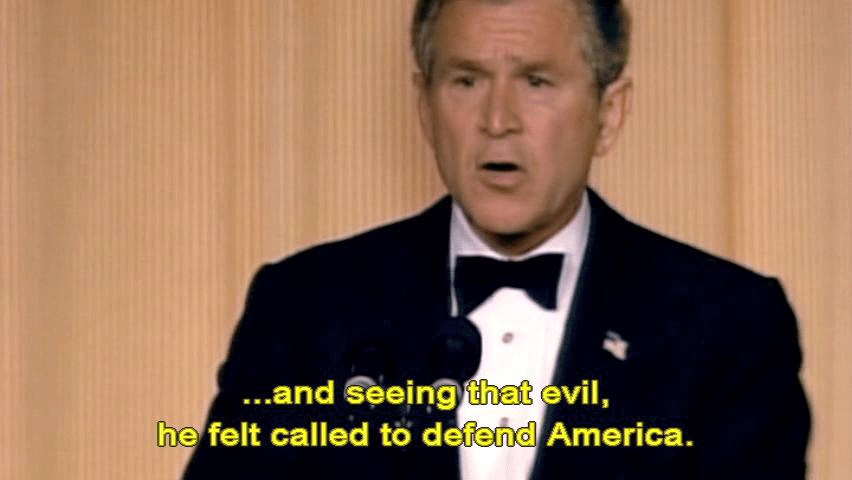
[George Bush] Pat Tillman loved the game
of football.
Yet, as much as Pat Tillman loved competing on the football field ...
he loved America even more.
Courageous and humble, a loving husband and son ...
a devoted brother and a fierce defender of liberty.
Pat Tillman will always be remembered --
[Mary Tillman] I think they just thought,
if they spun the story and we found out ...
... we'd just keep it quiet because we wouldn't want to diminish ...
... his heroism or anything like that ...
... but, you know, nobody questions Pat's heroics. He was always heroic.
What they said happened, didn't happen.
They made up a story, and so you have to set the record straight.
The Tillman Story
[Newscaster 1] [Friday, April 23, 2004]
Good evening, thanks for joining us --
[Newscaster 2] Our top story --
[Newscaster 3] On a more serious and
indeed, tragic note --
[Reporter] Live fire rounds all around me
--
[Neil Young: Hawks Doves Lyrics] In
history we painted pictures grim ...
[Narrator] In the third week of April
2004, the 24-hour news cycle ...
... was dominated by two stories about fallen American soldiers.
The first involved an airport worker who had been fired ...
... after sharing these photos with her local newspaper.
This sparked debate about a federal law ...
... that had been in place since the first Gulf War.
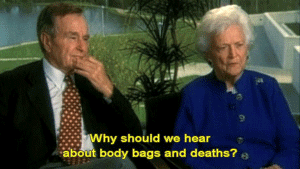
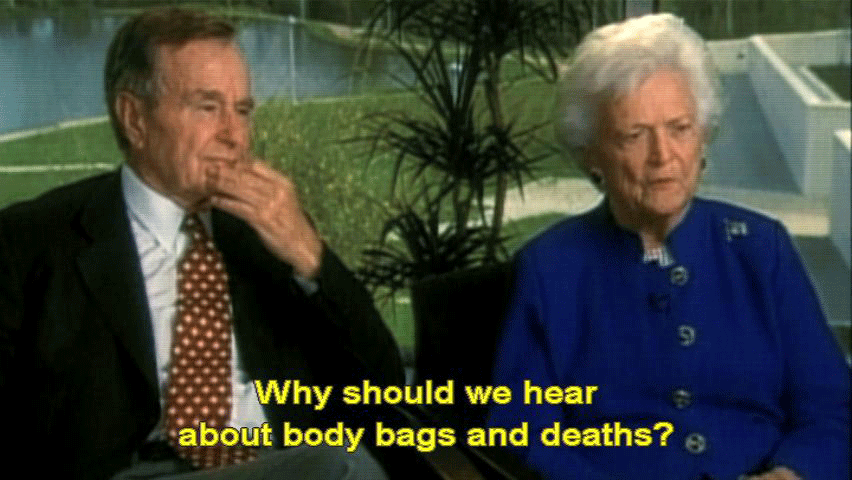
[Barbara Bush] Why should we hear about
body bags and deaths?
[Narrator] Americans had been mesmerized
by news coverage from the Persian Gulf.
But the military said photos like these ...
... violated the privacy of grieving families.
The second story was not considered a violation of privacy.
[Newscaster 3] Pat Tillman, who gave up a
multimillion-dollar contract ...
... in professional football, has been killed.
[Narrator] At age 25, Pat Tillman was a
charismatic defensive back ...
... in the national football league ...
with a reputation as a bruising tackler.
But he brushed it all aside ...
... when he announced that he would be quitting the NFL ...
... joining the Army Rangers along with his brother Kevin ...
... and setting off to fight in the Middle East.
Though the media hounded him for an interview ...
... Tillman refused to speak publicly about his decision to leave the
NFL ...
... requesting only that he be looked upon as any other soldier.
But this was a request that, in death, the public could not grant him.
[Mary Tillman] The first thing we heard
when we got the news of Pat's death ...
was that he was shot in the head getting out of a vehicle.
That's all we heard.
We didn't get an official story until the memorial service.
Pat Tillman Memorial Service, San
Jose, CA
[Senior Chief Petty Officer Steven White] If you're
the victim of an ambush, there are very few things you can do
... to increase your chances of survival.
One of which is to get off that ambush point as fast as you can.
One of the vehicles in Pat's convoy ...
... could not get off.
He made the call, he dismounted his troops ...
... taking the fight to the enemy uphill.
This gave his brothers, in the downed vehicle ...
... time to move off that target.
He directly saved their lives with that move.
|
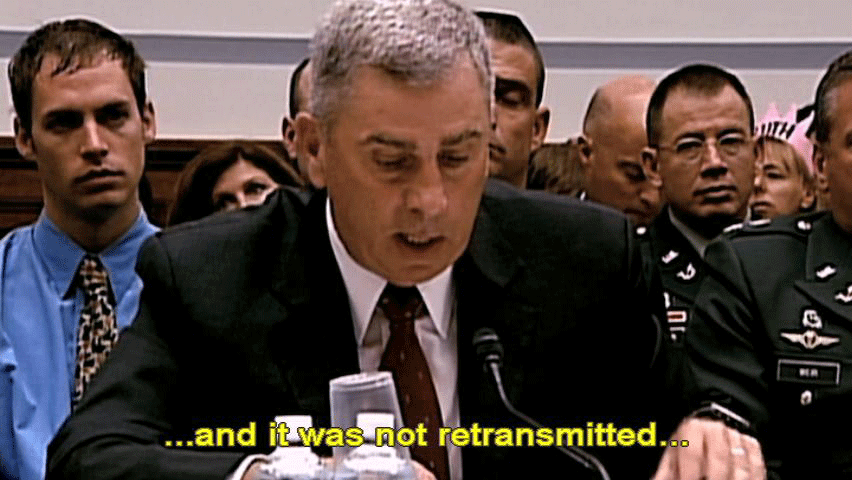
During the ceremony, Senior Chief Petty Officer Steven
White, a personal friend of Corporal Tillman and a Navy
SEAL, gave a eulogy in which he described the circumstances
of Corporal Tillman’s death using language that suggested he
was killed by enemy forces.
According to Senior Chief White, a member of the 75th Regiment had read
him portions of the Silver Star citation that morning, and he based his
speech on this information. Testifying before the Committee in April
2007, Senior Chief White said he felt "let down" by the military because
he was given inaccurate information to present publicly. He told the
Committee: "I'm the guy that told America how he died, basically, at
that memorial, and it was incorrect. That does not sit well with me."
--
Misleading
Information from the Battlefield: The Tillman and Lynch
Episodes -- United States House of Representatives Committee
on Oversight and Government Reform, Proposed Committee
Report, July 14, 2008
***
SILVER STAR CITATION
The President of the United States of America, authorized by
Act of Congress, 9 July 1918 (amended by act of 25 July
1963), has awarded the SILVER STAR to
CORPORAL PATRICK D. TILLMAN
UNITED STATES ARMY
for gallantry in action on 22 April 2004 against an armed
enemy while serving as a Rifle Team leader in support of
Operation Enduring Freedom. Corporal Tillman put himself in
the line of devastating enemy fire as he maneuvered his Fire
Team to a covered position from which they could effectively
employ their weapons on known enemy positions. While
mortally wounded, his audacious leadership and courageous
example under fire inspired his men to fight with great risk
to their own personal safety, resulting in the enemy's
withdrawal and his platoon's safe passage from the ambush
kill zone. Corporal Tillman's personal courage, tactical
expertise, and professional competence directly contributed
to this platoon's overall success and survival. Through his
distinctive accomplishments, Corporal Tillman reflected
great credit upon himself, the 75th Ranger Regiment, and the
United States Army. |
[Narrator] Pat's memorial service in San
Jose, California ...
... was carried live by all the major networks.
[Adam Housley, Fox News] That service is
ongoing right now, as you just saw here on Fox News ---
[Narrator] The story recounted in the
eulogy was abridged ...
... elaborated upon and retold time and again.
[Newscaster 4] According to military
accounts, Tillman ordered his men up a hill ...
... to attack terrorists that had pinned down part of his platoon.
All the soldiers in that ambushed platoon were saved.
They were rescued by Pat Tillman.
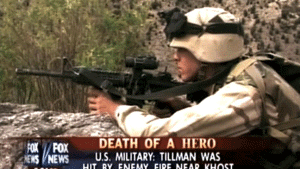
[FOX NEWS, Adam Housley, San Jose, CA]
Tillman directed his team into firing positions.
Tillman's voice was heard issuing commands ...
... to take the fight to the enemy forces.
Pat Tillman's family will also receive the Silver Star for his service
...
... and his great heroic efforts over there on April 22nd.
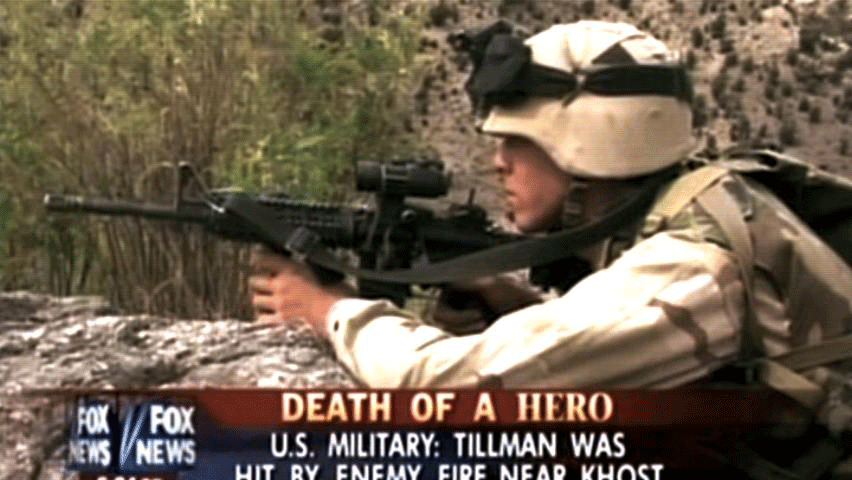
FOX NEWS: DEATH OF A HERO. U.S. MILITARY: TILLMAN WAS HIT BY ENEMY
FIRE NEAR KHOST
FOX FACTS: AZ STATE SCHEDULED PRIVATE MEMORIAL SERVICE FOR MAY 7.
FOX FACTS: PUBLIC EVENT FOR TILLMAN WILL BE MAY 8 AT SUN DEVIL STADIUM
FOX FACTS: TILLMAN WAS KILLED APRIL 22 DURING COMBAT IN AFGHANISTAN
[Narrator] Pat was given the Silver Star,
the nation's third highest combat honor ...
... awarded for valor in battle with enemies of the United States.
A Navy SEAL friend of the family ...
... had based his eulogy on the Silver Star narrative.
[Senior Chief Petty Officer Steven White] Pat
sacrificed himself so his brothers could live.
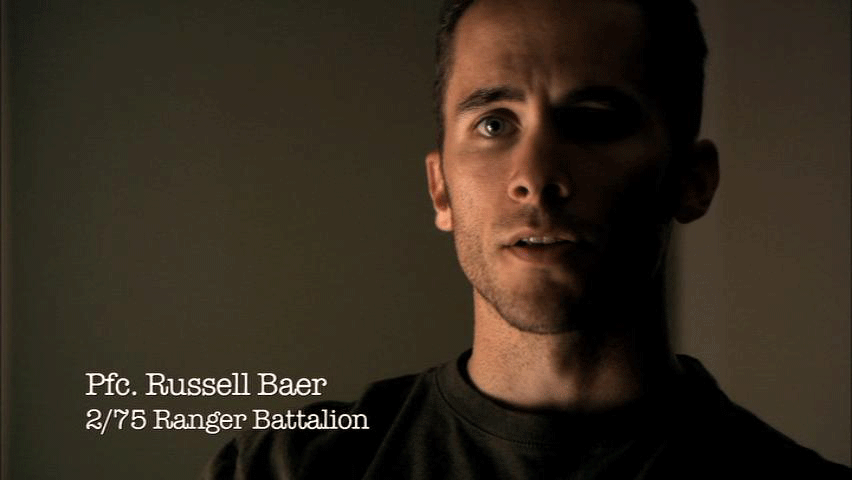
[Pfc. Russell Baer, 2/75 Ranger
Battalion] What they received was something that was really honorable,
you know.
The narrative that they got was something that was befitting a hero.
I knew that there was a massive possibility ...
... that other things were gonna come out to bring certain things to
light ...
... that were gonna completely ...
... make that ceremony invalid.
[Military Man] Company.
Present arm.
[Pfc. Russell Baer, 2/75 Ranger
Battalion] I remember, we did like this little memorial in Afghanistan
for Pat.
You know, I mean, fuck, everybody showed up.
It was terrible. It was terrible seeing everybody.
Everybody was just lost, shocked, frustrated.
[1st Sergeant] Sound off for roll call.
Specialist Atkins.
[Specialist Atkins] Here, first sarge.
[1st Sergeant] Sergeant Elroy.
[Sergeant Elroy] Here, first sarge.
[1st Sergeant] Specialist Norman.
[Specialist Norman] Here, first sarge.
[1st Sergeant] Specialist Tillman.
Specialist Patrick Tillman.
Specialist Patrick Daniel Tillman.
[Pfc. Russell Baer, 2/75 Ranger
Battalion] I knew we were gonna get debriefed.
And they were gonna pick it apart and figure out what happened.
And people were gonna get punished and people were gonna be leaving.
I didn't expect to ever, you know, be on a plane like two hours later.
They knew what the relationship was between me, Kevin and Pat.
And they told me:
"You're the closest to the brothers, we want you to fly back with Kevin.
It's not your place to tell the family anything.
You need to keep your mouth shut about it.
You need to not cause any type of turmoil."
And I -- You know, I said, okay. Yeah.
They put us into a cargo plane that was completely empty.
The only thing in it, right there in the middle, was Pat's coffin.
And they covered it with an American flag.
Just sitting across from Kevin and looking at him, I couldn't say
anything.
I barely said two words to Kevin the whole time we were flying home.
I was afraid that he might ask me what happened to Pat.
|
The Committee interviewed Colonel Bucci, who returned to the
Secretary’s personal office on Monday, May 24, 2004, after a
six-month temporary assignment to the Coalition Provisional
Authority in Iraq. Sometime during that week, he said he
received a call from the Army Chief of Staff’s executive
assistant or the Secretary of the Army’s military assistant.
His colleague told him, "We’re pretty sure that this may
have actually been a fratricide event, and you need to let
the Secretary know." Colonel Bucci’s colleague also told him
officials were "trying to ascertain exactly which caliber
weapon had killed him [Corporal Tillman] and trying to check
that against the weapon that his brother was carrying," in
order to eliminate any possibility that Corporal Tillman had
been killed by his brother, Specialist Kevin Tillman.
--
Misleading
Information from the Battlefield: The Tillman and Lynch
Episodes -- United States House of Representatives Committee
on Oversight and Government Reform, Proposed Committee
Report, July 14, 2008 |
[Mary Tillman] Russell Baer came to our
house after Pat's memorial service ...
... and my ex-husband, or Pat's father ...
... asked Russell to tell the story of what happened to Pat.
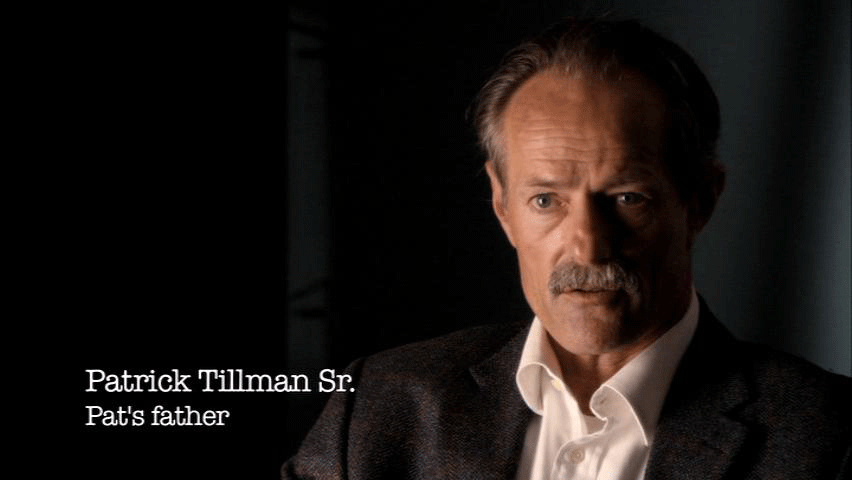
[Patrick Tillman Sr., Pat's father] The
position he was in while he was over at the house ...
... was, I'm sure, very awkward. It appeared very awkward.
At the time, it seemed that he was still very upset ...
... and rattled by the whole setting, and Pat's death ...
... because he liked Pat a lot.
[Pfc. Russell Baer, 2/75 Ranger
Battalion] I went into Pat's mom's living room and I gave them my
narrative ...
... excluding certain possibilities.
[Patrick Tillman Sr., Pat's father] And
Russell Baer told us nothing.
Initially, I was not real pleased with Russell Baer.
It upset me that this kid ...
... that's supposed to be a friend of the family's, didn't say anything.
But we found out about five weeks later, the reason.
[Mary Tillman] A reporter from the
Arizona Republic contacted me.
It was peculiar because I hadn't heard from the media for quite a few
weeks.
And I just got a very eerie feeling, and when I called him back ...
... he asked me what I thought about the news the Army had given us ...
... and I didn't know what he was talking about.
So I basically prodded him to tell me ...
... and he said that, you know, there was a suspicion ...
... that Pat was killed by fratricide, "friendly fire."
[Newscaster 5] The U.S. Army now says Pat
Tillman was not killed by enemy fire.
[Newscaster 6] It was dark, the terrain
was rough.
To put it another way, it was the fog of war.
[Newscaster 7] Now the Army says,
Tillman's death was apparently an accident.
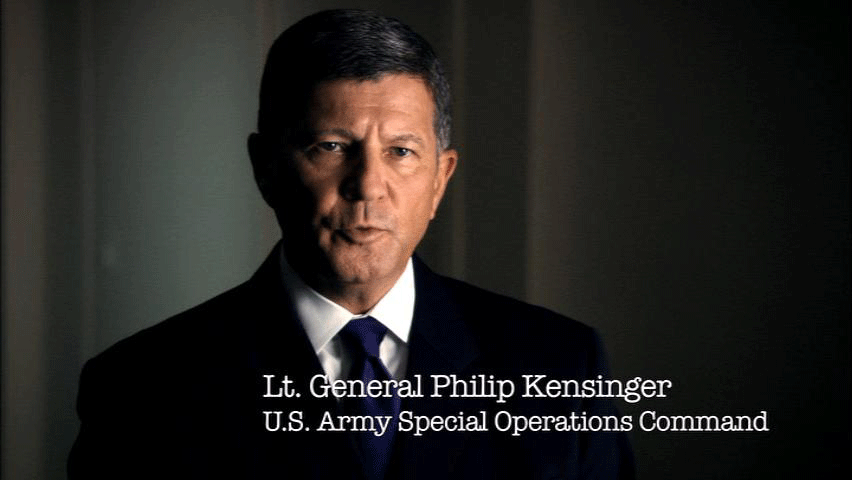
[Lt. General Philip Kensinger, U.S. Army
Special Operations Command] The investigation results indicate that
Corporal Tillman ...
... probably died as a result of friendly fire ...
... while his unit was engaged in combat with enemy forces.
|
General Kensinger’s statement was the only public
statement issued by any Department of Defense or White House official
acknowledging that Corporal Tillman had not been killed by the enemy, as
the American public had believed for more than a month....
At the press conference at Fort Bragg on May 29, 2004,
General Kensinger read a prepared statement approved by CENTCOM and the
Secretary of Defense’s public affairs office. The statement
asserted that "investigation results indicate that Corporal
Tillman probably died as the result of friendly
fire." According to Colonel Bush, "It was
specifically requested by CENTCOM that we include ‘probably’ in that
sentence." However, this language differed from the investigative
report itself, which stated, "My findings lead me to believe
that CPL Tillman’s death was the result of
fratricide." The report was not
made public at that time.
After the press conference, Pentagon public affairs
officials congratulated each other for limiting the impact of the
disclosure. Colonel George Rhynedance, an assistant to Mr. Di Rita in
the Secretary of Defense’s public affairs office, wrote to Bryan
Whitman, another employee in the same office: "No one will ever tell
you, but nice job on this one. May have minimized … damage by pushing
the panic button early."
In another e-mail on the day of the announcement,
Colonel Joseph Curtin, an Army public affairs officials, wrote, "Story
will run hot today and diminish over the weekend." He also noted,
"Senior leaders want to make sure the public affairs community
vigorously respond to any media query that potentially questions the
Silver Star award." In response, Lieutenant Colonel John Robinson, a CENTCOM
public affairs official, wrote "the WWII Memorial and attack in Saudi
Arabia have helped dilute the story somewhat."
--
Misleading
Information from the Battlefield: The Tillman and Lynch
Episodes -- United States House of Representatives Committee
on Oversight and Government Reform, Proposed Committee
Report, July 14, 2008 |
It was determined that I was to give the
press conference.
My role during this period ...
... was commander of the U.S. Army Special Operations Command.
I commanded the Green Berets ...
... Civil Affairs, SIOPs, the 160th Aviation ...
... the Rangers and a number of our Special units.
[Narrator] It was General Kensinger's job
to explain why five weeks earlier ...
... the military had reported that Pat was killed by the Taliban.
[Lt. General Philip Kensinger, U.S. Army
Special Operations Command] You know, I don't wanna sound trite ...
... but there's an old Army adage that says first reports are incorrect.
There is an inherent danger of confusion
in any firefight ...
... particularly when a unit is ambushed.
[Narrator] During the press conference
...
... and at a subsequent private briefing with the Tillmans ...
... the Army said Pat had been killed by an errant U.S. bullet ...
... during a chaotic ambush.
The ambush was conducted by 10 to 12 enemy personnel ...
... from multiple locations --
[Patrick Tillman Sr., Pat's father]
According to them, things were confusing ...
... and it's an unfortunate accident.
I know I felt like they haven't really looked into this well enough ...
... to give me an explanation, and I don't much appreciate that.
[Lt. General Philip Kensinger, U.S. Army
Special Operations Command] The results of this investigation ...
... in no way diminish the bravery and sacrifice displayed ...
... by Corporal Tillman.
[Patrick Tillman Sr., Pat's father] In
the process of this explanation, I asked one of them:
"Why then award him a Silver Star?
You don't give a Silver Star for attitude."
He goes, "Well, we did in this case."
|
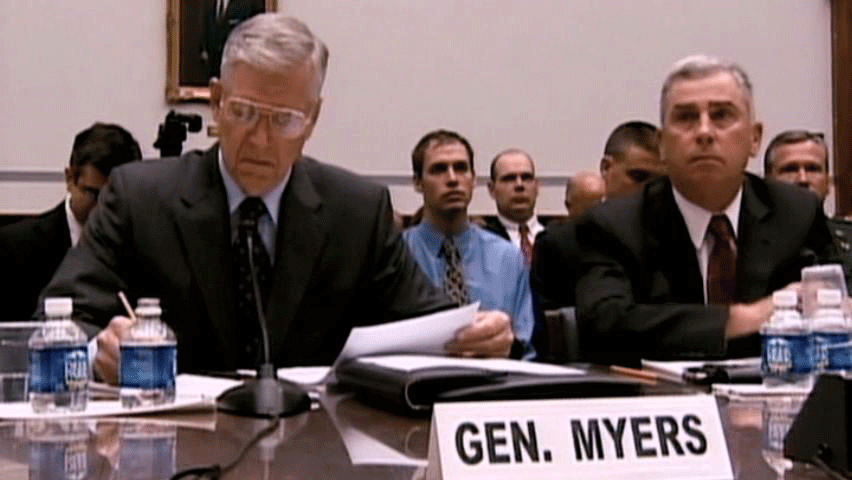
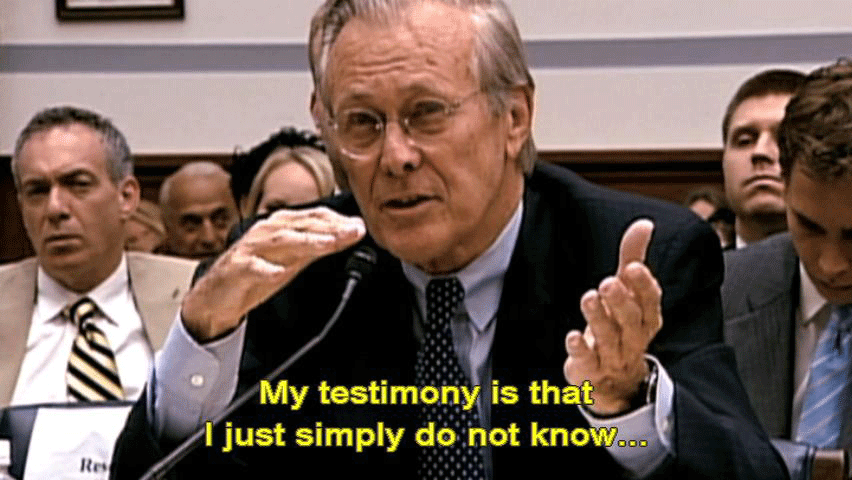
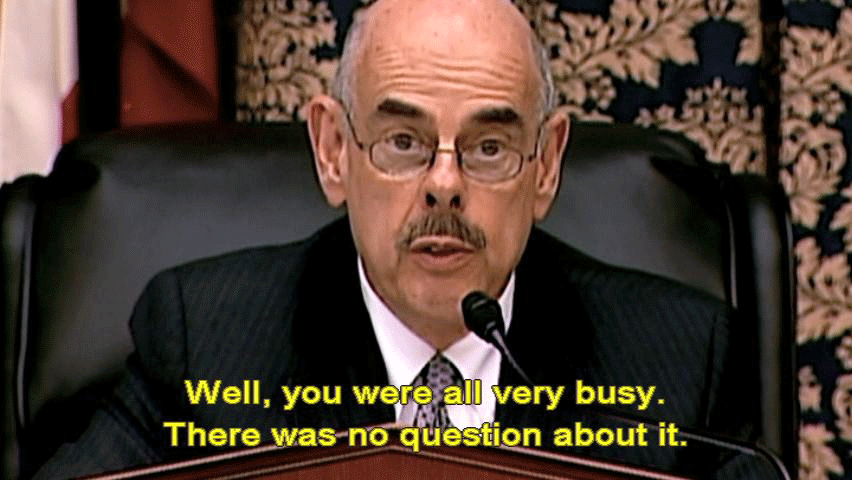
Mr. Clay. Corporal Pat Tillman
committed to serve his country, not to serving as a symbol for
promoting President Bush's war. Corporal Tillman's mother,
Mary, believes that this has been a complete donkey show and I
certainly agree with her assessment.
The Tillman family gave the ultimate sacrifice for their
country and they deserve to know the full truth behind Corporal
Tillman's death. Let me ask the entire panel, on April 30, 2004, the Army
Special Operations Command announced that Corporal Tillman has
been posthumously awarded the Silver Star. The award of a
Silver Star was a major development. It was rushed through so
it would be ready in time for the memorial service for Corporal
Tillman on May 3, 2004, which was widely covered by the press. According to Pentagon regulations, the Silver Star is to be
awarded for gallantry in action against an enemy of the United
States. And before I turn to the specifics of the award, can
anyone on the panel tell me who officially awarded the Silver
Star to Corporal Tillman? Can anyone answer that? Mr.
Secretary?
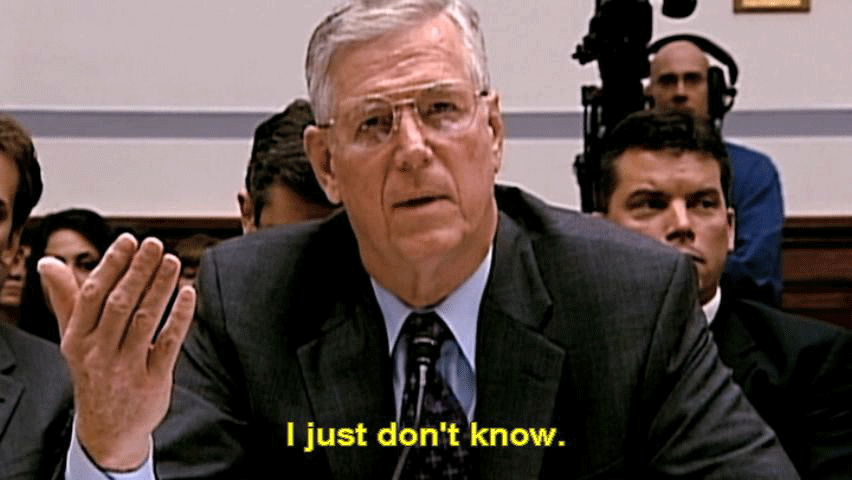
Mr. Rumsfeld. I have no idea ....
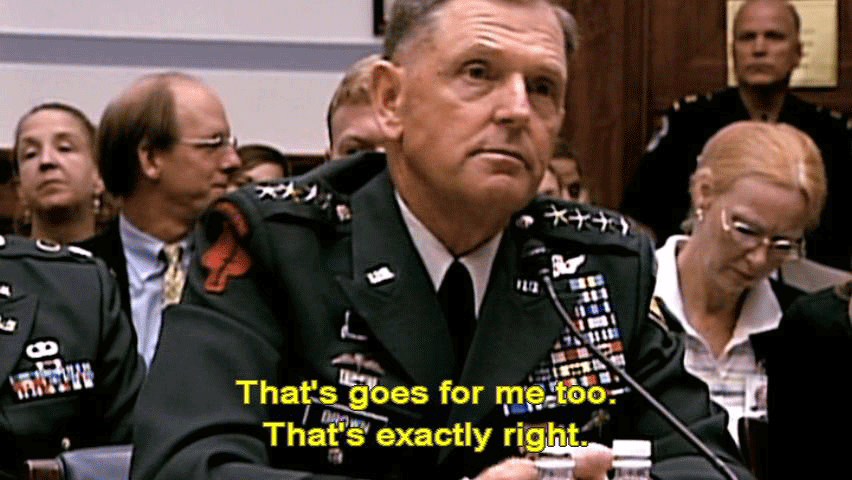
General Myers. The chairman's
office was not involved in this award in any way. It was an
Army matter....
General Abizaid. Sir, the awards go through service
channels, not through joint channels....
General Brown. I do not know who awarded the Silver Star at the memorial
service.
Mr. Clay. The answer is President Bush. And let me put up a
copy of the Silver Star citation. As you can see, it says the
President of the United States of America has awarded the
Silver Star to Corporal Patrick Tillman. So this is important.
I know the President didn't actually review the supporting
documentation for this award, but this award was given in the
President's name. And that authority should be exercised only
with the utmost care. But that didn't happen. Instead the
Silver Star citation was false. And here is what it says:
Corporal Tillman put himself in
the line of devastating enemy fire as he maneuvered his fire
team to a covered position from which they could effectively
employ their weapons at known enemy positions.
In his March 26, 2007, report, the Defense Department
Inspector General concluded that the Silver Star citation and
supporting documents had materially inaccurate statements and
erroneously implied that Corporal Tillman died by enemy fire.
Everyone on this panel learned before the Tillman family and
the American public that Corporal Tillman was likely killed by
his own unit. Can each of you please explain why you did not intervene to
correct the record? I guess we will start with you, Mr.
Secretary.
Mr. Rumsfeld. As I said ...
General Myers. My response
is essentially like Secretary Rumsfeld's. The chairman's
office, the Joint Staff is not involved in these awards.
This is an Army responsibility. And like the Secretary, I
understand that the wording is being looked at and I also
understand -- and I can't tell you where I
heard this -- it may have been in the prep -- that General McChrystal thought the actions were heroic whether or not they
came from enemy fire or friendly fire. That was his
determination.
Mr. Clay. We have heard the excuse that the military did
not want to tell the Tillman family and the American public
about the fratricide until the investigation was complete. As
General McChrystal put it, they didn't want to put out a half baked
story. But they did put out a half baked story. It was the
Silver Star....
Mr. Issa. I would like to go back to the
Silver Star. My understanding, correct me if I am wrong,
Corporal Tillman stood up to identify his unit, left a position
where he could have survived, in order to stop the friendly
fire. Is that correct? Anyone dispute that? OK.
So the bottom line is one of the most heroic acts anybody
could do is what Corporal Tillman did that day. Is there
anything in our regulations that would prevent him from
receiving a Silver Star simply because he stood up to protect
his people from friendly fire?
The Tillman
Fratricide: What the Leadership of the Defense Department
Knew -- Hearing before the Committee on Oversight and
Government Reform, House of Representatives, 110th Congress,
August 1, 2007
Both of the eyewitness statements submitted with the Silver Star
paperwork were altered by somebody within the 75th
Regiment’s chain of command.
Misleading
Information from the Battlefield: The Tillman and Lynch
Episodes -- United States House of Representatives Committee
on Oversight and Government Reform, Proposed Committee
Report, July 14, 2008 |
[Mary Tillman] You don't wanna think the
worst of the people that you're dealing with.
[Lt. General Philip Kensinger, U.S. Army
Special Operations Command] Our thoughts and our prayers remain with the
Tillman family.
Thank you for being here this morning.
[Mary Tillman] You want to believe
they're telling you the truth ...
... yet you're getting this sense that you're being lied to.
[U.S. Cent Com Spokesperson] U.S. Central
Command is the point of contact ...
... for further inquiries in this investigation. Thank you.
[Patrick Tillman Sr., Pat's father] At
the end of the briefing, we were told that we would be getting ...
... the source documents that were used to support the investigation.
They showed me the box. It was six binders full of stuff.
"Eventually, Mr. Tillman, you're going to get a copy of all this."
I said, "Great. When am I gonna get it?"
[Questioner] What motivates you the most?
[Pat Tillman] I don't know. I get a lot
of satisfaction out of, like ...
... you know, my family being proud of me.
My brothers, you know, I care what they think and how they feel ...
... and I want them to be proud of what I'm doing.
My mom -- My mom finished dead last in the San Francisco Marathon.
I don't know when it was. She was probably 30 -- Whatever years old.
I mean, dead last. On the little sheet when --
You know, they do it -- Her -- Mary Tillman, the last fricking name.
They were actually tearing everything down when she finished, you know.
They were putting everything away.
So, I mean, that says a lot about her. She's a real hard-working woman
--
[Patrick Tillman Sr., Pat's father]
Dannie committed herself to trying to ...
... you know, figure out exactly what happened to our son.
She contacted a lot of people. She did a lot of work.
[Mary Tillman] I'd take things to work,
or I'd make phone calls ...
... when I didn't have students, or when I had my break or at lunch.
I'd call the medical examiner, the coroner.
I'd call ballistic people trying to find someone that could answer
questions.
I Mean, I was just making calls all the time.
Along the way, I'd encounter people that were able to help us.
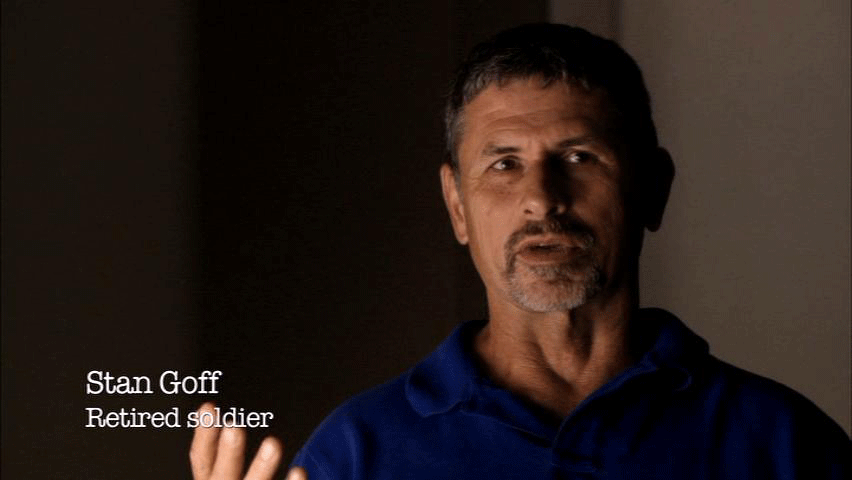
And at somewhere along the line, we got in touch with Stan Goff.
[Stan Goff, Retired soldier] I was
running a blog, everybody got a blog nowadays ...
... so I wrote something about the Tillman Case.
It was just, you know, a commentary piece related to ...
... this whole perception-management aspect of the war.
So when we got to talking, she realized I'd been around.
I'd been to Vietnam and Guatemala ...
... Grenada, El Salvador, Peru, Colombia, Somalia.
Three assignments with Ranger units ...
... two assignments with the Special Forces unit ...
... one assignment with the Counterterrorist unit.
So it wasn't just that I had experience in Pat's unit ...
... it was also that I could sort of help them ...
... read the hieroglyphics in that Special Operations world.
Because it is a culture.
[Mary Tillman] The first time the family
got a sense that we were being lied to ...
... was when we started looking at the documents.
[Stan Goff, Retired soldier] They gave
her the papers, but what they did was ...
... I think, they tried to drown her, you know.
They wanted to give her so much that, you know, no normal human being
...
... would dig through all this paperwork and try to make sense out of
it.
[Narrator] The Army handed over
transcripts of every interview they conducted ...
with Pat's platoon and their commanding officers.
There were also radio-communications logs ...
... field-hospital reports, terrain maps, an autopsy ...
... and a detailed study of the light conditions that day.
In all, it totaled over 3,000 pages of material on Pat's death.
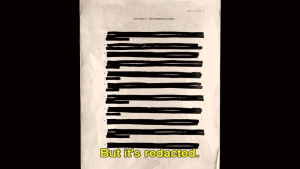
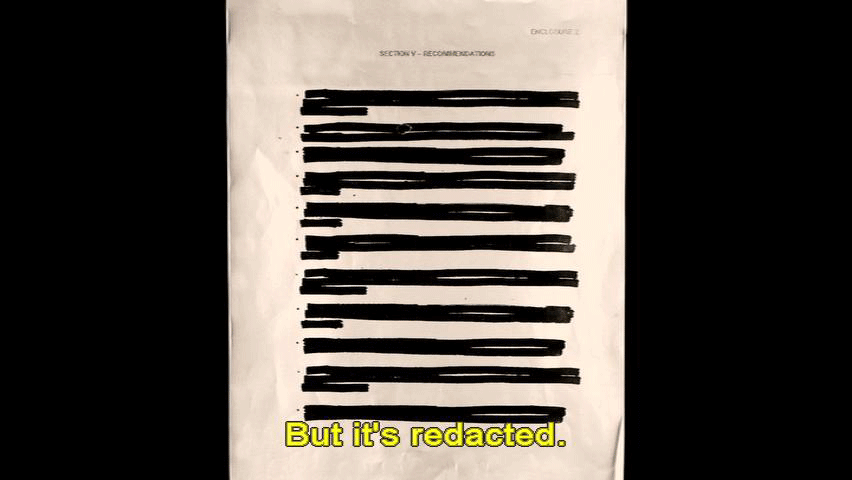
[Stan Goff, Retired soldier] But it's
redacted.
Every single name, half the actions, any references to places.
You have to go this sort of painstaking reconstruction.
It's like doing a very difficult crossword puzzle.
You keep running around looking for just one word you can fit in there
...
... and then you can sort of lock all the other stuff into it.
[Mary Tillman] We tried to look at what
was being said ...
... and then we'd try to piece together --
Okay, if they're saying this, then who might that be?
[Stan Goff, Retired soldier] We would
take a redacted name ...
... and we'd try to count the number of spaces that were in there ...
... to try to figure out whose last name was in there.
And of course, by going over the same thing again and again ...
... with some names plugged in ...
... we started to become familiar with aspects of it.
[Mary Tillman] I wanna make this very
clear, when we initially heard of this fratricide ...
... and the fact that these soldiers in this vehicle had killed Pat ...
... we felt very bad for them, to have to live with this.
We thought it was just some horrible accident.
You know, they were in a fog of war and they were frightened ...
... and it was too dark to see. But you're reading things in the
documents ...
... that make you very suspicious.
The more that we heard about the situation ...
... it seemed much more like gross negligence.
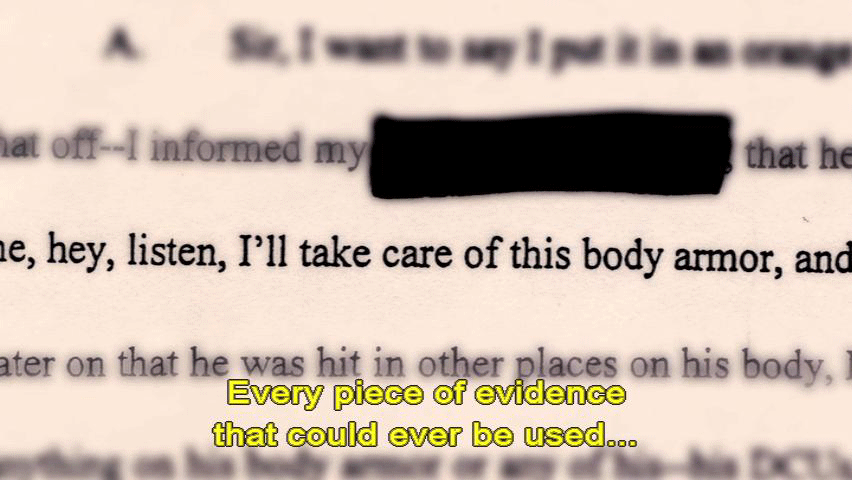
They asked one of the soldiers:
"Did you positively identify your target?"
He said, "I don't know. I thought everybody else did.
I just wanted to be in a firefight."
That doesn't sound like someone who's afraid.
That sounds like someone who simply wants to shoot at something.
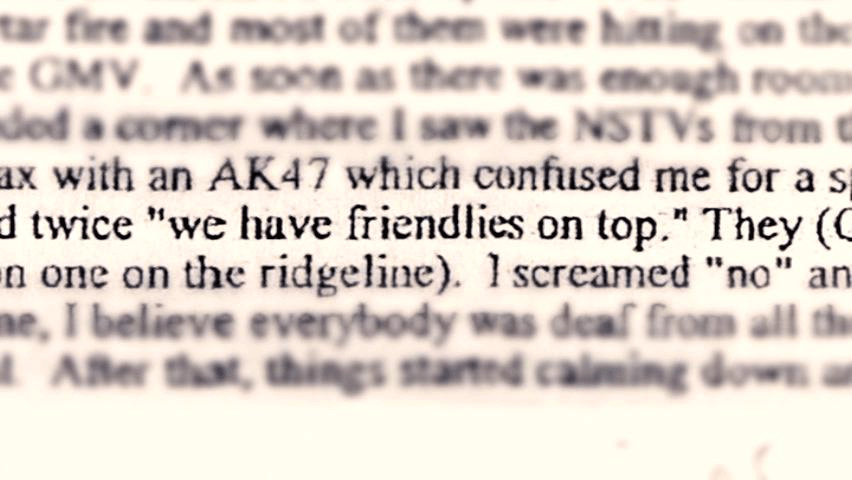
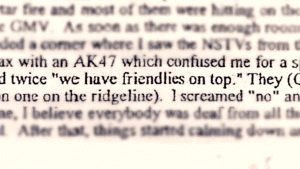
[Documents] "Hey, cease fire, cease
fire. You're shooting at us."
... said twice "we have friendlies on top."
... there yelling "Hey, friendlies up there." ... waiving their arms
trying to just get the attention ... Corporal Tillman was waiving his
arms.
I saw hands waiving like this ...
They stopped and fired for a good forty-five seconds to a minute.
Q9: Why did you fire at the shapes on the Western ...
A: I was excited.
Q7: Was this your first firefight?
A: Yes. No, second firefight.
Q8: Why did you fire at the arms waving on the ridgeline?
A: I saw the arms waving, but I didn't think that they were trying to
signal a cease-fire.
Q9: Did you have Positive Identification of your target when you fired?
A: I engaged with my weapon in the same general area where others were
firing ...
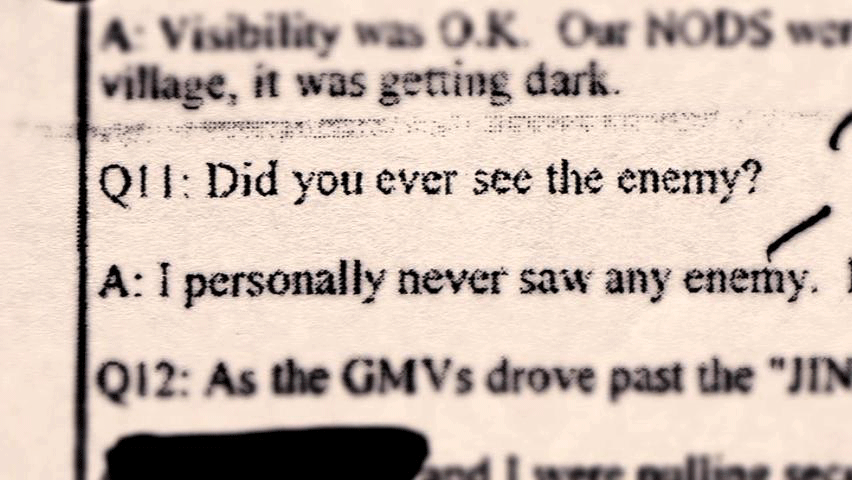
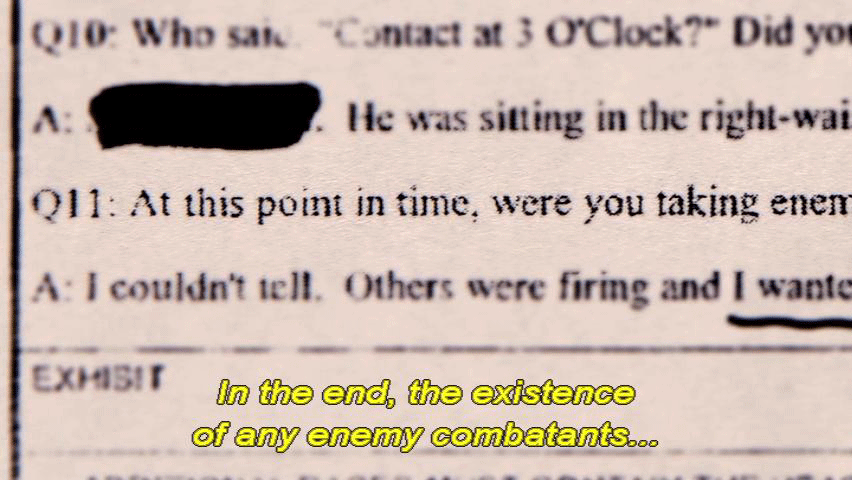
Q11: At this point in time, were you taking enemy fires?
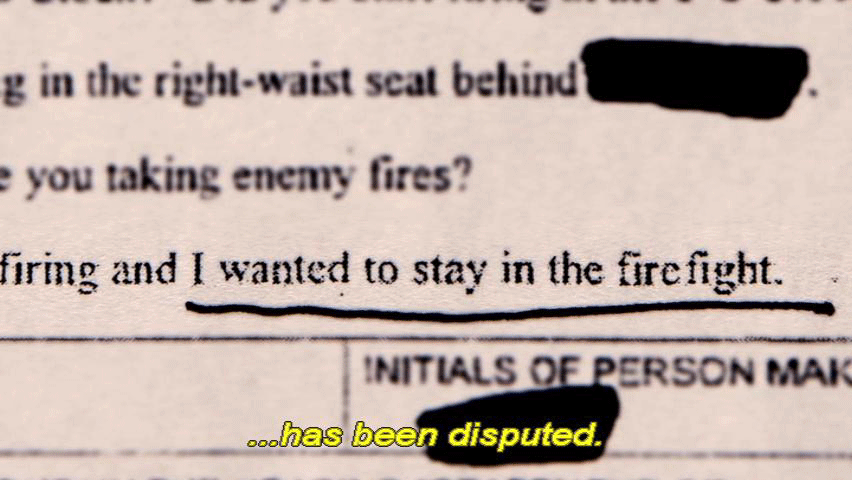
A: I couldn't tell. Others were firing and I wanted to stay in the
firefight.
[Stan Goff, Retired soldier] There's a
sense that we can't discover meaning ...
... we can't discover who we are, we have no real sense of identity ...
... until that's tested somehow.
Let's test it against something that's real, let's test it in a context
...
... where life and death are real coexisting possibilities.
All young infantrymen will say, "I wanna be in a firefight."
That's what makes them feel like they're fully fledged.
You know, they can say, "Well, I've actually experienced combat."
Home video of Pat Tillman's unit U.S.
Ranger Battalion 2/75
[Ranger] What is up?
[Pfc. Russell Baer, 2/75 Ranger Battalion] I went in for all the selfish
reasons.
I didn't go in because I was patriotic and wanted to serve my country.
I wanted to serve myself.
I wanted to get some money for college.
I wanted to learn to be more self-sufficient.
I wanted to blow things up and shoot guns, you know.
I got to Ranger battalion September 10th.
And literally, when I got there and woke up the next morning ...
... I got thrown out of my bed and I thought it was a joke.
You know, new guy, big joke.
And when I saw the planes hit the towers ...
... you know, during breakfast, it was like:
"I'm gonna fucking die."
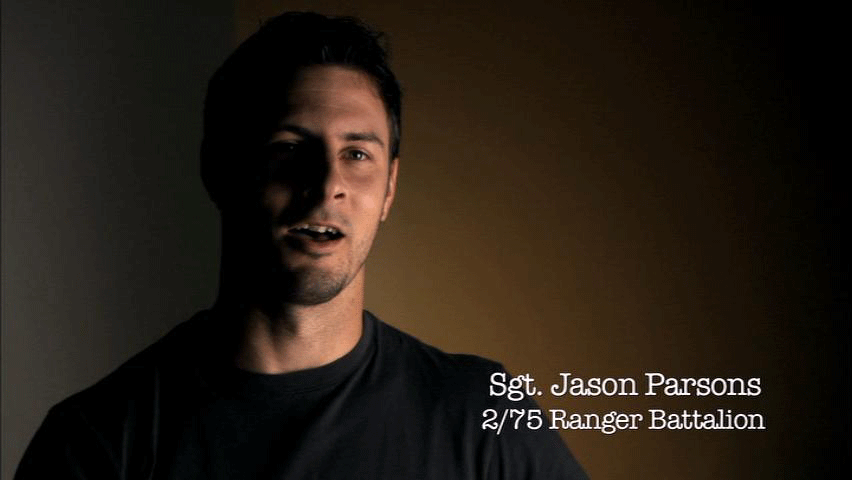
[Sgt. Jason Parsons, 2/75 Ranger
Battalion] It was about 10 minutes later, there was people yelling and
standing up.
They were pumped because we was gonna go to war.
They knew we was gonna go to war at that point.
Sound off.
You don't wanna see it happen, but at the
same time ...
... that's what you've been working for.
And whenever that comes down you want a chance to say:
"Hey, I can handle this."
Airborne Rangers, motherfucker!
Go!
[Stan Goff, Retired soldier] You know, we're supposed to believe that
soldiers' motives are pure ...
... that they go into these situations reluctantly.
It's an imposition of a level of wisdom and maturity on soldiers ...
... that doesn't apply to 19 year olds anywhere, ever.
[Ranger] I ain't fucking out, dude.
[Stan Goff, Retired soldier] A
19-year-old kid is far less interested in displaying wisdom ...
... than they are in, like, giving some sort of a practical
demonstration ...
... of their masculinity, you know what I mean?
The atmosphere in a military unit like that, is a locker-room
atmosphere.
[Ranger] Tapping.
[Ranger] Fucker.
[Stan Goff, Retired soldier] It's not
philosophical.
[Ranger] I turn my back on you.
[Ranger] Get that fucking camera out
of here.
[Pfc. Russell Baer, 2/75 Ranger
Battalion] I expected Pat to be kind of like, you know, in a general
sense ...
... the general depiction of, like, your jock, your meathead.
Not very intelligent.
Kind of like the guys I knew in high school. They were just ...
... jerks.
Arrogant, you know, full of himself.
Why the hell is somebody leaving an NFL contract ...
... to come to this shit hole and deal with this kind of nonsense?
[Sgt. Jason Parsons, 2/75 Ranger
Battalion] There was just kind of a low mumble ...
... that he really was looking to become a political leader.
[Pfc. Russell Baer, 2/75 Ranger
Battalion] A lot of people thought he just didn't have a good head on
his shoulders.
He wanted to kind of do the macho, red-blooded American, patriotic
thing.
[Sgt. Jason Parsons, 2/75 Ranger
Battalion] He was an ex-football player, he was used to getting millions
of dollars ...
... and he was used to pretty much having it his way.
He was a private ...
... which in Ranger mentality, it means that you're on the same level as
dirt.
There was a time where I did have to take corrective action against Pat
...
... for, basically, coming unglued on me for an order that he was given.
That's just the way that the military goes.
You get orders, sometimes you don't like them.
You don't have the option of saying:
"I don't like this. Let's do this another way."
Or in his case, saying, "This is completely fucking stupid."
[Pfc. Russell Baer, 2/75 Ranger
Battalion] Pat had something, you know, that I wanted.
You know, there was something that Pat knew and just got ...
... that I needed, that I wanted.
I went in looking for that one thing that I couldn't put my finger on
...
... that was going to help me to accomplish everything I wanted to do
...
... and Pat had that something.
He wasn't at all what I expected to find.
He didn't seem like this tough knucklehead guy.
You know, he was interested in Emerson, in Chomsky ...
... and he just seemed very, just, open.
It didn't matter who you were, where you were from, what you were into
...
Pat always wanted to find out what you were about.
And he would ask a million questions.
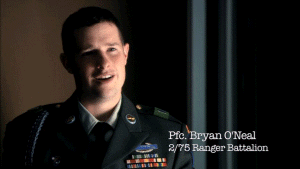
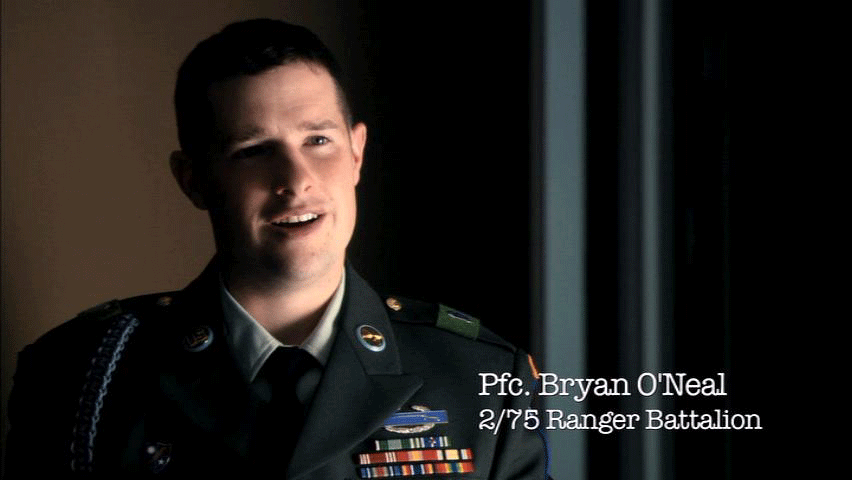
[Pfc. Bryan O'Neal, 2/75 Ranger
Battalion] I walked in on him one time and he was reading the Book of
Mormon.
And, you know, it really hit me because I am Mormon.
So I asked him, "Hey, you know, you have any questions ...
... please feel free to ask.
I'll explain whatever I can to you as best as I can."
I knew that he wasn't religious, but he told me that he respected all
religions.
[Sgt. Jason Parsons, 2/75 Ranger
Battalion] Bryan O'Neal was kind of a small guy, a very nervous guy.
I wasn't real impressed.
I think he was really looking for a place to fit in ...
... looking for more family ...
... looking for something that was a little bit of a closer tie.
[Pfc. Bryan O'Neal, 2/75 Ranger
Battalion] I was kind of terrified going there because, you know ...
... the rumors of hazing and tricks that the senior guys play on the new
guys.
Pat was different from everyone else in the platoon.
He didn't ever, you know, treat me like I was lower than him.
I think the only time, you know, that I upset Pat ...
... is he asked me to, you know, prep some ChemLights ...
... for an objective we had the next day ...
... and I forgot, you know, I was doing other things.
And he basically let me know that I disappointed him ...
... that I didn't do what he wanted me to do.
And that really, you know --
I wish he would've taken me in the hallway ...
... and smoked me up and down, and, you know, treated me horribly ...
... you know, called me stupid.
But him telling me that I disappointed him, it really upset me, you
know.
I decided I was never gonna do that again ...
... because he was such a great guy, I didn't wanna let him down.
[Sgt. Jason Parsons, 2/75 Ranger
Battalion] When Bryan came in, Pat kind of picked him up.
He just put an arm around him and scooped him up the best he could.
[Pfc. Bryan O'Neal, 2/75 Ranger
Battalion] Everyone was actually envious that he was my team leader.
... that little scrawny me would be working with this huge football
player.
I blamed myself for quite some time that maybe ...
... you know, Pat's not in a place where he should be ...
... because I didn't put forth more effort.
And, you know, it's something I still think about today.
You know, that because of my lack of faith ...
... you know, he may be suffering for it.
[ASU Announcer] For all those who are
here tonight ...
... we honor the memory and accomplishments of Pat Tillman ...
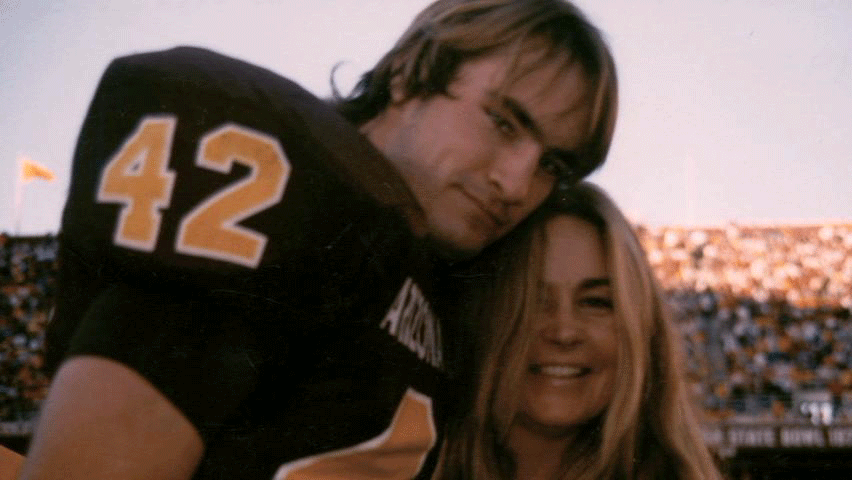
... by permanently retiring his number 42 ASU football jersey.
[Mary Tillman] Arizona was always very
good to Pat ...
... but it's very hard when you're put out there kind of on display.
[Patrick Tillman Sr., Pat's father] The
public grieving is not something that I can do.
I don't wanna do it.
It's an awkward spot.
The issue at the time was trying to figure out what had happened to Pat.
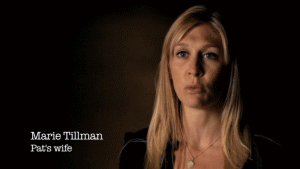
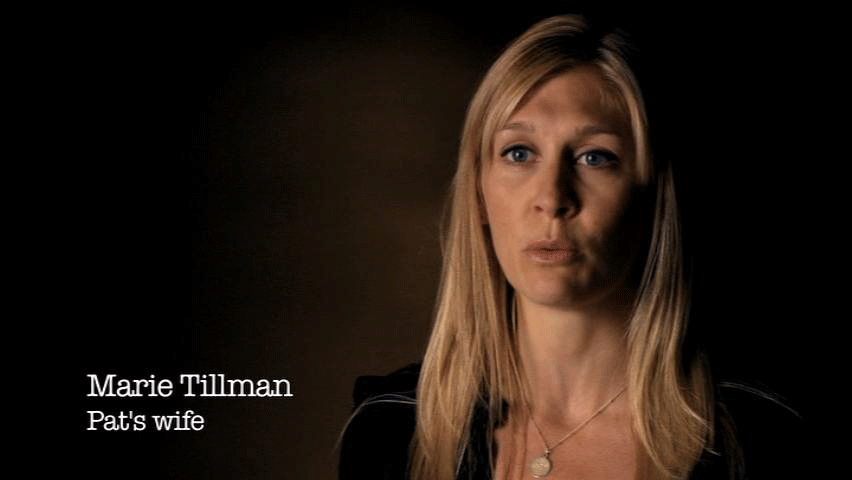
[Marie Tillman, Pat's wife] It was, you
know, sort of a difficult situation ...
... because it was a very private thing that happened ...
... that was then being played out in the public.
And so I had this sense of sort of wanting to hold on to what I could.
Even at that point, he was totally getting lost.
Pat, who he was as a person, was lost in the conversation.
[Reporter] -- what you did with Pat
Tillman --
[Ted the Interviewee] Oh, there we go,
typical Republican personal attack.
Can't stick to the issues --
[Reporter] Ted, let me finish the point.
Kudlow & Company, Political Wargames
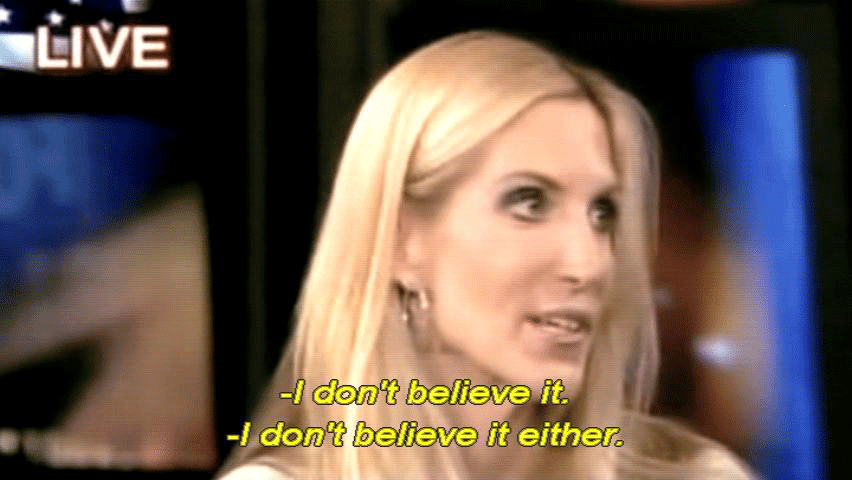
[Alan Colmes] Pat Tillman was a Noam Chomsky fan ...
... was gonna vote for John Kerry, was against the war in Iraq.
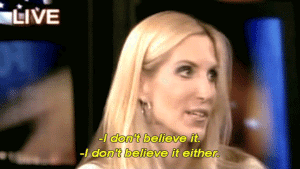
[Ann Coulter] I REALLY don't believe it.
[Sean Hannity] I don't believe it either.
He signed up because of his desire to fight.
[Marie Tillman, Pat's wife] They would
take parts of who he was ...
... and magnify those to suit their purposes.
I was trying to figure out how to live without him.
You feel like your world has stopped ...
... and yet, everything goes on like normal.
It started pretty much overnight after Pat was killed.
The day after he was killed, there were cameras on my front lawn ...
... which was bizarre.
I mean, I was not expecting anything like that at all.
[Reporter] He lived here in University
Place with his wife.
[Marie Tillman, Pat's wife] I remember my
mom was always going around closing the blinds.
[Reporter] Today three men from Fort
Lewis walk slowly to the house ...
... to tell his wife Marie, they care.
Staff Sergeant David High, a Ranger, tried unsuccessfully ...
... to express his feelings, choked up, and walked away.
[Staff Sergeant David High, Ranger] No,
that's not good. Sorry.
[Narrator] But the newsmen camped out on
Marie's lawn had the story wrong.
In fact, the casualty assistance officers were there to compel Marie ...
... to sign off on a funeral at Arlington National Cemetery ...
... with full military honors.
[Marie Tillman, Pat's wife] They were
sort of pushing for a military funeral ...
... which was not what his wishes were.
[Narrator] During basic training, Pat had
a premonition ...
that if he died, he might be used as a public-relations' stunt.
So he'd smuggled a copy of his final wishes home to Marie.
[Marie Tillman, Pat's wife] I really had
to kind of push back on them.
They were proceeding as if this was the way things were gonna happen.
Probably thinking that, you know, I was so grief-stricken ...
... that I would just go along with it.
[Staff Sergeant David High, Ranger] My
mission here is to support the family ...
... and help them through the process, and make it easier for her.
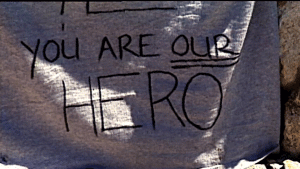
[Stan Goff, Retired soldier] That's the
first episode, in a way.
Before Pat's body is even cold.
The death didn't just belong to the family.
This was bigger than the family.
"This is ours," you know.
It's ours to interpret.
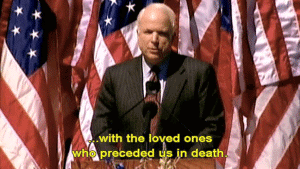
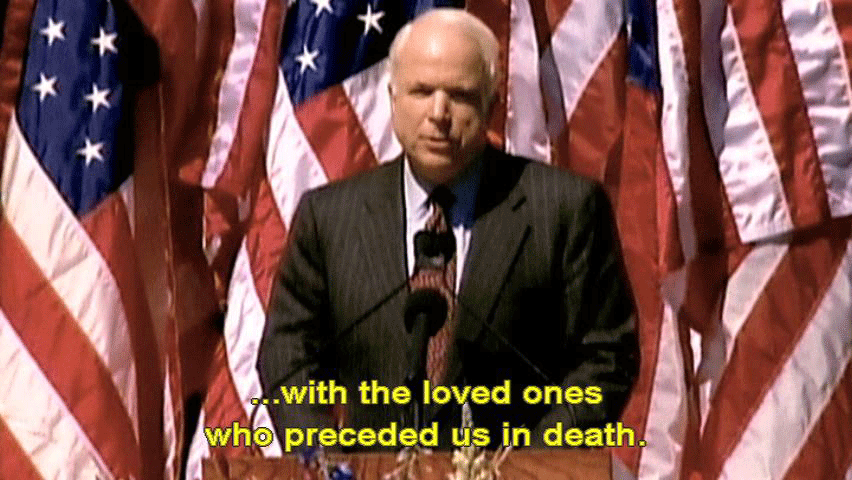
[John McCain] And you will see him again
when a loving God reunites us all ..
... with the loved ones who preceded us in death.
[Stan Goff, Retired soldier] The contrast
of the memorial service ...
... should have hit a warning shot to the military.
You got people out there speaking in these glittering generalities.
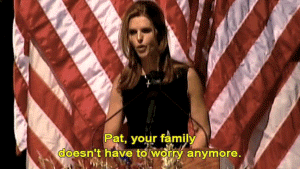
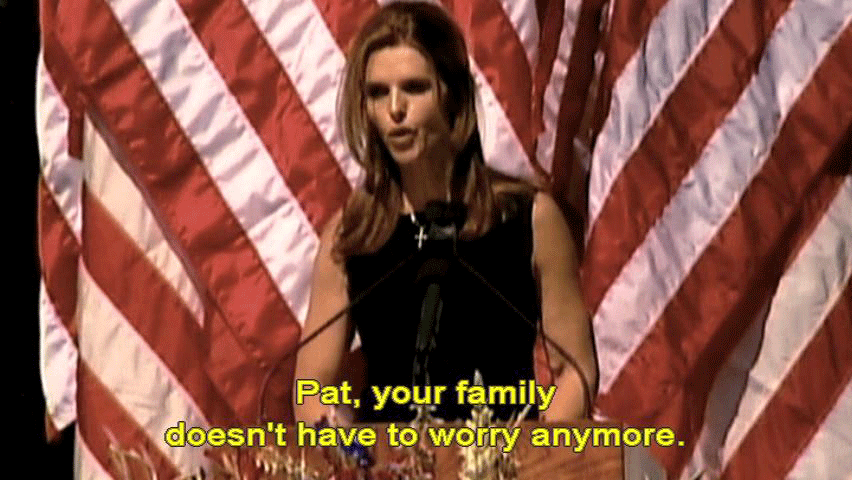
[Maria Shriver] Pat, your family
doesn't have to worry anymore.
You are home, you are safe, and you will not be forgotten.
[Stan Goff, Retired soldier] And then
you've got his brother coming up there.
Somebody who's willing to speak the brutality of that reality for them.
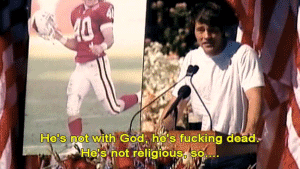
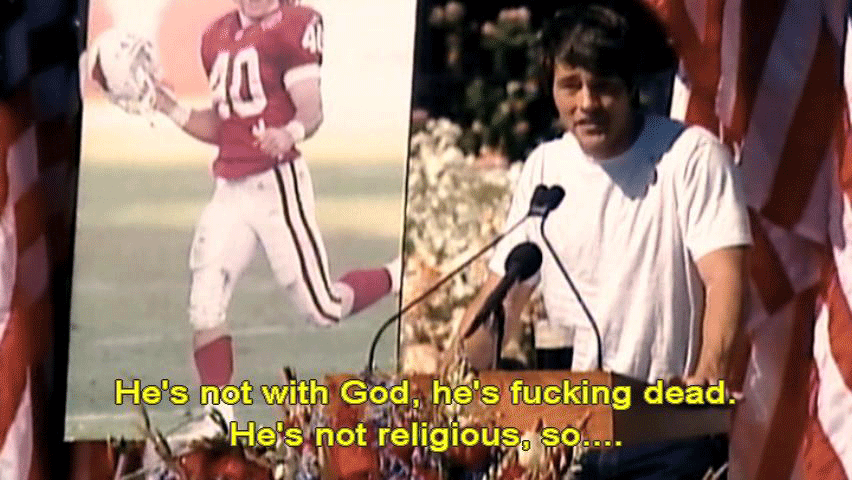
[Richard Tillman, Pat's youngest brother]
He was always giving gifts. Thanks, Pat.
I didn't write shit because I'm not a writer.
And I just want to say, it was --
There's a lot of people here, thanks.
It was really amazing to be his little baby brother.
Yeah, I'm not just gonna sit up here and break down on you, but ...
Thank you for coming. Pat's a fucking champion ...
... and always will be.
Just make no mistake, he'd want me to say this.
He's not with God, he's fucking dead. He's not religious, so ...
Thanks for your thoughts, but he's fucking dead.
I don't regret any of that.
You know, as far as what I was thinking ...
... I was just simply miserable, you know.
I was, you know -- I was sad for my whole family.
I was sad for my mom, my dad, Marie, Kevin.
This isn't a production. It's my brother's service.
I didn't plan on saying that, it just ...
He's not what these people wished he was.
Everyone grabbed at Pat's death.
Not necessarily just the military, everybody grabbed at him.
They just chose the wrong family to try to do it in front of.
[Mary Tillman] Not to say that we always
did the right thing in this house ...
... we made lots of mistakes ...
... but I think that we did make an attempt to tell the truth.
You know, sometimes you have to work at that.
[Narrator] In 1976, Patrick and Dannie
Tillman moved to New Almaden ...
... a two-road town near San Jose, California ...
... where he practiced law and she worked as a teacher.
[Patrick Tillman Sr., Pat's father] Part
of the reason for living out in New Almaden ...
... was a deliberate decision ...
... to set a better environment for the kids.
We discouraged watching TV.
We did the same thing with the telephone.
We had one telephone and it was right in the middle of the house.
If you wanted to talk to somebody ...
... then you'd talk right in front of everybody else.
So it wasn't like we isolated them, it's just there were certain
priorities ...
... and it wasn't that difficult to deprive them for their own good.
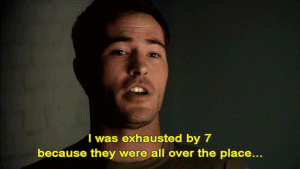
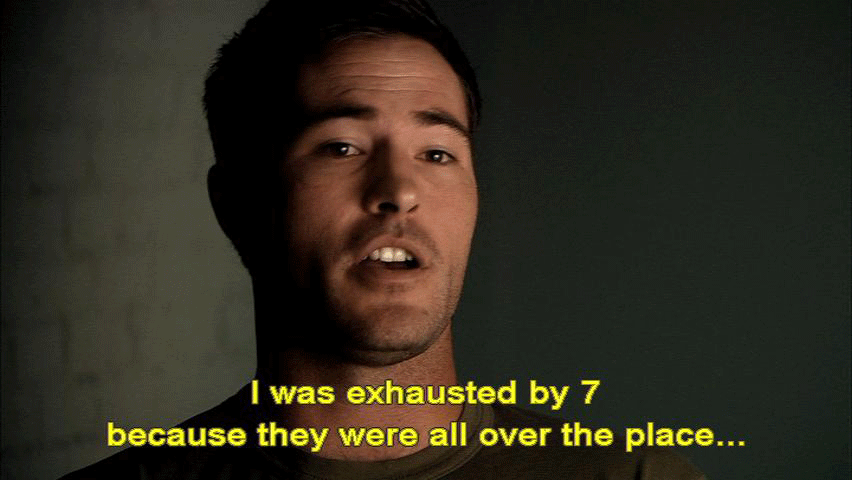
[Richard Tillman, Pat's youngest brother]
You know, we did grow up together. Pat and Kevin were so close in age
...
... they were only 14 months apart, so they were together all the time.
They would go to the creek, the mountains.
I was exhausted by 7 because they were all over the place ...
... and I just didn't have that kind of stamina.
It was just our own little world.
And we happened to have a very just and kind leader in Pat.
And it pushed Kevin and myself to do things ...
... that, you know, we probably wouldn't have normally done.
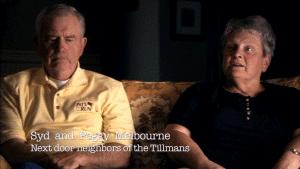
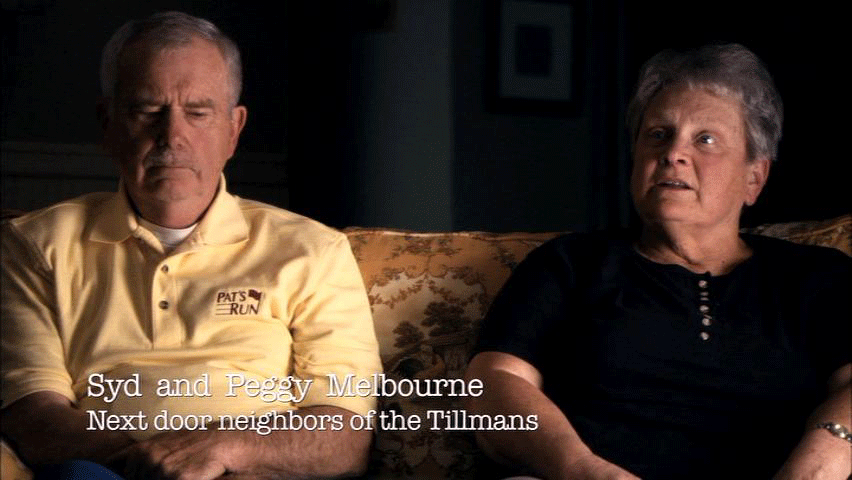
[Peggy Melbourne, Next door neighbor of
the Tillmans] It was just the way they talked.
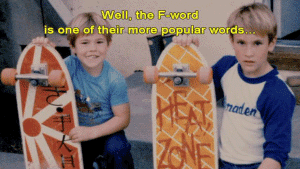
[Syd Melbourne, Next door neighbor of the
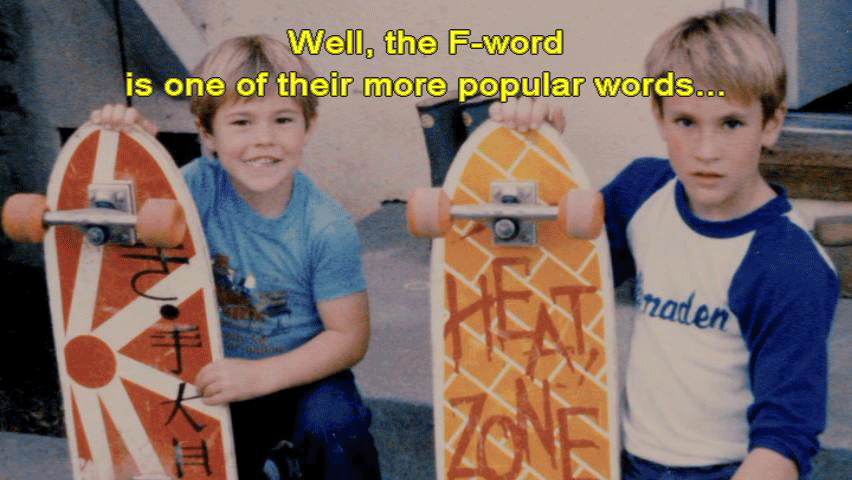
Tillmans] Well, the F-word is one of their more popular words ...
... and they can use it as an adjective, a verb, a noun.
They can, you know -- And then other parts of speech that we don't know.
[Mary Tillman] Yeah, that's true.
They kind of -- They swear a lot.
[Narrator] Did you have rules in the
house about cussing?
[Mary Tillman] Evidently not.
[Stan Goff, Retired soldier] I never met
Pat, so the only way that I know Pat Tillman ...
... is through what I've heard from his family.
Pat was a pretty typical kid, but then he also had this gift.
You know, he had this gift.
He was a comparatively little guy that could just really run fast ...
... and knock the shit out of people.
[Announcer] We first noticed Pat Tillman
when he scored the game-winning touchdown ...
... against Independence last season, then did a flip in full pads.
[Pat Tillman] Made it up, I don't know.
Came to me right about the time I did it. I don't know.
[Mary Tillman] He was very low-key about
getting the compliments and the accolades.
It kind of embarrassed him.
[Spokesman] You're always so modest when
I talk to you.
This time, take some credit for yourself.
You're not gonna do it, are you?
[Pat Tillman] I had a big line and a
great offensive coordinator.
I don't know where he is, but well-coached.
[Patrick Tillman Sr., Pat's father] He
wasn't much of a showman.
[Spokesman] Give him the plaque.
[Man] Here you go.
[Patrick Tillman Sr., Pat's father] He
enjoyed the game. He enjoyed all the games that he played.
He liked climbing things.
He liked jumping off of things.
He liked taking risks, yeah. Yeah, he was big on risks.
He challenged himself that way. He wouldn't let me see any of that.
If you're gonna do that kind of stuff, do it behind my back.
[Narrator] Pat was given a football
scholarship to Arizona State University ...
... where he became an academic All-American ...
... with a 3.8 grade point average.
[Pat Tillman] We never lose at home. We
kicked the shit out of them.
[Narrator] His square-jawed intensity and
long-haired California cool ...
... soon made him a local celebrity.
[Reporter] I want you to talk about
Patton ...
... military leaders that you kind of tap into ...
... for your own, I guess, abilities on a football field.
[Pat Tillman] You know, Patton's a cool
guy. I like his stuff.
He made some comment one time, something to the effect of:
"No one ever won a war dying for their country.
Let the other son of a bitch die for his."
It's things like that, it's guys like that, guys where their attitude --
They're a little bit crazy ...
... but it's that craziness that propels them to greatness.
[Sportscaster 1] The throw. Shoots it
over the middle. And, whoa, what a hit.
Pat Tillman knocked the helmet off of Isaac Byrd.
[Sportscaster 2] That was scary.
[Sportscaster 1] Oh, my.
[Narrator] Because he was considered
small, at 5'11" ...
... Pat was never expected to make it in the NFL.
But from his very first training camp, he set the tone for his career.
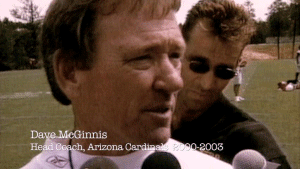
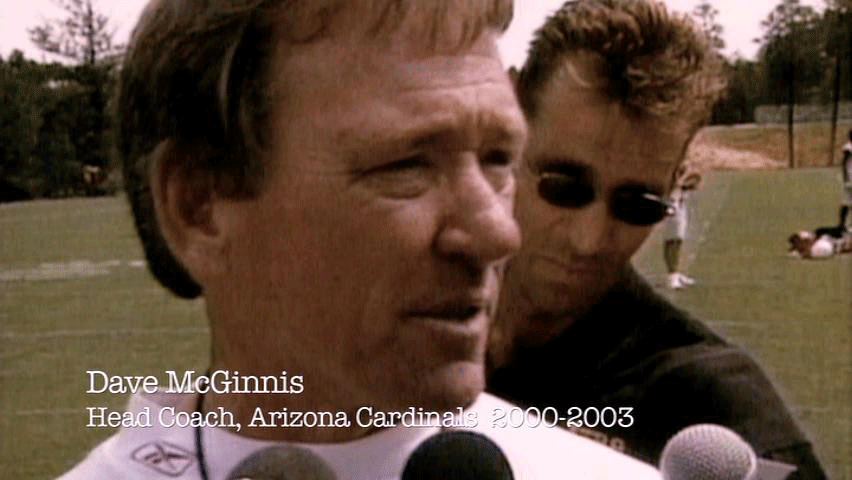
[Dave McGinnis, Head Coach, Arizona
Cardinals 2000-2003] I mean, there are gonna be fights in training camp.
I got Pitt and Pat Tillman together.
Those two are important to me. There was no problem.
You know, 9:00 in the morning, get your ass knocked off ...
... I might be mad too.
[Patrick Tillman Sr., Pat's father] He
would hit you as hard as he possibly could.
[Sportscaster 1] Never even looked at Pat
Tillman. Never even thought --
[Sportscaster 2] That's a perfect job for
Pat Tillman because he's a little bit free of spirit.
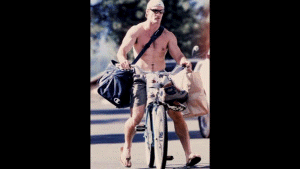
[Narrator] To his new teammates, Pat was
a bit of an oddball.
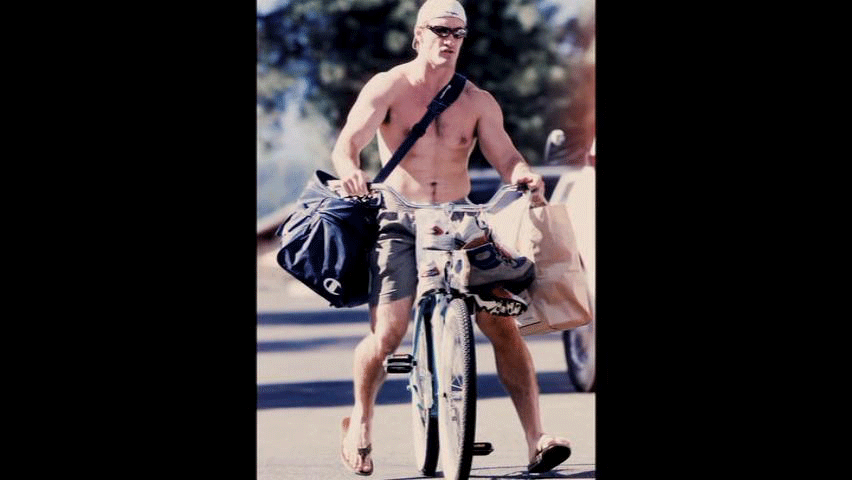
He didn't own a cell phone or a car ...
... and would leave his beach cruiser in the team parking lot ...
... among the Escalades and BMWs.
But to fans, Pat was a rare example of a public figure ...
... who wasn't afraid to speak his mind.
[Sportscaster] Why should the fans think
this year's gonna be any different?
[Pat Tillman] You know what? They
shouldn't.
We haven't done anything at this point to prove that we're not --
We didn't have a good year last year, and that's the only thing that
matters.
We need to go out and start winning games.
When we start winning games, the fans will come out and watch us.
Until that happens, you know, I wouldn't come out either.
[Sportscaster] The Cardinals win and they
go to the playoffs.
[Mary Tillman] He liked the physicality
of it, but I think he really liked that feeling ...
... of being connected with the man next to you.
I think he thrived on that feeling of unity.
[Narrator] At the age of 25, four years
into his NFL career ...
... Pat married his high-school sweetheart.
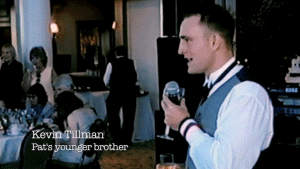
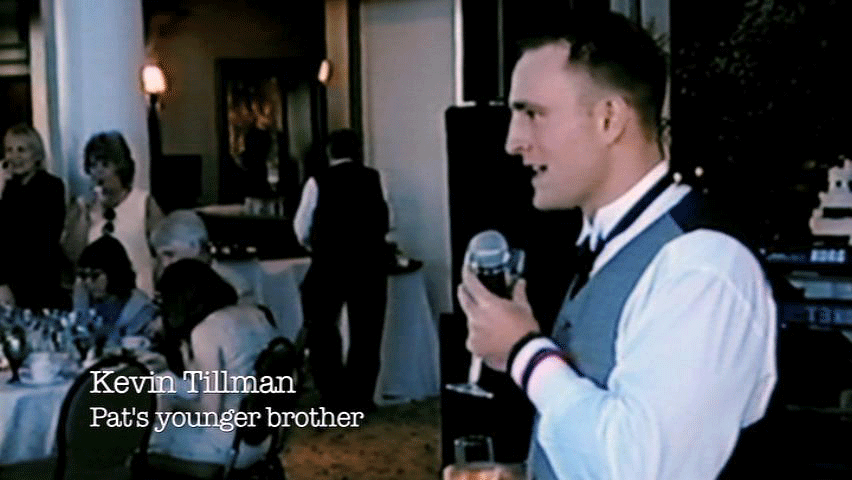
[Kevin Tillman, Pat's Younger Brother]
This is very special for me.
It means a lot that my older brother is getting married --
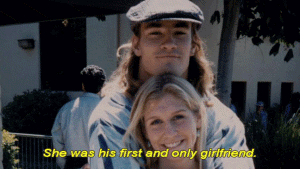
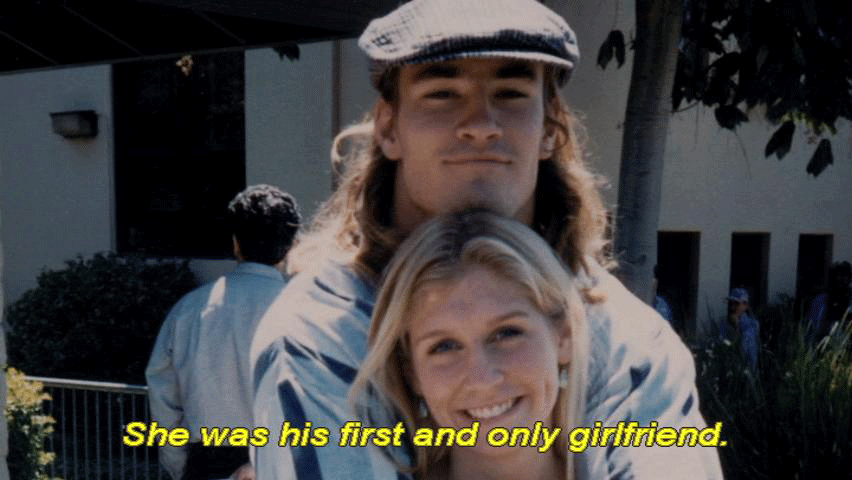
[Narrator] Pat first crossed paths with
Marie Ugenti at the age of 4 ...
... when they played in the same youth soccer league.
She was his first and only girlfriend.
And even though they would go to different colleges ...
... and he would become a high-profile athlete ...
... Pat remained faithful to Marie until the end of his life.
[Kevin Tillman, Pat's Younger Brother] As
far as an older brother, you couldn't ask for anything more than him.
I mean, he's lights out, he's fantastic. And to know that he's with
Marie ...
... the greatest girl in the whole world, it's just money, man.
It's absolutely money for me.
I don't know, I love it, dude. This is fucking awesome.
[Richard Tillman, Pat's youngest brother]
To see Pat and Marie get married -- It was just an awesome day.
I didn't realize that --
You know, what was known at that point, obviously.
But it was ...
I'm glad I didn't. I don't think I would have had as much fun, that's
for sure.
[Mary Tillman] They made this decision,
the three of them ...
... Kevin and Pat and Marie. It was something they talked about.
They kept it from us until after Pat and Marie were actually married.
The boys, they called me on, actually, Mother's Day of 2002 ...
... and they told me that they were going to enlist.
[Patrick Tillman Sr., Pat's father] And
Dannie was not happy about the whole thing.
She made it known.
[Mary Tillman] Members of the family go
back for generations serving.
My father, my father-in-law ...
... all my uncles, served in World War II or Korea.
And, you know, I talked to the boys a lot ...
... about, you know, the camaraderie of war.
And I suppose it concerned me that I did talk too much about that.
That it became more intriguing to them than it should've been.
[Marie Tillman, Pat's wife] Some people
thought that, you know, I could have talked him out of it ...
... or asked him not to do it.
But that was just never something I would've done.
[Patrick Tillman Sr., Pat's father]
Somehow or another, Dannie had a lot more foresight than I did ...
... because it dawned on her right then and there ...
... that she cannot deal with losing one of her sons.
My comment at the time was:
"Could you imagine someone seeing Pat and Kevin coming after them?
I feel bad for those people."
So that was a bad call on my part.
[Narrator] We'll never know exactly why
Pat Tillman enlisted.
He made a deliberate choice not to make it a public matter.
But after he died, an interview surfaced.
[Pat Tillman] Even as athletes, we bitch
and moan every now and again ...
... about this or that, and if we ever just, you know --
Times like this, you stop and think about just how --
Not only how good we have it, but what kind of a system we live under
...
... what freedoms we're allowed, and that wasn't built overnight.
And it's kind of --
The flag is a symbol of all that, the symbol of --
You know, you just don't think about it --
[Narrator] On the day after 9/11, the
Cardinals had conducted team interviews ...
... so players could comment on the country ...
... in the wake of the terrorist attacks.
[Pat Tillman] My great-grandfather was at
Pearl Harbor ...
... and a lot of my family has given up -- Has gone and fought in wars.
And I really haven't done a damn thing ...
... as far as laying myself on the line like that.
So I have a great deal of respect for those that have.
And what the flag stands for.
[Narrator] The interview became known as
Pat's explanation ...
... for why he dropped everything and joined the Army ...
... even though he wouldn't actually make his decision ...
... for another six months.
It would be used to violate his only request ...
... that his motivation for enlisting be kept private.
[Sportscaster] Pat Tillman had everything
to live for.
All that was missing was a true sense of purpose.
He said he found that on September 11th, 2001.
[Newscaster 2] Former safety for the
Arizona Cardinals ...
... gave up a multimillion-dollar pro-football deal ...
... the day after September 11th.
Tillman explained his decision --
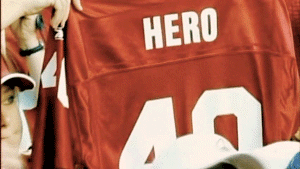
[Newscaster 3] This is what he said the
day after the attacks --
[Newscaster 4] Here's how he explained
his decision --
[Newscaster 5] "To make right," he said,
"what 9/11 had made so wrong."
[Mary Tillman] He was a human being ...
... and by putting this kind of heroic, saintly quality to him ...
... you're taking away the struggle of being a human being.
I mean, he had to make choices, just like we all do.
And he tried to make the right choices.
When he didn't make the right choice, he was the first person to tell
you.
[Patrick Tillman Sr., Pat's father] The
military was not what Pat expected it to be.
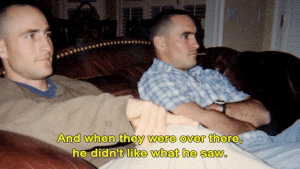
[Mary Tillman] He thought, just like the
majority of people in this country ...
... that going into Afghanistan was the right thing to do.
And then, of course, once they enlisted ...
... the talks started veering towards going into Iraq.
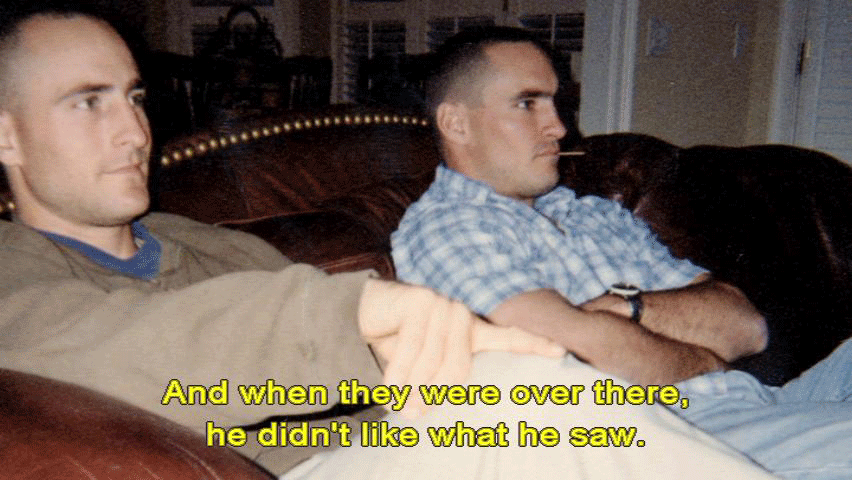
And when they were over there, he didn't like what he saw.
[Narrator] In February 2003, Pat and
Kevin were deployed to Iraq.
One month later, the Rangers were ordered ...
... to provide perimeter support for the rescue of Jessica Lynch ...
... a supply clerk who had reportedly engaged the enemy ...
... in a fierce firefight before being taken prisoner.
[Newscaster 1] She showed true courage.
[Newscaster 2] She shot until she ran out
of ammunition.
[Newscaster 3] She's alive, she's being
tortured.
[Narrator] Despite the apparent urgency
...
... the rescue of Jessica Lynch was inexplicably put on hold.
Russell Baer waited out the delay on top of a bunker ...
... with Pat and his brother Kevin.
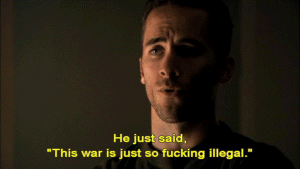
[Pfc. Russell Baer, 2/75 Ranger
Battalion] Just watching these bombs and these A-10's strafe the city.
That was the first time I'd heard Pat in kind of like no-kidding opinion
...
... on kind of what was going on there.
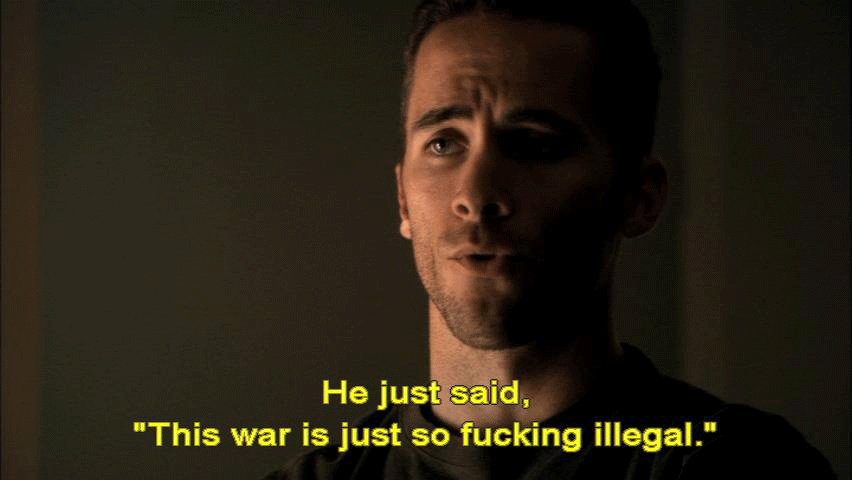
He just said, "This war is just so fucking illegal."
You know, just watching these scene unfold ...
... you know, the city's being blown to shit.
[Radio Voice] Come right, come right.
Okay. I'm moving to cover our backs.
Okay.
[Radio Voice 2] This is oppressive.
Hold it there, please.
[Stan Goff, Retired soldier] It's pretty
clear the Special Ops team could have essentially ...
... walked into the hospital, picked her up and carried her out ...
... and would've been cooperated with all along the way.
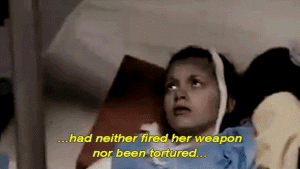
[Narrator] It would come out later that
Jessica Lynch ...
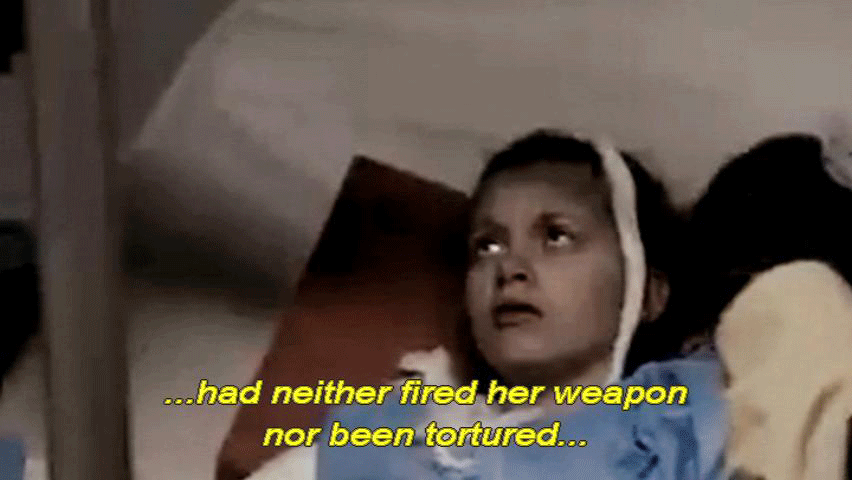
... had neither fired her weapon nor been tortured ...
... and that the inexplicable delay ...
... had been to enable a combat camera crew to record the mission.
[Photographer 1] Camera right here?
[Photographer 2] Can you smile?
Can you smile for the family?
[Photographer 3] For your folks?
[Photographer 4] There you go. You're
doing great, Jessica. You're doing wonderful.
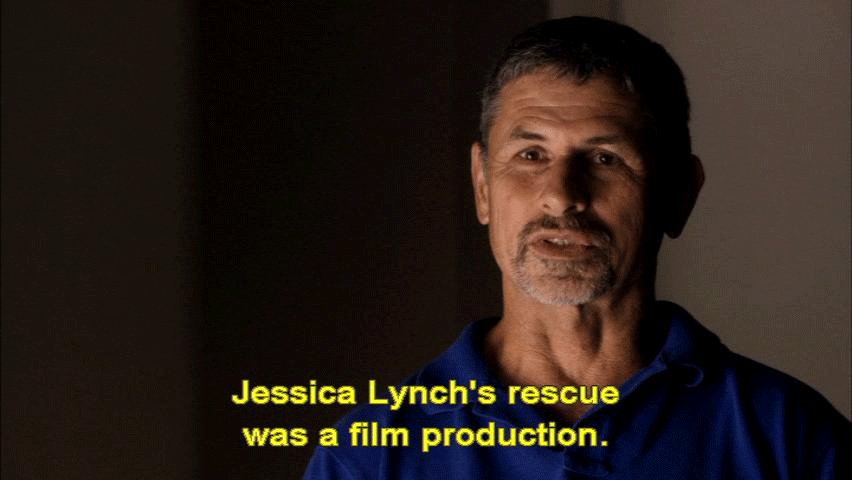
[Stan Goff, Retired soldier] It was a
film production.
Jessica Lynch's rescue was a film production.
[Official] We understand that there is
video taken by a combat camera team.
Can you show us that video?
[Army Man] Do we have the tape?
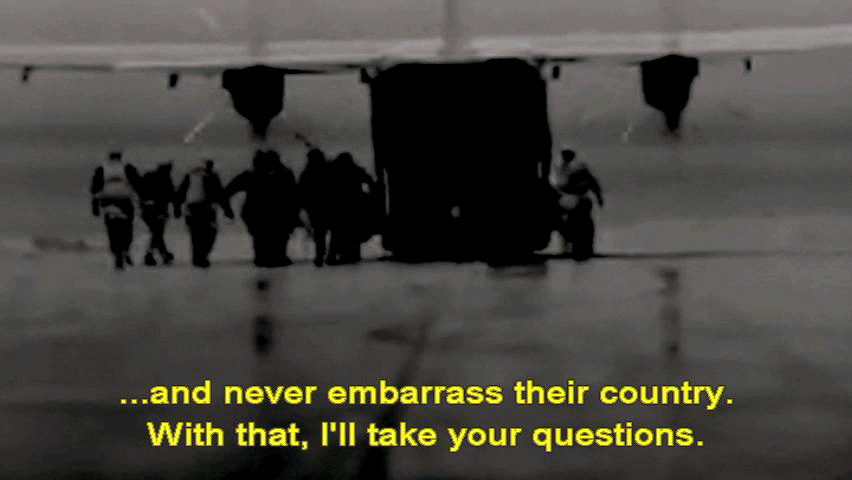
Some brave souls put their lives on the line to make this happen.
Loyal to the creed that they know ...
... that they'll never leave a fallen comrade ...
... and never embarrass their country. With that, I'll take your
questions.
|
Private First Class Jessica Lynch was a member of the
Army’s 507th Maintenance Company, a logistics team assigned to support a
Patriot missile battery during the initial invasion of Iraq. While the
company was heading towards Baghdad as part of a convoy on March 23,
2003, several vehicles experienced mechanical problems, and the company
fell hours behind. As a result, the company missed a turn and headed
into territory controlled by Iraqi forces.
Iraqi forces attacked the company as it traveled
through the city of An Nasiriyah. Private Lynch was severely injured
when the Humvee she was riding in crashed into another convoy vehicle.
Iraqi forces captured Private Lynch and transported her to a military
hospital and later to the Saddam Hussein General Hospital in An
Nasiriyah.
For the next seven days, Iraqi hospital staff treated
Private Lynch’s life-threatening wounds, which included numerous
shattered bones. During that time, Marines conducting operations in the
area learned that Private Lynch was being held at the hospital and that
Iraqi forces were using the hospital as an operations center.
Late on the night of April 1, 2003, a U.S. special
forces unit rescued Private Lynch and recovered the remains of nine U.S.
soldiers who had been killed during the earlier battle. Private Lynch
was transported to the Landstuhl Regional Medical Center in Germany for
further treatment.
On April 1, 2003, immediately after the
rescue of Private Lynch, military officials at U.S. Central
Command (CENTCOM) headquarters in Doha, Qatar, called in
members of the media to announce the success of the mission.
CENTCOM’s chief spokesman Jim Wilkinson stated: "America
doesn’t leave its heroes behind. … Never has. Never
will."....
On the same day, April 2, 2003, the Washington Post
printed its first report ("Missing Soldier Rescued; U.S. Forces
Remove POW From Hospital") on the Lynch rescue. The front page story was
written by Vernon Loeb and Dana Priest, and it provided a factually
accurate account of the rescue. The story’s opening paragraph began:
Jessica Lynch, a 19-year-old private first class
missing since the ambush of an Army maintenance company 10 days ago
in southern Iraq, has been rescued by Special Operations forces,
defense officials said yesterday. CIA operatives in Iraq located
Lynch in a hospital near Nasiriyah, where she was being held because
of multiple wounds, officials said, and a helicopter-borne team of
Navy SEALS and Army rangers rescued her about midnight local time.
The story quoted Mr. Wilkinson, who said of Private
Lynch, "[s]he’s safe in coalition hands and happier than where she
was."
The April 2 story did not include any details about
heroic actions by Private Lynch. But just one day later the
Washington Post reported sensational new details. The April 3 front
page story ("She Was Fighting to the Death"), written by Susan Schmidt
and Vernon Loeb, began with a vivid battlefield account:
Pfc. Jessica Lynch, rescued Tuesday from an Iraqi
hospital, fought fiercely and shot several enemy soldiers after
Iraqi forces ambushed the Army’s 507th Ordnance Maintenance Company,
firing her weapon until she ran out of ammunition, U.S. officials
said yesterday. Lynch, a 19-year-old supply clerk, continued firing
at the Iraqis even after she sustained multiple gunshot wounds and
watched several other soldiers in her unit die around her in the
fighting March 23, one official said.
The article quoted "one official" as saying that at
the time of her capture, Private Lynch "was fighting to the death. She
did not want to be taken alive." The authors stated that according
to this anonymous official, Private Lynch "was also stabbed when Iraqi
forces closed in on her position," though there was no "indication" that
Lynch’s wounds were "life-threatening." The article also stated:
Several officials cautioned that the precise
sequence of events is still being determined, and that further
information will emerge as Lynch is debriefed. Reports are thus far
based on battlefield intelligence, they said, which comes from
monitored communications from Iraqi sources in Nasiriyah whose
reliability has yet to be assessed. Pentagon officials said they
heard "rumors" of Lynch’s heroics but had no confirmation.
On the same day, April 3, 2003, the Military Times
ran a similar account with confirmation from Navy Captain Frank
Thorp. At the time, Captain Thorp was a CENTCOM public affairs
officer stationed at the command’s Qatar headquarters. He subsequently
became the top public affairs official for General Myers and was
promoted to Rear Admiral. According to this report:
Thorp said Lynch "waged quite a battle prior to
her capture. We do have very strong indications that Jessica Lynch
was not captured very easily," he said. "Reports are that she fired
her (M-16 rifle) until she had no more ammunition.
The dramatic story and video of Private Lynch’s rescue
dominated the media for the next few days. In the words of one CENTCOM
public affairs official, Lieutenant Colonel John Robinson, "It was an
awesome story."
The story of Private Lynch’s rescue unfolded during a
difficult time for the White House. An April 3, 2003, Washington Post
story detailed the difficulties the Bush Administration was having
at the time with communications about the war. The Post reported
that the Administration’s plan "did not allow for strong Iraqi
resistance and overestimated the welcome allied troops would
receive." The story also noted:
After nearly two weeks of discouraging news from
Iraq, the White House viewed yesterday as an excellent message day.
There were new details on the rescue of prisoner of war Jessica
Lynch by U.S. Special Operations forces.
Those new details, however, included an entirely
fictional account of her capture. It is not uncommon for initial
battlefield reports to have factual inaccuracies, since they are often
written in difficult circumstances and under intense time pressures.
Subsequent reports then correct the record. The opposite was true,
though, in Private Lynch’s case. The initial reporting was accurate. It
was the subsequent stories that invented new facts. This unusual
situation raised concerns that the misinformation might be part of a
deliberate propaganda strategy. As New York Times columnist Frank Rich
wrote, "[w]hen American forces were bogged down in the war’s early days,
she was the happy harbinger of an imminent military turnaround: a
19-year-old female Rambo who tried to blast her way out of the enemy’s
clutches, taking out any man who got in her way."
In a June 17, 2003, story, the Washington Post
disclosed that Private Lynch did not engage the enemy, was not wounded
by gunshots, and was rescued without significant resistance.
According to the Post, the source
of the inaccurate account was a top-secret battlefield
intelligence report that military officials had quickly
leaked to the press without verifying.
***
When asked whether he knew at the time he spoke to reporters
that Private Lynch had not actually fired any shots, Admiral Thorp
replied: "I would absolutely never, ever, ever, ever say anything that I
knew to not be true."
--
Misleading
Information from the Battlefield: The Tillman and Lynch
Episodes -- United States House of Representatives Committee
on Oversight and Government Reform, Proposed Committee
Report, July 14, 2008 |
[Stan Goff, Retired soldier] The media
has been more than complicit.
[Newscaster 1] The military has just
released new video this morning of the daring raid.
[Stan Goff, Retired soldier] They wanna
take all the complexities of a real situation ...
... and reduce them into a comfortable fable.

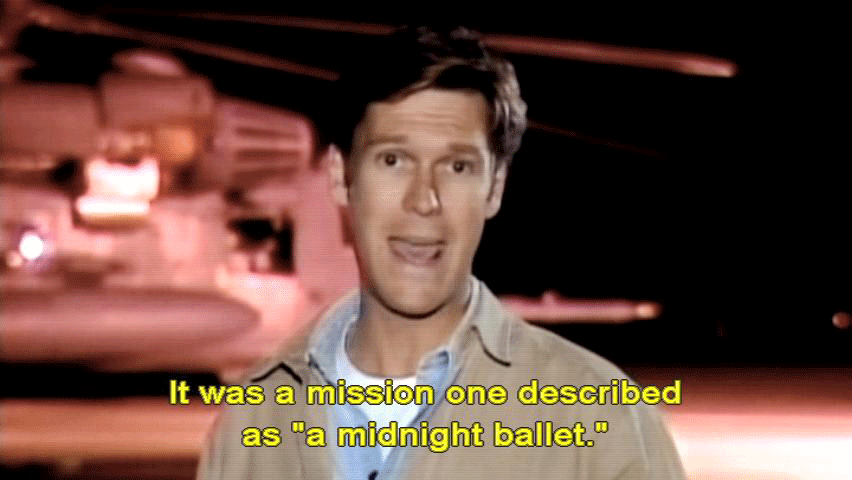
[Newscaster 1] It was a mission one
described as "a midnight ballet."
[Stan Goff, Retired soldier] One that's
easy to sort of digest ...
... and, you know, consists of good guys and bad guys ...
... that are clearly recognizable from movies.
[Newscaster 2] Saving Private Lynch.
[Newscaster 3] Private First Class
Jessica Lange, a 19-year-old U.S. Army soldier.
I apologize. It's Jessica Lynch.
[Stan Goff, Retired soldier] If you wanna
get the public to cosign something ...
... you gotta give them something that they're willing to cosign.
It has to be turned into a morality play.
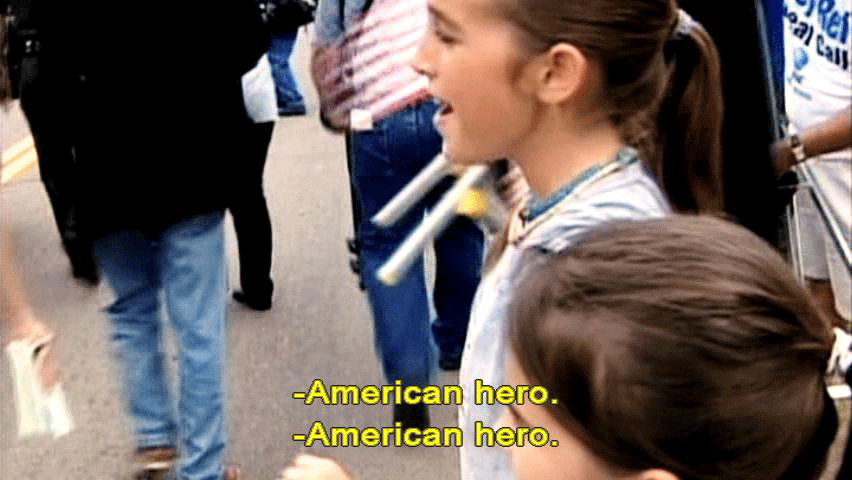
[Girl 1] American hero.
[Girl 2] American hero.
[Stan Goff, Retired soldier] I do not
wanna see dead bodies.
I do not wanna see coffins. I wanna remain comfortable.
[Girl] Welcome home.
[Stan Goff, Retired soldier] And so, you
know, the government gives them what they want.
The press gives them what they want.
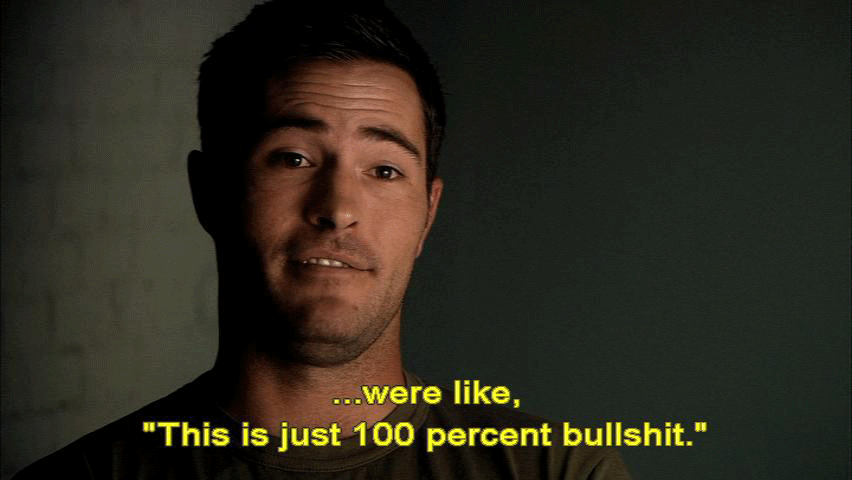
[Richard Tillman, Pat's youngest brother]
Pat and Kevin, when they came back from Iraq ...
... were like, "This is just 100 percent bullshit."
[Marie Tillman, Pat's wife] I think after
coming home from Iraq, he was a little disillusioned.
It was right around the halfway mark ...
... and he was in a stage of looking towards the next step.
[Narrator] Just before Pat was due to
return to combat duty ...
... an opportunity arose that would have saved his life.
[Marie Tillman, Pat's wife] One of the
NFL teams had approached his agent ...
.. and, you know, said that he would be eligible to get out ...
... since he had been on a combat tour.
[Narrator] In a back-channel agreement
...
... the military said that Pat could be immediately discharged with
honors ...
... and could return to his football career by the following season.
As coach Dave McGinnis later recalled ...
... Pat sought him out to discuss the secret offer.
[Coach Dave McGinnis] When he came in and
talked to me --
We talked for about two hours in my office.
And we talked about some things that at the time ...
... that he asked that I not talk about.
He said, "Coach Mac, I'll tell you some things, but I would prefer --"
And believe me, I will hold those things forever.
Just know this, that Pat Tillman made a decision ...
... based on some very real values.
And the words: honor, integrity, dignity, commitment ...
... they were not just adjectives with Pat Tillman ...
... they were realities in his life ...
... and that came through very loud and clear.
[Marie Tillman, Pat's wife] He committed
for three years and he was gonna fulfill his commitment.
It's the same reason why Kevin didn't leave after Pat was killed.
They made a commitment and they honored that.
[Newscaster] Did you get the impression
that he planned on returning to football?
[Coach Dave McGinnis] Just give me a
minute here, because this is ...
You know, he had ...
That's what he wanted to do ...
... because one of the last things that he said to me when we left up
there --
You know, I said, "Okay, good luck. Stay in touch, we'll be --"
And he said, "You know, I'd ..."
And then -- And his last --
He said, "Coach, I just -- You know I wanna come back and play for you."
[Narrator] Pat reported for his second
tour of duty in April of 2004.
His platoon was sent to Afghanistan and assigned to carry out ...
... reconnaissance sweeps near the Pakistani border.
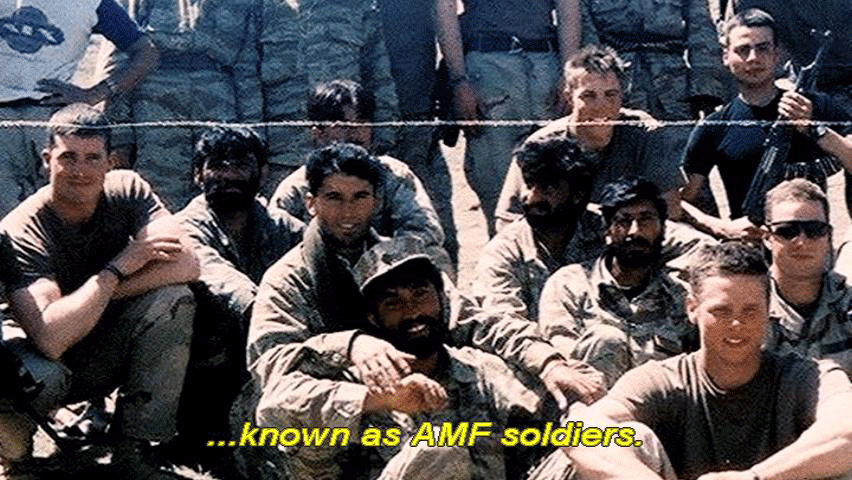
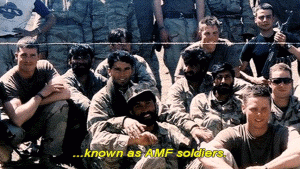
The Rangers were accompanied by a group of allied Afghan militia ...
... known as AMF soldiers.
Pat was now in charge of a small fire team including Bryan O'Neal.
[Pfc. Bryan O'Neal, 2/75 Ranger
Battalion] At that time, I mean, I was still brand-new.
Being from Arizona ...
I thought a lot of Afghanistan looked like a lot of Arizona.
The people were a bit different.
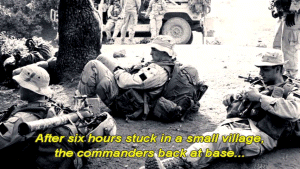
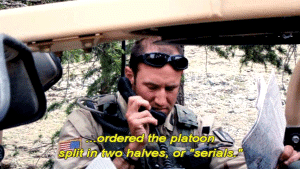
[Narrator] These photos were taken by
Pat's platoon ...
... in the days leading up to the incident of April 22nd.
On that day, while traversing the rugged terrain ...
... one of the platoon's Humvees broke down.
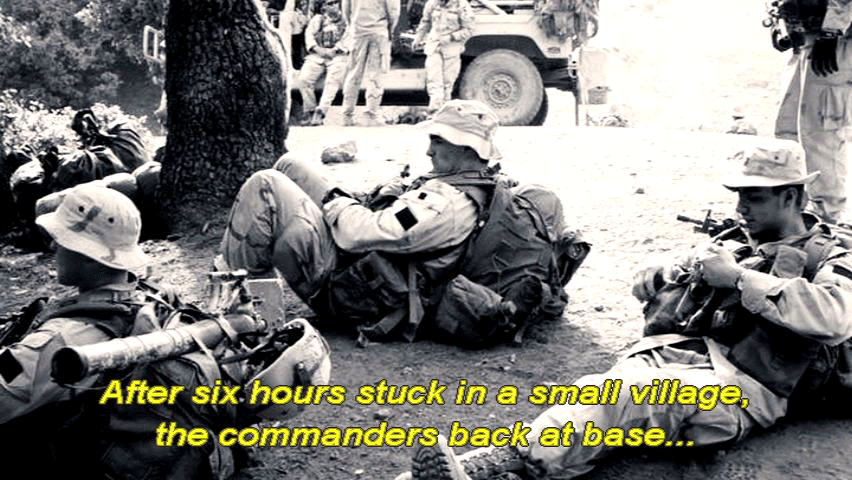
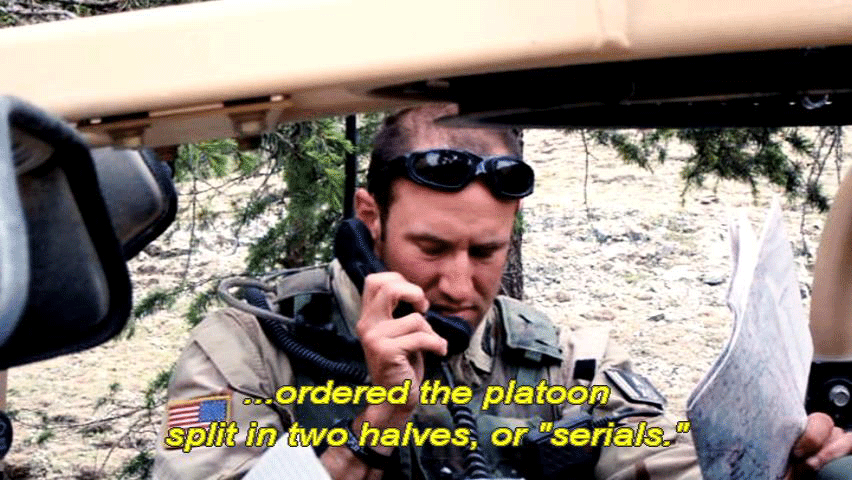
After six hours stuck in a small village, the commanders back at base
...
... ordered the platoon split in two halves, or "serials."
One serial was to deal with the downed vehicle ...
... while the other, including Pat, Russell Baer and Bryan O'Neal ...
... was to carry on with the mission.
[Pfc. Bryan O'Neal, 2/75 Ranger
Battalion] I remember thinking that it was a horrible idea to split the
convoy.
You know, you're taking half of your firepower away ...
... especially in this area we were going through.
As soon as we took off, we basically went into this canyon ...
... where the walls were so steep.
[Investigator] 442 Zulu. We're running
down the canyon.
Staff Sergeant **** is going to narrate as best he can ...
... his recollection of events passing through this canyon.
[Narrator] This video shows the actual
canyon where Pat was killed.
It was presented to the Tillmans ...
... as part of the military's official explanation of the incident.
[Investigator] Okay, we're rolling. This
is April 23rd, 2006, 0551 Zulu.
[Narrator] The Army's investigator
returned to Afghanistan ...
... with members of Pat's platoon ...
... who walked him through the sequence of events ...
... and laid out the routes of the two serials.
Traveling along a dry creek bed at the bottom of a narrow gorge ...
... Pat, Bryan O'Neal, Russell Baer, and the rest of Serial 1 ...
... made it through the canyon unscathed.
At the mouth of the canyon, they arrived at a small village.
[Pfc. Russell Baer, 2/75 Ranger
Battalion] There was a rolling hill with some compounds on it.
My squad leader said, "Stop the vehicles. Get out, stretch your legs.
Let's figure out where we're at. Let's figure out where Serial 2's at."
And that's when we heard the first initial explosion.
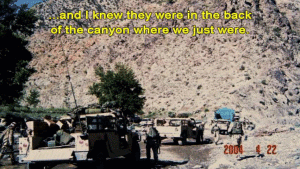
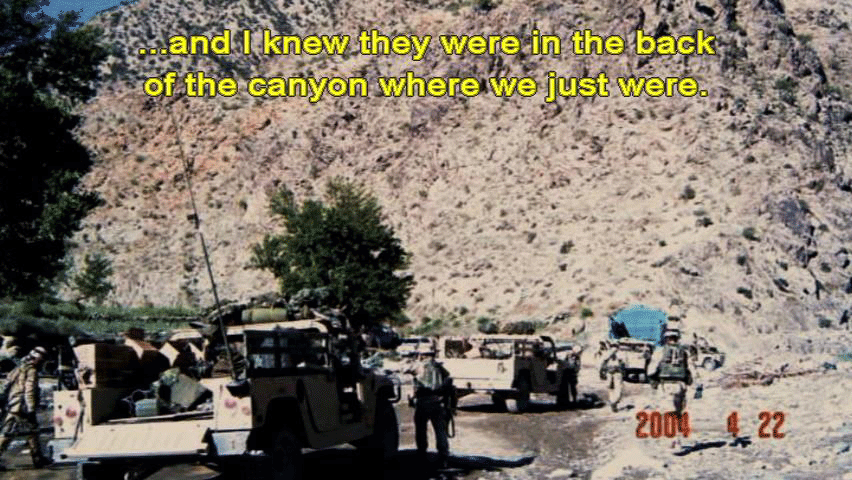
[Pfc. Bryan O'Neal, 2/75 Ranger
Battalion] I remember hearing these explosions go off ...
... and I knew they were in the back of the canyon where we just were.
Which kind of surprised me because, you know, I didn't realize ...
... that the second half of the convoy was following behind us like they
were.
|
On April 22, 2004, during operations in a rugged region
of eastern Afghanistan, the Tillmans’ platoon was divided into two parts
("serials"). Specialist Pat Tillman was a part of Serial 1, which
proceeded towards the village of Manah, Afghanistan, through a narrow
canyon. Specialist Kevin Tillman was a part of Serial 2, which was
supposed to take a different route, but ultimately changed plans and
followed Serial 1 along the same canyon road.
--
Misleading
Information from the Battlefield: The Tillman and Lynch
Episodes -- United States House of Representatives Committee
on Oversight and Government Reform, Proposed Committee
Report, July 14, 2008 |
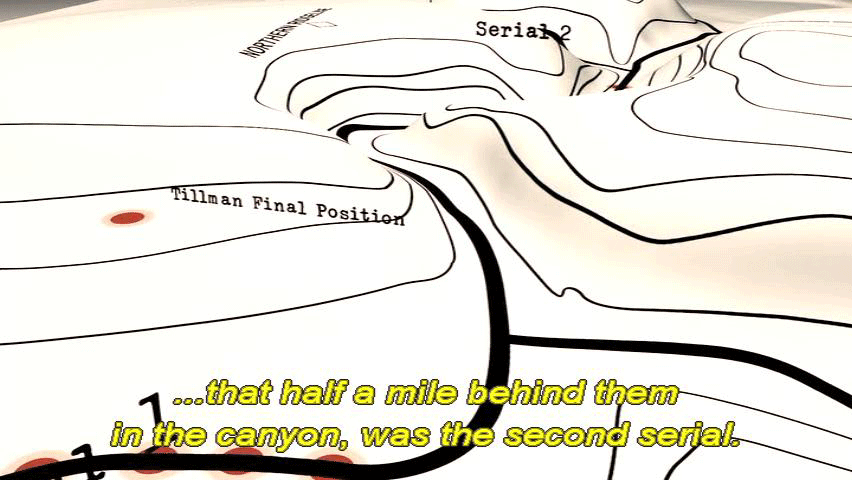
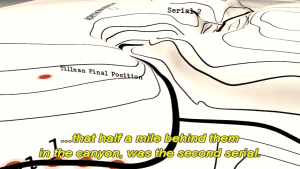
[Narrator] In the steep terrain ...
... the two serials had lost radio contact with each other.
Pat's serial didn't know ...
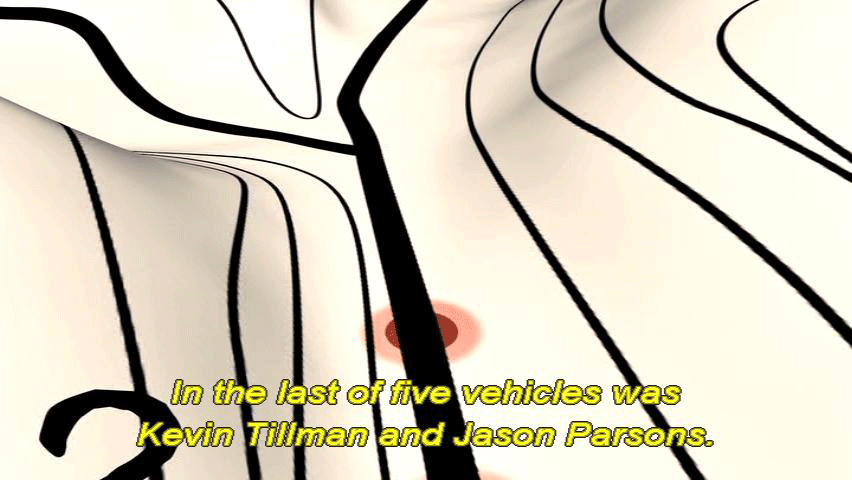
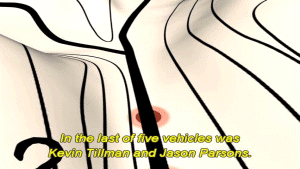
... that half a mile behind them in the canyon, was the second serial.
In the last of five vehicles was Kevin Tillman and Jason Parsons.
[Sgt. Jason Parsons, 2/75 Ranger
Battalion] We was moving through the canyon and then there was an
explosion.
I mean, it was a pretty decent explosion.
We seen rocks and dust and everything fly.
People in a vehicle further up the canyon ...
... believed that it was an RPG attack ...
... so they began lighting up that position.
[Narrator] The Army initially reported
that the Rangers were set upon
... by an ambush of up to 20 Taliban fighters.
[Stan Goff, Retired soldier] But in the
entire course of this attack ...
... not a single Ranger was wounded by enemy fire.
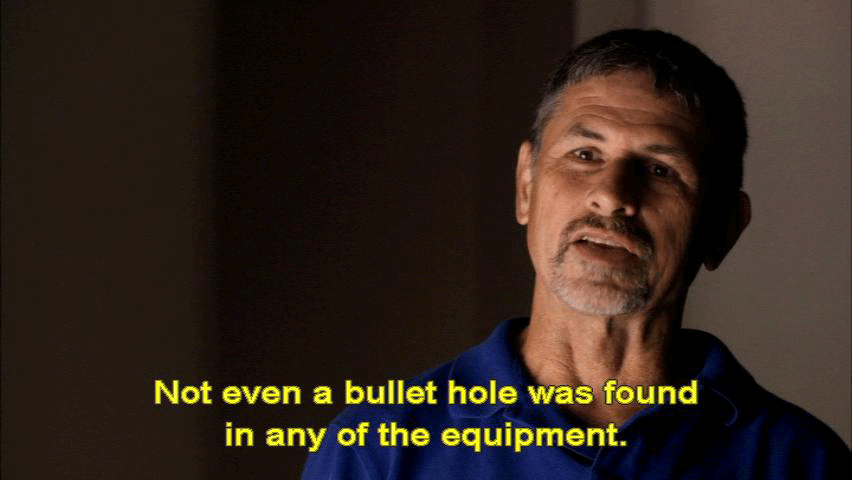
Not even a bullet hole was found in any of the equipment.
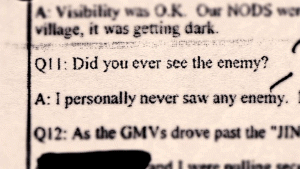
Even though you go through all the statements, no one ever saw ...
... more than two people at a time that were attacking them.
And in many cases, they sounded very unsure of themselves ...
... even saying that.
[Pfc. Bryan O'Neal, 2/75 Ranger
Battalion] It's completely conceivable ...
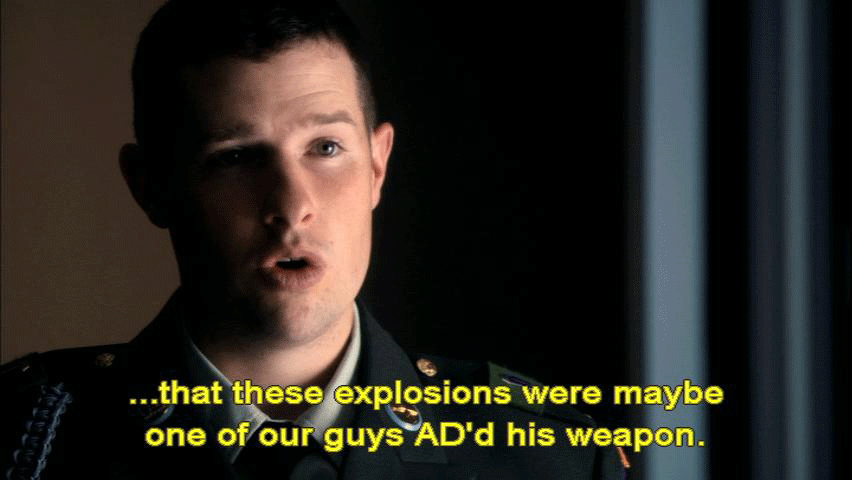
... that these explosions were maybe one of our guys AD'd his weapon.
AD meaning they discharged the weapon accidentally.
[Sgt. Jason Parsons, 2/75 Ranger
Battalion] That's his perspective. I'll let him have it.
But from my perspective, there was two mortars that hit ...
... there were rounds coming in ...
... I had one impact 6 to 7 feet away from me.
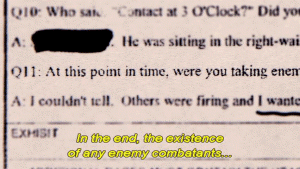
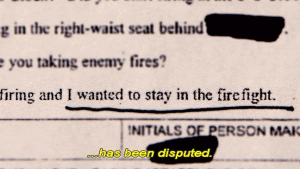
[Narrator] In the end, the existence of
any enemy combatants ...
... has been disputed.
What has never been disputed is that, in this moment ...
... the Rangers in Serial 2 unleashed their full firepower ...
... up into the canyon walls ...
... as they continued driving towards Serial 1.
[Mary Tillman] It was not a fog of war,
not in my mind at all.
I believe it was a lust to fight.
I don't think these soldiers were scared when they came out of that
canyon.
I think they were relieved they were out of the canyon ...
... and they just wanted to shoot.
[Narrator] Hearing the explosion and gun
fire ...
Serial 1 ran back toward the canyon to help Serial 2.
[Pfc. Bryan O'Neal, 2/75 Ranger
Battalion] I remember seeing Pat, you know. He yelled at me, "O'Neal,
follow me!"
And, you know, I do what I was told.
You know, he's my team leader. I follow him wherever I go.
[Pfc. Russell Baer, 2/75 Ranger
Battalion] And I was really surprised at how quick O'Neal was following
Pat.
I mean, he has just as much gear on as everybody else ...
... and he was just keeping up with him.
I remember getting halfway up this hill and Pat turning around ...
... asking Sergeant Weeks, my squad leader:
"Hey, Sergeant Weeks, can we take our body armor off?"
And I remember thinking to myself:
"Fuck that, I am keeping my body armor on."
Pat is wanting to get up there as quickly as possible.
[Sergeant Weeks] Tillman was at about
this location ...
... and he asked if he could drop his body armor ...
... and start pursuing up this hill.
I told him no.
[Pfc. Bryan O'Neal, 2/75 Ranger
Battalion] At that time, I noticed there was an Afghani militia man with
us.
He jumped in with us and we just started running.
[Narrator] At the moment Pat's fire team
reached these rocks ...
... the lead vehicle of Serial 2 emerged from the canyon below them.
The vehicle had left Kevin, Jason and the rest of the convoy behind.
It pulled into the clearing, and the soldiers onboard took aim ...
... directly up at Pat's fire team.
The AMF soldier standing next to Pat ...
... was shot eight times in the chest and dropped dead.
[Soldier's Voice] Facing the gentleman,
and I approached --
[Pfc. Russell Baer, 2/75 Ranger
Battalion] People started to yell, "Cease fire!"
Then people said, "Hey, I think they're fucking shooting at us."
And then, you know, we knew, no shit, that they were shooting at us.
[Pfc. Bryan O'Neal, 2/75 Ranger
Battalion] A .50 cal can shoot 900 rounds a minute ...
... and it could have been no less than a minute that they were shooting
at us.
You could see on the rock all the marks from the rounds ...
... all except the spot where I was lying.
I just remember thinking, "I'm gonna die."
And, you know, asking Pat, "What are we gonna do?
How are we gonna get out of this?" And he said, "I've got an idea."
He popped a smoke grenade and threw it ...
... and they stopped shooting at us.
And after they stopped shooting at us, you know, me and Pat stood up ...
I remember looking at Pat asking him, "How could that happen?
How did they not see us?
And, you know, he couldn't answer me, he didn't know.
I was actually more afraid for the guys that had just got done shooting
at us ...
... that they were gonna get in trouble.
[Narrator] The soldiers didn't get in
trouble ...
... because the military always maintained ...
... that what happened next transpired in only four seconds ...
... during the confusion of combat.
[Patrick Tillman Sr., Pat's father] For
years, we get this story ...
... that Pat was shot from probably 200, 300 yards away.
They were going about 25 to 35 miles an hour ...
... firing wildly to the right ...
... and Pat and this Afghan were just an unfortunate consequence ...
... of people being excited.
But Bryan O'Neal has said, in no uncertain terms that ...
... that was not the case.
[Pfc. Bryan O'Neal, 2/75 Ranger
Battalion] Today was the first day I've ever actually seen this
PowerPoint.
It's really interesting to see from this perspective now.
I don't find this video accurate because it depicts, on his account ...
... that they were moving continuously ...
... through the valley where they were driving.
In actuality, from my memory ...
... I remember them stopping and firing on two occasions.
What he's saying here is a complete lie.
[Patrick Tillman Sr., Pat's father] The
driver took them from about a hundred yards away ...
... over to a better location to kill them.
Now they're about 40 yards away.
[Pfc. Russell Baer, 2/75 Ranger
Battalion] You know, they stopped and then drove forward ...
... and then reengaged us, dismounted ...
... and then started reengaging us again.
At that point, I thought we were all gonna die.
And ...
I remember putting my weapon on fire, and having my finger on the
trigger ...
... and knowing these are my buddies down there ...
... but knowing that they're gonna kill us and kill everybody.
And I was, you know, a second away from just loading them up ...
... just killing them all, and I could have done it.
[Pfc. Bryan O'Neal, 2/75 Ranger
Battalion] I started to say a prayer out loud, you know, and it was
something like:
"Oh, God, please, if you can help us out of this situation ...
... you know, I'll be very grateful ...
... and I'll do what I can to repay you for this debt that I will owe
you."
And I remember Pat saying, "O'Neal, quit praying.
You know, God is not the one to help you now.
This is reality, this is what we need to focus on.
I don't want you to go into some la-la land ...
... not pay attention and then get killed."
I was actually grateful for him to say that.
I was really trying to put my focus somewhere else and not keep it here.
Pat, he saved my life.
All of a sudden, they started shooting at us again ...
... and I just remember Pat, you know, yelling his name.
"I'm Pat Tillman.
I'm Pat fucking Tillman, why are you shooting at me?"
[Patrick Tillman Sr., Pat's father] Pat's
last words were, repeatedly, "I'm Pat fucking Tillman."
And that was after he got lit up by the machine gun the first time.
He's flat on the ground, sitting on the ground, he was hurt.
And I suspect he was a bit disappointed ...
... that his own team is shooting at him.
And I imagine that those comments of his, "I'm Pat fucking Tillman" ...
... he said while looking right at them ...
... with a face that would make most people nervous.
[Pfc. Bryan O'Neal, 2/75 Ranger
Battalion] I remember hearing the sound of a drinking fountain.
Like, when you press the button ...
... to get water out of the drinking fountain, the sound it makes.\
And I just look over at my side and I see this blood ...
... pouring down this rock that I'm sitting behind.
He -- His head was gone.\
Completely gone.
And I take my helmet off and I throw it against the ground ...
... and then I kind of black out.
[Syd Melbourne, Next door neighbor of the
Tillmans] I just heard this guttural scream.
And I automatically thought, "Someone's dead."
It's the first thing I had.
And I caught Dannie about seven, eight feet outside her door ...
... and she was collapsing, and I caught her ...
... and she had a telephone in her hand.
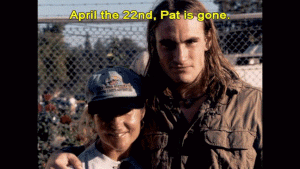
[Peggy Melbourne, Next door neighbor of
the Tillmans] One sad thing, and I'll never forget this ...
... but she went and got a picture of Patrick ...
... and she had this picture and she just kept saying:
"April the 22nd, 2004.
April the 22nd, Pat is gone.
April the 22nd --"
[Pfc. Russell Baer, 2/75 Ranger
Battalion] I was with Kevin when he found out Pat had been killed.
He got out of the vehicle ...
... and you could see there was a million things going through his head.
There was absolute horror and shock ...
... and I remember him screaming several times.
I remember him taking his helmet off and slamming it on the ground.
I remember ...
... our medic, Doc ...
... kind of coming up to him, you know, saying, "Hey, give me your
weapon."
And then I saw him go over to his brother's body and he just sat there.
I remember seeing Kevin in his Humvee ...
... and I was told by Colonel Bailey ...
... to not tell him Pat was killed by friendly fire.
[Pfc. Bryan O'Neal, 2/75 Ranger
Battalion] You know, "Your career is on the line.
Do not tell Kevin exactly what happened."
[Narrator] Kevin had arrived on the scene
10 minutes after the shooting.
He was immediately quarantined and the rest of the platoon ...
... was ordered not to tell him what had happened.
Russell Baer was put on a plane with Kevin.
He was ordered to escort Pat's remains back home ...
... and to present the family with flags on behalf of the country.
[Pfc. Russell Baer, 2/75 Ranger
Battalion] That was a difficult experience for me. Just with everything
that I knew ...
... and I was scared about what was to come afterwards.
You know, I was just -- I was afraid for it all.
I mean, it was the first time I'd ever met Pat's mom ...
... and she saw how difficult it was for me and she ...
She grabbed my hand, kind of just patted my hand a little bit.
[Senior Chief Petty Officer Steven White] The real
test of a man is not when he plays the role he wants for himself ...
... but when he plays the role destiny has for him.
So when that little voice in your head tells you not to do the easy
things ...
... but the right things ...
... it's Pat. Right in your ear, man. It's Pat.
[Mary Tillman] Right after Pat died ...
... we probably felt the most sense of comfort from people from the
military.
And we were very honored to see that General Kensinger was present.
[Patrick Tillman Sr., Pat's father] I
wanna thank anybody involved in the military ...
... especially the Rangers. Outstanding human beings --
[Mary Tillman] Then to find out that they
were the very people to lie to us ...
... it's outrageous.
[Patrick Tillman Sr., Pat's father] I
don't know a lot about what happened to Pat ...
... but the last few days have not been very pleasant.
It's only been a week and it ain't getting any better.
[Mary Tillman] It's a horrible thing to
lie.
It's an atrocity that they would take a young man with honorable
intentions ...
... who served his country ...
... and lie about how he died to promote a war.
To use him as a political -- A propaganda tool, basically.
That is immoral.
[Narrator] The five shooters never gave a
credible explanation for their actions.
But by the time the Tillmans had unredacted ...
... the entire box of documents ...
... they understood that the deception about their son's death ...
... went much higher than the soldiers on the ground.
[Stan Goff, Retired soldier] Pat Tillman
has been killed.
Forty-five minutes later, he's been killed by fratricide.
"Oh, shit. What do we do now?"
"Okay, let's spin this as a heroic action.
We'll turn his dead body into a recruiting poster."
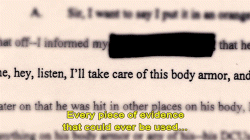
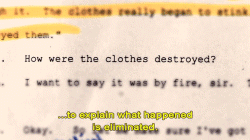
[Patrick Tillman Sr., Pat's father] They
destroyed his uniform, his body armor, his helmet, his diary.
Every piece of evidence that could ever be used ...
... to explain what happened is eliminated.
[Richard Tillman, Pat's youngest brother]
You just don't do shit without telling your superior officer.
"Oh, I'm gonna go burn Pat's uniform."
No.
You don't piss without permission ...
... so this goes pretty damn high.
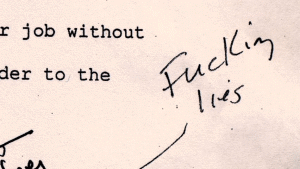
[Narrator] Once the Tillmans shifted
their focus ...
... to the higher-ups responsible for the cover-up ...
... the lead investigator assigned to their case ...
... began publicly suggesting that it was time to move on.
[Radio interview with Colonel Ralph
Kauzlarich, Lead Military investigator of the Tillman case] I don't
know. These people, they have a hard time letting it go.
It may be because of their religious beliefs.
I don't know how an atheist thinks.
[Radio Person] Right.
[Radio interview with Colonel Ralph
Kauzlarich, Lead Military investigator of the Tillman case] But I can
only imagine that, that would be pretty tough.
[Radio Person] Right.
[Radio interview with Colonel Ralph
Kauzlarich, Lead Military investigator of the Tillman case] If you're an
atheist, then you don't believe in anything?
If you die, what is there to go to? Nothing. You're worm dirt.
It's pretty hard to get your head around that.
[Radio Person] So you suspect that's the
reason why this thing's dragging on.
[Radio interview with Colonel Ralph
Kauzlarich, Lead Military investigator of the Tillman case] I think so.
There's not a whole lot of trust in the system.
[Radio Person] Right.
[Radio interview with Colonel Ralph
Kauzlarich, Lead Military investigator of the Tillman case] Or faith in
the system.
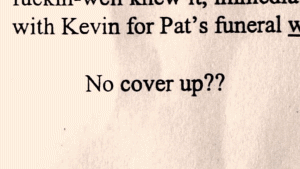
|
Mr. Cummings. Sir, are you claiming there was an error? You
mentioned error, error. Is there a difference between a lie and
an error, Mr. Secretary?
Mr. Rumsfeld. Well, certainly there is a difference between
the two. And I don't know how many investigations -- some people
have said five, some six, some seven -- but every single one of
them has suggested that was badly handled and errors were made.
But in no instance has any evidence of a cover-up, to use the
phrase you use, been presented or put forward. I know of
nothing that suggests that.
I know that I would not engage in a cover-up. I know that
no one in the White House suggested such a thing to me. I know
that the gentlemen sitting next to me are men of enormous
integrity and would not participate in something like that. So
of course there is a difference between error and cover-up.
Chairman Waxman. Mr. Cummings, your time is up but you did
ask a question that you wanted all of the witnesses to answer.
And I guess the question would be since the information was
distorted and O'Neal's -- Staff Sergeant O'Neal's statement was
rewritten to give a different statement than what he put
forward, and the family wasn't informed for the longest time,
and all these other problems, do any of you think there was a
cover-up of the errors or actions below?
General Myers. Mr. Chairman, I can only say that in the
places that I worked, I would agree totally with Secretary
Rumsfeld that whether it was the White House or in the
Secretary's office or when the Joint Chiefs of Staff met or
when I talked to General Abizaid, there was no -- never any
attempt to cover up anything. In fact this was not an issue
that we discussed. I just didn't discuss this issue. We had a
lot of issues. We mourn every death. We really do. We cry with
the parents and the friends and family.
Chairman Waxman. I guess the question is different. I am
not asking you whether you were a part of a cover-up. Do you
think there was a cover-up?
General Myers. I have no way of knowing. I don't have all
the information.
Chairman Waxman. General Abizaid, do you have any comments?
General Abizaid. No, sir, I don't think there was a cover-
up. I think people tried to do the right thing and the right
thing didn't happen.
General Brown. I agree with General Abizaid, I don't think
there was a cover-up.
***
Mr. Hodes. Gentlemen, as I understand it, there have been at least six
different investigations into this matter. It appears that each
of those investigations had serious flaws. First there was
Captain Scott's investigation, completed within 2 weeks of the
incident. Second, Colonel Kauzlarich's investigation -- I don't
know whether I have butchered his name -- which was finished on
May 16, 2004.
The DOD IG concluded that these two investigations were,
"tainted by the failure to preserve evidence, a lack of
thoroughness, and the failure to pursue investigative leads.''
Third was an investigation by General Jones completed 6
months later. The IG had similar criticisms of that report.
Fourth, the IG report itself, issued in March of this year.
But the IG was unable to determine who doctored key witness
statements supporting the Silver Star award.
And fifth, was an Army Criminal Investigation Division
investigation finished at the same time as the IG
investigation. This report inexplicably concluded there were no
rules of engagement violations, even though there was a
friendly fire fatality and multiple injuries.
And finally, as of yesterday, General Wallace has completed
his investigation. General Wallace's investigation apparently
suffered from an overly narrow scope, failing to examine the
actions of key military leaders. And we have before us the top
military brass involved in these questions at the time: General
Brown, General Abizaid, General Myers, and Secretary Rumsfeld.
Now, let's put aside for a moment the merits of each of the
individual investigations. Do you all, gentlemen, agree that it
should not take six different investigations, 3 years,
congressional investigations, and millions of taxpayer dollars
to address the significant failures that have occurred in this
case?
Mr. Rumsfeld. Absolutely.
General Myers. Agree.
General Brown. Yes, sir.
General Abizaid. Agree.
Mr. Hodes. Secretary
Rumsfeld, the approach of ordering a series of military
investigations that are limited in scope and that do not
address the question of what top officials knew appears to
be the Department of Defense's MO when it really doesn't
want accountability.
When the allegations of abuse at Abu Ghraib arose in 2004,
the Pentagon took the same approach. First, there was
the Taguba investigation, limited to the conduct of the military
police at Abu Ghraib. Second was
the Fay investigation that
examined the conduct of the military intelligence personnel at
Abu Ghraib, but there was no inquiry into the involvement of
the civilian leadership. Third was
the Army Inspector General's
investigation, which focused on interrogation practices in
general in Iraq and Afghanistan, without examining the role of
top Pentagon leadership. In all there were over a dozen
investigations by the Pentagon into detainee abuse issues, but
none has resulted in a full understanding of the civilian
leadership's involvement in the abuses. None has resulted in a
full understanding of your involvement or the involvement of
the White House.
Mr. Secretary, do you see the parallels here? Do you see
why some would think that in the case of both Abu Ghraib and in
the Tillman investigation there were deliberate efforts to
avoid accountability? And if you see that, the manner in which
this serial kind of narrow investigating, never answering the
questions about who at the top knew what is a problem, what do
you think ought to be done so that the American people can be
assured that the top leadership in this country is accountable,
is willing to come forward and tell the truth, and is going to
take the actions to reassure the American public that abuses
won't happen again?
Mr. Rumsfeld. Congressman, I don't
obviously agree with your characterization of the history of this.
***
Mr. Lynch [presiding]. Now, a number of us, including Mr. Murphy, Mr. Welch, Mr.
Shays and others, have been out to the area where Mr. Tillman
was ambushed. And we certainly appreciate the complex battle
space, as you have described it, and we can understand that
there was some chaos in this firefight.
However, I do want to follow the time line here because
Chairman Waxman spoke earlier about the testimony of Specialist
O'Neal. And as you may remember, Specialist O'Neal was with
Corporal Tillman on the ground there, on that canyon road near
Manah. And Specialist O'Neal went back to Salerno, just north
of that area, a couple of days after the firefight, and
actually he wrote a witness statement in the immediate
aftermath of Corporal Tillman's death that made it quite clear
that this was a case of friendly fire.
But then something happened. Someone rewrote that statement
and the revised version -- we had Specialist O'Neal in, and we
showed him the statement and we asked, Did you write this part?
No, I didn't. Did you write this part? No, I didn't.
So there was a drastic revision between what the eyewitness
wrote and what eventually went to the press and went to some of
you. And we don't know if it went to the President or not, but
it served at least in part as the basis for the Silver Star
citation. We know that.
And while we understand the chaos that might have occurred
during this firefight, this rewriting, this revision, happened
after the fact, after the smoke had cleared. And I can
appreciate the frustration of some of my colleagues who feel
that something else is going on here, and we're not sure what.
Some people think it was a mix-up, not a cover-up; and I
can certainly appreciate them feeling that way. But we have had
an opportunity, all of us, a lot of us, to go out there and
also observe the high excellence of our military, the high
excellence of our military officers and folks in uniform. And
they have performed brilliantly. And yet here we have this
major, major disconnect between what the people on the ground
observed and recounted, and then the report that gets out to
the press and the public and to the family.
And another issue that is confusing is the P-4 memo. It was
written explicitly to warn the senior defense officials and the
President that Pat Tillman, it was highly possible that he died
of friendly fire. But from the testimony today it would seem
that no one passed this information to either Secretary
Rumsfeld or the President. And knowing what I know about the
best of the military, I find that mind-boggling, just stunning,
that this happened.
The Tillman
Fratricide: What the Leadership of the Defense Department
Knew -- Hearing before the Committee on Oversight and
Government Reform, House of Representatives, 110th Congress,
August 1, 2007 |
[Patrick Tillman Sr., Pat's father] It
was my understanding at the time that this investigation is over ...
... that this has been closed ...
... they're not gonna give me the truth, it's a done deal.
And that being said, there's not much I can do to force the issue.
So I wrote them a letter.
I just went through and blew out ...
just about everything they considered to be a fact.
And explained to them why that is a lie ...
... and concluded by telling them that I have low regard for them.
I just wanted to tell somebody off.
[Narrator] Unbeknownst to Pat Sr., the
Army considered the wording of his letter ...
... to be a formal accusation of criminal misconduct.
This automatically initiated a new investigation ...
... by the inspector general's office.
[Army Secretary Pete Green] Thank you for
being here today.
[Richard Tillman, Pat's youngest brother]
It's kind of obnoxious that the letter did have the impact that it did.
It's like, wait a minute, my mom has been working her ass off for years
...
... and if she knew all she had to do was tell you to go fuck yourself
...
... and you'd actually do your job, I'm sure she would have done that
...
... two and a half years before.
[Narrator] After an 18-month inquiry, the
Army secretary announced ...
... that the military was finally ready to assign blame.
[Army Secretary Pete Geren] We present to
you the results of the Wallace Investigation ...
... into the tragic death of Corporal Pat Tillman.
[General Kensinger] I'm on my way to an
anniversary in Las Vegas.
I get a phone call from my wife that says, "Hey, you're on CNN."
[CNN Reporter] Up first, new information
about who bungled the initial probe ...
... into the friendly-fire death ...
... of Army Ranger and former football star Pat Tillman.
Let's go to the news conference now over at the Pentagon. Let's listen
in.
[Army Secretary Pete Geren] General
Wallace did find a senior official ...
... Lieutenant General Kensinger, the senior leader in ...
... the administrative chain of command for the 75th Ranger Regiment ...
... found him guilty of deception.
General Kensinger was the captain of that ship and his ship ran aground.
It ran aground because he failed --
[General Kensinger] Devastating.
Devastating to be called the villain in the process ...
... or the captain who ran his ship aground ...
... and let all his soldiers down.
[Narrator] General Kensinger was the
public face of the Army ...
... in the weeks after Pat's death.
[General Kensinger] I will not be taking
questions.
[Narrator] The Army said that Kensinger
knew about the fratricide ...
... when he attended Pat's memorial service.
He would be stripped of his third star.
But as a reporter noted ...
... there may have been another reason why Kensinger took the fall.
[Reporter] -- yet, all the blame falls on
General Kensinger.
I'm just trying to make sense of that.
He happens to be retired, is there a coincidence there?
[Army Secretary Pete Geren] The fact that
he --
[Reporter] He's the only one who's really
being singled out.
[Army Secretary Pete Geren] I believe the
buck stops with Kensinger.
He was the senior leader in the chain of command for --
[Mary Tillman] I don't think the buck
stops at Kensinger.
There's no way this cover-up started at the three-star level. It had to
go much higher than that.
[Army Secretary Pete Geren] You look at
what Kensinger's role --
[Mary Tillman] I don't think Kensinger
would have been inclined to cover it up ...
... if he wasn't ordered to.
[Army Secretary Pete Geren] -- if he
performed his duty we wouldn't be standing here today.
[Mary Tillman] I mean, he was culpable.
I mean, he could've easily picked up the phone and called us ...
... you know, but this is their life, this is their career ...
... and they're terrified of losing what they've worked so hard for.
[General Kensinger] My wife says I'm too
much of a soldier.
I've been doing it, you know, since 17.
When somebody tells me something, tells me to go do something, you say
--
In the Army, you salute and, you know, about-face, and go get it done.
To think that, you know, this is how, you know, you get treated.
[Army Secretary Pete Geren] Thank you.
Thanks a lot.
[Narrator] With the end of the press
conference ...
... the Army declared the Tillman matter over.
But two days later, as if in response to this ...
... a reporter received an anonymous leak.
It was a copy of a top-secret internal communique ...
... known as a P4 memo ...
... sent just seven days after Pat's death.
... and a full month before the family learned of the fratricide.
[Mary Tillman] After this briefing that
we received from the inspector general ...
... someone from Associated Press was sent a P4 memo ...
... that went out to the highest generals in the land.
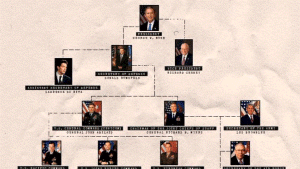
[Narrator] Not only did the P4 memo
clearly state ...
... that Pat was killed by friendly fire, but it left no doubt ...
... that the cover-up reached well above General Kensinger's rank.
[President George W. Bush] Thank you,
all.
[Narrator] General Stanley McChrystal had
sent the P4 memo on April 29th ...
... after White House speechwriters had requested details ...
... about Pat's death from the Pentagon.
[Mary Tillman] The P4 memo states they
must warn the president about this ...
... because they'll be giving speeches and they shouldn't be embarrassed
...
... if the circumstances of Pat's death become public.
[President George W. Bush] He set aside a
career in athletics --
[Narrator] The warning seemed to work.
In a speech given two days before the memorial service ...
... the president avoided the very details of Pat's death ...
... that his speechwriters had requested.
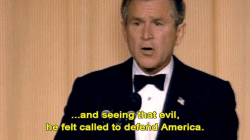
[President George W. Bush] Friends say
that this young man saw the images of September the 11th ...
... and seeing that evil, he felt called to defend America.
|
One sentence in this passage — "Friends say that this
young man saw the images of September the 11th, and seeing that evil, he
felt called to defend America" — was the subject of extensive
discussions during the speechwriting process. Although the White House
did not give Committee staff access to the earlier drafts of the
President’s speech, it appears from e-mails that in at least one of the
earlier drafts, this sentence read, "Pat Tillman saw the burning towers
on television and felt called to fight the evil behind it."
White House e-mails reviewed by the Committee show that
John Currin, the White House Director of Fact-Checking, quickly
discovered that he could not find any substantiation for the statement
that Corporal Tillman had enlisted after he "saw the burning towers on
television." When Mr. Currin asked White House speechwriter Matthew
Scully about the source of this statement, Mr. Scully responded: "Should
be in news accounts."
In an effort to confirm this statement, Mr. Currin
contacted Carol Darby, a public affairs officer at U.S. Army Special
Operations Command, to ask whether she could confirm why Pat and Kevin
Tillman had joined the Army. According to Ms. Darby, she told him:
No, that I could not, that I had never talked to
either of the brothers and I had never seen anything in print of any
sort that stated why they joined the Army. But I had seen press
reports where Pat’s coach had spoke of something along those lines,
but it really didn’t give exactly why Pat joined the Army. And he
asked if I could send him some of those press reports and I did have
those.
After speaking with Ms. Darby and receiving her faxed
articles discussing Corporal Tillman’s enlistment, Mr. Currin urged the
speechwriting team to change or remove text claiming that Corporal
Tillman joined the Army as a result of the attacks of September 11. On
April 28, 2004, he wrote to speechwriter Matthew Scully:
My DoD contact, who checked with the Rangers,
confirm that he never gave any media interview or discussed the
reason why he left the NFL to join the Rangers. … [G]iven that he
never spoke to the press about his reasons for joining the Rangers,
we simply do not have support for the statement that he decided to
join the Rangers after seeing the burning towers on television.
Two hours later, Mr. Currin e-mailed Michael Gerson, the
chief White House speechwriter:
There is no direct support for the statement that
Pat Tillman saw the burning towers on television and felt called to
fight the evil behind it. Tillman and his brother never discussed
their reasons with the press, nor have their parents. Tillman kept
his reasons to himself. The people at Fort Lewis, the base for
Tillman’s unit, could not confirm that September 11 was the reason
why Tillman joined the Army. All that I and Carol Darby at USASOC
(Ft. Lewis) could find is mention in a news article from March 2003
that says that ‘friends say the brothers were deeply affected by the
September 11 terrorist attacks and felt compelled to enlist.’ We do
not know if these friends were speculating about Tillman’s reasons
or if they had direct knowledge of Tillman’s reasons. The bottom
line is that Tillman never stated publicly his reasons for joining
the Rangers, and it is speculation that he did so because of
September 11.
Mr. Currin thought the issue was important enough that
he sent a third message to the speechwriters on the following day, April
29. In this e-mail, he wrote that Ms. Darby of USASOC had offered to
call the Tillman family on his behalf, but Mr. Currin advised against
it. He wrote:
As I mentioned yesterday, Pat Tillman and his family
never spoke about the reasons why he chose to leave the NFL and join
the Army, and the statement in the remarks for the correspondence
dinner attributing his motivation to seeing the burning towers on
9/11 is speculation. I spoke yesterday with Carol Darby at Ft. Lewis
(the base for the Rangers) to check on Tillman’s correct rank and
see if she could verify Tillman’s reasons for joining the Rangers.
Carol phoned me just now to ask if we wanted to go through the CACO
[casualty assistance officer] assigned to the Tillman family and see
if they would want to talk to us about Corporal Tillman’s reasons
for joining the Army. I am not certain if we would want to approach
the family in their time of grief (they will receive Corporal
Tillman’s remains today), or if you can work around the problem of
not knowing as fact the reasons that motivated Tillman to join the
Army. Let me know if you want me to go through the Tillman family
CACO to see if the family will let us know his reasons. My sense,
however, is that because Tillman wanted to keep his reasons private,
and because his family continues to respect his wish to this day, we
should as well, and work as best we can around the speculation.
Yet the final draft, approved and read by the President,
retained the admittedly "speculative" statement about Corporal Tillman’s
motivation for enlisting. Rather than remove the passage, the
speechwriters attributed it to unknown "friends."
***
When he was
asked why the White House played no role in the public fratricide
announcement, former White House Press Secretary Scott McClellan told
Committee staff, "We would leave that to the proper department, and that
would be DOD." White House Communications Director Dan Bartlett,
asked why the White House issued a statement after Corporal
Tillman died but not after the fratricide was announced,
explained these events "were fundamentally different
things." According to Mr. Bartlett, media
interest in a presidential statement about the fratricide "was not
there."
--
Misleading Information from the Battlefield: The Tillman and
Lynch Episodes -- United States House of Representatives
Committee on Oversight and Government Reform, Proposed
Committee Report, July 14, 2008 |

|
Barry Jackson, a deputy to President Bush’s political
adviser Karl Rove, sent Mr. Rove language for a potential
presidential tribute to Pat Tillman....
Karl Rove exchanged e-mails about Pat Tillman with
Associated Press reporter Ron Fournier, under the subject line
"H-E-R-O." In response to Mr. Fournier’s e-mail, Mr. Rove
asked, "How does our country continue to produce men and
women like this," to which Mr. Fournier replied, "The Lord
creates men and women like this all over the world. But only
the great and free countries allow them to flourish. Keep up
the fight."
--
Misleading Information from the Battlefield: The Tillman and
Lynch Episodes -- United States House of Representatives
Committee on Oversight and Government Reform, Proposed
Committee Report, July 14, 2008 |
[Mary Tillman] Our suspicions in the
beginning were very much validated by that P4 memo.
These generals had plenty of time ...
... to make sure that we, as a family, were told the truth ...
... but they chose not to tell us.
[Narrator] The P4 memo clearly showed ...
... that while America was being told the valorous account of Pat's
death ...
... the entire chain of command not only knew it was a lie ...
... but were urgently concerned about the implications ...
... should the truth get out
Armed with this new evidence ...
... the family was able to take their case above the military ...
... and in April 2007, the House of Representatives convened hearings
...
... to investigate whether there had been a cover-up in the Tillman
case.
The first testimony given was from the man ...
... who had remained silent throughout the ordeal ...
... Pat's brother, Kevin Tillman.
Even after discovering that the entire platoon ...
... had been lying to him about the fratricide ...
... Kevin had insisted on completing the full term of his enlistment.
Once he got out of the Army, Kevin went into seclusion ...
... refusing, until now, to speak publicly about his brother.
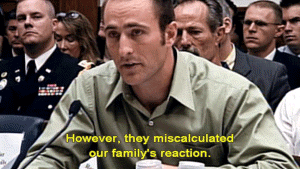
[Kevin Tillman, Pat's younger brother] My
name is Kevin Tillman.
Two days ago marked the third anniversary ...
... of the death of my older brother, Pat Tillman. Spera, Afghanistan.
To our family and friends, it was a devastating loss.
To the nation, it was a moment of disorientation.
To the military, it was a nightmare.
But to others within the government, it appears to have been an
opportunity.
A terrible tragedy was transformed into an inspirational message ...
... that served, instead, to support the nation's foreign-policy wars.
After the truth of Pat's death was partially revealed ...
... the Army was now left with the task of briefing our family ...
... and answering our questions.
With any luck, our family would sink quietly into our grief ...
... and the whole unsavory episode would be swept under the rug.
However, they miscalculated our family's reaction.
Through the amazing strength and perseverance of my mother ...
... the most amazing woman on earth ...
... our family has managed to have multiple investigations conducted.
However, while each investigation gathered more information ...
... the mountain of evidence was never used to arrive at an honest ...
... or even sensible conclusion.
That is why we ask Congress ...
... as a sovereign representative of the whole people ...
... to investigate Pat's death.
Anything less than the truth is a betrayal of those values ...
... that all soldiers who have fought for this nation have sought to
uphold.
Thank you for your time.
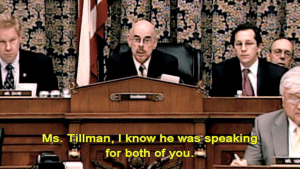
[Rep. Henry Waxman] Thank you very much
for your testimony.
Ms. Tillman, I know he was speaking for both of you.
Is there anything you want to add?
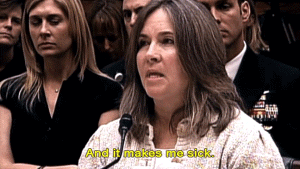
[Mary Tillman] I would like to say ...
... we have been asked, over and over again:
"Well, what can we do for your family? How can we appease you?"
And it makes me sick.
It's not about our family.
Our family will never be satisfied. We'll never have Pat back.
But what is so outrageous is this isn't about Pat.
This is about what they did to a nation.
Pat died for this country.
He believed it was a great country that had a system that worked.
It's not perfect, no one has ever said that ...
... but to write these glorious tales is really a disservice to Pat ...
... and to all the other soldiers.
You're diminishing their true heroism.
It may not be pretty, it may not be like out of John Wayne movie ...
... but that's not what war is all about. It's ugly, it's bloody, it's
painful.
Everyone should understand what's going on.
And we shouldn't have smokescreens thrown in our face.
[Rep. Henry Waxman] Thank you.
[Stan Goff, Retired soldier] Pat Tillman
was the most famous enlisted man in the military.
Pat Tillman is killed. It's obvious that it was fratricide.
The idea, the very idea, that anyone in that chain of command ...
... would dare keep this information from anyone above them ...
... is absolutely inconceivable.
Pat Tillman received a letter congratulating him on his enlistment ...
... under the signature of Donald Rumsfeld.
Dear Mr. Tillman: I heard that you
were leaving the National Football League to become an Army Ranger.
It is a proud and patriotic thing you are doing.
THE SECRETARY OF DEFENSE, WASHINGTON. June 28, 2002
The Secretary of Defense didn't give me a
congratulations letter ...
... whenever I joined the Army.
[Mary Tillman] Not only did Rumsfeld
write a letter to Pat right after he enlisted ...
... he also sent a high-priority e-mail to the secretary of the Army ...
... saying that this guy is very special, we need to keep an eye on him.
"Here is an article [from the
Chicago Tribune] on a fellow who is apparently joining the Rangers. He
sound [sic] like he is world-class. We might want to keep our eye on
him."
|
Mr. Burton. June 25, 2002, you wrote a snowflake to Army
Secretary Tom White, and you wrote, "Here is an article on a
fellow who is apparently joining the Rangers. He sounds like he
is world class. We might want to keep our eye on him.'' Can you
tell us what you meant by that?
Mr. Rumsfeld. Exactly what I wrote. That a fine individual
who was quite prominent had joined the Rangers. And that was a
good thing.
Mr. Burton. Well, when you said to Secretary White keep his
eye on him, you meant that he has potential?
Mr. Rumsfeld. I wouldn't know that. I just think here is an
individual who is serving his country and is prominent and gave
up a good deal to do that; and that we, as people in the
Department, ought to acknowledge that and be grateful for his
service, as I was.
Mr. Burton. You didn't single him out asking for progress
reports or anything like that?
Mr. Rumsfeld. No. Of course not.
The Tillman
Fratricide: What the Leadership of the Defense Department
Knew -- Hearing before the Committee on Oversight and
Government Reform, House of Representatives, 110th Congress,
August 1, 2007
On June 25, 2002, about a month after Pat Tillman
enlisted in the Army, Secretary Rumsfeld wrote a so-called "snowflake
memo" to the Secretary of the Army with the subject line, "Pat Tillman."
The memo attached a Chicago Tribune newspaper account about Mr.
Tillman’s enlistment and read, "Here is an article on a fellow who is
apparently joining the Rangers. He sound[s] like he is world-class. We
might want to keep our eye on him." Documents produced to the
Committee show that a friend living in the Chicago area had initially
brought the Tribune article to Secretary Rumsfeld’s attention.
Three days later, on June 28, 2002, Secretary Rumsfeld sent
Mr. Tillman a personal letter applauding him for his
decision to enlist. He wrote, "I heard that you were leaving
the National Football League to become an Army Ranger. It is
a proud and patriotic thing you are doing."
***
Colonel Steven Bucci, Secretary Rumsfeld’s military
assistant at the time, recalled that Mr. Tillman’s enlistment was a
major event that caught the attention of Secretary Rumsfeld. He told the
Committee, "it was all over the newspapers. It was sort of a
big event for everybody." Both Colonel Bucci and Lieutenant General Bantz
J. Craddock, former senior military assistant to Secretary
Rumsfeld, told the Committee this was the only time they
could recall Secretary Rumsfeld writing personal notes
praising the enlistment of an individual soldier.
Larry Di Rita, who was serving as Special Assistant to
the Secretary in June 2002, had a similar recollection of why Secretary
Rumsfeld took a personal interest in Pat Tillman’s enlistment. Mr. Di
Rita told Committee staff that he did not remember being involved in the
drafting of Secretary Rumsfeld’s June 25 snowflake memo or June 28
letter, but he generally remembered the attention Corporal Tillman’s
enlistment received within the Secretary’s office. He told the
Committee:
This was a noteworthy event in the country. It had
to do with the Department for which he [Secretary Rumsfeld] had
oversight responsibility and control. … [T]his was less than a year
after 9/11. So there was still a great deal of interest in what was
happening with respect to the Armed Forces. ... [I]t was a very
unusual circumstance, a football player leaving the NFL to join the
Army. I don’t recall that it had happened to anybody else while we
were serving. So the nature of that kind of event is not surprising
to me that the Secretary would have chosen to single it out.
***
On
the day following his death, April 23, White House officials sent or
received nearly 200 e-mails concerning Corporal Tillman. Several e-mails
came from staff members on President Bush’s reelection campaign, who
urged the President to respond publicly to Corporal Tillman’s death. The
White House did respond, rushing out a statement notwithstanding a
Department of Defense policy intended to provide 24-hour period for
private grieving before officials publicly discuss a casualty....
On April 23, 2004, and in the following days, thousands
of stories, commentaries, and tributes to Corporal Tillman appeared in
newspapers, television, and the Internet. An internal "Weekend Media
Assessment" produced by the Army Chief of Staff’s Office of Public
Affairs on Monday April 25, 2004, reported that the story of Corporal
Tillman’s death had helped generate the most media interest in the U.S.
Army "since the end of active combat last year." The report
also noted that "The Ranger Tillman story had been extremely
positive in all media."
E-mails reviewed by the Committee also show that the
news of Corporal Tillman’s death was discussed by public affairs
officials in the Office of the Secretary of Defense, the Joint Chiefs of
Staff, and the Army on April 23, 2004, potentially including a "front
office" morning meeting led by Secretary Rumsfeld’s public affairs
chief, Mr. Larry Di Rita.
Although Mr. Di Rita told Committee staff he could not
recall any particular discussions he had about Corporal Tillman’s death
on April 23, 2004, documents produced by the Department of Defense show
that Mr. Di Rita sent two e-mails that day related to Corporal Tillman.
In the first of these e-mails, Mr. Di Rita responded to a request from
the White House Media Affairs Director, who was seeking information
about Corporal Tillman for a Sports Illustrated reporter. Mr.
Di Rita responded that he would "see what we can do. details are sketchy
just now."
In the second e-mail, Mr. Di Rita responded to a
Department of Defense aide who had drafted a statement for the
Department of Defense to use to respond to press inquiries. Mr. Di
Rita edited the proposed statement and sent it back to the aide. His
revised version stated, "[o]ur thoughts and prayers go out to the family
of Army Sgt Pat Tillman," and noted, "[w]e mourn the death of every
servicemember who makes the ultimate sacrifice in the Global War on
Terror."
The same day, April 23, a memo was prepared by the Army
Human Resources Command for the Army Deputy Chief of Staff G-1,
Lieutenant General Franklin Hagenbeck. This executive summary ("EXSUM")
document explained that Corporal Tillman’s casualty "was a high-profile
death because SPC Tillman was a member of the Arizona Cardinals and SPC
Kevin Tillman was a former minor league baseball prospect in the
Cleveland Indians organization when they enlisted together for three
years." The summary said that in accordance with the Army’s policy of
holding casualty information for 24 hours after the soldier’s family has
been notified, the Army would not officially announce Corporal Tillman’s
death until 11 p.m. that night.....
According to [White House Communications
Director Dan] Bartlett, the story of Pat Tillman "made the
American people feel good about our country … and our
military."
--
Misleading Information from the Battlefield: The Tillman and
Lynch Episodes -- United States House of Representatives
Committee on Oversight and Government Reform, Proposed
Committee Report, July 14, 2008 |
[Narrator] At the urging of the Tillmans,
the investigating committee ...
... requested testimony from the recipients of the P4 memo ...
... as well as Secretary Rumsfeld and General Richard Myers.
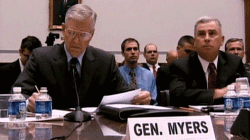
[Mary Tillman] We finally were face to
face with the highest generals in the land.
You know, the former Secretary of Defense.
And then we also had people that have the power ...
... to make these guys accountable.
|
Well, three officers
received this P-4 report: Lieutenant General Kensinger,
General Abizaid and General Brown. General Kensinger refused
to appear today. His attorney informed the committee that
General Kensinger would not testify voluntarily, and, if
issued a subpoena, would seek to evade service.
The committee did issue a
subpoena to General Kensinger earlier this week, but U.S.
Marshals have been unable to locate or serve him. So we will
not be able to ask General Kensinger what he did with the
P-4. We won't be able to ask him why he didn't notify the
Tillman family about the friendly fire investigation, and we
won't be able to ask him why he did nothing to correct the
record after he attended Corporal Tillman's memorial service
in early May and he heard statements he knew were false.
--
The Tillman
Fratricide: What the Leadership of the Defense Department
Knew -- Hearing before the Committee on Oversight and
Government Reform, House of Representatives, 110th Congress,
August 1, 2007
General Kensinger declined to testify before the
Committee in August 2007, but later agreed to be interviewed by
Committee staff. He acknowledged that he did not inform the Tillman
family as soon as he found out about the potential fratricide, but
claimed that he only learned about the fratricide after attending the
May 3, 2004, memorial for Corporal Tillman. This version of events was
contradicted by General Kensinger’s deputy, Brigadier General Howard
Yellen, who told Committee staff that he spoke with General Kensinger
about the fratricide within two or three days after it occurred. It was
also contradicted by Lieutenant Colonel David Duffy, who testified that
he personally delivered the P4 message to General Kensinger three days
before the memorial service, and by Colonel Clarence Chinn, deputy
commander of the 75th Ranger Regiment, who testified that General
Kensinger informed him that Corporal Tillman’s death was a possible
fratricide.
--
Misleading
Information from the Battlefield: The Tillman and Lynch
Episodes -- United States House of Representatives Committee
on Oversight and Government Reform, Proposed Committee
Report, July 14, 2008 |
[Rep. Henry Waxman] General Abizaid, let
me start with you. When did you receive this memo?
[U.S. Cent Com General John P. Abizaid]
On the 29th, General McChrystal sent his message ...
... and it went to my headquarters in Tampa ...
... and it was not retransmitted ...
... for reasons of difficulties with our systems within the headquarters
...
... until the 6th at the earliest --
|
General Abizaid. On the
22nd, the incident occurred. I believe about the 23rd,
General McChrystal called me and told me that Corporal
Tillman had been killed in combat, and that the
circumstances surrounding his death were heroic. I called
the chairman and discussed that with the chairman.
--
The Tillman
Fratricide: What the Leadership of the Defense Department
Knew -- Hearing before the Committee on Oversight and
Government Reform, House of Representatives, 110th Congress,
August 1, 2007
Within several days, Colonel Nixon, the commander of the
75th Ranger Regiment, transmitted the information that Corporal Tillman
may have been killed as a result of fratricide to Major General Stanley
McChrystal, the commander of the joint task force in Afghanistan under
which Corporal Tillman’s battalion was operating. General McChrystal
subsequently called General Bryan Brown, the top officer at
the U.S. Special Operations Command, the combatant command
under which Corporal Tillman’s battalion operated in
Afghanistan.
--
Misleading
Information from the Battlefield: The Tillman and Lynch
Episodes -- United States House of Representatives Committee
on Oversight and Government Reform, Proposed Committee
Report, July 14, 2008 |
[Stan Goff, Retired soldier] Yeah, yeah.
General Abizaid didn't get the fax ...
... and there was a mix-up at the office. That's a good one.
[U.S. Cent Com General John P. Abizaid]
Probably the 6th. It's a guess. I can't be sure exactly of the date --
[Stan Goff, Retired soldier] Abizaid is
responsible for the entire Middle East and North Africa ...
... and this guy's not gonna be informed?
[Rep. Henry Waxman] Well, General Myers,
let's turn to you.
[Narrator] The other generals recounted
similar stories.
[Former Chairman Joint Chiefs General
Richard Myers, Retired] I can't tell you. I don't know how I knew.
To the best of my knowledge, I've never seen this P4.
[General Bryan Brown] First of all, on
the message, on the P4, I was an info addressee ...
... which is not the primary addressee --
[Narrator] In the next three hours, the
committee would hear ...
... some variation of the phrase "I don't recall," 82 times.
[Former Chairman Joint Chiefs General
Richard Myers, Retired] I just don't know.
|
General Myers. Yes. The
best I can determine, once I got the letter from the
committee and talked to some of the folks on my staff, is
that I knew right at the end of April that there was a
possibility of fratricide in the Corporal Tillman death, and
that General McChrystal had started an investigation.... and
I told -- in working with my former public affairs adviser,
I said, you know, we need to keep this in mind in case we go
before the press. We have just got to calibrate ourselves.
With this investigation ongoing, we want to be careful how
we portray the situation.
The Tillman
Fratricide: What the Leadership of the Defense Department
Knew -- Hearing before the Committee on Oversight and
Government Reform, House of Representatives, 110th Congress,
August 1, 2007 |
[Narrator] Incredibly, this urgent
warning had somehow slipped through the cracks.
[U.S. Cent Com General John P. Abizaid]
There's an interesting thing about the P4 that says:
"Deliver during normal duty hours." And so, again --
[Mary Tillman] It was very disappointing.
That's not even the word, we were angry.
All the generals were lying.
They should've been called on a lot of things and they weren't.
[Patrick Tillman Sr., Pat's father] I
thought this was an oversight committee.
To me, an oversight committee ..
... is someone that does a bit of investigation.
It's not a cheerleading outfit.
[Rep. John L. Mica] I believe this is
appropriately handled ...
... and those who made errors were held accountable.
Ninety-nine point nine percent of the military do an outstanding job ...
... and I thank you for setting an example.
These folks were held accountable. Is that correct, General Myers?
General? All generals?
[General] From what I understand, that's
correct.
|
But I've never seen more
dedicated public servants -- dedicated servant or service to
this country than Donald Rumsfeld has provided.
I think on my dying day I
will remember September 11th when I was with Donald Rumsfeld
in the Pentagon for breakfast that morning. He invited me
and half a dozen Members, I think, over to the Pentagon. And
the subject of the conversation Donald Rumsfeld was
interested in was the military had been downsized during the
nineties since the fall of the Berlin Wall, and what we were
going to do about a situation if we had another -- the word
used was "incident.'' I remember in the conversation sitting
in the room right off of his office for coffee that morning,
and he was trying to make certain that we were prepared for
something that we might not expect.
There is a hero sitting right there, because that morning I
left just a few minutes -- we learned together of the attack on
the World Trade Center. And this Secretary rolled up his
sleeves and went down to save people who had been victimized by
the terrorist attack on the Pentagon. I just made it back here
as the plane hit. I will never forget that morning or your
service to our Nation.
The Tillman
Fratricide: What the Leadership of the Defense Department
Knew -- Hearing before the Committee on Oversight and
Government Reform, House of Representatives, 110th Congress,
August 1, 2007 |
[Stan Goff, Retired soldier] You know, a
lot of politics is theatrical wrestling, you know ...
... which, behind the scenes it's like, "Okay, let's don't get anybody
hurt."
[Rep. Tom Davis] Mr. Secretary, thank you
for being with us today.
How and when did you learn that Corporal Tillman had been killed?
[Donald Rumsfeld] I don't recall
precisely how I learned that he was killed.
[Rep. Tom Davis] Okay.
Before he did so, were you aware that President Bush ...
... was going to reference Corporal Tillman ...
... in a correspondents' dinner speech on May 1st?
[Donald Rumsfeld] No.
[Patrick Tillman Sr., Pat's father] It
was embarrassing to watch.
[Donald Rumsfeld] I have no recollection
of discussing it --
[Patrick Tillman Sr., Pat's father] These
guys didn't have the ammunition ...
... to cross-examine him and catch him in a lie.
[Rep. Henry Waxman] Well, let me conclude
the hearing by just indicating the facts ...
... that General Myers and General Brown knew at the end of April.
General Abizaid learned on May 6th.
Secretary Rumsfeld learned on May 20th.
[Donald Rumsfeld] Could I correct --?
Sir, could I make a point here?
[Rep. Henry Waxman] Who? Yes, Mr.
Secretary?
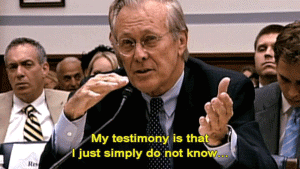
[Donald Rumsfeld] I wanna make sure it's
precisely accurate.
I do not believe I testified that I learned on May 20th, and if I --
If that impression's been left, I don't want that left.
My testimony is that I just simply do not know ...
... when I first learned of the possibility of fratricide.
[Rep. Henry Waxman] I appreciate that
correction.
[Donald Rumsfeld] Thank you.
[U.S. Cent Com General John P. Abizaid]
And, sir, if I may?
[Rep. Henry Waxman] Yeah.
[U.S. Cent Com General John P. Abizaid] I
also wanted to make sure that the 6th is a logical day.
It's not THE day.
[Rep. Henry Waxman]
[U.S. Cent Com General John P. Abizaid]
It's the best that my staff and I could come to the conclusion --
[Rep. Henry Waxman]
Well, you were all very busy.
There was no question about
it.
[General Bryan Brown] Sir, one other
thing, if I could interrupt to also correct.
Your statement was that I knew about the friendly fire.
I knew that there was an investigation ongoing ...
... about the potential for friendly fire.
[Former Chairman Joint Chiefs General
Richard Myers, Retired] That goes for me too. That's exactly right.
[U.S. Cent Com General John P. Abizaid]
And for me, as well.
|
In this chart, we show what
the committee had learned up to that point, which was that
at least nine Pentagon officials, including three generals,
either knew or were informed of the suspected fratricide in
the first 72 hours after it occurred.
And now I would like to put
up another chart. Here we identify Pentagon officials who
knew of the fratricide before the American public and the
Tillman family at the end of May 2004.
This chart shows that at
least 30 people knew, including some of the highest ranking
military officials in our government. Even this is not
comprehensive. The committee interviewed Lieutenant
General John Craddock on July 27th. In 2004 he was your
Senior Military Assistant. He is now the head of NATO. He
told us that he didn't learn of the fratricide in any
official capacity but rather from his neighbor, General Jim
Lovelace, who was the Director of the Army Staff. This is
how General Craddock described it and we will put that on
the board. He said, Jim Lovelace is my neighbor at Fort
Myer. Because he was my neighbor, in a social setting we
had, I would say frequent, when a couple of times a month we
talked to each other outside or something on the weekend.
The best that I can recollect was over the fence at my
quarters 1 weekend Jim Lovelace said something to me that
Tillman may have been killed by friendly fire. I recall
being surprised and taken aback quite frankly.
The Tillman
Fratricide: What the Leadership of the Defense Department
Knew -- Hearing before the Committee on Oversight and
Government Reform, House of Representatives, 110th Congress,
August 1, 2007
Admiral Olson said he did not
see the P4 when it was sent in April 2004, but he told the Committee
that the information in the P4 was sufficiently certain to share with
the family before the memorial service. His "after-the-fact" reflection
was:
But now having seen the contents of that P4, during
which General McChrystal said it’s highly probably there was
fratricide, and that P4 was released before the memorial service, it
would have been reasonable to expect that the family was informed of
the possibility of fratricide.
--
Misleading Information from the Battlefield: The Tillman and
Lynch Episodes -- United States House of Representatives
Committee on Oversight and Government Reform, Proposed
Committee Report, July 14, 2008 |
[Rep. Henry Waxman] Okay.
[Stan Goff, Retired soldier] At the point
that they let Abizaid off the hook ...
... that's the point where Dannie knew ...
... you know, that this is as far as it was gonna go.
[U.S. Cent Com General John P. Abizaid]
Thank you, sir.
[Rep. Henry Waxman] That concludes our
business and the committee hearing is adjourned.
[Patrick Tillman Sr., Pat's father] On
the way out of the congressional hearing ...
... this congressman, he squats down next to me ...
... and he holds out his hand to shake my hand ...
... and he just wanted to tell me that he's proud of me ...
... and he's proud of my son.
I just said, "Get out of here. Get away from me."
He would not go away, he wanted to keep talking.
I pulled my hand away from him, I said, "Get out of here, right now.
Get away from me."
Where does this stuff end?
It's been four years.
None of the actors in this matter have been held accountable.
But that's certainly no fault of Dannie's.
[Richard Tillman, Pat's youngest brother]
Pat would be nothing but unbelievably proud of her, you know.
I mean, she took it as far as she could take it.
She did everything in her power to fight for Pat.
And I mean, she knocked it out of the park.
Unfortunately, the fucking government moved the fence back, and it --
You know, that was it.
[Mary Tillman] It's about all I can do at
this point. We've sort of, you know --
The questioning has sort of run its course.
I guess I held out hope that at the last hour we would get answers ...
... but, no, that's not what happened.
I don't think there's much else that can be done.
[Stan Goff, Retired soldier] The be all
and the end all ...
... is not whether or not Congress follows through.
Like it or not, there's a public dimension to Pat Tillman ...
... and it ain't gonna go away.
That's a dangerous thing to fool around with, though.
It's dangerous to lionize people like Pat.
When people who are attracted to the mystique of Pat Tillman ...
... begin to actually study who Pat Tillman was ...
... they're gonna find out that this story doesn't fit ...
... into something that's all tidy and mythic.
The danger of something like this ...
... is it's an opportunity for reality to break through.
People start asking questions ...
... and then all of a sudden, the Tillman story changes.
[Richard Tillman, Pat's youngest brother]
I've talked about it with my dad, actually, and it was just like:
"It'd be really neat to have a statue of Pat where he's laughing his ass
off."
You wanna make him a myth?
Go ahead and make him a myth, just be accurate with it.
You know, if he could walk on water in these myths ...
... then let him have a beer every once in a while ...
... and let him hang out with friends and let him be gracious ...
... and let him be sensitive and let him be funny ...
... and let him be all the things that he was.
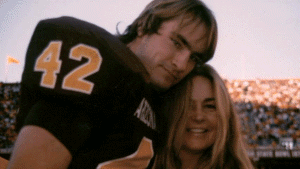
[Mary Tillman] When I talk about Pat --
And everybody is sort of on the same page, at least, you know, the
family.
That when you talk about Pat, he's sort of like sitting in the room with
you.
I mean, and that's such a -- That says so much about him.
I can conjure his face, I can conjure his laughter.
You know, he just had this quality to him that he so loved life ...
... and he would want us to, you know, move on, move forward.
I feel like, at least I've done what I can for him.
And now, it's just the idea of just kind of moving on ...
... and just kind of bringing him with us, sort of.
[Photographer] A few more seconds.
That's it, we're done.
[Pat Tillman] All right.
Director: Amir Bar-Lev
Producer: John Battsek
On February 26th, 2009, the Pentagon
lifted an 18-year ban on press coverage of fallen American soldiers
returning home.
Executive Producers: Molly Thompson,
Robert DeBitetto, Robert Sharenow
Dannie wrote a book about her son.
She left her teaching job and now arranges funerals at a Catholic
cemetery.
Executive Producers: Andrew Ruhemann,
Michael Davies
Pat Tillman, Sr. has written numerous
letters to government officials regarding his son's case.
To this day, he has not received a satisfactory explanation as to how
Pat was killed.
Writers: Amir Bar-Lev, Joe Bini, Mark
Monroe
Narrated by Josh Brolin
After Pat's memorial service, Russell
Baer disobeyed orders and refused to rejoin his platoon.
During those three weeks, he met a girl. Two years later, they named
their first son after Pat.
Co-Producer: Caitrin Rogers
Line Producer: Alice Henty
From the moment Pat was killed, Bryan
O'Neal insisted to his superiors that friendly fire was to blame.
He was kicked out of the unit and assigned to a desk job.
Story Consultant: Mark Monroe
Editors: Joshua Altman, Joe Bini, Gabriel Rhodes
Stan Goff's two sons are currently
serving in the military.
Richard Tillman lives in Venice, CA.
Directors of Photography: Sean Kirby,
Igor Martinovic
Original Music by: Philip Sheppard
Marie Tillman started an educational
charity in her husband's name.
Each year, the Pat Tillman Foundation
hosts a 4.2-mile run in Tempe, Arizona.
The End
|
The family of Specialist Jesse Buryj of
Canton, Ohio, who died in Iraq on May 5, 2004, experienced many of the
same frustrations as the Tillman family. The Army initially claimed that
Specialist Buryj had been killed by the enemy and posthumously awarded
him a Bronze Star for his valor while guarding a highway
checkpoint.
Nine months later, after several investigations, the family learned his
death was actually a fratricide. In July 2004, Specialist Buryj’s
parents accepted an invitation to meet President Bush at a
campaign rally. They asked him to help them learn the truth
about how their son died. According to the family, the
President agreed to assist.
Specialist Buryj’s mother recalled that after the meeting, her case
received more attention, but the military still did not
provide a satisfactory account of what happened to her son. A few months later,
a Bush-Cheney campaign official contacted the family. Rather than offer
assistance, the official asked Specialist Buryj’s mother to appear in a
campaign commercial for the President. Mrs. Buryj refused.
--
Misleading
Information from the Battlefield: The Tillman and Lynch
Episodes -- United States House of Representatives Committee
on Oversight and Government Reform, Proposed Committee
Report, July 14, 2008 |
_______________
PATRICK K. TILLMAN
Attorney at Law
1570 The Alameda
Suite 215
San Jose, CA
95126
(408) 998-4359
June
21, 2005
David
Morriss
Senate Armed Services Committee
Washington D.C.
Sent By Facsimile to 202/228-0037
Re: Senate Investigation -- Pat Tillman.
Dear
Mr. Morriss,
Thank you for taking the time to talk to me the other day. Sorry
about bending your ear so much. I'm sure that after my second rant, at
least, you were sorry you returned my call. Now that I've vented, I'm
fine.
To follow up on my comments:
On or about April 21, 2005 I exchanged the attached letter dated
April 21, 2005 for a box of documents reputed to be the latest "15-6"
homicide investigation. I presume General Jones and Michael Hargis, Esq.
received their respective original/copy, though I have not heard back
from either of them. The letter has gone to no one else -- or to any
press organization. "But for" your comment regarding General Jones's
presentation, I doubt seriously that I'd have released the letter to
anyone. But I have a feeling this guy is trying to sell you the same
used car he tried selling me.
You advised me that General Jones briefed your committee in
April 2005. I was not notified of this briefing, though military press
releases have repeatedly represented that I am kept abreast of all
aspects of this investigation. I was told only that the Senate & House
Armed Services Committees requested an unredacted copy of the 15-6. It
never dawned on me that you would accept a briefing from the same people
you are investigating or I'd have called sooner. It makes no sense. But
it probably committed them to the same presentation as that given me,
which should give you a flavor of my frustration.
I will assume the General used the same Power-Point presentation
he used on me, the one (1) I found to be absolute bullshit. Personally,
I think it's an outright lie. He relies on insupportable garbage, most
of which was made up. He holds a serious position of authority -- kinda
like you guys. You're all obligated to scrutinize this material and base
your conclusions (and presentations) on accurate, supportable facts. I'm
still waiting.
Since I did not have the 2000 pages at the time I wrote the
letter, I had to rely on their presentation, the 64 page Briefing Book
they gave me as soon as I arrived, and the baseline facts provided me
approximately six (6) months earlier. After reviewing the 2000 pages, I
can say that the letter I sent could have been much longer, but not much
more accurate with the exception of the identity of the killer.
As well as reviewing the underlying documents, I had a forensic
pathologist review the autopsy report. He's also a ballistics expert.
Though he is not as critical of the report as me, stating it's a
"typical military autopsy," I think that misses the point. Pat's death
was not a typical KIA. He does affirm that standard operating procedure
is to use the metric system to measure wounds, not the English system,
e.g. 1/4, 1/2, 5/8. It's much more accurate. He also added that
measurements of bullet piercings to the skin are nowhere near as helpful
or accurate as measurements of piercings to the skull in determining the
caliber of those bullets that struck Pat. Skin has more flexibility. No
such measurements were taken. Most importantly, he advised me that the
two (2) tightly spaced/grouped shots (.762 bullets from M240 machine
gun) probably killed Pat and probably did not push his body backwards,
as I assumed in my letter. If he was leaning forward, and he probably
was, his weight would have carried him forward, placing him face down in
the dirt, dead. Then, a single shot from a M-4 rifle -- a kill
shot -- made sure there was no need to walk up the hill to confirm his
death.
From 60 yards away with good visibility, a kill shot was put
into my son's head. Someone ought to be curious. The shooter was the
team leader, a 7-year veteran, a Ranger.
With respect to the three (3) investigations you asked about,
Captain Scott submitted the first one. A superior(s) wrote the second
one when Captain Scott refused to change his. Version two (2) was the
15-6 first presented to me. It contained falsified baseline facts like
distance and lighting conditions, and omitted some of the graphics of
the killings. Captain Scott disavowed the second 15-6 as his work
product. The third 15-6, presented to me March 31, 2005, was a
cosigning, a rubber stamp of the second.
I recognize the U.S. Senate is not interested in participating
in a homicide investigation. It should, however, be interested in the
integrity of military investigations, especially in situations of public
interest, and in the accuracy of presentations made to you. The Senate
should be able to rely on a decorated General when he makes a statement,
especially a prepared statement with pictures. General Jones was not
only in charge of the investigation, he personally investigated
particular aspects thereof. I'm sure he made comments to that effect
when making his presentation to you; of course, to assure you of the
accuracy of his presentation.
I ASSURE YOU, no investigator worth a damn would have made the
presentation I sat through unless they had an agenda different from the
truth. The initial investigation was changed. Conflicting testimony was
disregarded. Key evidence was destroyed and/or omitted. Witnesses,
probably with supervision of superiors, changed their testimony. No one
has been confronted with their conduct ... I'm just repeating my points
in the attachment. Sorry.
With respect to the timing of the family's notification, it's
almost irrelevant. Slight-of-hand for the press. The issue of
importance, at least to you, is the integrity of the military, from the
Lieutenant-Colonel on the ground who effected an immediate cover-up, all
the way up and past General Jones.
I'll spare you the balance unless you ask. I hate having clients
spoonfeeding me. I always think they're lying. But the information that
should have been highlighted by General Jones, information you now have,
was not even addressed in his presentation to me. I pressed many of the
points set forth in my letter and received responses that were simply
evasive lies, e.g. "our goal was simply to determine if there was
fratricide. It does not preclude others from using this information for
other purposes." And maybe so, but the presentation clearly states
that no one did anything wrong. Whose going to challenge a General?
You?
If you're interested, please call.
Respectfully,
Patrick K. Tillman
Attachment
***
PATRICK K. TILLMAN
Attorney at Law
1570 The Alameda
Suite 215
San Jose, CA
95126
(408) 998-4359
April
21, 2005
Gary
M. Jones, Brigadier General
Department of the Army
Special Forces Command (Airborne)
Fort Bragg, North Carolina 28310
Re: Patrick Daniel Tillman
Report of Death
General Jones,
The ''briefings'' you gave me -- approximately six (6) months
ago and March 31, 2005 – were dishonest. They were misleading, and I
believe deliberately so.
Before the first briefing, I asked no fewer than four times (4x)
for a copy of the 15-6 before I flew myself to Seattle, Washington,
"for the facts of my son's death." It seemed appropriate to prepare
if I was being allowed to ask questions. Apparently, contrary to
assurances otherwise, you wanted me to listen, only. The presentation,
of course, sympathized with the family and criticized the actions of
those in the field. The paperwork, however, was different. After the
presentation, when finally given the Briefing Book/Summary, along with
some of the supporting documents, I had the opportunity to review your
conclusions and address the limited baseline facts provided. Your
conclusions and criticisms were insupportable, many in the field were
superficially and/or inappropriately criticized, and you omitted or
clouded many of the baseline facts. The 15-6 was a sham. My criticisms
were made known to you. I again asked for the new and improved report
before the March 31, 2005 briefing. I got nothing. The March 31, 2005
briefing went much the same way as the first.
As far as I'm concerned, all investigations were to address two
(2) issues:
1. How was my son killed.
2. Was there a cover up.
1. How was my son killed. The updated, thoroughly
investigated, 2000+ page report omits an answer but clearly implies that
it doesn't matter. It was an accident. "The confusion of it all."
The prior 15-6 also omitted an answer. At the March 31, 2005 briefing,
repeatedly I was told that your mission was simply to determine if
fratricide [1] occurred. If that was the scope of your mission, you
wasted an awful lot of time, effort and money. A fortunate by-product,
however, is your concession that baseline facts are needed to
make appropriate decisions. Here’s a few:
a. Afghan. When Sgt. Baker (7+ years military
experience) came out of the canyon ambush, he knew full-well enemy
soldiers were situated 4-800 meters above and behind him. He had been
shooting up at them moments earlier. He spotted the Afghan 78
meters away, somewhat uphill and directly to his right. (p. 13-14 [2])
The Afghan was firing further uphill, cross-canyon, well over Baker's
head and behind him (p. 2, #3), at the same enemy ambushers Baker was
earlier concerned about. Could Baker, the first shooter, make out the
details of his first victim? Baker admits that he recognized "it" was a
man, his nationality, his skin color, he had a beard, and was firing an
AK-47. Was he standing or prone? Baker's statement (not referenced) put
him prone. Your report does not conclude or adequately address this lie.
The Afghan was on a fairly steep slope. Doubtful he was on his belly,
head down hill, shooting up. That makes no sense. (p. 5 & 15) He was
standing, or dropped to one (1) knee, like Pat and O'Neill. He was
dressed in military garb [3] (the enemy has no military garb). "Tracers"
were leaving the area. His underbelly was exposed. He was no threat. He
was, in fact, the proverbial "duck on a pond." Eight (8) rounds
were pumped into/at the Afghan. Not mentioned. Pat and O'Neill are
within five (5) yards of him. Not mentioned.
From this same general location (Position #1; p. 13-15), all
four (4) shooters unloaded an un-Godly barrage into Pat's position.
Details of what they saw immediately before and while shooting are
omitted. Details of how many rounds were fired, the duration or pattern
are sketchy, at best. "Derr, we're supposed to shoot where he
shoots." (N-5) You or someone at the briefing actually said --
repeatedly -- ''that's what they're trained to do." NO! They're not.
The GMV driver saw the Afghan, recognized the AK-47, and
recognized he was a "friendly." The report places this recognition after
passing the corner of the rock wall and just before reaching the spur
that would have masked Tillman's position. (N-7) By then, he was dead.
He was shot dead when the GMV was in the "#1" position -- approximately
55 meters earlier. (p. 13) "A[nother] crew member" -- not the
shooter -- identified the Afghan at "3:00 o'clock," (N-5) which is a
hard right. Look at the pictures. (p. 13-14) That was well after coming
out of the canyon. Baker -- the shooter -- then "engaged him with his
M-4," (N-5) meaning he killed him from the position where he was
initially sited, i.e. 3:00, position #1. O'Neill's statement, as well as
that of two (2) others, have the Afghan dead before the lull, which is
before the GMV reached the corner of the rock wall twelve (12) meters
away. (P. 13) Shooting him from position ''#2,'' or thereafter, as
intimated in the report, would have placed him more at "1:00 - 1:30." At
65 meters distance, that's more than 46 meters difference -- left/right.
A Ranger is not likely to make this error and there is no testimony to
support this position.
These "facts" earmark 3 of the 5 in the GMV identifying an AMP
-- an "Afghan
Military
Fighter," one of us -- not just an Afghan," well after
exiting the canyon and before firing commenced; one of them --
the one not charged with malfeasance [4] -- admitting he
recognized him as a "friendly."
Rangers are specialists, so maybe they can obliterate a still
target while moving laterally at 20 mph over rocky terrain (up & down
movement of GMV), but I doubt it. Most of these guys were green. The
more logical conclusion is that they slowed down or stopped momentarily
twice. "Not long after the firing stopped, the GMV moved out," (O'Neill)
versus "he never slowed down."
Now, who gives a shit about an Afghan? I do. Not only was he a
"friendly," a human being on our team, my son's life was taken with the
same regard -- none.
b. Pat. Pat was not shot from position #1, he was
shot at. He and O'Neill took cover. They suffered through a
barrage during which they conversed. Pat, from an awkward situation,
freed up a smoke grenade and threw it. There was a lull during which
both stood up, talked, and stretched their legs. Pat waived at the
shooters to confirm recognition. From less than 65 meters away, he was
fired on and this time hit by machine gun fire, knocking him down.
He's not dead yet.
"I'm Pat 'fucking' Tillman dammit. He said this over and over
again until he stopped." (O'Neill statement)
A single shot was then put through the top, right-side of his
head that went cross-wise through his left jaw and out his neck.
(autopsy) This bullet came from either an M-4 or the M249 ("SAW") --
they use the same ammunition. Doubtful it was from the "SAW." Had
it been, more rounds would have ended up in Pat's head and/or body, e.g.
shoulders, chest, back. The "SAW" fires at 725 rounds per minute, faster
than the M240 (7.62) -- grouping issue and comparison. Two (2) more
rounds were then fired from a M240 (7.62 mm) that took off the back of
his head. I place the order of the head shots as I do because machine
gun bullets (2) of this caliber (7.62 mm), tightly grouped, hitting him
simultaneously, would have moved his position so as not to allow for a
single shot to enter and exit as evidenced by the autopsy.
Accordingly, the kill shot was sent on its way by Sgt.
Baker. What did he see? What thoughts were running through his mind
as he was taking a bead on my son's head from 65 meters
distance. I don't know if Pat was still wearing his helmet at the time
(another detail left out). Did Baker sight-in a Ranger helmet or the top
of a whiteman's head? Certainly, this was no random shot nor made while
traveling over rough terrain at 20 mph. ''Not long after the firing
stopped, the GMV moved out." (O'Neill statement)
All this happened in 6.45 seconds?
c. Investigation -- Shooting.
i. Who killed either -- omitted.
ii. Location of kill shots. Implied as
location #2 (N-5) 78 meters versus 65 meters; 1st, 2nd, 3rd attempt to
kill Pat -- not mentioned.
iii. Lighting. Obfuscated. "Unable to
distinguish features (such as faces, ..." (N-5) ... such as skin
color, nationality, beard, AK-47? They were 78 meters away for Christ's
sake. How about from 65 meters? Think their vision was any better at 65
meters? Uniforms? Helmets? Arms? Smoke? Pat weighs 200 lbs. He was
carrying a "SAW." He was waiving a hand. At a standing position, the
rock they took cover behind barely reaches their knees -- they obviously
and deliberately put themselves in clear view, waiving, not firing back.
65 FUCKING METERS away.
In the original 15-6 investigation, of all the statements taken,
no contemporaneous comment was made -- none, nada, not a single one --
that could arguably inculpate lighting conditions. If lighting was a
factor, every guy there would have said so. "Yeah, big fucking
mistake, but you just couldn't see shit." You take a stray comment
... from a fucking shooter ... and make it a factual finding. Sunset was
at 1401Z (N-6, fn 47) -- Fact -- they started taking fire at 1404Z (N-3)
-- Fact -- the matter was over (?) by 1418Z [5] (N-8) which included
time to light up a small village and assess the situation, including the
condition of Pat, who was uphill. Fewer
than 17 minutes after sunset, probably closer to 10, lighting conditions
are good. (Bagram Light Data)
O'Neill, when asked about the lighting conditions "[w]hen you
were being shot at" said: "They were still pretty good." Another Ranger
said: "I could clearly see once we left the canyon area." Another said:
"Light conditions were OK ..." Baker, the shooter, said: "The sun was
going
down." (emphasis added)
The shooters were always looking North or Northwest. Even in
Afghanistan, the sun sets in the West -- Southwest. How on God's green
earth can you add in a "glare factor" looking away from the sun that
has set? (P. 16) Immediately after sunset, facing the wrong
direction (North vs. Southwest), the glare impaired their vision? Don't
you need sun to have glare?
iv. Evidence Destruction. All
evidence, with the exception of Pat's body, was destroyed. All
of it "slipped through procedural cracks" that will be
corrected "now that we've identified them." And the autopsy -- a
joke.
Pat's "personal remains," molle, clothing/uniform, RBA,
flash-bang grenade, helmet, and other equipment were destroyed in
different places for different reasons -- all acceptable to you. His
helmet was with his molle. Was it (helmet) burned, too? Were there any
holes in it? And nobody -- nobody -- burns a garment like a molle
without first checking the pockets. Nobody. Pat's diary probably still
exists, and I want it back. The flash-bang grenade had a bullet hole in
it. What caliber bullet pierced it? His uniform, did it match that of
the Afghan's, whose garb was never described. Simply an unfortunate set
of circumstances we have here, the trashing of evidence.
The autopsy was for what purpose -- to determine he was dead? Or
shot? Was there a "suspicion" he was dead? That he was killed by
bullets? The autopsy provided minimal detail. Its purpose was to further
cover up this incident. You simply wanted to say that you performed one.
For general information purposes, the metric system is used exclusively
by the medical profession - " ... the wound to the skin is 1/4 inch
in diameter" ... "Both wounds are
5/16-inches
in diameter ..."
Lack
of detail clouds the issue of "caliber," don't it.
v. Driver. LIED. They fired on Pat from at least
two (2) locations. They fired on the village from two (2) more. Think
this guy should have stopped the truck? He consistently, three (3) times
at least, placed out-of-control shooters in a better position to kill
Americans after he recognized the Afghan as a "friendly." (supra)
His placement of the GMV effectively co-signed the shooters' activity,
i.e. he agreed with it. FOR CHRIST'S SAKE ... maybe a comment.
2. Was there a cover up.
Army's Conclusion: was none.
Fratricide was never suspected, [6] my ass. It was known while
it was happening. No fewer than fourteen (14) people witnessed it. A
full-blown Colonel was there within hours. (N-8) How did he get
notified? Not mentioned. What was said? Not mentioned. Do Colonels fly
in for every soldier killed? You have recordings of every conversation
leading up to their deployment on this mission. Got a transcript of the
call from this platoon leader? (TOC Log @ 1418Z, 1420Z, 1412Z, 1427Z,
1435Z) Bet me that during at least one of these conversations he
said that Pat was killed by one of his own and he wanted assistance on
how to handle the situation. Bet me a full-blown Colonel said: "Keep
it quiet, get Kevin the hell out of there, and I'll be right over."
Not mentioned. Evidence omitted. I bet you saw the transcript, though.
At the March 31, 2005 briefing, I was told that "Operations"
correctly notified "Admin" that it was simply a KIA. "Operations" needed
a "suspicion" before telling "Admin" to tell the family the cause
of their son's/brother's death is "unknown." That
they had to investigate their "suspicions" before providing such
notification. We certainly didn't want the family to get some "half
baked" story about their son's death. Again, no one -- ever
-- suspected fratricide -- they fuckin-well
knew it, immediately. Kevin, at the scene, was not told. Another Ranger,
sent home with Kevin for Pat's funeral was told not to tell Kevin or us.
He honored his superiors' order.
No cover up??
Those "on the ground" had a sworn duty, and they were trained,
to positively identify whoever it was they were about to kill. People in
other positions of authority, too, had a sworn duty -- Colonels,
Generals, attorneys -- to do their job. We relied on all of you to
exercise your duty/authority/responsibility properly, at least not
maliciously or pursuant to some bullshit agenda. Telling us the truth
about how Pat died was the least you could do. Every one of you have
disregarded your duty, acting deliberately and shamelessly to kill my
son and lie about it including this ''update.'' Accountability has been
zero, for all of you. (see Report)
I don't remember the name or rank of the clown who put together
the first 15-6. As I told several of you, it was an outright lie. When I
heard the investigation had been reopened, I had hopes the military
would regain the high ground of truth and accuracy. But the second
version, under color of a one-star General with the assistance of many,
including an attorney, turned out worse, primarily because of the
authority your rank carries.
I think I understand the importance of ferreting out the facts,
cutting the crap, considering the credibility of witnesses, and
basically getting to the truth. The above are not insignificant details
overlooked. Any attorney contending the "evidence" set forth in this
report is persuasive, or "preponderates," should be ashamed of theirself.
They have truly wasted a privileged education. And integrity, apparently
it varies with the client.
"The
foundation of the ethical code at West Point is found in the Academy's
motto, 'Duty, Honor, Country.' Cadets also develop ethically by adhering
to the Cadet Honor Code, which states 'A cadet will not lie,
cheat, steal, or tolerate those who do.'"
(Emphasis added)
West
Point Publication
www.usma.edu/about.asp
You are a General. On paper you subscribe to this motto and
honor code. To say otherwise means its life ends on graduation and is
limited to cadets. I believe it carries over into the service. There is
no way a man like you, with your intelligence, education, military
experience, responsibilities (primarily for difficult situations), and
rank (authority -- both apparent and real), believes the conclusions
reached in the March 31, 2005 Briefing Book. But your signature is on
it. I assume, therefore, that you are part of this shameless bullshit. I
embarrassed myself be treating you with respect March 31, 2005. 1thought
your rank deserved it and anticipated something different from the new
and improved investigation. I won't act so hypocritically if we meet
again.
The Rangers stand for something -- to this day, in my mind, the
best. None of the five (5) soldiers on the ground, nor anyone in a
discretionary capacity involved in this "Briefing Book," deserve to be
affiliated with the Rangers. If your uniforms are so decorated, you
should remove those items.
In sum: Fuck you ... and yours.
Sincerely,
Patrick K. Tillman
P.S. I
understand that Baker is applying for or has been accepted into Delta
Force. You are a Brigadier General, Special Forces Command.
Coincidence?
cc:
Michael. J. Hargis, Esq.
_______________
Notes:
1. Fratricide is defined as "the act of killing one's own
brother." Webster's Dictionary) This was a "homicide,” which is defined
as “the killing of a human being by another, whether murder or
manslaughter." (Id.)
2. Citations of this nature throughout this letter refer
to "USASOC-Directed AR 15-6 Investigation BG Gary M. Jones,
Investigating Officer, Briefing Book" provided me March 31, 2005.
References to "P" are for the ''pictures'' section, designated as
Exhibit A. References to "N" are for the "narrative" section, designated
Exhibit B.
3. Note: nowhere does any document describe the Afgan,
what he was wearing or why he was carrying a Russian rifle (if he was).
4. Not
being charged tends to make witnesses more talkative.
5. Not
exactly. That's when the first call to headquarters occurred, calling
for a MEDEVAC. (TOC Log) It took some time to assess the situation
before making the call.
6.
Suspected is defined as, inter alia: imagined; to believe (someone)
guilty of something to his discredit without conclusive proof; to form a
notion (someone) not necessarily based on fact; to be suspicious.
(Webster's Dictionary &The American Heritage Concise Dictionary, 3rd
Edition) Note: the definition of "suspicion" basically refers the reader
to the word "suspect."
***
P4 Memo
0 292234Z APRIL 04 FM TASK
FORCE
TO RUCAACC/USCENTCOM MACDILL AFB FL//CDR//INFO RUCQAS/USSOCOM PP MACDILL
AFB//FL//CDR// RUEPVBT/TASK FORCE
BT [REDACTION] PERSONAL FOR CDR USCENTCOM CDR USSOCOM CDR USASOC
DELIVER DURING NORMAL DUTY HOURS [REDACTION] DO NOT TRANSMIT VIA OPINTEL
BROADCAST OPER/OEF// MSGID/GENAMIN/TASK FORCE
//
SUBJ/P-4 CONCERNING INFORMATION ON CORPORAL TILLMAN'S DEATH//
RMKS/SIR, IN THE AFTERMATH OF CORPORAL TILLMAN'S UNTIMELY YET HEROIC
DEATH IN AFGHANISTAN ON 22 APRIL 04, IT IS ANTICIPATED HIGHLY POSSIBLE
THAT CORPORAL TILLMAN WAS KILLED BY FRIENDLY FIRE. THIS POTENTIAL
FINDING IS EXACERBATED BY THE UNCONFIRMED REPORTS THAT POTUS AND THE
SECRETARY OF THE ARMY MIGHT INCLUDE COMMENTS ABOUT CORPORAL TILLMAN'S
HEROISM AND HIS APPROVED SILVER STAR MEDAL IN SPEECHES CURRENTLY BEING
PREPARED, NOT INFORMING THE SPECIFICS SURROUNDING HIS DEATH. THE
POTENTIAL THAT HE MIGHT HAVE BEEN KILLED BY FRIENDLY FIRE IN NO WAY
DETRACTS FROM HIS WITNESSED HEROISM OR THE RECOMMENDED PERSONAL
DECORATION FOR VALOR IN THE FACE OF THE ENEMY. CORPORAL TILLMAN WAS
KILLED IN A COMPLICATED BATTLESPACE GEOMETRY INVOLVING TWO SEPARATE
RANGER VEHICLE SERIALS TRAVERSING THROUGH SEVERE TERRAIN ALONG A WINDING
500-600 FOOT DEFILE IN WHICH FRIENDLY FORCES WERE FIRED UPON BY MULTIPLE
ENEMY POSITIONS. CORPORAL TILLMAN DISEMBARKED FROM HIS VEHICLE, AND IN
SUPPORT OF HIS FELLOW RANGERS AND DEMONSTRATING GREAT CONCERN FOR THEIR
WELFARE OVER CARE FOR HIS OWN PERSONAL SAFETY ENTERED THE ENEMY KILL
ZONE INTO WHICH BOTH IMPACTED. I FELT THAT IT WAS ESSENTIAL THAT YOU
RECEIVED THIS INFORMATION AS SOON AS WE DETECTED IT IN ORDER TO PRECLUDE
ANY UNKNOWING STATEMENTS BY OUR COUNTRY'S LEADERS WHICH MIGHT CAUSE
PUBLIC EMBARRASSMENT IF THE CIRCUMSTANCES OF CORPORAL TILLMAN'S DEATH
BECOME PUBLIC.//
DECL/DERI:DRV FROM [REDACTION] /INST-[REDACTION]-//BT
CLASSIFIED BY: [REDACTION]
REASON [REDACTION] DECLASSIFY ON: [REDACTION]
CLASSIFICATION: [REDACTION]
CAVEATS: [REDACTION] TERMS: [REDACTION]
***
Letter from Kevin Tillman
Oct. 19, 2006
It is Pat’s birthday on
November 6, and elections are the day after. It gets me thinking about a
conversation I had with Pat before we joined the military. He spoke
about the risks with signing the papers. How once we committed, we were
at the mercy of the American leadership and the American people. How we
could be thrown in a direction not of our volition. How fighting as a
soldier would leave us without a voice… until we get out.
Much has happened since we
handed over our voice:
Somehow we were sent to
invade a nation because it was a direct threat to the American people,
or to the world, or harbored terrorists, or was involved in the
September 11 attacks, or received weapons-grade uranium from Niger, or
had mobile weapons labs, or WMD, or had a need to be liberated, or we
needed to establish a democracy, or stop an insurgency, or stop a civil
war we created that can’t be called a civil war even though it is.
Something like that.
Somehow America has become a
country that projects everything that it is not and condemns everything
that it is.
Somehow our elected leaders
were subverting international law and humanity by setting up secret
prisons around the world, secretly kidnapping people, secretly holding
them indefinitely, secretly not charging them with anything, secretly
torturing them. Somehow that overt policy of torture became the fault of
a few “bad apples” in the military.
Somehow back at home,
support for the soldiers meant having a five-year-old kindergartener
scribble a picture with crayons and send it overseas, or slapping
stickers on cars, or lobbying Congress for an extra pad in a helmet.
It’s interesting that a soldier on his third or fourth tour should care
about a drawing from a five-year-old; or a faded sticker on a car as his
friends die around him; or an extra pad in a helmet, as if it will
protect him when an IED throws his vehicle 50 feet into the air as his
body comes apart and his skin melts to the seat.
Somehow the more soldiers
that die, the more legitimate the illegal invasion becomes.
Somehow American leadership,
whose only credit is lying to its people and illegally invading a
nation, has been allowed to steal the courage, virtue and honor of its
soldiers on the ground.
Somehow those afraid to
fight an illegal invasion decades ago are allowed to send soldiers to
die for an illegal invasion they started.
Somehow faking character,
virtue and strength is tolerated.
Somehow profiting from
tragedy and horror is tolerated.
Somehow the death of tens,
if not hundreds, of thousands of people is tolerated.
Somehow subversion of the
Bill of Rights and The Constitution is tolerated.
Somehow suspension of Habeas
Corpus is supposed to keep this country safe.
Somehow torture is
tolerated.
Somehow lying is tolerated.
Somehow reason is being
discarded for faith, dogma, and nonsense.
Somehow American leadership
managed to create a more dangerous world.
Somehow a narrative is more
important than reality.
Somehow America has become a
country that projects everything that it is not and condemns everything
that it is.
Somehow the most reasonable,
trusted and respected country in the world has become one of the most
irrational, belligerent, feared, and distrusted countries in the world.
Somehow being politically
informed, diligent, and skeptical has been replaced by apathy through
active ignorance.
Somehow the same
incompetent, narcissistic, virtueless, vacuous, malicious criminals are
still in charge of this country.
Somehow this is tolerated.
Somehow nobody is
accountable for this.
In a democracy, the policy
of the leaders is the policy of the people. So don’t be shocked when our
grandkids bury much of this generation as traitors to the nation, to the
world and to humanity. Most likely, they will come to know that
“somehow” was nurtured by fear, insecurity and indifference, leaving the
country vulnerable to unchecked, unchallenged parasites.
Luckily this country is
still a democracy. People still have a voice. People still can take
action. It can start after Pat’s birthday.
Brother and Friend of Pat Tillman,
Kevin Tillman
***
Pat Tillman Timeline
by ESPN.com
EVENTS LEADING UP TO PAT
TILLMAN'S DEATH
June 1994: Pat Tillman and
Marie Ugenti (future Mrs. Pat Tillman) graduate from Leland High in San
Jose. Marie is voted Best Smile (senior class); Pat is Most Masculine.
June 1997: David Uthlaut graduates high school in Charleston, S.C.
Accepts appointment to U.S. Military Academy at West Point from Sen.
Strom Thurmond (R-S.C.).
Fall 1997: Tillman is Pac-10 Defensive Player of the Year at Arizona
State.
April 1998: Tillman drafted in seventh and final round by Arizona
Cardinals.
May 28, 1998: Tillman and four-time tennis All-American Reka Cseresnyes
(Tillman study partner and Jared Schrieber's wife) selected Arizona
State's top male and female student-athletes, respectively.
Spring 1998: Tillman graduates summa cum laude from Arizona State in 3½
years with 3.82 GPA in marketing.
Jan. 2001: Uthlaut is No. 1 in his class at West Point and named captain
of cadets — represents Army marching in inauguration parade down
Pennsylvania Avenue
May 2001: Uthlaut graduates West Point.
Sept. 11, 2001: Terrorist attacks kill about 3,000 in New York;
Washington, D.C.; and rural Pennsylvania.
Oct. 7, 2001: Start of Arizona Cardinals at Philadelphia Eagles game
delayed as President Bush appears on Veterans Stadium videoboard to
announce American and British forces are attacking Taliban and terrorist
targets in Afghanistan in retaliation for 9/11 … Strong safety Pat
Tillman sprains ankle in first quarter and hops off the field on one leg
without assistance.
May 2002: Pat Tillman and brother, Kevin, enlist in Army at a Denver
recruiting station — signing a three-year commitment — soon after Pat
returned from a two-week honeymoon with wife, Marie, in Bora Bora.
Summer-fall 2002: Infantry basic training (14 weeks) at Fort Benning
(Ga.). Completed program October 2002, immediately followed by Basic
Airborne Course (three weeks) at Fort Benning.
Early 2003: Reports to 75th Ranger Regiment and Ranger indoctrination
program; returns to Fort Benning for Ranger School and returns to 75th
Ranger Regiment at Fort Lewis, Wash.
March 2003: Pat and Kevin Tillman deployed to Iraq.
May 8, 2003: Capt. Richard M. Scott among 27 officers presented Gen.
Douglas MacArthur Army Leadership Awards.
Early 2004: Pat Tillman friend and MIT grad student Jared Schrieber
e-mails anti-war activist Noam Chomsky, an MIT linguistics professor,
about meeting with Tillman after he returns from Afghanistan. Meeting
was to take place after Tillman completed his enlistment in July 2005.
Early April: Tillmans' unit deployed from Fort Lewis to Afghanistan.
April 20, 2004: Unit held up two days at AMF compound in southeastern
Afghanistan trying to repair broken Humvee.
April 21, 2004: Helicopter flies in fuel pump for broken-down Humvee,
but mechanics can't make repair.
APRIL 22, 2004
4 p.m.: Platoon leader (Lt. David Uthlaut) hires a local truck driver to
tow the broken vehicle.
5:30-6 p.m.: Company commander directs Lt. Uthlaut to split platoon — he
does so, into Serial 1 and Serial 2 … Serial 1 leaves down canyon road
toward village of Manah; Serial 2 leaves 15-20 minutes later, towing
broken vehicle. Because the terrain is too rugged, Serial 2 changes
route and follows same path as Serial 1.
6:31 p.m.: Sun sets over the small village of Manah in southeastern
Afghanistan close to Pakistan border, according to Army officials.
6:34 p.m.: Squad leader in Serial 1 instructs team leaders to maneuver
Rangers onto a ridgeline that faces ambush site.
6:43 p.m.: Pat Tillman maneuvers his team of Bryan O'Neal and a friendly
Afghan soldier low on the ridgeline. Sgt. Greg Baker, in the lead
vehicle of Serial 2, spots the Afghan, mistaking him for the enemy, and
fires a series of fatal rounds into his stomach. Three other Ranger
gunners follow sergeant's lead and open fire in same direction, killing
Pat Tillman.
6:53-6:58 p.m.: Kevin Tillman, in the section split from Pat about
quarter-mile down the road, arrives at the scene after his brother is
killed. He is put on assignment guarding the area and finds out about 30
minutes later that Pat is KIA.
7:50 p.m.: Pat Tillman pronounced dead after being flown by helicopter
to the 325th Field Hospital, Forward Operating Base at Salerno, though
fellow Rangers say he was obviously dead at the scene.
Night: Bryan O'Neal, who had been positioned alongside Pat Tillman,
tells a first sergeant that he suspects fratricide. The first sergeant
tells Company Commander Capt. William Saunders.
EVENTS FOLLOWING PATRICK
TILLMAN'S DEATH
April 23, 2004: Black Sheep
platoon spends the night at the site and the next day completes sweep
operation in the nearby village, finding only women, no men.
April 23, 2004: According to Army, a senior witness arrives at scene in
the morning and remains several hours, departing at noon.
April 23, 2004: Capt. Richard Scott is assigned as investigating officer
of 15-6, told of possibility of fratricide.
April 23, 2004: Jade Lane and Uthlaut talk with Kevin Tillman at the
field hospital in Salerno. They watch ceremony moving Tillman's body to
helicopter for 40-minute flight to Bagram. Lane and Uthlaut are flown on
another helicopter to hospital in Bagram.
April 23, 2004: Officials announce the death of Tillman. The White House
puts out a statement praising Tillman as "an inspiration both on and off
the football field."
April 23, 2004: Officials announce the death of Tillman. The White House
puts out a statement praising Tillman as "an inspiration both on and off
the football field."
April 23, 2004: Soldier burns Tillman's body armor.
April 24, 2004: Capt. Scott begins interviewing witnesses.
April 25, 2004: Platoon meets as a group at Forward Operating Base (Camp
Salerno) to talk over incident; meeting includes a chaplain, called
critical incident stress debriefing.
April 25, 2004: Tillman's uniform and vest are burned.
April 26, 2004: Army has collected at least 14 witness statements
describing the incident.
April 27, 2004: Tillman autopsy, performed at Dover AFB (Del.),
concludes based on available investigative reports that death was caused
by friendly fire, but date of report is July 22, 2004.
April 27, 2004: Tillman Silver Star recommendation submitted.
April 28, 2004: "60 Minutes II" shows photos depicting abuse by U.S.
soldiers working as guards in Iraq's Abu Ghraib prison.
April 29, 2004: Gen. Abizaid, Gen. Brown and Lt. Gen Kensinger are told
friendly fire is "highly possible" … determine Tillman should still
receive Silver Star.
April 29, 2004: Silver Star commendation signed by Gen. Wes Brownlee,
acting Army Secretary.
April 30, 2004: Army releases statement to announce Tillman is being
awarded Silver Star … tells of heroic battlefield action … Tillman also
to be awarded Purple Heart and promoted posthumously from specialist to
corporal.
May 1, 2004: Pres. Bush comments at 90th annual White House
Correspondents' Association dinner that Tillman death "brought home the
sorrow that comes with every loss and reminds us of the character of the
men and women who serve on our behalf … was modest because he knew there
were many like him making their own sacrifice."
May 3, 2004: About an hour before memorial service in Municipal Rose
Garden in San Jose, Calif., Navy SEAL Steve White — Tillman friend who
reads tale of heroic acts and what Tillman did to be honored with Silver
Star at ceremony — is given the story by an enlisted Army officer.
May 3, 2004: Memorial for Tillman in the Municipal Rose Garden in San
Jose — nearly 2,000 people, including Rangers and Army officials, attend
service — televised live by ESPN.
May 4, 2004: First investigation report delivered by Capt. Scott;
determines soldiers involved had committed gross negligence.
May 8, 2004: Lt. Col. Ralph Kauzlarich appointed to conduct a second
investigation.
May 15, 2004: Kauzlarich completes his investigation.
May 24, 2004: On the day his unit returns from Afghanistan to Fort
Lewis, Kevin Tillman is told by Col. Bailey that his brother's death was
caused by friendly fire.
May 28, 2004: Mary Tillman, Pat's mother, is notified of friendly
fire/fratricide in a call from Arizona Republic reporter.
May 28, 2004: Gen. Abizaid, head of CENTCOM, approves findings of
official investigation by Lt. Col. Kauzlarich under an aide's signature.
May 29, 2004: Army acknowledges friendly fire "probably" killed Tillman
in terse announcement issued by Lt. Gen. Philip R. Kensinger Jr. at Fort
Bragg, N.C. Kensinger takes no questions.
Memorial Day weekend, 2004: Col. Bailey and Kevin Tillman visit Mary
Tillman's house to detail situation. Mike Spalding, her brother, is
present.
June 2004: Lt. Uthlaut pays visit to Marie Tillman and Kevin Tillman in
Fort Lewis/Tacoma area.
Late June, 2004: Tillmans travel to Fort Lewis for presentation of
findings from Lt. Col. Kauzlarich's investigation, presented by Col.
Bailey/Col. Nixon.
June 18, 2004: Pres. Bush and Sen. McCain visit Madigan Army Medical
Center at Fort Lewis. Jade Lane, wounded in same friendly-fire incident,
meets Bush, gets photo taken and receives presidential coin.
July 22, 2004: Official report date on Tillman autopsy.
Late Summer 2004: Mary Tillman sends questions to Sen. John McCain, who
passes them to Secretary of Army for response.
Aug. 31, 2004: Sgt. Greg Baker signs out of his unit, with honorable
discharge.
Sept. 19, 2004: Pres. Bush appears on video scoreboard and offers
comments as Tillman is honored and jersey is retired at an Arizona
Cardinals game. … Marie Tillman, mother/father and younger brother
Richard are on field for ceremony, but Kevin Tillman isn't.
Oct. 1, 2004: Autopsy report is sent to Mary Tillman, Pat's mother, by
the Department of Defense — Armed Services Institute of Pathology.
Late 2004-2005: Kevin Tillman attends sniper school at Fort Bragg
(N.C.), runs into Capt. Richard Scott, who tells him he did first
investigation of the incident involving his brother. No one had been
aware of Scott's report, and it remains classified.
Nov. 1, 2004: Uthlaut promoted to Army captain, but is no longer in
Rangers.
Nov. 4, 2004 : Capt. Scott serves as witness in another investigation by
Brig. Gen. Gary Jones, complains that soldiers changed their stories
from his investigation to the next inquiry.
Dec. 16, 2004: USO center at Bagram Air Base in Afghanistan named in
honor of Tillman, funded by $250,000 donation from NFL.
Spring 2005: Brig. Gen. Gary M. Jones issues his investigative findings.
Report says Army knew almost immediately that Tillman killed by friendly
fire, but did not intentionally cover it up.
March 31, 2005: Brig. Gen. Jones briefs the Tillman family — his
parents, brother Kevin, wife Marie, uncle Mike Spalding — at Moffett
Field (air base near San Jose).
April 1, 2005: Mary Tillman and her brother, Mike, frustrated by
answers, return the following day to further question Jones.
Spring 2005: Mary Tillman sends questions to Sen. McCain after briefing
by Brig. Gen. Jones. … Army responds in letter.
April 21, 2005: Mr. Tillman writes Brig. Gen. Jones, painting his
investigation as cover-up and whitewash of the facts — lays out his
theory about the shooting, including reference to Sgt. Baker and "kill
shot." … Letter is forwarded to Department of Defense.
June 2005: Army apologizes for delay in notification; issues statement
that blames procedural misjudgements.
June 21, 2005: Mr. Tillman faxes David Morriss, counsel to Senate Armed
Services Committee, and includes copy of the letter he sent Brig. Gen.
Jones, colorfully laying out his facts, challenging the Army.
July 2005: Kevin Tillman completes three-year commitment and leaves
Army.
July 26, 2005: Mary Tillman sends questions to Rep. Mike Honda, D-Calif.,
which are forwarded to the Department of Defense.
Aug. 9, 2005: Department of Defense Inspector General's Office announces
it will conduct a review of the Army's handling of the Tillman incident.
March 4, 2006: Defense Department inspector general tells the Army to
open criminal inquiry (assigned to Criminal Investigation Division) into
shooting of Tillman, as part of inspector general's overall review. It
is not a separate investigation.
March 23, 2006: Letter sent to Defense Secretary Donald Rumsfeld by
Congressmen Dennis Kucinich, D-Ohio, Mike Honda, Christopher Shays,
R-Conn., and Ike Skelton, D-Mo., letting him know of their interest in
Tillman investigation.
Spring 2006 : Staff from Inspector General's Office visits Afghanistan.
***
An American Tragedy: Part
One: Pat Tillman's Uncertain Death, by Mike Fish, ESPN.com
Growing up, he was the
All-American boy: the popular student council president, a soccer and
wrestling star with chiseled good looks, an all-around nice guy.
It sounds like Pat Tillman,
but guess again.
Meet David A. Uthlaut, who
graduated at the top of his class at Middleton High School in
Charleston, S.C., and landed a prized appointment to the U.S. Military
Academy on a nomination from Sen. Strom Thurmond. At West Point, Uthlaut
rose to the top of his class, too, and was named first captain, a
distinction earned earlier by military giants William Westmoreland and
Douglas MacArthur. In 2001, he led the Army's procession in President
Bush's inauguration parade down Pennsylvania Avenue in Washington, D.C.
Uthlaut seemed destined for
great things.
In December 2003, Uthlaut,
then a lieutenant in the Army's special operations forces, crossed paths
with another high achiever. As the Rangers trained at Fort Lewis
(Wash.), in preparation for their deployment to Afghanistan, he welcomed
brothers Pat and Kevin Tillman into the 2nd Platoon, A Company, 2nd
Battalion, 75th Regiment, otherwise known as the Black Sheep..
In a series of interviews
with ESPN.com, Uthlaut said he came to appreciate the Tillmans almost
immediately. They were older than most of the Rangers, and they were
bright, interesting college guys. Pat became a de facto team leader with
the easy self-confidence to take new, teenage soldiers under his wing.
At one point, Uthlaut
said word came from high up the Army's chain of command the Tillmans
would be offered entrance to Officer Candidate School. But when he
broached the subject with the brothers, they were not interested.
"Some would view officers as
the glamorous job of the Army that get the recognition and all that, and
it is the enlisted men who do the dirty work in the trenches," Uthlaut
told ESPN.com. "I think both of them kind of relished that role --
'We're not in this for the glory.' Pat was never in it for Pat. He was
in it because he believed in serving our country. Kevin was the same
way. So they weren't in it to climb the ladder."
Uthlaut also said Pat
Tillman, because of his NFL celebrity, had the opportunity to be a
marketing tool for the Army, taking a cushy office gig working with
promotions and advertising folks. But he wasn't interested in that,
either, according to Uthlaut.
"He didn't see himself as
the poster boy," Uthlaut said. "He didn't want any of [the attention].
Suffice to say, Pat himself wouldn't want as much made out of [his
death] as it has. He signed up. He agreed basically to the fact that,
you know, 'I could be killed overseas.' Unfortunately, part of the job
is to go in and destroy. As leaders, we try to prevent unnecessary
tragedies like Pat, and accidents, but [it's] part of the job."
When the firefight broke out
in southeastern Afghanistan that April evening in 2004, Uthlaut, then
24, and Tillman, 27, were positioned less than 100 yards apart along the
same desolate ridge. Uthlaut, the platoon leader, was by a mud wall
outside a tiny village.
Like Tillman, Uthlaut was
shot by his own men. His face was bloodied by shrapnel, and he caught
fragments in his left arm and leg and upper back. He was taken to a
military hospital at nearby Camp Salerno.
He wasn't officially told
Tillman's death had been a case of friendly fire, or fratricide, for 10
days. The young leader said he was devastated, and told ESPN.com the
incident was "the hardest thing I've ever had to deal with." Tillman was
the first soldier under Uthlaut's command to be killed in action, and
the impact of his death was compounded by the news Tillman had been
killed by other soldiers under Uthlaut's command.
Uthlaut was reluctant to
discuss the details of the firefight with ESPN.com. But interviews
with other soldiers in the field, as well as transcripts from Army
investigations released to the Tillman family and obtained by ESPN.com,
show Uthlaut argued against a company commander's order to split the
troops just before the shooting began.
In the end, though, the
incident cost Uthlaut his position in the Rangers, though he wasn't
demoted or dismissed from the Army. Because of his injuries, he was
awarded a Purple Heart when the platoon returned to Fort Lewis; but it
was given to him without the customary formal ceremony.
"Well, leaders take
responsibility," Uthlaut told ESPN.com, sounding very much like a West
Point-trained soldier. "That's what they do. It's what I have done. I
was the ground force commander. Anything that happens below me on the
ground is technically my responsibility. If there were some personal
judgment errors from shooters on the ground, their training, their level
of proficiency belongs on my shoulders, as well. Their training at Fort
Lewis, or just making sure that proper control measures were in place
during the firefight. That stuff comes back on me.
"So the bottom line is a
fratricide should never happen. And it did. There are a lot of
extenuating circumstances; but as the leader on the ground, you have to
take responsibility for it."
Uthlaut first spoke with
ESPN.com about Pat Tillman and the fallout from his tragic death early
this spring. He was at Fort Benning, finishing up a five-month infantry
tactics course for rising company commanders and living in an upscale
apartment complex on the outskirts of Columbus, Ga.., a 15-minute drive
in his black sport utility vehicle to the base.
Uthlaut answered the door
early one night wearing green khaki cut-off shorts, a black T-shirt and
flip-flops. The apartment was sparsely furnished, nothing adorning the
white walls. The kitchen table was covered by several large maps, which
Uthlaut said he was using to study an actual operation that had occurred
in Baghdad.
For the next two hours, he
spoke in careful tones -- at times, his voice cracked -- about Pat
Tillman and his own personal struggles with guilt about Tillman's death,
about the friendships and religious convictions at the core of his
coping skills, and about the occasional flashback that comes over him
while he's out on long training runs.
"It was very hard overseas,
especially when I didn't know all the details of what happened," Uthlaut
said. "And once everything was being sorted [out] -- trying to figure
out what had happened to him and all that -- that was a very difficult
time for me."
Asked about the effect
the firefight has had on his career, Uthlaut said, "I don't want to talk
about it." Like almost 90 percent of his West Point graduating class,
however, he was promoted to captain in November 2004, seven months after
Tillman's death.
Uthlaut visited Kevin
Tillman and Pat's widow, Marie, after he returned from Afghanistan late
in the spring of 2004, just before he deployed to Iraq. They met in
Tacoma, Wash., where the brothers had kept a house while they were
stationed at Fort Lewis. He also wrote and e-mailed Pat's mother.
About reaching out to Marie
Tillman, Uthlaut said, "That was something that I felt the need to do. I
can't speak for the Army or what other people do. Her husband had died
under my command. I just wanted to talk to her, tell her as the leader
on the ground that I felt responsible; and I apologized to her for that.
I just wanted to make myself available, as she is the wife of one of my
soldiers, and that she could come to me if she had any questions or
wanted to talk to me."
Marie Tillman works for
ESPN, but declined to be interviewed for the story.
Unlike some in the military,
Uthlaut said he understands the Tillman family's anger and unwillingness
to accept the Army's findings without question. And he says he is not
upset about the series of investigations still lingering more than two
years after Pat Tillman's death. "I want for his parents to be
satisfied," he said.
Uthlaut said the comfort
provided by his family and his friends in the military, including some
old classmates from West Point, guided him through his own stormy days.
He acknowledged having moments when his mind spun with uncertainty and
he'd wonder aloud, "Why is this happening to me?"
What peace he has found, he
said, is rooted in his Christian faith.
In an e-mail to ESPN.com
later this spring, Uthlaut wrote, "I truly believe that God has known
every detail of my life -- and of the lives of all humans -- since
before I was even born (reference Psalm 139:15-16). I also believe that
He has an intricately woven plan for the events that occur on earth, and
I believe His plan is perfect. For those whom God has chosen, this plan
will work out for their good and for His glory, whether they can see it
that way at the time or not (reference Romans 8:28).
"While I take responsibility
for my own actions and the actions of my former platoon, and I often
think about what I could have done to prevent things from turning out
how they did, I believe that all of the events that occurred were meant
to happen in the way they did. Knowing this, I do not beat myself up
about the situation, and I am able to move on with my life."
Asked how Pat Tillman might
have reacted to his convictions about predetermination, Uthlaut wrote:
"Pat struck me as a man of strong moral character; he always did what he
thought was right, he put forth maximum effort to overcome any challenge
he encountered, and he had unquestionable integrity.
"Seeing that character
manifested in him, I asked Pat at one point if he had a religious
background, but he assured me that he did not. Based upon that response,
I'm sure he would disagree with my faith-based beliefs, but I could not
speculate as to what specifically he might have said about them."
Mike Fish is an
investigative reporter for ESPN.com. He can be reached at
[email protected].
***
Report: Army Medical
Examiners Were Suspicious of Pat Tillman's Death Among New Details
Thursday, July 26, 2007
AP
SAN FRANCISCO — Army medical
examiners were suspicious about the close proximity of the three bullet
holes in Pat Tillman's forehead and tried without success to get
authorities to investigate whether the former NFL player's death
amounted to a crime, according to documents obtained by The Associated
Press.
"The medical evidence did
not match up with the, with the scenario as described," a doctor who
examined Tillman's body after he was killed on the battlefield in
Afghanistan in 2004 told investigators.
The doctors — whose names
were blacked out — said that the bullet holes were so close together
that it appeared the Army Ranger was cut down by an M-16 fired from a
mere 10 yards or so away.
Ultimately, the Pentagon did
conduct a criminal investigation, and asked Tillman's comrades whether
he was disliked by his men and whether they had any reason to believe he
was deliberately killed. The Pentagon eventually ruled that Tillman's
death at the hands of his comrades was a friendly-fire accident.
The medical examiners'
suspicions were outlined in 2,300 pages of testimony released to the AP
this week by the Defense Department in response to a Freedom of
Information Act request.
Among other information
contained in the documents:
— In his last words moments
before he was killed, Tillman snapped at a panicky comrade under fire to
shut up and stop "sniveling."
— Army attorneys sent each
other congratulatory e-mails for keeping criminal investigators at bay
as the Army conducted an internal friendly-fire investigation that
resulted in administrative, or non-criminal, punishments.
— The three-star general who
kept the truth about Tillman's death from his family and the public told
investigators some 70 times that he had a bad memory and couldn't recall
details of his actions.
— No evidence at all of
enemy fire was found at the scene — no one was hit by enemy fire, nor
was any government equipment struck.
The Pentagon and the Bush
administration have been criticized in recent months for lying about the
circumstances of Tillman's death. The military initially told the public
and the Tillman family that he had been killed by enemy fire. Only weeks
later did the Pentagon acknowledge he was gunned down by fellow Rangers.
With questions lingering
about how high in the Bush administration the deception reached,
Congress is preparing for yet another hearing next week.
The Pentagon is separately
preparing a new round of punishments, including a stinging demotion of
retired Lt. Gen. Philip R. Kensinger Jr., 60, according to military
officials who spoke on condition of anonymity because the punishments
under consideration have not been made public.
In more than four hours of
questioning by the Pentagon inspector general's office in December 2006,
Kensinger repeatedly contradicted other officers' testimony, and
sometimes his own. He said on some 70 occasions that he did not recall
something.
At one point, he said:
"You've got me really scared about my brain right now. I'm really having
a problem."
Tillman's mother, Mary
Tillman, who has long suggested that her son was deliberately killed by
his comrades, said she is still looking for answers and looks forward to
the congressional hearings next week.
"Nothing is going to bring
Pat back. It's about justice for Pat and justice for other soldiers. The
nation has been deceived," she said.
The documents show that a
doctor who autopsied Tillman's body was suspicious of the three gunshot
wounds to the forehead. The doctor said he took the unusual step of
calling the Army's Human Resources Command and was rebuffed. He then
asked an official at the Army's Criminal Investigation Division if the
CID would consider opening a criminal case.
"He said he talked to his
higher headquarters and they had said no," the doctor testified.
Also according to the
documents, investigators pressed officers and soldiers on a question
Mrs. Tillman has been asking all along.
"Have you, at any time since
this incident occurred back on April 22, 2004, have you ever received
any information even rumor that Cpl. Tillman was killed by anybody
within his own unit intentionally?" an investigator asked then-Capt.
Richard Scott.
Scott, and others who were
asked, said they were certain the shooting was accidental.
Investigators also asked
soldiers and commanders whether Tillman was disliked, whether anyone was
jealous of his celebrity, or if he was considered arrogant. They said
Tillman was respected, admired and well-liked.
The documents also shed new
light on Tillman's last moments.
It has been widely reported
by the AP and others that Spc. Bryan O'Neal, who was at Tillman's side
as he was killed, told investigators that Tillman was waving his arms
shouting "Cease fire, friendlies, I am Pat (expletive) Tillman, damn
it!" again and again.
But the latest documents
give a different account from a chaplain who debriefed the entire unit
days after Tillman was killed.
The chaplain said that
O'Neal told him he was hugging the ground at Tillman's side, "crying out
to God, help us. And Tillman says to him, `Would you shut your
(expletive) mouth? God's not going to help you; you need to do something
for yourself, you sniveling ..."
***
July
26, 2007
BREAKING NEWS: AP: ARMY BLOCKED DOCTORS FROM
INVESTIGATING WHETHER PAT TILLMAN WAS MURDERED
[Keith Olbermann, MSNBC] General Clark, let me turn from this story. We
expected to spend all of our time with you tonight talking about this,
but there have been two developments in the Pat Tillman story, a fiasco,
there's no other word for it now, this awful report tonight. Parsing
through these documents obtained by the Associated Press that indicate
that Army investigators were denied permission to see whether or not Pat
Tillman's death in Afghanistan as an Army Ranger was a deliberate
fragging, was a case of murder, even though the shots were seemingly so
close together in his head that they looked to the doctors on the scene
that they might have been fired from only 10 yards away. Not only was
their access denied here, but the Army lawyers were congratulating
themselves in email traffic of keeping this from becoming a criminal
investigation. You think this case is still wide open?
[Gen. Wesley Clark] Absolutely. And it should be. The evidence of some
problems is very very clear. Mary Tillman and the Tillman family have
been incredibly courageous in pursuing the truth in this and the truth
is not yet out. If there's even a hint that there was something like a
homicide or a murder in this case, it should have been fully
investigated, and proved or disproved, and we don't really know how far
up, was it the Secretary of Defense's office, was it the White House,
where did the idea that you shouldn't give any indication of what
happened to Tillman, just go ahead and go through with the burial
ceremony, give him the Silver Star -- where was that idea blessed? You
can be sure that that idea did not originate or stop at the two or three
star level. Someone approved that all the way to the top because Pat
Tillman was a political symbol used by the Administration when it suited
their purposes.
[Olbermann]
Well we have assumed from the beginning that was exactly the scenario,
that this possibility, that his death from friendly fire would somehow
affect, in some way that neither of us has ever been able to understand,
somehow affect people's appreciation for his patriotism and sacrifice,
does it not begin to look more and more like that we're going the wrong
direction in this? That they were not trying to protect something
slightly negative from coming out, but in fact protecting the accusation
that his mother has made, and has not gotten a lot of attention to, that
perhaps he was indeed murdered. Were we actually underestimating what
was being covered up here?
[Wesley Clark] It is very possible. We just don't know, Keith. I think
the responsible thing for the Pentagon to do, and for the Congress to
do, is to demand that the investigation be reopened and people all the
way up the chain of the command to the very top discuss what happened,
when, why, we get to the facts about why the murder charge wasn't fully
investigated. I looked at some of the investigations. I looked at the
tape. I looked at the re-run of the scene. I met with the Tillman
family, and honestly the distance, even the investigator said that the
shots were fired at less than 100 meters. And okay, the light was
failing. But he had a clearly recognizable silhouette. His weapon was
clearly visible, the type of weapon -- it's really hard for people to
understand this. The investigation needs to be reopened and followed
through to its conclusion.
[Olberman]
As opposed to the ruling today that a three-star general is likely to be
demoted and other officers will be admonished, and that's it so far.
General Wesley Clark, our supreme allied commander of NATO in Europe,
our great thanks as always for being with us, sir.
_______________
Librarian's Comment:
[Pat Tillman] I'M PAT FUCKING TILLMAN!
[Donald Rumsfeld] There's no hero like a dead hero!
(collage by Tara Carreon)
Return to
Table of Contents
|