PART 1 OF 4
Chapter 1: The Truman and Eisenhower Years: 1945-1960
Highlights of the Period: 1945-1960
South Vietnam, the secret Pentagon account contends, is essentially the creation of the U.S., and the formative years were those of the Truman and -- in particular -- the Eisenhower Administrations.
Here, in chronological order, are key events-actions, decisions, policy formulations -- of this period:
1945-46
Ho Chi Minh wrote a series of appeals for U.S. support to President Truman and the Secretary of State. There is no indication, the account says, of any reply.
1950
A National Security Council study urged the U.S. to "scrutinize closely the development of threats from Communist aggression" in Asia and to aid "directly concerned" governments.
The U.S. recognized the Bao Dai regime, not Ho; the French requested military aid; Secretary of State Dean Acheson said that the alternative would be the "extension of Communism" throughout Southeast Asia "and possibly westward." The aid decision, the account says, meant the U.S. was "thereafter" directly involved "in the developing tragedy in Vietnam."
1953
The National Security Council reported that the loss of Indochina to Communism "would be critical to the security of the U.S."
1954
The National Security Council urged President Eisenhower to warn that "French acquiescence" in a negotiated settlement would end U.S. aid to France, and suggested that the U.S. might continue the war on to "military victory."
The French asked for a U.S. air strike with disguised planes. The President's nonintervention decision was still tentative. Secretary of State John Foster Dulles said he would give a "broad hint" to the French that U.S. intervention was a possibility, with preconditions. Eisenhower ordered a draft Congressional resolution, and the Defense Department prepared a memo on the U.S. forces that would be required.
The Joint Chiefs of Staff, in a memo, said Indochina was "devoid of decisive military objectives."
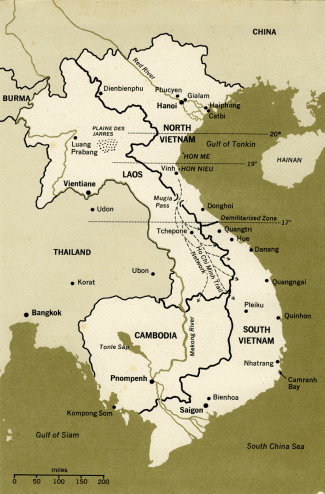
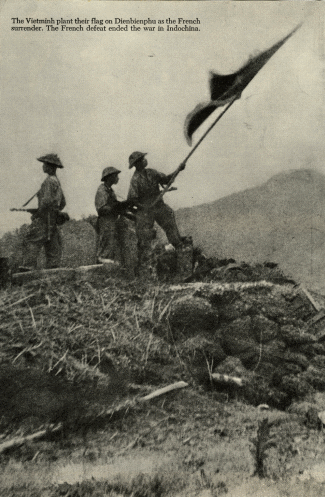
May -- Dienbienphu fell and the Geneva meetings began.
June -- Col. Edward G. Lansdale of the C.I.A. arrived in Saigon to head a team of agents for "paramilitary operations" and "political- psychological warfare" against the North.
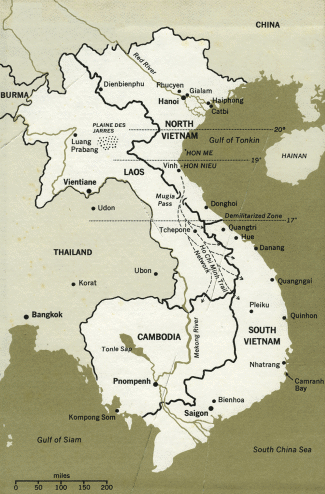
July -- The Geneva sessions ended in accords "temporarily" dividing Vietnam until reunification through free elections in 1956 and prohibiting foreign military use of Vietnamese territory.
August -- A national intelligence estimate termed the chances for a strong regime in the South poor. The National Security Council found the Geneva accords a "disaster" that completed a "major forward stride of Communism," the study says. A Joint Chiefs' memo said a "strong, stable civil government" was the "absolutely essential" basis for U.S. military-training aid. But Mr. Dulles felt the military- training program was "one of the most efficient means" of stabilizing a regime. With the President's approval of the Council's recommendations for direct economic and military aid to South Vietnam, "American policy toward post-Geneva Vietnam was drawn," the account says.
October -- The Lansdale team undertook the "delayed sabotage" of the Hanoi railroad and other operations.
December -- Gen. J. Lawton Collins, the U.S. special representative, urged the removal and replacement of Ngo Dinh Diem as the leader, or the "re-evaluation of our plans" for aid to the area. Mr. Dul1es replied that he had "no other choice but to continue our aid to Vietnam and support of Diem."
1955
April -- Mr. Dulles, after meeting with General Collins, cabled the embassy in Saigon to seek an alternative to Diem.
May -- Mr. Diem, with the aid of Lansdale, quashed the sect uprising in Saigon. Mr. Dulles canceled his previous cable.
December -- Mr. Dulles, in a cable to the embassy in Saigon, said the U.S. should not act to "speed up present process of decay of Geneva accords" but also should not make the "slightest effort to infuse life into them."
1956
The U.S. sent 350 additional military men to Saigon; the account says this was an "example of the U.S. ignoring" the Geneva accords.
1960
A national intelligence estimate predicted that "discontent with the [Diem] Government will probably continue to rise."
Chapter 1: The Truman and Eisenhower Years: 1945-1960
By Fox Butterfield
The secret Pentagon study of the Vietnam war discloses that a few days after the Geneva accords of 1954, the Eisenhower Administration's National Security Council decided that the accords were a "disaster" and approved actions to prevent further Communist expansion in Vietnam.
These National Security Council decisions, the Pentagon account concludes, meant that the United States had "a direct role in the ultimate breakdown of the Geneva settlement."
That judgment contradicts the repeated assertion of several American administrations that North Vietnam alone was to blame for the undermining of the Geneva accords.
According to the Pentagon writer, the National Security Council, at a meeting on Aug. 8, 1954, just after the Geneva conference, ordered an urgent program of economic and military aid -- substituting American advisers for French advisers -- to the new South Vietnamese Government of Ngo Dinh Diem.
The objectives set by the Council were "to maintain a friendly non-Communist South Vietnam" and "to prevent a Communist victory through all-Vietnam elections."
Under the Geneva settlement, Vietnam was to be temporarily divided into two zones pending reunification through elections scheduled for 1956. The introduction of foreign troops or bases and the use of Vietnamese territory for military purposes were forbidden. The United States, which did not join with the nations that endorsed the accords, issued a declaration taking note of the provisions and promising not to disturb them.
But a lengthy report, accompanying the Pentagon study, describes in detail how the Eisenhower Administration sent a team of agents to carry out clandestine warfare against North Vietnam from the minute the Geneva conference closed.
The team, headed by the legendary intelligence operative Col. Edward G. Lansdale, gave a graphic account of the actions just before evacuating Hanoi in October 1954. [See Document #15.]
The report says the team "spent the last days of Hanoi in contaminating the oil supply of the bus company for a gradual wreckage of engines in the buses, in taking actions for delayed sabotage of the railroad (which required teamwork with a C.I.A. special technical team in Japan who performed their part brilliantly), and in writing detailed notes of potential targets for future para-military operations."
"U. S. adherence to the Geneva agreement," the authors of the report said, "prevented [the American team] from carrying out the active sabotage it desired to do against the power plant, water facilities, harbor and bridge."
"The team had a bad moment when contaminating the oil. They had to work quickly at night, in an enclosed storage room. Fumes from the contaminant came close to knocking them out. Dizzy and weak-kneed, they masked their faces with handkerchiefs and completed the job."
The report is attributed to a hastily assembled group identified as the Saigon Military Mission. Its authors do not explain why they believed sabotage of buses and the railroad was allowed under the Geneva accords if sabotage of the power plant and harbor was forbidden.
The Pentagon study, which was commissioned by Secretary of Defense Robert S. McNamara to determine how the United States became involved in the Vietnam war, devotes nine lengthy sections to the nineteen-forties and fifties.
At key points during these years, the Pentagon study says, the Truman and Eisenhower Administrations made far-reaching decisions on Vietnam policy that the public knew little about or misunderstood. And by the time John F. Kennedy became President in 1961, the writers recount, the American Government already felt itself heavily committed to the defense of South Vietnam.
One of the earliest disclosures in the account is that in late 1945 and early 1946, Ho Chi Minh wrote at least eight letters to President Truman and the State Department requesting American help in winning Vietnam's independence from France. [See Document # 1.]
The analyst says he could find no record that the United States ever answered Ho Chi Minh's letters. Nor has Washington ever revealed that it received the letters.
A key point came in the winter of 1949-50 when the United States made what the account describes as a watershed decision affecting American policy in Vietnam for the next two decades: After the fall of mainland China to the Chinese Communists, the Truman Administration moved to support Emperor Bao Dai and provide military aid to the French against the Communist-led Vietminh.
This decision, which was made amid growing concern in the United States over the expansion of Communism in Eastern Europe and Asia, reversed Washington's long-standing reluctance to become involved with French colonialism in Indochina.
With this action, the account says, "the course of U. S. policy was set to block further Communist expansion in Asia." And "the United States thereafter was directly involved in the developing tragedy in Vietnam."
Another key point came in the spring of 1954, the writer discloses, when the Eisenhower Administration strongly hinted to France twice that it was willing to intervene with American military forces to prevent French defeat in Indochina.
While some information has been made public about these proposals, the Pentagon study says that the public has not understood how seriously the Eisenhower Administration debated intervention.
It adds that during the second episode, which occurred in May and June, 1954, while the Geneva conference was in session, President Dwight D. Eisenhower had aides draft a resolution requesting Congressional authority to commit American troops in Indochina.
The National Security Council was so opposed to France's negotiating an end to the war, the analyst relates, that "the President was urged to inform Paris that French acquiescence in a Communist take-over of Indochina would bear on its status as one of the Big Three" and that "U.S. aid to France would automatically cease."
Then in August, 1954, came the decision that the Pentagon account says determined United States policy toward Vietnam for the rest of the decade: The National Security Council launched its program of economic and military aid to Mr. Diem, then Premier and later President, though its action was not made public for months. [See Document #4.]
The Pentagon account discloses that most of these major decisions from 1950 on were made against the advice of the American intelligence community.
Intelligence analysts in the Central Intelligence Agency, the State Department and sometimes the Pentagon repeatedly warned that the French, Emperor Bao Dai and Premier Diem were weak and unpopular and that the Communists were strong.
In early August, 1954, for example, just before the National Security Council decided to commit the United States to propping up Premier Diem, a national intelligence estimate warned:
"Although it is possible that the French and Vietnamese, even with firm support from the U.S. and other powers, may be able to establish a strong regime in South Vietnam, we believe that the chances for this development are poor and moreover, that the situation is more likely to continue to deteriorate progressively over the next year."
"Given the generally bleak appraisals of Diem's prospects, they who made U.S. policy could only have done so by assuming a significant measure of risk," the study says of the Eisenhower commitments.
The Pentagon study does not deal at length with a major question: Why did the policy-makers go ahead despite the intelligence estimates prepared by their most senior intelligence officials?
The most important reason advanced by the Pentagon study is that after the fall of China to the Communists in 1949 and the hardening of American anti-Communist attitudes, "Indochina's importance to U.S. security interests in the Far East was taken for granted."
The basic rationale for American involvement -- what later came to be called the domino theory -- was first clearly enunciated by the National Security Council in February, 1950, when it decided to extend military aid to the French in Indochina.
"It is important to U.S. security interests," the Council said, "that all practicable measures be taken to prevent further Communist expansion in Southeast Asia. Indochina is a key area and is under immediate threat.
"The neighboring countries of Thailand and Burma could be expected to fall under Communist domination if Indochina is controlled by a Communist government. The balance of Southeast Asia would then be in grave hazard."
Subsequent Council decision papers throughout the nineteen-fifties repeated this formulation with ever-increasing sweep.
A Council paper approved by President Eisenhower in January, 1954, predicted that the "loss of any single country" in Southeast Asia would ultimately lead to the loss of all Southeast Asia, then India and Japan, and finally "endanger the stability and security of Europe."
"The domino theory and the assumptions behind it were never questioned," the Pentagon account says of the Eisenhower years. The result was that the Government's internal debate usually centered more on matters of military feasibility than on questions of basic national interests.
U.S. Policy in "Disarray"
The Pentagon study, which begins its account of American involvement in Vietnam with World War II, says that American policy from 1940 to 1950 has been a subject of "significant misunderstanding."
American policy toward Vietnam during these years, the study says, was "Less purposeful" than most people have assumed, and more characterized by "ambivalence and indecision."
President Franklin D. Roosevelt, the writer relates, never made up his mind whether to support the French desire to reclaim their Indochina colonies from the Japanese at the end of the war.
And at his death, American policy toward Indochina was in "disarray," the writer says.
He recounts that at first the Truman Administration had no clear-cut reaction to the conflict that broke out in 1945 and 1946 between the French and the Vietminh and eventually led to full-scale war. American policy, he adds, remained "ambivalent."
In a cablegram still kept secret in State Department files, Secretary of State George C. Marshall described the Government's quandary to the embassy in Paris:
"We have fully recognized France's sovereign position and we do not wish to have it appear that we are in any way endeavoring undermine that position.
"At same time we cannot shut our eyes to fact there are two sides this problem and that our reports indicate both a lack of French understanding other side and continued existence dangerously outmoded colonial outlook and method in areas.
"On other hand we do not lose sight fact that Ho Chi Minh has direct Communist connections and it should be obvious that we are not interested in seeing colonial empire administrations supplanted by philosophy and political organization directed from and controlled by Kremlin.
"Frankly we have no solution of problem to suggest."
On this reasoning, the Truman Government refused French requests for American planes and ships to transport French troops to Indochina and similarly turned down appeals for American arms to help fight the Vietminh.
But the Truman Administration also rebuffed the appeals from Ho Chi Minh. In August and September, 1945, the account relates, while his forces were in control of Hanoi, he sent a request to President Truman through the Office of Strategic Services, precursor of the C.I.A., asking that Vietnam be accorded "the same status as the Philippines" for a period of tutelage pending independence.
From October, 1945, until the following February, the account continues, Ho Chi Minh wrote at least eight letters to President Truman or to the Secretary of State, formally appealing for United States and United Nations intervention against French colonialism.
There is no record, the analyst says, that any of the appeals were answered.
"Nonintervention by the United States on behalf of the Vietnamese was tantamount to acceptance of the French," the Pentagon account declares.
In 1948 and 1949, as concern about the Soviet Union's expansion in Eastern Europe grew in the United States, Washington became increasingly anxious about Ho Chi Minh's Communist affiliations. Nevertheless, the account discloses, a survey by the State Department's Office of Intelligence and Research in the fall of 1948 concluded that it could not find any hard evidence that Ho Chi Minh actually took his orders from Moscow.
"If there is a Moscow-directed conspiracy in Southeast Asia, Indochina is an anomaly so far," the study reported in its evaluation section.
With its growing concern about Communism, Washington began to press Paris harder to give more independence to the Indochina states. The American Government thus hoped to encourage Vietnamese popular support for Bao Dai as a non- Communist alternative to Ho Chi Minh and his Vietminh.
Yet, the narrative relates, even when in March, 1949, France did agree with Emperor Bao Dai to grant Vietnam independence within the French Union, the Truman Administration continued to withhold its backing, fearful that Bao Dai was still weak and tainted with French colonialism.
In a cablegram to the Paris embassy, the State Department outlined its concern:
"We cannot at this time irretrievably commit the U.S. to support of a native government which by failing to develop appeal among Vietnamese might become virtually a puppet government separated from the people and existing only by the presence of French military forces."
But when Mao Tse-tung's armies drove Generalissimo Chiang Kai-shek out of China in late 1949, Washington's ambivalence ended dramatically.
On Dec. 30 President Truman approved a key National Security Council study on Asia, designated N.S.C. 48/2. With it, the Pentagon study says, "The course of U. S. policy was set to block further Communist expansion in Asia."
"The United States on its own initiative," the document declared, "should now scrutinize closely the development of threats from Communist aggression, direct or indirect, and be prepared to help within our means to meet such threats by providing political, economic and military assistance and advice where clearly needed to supplement the resistance of other governments in and out of the area which are more directly concerned."
The Council document concluded that "particular attention should be given to the problem of French Indochina."
The basic policy decisions having been made, the Pentagon account relates, developments followed swiftly.
When Peking and Moscow recognized Ho Chi Minh's Democratic Republic of Vietnam in January, 1950, Washington followed by recognizing Bao Dai that Feb. 7.
Nine days later, the French requested military aid for the war in Indochina. Secretary of State Dean Acheson, in recommending a favorable reply, wrote in a memorandum to President Truman:
"The choice confronting the U. S. is to support the legal governments in Indochina or to face the extension of Communism over the remainder of the continental area of Southeast Asia and possibly westward."
On May 8, Washington announced that it would provide economic and military aid to the French in Indochina, beginning with a grant of $10-million.
The first step had been taken. "The U.S. thereafter was directly involved in the developing tragedy in Vietnam," the account says.
Ultimately, the American military aid program reached $1.1-billion in 1954, paying for 78 per cent of the French war burden.
Brink of Intervention
In the spring of 1954, as the French military position in Indochina deteriorated rapidly and the date for the Geneva conference approached, the Eisenhower Administration twice hinted to France that it was ready to intervene with American forces.
The Pentagon study contends that while some information about these two episodes has become public, the American people have never been told how seriously the Eisenhower inner circle debated intervening.
"The record shows plainly," the analyst says, "that the U.S. did seriously consider intervention and advocated it to the U.K. and other allies."
The first of these episodes, during March and April before the fall of the French fortress at Dienbienphu, was disclosed not long afterward by American journalists. But the story of the second, in May and early June while the Geneva conference was in session, has never been fully revealed. Mr. Eisenhower himself, in his 1963 book "Mandate for Change," mentioned the second debate over intervention but gave only a sketchy account and did not report asking Secretary Dulles to draft a Congressional resolution.
The Eisenhower Administration felt intervention might be necessary, the study says, because without American help the French were likely to negotiate a "sellout" at Geneva to escape an unpopular war.
As early as August, 1953, the National Security Council decided that American policy should be that "under present conditions any negotiated settlement would mean the eventual loss to Communism not only of Indochina but of the whole of Southeast Asia. The loss of Indochina would be critical to the security of the U.S."
The Eisenhower Administration stated its opposition to a negotiated settlement most fully in an N.S.C. paper, "United States Position on Indochina to be Taken at Geneva," late in April in the week the conference opened.
It was at this point, according to the study, that the Council urged President Eisenhower "to inform Paris that French acquiescence in a Communist take-over of Indochina would bear on its status as one of the Big Three" and that "U.S. aid to France would automatically cease."
In addition, the Council's policy paper said that the United States should consider continuing the war itself, with the Indochina states, if France negotiated an unsatisfactory settlement. America's goal should be nothing short of a "military victory," the Council said.
The Government's internal record shows, the study says, that while Secretary of State John Foster Dulles and Adm. Arthur W. Radford, Chairman of the Joint Chiefs of Staff, pushed hard for intervention, other service chiefs, particularly Gen. Matthew B. Ridgway of the Army, were more cautious. They remembered the bitter and protracted experience in Korea and were not eager to repeat it.
President Eisenhower finally reached a decision against intervention on April 4 after a meeting of Mr. Dulles and Admiral Radford with Congressional leaders the previous day showed that the Congress would not support American action without allied help.
As journalists wrote, at the time, the President felt he must have Congressional approval before he committed American troops, and the Congressional leaders insisted on allied participation, especially by Britain.
At the very time the President was reaching this conclusion, Ambassador Douglas Dillon in Paris was cabling that the French had requested the "immediate armed intervention of U.S. carrier aircraft at Dienbienphu." [See Document #5.]
Mr. Dillon noted that the French had been prompted to make the request because they had been told by Admiral Radford that "he would do his best to obtain such help from the U.S. Government."
Moreover, the President's decision of April 4, contrary to what was written at the time, was only tentative. The debate on intervention was still very much alive, the Pentagon account says.
In fact, the following day, April 5, the National Security Council, in an action paper, concluded:
"On balance, it appears that the U.S. should now reach a decision whether or not to intervene with combat forces if that is necessary to save Indochina from Communist control, and tentatively the form and conditions of any such intervention."
On May 7, with the news that Dienbienphu had just fallen and with the delegates already in Geneva, President Eisenhower met with Mr. Dulles in the White House to again consider intervention.
According to a memorandum by Robert Cutler, the President's executive assistant, they discussed how "the U.S. should (as a last act to save Indochina) propose to France" that if certain conditions were met "the U.S. will go to Congress for authority to intervene with combat forces." The words in parentheses appeared in the memorandum. [See Document #8.]
Mr. Cutler noted that he explained to the President that some members of the Council's Planning Board "felt that it had never been made clear to the French that the United States was willing to ask for Congressional authority" if the preconditions were met.
Mr. Dulles said he would mention the subject to the French Ambassador, Henry Bonnet, that afternoon, "perhaps making a more broad hint than heretofore."
The preconditions included a call for the French to grant "genuine freedom" to the Indochina states -- Laos, Cambodia and Vietnam.
They also stipulated that American advisers in Vietnam should "take major responsibility for training indigenous forces" and "share responsibility for military planning." American officers in Vietnam had long chafed under the limits on the role the French allowed them, the study says.
Participation by the British, who had shown themselves extremely reluctant to get involved, was no longer cited as a condition.
The French picked up Mr. Dulles's hint, and on May 10 Premier Joseph Laniel told Ambassador Dillon that France needed American intervention to save Indochina. That evening the President again met with Mr. Dulles, along with Admiral Radford and Secretary of Defense Charles E. Wilson, to discuss the French appeal.
During the meeting President Eisenhower directed Secretary Dulles to prepare a resolution that he could take before a joint meeting of Congress, requesting authority to commit American troops in Indochina.
From a document included in the Pentagon chronicle -- the partial text of a legal commentary by a Pentagon official on the draft Congressional resolution -- it is clear that such a Congressional resolution was prepared and circulated in the State Department, the Justice Department and the Defense Department.
Both the State Department and the Defense Department then undertook what the account describes as "contingency planning" for possible intervention -- the State Department drawing up a hypothetical timetable of diplomatic moves and the Defense Department preparing a memorandum on the U.S. forces that would be required.
The Joint Chiefs of Staff, in a memorandum to Secretary of Defense Wilson on May 20, recommended that the United States limit its involvement to "air and naval support directed from outside Indochina."
"From the point of view of the United States," the Joint Chiefs said, "Indochina is devoid of decisive military objectives and the allocation of more than token U.S. armed forces to that area would be a serious diversion of limited U.S. capabilities."
In the debates over intervention, the study says, advocates of American action advanced several novel ideas. Admiral Radford proposed to the French, for example, that the United States help create an "International Volunteer Air Corps" for Indochina. The French in April had suggested an American air strike with the planes painted with French markings. And late in May the French suggested that the President might be able to get around Congress if he sent just a division of marines -- some 15,000 men.
But all the arguments in favor of intervention came to naught. The French Cabinet felt that the war-weary National Assembly would balk at any further military action.
And the military situation in the Red River Delta near Hanoi deteriorated so badly in late May and early June that Washington felt intervention would now be useless. On June 15 Secretary Dulles informed Ambassador Bonnet that the time for intervention had run out.
The Geneva "Disaster"
When the Geneva agreements were concluded on July 21, 1954 the account says, "except for the United States, the major powers were satisfied with their handiwork."
France, Britain, the Soviet Union, Communist China and to some extent North Vietnam believed that they had ended the war and had transferred the conflict to the political realm.
And. the study says, most of the governments involved "anticipated that France would remain in Vietnam." They expected that Paris would retain a major influence over the Diem regime, train Premier Diem's army and insure that the 1956 elections specified by the Geneva accords were carried out.
But the Eisenhower Administration took a different view, the Pentagon account relates.
In meetings Aug. 8 and 12, the National Security Council concluded that the Geneva settlement was a "disaster" that "completed a major forward stride of Communism which may lead to the loss of Southeast Asia."
The Council's thinking appeared consistent with its decision in April before the conference began, that the United States would not associate itself with an unsatisfactory settlement. Secretary Dulles had announced this publicly on several occasions, and in the end the United States had only taken note of the agreements.
But before the Council reached a final decision in August on exactly what programs to initiate in Indochina, several dissenting voices rose inside the Government.
The national intelligence estimate of Aug. 3 warned that even with American support it was unlikely that the French or Vietnamese would be able to establish a strong government. And the National Intelligence Board predicted that the situation would probably continue to deteriorate.
The Joint Chiefs of Staff had also objected to proposals that the United States train and equip the South Vietnamese Army.
In a memorandum to the Secretary of Defense on Aug. 4, the Joint Chiefs listed their preconditions for U.S. military aid to the Diem regime:
"It is absolutely essential that there be a reasonably strong, stable civil government in control. It is hopeless to expect a U. S. military training mission to achieve success unless the nation concerned is able effectively to perform those governmental functions essential to the successful raising and maintenance of armed forces."
The Joint Chiefs also called for the complete "withdrawal of French forces, French officials and French advisers from Indochina in order to provide motivation and a sound basis for the establishment of national armed forces."
Finally the Joint Chiefs expressed concern about the limits placed on American forces in Vietnam by the Geneva accords -- they were restricted to 342 men, the number of American military personnel present in Vietnam when the armistice was signed.
Despite these arguments, the study says, Secretary of State Dulles felt that the need to stop Communism in Vietnam made action imperative.
In a letter to Secretary of Defense Wilson, he said that while the Diem regime "is far from strong or stable," a military training program would be "one of the most efficient means of enabling the Vietnamese Government to become strong."
In the end, the study recounts, Secretary Dulles's views were persuasive.
On Aug. 20 the President approved a National Security Council paper titled "Review of U.S. Policy in the Far East." It outlined a threefold program:
• Militarily, the United States would "work with France only so far as necessary to build up indigenous forces able to provide internal security."
• Economically, the United States would begin giving aid directly to the Vietnamese, not as before through the French. The French were to be dissociated from the levers of command."
• Politically, the United States would work with Premier Diem, but would encourage him to broaden his Government and establish more democratic institutions.
With these decisions, the account says "American policy toward post-Geneva Vietnam was drawn." The commitment for the United States to assume the burden of defending South Vietnam had been made.
"The available record does not indicate any rebuttal" to the warnings of the National Intelligence Board or the Joint Chiefs of Staff, the account reports. "What it does indicate is that the U.S. decided to gamble with very limited resources because the potential gains seemed well worth a limited risk."
Although this major decision for direct American involvement in Vietnam was made in August, the Pentagon account shows that the Eisenhower Administration had already sent a team of Americans to begin secret operations against the Vietminh in June, while the Geneva conference was still in session.
The team was headed by Colonel Lansdale, the C.I.A. agent who had established a reputation as America's leading expert in counter-guerrilla warfare in the Philippines, where he had helped President Ramon Magsaysay suppress the Communist-led Hukbalahap insurgents.
So extensive were his subsequent exploits in Vietnam in the nineteen-fifties that Colonel Landsdale was widely known as the model for the leading characters in two novels of Asian intrigue -- "The Quiet American," by Graham Greene, and "The Ugly American," by William J. Lederer and Eugene Burdick.
A carefully detailed 21,000-word report by members of Colonel Lansdale's team, the Saigon Military Mission, is appended to the Pentagon chronicle. [See Document # 15.]
According to that report, in the form of a diary from June, ] 954, to August, 1955, the team was originally instructed "to undertake paramilitary operations against the enemy and to wage political-psychological warfare."
"Later," it adds, "after Geneva, the mission was modified to prepare the means for undertaking paramilitary operations in Communist areas rather than to wage unconventional warfare."
One of Colonel Lansdale's first worries was to get his team members into Vietnam before the Aug. 11 deadline set by the Geneva agreements for a freeze on the number of foreign' military personnel. As the deadline approached, the report says, it appeared that the Saigon Military Mission "might have only two members present unless action was taken."
It adds that Lieut. Gen. John W. O'Daniel, chief of the United States Military Assistance Advisory Group, "agreed to the addition of 10 S.M.M. members under MAAG cover, plus any others in the Defense pipeline who arrived before the deadline. A call for help went out. Ten officers in Korea, Japan and Okinawa were selected and rushed to Vietnam."
While the report says that the team members were given cover by being listed as members of MAAG, the report also points out that they communicated with Washington through the C.I.A. station in Saigon.
Colonel Lansdale himself is identified as a member of the C.I.A. in a memorandum on the actions of the President's Special Committee on Indochina, written Jan. 30, 1954, by Maj. Gen. Charles H. Bonesteel 3d. [See Document #3.]
The memorandum, which is appended to the Pentagon study, lists Colonel Lansdale as one of the C.I.A. representatives present at the meeting. Allen W. Dulles, Director of Central Intelligence, also attended the meeting.
In the fall of 1954, after all the members had arrived in Vietnam, the report says, the team's activities increased.
Under Colonel Lansdale, "a small English-language class [was] conducted for mistresses of important personages at their request."
This class provided valuable contacts for Colonel Lansdale, enabling him to get to know such people as the "favorite mistress" of the army Chief of Staff, Gen. Nguyen Van Hinh, the report recounts.
When the Oct. 9 deadline for the French evacuation of Hanoi approached, the team sought to sabotage some of Hanoi's key facilities.
"It was learned that the largest printing establishment in the north intended to remain in Hanoi and do business with the Vietminh," the report relates. "An attempt was made by S.M.M. to destroy the modern presses, but Vietminh security agents already had moved into the plant and frustrated the attempt."
It was the mission's team in Hanoi that spent several nights pouring contaminant in the engines of the Hanoi bus company so the buses would gradually be wrecked after the Vietminh took over the city.
At the same time, the mission's team carried out what the report calls "black psywar strikes" -- that is, psychological warfare with materials falsely attributed to the other side. The team printed what appeared to be "leaflets signed by the Vietminh instructing Tonkinese on how to behave for the Vietminh takeover of the Hanoi region in early October, including items about property, money reform and a three-day holiday of workers upon take-over." The attempt to scare the people worked.
"The day following the distribution of these leaflets," the report adds, "refugee registration [of those wishing to flee North Vietnam] tripled. Two days later Vietminh currency was worth half the value prior to the leaflets.
"The Vietminh took to the radio to denounce the leaflets; the leaflets were so authentic in appearance that even most of the rank-and-file Vietminh were sure that the radio denunciations were a French trick."
In the South, the team hired Vietnamese astrologers -- in whose art many Asians place great trust -- to compile almanacs bearing dire predictions for the Vietminh and good omens for the new Government of Premier Diem.
To carry out clandestine operations in North Vietnam after the team evacuated Hanoi, the report adds, Maj. Lucien Conein, an officer of S.M.M., recruited a group of Vietnamese agents under the code name of Binh.
"The group was to be trained and supported by the U.S. as patriotic Vietnamese," the report says, "to come eventually under Government control when the Government was ready for such activities. Thirteen Binhs were quietly ex-filtrated through the port of Haiphong ... and taken on the first stage of the journey to their training area by a U.S. Navy ship."
Until Haiphong was finally evacuated in May, 1955, Civil Air Transport, the Taiwan-based airline run by Gen. Claire Chennault, smuggled arms for the Binh team from Saigon to Haiphong.
In exchange, the report says, the Lansdale Mission got C.AT. the lucrative contract for flying the thousands of refugees out of North Vietnam.
As the report describes the team's actions, "Haiphong was reminiscent of our own pioneer days as it was swamped with people whom it couldn't shelter. Living space and food were at a premium, nervous tension grew. It was a wild time for our northern team."
Another team of 21 agents, code-named the Hao group, were recruited in Saigon, smuggled out on a U.S. Navy ship while disguised as coolies, and taken to a "secret site" for training, the report goes on.
Arms for the Haos were smuggled into Saigon by the United States Air Force, the report says, adding that S.M.M. brought in eight and a half tons of equipment. This included 14 radios, 300 carbines, 50 pistols, 300 pounds of explosives and 100,000 rounds of ammunition.
The Lansdale team's report does not tell what kinds of intelligence or sabotage activities the Binh and Hao groups carried out in North Vietnam. But it does recount that one Binh agent was mistakenly picked up by Premier Diem's troops on his return to South Vietnam.
"He was interrogated by being handcuffed to a leper, both beaten with the same stick to draw blood, told he would now have leprosy, and both locked up in a tiny cell together," it says. "S.M.M. was able to have him released."
For fiscal year 1955, the report shows, expenses for the Saigon Military Mission ran to $228,000. This did not include salary for the American officers or costs of weapons drawn from American stocks.
The largest item, $123,980, was listed as payment for operations, including pay and expenses for agents, safehouses and transportation.