OTHER RECOMMENDATIONS
A significant reduction in police corruption can be achieved if the momentum for reform is maintained and if the following objectives are vigorously pursued:
First, corrupt activity must be curtailed by eliminating as many situations as possible which expose policemen to corruption, and by controlling exposure where corruption hazards are unavoidable.
Second, temptations to engage in corrupt activity on the part of the police and the public must be reduced by subjecting both to significant risks of detection, apprehension, conviction and penalties.
Third, incentives for meritorious police performance must be increased.
Fourth, police attitudes toward corruption must continue to change.
Fifth, a climate of reform must be supported by the public.
Commissioner Murphy has instituted a host of managerial changes aimed at achieving all the above objectives. In the recommendations which follow, we single out some that need particular support and others that have not yet been implemented. But we concentrate mainly on reforms which require action by others than the Commissioner.
Reducing the Opportunities for Corrupt Activity
Changing Laws
The laws against gambling, prostitution, and the conduct of certain business activities on the Sabbath all contribute to the prevalence of police corruption in obviously different degrees of seriousness. However, they have one characteristic in common -- they are laws which are difficult to enforce because the "victims" of these crimes are usually willing participants and seldom complain to the police. Consequently, if a police officer for whatever motive decides to condone a violation, he need only fail to report it. Such a situation is an invitation to corruption. To curtail the opportunities for corruption fostered by these laws, the Commission makes the following recommendations:
Gambling. The criminal laws against gambling should be repealed. To the extent that the legislature deems that some control over gambling is appropriate, such regulation should be by civil rather than criminal process. The police should in any event be relieved from any responsibility for the enforcement of gambling laws or regulations.
Sabbath laws. The present Sabbath laws should be repealed as they have been in a number of states. To the extent they are retained, enforcement should not be a police function.
Prostitution. Although our evidence with respect to police corruption resulting from prostitution was not as strong as in other areas, the Commission believes that prostitution is a corruption hazard. It has been suggested that one way to eliminate the hazard would be to legalize prostitution, but this has usually included some regulatory control and other countries which have taken this approach do not seem to have eliminated the related police corruption. To the extent that prohibition or regulation of prostitution is deemed necessary or desirable, the Commission can suggest no alternative agency for enforcement.
Narcotics
The Commission believes that the police must continue to assume responsibility for enforcement of laws forbidding narcotics sale and possession as long as society deems it necessary to invoke criminal sanctions in this area. However, increased study and attention should be given to ways other than criminal sanctions for dealing with the addict.
The laws against marijuana are particularly controversial because of their growing unenforceability and the conviction of many that they are undesirable. However, the Commission has not found evidence that the marijuana laws are a distinct factor in police corruption.
Regulated Industries
Any industry subject to regulations whose enforcement is entrusted to the police presents a serious corruption hazard. Our investigations focused in particular upon the construction industry, and bars and other premises having liquor licenses which are subject to detailed and intricate regulations which are highly conducive to corruption. We believe that many opportunities for corruption can be eliminated by making such laws more reasonable.
The Commission recommends that in any area where a regulatory agency has jurisdiction, police officers should, insofar as possible, be relieved of the responsibility of enforcement unless (1) the agency requests police assistance or (2) a threat to order exists and must be dealt with on an emergency basis. Moreover, there must be publicly recognized means for waiving regulations where necessary, for example in construction, but we recommend that the police have no responsibility in this connection. We recognize that this approach will not in itself eliminate corruption but may simply transfer its hazards from the police to some other agency. But we believe that corruption in other agencies -- undesirable as it is -- has far less impact upon the body politic than corruption among the police.
The progression found again and again in the course of our investigation, from the acceptance by a police officer of petty graft to more serious corruption, makes it desirable to remove as many sources of such petty graft as possible. By eliminating the opportunity for petty graft, the Department can change the current attitude that such graft is an accepted part of the police job. This attitude makes it easier for a police officer to accept or solicit graft of a more serious nature when the opportunity presents itself. Moreover, policemen are more likely to pursue vigorously a corrupt public official who is not one of their own.
Finally, as a simple matter of efficiency there is no justification for using the police -- with all their powers and prerogatives -- in the enforcement of many miscellaneous regulations. It is ridiculous to have an armed police officer wasting his time (and that of his partner and supervising sergeant) checking restaurant washrooms to find out whether they are properly supplied with soap. We believe that the police should be taken out of bars and restaurants and away from building sites and returned to their principal job of protecting lives and property.
Reducing the Temptations and Increasing the Risks
Penalizing Bribe Givers
The Commission was struck by the apparent immunity from arrest enjoyed by givers as opposed to the takers of bribes. If the Police Department procedures in the past have been inadequate to apprehend members of the force who accept bribes, efforts to bring to justice those who give them have been almost non-existent.
Recently, a campaign was initiated to publicize the fact that the Police Department would hereafter arrest anyone offering a bribe. The Department has in fact increased its activity in this area. Bribery arrests in 1971 were up 440% over 1968 but the absolute numbers are still small. Further, the message conveyed by bribery arrests will be much stronger if the arrested bribers include individuals of some standing in the community like lawyers, hotel managers, restaurant or nightclub managers, and construction superintendents. The publicizing of such bribe arrests will deter offers of bribes and afford a legitimate excuse for refusing to pay them.
An effective way to supplement a campaign against bribers is to let it be known that specially assigned policemen will be used to apprehend bribers. In several instances, Commission investigators received offers of bribes from gamblers, bar owners, and prostitutes who mistook them for policemen. In one case, two investigators entered a bar for the purpose of checking records. Before they could make their request, the bartender informed them that the precinct captain had already been paid and asked them what they wanted. Experiences such as this indicate that this approach can be effective.
Procedures to Facilitate Corruption Investigations
Personnel Records. This Commission was hampered in its investigations by the lack of an efficiently organized system of personnel records. There is no centrally located personnel file for each police officer. For example, his applicant record, his Academy record, his service record, his disciplinary record and his award record, his medical record, his marksmanship record, his continuing education and training record, and his examination scores and promotion records are all maintained in different places. In order to check the record of an individual officer we found it necessary to go to as many as twelve different locations and search fourteen different files, since there was not even a central index to the various personnel files. It was not uncommon in these searches to discover all or part of a record missing or misfiled. Some records, maintained only at the precinct or unit headquarters level, are virtually inaccessible to investigators without alerting the subject of the investigation.
The Department has had a stated intent for several years of creating a central personnel file for each member of the Department. A centralized index summarizing the dispersed records is in the initial stages of construction. Both steps are necessary. The system of personnel records centralization should provide for two sets of records. One set of confidential records should contain all facts and allegations concerning a police employee's career. It should be maintained by the Internal Affairs Division and located in their headquarters. Access to this confidential set of records should be rigidly controlled to maintain the integrity of the files, and the files should be so structured as to make the unauthorized removal of a record difficult and obvious. Their principal use would be in investigations. A second set of accessible personnel records duplicating the first should be located at Police Headquarters, but this set should omit unsubstantiated allegations. This second set could be maintained by the Chief Clerk's staff or the Personnel Bureau or any other unit which could provide response to legitimate inquiries.
Both the quality and accessibility of photographs of police officers on active duty increase the difficulties faced by investigators of possible corrupt activities. Our investigators found that the pictures maintained in the files frequently appeared to be many years old and were taken in a rigid pose not conducive to ready identification. Moreover, investigators, including the Department's own, must go to a central photographic file in order to obtain photographs of suspected police officers and often must engage in elaborate subterfuges to conceal their interest in a particular individual.
The Commission recommends that two photographic files of police employees be maintained, one at the Internal Affairs Division and the other with the accessible central personnel file. The rule that photographs be taken every five years should be enforced, and the photographs should include several poses.
Complaints of Corruption. A complaint from a citizen or a police officer is one starting point for detecting corruption and apprehending corrupt officers. Such complaints must be encouraged by informing the public specifically how and where to make complaints and what details are necessary for action. More effective procedures must be established, with strong controls for insuring that complaints get immediately recorded wherever in the Department they may be received. These actions are necessary to mesh with the new departmental procedures for ensuring adequate complaint follow-up.
Line-ups. Commission investigators had one experience where they were called upon to identify allegedly corrupt officers in a line-up. The line-up was conducted in such a way that our investigators were exposed to full view before a number of police officers not connected with the case and, indeed, the suspects themselves. While such conditions did not deter our professional investigators, it was apparent to them that they would have intimidated civilian witnesses. Line-up procedures should insure that a complaining witness can identify an officer in a manner that protects the witness' anonymity.
Treatment of Cooperative Police Witnesses. If the Department is to use formerly corrupt policemen as undercover agents, it must be prepared to keep them on duty at full pay during the time that they are serving as agents and witnesses. When their services are no longer required, the Police Commissioner should allow them to resign in good standing as he did Patrolman Droge.
Enforcement Responsibility
Departmental Action Against Infractions Indicative of Corruption. Anti-corruption investigators often know the identities of corrupt police officers and from observing their behavior can be certain of the fact that they are engaged in corrupt activities. Proving a criminal case, however, is a different matter, since corrupt activities are inherently covert and involve mutually trusting parties. Although a more vigorous and effective effort to make criminal cases is certainly desirable and possible, one solution to the corruption problem may lie elsewhere.
There are a number of regulations and procedures in the Department that call for disciplinary punishment for a variety of infractions related to corrupt behavior, such as the regulation against associating with gamblers, criminals, or persons engaged in unlawful activities except in the discharge of official duty or with the permission of the Police Commissioner. The rules require that the fact and purpose of such a meeting in the course of duty be recorded. Whenever this kind of meeting is observed and has not been recorded, the excuse commonly given by the officer is that he was attempting to get information from an informant and had merely forgotten to report the matter. Invariably, no charges are brought for such infractions if the commander is satisfied with the excuse given in the particular case. Such rules as this one are designed to deter corruption. Yet their uneven enforcement undermines the achievement of this goal.
The Commission recommends that the required reporting procedures be strictly enforced and that Departmental charges be brought against violators in all instances. The validity of the excuse for such meetings should bear only upon the penalties imposed. However, since it would be unfair to change the enforcement policy abruptly, the Department should publicize its intention to punish with maximum severity any infraction of these rules. The threat of severe penalties may have a deterrent effect on an officer who knows how difficult it is to prove a corrupt conversation between him and a gambler or other criminal but who also knows how easy it is to prove the simple fact of the meeting.
Expanded Penalties in Department Hearings. Perhaps the most troublesome issue in the disciplining of policemen found guilty in Departmental hearings is the inappropriateness of the available penalties. The Administrative Code provides no gradations of penalty between outright dismissal from the force and a fine of 30 days pay or vacation followed by a year's probation. The Commission recommends that the disciplinary alternatives available to the Police Commissioner be broadened. Penalties under the Administrative Code should be changed so that there are penalties available between dismissal and a thirty-day fine.
The Police Commissioner can now reduce any officer above the rank of captain to captain. The Commission further recommends that provision be made for a penalty of reduction of one civil service rank after conviction on serious charges. This would mean that captains, and officers above captain, could be reduced to lieutenants and removed from command posts, lieutenants could be reduced to sergeants, and sergeants could be reduced to patrolmen.
This latter recommendation of rank reductions is necessary to provide meaningful penalties for failures to exercise supervisory and command responsibilities. At present, the usual penalty for such failure is transfer to a new assignment. Such a light penalty does little to motivate superior officers to move vigorously to eradicate corruption and laziness.
Hearing Officers. The Commission urges that the City Council approve the pending bill providing for additional Hearing Officers in departmental trials. The present requirement that only Deputy Commissioners can conduct such trials has created an unnecessary backlog.
Pensions. Another serious defect in the Department's disciplinary options is the present law requiring that any officer dismissed from the Department automatically forfeit his pension regardless of the nature of the offense bringing about his discharge, or how many years he may have worked to earn his pension, or how exemplary his prior record may have been. Although a Police Commissioner should be able to dismiss any policeman found to be corrupt, it by no means follows that a single act of corruption justifies what may amount to a fine of several hundred thousand dollars, the commuted value of many officers' vested pension rights. No civilian would be subjected to a comparable penalty.
The result of the present forfeiture rule has been that the courts on appeal have directed the reinstatement of patently unfit officers because they could not tolerate the injustice involved in the forfeiture of vested pension rights.
The solution recommended by the Commission is to separate considerations of pension from departmental disciplinary proceedings. Disciplinary proceedings within the Department should be concerned solely with the question of whether the offense has been established and whether the offender should be removed from the force or suffer some lesser departmental punishment. In the event of dismissal, and upon recommendation of the Police Commissioner, there should be a wholly separate proceeding conducted by the Corporation Counsel to determine whether the offender should be deprived of his accumulated pension rights.
Under present procedures, officers suspected of misconduct are permitted to put in their retirement papers and retire thirty days later, at which time they become immune to departmental disciplinary proceedings and become eligible to receive their pensions. This results in a thirty-day race, with a suspected officer seeking to retire before charges can be brought against him. The statute of limitations for beginning a pension proceeding should commence to run the day the officer is separated from the Department -- either by disciplinary action or by resignation -- and there should be no arbitrary period of time for the completion of such a proceeding. The normal rules for civil actions where issues of comparable importance are customarily decided should apply to such a proceeding.
Until these new procedures are adopted, the thirty-day limitation should immediately be extended to ninety days by passage of the bill to that effect now pending before the City Council.
Effect of Disciplinary Records upon Promotions. Officers with lengthy records of disciplinary infractions have, in the past, been promoted to supervisory and command ranks -- even repromoted after demotion. The system of departmental recognition provides for the Department of Personnel to add extra points to the scores of officers taking a promotion examination. But a disciplinary record is never counted by imposing specified negative points for convictions of various rule infractions. The Commission recommends that revisions be made in the formal system of promotion points to include both positive points for good performance and negative points for convictions of rule infractions.
Changing Procedures Which Encourage Corruption
Policemen sometimes engage in corrupt practices because alternative means of solving problems are not available or are too bothersome. For example, expense money is inadequate or too slow in being paid and procedures for handling contraband are too complex and too time-consuming. These situations, and others like them, can be readily corrected. Many such improvements have already been ordered by Police Commissioner Murphy.
Reimbursement of Expenses. Although plainclothesmen have traditionally been faced with the greatest temptation for corruption because of the nature of their work, the Department has made their job even more difficult by not giving them sufficient funds to do it properly. A plainclothesman incurs various expenses in the course of doing his job, but the Department has in the past allowed him only $100 per month. To facilitate the work of plainclothes officers, an expense advance should be provided, the amounts allowed should be flexible, and reimbursement for expenses should be prompt.
Arrest Quotas. The existence of informal arrest quotas is an inducement to a particular kind of corruption, the arrest of individuals not actually apprehended in the commission of the charged crime. Testimony before the State Investigation Commission in its investigation of narcotics described a pattern of requiring a quota of four felony arrests per month and concluded that this requirement led to "flaking" of individuals -- the planting of narcotics upon a suspected individual. Our investigation confirmed the existence of such an informal quota as well as similar flaking in policy arrests. The Commission also found that plainclothesmen assigned to prostitution details were faced with the necessity of producing a stipulated number of arrests a night and, in order to do so, often arrested persons they considered to be "obvious" prostitutes, without obtaining sufficient legal evidence.
The emphasis on quality arrests which the Department has now established should be pressed vigorously, and steps should be taken to insure that individual commanders do not replace formal quotas with informal quotas.
Informants. Abuses with respect to the use of informants have, in the past, been facilitated by the loose control exercised over them. According to Departmental Rules and Regulations, informants must be registered to an individual police officer. But in fact the Commission has found that this rule is not enforced and informants deal with a number of police officers. This leads to corruption because officers will not usually engage in illegal activities, such as selling narcotics, with informants registered to them. The Commission recommends that rules requiring the registration of informants be enforced. We further recommend that officers be required to report all contacts with informants.
Paid Informants. At the present time, it is the policy of the Department that informants are not paid. This leads to corruption because of the temptation to reward informants with narcotics or other contraband. The Commission recommends that realistic appraisal be made of the funds necessary to maintain the Department's registered informants and that adequate funds be made available to the Department for this purpose. Procedures for accounting for the expenditure of these funds should be simplified to the maximum extent possible and should be no more complicated than a regular expense report.
Gratuities. Although the acceptance of "any valuable gift" is against Departmental regulations, the rule has not been enforced with any regularity. Maintaining that a free cup of coffee is the acceptance of graft while finding no wrongdoing when a Chief of Detectives accepts a meal for himself and guests worth $84 promotes an attitude of cynicism in the Department leading to corruption. The Commission recommends that the Department bring practice and policy into accord, and enforce diligently whatever policy is finally adopted. If the Department decides to permit policemen to accept free meals and goods, the Commission urges that all such gratuities be reported in memorandum books or on Daily Field Activity Reports, which should be reviewed daily by supervisory officers. Supervisory personnel should then be held responsible for insuring that such privileges are not abused.
Sleeping Accommodations. Since there are many occasions, such as a morning court appearance after a night of duty, when it is difficult for an officer to return home to sleep, the Department should acknowledge this fact and arrange for sleeping accommodations. The City should make appropriate arrangements to reimburse hotels to permit officers to occupy hotel rooms on a space-available basis.
Management Procedures
The Department will always have to cope with opportunities and temptations for corruption. In part, the Murphy administration's strategy for doing so is to reduce exposure to corruption hazards and to fix responsibility and insure individual accountability. Many steps have been taken in these directions, and others are required.
Field Activity Reporting. To make the concept of accountability work it is important to have an officer's account of what he did while on duty -- to be compared with what he was supposed to do. The necessity for having on record an account of a policeman's daily doings that can be verified or proved false was made clear to this Commission when it subpoenaed several dozen memorandum books of policemen about whom questions had been raised. At that time the only record of a police officer's activities was his memorandum book, and he kept the only copy in his possession. We discovered that these books were uniformly useless, not just because they contained falsifications but because they were full of blanks. Under the memorandum book system, many patrolmen customarily leave large blanks and/or perhaps spend an hour or two a week reconstructing (or inventing) their activities. Since memo books are retained by the officers, it is easy to go back and add entries to provide an account of an officer's daily activities when an investigation of his activities creates a need to do so. To provide an improved record, the Department is now experimenting in twelve precincts with Daily Field Activity Reports for all patrolmen and is requiring them from plainclothes officers assigned to the Organized Crime Control Bureau (OCCB). These reports are filled out in triplicate, turned in every day, and signed by a superior officer. Whether or not the experimental Daily Field Activity Report form is satisfactory, there is a clear need for all field officers including detectives to prepare during their tour a reporting form or book specifying where the officers were and what they were doing at specific times. At least two copies of this daily report should be submitted at the end of each tour for supervisory scrutiny and signature. One copy should be retained by the Department and one by the officer. Other copies should be prepared as required for administrative review, as is now done in the OCCB.
Arrest Procedures. Corruption in connection with the arrest of an offender is facilitated by the reporting form used by the Department to record arrests. The Commission found that, particularly in gambling arrests, the description of the alleged offense is often written by the police officer in such ambiguous terms that he can later testify in a manner exculpating the defendant. This fact enables a police officer to make himself available for a change of testimony in exchange for financial consideration. A forced-choice arrest form which removes the possibility of a change of testimony in key areas involving search and seizure and the legality of an arrest is necessary and should be adopted after field experimentation.
Name Tags. We have already referred to the fact of police isolation from the community. To many citizens, the police officer on the street is the nameless embodiment of authority. The present badge numbers cannot be easily read. The Commission recommends that the uniformed officers in the department be required to wear name tags on the outside of their uniforms. This is standard practice for identifying individuals who deal with the public like doctors on hospital staffs, bank tellers, and airline personnel. Men and women in the armed services of the United States have worn name tags for years.
Reducing the Susceptibility to Corruption
There are two general approaches to reducing the susceptibility to corruption among police officers. The first is to improve screening and selection methods and standards. The second approach requires no less than a change in police attitudes.
Background Investigations. To prevent the few situations that have arisen in which unsuitable candidates were admitted to the force and sent out to the field before their full background investigations had been completed, there should be established in practice, as well as by rule, an absolute ban against the swearing in of police officers until their background investigations have been finished and reviewed.
Lateral Entry to Supervisory Ranks. A controversial reform in police practice involves the infusion of new blood at supervisory levels. Currently, all supervisory and commanding officers must rise through the ranks, and the officer-enlisted man relationship which contributes to a sense of discipline in the military is often entirely lacking. The quality of superior officers is necessarily limited by the refusal of the Department to accept supervisory personnel from outside its own ranks. If, as it appears to the Commission, the Department is imbued with an attitude of tolerance towards corruption, officers rising through the ranks cannot help but be conditioned by this prevailing attitude. Moreover, many superior officers are, rightly or wrongly, the subject of rumors as to their own past corrupt activities. The Commission recommends that provision for lateral entry to the Department be established by amendments to the present Civil Service regulations to permit individuals of outstanding qualifications from other law enforcement agencies to assume supervisory ranks.
Police College. A long-range reform which could facilitate lateral entry into all police departments would be the establishment of a National Police Academy at a college level. Suggestions for a National Academy have usually revolved around the idea of retraining officers already on the job. A national, Federally-funded academy patterned after the military service academies would provide a free college education for highly qualified young men and women who wish to make a profession out of police service. Application to the college should be open to any high school graduate. Entrance to the college, however, should be delayed until after the appointee has served one year, after completion of training, in any police department. Following a regular four-year education leading to a bachelor's degree and including on-the-job training in several police departments, a graduate should return to the city where he originally served and assume the rank of sergeant. He would have a four-year obligation in that Department. As in the military service, provision would also be made for education in the same college of officers rising from the uniformed force through an officers' candidate school along the lines of the British Police College. An academy of this sort would add to the professionalism of police service.
Partners for New Officers. Under Commissioner Murphy, the Department is providing, for the first time, thorough training for all ranks in dealing with the hazards of corruption and the proper response to them. To supplement this, the Commission recommends that the Department develop a new approach for the first field assignment of new recruits. After their first assignment to a model precinct, officers should be assigned a senior "training" patrolman as their partner. Specially selected and carefully screened patrolmen with considerable experience, both in the Department and in the particular precinct or unit, should be used for this purpose. A precinct training syllabus should be provided to cover all phases of police work within the precinct.
Master Patrolmen. For men of patrolman rank, the Commission recommends a system of promotion to create a new classification of Master Patrolman. These Master Patrolmen would be promoted from the ranks of veteran patrolmen and would be given responsibilities for training new recruits.
Enlisting Public Support
Progress Reporting. If concerned citizens are to be encouraged in bringing reports of corruption to the attention of the Police Department, they must be promptly informed of the final disposition of their complaints. This will give the aggrieved citizen who feels that the action taken was inadequate an opportunity to seek a remedy from other agencies.
Publication of Statistics. Besides providing specific information to complainants, general information concerning corruption should be provided to the public. Raw data concerning disciplinary actions is difficult to collect because it exists only in individual records. Furthermore, statistics relating disciplinary dispositions to charges are not even compiled. A monthly report should be prepared and made available to all communications media showing the changes and dispositions of all departmental actions against corrupt officers by rank and command. Such a report would be complementary to the Department's publication of bribery arrests. Similar reports are published in other cities, and in some the names of the accused officers are included.
***
The remaining sections of the Commission's report, which are to be issued shortly, set forth in detail the substantive findings upon which these recommendations are based.
August 3, 1972
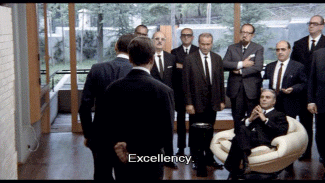
Excellency.

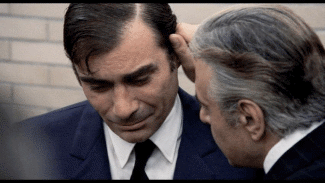
[Commander]
[Gently pulls the Chief's ear]
[Homicide Division Chief]
[Repentant and tearful] Excellency. I'm sorry to have inconvenienced so many important people.

[Commander] Eat this salt.
[salt protects from punishment]

[Mangani] Where were you, dear colleague between 3:00 and 7:00 p.m. the day of Augusta Terzi's murder?

[Homicide Division Chief] Excellency, gentlemen, I was there because I killed her.

[Commander] Can you prove you were at her house?

[Homicide Division Chief] I have some bad news. There is a witness. Unfortunately, the student Antonio Pace, a notorious subversive, saw me enter the building.

[Mangani] That's not true. The student Antonio Pace has a watertight alibi. He wasn't in Rome that afternoon. I questioned him for hours, my dear colleague, and I did it my way!

[Homicide Division Chief] Excellency, the bloody footprints discovered in Augusta Terzi's apartment. Not to interfere in the investigation, but they came from my left shoe.

[Commander] My dear friend, there are thousands of shoes of that size and model.

[Canes] I own a pair that's identical.

[Cop] So do I.

[Homicide Division Chief] Perhaps. But I left fingerprints all over her apartment, even on the shower faucet. Because, gentlemen, Excellency, I took a shower afterwards.

[Commander] Strange. Everyone left fingerprints on the faucets, cups and door handles, except for you.

[Homicide Division Chief] Yes, but the blue thread discovered under her fingernail comes from my tie.
[Commander] So, give us the tie with the missing thread.
[Homicide Division Chief] I destroyed it.
[Mangani] Why?
[Homicide Division Chief] In that moment I was torn between confessing and putting you on my trail or using the little bit of power I had to cover up my trail.

[Commander] A split personality, dissociation. Neurosis.

[Homicide Division Chief] A disease I probably contracted from my prolonged exercise of power. It's an occupational disease, common to those who hold the reins of our helpless little society in their hands.

[Commander] I'm healthy.

[Cop] Enough psychology! We need tangible proof of your guilt. Not just words, but facts.
[Homicide Division Chief] I made that poor idiot we arrested buy those 25 blue ties.
[Mangani] That's not true. He didn't recognize you.

[Homicide Division Chief] Yes, but we can admit what happened, between us. He denied it out of fear when he started to realize who I was -- a police officer.

[Commander] I will not tolerate these opinions and insinuations against your colleagues, the force, our institution!

[Mangani] Let's talk specifics. Your motive.What was your motive?

[Homicide Division Chief] She made fun of me! She made fun of me and our institution! Our institution! That means all of you, gentlemen!

[Commander] That's not a demonstrable motive.

[Homicide Division Chief] Please excuse me, Excellency. Gentlemen, excuse me. This is private. It won't take long. I rely on your discretion, Excellency. Every day that I was with her, my childishness and my inadequacies became more and more apparent.

[Commander] Absurd! Impossible! Science fiction!

[Homicide Division Chief] Well, then, I murdered her out of pure jealousy!

[Mangani] You didn't know her.
[Commander] Go on. Prove it.

[Canes] She wasn't your mistress. Nobody ever saw you together.
[All Cops] That's right.

[Homicide Division Chief] Excellency, gentlemen, these photos prove the victim was photographed right here.

Check the furniture, the floor. Here the victim strikes erotic poses that perversely imitate crime photos!


I exploited the situation for my love of amateur photography!

[Biglio and Patane]
[Beating the Chief over the head and shoulders]

[Cop] Disgusting!
[Cop] Look what we've come to.
[Cop] I'm at my wit's end.
[Cop] He's an immature child.

[Mangani] I always said he had no team spirit. See what things have come to?

[Homicide Division Chief] I'll petition the court!

[All Chiefs]
[Making a toast] Here's to your health.

[Homicide Division Chief] I'll do whatever you want.

[Commander] Well done, son. Do you have anything to say?

[Homicide Division Chief] I confess to my innocence.

[Mangani] Now sign here.
[Homicide Division Chief]
[Signs confession of innocence]

[Mangani] Everything's all right. Calm down.


[Homicide Division Chief] Gentlemen, colleagues, let's not forget there's still an enemy out there who knows the facts. He'll use them not only against me, but against all of us ...

against power, against God!

[Commander] That's a score we'll have to settle.
--
Investigation of a Citizen Above Suspicion, directed by Elio Petri