|
For all practical purposes,
the microcosm, our own individual world, is the only world we are
condemning or denouncing, in fact, is the only world we have the
slightest business to condemn or denounce...let us consider
whether we have the power to judge, not the world as a whole, but any other
individual whatsoever, in the world beside ourselves...we are always
dealing with ourselves and our inseparable shadows, not with a foreign
world....the whole point is this: that our own state of mind for the time being is
strong enough to tinge the whole of the world with its colours....Bear constantly in view this
fact, then, that the world we are judging is our own individual world...I want to make it quite clear that
I am not taking up the cudgels in defence of that terrible bugbear
"Idealism," nor doing battle with what the Philosophy of Common Sense
prides itself upon denominating "Realism." My sole object is to emphasise a fact which we are very apt to ignore, and which it is of the
utmost importance to remember.
The world we are condemning or praising
is not the world at large, but the world within ourselves...
Applied to the human organism, the aim is to transmute
gross muscular energy into fine nerve energy. This is
the idea of Plato in the "Republic," in which is embodied
the Greek Ideal...By
creating an "ideal" within our mental sphere we can
approximate ourselves to this "Ideal Image," till we become
one and the same with it ...Man's
conception of heaven is the ideal or perfect state of
consciousness which can express itself only, in the ideal or
perfect form and appearance...If "heaven" is the goal
of humanity, as it undoubtedly is, we might just as well
turn our eye in that direction now and here, by paying all
the attention we can to the laws of the human form, and
endeavouring to get as near as we can to the ideal..."The
Rider on the White Horse" portrays the evolution of a new
race upon the earth with new ideals, new methods, and new
conditions, which will transcend the civilisations of the
past...
For
thousands of years, cure of disease by Transference of
Nerve-Energy has been a well-authenticated fact in the
experience of mankind. It was practised in the temples of
Egypt and India long before the Christian era, and though it
fell more or less into disuse at various times and places,
it never in any age was entirely unknown to the few. In
modern times the man who brought it into prominent notice
was MESMER, from whom is derived the term
"Mesmerism."
Mesmer propounded, or rather formulated, the theory of a
Universal Fluid, which in reality corresponds in conception
to the scientific doctrine of Conservation of Energy, and
applied it with astonishing success to the alleviation of
pain and the cure of disease...
The term "Personal Magnetism" has been rather extensively used within
the last few years, but there are many objections to it, though from a
popular standpoint it does fairly well. Reichenbach, coined the term Od
or Odyle, but this does not, somehow or other, carry sufficient weight
to render it an ideal word. Unquestionably
the best term of all is that used, and so far as I know coined, by
Lytton in The Coming Race. It expresses, with precision, nerve-energy
and will-force combined in the developed individual. The word itself
suggests the very noblest and highest ideas connected with mankind.
The Romans used the words "vir" and "virilis" in a very different sense
from "homo." The latter signified a mere man pure and simple, while the
former expressed a lofty conception of the genus homo. The word
vir or
vri has the
same signification, more or less, in all the Aryan languages, e.g., in MacDonell's
Sanskrit Dictionary, the following is given: Vi-rá, m. (vigorous: √ vi) man, esp. man of might, hero, champion, chief,
leader; Vir-yá, n. Manliness, valour, power, potency, efficiency, heroic
deed, manly vigour; Vra-tá, n. (willed, √ vri, perh. old p.p.)
will,
command, law, ordinance, dominion. The term
"vril," therefore, naturally signifies
the height of dominion attained by cultivation
of man's latent power, and, as such, is the best that could possibly
have been devised...
I had been studying as well as teaching the science of breathing for
years before I realised the actual significance of the cranial
air-chambers in respiration and the immense part they played in human
evolution. I had read most of the books published on breathing,
especially the textbooks of Physiology containing chapters
devoted to respiration. In not a single one had I ever come
across a passage bearing upon the importance of the cranial
sinuses. And -- perhaps a feature more curious than the
silence of the text-books -- in not a single piece of poetry or a romance
in which wonderful visions are portrayed
is there to be found any reference to the potentiality of the cranial
sinuses. The reader meets with ideally beautiful women, majestic
super-men, but no hint is dropped as to the process
of their evolution...
For the practical purposes of Ars Vivendi breathing, all that is really
required to understand
is that in addition to going down to the
chest, the air also goes up to the region of the forehead. The frontal
sinuses are roughly marked by the eyebrows; the sphenoidal (perhaps the
most important) are just behind the eyes; the others are located at the
root and sides of the nose. These little cavities are small in size compared with the chest, and the
volume of tidal air going in and out of them is insignificant compared
with the volume going in and out of the lungs; but they contain the
essence of the life of the whole system, and they regulate and control
the development of the human being physically, mentally and morally...
The principal factor is the inability of the sinuses to open out
in the normal manner, as they were intended by Nature to do in normal
growth of body and mind. Just as one child does not thrive physically
through lack of sufficient air in the body as a whole, so another child
does not thrive mentally through lack of sufficient air in the cranial
sinuses as they open out in normal growth...
The method I have found most successful both
in personal treatment and by correspondence is
to direct the student to imagine a V placed in
the centre of the forehead between the eyes, and
to start breathing as silently as possible and without
strain or effort with mouth closed, from the
centre of the nostrils, roughly the bridge of the
nose, upwards to V. The out-breathing to be
done in the same manner with mouth closed, and
with as little noise as possible. By degrees, as the nostrils become clearer, and the breathing habitually
more easy and copious, the V will seem to be more pronounced. This is
the beginning of a higher stage of evolution, corresponding somewhat
faintly to the halo of light represented in art as surrounding the head
of "saints." It is an actual mental illumination brought about by
chemical action of the oxygen in the air inspired. At this stage, V reveals itself as
symbolical of the very highest conceptions of man, such as Vitality,
Vision, Will, stamped upon the human brow. It is "the white stone on the
forehead," the abode of the spirit in man. In Sanskrit literature, Shiva
or Spirit dwells in the forehead.
Swedenborg and all the mystics arrive
at the same conclusion. The sign V placed in the Ars Vivendi manner, unites in one plain but
comprehensive symbol the universal aspiration of the human race....
There is no chance working at random, producing a genius here and a
dunce there. The signs are written at the root of the nose for all who
can read them, marking unerringly the narrow-minded,
the broad-minded, the dull-witted, the degenerate, the weak-willed, the
intellectual, leading up to the eagle eye which takes in a
situation at a single glance...
The
portraits of Napoleon in early life show this
trait unmistakably. The formation of forehead
and root of nose reveal plainly his ability to freshen
and clear the brain. ...
In the Hebrew alphabet the letter
vau symbolises
light and brilliance. Fabre d'Olivet, a French
author, commenting upon its signification, says
that it is the universal convertible sign expressing
the deepest mystery of creation, and linking together
the light of the physical senses with the inner spiritual light...
There is only one way of doing it
and that is growing a new eye, capable of receiving and interpreting the
rays of the inner light as the physical eye receives
and interprets the rays of the physical light...
The Ars Vivendi principle of breathing up to the V in the forehead is
the direct road towards the Light which shineth in Darkness, and is
therefore
the final and universal religion embracing all nations, all sects and
all creeds in a comprehensive unity of Inspiration and Aspiration, for
God is Light and God is Spirit, and they who worship must worship in the
Light of the Holy Spirit of Breathing and Truth.
--
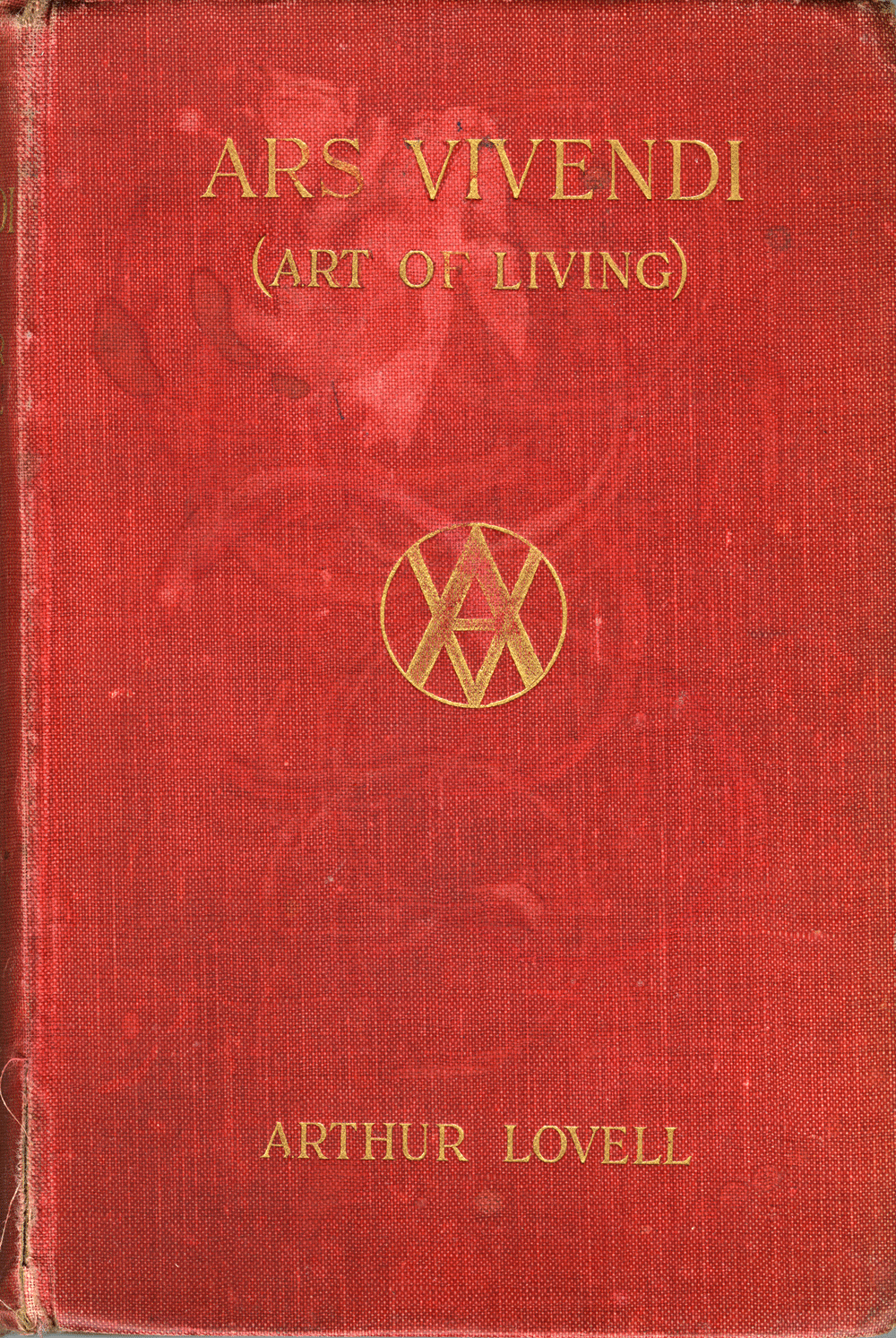
Ars Vivendi, by Arthur Lovell |