|
The Main Work:
Daily 5 to 10 minutes. Repeat the indicated exercises of the preliminary
work for seven days. After the sixth day move the index finger of your
angled hand, after it has been animated by Sa, to your nose. If you
smell a slight sulphurous odor, you can proceed. If such is not the
case, you must exercise for seven days longer.
Daily 10 minutes, 14 days long: The I is formed and animated by Si, Si,
Si. When warmth is felt the hand is dropped and the A is formed,
animated by the formula alam. The hand is moved into the Neck-grip at
the neck, constantly repeating the formula. After a while remove the
hand sharply. Then the O is formed again as before. After 14 days the
bitter taste of mercuric chloride will be perceived if the index finger
of the angled hand is placed on the tongue.
Daily 10 minutes, 14 days. The student forms the
I sign,
which he animates with Si, then the A-sign, which he animates with:
two days Alam
two days alamas
seven days alar
three days alamar
After the first four days there will be a perceptible slaty taste when
one puts the index finger of the angled hand on the tongue. Then it is
time to sharpen one's vision. If the student perceives a black shadow,
this part of the work is finished....
Once the student has
glimpsed the blackish shadow, this day is to be celebrated
as the beginning of a new life -- the student receives his
lodge-name....
The colors that the student slowly
begins to see are: out of the blackish shadow evolves a blue, then a
light red that soon fades into a pale green that becomes fresher from
day to day. Once the green appears very clearly, this work is finished.
The student changes to the Middle-grip,
with which the formulas alam, yas, sa, cham come into use. The
developing colors show an intricate interplay and finally fade into a
yellowish white. By means of the Master-grip and the formulas: cham,
cham asak, ka this yellowish white is transformed into a brilliant
white, which the mystics of the Orient cannot praise enough. The
Pursuant Work shall turn this white into a magnificent red....
With this the work of the Oriental
Mason is finished (the work upon one's self). From a raw, uneven stone
he has become a cubical one....
The words of recognition are: key,
water, fire, level, black, white, red, rose, stone. As will be
understood later, these words describe the entire work....
We must only further discuss the
pronunciation of the Arabic words. They are to be pronounced as they are
written, the transcription is very precise. The S is pronounced like a Z, as is the Z also. So one
does not say natzim but rather nazim. With words of more
than one syllable the emphasis is on the second syllable, alam - alám.
The CH is a guttural which may cause some difficulties. It is harder
than the ch in German ach, and tends more toward the k-sound. In Arabic the Science of the Key is also
called the Science of the Scale: Ilm el Nazan....
In order to forestall the idea that the
present book is any sort of betrayal, it must be said that it has been
written by command of the chiefs of the order. The reason is as follows:
The so-called civilized world has been overcome by a great organization
of infidels -- monstrous in extent -- and religious institutions have
already been undermined by this to such a degree that they are not able
to mount any unified resistance. In this emergency the Islamic brothers
remembered that the tradition says that in earlier times the science was
known in Europe. They sought and investigated -- and found -- in the
writings of the Rosicrucians and those of the alchemists that these
exemplified the Science of the Key in their books perfectly. The
assignment is to make people aware of this and to show seekers the way;
the requirements of the times allows any consideration against
publication to vanish. May the truth of the process of victory begin and
the clouds of darkness slowly, but all the more surely, disperse, "alam."
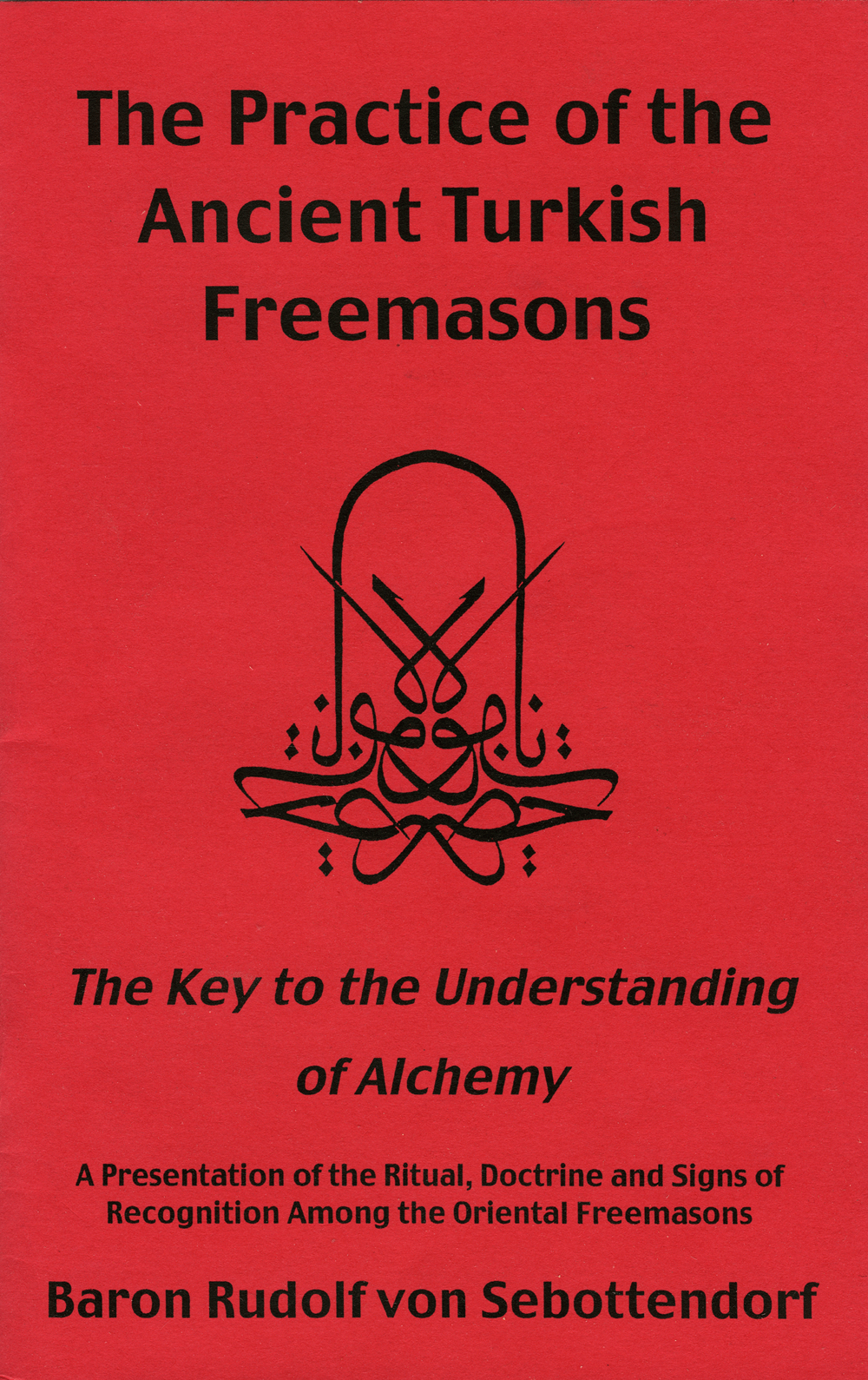
-- The Practice of the
Ancient Turkish Freemasons, by Baron Rudolf von Sebottendorf
|