|
HEALING: THE DIVINE ART |
|||
|
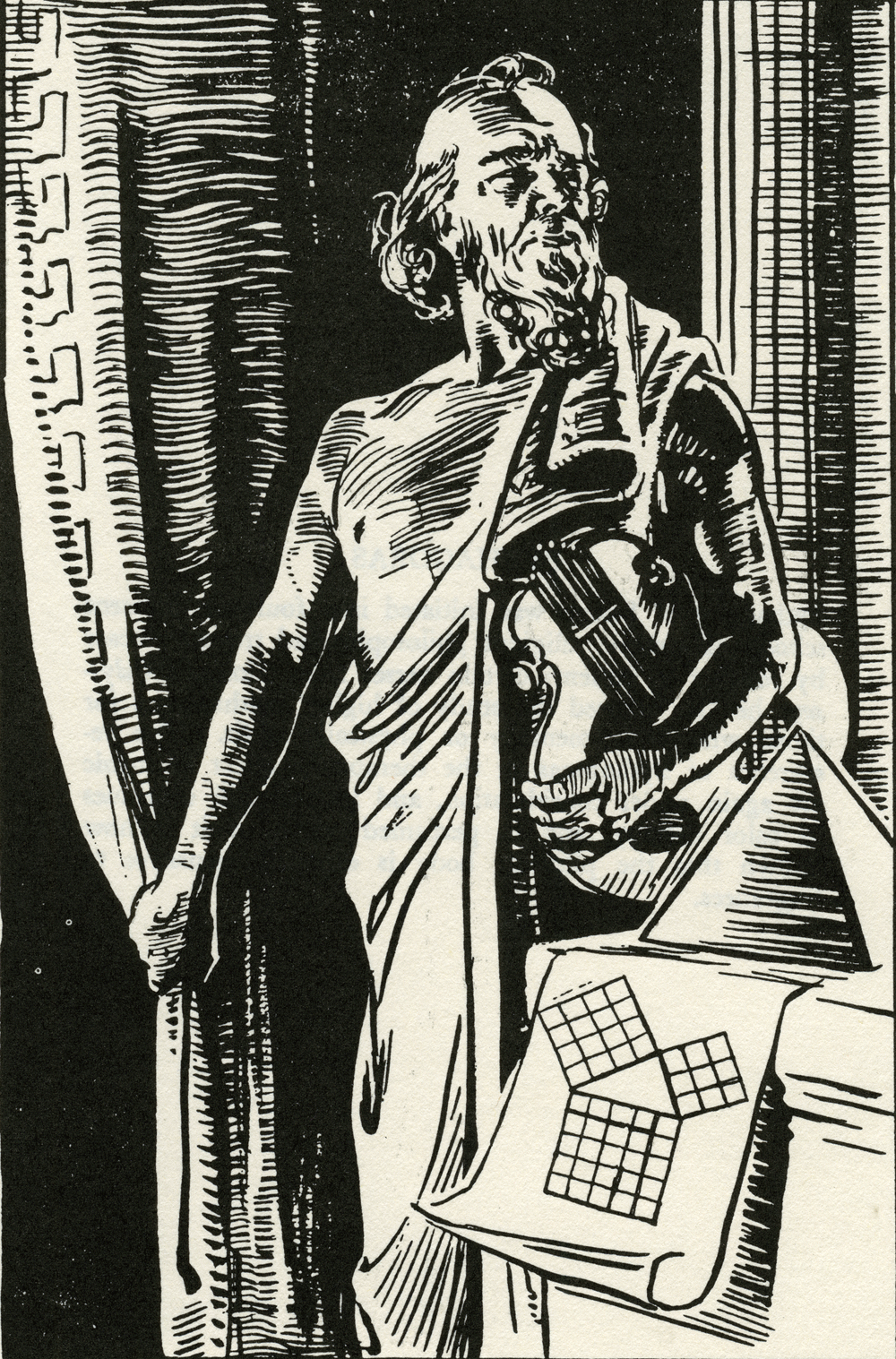
PYTHAGORAS Pythagoras of Sarnos was initiated into fourteen different schools of esoteric religious philosophy and treated disease by reading to patients certain verses from Homer's Odyssey; he also advised the study of higher mathematics for those who were mentally or physically unfit. The researches of Pythagoras in the therapeutic effect of music are again under consideration, and interest still continues in color therapy, and in perfumed odors, as it is now known that the pituitary body is especially sensitive to fragrances.
Pythagoras (6th century B. C.) taught in his school at Crotona the systems of occult healing practiced by the priests of various Eastern and near-Eastern cults CHAPTER 5: MODERN HEALING CULTS THEIR CLASSIFICATION ACCORDING TO METHOD -- OCCULT HEALING -- MAGNETIC HEALING -- MYSTICAL HEALING -- MENTAL HEALING -- PHYSICAL HEALING. THEIR CLASSIFICATION ACCORDING TO METHOD THERE is something almost awe inspiring about the certainty with which the spiritually minded can differ about the same thing. To gather the religious beliefs of human beings into one chapter of a book thus becomes almost as difficult as it would be to assemble the believers themselves under one roof. Most healing cults resent proper classification of their methods, for each feels that it is especially favored of the gods, is entirely unique, and is infinitely superior to all of the others. For the same reasons none relish being included with several rival sects in any literary pattern. As it is no desire of mine to breed dissension or cause unhappiness among the metaphysicians, it has seemed expedient to classify the various systems of healing according to the methods employed, rather than by names or claims. For comparative purposes, metaphysical medicine can be arranged under four general headings; occult healing, mystical healing, mental healing, and physical healing. In some cases more than one method is employed by a group or practitioner; whenever this occurs the combination should be separated into its basic parts and each considered under its proper heading. In Europe and America most healing cults are nominally Christian, but the technique which they use may be derived from ancient pagan or modern Asiatic sources. As metaphysical healing has been practiced with equal success by nearly all the great religious systems of the world, there is nothing to indicate that one faith has ever been favored above another in power to heal the sick. If miracles seem to be more frequent among non-Christian peoples, it is because the religious spirit is more vital with them than with us. OCCULT HEALING Occultism is the ancient science which deals with the hidden forces of nature, the laws governing them, and the means by which such forces can be brought under the control of the enlightened human mind. An occultist is one who believes in the reality of esoteric sciences, has studied them in a scholarly manner, has resolved to perfect his own consciousness according to their rules, and may, or may not, be able to practice the rituals and formulas of Transcendental Magic. The occult sciences are the secret teachings of the World Saviors, prophets, seers, sages, and initiated philosophers, with which they instructed their most intimate disciples. This body of esoteric tradition has descended to the present time through the medium of secret religious societies, which therefore are in possession of a most sacred and peculiar knowledge of extra-physical energies, faculties, functions, and powers. The most important of the occult sciences are magic, demonism, exorcism, alchemy, cabala, astrology and other forms of divination, spiritism, magnetism, esoteric cosmogony, and anthropology, the metaphysical physiology of man, and the extra-sensory perceptions. The well informed student of occultism is one of the most universally learned of human beings. He must be acquainted with all of the important systems of world philosophy and religion, both Eastern and Western, and he must have a thorough understanding of ancient sciences and arts. There is no place for the superficial thinker in this field; and should he wander in by accident, it would be wise for him to depart in haste. According to the rules of occultism, all particulars must be suspended from universal principles. In the case of healing, any particular cure must bear witness to some general philosophical pattern; that is, it must be explainable in terms of the relationship between the macrocosm and the microcosm -- between the universe and man. Strangely enough, there is no place for miracles in the sciences of Magic. Occultism defines a miracle as an effect, the cause of which is unknown; but the cause must be equal to the effect which it produces. Knowledge is power, and esoteric knowledge bestows the larger power which appears miraculous to the uninformed. The great occultist Paracelsus said, "The beginning of wisdom is the beginning of supernatural powers." Buddha taught that the universal disease of mankind was ignorance, and wisdom the only remedy. This statement sums up, exactly, the attitude of the occultist. It is his conviction that the world is ruled by absolute and immutable laws; to know them is to be wise, to keep them is to be happy, and to break them is to die. Many of these laws are unknown to material scientists, whose faculties are not developed to explore the fourth-dimensional vistas of spirit-space; but it is through such strange laws and knowledge of them that so-called miracles are produced. Occult healing may be defined as a method of treating various distempers of the mind, soul, and body, by means of a superior knowledge of the spiritual laws governing health. The remedies may be either physical or metaphysical, as the case may indicate, but the philosophy involved is entirely different from that which guides the medical practitioner. Occultism does not teach that good health is the natural birthright of man. Health is reserved for those who know how to live, and have the courage to live what they know. The ignorant can never be well, for cured of one ailment they immediately fall victim to another. Health, like happiness, must be earned. Those who would enjoy either, must set the proper causes in motion. Many of the systems of occult medicine practiced in ancient times are without apologists in the modern world, but such as seem likely to be revived I will include in the present survey. For some reason difficult to understand, the greatest of all classical institutions of healing, the Oracles of Asclepius, have no counterpart in present society, and the entire field of dream therapy is ignored. Pythagoras of Samos (6th century B. C.) was initiated into fourteen different schools of esoteric religious philosophy. He traveled as far as India, and was accepted into the Brahman Mysteries at Ellora and Elephanta. He is the only non-Hindu ever to be so honored. In his school at Crotona, Pythagoras taught certain of his more advanced disciples the systems of occult healing practiced by the priests of various Eastern and near-Eastern cults.
Pythagoras treated disease by reading to patients certain verses from Homer's Odyssey, but whether it was the words of the poem or the voice of the master that possessed healing power is not recorded. This Samian sage also advised the study of higher mathematics for those who were mentally or physically unfit, because contemplation of the orderly sequences of numbers would subdue the intemperate impulses of the soul and body. It may be interesting to note that Emanuel Swedenborg is said to have become clairvoyant as the result of his addiction to arithmetic problems. The researches of Pythagoras in the therapeutic effect of music were revived after the First World War, and experiments were made with men suffering from so-called shell shock. The results were sufficiently positive to arouse considerable interest, and the subject is still under consideration. Greek music was composed according to modes, and the Archon of Athens had enough faith in the occult power of the musical composition that a man could be exiled as an enemy of the state should he write a song in the wrong mode. The Pythagoreans were probably the first to experiment in color therapy, from the principle that it was possible to be fed through the eyes. From the same premise, they exposed various symmetrical geometric solids to the gaze of the sick, in order that the soul might benefit from the harmonizing influence of perfect proportion. This last method they had learned from the Egyptians. Perfumes, incense, and various magical fumigations were also used for healing purposes. These were compounded with the greatest of care, and the odors were believed to pass through the nostrils directly to the brain. It is now known that the pituitary body is especially sensitive to fragrances, so further research along this line might be profitable. A French perfumer has created what he calls a scale of odors, similar to a musical scale, and claims to be able to compose harmonic perfumes by this means. Astro-diagnosis and astro-therapy have been practiced for thousands of years, and prior to the middle of the eighteenth century most physicians made use of astrology. Even Lord Bacon allowed that plagues could be predicted from the motions of the stars, and it is reported of him that he fainted whenever there was an eclipse of the moon. Rene Descartes was no convert to the art, but he grudgingly admitted that astrology could not be disproved. Upon the authority of Hippocrates, Galen, and Avicenna, medieval astrologer-physicians developed an elaborate system of correspondences between the planets and herbs, chemicals, and mineral medicines. They administered these according to rules of sympathy and antipathy, and judged the disease by the afflicting planet and its aspects. Diseases of Saturn were offset with remedies of Jupiter, and critical days were determined by the moon. Seventeenth century England produced several important writers and practitioners along lines of astrological medicine. Dr. William Lilly, Dr. Nicholas Culpeper, and Dr. Henry Coley were the most famous of this group, and these men enjoyed the patronage of Sir Elias Ashmole, to whom some of their astrological books were dedicated, with permission. An interesting phase of astro-diagnosis was the old practice of setting up a horoscope for the exact minute when a sample of the patient's urine was taken to the doctor. This enabled the physician to select the proper remedies to take with him when he visited the sick person. Several modern metaphysical organizations make use of astrology to diagnose sickness and disease in connection with spiritual healing. It does not seem that many of them attempt to prescribe medication by this method, but for those who believe that the subject of astrology is not worthy of consideration the words of Dr. Carl Jung may prove discomforting. "I use astrology," he wrote to a friend, "in my difficult cases." The tradition of alchemy is also long and venerable. It flourished in Egypt, India, and China long before the beginning of the Christian era, and is rightly described as the mother of chemistry. All alchemists were not gold-makers, and it is on record that the most important ones were violent in their denouncement of the transmuters of base metals. The great quest in alchemy was for the Elixir of Life and the Universal Medicine. A few like Raymond Lully, Basilius Valentinus, and Albertus Magnus claim to have found the Wise Man's Stone, but if they did, the formulas still lie hidden in the archives of secret societies. In seeking after the ultimates of chemistry the alchemists made many important discoveries along the way, and these have enriched the pharmacopoeia of modern medicine. Sir Isaac Newton was sufficiently impressed by the literature of alchemy to collect a magnificent library on the subject for his own use. When this library was finally broken up, many of the books were found to contain thoughtful notations made by Newton's hand. Alchemy is too obscure a subject to find a place in popular metaphysics, but occasional references are made to it, and human regeneration is sometimes called spiritual alchemy. There are a number of advanced occultists, however, who are carrying on alchemical experiments in private laboratories. It has been my privilege to know some of these men, and study closely the work they are doing. They should not be confused with the gentleman who was selling chips off the Philosopher's Stone a few years ago. The Cabala is the secret doctrine of Israel, descended by oral tradition through the priesthood, from Moses the great Lawgiver. During the Middle Ages, both Jewish and Christian scholars were deep in cabalistic speculation about the origin of the universe, the letters of the Sacred Name, and the hierarchies of the blessed and infernal angels. The Sepher ha Zohar, the Book of the Splendors, has only recently been available in the English language. This is the great text of the Cabala, and those who wish to study the subject should accept no other authority. Popular numerology is not Cabalism.
The Ceremonial Cabala includes an elaborate development of the science of Demonism. Various spells and formulas are given for the binding of spirits so that they must obey the will of the Magician. Some rabbis, especially in the old country, exorcise demons, and cure spirit-possession by Cabalistic rites. Many orthodox Jews will have nothing to do with the Cabala, but most metaphysical philosophers of their race have been influenced by its teachings. All forms of Transcendental Magic contain elements from the Cabala. The French occultist, Abbe Louis Constant (Eliphas Levi) invoked the spirit of Apollonius of Tyanna for Lady Bulwer-Lytton with the aid of Cabalistic spells. Ceremonial Magic is mentioned here because it taught that spirits and demons could be called upon to heal disease and prolong life. The Rosicrucian physicians of the seventeenth century combined alchemy, astrology, the Cabala, and magic in their secret system of therapy. Among the doctors of the Rosy Cross should be mentioned Robert Fludd, Michael Maier and John Heydon. In his Theatrum Chemicum Britannicum, Elias Ashmole notes that a Rosicrucian physician was able to cure the young Duke of Norfolk of the leprosy. Some modern Rosicrucian movements include healing among their activities, but the methods used do not necessarily relate to the theories of the old order. Magnetic healing was known to the Egyptians, Greeks, and Hindus, and was practiced by them in remote times. The sorceresses of Thessaly treated the sick with metal rods called fingers, and the Chinese highly valued amber for its magnetic qualities. Later, in Europe, the lodestone was held in similar esteem. Magnetic healing and animal magnetism were revived in the eighteenth century as the result of the experiments of Anton Mesmer with his celebrated tub. Some magnetic healers, or mesmerists as they are now called, make use of instruments intended to store up or direct the course of the magnetic currents. Others depend entirely upon the magnetism of their own bodies, which they direct with mental impulses, or with motions of their hands over the body of the patient. Since the development of electrical therapy, a number of magnetic devices have been offered to the public. The best known are the magnetic belts which plug into a light socket and are referred to as 'horse collars' by the profane. The belief that, in the matter of health, those who have departed from this life can be of assistance to the living, is a very old doctrine that has survived to modern times. This is spiritistic healing, and a medium is usually consulted who will attempt to contact some decarnate intelligence to gain the knowledge necessary to prescribe the proper remedy. This procedure is based upon the belief that the dead who have already passed into the spirit world have discovered secrets about the hidden side of nature, beyond the knowledge of the living. Persons naturally sensitive to psychic impressions may attempt to communicate directly with some guide on the inner planes without recourse to a professional medium. Several cases have come to my attention of persons who received instructions in healing and solutions to their own health problems from entities which they contacted by mediumistic means. Widely accepted among modern metaphysicians is the ancient belief in the reality of certain superhuman beings called Initiates and Masters. A number of sects have arisen which involve these Adepts in their methods of healing. Adepts are such disciples of the occult sciences as have attained to great knowledge and power, and have been initiated into the secret schools of the esoteric wisdom. In India these Initiates are called Mahatmas, and are supposed to abide in remote places far from the habitations of ordinary mortals. These great souls are usually regarded as teachers and sages, but occasionally they perform miracles of healing. In the modern occult world, the Adepts are regarded with the same kind of veneration that the Catholic feels for his saints. Prayers are addressed to the Masters with the full conviction that these Initiates will be aware of the supplications, regardless of distance; and will answer them with appropriate demonstrations of supernatural power. The wonderful stories which have been circulated about these Initiates and Masters are well calculated to increase faith in their ability to heal all manner of disease, and belief in these superhuman beings has become a potent force in modern theories of metaphysical healing. There are a number of Hindus and a few other Asiatic teachers of metaphysics in this country who include philosophies of healing among their doctrines. Most of these Orientals combine diet, exercise, and rhythmic breathing with their occult forms of treatment. The power of the mind over the body is emphasized, and various esoteric disciplines are taught. This group holds the general view that the ailments of the body can be corrected by purifying the system and increasing the spiritual energies through meditation and the practice of the Yogas. Mantras, the Hindu hymns which proclaim the inseparability of the gods, monads, and atoms are also used by these cults; and in their teachings obscure references are made to the kundalini, the universal life-principle which everywhere manifests in Nature. As there is little organization among these Oriental teachers, it is very difficult to give an adequate summary of their methods. The diagnosis and treatment of disease by the study of the aura, or magnetic emanations of the human body, was practiced by the priests of the old Mystery cults. The Kilner Screen, invented by Walter J. Kilner, B. A., M. B., Cantab., M. R. C. P., etc., late Electrician at St. Thomas' Hospital, London, has now brought this subject within the field of physical scientific research. Dr. Kilner was able to devise for those without clairvoyant training a simple method of stimulating the human eye so that it is capable of seeing auras. European occultists are carrying on many interesting experiments suggested by old writings of medieval alchemists and magicians. Indicative of the trends are these: The possibility of capturing the rays of the planets in dew; research in the Druidic lore of the mistletoe, as a medium for the astral light; and investigation into the crystals formed in human blood, by the process of drying. Diagnosis by divination has also been widely practiced. That eccentric genius, Jerome Cardan, wrote a book on the occult significance of moles on the body, and in the lines of the forehead. The late Count Louis Hamon (Cheiro) told me that he could tell the condition of a person's health by the lines on the hands and the condition and shape of the finger nails. The Chinese can accurately predict the number of children a woman will bear, from the small lines in the corners of her eyes; and they will also determine the length of life from the angle of the cheek bones. All such methods belong to the general field of the occult sciences, because if they are true, they bear witness to laws operating in the body of man. An occult healer is a person learned in all the obscure arts and philosophies which bear upon the health of man. His ways may seem strange to the uninformed, but the practice of metaphysical medicine is justified by thousands of years of tradition and sanctified by the veneration of ages. MYSTICAL HEALING Mysticism may be academically defined as the belief that the direct knowledge of God and Truth is possible to man through an extension of his spiritual insight toward union with the substance and essence of Divinity. In common practice, mysticism is a simple and abiding faith in the power of God to accomplish all things necessary to the life and happiness of man. A mystic is one who practices the mystical attitude toward life, and rejects formal religious theologies, believing that God may be approached through personal devotion, and the contemplation of Divine Truths. A mystic may, or may not, believe in a personal God. To most Christian mystics, Deity is to some degree personal, capable of likes and dislikes, and able to hear and answer the prayers of the faithful. Among Oriental mystics the Divine Nature is usually regarded as impersonal, and is adored as the Universal Reality, to be glorified rather than supplicated. The mystical arts are the traditional disciplines by which the human consciousness is brought into a state of attunement with the World Spirit. These disciplines are largely derived from the lives and teachings of great mystics who are known to have achieved the Cosmic Consciousness.
The popular mysticism practiced in modern metaphysical movements has been called 'the heart doctrine,' and the followers of these cults are taught to live from day to day with the emotion of 'Divine Love' uppermost in their consciousness. Unfortunately, the average student of these subjects has no comprehension of the meaning of the words "Divine Love," and he can only assume that they signify a sublimated kind of human affection. He therefore tries to love God as he might try to love another human being, and the result is anything but true mysticism. It is difficult to define in words a spiritual process that has no equivalent in the outer life of mankind. Brother Lawrence defined mysticism as "the practice of the presence of God." This is a noble statement, and certainly inclines the mind in the direction of mystical conviction; but it is not the complete definition. Perhaps we can add, mysticism is participation in the Divine Nature of Being. Participation means to share in common, or to partake of, a substance, quality, or action. There can be no true mysticism without this becoming aware in God. The practice of the mystical disciplines must result ultimately in the attainment of the mystical state. A strange enthusiasm (from the Greek enthousiazein, to be possessed by a god), rises up and fills the consciousness of the mystic, and he is obsessed by a powerful ecstatic emotion of exaltation or rapture. While thus transported he feels himself one with God, and a part of all that lives. As the mystic becomes more sensitive to the sympathies present everywhere in nature, it is ever more difficult for him to resist the emotional or mystical content of life about him. Dante could not gaze upon an open rose without being so completely overcome by its beauty that he lost human consciousness in an ecstacy of exquisite pain. The great East Indian saint and mystic Sri Ramakrishna, spent many hours of each day in rapturous contemplation of the Motherhood of God. In the last years of his life, Ramakrishna could not think or speak of the Beloved Mother of the World without passing into Samadhi, the superconscious state. When this mood came upon him, it was necessary for his disciples to support his body, to prevent him from falling to the ground. The earlier forms of Christian mysticism were largely dominated by the emotion of suffering. Men sought to come nearer to Christ by experiencing his pain. This was the mysticism of participation through agony. The exquisite sweetness of great pain in Christ, led to the extreme austerities and physical disciplines of the Monks and Fathers of the Church. "Oh! how sweet it is," cried St. Alphonsus, "to suffer and die, embracing the cross." Modern mystics seldom go to the extreme of Sufi or Dervish ecstacy; they are satisfied to follow along the ways of prayer and faith. They believe that God is truly an ever present help in time of trouble, and turn to Him whenever pain or sorrow comes to them. The one really mystical attitude of these people is their firm conviction that Deity can be reached by personal appeal. Mystical healing, in practice, is most often faith healing, and depends for its accomplishment upon the stimulating of the faith content in human nature, and the psychological and biological results of sincere conviction upon the functional processes and organic structure of the body. Through faith, the power of God is released in the human chemistry to work its wonders and renew the life of the flesh. The mystical healing of the Catholic Church is closely associated with venerated shrines, holy relics, and sacred images. Through pilgrimage to sanctified places and meditation upon the symbols and objects of faith, the chemistry of the body may be profoundly influenced. Modern scientists are inclined to believe that the healings resulting from faith are psychological rather than spiritual, but they admit that results are obtained in cases where the doctor fails. Of the mystical healings at Lourdes in France, and St. Anne de Beaupre in Canada, Dr. Howard writes: "Relics and shrines cure today as they did in medieval times. Modern physicians even have sent some of their patients to be thus treated. All diseases due to hysteria or to melancholy states of mind are susceptible to such cures. Even men and women suffering from incurable diseases are temporarily improved by the hope that is inspired in them." Dr. Alexis Carrel is reported to have been converted to the Catholic faith as the result of seeing a cancer wither away and fall off a man's hand in a few moments at the shrine of Lourdes. It would therefore appear that faith can work miracles beyond the mere improvement of morbid psychological attitudes. The power of holy relics and the intercession of the saints are sustained from the words of the Scriptures. According to Acts 5, xv, xvi, the shadow of St. Peter cured the sick, and it is recorded in Acts 19, xii, that cloths that had touched the body of St. Paul had the power to restore health. It is therefore upon the authority of the words of Christ, and the testimony of the Disciples, that faith healing is practiced also by the protestant Christian denominations and metaphysical Christian sects. It is widely believed by these organizations that the spiritual curing of disease is possible to those who have a complete and abiding faith in Christ and his ministry. Other religions hold a similar belief, regarding their Prophets and Saviors, and examples of faith healing resulting from sincere conviction of the healing power of God are to be found in all parts of the world. To effect a healing by faith it is usually necessary to intensify the religious emotions of the sufferer in one of several ways. Faith healing in the orthodox Christian sects is frequently part of evangelistic revivals, during which the evangelist works upon the emotions of the audience until a condition approaching crisis or ecstacy is produced. Religious healers most often work against a background of this emotional intensity. Many religious organizations teach the value of direct prayer in the curing of bodily ailments. The sufferer may pray himself, or the prayers may be said on his behalf by a priest or clergyman. It is also common for a group or congregation to unite their prayers on behalf of a sick person. It is also a Christian belief that prayers may be addressed to Deity asking help for the sick by anyone of sincere and devout mind; and men may pray for the health of each other, and for those dear to them. When respected national leaders are stricken it is usual for congregations of all denominations to unite in prayers for the recovery of such outstanding men. Healing by the laying on of hands is a very ancient form of mystical therapy, and has been widely practiced among Christian religious groups. The healer has usually believed himself to possess a spiritual power derived from God, which he is able to communicate to other persons by touching their heads or the affected parts of their bodies with his hands. By this contact, the spiritual virtue passes into the sufferer, accomplishing a cure by the direct power of God. Laying on of hands is sometimes confused with magnetic healing, but the two methods are entirely different in basic principle. It has always seemed to me that the great power of faith lies in the changes that it can bring about in our living and thinking. When a man is converted to some religious belief by the conviction of his own consciousness, the mental, emotional, and physical parts of his nature are all profoundly affected. Diseases which were the direct or indirect results of the previous patterns of his living and thinking may cease in him, because his new life pattern does not support them. We are all acquainted with the type of doctor who says to his difficult patient, "My good fellow, what you need is a change of air," Very likely the physician is merely tactfully admitting his desire to terminate relationships with the case. But the advice may be far more sound than it appears. Human beings get into ruts, and these ruts can result in sickness and disease. Many a doctor has had the embarrassing experience of meeting on the street a hale and hearty person whose face is vaguely familiar. "Don't you know me?" beams the stranger, "I'm the chap you told, ten years ago, that he had just six months to live." It then develops that the erstwhile patient was so frightened by the prospect of an early demise that he resolved to get well at all cost. So he went to a ranch in Nebraska and his improvement was immediate. The trip to the West and the outdoor life unquestionably did a great deal of good, but there was more to the cure than vigorous living; there was a complete change of outlook, mental and emotional. New faces, other values, and different standards of living, all these played their part. The young man became a new person; and that new person was not subject to the old ailments; so he got well. If such changes can be brought about by shifting the personality pattern into a new environment, as much or more can be accomplished by changing the mental and emotional patterns. People can become allergic to themselves. The only remedy that is appropriate to such cases, is for the individual to change himself. Under certain conditions, religion can bring about this change. An old gentleman once told me that he had cured inflammatory rheumatism by joining a certain church. His friends ridiculed the idea, but it was probably true. Inspired by a new religious zeal, he had earnestly endeavored to mend his moral ways, and his physical health cleared up as a result. MENTAL HEALING Thousands of years before the advent of Freud, Adler, and Jung, the Witch Doctors of Africa, the Shamans of Asia and America, and the Priest-Physicians of classical Greece, were aware of the psychological factors which influence the lives of human beings. But, because these old occultists involved their knowledge in mystical and metaphysical rites, and used religious and philosophical terms in explaining their conclusions, the entire subject was ignored by modern scientific thinkers, who would not descend from the heights of their smug materialism to examine the 'superstitions' of the ancients. It therefore remained for the nineteenth century A. D. to re-discover what the nineteenth millennium B. C. already understood. A considerable part of psychological lore is still in the keeping of religion. In recent years a number of religio-psychological cults have arisen which are attempting to rescue the spiritual values in psychology from the rank materialism of most academic practitioners in the field. It is possible that one of the reasons why scientific psychology has not lived up to the hopes and expectations of its enthusiasts is, that in borrowing its principles from the ancient temples, too much of the religious and philosophical parts of the doctrine were rejected and ignored. Mentalism teaches that the various phenomena of life are of mental origin, that the universe itself is a creation in mind, that the laws of nature originated in the world of thought, and are administered by cosmic intelligence, and that God is the mental, or Intellectual Principle that rules all things, and not a spiritual Being. Mental science is a collective term used by metaphysicians to cover that aspect of spiritual culture by which the individual is improved through personal application of the universal laws governing spiritual thought. It further assumes that mind and not matter is an actual reality, and that the illusion of matter can be controlled by mental power. By this teaching, material life is a false attitude held by a mind which is ignorant of its potential power to dominate all material substances and conditions. Mental healing is any form of spiritual-psychological therapy which operates on the principle that the mind can correct the evils of sickness and disease, and restore health by reconditioning the mental outlook. Mental healing differs from academic psychotherapy in the emphasis that is placed on the spiritual aspect of mind; and in the teaching that spiritual mind is capable of bringing about a state of perfection in the consciousness of the individual. It is important to point out that it is a cardinal tenet of most mental healing cults that health is the natural state of man; sickness is the result of the acceptance of mental error. In this respect, the modern doctrine differs widely from the ancient philosophical belief: that sickness and disaster were natural to all mortals, until they perfected their standards of living. To metaphysical mentalists, God, the spiritual mind of the world, desires the health of man, and sickness comes from wrong thinking and not from other spiritual, moral, or physical causes. God wishes all creatures to be healthy and prosperous, but in order to achieve this state, they must realize that this is the Divine Will, and make it their daily task to reaffirm this fact in every thought and action. Mentalism as a religion is represented by a wide variety of sects, each differing from the others in terminology and minor details of procedure, but all agreeing that mind is the origin of happiness and misery, health and sickness, even life and death. A few groups have attempted to prove that it is possible to overcome death, the last great enemy, by setting the mind firmly in the realization of the eternity of life; but to date, none of them has been able to extend man's existence beyond the usual physical span. A strange contradiction comes into the practices of many of the mentalist sects. While claiming the unreality of material things, these groups are deeply engaged in accomplishing all that they can of physical success and power. Most mental healing cults seem to include personal unhappiness, marital difficulties, and financial reverses among physical ailments, and treat these problems along with sickness and disease. And, most mental sects are very prosperity conscious, even as they deny the actual existence of the material world. All mental healing is a form of suggestive or auto-suggestive therapy, but some practitioners will not admit this; they insist upon involving its practices in elaborate formulas and methods. Good results are frequently attained, because a person who takes on a more optimistic attitude about himself and his activities is the one most likely to succeed in life and in business. Also, as we expect a better state of things for ourselves, we are quicker to recognize opportunity and make use of it. The most widely practiced form of mental therapy is healing by affirmation. In metaphysics, an affirmation is a statement of spiritual truth intended to overcome a false attitude held in the material mind. It is assumed that sickness has no real existence, but is an illusion resulting from the failure of the individual to preserve the clarity of his spiritual viewpoint. Affirmations are most frequently made by the sufferer himself, but a practitioner may be consulted to determine the affirmation most suitable to the immediate problem. Affirmative statements are not addressed to any external agent of healing, but are intended to clarify the realization of personal spiritual sufficiency. Typical affirmations for health are: I am radiantly healthy, and, I am perfect; therefore I cannot be sick. The denial is the reverse of the affirmation. In some groups, instead of a positive statement of health, the negative statement of denial is employed. For example, the patient may say, There is no pain, or My leg does not hurt. In many systems of mental healing, affirmation and denial are used together in a logical sequence. Types of these statements include, There is no such thing as disease, therefore I am not sick. And again, I am only sick because I think I am sick. The whole purpose of the statements is to convince the individual himself that what he has accepted as the illness from which he is suffering is only its mental image. A platitude is a general statement of spiritual fact or conviction. The platitude is used in healing as the abstract basis for a particular affirmation. It is a moral argument to justify the belief in the therapeutic value of a metaphysical statement of truth. The patient may memorize the platitude himself, or he may have it recited or read to him by a practitioner. The patient can say, God desires all of his creatures to enjoy good health, or All things are perfect in the Divine Mind. These are platitudes because they are generalizations, serving to rationalize certain special attitudes concerning the conduct of life. In the field of New Thought, it is held by some, that healing thoughts can be sent to a person at a distance; this is called absent treatment. If the patient is visualized, held in the mind, or thought about intensely, a contact is established regardless of distance and the healing treatment or affirmation will be effective. This method is popular both with individual practitioners and large organizations. The requests for help are written, telegraphed, or phoned to the healer, or group, and the curative vibrations are sent out to meet the need. Large metaphysical-religious orders have departments to handle nothing but requests for healing and related matters. Most of these sects have developed their own special technique in the practice of absent treatment. The ultimate in something or other, is the recent innovation of healing by decrees. In this type of mental therapy, the patient or the healer commands the Infinite or its agencies to accomplish the desired cure, immediately and completely. In some cases the power of the decree is intensified by a number of persons decreeing together for the attainment of the purpose. The decrees are usually spoken formulas addressed to some superhuman force or being as, I decree for perfect health, or, I demand instantaneous healing for my injured foot. There are mental healing sects that do not deny the reality of matter, but teach the development of a dominant personality that can accomplish anything that it wills to do. These folks practice the process of willing for things that they want. Again, this is a method of increasing the courage content in themselves, in this way to overcome the natural or unnatural limitations of their characters. Schopenhauer's doctrine of the will to power is apparent in these cults and may lead to the production of dictatorial complexes. All who are interested in the power of the mind over the affairs of their lives will do well to remember the words of Pythagoras, who refused to ask any favors from Divinity because, "All men know what they want, but only the Gods know what they need." Emile Coue's famous formula, Day by day, in every way, I am getting better and better, is an example of mental healing that is not necessarily religious but is simply autosuggestion popularized for the masses. One of the most ingenious devices yet to be advanced in this field, is an automatic phonograph which plays suggestive affirmations to the fortunate purchaser while he is asleep. This is based on the belief that the subconscious mind is more receptive to impressions while the conscious mind is at rest. Hypnotic therapy belongs in the class of mental healing. It is the technique of creating an artificial receptivity in the mind, so that suggestions for the correction of character defects and functional ailments will be more readily assimilated by the intellect. The practice of hypnotic therapy is encouraged in Europe, and recognized as an important branch of psychology, but the entire field is practically ignored in America, due probably, to unfortunate religious prejudices, rooted in a complete misunderstanding of the principles involved. Hypnotism is a mechanical art, and not a spiritual mystery, as so many believe. Students of the processes behind suggestion, or mental healing, should bear in mind the often quoted story of the dyspeptic farmer who went to the local doctor to get something for his bad stomach. The physician wrote out a prescription and told the man to take it the first thing in the morning. A few days later the patient returned and said that nothing had ever done him so much good. A little adroit questioning revealed that the farmer had not taken the prescription to the druggist to be filled but had eaten the paper itself. PHYSICAL HEALING It may appear inconsistent to include a consideration of physical healing in a chapter devoted to metaphysical therapy, but it must be remembered that it is quite possible to have religious convictions about absolutely purely physical practices. Most religions have involved themselves in the personal lives of their followers, sometimes with disastrous results. Diet, for example, plays an important part in the spiritual persuasions of many persons. A number of metaphysical sects will not permit their members to eat certain foods, because these are regarded as detrimental to spiritual development. Such restrictions obviously should be applied cautiously, for usually they are entirely arbitrary, and do not take into consideration the particular needs of the individual. Vegetarianism was not originally a Christian doctrine; it came to Europe and America from the Orient, where it is practiced by a number of mystic sects, especially the Buddhists. It is not certain that Buddha himself preached a meatless diet, but it is held as necessary to the virtuous life by most of his followers. Buddha is said to have died as the result of eating tainted pork, which was given to him by a poor peasant who could offer nothing better to the great teacher whom he dearly loved. The attitude of Buddha on this occasion was, that it is the duty of the Holy Man to accept without question whatever food is given by the sincere, and eat it with gratitude, even though death be the result. This part of the doctrine would simplify life for the hostess who has vegetarians coming in to dinner. Religious organizations may also prescribe the clothing that members shall wear. The style of dress, the color, and the number of garments worn, may be determined by unchanging tradition, or more modern revelations. In many cases, the attire of the sect member is neither artistic nor hygienic, and may be detrimental to health. As the present trend is from prudery to nudity, from the overdressed we can pass to a consideration of the underdressed. In the freilichparks (free light parks) of Germany before the Second World War, nacktkultur (nudism) assumed the proportions of a spiritual belief. And it is permissible to regard nudism as a form of spiritual healing, if the devotees of the cult believe in the Divine power of the sun, and agree with the East Indian gymnosophists that the unclothed way is the direct route to God. It is still a moot question as to whether the sexual life of man is a problem in biology or theology; but until the mechanics of the immaculate conception have been somewhat simplified, the biologists have an edge in the argument. Celibacy is a very ancient religious practice that may have a profound effect upon the physical life of human beings. Some sects demand complete continence of their members, others permit the sex relationship solely for purposes of propagation. A number of oriental teachers include simple calisthenics and setting up exercises among the disciplines of their cults. So rigorous is the physical culture of the Eastern mystics that few occidentals are able to assume the correct postures used in Tantra and Yoga. Anyone who has sat crosslegged and attempted to hold his body off the ground for an hour by the strength of his arms and hands alone, will realize the tremendous physical endurance that the Asiatic holy men have developed. Because of their spiritual persuasions, metaphysicians are opposed frequently to the entire theory of allopathic medicine. They will not go to doctors, nor will they take drugs, serums, or glandular secretions; and many are opposed to vaccination. Some go so far as to reject surgery, others will permit it if there is no other way to preserve life, but are opposed to minor operations, such as removal of tonsils. There is considerable hard feeling between the mystics and the medics, and each group has rather unpleasant opinions of the other. There does not appear to be any general antipathy to dentistry, but a prominent new thoughtist, some years ago, when asked why, instead of wearing a plate he had not demonstrated a new set of teeth, replied, "I would, only I've never had the time." Natural methods of physical therapy are favored by metaphysicians generally, and they turn to osteopathy, chiropractic, homeopathy, and naturopathic forms of treatment. Electrical and radiomagnetic devices are also accepted as indicating a trend away from drugs. But there is considerable opposition to the use of X-ray for therapeutic purposes. A medical writer, unhappy over the whole mystical attitude on healing, includes osteopathy among the faith cults, because the founder, Dr. Andrew Still, once said, "God is the Father of osteopathy and I am not ashamed of the child of His mind." Biochemistry, as developed by Schusler, and later given a metaphysical explanation by Dr. George Carey, with his twelve cell-salts and their zodiacal correspondences, has many followers. With the exception of certain of the mentalists, the members of the various spiritual groups believe in the sacredness of the human body, and teach that it should be preserved and cared for in every way possible. They emphasize good simple food, proper ventilation, light and non-binding clothes, sufficient exercise, sunbaths, hydro-therapy, moderation in all personal habits, the outdoor life, and healthful recreation. To these folks natural living is a religious virtue. While a few go to doubtful extremes in their allegiance to these principles, the majority have a sound and constructive policy in harmony with the best traditions of spiritual and physical culture. |