|
THE ESOTERIC PAPERS OF MADAME BLAVATSKY |
||||||||||||||||||||||||||||||||||||||||||||||||||||||||||||||||||||||||||||||||||||||||||||||||||||||||||||||||||||||||||||||||||||||||||||||||||||||||||||||||||||||||||||||||||||||||||||||||||||||||||||||||||||||||||||||||||||||||||||||||||||||||||||||||||||||||||||||||||||||||||||||||||||||||||||||||||||||||||||||||||||||||||||||||||||||||||||||||||||||||||||||||||||||||||||||||||||||||||||||||||||||||||||||||||||||||||||||||||||||||||||||||||||||||||||||||||||||||||||||||||||||||||||||||||||||||||||||||||||||||||||||||||||||||||||||||||||||||||||||||||||||||||||||||||||||||||||||||||||||||||||||||||||||||||||||||
|
Appendix I 1891 Revised Edition of H.P.B.'s Instructions I, II and III [See p. 311 of this compilation for more details about this edition.]
INSTRUCTIONS NOS. I, II AND III THE ESOTERIC SCHOOL OF THEOSOPHY
PRINTED PRIVATELY ON THE H.P.B. PRESS *** NOTICE. It must be distinctly understood that this School is entirely apart from the exoteric organization of the Theosophical Society and has no official connection with it.
Strictly Private and Confidential. [NOT THE PROPERTY OF ANY MEMBER, AND TO BE RETURNED ON DEMAND TO THE AGENT OF THE HEAD OF THE N.S.] INSTRUCTION NO. I. A Warning Addressed to All Esotericists.
THERE is a strange law in Occultism which has been ascertained and proven by thousands of years of experience; nor has it failed to demonstrate itself, almost in every ease, during the fifteen years that the T.S. has been in existence. As soon as anyone pledges himself as a "Probationer," certain occult effects ensue. Of these the first is the throwing outward of everything latent in the nature of the man: his faults, habits, qualities or subdued desires, whether good, bad or indifferent. For instance, if a man is vain or a sensualist, or ambitious, whether by Atavism or by Karmic heirloom, all those vices are sure to break out, even if he has hitherto successfully concealed and repressed them. They will come to the front irrepressibly, and he will have to fight a hundred times harder than before, until he kills all such tendencies in himself. On the other hand, if he is good, generous, chaste and abstemious, or has any virtue hitherto latent and concealed in him, it will work its way out as irrepressibly as the rest. Thus a civilized man who hates to be considered a saint, and therefore assumes a mask, will not be able to conceal his true nature, whether base or noble. THIS IS AN IMMUTABLE LAW IN THE DOMAIN OF THE OCCULT. Its action is the more marked, the more earnest and sincere the desire of the candidate, and the more deeply he has felt the reality and importance of his pledge. Therefore let all members of this School be warned and on their guard; for even during the three months before the esoteric teaching began, several of the most promising candidates failed ignominiously. ---------- The ancient occult axiom, "Know Thyself," must be familiar to every member of this School; but few if any have apprehended the real meaning of this wise exhortation of the Delphic Oracle. You all know your earthly pedigree, but who of you has ever traced all the links of heredity, astral, psychic and spiritual, which go to make you what you are? Many have written and expressed their desire to unite themselves with their Higher Ego, yet none seem to know the indissoluble link connecting their "Higher Egos" with the One Universal SELF. For all purposes of Occultism, whether practical or purely metaphysical, such knowledge is absolutely requisite. It is proposed, therefore, to begin the esoteric instruction by showing this connection in all directions with the worlds: Absolute, Archetypal, Spiritual, Manasic, Psychic, Astral and Elemental. Before, however, we can touch upon the higher worlds -- Archetypal, Spiritual and Manasic -- we must master the relations of the seventh, the terrestrial world, the lower Prakriti, or Malkuth as in the Kabala, to the worlds or planes which immediately follow it. It is clear that once the human body is admitted to have direct relation with such higher worlds, the specialization of the organs and parts of the body will necessitate the mention of all parts of the human organism without exception. In the eyes of truth and nature, no one organ is more noble or ignoble than another. The ancients considered as the most holy, precisely those organs which we associate with feelings of shame and secrecy: for they are the creative centres corresponding to the Creative Forces of the Kosmos. The Esotericists are therefore warned that unless they are prepared to take everything in the spirit of truth and nature, and forget the code of false propriety bred by hypocrisy and the shameful misuse of primeval functions, which were once considered divine -- they had better not study Esotericism. ---------- OM. "OM," says the Aryan Adept, the son of the Fifth Race, who with this syllable begins and ends his salutation to the human being, his conjuration of, or appeal to, non-human PRESENCES. "OM-MANI," murmurs the Turanian Adept, the descendant of the Fourth Race; and after pausing he adds, "PADME-HUM." This famous invocation is very erroneously translated by the Orientalists as meaning, "O the Jewel in the Lotus." For although literally, OM is a syllable sacred to the deity, PADME means "in the Lotus," and MANI is any precious stone, still neither the words themselves, nor their symbolical meaning, are thus really correctly rendered. In this, the most sacred of all Eastern formulas, not only has every syllable a secret potency producing a definite result, but the whole invocation has seven different meanings and can produce seven distinct results, each of which may differ from the others. The seven meanings and the seven results depend upon the intonation which is given to the whole formula and to each of its syllables; and even the numerical value of the letters is added to or diminished according as such or another rhythm is made use of. Let the student remember that number underlies form, and number guides sound. Number lies at the root of the manifested Universe: numbers and harmonious proportions guide the first differentiations of homogeneous substance into heterogeneous elements; and number and number set limits to the formative hand of Nature. Know the corresponding numbers of the fundamental principle of every element and its sub-elements, learn their interaction and behaviour on the occult side of manifesting nature, and the law of correspondences will lead you to the discovery of the greatest mysteries of macrocosmical life. But to arrive at the macrocosmical, you must begin by the microcosmical: i.e., you must study MAN, the microcosm -- in this case as physical science does -- inductively, proceeding from particulars to universals. At the same time, however, since a key-note is required to analyze and comprehend any combination of differentiations of sound, we must never lose sight of the Platonic method, which starts with one general view of all, and descends from the universal to the individual. This is the method adopted in Mathematics -- the only exact science that exists in our day. Let us study Man, therefore; but if we separate him for one moment from the Universal Whole, or view him in isolation, from a single aspect, apart from the "Heavenly Man " -- the Universe symbolized by Adam Kadmon or his equivalents in every philosophy -- we shall either land in black magic or fail most ingloriously in our attempt. Thus the mystic sentence, "Om Mani Padme Hum," when rightly understood, instead of being composed of the almost meaningless words, "O the Jewel in the Lotus," contains a reference to this indissoluble union between Man and the Universe, rendered in seven different ways and having the capability of seven different applications to as many planes of thought and action. From whatever aspect we examine it, it means: "I am that I am"; "I am in thee and thou art in me." In this conjunction and close union the good and pure man becomes a god. Whether consciously or unconsciously, he will bring about, or innocently cause to happen, unavoidable results. In the first case, if an Initiate (of course an Adept of the Right-hand Path alone is meant), he can guide a beneficent or a protecting current, and thus benefit and protect individuals and even whole nations. In the second case, although quite unaware of what he is doing, the good man becomes a shield to whomsoever he is with. Such is the fact; but its how and why have to be explained, and this can be done only when the actual presence and potency of numbers in sounds, and hence in words and letters, have been rendered clear. The formula, "Om Mani Padme Hum," has been chosen as an illustration on account of its almost infinite potency in the mouth of an Adept, and of its potentiality when pronounced by any man. Be careful, all you who read this: do not use these words in vain, or when in anger, lest you become yourself the first sacrificial victim, or, what is worse, endanger those whom you love. The profane Orientalist, who all his life skims mere externals, will tell you flippantly, and laughing at the superstition, that in Tibet this sentence is the most powerful six-syllabled incantation and is said to have been delivered to the nations of Central Asia by Padmapani, the Tibetan Chenresi. [1] But who is Padmapini, in reality? Each of us must recognize him for himself, whenever he is ready. Each of us has within himself the "Jewel in the Lotus," call it Padmapani, Krishna, Buddha, Christ, or by whatever name we may give to our Divine Self. The exoteric story runs thus: The supreme Buddha, or Amitabha, they say, at the hour of the creation of man, caused a rosy ray of light to issue from his right eye. The ray emitted a sound and became Padmapani Bodhisattva. Then the Deity allowed to stream forth from his left eye a blue ray of light, which, becoming incarnate in the two virgins Dolma, acquired the power to enlighten the minds of living beings. Amitabha then called the combination, which forthwith took up its abode in man, "Om Mani Padme Hum," "I am the Jewel in the Lotus, and in it I will remain." Then Padmapani, the one in the Lotus," vowed never to cease working until he had made Humanity feel his presence in itself and had thus saved it from the misery of rebirth. He vowed to perform the feat before the end of the Kalpa, adding that in case of failure, he wished that his head should split into numberless fragments. The Kalpa closed, but Humanity felt him not within its cold, evil heart. Then Padmapani's head split and was shattered into a thousand fragments. Moved with compassion, the Deity re-formed the pieces into ten heads, three white, and seven of various colours. And since that day man has become a perfect number, or Ten.
In this allegory the potency of SOUND, COLOUR, and NUMBER is so ingeniously introduced as to veil the real esoteric meaning. To the outsider it reads like one of the many meaningless fairy- tales of creation; but it is pregnant with spiritual and divine, physical and magical, meaning. From Amitabha -- no colour, or the white glory -- are born the seven differentiated colours of the prism. These each emit a corresponding sound, forming the seven of the musical scale. As Geometry, among the Mathematical Sciences, is specially related to Architecture, and also (proceeding to Universals) to Cosmogony, so the ten Jods of the Pythagorean Tetrad, or Tetraktys, being made to symbolize the Macrocosm, the Microcosm, or man, its image, had also to be divided into ten points. For this Nature herself has provided, as will be seen. But before this statement can be proved and the perfect correspondences between the Macrocosm and the Microcosm demonstrated, a few words of explanation are necessary. To the learner who would study the Esoteric Sciences with their double object: (a) of proving Man to be identical in spiritual and physical essence with both the Absolute Principle and with God in Nature; and (6) of demonstrating the presence in him of the same potential powers as exist in the creative forces in Nature, -- to such an one a perfect knowledge of the correspondences between Colours, Sounds, and Numbers is the first requisite. As already said, the sacred formula of the Far East, "Om Mani Padme Hum," is the one best calculated to make these correspondential qualities and functions clear to the learner. Let those, I say again, who feel themselves too much the children of our age to approach the many mysteries which have to be revealed, in a truly reverential spirit, even though references be made to such subjects and objects as are deemed improper and, to use the correct term, indecent, in our modern day -- let such abandon these teachings at once. For I shall have to use terms and refer, especially in the beginning, to the most secret organs and functions of the human body, the bare mention of which is certain to provoke either a feeling of disgust and shame or an irreverent laugh. It is such feelings which have invariably led the generations of writers on symbology and religions, ever since the day of Kircher, to materialize every natural emblem and ideograph in their impure thought, and finally to sum up all religions, Christianity included, as phallic worship. It is quite true that ever since the days of Pythagoras and Plato the exoteric cults gradually began to deteriorate, until they debased the symbolism into the most shameful practices of sexual worship. Hence the horror and contempt with which every true Occultist regards the so-called "personal God" and the exoteric ritualistic worship of the Churches -- be they Heathen or Christian. But even in the days of Plato it was not so. It was the persecution of the true Hierophants and the final suppression of those mysteries, which alone purified man's thoughts, that led to Tantrika sexual worship and, through the forgetting of divine truth, to BLACK MAGIC whether conscious or otherwise. Numerous works have been written upon this subject, especially in the latter part of our century. Every student can read for himself such works as those of Payne Knight, Higgins, Inman, Furlong, and finally Hargrave Jennings' Phallicism and Allen Campbell's Phallic Worship. All are based on truth as far as the facts are concerned; all are erroneous and unjust in their ultimate conclusions and deductions. The above words are addressed to students in order that (knowing how bitter some Occultists feel both towards carnalizing Churches and materialistic thinkers, who see phallicism in every symbol) they should not at the outset jump to the conclusion that, after all, the Occult Sciences likewise are based on nothing else but a sexual foundation. Man and woman in their physical aspects and corporeal envelopes are but higher animals, and the various parts of their bodies, if named at all, must be referred to in terms comprehensible to the student. But the idea of the unclean acts with which some of these organs are connected, in the present conception of humanity, does not militate against the fact that each such organ has been evolved and developed to perform six functions on six distinct planes of action, besides its seventh, the lowest and purely terrestrial function on the physical plane. This will suffice as an introduction to what follows. In the allegory of Padmapani, the Jewel (or Spiritual Ego) in the Lotus, or the symbol of androgynous man, the numbers 3, 4, 7, 10, as synthesizmg the Unit, Man, are prominent, as I have already said. It is on the thorough knowledge and comprehension of the meaning and potency of these numbers, in their various and multiform combinations, and in their mutual correspondence with sounds (or words) and colours, or rates of motion (represented in physical science by vibrations), that the progress of a student in Occultism depends. Therefore we must begin by the first, initial word, OM, or AUM. OM is a "blind." The sentence "Om Mani Padme Hum" is not a six but a seven syllabled phrase, as the first syllable is double in its right pronunciation, and triple in its essence, A-UM. It represents the forever concealed primeval triune differentiation, not from, but in the ONE Absolute, and is therefore symbolized by the 4, or the Tetraktys, in the metaphysical world. It is the Unit-ray, or Atman. It is Atman, this highest spirit in man, which, in conjunction with Buddhi and Manas, is called the upper Triad, or Trinity. This Triad with its four lower human principles is, moreover, enveloped with an auric atmosphere, like the yolk of an egg (the future embryo) by the albumen and shell. This to the perceptions of higher beings from other planes makes of each individuality an oval sphere of more or less radiancy. To show the student the perfect correspondence between the birth of Kosmos, a World, a Planetary Being, or a Child of Sin and Earth, a more definite and clear description must be given. Those acquainted with Physiology will understand it better than others. Who, having read say the Vishnu or other Purana, is not familiar with the exoteric allegory of the birth of Brahma (male-female) in the Egg of the World, Hiranyagarbha, surrounded by its seven zones, or rather planes, which In the world of form and matter become seven and fourteen Lokas: the numbers seven and fourteen reappearing as occasion requires. Without giving out the secret analysis, the Hindus have from time immemorial compared the matrix of the Universe, and also the solar matrix, to the female uterus. It is written of the former: "Its womb is vast as the Meru," and "the future mighty oceans lay asleep in the waters that filled its cavities, the continents, seas and mountains, the stars, planets, the gods, demons and mankind." The whole resembled, in its inner and outer coverings, the cocoanut filled interiorly with pulp, and covered externally with husk and rind. "Vast as Meru," say the texts. "Meru was its Amnion, and the other mountains were its Chorion," adds a verse in Vishnu Purana. [2] In the same way is man born in his mother's womb. As Brahma is surrounded, in exoteric traditions, by seven layers within and seven without the Mundane Egg, so is the Embryo (the first or the seventh layer, according to the end from which we begin to count). Thus, just as Esotericism in its Cosmogony enumerates seven inner and seven outer layers, so Physiology notes the contents of the uterus as seven also, although it is completely ignorant of this being a copy of what takes place in the Universal Matrix. These contents are: 1. Embryo. 2. Amniotic Fluid, immediately surrounding the Embryo. 3. Amnion, a membrane derived from the Foetus, which contains the fluid. 4. Umbilical Vesicle, which serves to convey nourishment originally to the Embryo and to nourish it. 5. Allantois, a protrusion from the Embryo in the form of a closed bag, which spreads itself between 3 and 7, in the midst of 6, and which, after being specialized into the Placenta, serves to conduct nourishment to the Embryo. 6. Interspace between 3 and 7 (the Amnion and Chorion), filled with an albuminous fluid. 7. Chorion, or outer layer. Now, each of these seven contents severally corresponds with, and is formed after, an antetype, one on each of the seven planes of being, with which in their turn correspond the seven states of matter and all other forces, sensational or functional, in Nature. The following is a bird's-eye view of the seven correspondential contents of the wombs of Nature and of Woman. We may contrast them thus:
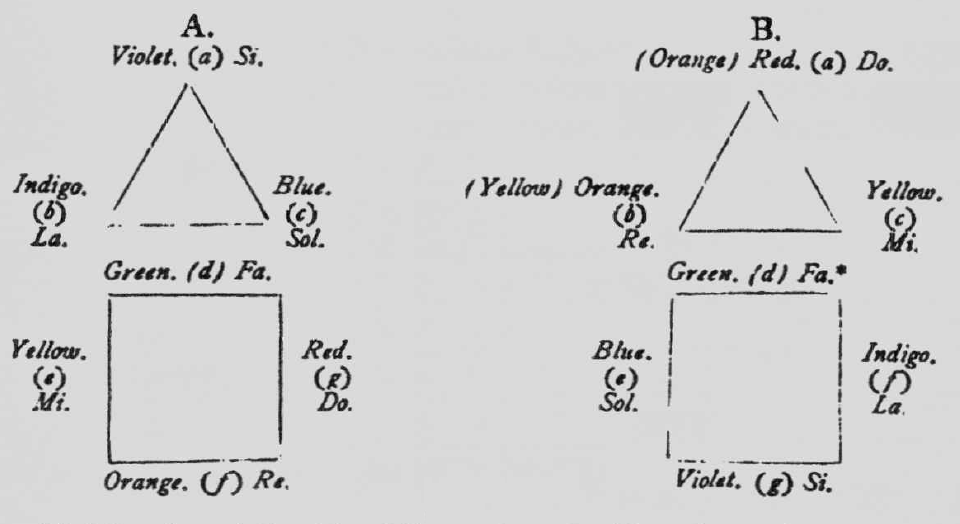
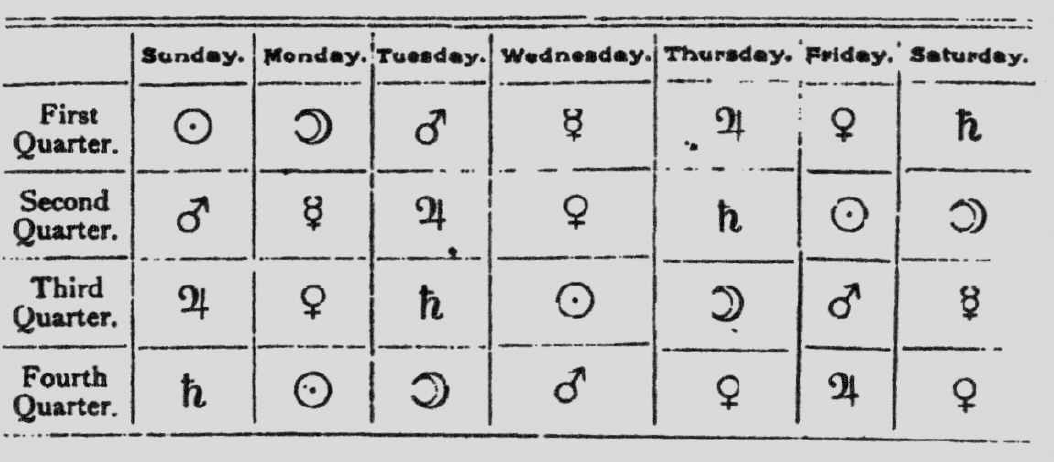
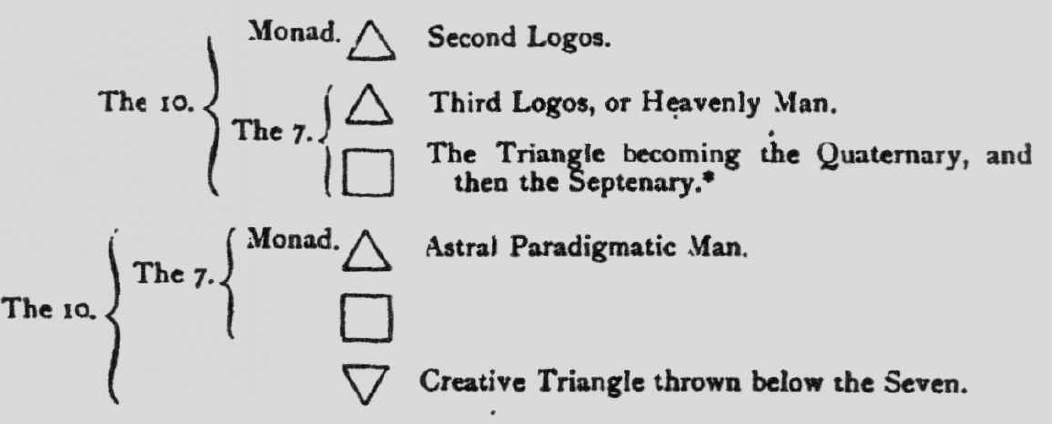
Even in the evolution of the Races we see the same order as in nature and man. [5] Placental animal-man became such only after the separation of sexes in the Third Root-Race. In the physiological evolution, the placenta is fully formed and functional only after the third month of uterine life. ---------- Let us put aside such human conceptions as a personal God, and hold to the purely divine, to that which underlies all and everything in boundless Nature. It is called by its Sanskrit esoteric name in the Vedas, TAT (or THAT), a term for the unknowable Rootless Root. If we do so, we may answer these seven questions of the Esoteric Catechism thus: (1) Q. -- What is the Eternal Absolute? A. -- THAT. (2) Q. -- How came Kosmos into being? A. -- Through THAT. (3) Q. -- How, or what will it be when it falls back into Pralaya? A. -- In THAT. (4) Q. -- Whence all the animate, and suppositionally, the "inanimate" nature? A. -- From THAT. (5) Q. -- What is the Substance and Essence of which the Universe is formed? A. --THAT. (6) Q. -- Into what has it been and will be again and again resolved?' A. -- Into THAT. (7) Q. -- Is THAT then both the instrumental and material cause of the Universe? A. -- What else is it or can it be than THAT? As the Universe, the Macrocosm and the Microcosm, [6] are ten, why should we divide Man into seven "principles"? This is the reason why the perfect number ten is divided into two, a reason which cannot be given out publicly: In their completeness, i.e., super-spiritually and physically, the forces are TEN: to-wit, three on the subjective and inconceivable, and seven on the objective plane. Bear in mind that I am now giving you the description of the two opposite poles: (4) the primordial triangle, which, as soon as it has reflected itself in the "Heavenly Man," the highest of the lower seven -- disappears, returning into "Silence and Darkness"; and (b) the astral paradigmatic man, whose Monad (Atma) is also represented by a triangle, as it has to become a ternary in conscious Devachanic interludes. The purely terrestrial man being reflected in the universe of matter, so to say, upside down, the upper triangle, wherein the creative ideation and the subjective potentiality of the formative faculty resides, is shifted in the man of clay below the seven. Thus three of the ten, containing in the archetypal world only ideative and paradigmatic potentiality, i.e., existing in possibility, not in action, are in fact one. The potency of formative creation resides in the Logos, the synthesis of the seven Forces or Rays, which becomes forthwith the Quaternary, the sacred Tetraktys. This process is repeated in man, in whom the lower physical Triangle becomes, in conjunction with the female One, the male-female creator, or generator. The same on a still lower plane in the animal world. A mystery above, a mystery below, truly. This is how the upper and highest, and the lower and most animal, stand in mutual relation. DIAGRAM I. In this diagram, we see that physical man (or his body) does not share in the direct pure wave of the divine Essence which flows from the One in Three, the Unmanifested, through the Manifested Logos (the upper face in the diagram). Purusha, the primeval Spirit, touches the human head and stops there. But the Spiritual Man (the synthesis of the seven principles) is directly connected with it. And here a few words ought to be said about the usual exoteric enumeration of the principles. As those not pledged could hardly be entrusted with the whole truth, an approximate division only was made and given out. Esoteric Buddhism, begins with Atma, the seventh, and ends with the Physical Body, the first. Now, neither Atma, which is no individual "principle," but a radiation from and one with the Unmanifested Logos; nor the Body, which is the material rind, or shell, of the Spiritual Man, can be, in strict truth, referred to as "principles." Moreover, the chief "principle" of all, one not even mentioned heretofore, is the "Luminous Egg" (Hiranyagarbha), or the invisible magnetic sphere in which every man is enveloped. [7] It is the direct emanation: (a) from the Atmic Ray in its triple aspect of Creator, Preserver and Destroyer (Regenerator); and (b) from Buddhi-Manas. The seventh aspect of this individual aura is the faculty of assuming the form of its body and becoming the "Radiant," the Luminous Augoeides. It is this, strictly speaking, which at times becomes the form called Mayavi Rupa. Therefore, as explained on the second face of the diagram (the astral man), the Spiritual Man consists of only five principles, as taught by the Vedantins, [8] who substitute, tacitly, for the physical, this sixth, or Auric, Body, and merge the dual Manas (the dual mind, or consciousness) into one. Thus they speak of five Koshas (sheaths, or principles), and call Atma the sixth yet no "principle." This is the secret of the late Subba Row's criticism of the division in Esoteric Buddhism. But let the student now learn the true esoteric enumeration. PLATE 1. The reason why public mention of the Auric Body is not permitted is on account of its being so sacred. It is this Body which, at death, assimilates the essence of Buddhi and Manas and becomes the vehicle of these spiritual principles, which are not objective, and then, with the full radiation of Atma upon it, ascends as Manas-Taijasi into the Devachanic state. Therefore is it called by many names. It is the Sutratma, the silver "thread" which "incarnates" from the beginning of Manvantara to the end, stringing upon itself the pearls of human existence, in other words, the spiritual aroma of every personality it follows through the pilgrimage of life. [9] It is also the material from which the Adept forms his Astral Bodies, from the Augoeides and the Mayavi Rupa downwards. After the death of man, when its most ethereal particles have drawn into themselves the spiritual principles of Buddhi and the Upper Manas, and are illuminated with the radiance of Atma, the Auric Body remains either in the Devachanic state of consciousness, or, in the case of a full Adept, prefers the state of a Nirmanakaya, that is, one who has so purified his whole system that he is above even the divine illusion of a Devachinee. Such an Adept remains in the astral (invisible) plane connected with our earth, and henceforth moves and lives in the possession of all his principles except the Kama Rupa and Physical Body. In the case of the Devachanee, the Linga Sarira -- the alter ego of the Body which during life is within the physical envelope while the radiant aura is without -- strengthened by the material particles which this aura leaves behind, remains close to the dead body and outside it, and soon fades away. In the case of the full Adept, the body alone becomes subject to dissolution, while the centre of that force which was the seat of desires and passions, disappears with its cause -- the animal body. But during the life of the latter all these centres are more or less active and in constant correspondence with their prototypes, the cosmic centres, and their microcosms, the principles. It is only through these cosmic and spiritual centres that the physical centres (the upper seven orifices and the lower triad) can benefit by their occult interaction, for these orifices, or openings, are channels conducting into the body the influences that the will of man attracts and uses, viz: the cosmic forces. This will has, of course, to act primarily through the spiritual principles. To make this clearer, let us take an example. In order to stop pain, let us say in the right eye, you have to attract to it the potent magnetism from that cosmic principle which corresponds to this eye and also to Buddhi. Create, by a powerful will effort, an imaginary line of communication between the right eye and Buddhi, locating the latter as a centre in the same part of the head. This line, though you may call it "imaginary," is, once you succeed in seeing it with your mental eye and give it a shape and colour in truth as good as real. A rope in a dream is not and yet is. Moreover, according to the prismatic colour with which you endow your line, so will the influence act. Now, Buddhi and Mercury correspond with each other, and both are yellow, or radiant and golden coloured. In the human system, the right eye corresponds with Buddhi and Mercury; and the left with Manas and Venus, or Lucifer. Thus, if your line is golden or silvery, it will stop the pain, if red, it will increase it, for red is the colour of Kama and corresponds with Mars. Mental or Christian Scientists have stumbled upon the effects without understanding the causes. Having found by chance the secret of producing such results owing to mental abstraction, they attribute them to their union with God (whether a personal or impersonal God they know best), whereas it is simply the effect of one or another principle. However it may be, they are on the path of discovery, although they must remain wandering for a long time to come. Let not the students of the Esoteric School commit the same mistake. It has often been explained that neither the cosmic planes of substance nor even the human principles -- with the exception of the lowest material plane or world and the physical body, which, as has been said, are no "principles," -- can be located or thought of as being in Space and Time. As the former are seven in ONE, so are we seven in ONE -- that same Absolute Soul of the World, which is both matter and non-matter, spirit and non-spirit, being and non-being. Impress yourselves well with this idea, all those of you who would study the mysteries of SELF. Remember that with our physical senses alone at our command, none of us an hope to reach beyond gross matter. We can do so only through one or another of our seven spiritual senses, either by training, or if one is a born seer. Yet even a clairvoyant possessed of such faculties, if not an Adept, no matter how honest and sincere he may be, will, through his ignorance of the truths of Occult Science, be led by the visions he sees in the Astral Light, only to mistake for God or Angels the denizens of those spheres of which he may occasionally catch a glimpse, as witness Swedenborg and others. These seven senses of ours correspond with every other septenate in nature and in ourselves. Physically, though invisibly, the human Auric Envelope (the amnion of the physical man in every age of life) has seven layers, just as Cosmic Space and our physical epidermis have. It is this aura which, according to our mental and physical state of purity or impurity, either opens for us vistas into other worlds or shuts us out altogether from anything but this three dimensional world of matter. Each of our seven physical senses (two of which are still unknown to profane Science), and also of our seven states of consciousness -- viz: (1) waking; (2) waking-dreaming; (3) natural sleeping; (4) induced or trance-sleep; (5) psychic; (6) superpsychic; and (7) purely spiritual, -- corresponds with one of the seven cosmic planes, developes and uses one of the seven super-senses, and is connected directly, in its use on the terrestro-spiritual plane, with the cosmic and divine centre of force that gave it birth, and which is its direct creator. Each is also connected with, and under the direct influence of, one of the seven Sacred Planets. [10] These belonged to the Lesser Mysteries, whose followers were called Mystai (the veiled), seeing that they were allowed to perceive things only through a mist, as it were "with the eyes closed" while the Initiates or "Seers" of the Greater Mysteries were called Epoptai (those who see things unveiled). It was the latter only who were taught the true mysteries of the Zodiac and the relations and correspondences between its twelve signs (two secret) and the ten human orifices. The latter are now of course ten in the female, and only nine in the male; but this is merely an external difference. In the second volume of the Secret Doctrine it is stated that till the end of the Third Root-Race (when androgynous man separated into male and female) the ten orifices existed in the hermaphrodite, first potentially, then functionally. The evolution of the human embryo shows this. For instance, the only opening formed at first is the buccal cavity, "a cloaca communicating with the anterior extremity of the intestine." This becomes later the mouth and the posterior orifice: the Logos differentiating and emanating gross matter on the lower plane, in occult parlance. The difficulty which some students will experience in reconciling the correspondences between the Zodiac and the orifices can be easily explained. Magic is coeval with the Third Root-Race, which began by creating through Kriyashakti and ended by generating its species in the present way. [11] Woman being left with the full or perfect cosmic number 10 (the divine number of Jehovah), was deemed higher and more spiritual than man. In Egypt, in days of old, the marriage service contained an article that the woman should be the "lady of the lord," and real lord over him, the husband fledging himself to be "obedient to his wife" for the production of alchemical results such as the elixir of life and the philosopher's stone, for the spiritual help of the woman was needed by the male alchemist. But woe to the alchemist who should take this in the dead-letter sense of physical union. Such sacrilege would become black magic and be followed by certain failure. The true alchemist of old took aged women to help him, carefully avoiding the young ones; and if any of them happened to be married they treated their wives for months both before and during their operations as sisters. The error of crediting the ancients with knowing only ten of the zodiacal signs is explained in Isis Unveiled. [12] The ancients did know of twelve, but viewed these signs differently to ourselves. They took neither Virgo nor Scorpio singly into consideration, but regarded them as two in one, since they were made to refer directly and symbolically to the primeval dual man and his separation into sexes. During the reformation of the Zodiac, Libra was added as the twelfth sign, though it is simply an equilibrating sign, at the turning-point -- the mystery of separated man. Let the student learn all this well. Meanwhile we have to recapitulate what has been said. (1) Each human being is an incarnation of his God, in other words, one with his "Father in Heaven," just as Jesus, an Initiate, is made to say. As many men on earth, so many Gods in Heaven; and yet these Gods are in reality ONE, for at the end of every period of activity, they are withdrawn, like the rays of the setting sun, into the Parent Luminary, the Non-Manifested Logos, which in its turn is merged into the One Absolute. Shall we call these "Fathers" of ours, whether individually or collectively, and under any circumstances, our personal God? Occultism answers, Never. All that an average man can know of his "Father" is what he knows of himself, through and within himself. The soul of his "Heavenly Father" is incarnated in him. This soul is himself, if he is successful in assimilating the divine individuality while in his physical, animal shell. As to the spirit thereof, as well expect to be heard by the Absolute. Our prayers and supplications are vain, unless to potential words we add potent acts, and make the aura which surrounds each one of us so pure and divine that the God within us may act outwardly, or, in other words, become as it were an extraneous Potency. Thus have Initiates, Saints, and very holy and pure men been enabled to help others as well as themselves in the hour of need, and produce what are foolishly called "miracles," each by the help and with the aid of the God within himself, which he alone has enabled to act on the outward plane. (2) The word AUM or OM, which corresponds to the upper triangle, if pronounced by a very holy and pure man, will draw out, or awaken, not only the less exalted potencies residing in the planetary spaces and elements, but even his Higher Self, or the "Father" within him. Pronounced by an averagely good man, in the correct way, it will help to strengthen him morally, especially if between two "AUMS" he meditates intently upon the AUM within him, concentrating all his attention upon the ineffable glory. But woe to the man who pronounces it after the commission of some far-reaching sin: he will only thereby attract to his own impure photosphere invisible presences and forces which could not otherwise break through the divine envelope. All the members of the Esoteric School, if earnest in their endeavour to learn, are invited to pronounce the divine word before going to sleep and the first thing upon awakening. The right accent, however, should be first obtained from one of the officers of the E. S. AUM is the original of Amen. Now, Amen is not a Hebrew term, but, like the word Halleluiah, was borrowed by the Jews and Greeks from the Chaldees. The latter word is often found repeated in certain magical inscriptions upon cups and urns among the Babylonian and Ninivean relics. Amen does not mean "so be it," or "verily," but signified in hoary antiquity almost the same as AUM. The Jewish Tanaim (Initiates) used it for the same reason as the Aryan Adepts use AUM, and with a like success, the numerical value of AMeN in Hebrew letters being 91, the same as the full value of YHVH, [13] 26, and ADoNaY, 65, or 91. Both words mean the affirmation of the being, or existence, of the sexless "Lord" within us. (3) Esoteric Science teaches that every sound in the visible world awakens its corresponding sound in the invisible realms, and arouses to action some force or other on the occult side of nature. Moreover, every sound corresponds to a colour and a number (a potency spiritual, psychic or physical) and to a sensation on some plane. All these find an echo in every one of the so-far developed elements, and even on the terrestrial plane, in the Lives that swarm in the terrene atmosphere, thus prompting them to action. Thus a prayer, unless pronounced mentally and addressed to one's "Father" in the silence and solitude of one's "closet," must have more frequently disastrous than beneficial results, seeing that the masses are entirely ignorant of the potent effects which they thus produce. To produce good effects, the prayer must be uttered by "one who knows how to make himself heard in silence," when it is no longer a prayer, but becomes a command. Why is Jesus shown to have forbidden his hearers to go to the public synagogues? Surely every praying man was not a hypocrite and a liar, nor a Pharisee who loved to be seen praying by people! He had a motive, we must suppose: the same motive which prompts the experienced Occultist to prevent his pupils from going into crowded places now as then, from entering churches, seance rooms, etc, unless they arc in sympathy with the crowd. There is one piece of advice to be given to beginners, who cannot help going into crowds -- one which may appear superstitious, but which in the absence of occult knowledge will be found efficacious. As well known to good astrologers, the days of the week are not in the order of those planets whose names they bear. The fact is that the ancient Hindus and Egyptians divided the day into four parts, each day being under the protection (as ascertained by practical magic) of a planet; and every day, as correctly asserted by Dion Cassius, received the name of the planet which ruled and protected its first portion. Let the student protect himself from the "Powers of the Air" (Elementals) which throng public places, by wearing either a ring containing some jewel of the colour of the presiding planet, or else of the metal sacred to it. But the best protection is a clear conscience and a firm desire of benefiting Humanity. The Planets, the Days of the Week, and Their Corresponding Colours and Metals. In the accompanying Diagram the days of the week do not stand in their usual order, though they are placed in their correct sequence as determined by the order of the colours in the solar spectrum and the corresponding colours of their ruling planets. The fault of the confusion in the order of the days revealed by this comparison lies at the door of the early Christians. Adopting from the Jews their lunar months, they tried to blend them with the solar planets, and so made a mess of it; for the order of the days of the week as it now stands does not follow the order of the planets. Now, the ancients arranged the planets in the following order: Moon, Mercury, Venus, Sun, Mars, Jupiter, Saturn, counting the Sun as a planet for exoteric purposes. Again, the Egyptians and Indians, the two oldest nations, divided their day into four parts, each of which was under the protection and rule of a planet. In course of time each day came to be called by the name of that planet which ruled its first portion -- the morning. Now, when they arranged their week, the Christians proceeded as follows: they wanted to make the day of the Sun, or Sunday, the seventh, so they named the days of the week by taking every fourth planet in turn, e.g., beginning with the Moon (Monday), they counted thus: Moon, Mercury, Venus, Sun, Mars; thus Tuesday, the day whose first portion was ruled by Mars, became the second day of the week; and so on. It should be remembered also that the Moon, like the Sun, is a substitute for a secret planet. The present division of the solar year was made several centuries later than the beginning of our era; and our week is not that of the ancients and the Occultists. The septenary division of the four parts of the lunar phases is as old as the world, and originated with the people who reckoned time by the lunar months. The Hebrews never used it, for they counted only the seventh day, the Sabbath, though the second chapter of Genesis seems to speak of it. Till the days of the Caesars there is no trace of a week of seven days among any nation save the Hindus. From India it passed to the Arabs, and reached Europe with Christianity. The Roman week consisted of eight days, and the Athenian of ten. [14] Thus one of the numberless contradictions and fallacies of Christendom is the adoption of the Indian septenary week of the lunar reckoning and the preservation at the same time of the mythological names of the planets. Nor do modern Astrologers give the correspondences of the days and planets and their colours correctly; and while Occultists can give good reason for every detail of their own tables of colours, etc., it is doubtful whether the Astrologers can do the same. To close this first Instruction, let me say that those who have honoured me with their confidence by taking the pledge must in all necessity be separated into two broad divisions: those who have not quite rid themselves of the usual sceptical doubts, but who long to ascertain how much truth there may be in the claims of the Occultists; and those others who, having freed themselves from the trammels of materialism and relativity, feel that true and real bliss must be sought only in the knowledge and personal experience of that which the Hindu philosopher calls the Brahmavidya, and the Buddhist Arhat the realization of Adibudha, the primeval Wisdom. Let the former pick out and study from the Instructions only those explanations of the phenomena of life which profane science is unable to give them. Even with such limitations, they will find by the end of a year or two that they will have learned more than all their Universities and Colleges can teach them. As to the sincere believers, they will be rewarded by seeing their faith transformed into knowledge. True knowledge is of Spirit and in Spirit alone, and cannot be acquired in any other way except through the region of the higher mind, the only plane from which we can penetrate the depths of the all-pervading Absoluteness. He who carries out only those laws established by human minds, who lives that life which is prescribed by the code of mortals and their fallible legislation, chooses as his guiding star a beacon which shines on the ocean of Maya, or of temporary delusions, and lasts for but one incarnation. These laws are necessary for the life and welfare of physical man alone. He has chosen a pilot who directs him through the shoals of one existence, a master who parts with him, however, on the threshold of death. How much happier that man who, while strictly performing on the temporary objective plane the duties of daily life, carrying out each and every law of his country, and rendering, in short, to Caesar what is Caesar's, leads in reality a spiritual and permanent existence, a life with no breaks of continuity, no gaps, no interludes, not even during those periods which are the halting-places of the long pilgrimage of purely spiritual life. All the phenomena of the lower human mind disappear like the curtain of a proscenium, allowing him to live in the region beyond it, the plane of the noumenal, the one reality. If man by suppressing, if not destroying, his selfishness and personality, only succeeds in knowing himself as he is behind the veil of physical Maya, he will soon stand beyond all pain, all misery, and beyond all the wear and tear of change, which is the chief originator of pain. Such a man will be physically of matter, he will move surrounded by matter, and yet he will live beyond and outside it. His body will be subject to change, but he himself will be entirely without it, and will experience everlasting life even while in temporary bodies of short duration. All this may be achieved by the development of unselfish universal love of Humanity, and the suppression of personality, or selfishness, which is the cause of all sin, and consequently of all human sorrow. H.P.B.
AUM _______________ Notes: 1. See Secret Doctrine, vol. II, pp. 178 and 179. 2. I, 2: Vol. I, p. 40, of Wilson's translation, as emended by Fitzedward Hall. 3. Prana is in reality the universal Life Principle 4. All the uterine contents, having a direct spiritual connection with their cosmic antetypes are, on the physical plane, potent objects in Black Magic -- therefore considered unclean. 5. See Secret Doctrine, Vol. I, Part I. 6. The solar system or the earth, as the case may be. 7. So are the animals, the plants, and even the minerals. Reichenbach never understood what he learned through his sensitives and clairvoyants. It is the odic, or rather the auric or magnetic fluid which emanates from man, but it is also something more. 8. See Secret Doctrine, vol. i, p. 157, for the Vedantic exoteric enumeration. 9. See Lucifer, January, 1889, "Dialogue upon the Mysteries of After-Life." 10. See Secret Doctrine, vol. 1, pp. 572-574. 11. See Secret Doctrine, vol. 1, p. 207, et seq., and vol. II, passim. 12. Vol. II, pp. 456, 461 and 465 et seq. 13. Jod-Hevah, or male-female on the terrestrial plane, as invented by the Jews, and now made out to mean Jehovah; but signifying in reality and literally, "giving being" and "receiving life." 14. See Notice sur le Calendrier, J.H.
Ragon. ***
1. Embryo. 2. Amniotic Fluid (Liquor Amnii) in which the Embryo floats. 3. Amnion, a foetal membrane surrounding the Embryo, and containing the Amniotic Fluid. 4. Umbilical Vesicle, or Yolk Sac, containing the Yolk, the source of nutrition to the early Embryo. 5. Allantois, a vesicle proceeding from the extremity of the Embryo, spreading itself throughout the interior of the Ovum. 6. Interspace between the outer layer of the Ovum and the Amnion, in which are contained the Umbilical Vesicle and Allantois. 7. Chorion, or False Amnion, formed by the outer layer of the Ovum. Figure I is a representation of the Ovum before the Amnion and Chorion are fully discernable; the Allantois (5) also is in the first stages of its development.
Figure 2 shows the Allantois spreading itself through the Interspace (6): here the Yolk Sac has considerably shrunk. Nos. 3 are projections forming the Amnion.
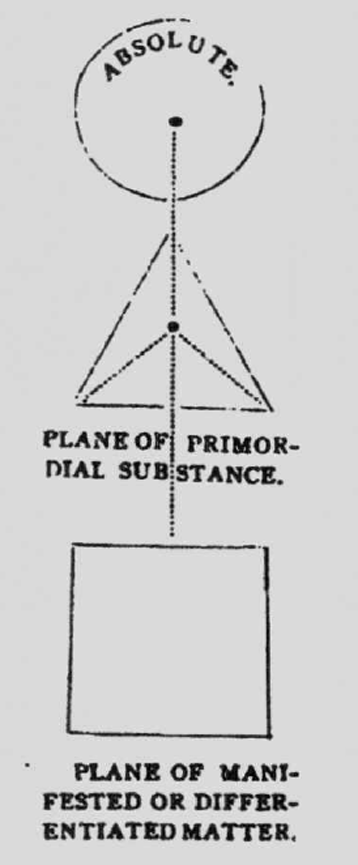
Figure 3 shows the Yolk Sac still further shrunk; the Allantois has completely spread itself in the Interspace between the Amnion and Chorion (false Amnion), against the walls of the latter, which has grown in the form of ramified villi into the substance of the uterine mucous membrane. In later stages the latter forms the Placenta. *** DIAGRAM 1 1st. -- Macrocosm and Its 3, 7, or 10 Centres of Creative Forces. A. Sexless, Unmanifested Logos. a. Creative Logos. D. The Spiritual Forces acting in Matter A.B.C. The Unknowable. a.b.c. This is Pradhana, undifferentiated matter in Sankhya philosophy, or Good, Evil and Chaotic Darkness (Sattva, Rajas, and Tamas) neutralizing each other. When differentiated, they become the Seven Creative Potencies: Spirit, Substance and Fire stimulating Matter to form itself.
2d. Microcosm (the Inner Man and His 3, 7, or 10 Centres of Potential Forces. (ATMAN, although exoterically reckoned as the seventh principle, is no individual principle at all, and belongs to the Universal Soul; 7 is the AURIC EGG, the Magnetic Sphere round every human and animal being.) 1. BUDDHI, the vehicle of ATMA. 2. MANAS, the vehicle of BUDDHI. 3. LOWER MANAS (the Upper and Lower MANAS are two aspects of one and the same princiople) and 4. KAMA RUPA, its vehicle. 5. PRANA, Life, and 6. LINGA SARIRA, its vehicle. I. II. III. are the Three Hypostases of ATMAN, its contact with Nature and Man being the Fourth, making it a Quaternary, or Tetraktys, the Higher Self. 1, 2, 3, 4, 5, 6. These six principles, acting on four different planes, and having their AURIC ENVELOPE on the seventh (vide infra), are those used by the Adepts of the Right-Hand, or White Magicians. * The Physical Body is no principle; it is entirely ignored, being used only in Black Magic. 3. -- Microcosm (the Physical Man) and His 10 Orifices, or Centres of Action. 1. (BUDDHI) Right Eye. 2. (MANAS) Left Eye. 3. (LOWER MANAS) Right Ear. 4. (KAMA RUPA) Left Ear. 5. (LIFE PRINCIPLE) Right Nostril. 6. (LIFE VEHICLE) Left Nostril. 7. The Paradigm of the 10th (creative) orifice in the Lower Triad. 8. 9, 10. As this Lower Ternary has a direct connection with the Higher Atmic Triad and its three aspects (creative, preservative and destructive, or rather regenerative), the abuse of the corresponding functions is the most terrible of Karmic Sins -- the Sin against the Holy Ghost with the Christians. These Physical Organs are used only by Dugpas in Black Magic. ***
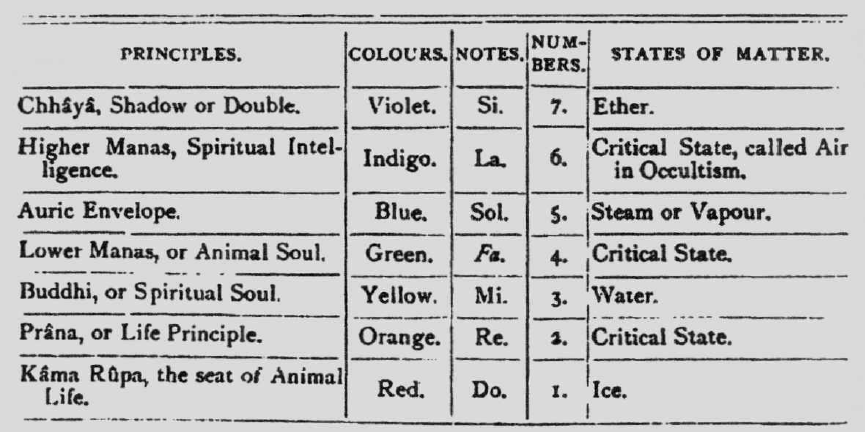
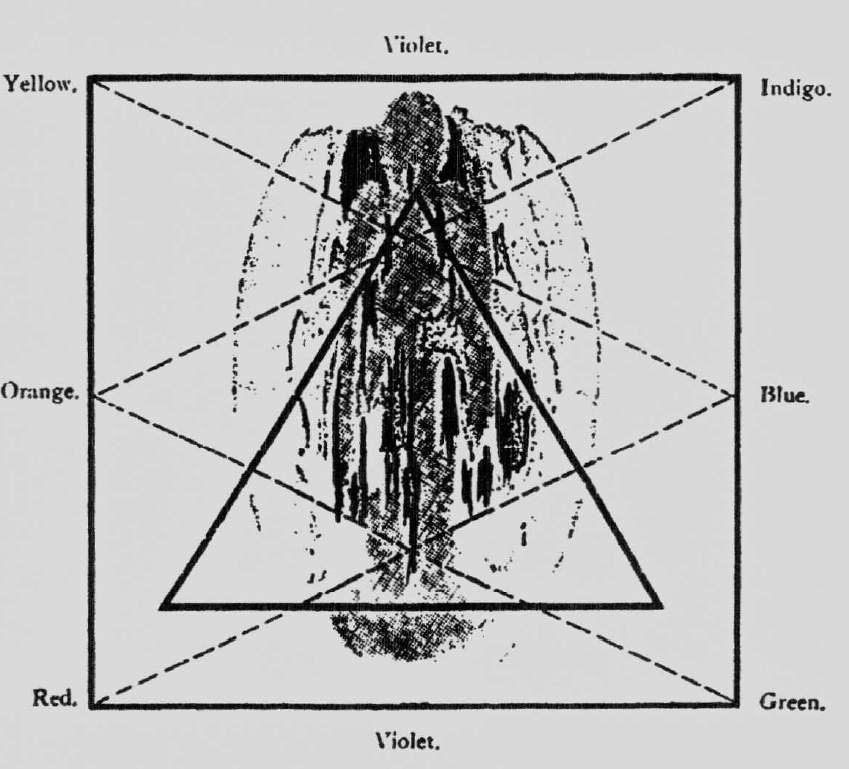
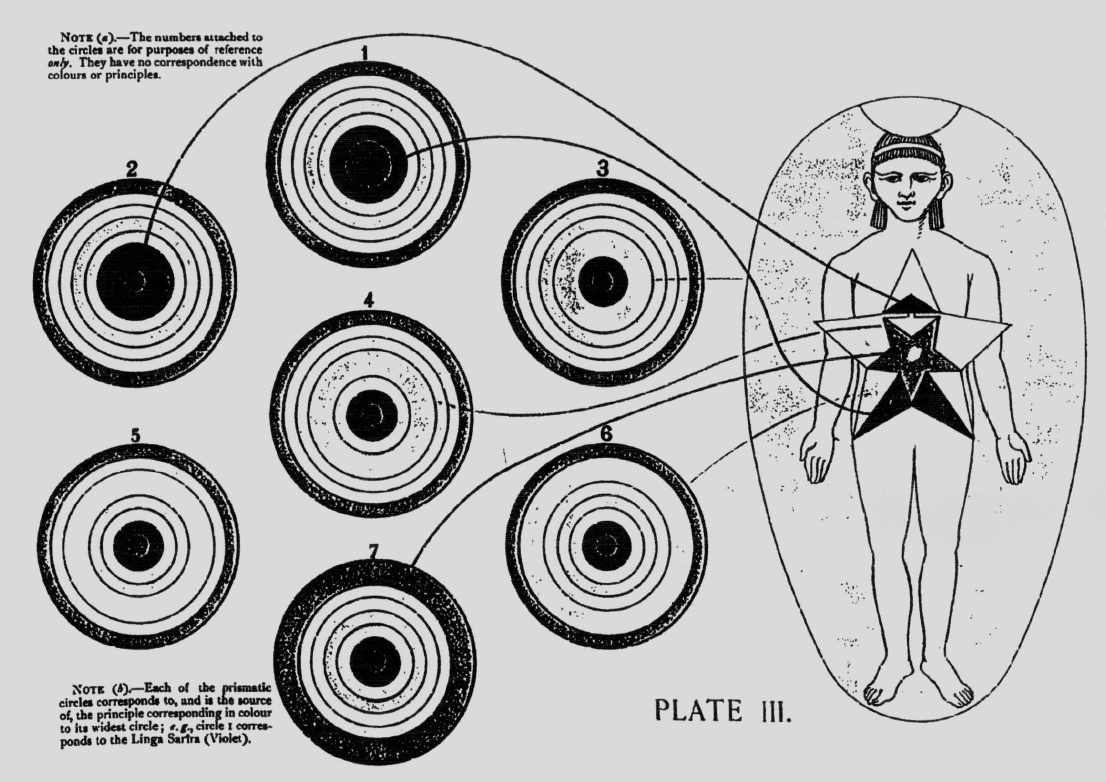
PLATE I. PLATE l. In Plate 1, we see that ATMA is no "principle," but stands separate from the Man, whose seven "principles" are represented as follows: 7th, AURIC EGG, coloured Blue. 6th, BUDDHI, coloured Yellow. 5th, MANAS: The UPPER, represented as a triangle with its apex pointing upwards, coloured Indigo Blue. The LOWER, represented by a triangle with its apex pointing downwards, coloured Green. 4th KAMA, represented as a five-pointed star, with the "horns of evil" upwards, embracing the LOWER MANAS, coloured Blood-Red. 3d. LINGA SARIRA, coloured Violet as the vehicle of PRANA (Orange), and partaking of KAMA (Red), and occasionally of the AURIC ENVELOPE (Blue). 2d, PRANA, Life, coloured Orange, the hue of the ascetic's robes. 1st, STHULA SARIRA, the Physical Body of Man, represented by the mayavic contour of the large five-pointed star within the AURIC EGG. *** DIAGRAM II. ATMAN is no Number, and corresponds to no visible Planet, for it proceeds from the Spiritual Sun; nor does it bear any relation either to Sound, Colour, or the rest, for it includes them all. As the Human Principles have no Numbers per se, but only correspond to Numbers, Sounds, Colours, etc., they are not enumerated here in the order used for exoteric purposes.
DIAGRAM II.
PRINTED PRIVATELY ON THE H.P.B. PRESS
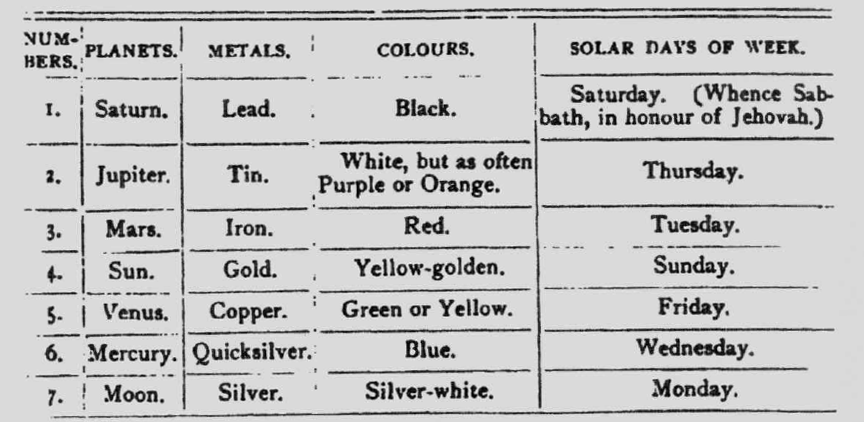
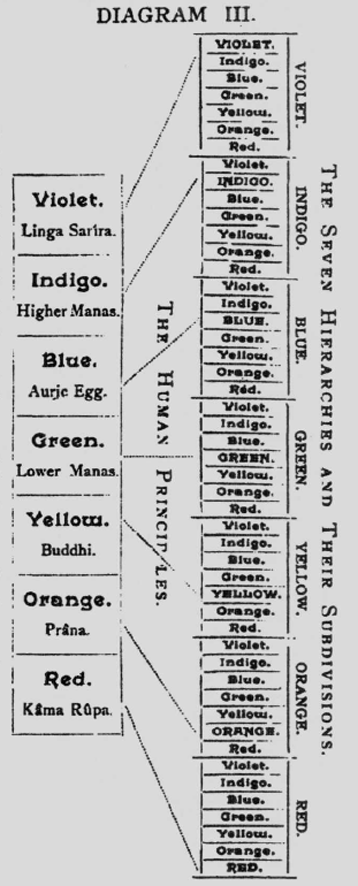
Strictly Private and Confidential Not the Property of Any Member, and to be Returned on Demand to the Agent of the Head of the N.S. INSTRUCTION NO. II. IN view of the abstruse nature of the subjects dealt with, the present Instruction will begin with an explanation of some points which remained obscure in the preceding one, as well as some statements in which there was an appearance of contradiction. Astrologers, of whom there are many among the Esotericists, are likely to be puzzled by some statements distinctly contradicting their teachings; whilst those who know nothing of the subject may perhaps find themselves opposed at the outset by those who have studied the exoteric systems of the Kabala and Astrology. For, let it be distinctly known, nothing of that which is printed broadcast, and available to every student in public libraries or museums, is really esoteric, but is either mixed with deliberate "blinds," or cannot be understood and studied with profit without a complete glossary of occult terms. The following teachings and explanations, therefore, may be useful to the student in assisting him to formulate the teaching given in the preceding Instruction. In Diagram I, it will be observed that the 3, 7 and 10 centres are respectively as follows: (a) The 3 pertain to the spiritual world of the Absolute, and therefore to the three higher principles in Man. (b) The 7 belong to the spiritual, psychic, and physical worlds and to the body of man. Physics, metaphysics and hyper-physics are the triad that symbolizes man on this plane. (c) The 10, or the sum total of these, is the Universe as a whole, in all its aspects, and also its Microcosm-Man, with his ten orifices. Laying aside, for the moment, the Higher Decad (Kosmos) and the Lower Decad (Man), the first three numbers of the separate sevens have a direct reference to the Spirit, Soul and Auric Envelope of the Human Being, as well as to the Higher Supersensual World. The lower four, or the four aspects, belong to Man also, as well as to the Universal Kosmos, the whole being synthesized by the Absolute. If these three discrete or distributive degrees of being be conceived, according to the symbology of all the Eastern religions, as contained in one Ovum, or EGG, the name of that EGG will be Swabhavat, or the ALL-BEING on the manifested plane. This Universe has, in truth, neither centre nor periphery; but in the individual and finite mind of man it has such a definition, the natural consequence of the limitations of human thought. In Diagram II, as already stated therein, no notice need be taken of the numbers used in the left-hand column, as these refer only to the Hierarchies of the Colours and Sounds on the metaphorical plane, and are not the characteristic numbers of the human principles or of the planets. The human principles elude enumeration, because each man differs from every other, just as no two blades of grass on the whole earth are absolutely-alike. Numbering is here a question of spiritual progress and the natural predominance of one principle over another. With one man it may be Buddhi that stands as number one; with another, if he be a bestial sensualist, the Lower Manas. With one the physical body, or perhaps Prana, the life principle, will be on the first and highest plane, as would be the case in an extremely healthy man, full of vitality; with another it may come as the sixth or even seventh downward. Again, the colours and metals corresponding to the planets and human principles, as will be observed, are not those known exoterically to modern Astrologers and Western Occultists. Let us see whence the modern Astrologer got his notions about the correspondence of planets, metals and colours. And here we are reminded of the modern Orientalist, who, judging on appearances, credits the ancient Akkadians (and also the Chaldeans, Hindus and Egyptians) with the crude notion that the Universe, and in like manner the earth, was like an inverted, bell-shaped bowl! This he demonstrates by pointing to the symbolical representations of some Akkadian inscriptions and to the Assyrian carvings. It is, however, no place here to explain how mistaken is the Assyriologist, for all such representations are simply symbolical of the Khargak-kurra, the World-Mountain, or Meru, and relate only to the North Pole, the Land of the Gods. [1] Now, the Assyrians arranged their exoteric teaching about the planets and their correspondences as follows:
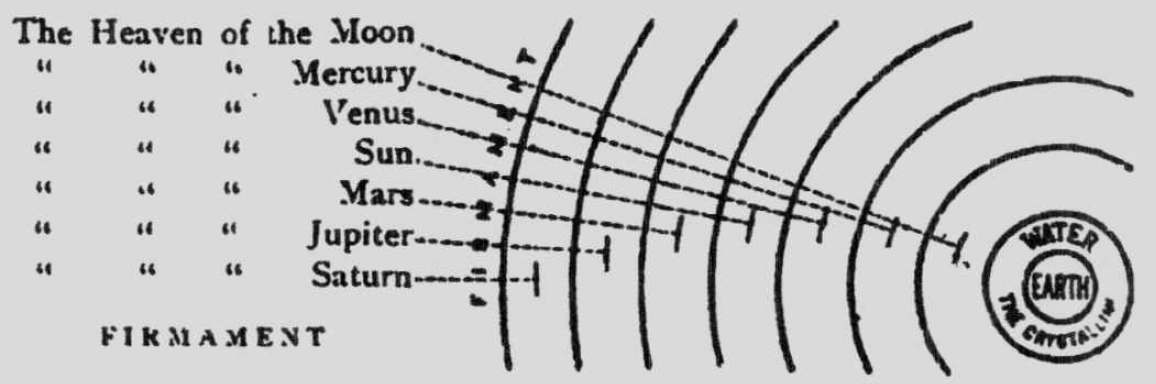
This is the arrangement now adopted by Christian Astrologers, with the exception of the order of the days of the week, of which, by associating the solar planetary names with the lunar weeks, they have made a sore mess, as has been already shown in Instruction I. This is the Ptolemaic geocentric system, which represents the Universe as in the following diagram, showing our Earth in the centre of the Universe and the Sun a planet, the fourth in number:
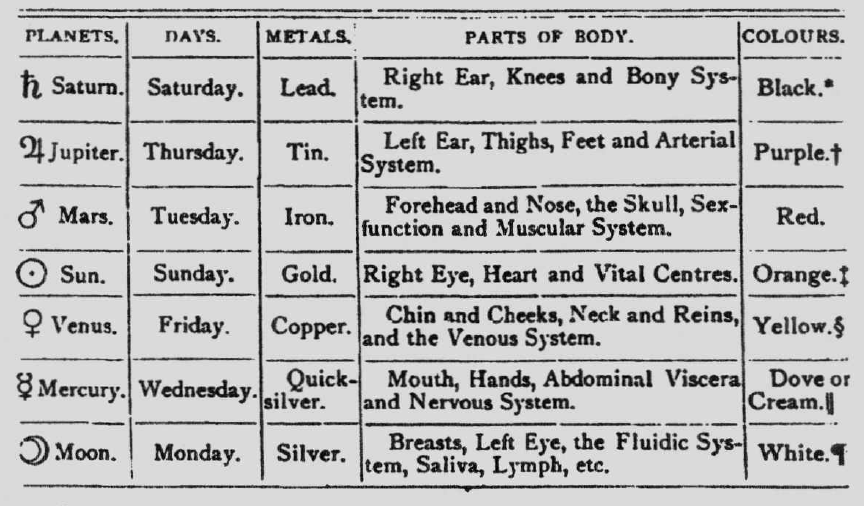
The Heaven of the Moon And if the Christian chronology and order of the days of the week are being daily denounced as being based on an entirely wrong astronomical foundation, it is high time to begin a reform also in Astrology built on such lines, and coming to us entirely from the Chaldean and Assyrian exoteric mob. But the correspondences given in our Instructions are purely esoteric. For this reason it follows that when the planets of the solar system are named or symbolized (as in Diagram II) it must not be supposed that the planetary bodies themselves are referred to, except as types on a purely physical plane of the septenary nature of the psychic and spiritual worlds. A material planet can correspond only to a material something, Thus when Mercury is said to correspond to the right eye it does not mean that the objective planet has any influence on the right optic organ, but that both stand rather as corresponding mystically through Buddhi. Man derives his Spiritual Soul (Buddhi) from the essence of the Manasa Putri, the Sons of Wisdom, who are the Divine Beings (or Angels) ruling and presiding over the planet Mercury. In the same way Venus, Manas and the left eye are set down as correspondences. Exoterically, there is, in reality, no such association of physical eyes and physical planets; but esoterically there is; for the right eye is the "Eye of Wisdom," i.e., it corresponds magnetically with that occult centre in the brain which we call the "Third Eye"; [2] while the left corresponds with the intellectual brain, or those cells which are the organ on the physical plane of the thinking faculty, The Kabalistic triangle of Kether, Chocmah and Binah shows this. Chocmah and Binah, or Wisdom and Intelligence, the Father and the Mother, or, again, the Father and Son, are on the same plane and react mutually on one another. When the individual consciousness is turned inward, a conjunction of Manas and Buddhi takes place. In the spiritually regenerated man this conjunction is permanent, the Higher Manas clinging to Buddhi beyond the threshold of Devachan, and the Soul, or rather the Spirit, which should not be confounded with Atma, the Super-Spirit, is then said to have the "Single Eye." Esoterically, in other words, the "Third Eye" is active. Now, Mercury is called Hermes, and Venus, Aphrodite, and thus their conjunction in man on the psycho-physical plane gives him the name of the Hermaphrodite, or Androgyne. The absolutely Spiritual Man is, however, entirely disconnected from sex. The Spiritual Man corresponds directly with the higher "coloured circles," the Divine Prism which emanates from the One Infinite White Circle; while physical man emanates from the Sephiroth, which are the Voices or Sounds of Eastern philosophy. And these "Voices" are lower than the "Colours," for they are the seven lower Sephiroth, or the objective Sounds, seen, not heard, as the Zohar (11, 81, 6) shows, and even the Old Testament also. For, when properly translated, verse 18 of chapter XX Exodus would read: "And the people saw the Voices," (or Sounds, not the "thunderings," as now translated); and these Voices, or Sounds, are the Sephiroth. [3] In the same way the right and left nostrils, into which is breathed the "Breath of Lives" (Genesis, II, 7), are here said to correspond with the Sun and Moon, as Brahma-Prajapati and Vach, or Osiris and Isis, are the parents of the natural life. This Quaternary, viz: the two eyes and two nostrils, Mercury and Venus, Sun and Moon, constitutes the Kabalistic Guardian-Angels of the Four Corners of the Earth. It is the same in the Eastern esoteric philosophy, which, however, adds that the Sun is not a planet, but the central star of our system, and the Moon a dead planet, from which all the principles are gone, both being substitutes, the one for an invisible inter- Mercurial planet, and the other for a planet which seems to have now altogether disappeared from view. These are the Four Maharajahs of the Secret Doctrine, [4] the "Four Holy Ones" connected with Karma and Humanity, Kosmos and Man, in all their aspects. They are: the Sun, or its substitute Michael; Moon, or substitute Gabriel; Mercury, Raphael; and Venus, Uriel. It need hardly be said here again that the planetary bodies themselves, being only physical symbols, are not often referred to in the Esoteric System, but, as a rule, their cosmic, psychic, physical and spiritual forces are symbolized under these names. In short, it is the seven physical planets which are the lower Sephiroth of the Kabala and our triple physical Sun whose reflection only we see, which is symbolized, or rather personified, by the Upper Triad, or Sephirothal Crown. All this will be demonstrated. [5] Then, again, it will be well to point out that the numbers attached to the psychic principles in Diagram 1 appear the reverse of those in Plate I. This, again, is because numbers in this connection are purely arbitrary, changing with every school. Some schools count three, some four, some six, and others seven, as do all the Buddhist Esotericists. In Plate I, the numbers of the principles disagree with the numbers used in Diagram I, simply because the first are those hitherto used in the semi-exoteric teachings of Theosophy, for instance in Esoteric Buddhism. As said in the Secret Doctrine, [6] since the fourteenth century the Esoteric School has been divided into two departments, one for the inner Lanoos, or higher Chelas, the other for the outer circle, or lay Chelas. Mr. Sinnett was distinctly told in the letters he received from one of the Gurus that he could not be taught the real Esoteric Doctrine given out only to the pledged Disciples of the Inner Circle. Therefore, it would perhaps simplify matters if each student would add to the exoteric enumeration of the order in Plate I the secret one as given in Diagram II. But even that would require special study. The numbers and principles do not go, in regular sequence, like the skins of an onion, but the student must work out for himself the number appropriate to each of his principles, when the time comes for him to enter upon practical study. The above will suggest to the student the necessity of knowing the principles by their names and their appropriate faculties apart from any system of enumeration, or by association with their corresponding centres of action, colours, sounds, etc., until these become inseparable. The old and familiar mode of reckoning the principles, given in the Theosophist and Esoteric Buddhism, leads to another apparently perplexing contradiction, though it is really none at all. In Plate I, it will be seen that the principles numbered 3 and 2, viz: Linga Sarira and Prana, or Jiva, stand in the reverse order to that given in Diagram I. A moment's consideration will suffice to explain the apparent discrepancy between the exoteric enumeration, as printed in Plate I, and the esoteric order given in Diagram I. For in Diagram I, Linga Sarira is defined as the vehicle of Prana, or Jiva, the life principle, and as such must, on the esoteric plane, of necessity be inferior to Prana, not superior as the exoteric enumeration in Plate I would suggest. The coloured part of the Plate is profoundly esoteric, but the old and more familiar exoteric enumeration has been used to force upon the attention of the student the fact that the principles do not stand one above the other, and thus cannot be taken in numerical sequence, their order depending upon the superiority and predominance of one or another principle, and therefore differing in every man. The Linga Sarira is the double, or protoplasmic antetype of the body, which is its image. It is in this sense that it is called in Diagram II the parent of the physical body, i.e., the mother by conception of Prana, the father. This idea is conveyed in the Egyptian mythology by the birth of Horus, the child of Osiris and Isis, although, like all sacred Mythoi, this has both a threefold spiritual, and a sevenfold psycho-physical application. To close the subject, Prana, the life principle, can, in sober truth, have no number, as it pervades every other principle, or the human total. Each number of the seven would thus be naturally applicable to Prana-Jiva exoterically as it is to the Auric Body esoterically. As Pythagoras showed, Kosmos was produced not through or by number, but geometrically, i.e., following the proportions of numbers. ---------- To those who are unacquainted with the exoteric astrological natures ascribed in practice to the planetary bodies, it may be useful if we set them down here after the manner of Diagram II, in relation to their dominion over the human body, colours, metals, etc., and explain at the same time why genuine Esoteric Philosophy differs from the astrological claims.
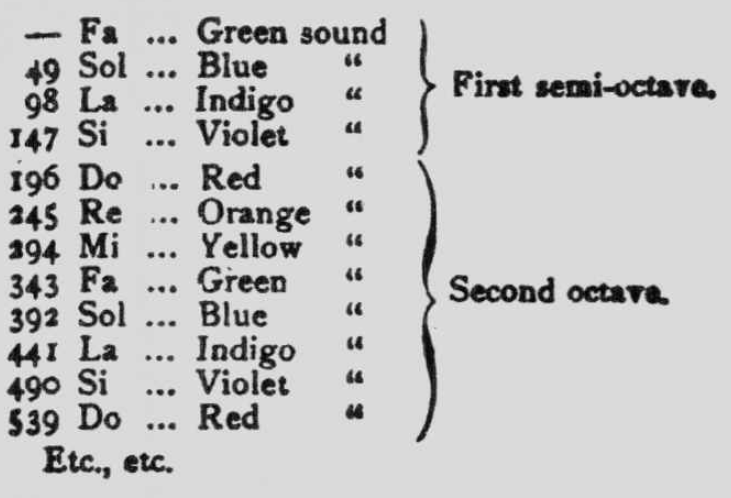
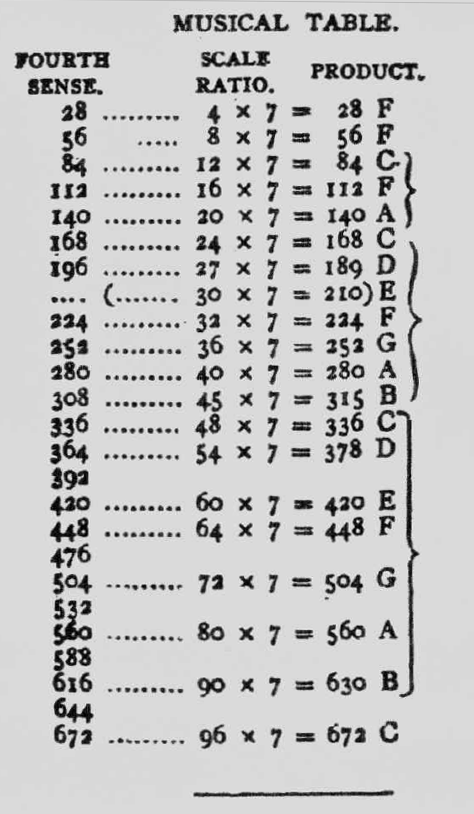
Thus it will be seen that the influence of the solar system in the exoteric Kabalistic Astrology is by this method distributed over the entire human body, the primary metals, and the gradations of colour from black to white; but that Esotericism recognizes neither black nor white as colours, because it holds religiously to the seven solar or natural colours of the prism. Black and white are artificial tints. They belong to the Earth, and are only perceived by virtue of the special construction of our physical organs. White is the absence of all colours, and therefore no colour; black is simply the absence of light, and therefore the negative aspect of white. The seven prismatic colours are direct emanations from the Seven Hierarchies of Being, each of which has a direct bearing upon and relation to one of the human principles, since each of these Hierarchies is, in fact, the creator and source of the corresponding human principle. Each prismatic colour is called in Occultism the "Father of the Sound" which corresponds to it; sound being the Word, or the Logos, of its Father-Thought. This is the reason why sensitives connect every colour with a definite sound, a fact well recognized in modern science, (e.g., Francis Galton's Nature and Nurture). But black and white are entirely negative colours, and have no representatives in the world of subjective being. Kabalistic Astrology says that the dominion of the planetary bodies in the human brain also is defined thus: there are seven primary groups of faculties, six of which function through the cerebrum, and the seventh through the cerebellum. This is perfectly correct esoterically. But when it is further said that: Saturn governs the devotional faculties; Mercury, the intellectual; Jupiter, the sympathetic; the Sun, the governing faculties; Mars, the selfish; Venus, the tenacious; and the Moon, the instincts; -- we say that the explanation is incomplete and even misleading. For, in the first place, the physical planets can rule only the physical body and the purely physical functions. All the mental, emotional, psychic and spiritual faculties are influenced by the occult properties of the scale of causes which emanate from the Hierarchies of the Spiritual Rulers of the planets, and not by the planets themselves. This scale, as given in Diagram II, leads the student to perceive in the following order: (1) colour; (2) sound; (3) the sound materializes into the spirit of the metals, i. e., the metallic Elementals; (4) these materialize again into the physical metals; (5) then the harmonial and vibratory radiant essence passes into the plants, giving them colour and smell, both of which "properties" depend upon the rate of vibration of this energy per unit of time; (6) from plants it passes into the animals; (7) and finally culminates in the "principles" of man. Thus we see the divine essence of our Progenitors in heaven circling through seven stages; spirit becoming matter, and matter returning to spirit. As there is sound in nature which is inaudible, so there is colour which is invisible, but which can be heard. The creative force, at work in its incessant task of transformation, produces colour, sound and numbers, in the shape of rates of vibration which compound and dissociate the atoms and molecules. Though invisible and inaudible to us in detail, yet the synthesis of the whole becomes audible to us on the material plane. It is that which the Chinese call the "Great Tone," or Kung. It is, even by scientific confession, the actual tonic of nature, held by musicians to be the middle Fa on the keyboard of a piano. We hear it distinctly in the voice of nature, in the roaring of the ocean, in the sound of the foliage of a great forest, in the distant roar of a great city; in the wind, the tempest and the storm: in short, in everything in nature which has a voice or produces sound. To the hearing of all who hearken, it culminates in a single definite tone, of an unappreciable pitch, which, as said, is the F, or Fa, of the diatonic scale. From these particulars, that wherein lies the difference between the exoteric and the esoteric nomenclature and symbolism will be evident to the student of Occultism. In short, Kabalistic Astrology, as practised in Europe, is the semi-esoteric secret science, adapted for the outer and not for the inner circle. It is, furthermore, often left incomplete and not infrequently distorted to conceal the real truth. While it symbolizes and adopts its correspondences on the mere appearances of things, esoteric philosophy, which concerns itself preeminently with the essence of things, accepts only such symbols as cover the whole ground, i.e., such symbols as yield a spiritual as well as a psychic and physical meaning. Yet even Western Astrology has done excellent work, for it has helped to carry the knowledge of the existence of a Secret Wisdom throughout the dangers of the Mediaeval Ages and their dark bigotry up to the present day, when all danger has disappeared. The order of the planets in exoteric practice is that defined by their geocentric radii, or the distance of their several orbits from the Earth as a centre, viz: Saturn, Jupiter, Mars, Sun, Venus, Mercury and Moon. In the first three of these we find symbolized the celestial triad of supreme power in the physical, manifested universe, or Brahma, Vishnu and Siva; while in the last four we recognize the symbols of the terrestrial quaternary ruling over all natural and physical revolutions of the seasons, quarters of the day, points the compass, and elements. Thus:
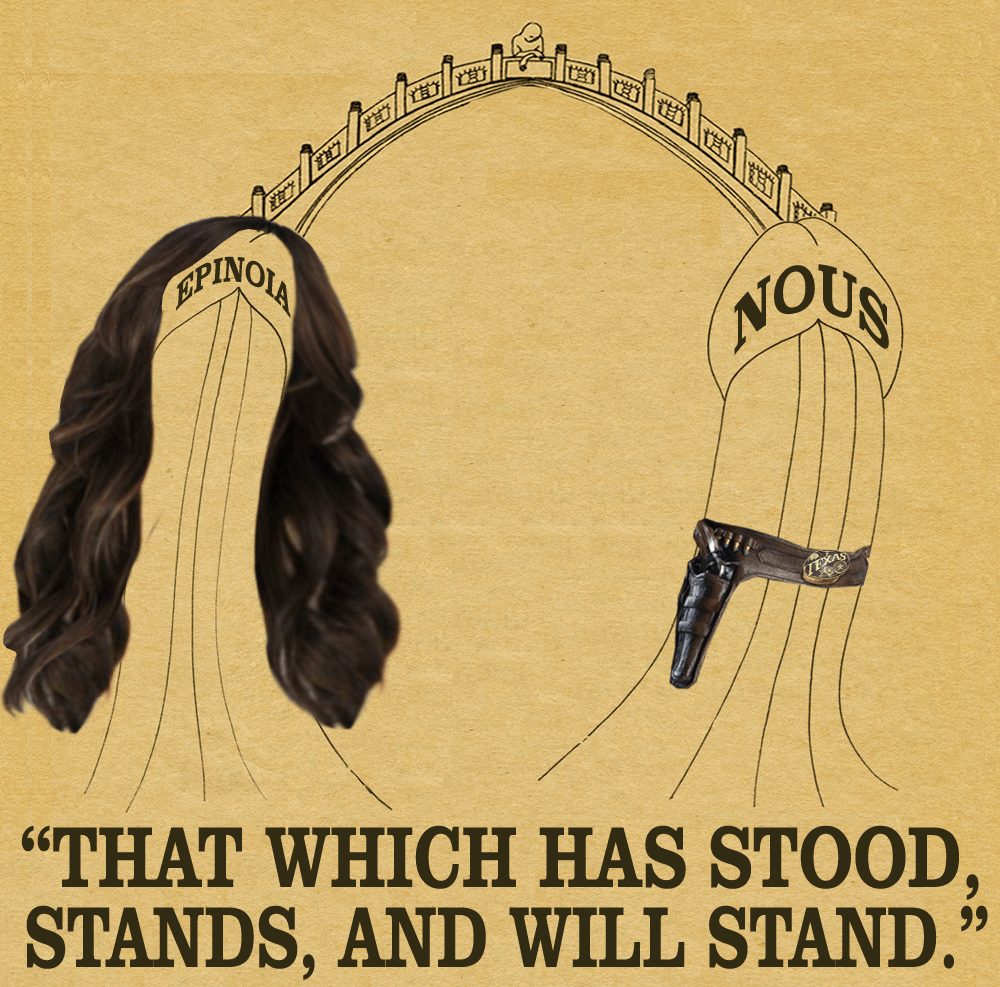
But Esoteric Science is not content with analogies on the purely objective plane of the physical senses, and therefore it is absolutely necessary to preface further teachings in this direction with a clear explanation of the real meaning of the word Magic. What Magic Is, in Reality Esoteric Science is, above all, the knowledge of our relations with and in divine magic, [13] inseparableness from our divine Selves -- the latter meaning something else besides our own higher spirit. Thus, before proceeding to exemplify and explain these relations, it may perhaps be useful to give the student a correct idea of the full meaning of this most misunderstood word "magic." Many are those willing and eager to study Occultism, but very few have even an approximate idea of the science itself. Now, very few of our American and European students can derive benefit from Sanskrit works or even their translations, as these translations are, for the most part, merely blinds to the uninitiated. I therefore propose to offer to their attention demonstrations of the aforesaid drawn from Neo-Platonic works; These are accessible in translations; and in order to throw light on that which has hitherto been full of darkness, it will suffice to point to a certain key in them. Thus the Gnosis, both pre-Christian and post-Christian, will serve our purpose admirably. There are millions of Christians who know the name of Simon Magus, and the little that is told about him in the Acts; but very few who have even heard of the many motley, fantastic and contradictory details which tradition records about his life. The story of his claims and his death is to be found only in the prejudiced, half-fantastic records about him in the works of the Church Fathers, such as Irenaeus, Epiphanius and St. Justin, and especially in the anonymous Philosophumena. Yet he is an historical character, and the appellation of "Magus" was given to him and was accepted by all his contemporaries, including the heads of the Christian Church, as a qualification indicating the miraculous powers he possessed, and irrespective of whether he was regarded as a white (divine) or a black (infernal) magician. In this respect, opinion has always been made subservient to the Gentile or Christian proclivities of the chronicler. It is in his system and in that of Menander, his pupil and successor, that we find what the term "magic" meant for Initiates in those days. Simon, as all the other Gnostics, taught that our world was created by the lower angels, whom he called AEons. He mentions only three degrees of such, because it was and is useless, as explained in the Secret Doctrine, to teach anything about the four higher ones, and he therefore begins at the plane of globes A and G. His system is as near to occult truth as any, so that we may examine it, as well as his own and Menander's claims about "magic," to find out what they meant by the term. Now, for Simon, the summit of all manifested creation was Fire. It is, with him as with us, the Universal Principle, the Infinite Potency, born from the concealed Potentiality. This Fire was the primeval cause of the manifested world of being, and was dual, having a manifested and a concealed or secret side. "The secret side of the Fire is concealed in its evident (or objective) side, and the objective is produced from the secret side," [14] he writes, which amounts to saying that the visible is ever present in the invisible, and the invisible in the visible. This was but a new form of stating Plato's idea of the Intelligible (Noeton) and the Sensible (Aistheton), and Aristotle's teaching on the Potency (Dunamis) and the Act (Energeia). For Simon, all that can be thought of, all that can be acted upon, was perfect intelligence. Fire contained all. And thus all the parts of that Fire, being endowed with intelligence and reason, are susceptible of development by extension and emanation. This is our teaching of the Manifested Logos and these parts in their primordial emanation are our Dhyan Chohans, the "Sons of Flame and Fire," or higher AEons. This "Fire" is the symbol of the active and living side of divine Nature. Behind it lay "infinite Potentiality in Potentiality," which Simon named "that which has stood, stands and will stand," or permanent Stability and personified Immutability.
From the Potency of Thought, Divine Ideation thus passed to Action. Hence the series of primordial emanations through Thought begetting the Act, the objective side of Fire being the Mother, the secret side of it being the Father. Simon called these emanations Syzgyies (a united pair, or couple), for they emanated two-by-two, one as an active, and the other as a passive AEon. Three couples thus emanated (or six in all, the Fire being the seventh), to which Simon gave the following names: "Mind and Thought, Voice and Name, Reason and Reflection," [15] the first in each pair being male, the last female. From these primordial six emanated the six AEons of the Middle World. Let us see what Simon himself says: "Each of these six primitive beings contained the entire infinite Potency [of its parent]; but it was there only in Potency, and not in Act. That Potency had to be called forth (or conformed) through an image in order that it should manifest in all its essence, virtue, grandeur and effects; for only then could the emanated Potency become similar to its parent, the eternal and infinite Potency. If, on the contrary, it remained simply potentially in the six Potencies and failed to be conformed through an image, then the Potency would not pass into action, but would get lost"; [16] in clearer terms, it would become atrophied, as the modern expression goes. Now, what do these words mean if not that to be equal in all things to the Infinite Potency the AEons had to imitate it in its action, and become themselves, in their turn, emanative principles, as was their parent, giving life to new beings, and becoming Potencies in actu themselves? To produce emanations, or to have acquired the gift of Kriyasakti, [17] is the direct result of that power, an effect which depends on our own action. That power, then, is inherent in man, as it is in the primordial AEons and even in the secondary emanations, by the very fact of their and our descent from the One Primordial Principle, the Infinite Power, or Potency. Thus we find in the system of Simon Magus that the first six AEons, synthesized by the seventh, the Parent Potency, passed into Act, and emanated, in their turn, six secondary AEons, which were each synthesized by their respective Parent. In the Philosophumena we read that Simon compared the AEons to the "Tree of Life." '"It is written,' said Simon in the Revelation, [18] that there are two ramifications of the universal AEons, having neither beginning nor end, issued both from the same Root, the invisible and incomprehensible Potentiality, Sige (Silence). One of these [series of AEons] appears from above. This is the Great Potency, Universal Mind [or Divine Ideation, the Mahat of the Hindus]; it orders all things and is male. The other is from below, for it is the Great [manifested] Thought, the female AEon, generating all things. These [two kinds of AEons] corresponding [19] with each other, have conjunction and manifest the middle distance [the intermediate sphere, or plane], the incomprehensible Air which has neither beginning nor end'." [20] This female "Air" is our Ether, or the Kabalistic Astral Light. It is, then, the Second World of Simon, born of FIRE, the principle of everything. We call it the ONE LIFE, the Intelligent, Divine Flame, omnipresent and infinite. In Simon's system, this Second World was ruled by a Being, or Potency, both male and female, or active and passive, good and bad. This Parent-Being, like the primordial infinite Potency, is also called "that which has stood, stands and will stand," so long as the manifested Kosmos shall last. When it emanated in actu and became like unto its own Parent, it was not dual or androgyne. It is the Thought that emanated from it (Sige) which became as itself (the Parent), having become like unto its image (or antetype); the second had now become in its turn the first (on its own plane or sphere). As Simon has it: "It [the Parent or Father] was one. For having it [the Thought] in itself, it was alone. It was not, however, first, though it was preexisting; but manifesting itself to itself from itself, it became the second (or dual). Nor was it called Father before it [the Thought] gave it that name. As, therefore, itself developing itself by itself, manifested to itself its own Thought, so also the Thought being manifested, did not act, but seeing the Father, hid it in itself, that is, (hid) that Potency (in itself). And the Potency (Dunamis, viz: Nous) and Thought (Epinoia) are male- female. Whence they correspond with one another -- for Potency in no way differs from Thought -- being one. So from the things above is found Potency, and from those below, Thought. It comes to pass, therefore, that that which is manifested from them, although being one, yet is found to be twofold, the androgyne having the female in itself. So is Mind in Thought, things inseparable from each other, which though being one are yet found dual." [21] "He (Simon) calls the first Syzygy of the six Potencies and of the seventh, which is with it, Nous and Epinoia, Heaven and Earth: the male looks down from on high and takes thought for his Syzygy (or spouse), for the Earth below receives those intellectual fruits which are brought down from Heaven and are cognate to the Earth." [22] Simon's Third World with its third series of six AEons and the seventh, the Parent, is emanated in the same way. It is this same note which runs through every Gnostic system -- gradual development downward into matter by similitude; and it is a law which is to be traced down to primordial Occultism, or Magic. With the Gnostics, as with us, this seventh Potency, synthesizing all, is the Spirit brooding over the dark waters of undifferentiated Space, Narayana, or Vishnu, in India; the Holy Ghost in Christianity. But while in the latter the conception is conditioned and dwarfed by limitations necessitating faith and grace, Eastern Philosophy shows it pervading every atom, conscious or unconscious. Irenaeus supplements the information on the further development of these six AEons. We learn from him that Thought, having separated itself from its Parent, and knowing through its identity of Essence with the latter what it had to know, proceeded on the second or intermediate plane, or rather World (each of such Worlds consisting of two planes, the superior and inferior, male and female, the latter assuming finally both Potencies and becoming androgyne), to create inferior Hierarchies, Angels and Powers, Dominions and Hosts, of every description, which in their turn created, or rather emanated out of their own Essence, our world with its men and beings, over which they watch. It thus follows that every rational being -- called Man on Earth -- is of the same essence and possesses potentially all the attributes of the higher AEons, the primordial seven. It is for him to develop, "with the image before him of the highest," by imitation in actu, the Potency with which the highest of his Parents, or Fathers, is endowed. Here we may again quote with advantage from the Philosophumena: "So then, according to Simon, this blissful and imperishable (principle) is concealed in everything in potency, not in act. This is 'that which has stood, stands and will stand,' viz: that which has stood above in ingenerable Potency; that which stands below in the stream of the waters generated in an image; that which will stand above, beside the blissful Infinite Potency, if it makes itself like unto this image. For three, he says, are they that stand, and without these three AEons of stability, there is no adornment of the generable which, according to them [the Simonians], is borne on the water, and being moulded according to the similitude is a perfect and celestial (AEon), in no manner of thinking inferior to the ingenerable Potency. Thus they say: 'I and thou [are] one; before me [wast] thou; that which is after thee [is] I.' This, he says, is the one Potency, divided into above and below, generating itself, nourishing itself, seeking itself, finding itself; its own mother, father, brother, spouse, daughter and son, one, for it is the Root of all." [23] Thus of this triple AEon, we learn the first exists as "that which has stood, stands and will stand," or the uncreate Power, Atman; the second is generated in the dark waters of Space (Chaos, or undifferentiated Substance, our Buddhi), from or through the image of the former reflected in those waters, the image of him, or It, which moves on them; the third World (or, in man, Manas) will be endowed with every power of that eternal and omnipresent Image if it but assimilates it to itself. For, "all that is eternal, pure and incorruptible is concealed in everything that is," if only potentially, not actually. And "everything is that image, provided the lower image (man) ascends to that highest Source and Root in Spirit and Thought." Matter as Substance is eternal and has never been created. Therefore Simon Magus, with all the great Gnostic teachers and Eastern philosophers, never speaks of its beginning. "Eternal Matter" receives its various forms in the lower AEon from the Creative Angels, or Builders, as we call them. Why, then, should not Man, the direct heir of the highest AEon, do the same, by the potency of his thought, which is born from Spirit? This is Kriyasakti, the power of producing forms on the objective plane through the potency of Ideation and Will, from invisible, indestructible matter. Truly says Jeremiah, [24] quoting the "Word of the Lord"; "Before I formed thee in the belly I knew thee; and before thou camest forth out of the womb I sanctified thee"; for Jeremiah stands here for Man when he was yet an AEon, or Divine Man, both with Simon Magus and Eastern Philosophy. The first three chapters of Genesis are as occult as what is given in Instruction No. I. For the terrestrial Paradise is the Womb, says Simon, [25] Eden the region surrounding it. The river which went out of Eden to water the garden is the Umbilical Cord; this cord is divided into four Heads, the streams that flowed out of it, the four canals which serve to carry nutrition to the Foetus, i.e., the two arteries and the two veins which are the channels for the blood and convey the breathing air, the unborn child, according to Simon, being entirely enveloped by the Amnion, fed through the Umbilical Cord and given vital air through the Aorta. [26] The above is given for the elucidation of that which is to follow. The disciples of Simon Magus were numerous, and were instructed by him in magic. They made use of so-called "exorcisms" (as in the New Testament), incantations, philtres; believed in dreams and visions, and produced them at will; and finally forced the lower orders of spirits to obey them. Simon Magus was called "the Great Power of God," literally "the Potency of the Deity which is Called Great." That which was then termed Magic we now call Theosophia, or Divine Wisdom, Power and Knowledge. His direct disciple, Menander, was also a great Magician. Says Irenaeus, among other writers: "The successor of Simon was Menander, a Samaritan by birth, who reached the highest summits in the Science of Magic." Thus both master and pupil are shown as having attained the highest powers in the art of enchantments, powers which can be obtained only through "the help of the Devil," as Christians claim; and yet their works were identical with those spoken of in the New Testament, wherein such phenomenal results are called divine miracles, and are, therefore, believed in and accepted as coming from and through God. But the question is, have these so-called "miracles" of the "Christ" and Apostles ever been explained any more than the magical achievements of so-called sorcerers and magicians? I say, never. We Occultists do not believe in supernatural phenomena, and the Masters laugh at the word "miracle." Let us see, then, what is really the sense of the word Magic. The source and basis of it lie in Spirit and Thought, whether on the purely divine or the terrestrial plane. Those who know the history of Simon have the two versions before them, that of White and of Black Magic, at their option, in the much talked of union of Simon with Helena, whom he called his Epinoia (Thought). Those who, like the Christians, had to discredit a dangerous rival, talk of Helena as being a beautiful and actual woman, whom Simon had met in a house of ill-fame at Tyre, and who was, according to those who wrote his life, the reincarnation of Helen of Troy. How, then, was she "Divine Thought"? The lower angels, Simon is made to say in Philosophumena, or the third AEons, being so material, had more badness in them than all the others. Poor man, created or emanated from them, had the vice of his origin. What was it? Only this: when the third AEons possessed themselves, in their turn, of the Divine Thought through the transmission into them of Fire, instead of making of man a complete being, according to the universal plan, they at first detained from him that divine spark (Thought, or Earth Manas); and that was the cause and origin of senseless man's committing the original sin as the angels had committed it aeons before by refusing to create. [27] Finally, after detaining Epinoia prisoner amongst them and having subjected the Divine Thought to every kind of insult and desecration, they ended by shutting it into the already defiled body of man. After this, as interpreted by the enemies of Simon, she passed from one female body into another through ages and races, until Simon found and recognized her in the form of Helena, the "prostitute," the "lost sheep" of the parable. Simon is made to represent himself as the Saviour descended on Earth to rescue this "lamb" and those men in whom Epinoia is still under the dominion of the lower angels. The greatest magical feats are thus attributed to Simon through his sexual union with Helena, hence Black Magic. Indeed, the chief rites of this kind of magic are based on such disgusting literal interpretation of noble myths, one of the noblest of which was thus invented by Simon as a symbolical mark of his own teaching. Those who understood it correctly knew what was meant by "Helena." It was the marriage of Nous (Atma-Buddhi) with Manas, the union through which Will and Thought become one and are endowed with divine powers. For Atman in man, being of an unalloyed essence, the primordial divine Fire (or the eternal and universal "that which has stood, stands and will stand"), is of all the planes; and Buddhi is its vehicle or Thought, generated by and generating the "Father" in her turn, and also Will. She is "that which has stood, stands and will stand," thus becoming, in conjunction with Manas, male-female, in this sphere only. Hence, when Simon spoke of himself as the Father and the Son and the Holy Ghost, and of Helena as his Epinoia, Divine Thought, he meant the marriage of his Buddhi with Manas. Helena was the Sakti of the inner man, the female potency. Now, what says Menander? The lower angels, he taught, were the emanations of ENNOIA (Designing Thought). It was Ennoia who taught the Science of Magic and imparted it to him, together with the art of conquering the creative angels of the lower world. The latter stand for the passions of our lower nature. His pupils, after receiving baptism from him, (i.e., after initiation), were said to "resurrect from the dead" and, "growing no older," become "immortal." [28] The "resurrection" promised by Menander meant, of course, simply the passage from the darkness of ignorance into the light of truth, the awakening of man's immortal Spirit to inner and eternal life. This is the Science of the Raja Yogis -- Magic. Every person who has read Neo-Platonic philosophy knows how its chief Adepts, such as Plotinus, and especially Porphyry, fought against phenomenal Theurgy. But, beyond all of them, Jamblichus, the author of the De Mysteriis, lifts high the veil from the real term Theurgy, and shows us therein the true divine Science of Raja Yoga. Magic, he says, is a lofty and sublime Science, divine, and exalted above all others. "It is the great remedy for all... It neither takes its source in, nor is it limited to, the body or its passions, to the human compound or its constitution; but all is derived by it from our upper Gods," our divine Egos, which run like a silver thread from the Spark in us up to the primeval divine Fire. [29] Jamblichus execrates physical phenomena, produced, as he says, by the bad demons who deceive men (the spooks of the seance room), as vehemently as he exalts divine Theurgy. But to exercise the latter, he teaches, the Theurgist must imperatively be "a man of high morality and a chaste soul." The other kind of magic is used only by impure, selfish men, and has nothing of the divine in it.... No real Vates would ever consent to find in its communications anything coming from our higher Gods ... Thus one (Theurgy) is the knowledge of our Father (the Higher Self); the other, subjection to our lower nature.... One requires holiness of the soul, a holiness which rejects and excludes everything corporeal; the other, the desecration of it (the Soul).... One is the union with the Gods (with one's God), the source of all Good; the other, intercourse with demons (Elementals), which, unless we subject them, will subject us, and lead us step by step to moral ruin (mediumship). In short: "Theurgy unites us most strongly to divine nature. This nature begets itself through itself, moves through its own powers, supports all, and is intelligent. Being the ornament of the Universe, it invites us to intelligible truth, to perfection and imparting perfection to others. It unites us so intimately to all the creative actions of the Gods, according to the capacity of each of us, that the soul having accomplished the sacred rites is consolidated in their (the Gods') actions and intelligences, until it launches itself into and is absorbed by the primordial divine essence. This is the object of the sacred Initiations of the Egyptians." [30] Now, Jamblichus shows us how this union of our Higher Soul with the Universal Soul, with the Gods, is to be effected. He speaks of Manteia, which is Samadhi, the highest trance. [31] He speaks also of dream which is divine vision, when man re-becomes again a God. By Theurgy, or Raja Yoga, a man arrives at: (1) Prophetic Discernment through our God (the respective Higher Ego of each of us) revealing to us the truths of the plane on which we happen to be acting; (2) Ecstacy and Illumination; (3) Action in Spirit (in Astral Body or through Will); (4) and Domination over the minor, senseless Demons (Elementals) by the very nature of our purified Egos. But this demands the complete purification of the latter. And this is called by him Magic, through initiation into Theurgy. But Theurgy has to be preceded by a training of our senses and the knowledge of the human Self in relation to the Divine SELF. So long as man has not thoroughly mastered this preliminary study, it is idle to anthropomorphize the formless. By "formless" I mean the higher and the lower Gods, the supermundane as well as mundane Spirits, or Beings, which to beginners can be revealed only in Colours and Sounds. For none but a high Adept can perceive a "God" in its true transcendental form, which to the untrained intellect, to the Chela, will be visible only by its Aura. The visions of full figures casually perceived by sensitives and mediums belong to one or another of the only three categories they can see: (a) Astrals of living men; (b) Nirmanakayas (Adepts, good or bad, whose bodies are dead, but who have learned to live in the invisible space in their ethereal personalities); and (c) Spooks, Elementaries and Elementals masquerading in shapes borrowed from the Astral Light in general, or from figures in the "mind's eye" of the audience, or of the medium, which are immediately reflected in their respective Auras. Having read the foregoing, students will now better comprehend the necessity of first studying the correspondences between our "principles" -- which are but the various aspects of the triune (spiritual and physical) man -- and our Paradigm, the direct roots of these in the Universe. In view of this, we must resume our teaching about the Hierarchies directly connected and forever linked with man. ---------- Enough has been said to show that while for the Orientalists and profane masses the sentence, "Om Mani Padme Hum," means simply "O, the Jewel in the Lotus," esoterically it signifies "O, my God within me." Yes; there is a God in each human being, for man was and will re-become God. The sentence points to the indissoluble union between Man and the Universe. For the Lotus is the universal symbol of Kosmos as the absolute totality, and the Jewel is Spiritual Man, or God. In the preceding Instruction, the correspondences between Colours, Sounds and "Principles" were given; and those who have read the second volume of the Secret Doctrine will remember that these seven principles are derived from the seven great Hierarchies of Angels, or Dhyan Chohans, which are, in their turn, associated with Colours and Sounds, and form collectively the Manifested Logos. In the eternal music of the spheres we find the perfect scale corresponding to the colours, and in the number, determined by the vibrations of colour and sound, which underlies every form and guides every sound, we find the summing-up of the Manifested Universe. We may illustrate these correspondences by showing the relation of colour and sound to the geometrical figures which, as explained in the Secret Doctrine, [32] express the progressive stages in the manifestation of Kosmos. But the student will certainly be liable to confusion if, in studying the Diagrams, he does not remember two things: (1) That, our plane being a plane of reflection, and therefore illusionary, the various notations are reversed and must be counted from below upwards. The musical scale begins from below upwards, commencing with the deep Do and ending with the far more acute Si. (2) That Kama Rupa (corresponding to Do in the musical scale), containing as it does all potentialities of matter, is necessarily the starting-point on our plane. Further, it commences the notation on every plane, as corresponding to the "matter" of that plane, Again, the student must also remember that these notes have to be arranged in a circle, thus showing how Fa is the middle note of Nature. In short, musical notes, or Sounds, Colours and Numbers proceed from one to seven, and not from seven to one as erroneously shown in the spectrum of the prismatic colours, in which Red is counted first: a fact which necessitated my putting the principles and the days of the week at random in Diagram II. The musical scale and Colours, according to the number of vibrations, proceed from the world of gross matter to that of spirit thus:
Here again the student is asked to dismiss from his mind any correspondence between "principles" and numbers, for reasons already given. The esoteric enumeration cannot be made to correspond with the conventional exoteric. The one is the reality, the other classified according to illusive appearances. The human principles, as given in Esoteric Buddhism, were tabulated for beginners, so as not to confuse their minds. It was half a blind. To proceed:
INSTRUCTION NO. II
A. Violet. (a) Si. B. (Orange) Red. (a) Do. A. (a) The Astral Double of Nature, or the Paradigm of all Forms. (b) Divine Ideation, or Universal Mind. (c) The Synthesis of occult Nature, the Egg of Brahma, containing all and radiating all. (d) Animal or Material Soul of Nature, source of animal and vegetable intelligence and instinct. (e) The aggregate of Dhyan Chohanic Intelligences, Fohat. (f) Life Principle in Nature. (g) The Life Procreating Principle in Nature. That which, on the spiritual plane, corresponds to sexual affinity on the lower. Mirrored on the plane of Gross Nature, the World of Reality is reversed, and becomes on Earth and our plane: B. (a) Red is the colour of manifested dual, or male and female. In man it is shown in its lowest animal form. (b) Orange is the colour of the robes of the Yogis and Buddhist priests, the colour of the Sun and Spiritual Vitality, also of the Vital Principle. (c) Yellow or radiant Golden is the colour of the Spiritual, Divine Ray in every atom; in man of Buddhi. (d) Green and Red are, so to speak, interchangeable colours, for Green absorbs the Red, as being threefold stronger in its vibrations than the latter; and Green is the complementary colour of extreme Red. This is why the Lower Manas and Kama Rupa are respectively shown as Green and Red. (e) The Astral Plane, or Auric Envelope in Nature and Man. (f) The Mind or rational element in Man and Nature. (g) The most ethereal counterpart of the Body of man, the opposite pole, standing in point of vibration and sensitiveness as the Violet stands to the Red. PLATE II.
The above is on the manifested plane; after which we get the seven and the Manifested Prism, or Man on Earth. With the latter, the Black Magician alone is concerned. In Kosmos, the gradations and correlations of Colours and Sounds, and therefore of Numbers, are infinite. This is suspected even in Physics, for it is ascertained that there exist slower vibrations than those of the Red, the slowest perceptible to us, and far more rapid vibrations than those of the Violet, the most rapid that our senses can perceive. But on Earth, in our physical world, the range of perceptible vibrations is limited. Our physical senses cannot take cognizance of vibrations above and below the septenary and limited gradations of the prismatic colours, for such vibrations are incapable of causing in us the sensation of colour or sound. It will always be the graduated septenary and no more, unless we learn to paralyze our Quaternary and discern both the superior and inferior vibrations with our spiritual senses seated in the upper Triangle. Now, on this plane of illusion, there are three fundamental colours, as demonstrated by physical Science: Red, Blue, and Yellow, (or rather Orange-Yellow). Expressed in terms of the human principles they are: (1) Kama Rupa, the seat of the animal sensations, welded to, and serving as a vehicle for the Animal Soul or Lower Manas (Red and Green, as said, being interchangeable); (2) Auric Envelope, or the essence of man; and (3) Prana, or Life Principle. But if from the realm of illusion, or the living man as he is on our Earth, subject to his sensuous perceptions only, we pass to that of semi-illusion, and observe the natural colours themselves, or those of the principles, that is, if we try to find out which are those that in the perfect man absorb all others, we shall find that the colours correspond and become complementary in the following way:
Hence the full septenary man, symbolically as to the geometrical figures, and in reality as to the various colours of his principles, presents some such appearance as in Plate II. A faint violet, mist-like form represents the Astral Man within an oviform bluish circle over which radiate in ceaseless vibrations the prismatic colours. That colour is predominant, of which the corresponding principle is the most active generally, or at the particular moment when the clairvoyant perceives it. Such man appears during his waking states: and it is by the predominance of this or that colour, and by the intensity of its vibrations, that a clairvoyant, if he is acquainted with correspondence, can judge of the inner state or character of a person, for the latter is an open book to every practical Occultist. In the trance state the Aura changes entirely, the seven prismatic colours being no longer discernible. In sleep also they are not all "at home." For those which belong to the spiritual elements in the man, viz: Yellow, Buddhi; Indigo, Higher Manas; and the Blue of the Auric Envelope will be either hardly discernible, or altogether missing. The Spiritual Man is free during sleep, and though his physical memory may not become aware of it, lives, robed in his highest essence, in realms on other planes, in realms which are the land of reality, called dreams on our plane of illusion.
PLATE III. NOTE (a). -- The numbers attached to the circles are for purposes of reference only. They have no correspondence with colours or principles. NOTE (b). -- Each of the prismatic circles corresponds to, and is the source of, the principle corresponding in colour to its widest circle; e.g., circle 1 corresponds to the Linga Sarira (Violet). A good clairvoyant, moreover, if he had an opportunity of seeing a Yogi in the trance state and a mesmerized subject, side by side, would learn an important lesson in Occultism. He would learn to know the difference between self-induced trance and a hypnotic state resulting from extraneous influence. In the Yogi, the "principles" of the lower Quaternary disappear entirely. Neither Red, Green, Red-Violet nor the Auric Blue of the Body are to be seen; nothing but hardly perceptible vibrations of the golden-hued Prana principle and a violet flame streaked with gold rushing upwards from the head, in the region where the Third Eye rests, and culminating in a point. If the student remembers that the true Violet, or the extreme end of the spectrum, is no compound colour of Red and Blue, but a homogeneous colour with vibrations seven times more rapid than those of the extreme Red, [*] and that the golden hue is the essence of the three yellow hues from Orange Red to Yellow-Orange and Yellow, he will understand the reason why: he lives in his own Auric Body, now become the vehicle of Buddhi-Manas. On the other hand, in a subject in an artificially produced hypnotic or mesmeric trance, an effect of unconscious when not of conscious Black Magic, unless produced by a high Adept, the whole set of the principles will be present, with the Higher Manas paralysed, Buddhi severed from it through that paralysis, and the red-violet Astral Body entirely subjected to the Lower Manas and Kama Rupa (the green and red animal monsters in us). One who comprehends well the above explanations will readily see how important it is for every student, whether he is striving for practical occult powers or only for the purely psychic and spiritual gifts of clairvoyance and metaphysical knowledge, to master thoroughly the right correspondences between the human, or nature principles, and those of Kosmos. It is ignorance which leads materialistic science to deny the inner man and his divine powers; knowledge and personal experience that allow the Occultist to affirm that such powers are as natural to man as swimming to fishes. It is like a Laplander, in all sincerity, denying the possibility of the catgut, strung loosely on the sounding-board of a violin, producing comprehensive sounds or melody. Our principles are the Seven-Stringed Lyre of Apollo, truly. In this our age, when oblivion has shrouded ancient knowledge, men's faculties are no better than the loose strings of the violin to the Laplander. But the Occultist who knows how to tighten them and tune his violin in harmony with the vibrations of colour and sound, will extract divine harmony from them. The combination of these powers and the attuning of the Microcosm and the Macrocosm will give the geometrical equivalent of the invocation "Om Mani Padme Hum."
This was why the previous knowledge of music and geometry was obligatory in the school of Pythagoras. ---------- The Roots of Colour and Sound. PLATE III. Further, each of the Primordial Seven, the first Seven Rays forming the Manifested Logos, is again sevenfold. Thus, as the seven colours of the solar spectrum correspond to the seven Rays, or Hierarchies, so each of these latter has again its seven divisions corresponding to the same series of colours. But in this case one colour, viz: that which characterizes the particular Hierarchy as a whole, is predominant and more intense than the others. These Hierarchies can only be symbolized as concentric circles of prismatic colours; each Hierarchy being represented by a series of seven concentric circles, each circle representing one of the prismatic colours in their natural order. But in each of these "wheels" one circle will be brighter and more vivid in colour than the rest and the wheel will have a surrounding Aura (a fringe, as the physicists call it) of that colour. This colour will be the characteristic colour of that Hierarchy as a whole. Each of these Hierarchies furnishes the essence (the soul) and is the "Builder" of one of the seven kingdoms of Nature, which are the three elemental kingdoms, the mineral, the vegetable, the animal, and the kingdom of spiritual man. [34] Moreover, each Hierarchy furnishes the aura of one of the seven principles in man with its specific colour. Further, as each of these Hierarchies is the Ruler of one of the Sacred Planets, it will easily be understood how Astrology came into existence, and that real Astrology has a strictly scientific basis. Plate III demonstrates the fact by showing the symbol adopted in the Eastern school to represent the Seven Hierarchies of creative Powers; call them Angels, if you will, or Planetary Spirits, or, again, the Seven Rulers of the Seven Sacred Planets of our system, as in our present case. At all events, the concentric circles stand as symbols for Ezekiel's "Wheels" with some Western Occultists and Kabalists, and for the "Builders" or Prajapati with us. DIAGRAM III. The student should carefully examine the following Diagram. Thus the Linga Sarira is derived from the Violet sub-ray of the Violet Hierarchy; the Higher Manas is similarly derived from the Indigo sub-ray of the Indigo Hierarchy, and so on. Every man being born under a certain planet, there will always be a predominance of that planet's colour in him, because that "principle" will rule in him which has its origin in the Hierarchy in question. There will also be a certain amount of the colour derived from the other planets present in his Aura, but that of the ruling planet will be strongest. Now a person in whom say, the Mercury principle is predominant, will, by acting upon the Mercury principle in another person born under a different planet, be able to get him entirely under his control. For the stronger Mercury principle in him will overpower the weaker mercurial element in the other. But he will have little power over persons born under the same planet as himself. This is the key to the Occult Sciences of Magnetism and Hypnotism. The student will understand that the Orders and Hierarchies are here named after their corresponding colours, so as to avoid using numerals, which would be confusing in connection with the human principles, as the latter have no proper numbers of their own. The real occult names of these Hierarchies cannot now be given.
The student must, however, remember that the colours which we see with our physical eyes are not the true colours of occult nature, but are merely the effects produced on the mechanism of our physical organs by certain rates of vibration. For instance, Clerk Maxwell has demonstrated that the retinal effects of any colour may be imitated by properly combining three other colours. It follows, therefore, that our retina has only three distinct colour sensations, and we therefore do not perceive the seven colours which really exist, but only their "imitiations," so to speak, in our physical organism. Thus, for instance, the Orange-Red of the first "Triangle" is not a combination of Orange and Red, but the true "spiritual" Red, if the term may be allowed, while the Red (blood-red) of the spectrum is the colour of Kama, animal desire, and is inseparable from the material plane. ---------- The Unity of Deity. Esotericism, pure and simple, speaks of no personal God; therefore are we considered as Atheists. But, in reality, Occult Philosophy, as a whole, is based absolutely on the ubiquitous presence of God, the Absolute Deity; and if IT itself is not speculated upon, as being too sacred and yet incomprehensible as a Unit to the finite intellect, yet the entire philosophy is based upon Its divine Powers as being the source of all that breathes and lives and has its existence. In every ancient religion the ONE was demonstrated by the many. In Egypt and India, in Chaldea and Phoenicia, and finally in Greece, the ideas about Deity were expressed by multiples of three, five, and seven: and also of eight, nine and twelve great Gods, which symbolized the powers and properties of the One and Only Deity. This was related to that infinite subdivision by irregular and odd numbers to which the metaphysics of these nations subjected their ONE DIVINITY. Thus constituted, the cycle of the Gods had all the qualities and attributes of the ONE SUPREME AND UNKNOWABLE; for in this collection of divine personalities, or rather of symbols personified, dwells the ONE GOD, the GOD ONE, that God which, in India, is said to have no Second: "Oh God Ani (the Spiritual Sun), thou residest in the agglomeration of thy divine personages." [35] These words show the belief of the ancients that all manifestation proceeds from one and the same source, all emanating from the one identical principle which can never be completely developed except in and through the collective and entire aggregate of its emanations. The Pleroma of Valentinus is absolutely the Space of Occult Philosophy; for Pleroma means the "Fullness," the superior regions. It is the sum total of all the divine manifestations and emanations expressing the plenum or totality of the rays proceeding from the ONE, differentiating on all the planes, and transforming themselves into divine Powers, called Angels and Planetary Spirits in the philosophy of every nation. The Gnostic AEons and Powers of the Pleroma are made to speak as the Devas and Saddhus of the Puranas. The Epinoia, the first female manifestation of God, the "Principle" of Simon Magus and Saturninus, holds the same language as the Logos of Basilides: and each of these is traced to the purely esoteric Aletheia, the TRUTH of the Mysteries. All of them, we are taught, repeat at different times and in different languages the magnificent hymn of the Egyptian papyrus, thousands of years old: "The Gods adore thee, they greet thee, O the One Dark Truth"; and addressing Ra, they add: "The Gods bow before thy Majesty, by exalting the Souls of that which produces them ... and say to thee, Peace to all emanations from the Unconscious Father of the Conscious Fathers of the Gods.... Thou producer of beings, we adore the Souls which emanate from thee. Thou begettest us, O thou Unknown, and we greet thee in worshipping each God-Soul which descendeth from thee and liveth in us." (Hymn to Amon-Ra). This is the source of the assertion, "Know ye not that ye are Gods and the temple of God." This is shown in the "Roots of Ritualism in Church and Masonry," in Lucifer for March, 1889. Truly then, as said seventeen centuries ago, "Man cannot possess Truth (Aletheia) except he participate in the Gnosis." So we may say now: No man can know the Truth unless he studies the secrets of the Pleroma of Occultism; and these secrets are all in the Theogony of the ancient Wisdom-Religion, which is the Aletheia of Occult Science. H. P. B.,
_______________ Notes: 1. See Secret Doctrine, vol. II, p. 357; and vol. I, p. 127, et seq. 2. See Secret Doctrine, vol. II, p. 288 et seq. 3. See Franck's Die Kabbala, p. 314 et seq. 4. Vol. I, p. 122 5. Meanwhile we point out for confirmation Origen's works, who says that "the seven ruling daimons" (genii or planetary rulers) are Michael, the Sun (the lion-like); the second in order, the Bull, Jupiter or Suriel, etc.; and all these, the "Seven of the Presence," are the Sephiroth. The Sephirothal Tree is the Tree of the Divine Planets as given by Porphyry, or Porphyry's Tree, as it is usually called. 6. Vol. I, p. 122. 7. Esoterically, green, there being no black in the prismatic ray. 8. Esoterically, light blue. As a pigment, purple is a compound of red and blue, and in Eastern Occultism blue is the spiritual essence of the colour purple, while red is its material basis. In reality, Occultism makes Jupiter blue because he is the son of Saturn, which is green, and light blue as a prismatic colour contains a great deal of green. Again, the Auric Body will contain much of the colour of the Lower Manas if the man is a material sensualist, just as it will contain much of the darker hue if the Higher Manas has preponderance over the Lower. 9. Esoterically, the Sun cannot correspond with the eye, nose, or any other organ, since, as explained, it is no planet, but a central star. It was adopted as a planet by the post-Christian Astrologers, who had never been initiated. Moreover, the true colour of the Sun is blue, and it appears yellow only owing to the effect of the absorption of vapours (chiefly metallic) by its atmosphere. All is Maya on our Earth. 10. Esoterically, indigo or dark blue, which is the complement of yellow in the prism. Yellow is a simple or primitive colour. Manas being dual in its nature, as is its sidereal symbol, the planet Venus, which is both the morning and evening star, the difference between the higher and the lower principles of Manas, whose essence is derived from the Hierarchy ruling Venus, is denoted by the dark blue and green. Green, the Lower Manas resembles the colour of the solar spectrum which appears between the yellow and the dark blue, the Higher Spiritual Manas. Indigo is the intensified colour of the heaven or sky, to denote the upward tendency of Manas toward Buddhi, or the heavenly Spiritual Soul. This colour is obtained from the indigofera tinctoria, a plant of the highest occult properties in India, much used in White Magic, and occultly connected with copper. This is shown by the indigo assuming a coppery lustre, especially when rubbed on any hard substance. Another property of the dye is that it is insoluble in water and even in ether, being lighter in weight than any known liquid. No symbol has ever been adopted in the East without being based upon a logical and demonstrable reason. Therefore Eastern symbologists, from the earliest ages, have connected the spiritual and the animal mind, of man, the one with dark blue (Newton's indigo), or true blue, free from green; and the other with pure green. 11. Esoterically, yellow because the colour of the Sun is orange, and Mercury now stands next to the Sun in distance, as it does in colour. The planet for which the Sun is a substitute, was still nearer the Sun than Mercury now is, and was one of the most secret and highest planets. It is said to have become invisible at the close of the Third Race. 12. Esoterically, violet, because, perhaps violet is the colour assumed by a ray of sunlight when transmitted through a very thin plate of silver, and also because the Moon shines upon the Earth with light borrowed from the Sun, as the human body shines with qualification, borrowed from its double -- the aerial man. As the astral shadow starts the series of principles in man, on the terrestrial plane, up to the lower, animal Manas, so the violet ray starts the series of prismatic colours from its end up to green, both being, the one as a principle and the other as a colour, the most refrangible of all the principles and colours. Besides which, there is the same great occult mystery attached to all these correspondences, both celestial and terrestrial bodies, colours and sounds. In clearer words, there exists the same law of relation between the Moon and the Earth, the astral and the living body of man, as between the violet end of the prismatic spectrum and the indigo and the blue. But of this more anon. 13. Magic, Magia, means, in its spiritual, secret sense, the "Great Life," or divine life in spirit. The root is magh, as seen in the Sanskrit mahat, Zend maz, Greek megas, and Latin magnus, all signifying "great." 14. Philosophumena, VI, 9. 15. Nous, Epinoia; Phone, Onoma; Logismos, Enthumesis. 16. Philosophumena, VI, 12. 17. See Secret Doctrine, sub voce. 18. "The Great Revelation" (He Megale Apophasis), of which Simon himself is supposed to have been the author. 19. Literally, standing opposite each other in rows or pairs. 20. Philosophumena, VI, 18. 21. Ibid., VI, 18. 22. Ibid., VI, 13. 23. VI, 17. 24. Chap. I, v. 5. 25. Philosophumena, VI, 14. 26. At first there are the omphalo-mesenteric vessels, two arteries and two veins, but these afterwards totally disappear, as does the “vascular area” on the Umbilical Vesicle, from which they proceed. As regards the “Umbilical Vessels” proper, the Umbilical Cord ultimately has entwined around it from right to left the one Umbilical Vein which takes the oxygenated blood from the mother to the Foetus and two Hypogastric or Umbilical Arteries which take the used-up blood from the foetus to the Placenta, the contents of the vessels being the reverse of that which prevails after birth. Thus science corroborates the wisdom and knowledge of ancient occultism, for in the days of Simon Magus no man, unless an Initiate, knew anything about the circulation of the blood or about Physiology. While this Instruction was being printed, I received two small pamphlets from Dr. Jerome A. Anderson (E.S.T.) which were printed in 1884 and 1888, and in which is to be found the scientific demonstration of the foetal nutrition as advanced in Instruction No. I. Briefly, the foetus is nourished by osmosis from the Amniotic Fluid and respires by means of the Placenta. Science knows little or nothing about the Amniotic Fluid and its uses. If any of our members care to follow up this question, I would recommend Dr. Anderson’s Remark on the Nutrition of the Foetus (Wood & Co., New York). 27. See Secret Doctrine, Vol. II. 28. See Eusebius' Hist. Eccles., lib. III, cap. 26. 29. De Mysteriis, p. 100, lines 10 to 19, fol. I. 30. De Mysteriis, p. 290, lines 15 to 18, et seq., caps. V and VII. 31. Ibid., p. 100, sec. III, cap. III. 32. Vol. I, p. 4, et seq.; vol. II, p. 36 et seq., and 590 et seq. 33. The Master-Key or Tonic of Manifested Nature. 34. See Five Years of Theosophy, pp. 273 to 278. 35. Apud Grebani Papyrus Orbiney, p. 101.
Strictly Private and Confidential. Not the Property of Any Members, and to be Returned on Demand to the Agent of the Head of the N.S. INTRODUCTION. [The following Introduction, which was originally headed "Preliminary Explanations to No. III of the Instructions," was written at the time of a grave crisis, or rather series of crises, that the T.S. passed through in the West in 1889-90. Treachery within the E.S. itself, and persistent and relentless attacks on the T.S. from without, especially in America, necessitated the striking of a fresh key-note and giving directions for the closing up of the ranks of the E.S. Those portions of the original which dealt with the details of the actual state of affairs have now been omitted.]
OF the fact that no such large and ever-growing body as the E.S. could remain without its traitors, open and secret, I have been aware from the beginning. I knew what I had to expect from the first day. I knew that the task I had undertaken would lead to more obloquy and misrepresentations for me than ever; that it was sure to create a large amount of bad feeling among the members of the main (exoteric) body of the T.S., which would finally be vented, in particular, if not solely, upon myself. And all has come to pass as I knew it would. But if it is, in a great measure, owing to this that the regular issue of Instructions has been prevented, it has not been the sole reason. There came a more serious impediment -- to me the bitterest of all. I had received two letters and a reproof from the Masters. These reached me in no such way as to allow the hope that it was less serious than had at first appeared. That which I received both times was a letter in plain language, sent by post and mailed quite prosaically, at the Sikkhim frontier, one in March, the other in August, 1889. The last of these left me no ephemeral hope that I had misunderstood or even exaggerated the facts. In their first, our Masters were displeased, and in their last, which arrived just as the news of a flagrant case of treachery reached me, that displeasure became still more apparent. I was told to keep back Instruction No. III until further developments, and then to make those portions of the contents of the Masters' letter that related to the E.S. known to all its members, without even omitting to show them how mistaken and dangerous had been my policy in the E.S. from its beginning. I had been warned by the Council and my trusted friends, of the danger there was in admitting such a number of persons, scattered so widely over the world, who, it was added, knew me not, except on hearsay, and each of whom I had no other means, as they supposed, of studying, than through their auras and photographs. I myself realized that danger, but had no means of averting it, since the Book of the Discipline and Rules states that: "No one shall be refused admission, of the chance of learning truth and thereby improving his life, only because some one, or even all his neighbours think ill of him." Such is the rule. Therefore, the larger the number of applicants who take the pledge, the greater the possibility of helping the masses. A member of the T.S. may be utterly unfit for the higher sciences and never grasp the true teachings of Occultism and Esoteric Philosophy; but yet if he has the true spark of the divine, and faith in the real presence of the HIGHER SELF in him, he will remain loyal to his pledge, and will try to model his life in accordance with the rules of the E.S., and thereby become nobler and better in every case. Membership in the E.S. and "pledges" signed, sent, and accepted, are no warrants for a high success, nor do these pledges aim at making of every student an adept or a magician. They are simply the seeds in which lurks the potentiality of every truth, the germ of that progress which will be the heirloom of only the seventh perfect Race. A handful of such seeds has been entrusted to me by the keepers of these truths, and it is my duty to sow them there, where I perceive a possibility of growth. It is the parable of the Sower put once more into practice, and a fresh lesson to be derived from its new application. The seeds that fall into good ground will bring forth fruit an hundredfold, and thus repay in each case the waste of those seeds which will have fallen by the wayside, on stony hearts and among the thorns of human passions. It is the duty of the Sower to choose the best soil for the future crops. But he is held responsible only so far as that ability is directly connected with the failures, and that such are solely due to it; it is the Karma of the individuals who receive the seeds by asking for them, that will repay or punish those who fail in their duties to their HIGHER SELF. Nature is ever struggling, even in its so-called inorganic and inanimate kingdoms, towards progress and perfectibility by production; how much more so the nature of conscious, thinking man! Each of us, if his nature is not productive or deep enough of itself, may borrow and derive material for soil from the seeds themselves which he receives; and everyone has the means of avoiding the scorching sun, and of forcing the seeds to strike root, or preventing the thorns choking them, with very little effort indeed. Therefore my mistake did not lie in that I accepted too readily applications to join the E.S. Nor have I sinned even in accepting men and women of whom I have not felt quite sure, though the opportunity of discerning their inner natures was possible and given to me in almost every instance. I have not sinned in this, I say, as some think, because the Rules teach again that the grand ethics taught in the secret Aryasanga schools are not for the benefit or perfection of saints, but verily of sinners who need moral and intellectual help. In what particular, then, have I failed to do my duty? Simply in this, as am shown: I have begun to give out Eastern teachings to those who are unacquainted with the Eastern discipline; to Westerners, who, had they been thoroughly versed in the laws of that discipline so unfamiliar to cultured Christian-born people, would have thought twice before joining the E.S. Being taught to rely on their Saviour and scape-goat instead of on themselves, they have never stopped to think that their salvation and future incarnation depend entirely upon themselves, and that every transgression against the Holy Ghost (their Higher Self) will indeed be unpardoned in their present life, or their next incarnation, for Karma is there to watch their actions and even their thoughts. In short, I have begun to instruct them in spelling before I had taught them the letters of the Occult alphabet. Instead of solemnly warning those who signed their pledge, that, by breaking it and becoming guilty of that which they had sworn to avoid, they incurred thereby the most dangerous responsibilities, entailing sooner or later the most terrible consequences, and proving this to them by living examples from their own and other people's lives, I left them to their own devices. Instead of such warning, I have given out the preliminary knowledge which leads to the hidden secrets of Nature and the old Wisdom-Religion, and which but very few can appreciate. I have, finally, by neglecting to prepare them by first placing each and all on a twelve-month's or so Probation, given them an opportunity of going quite easily, and in most cases, unconsciously to themselves, astray. It is in consequence of this that we have had such a number of members caring for nothing but new Instructions to amuse them, and several backsliders who have already done the greatest harm, not only to the E.S., but also to the T.S. This is in consequence of my neglect to conform with and enforce the rules; and I now, in all humility, confess it to all my friends who read this. How true are these words in Master's letter:
"Before the pupil can be taught, he must learn how to conduct himself as regards the world, his teacher, the sacred science, and his INNER SELF," the letter adds, quoting the Eastern aphorism: "The ruffled water-surface reflects naught but broken images": which means, that so long as the learners have not mastered their world-passions and remain ignorant of the TRUTH, their unprepared minds will perceive everything in the light of their worldly, not of their truly spiritual, inner judgment. "How can they be expected, then," it asks, "to see aught but the broken truth, that such judgment is sure to suggest and distort the more? Violation of ancient usages is sure to result in evil." How true are these words is shown in our own case. For what but grief and scandal have the violations of that time-honoured usage which forbids speaking in public or before the ignorant masses, of sacred things, brought upon the T.S. and individual aspirants, even before the E.S. had been established? In blind foolishness, without warrant and reflection, have the two Founders of the T.S., myself chiefest of all, lifted some of the veils of Truth, given some flitting glimpses of the secret laws of Nature and of Being, to a blind, ignorant, sense-ruled public, and thus provoked the hatred, deepened the scepticism, and excited the malevolent activity of many opponents who, otherwise, would have left us alone. Ah, friends, a wise law and prudent restriction was that ancient rule that kept the sacred, but dangerous knowledge (dangerous because it cuts both ways), confined to the few, and these few pledged by a vow, which, if broken, led them almost to perdition. And to this day it is these few who run the greater risk. Some of the Theosophists, yet quite recently almost adorers of the T.S., and especially of the Masters, have lost or are losing, unconsciously to themselves, their moral balance; some because of the venomous words spoken in their ears by traitors, while others are flinging aside to the four winds their good Karmic chances, and turning into bitter and unprincipled enemies. Of the rude public one would have expected this, but from friends, brothers, and associates! Well, as it now appears, so far as the members of the E.S. are concerned, it is in a great measure, if not entirely, my fault; and it is a bitter draught that Karma compels me to drink out of her iron cup. Had I, instead of showing such hopeful confidence and belief in the inviolability of people's word of honour, and almost a blind faith that the sacredness of their pledge would prove the surest guarantee of the good faith of any pledged member; had I, instead of that, gone on the old occult lines of the Eastern discipline, such things as have taken place could never have happened. But I have never permitted myself to even dream that a double pledge of such sanctity as the one taken, both on one's most solemn and sacred word of honour and in the name of the HIGHER SELF, could ever be broken, however little one might make even of his "most sacred word of honour" by itself. Even in a few cases when a dark and ominous Aura round the face of a photograph plainly warned me, I still tried to hope against all hope. I could not bring myself to believe any man or woman capable of such deliberate treachery. I rejected as an evil, sinful thought, the idea that conscious depravity could ever remain on the best of terms with a man, after the signing of such a sacred promise; and I have learned now for the first time, the possibility of what has been truthfully dubbed by some Theosophists "only a lip-pledge." Had I strictly enforced the rules, I would have, no doubt, lost the two-thirds of our pledged members -- those who had signed it as they would any circular letter; but then, at least, those few who will remain true to their vows to the bitter end, would have profited more than they have now. Having, however, omitted the usual precautions of the probationary period, I have but myself to thank; and, therefore, it is but just that I should also be myself the first to suffer for it at the hands of the inexorable Karmic law. For this, ironclad as I have been made by daily and almost hourly unjust attacks, I would have cared but very little; but that which I deplore the most, with a bitterness few of you will ever realize, is the fact that such a number of thoroughly earnest, good, and sincere men and women should have been made to suffer for the guilt of the few. For, though but a fault of omission on my part, still that guilt, as I feel, is due to my neglect. Behold! my Karma appeared as a warning almost from the beginning of the E.S. I had started well. Several of those whom I knew to be entirely unfitted to take the pledge, had been refused from the first; but I proved unable to withstand their prayers when certain of them declared to me that it was their "last chance in life." The "pledge fever" made short work of their promises. Then it was that the old wondering query: "How is it that 'poor H.P.B.', not withstanding the Masters at her back, and her own insight, is so evidently unable to know her friends from her foes?" ran once more the round of Theosophical circles, both here and in America. Brothers, if you will judge from appearances, and from the worldly standpoint, you are right; but if you take the trouble of looking into the inner causes producing outward results, you will find that you are decidedly in the wrong. That you should no longer do me injustice, let me explain what I mean. Take for an instant for granted (you, who still may doubt at moments in your hearts) that I am doing the work of real living Masters. And if so, then surely I would not have been entrusted with such a mission unless I had pledged myself irrevocably to the laws of the Ethics, Science, and Philosophy THEY teach. Come whatever may, I have to abide by these laws and rules even in the face of condemnation to death. Now, if the law, in common legislature even, holds that no person should be condemned before his guilt is proven, or becomes manifest, how much more strict must this law be in our Occult Code? Have I the right -- in special cases when I see that a person has in him the germs of, or even a decided proclivity toward, evil-doing, deception, ingratitude, or revenge, that, in short, that person is not a reliable man or woman; but that, on the other hand, for the time being, he is earnest and sincere in his interest and sympathy for Theosophy and Occultism; have I the right, I ask, to deny him the chance of becoming a better man, merely out of fear that he may one day turn traitor? I will say more. Knowing, as I do, that no earthly forces combined can destroy the T.S. and its Truths, even if they can and do, in each case, hurt more or less my outward and miserable personality, that shell that I am solemnly pledged to use as a buffer of the cause I serve, have I the right, think you, out of mere personal cowardice and in self-defence, to refuse to anyone the chance of profiting by the truths I can teach him, and of thereby becoming better? That "many are called, but few chosen" is something I knew from the beginning; that "he who speaks the truth is turned out of nine cities" is an old saying; and that the man (and especially the woman) who preaches new truths, whether in religion or science, is stoned and martyred by those to whom they are unwelcome -- all this is what I have bargained for, and no more. Let me give you an illustration out of real life. When the notorious Madame Coulomb came to me in Bombay, with her husband, to ask for bread and shelter, though I had met her in Cairo, and knew her to be a treacherous, wicked, and lying woman, nevertheless I gave her all she needed, because such was my duty. But when, in course of time, I saw she hated me, envied my position and influence, and slandered me to my friends while flattering me to my face, my human nature revolted. We were very poor then, poorer even in fact than we are now, both the Society and ourselves, and to keep two enemies at our expense seemed hard. Then I applied to my Guru and Master, who was then at three days' distance from Bombay, and submitted to his decision the question whether it was right and Theosophical to keep two such Serpents in the house; for she, at any rate, if not her husband, threatened the whole Society. Would you know the answer I received? These are the words verbatim, the reply beginning with an aphorism from the Book of Precepts: "'If thou findest a hungry serpent creeping into thy house, seeking for food, and, out of fear it should bite thee, instead of offering it milk thou turnest it out to suffer and starve, thou turnest away from the Path of Compassion. Thus acteth the fainthearted and the selfish.' You know," went on the message, "that you are PERSONALLY threatened; you have still to learn that SO LONG AS THERE ARE THREE MEN WORTHY OF OUR LORD'S BLESSING IN THE THEOSOPHICAL SOCIETY -- IT CAN NEVER BE DESTROYED.... Your two Karmas [hers and mine] run in two opposite directions. Shall you, out of abject fear of that which may come, blend the two [Karmas] and become as she is? ... They are homeless and hungry: shelter and feed them, then, if you would not become participant in her Karma." Since then I have acted more than ever on this principle of trying to help everyone irrespective of what I personally may have to suffer for it. It is not, therefore, the utter incapacity for right discrimination in me, but something quite different, that compelled me to lay aside all thought of possible consequences in this case of selection of fit members of the E.S. No; I sinned on a different plane. Neglecting to profit by personal experience, I allowed myself in this instance to be more prompted by an easily-understood delicacy and regard for Western feeling than by my duty. In one word, I was loath to apply to Western students the rigorous rules and discipline of the Eastern school; afraid of seeing any demand on my part of strict submission to the rules, misinterpreted into a desire of claiming papal and despotic authority. Read your Pledges and the Book of Rules and study them; and then, finding the amount of authority you have yourselves conferred upon me by signing the pledge -- say honestly which of you, if any, can come and complain, not only that I have ever abused, but even used that authority over any probationer? In one case only, that of a friend who could hardly misinterpret my action, I have insisted that he should leave America for a certain time. And to emphasize this the more, no sooner had I heard from several of those members in whom I have the greatest confidence that the Pledge, as originally worded, was open to a dead-letter construction, than I immediately altered it. The 2d and 3d clauses now stand: "(2) I pledge myself to support, before the world, the Theosophical movement, and those of its leaders and members in whom I have full confidence; and in particular to obey, without cavil or delay, the orders given through the Head of the Section in all that concerns my Theosophical duties and Esoteric work, so far as my pledge to my Higher Self and my conscience sanction. [1] "(3) I pledge myself never to listen, without protest, to any evil thing spoken falsely, or yet unproven, against a brother Theosophist, and to abstain from condemning others." [2] I have done this because I think it right to explain the true spirit of the pledge. But it is precisely that unwillingness in me to ever guide any one of you more than is strictly necessary that is now shown as having been productive of evil, and as that wherein my fault lies. As the same letter says, addressing me: "You have spoken to them before their ear was trained to listen, and began showing things before the eye of the learner was prepared to see. And just for this reason, hearing but indistinctly and seeing each in his own way, more than one [member of the E.S.] has turned round and tried to rend you [me] for your pains." Those, therefore, who desire to receive further instruction, will have to study and faithfully endeavour to practise the Ethics of Theosophy and the Occult Schools, such as are to be found in the present teaching, and in the Voice of the Silence, otherwise they cannot receive any further teachings from me. For, as saith the Book of Discipline in the schools of Dzyan:
This does not mean that you are at liberty to repeat what you have learned to anyone whom you believe to answer that description, but that you can exchange views with your co-disciples who are pledged as you are yourself. I can do no better, I believe, than give at once some of the oral and written precepts from the same book above mentioned as pointed out by the Master.
Before I proceed, let me explain, for fear of being misunderstood again, that by “Teacher” I neither mean myself, as I am but the humble mouthpiece of the true Teacher, nor do I write the above in order to stimulate any one to defend or stand by my own personality, but verily to make it clear, once for all, that to defend the E.S. and Theosophy (the heart and the soul of the T.S., its visible body) is the duty of every good Theosophist, of the E.S. especially. So is it his bounden duty to protect from attack and defend every fellow-brother, if he knows him to be innocent, and try and help him morally, if he thinks he is guilty. Nor is verse 5 intended to convey the idea that aggressiveness is the best course to take, for it is not: passive resistance and a firm refusal to listen to any slanderous reports about one another, in the case of a member as well as of a stranger or an ex-Fellow, is all that would be necessary in some cases to entirely defeat conspiracy and malevolence. And now hoping that no misunderstanding is any longer possible, I resume in this hope the Rules, quoting a few more remarks upon them from the said letter. They come as a comment on art. 5, and I quote them verbatim.
These are the words of great Teachers, and I but do the bidding of one of these in repeating them to you. What is found in the letter, I, H.P.B., now say to you in the authentic words, which are: “THINK; and thinking, TRY: the goal is indeed worth all the possible effort.” Much of what the Book of Discipline contains you may find in the fragments just translated by me from The Book of the Golden Precepts, and published for the benefit of the “Few.” These rules are as old as the world. And it is these, as I now see, that I was expected to impress upon the minds of all those who applied to me for instruction. This duty I knew well, and yet omitted doing it. I will not excuse myself by saying that I forgot to do so, for this would not be the truth, but I say and confess that I skipped it, out of an idiotic regard to Western prejudices and habits of thought. I knew that a code of preliminary ethics such as is obligatory with, and enforced upon, Eastern disciples would grate upon, even offend, the feelings of many American and European probationers. Ever misunderstood, judged by appearances, vilified, slandered and persecuted, I feared to hurt the Society by forcing several, if not many, of our members to sever their connection with it, if they found that I made the rules too exacting. For the first time in my life I acted like a coward in my own sight, and almost a traitor to my duties by such compromise with my conscience. Therefore, though the first punished, I do not complain, and only hope that no one else will suffer through my weakness. It is of the second and last letter in relation to the E.S. that I speak. The first was to the effect that those who desired to receive Eastern teaching had to conform to Eastern rules, and that I had better suspend my instructions until I had notified them of that; reminding them also of Rule 3 of their Pledge, which, if I had not the courage to enforce I had better change, as it only caused the members to become untrue to their vows. This was repeated by me to the Council of the E.S., and it led to their sending a joint letter of advice to the Esotericists, which was surreptitiously handed over to the R.P.J., a leading spiritualistic paper in America, and published. Behold, all of you, the work of never failing, prompt Karma! Had I not departed from the old Rules of the Book of Discipline, such a sad case would not have happened, for there would have been no need of such a document as framed by the Council. For the Rule says, to the Chela:
And to the Teacher: “Thou shalt not remind the Disciple who shows himself, whether willingly or inadvertently, disloyal to the letter and spirit of any law––more than TWICE: at the third time, thou shalt separate him from the Body,” or in other words, ask him to resign or expel him. But as unfortunately in general, though very fortunately in this case, every handful of mud thrown at the T.S. reaches only myself, and as the members of the E.S. had no opportunity of defending anyone but myself, I was loath to enforce this rule. I felt a great unwillingness to even pass a message in which I was personally concerned. But after the second letter I could remain silent no longer; it is the law and I have but to obey, taking now this opportunity imploring every pledged member of the E.S. who feels incapable of allowing himself to be subjected to such a discipline, to resign. Knowing, indeed, as I do, the free American and the free Briton, how can I come and tell either of them, for instance:
And how could I hope, in those early days of the E.S., to make them understand that by "Teacher" it was the Master who was meant and not myself, when I knew that at that time many of them while knowing of me, and luckily not having any reason to doubt my existence, still doubted that of the Mahatmas? Such is my only excuse. Unable to transfuse my certain knowledge of the reality of the Masters as men into the consciousness of the Theosophists and even of pledged members, for the last fourteen years, I have ever avoided pressing this truth upon them. Yet unwilling to play the part of the crow in peacock’s feathers, I had to assert the existence of Teachers who had taught me all I know. And yet the rules of Discipleship being so very strict upon the subject of the personal and other relations between the Teachers and the pupils, I have no choice. A Guru has ever been considered as the Chela’s benefactor, because he imparts that which is more precious than worldly wealth or honors, that which money cannot buy, and which concerns the welfare of the pupil’s soul and future weal or woe. Yet the Guru is not the only one pointed out to the Chela’s consideration, but also all those who help a disciple one way or the other to pursue and progress in his studies. “Observe,” writes the Master, “that the first of the steps of gold which mount towards the Temple of Truth is––A CLEAN LIFE. This means a purity of body, and a still greater purity of mind, heart, and spirit.” And the latter are found more in the poor country-classes than among the cultured and the rich. That the Master’s eye is upon you, Theosophists, is evidenced by the following lines from the same pen: “How many of them [you] violate one or more of these conditions [of the right Path], and yet expect to be freely taught the highest Wisdom and Sciences, the Wisdom of the gods. As pure water poured into the scavenger’s bucket is befouled and unfit for use, so is divine Truth when poured into the consciousness of a sensualist, of one of selfish heart and a mind indifferent and inaccessible to justice and compassion.... There is a very, VERY ancient maxim, far older than the time of the Romans or the Greeks, more ancient than the Egyptians or Chaldeans. It is a maxim all of them [Theosophists] ought to remember and live accordingly. And it is that a sound and pure mind requires a sound and pure body. Bodily purity every Adept takes precautions to keep.... Most of you [Theosophists] know this.” And yet, knowing it, how few live up to this! I had rather not say whether the letter includes in this reproof Theosophists generally or only Esotericists. It names a few, but this is for my own private information; meanwhile, these are the words addressed to all.
Alas! if these words apply to the Theosophical Society in general, to the selfish coldness and supreme indifference of most members to the future of the cause they belong to, but will not go out of their way to serve, do not most of the cases cited apply to some Esotericists, if not to all? Do not we find among them envy and hatred for their colleagues, suspicion and slanderous talk? Who of you who read this is prepared to say that not one out of the above enumerated faults concerns you? Ah, friends, brothers, and many of you beloved co-workers, indeed, indeed little do you know of the eternal, unchangeable conditions of soul-development, and chiefly of the inexorable occult laws! Believe the Teacher from whose letter I quote, if you will not believe me:
If, explaining this, I add that gentle kindness to all beings, strict honesty (not according to the world-code, but that of Karmic action), virtuous habits, strict truthfulness, and temperance in all things; that these alone are the keys that unlock the doors of earthly happiness and blissful peace of mind, and that fit the man of flesh to evolve into the perfect Spirit-Ego––many of you will feel inclined, I fear, to mock me for saying this. You may think that I am carrying coals to Newcastle, and that each of you knows this, at least, as well as I do. You may remark, perhaps, that I am taking my rôle of “teacher” on a too high tone altogether, regarding and treating you, grown up, intelligent men and women, as I would little school-boys and girls. And some of you may indulge in the thought that it is useless for me to be teaching you to be “goody-goody” instead of going on with my Instructions and give you explanations about “that occult jumble of color and sound, and their respective relations to the human principles,” as some have already complained. But I say again, if you are ignorant of the real occult value of even such trite truths as are contained in my “grandmother’s sermon,” how can you hope to understand the science which you are studying? Can an electrician, however well familiarized with the electric fluid and its variable currents, unless he knows human anatomy and is a good physician at the same time, apply them to himself or the body of any living man, without the risk of killing his patient or himself? What is the good of knowing all about the occult relations between the forces of nature and the human principles if, by remaining deliberately ignorant of SELF, we remain thereby as ignorant of what does or what does not affect each distinct principle? Are you aware that by starving, so to speak, one principle or even centre, at the expense of another principle or centre, we may lose the former and hopelessly injure the latter? That by forcing our Higher Ego (not Self, mind you) to remain inactive and silent, a result easily achieved by overfeeding the lower Manas, which is ever gravitating downward to Kâma-rûpa, we risk utter annihilation of our present personality? As this may be questioned by some members who are not very strong even in the exoteric Theosophical doctrines, in order to make my meaning more clear I will supplement the present explanation, which had become unavoidable, by incorporating a paper on this subject in the present Instruction, which explains the case in hand. Let the dreadful possibility of losing one’s “soul,” not a rare occurrence, and vouched for, moreover, by the experience of a long series of seers and clairvoyant teachers, become known to all. This dogma of the inner schools has been often hinted at in our literature, yet never till now explained. It can be done only to the few who are pledged not to make the details of it known. And now I must close. For some of you, perhaps, these will turn out to be my “parting” farewell words. Such I may as well thank now for the confidence they have shown, and with which they have honored me, if even for a few months; and so I wish them “God speed” in some other Science made less heavy by discipline and rules. But those, whom no hardships, providing they lead them to the eternal TRUTH, can ever discourage, I address in the words of the great American poet, whose lips are now cold and mute: “Up and onward for evermore!” Let this be the motto of the E.S., applied to Death of Selfishness and Sin through the bright dawn of the resurrection of the Divine Science now known as THEOSOPHY. H.P.B. _______________ Notes: 1. As this qualification may possibly be abused, the decision shall rest with seven members of the E.S., as arbitrators, four of whom shall be chosen by the Probationer and three by the Head of the Section. 2. The second and third clauses of the original Pledge ran as follows:
3. "So shalt thou be in full accord with
all that lives; bear love to men as though they were they
brother-pupils, disciples of one Teacher, the sons of one sweet mother."
(Voice of the Silence, p. 49.) *** A Word Concerning the Earlier Instructions As many Esotericists have written and almost complained to me that they could find no practical, clear application of certain diagrams appended to the first two Nos. of Instructions, and others have spoken of their abstruseness, a short explanation is necessary. The reason of this difficulty, in most cases, has been that the point of view taken was erroneous; the purely abstract and metaphysical was mistaken for, and confused with, the concrete and the physical. Let us take for example the diagrams on page 48 of Instruction II, and say that these are entirely macrocosmic and ideal. It must be remembered that the study of Occultism proceeds from Universals to Particulars, and not the reverse, as accepted by Science. As Plato was an Initiate, he very naturally used the former method, while Aristotle, having never been initiated, scoffed at his master, and, elaborating a system of his own, left it as an heirloom to be adopted and improved by Bacon. Of a truth the aphorism of the Hermetic Wisdom, "As above, so below," applies to all esoteric instruction; but we must begin with the above; we must learn the formula before we can sum the series. The two figures, therefore, are not meant to represent any two particular planes, but are the abstraction of a pair of planes, explanatory of the law of reflection, just as the Lower Manas is a reflection of the Higher in Plate I. They must therefore be taken in the highest metaphysical sense. The Diagrams and Plates are intended to familiarize students with the leading ideas of occult correspondences only, the very genius of metaphysical, or macrocosmic and spiritual Occultism, forbidding the use of figures or even symbols further than as temporary aids. Once define an idea in words, and it loses its reality; once figure a metaphysical idea, and you materialize its spirit. Figures must be used only as ladders to scale the battlements, ladders to be disregarded once the foot is set upon the rampart. Let the Esotericists, therefore, be very careful to spiritualize the Instructions and avoid materializing them; let them always try to find the highest meaning possible, confident that in proportion as they approach the material and visible in their speculations on the Instructions, so far are they from the right understanding of them. This is especially the case with these first Instructions and Diagrams, for as in all true arts, so in Occultism, we must first learn the theory before we are taught the practice. *** Concerning the Secrecy Required Students ask: Why such secrecy about the details of a doctrine the body of which has been publicly revealed, as in Esoteric Buddhism and the Secret Doctrine. To this Occultism would reply: For two reasons: (a) The whole truth is too sacred to be given out promiscuously. (6) The knowledge of all the details and missing links in the exoteric teachings, too dangerous in profane hands. The truths revealed to man by the "Planetary Spirits" (the highest Kumaras, those who incarnate no longer in the universe during this Mahamanvantara), who appear on earth as Avatars only at the beginning of every new human race, and at the junctions or close of the two ends of the small and great cycle -- in time, as man became more animalized, were made to fade away from his memory. Yet, though these Teachers remain with man no longer than the time required to impress upon the plastic minds of child-humanity the eternal verities they teach, their spirit remains vivid though latent in mankind. And the full knowledge of the primitive revelation has remained always with a few Elect, and has been transmitted from that time up to the present, from one generation of Adepts to another. As the Teachers say in the Occult Primer: "This is done so as to ensure them (the eternal truths) from being utterly lost or forgotten in ages hereafter by the forthcoming generations." .... The mission of the Planetary Spirit is but to strike the key-note of Truth: Once he has directed the vibration of the latter to run its course uninterruptedly along the concatenation of the race to the end of the cycle, he disappears from our earth until the following Planetary Manvantara. The mission of any teacher of esoteric truths, whether he stands at the top or the foot of the ladder of knowledge, is precisely the same: as above, so below. I have only orders to strike the key-note of the various esoteric truths among the learners as a body. Those units among you who will have raised themselves on the "Path" over their fellow-students, in their esoteric sphere, will, as the "Elect" spoken of did and do in the PARENT BROTHERHOODS, receive the last explanatory details and the ultimate key to what they learn. No one, however, can hope to gain this privilege before the MASTERS (not my humble self) find him or her worthy.
If you wish to know the real raison d'etre for this policy, I now give it to you. No use my repeating and explaining what all of you know as well as myself; at the very beginning, events have shown that no caution can be dispensed with. Of our body of several hundred men and women, many did not seem to realize either the awful sacredness of the pledge (which some took at the end of their pen), or the fact that their personality has to be entirely disregarded, when brought face to face with their HIGHER SELF; or that all their words and professions went for naught unless corroborated by actions. This was human nature, and no more; therefore it was passed leniently by, and a new lease accorded by the MASTER. But apart from this there is a danger lurking in the nature of the present cycle itself. Civilized Humanity, however carefully guarded by its invisible Watchers, the Nirmanakayas, who watch over our respective races and nations, is yet, owing to its collective Karma, terribly under the sway of the traditional opposers of the Nirmanakayas -- the "Brothers of the Shadow," embodied and disembodied; and this, as has already been told you, will last to the end of the first Kali Yuga cycle (1897), and a few years beyond, as the smaller dark cycle happens to overlap the great one. Thus, notwithstanding all efforts, terrible secrets are often revealed to entirely unworthy persons, by the efforts of the "Dark Brothers" and their working on human brains. This is entirely owing to the simple fact that in certain privileged organisms, vibrations of the primitive truths put in motion by the Planetary Beings are set up, in what Western philosophy would term innate ideas, and Occultism "flashes of genius." [1] Some such idea based on eternal truth is awakened, and all that the watchful Powers can do is to prevent its entire revelation. Everything in this Universe of differentiated matter has its two aspects, the light and the dark side, and these two attributes applied practically, lead, the one to use, the other to abuse. Every man may become a botanist without apparent danger to his fellow-creatures; and many a chemist who has mastered the science of essences knows that every one of them can both heal and kill. Not an ingredient, not a poison, but can be used for both purposes -- aye, from harmless wax to deadly prussic acid, from the saliva of an infant to that of the cobra di capella. This every tyro in medicine knows -- theoretically, at any rate. But where is the learned chemist in our day who has been permitted to discover the "night side" of an attribute of any substance in the three kingdoms of Science, let alone the seven of the Occultists? Who of them has penetrated into its Arcana, into the innermost Essence of things and its primary correlations? Yet it is this knowledge alone which makes of an Occultist a genuine practical Initiate, whether he turns out a Brother of Light or a Brother of Darkness. The essence of that subtle, traceless poison, the most potent in nature, which entered into the composition of the so-called Medici and Borgia poisons, if used with discrimination by one well versed in the septenary degrees of its potentiality on each of the planes accessible to man on earth. -- could heal or kill every man in the world; the result depending, of course, on whether the operator was a Brother of the Light or a Brother of the Shadow. The former is prevented from doing the good he might, by racial, national, and individual Karma; the second is impeded in his fiendish work by the joint efforts of the human "Stones" of the "Guardian Wall." [2]
It is incorrect to think that there exists any special "powder of projection" or "philosopher's stone," or "elixir of life." The latter lurks in every flower, in every stone and mineral throughout the globe. It is the ultimate essence of everything on its way to higher and higher evolution. As there is no good or evil per se, so there is neither "elixir of life" nor" elixir of death," nor poison, per se, but all this is contained in one and the same universal essence, this or the other effect, or result, depending on the degree of its differentiation and its various correlations. The dark side of it produces life, health, bliss, divine peace, etc.; the dark side brings death, disease, sorrow, and strife. This is proven by the knowledge of the nature of the most violent poisons; of some of them even a large quantity will produce no evil effect on the organism, whereas a gram of the same poison kills with the rapidity of lightning; while the same grain, again, altered by a certain combination, though its quantity remains almost identical -- will heal. The number of the degrees of its differentiation is septenary, as are the planes of its action, each degree being either beneficent or maleficent in its effects, according to the system into which it is introduced. He who is skilled in these degrees is on the highroad to practical Adeptship; he who acts at haphazard -- as the enormous majority of the "Mind Curers," whether "Mental" or "Christian Scientists," -- is likely to rue the effects on himself as well as on others. Put on the track by the example of the Indian Yogis, and of their broadly but incorrectly outlined practices, which they have only read about, but have had no opportunity to study -- these new sects have rushed headlong and guideless into the practice of denying and affirming. Thus they have done more harm than good. Those who are successful owe it to their innate magnetic and healing powers, which very often counteract that which would otherwise be conducive to much evil. Beware, I say; Satan and the Archangel are more than twins; they are one body and one mind -- Deus est Demon inversus. _______________ Notes: 1. See "Genius," Lucifer, Nov., 1889, p. 227. 2. See Voice of the Silence, pp. 68 and 94, art. 28, Glossary. *** Is the Practice of Concentration Beneficent? Such is another question asked by members of the E.S. I answer: Genuine concentration and meditation, conscious and cautious, upon one's Lower Self in the light of the inner divine man and the Paramitas, is an excellent thing. But to "sit for Yoga," with only a superficial and often distorted knowledge of the real practice, is almost invariably fatal; for ten to one the student will either develop mediumistic powers in himself or lose time and get disgusted both with practice and theory. Before one rushes into such a dangerous experiment and seeks to go beyond a minute examination of one's Lower Self and its walk in life, or that which is called in our phraseology, "The Chela's Daily Life Ledger," he would do well to learn at least the difference between the two aspects of "Magic," the White or Divine, and the Black or Devilish, and assure himself that by "sitting for Yoga," with no experience, as well as with no guide to show him the dangers, he does not daily and hourly cross the boundaries of the Divine to fall into the Satanic. Nevertheless, the way to learn the difference is very easy: one has only to remember that no esoteric truths entirely unveiled will ever be given in public print, in book or magazine. In the Book of Rules I advise students to get certain works, as I shall have to refer to and quote from them repeatedly. I reiterate the advice and ask them to turn to the Theosophist of November, 1887. On page 98 they will find the beginning of an excellent article by Mr. Rama Prasad on "Nature's Finer Forces." [1] The value of this work is not so much in its literary merit, though it gained its author the gold medal of the Theosophist, -- as in its exposition of tenets hitherto concealed in a rare and ancient Sanskrit work on Occultism. But Mr. Rama Prasad is not an Occultist, only an excellent Sanskrit scholar, a university graduate and a man of remarkable intelligence. His Essays are almost entirely based on Tantra works, which, if read indiscriminately by a tyro in Occultism, will lead to the practice of most unmitigated Black Magic. Now, since the difference of primary importance between Black and White Magic is the object with which it is practised, and that of secondary importance, the nature of the agents used for the production of phenomenal results, the line of demarcation between the two is very, very thin. The danger is lessened only by the fact that every occult book, so called, is occult only in a certain sense; that is, the text is occult merely by reason of its blinds. The symbolism has to be thoroughly understood before the reader can get at the correct sense of the teaching. Moreover, it is never complete, its several portions each being under a different title and each containing a portion of some other work; so that without a key to these no such work divulges the whole truth. Even the famous Sivagama, on which "Nature's Finer Forces" is based, "is nowhere to be found in complete form," as the author tells us. Thus, like all others, it treats of only five Tatwas instead of the seven in esoteric teachings. Now, the Tatwas being simply the substratum of the seven forces of nature, how can this be? There are seven forms of Prakriti, as Kapila's Sankhya, Vishnu Purana and other works teach. Prakriti is nature, matter (primordial and elemental); therefore logic demands that the Tatwas should be also seven. For, whether Tatwas mean, as Occultism teaches, "forces of nature" or, as the learned Rama Prasad explains, "the substance out of which the universe is formed" and "the power by which it is sustained," it is all one; they are force and matter, Prakriti. And if the forms, or rather planes, of the latter are seven, then its forces must be seven also. In other words, the degrees of the solidity of matter and the degrees of the power that ensouls it must go hand in hand. "The Universe is made out of the Tatwa, it is sustained by the Tatwa, and it disappears into the Tatwa," says Siva, as quoted from the Sivagama in "Nature's Finer Forces." This settles the question; if Prakriti is septenary, then the Tatwa must be seven, for, as said, they are both substance and force, or atomic matter and the spirit that ensouls it. This is explained here to enable the student to read between the lines of the so-called occult articles on Sanskrit philosophy by which they must not be misled. The doctrine of the seven Tatwas (the principles of the universe and also of man) was held in great sacredness, and therefore secrecy, in days of old, by the Brahmans, who have now almost forgotten the teaching. Yet it is taught to this day in the schools beyond the Himalayan Range, though now hardly remembered or heard of in India except through rare Initiates. The policy, has, however, been changed gradually; Chelas began to be taught the broad outlines of it, and at the advent of the T.S. in India in 1879, I was ordered to teach it in its exoteric form to one or two. To you who are pledged, I give it out esoterically. Knowing that some of the members of the E.S. try to follow a system of Yoga in their own fashion, guided only by the rare hints they find in Theosophical books and magazines, which must naturally be incomplete, I chose one of the best expositions upon ancient occult works, "Nature's Finer Forces," in order to point out how very easily one can be misled by their blinds. The author seems to have been himself deceived. The Tantras read esoterically are as full of wisdom as the noblest occult works. Studied without a guide and applied to practice, they may lead to the production of various phenomenal results, on the moral and physiological planes. But let anyone accept their dead-letter rules and practices, let him try with some selfish motive in view to carry out the rites prescribed therein, and he is lost. Followed with pure heart and unselfish devotion merely for the sake of experiment, either no results will follow, or such as can only throw back the performer. But woe to the selfish man who seeks to develop occult powers only to attain earthly benefits or revenge, or to satisfy his ambition; the separation of the Higher from the Lower Principles and the severing of Buddhi-Manas from the Tantrist's Personality will speedily follow, the terrible Karmic results of the dabbler in Magic. In the East, in India and China, soulless men and women are as frequently met with as in the West, though vice is, in truth, far less developed than it is here. It is Black Magic and oblivion of their ancestral wisdom that leads them thereunto. But of this I will speak later, now merely adding: you have to be warned and know the danger. Meanwhile, in view of what follows, the real occult division of the Principles in their correspondences with the Tatwas and other minor forces has to be well studied. Notes: 1. The references to "Nature's Finer Forces" which follow, have respect to the eight articles which appeared in the pages of the Theosophist and not to the fifteen essays and the translation of a chapter of the Śaivâgama, which are contained in the book called Nature’s Finer Forces. The Śaivâgama in its details is purely Tântric, and nothing but harm can result from any practical following of its precepts. I would most strongly dissuade a member of the E.S. from attempting any of these Hatha Yoga practices, for he will either ruin himself entirely, or throw himself so far back that it will be almost impossible to regain the lost ground in this incarnation. The translation referred to has been considerably expurgated, and even now is hardly fit for publication. It recommends Black Magic of the worst kind, and is the very antipodes of spiritual Râja-Yoga. Beware, I say. *** About "Principles" and "Aspects." Speaking metaphysically and philosophically, on strict esoteric lines, man as a complete unit is composed of Four basic Principles and their Three Aspects on this earth. In the semi-esoteric teachings, these Four and Three have been called Seven Principles, to facilitate the comprehension of the masses. THE ETERNAL BASIC PRINCIPLES. 1. Atman, or Jiva, "the One Life," which permeates the Monadic Trio. (One in three and three in One.) 2. Auric Envelope; because the substratum of the Aura around man is the universally diffused primordial and pure Akasa, the first film on the boundless and shoreless expanse of Jiva, the immutable Root of all. 3. Buddhi; for Buddhi is a ray of the Universal Spiritual Soul (ALAYA). 4. Manas (the Higher Ego); for it proceeds from Mahat, the first product or emanation of Pradhana, which contains potentially all the Gunas (attributes). Mahat is Cosmic Intelligence, called the "Great Principle." [1] TRANSITORY ASPECTS PRODUCED BY THE PRINCIPLES. 1. Prana, the Breath of Life, the same as Nephesh. At the death of a living being, Prana re-becomes Jiva. [2] 2. Linga Sarira, the Astral Form, the transitory emanation of the Auric Egg. This form precedes the formation of the living Body, and after death clings to it, dissipating only with the disappearance of its last atom (the skeleton excepted). 3. Lower Manas, the Animal Soul, the reflection or shadow of the Buddhi-Manas, having the potentialities of both, but conquered generally by its association with the Kama elements. As the lower man is the combined product of two aspects: physically, of his Astral Form, and psycho-physiologically of Kama Manas, he is not looked upon even as an aspect, but all an illusion. The Auric Egg, on account of its nature and manifold functions, has to be well studied. As Hiranyagarbha, the Golden Womb or Egg, contains Brahma, the collective symbol of the Seven Universal Forces, so the Auric Egg contains, and is directly related to, both the divine and the physical man. In its essence, as said, it is eternal; in its constant correlations and transformations, during the reincarnating progress of the Ego on this earth, it is a kind of perpetual motion machine. As given out in the Secret Doctrine, the Egos or Kumaras, incarnating in man, at the end of the Third Root-Race, are not human Egos of this earth or plane, but become such only from the moment they ensoul the animal man, thus endowing him with his Higher Mind. Each is a "Breath" or Principle, called the Human Soul, or Manas, the Mind. As the teachings say: "Each is a Pillar of Light. Having chosen its vehicle, it expanded, surrounding with an Akasic Aura the human animal, while the Divine (Manasic) Principle, settled within that human form." Ancient Wisdom teaches us, moreover, that from this first incarnation, the Lunar Pitris, who had made men out of their Chhayas or Shadows, are absorbed by this auric essence, and a distinct Astral Form is now produced for each forthcoming Personality of the reincarnating series of each Ego. Thus the Auric Egg, reflecting all the thoughts, words and deeds of man, is: (a) The preserver of every Karmic record. (b) The storehouse of all the good and evil powers of man, receiving and giving out at his will -- nay, at his very thought -- every potentiality, which becomes, then and there, an acting potency: this aura is the mirror in which sensitives and clairvoyants sense and perceive the real man, and see him as he is, not as he appears. (c) As it furnishes man with his Astral Form, around which the physical entity models itself, first as a foetus, then as a child and man, the astral growing apace with the human being, so it furnishes him during life, if an Adept, with his Mayavil Rupa, or Illusion Body, which is not his Vital Astral Body; and after death, with his Devachanic Entity and Kama Rupa, or Body of Desire, (the Spook). [3] In the case of the Devachanic Entity, the Ego, in order to be able to go into a state of bliss, as the "I" of its immediately preceding incarnation, has to be clothed (metaphorically speaking) with the spiritual elements of the ideas, aspirations and thoughts of the now disembodied Personality; otherwise what is it that enjoys bliss and reward? Surely not the impersonal Ego, the Divine Individuality. Therefore it must be the good Karmic records of the deceased, impressed upon the Auric Substance, which furnish the Human Soul with just enough of the Spiritual elements of the ex-personality, to enable it to still believe itself that body from which it has just been severed, and to receive its fruition, during a more or less prolonged period of "spiritual gestation." For Devachan is a "spiritual gestation" within an ideal matrix state, a birth of the Ego into the world of effects, which ideal, subjective birth precedes its next terrestrial birth, the latter being determined by its bad Karma, into the world of causes. [4] In the case of the Spook, the Kama Rupa is furnished from the animal dregs of the Auric Envelope, with its daily Karmic record of animal life, so full of animal desires and selfish aspirations. [5] Now the Linga Sarira remains with the Physical Body, and fades out along with it. An astral entity then has to be created, a new Linga Sarira provided, to become the bearer of all the past Tanhas and future Karma. How is this accomplished? The mediumistic Spook, the "departed angel," fades out and vanishes also in its turn [6] as an entity or full image of the Personality that was, and leaves in the Kamalokic world of effects only the record of its misdeeds and sinful thoughts and acts, known in the phraseology of Occultists as Tanhic or human Elementals. Entering into the composition of the Astral Form of the new body, into which the Ego, upon its quitting the Devachanic state, is to enter according to Karmic decree, the Elementals form that new astral entity which is born within the Auric Envelope, and of which it is often said "bad Karma waits at the threshold of Devachan, with its army of Skandhas." [7] For no sooner is the Devachanic state of reward ended, than the Ego is indissolubly united with (or rather follows in the track of) the new Astral Form. Both are Karmically propelled towards the family or woman from whom is to be born the animal child chosen by Karma to become the vehicle of the Ego which has just awakened from the Devachanic state. Then the new Astral Form, composed partly of the pure Akasic Essence of the Auric Egg, and partly of the terrestrial elements of the punishable sins and misdeeds of the last Personality, is drawn into the woman. Once there, Nature models the foetus of flesh around the Astral, out of the growing materials of the male seed in the female soil. Thus grows out of the essence of a decayed seed the fruit or eidolon of the dead seed, the physical fruit producing in its turn within itself another and other seeds for future plants. And now we may return to the Tatwas, and see what they mean in nature and man, showing thereby the great danger of indulging in fancy, amateur Yoga, without knowing what we are about. *** The Tatwic Correlations and Meaning. In nature, then, we find seven Forces, or seven Centres of Force, and everything seems to respond to that number, as for instance, the septenary scale in music, or Sounds, and the septenary spectrum in Colours. In the Secret Doctrine I have not exhausted its nomenclature and proofs, yet enough is given to show every thinker that the facts adduced are no coincidences, but very weighty testimony. There are several reasons why only five Tatwas are given in the Hindu systems. One of these I have already mentioned; another is that, owing to our having reached only the Fifth Race and being (so far as Science is able to ascertain) endowed with only five senses, the two remaining senses that are still latent in man can have their existence proven only on phenomenal evidence, which to the materialist is no evidence at all. The five physical senses are made to correspond with the five lower Tatwas, the two yet undeveloped senses in man, and the two forces, or Tatwas, forgotten by Brahmans and still unrecognized by Science, being so subjective, and the highest of them so sacred, that they can only be recognized by, and known through, the highest Occult Sciences. It is easy to see that these two Tatwas and the two senses (the sixth and the seventh) correspond to the two highest human principles, Buddhi and the Auric Envelope, impregnated with the light of Atman. Unless we open in ourselves, by occult training, the sixth and seventh senses, we can never comprehend correctly their corresponding types. Thus the statement in "Nature's Finer Forces" that, in the Tatwic scale, the highest Tatwa of all is Akasa. [8] (followed by [only] four, each of which becomes grosser than its predecessor), if made from the esoteric standpoint, is erroneous. For once Akasa, an almost homogeneous and certainly universal principle, is translated Ether, then Akasa is dwarfed and limited to our visible universe, for assuredly it is not the Ether of Space. Ether, whatever modern Science makes of it, is differentiated Substance; Akasa, having no attributes save one -- SOUND, of which it is the substratum, -- is no substance even exoterically and in the minds of some Orientalists, [9] but rather, Chaos, or the Great Spatial Void. [10] Esoterically, Akasa alone is Divine Space, and becomes Ether only on the lowest and last plane, or our visible universe and earth. In this case the blind is in the word "attribute," which is said to be Sound. But Sound is no attribute of Akasa, but its primary correlation, its primordial manifestation, the Logos, or Divine Ideation made WORD, and that "Word" made "Flesh." Sound may be considered an "attribute" of Akasa only on the condition of anthropomorphizing the latter. It is not a characteristic of it, though it is certainly as innate in it as the idea "I am I" is innate in our thought. Occultism teaches that Akasa contains and includes the seven Centres of Force, therefore the six Tatwas of which it is the seventh, or rather their synthesis. But if Akasa be taken, as we believe it is in this case, to represent only the exoteric idea, then the author is right; because, seeing that Akasa is universally omnipresent, following the Puranic limitation, for the better comprehension of our finite intellects, he places its commencement only beyond the four planes of our Earth Chain, [11] the two higher Tatwas being as concealed to the average mortal as the sixth and seventh senses are to the materialistic mind. Therefore, while Sanskrit and Hindu philosophy generally speak of five Tatwas only, Occultists name seven, thus making them correspond with every septenary in nature. The Tatwas stand in the same order as the seven macro- and micro-cosmic Forces; and as taught in Esotericism, are as follows: (1) ADI TATWA, the primordial universal Force, issuing at the beginning of manifestation, or of the "creative" period, from the eternal immutable SAT, the substratum of ALL. It corresponds with the Auric Envelope or Brahma's Egg, which surrounds every globe, as well as every man, animal and thing. It is the vehicle containing potentially everything -- Spirit and Substance, Force and Matter. Adi Tatwa, in Esoteric Cosmogony, is the Force which we refer to as proceeding from the First or Unmanifested Logos. (2) ANUPADAKA TATWA, [12] the first differentiation on the plane of being -- the first being an ideal one -- or that which is born by transformation from something higher than itself. With the Occultists, this Force proceeds from the Second Logos. (3) AKASA TATWA, this is the point from which all exoteric philosophies, and religions start. Akasa Tatwa is explained in them as Etheric Force, Ether. Hence Jupiter, the "highest "god, was named Pater AEther; Indra, once the highest god in India, is the etheric or heavenly expanse, and so with Uranus, etc., etc. The Christian biblical God, also, is spoken of as the Holy Ghost, Pneuma, rarefied wind or air. This the Occultists call the Force of the Third Logos, the Creative Force in the already Manifested Universe. (4) VAYU TATWA, the aerial plane where substance is gaseous. (5) TAUAS TATWAS, the plane of our atmosphere, from tejas, luminous. (6) APAS TATWA, watery or liquid substance or force. (7) PRITHIVI TATWA, solid earthly substance, the terrestrial spirit or force; the lowest of all. All these correspond to our principles and to the seven senses and forces in man. According to the Tatwa or Force generated or induced in us, so will our bodies act. Now, what I have to say here is addressed especially to those members who are anxious to develop powers by "sitting for Yoga." You have seen, from what has been already said, that in the development of Raja Yoga, no extant works made public are of the least good; they can at best give inklings of Hatha Yoga, something that may develop mediumship at best, and in the worst case -- consumption. If those who practise "meditation," and try to learn the "Science of Breath," will read attentively "Nature s Finer Forces," they will find that it is by utilizing the five Tatwas only that this dangerous science is acquired. For in the exoteric Yoga Philosophy, and the Hatha Yoga practice, Akasa Tatwa is placed in the head (or physical brain) of man; Tejas Tatwa in the shoulders; Vayu Tatwa in the navel (the seat of all the phallic gods, "creators" of the universe and man); Apas Tatwa in the knees; and Prithivi Tatwa in the feet. Hence the two higher Tatwas and their correspondences are ignored and excluded; and, as these are the chief factors in Raja Yoga, no spiritual or intellectual phenomena of a high nature can take place. The best results obtainable will be physical phenomena and no more. As the "Five Breaths," or rather the five states of the human breath, in Hatha Yoga correspond to the above terrestrial planes and colours, what spiritual results can be obtained? On the contrary, they are the very reverse of the plane of Spirit, or the higher macrocosmic plane, reflected as they are upside down, in the Astral Light. This is proven in the Tantra Work, Sivagama, itself. Let us compare. First of all, remember that the Septenary of visible and also of invisible Nature is said in Occultism to consist of the three (and four) Fires, which grow into the forty-nine Fires. This shows that as the Macrocosm is divided into seven great planes of various differentiations of Substance -- from the spiritual, or subjective, to the fully objective or material, from Akasa down to the sin-laden atmosphere of our earth, -- so, in its turn, each of these great planes has three aspects, based on four principles, as already shown above. This seems to be quite natural, as even modern Science has her three states of matter and what are generally called the "critical" or intermediate states between the solid, the fluidic, and the gaseous. Now, the Astral Light is not a universally diffused stuff, but pertains only to our earth and all other bodies of the system on the same plane of matter with it. Our Astral Light is, so to speak, the Linga Sarira of our earth; only instead of being its primordial prototype, as in the case of our Chhaya, or Double, it is the reverse. Human and animal bodies grow and develop on the model of their antetypal Doubles; whereas the Astral Light is born from the terrene emanations, grows and develops after its prototypal parent; and in its treacherous waves everything from the upper planes and from the lower solid plane, the earth, both ways, is reflected reversed. Hence the confusion of its colours and sounds in the clairvoyance and clairaudience of the sensitive who trusts to its records, be that sensitive a Hatha Yogi or a medium. The following parallel between the Esoteric and the Tantra Tables of the Tatwa in relation to Sound, and Colours shows this very clearly:
Such, then, is the occult science on which the modern ascetics and Yogis of India base their soul development and powers. They are known as the Hatha Yogis. Now, the science of Hatha Yoga rests upon the "suppression of breath," or Pranayama; to which exercise our Masters, are unanimously opposed. For what is Pranayama? Literally translated, it means the "death of (vital) breath." Prana, as said, is not Jiva, the eternal fount of life immortal: nor is it connected in any way with Pranava, as some think, for Pranava is a synonym of AUM in a mystic sense. As much as has ever been taught publicly and clearly about it is to be found in "Nature's Finer Forces." If such directions, however, are followed, they can only lead to black magic and mediumship. Several impatient Chelas, whom we knew personally in India, went in for the practice of Hatha Yoga, notwithstanding our warnings. Of these, two developed consumption, of which one died; others became almost idiotic; another committed suicide; and one developed into a regular Tantrika, a black magician, but his career, fortunately for himself, was cut short by death. The science of the five breaths, the moist, the fiery, the airy, etc., etc., has a twofold significance and two applications. The Tantrikas take it literally, as relating to the regulation of the vital, lung breath, whereas the ancient Raja Yogis understood it as referring to the mental or "will" breath, which alone leads to the highest clairvoyant powers, to the function of the Third Eye and the acquisition of the true Raja Yoga occult powers. The difference between the two is enormous. The former, as shown, use the five lower Tatwas; the latter begin by using the three higher alone, for mental and will development, and the rest only when they have completely mastered the three; hence, they use only one (Akasa Tatwa) out of the Tantric five. As well said in the above stated work, "Tatwas are the modifications of Swara." Now, the Swara is the root of all sound, the substratum of the Pythagorean music of the spheres, Swara being that which is beyond spirit, in the modern acceptation of the word, the spirit within spirit, or as very properly translated, the "current of the life-wave," the emanation of the One Life. The Great Breath spoken of in volume I of the Secret Doctrine is ATMA, the etymology of which is "eternal motion." Now while the ascetic-chela of our school, for his mental development, follows carefully the process of the evolution of the Universe, that is, proceeds from universals to particulars, the Hatha Yogi reverses the conditions and begins by sitting for the suppression of his (vital) breath. And if, as Hindu philosophy teaches, at the beginning of cosmic evolution, "Swara threw itself into the form of Akasa," and thence successively into the forms of Vayu (air), Agni (fire), Apas (water), and Prithivi (solid matter), [15] then it stands to reason that we have to begin by the higher supersensuous Tatwas. The Raja Yogi does not descend on the planes of substance beyond Sukshma (subtle matter); while the Hatha Yogi develops and uses his powers only on the material plane. Some Tantrikas locate the three Nadis: Sushumna, Ida and Pingala, in the medulla oblongata, the central line of which they call Sushumna, and the right and left divisions, Pingala and Ida, and also in the heart, to the divisions of which they apply the same names. The Trans- Himalayan school of the ancient Indian Raja Yogis, with which the modern Yogis of India have little to do, locates Sushumna, the chief seat of these three Nadis, in the central tube of the spinal cord, and Ida and Pingala on its left and right sides. Sushumna is the Brahmadanda. It is that canal (of the spinal cord), of the use of which physiology knows no more than it does of the spleen and the pineal gland. Ida and Pingala are simply the sharps and flats of that Fa of human nature, the key-note and the middle key in the scale of the septenary harmony of the principles, which, when struck in a proper way, awakens the sentries on either side, the spiritual Manas and the physical Kama, and subdues the lower through the higher. But this effect has to be produced by the exercise of willpower, not through the scientific or trained suppression of the breath. Take a transverse section of the spinal region, and you will find sections across three columns, one of which columns transmits the volitional orders, and a second a life current of Jiva -- not of Prana, which animates the body of man -- during what is called Samadhi and like states. He who has studied both systems, the Hatha and Raja Yoga, finds an enormous difference between the two: one is purely psycho-physiological, the other purely psycho-spiritual. The Tantrists do not seem to go higher than the six visible and known plexuses, with each of which they connect the Tatwas; and the great stress they lay on the chief of these, the Muladhara Chakra (the sacral plexus), shows the material and selfish bent of their efforts towards the acquisition of powers. Their five Breaths and five Tatwas are chiefly concerned with the prostatic, epigastric, cardiac and laryngeal plexuses. Almost ignoring the Ajna, they are positively ignorant of the synthesizing pharyngeal plexus. But with the followers of the old school it is different. We begin with the mastery of that organ which is situated at the base of the brain, in the pharynx, and called by Western anatomists the Pituitary Body. In the series of the objective cranial organs, corresponding to the subjective Tatwic principles, it stands to the Third Eye (Pineal Gland) as Manas stands to Buddhi: the arousing and awakening of the Third Eye must be performed by that vascular organ, that insignificant little body, of which, once again, physiology knows nothing at all. The one is the Energizer of WILL, the other that of Clairvoyant Perception.
Those among the students of the E.S. who are physicians, physiologists, anatomists, etc., will understand me better than the rest in the following explanation. Now, as to the functions of the Pineal Gland, or Conarium, and of the Pituitary Body, we find no explanations vouchsafed by the standard authorities. Indeed, on looking through the works of the greatest specialists, it is curious to observe how much confused ignorance on the human vital economy, physiological as well as psychological, is openly confessed. The following is all that can be gleaned from the authorities upon these two important organs. (1) The Pineal Gland, or Conarium, is a rounded, oblong body, from three to four lines long, of a deep reddish grey, connected with the posterior part of the third ventricle of the brain. It is attached at its base by two thin medullary cords, which diverge forward to the Optic Thalami. Remember that the latter are found by the best physiologists to be the organs of reception and condensation of the most sensitive and sensorial incitations from the periphery of the body (according to Occultism, from the periphery of the Auric Egg, which is our point of communication with the higher, universal planes). We are further told that the "two bands of the Optic Thalami, which are inflected to meet each other, unite on the median line, where they become the two Peduncles of the Pineal Gland."
1. Corpus Callosum. (2) The Pituitary Body, or Hypophysis Cerebri, is a small and hard organ, about six lines broad, three long and three high. It is formed of an anterior bean-shaped, and of a posterior and more rounded lobe, which are uniformly united. Its component parts, we are told, are almost identical with those of the Pineal Gland; yet not the slightest connection can be traced between the two centres. To this, however, Occultists take exception; they know that there is a connection, and this even anatomically and physically. Dissectors, on the other hand, have to deal with corpses; and, as they themselves admit, brain-matter, of all tissues and organs, collapses and changes form the soonest -- in fact, a few minutes after death. When, then, the pulsating life which expanded the mass of the brain, filled all its cavities and energized all its organs, vanishes, the cerebral mass shrinks into a sort of pasty condition, and once open passages become closed. But the contraction and even interblending of parts in this process of shrinking, and the subsequent pasty state of the brain, do not imply that there is no connection between these two organs before death. In point of fact, as Professor Owen has shown, a connection as objective as a groove and tube, exist in the crania of the human foetus and of certain fishes. When a man is in his normal condition, an Adept can see the golden Aura pulsating in both the centres, like the pulsation of the heart, which never ceases throughout life. This motion, however, under the abnormal condition of effort to develop clairvoyant faculties, becomes intensified and the Aura takes on a stronger vibratory or swinging action. The arc of the pulsation of the Pituitary Body mounts upward, more and more, until, just as when the electric current strikes some solid object, the current finally strikes the Pineal Gland, and the dormant organ is awakened and set all glowing with the pure Auric Fire. This is the psycho-physiological illustration of two organs on the physical plane, which are, respectively, the concrete symbols of the metaphysical concepts called Manas and Buddhi. The latter, in order to become conscious on this plane, needs the more differentiated fire of Manas; but once the sixth sense has awakened the seventh, the light which radiates from this seventh sense illumines the fields of infinitude. For a brief space of time man becomes omniscient; the Past and the Future, Space and Time, disappear and become for him the Present. If an Adept, he will store the knowledge he thus gains, in his physical memory and nothing, save the crime of indulging in Black Magic, can obliterate the remembrance of it. If only a Chela, portions alone of the whole truth will impress themselves on his memory, and he will have to repeat the process for years, never allowing one speck of impurity to stain him mentally or physically, before he becomes a fully initiated Adept.
It may seem strange, almost incomprehensible, that the chief success in Gupta Vidya, or Occult Knowledge, should depend upon such flashes of clairvoyance, and that the latter should depend in man, on two insignificant excrescences in his cranial cavity, "two horny warts covered with grey sand (acervulus cerebri)," as expressed by Bichat in his Anatomie Descriptive; yet so it is. But this sand is not to be despised; nay, in truth, it is only this landmark of the internal, independent activity or the Conarium that prevents physiologists from classifying it with the absolutely useless atrophied organs, the relics of a previous and now utterly changed anatomy of man during some period of his unknown evolution. This "sand" is very mysterious, and baffles the inquiry of every materialist. In the cavity on the anterior surface of this gland, in young persons, and in its substance, in people of advanced years, is found "a yellowish substance, semi-transparent, brilliant and hard, the diameter of which does not exceed half a line." [16] Such is the acervulus cerebri. This brilliant "sand" is the concretion of the gland itself, so say the physiologists. Perhaps not, we answer. The Pineal Gland is that which the Eastern Occultist calls Devaksha, the "Divine Eye." To this day, it is the chief organ of spirituality in the human brain, the seat of genius, the magical Sesame uttered by the purified will of the mystic, which opens all the avenues of truth for him who knows how to use it. The Esoteric Science teaches that Manas, the Mind Ego, does not accomplish its full union with the child before he is six or seven years of age, before which period, even according to the canon of the Church and Law, no child is deemed responsible. [17] Manas becomes a prisoner, one with the body, only at that age. Now, a strange thing was observed in several thousand cases by the famous German anatomist, Wengel. With a few extremely rare exceptions, this "sand," or golden-coloured concretion, is found only in subjects after the completion of their seventh year. In the case of fools these calculi are very few; in congenital idiots they are completely absent. Morgagni, [18] Grading, [19] and Gum [20] were wise men in their generation, and are wise men to-day, since they are the only physiologists, so far, who connect these calculi with mind. For, sum up the facts, that they are absent in young children, in very old people, and in idiots, and the unavoidable conclusion will be that they must be connected with mind. Now since every mineral, vegetable and other atom is only a concretion of crystallized Spirit, or Akasa, the Universal Soul, why, asks Occultism, should the fact that these concretions of the Pineal Gland are, upon analysis, found to be composed of animal matter, phosphate of lime and carbonate, serve as an objection to the statement that they are the result of the work of mental electricity upon surrounding matter? Our seven Chakras are all situated in the head, and it is these Master Chakras which govern and rule the seven (for there are seven) principal plexuses in the body, besides the forty-two minor ones to which Physiology refuses that name. The fact that no microscope can detect such centres on the objective plane goes for nothing; no microscope has ever yet detected, nor ever will, the difference between the motor and sensory nerve-tubes, the conductors of all our bodily and psychic sensations; and yet logic alone would show that such difference exists. And if the term plexus, in this application, does not represent to the Western mind the idea conveyed by the term of the anatomist, then call them Chakras or Padmas, or the Wheels, the Lotus Hearts and Petals. Remember that Physiology, imperfect as it is, shows septenary groups all over the exterior and interior of the body; the seven head orifices, the seven "organs" at the base of the brain, the seven plexuses, the pharyngeal, laryngeal, cavernous, cardiac, epigastric, prostatic, and the sacral plexus, etc., etc. When the time comes, the members of the E.S., will be given the minute details about the Master Chakras and taught to use them; till then, less difficult subjects have to be learned. If asked whether the seven plexuses, or Tatwic centres of action, are the centres where the seven rays of the Logos vibrate, I answer in the affirmative, simply remarking that the rays of the Logos vibrate in every atom, for the matter of that. In the Secret Doctrine it is almost revealed that the "Sons of Fohat" are the personified Forces known in a general way as Motion, Sound, Heat, Light, Cohesion, Electricity or Electric Fluid, and Nerve-Force or Magnetism. This truth, however, cannot teach the student to attune and moderate the Kundalini of the Cosmic plane with the vital Kundalini, the Electric Fluid with the Nerve-Force, and unless he does so, he is sure to kill himself; for the one travels at the rate of about 90 feet, and the other at the rate of 115,000 leagues a second. The seven Saktis respectively called Para Sakti, Jnana Sakti, etc. etc., are synonymous with the "Sons of Fohat," for they are their female aspects. At the present stage, however, as their names would only be confusing to the Western student, it is better to remember the English equivalents as translated above. As each Force is septenary, their sum is, of course, forty-nine. The question now mooted in Science, whether a sound is capable of calling forth impressions of light and colour in addition to its natural sound impressions, has been answered by Occult Science ages ago. Every impulse or vibration of a physical object producing a certain vibration of the air, that is, causing the collision of physical particles, the sound of which is capable of affecting the ear, produces at the same time a corresponding flash of light, which will assume some particular colour. For, in the realm of hidden Forces, an audible sound is but a subjective colour; and a perceptible colour, but an inaudible sound; both proceed from the same potential substance, which Physicists used to call ether, and now refer to under various other names; but which we call plastic, though invisible, SPACE. This may appear a paradoxical hypothesis, but facts are there to prove it. Complete deafness, for instance, does not preclude the possibility of discerning sounds; medical science has several cases on record which prove that these sounds are received by, and conveyed to, the patient's organ of sight, through the mind, under the form of chromatic impressions. The very fact that the intermediate tones of the chromatic musical scale were formerly written in colours, shows an unconscious reminiscence of the ancient occult teaching that colour and sound are two out of the seven correlative aspects, on our plane, of one and the same thing, viz: Nature's first differentiated Substance.
Here is an example of the relation of colour to vibration well worthy of the attention of Occultists. Not only Adepts and advanced Chelas, but also the lower order of psychics, such as clairvoyants and psychometrists, can perceive a psychic Aura of various colours around every individual, corresponding to the temperament of the person within it. In other words, the mysterious records within the Auric Egg are not the heirloom of trained Adepts alone, but sometimes also of natural psychics. Every human passion, every thought and quality, is indicated in this Aura by corresponding colours and shades of colour, and certain of these are sensed and felt rather than perceived. The best of such psychics, as shown by Galton, can also perceive colours produced by the vibrations of musical instruments, every note suggesting a different colour. As a string vibrates and gives forth an audible note, so the nerves of the human body vibrate and thrill in correspondence with various emotions under the general impulse of the circulating vitality of Prana, thus producing undulations in the psychic Aura of the person which result in chromatic effects. The human nervous system as a whole, then, may be regarded as an AEolian Harp, responding to the impact of the vital force, which is no abstraction, but a dynamic reality, and manifests the subtlest shades of the individual character in colour phenomena. If these nerve vibrations are made intense enough and brought into vibratory relation with an astral element, the result is -- sound. How, then, can anyone doubt the relation between the microcosmic and macrocosmic forces? And now that I have shown that the Tantric works as explained by Rama Prasad, and other Yoga treatises of the same character which have appeared from time to time in Theosophical journals -- for note well that those of true Raja Yoga are never published -- tend to Black Magic and are most dangerous to take for guides in self-training, I hope that the American Esotericists will be on their guard. For, considering that no two authorities up to the present day agree as to the real location of the Chakras and Padmas in the body, and, seeing that the colours of the Tatwas as given are reversed, e. g. -- (a) Akasa is made black or colourless, whereas, corresponding to Manas, it it indigo; (6) Vayu is made blue, whereas, corresponding to the Lower Manas, it is green; (c) Apas is made white, whereas, corresponding to the Astral Body, it is violet, with a silver, moonlike white substratum; Tejas, red, being the only colour given correctly, -- from such considerations, I say, it is easy to see that these disagreements are dangerous blinds. Further, the practice of the Five Breaths results in deadly injury, both physiologically and psychically, as already shown. It is indeed that which it is called, Pranayama, or the death of the breath, for it results, for the practiser, in death -- in moral death always, and in physical death very frequently. _______________ Notes: 1. Remember that our reincarnating Egos are called in the Secret Doctrine the Manasaputras, "Sons of Manas, (or Mahat) Intelligence, Wisdom. 2. Prana, on earth at any rate, is thus but a mode of life, a constant cyclic motion from within outwardly and back again, an out-breathing and in-breathing of the ONE LIFE, or Jiva, the synonym of the Absolute and Unknowable Deity. Prana is not abstract life, or Jiva, but its aspect in a world of delusion. In the Theosophist, May, 1888, p. 478, Prana is said to be "one stage finer than the gross matter of the earth." 3. It is erroneous to call this fifth human principle "Kama Rupa." It is no Rupa, or form at all, until after death, but stands for the Kamic elements in man, his animal desires and passions, such as anger, lust, envy, revenge, etc., etc., the progeny of selfishness and matter. 4. Here the world of effects is the Devachanic state, and the world of Causes, earth life. 5. And it is this Kama-Rupa alone that can materialize in mediumistic séances, which it occasionally does when it is not the Astral Double, or Linga-Śarîra, of the medium himself which appears. How, then, can this vile bundle of passions and terrestrial lusts, resurrected by, and gaining consciousness only through the organism of the medium, be accepted as a “departed angel” or the spirit of a once human body? As well say of the microbe pest which fastens upon a person, that it is a sweet departed angel. 6. This is accomplished in more or less time, according to the degree that the Personality (whose dregs it now is) was spiritual or material. If spirituality prevailed, then the Larva, or spook, will fade out very soon; but if the Personality was very materialistic, the Kâma-Rûpa may last centuries and––in some, though very exceptional cases -- even survive with the help of some of its scattered Skandhas, which are all transformed in time into Elements. See The Key to Theosophy, pp 141 et seq., in which work it was impossible to go into details, but where the Skandhas are spoken of as the germs of Karmic effects. 7. The Key to Theosophy, p. 141. 8. Following Sivagama, the said author enumerates the correspondences in this wise: Akasa, Ether, is followed by Vayu, Gas; Tejas, Heat; Apas, Liquid; and Prithivi, Solid. 9. See Fitz-Edward Hall's notes on Vishnu Purana 10. That which we refer to as the One Life, the Root of All, and Akasa in its pre-differentiating period answer to the Brahma (neuter) and Aditi of some Hindus, and stand in the same relation as the Parabrahma and Mulaprakriti of the Vedantins. 11. See Secret Doctrine, vol. I, diagram p. 200. 12. Anupadaka, Opapatika in Pali, means the "parentless," born without father or mother, from itself, as a transformation: e.g., the god Brahma sprung from the Lotus (the symbol of the Universe) that grows from Vishnu's navel, Vishnu typifying eternal and limitless Space, and Brahma the Universe and Logos; the mythical Buddha is also born from a Lotus. 13. One may see at a glance how reversed are the colours of the Tatwas, reflected in the Astral Light, when we find the indigo called black; the green blue; the violet, white; and the orange, yellow. 14. The colours, I repeat, do not here follow the prismatic scale -- red, orange, yellow, green, blue, indigo and violet -- because this scale is a false reflection, a true Maya; whereas our esoteric scale is that of the spiritual spheres, the seven planes of the Macrocosm. 15. See Theosophist, February, 1888, p. 276. 16. Soemmerring, De Acervule Cerebri, vol. II, p. 322. 17. In the Greek Eastern Church no child is allowed to go to confession before the age of seven, after which he is considered to have reached the age of reason. 18. De Caus, Ep., vol. XII. 19. Advers. Med., vol. II, p. 322. 20. De Lapillis Glandular Pinealis in Quinque Ment. Alien., 1753. *** On Exoteric "Blinds" and "the Death of the Soul." As a corollary to this, and before going into still more abstruse teachings, I must redeem the promise already given. I have to illustrate by tenets you already know, the awful doctrine of personal annihilation. Banish from your minds all that you have hitherto read in such works as Esoteric Buddhism, and thought you understood, of such hypotheses as the eighth sphere and the moon, and that man shares a common ancestor with the ape. Even the details occasionally given out by myself in the Theosophist and Lucifer were nothing like the whole truth, but only broad general ideas, hardly touched upon in their details. Certain passages, however, give out hints, especially my foot-notes on articles translated from Eliphas Levi's "Letters on Magic." [1] Nevertheless, personal immortality is conditional, for there is such a thing as "soulless men," a teaching barely mentioned, although it is spoken of even in Isis Unveiled; [2] and there is an Avitchi, rightly called Hell, though it has no connection with, or similitude to, the good Christian Hell, either geographically or psychically. The truth known to Occultists and Adepts in every age could not be given out to a promiscuous public; hence, though almost every mystery of occult philosophy lies half concealed in Isis and the Secret Doctrine, I had no right to amplify or correct the details of others. You may now compare these four volumes and such books as Esoteric Buddhism with the diagrams and explanations in the Instructions, and see for yourselves. I have, first of all, to draw your attention to Plate 1. The numbering, as you have already been told, is exoteric, and you have, therefore, to leave it out of your calculations and consideration. But examine well the Auric Egg, containing the picture of the Microcosm within the Macrocosm, Man within the Universe, and try to remember that which I have now to reveal in all its details. You find here Paramatma, the Spiritual Sun, outside of the human Auric Egg, as it is also outside the Macrocosmic or Brahma's Egg. Why? Because, though every particle and atom are, so to speak, cemented with and soaked through by this Paramatmic essence, yet it is wrong to call it a "human" or even a "universal" principle, for the term is very likely to give rise to naught but an erroneous idea of the philosophical and purely metaphysical concept; it is not a principle, but the cause of every principle, the latter term being applied by Occultists only to its shadow -- the Universal Spirit that ensouls the boundless Kosmos whether within, or beyond, Space and Time. The Plate, moreover, shows Buddhi, the yellow semi-disc, serving as a vehicle to that Paramatmic shadow. This Buddhi is universal, and so also is the human Atman, the Sun or white sphere above Buddhi. Within the blue Auric Egg is the orange macrocosmic pentacle of LIFE, Prana, containing within itself the red pentagram which represents man. It is to be noticed that while the universal pentacle has its point soaring upwards, the sign of White Magic, -- in the human red pentacle it is the lower limbs which are upward, forming the "Horns of Satan," as the Christian Kabbalists call them. This is the symbol of matter, that of the personal man, and the recognized pentacle of the black magician. For the red pentacle does not stand only for Kama, the fifth principle exoterically, but it also represents physical man, the animal of flesh with its desires and passions. So far, I have given you only one of its explanations, namely, that which refers to human and not to macrocosmic principles. The orange pentacle may be taken for both the universe and man; but for the present we shall consider the latter only. Now, mark well, in order to understand that which follows, that the upper, indigo-blue Manas is connected with the lower, green Manas by a thin line which binds the two together. This is the Antaskarana, that path or bridge of communication which serves as a link between the personal being whose physical brain is under the sway of the lower, animal mind, and the reincarnating Individuality, the spiritual Ego, Manas, Manu, the "Divine Man." This thinking Manu, therefore, alone is that which reincarnates. In truth and in nature, the two Minds, the spiritual and the physical or animal, are one, but separate at reincarnation. For, while that portion of the divine which goes to animate the personality, consciously separating itself, like a dense but pure shadow, from the divine Ego, [3] wedges itself into the brain and senses [4] of the foetus, at the completion of its seventh month, the Higher Manas does not unite itself with the child before the completion of the first seven years of its life. This detached essence, or rather the reflection or shadow of the Higher Manas, becomes, as the child grows, a distinct thinking principle in man, its chief agent being the physical brain. No wonder the materialists, who perceive only this "rational soul," or mind, will not disconnect it with the brain and matter. But occult philosophy has, ages ago, evolved the problem of mind, and discovered the duality of Manas. Look at the Plate; see the divine Ego tending with its point upwards towards Buddhi, and the human Ego gravitating downwards, immersed in matter and connected with its higher, subjective half only by the Antaskarana. As its derivation suggests, it is the connecting link during life between the two minds -- the higher consciousness of the Ego and the human intelligence of the lower mind. To understand this abstruse metaphysical doctrine fully and correctly, one has to be thoroughly impressed with an idea, which I have in vain endeavoured to impart to Theosophists at large, namely, the great axiomatic truth that the only eternal and living reality is that which the Hindus call Paramatma and Parabrahma. This is the one ever-existing Root Essence, immutable, and unknowable to our physical senses, but manifest and clearly perceptible to our spiritual natures. Once imbued with that basic idea and the further conception that if it is omnipresent, universal, and eternal, like abstract Space itself, we must have emanated from it and must, some day, return into it, and all the rest becomes easy. If so, then it stands to reason that life and death, good and evil, past and future, are all empty words, or, at best, figures of speech. If the objective universe itself is but a passing illusion on account of its beginning and finitude, then both life and death must also be aspects and illusions. They are changes of state, in fact, and no more. Real life is in the spiritual consciousness of that life, in a conscious existence in Spirit, not Matter; and real death is the limited perception of life, the impossibility of sensing conscious or even individual existence outside of form, or, at least, of some form of matter. Those who sincerely reject the possibility of conscious life divorced from matter and brain-substance, are dead units. The words of Paul, an Initiate, become comprehensible. "Ye are dead and your life is hid with Christ in God," which is to say: Ye are personally dead matter, unconscious of its own spiritual essence, and your real life is hid with your divine Ego (Christos) in, or merged with, God (Atman); now has it departed from you, ye soulless people. [5] Speaking on esoteric lines, every irrevocably materialistic person is a dead MAN, a living automaton, in spite of his being endowed with great brain power. Listen to what Aryasanga says, stating the same fact:
This is the first lesson to learn. The second is to study well the principles of both the Kosmos and ourselves, dividing the group into the permanent and the impermanent, the higher and immortal, and the lower and mortal, for thus only can we master and guide, first the lower cosmic and personal, then the higher cosmic and impersonal. Once we can do that we have secured our immortality. But some may say: "How few are those who can do so. All such are great Adepts, and none can reach such adeptship in one short life." Agreed; but there is an alternative. "If Sun thou canst not be, then be the humble Planet," says the Book of the Golden Precepts. And if even that is beyond our reach, then let us at least endeavour to keep within the ray of some lesser star, so that its silvery light may penetrate the murky darkness, through which the stony path of life trends onward; for without this divine radiance we risk losing more than we imagine. With regard, then, to "soulless" men, and the "second death" of the "Soul," mentioned in Isis Unveiled, you will there find that I have spoken of such soulless people, and even of Avitchi, though I leave the latter unnamed. Read from the last paragraph on page 367 to the end of the first paragraph on page 370, and then collate what is there said with what I have now to say.
The higher triad, Atma-Buddhi-Manas, may be recognized from the first lines of the quotation from the Egyptian papyrus. In the Ritual, now the Book of the Dead, the purified Soul, the dual Manas, appears as "the victim of the dark influence of the Dragon Apophis" the physical personality of Kama-Rupic man, with his passions. If it has attained the final knowledge of the heavenly and infernal mysteries, the Gnosis" -- the divine and the terrestrial mysteries of White and Black Magic -- then the defunct personality "will triumph over its enemy" -- death. This alludes to the case of a complete reunion, at the end of earth life, of the lower Manas, full of "the harvest of life," with its Ego. But, if Apophis conquers the Soul, then it "cannot escape a second death." These few lines from a papyrus, many thousands of years old, contain a whole revelation, known in those days, only to the Hierophants and the Initiates. The "harvest of life" consists of the finest spiritual thoughts, of the memory of the noblest and most unselfish deeds of the personality, and the constant presence during its bliss after death of all those it loved with divine, spiritual devotion. [6] Remember the teaching: The human soul, lower Manas, is the only and direct mediator between the personality and the divine Ego. That which goes to make up on this earth the personality, miscalled individuality by the majority, is the sum of all its mental, physical, and spiritual characteristics, which, being impressed on the human soul, produces the man. Now, of all these characteristics it is the purified thoughts alone which can be impressed on the higher, immortal Ego. This is done by the human soul merging again, in its essence, into its parent source, commingling with its divine Ego during life, and reuniting itself entirely with it after the death of the physical man. Therefore, unless Kama-Manas transmits to Buddhi-Manas such personal ideations, and such consciousness of its "I" as can be assimilated by the divine Ego, nothing of that "I" or personality can survive in the Eternal. Only that which is worthy of the immortal God within us, and identical in its nature with the divine quintessence, can survive; for in this case it is its own, the divine Ego's, "shadows" or emanations which ascend to it and are indrawn by it into itself again, to become once more part of its own Essence. No noble thought, no grand aspiration, desire, or divine immortal love, can come into the brain of the man of clay and settle there, except as a direct emanation from the higher to, and through, the lower Ego; all the rest, intellectual as it may seem, proceeds from the "shadow," the lower mind, in its association and commingling with Kama, and fuses away and disappears for ever. But the mental and spiritual ideations of the personal "I" return to it, as parts of the Ego's essence, and can never fade out. Thus of the personality that was, only its spiritual experiences, the memory of all that is good and noble, with the consciousness of its "I," blended with that of all the other personal "I's" that preceded it, survive and become immortal. There is no distinct or separate immortality for the men of earth outside of the Ego which informed them. That Higher Ego is the sole Bearer of all its alter egos on earth and their sole representative in the mental state called Devachan. As the last embodied personality, however, has a right to its own special state of bliss, unalloyed and free from the memories of all others, it is the last life only which is fully and realistically vivid. Devachan is often compared to the happiest day in a Series of many thousands of other "days" in the life of a person. The intensity of its happiness makes the man entirely forget all others, his past becoming obliterated. This is what we call the Devachanic State and the reward of the personality, and it is on this old teaching that the hazy Christian notion of Paradise was built, borrowed with many other things from the Egyptian Mysteries, wherein the doctrine was enacted. And this is the meaning of the passage quoted in Isis. The Soul has triumphed over Apophis, the Dragon of Flesh. Henceforth, the personality will live in eternity, in its highest and noblest elements, the memory of its past deeds, while the "characteristics" of the "Dragon" will be fading out in Kama Loka. If the question is asked "How live in eternity, when Devachan lasts but from 1,000 to 2,000 years?" the answer is: "In the same way as the recollection of each day which is worth remembering lives in the memory of each one of us." For the sake of an example, the days passed in one personal life may be taken as an illustration of each personal life, and this or that person may stand for the divine Ego. To obtain the key which will open the door of many a psychological mystery it is sufficient to understand and remember that which precedes and that which follows. Many a Spiritualist has felt terribly indignant on being told that personal immortality was conditional; and yet such is the philosophical and logical fact. Much has been said already on the subject, but no one to this day seems to have fully understood the doctrine. Moreover, it is not enough to know that such a fact is said to exist. An Occultist, or he who would become one, must know why it is so; for having learned and comprehended the raison d'etre, it becomes easier to set others right in their erroneous speculations, and, most important of all, it affords one an opportunity, without saying too much, to teach other people to avoid a calamity which, sad to say, occurs in our age almost daily. This calamity will now be explained at length. One must know little indeed of the Eastern modes of expression to fail to see in the passage quoted from the Book of the Dead, and the pages of Isis, (a) an allegory for the uninitiated, containing our esoteric teaching; and (b) that the two terms "second death" and "soul" are, in one sense, blinds. "Soul" refers indifferently to Buddhi-Manas and Kama-Manas, As to the term "second death," the qualification "second" applies to several deaths which have to be undergone by the "principles" during their incarnation. Occultists alone understanding fully the sense in which such a statement is made. For we have (1) the death of the Body; (2) the death of the Animal Soul in Kama Loka; (3) the death of the Astral, Linga Sarira, following that of the Body; (4) the metaphysical death of the Higher Ego, the immortal, every time it "falls into matter," or incarnates in a new personality. The Animal Soul, or lower Manas, that shadow of the divine Ego which separates from it to inform the personality, cannot by any possible means escape death in Kama Loka, at any rate that portion of this reflection which remains as a terrestrial residue and cannot be impressed on the Ego. Thus the chief and most important secret with regard to that "second death," in the esoteric teaching, was and is to this day the terrible possibility of the death of the Soul, that is, its severance from the Ego on earth during a person's lifetime. This is a real death (though with chances of resurrection), which shows no traces in a person and yet leaves him morally a living corpse. It is difficult to see why this teaching should have been preserved until now with such secrecy, when, by spreading it among people, at any rate among those who believe in reincarnation, so much good might be done. But so it was, and I had no right to question the wisdom of the prohibition, but have given it hitherto, as it was given to myself, under pledge not to reveal it to the world at large. But now I have permission to give it to all, revealing its tenets first to the Esotericists and then when they have assimilated them thoroughly, it will be their duty to teach others this special tenet of the "second death," and warn all the Theosophists of its dangers. The pledge of secrecy, therefore, will no longer extend over this one solitary article of the esoteric creed. To make the teaching clearer, I shall seemingly have to go over old ground; in reality, however, it is given out with new light and new details. I have tried to hint at it in the Theosophist as I have done in Isis, but have failed to make myself understood. I will now explain it, point by point. _______________ Notes: 1. See "Stray Thoughts on Death and Satan," in the Theosophist, vol. III, No. I; also "Fragments of Occult Truth," vols. III and IV. 2. Volume II, p. 368, et seq. 3. The essence of the divine Ego is "pure flame," an entity to which nothing can be added and from which nothing can be taken; it cannot, therefore, be diminished even by countless numbers of lower minds, detached from it like flames from a flame. This is in answer to an objection by an Esotericist who asked whence was that inexhaustible essence of one and the same Individuality which was called upon to furnish a human intellect for every new personality in which it is incarnated. 4. The brain, or thinking machinery, is not only in the head, but, as every physiologist who is not quite a materialist, will tell you, every organ in man, heart, liver, lungs, etc., down to every nerve and muscle, has, so to speak, its own distinct brain, or thinking apparatus. As our brain has naught to do in the guidance of the collective and individual work of every organ in us, what is that which guides each so unerringly in its incessant functions; that makes these struggle; and that too with disease, throw it off and act, each of them, even to the smallest, not in a clock-work manner, as alleged by some materialists (for, at the slightest disturbance or breakage the clock stops), but as an entity endowed with instinct? To say it is Nature is to say nothing, if it is not the enunciation of a fallacy; for Nature after all is but a name for these very same functions, the sum of the qualities and attributes, physical, mental, etc., in the universe and man, the total of agencies and forces guided by intelligent laws. 5. See Coloss., iii:3. 6. See "Key to Theosophy," pp. 147, 148 et seq. *** The Philosophical Rationale of the Tenet. (1) Imagine, for illustration's sake, the one homogeneous, absolute and omnipresent Essence, above the upper step of the "stair of the seven planes of worlds," ready to start on its evolutionary journey. As its correlating reflection gradually descends, it differentiates and transforms into subjective, and finally into objective matter. Let us call it at its north pole Absolute Light; at its south pole, which to us would be the fourth or middle step, or plane, counting either way, we know it esoterically as the One and Universal Life. Now mark the difference. Above, LIGHT; below, Life. The former is ever immutable, the latter manifests under the aspects of countless differentiations. According to the occult law, all potentialities included in the higher become differentiated reflections in the lower; and according to the same law, nothing which is differentiated can be blended with the homogeneous. Again, nothing can endure of that which lives and breathes and has its being in the seething waves of the world, or plane of differentiation. Thus Buddhi and Manas being both primordial rays of the One Flame, the former the vehicle, upadhi or vahana, of the one eternal essence, the latter the vehicle of Mahat or Divine Ideation (Maha-Buddhi in the Puranas), the Universal Intelligent Soul -- neither of them, as such, can become extinct or be annihilated, either in essence or consciousness. But the physical personality, with its Linga Sarira, and the animal soul, with its Kama, can and do become so. They are born in the realm of illusion, and must vanish like a fleecy cloud from the blue and eternal sky. He who has read the Secret Doctrine with any degree of attention, must know the origin of the human Egos, called Monads, generically, and what they were before they were forced to incarnate in the human animal. The divine beings whom Karma led to act in the drama of Manvantaric life, are entities from higher and earlier worlds and planets, whose Karma had not been exhausted when their world went into Pralaya. Such is the teaching; but whether it is so or not, the Higher Egos are -- as compared to such forms of transitory, terrestrial mud as ourselves - Divine Beings, Gods, immortal throughout the Mahamanvantara, or the 311,949,000.000.000 years during which the Age of Brahma lasts. And as the Divine Egos, in order to re-become the One Essence, or be indrawn again into the AUM, have to purify themselves in the fire of suffering and individual experience, so also have the terrestrial Egos, the personalities, to do likewise, if they would partake of the immortality of the Higher Egos. This they can achieve by crushing in themselves all that benefits only the lower personal nature of their "selves" and by aspiring to transfuse their thinking Kamic principle into that of the Higher Ego. We (i.e., our personalities) become immortal by the mere fact of our thinking moral nature being grafted on our divine triune Monad, Atma-Buddhi-Manas, the three in one and one in three (aspects). For the Monad manifested on earth by the incarnating Ego is that which is called the Tree of Life Eternal, that can only be approached by eating the fruit of Knowledge, the Knowledge of Good and Evil, or of GNOSIS, Divine Wisdom.
In the esoteric teachings, this Ego is the fifth principle in man. But the student who has read and understood the first two Instructions, knows something more. He is aware that the seventh is not a human, but a universal principle in which Man participates; but so does equally every physical and subjective atom, and also every blade of grass and everything that lives or is in Space, whether it is sensible of it or not. He knows, moreover, that if man is more closely connected with it, and assimilates it with a hundredfold more power, it is simply because he is endowed with the highest consciousness on this earth; that man, in short, may become a Spirit, a Devi, or a God in his next transformation, whereas neither a stone nor a vegetable, nor an animal can do so before they become men in their proper turn. (2) Now what are the functions of Buddhi? On this plane it has none, unless it is united with Manas, the Conscious Ego. Buddhi stands to the divine Root Essence in the same relation as Mulaprakriti to Parabrahma, in the Vedanta School; or as Alaya the Universal Soul to the One Eternal Spirit, or that which is beyond Spirit. It is its human vehicle, one remove from that Absolute which can have no relation whatever to the finite and the conditioned. (3) What again is Manas and its functions? In its purely metaphysical aspect, Manas, though one remove on the downward plane from Buddhi, is still so immeasureably higher than the physical man, that it cannot enter into direct relation with the personality, except through its reflection, the lower mind. Manas is Spiritual Self-Consciousness, in itself, and Divine Consciousness when united with Buddhi, which is the true "producer" of that "production" (vikara), or Self-consciousness, through Mahat. Buddhi-Manas, therefore, is entirely unfit to manifest during its periodical incarnations, except through the human mind or lower Manas. Both are linked together and are inseparable, and can have as little to do with the lower Tanmatras, [2] or rudimentary atoms, as the homogeneous with the heterogeneous. It is, therefore, the task of the lower Manas, or thinking personality, if it would blend itself with its God, the divine Ego, to dissipate and paralyze the Tanatras, or properties of the material form. Therefore, Manas is shown double, as the Ego and Mind of Man. It is Kama Manas, or the lower Ego, which, deluded into a notion of independent existence, as the "producer" in its turn and the Sovereign of the five Tanmatras, becomes Egoism, the selfish Self, in which case it has to be considered as Mahabhutic and finite, in the sense of its being connected with Ahankara, the personal "I-creating" faculty. Hence "Manas has to be regarded as eternal and non-eternal; eternal in its atomic nature (paramanu rupa), as eternal substance (dravya), finite (karya rupa), when linked as a duad with Kama (animal desire or human egoistic volition), a lower production, in short." [3] While, therefore, the INDIVIDUAL EGO, owing to its essence and nature, is immortal, throughout eternity, with a form (rupa) which prevails during the whole life cycles of the Fourth Round, its Sosie, or resemblance, the personal Ego, has to win its immortality. (4) Antaskarana is the name of that imaginary bridge, the path which lies between the divine and the human Egos, for they are Egos, during human life, to rebecome one Ego in Devachan or Nirvana. This may seem difficult to understand, but in reality, with the help of a familiar, though fanciful, illustration, it becomes quite simple. Let us figure to ourselves a bright lamp in the middle of a room, casting its light upon the wall. Let the lamp represent the divine Ego, and the light thrown on the wall the lower Manas, and let the wall stand for the body. That portion of the atmosphere which transmits the ray from the lamp to the wall, will then represent the Antaskarana. We must further suppose that the light thus cast is endowed with reason and intelligence, and possesses, moreover, the faculty of dissipating all the evil shadows which pass across the wall, and of attracting all brightnesses to itself, receiving their indelible impressions. Now, it is in the power of the human Ego to chase away the shadows, or sins, and multiply the brightnesses, or good deeds, which make these impressions, and thus, through Antaskarana, ensure its own permanent connection, and its final reunion with the divine Ego. Remember that the latter cannot take place while there remains a single taint of the terrestrial, or of matter, in the purity of that light. On the other hand, the connection cannot be entirely ruptured, and final reunion prevented, so long as there remains one spiritual deed, or potentiality, to serve as a thread of union; but the moment this last spark is extinguished, and the last potentiality exhausted, then comes the severance. In an Eastern parable the divine Ego is likened to the Master who sends out his labourers to till the ground and to gather in the harvest, and who is content to keep the field so long as it can yield even the smallest return. But when the ground becomes absolutely sterile, not only is it abandoned, but the labourer also (the lower Manas) perishes. On the other hand, however, still using our simile, when the light thrown on the wall, or the rational human Ego, reaches the point of actual spiritual exhaustion, the Antaskarana disappears, no more light is transmitted, and the lamp becomes non-existent to the ray. The light which has been absorbed gradually disappears and "soul-eclipse" occurs; the being lives on earth and then passes into Kama Loka as a mere surviving congeries of material qualities; it can never pass outwards towards Devachan, but is reborn immediately, a human animal and scourge. This simile, however fantastic, will help us to seize the correct idea. Save through the blending of the moral nature with the divine Ego, there is no immortality for the personal Ego. It is only the most spiritual emanations of the personal human soul which survive. Having, during a lifetime, been imbued with the notion and feeling of the "I am I" of its personality, the human soul, the bearer of the very essence of the Karmic deeds of the physical man, becomes, after the death of the latter, part and parcel of the divine Flame, the Ego. It becomes immortal through the mere fact that it is now strongly grafted on the Monad, which is the "Tree of Life Eternal." And now we must speak of the tenet of the "second death." What happens to the Kamic human soul, which is always that of a debased and wicked man or of a soulless person? This mystery will now be explained. The personal soul in this case, viz: in that of one who has never had a thought not concerned with the animal self, having nothing to transmit to the Higher, or to add to the sum of the experiences gleaned from past incarnations which its memory is to preserve throughout eternity, -- this personal soul becomes separated from the Ego. It can graft nothing of Self on that eternal trunk whose sap throws out millions of personalities, like leaves from its branches, leaves which wither, die and fall at the end of their season. These personalities bud, blossom forth and expire, some without leaving a trace behind, others after commingling their own life with that of the parent stem. It is the souls of the former class that are doomed to annihilation, or Avitchi, a state so badly understood, and still worse described by some Theosophical writers, but which is not only located on our earth, but is in fact this very earth itself. Thus we see that Antaskarana has been destroyed before the lower man has had an opportunity of assimilating the Higher and becoming at one with it: and therefore the Kamic "Soul" becomes a separate entity, to live henceforth, for a short or long period according to its Karma, as a "soulless" creature. But before I elaborate this question, I must explain more clearly the meaning and functions of the Antaskarana. As already said, it is represented in Plate I as a narrow strip connecting the Higher and the lower Manas. If you look at the Glossary of the Voice of the Silence, pp. 88 and 89, you will find that it is a projection of the lower Manas, or, rather, the link between the latter and the Higher Ego, or between the human and the divine or spiritual Soul. [4] "At death it is destroyed as a path, or medium of communication, and its remains survive as Kama Rupa" -- the "shell." It is this which the Spiritualists see sometimes appearing in the seance rooms as materialized "forms," which they foolishly mistake for the "Spirits of the Departed." [5] So far is this from being the case, that in dreams, though Antaskarana is there, the personality is only half awake; therefore, Antaskarana is said to be drunk or insane during our normal sleeping state. If such is the case during the periodical death, or sleep, of the living body, one may judge what the consciousness of Antaskarana is like when it has been transformed after the "eternal sleep" into Kama Rupa. But to return. In order not to confuse the mind of the Western student with the abstruse difficulties of Indian metaphysics, let him view the lower Manas, or Mind, as the personal Ego during the waking state, and as Antaskarana only during those moments when it aspires towards its Higher Ego, and thus becomes the medium of communication between the two. It is for this reason that it is called the "Path." Now, when a limb or organ belonging to the physical organism is left in disuse, it becomes weak and finally atrophies. So also is it with mental faculties; and hence the atrophy of the lower mind-function, called Antaskarana, becomes comprehensible in both completely materialistic and depraved natures. According to esoteric philosophy, however, the teaching is as follows. Seeing that the faculty and function of Antaskarana is as necessary as the medium of the ear for hearing, or that of the eye for seeing; then so long as the feeling of Ahankara, that is, of the personal "I" or selfishness, is not entirely crushed out in a man, and the lower mind not entirely merged into and become one with the Higher Buddhi-Manas, it stands to reason that to destroy Antaskarana is like destroying a bridge over an impassable chasm: the traveller can never reach the goal on the other shore. And here lies the difference between the exoteric and esoteric teaching. The former makes Vedanta state that so long as Mind (the lower) clings through Antaskarana to Spirit (Buddhi-Manas), it is impossible for it to acquire true spiritual Wisdom, Jnana, and that this can only be attained by seeking to come en rapport with the Universal Soul (Atma); that, in fact, it is by ignoring the Higher Mind altogether that one reaches Raja Yoga. We say it is not so. No single rung of the ladder leading to knowledge can be skipped. No personality can ever reach or bring itself into communication with Atma, except through Buddhi-Manas; to try and become a Jivanmukta or a "Mahatma," before one has become an Adept or even a Narjol (a sinless man) is like trying to reach Ceylon from India without crossing the sea. Therefore we are told that if we destroy Antaskarana before the personal is absolutely under the control of the impersonal Ego, we risk to lose the latter and be severed for ever from it, unless indeed we hasten to reestablish the communication by a supreme and final effort. It is only when we are indissolubly linked with the essence of the divine Mind, that we have to destroy Antaskarana. "Like as a solitary warrior pursued by an army, seeks refuge in a stronghold; to cut himself off from the enemy, he first destroys the drawbridge, and then only commences to destroy the pursuer; so must the Srotapatti act before he slays Antaskarana." Or, as an occult axiom has it: "The unit becomes three, and three generate four. It is for the latter (the quaternary) to rebecome three, and for the divine three to expand into the Absolute One." Monads, which become duads on the differentiated plane, to develop into triads during the cycle of incarnations, even when incarnated, know neither space nor time, but are diffused through the lower principles of the quaternary, being omnipresent and omniscient in their nature. But this omniscience is innate, and can manifest its reflected light only through that which is at least semi-terrestrial or material; even as the physical brain which, in its turn, is the vehicle of the lower Manas enthroned in Kama Rupa. And it is this which is gradually annihilated in cases of "second death." But such annihilation -- which is in reality the absence of the slightest trace of the doomed soul from the eternal MEMORY, and therefore signifies annihilation in eternity -- does not mean simply discontinuation of human life on earth, for earth is Avitchi, and the worst Avitchi possible. Expelled for ever from the consciousness of the Individuality, the reincarnating Ego, the physical atoms and psychic vibrations of the now separate personality are immediately reincarnated on the same earth, only in a lower and still more abject creature, a human being only in form, doomed to Karmic torments during the whole of its new life. Moreover, if it persists in its criminal or debauched course, it will suffer a long series of such immediate reincarnations. Here two questions present themselves: (1) What becomes of the Higher Ego in such cases? (2) What kind of an animal is a human creature born soulless? Before answering these two very natural queries, I have to draw the attention of all of you who are born in Christian countries to the fact that the romance of the vicarious atonement and the mission of Jesus, as it now stands, was drawn or borrowed by some too liberal Initiates from the mysterious and weird tenet of the earthly experience of the reincarnating Ego. The latter is indeed the sacrificial victim of, and through, its own Karma in previous Manvantaras, which takes upon itself voluntarily the duty of saving what would be otherwise soulless men or personalities. Eastern truth is thus more philosophical and logical than Western fiction. The Christos, or Buddhi-Manas, of each man is not quite an innocent and sinless God, though in one sense it is the "Father," being of the same essence with the Universal Spirit, and at the same time the "Son," for Manas is the second remove from the "Father." By incarnation the Divine Son makes itself responsible for the sins of all the personalities which it will inform. This it can do only through its proxy or reflection, the lower Manas. The only case in which the Divine Ego can escape individual penalty and responsibility as a guiding principle, is when it has to break off from the personality, use matter, with its psychic and astral vibrations, is then, by the very intensity of its combinations, placed beyond the control of the Ego. Apophi, the Dragon, having become the conqueror, the reincarnating Manas, separating itself gradually from its tabernacle, breaks finally asunder from the psycho-animal soul. Thus, in answer to the first question, I say: (1) The Divine Ego does one of two things: either (a) it recommences immediately under its own Karmic impulses a fresh series of incarnations; or (b) it seeks and finds refuge in the bosom of the Mother, Alaya, the Universal Soul, of which the Manvantaric aspect is Mahat. Freed from the life impressions of the personality, it merges into a kind of Nirvanic Interlude, wherein there can be nothing but the eternal present, which absorbs the past and future. Bereft of the "labourer," both field and harvest now being lost, the Master, in the infinitude of his thought, naturally preserves no recollection of the finite and evanescent illusion which had been his last personality. And then, indeed, is the latter annihilated. (2) The future of the lower Manas is more terrible, and still more terrible to humanity than to the now animal man. It sometimes happens that after the separation the exhausted Soul, now become supremely animal, fades out in Kama Loka, as do all other animal souls. But seeing that the more material is the human mind, the longer it lasts, even in the intermediate stage, it frequently happens that after the present life of the soulless man is ended, he is again and again reincarnated into new personalities, each one more abject than the other. The impulse of animal life is too strong; it cannot wear itself out in one or two lives only. In rarer cases, however, when the lower Manas is doomed to exhaust itself by starvation; when there is no longer hope that even a remnant of a lower light will, owing to favourable conditions -- say, even a short period of spiritual aspiration and repentance -- attract back to itself its Parent Ego, and Karma leads the Higher Ego back to new incarnations, then something far more dreadful may happen. The Kama-Manasic spook may become that which is called in Occultism the "Dweller on the Threshold." This Dweller is not like that which is described so graphically in Zanoni, but an actual fact in nature and not a fiction in romance, however beautiful the latter may be. Bulwer, however, must have got the idea from some Eastern Initiate. This Dweller, led by affinity and attraction, forces itself into the astral current, and through the Auric Envelope of the new tabernacle inhabited by the Parent Ego, and declares war to the lower light which has replaced it. This, of course, can only happen in the case of the moral weakness of the personality so obsessed. No one strong in virtue, and righteous in his walk of life, can risk or dread any such thing; but only those depraved in heart. Robert Louis Stevenson had a glimpse of a true vision indeed when he wrote his Strange Case of Dr. Jekyll and Mr. Hyde. His story is a true allegory. Every Chela will recognize in it a substratum of truth, and in Mr. Hyde a Dweller, an obsessor of the personality, the tabernacle of the Parent Spirit. "This is a nightmare tale!" I was often told by one, now no more in our ranks, who had a most pronounced "Dweller," a "Mr. Hyde," as an almost constant companion. "How can such a process take place without one's knowledge?" It can and does so happen, and I have almost described it once before in the Theosophist. "The Soul, the lower Mind, becomes as a half animal principle almost paralyzed with daily vice, and grows gradually unconscious of its subjective half, the Lord, one of the mighty Host;" and "in proportion to the rapid sensuous development of the brain and nerves, sooner or later, it (the personal Soul) finally loses sight of its divine mission on earth." Truly, "like the vampire, the brain feeds and lives and grows in strength at the expense of its spiritual parent... and the personal half-unconscious Soul becomes senseless, beyond hope of redemption. It is powerless to discern the voice of its God. It aims but at the development and fuller comprehension of natural, earthly life; and thus can discover but the mysteries of physical nature .... It begins by becoming virtually dead, during the life of the body; and ends by dying completely -- that is, by being annihilated as a complete immortal Soul. Such a catastrophe may often happen long years before one's physical death: 'We elbow soulless men and women at every step in life.' And, when death arrives.... there is no more a Soul (the reincarnating Spiritual Ego) to liberate .... for it has fled years before." Result: Bereft of its guiding principles, but strengthened by the material elements, Kama-Manas, from being a "derived light" now becomes an independent Entity. After thus suffering itself to sink lower and lower on the animal plane, when the hour strikes for its earthly body to die, one of two things happens: either Kama-Manas is immediately reborn in Myalba, the state of Avitchi on earth, [6] or, if it become too strong in evil -- "immortal in Satan" is the occult expression -- it is sometimes allowed, for Karmic purposes, to remain in an active state of Avitchi in the terrestrial Aura. Then through despair and loss of all hope it becomes like the mythical "devil" in its endless wickedness; it continues in its elements, which are imbued through and through with the essence of matter; for evil is coeval with matter rent asunder from spirit. And when its Higher Ego has once more reincarnated, evolving a new reflection, or Kama-Manas, the doomed lower Ego, like a Frankenstein's monster, will ever feel attracted to its Father, who repudiates his Son, and will become a regular Dweller on the "threshold" of terrestrial life. I gave the outlines of the Occult Doctrine in the Theosophist of October, 1881, and November, 1882, but would not go into details, and therefore got very much embarrassed when called upon to explain. Yet I had written there plainly enough about "useless drones," those who refuse to become co-workers with nature and who perish by millions during the Manvantaric life-cycle; those, as in the case in hand, who prefer to be ever suffering in Avitchi under Karmic law than to give up their lives "in evil," and finally, those who are co-workers with Nature for destruction. These are thoroughly wicked and depraved men, but yet as highly intellectual and acutely spiritual for evil, as those who are spiritual for good. "The (lower) Egos of these may escape the law of final destruction or annihilation for ages to come." Thus we find two kinds of soulless beings on earth: those who have lost their Higher Ego in the present incarnation, and those who are born soulless, having been severed from their Spiritual Soul in the preceding birth. The former are candidates, for Avitchi; the latter are "Mr. Hydes," whether in or out of human bodies, whether incarnated or hanging about as invisible or potent ghouls. In such men, cunning develops to an enormous degree, and no one except those who are familiar with the doctrine would suspect them of being soulless, for neither Religion nor Science has the least suspicion that such facts actually exist in Nature. There is, however, still hope for a person who has lost his higher Soul through his vices, while he is yet in the body. He may be still redeemed and made to turn on his material nature. For either an intense feeling of repentance, or one single earnest appeal to the Ego that has fled, or best of all, an active effort to amend one's ways, may bring the Higher Ego back again. The thread of connection is not altogether broken, though the Ego is now beyond forcible reach, for "Antaskarana is destroyed," and the personal Entity has one foot already in Myalba; [7] yet it is not entirely beyond hearing a strong spiritual appeal. There is another statement made in Isis Unveiled (loc. cit.) on this subject. It is said that this terrible death may be sometimes avoided by the knowledge of the mysterious NAME, the "WORD." [8] What this "WORD," which is not a "Word " but a Sound, is, you all know. Its potency lies in the rhythm or the accent. This means simply that even a bad person may, by the study of the Sacred Science, be redeemed and stopped on the path of destruction. But unless he is in thorough union with his Higher Ego, he may repeat it, parrot-like, ten thousand times a day, and the "Word" will not help him. On the contrary, if not entirely at one with his higher Triad, it may produce quite the reverse of a beneficent effect, the Brothers of the Shadow using it very often for malicious objects; in which case it awakens and stirs up naught but the evil, material elements of nature. But if one's nature is good, and sincerely strives toward the HIGHER SELF, which is that AUM, through one's Higher Ego, which is its third letter, and Buddhi the second, there is no attack of the Dragon Apophis which it will not repel. From those to whom much is given much is expected. He who knocks at the door of the sanctuary in full knowledge of its sacredness, and after obtaining admission, departs from the threshold, or turns round and says, "Oh, there's nothing in it!" and thus loses his chance of learning the whole truth -- can but await his Karma. Such are then the esoteric explanations of that which has perplexed so many who have found what they thought contradictions in various Theosophical writings, including "Fragments of Occult Truth," in Vols. III and IV of the Theosophist, etc. Before finally dismissing the subject I must add a caution, which pray keep well in mind. It will be very natural for you who are Esotericists to hope that none of you belongs so far to the soulless portion of mankind, and that you can feel quite easy about Avitchi, even as the good citizen is about the penal laws. Though not, perhaps, exactly on the Path as yet, you are skirting its border, and many of you in the right direction. Between such venal faults as are inevitable under our social environment, and the blasting wickedness described in the Editor's note on Eliphas Levi's "Satan," [9] there is an abyss. If not become "immortal in good by identification with (our) God," or AUM, Atma-Buddhi-Manas, we have surely not made ourselves "immortal in evil" by coalescing with Satan, the lower Self. You forget, however, that everything must have a beginning; that the first step on a slippery mountain slope, is the necessary antecedent to one's falling precipitately to the bottom and into the arms of death. Be it far from me the suspicion that any of the esoteric students have reached to any considerable point down the plane of spiritual descent. All the same I warn you to avoid taking the first step. You may not reach the bottom in this life or the next, but you may now generate causes which will insure your spiritual destruction in your third, fourth, fifth, or even some subsequent birth. In the great Indian epic you may read how a mother whose whole family of warrior sons were slaughtered in battle, complained to Krishna that though she had the spiritual vision to enable her to look back fifty incarnations, yet she could see no sin of hers that could have begotten so dreadful a Karma; and Krishna answered her: "If thou couldst look back to thy fifty-first anterior birth, as I can, thou couldst see thyself killing in wanton cruelty the same number of ants as that of the sons thou hast now lost." This of course, is only a poetical exaggeration; yet it is a striking image to show how great results come from apparently trifling causes. Good and evil are relative, and are intensified or lessened according to the conditions by which man is surrounded. One who belongs to that which we call the "useless portion of mankind," that is to say, the lay majority, is in many cases irresponsible. Crimes committed in Avidya, or ignorance, involve physical but not moral responsibilities or Karma. Take, for example, the case of idiots, children, savages, and people who know no better. But the case of each of you, pledged to the HIGHER SELF, is quite another matter. You cannot invoke this Divine Witness with impunity, and once that you have put yourselves under its tutelage, you have asked the Radiant Light to shine and search through all the dark corners of your being; consciously you have invoked the Divine justice of Karma to take note of your motive, to scrutinize your actions, and to enter up all in your account. The step is as irrevocable as that of the infant taking birth. Never again can you force yourselves back into the Matrix of Avidya and irresponsibility. Resignation and return of your pledges will not help you. Though you flee to the uttermost parts of the earth, and hide yourselves from the sight of men, or seek oblivion in the tumult of the social whirl, that Light will find you out and lighten your every thought, word and deed. Were any of you so foolish as to suppose that it was to poor, miserable H. P. B. you were giving your pledge? All she can do is to send to each earnest one among you, a most sincerely fraternal sympathy and hope for a good outcome to your endeavours. Nevertheless, be not discouraged, but try, ever keep trying, [10] twenty failures are not irremediable if followed by as many undaunted struggles upward. Is it not so that mountains are climbed? And know further, that if Karma relentlessly records in the Esotericist's account, bad deeds that in the ignorant would be overlooked, yet, equally true is it that each of his good deeds is, by reason of his association with the Higher Self, a hundredfold intensified as a potentiality for good. Finally, keep ever in mind, the consciousness that though you see no Master by your bedside, nor hear one audible whisper in the silence of the still night, yet the Holy Power is about you, the Holy Light is shining into your hour of spiritual Deed and aspirations, and it will be no fault of the MASTERS, or of their humble mouthpiece and servant, if through perversity or moral feebleness some of you cut yourselves off from these higher potencies, and step upon the declivity that leads to Avitchi. H.P.B.,
_______________ Notes: 1. Kama Rupa, the vehicle of the Lower Manas, is said to dwell in the physical brain, in the five physical senses and in all the sense organs of the physical body. 2. Tanmatra means subtle and rudimentary form, the gross type of the finer elements. The five Tanmatras are really the characteristic properties or qualities of matter and of all the elements; the real spirit of the word is "something" or "merely transcendental," in the sense of properties or qualities. 3. See Theosophist, August 1883, "The Real and the Unreal." 4. As the author of Esoteric Buddhism and the Occult World called Manas the Human Soul, and Buddhi, the Spiritual Soul, I have left these terms unchanged in the Voice, seeing that it was a book intended for the public. 5. In the exoteric teachings of Raja Yoga, Antaskarana is called the inner organ of perception, and is divided into four parts: the (lower) Manas, Buddhi (reason), Ahankara (personality), and Chitta (selfishness). It also, together with several other organs, forms a part of Jiva, Soul, called also Lingadeha. Esotericists, however, must not be misled by this popular version. 6. The Earth, or earth-life rather, is the only Avitchi (Hell) that exists for the men of our humanity on this globe. Avitchi is a state, not a locality, a counterpart of Devachan. Such a state follows the Soul wherever it goes, whether into Kama Loka, as a semi-conscious spook, or into a human body, when reborn to suffer Avitchi. Our philosophy recognizes no other Hell. 7. See Voice of the Silence, p. 97. 8. Read the last footnote on p. 368, vol. II, of Isis Unveiled, and you will see that even profane Egyptologists and men who, like Bunsen, were ignorant of Initiation, were struck by their own discoveries when they found the "Word" mentioned in old papyri. 9. See Theosophist, vol. III, October, 1882, p. 13. 10. Read pp. 40 and 63 in the Voice of
the Silence. *** APPENDIX. NOTES ON INSTRUCTIONS I, II AND III. Page 6. Students in the West have little or no idea of the forces that lie latent in Sound, the Akasic vibrations that may be set up by those who understand how to pronounce certain words. The Om, or the "Om mani padme hum" are in spiritual affinity with cosmic forces, but without a knowledge of the natural arrangement, or of the order in which the syllables stand, very little can be achieved. "Om" is, of course, Aum, that may be pronounced as two, three or seven syllables, setting up different vibrations. Now, letters, as vocal sounds, cannot fail to correspond with musical notes, and therefore with numbers and colours; hence also with Forces and Tatwas. He who remembers that the universe is built up from the Tatwas will readily understand something of the power that may be exercised by vocal sounds. Every letter in the alphabet, whether divided into three, four, or seven septenaries, or forty-nine letters, has its own colour, or shade of colour. He who has learnt the colours of the alphabetical letters, and the corresponding numbers of the seven, and the forty-nine colours and shades on the scale of planes and forces, and knows their respective order in the seven planes, will easily master the art of bringing them into affinity or interplay. But here a difficulty arises. The Senzar and Sanskrit alphabets, and other occult tongues, besides other potencies, have a number, colour, and distinct syllable for every letter, and so had also the old Mosaic Hebrew. But how many of the E.S. know any of these tongues? When the time comes, therefore, it must suffice to teach the students the numbers and colours attached to the Latin letters only (N. B. as pronounced in Latin, not in Anglo-Saxon, Scotch, or Irish). This, however, would be at present, premature. The colour and number of not only the planets but also the zodiacal constellations corresponding to every letter of the alphabet, are necessary to make any special syllable, and even letter, operative. [1] Therefore if a student would make Buddhi operative, for instance, he would have to intone the first words of the Mantra on the note mi. But he would have still further to accentuate the mi, and produce mentally the yellow colour corresponding to this sound and note, on every letter M in "Om mani padme hum"; this, not because the note bears the same name in the vernacular, Sanskrit, or even the Senzar, for it does not -- but because the letter M follows the first letter, and is in this sacred formula also the seventh and the fourth. As Buddhi it is second: as Buddhi-Manas it is the second and third combined. H.P.B.,
_______________ Note: 1. See Voice of the Silence, p. viii. *** Page 9. [1] The Pythagorean Four, or Tetraktys, was the symbol of the Kosmos, as containing within itself, the point, the line, the superficies, the solid; in other words, the essentials of all forms. Its mystical representation is the point within the triangle. The Decad or perfect number is contained in the Four; thus, 1 + 2 + 3 + 4 = 10. Page 21.
Page 47. The difficult passage: Bear in mind.... a mystery below truly," [2] may become a little more clear to the student if slightly amplified. The "primordial triangle" is the Second Logos, which reflects itself as a Triangle in the Third Logos, or Heavenly Man and then disappears. The Third Logos, containing the "potency of formative creation," develops the Tetraktys from the Triangle, and so becomes the Seven, the Creative Force, making a Decad with the primordial triangle which originated it. When this heavenly Triangle and Tetraktys are reflected in the universe of matter, as the astral paradigmatic man, they are reversed, and the Triangle, or formative potency, is thrown below the Quaternary, with its apex pointing downwards: the Monad of this astral paradigmatic man is itself a Triangle, bearing to the Quaternary and Triangle the relation borne by the primordial Triangle to the Heavenly Man. Hence the phrase, "the upper triangle.... is shifted in the man of clay below the seven." Here again the point tracing the triangle, the Monad becoming the Ternary, with the Quaternary and the lower creative triangle, make up the Decad, the perfect number. "As above, so below." The student will do well to relate the knowledge here acquired to that given on p. 48. Here the upper triangle is given as Violet, Indigo, Blue, associating Violet as the paradigm of all forms with Indigo as Mahat, and Blue as the Atmic Aura. In the Quaternary, Yellow, as substance, is associated with Yellow-Orange, Life, and Red-Orange, the creative potency. Green is the plane between. The next stage is not explained. Green passes upwards to Violet, Indigo, Blue, the Triangle opening out to receive it, and so forming the square, Violet, Indigo, Blue, Green. This leaves the Red-Orange, Yellow-Orange, and Yellow, and these, having thus lost their fourth member, can only form a triangle. This triangle revolves, to point downwards for the descent into matter, and "mirrored on the plane of gross nature, it is reversed," and appears as in the diagram following these words.
The 10 = (1) Monad. Second Logos; (2) The 7. (a) Third Logos, or Heavenly Man; (b) The Triangle becoming the Quaternary, and then the Septenary. [3] The 10 = The 7. (a) Monad: Astral Pardigmatic Man, (b) [Square] (c) Creative Triangle thrown below the Seven. In the perfect man, the Red will be absorbed by the Green: Yellow will became one with Indigo; Yellow-Orange will be absorbed in Blue; Violet will remain outside the True Man, though connected with him. Or, to translate the colours: Kama will be absorbed in the Lower Manas; Buddhi will become one with Manas; Prana will be absorbed in the Auric Egg: the physical body remains, connected but outside the real life. Notes: 1. The following notes are contributed by students from explanations given by H.P.B. 2. See No. I, p. 15. 3. See Secret Doctrine, vol. I, pp. 59, 60 and 66. *** Page 50. To the five senses at present the property of mankind, two more on this globe are to be added. The sixth sense is the psychic sense of colour. The seventh is that of spiritual sound. In the second Instruction, the corrected rates of vibration for the seven primary colours and their modulations are given. Inspecting these, it appears that each colour differs from the preceding one by a step of 42, or 6 x 7.
462 Red + 42 = 504 Third octave of psychic colour perceptions. Carrying the process backward, and subtracting 42, we find that the first or ground colour is green, for this globe.
-- Green: First semi-octave The second and fourth octaves would be heat and actinic rays, and only invisible to our present perception. The seventh sense is that of spiritual sound; and, since the vibrations of the sixth progress by steps of 6 x 7, those of the seventh progress by steps of 7 x 7. This is their table:
-- F: Green sound: First semi-octave. The fifth sense is in our possession: it is possibly that of geometrical form, and its steps of progression would be 5 x 7, or 35. The fourth sense is that of physical hearing, music, and its progressions are 28, or 4 x 7. The truth of this is demonstrated by the fact that it is in accord with the theories of science as to the vibrations of musical notes. Our scale is as follows: -, 28, 56, 84, 112, 140, 168, 196, 224, 252. 280, 308, 336, 364, 392, 420, 448, 476, 504, 532, 560, 588, 616, 644, 672, 700. According to musical science, the notes C, E, G, are as 4, 5, 6, in their ratios of vibrations. The same ratio obtains between the notes of the triplet G, B, D, and F, A, C. This gives the scale, and reducing the vibrations to C as 1, the ratios of the seven notes to C are:
Reducing these to whole numbers, we get for one octave:
By a similar calculation we can put an octave below C', and above C". Writing these three octaves in line, and multiplying by seven, we obtain a nearly exact correspondence with our table of vibrations for the fourth sense. MUSICAL TABLE
Some References to the "Secret Doctrine" and "Isis Unveiled." [Page Nos. Omitted -- ABOL Librarian] Absolute, The, S D. Breaths, S. D. Chemistry, S.D. Eden, S.D. "Father in Heaven," S.D. Hierarchies, S.D. Ideation, S.D. Jupiter, S.D. Kriyasakti, S.D. Linga Sarira (Astral Body), S.D. Magic, S.D. Narayana, S.D. Pineal Gland, S.D. Quaternary, S.D. Raja Yoga, S.D. Saturn, S.D. Tanha, S.D. Unmanifested Logos, S.D. Venus, S.D. Watchers, S.D. Zodiac, S.D.
|
||||||||||||||||||||||||||||||||||||||||||||||||||||||||||||||||||||||||||||||||||||||||||||||||||||||||||||||||||||||||||||||||||||||||||||||||||||||||||||||||||||||||||||||||||||||||||||||||||||||||||||||||||||||||||||||||||||||||||||||||||||||||||||||||||||||||||||||||||||||||||||||||||||||||||||||||||||||||||||||||||||||||||||||||||||||||||||||||||||||||||||||||||||||||||||||||||||||||||||||||||||||||||||||||||||||||||||||||||||||||||||||||||||||||||||||||||||||||||||||||||||||||||||||||||||||||||||||||||||||||||||||||||||||||||||||||||||||||||||||||||||||||||||||||||||||||||||||||||||||||||||||||||||||||||||||||

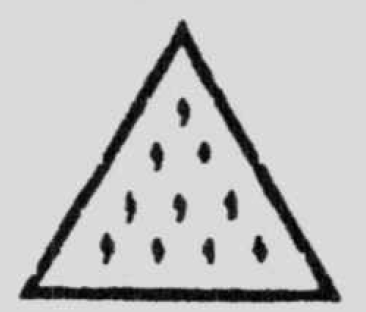

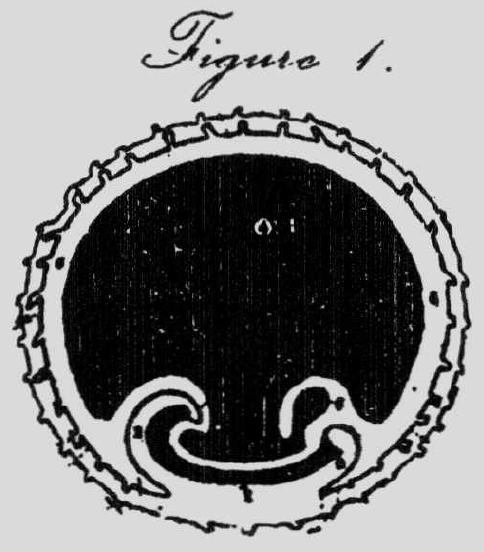
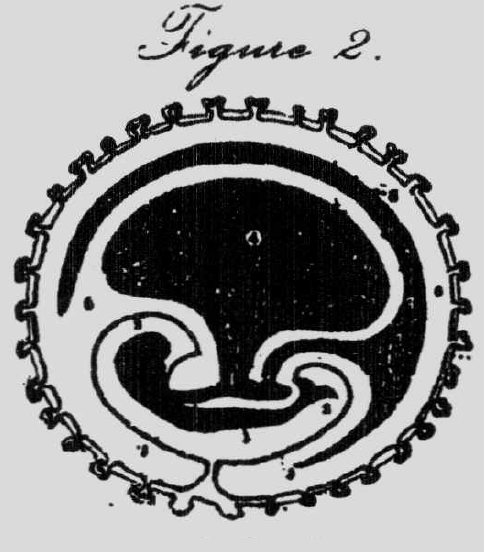
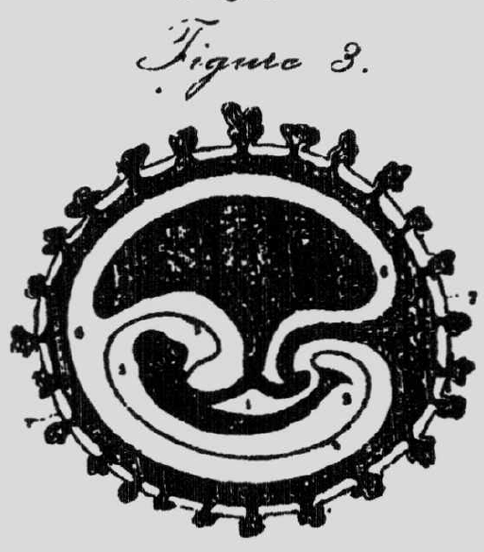
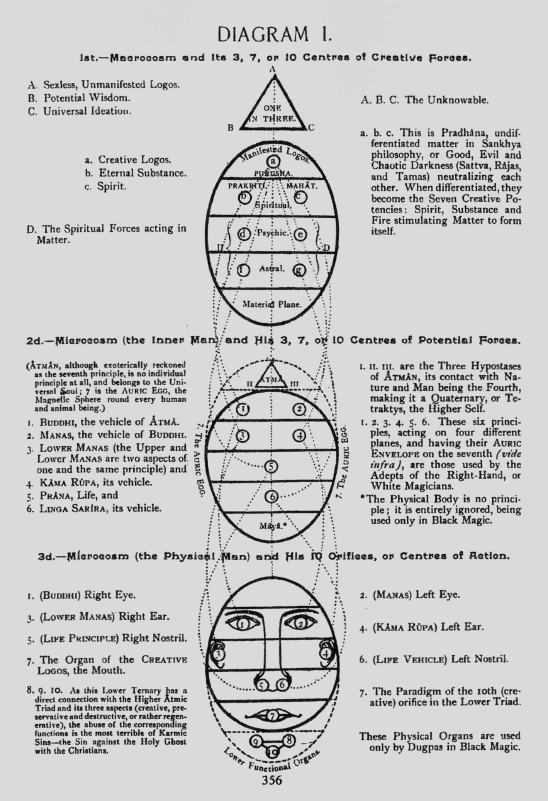
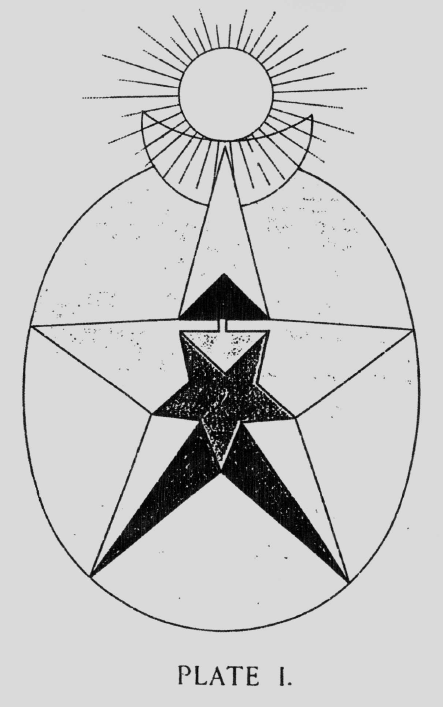
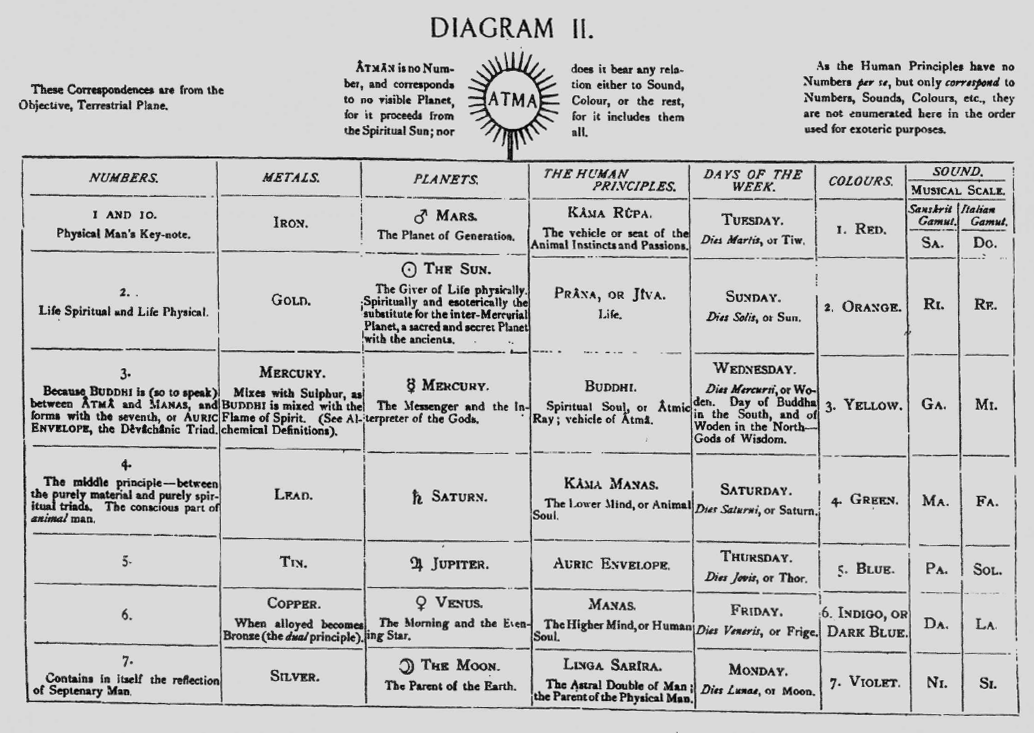
 MARS. The Planet of Generation
 THE SUN. Giver of Life Physically. Spiritually and
esoterically the substitute for the inter-Mercurial planet,
a sacred and secret planet with the ancients
THE SUN. Giver of Life Physically. Spiritually and
esoterically the substitute for the inter-Mercurial planet,
a sacred and secret planet with the ancients MERCURY. The Messenger and the Interpreter of the Gods.
 SATURN
 JUPITER
 VENUS. The Morning and the Evening Star.
 THE MOON. Parent of the Earth