|
Appendix I - Confessio Fraternitatis R.C - AD Eruditos Europa
An inkling of the
substance of Rosicrucianism--its esoteric doctrines--can be gleaned from
an
analysis of its shadow--its exoteric writings. In one of the most
important of their manifestos, the
Confessio Fraternitatis, the Brethren of the Fraternity of R.C. seek to
justify their existence and explain
the purposes and activities of their Order. In its original form the
Confessio is divided into fourteen
chapters, which are here summarized. The Confessio is important as a
motivator of the peoples who
were oppressed by both politics and religion at the time, however, the
manifesto was not a code or
doctrine of virtues and spiritual truth. The mysteries and insights were
delivered in the lodges and in
secret. These mysteries were delivered to BUILD the MAN on a mental,
physical, and spiritual level
with a distinct focus on CHARACTER and VIRTUE.
Chapter I. Do not
through hasty judgment or prejudice misinterpret the statements
concerning our
Fraternity published in our previous manifesto--the Fama Fraternitatis.
The true purpose of our
Order was set forth in the Fama Fraternitatis. In this document, we hope
so to clarify our position
so that you will be moved to join with us in the dissemination of
spiritual knowledge according to
the secrets of our illustrious brotherhood.
Chapter II. The
Rose Croix Fraternity has provided a remedy for the infirmities of the
world's
philosophic systems. The secret philosophy of the R.C. is founded upon
that knowledge which is
the sum and head of all faculties, sciences, and arts. By our divinely
revealed system--which partakes
much of theology and spiritual- mental medicine but little of
jurisprudence--we analyze the heavens
and the earth; but mostly we study man himself, within whose nature is
concealed the supreme
secret. If the people of our day accept our invitation and join
themselves to our Fraternity, we will
reveal to them undreamed-of secrets and wonders concerning the hidden
workings of the Universe.
Chapter III. Do
not believe that the secrets discussed in this brief document are
lightly esteemed by
us. We cannot describe fully the marvels of our Fraternity lest the
uninformed be overwhelmed by
our astonishing declarations and the vulgar ridicule the mysteries which
they do not comprehend.
We also fear that many will be confused by the unexpected generosity of
our proclamation, for not
understanding the wonders of this age, they do not realize the great
changes which are to come. Like
blind men living in a world full of light, they discern only through the
sense of feeling. [By sight is
implied spiritual cognition: by feeling, the material senses.]
Chapter IV.
Because of the great depth and perfection of our knowledge, those
desiring to
understand the mysteries of the Fraternity of R. C. cannot attain to
that wisdom immediately, but
must grow in understanding and knowledge. Therefore, our Fraternity is
divided into grades through
which each must ascend step by step to the Great Arcanum. Furthermore,
those who receive this
knowledge shall become masters of all arts and crafts; no secret shall
be hidden from them; and all
good works of the past, present, and future shall be accessible to them.
The whole world shall
become as one book and the contradictions of science and theology shall
be reconciled. Rejoice, O
humanity! for the time has come when God has decreed that the number of
our Fraternity shall be
increased, a labor that we have joyously undertaken. The right to
receive spiritual truth cannot be
inherited: it must be evolved within the soul of man himself.
Chapter V. Though
we may be accused of indiscretion in offering our treasures so freely
--without
discriminating between the godly, the wise, the prince, the peasant--we
affirm that we have not
betrayed our trust. Seekers will find us worldwide.
Chapter VII.
Because of the need of brevity, it is enough to say that our Father
C.R.C. was born in
the year 1378 and departed at the age of 106, leaving to us the labor of
spreading the doctrine of
philosophic religion to the entire world. Our Fraternity is open to all
who sincerely seek for truth;
but we publicly warn the false and impious that they cannot betray or
injure us, for God has
protected our Fraternity, and all who seek to do it harm shall have
their evil designs return and
destroy them, while the treasures of our Fraternity shall remain
untouched, to be used by the Lion in
the establishment of his kingdom.
Chapter VII. We
declare that God, before the end of the world, shall create a great
flood of spiritual
light to alleviate the sufferings of humankind. Falsehood and darkness
which have crept into the
arts, sciences, religions, and governments of humanity--making it
difficult for even the wise to
discover the path of reality--shall be forever removed and a single
standard established, so that all
may enjoy the fruitage of truth. We shall not be recognized as those
responsible for this change, for
people shall say that it is the result of the progressiveness of the
age. Great are the reforms about to
take place; but we of the Fraternity of R.C. do not arrogate to
ourselves the glory for this divine
reformation, since many there are, not members of our Fraternity but
honest, true and wise men,
who by their intelligence and their writings shall hasten its coming. We
testify that sooner the stones
shall rise up and offer their services than that there shall be any lack
of righteous persons to execute
the will of God upon earth.
Chapter VIII. That
no one may doubt, we declare that God has sent messengers and signs in
the
heavens, namely, the new stars in Serpentarius and Cygnus,
to show that a great Council of the Elect is
to take place. This proves that God reveals in visible nature--for the
discerning few--signs and
symbols of all things that are coming to pass. God has given man two
eyes, two nostrils, and two
ears, but only one tongue. Whereas the eyes, the nostrils, and the ears
admit the wisdom of Nature
into the mind, the tongue alone may give it forth. In various ages there
have been illumined ones
who have seen, smelt, tasted, or heard the will of God, but it will
shortly come to pass that those
who have seen, smelt, tasted, or heard shall speak, and truth shall be
revealed. Before this revelation
of righteousness is possible, however, the world must sleep away the
intoxication of her poisoned
chalice (filled with the false life of the theological vine) and,
opening her heart to virtue and
understanding, welcome the rising sun of Truth.
Chapter IX. We
have a magic writing, copied from that divine alphabet with which God
writes His
will upon the face of celestial and terrestrial Nature. With this new
language we read God's will for
all His creatures, and just as astronomers predict eclipses so we
prognosticate the obscurations of
the church and how long they shall last. Our language is like unto that
of Adam and Enoch before
the Fall, and though we understand and can explain our mysteries in this
our sacred language, we
cannot do so in Latin, a tongue contaminated by the confusion of
Babylon.
Chapter X.
Although there are still certain powerful persons who oppose and hinder
us--because of
which we must remain concealed--we exhort those who would become of our
Fraternity to study
unceasingly the Sacred Scriptures, for such as do this cannot be far
from us. We do not mean that
the Bible should be continually in the mouth of man, but that he should
search for its true and
eternal meaning, which is seldom discovered by theologians, scientists,
or mathematicians because
they are blinded by the opinions of their sects. We bear witness that
never since the beginning of the
world has there been given to man a more excellent book than the Holy
Bible. Blessed is he who
possesses it, more blessed he who reads it, most blessed he who
understands it, and most godlike he
who obeys it.
Chapter XI. We
wish the statements we made in the Fama Fraternitatis concerning
the transmutation
of metals and the universal medicine to be lightly understood. While we
realize that both these
works are attainable by man, we fear that many really great minds may be
led away from the true
quest of knowledge and understanding if they permit themselves to limit
their investigation to the
transmutation of metals. When to a man is given power to heal disease,
to overcome poverty, and to
reach a position of worldly dignity, that man is beset by numerous
temptations and unless he
possess true knowledge and full understanding he will become a terrible
menace to mankind. The
alchemist who attains to the art of transmuting base metals can do all
manner of evil unless his
understanding be as great as his self-created wealth. We therefore
affirm that man must first gain
knowledge, virtue, and understanding; then all other things may be added
unto him. We accuse the
Christian Church of the great sin of possessing power and using it
unwisely; therefore we prophesy
that it shall fall by the weight of its own iniquities and its crown
shall be brought to naught.
Chapter XII. In
concluding our Confessio, we earnestly admonish you to cast aside
the worthless books
of pseudo-alchemists and philosophers (of whom there are many in our
age), who make light of the
Holy Trinity and deceive the credulous with meaningless enigmas. One of
the greatest of these is a
stage player, a man with sufficient ingenuity for imposition. Such men
are mingled by the Enemy of
human welfare among those who seek to do good, thus making Truth more
difficult of discovery.
Believe us, Truth is simple and unconcealed, while falsehood is complex,
deeply hidden, proud, and
its fictitious worldly knowledge, seemingly a glitter with godly luster,
is often mistaken for divine
wisdom. You that are wise will turn from these false teachings and come
to us, who seek not your
money but freely offer you our greater treasure. We desire not your
goods, but that you should
become partakers of our goods. We do not deride parables, but invite you
to understand all parables
and all secrets. We do not ask you to receive us, but invite you to come
unto our kingly houses and
palaces, not because of ourselves but because we are so ordered by the
Spirit of God, the desire of
our most excellent Father C.R.C., and the need of the present moment,
which is very great.
Chapter XIII. Now
that we have made our position clear that we sincerely confess Christ;
disavow
the Papacy; devote our lives to true philosophy and worthy living; and
daily invite and admit into our
Fraternity the worthy of all nations, who thereafter share with us the
Light of God: will you not join
yourselves with us to the perfection of yourselves, the development of
all the arts, and the service of
the world? If you will take this step, the treasures of every part of
the earth shall be at one time given
unto you, and the darkness which envelopes human knowledge and which
results in the vanities of
material arts and sciences shall be forever dispelled.
Chapter XIV. Again
we warn those who are dazzled by the glitter of gold or those who, now
upright,
might be turned by great riches to a life of idleness and pomp, not to
disturb our sacred silence with
their clamorings; for though there be a medicine which will cure all
diseases and give unto all men
wisdom, yet it is against the will of God that men should attain to
understanding by any means other
than virtue, labor, and integrity. We are not permitted to manifest
ourselves to any man except it be
by the will of God. Those who believe that they can partake of our
spiritual wealth against the will
of God or without His sanction will find that they shall sooner lose
their lives in seeking us than
attain happiness by finding us.
Johann Valentin
Andreæ is generally reputed to be the author of the Confessio. It is a
much-mooted
question, however, whether Andreæ did not permit his name to be used as
a pseudonym by Sir
Francis Bacon. Apropos of this subject are two extremely significant
references occurring in the
introduction to that remarkable potpourri, The Anatomy of Melancholy.
This volume first appeared in
1621 from the pen of Democritus junior, who was afterwards identified as
Robert Burton, who, in
turn, was a suspected intimate of Sir Francis Bacon. One reference
archly suggests that at the time of
publishing The Anatomy of Melancholy in 1621 the founder of the
Fraternity of R.C. was still alive. This
statement--concealed from general recognition by its textual
involvement--has escaped the notice of
most students of Rosicrucianism. In the same work there also appears a
short footnote of
stupendous import. It contains merely the words: "Job. Valent. Andreas,
Lord Verulam." This single
line definitely relates Johann Valentin Andreæ to Sir Francis Bacon, who
was Lord Verulam, and by
its punctuation intimates that they are one and the same individual.
Appendix II - The Fraternity of the Rose Cross & Masonic History
WHO were the
Rosicrucians? Were they an organization of profound thinkers rebelling
against the
inquisitional religious and philosophical limitations of their time or
were they isolated
transcendentalists united only by the similarity of their viewpoints and
deductions? Where was the
"House of the Holy Spirit, " in which, according to their manifestoes,
they met once a year to plan
the future activities of their Order? Who was the mysterious person
referred to as "Our Illustrious
Father and Brother C.R.C."? Did those three letters actually stand for
the words "Christian Rosie
Cross"? Was Christian Rosencreutz, the supposed author of the Chymical
Nuptials, the same person
who with three others founded "The Society of the Rose Cross"?
What relationship
existed between Rosicrucianism and mediæval Freemasonry? Why were the
destinies of these two organizations so closely interwoven? Is the
"Brotherhood of the Rose Cross"
the much-sought-after link connecting the Freemasonry of the Middle Ages
with the symbolism and
mysticism of antiquity, and are its secrets being perpetuated by modern
Masonry? Did the original
Rosicrucian Order disintegrate in the latter part of the eighteenth
century, or does the Society still
exist as an organization, maintaining the same secrecy for which it was
originally famous? What was
the true purpose for which the "Brotherhood of the Rose Cross" was
formed? Were the
Rosicrucians a religious and philosophic brotherhood, as they claimed to
be, or were their avowed
tenets a blind to conceal the true object of the Fraternity, which
possibly was the political control of
Europe? These are some of the problems involved in the study of
Rosicrucianism.
There are several
distinct theories regarding the Rosicrucian origins. Each is the result
of a careful
consideration of the evidence by scholars who have spent their lives
ransacking the archives of
Hermetic lore. The conclusions reached demonstrate clearly the
inadequacy of the records available
concerning the genesis and early activities of the "Brethren of the Rose
Cross."
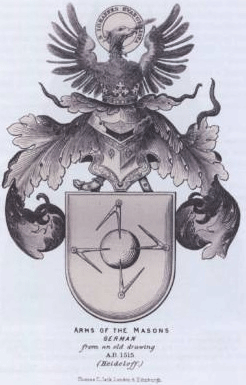
The Historical
Postulate of Rosicrucianism
Those Fraternal
brethren who have investigated the subject accept the historical
existence of the
"Brotherhood of the Rose Cross" but are divided concerning the origin of
the Order. One group
holds the society originated in mediæval Europe as an outgrowth of
alchemical speculation. Robert
Macoy, 33°, believes that Johann Valentin Andreæ, a German theologian,
was the true founder, and
he also believes it possible that this movement merely reformed and
amplified an existing society
which had been founded by Sir Henry Cornelius Agrippa. Some believe that
Rosicrucianism
represented the first European invasion of Buddhist and Brahmin culture.
Still others hold the
opinion that the "Society of the Rose Cross" was founded in Egypt during
the philosophic
supremacy of that empire, and that it also perpetuated the Mysteries of
ancient Persia and Chaldea.
In his
Anacalypsis, Godfrey Higgins writes: "The Rosicrucians of Germany
are quite ignorant of their
origin; but, by tradition, they suppose themselves descendants of the
ancient Egyptians, Chaldeans,
Magi, and Gymnosophists." (The last was a name given by the followers of
Alexander the Great to a
caste of naked Wise Men whom they found meditating along the river banks
in India.) The
consensus among these factions is that the story of Father C.R.C., like
the Masonic legend of Hiram
Abiff, is an allegory and should not be considered literally. A similar
problem has confronted
students of the Bible, who have found not only difficult, but in the
majority of cases impossible,
their efforts to substantiate the historical interpretation of the
Scriptures.
Admitting the
existence of the Rosicrucians as a secret society with both philosophic
and political
ends, it is remarkable that an organization with members in all parts of
Europe could maintain
absolute secrecy throughout the centuries. Nevertheless, the "Brothers
of the Rose Cross" were
apparently able to accomplish this. A great number of scholars and
philosophers, among them Sir
Francis Bacon and Wolfgang von Goethe, have been suspected of
affiliation with the Order, but
their connection has not been established to the satisfaction of prosaic
historians. Pseudo-
Rosicrucians abounded, but the true members of the "Ancient and Secret
Order of The Unknown
Philosophers" have successfully lived up to their name; to this day they
remain unknown.
During the Middle
Ages a number of tracts appeared, purporting to be from the pens of
Rosicrucians. Many of them, however, were spurious, being issued for
their self-aggrandizement by
unscrupulous persons who used the revered and magic name Rosicrucian in
the hope of gaining
religious or political power. This has greatly complicated the work of
investigating the Society. One
group of pseudo-Rosicrucians went so far as to supply its members with a
black cord by which they
were to know each other, and warned them that if they broke their vow of
secrecy the cord would
be used to strangle them. Few of the principles of Rosicrucianism have
been preserved in literature,
for the original Fraternity published only fragmentary accounts of its
principles and activities.

In his Secret
Symbols of the Rosicrucians, Dr. Franz Hartmann describes the
Fraternity as "A secret
society of men possessing superhuman--if not supernatural--powers; they
were said to be able to
prophesy future events, to penetrate into the deepest mysteries of
Nature, to transform Iron,
Copper, Lead, or Mercury into Gold, to prepare an Elixir of Life,
or Universal Panacea, by the use of
which they could preserve their youth and manhood; and moreover it was
believed that they could
command the Elemental Spirits of Nature, and knew the secret of the
Philosopher's Stone, a substance
which rendered him who possessed it all-powerful, immortal, and
supremely wise."
The same author
further defines a Rosicrucian as "A person who by the process of
spiritual
awakening has attained a practical knowledge of the secret
significance of the Rose and the Cross. * * *
To call a person a Rosicrucian does not make him one, nor does the act
of calling a person a
Christian make him a Christ. The real Rosicrucian or Mason cannot be
made; he must grow to be
one by the expansion and unfoldment of the divine power within his own
heart. The inattention to
this truth is the cause that many churches and secret societies are far
from being that which their
names express." The symbolic principles of Rosicrucianism are so
profound that even today they
are little appreciated. Their charts and diagrams are concerned with
weighty cosmic principles which
they treat with a philosophic understanding decidedly refreshing when
compared with the orthodox
narrowness prevalent in their day. According to the available records,
the Rosicrucians were bound
together by mutual aspirations rather than by the laws of a fraternity.
The "Brothers of the Rose
Cross" are believed to have lived unobtrusively, laboring industriously
in trades and professions,
disclosing their secret affiliation to no one--in many cases not even to
their own families. After the
death of C.R.C., most of the Brethren apparently had no central meeting
place. Whatever initiatory
ritual the Order possessed was so closely guarded that it has never been
revealed. Doubtless it was
couched in chemical terminology.
Many suspect the
Rosicrucian rose to be a conventionalization of the Egyptian and Hindu
lotus
blossom, with the same symbolic meaning as this more ancient symbol. The
Divine Comedy stamps
Dante Alighieri as being familiar with the theory of Rosicrucianism.
Concerning this point, Albert
Pike in his Morals and Dogma
makes this significant statement: "His Hell is but a negative Purgatory.
His heaven is composed of a series of Kabalistic circles, divided by a
cross, like the Pantacle of
Ezekiel. In the center of this cross blooms a rose, and we see the
symbol of the Adepts of the Rose-
Croix for the first time publicly expounded and almost categorically
explained."
Doubt has always
existed as to whether the name Rosicrucian came from the symbol of the
rose and
cross, or whether this was merely a blind to deceive the uninformed and
further conceal the true
meaning of the Order. Godfrey Higgins believes that the word
Rosicrucian is not derived from the
flower but from the word Ros, which means dew. It is also interesting to
note that the word Ras
means wisdom, while Rus is translated concealment. Doubtless all of
these meanings have
contributed to Rosicrucian symbolism.
A. E. Waite holds
with Godfrey Higgins that the process of forming the Philosopher's Stone
with
the aid of dew is the secret concealed within the name Rosicrucian. It
is possible that the dew
referred to is a mysterious substance within the human brain, closely
resembling the description
given by alchemists of the dew which, falling from heaven, redeemed the
earth. The cross is
symbolic of the human body, and the two symbols together--the rose on
the cross--signify that the
soul of man is crucified upon the body, where it is held by three nails.
It is probable
that Rosicrucian symbolism is a perpetuation of the secret tenets of the
Egyptian
Hermes, and that the Society of Unknown Philosophers is the true link
connecting modern
Masonry, with its mass of symbols, to ancient Egyptian Hermeticism, the
source of that symbolism.
In his Doctrine and Literature of the Kabalah, A. E. Waite makes
this important observation: "There are
certain indications which point to a possible connection between Masonry
and Rosicrucianism, and
this, if admitted, would constitute the first link in its connection
with the past. The evidence is,
however, inconclusive, or at least unextricated. Freemasonry per se, in
spite of the affinity with
mysticism which I have just mentioned, has never exhibited any mystic
character, nor has it a clear
notion how it came by its symbols."
Many of those
connected with the development of Freemasonry were suspected of being
Rosicrucians; some, as in the case of Robert Fludd, even wrote defenses
of this organization. Frank
C. Higgins, a modern Masonic symbolist, writes: "Doctor Ashmole, a
member of this fraternity
[Rosicrucian], is revered by Masons as one of the founders of the first
Grand Lodge in London."
(See Ancient Freemasonry.) Elias Ashmole is but one of many
intellectual links connecting
Rosicrucianism with the genesis of Freemasonry.
The
Encyclopædia Britannica notes that Elias Ashmole was initiated into
the Freemasonic Order in
1646, and further states that he was "the first gentleman, or amateur,
to be 'accepted'." On this same
subject, Papus, in his Tarot of the Bohemians, has written: "We
must not forger that the Rosicrucians
were the Initiators of Leibnitz, and the founders of actual Freemasonry
through Ashmole." If the
founders of Freemasonry were initiated into the Great Arcanum of
Egypt--and the symbolism of
modern Masonry would indicate that such was the case--then it is
reasonable to suppose that they
secured their information from a society whose existence they admitted
and which was duly qualified
to teach them these symbols and allegories. One theory concerning the
two Orders is to the effect
that Freemasonry was an outgrowth of Rosicrucianism; in other words,
that the "Unknown
Philosophers" became known through an organization which they created to
serve them in the
material world. The story goes on to relate that the Rosicrucian adepts
became dissatisfied with their
progeny and silently withdrew from the Masonic hierarchy, leaving behind
their symbolism and
allegories, but carrying away the keys by which the locked symbols could
be made to give tip their
secret meanings. Speculators have gone so far as to state that, in their
opinion, modern Freemasonry
has completely absorbed Rosicrucianism and succeeded it as the world's
greatest secret society.
Other minds of
equal learning declare that the Rosicrucian Brotherhood still exists,
preserving its
individuality as the result of having withdrawn from the Masonic Order.
According to a widely
accepted tradition, the headquarters of the Rosicrucian Order is near
Carlsbad, in Austria (see
Doctor Franz Hartmann). Another version has it that a mysterious school,
resembling in general
principles the Rosicrucian Fraternity, which calls itself "The Bohemian
Brothers," still maintains its
individuality in the Schwarzwald (Black Forest) of Germany. One
thing is certain: with the rise of
Freemasonry, the Rosicrucian Order in Europe practically disappeared,
and notwithstanding existing
statements to the contrary, it is certain that the 18th degree (commonly
known as the Rose-Croix)
perpetuates many of the symbols of the Rosicrucian Fire Alchemists.
In an anonymous
unpublished manuscript of the eighteenth century bearing the earmarks of
Rosicrucian Qabbalism appears this statement: "Yet will I now give the
over-wise world a paradox
to be solved, namely, that some illuminated men have undertaken to found
Schools of Wisdom in
Europe and these for some peculiar reason have called themselves
Fratres Rosa: Crucis. But soon
afterwards came false schools into existence and corrupted the good
intentions of these wise men.
Therefore, the Order no longer exists as most people would understand
existence, and as this
Fraternity of the Seculo Fili call themselves Brothers of the
Rosie Cross, so also will they in the Seculo
Spiritus Sancti call themselves Brothers of the Lily Cross
and the Knights of the White Lion. Then will the
Schools of Wisdom begin again to blossom, but why the first one chose
their name and why the
others shall also choose theirs, only those can solve who have
understanding grounded in Nature."
The rose is a
symbol associated with generation, fecundity, and purity. The fact that
flowers blossom
by unfolding has caused them to be chosen as symbolic of spiritual
unfoldment. The red color of the
rose refers to the blood of Christ, and the golden heart concealed
within the midst of the flower
corresponds to the spiritual gold concealed within the human nature. The
number of its petals being
ten is also a subtle reminder of the perfect Pythagorean number. The
rose symbolizes the heart, and
the heart has always been accepted by Christians as emblematic of the
virtues of love and
compassion, as well as of the nature of Christ--the personification of
these virtues. The rose as a
religious emblem is of great antiquity. It was accepted by the Greeks as
the symbol of the sunrise, or
of the coming of dawn. In his Metamorphosis, or Golden Ass, Apuleius,
turned into a donkey
because of his foolishness, regained his human shape by eating a sacred
rose given to him by the
Egyptian priests. The presence of a hieroglyphic rose upon the
escutcheon of Martin Luther has
been the basis of much speculation as to whether any connection existed
between his Reformation
and the secret activities of the Rose Cross. Political aspirations of
the Rosicrucians were expressed
through the activities of Sir Francis Bacon, the Comte de St.-Germain,
and the Comte di Cagliostro.
The last named is suspected of having been an emissary of the Knights
Templars, a society deeply
involved in transcendentalism, as Eliphas Levi has noted. There is a
popular supposition to the
effect that the Rosicrucians were at least partial instigators of the
French Revolution. (Note
particularly the introduction to Lord Bulwer-Lytton's Rosicrucian novel
Zanoni.) "The Gnostic sects,
the Oriental Christian Mystics, the Arabs, Alchemists, Templars,
Rosicrucians, and lastly the
Freemasons, form the Western chain in the transmission of occult
science." (See The Tarot of the
Bohemians translated by A. E. Waite from the French of Papus.)
Max Heindel, the
Christian mystic, described the Rosicrucian Temple as an "etheric
structure"
located in and around the home of a European country gentleman. He
believed that this invisible
building would ultimately be moved to the American continent. Mr.
Heindel referred to the
Rosicrucian Initiates as so advanced in the science of life that "death
had forgotten them."
Beatitudes: A Brief Analysis & Positive Meanings
The Beatitudes
(Latin: beatitudo, happiness) is the name given to the best-known &
introductory portion
of the Sermon on the Mount of the Gospel of Matthew. For purposes of
analyzing the mindset of
abundance, we show each basic part of the Beatitudes and provide some
insight into the highest meaning
of each.
1. Poor in
Spirit – Theirs is the Kingdom of Heaven - This means that we should
be teachable, be
willing to grow. Humility is understanding your right size, putting
the source of good first, and putting
spirit before ego.
2. Mourn –
They will be Comforted - This implies that we should turn our will
toward the Spirit.
Understand your private emotions and transcend the instincts that
may result in destructive thinking and
action.
3. The Meek –
Shall Inherit the Earth - Forgive, clean house, receive forgiveness.
Through self
analysis, meditation, or focused prayer and visualization, you can
allow for the highest thoughts to enter
your spiritual mind.
4. Those who
Hunger – They will be filled. - Remain hungry for insight and
guidance. Never give
up. The mind is connected to ALL and is a benefactor of the greatest
of wisdom if it is allowed to receive
prosperous intelligence.
5. The
Merciful – Will obtain Mercy - Think and project love and gratitude.
Radiate your good
toward all including those who may have hurt you in the past. It is
key for you to rise above past hurts
and become the best you can be while also affording kind acts toward
others that will help them grow.
6. The Pure in
Heart – Will See God - Our thinking, our actions and our omissions
are part of our
mind and character. Keeping a mind directed toward the highest good
will always expand your abundance
and flow of it toward you.
7. The
Peacemakers – Will be the Children of God - Bring Harmony, win-win
relationships to all
without facilitating injury toward yourself or to your family.
8. The
Persecuted – Theirs in the Kingdom of Heaven - Experience and feel:
a catharsis,
absolution, forgiveness, and wholeness. Keep in mind that the self
can give the illusion of self
persecution. Your duty is to transcend your lower mental states with
peace, love, abundance, and
gratitude.
12 Principles of Abundance and Right Thinking with Scripture Comparison
Notes on the Right.
Step 1: Admitted
that ego and self is limited, and
that living under this power of self and
destructive thinking has resulted in a life of
frustration without peace of mind. |
I know that
nothing good lives in me, that
is, in my sinful nature. For I have the desire
to do what is good, but I cannot carry it
out. (Romans 7:18) |
Step 2: Came to
believe that the personal
recognition of Spiritual abundance within my
own being and without would allow prosperity in
my life. |
Jesus said unto
him, If thou canst believe,
all things are possible to him that believeth.
And straightway the father of the child
cried out, and said with tears, Lord, I
believe; help thou mine unbelief. (Mark
9:23-24) |
Step 3: Made a
decision to seek Spirit before ego
by seeking a harmonious relationship with the
Universal Spirit Force of abundance. |
If anyone would
come after me, he must
deny himself and take up his cross daily
and follow me. (Luke 9:23**) |
Step 4: I engage
in self-analysis for the purpose
of removing wasteful thought energy. |
Let us examine our
ways and test them,
and let us return to the Lord.
(Lamentations 3:40) |
Step 5: I expose
to my higher self and another
human being the exact nature of the destructive
thoughts and actions of the past. |
Therefore confess
your sins to each other
and pray for each other so that you may be
healed. (James 5:16) |
Step 6: I became
willing to have the Universal
Spirit remove my destructive beliefs in favor of
building my own character of goodness and
prosperity. |
If you are willing
and obedient, you will eat
the best from the land. (Isaiah 1:19) |
Step 7: I humbly
asked the Universal Spirit to
remove my consciousness of fear, failure,
poverty, or inadequacy. |
Humble yourselves
before the Lord, and
He will lift you up. (James 4:10) |
Step 8: I made a
list of all relationships gone
bad and became willing to allow the Universal
Spirit mend my soul and heart and allow my
forgiveness permanently. |
Therefore, if you
are offering your gift at the
altar and there remember that your brother
has something against you, leave your gift
there in front of the altar. First go and be
reconciled to your brother; then come and
offer your gift. (Matthew 5:23, 24**) |
Step 9: I allow
the Universal Spirit to help me
heal relationships wherever possible, except
when to do so would create more harm than
good to all parties involved. |
Give and it shall
be given you. A good
measure, pressed down, shaken together and
running over, will be poured into your lap.
For with the measure you use, it will be
measured to you. (Luke 6:38**) |
Step 10: I
continue to periodically analyze my
thinking, and immediately recognize and
correct error consciousness while avoiding
destructive actions. |
For by the grace
given me I say to every one
of you: Do not think of yourself more highly
than you ought, but rather think of yourself
with sober judgment, in accordance with the
measure of faith GOD has given you.
(Romans 12:3) |
Step 11: I Seek to
maintain a harmonious,
grateful and thankful relationship with my
inner self and with The Universal Spirit of
abundance. |
Let the word of
Christ dwell in you richly.
(Col. 3:16) |
Step 12: Having
become Spiritually awake as a
result of these steps, I carried this message to
others, and practiced these principles in my life
affairs. |
Brothers, if
someone is caught in a sin, you
who are Spiritual should restore him gently.
But watch yourself, or you also may be
tempted. Carry each other's burdens, and in
this way you will fulfill the law of Christ.
(Galatians 6:1-2) |
Origins of The Ancient Esoteric Tradition - Earliest Indo-European
Religions
The most ancient
world religions of Mesopotamia which include Sumeria, Assyria, and
Babylon are
built on mythological deities, but also contain the primary wisdom of
the warrior way, philosophy,
creation myth, law and ethics. To begin with, it is clear that there
were commandments or written
codes of law by the kings of Mesopotamia. From about 2100 BC which is
over 4100 years ago, The
Code of Ur-Nammu is the oldest known tablet containing a law code
surviving today, and it was
written in the Sumerian language. Further, Hammurabi 1810 BC – 1750 BC),
who became the first
king of the Babylonian Empire, extending Babylon's control over
Mesopotamia by winning a series
of wars against neighboring kingdoms. From his reign, the code of
Hammurabi was created and
contained 282 laws, written by scribes on 12 tablets and dated 1780 BC.
In perspective, the Great
Abraham is said to have lived in the time of 2000 BC (probably under the
rule of the Kings of
Mesopotamia of this time. It is currently the year 6758 according to the
Assyrian calendar of 2008.
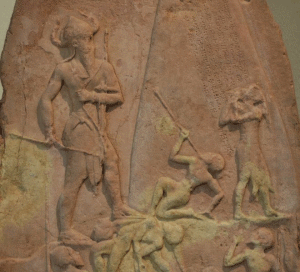
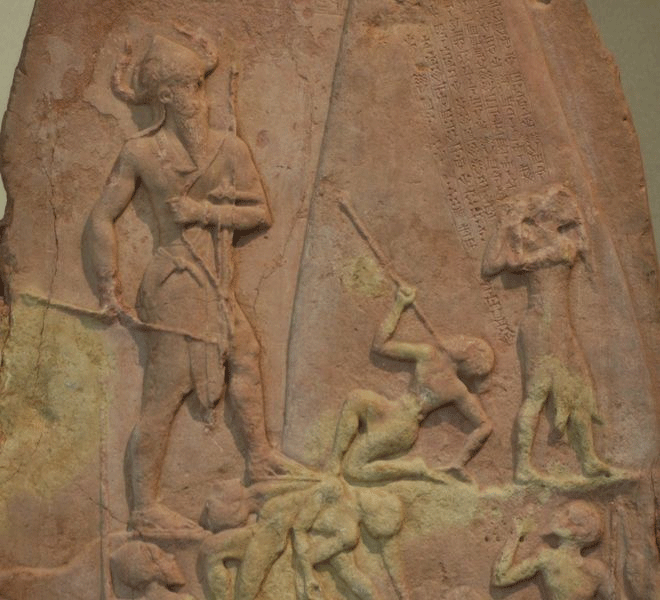
Stele of
Naram-Sin, (2240 BC) Sargon's grandson, celebrating his victory against
the Lullubi from
Zagros. with Horned War Helmet and long beard.
Mesopotamian
religious views are probably the first in recorded history, and
Mesopotamians are said
to have believed that the universe or world was a flat disc, surrounded
by a huge, holed space, and
above that, heaven. Mesopotamians also believed that water was
everywhere and that the universe
was born from this enormous sea. In addition, Mesopotamian religion was
both Henotheistic and
polytheistic. This means that Mesopotamians had many gods but Enlil was
the most powerful chief
God. Although the beliefs described above were held in common among
Mesopotamians, there
were also regional variations. For example, Sumer was the first
civilization of record in Southern
Iraq or Mesopotamia. The Sumerian word for universe is An-Ki, which
refers to the god An and
the goddess Ki. It is quite interesting that the Universe is a
combination of masculine and feminine.
Sumer is widely considered to be the earliest settled society in the
world to have manifested all the
features needed to qualify fully as a civilization, dating back
approximately 7000 years ago.
In Sumerian
mythology, Eridu may have been one of the cities built before the great
flood and the
earliest Sumerian settlement, founded ca. 4,900 BCE, close to the
Persian Gulf and Basra near the
mouth of the Euphrates River. The son of the Major Gods An and Ki was
named Enlil who was
the air god. Mesopotamians may have believed that Enlil was the most
powerful god and the chief
god of the Pantheon, much like the Greeks had Zeus. The gods were said
to have created humans
from clay for the purpose of serving them. Moreover, in the time around
3000 BC, the later
civilizations and mysteries of Egypt would also become prominent.
The 20th century
BC Akkadian written work called the Atra-Hasis which is named after its
human
hero, contains both a creation myth and a flood story. It may be one of
history’s earliest writings.
Tablet I contains a creation myth of the Sumerian gods Anu, Enlil and
Enki, gods of sky, wind and
water. Tablet II has tales of the god Enlil sending famine and drought
at intervals of every 1200
years to reduce the population. Tablet III of the Atrahasis Epic
contains the flood story. This is the
section that was adapted in the Epic of Gilgamesh which was probably
written well over 4000 years
ago. [47]
In a similar way,
Greek awareness during the Hellenic era of Osiris had grown, and
attempts had
been made to merge Greek philosophy, such as Platonism, and the cult of
Osiris (especially the
myth of his resurrection), resulting in a new mystery religion. Today,
the term Osiris-Dionysus is
used by some metaphysical teachers of philosophy and spirituality to
refer to a group of deities
worshipped around the Mediterranean in the hundreds if not thousands of
years before the
emergence of Christ. Osiris is one of the oldest gods for whom records
have been found; one of
the oldest known attestations of his name is on the Palermo Stone of
around 2500 BC. Isis is the
wife of Osiris while Horus being considered his posthumously begotten
son It has been posited
that all of these deities were closely related in fact and myth and
shared many characteristics, most
notably being male, partly-human, born of virgins, life-death-rebirth
deities and other similar
characteristics.
With the above
mythology, cosmology, and creation stories, it is easy to see how the
Western
Metaphysicians are drawn to the historical lessons and stories of the
Ancient cultures and mystics of:
Mesopotamia, Babylon, Sumeria, Assyria, Egypt, Greece, Persia, Rome,
India, Celtic, and others.
Some Core Historical Spiritual Practices and Beliefs of Mesopotamia
-
Many
gods/saints and powerful deities, but generally revering one MOST
powerful God.
-
Laws and
Ethics for the People (Commandments and Codes)
-
Incantation
and prayers offered to the God or Gods
-
Astrology and
use of the stars and heavens for speculation, health, and action.
-
Festival Days
and Cult worship of the primal Gods
-
Sacrifices or
gifts to praise the Gods which in turn would feed the attendees.
-
Atonement to
the Gods
-
Building
Shrines for Gods – ritual temples called Ziggurats.
-
The Heart was
the center of emotion and reason
-
That the
spirit or soul was eternal.
-
Talismans or
Spiritual Symbols used to reinforce mental/spiritual connection.
-
Magic and
Prayer (invocations, amulets, affirmations)
-
Ancestor
veneration or reverence
-
Purification
and cleansing rituals for purity of mind, spirit, or body.
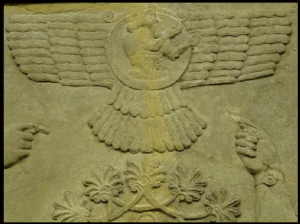
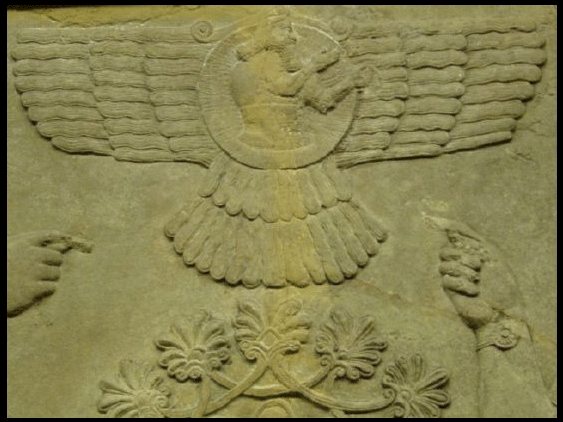
God Ashur or Shamash with Long Hair and Beard encircled by Winged
Disc. Ashur and Marduk
were worshipped some 3500 years ago after Hammurabi
Babylonian “Counsels
of Wisdom” 1500 B.C.
These ancient
teachings have been used by scholars to show the wisdom of the ages that
preceded
the Old Testament. It is highly probable that these teachings were
called the, “Instructions of
Shuruppak. [48]
-
Every day
worship your god.
-
Sacrifice and
benediction are the proper accompaniment of incense
Present your free-will offering to your god,
-
For this is
proper toward the gods.
-
Prayer,
supplication, and prostration
-
Offer him
daily, and you will get your reward.
-
Then you will
have full communion with your god.
-
In your wisdom
study the tablet.
-
Reverence
begets favour,
-
Sacrifice
prolongs life,
-
And prayer
atones for guilt.
-
Do not utter
libel, speak what is of good report.
-
Do not say
evil things, speak well of people.
-
One who utters
libel and speaks evil,
-
Men will
waylay him with his debit account to god.
-
Beware of
careless talk, guard your lips;
-
Do not utter
solemn oaths while alone,
-
For what you
say in a moment will follow you afterwards.
-
But exert
yourself to restrain your speech.
Other important
teachings in this codex are:
-
Avoidance of
bad companions.
-
Improper
speech.
-
Avoidance of
altercations and pacification of enemies.
-
Kindness to
those in need.
-
The duties and
benefits of religion.
-
Improper
deception of friends.
-
Atonement and
mental harmony
-
Supplication
and Praise toward Good
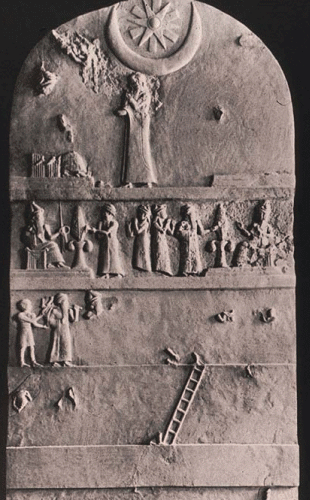
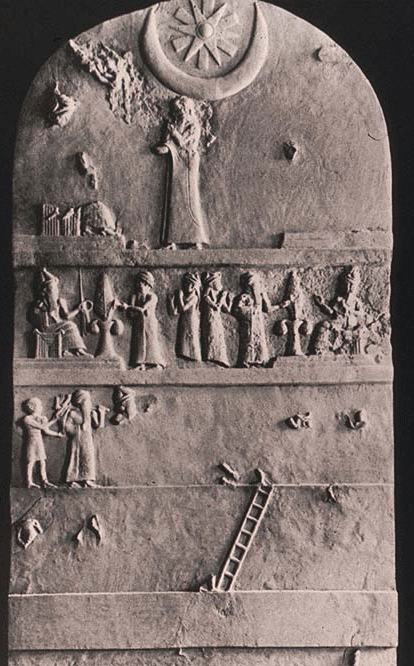
The Stele of
Ur-Nammu of Ur 2100BC, who waters the Tree of Life before Shamash the
Sun God. Notice the 6 Point Star Encircled by the Crescent Moon.
Further, there is a six pointed Cross behind the Star. [49]
Disclaimer: All
Rights Reserved for All Original or Enhanced content herein. Note:
Excerpts and chapters have been taken from some of the writers listed in
the endnotes or other . All direct usage is based on content, writings,
and images that are in the public domain or pre-1925 information. It was
the intent of the editor and author to utilize the best writings,
quotes, and insights from the recent past to present the updated and
expanded lessons from the 1763-4 Orleans Rites of the Loge de Parfaits
de Escosse ™ . Terms: All readers agree to practice these teachings in a
safe environment. All readers are by implied consent agreeing to seek
the help of a qualified and licensed professional for any special
psychological or medical needs.

Go to Next Page
|