|
You
are in the path that leads up the slope of the mountain of
Truth; and it depends upon your
secrecy, obedience, and fidelity, whether you will advance or remain
stationary. If you will advance,
gird up your loins for the struggle! for the way is long and
toilsome. Pleasure, all smiles, will beckon you on the one hand, and
Indolence will invite you to sleep among the flowers, upon the
other. Prepare, by secrecy, obedience, and fidelity, to resist the
allurements of both!
Secrecy is
indispensable in a Mason of whatever Degree. It is the first and
almost the only lesson taught to the Entered Apprentice. The
obligations which we have each assumed toward every Mason that
lives, requiring of us the performance of the most serious and
onerous duties toward those personally unknown to us until they
demand our aid, -- duties that must be performed, even at the risk of
life, or our solemn oaths be broken and violated, and we be branded
as false Masons and faithless men, teach us how profound a folly it
would be to betray our secrets to those who, bound to us by no tie
of common obligation, might, by obtaining them, call on us in their
extremity, when the urgency of the occasion should allow us no time
for inquiry, and the peremptory mandate of our obligation compel us
to do a brother's duty to a base impostor.
The secrets of our
brother, when communicated to us, must be sacred, if they be such as
the law of our country warrants us to keep. We are required to keep
none other, when the law that we are called on to obey is indeed a
law, by having emanated from the only source of power, the People.
Edicts which emanate from the mere arbitrary will of a despotic
power, contrary to the law of God or the Great Law of Nature,
destructive of the inherent rights of man, violative of
the right of free thought, free speech, free conscience, it is
lawful to rebel against and strive to abrogate.
For obedience to the
Law does not mean submission to tyranny; nor that, by a profligate
sacrifice of every noble feeling, we should offer to despotism the
homage of adulation.
In this Degree, my
brother, you are especially to learn the duty of obedience to that
law. There is one true and original law, conformable to reason and
to nature, diffused over all, invariable, eternal, which calls to
the fulfillment of duty, and to abstinence from injustice, and calls
with that irresistible voice which is felt in all its authority
wherever it is heard. This law cannot be abrogated or diminished, or
its sanctions affected, by any law of man. A whole senate, a whole
people, cannot dissent from its paramount obligation. It requires no
commentator to render it distinctly intelligible: nor is it one
thing at Rome, another at Athens; one thing now, and another in the
ages to come; but in all times and in all nations, it is, and has
been, and will be, one and everlasting; -- one
as that God, its great Author and Promulgator, who is the Common
Sovereign of all mankind, is Himself One. No man can disobey it
without flying, as it were, from his own bosom, and repudiating his
nature; and in this very act he will inflict on himself the severest
of retributions, even though he escape what is regarded as
punishment. It is our duty to
obey the laws of our country, and to be careful that prejudice or
passion, fancy or affection, error and illusion, be not mistaken for
conscience. Nothing is more usual than to pretend conscience in all
the actions of man which are public and cannot be concealed. The
disobedient refuse to submit to the laws, and they also in many
cases pretend conscience; and so disobedience and rebellion become
conscience, in which there is neither knowledge nor revelation, nor
truth nor charity, nor reason nor religion. Conscience is tied to
laws. Right or sure conscience is right reason reduced to practice,
and conducting moral actions, while perverse conscience is seated in
the fancy or affections -- a heap of irregular principles and
irregular defects -- and is the same in conscience as deformity is in
the body, or peevishness in the affections. It is not enough that
the conscience be taught by nature; but it must be taught by God,
conducted by reason, made operative by discourse, assisted by
choice, instructed by laws and sober principles; and then it is
right, and it may be sure. All the general measures of
justice, are the laws of God, and therefore they constitute the
general rules of government for the conscience; but necessity also
hath a large voice in the arrangement of human affairs, and the
disposal of human relations, and the dispositions of human laws; and
these general measures, like a great river into little streams, are
deduced into little rivulets and particularities, by the laws and
customs, by the sentences and agreements of men, and by the absolute
despotism of necessity, that will not allow perfect and abstract
justice and equity to be the sole rule of civil government in an
imperfect world; and that must needs be law which is for the
greatest good of the greatest number. Fides servanda est:
Faith plighted is ever to be kept, was a maxim and an axiom even
among pagans. The word of a Mason, like the word of a knight in the times of
chivalry, once given must be sacred; and the judgment of his
brothers, upon him who violates his pledge, should be stern as the
judgments of the Roman Censors against him who violated his oath.
Good faith is revered among Masons as it was among the
Romans. We, like them, hold that calamity should always be
chosen rather than baseness; and with the knights of old, that one
should always die rather than be dishonored. Be faithful to your
country, and prefer its dignity and honor to any degree of
popularity and honor for yourself; consulting its interest rather
than your own, and rather than the pleasure and gratification of the
people, which are often at variance with their welfare. Be faithful to
Masonry, make all men know it for Liberty, Equality, and Fraternity.
Masonry is useful to all men who have
souls capable of appreciating its importance, and of enjoying the
charms of a friendship founded on the same principles of religion,
morality, and philanthropy. A Freemason,
therefore, should be a man of honor and of conscience, preferring
his duty to everything beside, even to his life; independent in his
opinions, and of good morals; submissive to the laws, devoted to
humanity, to his country, to his family; kind and indulgent to his
brethren, friend of all virtuous men, and ready to assist his
fellows by all means in his power.
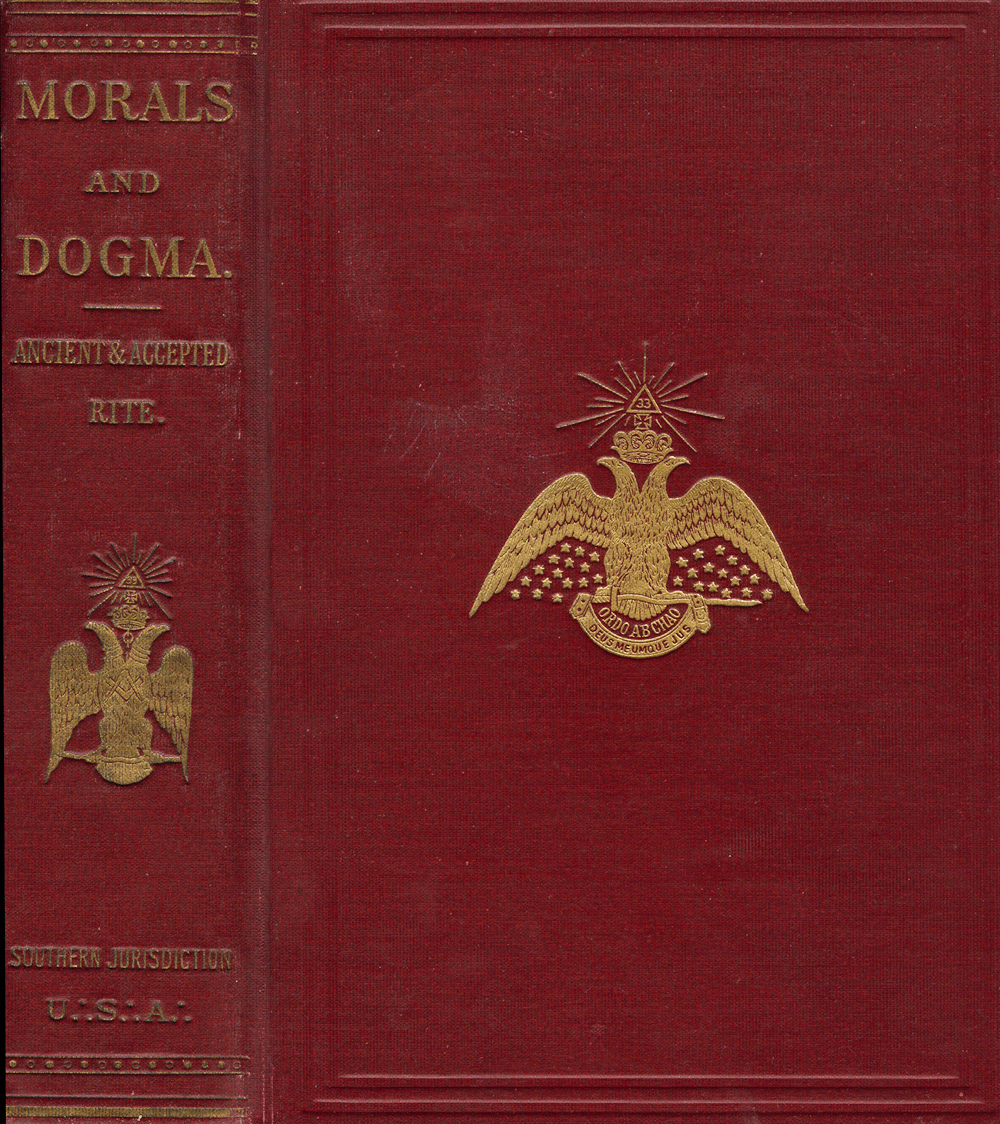
-- Morals and Dogma,
by Albert Pike |