|
THE PRACTICE OF THE ANCIENT TURKISH FREEMASONS: THE KEY TO THE UNDERSTANDING OF ALCHEMY |
||||||||||||||
|
II. THEORY
So far we have been introduced to the practice of Islamic Freemasonry, now we must present evidence to show that the Science of the Key is actually the preparation of the Philosophers' Stone, the magnum opus, the mystery of the Rosicrucians and alchemists. Whoever is knowledgeable about these writings will recognize the connections with ease, if he is not so stupid as to think that such a recognition is detrimental -- that is, the dogma or opinion that one already knows everything. I do not undertake to oppose such an opinion, for that would be a useless beginning. I console myself with a verse I once read somewhere:
What I am revealing here is old, primeval, knowledge. I cannot be credited with having discovered the secret, I am only the means to an end, the tool. And this tool struggled long enough against revealing this secret. It was supposed to be revealed only to a small circle in my History of Astrology; I confess that that was a conceit of mine. For those who are not familiar with the mode of teaching and symbolism of the Rosicrucians, I will give the necessary explanations. Additionally, there are enough books in the Theosophical Publishing House where more detailed information can be found. It is likewise with the symbols and signs of recognition of the Freemasons. Modern Freemasonry has truly preserved one thing, and that is a great deal of the symbolism still used in the lodges, even though the meaning might have been lost or another external meaning might have been applied. I once presented this years ago in magical writings under the pseudonym Lessing the Younger. (Conversations Ernst and Falk.) Modern Freemasonry, which since the Constitution of 1717 was developed into worldwide Freemasonry, both is and is not the continuation of the old Freemasonry of the Middle Ages. It is so as far as outward appearances are concerned, but as it concerns the nature and content of the teaching it has entirely abandoned the ways of ancient Masonry. It has placed itself on a purely humanistic basis and views salvation as a matter of external progress moving from the outside inward. Ancient Masonry views, or rather viewed, its assignment as the ennobling of the individual. It taught a system whereby the individual being had to begin to become better and it hoped that this person would then function like leavening in the mass of the people. This hope was justified as long as there remained a religious unity in the western world. As soon as this unity began to crumble, the powers of the shadow started to win the game and the emerging Enlightenment gradually overwhelmed the old sources completely such that the meanings of the symbols were forgotten. Modern Masonry has no system of exercises such as ancient Masonry did. The word [Jakin], which is imparted to the apprentice, signifies nothing to him other than it is a sign of recognition of the First Degree -- that, however, the two vowels I and A are contained in this word, and that these are the work of the First Degree, has been forgotten. The column Jachin is the upward pointing index finger, just as still today all minarets around the mosques are compared to index fingers. The column Boas is the thumb. In the Second Degree the apprentice is to work on the A and the O. He is to go from the point to the line (I), from the line through the compass (A) to a perfect circle (O). This is the meaning of the letter G, which means geometry, of the Second Masonic Degree. And what does the Third Degree mean to the present-day Mason? He receives the master-word and the mastergrip, but he does not know that he has to make this word true by means of the grip, so that out of the discolored ashes the full redness of the rose can be engendered. Only through the black shadow of death can the spirit attain to its complete unfoldment. It is telling enough that most historians of Freemasonry reject Rosicrucianism and alchemy as aberrations; but no, it was precisely these which embodied ancient Freemasonry. If we trace our way back we will find significant connections. In my second volume of Die Geschichte der Astrologie I will pursue these connections. It is there that one also finds the basis of the teachings concerning letters and numbers, which I can only touch on here. We will become familiar with numerous alchemical and Rosicrucian writers in the following presentation. I am concerned with demonstrating from these writings the proof that the exercises of the Beni el Mim embody the "Great Work" which the Rosicrucians and alchemists have described as the highest of all. I want to open the way to the understanding of these things so that even the doubter can enter upon it. Doubtless further investigations by men more suitable than I myself am will increase the proofs, but I know that for many this will not be necessary. It is ancient secret knowledge that everything in the world -- that the whole universe --consists of a primeval matter, and that matter as we know it is only an apparent form of this primeval matter. The ancients called this primeval matter aether, and they taught that God, the ultimate, incomprehensible unity, manifested as spirit and aether. Modern science expresses this by saying that every form of matter is determined by a different vibratory rate of the primeval matter. Even just 20 years ago it was taught that the atom was the smallest thing and was indivisible; today it is taught that in the atom a certain number of electrons circulate around a fixed nucleus. The direction of motion and number of these electrons determine the nature of the matter. [i] To know the nature of this primeval matter is conceptually impossible for us, but its first apparent forms are recognizable. These are cosmic forces designated by the ancients as elements: fire, water, air and earth. By means of these the seven forces which play a role in astrology are fixed. God (Sun) is manifest in the Spirit (Moon) and Matter-Aether (Saturn). Spirit and Matter are manifest in the four cosmic forces: Fire (Mars), Earth (Venus), Air (Mercury), and Water (Jupiter). In astrology a zodiacal sign is ascribed to each of these forces as a diurnal and nocturnal house. The sequence of zodiacal signs as nocturnal houses represent the materialization of spirit, while the sequence of the diurnal houses represent the spiritualization of matter.
Here the goal of human development is presented in this ordering of the zodiacal signs in the simplest and most conceivable form. Each person must undergo this development, however, the free will of the human being makes it possible to accelerate this development. One way to spiritualize matter is the Science of the Key. I is the creative principle, the first unity. From the I arises the A, spirit and the O, matter. By means of the three vowels spiritual currents are stimulated. We very frequently find these two signs, I and A, represented in images in ancient Freemasonic literature, and less frequently the O. Two very good illustrations of the vowels are found in the 1619 Hannover edition of Heinrich Khunrath's Amphitheatrum Sapientiae Aeternae. Khunrath was a physician in Dresden. He already secured imperial permission to publish the book from the then mint-master of the elector by the name of Sebottendorf in 1598, although the work did not appear until three years after Khunrath's death. His lodge-brother, Erasmus Wolfart, provided for the publication. The three vowels are found on the first table which shows two crossed torches in the middle: the A, over these is an owl, as a symbol of wisdom. The owl is wearing glasses: the O. To the right and left are two lights, which indicate the I. The inscription below reads:
Khunrath indicates the way in the following words: "Consider why you have come into the world: to learn to know GOD, yourself and the spiritual world." You arrive at this --
That is the highest philosophy. An illustration which shows us how the vowels are represented by the hands is found on another page of the same work. The fourth table illustrates two wise men in the foreground who are showing the crowd the entrances to art. The wise man to the left is clearly forming an I, the one to the right forms an A with his right hand and an O with his left. An epigram makes the symbols even more clear; it says: Capiat et sapiat qui capere et sapere potest, qui non vel taceat vel discat aut abeat aut talis, qualis est, maneat. "Grasp and use it, whosoever can grasp and use it, whosoever cannot do so, to be silent and learn, or remove himself, or remain as he is." In the holdings of the Munich Staatsbibliotek there is a prayer book of the French Freemason Jacques Coeur, which is especially instructive, and which contains copious illustrations of the three vowels. Franz Boll presented a study of this prayer book in 1902. [ii] Jacques Coeur was a merchant from Bourges who was often in Damascus, and who perhaps learned the Science of the Key there. He supported the campaign of Joan of Arc, was the advisor of king Charles VII, and died in 1456 on the island of Chios. His two houses in Montpellier and Bourges are famous in the context of cultural history as we find in both a number of Freemasonic emblems and epigrams. The house in Bourges is set off with two towers, one of which portrays an index finger, the other a thumb. Especially instructive are the hand-positions of the figures in the vestibule of the cathedral in Freiburg. The series is derived from Albertus Magnus who makes us aware of the entire system of ancient Freemasonry by means of descriptions of the same things in his Mineralium libri quinque. For example, he describes the form of the A as follows: [iii] Cassiope est Virgo sedens in Cathedra habens manus erectas et cancellatas. "Cassiopeia is a Virgin, sitting in an arm-chair with her hands erect and crossed." From the sentences which follow it then becomes clear that the A is only made with the right hand. Much information is made available in the books of Louis Herre concerning the vestibule cycle of sculptures and the Masonic interpretation of the Freiburg cathedral. This literature is easy to obtain. From the plethora of material I wish to present there are two more examples which are especially instructive: they demonstrate the way in which the wise concealed their wisdom. In the book: von dem grossen Stein der uralten daran so viel tausend Meister anfangs der Welt hero gemacht haben, (6) published for the benefit of the sons of philosophy by Johannes Tholden, Hessen, Zerbst 1602 -- the author gives us a clue by means of a riddle from the tractate of the Benedictine Basilius Valentinus (around 1550). It goes like this: For a final departure from here you should, of all things, understand that you should weigh on the heavenly scale -- ram, bull, crab, scorpion and mountain-goat. On the other side of the scale, however, you should put the twin, archer, water-bearer, fish and maiden. Then make sure that the gold-rich lion enters the womb of the virgin, so that the balance will be tipped to that side of the scale. Then let the twelve signs of heaven come into opposition with the Pleiades, thus a final conjunction and connection of all the colors of the cosmos will occur so that the greatest will become the least and the least will become the greatest of all. We write the Latin names of the zodiacal signs in the usual way one under the other and read the final letters:
The solution results in ars ros is os as. Art is a tau [= dew] from is, as or the art of the rose is is, as os. We find the second proof in the secret figures of the Rosicrucians, which were reprinted in German translation in Altona in 1785. I do not recall whether it is contained in the reprint issued by Barsdorf (Berlin, 1918), the first part of which is Aureum seculum redivivum von Henricus Madathanus, theosophus, medicus et tandem dei gratia aureae crucis frater. (7) Madathan says: "The number of my name is MDCXI, in which my whole name has been written secretly in the book of nature with 11 dead and 7 living things. Additionally, the fifth letter is the fifth part of the eighth and the fifth part of the twelfth. Let yourself be satisfied with this. The name HENRICVS MADATHANVS consists of eleven
consonants and seven vowels. If the letters which can also stand for
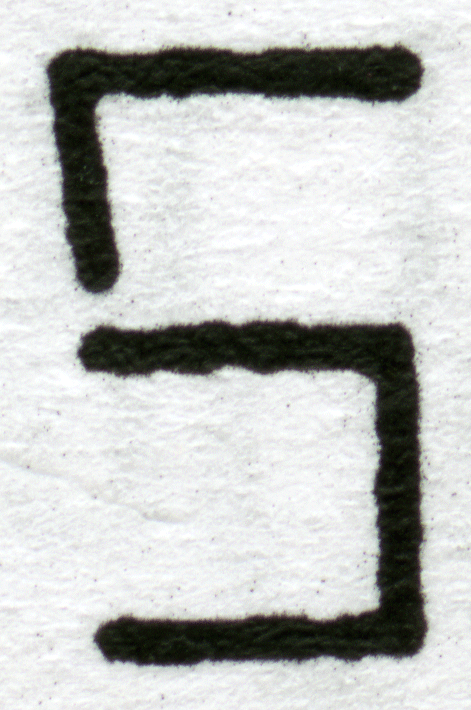
Roman numerals are read the date 1611 results. (8) The fifth letter is
I, the eighth S, the twelfth A. If we write the S in an angular manner
thus
The Masonic neck-grip is found very frequently in old sculptures; a reproduction is given by Guido von List in his Bilderschrift der Ario-Germanen, besides this there is also Louis Herre in his books on the Freiburg cathedral. In alchemistic literature this neck-grip is referred to as the seal of Hermes, or merely as the Seal, or the Bath of Mary. The Venetian physician Laurentius Ventura writes: [iv] Stude ergo ad inveniendum hoc sigillum secretum: quia sine illo magisterium perfici non potest, et hoc est duplex modus: primus per torturam colli, that is: "...therefore concern yourself with finding this secret seal, because without that mastery cannot be attained. And there is a doubled method of practice: the first is by means of encircling (9) the neck." On the seventh page of the previously mentioned work by Basilius Valentinus we find a man who is holding a scale in his left hand, and the right hand encompasses a bottle with the neck-grip. The level of importance the translator Tholde places on this drawing can be seen in his polemic which he directed at a greedy reprinter of his book, who had incorrectly reproduced the drawings. The distorted drawings are also found in the Strassburg editions of 1645 and 1666. Concerning the Seal, or the Bath of Mary -- the expression comes from the Alexandrian alchemist, Maria phrophetissa -- Arnold of Villanova writes: [v] item nota, quod ignis primi gradus qui pertinet solum ad putre!actionem, solutionem, mortificationem corporis, dicitur per quandam similitudinem balneum, quia balneum est res temperata, non intensa in calore nec etiam rigida sed calure remisso -- "Likewise notice that the degree of the first fire, which only extends to the putrefaction, dissolution and mortification of the body, is said to be the result of a certain bath of similarity, because the bath is a moderate thing, neither harsh in its warmth, nor cold, but rather relaxed in its warmth." Before I go on to a discussion of the work itself, I want to quote yet another passage, which I take from a book of a now unknown author. It is the Liber de Magni Lapidis Compositione et Operatione. The small work is made up of 56 short chapters and is found in the collection of Freemasonic writings which the Italian physician Guielmus Gratrolus of Bergamo compiled and published in Basel in 1561. The title of this collection is Verae Alchemiae Metallicae Doctrina Certusque Modus. Cap. XXXV Primum opus: Elixir ubique reperiri
In the future I will not provide the Latin texts, but will limit myself to their translations. Chapt. 35 First Work: The Elixir is to be found everywhere.
We shouldn't think badly of a modern person if he shakes his head over such utterances and puts this book aside. It is meant even less for the curious -- it will confuse him as well as the superficial individual. The old philosopher quotes an old book: the allegory of the wise, and wishes thereby to convey that the expression "gold" is to be understood according to the way the wise understood it. He quotes Albertus, but incorrectly in fact. Whoever does not take the trouble to read closely will go down the wrong path. The gold between the teeth is the word out of which, according to the Gospel of John, everything was created. The kernels of gold (syllables) are minutis and oblongis -- "pointed" and "broad lengthwise." I and A which animate the body (gum), the little gold that is necessary is the rarified solar power. Artefius teaches us in his Clavis Majoris Sapientiae the art "facere descendere spiritum"(10) and provides the following forms in which the spirit willingly overflows. I V X O through L. Here we have the I and the O; V and X are two forms of the A, the so-called point which comes about when the thumb is not spread in a right-angle and the breadth which is the right angle. The L means a level and a square. We find very significant pictures in the treatise of the Italian physician Ianus Lacinius from Calabria: Metallorum in melius mutationem Typus Methodusque (Venice, 1546). The first illustration shows a king, who draws attention to his extended index finger -- it is the beginning of the royal art. Another work is appended to this tractate, which is also very instructive: Pretiosa mararita novella by Petrus Bonus Ferrariensis. Even more important for us is the short work left behind by the unfortunate Seton, and which Sendivogius published. Orthelius annotated this piece of writing: Novum Lumen Chemicum. Here there are twelve figures which clearly show where the way leads. Before I go on, it should be mentioned that Seton was an adept seduced by vanity who wanted to make use of his wisdom to manufacture gold from ignoble metals. He was arrested by the Saxon Elector, Christian II, and cruelly tortured without ever betraying his secret. Sendivog freed him from prison, but unfortunately too late, as he died three months later -- after he had shared out the elixir to his wife and Sendivog. Sendivogius married his widow and so came into possession of the entirety of the elixir. Afterward he passed himself off as an adept without, however, being able to produce the elixir himself. Whoever has diligently followed my discussion will already have understood that the production of the stone is only possible for someone who has mastered the Science of the Key. This science is, however -- at least according to the notions of the world -- so childish that Seton would prefer to have himself tortured and killed rather than surrender it. He wouldn't have been believed. At the conclusion I will give an example where this is made clear. If you are interested in the special field of the alchemists of the art of making gold, I recommend to you the book by Schmieder, Geschichte der Alchemie (Halle, 1832). You will derive much information from it. We find Orthelius' commentary in volume VI of the Theatrum Chemicum (Strassburg, 1661). This edition corresponds completely to the book I am referring to: Novum Lumen Chymicum Michaelis Sendivogii Polni XII Figuris in Germania reperitis illustratum, 1624. The first figure shows the following: From the upper left a well masked hand is extended toward the bottom right. The thumb is indicated by a small elongated cloud over the top of the third hill. Only the index finger is clearly shown, the other fingers cannot be seen. There is an old saying of the Rosicrucians, which I will translate: "Whoever is not equipped with the golden rod for fishing has to take common quicksilver." By "the golden rod" they mean the angled hand -- the A. By the expression "he has to take common quicksilver" they mean to say that he should keep his hands off. Another drawing shows us a chemical laboratory with a furnace. The drawing is surrounded by 20 circles, of these seven are shown on the lengthwise sides, and three are shown on the above and below. On the furnace there is a large diagram that should be commented upon. In the middle of the diagram a flask is shown with a small vertical mark -- an I. Next to the furnace at the bottom is a small grate, the cover of a vent for ashes or air. The gratework has 24 fields -- the 24 letters. Concerning this Orthelius provides the commentary that the I is to be connected to a finger. I wish to explain a few more of the diagrams because the diagrams of Seton are important to me precisely because the art of this adept is doubtless solid and because a man who is irreproachable in all things, Surya, could not derive anything from the Novum Lumen Chymicum, otherwise he would have made some comment on Schmieder's assertion. Surya writes in volume XI of the collection Okkulte Medizin: "Setonius left behind only a single alchemical treatise in Latin under the title Cosmopolitae Novum Lum chymicum. It concerns the stone of the wise in twelve chapters, which the author may have associated in his mind with the twelve gates of Ripey. That no disclosure concerning the secret is to be expected from this work is made absolutely clear by the previously quoted oral remarks of the author. One who betrays nothing in the heat of disputation or under torture will certainly be even more circumspect at his writing desk. This treatise was published after his death by Sendivogius and appeared in different editions. Seton knew the time had not yet come, and he paid for this knowledge with his life. In his work he clearly set down the science for those who possess the key. But the cursed hunger for gold made them all go astray. We know that the Sun represents God and the Moon represents the spirit, and the soul as well, since the soul and the spirit are the same thing: the soul is the immortal spirit which struggles back toward its primeval source. The medieval Latin alphabet of 20 letters had four vowels: A E I O. The U was expressed by V. In addition there were 16 consonants. Based on this scholastic division the vowel A was often expressed by the number 17. Now we see on the left side of the illustration a two-handled wash-tub with soil in it, on the right side the soil has disappeared and there appears something akin to the finger-tips of a hand. In the sky above shine the Moon and the Sun. The Moon is surrounded by 17 stars, of which 16 are quite clearly shown, while the 17th is indicated more faintly. Here the letters are ascribed to the first emanation of God. It should also be indicated that these letters are to be spoken aloud. The Sun shows that the letters are to be fulfilled by means of divine spirit. As the accompanying text emphasizes, this only concerns the 17th letter, the A. The explanation is the following: The soil in the wash-tub on the left is the Terra Adamica, the human being. The left segment of the figure is meant to indicate that the human being is the object of alchemy. The right segment provides us with the actual means for the work -- the letter A, the spirit and the hand. The Moon and the stars, illuminated by the Sun in the sky in the upper part of the segment on the right, symbolize the spiritually animated letter A. The hand stretches itself down toward the A, ready to grasp it. The text belonging to this figure says: "The aforementioned spiritual water is taken up and both waters are blended in a single vessel and put outside under a clear, starry sky. Then the celestial rays are mixed with them. When, however, rain falls you can operate. The longer it is set out, the better it is." The two waters are the spoken and the spiritually animated A. They are connected to each other in a single vessel, that is the angled hand, and put outside -- that is, the hand is stretched out so that it can draw spiritual water out of the aether. The expression "under a clear, starry sky" is supposed to indicate the aether. When the hand is extended in this way so as to animate the A in it, aetherical rays are mixed with the animated hand and they flow forth into it like rain. Once the hand is sufficiently saturated with this spiritual water, one proceeds on to the operation -- the neck-grip. The water is defined as "our heavenly water which does not wet our hands, not normal water, yet almost like rainwater." I wish to describe one last figure. We see on this one an alchemist who is holding the tragula aurea, the golden javelin, in his left hand with which he is pointing to a wash-tub. The tub is empty, whereby it is indicated that this has nothing to do with actual water. His right hand is making a grasping gesture. On the chair stands a smaller vessel with water, and if one carefully examines this vessel a small hand can be seen to have been drawn in. With this I believe I have fulfilled my assignment of providing proof that the secret of the alchemists is hidden in the vowels connected to signs and grips. I will therefore conclude that, as I will quote other masters later on, with the words which the much misunderstood Freemason of Basel, Leonhardt Thurneisser, directed toward his readers as a conclusion. In 1586 Thurneisser forged a union of Reformed and Lutheran lodges into one great league. The Fama of 1614 acknowledges him as the father of the Rosicrucians and also mentions his two dictionaries along with the writings of Paracelsus. These dictionaries were only known in lodge-circles and probably only survive in a few copies. One bears the title: Hermeneia, das ist ein Onomasticum lnterpretatio oder erklerunge Leonhardt Thurneyssers zum Thurm aber die frebden vnd vnbekannten Warter in den schriften Theophrasti Peracelsi. (11) It is 95 pages long and was printed in Berlin in 1574. The last two pages contain a rhymed poem to the reader as a conclusion to the work. In this Thurneisser represents the viewpoint that Freemasonic practices will lead to better and higher knowledge than going to the greatest universities. Our hand-grips, he says, reveal the truth to us much better and more clearly than any book. Also all obscure writings will become clear by these means, and whatever we do not understand in Paracelsus will be easily understood when we connect the question to a hand-grip. We inquire with the chest-grip and god provides the answer in our hearts. The concluding words read:
_______________ Notes: i. Okkulte Chemie. Theosophisches Verlagshaus, Leipzig. ii. Zeitschrift fur Bucherfreunde Vol. VI:2 (1902). iii. Opera omnia Parisiis, Vol V (1890), Lib II Tract III, Chap. V, page 54. iv. De Lapide Philosophorum ch. XVII printed in the Theatrum Chemicum, Strassburg. v. De Decoctione Lapidis Philosophorum.
|
||||||||||||||