|
INSPECTOR GENERAL'S SURVEY OF THE CUBAN OPERATION AND ASSOCIATED DOCUMENTS |
|
by spartacus.schoolnet.co.uk BIOGRAPHIES OF MAJOR PLAYERS
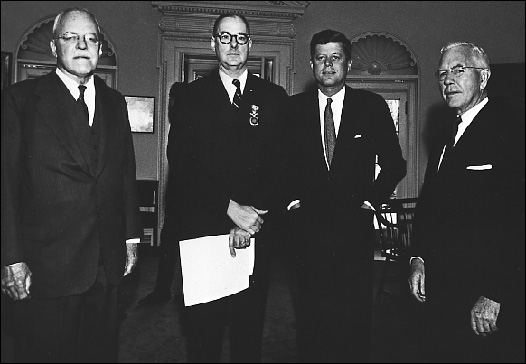
Allen Dulles, Richard Bissell, John F. Kennedy and John McCone (April 1962) In the three years that followed the Cuban Revolution, 250,000 Cubans out of a population of six million left the country. Most of these were from the upper and middle-classes who were financially worse off as a result of Castro's policies. Of those who stayed, 90 per cent of the population, according to public opinion polls, supported Fidel Castro. However, Castro did not keep his promise of holding free elections. Castro claimed the national unity that had been created would be destroyed by the competing political parties in an election. Castro was also becoming less tolerant towards people who disagreed with him. Ministers who questioned the wisdom of his policies were sacked and replaced by people who had proved their loyalty to him. These people were often young, inexperienced politicians who had fought with him in the Sierra Maestra. Politicians who publicly disagreed with him faced the possibility of being arrested. Writers who expressed dissenting views and people he considered deviants such as homosexuals were also imprisoned. In March 1960 Richard Bissell had drafted a top-secret policy paper entitled: A Program of Covert Action Against the Castro Regime (code-named JMARC). This paper was based on PBSUCCESS, the policy that had worked so well in Guatemala in 1954. In fact, Bissell assembled the same team as the one used in Guatemala (Tracy Barnes, David Atlee Phillips, David Morales, Jake Esterline, Rip Robertson, E. Howard Hunt and Gerry Droller “Frank Bender”). The only one missing was Frank Wisner, who had suffered a mental breakdown in 1956. Added to the team was Desmond FitzGerald, William Harvey and Ted Shackley. The policy involved the creation of an exile government, a powerful propaganda offensive, developing a resistance group within Cuba and the establishment of a paramilitary force outside Cuba. In Guatemala this strategy involved persuading Jacobo Arbenz to resign. Richard Bissell knew of course that Fidel Castro would never agree to that. Therefore, Castro had to be removed just before the invasion took place. If this did not happen, the plan would not work. In August 1960 Dwight Eisenhower authorized $13m to pay for JMARC. Sidney Gottlieb of the CIA Technical Services Division was asked to come up with proposals that would undermine Castro's popularity with the Cuban people. Plans included a scheme to spray a television studio in which he was about to appear with an hallucinogenic drug and contaminating his shoes with thallium which they believed would cause the hair in his beard to fall out. These schemes were rejected and instead Bissell decided to arrange the assassination of Fidel Castro. In September 1960 Richard Bissell and Allen W. Dulles, the director of the Central Intelligence Agency (CIA), initiated talks with two leading figures of the Mafia, Johnny Roselli and Sam Giancana. Later, other crime bosses such as Carlos Marcello, Santos Trafficante and Meyer Lansky became involved in this plot against Castro. Robert Maheu, a veteran of CIA counter-espionage activities, was instructed to offer the Mafia $150,000 to kill Fidel Castro. The advantage of employing the Mafia for this work is that it provided CIA with a credible cover story. The Mafia were known to be angry with Castro for closing down their profitable brothels and casinos in Cuba. If the assassins were killed or captured the media would accept that the Mafia were working on their own. The Federal Bureau of Investigation had to be brought into this plan as part of the deal involved protection against investigations against the Mafia in the United States. Castro was later to complain that there were twenty ClA-sponsered attempts on his life. Eventually Johnny Roselli and his friends became convinced that the Cuban revolution could not be reversed by simply removing its leader. However, they continued to play along with this CIA plot in order to prevent them being prosecuted for criminal offences committed in the United States. John F. Kennedy was given a copy of the JMARC proposal by Bissell and Allen W. Dulles in Palm Beach on 18th November, 1960. According to Bissell, Kennedy remained impassive throughout the meeting. He expressed surprise only at the scale of the operation. The plan involved a 750 man landing on a beach near the port of Trinidad, on the south coast of Cuba. The CIA claimed that Trinidad was a hotbed of opposition to Castro. It was predicted that within four days the invasion force would be able to recruit enough local volunteers to double in size. Airborne troops would secure the roads leading to the town and the rebels would join up with the guerrillas in the nearby Escambray Mountains. In March 1961 John F. Kennedy asked the Joint Chiefs of Staff to vet the JMARC project. As a result of “plausible deniability” they were not given details of the plot to kill Castro. The JCS reported that if the invaders were given four days of air cover, if the people of Trinidad joined the rebellion and if they were able to join up with the guerrillas in the Escambray Mountains, the overall rating of success was 30%. Therefore, they could not recommend that Kennedy went along with the JMARC project. At a meeting on 11th March, 1961, Kennedy rejected Bissell’s proposed scheme. He told him to go away and draft a new plan. He asked for it to be “less spectacular” and with a more remote landing site than Trinidad. It appears that Kennedy had completely misunderstood the report from the JCS. They had only rated it as high as a 30% chance of success because it was going to involve such a large landing force and was going to take place in Trinidad, near to the Escambray Mountains. After all, Fidel Castro had an army and militia of 200,000 men. Richard Bissell now resubmitted his plan. As requested, the landing was no longer at Trinidad. Instead he selected Bahia de Cochinos (Bay of Pigs). This was 80 miles from the Escambray Mountains. What is more, this journey to the mountains was across an impenetrable swamp. As Bissell explained to Kennedy, this means that the guerrilla fallback option had been removed from the operation. As Allen W. Dulles recorded at the time: “We felt that when the chips were down, when the crisis arose in reality, any action required for success would be authorized rather than permit the enterprise to fail.” In other words, he knew that the initial invasion would be a disaster, but believed that Kennedy would order a full-scale invasion when he realized that this was the case. According to Evan Thomas (The Very Best Men): “Some old CIA hands believe that Bissell was setting a trap to force U.S. intervention”. Edgar Applewhite, a former deputy inspector general, believed that Bissell and Dulles were “building a tar baby”. Jake Esterline was very unhappy with these developments and on 8th April attempted to resign from the CIA. Bissell convinced him to stay. On 10th April, 1961, Bissell had a meeting with Robert Kennedy. He told Kennedy that the new plan had a two out of three chance of success. Bissell added that even if the project failed the invasion force could join the guerrillas in the Escambray Mountains. Kennedy was convinced by this scheme and applied pressure on those like Chester Bowles, Theodore Sorenson and Arthur Schlesinger who were urging John F. Kennedy to abandon the project. On 13th April, Kennedy asked Richard Bissell how many B-26s were going to be used. He replied sixteen. Kennedy told him to use only eight. Bissell knew that the invasion could not succeed without adequate air cover. Yet he accepted this decision based on the idea that he would later change his mind “when the chips were down”. The following day B-26 planes began bombing Cuba's airfields. After the raids Cuba was left with only eight planes and seven pilots. Two days later five merchant ships carrying 1,400 Cuban exiles arrived at the Bay of Pigs. Allen W. Dulles was in Puerto Rico during the invasion. He left Charles Cabell in charge. Instead of ordering the second air raid he checked with Dean Rusk. He contacted Kennedy who said he did not remember being told about the second raid. After discussing it with Rusk he decided to cancel it. Instead the operation tried to rely on Radio Swan, broadcasts being made on a small island in the Caribbean by David Atlee Phillips, calling for the Cuban Army to revolt. They failed to do this. Instead they called out the militia to defend the fatherland from “American mercenaries”. At 7 a.m. on 18th April, Richard Bissell told John F. Kennedy that the invasion force was trapped on the beaches and encircled by Castro’s forces. Then Bissell asked Kennedy to send in American forces to save the men. Bissell expected him to say yes. Instead he replied that he still wanted “minimum visibility”. After the air raids Cuba was left with only eight planes and seven pilots. Two days later five merchant ships carrying 1,400 Cuban exiles arrived at the Bay of Pigs. Two of the ships were sunk, including the ship that was carrying most of the supplies. Two of the planes that were attempting to give air-cover were also shot down. That night Bissell had another meeting with John F. Kennedy. This time it took place in the White House and included General Lyman Lemnitzer, the chairman of the Joint Chiefs of Staff and Admiral Arleigh Burke, Chief of Naval Operations. Bissell told Kennedy that the operation could still be saved if American warplanes were allowed to fly cover. Admiral Burke supported him on this. General Lemnitzer called for the Brigade to join the guerrillas in the Escambray Mountains. Bissell explained this was not an option as their route was being blocked by 20,000 Cuban troops. Within seventy-two hours all the invading troops had been killed, wounded or had surrendered. Bissell had a meeting with John F. Kennedy about the Bay of Pigs operation. Kennedy admitted it was his fault that the operation had been a disaster. Kennedy added: "In a parliamentary government, I'd have to resign. But in this government I can't, so you and Allen (Dulles) have to go." As Evan Thomas points out in The Very Best Men: "Bissell had been caught in his own web. "Plausible deniability" was intended to protect the president, but as he had used it, it was a tool to gain and maintain control over an operation... Without plausible deniability, the Cuba project would have turned over to the Pentagon, and Bissell would have have become a supporting actor." After the CIA's internal inquiry into this fiasco, Allen W. Dulles was forced to resign as Director of the CIA (November, 1961) by President John F. Kennedy. He did not actually sack Bissell. Instead he offered him the post as director of a new science and technology department. Bissell turned down the offer and in February 1962 he left the CIA and was replaced as head of the Directorate for Plans, by Richard Helms. He now introduced a campaign that involved covert attacks on the Cuban economy.
When Christopher Columbus landed in Cuba on October 24, 1492 he described it as the "fairest island human eyes have yet beheld." However, the Spanish had not come for the scenery. When gold was discovered soon afterwards King Ferdinand of Spain sent an army to take control of the island. Led by Chief Hatuey the local Indians put up a brave struggle but the Cubans were soon defeated by the superior weapons of the Spanish. Twenty-five years later, the population of over 1,000,000 Indians had been reduced to only 2,000. Many were murdered, others died of starvation or disease, committed suicide or had died from the consequences of being forced to work long hours in the gold-mines. The Spanish replaced the Indians with slaves from Africa. When the gold mines were exhausted the Spanish used slaves to produce cash crops, especially sugar and tobacco. There were several slave revolts in Cuba but they were defeated by the descendants of the original Spanish settlers who became known as Creoles. The Creoles were forced to sell their produce for low prices to Spain. They objected to this system and became involved in a war to obtain their independence. By 1898 the Cubans were on the verge of defeating the Spanish when troops from the United States arrived to quell the revolt. The United States had originally tried to buy the island from Spain in 1853 for $130 million. After putting down the Cuban revolt, the United States was in a position to force Cuba to sell their sugar and tobacco to them instead of to Spain. As the Spanish had done previously, the United States forced the Cubans to sell raw materials for low prices. They also made sure that Cuba bought their manufactured goods, and by 1914 an estimated 74 per cent of all imports came from the United States. Much of Cuban industry was now owned by United States companies including the railways, telephones and tobacco plantations, as was two-thirds of all arable land. The United States also took control of Guantanamo Bay. As well as providing an important base for the US Navy, Guantanamo also had two airstrips and a Marine Garrison. The Cubans were also forced to sign what became known as the Platt Agreement. This agreement gave the United States the right to send troops to the island if they disagreed with the way that the country was being run. This meant that no Cuban government could be elected unless they were willing to implement policies favourable to the United States. In return for their cooperation, government ministers in Cuba received payments from United States businessmen. Elections in Cuba were usually rigged and the victors were rarely popular with the Cuban people. Just ninety miles off the Florida coast, Cuba became a holiday island for rich Americans. It was a place where they could enjoy pleasures that were illegal in many states in North America. These included drinking, gambling and prostitution. Large profits could be made from these activities and it was not long before they were under the control of the Mafia. In 1947 Fidel Castro joined the Cuban People's Party. He was attracted to this new party's campaign against corruption, injustice, poverty, unemployment and low wages. The Cuban People's Party accused government ministers of taking bribes and running the country for the benefit of the large United States corporations that had factories and offices in Cuba. In 1952 Castro became a candidate for Congress for the Cuban People's Party. He was a superb public speaker and soon built up a strong following amongst the young members of the party. The Cuban People's Party was expected to win the election but during the campaign. General Fulgencio Batista, with the support of the armed forces, took control of the country. Castro came to the conclusion that revolution was the only way that the Cuban People's Party would gain power. In 1953, Castro, with an armed group of 123 men and women, attacked the Moncada army barracks. The plan to overthrow Batista ended in disaster and although only eight were killed in the fighting, another eighty were murdered by the army after they were captured. Castro was lucky that the lieutenant who arrested him ignored orders to have him executed and instead delivered him to the nearest civilian prison. Castro also came close to death in prison. Captain Pelletier was instructed to put poison in Castro's food. The man refused and instead revealed his orders to the Cuban people. Pelletier was court-martialed but, concerned about world opinion, Batista decided not to have Castro killed.
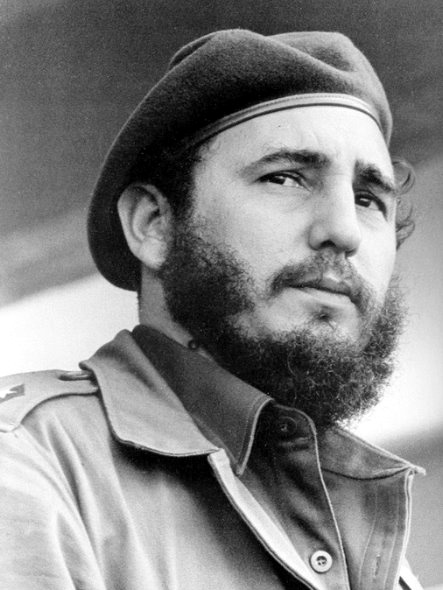
Fidel Castro, the illegitimate son of a successful Creole sugar plantation owner, was born in Cuba in 1926. He was a rebellious boy and at the age of thirteen helped to organize a strike of sugar workers on his father's plantation. Both his parents were illiterate but they were determined that their children should receive a good education and Fidel was sent to a Jesuit boarding school. Although he disliked the strict discipline of the school, Fidel soon showed that he was extremely intelligent. However, except for history, he preferred sports to academic subjects. Fidel was good at running, soccer and baseball, and in 1944 was awarded the prize as Cuba's best all-round school athlete. After he had finished his education Castro became a lawyer in Havana. As he tended to take the cases of poor people who could not afford to pay him, Castro was constantly short of money. Castro's experience as a lawyer made him extremely critical of the great inequalities in wealth that existed in Cuba. Like many other Cubans, Castro resented the wealth and power of the American businessmen who appeared to control the country. In 1947 Castro joined the Cuban People's Party. He was attracted to this new party's campaign against corruption, injustice, poverty, unemployment and low wages. The Cuban People's Party accused government ministers of taking bribes and running the country for the benefit of the large United States corporations that had factories and offices in Cuba. In 1952 Fidel Castro became a candidate for Congress for the Cuban People's Party. He was a superb public speaker and soon built up a strong following amongst the young members of the party. The Cuban People's Party was expected to win the election but during the campaign. General Fulgencio Batista, with the support of the armed forces, took control of the country. Castro came to the conclusion that revolution was the only way that the Cuban People's Party would gain power. In 1953, Castro, with an armed group of 123 men and women, attacked the Moncada army barracks. The plan to overthrow Batista ended in disaster and although only eight were killed in the fighting, another eighty were murdered by the army after they were captured. Castro was lucky that the lieutenant who arrested him ignored orders to have him executed and instead delivered him to the nearest civilian prison. Castro also came close to death in prison. Captain Pelletier was instructed to put poison in Castro's food. The man refused and instead revealed his orders to the Cuban people. Pelletier was court-martialed but, concerned about world opinion, Batista decided not to have Castro killed. Castro was put on trial charged with organising an armed uprising. He used this opportunity to make a speech about the problems of Cuba and how they could be solved. His speech later became a book entitled History Will Absolve Me. Castro was found guilty and sentenced to fifteen years in prison. The trial and the publication of the book made Castro famous in Cuba. His attempted revolution had considerable support in the country. After all, the party he represented would probably have won the election in 1952 had it been allowed to take place. Following considerable pressure from the Cuban population, Batista decided to release Castro after he had served only two years of his sentence. Batista also promised elections but when it became clear that they would not take place, Castro left for Mexico where he began to plan another attempt to overthrow the Cuban government. After building up a stock of guns and ammunition, Castro, Che Guevara and eighty other rebels arrived in Cuba in 1956. This group became known as the July 26 Movement (the date that Castro had attacked the Moncada barracks). Their plan was to set up their base in the Sierra Maestra mountains. On the way to the mountains they were attacked by government troops. By the time they reached the Sierra Maestra there were only sixteen men left with twelve weapons between them. For the next few months Castro's guerrilla army raided isolated army garrisons and were gradually able to build-up their stock of weapons. When the guerrillas took control of territory they redistributed the land amongst the peasants. In return, the peasants helped the guerrillas against Batista's soldiers. In some cases the peasants also joined Castro's army, as did students from the cities and occasionally Catholic priests. In an effort to find out information about Castro's army people were pulled in for questioning. Many innocent people were tortured. Suspects, including children, were publicly executed and then left hanging in the streets for several days as a warning to others who were considering joining Castro. The behaviour of Batista's forces increased support for the guerrillas. In 1958 forty-five organizations signed an open letter supporting the July 26 Movement. National bodies representing lawyers, architects, dentists, accountants and social workers were amongst those who signed. Castro, who had originally relied on the support of the poor, was now gaining the backing of the influential middle classes. Fulgencio Batista responded to this by sending more troops to the Sierra Maestra. He now had 10,000 men hunting for Castro and his 300-strong army. Although outnumbered, Castro's guerrillas were able to inflict defeat after defeat on the government's troops. In the summer of 1958 over a thousand of Batista's soldiers were killed or wounded and many more were captured. Unlike Batista's soldiers, Castro's troops had developed a reputation for behaving well towards prisoners. This encouraged Batista's troops to surrender to Castro when things went badly in battle. Complete military units began to join the guerrillas. The United States supplied Batista with planes, ships and tanks, but the advantage of using the latest technology such as napalm failed to win them victory against the guerrillas. In March 1958, the United States government, disillusioned with Batista's performance, suggested he held elections. This he did, but the people showed their dissatisfaction with his government by refusing to vote. Over 75 per cent of the voters in the capital Havana boycotted the polls. In some areas, such as Santiago, it was as high as 98 per cent. Castro was now confident he could beat Batista in a head-on battle. Leaving the Sierra Maestra mountains, Castro's troops began to march on the main towns. After consultations with the United States government, Batista decided to flee Cuba. Senior Generals left behind attempted to set up another military government. Castro's reaction was to call for a general strike. The workers came out on strike and the military were forced to accept the people's desire for change. Castro marched into Havana on January 9,1959, and became Cuba's new leader. In its first hundred days in office Castro's government passed several new laws. Rents were cut by up to 50 per cent for low wage earners; property owned by Batista and his ministers was confiscated; the telephone company was nationalized and the rates were reduced by 50 per cent; land was redistributed amongst the peasants (including the land owned by the Castro family); separate facilities for blacks and whites (swimming pools, beaches, hotels, cemeteries etc.) were abolished. Castro had strong views on morality. He considered that alcohol, drugs, gambling, homosexuality and prostitution were major evils. He saw the casinos and night-clubs as sources of temptation and corruption and he passed laws closing them down. Members of the Mafia, who had been heavily involved in running these places, were forced to leave the country. Castro believed strongly in education. Before the revolution 23.6 per cent of the Cuban population were illiterate. In rural areas over half the population could not read or write and 61 per cent of the children did not go to school. Castro asked young students in the cities to travel to the countryside and teach the people to read and write. Cuba adopted the slogan: "If you don't know, learn. If you know, teach." Eventually free education was made available to all citizens and illiteracy in Cuba became a thing of the past. The new Cuban government also set about the problem of health care. Before the revolution Cuba had 6,000 doctors. Of these, 64 per cent worked in Havana where most of the rich people lived. When Castro ordered that doctors had to be redistributed throughout the country, over half decided to leave Cuba. To replace them Cuba built three new training schools for doctors. The death of young children from disease was a major problem in Cuba. Infant mortality was 60 per 1,000 live births in 1959. To help deal with this Cuba introduced a free health-service and started a massive inoculation program. By 1980 infant mortality had fallen to 15 per 1,000. This figure is now the best in the developing world and is in fact better than many areas of the United States. It has been estimated that in his seven-year reign, Batista's regime had murdered over 20,000 Cubans. Those involved in the murders had not expected to lose power and had kept records, including photographs of the people they had tortured and murdered. Castro established public tribunals to try the people responsible and an estimated 600 people were executed. Although this pleased the relatives of the people murdered by Batista's government, these executions shocked world opinion. Some of Castro's new laws also upset the United States. Much of the land given to the peasants was owned by United States corporations. So also was the telephone company that was nationalized. The United States government responded by telling Castro they would no longer be willing to supply the technology and technicians needed to run Cuba's economy. When this failed to change Castro's policies they reduced their orders for Cuban sugar. Castro refused to be intimidated by the United States and adopted even more aggressive policies towards them. In the summer of 1960 Castro nationalized United States property worth $850 million. He also negotiated a deal where by the Soviet Union and other communist countries in Eastern Europe agreed to purchase the sugar that the United States had refused to take. The Soviet Union also agreed to supply the weapons, technicians and machinery denied to Cuba by the United States. President Dwight Eisenhower was in a difficult situation. The more he attempted to punish Castro the closer he became to the Soviet Union. His main fear was that Cuba could eventually become a Soviet military base. To change course and attempt to win Castro's friendship with favourable trade deals was likely to be interpreted as a humiliating defeat for the United States. Instead Eisenhower announced that he would not buy any more sugar from Cuba. In March I960, Eisenhower approved a CIA plan to overthrow Castro. The plan involved a budget of $13 million to train "a paramilitary force outside Cuba for guerrilla action." The strategy was organised by Richard Bissell and Richard Helms. An estimated 400 CIA officers were employed full-time to carry out what became known as Operation Mongoose. Edward Lansdale became project leader whereas William Harvey became head of what became known as Task Force W. The JM WAVE station served as operational headquarters for Operation Mongoose. Sidney Gottlieb of the CIA Technical Services Division was asked to come up with proposals that would undermine Castro's popularity with the Cuban people. Plans included a scheme to spray a television studio in which he was about to appear with an hallucinogenic drug and contaminating his shoes with thallium which they believed would cause the hair in his beard to fall out. These schemes were rejected and instead Bissell decided to arrange the assassination of Castro. In September 1960, Richard Bissell and Allen W. Dulles, the director of the Central Intelligence Agency (CIA), initiated talks with two leading figures of the Mafia, Johnny Roselli and Sam Giancana. Later, other crime bosses such as Carlos Marcello, Santos Trafficante and Meyer Lansky became involved in this plot against Castro. Robert Maheu, a veteran of CIA counter-espionage activities, was instructed to offer the Mafia $150,000 to kill Fidel Castro. The advantage of employing the Mafia for this work is that it provided CIA with a credible cover story. The Mafia were known to be angry with Castro for closing down their profitable brothels and casinos in Cuba. If the assassins were killed or captured the media would accept that the Mafia were working on their own. The Federal Bureau of Investigation had to be brought into this plan as part of the deal involved protection against investigations against the Mafia in the United States. Castro was later to complain that there were twenty ClA-sponsered attempts on his life. Eventually Johnny Roselli and his friends became convinced that the Cuban revolution could not be reversed by simply removing its leader. However, they continued to play along with this CIA plot in order to prevent them being prosecuted for criminal offences committed in the United States. In 1961 Eisenhower retired and the problem of dealing with Castro was passed on to the new president, John F. Kennedy. The new president continued with Eisenhower's policy of trying to assassinate Castro. This became known as Operation Freedom and was placed under the control of Robert Kennedy. In the three years that followed the revolution, 250,000 Cubans out of a population of six million left the country. Most of these were from the upper and middle-classes who were financially worse off as a result of Castro's policies. Of those who stayed, 90 per cent of the population, according to public opinion polls, supported Castro. However, Castro did not keep his promise of holding free elections. Castro claimed the national unity that had been created would be destroyed by the competing political parties in an election. Castro was also becoming less tolerant towards people who disagreed with him. Ministers who questioned the wisdom of his policies were sacked and replaced by people who had proved their loyalty to him. These people were often young, inexperienced politicians who had fought with him in the Sierra Maestra. Politicians who publicly disagreed with him faced the possibility of being arrested. Writers who expressed dissenting views and people he considered deviants such as homosexuals were also imprisoned. When John F. Kennedy replaced Dwight Eisenhower as president of the United States he was told about the CIA plan to invade Cuba. Kennedy had doubts about the venture but he was afraid he would be seen as soft on communism if he refused permission for it to go ahead. Kennedy's advisers convinced him that Castro was an unpopular leader and that once the invasion started the Cuban people would support the ClA-trained forces. On April 14, 1961, B-26 planes began bombing Cuba's airfields. After the raids Cuba was left with only eight planes and seven pilots. Two days later five merchant ships carrying 1,400 Cuban exiles arrived at the Bay of Pigs. The attack was a total failure. Two of the ships were sunk, including the ship that was carrying most of the supplies. Two of the planes that were attempting to give air-cover were also shot down. Within seventy-two hours all the invading troops had been killed, wounded or had surrendered. At the beginning of September 1962, U-2 spy planes discovered that the Soviet Union was building surface-to-air missile (SAM) launch sites. There was also an increase in the number of Soviet ships arriving in Cuba which the United States government feared were carrying new supplies of weapons. President Kennedy complained to the Soviet Union about these developments and warned them that the United States would not accept offensive weapons (SAMs were considered to be defensive) in Cuba. As the Cubans now had SAM installations they were in a position to shoot down U-2 spy-planes. Kennedy was in a difficult situation. Elections were to take place for the United States Congress in two month's time. The public opinion polls showed that his own ratings had fallen to their lowest point since he became president. In his first two years of office a combination of Republicans and conservative southern Democrats in Congress had blocked much of Kennedy's proposed legislation. The polls suggested that after the elections he would have even less support in Congress. Kennedy feared that any trouble over Cuba would lose the Democratic Party even more votes, as it would remind voters of the Bay of Pigs disaster where the CIA had tried to oust Castro from power. One poll showed that over 62 per cent of the population were unhappy with his policies on Cuba. Understandably, the Republicans attempted to make Cuba the main issue in the campaign. This was probably in Kennedy's mind when he decided to restrict the flights of the U-2 planes over Cuba . Pilots were also told to avoid flying the whole length of the island. Kennedy hoped this would ensure that a U-2 plane would not be shot down, and would prevent Cuba becoming a major issue during the election campaign. On September 27, a CIA agent in Cuba overheard Castro's personal pilot tell another man in a bar that Cuba now had nuclear weapons. U-2 spy-plane photographs also showed that unusual activity was taking place at San Cristobal. However, it was not until October 15 that photographs were taken that revealed that the Soviet Union was placing long range missiles in Cuba. President Kennedy's first reaction to the information about the missiles in Cuba was to call a meeting to discuss what should be done. Fourteen men attended the meeting and included military leaders, experts on Latin America, representatives of the CIA, cabinet ministers and personal friends whose advice Kennedy valued. This group became known as the Executive Committee of the National Security Council. Over the next few days they were to meet several times. At the first meeting of the Executive Committee of the National Security Council, the CIA and other military advisers explained the situation. After hearing what they had to say, the general feeling of the meeting was for an air-attack on the missile sites. Remembering the poor advice the CIA had provided before the Bay of Pigs invasion, John F. Kennedy decided to wait and instead called for another meeting to take place that evening. By this time several of the men were having doubts about the wisdom of a bombing raid, fearing that it would lead to a nuclear war with the Soviet Union. The committee was now so divided that a firm decision could not be made. The Executive Committee of the National Security Council argued amongst themselves for the next two days. The CIA and the military were still in favour of a bombing raid and/or an invasion. However, the majority of the committee gradually began to favour a naval blockade of Cuba. Kennedy accepted their decision and instructed Theodore Sorensen, a member of the committee, to write a speech in which Kennedy would explain to the world why it was necessary to impose a naval blockade of Cuba. As well as imposing a naval blockade, Kennedy also told the air-force to prepare for attacks on Cuba and the Soviet Union. The army positioned 125,000 men in Florida and was told to wait for orders to invade Cuba. If the Soviet ships carrying weapons for Cuba did not turn back or refused to be searched, a war was likely to begin. Kennedy also promised his military advisers that if one of the U-2 spy planes were fired upon he would give orders for an attack on the Cuban SAM missile sites. The world waited anxiously. A public opinion poll in the United States revealed that three out of five people expected fighting to break out between the two sides. There were angry demonstrations outside the American Embassy in London as people protested about the possibility of nuclear war. Demonstrations also took place in other cities in Europe. However, in the United States, polls suggested that the vast majority supported Kennedy's action. On October 24, President John F. Kennedy was informed that Soviet ships had stopped just before they reached the United States ships blockading Cuba. That evening Nikita Khrushchev sent an angry note to Kennedy accusing him of creating a crisis to help the Democratic Party win the forthcoming election. On October 26, Khrushchev sent Kennedy another letter. In this he proposed that the Soviet Union would be willing to remove the missiles in Cuba in exchange for a promise by the United States that they would not invade Cuba. The next day a second letter from Khrushchev arrived demanding that the United States remove their nuclear bases in Turkey. While the president and his advisers were analyzing Khrushchev's two letters, news came through that a U-2 plane had been shot down over Cuba. The leaders of the military, reminding Kennedy of the promise he had made, argued that he should now give orders for the bombing of Cuba. Kennedy refused and instead sent a letter to Khrushchev accepting the terms of his first letter. Khrushchev agreed and gave orders for the missiles to be dismantled. Eight days later the elections for Congress took place. The Democrats increased their majority and it was estimated that Kennedy would now have an extra twelve supporters in Congress for his policies. The Cuban Missile Crisis was the first and only nuclear confrontation between the United States and the Soviet Union. The event appeared to frighten both sides and it marked a change in the development of the Cold War. Castro remained dependent on the support of the Soviet Union. Nikita Khrushchev was ousted from power on 15th October, 1964, but his successors, including Leonid Brezhnev, Yuri Andropov, Konstantin Chernenko and Mikhail Gorbachev provided aid to his government. However, after the fall of communism in the Soviet Union in 1989 this economic help came to an end. In 1991 Cuba suffered an economic crisis. Its outdated and unrepaired equipment meant that sugar and tobacco production fell. At the same time Cuba could no longer rely on former countries in Eastern Europe to buy its goods. Castro suffered great embarrassment when his own daughter sough asylum in the United States in 1994.
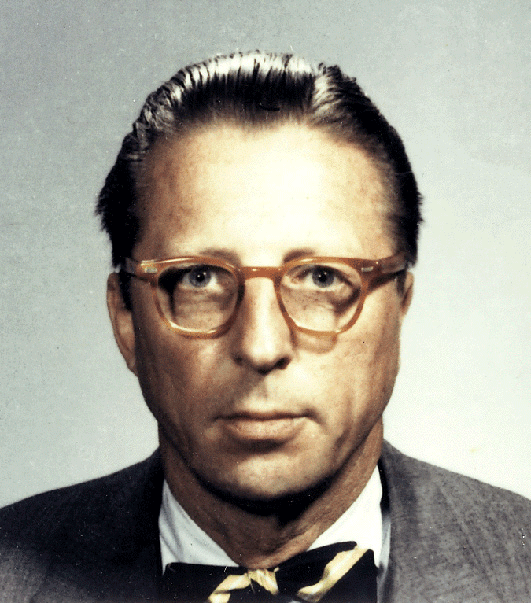
Richard Bissell was born in 1910. He went to Groton where three of his fellow pupils were Joseph Alsop, Eugene Rostow, and Tracy Barnes. He also studied economics at Yale University. In July, 1947 Bissell was recruited by Averell Harriman to run a committee to lobby for an economic recovery plan for Europe. The following year he was appointed as an administrator of the Marshall Plan in Germany and eventually became head of the Economic Cooperation Administration. Bissell also worked closely with the Office of Strategic Services (OSS) which had helped to organize guerrilla fighting, sabotage and espionage during the war. Bissell moved to Washington where he associated with George Kennan, Frank Wisner, Desmond FitzGerald, Joseph Alsop, Tracy Barnes, Philip Graham, Katharine Graham, Clark Clifford, Walt Rostow, Eugene Rostow, Chips Bohlen and Paul Nitze. This group became known as the Georgetown Crowd. Members of the group were passionately anti-communist but held liberal views on domestic issues. Bissell worked for the Ford Foundation for a while but in 1953, an old friend, Frank Wisner, persuaded him to join the Central Intelligence Agency (CIA) that was established in September 1947. Its role was to evaluate intelligence reports and coordinate the intelligence activities of the various government departments in the interest of national security. Bissell joined the CIA and in 1954 was placed in charge of developing and operating the U-2 spy plane. The U-2 was designed by Kelly Johnson, who had previously been responsible for the P-38 and the F-104 fighter planes. It was essentially a glider with a jet engine. It was so light it could fly at an altitude of 70,000 feet and travel over 4,000 miles. It took two years and $19m to develop. President Dwight Eisenhower gave permission for the U-2 to fly over Moscow and Leningrad for the first time on 4th July, 1956. The U-2 spy plane was a great success and within two years Bissell was able to say that 90% of all hard intelligence about the Soviet Union coming into the CIA was "funneled through the lens of the U-2's aerial cameras". This information convinced Eisenhower that Nikita Khrushchev was lying about the number of bombers and missiles being built by the Soviet Union. Eisenhower now knew that United States enjoyed a major advantage over the Soviet Union and allowed him to control defence spending. In December, 1956, Frank Wisner, head of the Directorate for Plans, an organization instructed to conduct covert anti-Communist operations around the world, suffered a mental breakdown and was diagnosed as suffering from manic depression. During his absence Wisner's job was covered by Richard Helms. The CIA sent Wisner to the Sheppard-Pratt Institute, a psychiatric hospital near Baltimore. He was prescribed psychoanalysis and shock therapy (electroconvulsive treatment). It was not successful and still suffering from depression, he was released from hospital in 1958. Wisner was too ill to return to his post as head of the Directorate for Plans (DPP). Allen W. Dulles therefore sent him to London to be CIA chief of station in England. Dulles decided that Bissell rather than Richard Helms should become the new head of the DPP. Helms became Bissell's deputy. The Directorate for Plans was responsible for what became known as the CIA's Black Operations. This involved a policy that was later to become known as Executive Action (a plan to remove unfriendly foreign leaders from power). This including a coup d'état that overthrew the Guatemalan government of Jacobo Arbenz in 1954 after he introduced land reforms and nationalized the United Fruit Company. Other political leaders deposed by Executive Action included Patrice Lumumba of the Congo, the Dominican Republic dictator Rafael Trujillo, General Abd al-Karim Kassem of Iraq and Ngo Dinh Diem, the leader of South Vietnam. However, his main target was Fidel Castro who had established a socialist government in Cuba. In March I960, President Dwight Eisenhower of the United States approved a CIA plan to overthrow Castro. The strategy was organised by Bissell. Sidney Gottlieb of the CIA Technical Services Division was asked to come up with proposals that would undermine Castro's popularity with the Cuban people. Plans included a scheme to spray a television studio in which he was about to appear with an hallucinogenic drug and contaminating his shoes with thallium which they believed would cause the hair in his beard to fall out. These schemes were rejected and instead Bissell decided to arrange the assassination of Fidel Castro. In September 1960, Bissell and Allen W. Dulles, the director of the Central Intelligence Agency (CIA), initiated talks with two leading figures of the Mafia, Johnny Roselli and Sam Giancana. Later, other crime bosses such as Carlos Marcello, Santos Trafficante and Meyer Lansky became involved in this plot against Castro. The strategy was managed by Sheffield Edwards and Robert Maheu, a veteran of CIA counter-espionage activities, was instructed to offer the Mafia $150,000 to kill Fidel Castro. The advantage of employing the Mafia for this work is that it provided CIA with a credible cover story. The Mafia were known to be angry with Castro for closing down their profitable brothels and casinos in Cuba. If the assassins were killed or captured the media would accept that the Mafia were working on their own. The Federal Bureau of Investigation had to be brought into this plan as part of the deal involved protection against investigations against the Mafia in the United States. Castro was later to complain that there were twenty ClA-sponsered attempts on his life. Eventually Johnny Roselli and his friends became convinced that the Cuban revolution could not be reversed by simply removing its leader. However, they continued to play along with this CIA plot in order to prevent them being prosecuted for criminal offences committed in the United States. As the end of his presidency approached, Dwight Eisenhower, decided to take a decisive step towards ending the Cold War by arranging a summit meeting with Nikita Khrushchev. The two sides agreed to meet in Paris on 16th May, 1960. On 1st May, 1960, a high-altitude American photographic reconnaissance aircraft, a Lockheed U-2, was shot down over the Soviet Union and the pilot, Gary Powers, was taken prisoner. Six days later Khrushchev announced to the world what had happened and demanded a full apology from the United States government. President Eisenhower replied by admitting that the Central Intelligence Agency had carried out these spying missions without his authority. However, he argued that the United States government had the right to protect its security by collecting the maximum of information about Soviet military strength. On 15th May Nikita Khrushchev made another appeal to Dwight Eisenhower to apologize for carrying out aerial spying on the Soviet Union. When he refused, the Soviet delegation left Paris and the summit meeting never took place. Some suspected that some hardliners had purposely undermined Eisenhower's attempts to bring an end to the Cold War. In March 1960 Bissell had drafted a top-secret policy paper entitled: A Program of Covert Action Against the Castro Regime (code-named JMARC). This paper was based on PBSUCCESS, the policy that had worked so well in Guatemala in 1954. In fact, Bissell assembled the same team as the one used in Guatemala (Tracy Barnes, David Atlee Phillips, David Morales, Jake Esterline, Rip Robertson, E. Howard Hunt and Gerry Droller “Frank Bender”). The only one missing was Frank Wisner, who had suffered a mental breakdown in 1956. Added to the team was Desmond FitzGerald, William Harvey and Ted Shackley. The policy involved the creation of an exile government, a powerful propaganda offensive, developing a resistance group within Cuba and the establishment of a paramilitary force outside Cuba. In Guatemala this strategy involved persuading Jacobo Arbenz to resign. Bissell knew of course that Fidel Castro would never agree to that. Therefore, Castro had to be removed just before the invasion took place. If this did not happen, the plan would not work. John F. Kennedy was given a copy of the JMARC proposal by Bissell and Allen W. Dulles in Palm Beach on 18th November, 1960. According to Bissell, Kennedy remained impassive throughout the meeting. He expressed surprise only at the scale of the operation. The plan involved a 750 man landing on a beach near the port of Trinidad, on the south coast of Cuba. The CIA claimed that Trinidad was a hotbed of opposition to Castro. It was predicted that within four days the invasion force would be able to recruit enough local volunteers to double in size. Airborne troops would secure the roads leading to the town and the rebels would join up with the guerrillas in the nearby Escambray Mountains. In March 1961 John F. Kennedy asked the Joint Chiefs of Staff to vet the JMARC project. As a result of “plausible deniability” they were not given details of the plot to kill Castro. The JCS reported that if the invaders were given four days of air cover, if the people of Trinidad joined the rebellion and if they were able to join up with the guerrillas in the Escambray Mountains, the overall rating of success was 30%. Therefore, they could not recommend that Kennedy went along with the JMARC project. At a meeting on 11th March, 1961, Kennedy rejected Bissell’s proposed scheme. He told him to go away and draft a new plan. He asked for it to be “less spectacular” and with a more remote landing site than Trinidad. It appears that Kennedy had completely misunderstood the report from the JCS. They had only rated it as high as a 30% chance of success because it was going to involve such a large landing force and was going to take place in Trinidad, near to the Escambray Mountains. After all, Fidel Castro had an army and militia of 200,000 men. Bissell now resubmitted his plan. As requested, the landing was no longer at Trinidad. Instead he selected Bahia de Cochinos (Bay of Pigs). This was 80 miles from the Escambray Mountains. What is more, this journey to the mountains was across an impenetrable swamp. As Bissell explained to Kennedy, this means that the guerrilla fallback option had been removed from the operation. As Allen W. Dulles recorded at the time: “We felt that when the chips were down, when the crisis arose in reality, any action required for success would be authorized rather than permit the enterprise to fail.” In other words, he knew that the initial invasion would be a disaster, but believed that Kennedy would order a full-scale invasion when he realized that this was the case. According to Evan Thomas (The Very Best Men): “Some old CIA hands believe that Bissell was setting a trap to force U.S. intervention”. Edgar Applewhite, a former deputy inspector general, believed that Bissell and Dulles were “building a tar baby”. Jake Esterline was very unhappy with these developments and on 8th April attempted to resign from the CIA. Bissell convinced him to stay. On 10th April, 1961, Bissell had a meeting with Robert Kennedy. He told Kennedy that the new plan had a two out of three chance of success. Bissell added that even if the project failed the invasion force could join the guerrillas in the Escambray Mountains. Kennedy was convinced by this scheme and applied pressure on those like Chester Bowles, Theodore Sorenson and Arthur Schlesinger who were urging John F. Kennedy to abandon the project. On 14th April, Kennedy asked Bissell how many B-26s were going to be used. He replied sixteen. Kennedy told him to use only eight. Bissell knew that the invasion could not succeed without adequate air cover. Yet he accepted this decision based on the idea that he would later change his mind “when the chips were down”. Allen W. Dulles was in Puerto Rico during the invasion. He left Charles Cabell in charge. Instead of ordering the second air raid he checked with Dean Rusk. He contacted Kennedy who said he did not remember being told about the second raid. After discussing it with Rusk he decided to cancel it. Instead the operation tried to rely on Radio Swan, broadcasts being made on a small island in the Caribbean by David Atlee Phillips, calling for the Cuban Army to revolt. They failed to do this. Instead they called out the militia to defend the fatherland from “American mercenaries”. At 7 a.m. on 18th April, Bissell told Kennedy that the invasion force was trapped on the beaches and encircled by Castro’s forces. Then Bissell asked Kennedy to send in American forces to save the men. Bissell expected him to say yes. Instead he replied that he still wanted “minimum visibility”. After the air raids Cuba was left with only eight planes and seven pilots. Two days later five merchant ships carrying 1,400 Cuban exiles arrived at the Bay of Pigs. Two of the ships were sunk, including the ship that was carrying most of the supplies. Two of the planes that were attempting to give air-cover were also shot down. That night Bissell had another meeting with John F. Kennedy. This time it took place in the White House and included General Lyman Lemnitzer, the chairman of the Joint Chiefs of Staff and Admiral Arleigh Burke, Chief of Naval Operations. Bissell told Kennedy that the operation could still be saved if American warplanes were allowed to fly cover. Admiral Burke supported him on this. General Lemnitzer called for the Brigade to join the guerrillas in the Escambray Mountains. Bissell explained this was not an option as their route was being blocked by 20,000 Cuban troops. Within seventy-two hours all the invading troops had been killed, wounded or had surrendered. Bissell had a meeting with John F. Kennedy about the Bay of Pigs operation. Kennedy admitted it was his fault that the operation had been a disaster. Kennedy added: "In a parliamentary government, I'd have to resign. But in this government I can't, so you and Allen (Dulles) have to go." As Evan Thomas points out in The Very Best Men: "Bissell had been caught in his own web. "Plausible deniability" was intended to protect the president, but as he had used it, it was a tool to gain and maintain control over an operation... Without plausible deniability, the Cuba project would have turned over to the Pentagon, and Bissell would have have become a supporting actor." John F. Kennedy asked Maxwell Taylor to investigate what went wrong during the Bay of Pigs operation. Taylor asked Lyman Kirkpatrick, the CIA's inspector general, to write a report on the failed project. Kirkpatrick was highly critical of both Bissell and Tracy Barnes. He claimed that they had misled the president and that "plausible deniability was a pathetic illusion". Kennedy was still determined to overthrow Fidel Castro. He created a committee (SGA) charged with overthrowing Castro's government. The SGA, chaired by Robert F. Kennedy (Attorney General), included Allen W. Dulles (CIA Director), later replaced by John McCone, Alexis Johnson (State Department), McGeorge Bundy (National Security Adviser), Roswell Gilpatric (Defence Department), General Lyman Lemnitzer (Joint Chiefs of Staff) and General Maxwell Taylor. Although not officially members, Dean Rusk (Secretary of State) and Robert S. McNamara (Secretary of Defence) also attending meetings. At a meeting of this committee at the White House on 4th November, 1961, it was decided to call this covert action program for sabotage and subversion against Cuba, Operation Mongoose. Attorney General Robert F. Kennedy also decided that General Edward Lansdale (Staff Member of the President's Committee on Military Assistance) should be placed in charge of the operation. Robert F. Kennedy now took the leading role in trying to overthrow Castro. At a meeting in November, 1961, Kennedy accused Bissell of "not doing anything about getting rid of Castro and the Castro regime." CIA agent Sam Halpern complained that "Bobby (Kennedy) wanted boom and bang all over the island... it was stupid... the pressure from the White House was very great." Bissell did what he could to arrange the assassination of Castro. This included asking William Harvey to take over the Mafia contracts from Sheffield Edwards. John F. Kennedy did not actually sack Bissell. Instead he offered him the post as director of a new science and technology department. This would place him in charge of the development of the SR-71, the new spy plane that would make the U-2 obsolete. Bissell turned down the offer and in February 1962 he left the Central Intelligence Agency and was replaced as head of the Directorate for Plans, by Richard Helms. Bissell became head of the Institute for Defense Analyses (IDA) in 1962. IDA was a Pentagon think tank set up to evaluate weapons systems. Later he worked for United Technologies in Hartford (1964-74). He also worked as a consultant for the Ford Foundation. Richard Bissell died in 1994. His autobiography, Reflections of a Cold Warrior: From Yalta to the Bay of Pigs, was published two years later.
Tracy Barnes was born in 1911. He worked as a lawyer with Frank Wisner at the Carter Ledyard, law firm in New York. The day after Pearl Harbor Barnes joined the U.S. Army. He served at the air intelligence school in Harrisburg, Pennsylvania. Later he was recruited into the Office of Strategic Services (OSS). Barnes was sent to London where he served under David Bruce, the head of SOS operations in England. While in London he spent time with his old friend Paul Nitze. Barnes parachuted into France on 5th August, 1944. According to his Silver Star citation: The liquidation of a detachment of several hundred of the enemy waslargely attributable to his courage and initiative, when, after unsuccessful attempts to effect a surrender, he and a French officer, armed with only with carbines, opened fire, constantly changing firing position to convey the impression of a large force." On 3rd December, 1944, Allen W. Dulles wrote to David Bruce: "I have met Tracy Barnes here today and am anxious to get him to Switzerland as soon as possible... We can find useful work for him." Barnes worked under Dulles until the end of the war. Barnes returned to work for the Carter Ledyard, law firm in New York. In June 1950, Barnes was recruited by Frank Wisner to join the Central Intelligence Agency. His first job was as deputy director of the Psychological Strategy Board. Later Barnes was involved in clandestine operations in Guatemala against President Jacobo Arbenz. The plot against Arbenz became part of Executive Action (a plan to remove unfriendly foreign leaders from power). Barnes was eventually placed in charge of what became known as Operation Success. David Atlee Phillips was appointed to run the propaganda campaign against Arbenz's government. According to Phillips he initially questioned the right of the CIA to interfere in Guatemala: In his autobiography Phillips claims he said to Barnes: "But Arbenz became President in a free election. What right do we have to help someone topple his government and throw him out of office?" However, Barnes convinced him that it was vital important that the Soviets did not establish a "beachhead in Central America". The CIA propaganda campaign included the distribution of 100,000 copies of a pamphlet entitled Chronology of Communism in Guatemala. They also produced three films on Guatemala for showing free in cinemas. David Atlee Phillips, along with E.Howard Hunt, was responsible for running the CIA's Voice of Liberation radio station. Faked photographs were distributed that claimed to show the mutilated bodies of opponents of Arbenz. William (Rip) Robertson was also involved in the campaign against Arbenz. The CIA began providing financial and logistic support for Colonel Carlos Castillo. With the help of resident Anastasio Somoza, Castillo had formed a rebel army in Nicaragua. It has been estimated that between January and June, 1954, the CIA spent about $20 million on Castillo's army. On 18th June 1954 aircraft dropped leaflets over Guatemala demanding that Arbenz resign immediately or else the county would be bombed. CIA's Voice of Liberation also put out similar radio broadcasts. This was followed by a week of bombing ports, ammunition dumps, military barracks and the international airport. Carlos Castillo's collection of soldiers now crossed the Honduran-Guatemalan border. His army was outnumbered by the Guatemalan Army. However, the CIA Voice of Liberation successfully convinced Arbenz's supporters that two large and heavily armed columns of invaders were moving towards Guatemala City. The CIA was also busy bribing Arbenz's military commanders. It was later discovered that one commander accepted $60,000 to surrender his troops. Ernesto Guevara attempted to organize some civil militias but senior army officers blocked the distribution of weapons. Jacobo Arbenz now believed he stood little chance of preventing Castillo gaining power. Accepting that further resistance would only bring more deaths he announced his resignation over the radio. Castillo's new government was immediately recognised by President Dwight Eisenhower. Castillo now reversed the Arbenz reforms. In July 19, 1954, he created the National Committee of Defense Against Communism and decreed the Preventive Penal Law Against Communism to fight against those who supported Arbenz when he was in power. Over the next few weeks thousands were arrested on suspicion of communist activity. A large number of these prisoners were tortured or killed. The removal of Jacobo Arbenz resulted in several decades of repression. Later, several of the people involved in Operation Success, including Barnes and Richard Bissell regretted the outcome of the Guatemala Coup. In November, 1954, Barnes replaced General Lucian Truscott as head of CIA headquarters in Frankfurt. Several other CIA agents worked in Germany at this time including William Harvey, Ted Shackley, David Morales and Tom Parrott. After working in Germany (1954-1956) Barnes was made CIA station chief in London (1957-1959). He returned to the United States in 1960 to serve with the Directorate for Plans (the CIA's clandestine service and covert action arm) and helped Richard Bissell organize the Bay of Pigs operation. Within seventy-two hours all the invading troops had been killed, wounded or had surrendered. Bissell had a meeting with John F. Kennedy about the operation. Kennedy admitted it was his fault that the operation had been a disaster. Kennedy added: "In a parliamentary government, I'd have to resign. But in this government I can't, so you and Allen (Dulles) have to go." As Evan Thomas points out in The Very Best Men: "Bissell had been caught in his own web. "Plausible deniability" was intended to protect the president, but as he had used it, it was a tool to gain and maintain control over an operation... Without plausible deniability, the Cuba project would have turned over to the Pentagon, and Bissell would have have become a supporting actor." John F. Kennedy asked Maxwell Taylor to investigate what went wrong during the Bay of Pigs operation. Taylor asked Lyman Kirkpatrick, the CIA's inspector general, to write a report on the failed project. Kirkpatrick was highly critical of both Bissell and Barnes. He claimed that they had misled the president and that "plausible deniability was a pathetic illusion". In 1962 Barnes was placed in charge of Domestic Operations Division. Robert Morrow later claimed that Barnes recruited Richard Case Nagell and sent him to New Orleans in the summer of 1963. Barnes also asked Morrow to purchase several weapons: "I was told specially to get good ones, 7.35mm Mannlicher-Carcanos. A 6.5mm was not an accurate rifle at all, and not to be considered. I remember going to Sunny's Surplus up in Towson, Maryland. They had a whole wall of Mannlichers, Mausers, and other rifles. I picked out four, which I felt were pretty good." Morrow claimed that the rifles were picked up by David Ferrie in a private plane and taken to New Orleans. Richard Helms became director of the Central Intelligence Agency in June, 1966. He immediately put Desmond FitzGerald under pressure to sack Barnes. The following month FitzGerald told Barnes his CIA career was over. FitzGerald told his friend, Thomas Parrott: "It was the hardest thing I ever did". Kingman Brewster, the president of Yale University, employed Barnes as his personal assistant. His work involved trying to improve race relations at the university. He also worked behind the scenes to try and get Yale to admit women graduates. In June, 1970, Tracy Barnes suffered a serious stroke. He made a slow recovery but on 18th February, 1972, he had a heart-attack and died at his home at Saunderstown, Rhode Island.
David Atlee Phillips was born in Fort Worth, Texas, on 31st October, 1922. He was educated at William and Mary College and Texas Christian University. During the Second World War he served as a nose gunner in the United States Air Force. Phillips joined the Central Intelligence Agency in 1950. Over the next few years Phillips was involved in clandestine operations in Guatemala against President Jacobo Arbenz. The plot against Arbenz became part of Executive Action (a plan to remove unfriendly foreign leaders from power) Tracy Barnes was placed in charge of what became known as Operation Success. Phillips was appointed to run the propaganda campaign against Arbenz's government. According to Phillips he initially questioned the right of the CIA to interfere in Guatemala: In his autobiography Phillips claims he said to Barnes: "But Arbenz became President in a free election. What right do we have to help someone topple his government and throw him out of office?" However, Barnes convinced him that it was vital important that the Soviets did not establish a "beachhead in Central America". The CIA propaganda campaign included the distribution of 100,000 copies of a pamphlet entitled Chronology of Communism in Guatemala. They also produced three films on Guatemala for showing free in cinemas. Phillips, along with E.Howard Hunt, was responsible for running the CIA's Voice of Liberation radio station. Faked photographs were distributed that claimed to show the mutilated bodies of opponents of Arbenz. William (Rip) Robertson was also involved in the campaign against Arbenz. The CIA began providing financial and logistic support for Colonel Carlos Castillo. With the help of resident Anastasio Somoza, Castillo had formed a rebel army in Nicaragua. It has been estimated that between January and June, 1954, the CIA spent about $20 million on Castillo's army. On 18th June 1954 aircraft dropped leaflets over Guatemala demanding that Arbenz resign immediately or else the county would be bombed. CIA's Voice of Liberation also put out similar radio broadcasts. This was followed by a week of bombing ports, ammunition dumps, military barracks and the international airport. Carlos Castillo's collection of soldiers now crossed the Honduran-Guatemalan border. His army was outnumbered by the Guatemalan Army. However, the CIA Voice of Liberation successfully convinced Arbenz's supporters that two large and heavily armed columns of invaders were moving towards Guatemala City. The CIA was also busy bribing Arbenz's military commanders. It was later discovered that one commander accepted $60,000 to surrender his troops. Ernesto Guevara attempted to organize some civil militias but senior army officers blocked the distribution of weapons. Jacobo Arbenz now believed he stood little chance of preventing Castillo gaining power. Accepting that further resistance would only bring more deaths he announced his resignation over the radio. Castillo's new government was immediately recognised by President Dwight Eisenhower. Castillo now reversed the Arbenz reforms. In July 19, 1954, he created the National Committee of Defense Against Communism and decreed the Preventive Penal Law Against Communism to fight against those who supported Arbenz when he was in power. Over the next few weeks thousands were arrested on suspicion of communist activity. A large number of these prisoners were tortured or killed. He also worked undercover in Cuba (1959-60). He returned to the United States in 1960 and was involved in the organization of the Bay of Pigs operation. During this period he worked with E.Howard Hunt in the attempts to have Fidel Castro murdered. In 1963 Phillips became Chief of Cuban Operations. He worked closely with David Morales at JM WAVE in Miami. Phillips also provided support to Alpha 66. It was later claimed that Phillips told Antonio Veciana his goal was to provoke US intervention in Cuba by "putting Kennedy's back to the wall." Phillips served as Station Chief in the Dominican Republic and in Rio de Janeiro. In 1970, he was called to Washington and asked to lead a special task force assigned to prevent the election of Salvador Allende as President of Chile. Allende was killed in a military takeover in 1973. Phillips last assignment was as head of the Western Hemisphere Division. He held the rank of GS18, the highest position in the CIA not requiring executive appointment. After he retired in 1975 he became head of the Association of Former Intelligence Officers (AFIO). In 1976 Antonio Veciana was interviewed by Gaeton Fonzi of the House Select Committee on Assassinations. The founder of the anti-Castro organization, Alpha 66, he told the committee about his relationship with his Central Intelligence Agency contact, Maurice Bishop. He claimed that in August, 1963, he saw Bishop and Lee Harvey Oswald in Dallas. Veciana admitted that Bishop had organized and funded the Alpha 66 attacks on the Soviet ships docked in Cuba in 1963. Veciana explained the policy: "It was my case officer, Maurice Bishop, who had the idea to attack the Soviet ships. The intention was to cause trouble between Kennedy and Russia. Bishop believed that Kennedy and Khrushchev had made a secret agreement that the USA would do nothing more to help in the fight against Castro. Bishop felt - he told me many times - that President Kennedy was a man without experience surrounded by a group of young men who were also inexperienced with mistaken ideas on how to manage this country. He said you had to put Kennedy against the wall in order to force him to make decisions that would remove Castro's regime." Richard Schweiker, a member of the committee, speculated that Bishop was David Atlee Phillips. Schweiker asked his researcher, Gaeton Fonzi, to investigate this issue. Fonzi arranged for Veciana and Phillips to be introduced at a meeting of the Association of Retired Intelligence Officers in Reston. Phillips denied knowing Veciana. After the meeting Veciana told Schweiker that Phillips was not the man known to him as Bishop. Fonzi was unconvinced by this evidence. He found it difficult to believe Phillips would not have known the leader of Alpha 66. Especially as Phillips had been in charge of covert action in Cuba when Alpha 66 was established. Other information also emerged to undermine Phillips. CIA agent, Ron Crozier, who worked in Cuba during this period, claimed that Phillips sometimes used the code name, Maurice Bishop. Phillips testified before the House Select Committee on Assassinations on 25th April, 1978. He denied he ever used the name Maurice Bishop. He also insisted that he had never met Veciana. Phillips published his autobiography, The Night Watch: 25 Years of Peculiar Service, in 1977. The following year he published Carlos Contract, a novel that dealt with political assassins. Phillips also wrote The Great Texas Murder Trials: A Compelling Account of the Sensational T. Cullen Davis Case (1979). According to Larry Hancock, the author of Someone Would Have Talked, just before his death Phillips told Kevin Walsh, an investigator with the House Select Committee on Assassinations: "My final take on the assassination is there was a conspiracy, likely including American intelligence officers." (Some books wrongly quote Phillips as saying: "My private opinion is that JFK was done in by a conspiracy, likely including rogue American intelligence people.") David Atlee Phillips died of cancer on 7th July, 1988. He left behind an unpublished manuscript. The novel is about a CIA officer who lived in Mexico City. In the novel the character states: "I was one of those officers who handled Lee Harvey Oswald... We gave him the mission of killing Fidel Castro in Cuba... I don't know why he killed Kennedy. But I do know he used precisely the plan we had devised against Castro. Thus the CIA did not anticipate the president's assassination, but it was responsible for it. I share that guilt."
David Sanchez Morales was born on 26th August, 1925. He spent his early life in Phoenix, Arizona. A Mexican-American, Morales was later to be nicknamed El Indio because of his dark skin and Indian features. As a boy his best friend was Ruben Carbajal. After his mother divorced his father he was virtually adopted by Carbajal's parents. Morales attended Arizona State College in Tempe (now Arizona State University) during the 1944-45 school year, before moving to Los Angeles and attending the University of Southern California (1945-46). Morales joined the United States Army in 1946 and after basic training was sent to Germany where he was part of the Allied occupation force. According to Ruben Carbajal, Morales was recruited into army intelligence in 1947. However, officially he was a member of 82nd Airborne of the US Army. It was during this time he began associating with Ted Shackley and William Harvey. In 1951 became a employee of the Central Intelligence Agency while retaining his army cover. The following year he joined the Directorate for Plans, an organization instructed to conduct covert anti-Communist operations around the world. In 1953 he returned to the United States and after a spell at the University of Maryland he assumed cover as a State Department employee. Morales became involved in CIA's Black Operations. This involved a policy that was later to become known as Executive Action (a plan to remove unfriendly foreign leaders from power). This including a coup d'état that overthrew the Guatemalan government of Jacobo Arbenz in 1954 after he introduced land reforms and nationalized the United Fruit Company. After the removal of Arbenz he joined the staff of the US embassy in Caracas (1955-58). During this time he became known as the CIA's top assassin in Latin America. Morales moved to Cuba in 1958 and helped to support the government of Fulgencio Batista. Later Morales worked behind the scenes with people like David Atlee Phillips, Tracy Barnes, William Pawley, Johnny Roselli and John Martino in an attempt to overthrow Fidel Castro. In November, 1961, William Harvey arranged for Morales to be posted to JM/WAVE, the CIA station in Miami. Morales was operations chief for the CIA's covert operation to train and infiltrate teams into Cuba to destabilize the Castro government. Morales reported directly to veteran Agency covert operator Ted Shackley, who was the Agency’s Miami bureau chief. In May, 1962, Morales was seconded to ZR/RIFLE, the plot to assassinate Castro. According to fellow CIA agent, Robert Wall: "He (Morales) was a rough-neck. He was a bully, a hard-drinker and big enough to get away with a lot of stuff other people couldn't get away with.” Some researchers such as Gaeton Fonzi, Larry Hancock, Noel Twyman, James Richards and John Simkin believe that Morales was involved in the assassination of John F. Kennedy. It has been suggested that others involved included James Arthur Lewis, Roy Hargraves, Edwin Collins, Steve Wilson, Gerry P. Hemming, Herminio Diaz Garcia, Tony Cuesta, Eugenio Martinez, Virgilio Gonzalez, Felipe Vidal Santiago and William (Rip) Robertson. According to CIA agent Tom Clines, Morales helped capture Che Guevara in 1965. "We all admired the hell out of the guy. He drank like crazy, but he was bright as hell. He could fool people into thinking he was stupid by acting stupid, but he knew about cultural things all over the world. People were afraid of him. He was big and aggressive, and he had this mystique. Stories about him permeated the Agency. If the Agency needed someone action-oriented, he was at the top of the list. If the U.S. government as a matter of policy needed someone or something neutralized, Dave would do it, including things that were repugnant to a lot of people.” In 1966 Ted Shackley was placed in charge of CIA secret war in Laos. He recruited Morales to take charge at Pakse, a black operations base focused on political paramilitary action within Laos. Pakse was used to launch military operations against the Ho Chi Minh Trial. In 1969 Morales moved to Vietnam where he officially worked as a Community Development Officer for the International Development Agency. Morales moved to Chile in 1970. He was a member of the team that used $10 million in order to undermine left-wing forces in the country. Morales told friends that he had personally eliminated several political figures. He was also involved in helping Augusto Pinochet overthrow Salvador Allende in September, 1973. After arriving back in the United States Morales moved to Washington where he became Consultant to the Deputy Director for Operations Counter Insurgency and Special Activities. Larry Hancock believes that during this period he provided advice to right-wing governments in the Condor Coalition (Paraguay, Uruguay, Chile, Brazil and Argentina). According to his friend, Ruben Carbajal, in the spring of 1973, Morales talked about his involvement with the Bay of Pigs operation. He claimed "Kennedy had been responsible for him having to watch all the men he recruited and trained get wiped out". He added: "Well, we took care of that SOB, didn't we?" David Sanchez Morales retired from the Central Intelligence Agency in 1975. Three years later he was added to the list of people to be interviewed by the House Select Committee on Assassinations. He died of a heart-attack on 8th May, 1978.
Jacob "Jake'' Esterline was born in Lewistown, Pennsylvania, on April 26, 1920. He attended Temple University in Philadelphia for three years before joining the Officer Candidate School. During the Second World War Esterline was recruited into the Office of Strategic Services (OSS). Esterline was sent to Burma where he became a commander of a guerrilla battalion fighting the Japanese Army. On the outbreak of the Korean War Esterline joined the Central Intelligence Agency (CIA). He was sent to work at what became known as "The Farm" - a clandestine training school for CIA recruits at Williamsburg, Virginia. Esterline was put in charge of guerrilla warfare training. Esterline went to work for Frank Wisner, head of the Directorate of Plans (DPP) an organization that concentrated on "propaganda, economic warfare; preventive direct action, including sabotage, anti-sabotage, demolition and evacuation measures; subversion against hostile states, including assistance to underground resistance groups, and support of indigenous anti-Communist elements in threatened countries of the free world." In 1954 Esterline was placed in charge of the CIA's Washington task force in the successful overthrow of Guatemalan President Jacobo Arbenz. Esterline also served as CIA station chief in Guatemala, Venezuela and Panama. Richard Bissell, the new head of the Directorate of Plans, appointed Esterline as Task Force Chief for the Bay of Pigs invasion. He was also involved in the plot to assassinate Fidel Castro. In an interview he gave to Don Bohning of the The Miami Herald just before his death, Esterline admitted that Juan Orta, who functioned as Castro's private secretary, had been recruited to slip a poisoned pill into a drink. However, a few days before the invasion Orta changed his mind and fled to the Venezuelan Embassy. When Esterline discovered that the assassination plot against Castro had failed he had serious doubts about whether the Bay of Pigs operation would be a success. Esterline and Jack Hawkins, Chief of Paramilitary Staff, were also unhappy about the decision to change the landing site from Trinidad to the Bay of Pigs. On 8th April, Esterline and Hawkins went to see Richard Bissell and told him they wanted to resign. Bissell persuaded them to stay and be "good soldiers". In February, 2005, Gerry P. Hemming claimed that it was Esterline and not David Atlee Phillips who was Maurice Bishop, the man who met with Antonio Veciana and Lee Harvey Oswald in August, 1963, in the building that housed the office of Haroldson L. Hunt in Dallas. Esterline also served as chief of the CIA's Miami office (1968-1972) and as deputy chief of the agency's Western Hemisphere division. Esterline retired from the CIA in 1978. Jacob "Jake'' Esterline died at Hendersonville, North Carolina, in October, 1999.
William (Rip) Robertson was born in Texas. He joined the United States Marines and served in the Pacific during the Second World War. After the war Robertson joined the Central Intelligence Agency. He was employed as a counter-intelligence agent and was involved in what became known as Executive Action (a plan to remove unfriendly foreign leaders from power). This including a coup d'état that overthrew the Guatemalan government of Jacobo Arbenz in 1954 after he introduced land reforms and nationalized the United Fruit Company. Robertson became a CIA outcast after he was found responsible for ordering the bombing of a British ship which he had mistakenly identified as Russian. He moved to Nicaragua where he worked as an adviser to the government of Anastasio Somoza. Robertson returned to the CIA before the Bay of Pigs operation. He commanded the supply ship Barbara J and disobeyed orders by landing in Cuba with Brigade 2506. Afterwards Roberson became a member of staff at CIA's JM WAVE station in Miami. In the winter of 1962 Eddie Bayo claimed that two officers in the Red Army based in Cuba wanted to defect to the United States. Bayo added that these men wanted to pass on details about atomic warheads and missiles that were still in Cuba despite the agreement that followed the Cuban Missile Crisis. Bayo had originally fought with Fidel Castro against Fulgencio Batista. He disagreed with Castro's policies after he gained power and moved to Miami and helped establish Alpha 66. His story was eventually taken up by several members of the anti-Castro community. William Pawley became convinced that it was vitally important to help get these Soviet officers out of Cuba. To help this happen he contacted James Eastland, the chairman of the Senate Internal Security Subcommittee. William Pawley also contacted Ted Shackley, head of the CIA's JM WAVE station in Miami. Shackley decided to help Pawley organize what became known as Operation Tilt. He also assigned Robertson to help with the operation. David Sanchez Morales, another CIA agent, also became involved in this attempt to bring out these two Soviet officers. In June, 1963, a small group, including Robertson, John Martino, William Pawley, Eddie Bayo and Richard Billings, a journalist working for Life Magazine, secretly arrived in Cuba. They were unsuccessful in their attempts to find these Soviet officers and they were forced to return to Miami. Bayo remained behind and it was rumoured that he had been captured and executed. However, his death was never reported in the Cuban press. Some researchers such as James Richards have argued that photographic evidence suggests that Robertson was in Dealey Plaza during the assassination of John F. Kennedy. Others involved in the plot include James Arthur Lewis, Roy Hargraves, Edwin Collins, Steve Wilson, Gerry P. Hemming, David Morales, Herminio Diaz Garcia, Tony Cuesta, Eugenio Martinez, Virgilio Gonzalez and Felipe Vidal Santiago. Robertson was later sent to Vietnam. He died in 1970 from the after effects of malaria.
Is this Rip Robertson on the corner of Main and Houston in Dealey Plaza during the John F. Kennedy motorcade in Dallas on 22nd November, 1963?
Edward Howard Hunt was born, East Hamburg, on 9th October, 1918. During the Second World War Hunt served in the Office of Strategic Services. After the war he joined the Central Intelligence Agency (CIA) and for a while was stationed in China. While there he met and married Dorothy Hunt. In 1949 Hunt establish the first postwar CIA station in Mexico City. He also worked closely with President Anastasio Somoza of Nicaragua. In his spare time Hunt wrote spy novels. This included East of Farewell (1942) Limit of Darkness (1944), Stranger in Town (1947), Bimini Run (1949) and The Violent Ones (1950). Hunt was involved in clandestine operations in Guatemala against President Jacobo Arbenz. The plot against Arbenz became part of Executive Action (a plan to remove unfriendly foreign leaders from power). Tracy Barnes was eventually placed in charge of what became known as Operation Success. David Atlee Phillips was appointed to run the propaganda campaign against Arbenz's government. According to Phillips he initially questioned the right of the CIA to interfere in Guatemala: In his autobiography Phillips claims he said to Barnes: "But Arbenz became President in a free election. What right do we have to help someone topple his government and throw him out of office?" However, Barnes convinced him that it was vital important that the Soviets did not establish a "beachhead in Central America". The CIA propaganda campaign included the distribution of 100,000 copies of a pamphlet entitled Chronology of Communism in Guatemala. They also produced three films on Guatemala for showing free in cinemas. David Atlee Phillips, along with Hunt, was responsible for running the CIA's Voice of Liberation radio station. Faked photographs were distributed that claimed to show the mutilated bodies of opponents of Arbenz. William (Rip) Robertson was also involved in the campaign against Arbenz. The CIA began providing financial and logistic support for Colonel Carlos Castillo. With the help of resident Anastasio Somoza, Castillo had formed a rebel army in Nicaragua. It has been estimated that between January and June, 1954, the CIA spent about $20 million on Castillo's army. On 18th June 1954 aircraft dropped leaflets over Guatemala demanding that Arbenz resign immediately or else the county would be bombed. CIA's Voice of Liberation also put out similar radio broadcasts. This was followed by a week of bombing ports, ammunition dumps, military barracks and the international airport. Carlos Castillo's collection of soldiers now crossed the Honduran-Guatemalan border. His army was outnumbered by the Guatemalan Army. However, the CIA Voice of Liberation successfully convinced Arbenz's supporters that two large and heavily armed columns of invaders were moving towards Guatemala City. The CIA was also busy bribing Arbenz's military commanders. It was later discovered that one commander accepted $60,000 to surrender his troops. Ernesto Guevara attempted to organize some civil militias but senior army officers blocked the distribution of weapons. Jacobo Arbenz now believed he stood little chance of preventing Castillo gaining power. Accepting that further resistance would only bring more deaths he announced his resignation over the radio. In 1959 Hunt visited Cuba and decided that Fidel Castro posed a serious threat to the security of the United States: "I wrote a top secret report, and I had five recommendations, one of which was the one that's always been thrown at me, is that during... or... slightly antecedent to an invasion, Castro would have to be neutralized - and we all know what that meant, although I didn't want to say so in a memorandum with my name on it." Hunt played an important role in planning the failed Bay of Pigs invasion. Hunt was CIA station chief in Mexico during the early 1960s and was rumoured to have been involved in the conspiracy to assassinate John F. Kennedy. It was falsely claimed that he was one of the men arrested in Dallas on the day of the murder. In 1970 Hunt officially retired from the the Central Intelligence Agency. On 7th July, 1971, Charles Colson and John Ehrlichman appointed Hunt to the White House staff. Working under Egil Krogh and Gordon Liddy Hunt became a member of the Special Investigations Group (SIG). The group was (informally known as "the Plumbers" because their job was to stop leaks from Nixon's administration). On 15th May, 1972, Arthur Bremer tried to assassinate George Wallace at a presidential campaign rally in Laurel, Maryland. Wallace was hit four times. Three other people, Alabama State Trooper Captain E. C. Dothard, Dora Thompson, a Wallace campaign volunteer, and Nick Zarvos, a Secret Service agent, were also wounded in the attack. Richard Nixon was deeply shocked by this event. He told Charles Colson, a member of his White House staff, that he was concerned that Bremer “might have ties to the Republican Party or, even worse, the President’s re-election committee”. Colson now phoned Hunt and asked him to break-in to Bremer's apartment to discover if he had any documents that linked him to Nixon or his main political opponent in the presidential election, George McGovern. According to Hunt's autobiography, Undercover, he refused to carry out this order. Bob Woodward reported in the Washington Post: "Within hours of the Wallace assassination attempt, a White House official was asked by the Washington Post about the identity of the governor's attacker. During a subsequent conversation that evening, the official raised the possibility of Bremer's connection to leftist causes and the campaign of Sen. George McGovern, through literature found in his apartment.... One White House source said that when President Nixon was informed of the shooting, he became deeply upset and voiced concern that the attempt on Gov. Wallace's life might have been made by someone with ties to the Republican Party or the Nixon campaign." It later emerged that Federal Bureau of Investigation officers found both left-wing and right-wing propaganda in Bremer's apartment. They also found a diary where Bremer wrote about his plans to kill George Wallace or Richard Nixon. The opening sentence was: "Now I start my diary of my personal plot to kill by pistol either Richard Nixon or George Wallace." The diary was eventually published as a book, An Assassin's Diary (1973). Local reporters later claimed that the FBI left Bremer’s home for around 90 minutes before coming back and sealing it. During this time reporters and other unidentified figures took away papers from Bremer’s apartment. Later that year the SIG became concerned about the activities of Daniel Ellsberg. He was a former member of the McNamara Study Group which had produced the classified History of Decision Making in Vietnam, 1945-1968. Ellsberg, disillusioned with the progress of the war, believed this document should be made available to the public. Ellsberg gave a copy of what later became known as the Pentagon Papers to Phil Geyelin of the Washington Post. Katharine Graham and Ben Bradlee decided against publishing the contents on the document. Daniel Ellsberg now went to the New York Times and they began publishing extracts from the document on 13th June, 1971. This included information that Dwight Eisenhower had made a secret commitment to help the French defeat the rebellion in Vietnam. The document also showed that John F. Kennedy had turned this commitment into a war by using a secret "provocation strategy" that led to the Gulf of Tonkin incidents and that Lyndon B. Johnson had planned from the beginning of his presidency to expand the war. On 3rd September, 1971, Hunt and Gordon Liddy supervised the burglary of a psychiatrist who had been treating Ellsberg. The main objective was to discover incriminating or embarrassing information to discredit Ellsberg. Another project involved the stealing of certain documents from the safe of Hank Greenspun, the editor of the Las Vegas Sun. Later, James W. McCord claimed that Greenspun was being targeted because of his relationship with Robert Maheu and Howard Hughes. In 1972 Gordon Liddy joined the Committee to Re-Elect the President (CREEP). Later that year Liddy presented Nixon's attorney general, John N. Mitchell, with an action plan called Operation Gemstone. Liddy wanted a $1 million budget to carry out a series of black ops activities against Nixon's political enemies. Mitchell decided that the budget for Operation Gemstone was too large. Instead he gave him $250,000 to launch a scaled-down version of the plan. One of Liddy's first tasks was to place electronic devices in the Democratic Party campaign offices in an apartment block called Watergate. Liddy wanted to wiretap the conversations of Larry O'Brien, chairman of the Democratic National Committee. This was not successful and on 3rd July, 1972, Frank Sturgis, Virgilio Gonzalez, Eugenio Martinez, Bernard L. Barker and James W. McCord returned to O'Brien's office. However, this time they were caught by the police. The phone number of Howard Hunt was found in address books of two of the burglars. Reporters were able to link the break-in to the White House. Bob Woodward, a reporter working for the Washington Post was told by a friend who was employed by the government, that senior aides of President Richard Nixon, had paid the burglars to obtain information about its political opponents. Hunt threatened to reveal details of who paid him to organize the Watergate break-in. Dorothy Hunt took part in the negotiations with Charles Colson. According to investigator Sherman Skolnick, Hunt also had information on the assassination of John F. Kennedy. He argued that if "Nixon didn't pay heavy to suppress the documents they had showing he was implicated in the planning and carrying out, by the FBI and the CIA, of the political murder of President Kennedy" James W. McCord claimed that Dorothy Hunt told him that at a meeting with her husband's attorney, William O. Buttmann, she revealed that Hunt had information that would "blow the White House out of the water". In October, 1972, Dorothy attempted to speak to Charles Colson. He refused to talk to her but later admitted to the New York Times that she was "upset at the interruption of payments from Nixon's associates to Watergate defendants." On 15th November, Colson met with Richard Nixon, H. R. Haldeman and John Ehrlichman at Camp David to discuss Howard Hunt's blackmail threat. John N. Mitchell was also getting worried by Dorothy Hunt's threats and he asked John Dean to use a secret White House fund to "get the Hunt situation settled down". Eventually it was arranged for Frederick LaRue to give Hunt about $250,000 to buy his silence. However, on 8th December, 1972, Dorothy Hunt had a meeting with Michelle Clark, a journalist working for CBS. According to Sherman Skolnick, Clark was working on a story on the Watergate case: "Ms Clark had lots of insight into the bugging and cover-up through her boyfriend, a CIA operative." Also with Hunt and Clark was Chicago Congressman George Collins. Dorothy Hunt, Michelle Clark and George Collins took the Flight 533 from Washington to Chicago. The aircraft hit the branches of trees close to Midway Airport: "It then hit the roofs of a number of neighborhood bungalows before plowing into the home of Mrs. Veronica Kuculich at 3722 70th Place, demolishing the home and killing her and a daughter, Theresa. The plane burst into flames killing a total of 45 persons, 43 of them on the plane, including the pilot and first and second officers. Eighteen passengers survived." Hunt, Clark and Collins were all killed in the accident. The following month Howard Hunt pleaded guilty to burglary and wiretapping and eventually served 33 months in prison. Hunt continued to write spy novels and titles included Give Us This Day (1973) and The Berlin Ending (1973). Hunt also published the novel The Hargrave Deception. The book was based on the James Angleton investigation of Kim Philby. In August, 1978, Victor Marchetti published an article about the assassination of John F. Kennedy in the liberty Lobby newspaper, Spotlight. In the article Marchetti argued that the House Special Committee on Assassinations (HSCA) had obtained a 1966 CIA memo that revealed Hunt, Frank Sturgis and Gerry Patrick Hemming had been involved in the plot to kill Kennedy. Marchetti's article also included a story that Marita Lorenz had provided information on this plot. Later that month Joseph Trento and Jacquie Powers wrote a similar story for the Sunday News Journal. The HSCA did not publish this CIA memo linking its agents to the assassination of John F. Kennedy. Hunt now decided to take legal action against the Liberty Lobby and in December, 1981, he was awarded $650,000 in damages. Liberty Lobby appealed to the United States Court of Appeals. It was claimed that Hunt's attorney, Ellis Rubin, had offered a clearly erroneous instruction as to the law of defamation. The three-judge panel agreed and the case was retried. This time Mark Lane defended the Liberty Lobby against Hunt's action. Lane eventually discovered Marchetti’s sources. The main source was William Corson. It also emerged that Marchetti had also consulted James Angleton and Alan J. Weberman before publishing the article. As a result of obtaining of getting depositions from David Atlee Phillips, Richard Helms, G. Gordon Liddy, Stansfield Turner and Marita Lorenz, plus a skillful cross-examination by Lane of Hunt, the jury decided in January, 1995, that Marchetti had not been guilty of libel when he suggested that John F. Kennedy had been assassinated by people working for the CIA. In June, 1995, Hunt filed for bankruptcy protection from his creditors.
|