|
ANDRE MORISSET, THE MOTHER'S SON |
|||
|
by Anurag Banerjee
Part A The history of spirituality and the world preaches in great detail the lives, times and sayings of the Avatars. Their mission on earth is often discussed and the teachings left behind by Them for posterity are well preserved in order to transport the aspirants from Darkness to Light for the purpose of enlightening them. But while the spiritual family of the Avatar gains infinite reputation, yet, detailed information about His physical family is seldom documented and that too half-heartedly. Little is known about Luv and Kush—the sons of Lord Rama after their coronation on the throne of Ayodhya. Not much is known about Rahul, the son of Lord Buddha as well. The world seems to be least interested about them or the halo of the Avatar overshadows the existence of His children. And sometimes they prefer to remain anonymous, unsung; the cause being ambiguous. But we tend to forget that though the children of the Avatar may not necessarily inherit the spark of Divinity possessed by the Parent, but they were born through Him and that made them special as they too were blessed by the divine-touch of the Avatar in the form of their parent. In the garb of ordinary mortals, they work for the Avatar as His instrument, but the garb disallows others to peep into their inner true-self. Moreover, they allow themselves to be misled by their outer appearance only (the fact that appearance is always different from reality is understood by a few). Such has been the case of André Morisset, the Mother’s son. The Mother’s father Maurice Moïse Alfassa (5 July 1843—13 September 1918) who was born in the Turkish city of Adrianople was a banker; her mother Mathilde Alfassa née Ismalun (18 December 1857—9 December 1944) too hailed from a family of bankers. They were married in 1874 and had three children. Their first born—a boy— died early “from a vaccination against small pox” (Georges Van Vrekhem), their second son Matteo was born on 13 July 1876, followed by the Mother on 21 February 1878 at 10:15 am (though according to André, the time of birth was incorrect). She was named Blanche Rachel Mirra Alfassa. A few words about Matteo would not be irrelevant. Born in 1876, he earned the title of Ancien éléve de l’ecole polytechnique from the famous Ecole Polytechnique, his first function being the aide commissaire in New Caledonia and later, he worked in Congo as the Lieutenant-Governor where he took part in the difficult construction of the Congo-Oceanic Railway line. He married Eva Brossé (b. 1883) in 1905 and had two daughters Simone and Janine and a son named Etienne. Etienne specialized in Railway Engineering. Matteo became the Governor of Congo in 1919 and Governor of French Equatorial Africa in 1934. He died on 12 August 1942. One of his granddaughters Nicole, who was in India as a student of the French Ecole des Sciences Politiques, had visited the Ashram to see the Mother in the 1950s. Pournaprema, the Mother’s granddaughter, writes about her maternal grandparents: “It is indeed an unusual family! Her mother came from Egypt, her father came from Turkey and Douce Mére was born in France, and had an Indian name!... Therefore, she had many different places gathered together in her right from the beginning. And then her mother, who came from Egypt, was Jewish and her father, who came from Turkey, was Moslem. Generally, these two people did not intermarry, especially in those days… So, one could say that Douce Mére was born without race or religion, because neither her father nor her mother were believers, they were materialists and therefore Douce Mére was brought up free of all religious influence… Douce Mére’s mother used to tell us that she wanted to marry this gentleman because he had a large number of books! She thought that with such a library in the house, she would never get bored.” [1] Mirra learnt to read at the age of seven and by the time she was eight, she had started painting and drawing and also learnt to sing and play the piano. At that age, she learnt tennis as well which, she claimed, was “a passion” for her. She started going to school when she was nine years of age in 1887 and passed her final school examination in 1893 and joined the Academie Julian, Paris. Though she was the youngest of the pupils, yet, whenever any dispute arose among the other students, she was approached as an arbiter. Since she was serious by nature and always remained busy with her work, the students called her “The Sphinx”. It was then that she was introduced to Henri Morisset, the renowned painter. Henri Morriset, son of noted artist Edouard Morriset was born on 6 April 1870 in Paris and was quite well-known by the time he met Mirra. He studied at the Ecole des Beaux-Arts which was the most important painting school in Paris and had famous painters as its professors. “Successful study at that institution was a prerequisite for anybody who wanted to pursue a career in the arts world,” writes Georges Van Vrekhem in his biography of the Mother titled The Mother: The Story of Her Life, (p. 16). Before joining Ecole des Beaux-Arts in 1889, he had studied at the Ecole Nationale des Arts Oecoratifs Julian for four years where he had Bouguereau and Robert Fleury (who was also a professor at the Academie Julian) as his teachers. It is said that Henri and Mirra were introduced to each other by Mira Ismalun, Mirra’s maternal grandmother who knew Edouard Morisset for several years. But Pournaprema had informed the author: “The Mother and Henry Morisset met in Paris. They were going to the same Art School to study painting”. Mira Ismalun (born on 18 December 1830; her father Said Pinto was an Egyptian with origin tracing to Spain; she married Matteo Ismalun in 1843—Elvire was their eldest daughter who was followed by Mathilde) lived in Egypt where she ordered portraits of the Egyptian princesses “to be done from photographs” and also supplied their wardrobes which she ordered “from the best dress makers in Paris”. Mirra and Henri got married on 13 October 1897 “in a civil ceremony in the town hall of the VIIIth Arrondissement.” They settled at 15 Rue Lemercier where they lived till 1907. Georges Van Vrekhem, in his biography of the Mother, writes: “Henri and Mirra seem to have been rather well-off, maybe with some help from father Edouard. In Rue Lemercier they rented an apartment on the first floor, connected by a footbridge with their glass-topped studio in the ‘fairly large’ garden.” [2] Pournaprema adds: “While she was married to Henri, she used to go on holidays to Beaugency, on the banks of the Loire, where they had a country house. It was a lovely place, and here they practised painting.” [3] In 1898, Henri was invited to Pau (a town in southern France) to paint a series of murals in the Church of Saint James the Great. There he painted The Vocation of James the Fisherman, Saint James Preaching to the Masses, The Martyrdom of Saint James and The Apotheosis of Saint James. The last one represented a scene from the Battle of Clavijo fought between the Muslim Moors and the Spanish Christians in 844 AD. Mirra later said: “It was I who painted the slain and the struggling Moors, because I couldn’t climb up. One had to climb high on a ladder to paint. That was too difficult, so I did the things at the bottom.” [4] Mirra could not climb up the ladder because she was pregnant at that time. On 23 August 1898, her son André was born. Much later Mirra, who had by that time, become the Mother of Sri Aurobindo Ashram, Pondicherry, told Pranab Kumar Bhattacharya, her closest confidant that when André was born, she felt as if she did not want much for him and all she wanted him to become was a ‘true human being’. André, in Greek, means ‘man’. Therefore, she gave him the name ‘André.’ “André-da did not disappoint Mother, he became indeed a true human being,” remembers Pranab. [5] The Mother later had said that as a young boy, whenever André fell ill, she never summoned a doctor and cured him by her own spiritual powers. And André probably, from his early childhood, knew who his mother actually was. A devoted son, he always opposed the elder members of his family whenever any criticism about his mother reached his ear; he made his protest quite vocal even at a tender age. Pranab remembers: “He would loudly affirm that people did not know what they were talking about, that his mother was a seeker of Truth and she was always sincere in whatever she did.” The Mother too recalls: “Whenever any harsh opinion was expressed by in-laws, little André used to defend me.” Once during dinner, a member of the Morisset family had criticized her; little André promptly proclaimed: “Ma mére est la vérité (My mother is truth).” After the birth of the child, Mirra suffered from a ‘floating kidney’ due to which she was bed-ridden for five months. She utilized the time by reading hundreds of books and developing her occult faculties. Georges Van Vrekhem writes: “One of her exercises consisted in extending her occult body in such a way that she could perceive what was going on in adjacent rooms. In this way she even managed to be invisibly present in the studio.” [6] Mirra too, at a later age said: “Between the age of eighteen and twenty, I attained a conscious and constant union with the divine Presence and I had done it all alone, with absolutely nobody to help me, not even books. When I found one—a little later I got hold of Vivekananda’s Raja Yoga— it seemed to me such a wonderful thing, you see, that somebody could explain something to me! This made me gain in a few months what would perhaps have taken me years to do.” [7] André stayed with his grandfather, his two aunts (Henri’s sisters) named Blanche and Henriette and a nurse at Beaugency. Mirra was on excellent terms with the Morisset sisters and she often went to their house where she played tennis. Pournaprema remembers: “They were very cultured and sweet person.” [8] In due course of time, André was enrolled to Lycee Chaptal School. At the age of eighty, André shared his childhood memories: “Beaugency is still in my mind for the garden which was at the back of the house and separated from it by a small courtyard. I also have a recollection of my foster sister, Geneviéve; but what struck me the most were the visits which mother and father paid to us in their motor car. It was a Richard Brazier and had not to bear a number plate because it could not do more than thirty kilometers per hour. I cannot remember if I took this fact as a big advantage or, on the contrary, the sign of an irretrievable inferiority. My parents used to carry with them a couple of bicycles “just in case”. As a matter of fact, on the first hundred-and-fifty kilometers trip to Beaugency, the steering gear broke after fifty kilometers, at Etampes, and the car stopped inside a bakery. They stayed there overnight, used the cycles to visit the place and left the next day, the car having been repaired by the local blacksmith.” [9] André also remembered his parents’ flat and their painters’ studio which he considered to be the “most wonderful place in the world.” In his reminiscences, he said:
A few words about Madam Fraya won’t be irrelevant. She was born as Valentine Dencausse in 1871 and was “probably the most famous chiromancer in Paris during the first half of the twentieth century… She would use a person’s hand and handwriting to predict his/her future, but she admitted to not following the principles of traditional chiromancy, and just making use of her instinctual knowledge. Her clients included important French artists and politicians of the time, such as the Princess of Saxe-Meninge (sister of Emperor Wilhelm II of Germany) to whom she reportedly predicted World War I, and the defeat of Germany in it. She was subsequently called into the French Ministry of War, where she assured the government that the marching German troops would not reach Paris (they were in fact stopped at the First Battle of the Marne). The abilities displayed by Valentine Dencausse were studied by prominent scientists such as Alfred Binct, Eugine Osty, and Albert von Schrenck-Notzing.” She died in 1954. [Source: www.wikipedia.org .] During Mirra’s stay at 15 Rue Lemercier, André was taken to Lausanne (in Switzerland) to meet Mira Ismalun. Mathilde Alfassa introduced André to his great-grandmother who addressed him: “Bonjour, mon petit André, tu me trouves bien vieille, n’estce pas? (“Good morning, my little André, you find me very old, do you not?”). Young André replied “with all truth” in his voice:” Oh! oui!”(Oh! Yes!”). [11] Meanwhile, Mirra continued her practice of occultism. She also formed a small group of seekers called Idea [l'Idèe Nouvelle] who would meet every week or fortnight and discuss some subjects and exchange ideas and “try to find solutions which could be of use to the group as a whole.” André remembers:
In March 1908, Mirra divorced Henri Morriset and left their flat at Rue Lemercier and went to live alone on the fifth floor of 49 Rue du Levis which was not quite far off from her former residence. The apartment was owned by Jeanne Lombard, the sister of Wanda’s mother. “Jeanne was a friend of Mother and at a time envisaged leaving France with her. They may have lived together for sometime,” informs Janine. [13] It is not known why their marriage ended but the following lines from the Mother’s drama Towards the Future might explain the reason to some extent: “I always dreamt of a great love that would be shared, free from all animal activity, something that could physically represent the great love which is at the origin of the worlds. This dream accounts for my marriage. But the experience has not been a very one. I have loved deeply, with great sincerity and intensity, but my love has not met with the response it hoped for.” André continued to stay with his grandfather and aunts at Beaugency. Nothing much is known about Henri Morisset except that he had a successful career and was honoured in 1912 with a membership in the Legion of Honour. And due to his earlier works at the Church of Saint James the Great, his name was included in the French dictionary of artists Benezit. Janine writes about her grandfather and her grand-aunts: “Henri Morisset died on 15 November 1956…André kept the best relations with them and probably had to support them all financially. At that time the art of painting has undergone a considerable change, with the arrival of Picasso, Matisse and others. Henri Morisset who was well known and appreciated before the 1st World War lost all notoriety.” [14] At the age of eleven, André met his future wife Wanda Wilczynska at a Christmas Tree Party arranged for children. Wanda was five years of age then; she was born in Noumea (New Caledoina). Janine adds: “Wanda was residing with her family in a house near Mathilde’s apartment in Montomorency.” [15] While returning home, André told the people around him: “Wanda is a very sweet girl, when I will be a grown up person, I will marry her.” [16] Three years after Mirra divorced Henri Morisset she married, on 5 May 1911, Paul Richard (1874-1968) who was a friend of Matteo and settled at 9 Rue du Val de Grace. It is said that she had met him a couple of years earlier in Montmorency at the residence of the Morisset sisters, which is contradicted by Janine who states: “The Morisset sisters never lived in Montomorency but many years later in Enghien-les-Bains.” [17] Like Mirra, Paul Richard too was deeply interested in occultism and following Mirra’s divorce in March 1908, they came quite close to each other. She also studied Law with Paul who obtained his degree in Law in July 1908 from Academie de Lille. Later he joined the Paris Court of Appeals as a barrister and eventually entered politics in February 1910. However, his main interest was in occultism and spirituality. André, who was aged thirteen when his mother remarried, remembers: “They [Paul and Mirra] came to live at rue du Val de Grace and I used to go and have lunch with them every Sunday. After lunch, specially when the weather was bad, we went to the studio, Paul Richard stretched on a couch, lit his pipe, and they started working. That is, my mother wrote in her own handwriting what he dictated. I could not help but notice that Mother was rectifying most of Paul’s dictation. This small house, at the back of a garden, or more precisely of a fairly large courtyard, with a few trees, stretching in front of a big apartment house, was strikingly cosy and very comfortable.” [18] It should be kept in mind that Mirra was actually Paul Richard’s Guru. All the knowledge of occultism that he had acquired was from Mirra. Georges Van Vrekhem writes: “Everything he came to know about occultism and spirituality he had from her, and the books he wrote were based on her inspiration. She would accompany him to Pondicherry and to Japan, each time paying for the passage from the money she had left. Outwardly she would be the cultured, intelligent, refined Madame Mirra Richard, while inwardly she would be battling for Richard’s soul, having to swallow the venom of his antagonism and to weather the fury of his Asuric revolt. The Mother sometimes described their relationship as “infernal” and “diabolical”. [19] The Mother too remarked later: “The books he wrote [The Living Ether and The Gods]—especially the first one, The Living Ether—were in fact based on my knowledge. He put my knowledge into French, and beautiful French at that. I would tell him my experiences and he would write them down. Later he wrote The Gods. This was incomplete, one-sided.”
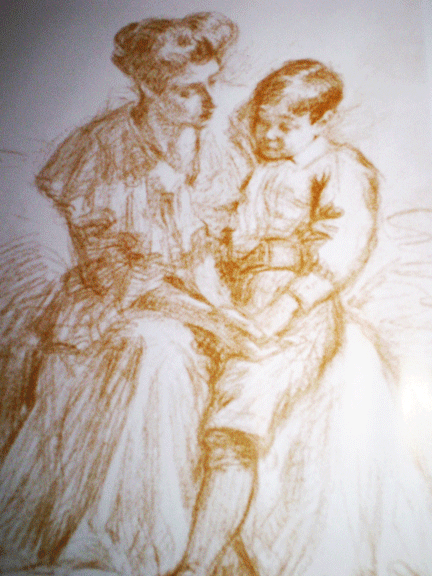
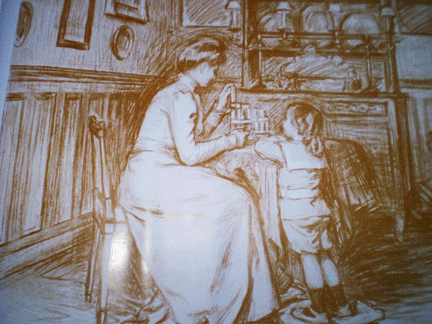
In 1914, Mirra and Paul Richard came to Pondicherry where on 29 March at 3.30 in the afternoon, she met Sri Aurobindo at 41 Rue Francois Martin. Immediately she recognized him as the “Krishna” whom she had seen in her visions. Later she recounted the experience of the first meeting: “Something in me wanted to meet Sri Aurobindo all alone the first time. Richard went to him in the morning and I had an appointment in the afternoon. He was living in the old Guest House. I climbed the staircase and he was standing there, waiting for me at the top of the stairs: exactly my vision! Dressed the same way, in the same position, in profile, his head held high. He turned his head towards me and I saw in his eyes that it was He.” On the very next day, Mirra wrote in her diary:” It matters little that there are thousands of beings plunged in the densest ignorance. He whom we saw yesterday is on Earth; his presence is enough to prove that a day will come when darkness shall be transformed into light, and Thy reign shall indeed be established upon Earth.” [20] The Richards left Pondicherry on 22 February 1915 and arrived in Paris on 18 March; eleven days later, they travelled to Lunel where Paul Richard was summoned as a reservist. After he was freed from military service due to medical reasons, the Richards settled at Marsillargues. Andre used to stay with them during his school holidays in July and August. It was then that he heard of Sri Aurobindo and his Integral Yoga. He also learnt to play chess with Paul Richard during that period. Here are two portraits of the Mother with Child André
_______________ Notes: [1] Pournaprema: A Unique Little Girl,
pp. 4-5 Part B At the age of eighteen, André joined the army in October 1916 as an artillery officer. Meanwhile the First World War had started (in 1914) and in March 1916, the Richards left for Japan where they arrived on 18th May. André met his mother in 1916 and the next time they were destined to meet was in 1949, i.e. thirty-three years later. He did receive letters from his mother (written from Japan) regularly but was compelled to destroy them due to the strict military rules. Though André was separated from his mother due to the war, yet he always felt as if a force-field was protecting him. An inner contact continued to exist between the son and his mother due to which André escaped fatal accidents several times. He himself has admitted: "The continuous flow of 'luck' was amazing.” Let’s quote two such instances of “luck” from his reminiscences. In May 1918, André had suffered an attack of flu along with others and was treated with heavy doses of aspirin. He and his colleagues recovered after forty-eight hours of high fever. However, they did not catch the ‘Spanish Flu’ which started towards the end of the war (and claimed the lives of twenty million people across the world—Sri Aurobindo’s wife Mrinalini Devi being one of them) for which aspirin was no longer a cure. “It seemed that we had been more or less vaccinated by the first attack of what was not yet called the Spanish Flu”, recollects André. The second instance of “luck”: on the night of 15 July 1918, the battery of 6# howitzer in which André was serving had to face severe gunfire from the enemy camp. “The way from the Command post to the battery was limited to a narrow footpath by rolls of barbed wire,” remembers André. While he was walking over there, he was caught in one of the rolls which were thrown on him following the explosion of a shell. Some more rolls fell on him as he was trying to extricate himself. Three months later, while he was at a distance of two hundred and fifty kilometers on the North-West of the site of 15 July, he found one of La Main de Massiges—the place where he and his fellow soldiers were present in July—and the location of their battery was shown as a target; however there was a mistake and the “four guns being shown at both ends of the footpath” so that the spot where André was “pinned to the ground” was shown as the actual target. The war ended in 1918 and André, as a reward for his bravery and contribution, received several titles of honour which included the Cross of the War 1914-1918 (which he received just after the War), the Cross of the Voluntary Fighters and Chevalier of the Legion of Honour (these were received after 1935) which is considered as the highest order conferred by the State. In December 1919, he joined Ecole Polytechnique and obtained the title of Ancien éléve de l’ecole polytechnique in August 1921, after which he joined Le Carbone-Lorraine (Le Carbone came to be known as Le Carbone-Lorraine when it merged with Le Lorraine probably in 1935); he was the director of a factory making batteries and other electrical materials for Le Carbone-Lorraine from 1926 to 1939. Later he joined the Industrial Company of Battery Cells and became the honorary President of the company. He was also associated with several foreign and international organizations and established himself very well in the elite society of Paris. On 10 September 1923, he married Wanda and was blessed with two daughters Janine (born on 7 November 1924) and Françoise (19 June 1931-15 March 2008) who was better known as Pournaprema. Meanwhile in 1920, Mirra and Paul Richard returned to Pondicherry on 24 April accompanied by Dorothy Hodgson (Datta). In November, Paul Richard left Pondicherry and Mirra stayed back to continue the yoga with Sri Aurobindo who had “already brought the supramental Light into the mental world and was trying to transform the Mind.” On 24 November 1926, Sri Aurobindo withdrew into voluntary seclusion when Krishna descended into his body. KRS Iyengar writes in his biography Sri Aurobindo: “From 1926, the Mother began to assume more and more of Sri Aurobindo’s responsibilities for the spiritual guidance of the sadhaks, as if giving him the needed relief so that he might attend to his more important work.” And thus Mirra became the Mother of Sri Aurobindo Ashram. Sri Aurobindo has said: “All creation and transformation is the work of the Mother.” And it was the Mother who gave the Ashram a proper shape. In fact she created a “miniature world within the larger world that was Pondicherry, or India” and “it was also a world in a process of change and transformation,” (KRS Iyengar: On the Mother). Every year the Ashram grew in size and the Mother, through her correspondence with André (she wrote around twenty letters in a span of thirty three years to her son), informed him about its development and expansion and also about her own sadhana. Some relevant passages from the letters written by the Mother to André are reproduced in the following.
Due to the outbreak of the Second World War, all communications between the Mother and André got severed, especially after the conquest of France by Adolf Hitler and it lasted till liberation of France. Meanwhile when the Second World War started, André joined the French Army of which he was the Captain from 1939 to 1940. From 1940 to 1942, he was the director of a factory of Le Carbone-Lorraine near Lyons and from 1942 to 1949, he worked in the Paris office of Le Carbone-Lorraine. He also established a company named CIPEL in collaboration with Fernand Portail. Janine writes about CIPEL: “The CIPEL (Compagnie industrielle des piles electriques) was founded after the war (in 1947 or 48) by my father, together with a good friend and colleague who was also an eminent chemical engineer Mr. Fernand Portail. The factory where my father was the director was part of Le Carbone-Lorraine. When CIPEL was founded, this factory became part of it with another French company named Mazda. The idea was to have the complete range of batteries from the smallest (for radio sets and domestic use made by Mazda) to the biggest which at that time were made by Le Carbone-Lorraine and used for telephone and railway signals. A few years later there were some negotiations with a British company named Everready but I don’t know what happened next.” [3] _______________ Notes: Part C In 1949, an opportunity arose for André to visit India and meet his mother after a gap of thirty-three years. “It was his first opportunity to arrange a business trip,” informs Janine, who also adds that before 1945, there were “no planes and vacations. It took at least three weeks to reach Colombo by ship. Such a long absence from work was out of question at that time.” [1] And in that year only, André’s younger daughter Francoise alias Pournaprema got married. Champaklal noted in his diary on 12 August 1949: “Mother informed Sri Aurobindo while leaving his room: ‘My granddaughter is going to marry.’” On 4 November the Mother informed Sri Aurobindo: “André is coming today from France. They want to arrange things in such a way that he can meet me as soon as he comes from Madras without waiting. I do not know where to see him; there is no place where I could see him alone. Generally, I arrange these things in Mona’s office at Golconde. I think I will see him there. It is many years since we last met. Perhaps if we met on the road without being introduced to each other I would not know him, and he too would not recognise me. For many years have passed—he was eighteen when I left—and in all these years hardly twenty letters have been written. He reads your books and understands them too. He had sent his wife’s photo; she resembles me. André had also written to me that he resembles me very much. That is true.” [2] The Mother instructed André to make the arrangements for his stay in the Ashram from 20 November to 2 December so that he could attend the Darshan on 24 November and the anniversary of the Ashram School (on 2 December) as well. When André arrived in India, he was instructed by the Mother to drive with Mahadeolal Dalmia from Madras to Pondicherry and arrive at the Ashram on 21 of November at 5 p.m. in the room 3EI of Golconde (the Ashram Guest House). The Mother explained that she was desirous of spending some time with him. She told Sri Aurobindo: “Perhaps if we met on the road without being introduced to each other I would not know him, and he too would not recognize me.” Amal Kiran too, remembers the Mother saying: “I don’t know what he looks like now. I only hope he hasn’t become bald.” Nirodbaran remembers: “It [the arrival of André] was sensational news, and the Mother seemed quite excited about it. Often she spoke of him to Sri Aurobindo. As the arrival day was approaching, she said to him that she wanted to meet André all alone, but couldn’t find a suitable place. Finally it was decided that Golconde would be the best place and a room was made ready there for the purpose. She also doubted whether her son would be able to recognise her after so many years! However, on the appointed day Sri Aurobindo’s lunch was finished earlier than usual, since the Mother had to get ready and be on time. There was plenty of time in hand, but she liked to go much in advance and wait for him. That was very typical of the Mother in all cases where she had some important thing to do. In fact, she waited for more than three to four hours before André arrived.” [3] Though André and Mahadeolal were supposed to leave Madras at one o’clock, yet they could not do so as they got delayed in getting André’s papers in order at the Madras Police Station and it was almost 2:30 in the afternoon when they finally left Madras. By the time they reached the Ashram, it was time for the sun to set. Pavitra greeted André and informed him that the Mother was awaiting him at Golconde. It was quite dark when André arrived at Golconde. He climbed the two storeys hastily and then,—let’s quote him: “…in the dim light of the corridor, I saw a white shape with her back against the door in a very familiar attitude.” It was the Mother waiting for her son. Later, André remarked: “Though we had not seen each other since Mother left France in 1915, we were at once in full understanding and I had the strong impression of being still a small boy seeking safety in his mother’s lap.” [4] Amal Kiran remarks: “She [the Mother] must have been pleased to find that though his hair was not quite bushy his head was far from having reached the billiard-ball state. The reunion of Maman and fils was said to have been a warm one.” He also remembers Andre as a “handsome and affable person, with a fine poise of mind.” [5] During André’s stay in the Ashram, the Mother told Pranab to take André along with him, who on Sundays, used to cycle out with five or six boys and girls. She arranged a car for all of them and they visited quite a few places. Pranab remembers that André had enjoyed the trip and adds: “At that time I used to take the Blue-group Gymnastic Marching in the evenings. André-da too joined in, wore the blue uniform and did exercise with us during the whole time he was here on that trip.” [6] On 24 November, André had the Darshan of Sri Aurobindo with the Mother sitting on his right. He wrote afterwards, remembering the memories of the Darshan: “The most extraordinary experience which one can get at the Ashram is however the luck of being present at the Darshan. No words can describe the overwhelming impression of benevolence, knowledge and strength which radiates from Sri Aurobindo and the Mother sitting on their thrones. It is not at all surprising that so many people undertake long journeys in order to have the privilege of paying their tribute of devotion. What they get in return is a glimpse of a higher and truer life which responds to the most innate aspiration of human nature.” [7] About the celebrations of the Ashram School, he wrote: “The various displays which took place on the sixth anniversary of the Ashram school were remarkable achievements. There was nothing amateurish in the theatrical show and the display of physical education was surprisingly athletic if one takes into account the comparatively small number of people who received the training.” [8] The Mother herself made all the arrangements which made André’s stay in the Ashram comfortable. He took his meals with Nolini Kanta Gupta, Amrita and Pavitra (in due course André would become Pavitra’s closest collaborator). He was also invited for lunch and dinner to the houses of several Ashramites who were well-known for their culinary skills and Pujalal, the poet, composed a laudatory poem on him. Through her flawless arrangements, the Mother made him feel at home. Thus, he developed a bond of unshakeable love with the Ashramites and it continued till the very end. Gradually the time of André’s departure arrived. The Mother sent Kameshwar, a sadhak, to escort him to the Madras Airport. On the way, Kameshwar asked André whether he had always known who the Mother was. André replied that he had the sense of reality from a very early age. After André’s departure, Amal Kiran asked the Mother why he had not come to Pondicherry in all those years. She replied: “Why should he have? He had his own life to live in France; and actually, even while he was there, there was no real inner separation. Up till now it was as if there were a screen in my room and André was present behind that screen. What has happened now is simply that he has come out in front.” Later Amal Kiran wrote: “Talking with André on one occasion I learned from him that a subtle contact always existed between the Mother and him and that even at a distance he would know if she wanted him to do something.” (Our Light and Delight) In an article published in The Advent, André recounted his visit to the Sri Aurobindo Ashram (it is lengthy but worth quoting):
On 21 November Champaklal notes:
After his first visit, André began to visit the Ashram every year. Once during one of the Darshan days, he had dressed up in a dhoti and punjabi, just like a Bengali. Bani Mutsuddi, Nirodbaran’s niece recounted to the author: “We could not move our eyes away from him. He was looking so good!” His visits became frequent following Sri Aurobindo’s mahasamadhi on 5 December 1950 (he was not in Pondicherry when Sri Aurobindo left his body). He spent six months in France and the remaining six months in Pondicherry after his retirement in 1963 (before that, he had only a month’s vacation in a year). And whenever he came to the Ashram, he stayed at his own expense and always worked for the Ashram. “He had a multitude of talents and capacities”, writes Amal Kiran about him, “and could cope intellectually with almost any kind of commission.” And Nirodbaran reminisces: “I had the good fortune to have a cordial relation with him. Every time I met him—the times were not many—I had a feeling that here was a gentleman whose appearance and talk bore all the signs of a refined culture—a true French gentleman. In our talks on various Ashram topics, he was always impersonal; never a strong word of criticism or disparagement came out of his mouth. Nobility, dignity and sweetness breathed through his demeanour, and one always felt the presence of the Mother in his quiet company. It would seem that in this respect the son fulfilled in himself what the Mother had wanted of him, for she did not crave any greatness either for herself or for her son. Like her own mother, her aspiration for her child was that he should be noble and true. Every time I met him I came away with this impression.”[10] As mentioned earlier, all the assets of the Ashram were in Sri Aurobindo’s name but after his passing away, the assets were transferred to the name of the Mother. As soon as the assets were transferred, she wrote to André asking him to give a written statement that he would not have any claim on the Ashram properties. André duly sent statements that neither he nor his family would have any claim to the Ashram properties.
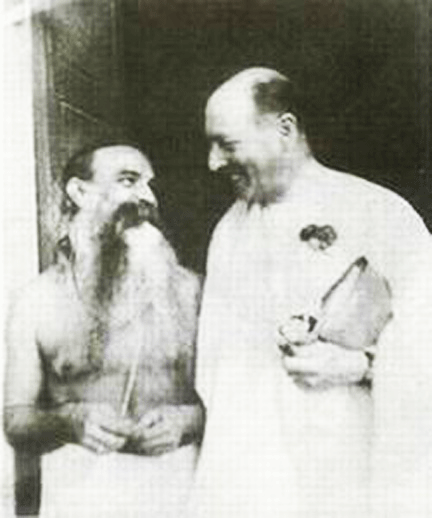
André with Champaklal _______________ Notes: [1] Personal communication to the author
by Janine. Part D On 24 April 1951, the Mother presided over a convention where the resolution to establish “an international university centre” was accepted. On 6 January 1952, she inaugurated the Sri Aurobindo International University Centre (renamed Sri Aurobindo International Centre of Education in 1959). André wrote in an article with reference to this context:
In 1954, the Mother wrote The Great Secret in collaboration with Nolini Kanta Gupta, Pavitra, Pranab Kumar Bhattacharya and André. The Great Secret cannot be termed as a drama in its actual sense; it is a monologue of seven people. The background is as follows: Six people (an artist, a statesman, a writer, an athlete, a scientist and an industrialist) who happened to be the world’s most renowned personalities have taken shelter in a life-boat as the ship in which they were travelling to attend a world conference on human progress have sunk. There is a seventh person who is the ‘Unknown Man’ whom nobody notices much. Each of the six famous people recounts the story of their lives. In a letter dated 7 July 1954, the Mother wrote to André:
Let’s quote the monologue of the industrialist as written by André in full as it would portray the literary aspect of his personality:
André’s main objective in life was to materialize the vast projects conceptualized by the Mother for the Ashram in France. In 1956, he established the Franco-Indian Union Association with the view of developing commercial, industrial and technological exchanges between France and India. As the Mother wanted India and France to collaborate with each other and show the rest of the world what they are capable of achieving, André worked to realize her dreams. This organization brought together people “who without having a particular interest in the Ashram have a benevolent attitude towards India and all that happens there, above all in the scientific and technical domain.” [Janine’s letter to Nirodbaran] [4]
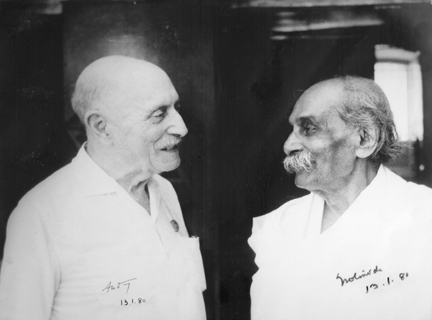
André and Nolini _______________ Notes: [1] Mother India, January 1983, p. 41 Part E In 1956, André established the Sri Aurobindo Study Centre; this organization sent teaching materials, class textbooks and other objects to the Ashram School. However, this organization did not increase in size. Janine, in her letter to Nirodbaran, explained the reason: “In the statement approved by the Mother about the textbooks in the Centre of Studies, we read: ‘The role of the Centre is to serve as a link between the Ashram and the French people, etc.’ The link functions in such a manner that the Centre could never have more than a hundred members: as soon as that number was reached, some of them decided to settle permanently in Pondicherry…” [1] In the same letter, Janine writes about her father: “His concern was to extend all his efforts to the service of the Mother in France in order to realise the vast projects that she had conceived for this country. I know how attached he was to the Ashram, so much so that one day he asked the Mother (in 1955-60, probably) for permission to settle definitively in the Ashram. The Mother answered: “No such question! I need you in France.” If André has done anything for the Ashram, it is work more of a general nature which the Mother had assigned to him.” [2] However, the Mother did not quite always appreciate the methods undertaken by André to spread the message of Sri Aurobindo’s teachings. For instance, when Pavitra informed the Mother (on 25 April 1961) that André had been bitten by the “propaganda bug” (as he had preached that the goal of the Sri Aurobindo Study Centre was to steer people towards Pondicherry and the Mother), she had exclaimed: “Ooh!... OH! How dreadful. How dreadful. He too!” [3] André’s name would be mentioned several times in the Agenda in various circumstances. Let’s quote a few of them. On 15 February 1963, we find the Mother saying (regarding a passage from the Agenda at the time of her first “great turning point”, which she wanted to show to one of the persons of her entourage in order to make him understand her work): “I had asked Sujata [Nahar] for two copies, but then I realized it wasn’t at all necessary. When I told you I would give it to André for him to read, and when André came, I showed him one or two of the latest [Agenda conversations] typed by Sujata—and soon lost any desire.” [4] On 3 June 1967, the Mother said: “André writes that he received in Paris people who asked for information on Auroville. He answered with a letter, and when he was about to send it, he thought, ‘Maybe I’d better show it to the Mother, after all.’ He sent his letter—and well he did! Those people asked him the conditions to be admitted to Auroville; he replies, ‘Oh, that hasn’t been decided yet!’ So I’ve prepared a little note; because he just says, ‘Oh, nothing has been decided, we’ll see,’ as though there weren’t any Aurovilians yet. I don’t know if he did it purposely to discourage people; at any rate it’s not good to write like that… I know what he based himself on: I had told him that, naturally, from the material point of view, the CONDITIONS OF LIFE in Auroville were not arbitrarily fixed in advance.” [5] On 20 September 1969, the Mother said: “André told me that when he has some pain, he just has to put his hand and concentrate—and it goes away. As for me, I’ve been doing it for… (I was going to say for centuries!), even when I was small I used to do it. I always found it something quite natural.” [6] On 22 July 1972, there was a discussion between the Mother, André and Satprem on the fact that SABDA was not giving Satprem any details regarding the sales of his books. Similar charges arose regarding the printing and distribution of Sri Aurobindo’s books as well. During the course of the conversations, the Mother remarked (in André’s presence): “But André isn’t combative.” André agreed that he wasn’t so and explained: “I try to see through their eyes, and then I don’t know who’s right any more.” He said to the Mother: “I’ll tell frankly what bothers me. What bothers me is that I know from experience that you’re always right because you always see things from a higher plane than we. Also I know from experience that even if at the time I feel you say something that doesn’t match my own thinking, well, you’re still right. And that’s why I have a lot of trouble being ‘combative.’” [7] But André had become an important and integral figure in the Ashram and he helped the members of the Ashram in whatever ways were possible for him. When the associate editor of Mother India, the Ashram magazine, Soli Albless had planned to go to a philosophical conference at Brussels, a “hitch” arose; André on the Mother’s suggestion took Soli’s papers with him and represented him at the conference. He worked with Pavitra, and Nirodbaran describes them as “complementary souls.” Towards the end of his life, when Pavitra was unable to walk freely, he would go to the Mother’s room with André’s support. More than once he was seen coming downstairs after visiting the Mother leaning on André’s shoulders. In fact, Pavitra wanted André to take up his post and work at the Sri Aurobindo International Centre of Education. In May 1969, when the condition of his health grew worse, Pavitra eagerly awaited the arrival of André (who was in France) as he did not want to leave his body before André’s coming. The Mother too said in her talks (dated 17 May 1969): “But I had been forewarned (long ago) that his [Pavitra] inner being was waiting for André to return before it would leave.” André arrived at Pondicherry on 13 May and just before his coming, Pavitra fell down. On the 15th, he had his lunch with André and then, immediately after lunch, he asked André to leave as he did not want to show him the extreme difficulty he was facing to walk. When he was assured by André that all of Pavitra’s responsibilities would be taken over by him, he decided to leave his body. On 16 May, André met Pavitra who was bed-ridden since the day before; just as he was about to go to the Mother, Pavitra opened his eyes and looked at him. Half an hour later, when André was in the Mother’s room talking to her, the news arrived that the doctor had declared Pavitra dead. After the passing of Pavitra, André became the de facto Director of the Sri Aurobindo International Centre of Education and the Mother gave all her directions through him. When Auroville was established in 1968, he became a channel of communication between Auroville and the Mother. Nirodbaran remembers André holding several meetings with the Aurovilians whenever he was in Pondicherry. However, one action of André’s that went over the heads of many was the destruction of several pages from Pavitra’s diary in which he had noted his conversations with Sri Aurobindo till 1926. André gave the reason, “Better left unsaid.” The remaining portions of the diary were later published as Conversations with Sri Aurobindo. Years passed by. André suffered a stroke and a heart attack. The stroke affected one of his legs and the Mother was deeply concerned about his health. Whenever Nirodbaran went to the Mother’s room to read out the manuscripts of his books Twelve Years with Sri Aurobindo, Correspondence with Sri Aurobindo and Talks with Sri Aurobindo to her with André, he did not miss her eye of concern. The Mother enquired about André’s health and asked whether the seat taken by him was comfortable or not and sometimes she drew his attention to some remarks of Sri Aurobindo in Nirodbaran’s books and both would appreciate them together. Nirodbaran adds: “Later on the Mother suggested to me that if I had no objection I could come to her on alternate days since André had to leave soon for France and he would like to discuss and settle many problems with her before he left. Naturally I agreed. Here André proposed that on his days I could come, do my pranam and go. This consideration on his part touched me deeply.” [8] Amal Kiran also writes that all communication from and to the Mother was at its best and clearest through André as his way of speaking seemed to be on a wavelength most attuned to the Mother who was a little hard of hearing in her old age. The Mother’s health deteriorated towards the end of March 1973. From 20 May, all meetings with her were ceased and nobody was allowed to meet her except her attendants and doctors and of course, André who went to see her every evening. In his biography of the Mother, Georges Van Vrekhem writes: “‘Bonsoir, maman,’ one could hear him saying in the courtyard, for he had to raise his voice a little; and on her inquiring about his wellbeing: ‘ça va bien, maman.’” [9] Nirodbaran used to inquire about the Mother’s health from André but the answers he received were not hopeful. Probably André had realized that the Mother would leave her body soon. He told Nirodbaran that the Mother seemed to have “given up the fight.” To Sujata Nahar, he had said: “People must be prepared.” On 17 November in the evening, the Mother’s condition grew worse. André went to her room at around 6:30-6:45 pm. It was then noticed by Kumud, the Mother’s assistant, that certain sounds were coming from her throat and her head was moving in a strange manner. After consulting Champaklal, Dr. Prabhat Sanyal and Pranab were sent for. Pranab arrived at five past seven. Dr. Sanyal had come before him. He started examining the Mother immediately after his arrival. But at 7:25 p.m. the Mother left her body. André took Pranab aside and told him that the Mother had once said that if she left her body, Pranab would be affected the most; so André assured him that he and others would take good care of him. He told Pranab not to worry and added that he and others would see to it that everything was in order. Pranab was deeply touched. He told André that he would like to wait for some time before taking the Mother’s body down to the Meditation Hall, as she had instructed all those who were close to her not to disturb the body if it appeared that she had left her body. André agreed to it. He expressed his desire to stay back but since the condition of his own health (he was unable to bear much strain) was not good, he was advised by Pranab to retire for the night and come on the following day. André came downstairs and left for his house. Nirodbaran saw him coming down, “grave silent picture of sadness”, he observed. He wondered why was he leaving “with a heavy countenance” but got his answer after a few hours. What follows is a report published in Mother India (joint issue of November-December 1973) regarding the Mother’s physical departure:
The message that was sent to everyone was as follows:
André had noted in his diary a decision taken by the Mother in May 1973 to submit entirely to the Divine’s Will and give up her attempt to transform her body. He wrote that there was a marked difference from that day onwards. But André never published it because since it was an oral conversation, he was reluctant to put it in print lest it created unnecessary controversy.
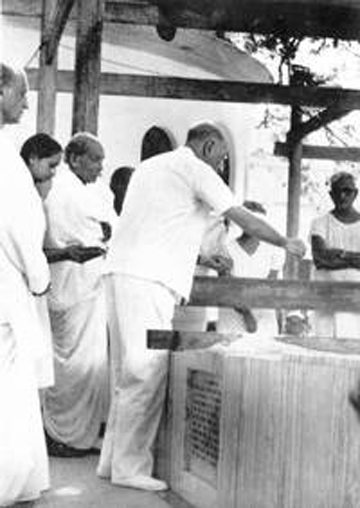
André at the Samadhi; also are seen Udar, Nolini and Dyuman _______________ Notes: [1] Ibid., p. 36 Part F It is often debated as how well did André realize the importance of the Work, that is, the Yoga of Transformation, the Mother was carrying on in her body. Some people claim that what he understood was next to nothing, for he never practised the Integral Yoga. On the other hand, those who knew him well and were quite close to him argue that he did practise the Integral Yoga and was fortunate enough to receive certain spiritual experiences, though he never talked about them, as the Mother had instructed him not to do so. (In an e-mail to the author, Janine had written: “My father never talked about his spiritual experiences.” Pournaprema supported this statement and had informed the author in an e-mail sent a few months before her death: “André was a disciple of Sri Aurobindo and the Mother. Following their advice, he never spoke about his spiritual experiences except to them.”) This argument might go on for ever, for André was always silent about his spiritual experiences and since appearance is always different from reality, no conclusion would be drawn. But from his writings, one can at least get an idea about how well did he understand Sri Aurobindo and his teachings. Let’s quote some portions of an article he wrote soon after Sri Aurobindo’s mahasamadhi; it was published in the Sri Aurobindo Circle (9th Number, 1953):
In the same article, André wrote: “In spite of all its deficiencies western civilization has brought in achievements which cannot be overlooked. Nor is it advisable to ignore the fact that religions fulfil their scope only as long as they retain their Divine inspiration and do not degenerate into mere rites. All that has been said of the drying-up effect of reason when unduly considered as the highest human faculty applies equally to religious teaching if it is not aimed at making man conscious of his higher and divine self. To consider that there is a Divine law enforced upon the human individual under penalties either before or after death, that the Divine is nothing more than, so to speak, a super-policeman as well as a super-lawmaker, may be useful to a certain extent, but only to a very limited extent. It can help in checking, at least partly, the evil effects of an unethical use of power which Science has given to man. But the egoistic trend of the individual is thus left entirely unchecked and his inner conscience therefore by no means awakened. If, on the other hand, the inner consciousness is awakened in such a way that the individual neglects entirely the physical plane and even despises his body, withdraws from the community and takes no part in its activity, devotes all his energy to the somehow selfish cultivation of his soul, this will be of no help in the running of the social and technical machinery. On the contrary, any assumption that to attain spirituality one has to reject everything of the physical plane, tends to put the powerful scientific machinery more under the control of evil forces.” “Is there any hope for humanity to get out of this deadlock?” André asked and then he continued: “To this question, as well as to so many others, Sri Aurobindo’s message provides an answer, and very likely the only satisfactory one. The ever stumbling and apparently erratic progress of humanity through the ages takes its full significance if it is looked at as the preparation for the descent of the Supramental. The present state of chaos, the great peril of complete destruction which threatens humanity through its recent scientific discoveries, have to be considered as signs that the descent is imminent. There remains to be seen whether the human race will be prepared to receive the Supramental. If the Supramental is not recognised and accepted, there will be very little hope for humanity to carry on in its present form, the human race would have missed the opportunity it was offered of ascending a step further towards its realization.” After the Mother’s departure, André did not want to involve himself in the matters related to the administration of the Ashram. He accepted whatever Nolini Kanta Gupta advised him. “Nolini’s word was to him final in all matters,” remarks Nirodbaran who discussed the problems of the Ashram School with him whenever he came from France. “He kept us on the right path,” remembers Nirodbaran. As his work was becoming less, André reduced his stay in the Ashram. But whenever he came, his presence brought fresh breeze to the Ashram. From 1977, André got involved in the struggle to prevent the publication of the Mother’s Agenda edited by Satprem. The trustees of the Ashram had communicated to Satprem through André that they doubted about the “advisability” of the publication of the Mother’s Agenda. But Satprem went ahead with his plans to publish the Agenda. The trustees sent a letter to him threatening him of imminent legal proceedings; Nolini Kanta Gupta however did not want to sign the letter of legal threatening initially but André persuaded him to do so. What happened next is a different story altogether. From 1973 to 1982, André took part in a few societies like the Franco-Indian Union Association and the Sri Aurobindo Study Centre which he had founded. He also participated in the discussions of the Conseil du Commerce Extérieur, an advisory council of the French Government. From the 1980s, André began to withdraw gradually. His health was failing fast. During his last-but-one visit to the Ashram, he suffered an attack of influenza. He wanted to go back to France though he was not well enough. At that time, the relation of the Ashram with the Central Government was strained. As André had to go via New Delhi, Nolini Kanta Gupta advised him to meet Indira Gandhi, the Prime minister and explain the internal circumstances of the Ashram to her. It was a known fact that Mrs. Gandhi was on excellent terms with the Mother. Nolini Kanta Gupta also provided André with a letter of introduction. André’s cultured manners and personality impressed Mrs. Gandhi who was also pleased to meet the son of the Mother. André’s meeting with Mrs. Gandhi resulted in the establishment of a cordial relationship between the Ashram and the Central Government. This was one of the greatest and perhaps the last services provided by André to the Ashram. When André visited Pondicherry for the last time, the Ashramites observed that his health had deteriorated much. He had grown weak and Nirodbaran observed “the quiet glow in his face was replaced by signs of pallor.” Since he was not well, he kept himself confined to his daughter’s house for some time. When he recovered, he visited Nolini Kanta Gupta once a week as long as he stayed. Nirodbaran remembers the last meeting he had with André. André asked him about the Ashram School and some general matters. He ended the talk by saying: “Well, whatever the condition may be you people are there.” Nirodbaran remarks: “My farewell meeting was rather sombre. Very little talk, his eyes wearing a calmly sad expression.” Pranab too remembers that one evening, during André’s last visit, André and he had talked about the ups-and-downs of the Ashram. André went back to France but his health did not improve. On 29 March 1982, at midnight, André Morisset left his body at his country house in the south of France. Wanda (who followed him after twenty years on 24 October 2002), Janine and Pournaprema were with him when he breathed his last. One must keep in mind the significance of the date 29 March. It was on this very date that the Mother had met Sri Aurobindo for the first time on the physical plane. So, it is understandable that the passing of André Morisset on that very day carried a special inner importance. What that can be is anybody’s guess. On the night André left his body, a sadhika had a dream-vision in which she saw herself entering an exquisite and attractive two-storey building with a garden in front. On the first floor, she saw a group of extraordinary luminous people with glowing faces talking among themselves. While she moved to the second floor, she saw herself in a big well-furnished hall where she saw a white robed middle aged lady sitting with a child aged a year or so in her lap. She said in a solemn voice: “The child has passed away.” About fifteen feet away from her, the sadhika saw Sri Aurobindo standing quietly and calmly; then he came forward and lifted the child into his arms from the lady’s lap and pressed him vigorously against his own chest. When Indira Gandhi was informed about the demise of André Morisset, she sent a telegram to the Ashram: “Grieved at sad news of Mr. Morriset’s death. Deep sympathy and condolences to his personal family and the large family of the Ashram and Auroville and the Mother’s many devotees.” In an article published during André Morisset’s lifetime, Amal Kiran wrote: “André would be the last person to announce publicly that the Mother had given him any special charge. He never forces anything on people’s attention in personal matters and is always loath to take advantage of being the Mother’s son. He knows too that being physically born from her is not the sole claim to being her child.” [1] Pranab remembers: “The unlimited love I received from André-da I have received from few people in my life.” [2] Let’s conclude in the words of Nirodbaran, who, in a speech delivered at the Ashram School in André’s memory said: “There are some persons in this world who bear outwardly no insignia of greatness or brilliance. But as soon as you meet them their deep composure, refined deportment and the serene glow on their faces speak of their soul-purity and you never forget them. Their contact and memory are a cool bath to our souls. Such was André…” [3] _____________ Notes: [1] Our Light and Delight, p. 69
|