|
THE DIALOGUE IN HELL BETWEEN MACHIAVELLI AND MONTESQUIEU -- TRANSLATION |
|
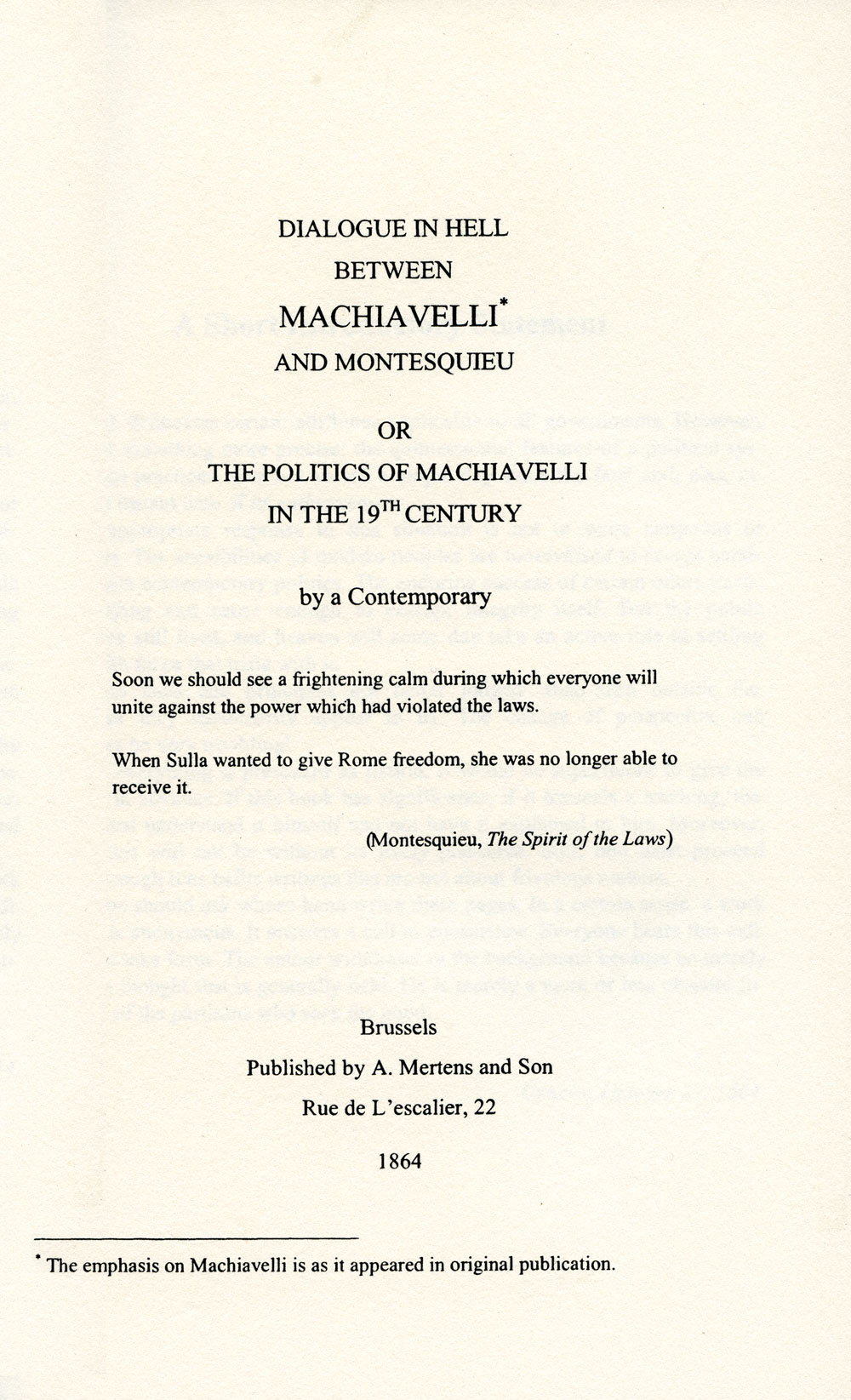
DIALOGUE IN HELL
by a Contemporary Soon we should
see a frightening calm during which everyone will When Sulla
wanted to give Rome freedom, she was no longer able to (Montesquieu, The Spirit of the Laws ) Brussels _______________
A Short Introductory Statement This book delineates certain attributes applicable to all governments. However, it aims at something more precise: the quintessential features of a political system whose practices have not varied a single day since the fatal and, alas, a~ ready too distant date of its enthronement. The appropriate response to this situation is not to write lampoons or pamphlets. The sensibilities of modern peoples are too civilized to accept harsh truths about contemporary politics. The enduring success of certain other tracts is mystifying and cause enough to corrupt integrity itself. But the public conscience still lives, and heaven will some day take an active role in settling scores with those that trifle with it. Certain facts and principles are better judged when seen outside the framework they customarily appear to us. The change of perspective can sometimes be very troubling! Here, everything is presented as fiction. It would be superfluous to give the key to it in advance. If this book has significance, if it conceals a teaching, the reader must understand it himself and not have it explained to him. Moreover, reading this will not be without its lively pleasures. Still, one must proceed slowly through it as befits writings that are not about frivolous matters. No one should ask whose hand wrote these pages. In a certain sense, a work like this is anonymous. It answers a call to conscience. Everyone hears this call. The ideas take form. The author withdraws to the background because he merely records a thought that is generally held. He is merely a more or less obscure in strument of the partisans who seek the good. Geneva, October 15, 1864 First Dialogue Machiavelli: At the edge of this shore, I was told I would meet the shade of the great Montesquieu. Is this it in front of me? Montesquieu: The name "great" belongs to no one here, O Machiavelli. But I am the one you seek. Machiavelli: Among the illustrious persons whose spirits populate this gloomy stopping place, there is no one I wished to meet more than Montesquieu. Forced into these unknown regions by the migration of souls, I thank fortune for finally placing me in the presence of the author of The Spirit of the Law . Montesquieu: The former Secretary of State of the Florentine Republic has not yet forgotten the language of courts. But what can those who have crossed to these dismal shores have to exchange but anguish and regrets? Machiavelli: Is this the philosopher, the statesman, who speaks like this? What does death matter to those who have lived by thought, since thought is immortal? For myself, I do not know a more tolerable situation than that which is ours here until Judgment Day. We are delivered from he cares and worries of material existence, live in the domain of pure reason, and are able to converse with the great men whose names have resounded throughout the universe. We may follow from afar the revolutions of states, the fall and transformation a empires. It is open to us to meditate upon their new constitutions, upon the changes brought about in the morals and the ideas of the peoples of Europe, upon the progress of civilization in politics, arts, industry , as well as the sphere of philosophical ideas. What a spectacle to contemplate! What astonishing marvel&-if the shades that have descended here are to be believed! Death is for us like a remote refuge where we can assimilate the final lessons of history and the vindication of human rights. Even the void of death is not able to break all the ties that keep us attached to earthly existence, for posterity still demonstrates its dependence on men like you who have wrought great changes in the human spirit. At this moment your political principles reign over almost half of Europe. Who should be freer from fear in undertaking this somber passage which leads to hell or heaven than someone like you who can appear before Eternal Justice with such pure claims to glory? Montesquieu: You ought to speak for yourself, Machiavelli. You 're being too modest for one who has left behind immense renown as the author of The Prince. Machiavelli: l think I catch the drift of your irony. Would the great French publicist judge me like the crowd, which knows me only as a name and through blind prejudice? I know that book has given me a disastrous reputation. It has made me responsible for all sorts of tyrannies. It has earned me the enmity of peoples as the hated personification of despotism. It has poisoned my last da, and the reprobation of posterity seems to have followed me even here. But what have I done? For fifteen years l served my country, which was a republic. I conspired for its independence and defended it staunchly against Louis XII, the Spanish, Julius 11, and Borgia himself, who, but for me, would have snuffed it out. I protected it against bloody intrigues that riddled it everywhere, combating them with diplomacy when another would have used the sword. I treated, negotiated, made or broke ties in accordance with the interests of the republic which found itself crushed between great powers and which war tossed about like a skiff. And it was not an oppressive or autocratic government but popular institutions that we supported in Florence. Was I one of those who was seen changing with fortune? The Medici's executioners knew where to find me after the fall of Soderini. I advanced with the rise of liberty and fell with it. I was proscribed and no prince deigned to glance on me. I died impoverished and forgotten. That was my life, and those the crimes that earned me the ingratitude of my country and the hatred of posterity. Perhaps, heaven will be more just toward me. Montesquieu: I know all that, Machiavelli. That's why I could never understand how the Florentine patriot, the servant of a republic, became the founder of that sinister school which includes all the crowned heads as disciples and is put to use to justify tyrannies' most heinous crimes. Machiavelli: And what if I told you that that book was only he product of a diplomat's imagination, that it was not intended for print, that the notorious uses to which it has been put are alien to its author~ That it was conceived under the influence of ideas which were then common to all Italian principalities and to aggrandize themselves at each other's expense and directed by a cunning politics in which the most perfidious was reputed to be the most skillful. ... Monlesquieu: Are these your real thoughts on the matter? Since you are speaking so candidly, I can assure you that this is what I always thought. Indeed, I share such convictions with those few that know your life and have attentively read your works. Yes, yes Machiavelli, your avowals in this regard do you honor. So, you did not say what you really thought, or you only spoke under the sway of personal feelings which for a moment clouded your exalted mind. Machiavelli: There you are mistaken, Montesquieu, as are those who have judged this matter like you. My only crime was to speak the truth to peoples and to kings-not the moral truth, but the political truth, not the truth as it ought to be, but as it is and always will be. I am not the founder of the doctrine whose paternity is attributed to me. It is grounded in the human heart. Machiavellianism preceded Machiavelli. Moses, Sesostris, Solomon, Lysander, Phillip and Alexander of Macedon, Agathocles, Romulus, Tarquin, Julius Caesar, Augustus, and even Nero, ChaF lemagne, Theodoric, Clovis, Hugh Capet, Louis XI, Gonzalo of Cordova, Cesare Borgia- these are the progenitors of my doctrine. I am skipping some even better examples, and of course will not speak of those who came after me. The list would be too long and The Prince would teach them nothing but what they already knew by wielding power. Who in your time has rendered me more brilliant homage than Frederick II? To gain popular favor, he took" pen in hand to refute me. While in politics, he rigorously applied my doctrines. What inexplicable quirk of the human mind would hold what I have written . in this book against me? Logic dictates that the scientist should be reproached for investigating the physical causes of bodies that fall and harm us, the doctor .for describing diseases, the chemist for cataloguing poisons, the moralist for portraying vice, and tre historian for writing history. Montesquieu: Oh, Machiavelli. Would that Socrates was here to untangle the sophistry couched in your remarks. Although I am not by nature endowed with strong debating skills, it is still not very difficult for me to rebut you. You compare to poison and disease the ills engendered by the spirit of domination, cunning, and violence. But your writings teach the ways to communicate diseases to states. You teach how to distill these poisons. When the scientist, the doctor, or moralist investigates evil, it is not to teach its propagation, but to cure it. As soon as you let out that you do not hold to despotism on principle and that you yourself consider it an evil, it seems to me that by this alone you condemn it and that we agree at least on this point. Machiavelli: We do not, Montesquieu, for you have not understood my thought in its entirety. I have opened myself to attack by using an analogy that can only too easily be turned against me. Socratic irony itself could not disconcert me. It is sophists who are most skillful in wielding the underhanded weapon of dialectics in such a way. You are not of this school, nor am I. Therefore let's put aside semantics and facile analogies so that we don't lose sight of certain ideas. Here is the essence of my system, and I doubt that you will shake it, because it is composed only of moral and political facts deduced from one eternal truth: the evil instinct in man is more powerful than the good. Man is more attracted by evil than by good and fear and force have more sway over him than reason. I won't bother to demonstrate these truths. In your country, only the harebrained coterie of Baron d'Holbach, of which J. J. Rousseau was the high priest and Diderot the apostle, attempted to controvert these truths. All men seek to dominate and no one would not be a tyrant if he could. All, or nearly all, are ready to sacrifice another's rights to their own interests. By what means can these ravenous beasts we call men be restrained? At the origins of societies, it is brutal and unrestrained force; later, it is the law, that is to say, still force, but institutionalized. You have fully investigated the origins of history. Everywhere force precedes right. Political liberty is only a secondary idea. The need to live is what dominates states as it does individuals. In certain regions of Europe, there are people incapable of moderation in the exercise of liberty. Prolonged liberty is transformed into license. Civil or social war follows. The state perishes. This happens either when the state fractures and is dismembered as a result of its convulsions, or when its divisions make it the prey of foreigners. In such situations, people prefer despotism to anarchy. Are they wrong? Once established, states have two kinds of enemies: internal and external. What arms do states use in making war against foreigners? Will two enemy generals inform each other of their battle plans so that each will be better able to defend himself? Will they forbid attacks by night, troops, ambushes, and battles in which the numbers of troops are unequal? Obviously not. Don't you agree? Such combatants would be a laughing stock. But you don't want to use all the traps, artifices, and stratagems that are indispensable to war against internal enemies and factions? Doubtless, this case calls for less rigor but basically the rules are the same. Can pure reason lead violent masses that are motivated by emotions, passions, and prejudices? Let the direction of affairs be placed in the hands of an autocrat, an oligarch, or the people themselves. No war, no negotiation, no internal reform would succeed without the help of those stratagems that you seem to condemn but which you yourself would have had to use if the king of France had charged you with the least important affairs of state. What childish condemnation has dogged The Prince! Has politics anything to do with morality? Have you ever seen a single state conduct itself according to the principles that govern private morality? But then every war would be a crime, even when it had fair cause. Given that conquest has no other motive than glory, it would always be a heinous offense. Every treaty in which one power tipped the balance in its favor would be a base fraud. Any usurpation of sovereign power would deserve death. Nothing would be legitimate except what was based on justice! But what I have just related I also maintain even in the face of contemporary history. All sovereign powers find their origin in force or, what is the same thing, in the negation of justice. Does that mean that I proscribe justice? No. But I regard it as having an extremely limited application, both in the relations among nations and in the relations between rulers and ruled. Moreover, don't you see that this word-'justice"-is infinitely vague? Where do its claims begin? Where do they end? Where should it apply? Where not? I will give some examples. Consider the following state. Its public institutions are poorly organized. It's in the throes of a turbulent democracy. Its laws are powerless before factions. Disorder reigns everywhere- everything precipitates its ruin. A bold man springs up from the ranks of the aristocrats or from the midst of the people. He demolishes all constitutional power, takes over lawful authority, reforms all institutions, and gives the country twenty years of peace. Had he the right to do what he did? Pisastatus seizes the citadel in a surprise attack and prepares the way for the century of Pericles. Brutus violates the monarchical constitution of Rome, expels the Tarquins, and with the thrusts of a dagger founds a republic whose grandeur is the most impressive spectacle that the universe has seen. The struggle between patricians and plebeians, so long as it was controlled, made for the vitality of the Republic but it ultimately leads to its dissolution and brings every thing to the brink of destruction. Caesar and Augustus appear. They too are viG lators. But the Roman Empire that succeeded the Republic, thanks to them, lasts as long. It finally falls only after having covered the entire world with its debris. So, was justice on the side of these audacious men? No, according to you. And yet posterity has showered them with glory .In truth, they served their country by saving it. They prolonged its existence through the centuries. You do see that, in states, interest overrules the principle of justice. What emerges from these considerations is that good can come from evil; that one attains good through evil, just as someone is cured by poison, or someone's life is saved by the cut of a knife. I have taken societies as they are and have prescribed rules accordingly. Considered in the abstract, are violence and deceit evil? Yes, but they will have to be used to govern men, as long as men are not angels. Everything is good or bad according to the use made of it and the advantage derived from it. The ends justify the means. And now, if you ask me why I, a republican, everywhere give preference to absolute government, I will tell you. In my country, I witnessed the inconstancy and cowardice of the people, its predilection for servitude, its incapacity to conceive and respect the conditions of free life. In my view, the people represent a blind force that dissipates sooner or later, unless taken in hand by a single man. I answer that the people, left alone, only know how to destroy themselves. They are incapable of knowing how to administer, judge, and make war. I tell you that the brilliance of Greece shone only during the eclipse of liberty, that without the despotism of the Roman aristocracy, and later, the despotism of the emperors, the brilliant civilization of Europe would never have developed. Shall I look for examples among modern states? They are so striking and so numerous that I shall cite only the first that come to mind. The Italian republics shone under what institutions and under which men? Under which sovereigns did Spain, France, and Germany establish their power. The Leo X's, the Julius II's, the Phillip II's, the Barbarossas, the Louis XIV's, the Napoleons are all men of awesome strength, whose hands were placed more often on the hilts of their swords than on the charters of their states. But I'm surprised to have to speak at such length to convince the illustrious writer who's listening to me now. If I'm not mistaken, aren't a number of these ideas found in The Spirit of the Laws? Has this discourse offended that sober and reserved man who has dispassionately meditated upon the problems of politics? The Encyclopedists were no Catos. The author of The Persian Letters was not a saint, nor even fervently devout. Our school, which is called immoral, followed the true God more than did philosophers of the eighteenth century. Montesquieu: I have listened to you attentively. Even your last statement fails to rile me, Machiavelli. Will you be so good as to listen to me and allow me the same liberty to express myself? Machiavelli: I'll keep quiet and listen in respectful silence to the man they call the legislator of nation. Montesquieu: Your doctrines contain nothing new to me, Machiavelli, and if I experience some difficulty in refuting them, it is less because of their frightening implications than because, whether true or false in particular instances, they have no philosophic ba5is. I understand very well that you are above all a political man, and that facts impress you more than ideas. But you will agree nevertheless that when the question concerns government, it is incumbent on us to lay down certain principles. You leave no place in your politics for morals, religion, or justice. You have on your lips but two words: force and cunning. A system that can be summed up by saying that force plays a great role in human affairs, and that cunning is a prerequisite for statesmen expresses truisms, you know full well, that need no demonstration. But if you set up violence as a principle and cunning as a maxim of government, and if your calculations take into account none of the laws of human nature, then the code of tyranny you acclaim is no more than the law of the jungle. Animals also are cunning and strong and, in effect, no right is recognized among them other than brute force. But I don't think your reductionist thinking goes that far, for you recognize the existence of good and evil. It is your principle that good can come from evil, and that it is permitted to do evil when it may result in a good. Thus, you don't say that betraying one's word is good itself, that it is good to put corruption, violence, and murder to use. Rather, you say that a person can be a traitor when it's useful, kill when it's necessary, and take another's goods when it's advantageous. I hasten to add that, in your system, these maxims apply only to princes, and only when it is a question of their interests or those of the state. Consequently, the prince has the right to break his oaths. He may shed torrents of blood to seize and keep power. He may despoil those he has banished, overturn all law, promulgate new ones, then vic late these, squander finances, corrupt, repress, punish, and threaten continually. Machiavelli: But haven't you yourself said that in despotic states fear is necessary, virtue useless, and honor dangerous, that blind obedience is required, and that the prince is lost if he lowers his guard for an instant. [2] Montesquieu: Yes, I did say that. But when I discovered, as you did, the horrible conditions on which tyrannical power depends, it was to excoriate it, not to celebrate it, to incite a horror in my country, which, fortunately for her, ms never bent her head under such a yoke. How is it you can't see that the use of force is only an exception in the conduct of orderly societies and that even the most arbitrary powers are forced to search for their sanction in considerations divorced from theories of force? It is not only in the name of interest of state, it is also in the name of duty that all oppressors act. They violate its strictures but they invoke it nevertheless. It follows that state interests are inadequate of them selves to justify the ends and therefore the means that they put to use. Machiavelli: Here, I must stop you. You do take such interest into account. And that is enough to justify all those political necessities that are not in accord with justice. Montesquieu: You invoke raison d'etat. But look, I won't posit for the basis of societies precisely that which destroys them. In the name of such interests, princes and peoples, in their capacity as citizens, will only commit crimes. State interests, you say! But how do I know whether it is really advantageous for the state to commit this or that iniquity? Don't we both know that the interest (if the state most often serves as cover for the interest of the prince and of the corrupt favorites that surround him? I avoid such consequences by positing justice as the basis of the very existence of societies. This is because the notion of justice sets limits that such interest must not pass beyond. If you were to ask me what is the foundation of justice, I would tell you that it is morality, whose precepts contain nothing doubtful or obscure, because they are written in an religions and are imprinted in luminous characters in the COD science of man. It is from this pure source that all civil, political, economic, and international laws must flow. Ex eodum jure, sive ex eoded fonte, sive ex eodem principio. But it is here that the inconsistency of your argument is most flagrant. You are Catholic; you are Christian; we worship the same God. You accept His commandments. You accept morality .You accept justice in human relations. But you trample upon all its rules where the state or prince is concerned. In short, according to you, politics has nothing at all to do with morality. You allow the monarch what you forbid the subject. Depending on whether the same actions are done by the weak or the strong, you glorify or condemn them. They are crimes or virtues depending on the rank of the one who performs them. You praise the prince for having done them and you send the subject to the galleys. You do not consider the fact that no society based on such maxims could endure. Do you believe that a subject will keep his promises for long when he sees the sovereign betray his? That he will respect the laws when he knows that the lawgiver has violated them, and continues to violate them every day? Do you believe that a subject will hesitate to embark upon the path of violence, corruption, and fraud when he constantly sees walking there those who are charged with leading him? Stop deceiving yourself. Each act of usurpation by the prince in the public domain authorizes a similar infraction where the subject is concerned. Each act of political betrayal engenders the same in society at large. Each act of violence in high places legitimates one in low. Note well what hap- pens to the relations among men in civil society. And as for the relations between citizens and their rulers, I don't need to tell you that it means the introduction of civil war into the bosom of a society al ready in a turbulent situation. The silence of the people is only the truce of the vanquished, for which complaint is a crime. Wait until the people awaken. You have devised the theory of force. Rest assured. It will sink into the minds of the people. At the first occasion, they will bre~ their chains on the most trifling of pretexts and take back by force what force has wrested from them. The maxim of despotism is the Jesuitical saying Perinde ac Cadaver-kill or be killed. That's all there is to its law. Today the people are brutalized. Tomorrow civil war .At least things happen this way in European climes. In the on ent, people doze peacefully in the degradation of slavery. Thus, princes cannot let themselves do what private morality does not permit. This is my conclusion. It is categorical. You thought that you could con- found me by citing examples of many great men who have undertaken bold acts in violation of the laws and given their countries peace and sometimes glory. And from this you draw your great conclusion: good comes from evil. I'm not very impressed by it. It hasn't been proved to my satisfaction that these bold men have done more good than evil, nor that society would not have been saved and maintained without them. The measure of safety that they bring does not compensate for the germs of dissolution that they introduce into states. A few years of anarchy are often much less deadly for a kingdom then several years of stultifying despotism. You admire great men. I admire only great institutions. For people to be happy, I believe that they have less need of men of genius than men of integrity. But, if you wish, I concede that some violent enterprises that you defend could have been advantageous for certain states. These acts might be justified in ancient societies where slavery and the belief in fate prevailed. They reappear in the Middle Ages and even in modem times. But as manners have grown softer, as enlightenment has spread among the diverse peoples of Europe, and above all, as the principles of political science have become better known, justice has been substituted for force in theory and in practice. Undoubtedly, the politics of free societies will always be stormy and many crimes will be committed in liberty's name. But a fatalistic mindset no longer exists. If you could say in your time that despotism was a necessary evil, you could not say so today, because given the present state of manners and political institutions among the principal peoples of Europe, despotism has become impossible. Machiavelli: Impossible? If you succeed in proving that to me, I'll agree to start turning my thought around to your direction. Montesquieu: I will prove it, if you are still willing to give me the lead Machiavelli: I'm quite willing. But be careful. I think that you are undertaking quite a task. Montesquieu: A dense mass of shadows is coming toward this shore. The place where we are now win soon be overrun. Come over to this side, or else we'll soon be separated. Machiavelli: Your last statement is less tenable than your remarks at the beginning of our conversation. I find that you have overstated the implications of principles found in The Spirit of the Laws. Montesquieu: In that work, I purposely avoided elaborating long theories. If hearsay were not your only access to the work, you would see that the particular developments I mention readily for now from the principles there posited. Moreover, I freely confess that the knowledge I have acquired of recent times has not modified or added anything to my ideas. Machiavelli: Do you seriously intend to argue that despotism is incompatible with prevailing political conditions in Europe? Montesquieu: J did not say in every country but, if you wish, I will name the ones where the advance of political science has brought about this grand development. Machiavelli: Which are these? Montesquieu: England, France, Belgium, a portion of Italy, Prussia, Switzerland, the German Confederacy, Holland, even Austria, which is to say, as you see, almost all the countries over which the Roman world formerly extended. Machiavelli: I know a little of what has happened in Europe from 1527 to the present, and I confess I am quite curious to hear you back up your claim. Montesquieu: Well, listen, and maybe you'll end up being convinced. It is rot men but institutions that preserve the reign of liberty and sound morals in states. All the good, indeed all the bad, which redounds to man in society, necessarily depends on the correct or incorrect ordering of institutions. And when J call for the most correct institutions, you understand that, following the fine words of Solon, I mean the most perfect institutions that peoples are able to support That is to say, I don't presuppose impossible conditions and, consequently, I distance myself from those deplorable reformers who claim to found societies on a purely rational basis without taking into account climate, habits, morals, and even prejudices. Originally, the role of institutions in nation making was narrowly conceived but has since evolved. Antiquity showed us marvelous civilizations and states in which the conditions for free government were admirably understood. The peoples of the Christian era have had more difficulty putting constitutions in harmony with the dynamics of political life, but trey have profited from the lessons of antiquity, and with infinitely more complicated civilizations, they have nevertheless arrived at more perfect results. One of the foremost causes of anarchy and despotism was the theoretical and practical ignorance that had so long existed in the states of Europe regarding the fundamental principles of organizing political power. At a time when sovereignty rested solely in the person of the prince, how could the right of the nation be guaranteed? How could power not be tyrannical when the person who was charged with executing the laws was also the lawmaker? How could the citizens be protected from arbitrary rule, when the legislative and executive powers were from the first mixed together, and when judicial power subsequently came to be united in the same hands? I know full well that certain ideas of liberty and certain notions of public rights eventually penetrated the consciousness of even the most benighted. Yet they were but feeble obstacles to the unlimited power of absolute monarchy. On the other hand, the fear of popular anarchy and the gentle disposition of certain kings did lead some of them to make moderate use of the excessive powers with which they were invested. But it is no less true that such precarious guarantees existed at the discretion of the monarch who, in principle, possessed the goods, rights, and person of his subjects. In Europe, the separation of powers has solved the problem of free societies, and if anything can alleviate my anxiety in the hours before the Last Judgment, it is the thought that my time on earth had something to do with this great emancipation. You were born, Machiavelli, at the end of the Middle Ages, and with the renaissance of the arts, you witnessed the dawn of modem times. But let me point out that the society in which you lived was still quite infected with barbarism. Europe was an arena. The ideas of war , domination, and conquest filled the heads of statesmen and princes. I know that force counted for everything and justice very little in those times. Kingdoms were the prey of conquerors. Within states, sovereigns fought lords; the lords crushed cities. In the midst of feudal anarchy that brought all Europe to arms, the people, trampled under foot, had been habituated to regard princes and nobles as preordained divinities, to whom the human race was delivered. You were born into times filled with tumult but also with grandeur. You observed intrepid commanders, men of iron, and audacious geniuses. And this world of disorder in all its complex and colorful variety appeared to you as it would to an artist whose imagination was more affected than his moral sense. In my opinion, this is what explains The Prince. A short while ago, your Italian deviousness was put to use to sound me out about what I thought about that work. You were amused. But in attributing The Prince to the caprice of a diplomat, you weren't so far from the truth after all. Since your time, however, the world has moved forward. Today people regard themselves as the arbiters of their destinies. The claims of privilege and aristocracy have been destroyed in theory and practice. They have raised in its stead a principle that would be quite novel to you, a descendant of Marquis Hugo-the principle of equality. They see those who govern merely as their representatives. They have fought civil wars to put the principle of equality into practice and it summons an adamant allegiance. They value these laws as their blood, because these laws have in a real sense cost the blood of their ancestors. A while ago, I spoke to you of wars. I am aware that they are always raging. But one of the primary indications of progress is that conquered states in today's world no longer forfeit their property to the conquerors. Rights and guarantees that you are hardly aware of in international law today regulate the relations among nations as civil law regulates the relations of subjects in each nation. After having secured their personal rights by civil laws and international obligations by treaties, people wanted to put themselves in an ordered relation with their princes and so they secured their political rights by constitutions. People were subjected for a long time to arbitrary rule because of the blending of powers. This anowed princes to make tyrannical laws and to execute them tyrannically. Now, the three powers of the state--legislative, executive, and judicial- are separated by constitutional demarcations that could not be breached without sounding the alarm to the whole body politic. By this single reform, itself an immense accomplishment, internal public right was created and the superiority of the principles that constitute it became manifest. The person of the prince ceases to be confounded with the notion of the state. Sovereignty is seen to derive its authority from the very heart of the nation. Power is divided between the prince and other political bodies in a way that preserved their independence. In the presence of such an illustrious states man, I don't want to go into detail describing what is known in England and France as the constitutional regime. Today it is operational in the major European states, not only because it is an expression of the most advanced political science, but above all because it is the only practicable mode of government given the ideas of modern civilization. Political society is always governed by laws. This holds no less in tyrannical regimes than in free societies. Therefore, all the safeguards a citizenry enjoys depend on the way the laws are made. If the prince is the sole lawgiver, he will make only tyrannical laws. It would be fortunate if he did not overthrow the state's constitution in a few years but, eventually, we would arrive at absolute rule. If a Senate is the lawgiver, oligarchy is established, a regime odious to the people because it gives to them as many tyrants as there are rulers; if the people are the lawgivers, the tendency is toward anarchy, which is but another route to despotism. If an Assembly elected by the people is the lawgiver, the primary problem is already solved, for this is the very foundation of representative government, which today flourishes in all of southern Europe. But even an Assembly of the people's representatives, if it alone possessed all legislative power, would not hesitate to abuse its power and expose the state to the greatest dangers. The properly constituted regime, a happy compromise of aristocracy, democracy, and monarchy, simultaneously partakes of these three forms of government through a balance of powers which seems to be the masterpiece of the human mind. The person of the sovereign remains sacred and inviolable. Although he keeps many major prerogatives necessary for the good of the state, his essential role is to be the living embodiment of the bws with responsibility for their faithful execution. He is no longer personally accountable for everything. Responsibility is also assumed by the ministers that he brings into his government. The law, which he proposes alone or concurrently with another body of the state, is drawn up by a council composed of men experienced in affairs of state. It is then submitted to an upper chamber which is hereditary or sits for life and which examines the law's provisions to determine whether they contain anything contrary to the constitution. The law is then voted on by a popularly elected legislative body and subsequently interpreted by an independent judicial body. If the law is bad, it is rejected or amended by the legislative body and the upper chamber opposes Is adoption if it is contrary to the principles on which the constitution rests. You understand that the mechanisms of this system can be adapted in a thou sand ways according to the temperament of the people to which it is applied. Its great achievement ~ to reconcile order and liberty, stability and change, and to bring about the participation of all citizens in public life, thereby defusing popular insurrection. Such a country is self-governing. When different majorities are elected to the legislature, new ministers are named to form a new government. As you see, relations between the prince and subjects rest upon a vast system of guarantees whose unshakable foundations are found in the social order. No administrative act can touch anyone's property. The judiciary protects individual liberty .In criminal cases, the peers of the accused sit in judgment. A Supreme Court oversees all lower courts and is charged with reversing unfortunate decisions. The citizens themselves are armed for the defense of their rights by forming citizen militias that complement the work of the police in the cities. By right of petition, the most humble individual can bring his grievance to the door of the sovereign assemblies that represent the nation. Regional districts are ad ministered by elected government officials. Each year, large provincial assemblies, likewise popularly elected, convene to express the needs and wishes of the surrounding populace. This is the merest sketch, O Machiavelli, of some of the institutions that flourish today in modern states and notably in my beloved homeland. But as access to information is the essence of free countries, none of these institutions could long survive if they did not function in full view. These institutions were given the breath of life by a power unknown in your century and only born in my time. I refer to the press, long proscribed, still decried through ignorance, to which could be applied the felicitous phrase spoken by Adam Smith about credit; it is a public thoroughfare. In effect, along this thoroughfare, all the ideas of modem peoples move. In the state, the press performs functions similar to traditional police powers. It voices needs, conveys complaints, denounces abuses and arbitrary acts. It compels the depositories of power to keep within moral bounds, and to do this, it suffices to place them before public opinion. In societies regulated in such a way, O Machiavelli, how could you advance the ambitions of princes and the designs of tyranny? I am aware of the agonizing convulsions through which these advances triumphed. In France, liberty, steeped in blood during the revolution, returned only with the restoration. Even then, new disturbances were brewing. But all the principles, all the institutions of which I have spoken had already become a part of the mores of France and the peoples who had come under the influence of her civilization. I've finished, Machiavelli. Today, states as well as sovereigns are governed only by the rules of justice. A minister in the present age, inspired by your lessons, would not remain in power a year! The monarch who tried to put into practice the maxims of The Prince would bring upon himself the reprobation of his subjects. He would be banished from Europe. Machiavelli; You think so? Montesquieu: Please. Excuse my bluntness. Machiavelli: Certainly. Montesquieu: May I assume that you have changed your ideas somewhat? Machiavelli: I intend to demolish, piece by piece, an the fine things you have just said and to demonstrate to you that ally my doctrines prevail, even today, despite new ideas, despite new morals, despite your so-called principles of public right, despite all the institutions you have just described. But allow me, first, to ask one question. Your knowledge of contemporary history ends where? Montesquieu: The information I've collected concerning different European states is current to the end of 1847. My wanderings through these infinite spaces filled with this motley crowd of souls haven't brought me into contact with any one who could tell me anything about subsequent periods. Since I descended into this dismal dwelling place, I've spent about half a century among ancient peoples, and it has only been for a quarter of a century that I've come across great numbers of modern peoples. Moreover, most of these have been from the most remote comers of the world. I don't even know what year it actually is. Machiavelli: Here the last are indeed the first, O Montesquieu. The statesman of the Middle Ages, the political man of barbarous times, knows more about the history of modem times than the philosopher of the eighteenth century. It is the year of grace, 1864. Montesquieu: Please, tell right away, I beg you, O Machiavelli, what has happened in Europe since 1847? Machiavelli: With your permission, not until I have given myself the pleasure of refuting your core theories. Montesquieu: As you wish, but rest assured that I have no misgivings in this regard. Centuries are necessary to change the principles and form of government under which people have been accustomed to live. No new political teaching could have any effect in the fifteen years that have just elapsed, and, in any case, even if it were possible, the doctrines of Machiavelli would never be the ones that triumph Machiavelli: That's what you think. Now you listen to me. Machiavelli: While listening to your theories on the separation of powers and the benefits the peoples of Europe owe to it, I could not prevent myself, Montesquieu, from marveling at the extent to which the greatest minds could be deluded by such a system. Impressed by the institutions of England, you thought that the constitutional regime could be made the universal panacea for states. But you did not foresee the irresistible movement of history that tears societies today loose from their old traditions. It will not take two centuries for this form of government that you so admire to be merely a memory in Europe, something antiquated and obsolete, like Aristotle's theory of drama and the rule of the three unities of time, place, and action. First, let me examine your political mechanism in the abstract. You balance the three powers and you limit each to its sphere. One win make the Jaws; an other win interpret them; a third win execute them. The prince win reign; ministers will govern. A marvelous thing-this constitutional seesaw! You have foreseen everything, regulated everything, but haven't provided for movement. No action would result from such a system. If this system functions precisely as you theorize, it would result in immobility. But in reality, things won't happen this way. At the first opportunity, movement win occur by the release of one of those springs that you have so painstakingly compressed. Do you think that the powers will remain for long within the constitutional bounds you have assigned them, and that they will not end up breaking them? Where is the independent Assembly that will not aspire to sovereignty? Where is the court that will not bend to the pressure of public opinion? Above all, where is the prince who win not, in his innermost thoughts, contemplate overthrowing the rival powers that constrain his activities? In reality, you have placed at loggerheads an opposing forces, encouraged usurpation, and given power to all parties involved. You have put the prospect of ruling before all the ambitious and would make the state an arena where factions are unleashed. In a short while there would be disorder everywhere. Longwinded orators would transform deliberative assemblies into debating contests. Audacious journalists and unscrupulous pamphleteers would attack the character of the sovereign every day and discredit the government, ministers, and officials. ... Montesquieu: I am well acquainted with these criticisms of free governments. To my mind, they carry no weight. Abuses do not constitute a condemnation of the institutions themselves. I know many states that have lived in peace for a long time under such laws. I pity those that are not able to experience them. Machiavelli: Hold on! In your theories, you have taken into consideration individual social groups. But there are huge numbers of people whose poverty chains them to their work in the same way that slavery did in former times. I ask you, what do an your parliamentary conventions have to do with their welfare? After all, this vaunted political development has merely resulted in the triumph of a privileged minority , elevated by chance, as the former nobility was by birth. What does it matter to the proletarim, bent over his work, oppressed by the weight of his fate, that a few orators have the right to speak and a few journalists to write? For the masses, the rights you have created will forever remain unrealized since they are incapable of putting them to \Be. Theoretically, the law promises the enjoyment of such rights, while circumstances prevent their actual exercise. This merely underscores the bitter irony of their fate. I ten you that some day they win take up their rights and spitefully destroy them in order to give themselves over to despotism. Montesquieu: What scorn Machiavelli has for humanity and how base he must think modern peoples are! Alrnighty God, I refuse to believe that You have created men so vile. Whatever Machiavelli may say, he is ignorant of the principles and character of contemporary civilization. Today, both God and society sanction work. And far from being a sign of man's servitude, it is what brings men into social groups and is the means by which their equal rights are asserted Political rights are hardly meaningless for people in states where the law recognizes no privileged class and where an careers are open to individual enterprise. Without doubt, inequality in matters of intelligence and fortunes brings about inevitable inequalities among individuals in the enjoyment of their rights. This would hold true in any society .But isn't the recognition of such rights enough to fulfill the promise of the Enlightenment to assure for men their fullest possible emancipation? For thoe very people destined by birth to the most humble conditions, does the consciousness of their autonomy, and dignity as citizens, mean nothing? But that's only one side of the coin. If the spiritual dignity of peoples is tied to liberty, they are no less strongly attached to liberty by their material interests. Machiavelli: I was expecting you to bring this up. Your school has posited principles whose ultimate consequences seem to escape you. You believe that they lead to the rule of reason. I am going b show that they bring back the rule of force. As originally conceived, the essence of your political system consists in giving nearly equal influence to each of the various powerful groups composing society, in order to bring an even balance to their social interests. You don't want the aristocratic element to dominate the democratic element. However, the temper of your institutions is to give more power to the aristocracy than to the people and more power to the prince than to the aristocracy, thereby calibrating the powers according to the political capacities of those who are to exercise them. Montesquieu: That's true. Machiavelli: You have the different classes of society participating in public affairs according to their aptitude and enlightenment. You put power in the hands of the property-holding classes by giving them the right to vote and they restrain the people through their collective common sense. Freedom of expression empowers popular opinion in such nations. The aristocracy sets the tone by its grand bearing. Through its preeminence, the throne lends majestic brilliance. You tenaciously preserve all traditions, the memory of all great historical events, and the celebration of greatness. On the surface, the society appears monarchical, but at bottom everything is democratic, for in reality there are no barriers between classes and work is the means to all fortunes. Isn't it something like this? Montesquieu: Yes, Machiavelli. At least you are able to understand thoughts you don't agree with. Machiavelli: Well, all these things are passe or will disappear like a dream, for you must contend with a new principle that is causing the lightning-like disintegration of all institutions. Montesquieu: And what is this principle? Machiavelli: Popular sovereignty. Take it from me. They will find a way to square the circle before the balance of powers will be reconciled with the existence of such a principle in nations where it is accepted. It is absolutely inevitable that the people, one day or another, will take over an power that ultimately resides in them. Will they hold onto it? No. After a few days, they will cast it aside and out of weariness confer it on the first soldier of fortune they come across. You know in your country in 1793 how the French rabble treated the representative monarchy. The people asserted their sovereignty by severing the head of their king. They then squandered all their rights and delivered themselves over to Robespierre, Barras, Bonaparte. You are a great thinker but you do not appreciate the infinite baseness of the people. I am not describing those of my time but those of yours. They grovel in the face of strength and are without pity in the face of weakness. They are implacable in the face of trifling faults and indulgent toward crimes. They are incapable of tolerating the frustrations of a free society and patient to the point of martyrdom with all the outrages of audacious despotism. They overturn thrones in moments of anger. They hand themselves over to masters in whom they par don outrages which, for much slighter reason, they would have decapitated twenty constitutional kings. Try to find justice then, try to find right, stability, order, and respect for complicated forms of your parliamentary machinery, when you're faced with violent, undisciplined, faithless masses whom you've told the following: .'You personify justice; you are the masters; you are the arbiters of the state." Oh! I'm quite aware that the prudent, politic Montesquieu, who posited certain principles but was reserved in spelling out all the implications, did not write the doctrine of popular sovereignty into The Spirit of the Laws. But, as you said a short while ago, certain things follow implicitly from the principles you set down there. The similarity of your doctrines with those of The Social Contract is readily apparent. And the day the French revolutionaries, swearing in verba magistra, proclaimed that "a constitution can only be the free compact among equals," monarchic and parliamentary government was sentenced to death in your country. It was useless to try to restore the principles of such government. It was useless for your Louis xvm, upon returning to France, to try to show that his powers had their source in the declarations of '89, which he pretended were but a royal concession. This pious fraud of the aristocratic monarchy flew in the face of history. It was to disappear in the conflagration of the 1830 revolution, as the govern ment of 1830, in its own right. ... Montesquieu: Come on, out with it. Machiavelli: Let's not jump ahead of ourselves. What we both know of the past allows me to claim that the principle of popular sovereignty destroys an stability and indirectly consecrates the right of revolution. It puts societies in open conflict with all human authorities and even with God. It is the very incarnation of force. It turns the people into a ferocious beast, which goes to sleep when it is surfeited with blood and then is enchained. And here is the inevitable path followed by societies whose conduct is regulated by that principle. Popular sovereignty engenders demagoguery; demagoguery engenders anarchy; anarchy leads to despotism. According to you, despotism is barbarism. Well, don't you see that peoples return to barbarism via civilization? And what's more, no matter how you look at it,. despotism is the only form of government really suited to the social conditions of modern peoples. You said that their material interests attach them to liberty. Surely, you jest. In general, what kinds of states require liberty? Those animated by great sentiments and passions, by heroism, by faith, even by honor, as you used to characterize the French monarchy. Stoicism could produce a free people. Christianity, under certain conditions, could do the same. I understand the necessity of liberty for Athenians and Romans, people from nations that thirsted only for military glory, whose every aspiration was satisfied by war, who, moreover, required a most vigorous and enthusiastic patriotism in order to triumph over their enemies. Public liberties were the natural patrimony of states where manual labor and productive tasks were relegated to slaves and where a man was worthless unless he was a citizen. I also perceive liberty in certain Christian periods, notably in small states, as in Italy or Germany, confederated like the Greek republics. In them, I also find some of the natural causes that make liberty necessary. It was much less problematic when there was an unquestioned principle of authority, when people, working in regimented, tutelary guilds docilely obeyed the beck and call of their pastors. If political emancipation had been attempted then, it would have taken place without danger for it would have been accomplished in conformity with the principles upon which the existence of all societies depend. But your large states depend solely on industry for survival and are populated by the godless and faithless. When popular aspirations are no longer satisfied by war and violent forces turn inward, liberty, and the principles upon which it is founded, can only be a cause of dissolution and ruin. I might add that liberty is no more necessary to the moral needs of individuals than to states. Bored of ideas and under the shock of revolution, cold and disillusioned societies have emerged, indifferent to politics and religion. They are no longer moved by anything but material possessions and live only in terms of self-interest, worshipping only gold. Their mercantile morals rival those of the Jews whom they have taken for models. Do you really think it is love of liberty itself that leads the lower classes to mount an assault on authority? It is rather hatred for the well-off. Basically, it is to rob them of their riches, the means to pleasures they covet. The well-off call for law and order, executive energy, and strength. They demand of the state but one thing, its protection against the turmoil that its feeble constitution can not withstand, the security necessary for the maintenance of their possessions and the conduct of their businesses. What forms of government would you establish in societies where corruption has insinuated itself everywhere, where fortune is acquired only by fraud, where morality can no longer be guaranteed except by repressive laws, and where patriotism itself has been extinguished by an amorphous universal cosmopolitanism? I don't see any salvation for such societies, veritable colossuses with feet of clay, except by instituting extreme centralization, placing all public power at the disposal of those who govern. What is needed is a hierarchical administration similar to that of the Roman Empire, which regulated with machine-like precision all the movements of the individual. It calls for a vast system of legislation that takes back bit by bit all the liberties that had been imprudently bestowed- in sum, a gigantic despotism that could strike immediately and at any time all who resist and complain. I think the Caesarism of the late Empire answers fairly well to what I would want for the well-being of modern societies. I have been told that such vast apparatuses already exist in more than one country in Europe, and thanks to them, these countries can live in peace, like China, Japan, and India. It's only vulgar prejudice that makes us look down on these oriental civilizations whose institutions one learns to appreciate more every day. The Chinese, for example. are very good businessmen and their lives are very well regulated. Montesquieu: I hesitate to respond: Machiavelli, because what you just said is uttered with a kind of fiendish maliciousness that you leave me with the suspicion that your statements are not completely in accord with your real thoughts. Yes, you are capable of devastating rhetorical skins that play with the truth and you are indeed the dark genius whose name is still dreaded by current generations. I also freely grant, however, that too much would be lost if such a powerful mind were to keep its silence. I want to hear you out. And I even want to respond to you, although I now have come to the conclusion that I have little hope of convincing you. You have just painted a truly sinister picture of modern society. I am not able to judge whether it's a good rendering. The least I can say is that it is incomplete. In everything, good is mixed with bad, but you have portrayed only the latter. Furthermore, you have not given me the means to verify the extent to which you are correct. I don't know which people or states you had in mind when you drew this brak picture of contemporary life. Machiavelli: All right, let's take as a test case the most civilized nation in Europe, which, I hasten to say, should correspond least to the portrait I have just painted. Montesquieu: Do you mean France? Machiavelli: Yes, of course. Montesquieu: You're right, for it is in France that the sinister doctrines of materialism have penetrated least. France has remained the home of great ideas and great passions, the sources of which you think have dried up. Those great princples of public right that you see as having no role in the government of states emanates from France. Machiavelli: You might add that it's the field of experiment consecrated to political theories. Montesquieu: As yet I know of no historical experiment that demonstrates any durable benefits from the establishment of despotism, in France any more than in any other nation. Above all else this brings me to the conclusion that your theories on the inevitability of absolute power are quite inconsistent with the reality of things. Until now, I know of only two European states, Turkey and Russia, completely bereft of liberal institutions, which everywhere else have mitigated the pure monarchical element. And yet if you look closely at the internal changes taking place in the heart of Russia, perhaps you'd find intimations of an approaching transformation. I know you predict that in the more or less distant future, peoples, menaced by inevitable disintegration, will return to despotism as to the ark of their salvation. They will bring into being great absolute monarchies similar to those of Asia. But this is only a prediction. How long will it take? Machiavelli: No more than a century. Montesquieu: Aren't you the clairvoyant. A century is still so much time gained. But now let me tell you why your prediction win not be borne out. Modem societies must not be seen through the eyes of the past. Everything has changed- morals, habits, needs. When I come to judging the destiny of modern societies, reasoning from historical analogies is not completely cogent. Above all, one must beware of taking what is contingent for universal Jaws and of transforming what is particular to certain times and places into general rules. Given that periods of despotism in the past have occurred several times as a result of social upheavals, does it follow that despotism must be taken as the rule for government? I grant it has played a transitional role in history but I am far from concluding from this that it is an appropriate solution for the crises of modern times. Isn't it more reasonable to say that different evils call for different remedies; that different problems call for different solutions; and different social mores call for different political mores? The tendency to perfection and progress is a foreordained social law. Eternal Wisdom, if I may say so, has condemned us to it. It has denied them movement in a contrary direction. Societies are fated to progress. Machiavelli: Or they die. Montesquieu: Let's not put too much emphasis on extreme cases. Societies never die in the process of generation. When the constituted order is not suited to them, their institutions can subsequently change, fall into decay, and perish. But the process of generating a new social order takes centuries. In this way, the various peoples of Europe have been successively transformed from a feudal to a monarchic system and from a pure monarchy to a constitutional regime. There is nothing fortuitous in this progressive development, whose inherent direction is so clear. It was the necessary result of a progress in thought being translated into practice. A society's form of government must be in harmony with its principles, and you run counter to this absolute law when you think that despotism is compatible with modern civilization. As long as people regarded the sovereign as a pure emanation of divine will, they submitted to absolute power without complaint. As long as the institutions under which they lived were incapable of assuring their welfare, they put up with arbitrary rule. But, from the moment their rights were recognized and solemnly declared, and more responsive institutions, based on free consent, were able to perform all the functions of the social body, princely politics was brought down. Power came to be regarded as subordinate to public purposes. The art of government was changed into administrative science. Today, things in states are organized so that the governing power merely appears as the engine where social power is generated. Unquestionably, if you take it for granted that these societies are infected by all the corruption and vices that you just mentioned, they will rapidly disintegrate. But don't you see that this really begs the question? Since when does liberty debase souls and degrade character? These are not the lessons of history, which clearly reveal in the clearest terms that the greatest peoples have always been the freest. If morals are debased, as you say, in some part of Europe unknown to me, despotism must have been the cause, and liberty must have been extinguished. Therefore, liberty must be preserved where it exists and reestablished where it no longer exists. Don't forget. We are basing our discussion on principles. And if yours are different from mine, they must at least be consistent. But you confuse me when you praise liberty in antiquity and condemn it in modern times, rejecting or accepting it depending on the time or place. Even assuming that these distinctions are justified, the principle remains intact, and I am only concerned with principle. Machiavelli: I see you, like a skilled pilot, avoiding the reefs by keeping to the high seas. Generalizations are very convenient in arguments. But I confess that I am very curious to see how the sober Montesquieu deals with the problem of the principle of popular sovereignty. Up until now, I can't tell whether or not it's part of your system. Do you or do you not accept it? Montesquieu: I can't answer a question posed in such terms. Machiavelli: I can appreciate how the specter of popular sovereignty might well disconcert you. Montesquieu: You're wrong, Machiavelli. But before answering I must remind you of the character of my writings and the function they served. You have tied my name to the iniquities of the French Revolution. This is quite a harsh judgment of a philosopher who proceeded so prudently in his quest for truth. I was born in a century of intellectual ferment, on the eve of a revolution that was to sweep away the ancient forms of monarchical government. I can say that I saw into all the practical consequences that this change of ideas would entail. I could not fail to see that the separation of powers would one day necessarily shift the seat of sovereignty. This principle-poorly understood, poorly defined, above an, poorly applied-gave rise to terrible misunderstanding and shook French society from top to bottom. The consciousness of these dangers oriented my works. So while important innovators directly attacked the foundations of authority and unknowingly prepared a momentous catastrophe, I single-mindedly applied myself to the study of free governments to discover the fundamental principles upon which they rest. Statesman more than philosopher, jurist more than theologian, practical legislator-if I may be so bold to use such a word -- more than theoretician, I think I did more for my country in teaching it to govern itself than calling into question the very principle of authority. Yet, God forbid that I raise my self above those who, like me, have in good faith sought the truth! We all have made mistakes. But each bears the responsibility for his works. Yes, Machiavelli, there is one thing I do not hesitate to grant. You were right when you said a little while ago that the emancipation of the French people had to take place in accord with the fundamental principles upon which the existence of human societies depend. And from this concession you will see how I am going to judge the principle of popular sovereignty. For me, I don't accept a meaning of popular sovereignty that would effectively exclude the most enlightened classes in the society from rule. We are talking about a crucial distinction, that between a pure democracy and one that is representative. If sovereignty resides anywhere, it resides in the nation as a whole. Therefore, to begin with, I win call it national sovereignty. But this concept of sovereignty is not absolute. It is only relative. When the unrestrained exercise of man's power is viewed as legitimate, a profoundly subversive idea follows-the unquestioned supremacy of man-made law. This is the materialistic and atheistic doctrine that set the French Revolution upon its bloody course, and, after the delirium of independence, imposed a degrading despotism. It's not quite correct to say that nations are absolute masters of their destinies, for their sovereign master is God Himself, and they can never be beyond His power. If nations were absolutely sovereign, they could do anything-act against eternal justice, even against God. Who dares go so far? But the principle of divine right, as commonly understood, is no less deadly a principle in diminishing the people and delivering them over to obscurantism and arbitrary rule. It leads to a system of castes where the people are turned into a herd 'of slaves, led, as in India, by the hand of priests and trembling under the rod of the master. How could it be otherwise? If it is God who designates the sovereign as the very representative of the Divine on earth, he has complete power over the human beings under his sway. This power win admit of no restraint except the general rules of fairness, which will always be easy to evade. The area between these two extreme positions is occupied by furious partisan conflict. Some cry: "no divine authority!" Others: "no human authority!" O Supreme Providence, I refuse to accept either of these alternatives. They both appear to me blasphemous and contrary to Your wisdom. The truth lies between a divine right that does not include man in its considerations and a human right that does not include God, Machiavelli. Nations, like individuals, are free in the hands of God. They possess all rights and all powers provided they are exercised in accord with the rules of eternal justice. Sovereignty is human in the sense that it is men who confer it and that it is men who exercise it. It is divine in the sense that it is God who institutes it and that it can only be exercised according to the precepts He has established. Machiavelli: I'd like to determine exactly what follows from what you've just said. T o what extent does the hand of God control human affairs? Who determines who is sovereign? Montesquieu: The people. Machiavelli: It is written: Per me regnes regnant. Which literally means Through Me kings reign. Montesquieu: Yours is a translation tailor-made for The Prince, O Machiavelli and in this century was the inspiration of one of your most illustrious partisans. But it doesn't come from Holy Scripture. God established sovereignty. He does not determine sovereigns. His almighty hand stopped at that point because it is there that human free will begins. "Kings reign according to my commandments. They must rule according to my laws." This is the meaning of the Holy Book. If it were otherwise, you'd have to say that Providence invests good and bad princes alike. We would have to bow down before Nero as well as Titus, before Caligula as well as Vespasian. No, God did not will that the most sacrilegious reigns could invoke His sanction and that the vilest tyrannies could claim His ordination. He has left to peoples as he has to kings the responsibility for their actions. Machiavelli: I strongly doubt the orthodoxy of all this. Be that as it may, isn't it the people, according to you, who confer sovereign authority? Montesquieu: Be careful, in the event you oppose such an argument, that you do not run up against a truth of pure common sense. What we are talking about is no historical novelty. In ancient times, in the Middle Ages, wherever rule was established other than by invasion or conquest, the free will of the people gave rise to sovereign power, originally by means of election. To cite only one example, in France the leader of the Carolingian line succeeded the descendants of Clovis, and the dynasty of Hugh Capet that of Charlemagne. [3] Of course, heredity eventually took the place of election. Because of their distinguished services and the public's gratitude, various traditions established the right to rule in the principal families of Europe. Nothing was more legitimate. But during periods of revolution, we revert to the fundamental principle of popular sovereignty .It is the ultimate appeal whereby authority never fails to gain consecration. This inherent principle has been explicitly recognized only recently in certain constitutions of modern states. Machiavelli: But if the people choose their masters, can they then overthrow them? If they have the right to establish whatever form of government that suits them, who is to prevent them from changing it at will? A regime of ordered liberty will not be the result of your doctrines, but an era marked by continual revolutions. Montesquieu: You are confusing the right with an abuse that mayor may not result from its exercise. In other words, you are confusing the principle with its application. These are fundamental distinctions that must be understood. Machiavelli: Don't expect to get off so easily. I am asking you about what logically follows from your principles. Try to avoid the consequences if you wish. But do the people have the right to overthrow their sovereigns or not? Montesquieu: Yes, in extreme cases and for just cause. Machiavelli: Who will be the judge of these extreme cases and their justice? Montesquieu: And who could it be, if not the people themselves? Has it been otherwise since time immemorial? No doubt this is a dangerous prerogative, but it is as salutary as it is necessary. To hold the contrary would command men to respect the most odious governments and force them back under the yoke of a preordained monarchy. Machiavelli: Your system has only one drawback. It presupposes the infallibility of the people's collective reason. But being men, aren't they prone to passion, error, and injustice? Montesquieu: If the people are mistaken, they will be punished as men who have sinned against the moral law. Machiavelli: How so? Montesquieu: The scourge of discord, anarchy, and despotism itself will be their punishment. There is no other justice on earth while awaiting God's. Machiavelli: You just mentioned the word despotism. See how we always return to it. Montesquieu: This comment is not worthy of your great intelligence, Machiavelli. I have considered the most extreme consequences of the principles you oppose, in spite of the fact that taking the extreme case effectively distorts the truth of things. God has granted peoples neither the power nor the will to change so radically those forms of government essential to their existence. In political societies, as with all organic beings, the very nature of things limits the range of the use of freedom. The thrust of your argument must be limited to what is reasonable. You believe that revolutions will be more frequent because of modern ideas. In fact, they won't be more frequent, and will possibly be much less so. To repeat what you said a little while ago, nations today live through industry .And what seems to you a cause of servitude is instead a factor that leads to order and liberty. I am aware that industrial civilizations are plagued with severe problems, but their benefits must not be denied nor their tendencies distorted. Whatever anyone says, societies that live by means of work, exchange, and credit are essentially Christian, for all such powerful and varied forms of industry are basically applications of several great moral ideas derived from Christianity, the source of all strength and all truth. Industry plays such a formidable role in the dynamics of modern societies that you can't account for them without considering its influence. Such maters have nothing to do with the way you think. The scientific principles of modem economics are derived from the study of the interconnectedness of modern industrial society which decidedly points away from the concentration of power. The tendency of economics is to see the political apparatus merely as a necessary but very costly mechanism, whose workings must be simplified. It reduces the role of government to such elementary functions that its greatest drawback perhaps is to destroy government's prestige. Industry is the archenemy of revolutions, for without social order, it perishes, and the vital sap that sustains modern peoples is stopped. Industry can not do without liberty and is itself only a manifestation of liberty. Furthermore, economic liberty necessarily gives rise to political liberty, so that it can be said that the most advanced industrial peoples are also the freest. Forget India and China, whose dismal fate is to live under absolute monarchy. Cast your eyes upon Europe and you will see. You just mentioned the word despotism again. All right, Machiavelli. You are one whose dark genius has completely drunk in all hellish ploys, all occult schemes, all the artifices of law and government that could be used to enchain both the peoples' bodies and minds. You are one who despises men and wishes a terrible oriental domination over them. You are one whose political doctrines are borrowed from the frightful visions of Indian mythology. Please tell me, I beg you, how you could set up despotism among peoples where public right is firmly based on liberty, and where morality and religion also conduce to the same end. How is it possible among Christian nations that are sustained by commerce and industry and in states whose political institutions stand in full view to a free press that casts light into the most obscure recesses of power? Summon all the resources of your powerful imagination. Search. Contrive. And if you solve this problem, I will join you in declaring that the spirit of modernity is vanquished. Machiavelli: You have dealt me a strong hand. Be careful or I might take you up at your word. Montesquieu: Do so, I beg you. Machiavelli: I fully expect to be up to the challenge. Montesquieu: In a few hours, maybe we'll be separated. You're unfamiliar with this place. Follow me along this winding, dark footpath. For several more hours we can avoid the surging crowd of spirits over there. Machiavelli: We can stop here. Montesquieu: I'm listening. Machiavelli: First, I must tell you that you are completely mistaken about what my principles imply. You always associate despotism with decadent forms of eastern monarchy, but I don't see things that way. Given new societies, new ways of proceeding are required. To rule today does not require committing atrocities, or decapitating your enemies, confiscating the goods of your subjects, or engaging in widespread torture. No. Death, expropriation, and torture should only play a minor role in the internal politics of modem states. Montesquieu: That's nice. Machiavelli: To be sure, I confess that I'm not terribly impressed with your complicated, clanging machinery of industrial civilizations. But, rest assured. I do keep up with the times. The strength of those doctrines associated with my name is their adaptability to all times and all situations. Today, Machiavelli has progeny who understand the worth of his teachings. Although I am thought to be very old, my eternal youthfulness is always in evidence. Montesquieu: Are you serious? Machiavelli: Listen and decide for yourself. Ruling today is less a question of doing men violence than of disarming them, less a question of repressing political passions than of de-politicizing men altogether, less a question of censoring their ideas than of assimilating them and subtly altering them. Montesquieu: What? I don't understand what you're saying. Machiavelli: We are talking about the moral dimension of politics and we'll soon see how it can be put to use. The principle secret of governing consists in sapping public spirit to the point where there is a total lack of interest in the ideas and principles that inspire revolutions today. In all times, peoples, like men, are bought off with words. Appearances are almost always enough for them. That's all they ask. Sham institutions can be established that rest on equally empty speech and ideas. The liberal slogans that are used by some par ties as weapons against the government must be cleverly co-opted. The people must be inundated with these slogans to the point of boredom, even disgust. Today much is made of the power of public opinion. I will show you that it can be made to express whatever one wants if the hidden springs of power are truly understood. But before thinking about controlling opinion, you have n disorient it, to unsettle its convictions by acting in astonishingly contradictory ways, constantly diverting it, mesmerizing it, little by little leading it astray. One of the great secrets of the day is to know how to manipulate popular prejudices and passions so as to create such a confused way of thinking that any common ground of understanding is impossible among people who speak the same language and have the same interests. Montesquieu: Where are you headed with these thoughts? Their obscurity portends something sinister. Machiavelli: If the wise Montesquieu intends to let emotions get in the way of politics, perhaps I should stop here. I did not claim to base my position on moral grounds. You challenged me to put a stop to what agitates your societies, constantly wracked by the spirit of anarchy and revolt. Will you let me say how I'd solve the problem? You can indulge your scruples by taking my argument as purely theoretical. Montesquieu: O.K. Machiavelli: I acknowledge your request for more clarity. I will make myself clear eventually. But first let me tell you what is essential for the prince if his hopes to consolidate power are to be realized. First of all, he must try to destroy parties and dissolve independent associations, wherever they exist, in order to paralyze individual initiative in all its forms. Civic character would thus be undermined, weakening all resistance to slavery. Absolute power will no longer be an accident of fortune, but will become a need. These political precepts are not entirely new, but, as I was telling you, the techniques must be. Simple police and administrative regulations can attain a great number of these ends. In your societies-so intricate and well ordered- ou have put a monster called the state in the place of absolute monarchs, a new Briareus whose arms extend every where, a colossal, tyrannical organism in whose shadow despotism will always be reborn. So, by invoking the authority of the state, nothing could be so easy as putting into effect the secret project I was talking about a short while ago. And the most powerful means to that end are likely to be precisely those that an able man may gather from this same industrial regime that you find so admirable. For example, a simple change of a regulation would allow me to bring into existence immense monopolies. The fate of all private fortunes would become completely dependent on these vast reservoirs of public wealth. They could be taken over on the credit of the state the day after my political catastrophe. You are an economist, Montesquieu. Weigh the value of such a scheme. As head of the government, all my edicts, all my ordinances would constantly aim at the same goal-the annihilation of independent powers, whether of groups or individuals, to develop the unlimited dominance of the state, making it the most powerful force in protecting, promoting, and remunerating society's activities. I have another scheme that the industrial order makes opportune. In contemporary times, the aristocracy, as a political force, has disappeared. But the middle class landowners are still an obstacle to governments because they are inherently autonomous. It might be necessary to impoverish them or destroy them completely. In order to do that, all you need to do is increase the taxes on landed property, keep agriculture in a condition of relative inferiority, and aggressively promote commerce and industry. But, above all, speculation must be encouraged to the fullest, for excessive industrial prosperity can itself become a danger by creating too many independent fortunes. Industrial magnates and manufacturers can be effectively dealt with by heavily stimulating spending for luxuries, increasing the level of wages, and skillfully striking heavy blows at the sources of production. I don't need to elaborate on these ideas. You know them well enough and in what circum stances and under what pretexts all this can happen. The public interest and even a kind of zealous regard for liberty and great economic principles will easily provide a cover, if need be, for the true goal. It hardly needs to be said that maintaining a formidable army continually employed in foreign wars must be the indispensable complement to this system. The point must be reached where the state is composed of nothing but proletarians, a few millionaires, and soldiers. Montesquieu: Continue. Machiavelli: So much for the domestic policy of the state. As for foreign policy, revolutionary ferment, which is suppressed in one's own country, should be in cited throughout Europe. Two important advantages result. The turmoil bred of liberalism abroad will excuse its repression at home. Moreover, because you can easily promote either order or chaos in foreign countries, you will command their respect. The main thing is to infiltrate the seats of power and foment cabinet intrigues. In this way, European politics becomes so entangled that you can manipulate, by turns, any country with which you deal. Don't think that this duplicity, if it is well carried out, could eventually work against the sovereign. Alexander VI practiced nothing but deception in his diplomacy, yet he always succeeded, so well possessed was he of the wiles of the fox. [4] But in what is today called official language, a strikingly different approach must be taken. Here, you cannot affect too great a display of the spirit of integrity and goodwill. Given that people see only the surface of things, the sovereign who knows how to act in this way will gain a reputation for probity. Whenever there is any domestic turmoil, the prince must be in a position to respond with a foreign adventure. Whenever revolution is imminent, with a general war. But in politics, words must never correspond with deeds. So in these different circumstances, the prince must be clever enough to disguise his true designs. He must always appear to yield to the power of opinion while he exe cutes what he has secretly contrived. To sum up the whole scheme: within the state, revolution is contained by the fear of anarchy, bankruptcy, and more generally, by general war. In the quick sketch I've given .you, you can already see the crucial role that the art of rhetoric is called upon to play in modern politics. As you will see, I don't minimize the importance of the press and I know how to use the public rostrum when needed. You must be able to employ all the weapons against your adversaries that they use against you. Rather than rely on the violent power of the "demos," I would recur to the principles of right, in order to turn its arcane subtleties into resources of power. When decisions are made that might appear unjust or reckless, it is essential to know how to couch them in fine phrases, to adorn them with the most elevated principles of morality and right. As you see, I have in mind an idea of power that is far from barbaric. On the contrary, power must draw to itself all the strengths and talents of that civilization where it finds itself. It must surround itself with journalists, lawyers, administrators, and men of experience, with people who know all the hidden mysteries, all the essential springs of social life, people who can speak all languages and who have studied man in all situations. They must be recruited wherever they are found, for these people perform extraordinary services by virtue of the ingenious ways they apply their talents to politics. In addition, it must have a multitude of economists, bankers, industrialists, capitalists, planners, millionaires, for everything ultimately can be reduced to numbers. Assume for a moment that I have at my disposal the various intellectual and material resources that I have just outlined to you. Now, give me any nation -- do you hear-any nation whatsoever. In The Spirit of the Laws, you regard it as an essential maxim not to disturb the character of a nation, [5] that is, if you want to preserve its original vitality. Well, I wouldn't even need twenty years to trans form utterly the most indomitable European character and to render it as docile under tyranny as the debased people of Asia. Montesquieu: While amusing yourself in this way, you have just added a chapter to The Prince. Whatever your doctrines, I won't debate them. I will only make one observation. It is clear that you have not upheld your end of the bargain. The use of any of these means presupposes absolute power, and I have asked you explicitly how you could obtain it in political societies that rest on liberal institutions. Machiavelli: Your observation is perfectly correct and I don't intend to dodge it. This was only a preface. Montesquieu: I ask you to deal with a state based on representative institutions, a monarchy or a republic, a nation with a long experience of liberty. I ask you how, from there, you could return to absolute power. Machiavelli: Nothing could be easier. Montesquieu: Shall we see?
1. The emphasis on Machiavelli is as it appeared in original publication. 2. The Spirit of the Laws IX 3. 3. The Spirit of the Laws XXXI 4. 4. The Prince XVII. 5. The Spirit of the Laws XIX 5.
|