|
KHAZARS |
|||
|
by Wikipedia
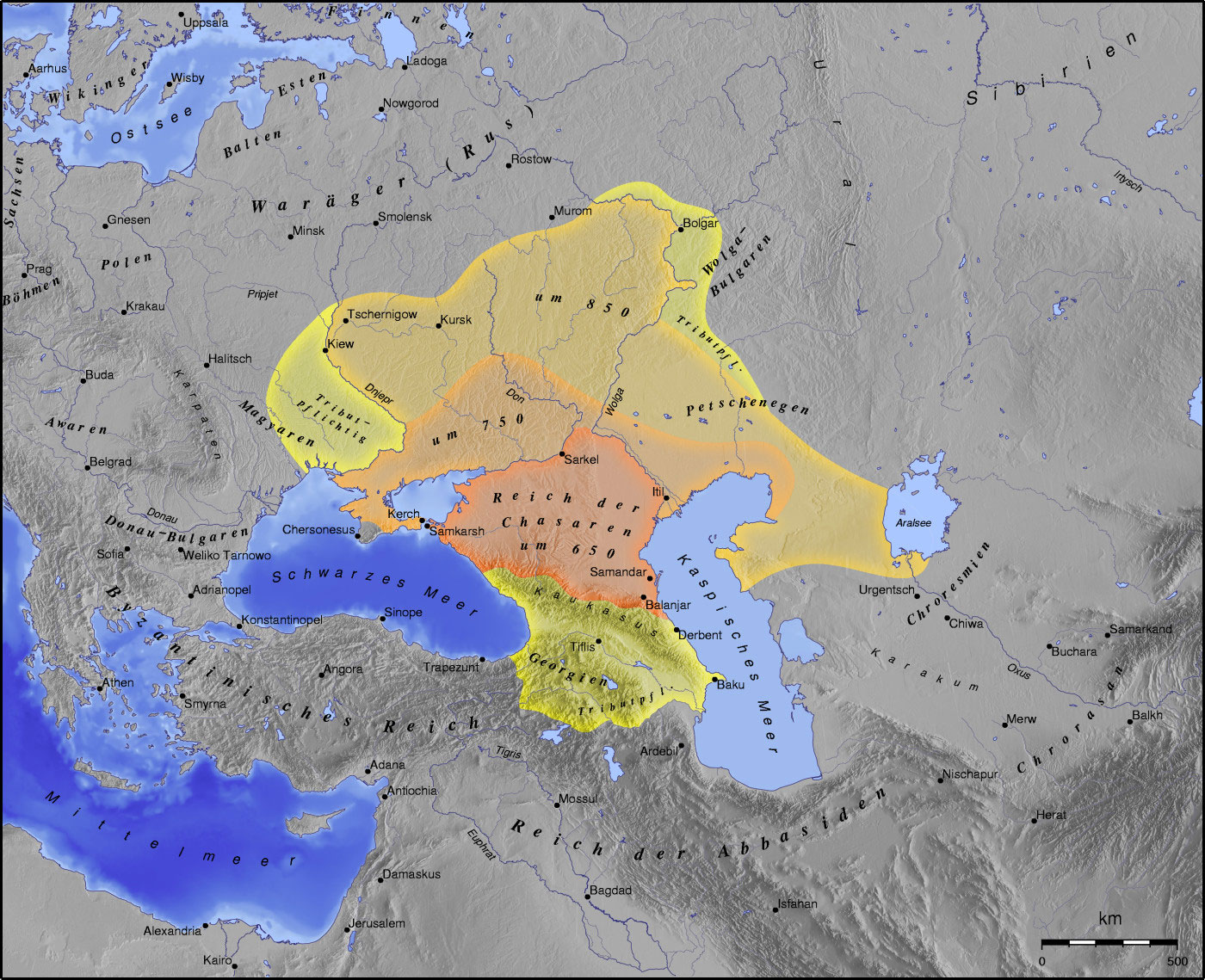
The Khazar Khaganate, between 650 and 850 The Khazars were semi-nomadic Turkic people who established one of the largest polities of medieval Eurasia, with the capital of Atil and territory comprising much of modern-day European Russia, western Kazakhstan, eastern Ukraine, Azerbaijan, large portions of the northern Caucasus (Circassia, Dagestan), parts of Georgia, the Crimea, and northeastern Turkey.[5] A successor state of the Western Turks, Khazaria was a polyethnic-multifaith state with a population of Turkic, Uralic, Slavic, and Palaeo-Caucasian peoples.[6] Khazaria was the first feudal state to be established in Eastern Europe.[7] During the 9th and 10th centuries, Khazaria was one of the major arteries of commerce between northern Europe and southwestern Asia, as well as a connection to the Silk Road. The name "Khazar" is found in numerous languages[8] and seems to be tied to a Turkic verb form meaning "wandering" (Modern Turkish: Gezer).[9] Pax Khazarica is a term used by historians to refer to the period during which the Khazaria dominated the Pontic steppe and the Caucasus Mountains. Khazaria was referred to as Tourkia (Greek: Τουρκία) in medieval Byzantine sources. Khazaria had an ongoing entente with Byzantium. Serving their partner in wars against the Abbasid Caliphate, Khazars aided the Byzantine emperor Heraclius (reigned 610–641) by sending an army of 40,000 soldiers in their campaign against the Persians.[10] In 775, Leo (son of Tzitzak) was crowned as the sole emperor of the Byzantine Empire. Sarkel (a Turkish word meaning White Fortress) was built in 830s by a joint team of Greek and Khazar architects to protect the north-western border of the Khazar state.[11] The chief engineer during the construction of Sarkel was Petronas Kamateros who later became the governor of Cherson. Khazars played a role in the balance of powers and destiny of world civilization. After Kubrat's Great Bulgaria was destroyed by the Khazars, some of the Bulgars fled to the west and founded a new Bulgar state (present day Bulgaria) near the Danubian Plain, under the command of Khan Asparukh. The rest of the Bulgars fled to the north of the Volga River region and founded another state there called Volga Bulgaria (present day Chuvashia).[12] By serving as a buffer state between Christians and Muslims, Khazars blocked the western spread of Islam in Europe. It was the military might of the Khazars that made it impossible for armies of Islam to roll west into eastern Europe and possibly even into Scandinavia. Scholars say that if Arabs had occupied what is now Ukraine and Russia, the Rus would never have been able to push south and east from the Baltic to establish Russia.[13] The Khazars had, for years, been venturing forth southward, in their marauding raids on the Muslim countries south of the Caucasus.[14] Islamic armies conquered part of Persia, Syria, Mesopotamia, Egypt, Armenia, and what is now the modern-day post-Soviet Republic of Azerbaijan and surrounded the Byzantine heartland (present-day Turkey) in a pincer movement which extended from the Mediterranean to the Caucasus and the southern shores of the Caspian. This was the time when the long series of wars called Khazar-Arab wars began. These wars eventually saw the Arabs defeated at every advance with the death of thousands of Arab soldiers including their commander, Abd ar-Rahman ibn Rabiah, and the Arab armies in complete disarray. The Arab armies' inability to traverse the Caucasus made it logistically impossible for them to besiege the Byzantine capital of Constantinople. Coupled with the military barrier presented by the Khazars themselves, this prevented Europe from more direct and intensive assaults by the forces of Islam, arguably keeping it from falling to the Muslim armies. After fighting the Arabs to a standstill in the North Caucasus, Khazars became increasingly interested in replacing their Tengriism with a state religion that would give them equal religious standing with their Abrahamic neighbors. During the 8th century, the Khazar royalty and much of the aristocracy converted to a form of Judaism.[15]Yitzhak ha-Sangari is the name of the rabbi who converted Khazars to Judaism according to Jewish sources. Khazars were judged according to Tōra[16] (orders of the Khagan; coming from the root Tōr meaning customs; unwritten law of people in Old Turkic) (Modern Turkish: Töre), while the other tribes were judged according to their own laws.[12] Being a surprisingly tolerant and pluralistic society, even its army incorporated Jews, Christians, Muslims and Pagans at a time when religious warfare was the order of the day around the Mediterranean and in Western Europe. By welcoming educated and worldly Jews from both Christian Europe and the Islamic Middle East, Khazars rapidly absorbed many of the arts and technologies of civilization. As a direct result of this cultural infusion, they became one of the very few Asian steppe tribal societies that successfully made the transition from nomad to urbanite. Settling in their newly created towns and cities between the Caspian Sea and the Crimean Peninsula on the Black Sea, they became literate and multi-lingual agriculturalists, manufacturers and international traders.[17] Between 965 and 969, Khazar sovereignty was broken by Kievan Rus. Sviatoslav I of Kiev defeated Khazars in 965 by conquering the Khazar fortress of Sarkel. Two years later, Rus prince conquered Atil, after which he campaigned in the Balkans. Medieval Ruthenian epic poems mention Ruthenian warriors fighting the Jewish Giant (Богатырь Жидовин).[18] The Rus and the Hungarians both adopted the dual-kingship system of the Khazars. The Rus princes even borrowed the title Khagan. Many artifacts from the Khazars, exhibiting their artistic and industrial talents, have survived to the present day.[12]
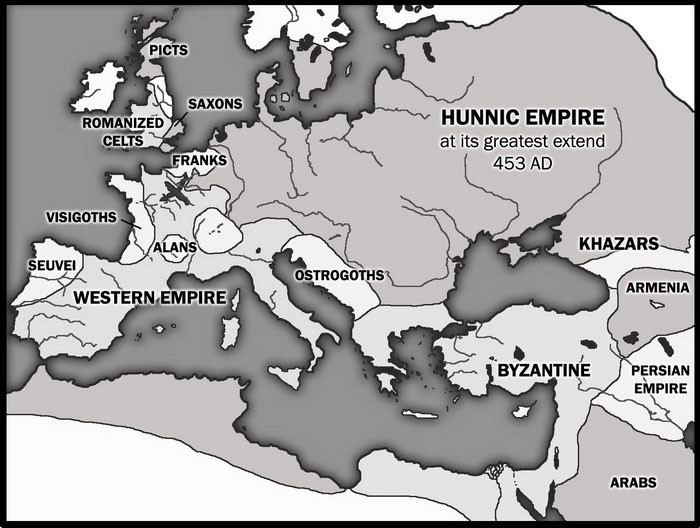
A map showing Khazars (under Hun jurisdiction) during mid 5th century.
Chronicle of Khazar Empire events in their rise and fall including events in Europe. (448-1048) Origins and prehistory The origins of the Khazars are unclear. Uyghurs Certain scholars, such as D. M. Dunlop and P. B. Golden, considered the Khazars to be connected with a Uyghur or Tiele confederation tribe called He'san in Chinese sources from the 7th-century (Suishu, 84). The Khazar language appears to have been an Oghuric tongue, similar to that spoken by the early Bulgars and corresponding to the modern day Chuvash dialects.[19] P. B. Golden along with M. Artamonov and A. Novoseltsev claimed that the Khazars were a tribal union of Uyghur, Sabir, and some other Altaic Turkic people. That theory is favored among most of the post-Soviet Russian scholars.[20] Huns A Hunnish origin has also been postulated, particularly as an Akatzir tribe, by such scholars as O. Pritsak and A. Gadlo. Khazars are mentioned after the fall of the Hunnic Attila Empire in 454.[21] Since the Hun empire was not ethnically homogeneous, this proposal is not necessarily in conflict with others. It is likely that the Khazar nation itself was made up of tribes from various ethnic backgrounds, as steppe nations traditionally absorbed those they conquered. Their name would accordingly be derived from Turkic *qaz-, meaning "to wander, flee." Armenian chronicles contain references to the Khazars as early as the late 2nd century. These are generally regarded as anachronisms, and most scholars believe that they refer to Sarmatians or Scythians. Priscus stated that one of the nations in the Hunnish confederacy was called Akatziroi. Their king was named Karadach or Karidachus. Some, going on the similarity between Akatziroi and "Ak-Khazar" (see below), have speculated that the Akatziroi were early proto-Khazars.
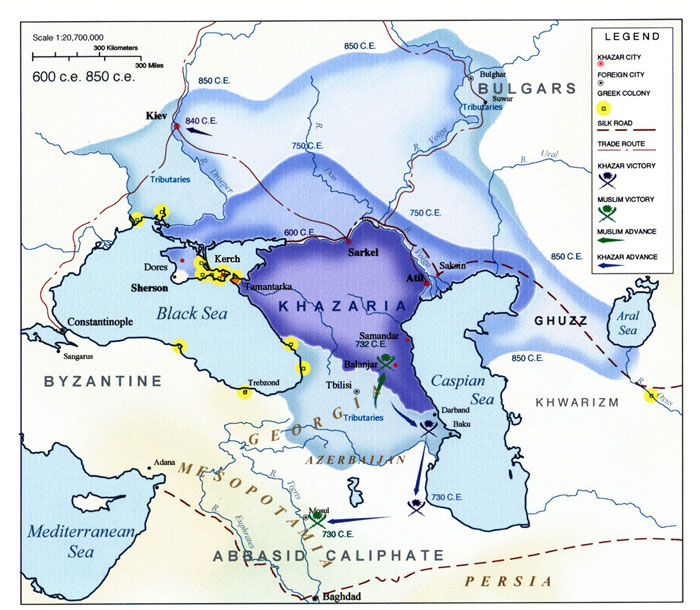
Khazaria map from CE 600 till 850. Transoxiana origin Dmitri Vasilyev of Astrakhan State University recently hypothesized that the Khazars moved in to the Pontic steppe region only in the late 6th century, and originally lived in Transoxiana. According to Vasilyev, Khazar populations remained behind in Transoxiana under Pecheneg and Oghuz suzerainty, possibly remaining in contact with the main body of their people. D. Ludwig claims that Khazars were driven out of the region by the rising Hephthalites. In September 2008, Vasilyev reported findings in Samosdelka that he thought represented a medieval Jewish capital. Dr. Simon Kraiz, an expert on Eastern European Jewry at the University of Haifa, pointed out that no Khazar writings have been found: "We know a lot about them, and yet we know almost nothing: Jews wrote about them, and so did Russians, Georgians, and Armenians, to name a few. But from the Khazars themselves, we have nearly nothing."[22]
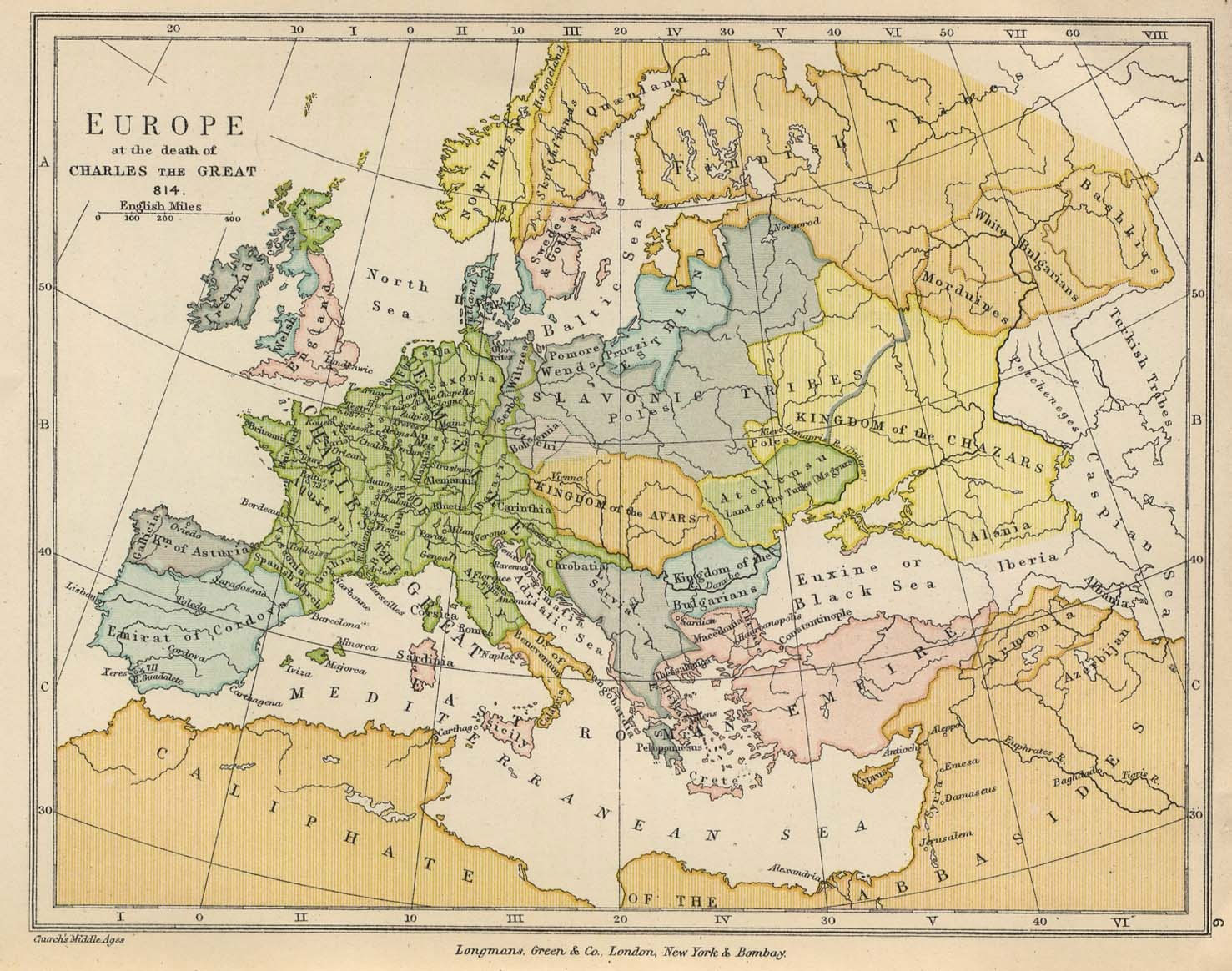
A 1905 map shows the Khazar empire in 814
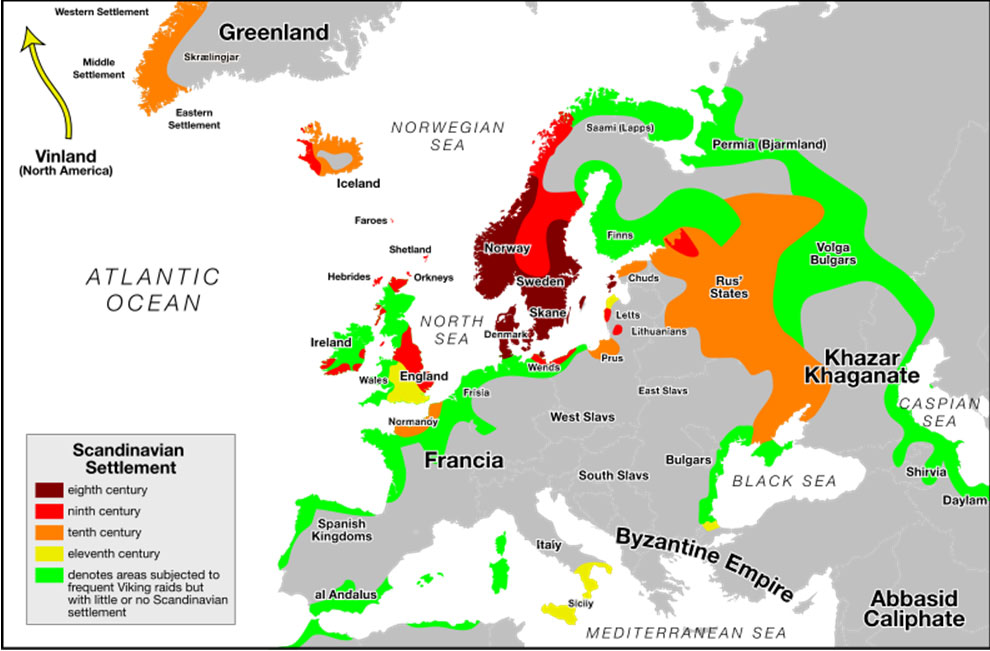
A map showing Khazars during expansion of Vikings. Others Following the conversion to Judaism of the Khazarian royalty and aristocracy, their descendants began to claim origins in Kozar, a son of Togarmah. Togarmah is mentioned in Genesis (Chapter 10 verses 2 & 3) as a grandson of Japheth. Some scholars in the former USSR considered the Khazars to be an indigenous people of the North Caucasus, mostly Nakh peoples. They argue that the name khazar comes from the Chechen language, meaning beautiful valley.[23] Language The Khazar language spoken by the Khazars is also referred to as Khazarian, Khazaric, or Khazari. The language is extinct and written records are almost non-existent. Few examples of the Khazar language exist today, mostly in names that have survived in historical sources. All of these examples seem to be of the "Lir"-type though. Extant written works are primarily in Hebrew. The only Khazar word written in the original Khazar alphabet that survives is the single word-phrase OKHQURÜM, "I read (this or it); (Modern Turkish: OKURUM)" at the end of the Kievian Letter. This word is written in Turkic runiform script, suggesting that this script survived the upper class's conversion to Judaism.
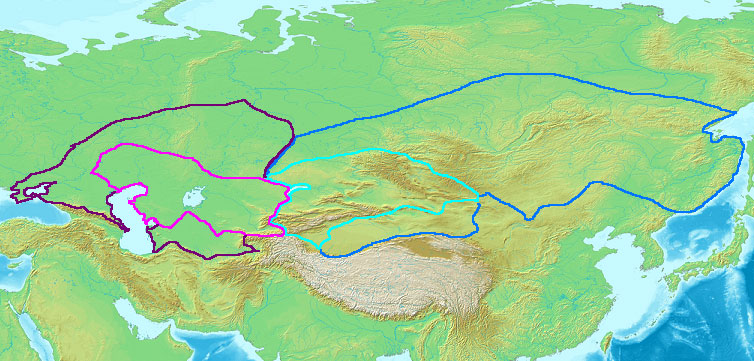
Map of the Western (purple) and Eastern (blue) Göktürk khaganates at their height, c. 600 CE. Lighter areas show direct rule; darker areas show spheres of influence.
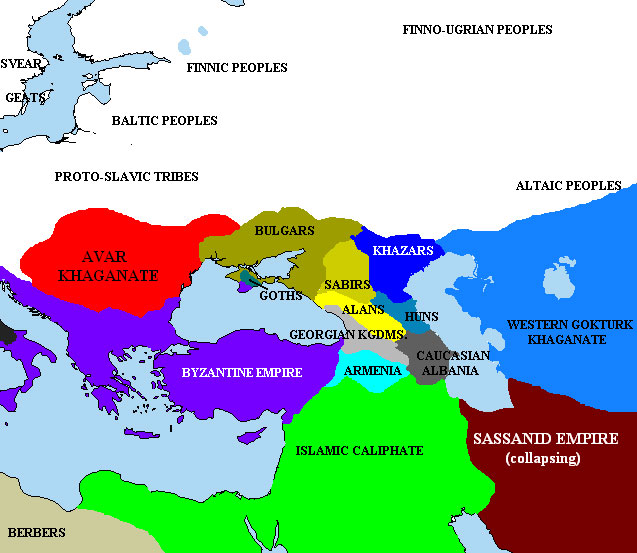
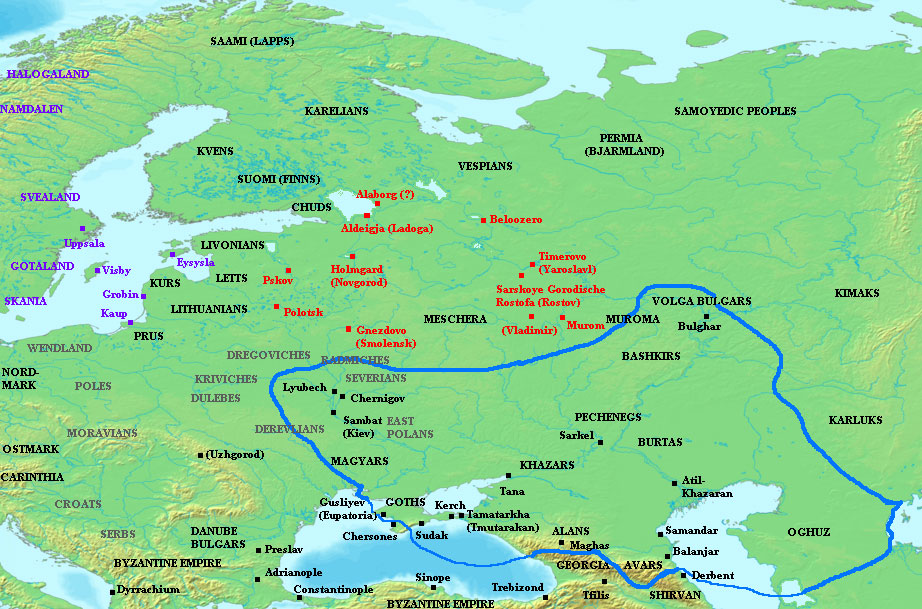
The Pontic steppe, c. 650, showing the early territory of the Khazars and their neighbors. Tribes The Khazars' tribal structure is not well understood. They were divided between Ak-Khazars ("White Khazars") and Kara-Khazars ("Black Khazars"). The 10th-century Muslim geographer al-Istakhri claimed that the White Khazars were strikingly handsome with reddish hair, white skin and blue eyes while the Black Khazars were swarthy verging on deep black as if they were "some kind of Indian".[25] Many Turkic nations had a similar (political, not racial) division between a "white" ruling warrior caste and a "black" class of commoners; the consensus among mainstream scholars is that Istakhri was confused by the names given to the two groups.[26] However, Khazars are described by the generality of early Arab sources as having a white complexion, blue eyes, and reddish hair.[27][28][29][30][31][32] The Turkic affinities of the Khazars are confirmed by modern anthropological studies.[33] Rise Early Khazar history is intimately tied with that of the Göktürk Empire, founded when the Ashina clan overthrew the Juan Juan in 552 CE. It is known that in 515-516 Hunnic-Savirs attacked Armenia. The widow of the Hunnic-Savir prince Bolakh Boariks concluded a peace with Byzantium in 527. In 529, Prince Khosrau I of the Persian Empire fought the social movement led by the Zoroastrian priest Mazdak. Numerous Jewish families who supported the movement had to flee the country north of Caucasus Mountains. In 552, a western-Turkic khaganate is mentioned led by khagan Tumyn (or Tumen) out of the Ashina clan. There are some speculations that the Western portion of the Göktürk Empire in the West became known as Avars.[34] During that time, there is mention of Savirs' and Khazars' attacks on Caucasus Albania. The first significant appearance of the Khazars in history is their aid to the campaign of the Byzantine emperor Heraclius against the Sassanid Persians. The Khazar ruler Ziebel (sometimes identified as Tong Yabghu Khagan of the West Turks) aided the Byzantines in overrunning Georgia. A marriage was even contemplated between Ziebel's son and Heraclius' daughter, but never took place. During these campaigns, the Khazars may have been ruled by Bagha Shad and their forces may have been under the command of his son Buri-shad.[35] With the collapse of the Göktürk Empire due to internal conflict in the 6th century, the western half of the Turkish empire split into a number of tribal confederations, among whom were the Bulgars, led by the Dulo clan, and the Khazars, led by the Ashina clan, the traditional rulers of the Göktürk Empire. By 670, the Khazars had broken the Bulgar confederation, causing various tribal groups to migrate and leaving two remnants of Bulgar rule -- Volga Bulgaria, and the Bulgarian khanate on the Danube River. During the 7th and 8th centuries, the Khazar fought a series of wars against the Umayyad Caliphate, which was attempting simultaneously to expand its influence into Transoxiana and the Caucasus. The first war was fought in the early 650 and ended with the defeat of an Arab force led by Abd ar-Rahman ibn Rabiah outside the Khazar town of Balanjar, after a battle in which both sides used siege engines on the others' troops. A number of Russian sources give the name of a Khazar khagan, Irbis, from this period, and describe him as a scion of the Göktürk royal house, the Ashina. Whether Irbis ever existed is open to debate, as is the issue of whether he can be identified with one of the many Göktürk rulers of the same name. Several further conflicts erupted in the decades that followed, with Arab attacks and Khazar raids into Kurdistan and Iran. There is evidence from the account of al-Tabari that the Khazars formed a united front with the remnants of the Göktürks in Transoxiana.
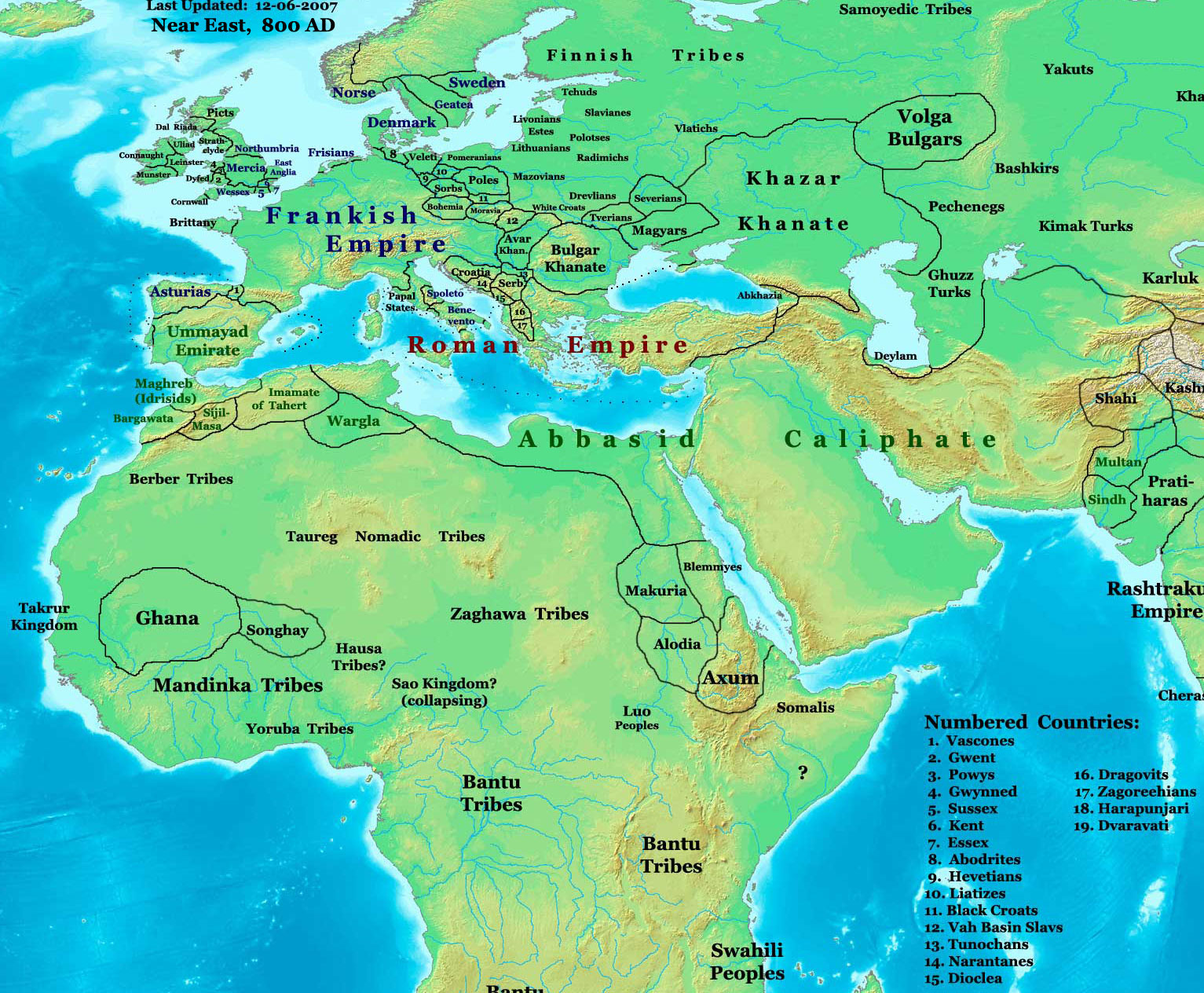
Near East in 800 CE, showing the Khazar Khanate at its height. Khazars and Byzantium Khazar dominion over most of the Crimea dates from the late 7th century C.E. In the mid-8th century, the rebellious Crimean Goths were put down and their city, Doros (modern Mangup) occupied. A Khazar tudun was resident at Cherson in the 690s, despite the fact that this town was nominally subject to the Byzantine Empire. The Khazars are also known to have been allied with the Byzantine Empire during at least part of the 8th century. In 704/705 Justinian II, exiled in Cherson, escaped into Khazar territory and married Theodora, the sister of the Khagan Busir. With the aid of his wife, he escaped from Busir, who was working against him with the usurper Tiberius III, murdering two Khazar officials in the process. He fled to Bulgaria, whose Khan Tervel helped him regain the throne. The Khazars later provided aid to the rebel general Bardanes, who seized the throne in 711 as Emperor Philippicus. The Byzantine emperor Leo III married his son Constantine (later Constantine V Kopronymous) to the Khazar princess Tzitzak (Çiçek in Turkish), daughter of the Khagan Bihar) as part of the alliance between the two empires. Tzitzak, who was baptized as Irene, became famous for her wedding gown, which started a fashion craze in Constantinople for a type of robe (for men) called tzitzakion. Their son Leo (Leo IV) would be better known as "Leo the Khazar".
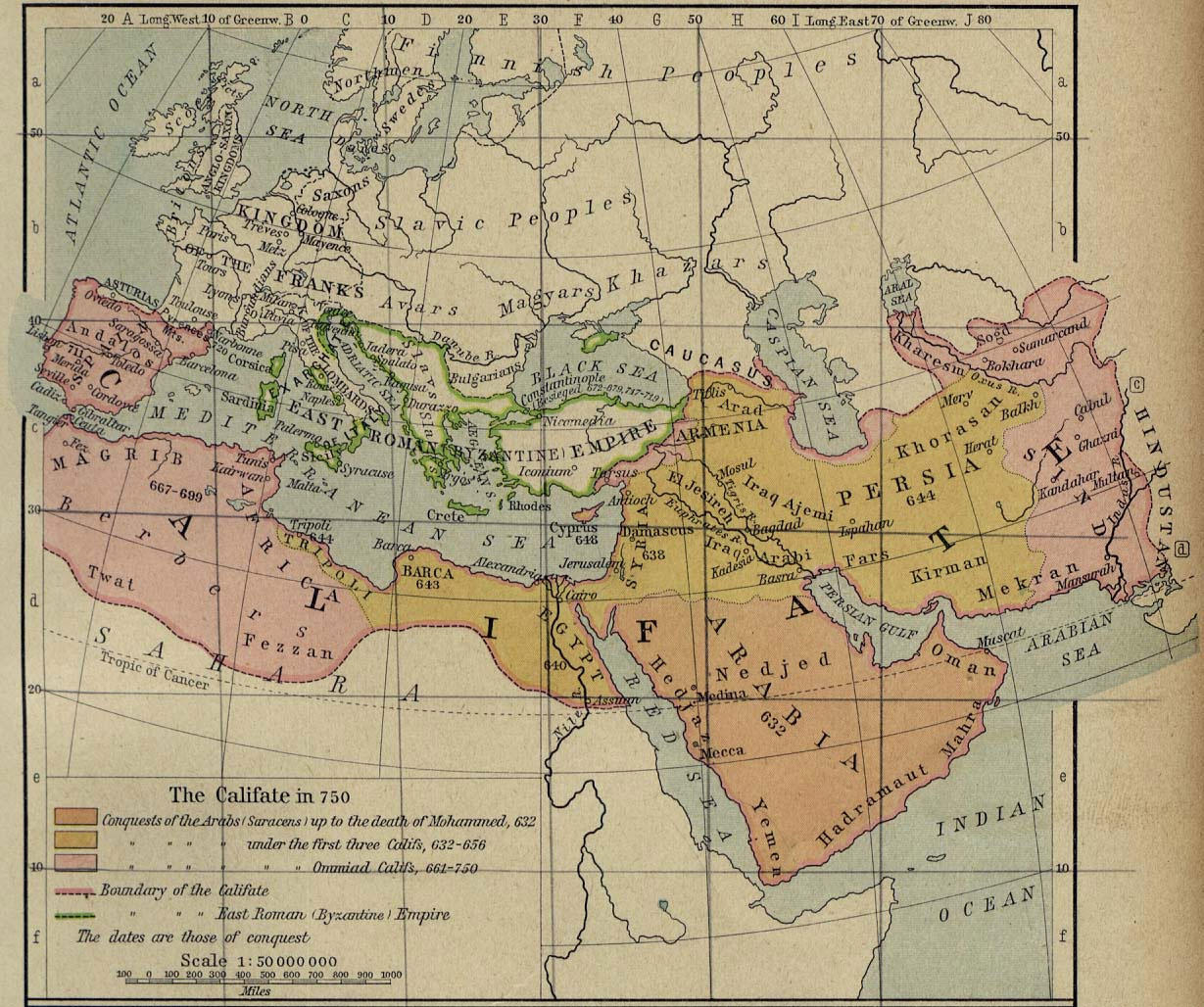
Expansion of the Caliphate to 750 CE. From The Historical Atlas by William R. Shepherd, 1923. Courtesy of The General Libraries, The University of Texas at Austin Second Khazar-Arab war Hostilities broke out again with the Caliphate in the 710s, with raids back and forth across the Caucasus but few decisive battles. The Khazars, led by a prince named Barjik, invaded northwestern Iran and defeated the Umayyad forces at Ardabil in December 730, killing the Arab warlord al-Djarrah al-Hakami and briefly occupying the town. They were defeated the next year at Mosul, where Barjik directed Khazar forces from a throne mounted with al-Djarrah's severed head, and Barjik was killed. Arab armies led first by the Arab prince Maslamah ibn Abd al-Malik and then by Marwan ibn Muhammad (later Caliph Marwan II) poured across the Caucasus and eventually (in 737) defeated a Khazar army led by Hazer Tarkhan, briefly occupying Atil itself and possibly forcing the Khagan to convert to Islam. The instability of the Umayyad regime made a permanent occupation impossible; the Arab armies withdrew and Khazar independence was re-asserted. It has been speculated that the adoption of Judaism (which in this theory would have taken place around 740) was part of this re-assertion of independence. Around 729, Arab sources give the name of the ruler of the Khazars as Parsbit or Barsbek, a woman who appears to have directed military operations against them. This suggests that women could have very high positions within the Khazar state, possibly even as a stand-in for the khagan. Although they stopped the Arab expansion into Eastern Europe for some time after these wars, the Khazars were forced to withdraw behind the Caucasus. In the ensuing decades they extended their territories from the Caspian Sea in the east (many cultures still call the Caspian Sea "Khazar Sea"; e.g. "Xəzər dənizi" in Azeri, "Hazar Denizi" in Turkish, "Bahr ul-Khazar" in Arabic, "Darya-ye Khazar" in Persian) to the steppe region north of Black Sea in the west, as far west at least as the Dnieper River. In 758, the Abbasid Caliph Abdullah al-Mansur ordered Yazid ibn Usayd al-Sulami, one of his nobles and military governor of Armenia, to take a royal Khazar bride and make peace. Yazid took home a daughter of Khagan Baghatur, the Khazar leader. Unfortunately, the girl died inexplicably, possibly in childbirth. Her attendants returned home, convinced that some Arab faction had poisoned her, and her father was enraged. A Khazar general named Ras Tarkhan invaded what is now northwestern Iran, plundering and raiding for several months. Thereafter relations between the Khazars and the Abbasid Caliphate (whose foreign policies were generally less expansionist than its Umayyad predecessor) became increasingly cordial.
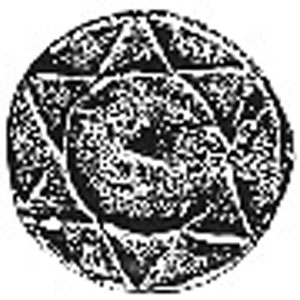
Seal discovered in excavations. It is unclear that it is a Jewish or Pagan symbol. Khazar religion Turkic Tengriism Originally, the Khazars practiced traditional Turkic Tengriism, focused on the sky god Tengri, but were heavily influenced by Confucian ideas imported from China, notably that of the Mandate of Heaven. The Ashina clan were considered to be the chosen of Tengri and the kaghan was the incarnation of the favor the sky-god bestowed on the Turks. A kaghan who failed had clearly lost the god's favor and was typically ritually executed. Historians have sometimes wondered, only half in jest, whether the Khazar tendency to occasionally execute their rulers on religious grounds led those rulers to seek out other religions. The Khazars revered a number of traditional divinities subordinate to Tengri, including the fertility divinity Umay, Kuara, a thunder divinity, and Erlik, the divinity of underworld.
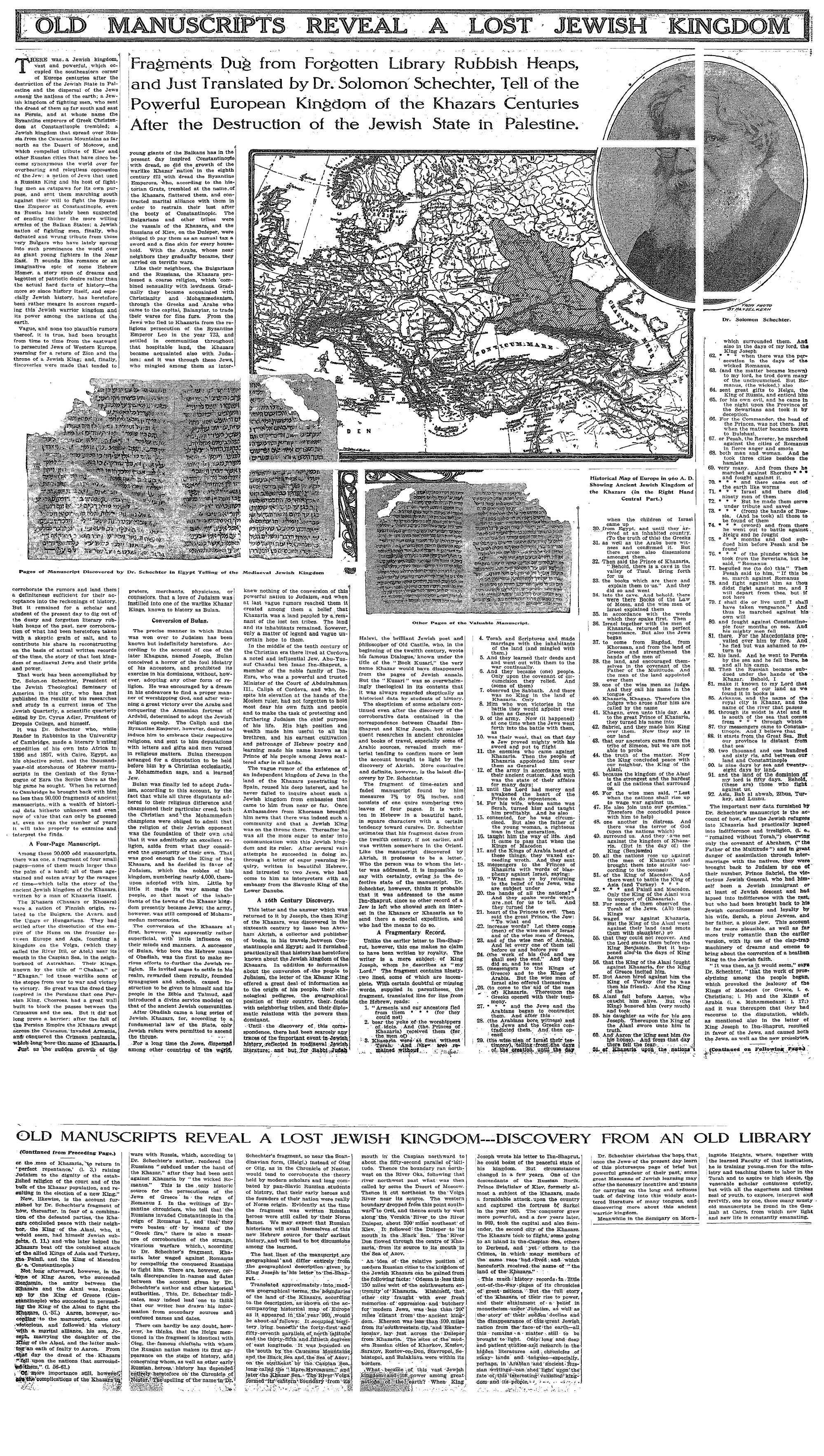
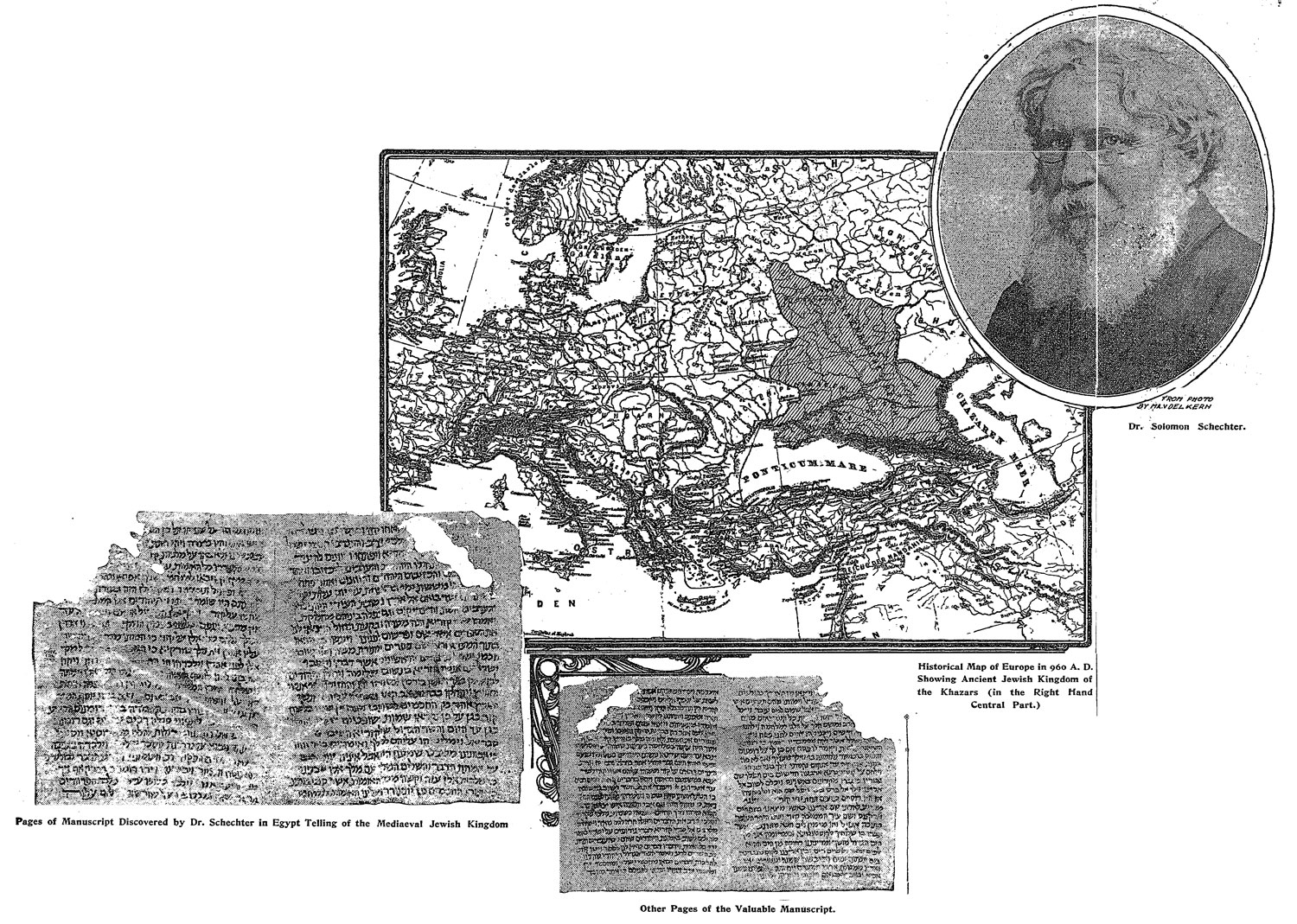
Two pages from The New York Times newspaper published in 1912
Conversion of the royalty and aristocracy to Judaism Jewish communities had existed in the Greek cities of the Black Sea coast since late classical times. Chersonesos, Sudak, Kerch and other Crimean cities sustained Jewish communities, as did Gorgippia, and Samkarsh / Tmutarakan was said to have had a Jewish majority as early as the 670s. Jews fled from Byzantium to Khazaria as a consequence of persecution under Heraclius, Justinian II, Leo III, and Romanos I.[36] These were joined by other Jews fleeing from Sassanid Persia (particularly during the Mazdak revolts),[37] and, later, the Islamic world. Jewish merchants such as the Radhanites regularly traded in Khazar territory, and may have wielded significant economic and political influence. Though their origins and history are somewhat unclear, the Mountain Jews also lived in or near Khazar territory and may have been allied with the Khazars, or subject to them; it is conceivable that they, too, played a role in Khazar conversion. At some point in the last decades of the 8th century or the early 9th century, the Khazar royalty and nobility converted to Judaism, and part of the general population may have followed.[38] The extent of the conversion is debated. The 10th century Persian historian Ibn al-Faqih reported that "all the Khazars are Jews." Notwithstanding this statement, most scholars believe that only the upper classes converted to Judaism;[39] there is some support for this in contemporary Muslim texts.[40] Essays in the Kuzari, written by Yehuda Halevi, detail a moral liturgical reason for the conversion which some consider a moral tale. Some researchers have suggested part of the reason for conversion was political expediency to maintain a degree of neutrality: the Khazar empire was between growing populations, Muslims to the east and Christians to the west. Both religions recognized Judaism as a forebearer and worthy of some respect. The exact date of the conversion is hotly contested. It may have occurred as early as 740 or as late as the mid-9th century. Recently discovered numismatic evidence suggests that Judaism was the established state religion by c. 830, and though St. Cyril (who visited Khazaria in 861) did not identify the Khazars as Jews, the khagan of that period, Zachariah, had a biblical Hebrew name. Some medieval sources give the name of the rabbi who oversaw the conversion of the Khazars as Isaac Sangari or Yitzhak ha-Sangari. The first Jewish Khazar king was named Bulan which means "elk", though some sources give him the Hebrew name Sabriel. A later king, Obadiah, strengthened Judaism, inviting rabbis into the kingdom and built synagogues. Jewish figures such as Saadia Gaon made positive references to the Khazars, and they are excoriated in contemporary Karaite writings as "bastards"; it is therefore unlikely that they adopted Karaism as some (such as Avraham Firkovich) have proposed. According to the Schechter Letter, early Khazar Judaism was centered on a tabernacle similar to that mentioned in the Book of Exodus. Archaeologists at Rostov-on-Don have tentatively identified a folding altar unearthed at Khumar as part of such a religious building. The Khazars enjoyed close relations with the Jews of the Levant and Persia. The Persian Jews, for example, hoped that the Khazars might succeed in conquering the Caliphate.[41] The high esteem in which the Khazars were held among the Jews of the Orient may be seen in the application to them, in an Arabic commentary on Isaiah ascribed by some to Saadia Gaon, and by others to Benjamin Nahawandi, of Isaiah 48:14: "The Lord hath loved him." "This", says the commentary, "refers to the Khazars, who will go and destroy Babel" (i.e., Babylonia), a name used to designate the country of the Arabs.[42] From the Khazar Correspondence it is apparent that two Spanish Jews, Judah ben Meir ben Nathan and Joseph Gagris, had succeeded in settling in the land of the Khazars. Saadia, who had a fair knowledge of the kingdom of the Khazars, mentions a certain Isaac ben Abraham who had removed from Sura to Khazaria.[43] Likewise, the Khazar rulers viewed themselves as the protectors of international Jewry, and corresponded with foreign Jewish leaders. The letters exchanged between the Khazar ruler Joseph and the Spanish rabbi Hasdai ibn Shaprut have been preserved). They were known to retaliate against Muslim or Christian interests in Khazaria for persecution of Jews abroad. Ibn Fadlan relates that around 920 the Khazar ruler received information that Muslims had destroyed a synagogue in the land of Babung, in Iran; he gave orders that the minaret of the mosque in his capital should be broken off, and the muezzin executed. He further declared that he would have destroyed the mosque entirely had he not been afraid that the Muslims would in turn destroy all the synagogues in their lands. Similarly, during the persecutions of Byzantine Jews under Romanos I, the Khazar government retaliated by attacking Byzantine interests in the Crimea. The theory that the majority of Ashkenazi Jews are the descendants of the non-Semitic converted Khazars was advocated by various racial theorists[44][45] and antisemitic sources[45][46][47][48] in the 20th century, especially following the publication of Arthur Koestler's The Thirteenth Tribe. Despite recent genetic evidence to the contrary,[49] and a lack of any real mainstream scholarly support, this belief is still popular among groups such as the Christian Identity Movement, Black Hebrews, British Israelitists and others (particularly Arabs[50][51][52]) who claim that they, rather than Jews, are the true descendants of the Israelites, or who seek to downplay the connection between Ashkenazi Jews and Israel in favor of their own. For more detail on this controversy, see below.
Other religions Besides Judaism, other religions probably practiced in areas ruled by the Khazars included Greek Orthodox, Nestorian, and Monophysite Christianity, Zoroastrianism as well as Norse, Finnic, and Slavic cults.[53] The Khazar government tolerated a wide array of religious practices within the Khaganate. Many Khazars reportedly were converts to Christianity and Islam. (See "Judiciary", below.) A Greek Orthodox bishop was resident at Atil and was subject to the authority of the Metropolitan of Doros. The "apostle of the Slavs", Saint Cyril, is said to have attempted the conversion of Khazars without enduring results. Khazaran had a sizable Muslim population and quarter with a number of mosques. A Muslim officer, the khazz, represented the Muslim community in the royal court. Government Khazar kingship Khazar kingship was divided between the khagan and the Bek or Khagan Bek. Contemporary Arab historians related that the Khagan was purely a spiritual ruler or figurehead with limited powers, while the Bek was responsible for administration and military affairs. Both the Khagan and the Khagan Bek lived in Itil. The Khagan's palace, according to Arab sources, was on an island in the Volga River. He was reported to have 25 wives, each the daughter of a client ruler; this may, however, have been an exaggeration. In the Khazar Correspondence, King Joseph identifies himself as the ruler of the Khazars and makes no reference to a colleague. It has been disputed whether Joseph was a Khagan or a Bek; his description of his military campaigns make the latter probable. However, аccording to the Schechter Letter, king Joseph is identified as not Khagan. A third option is that by the time of the Correspondence (c. 950-960) the Khazars had merged the two positions into a single ruler, or that the Beks had somehow supplanted the Khagans or vice versa. The Khazar dual kingship may have influenced other people; power was similarly divided among the early Hungarian people between the sacral king, or kende, and the military king, or gyula. Similarly, according to Ibn Fadlan, the early Oghuz Turks had a warlord, the Kudarkin, who was subordinate to the reigning yabghu.
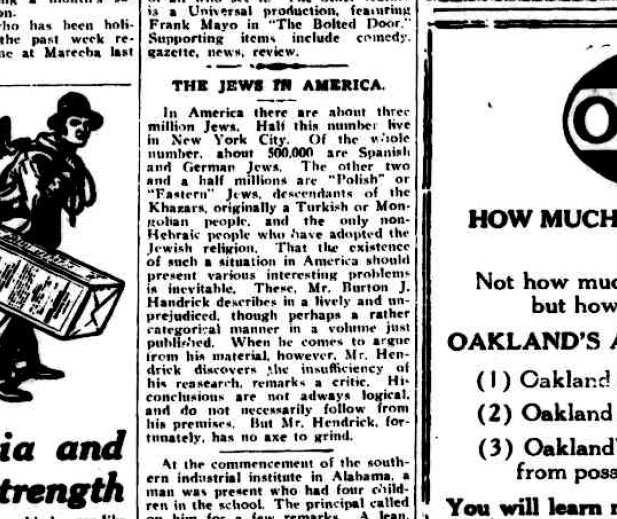
A part from a newspaper published in 1924 says about Khazars "non-Hebraic people who have adopted the Jewish religion"
Army Khazar armies were led by the Khagan Bek and commanded by subordinate officers known as tarkhans. A famous tarkhan referred to in Arab sources as Ras or As Tarkhan led an invasion of Armenia in 758. The army included regiments of Muslim auxiliaries known as Arsiyah, of Khwarezmian or Alan extraction, who were quite influential. These regiments were exempt from campaigning against their fellow Muslims. Early Rus' sources sometimes referred to the city of Khazaran (across the Volga River from Atil) as Khvalisy and the Khazar (Caspian) sea as Khvaliskoye. According to some scholars such as Omeljan Pritsak, these terms were East Slavic versions of "Khwarezmian" and referred to these mercenaries. In addition to the Bek's standing army, the Khazars could call upon tribal levies in times of danger and were often joined by auxiliaries from subject nations. Other officials Settlements were governed by administrative officials known as tuduns. In some cases (such as the Byzantine settlements in southern Crimea), a tudun would be appointed for a town nominally within another polity's sphere of influence. Other officials in the Khazar government included dignitaries referred to by ibn Fadlan as Jawyshyghr and Kündür, but their responsibilities are unknown. Judiciary Muslim sources report that the Khazar supreme court consisted of two Jews, two Christians, two Muslims, and a "heathen" (whether this is a Turkic shaman or a priest of Hungarian or Slavic or Norse religion is unclear), and a citizen had the right to be judged according to the laws of his religion. Some have argued that this configuration is unlikely, as a Beit Din, or rabbinical court, requires three members. It is therefore possible that as practitioners of the state religion, the Jews had three judges on the Supreme Court rather than two, and that the Muslim sources were attempting to downplay their influence.
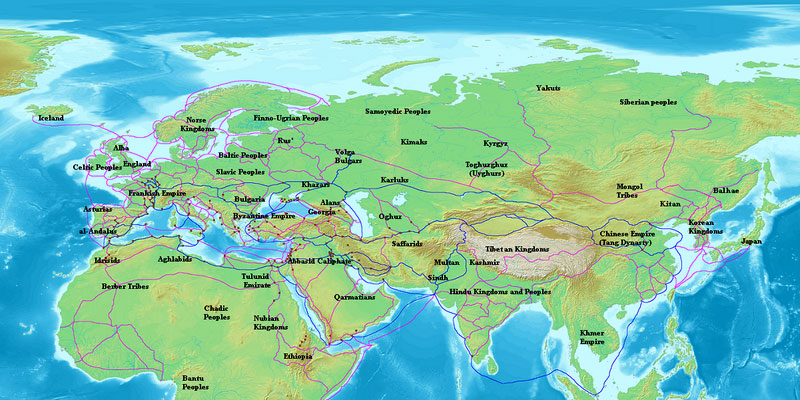
Map of Eurasia showing the trade network of the Radhanites, c. 870 CE, as reported in the account of ibn Khordadbeh in the Book of Roads and Kingdoms. Economic position Trade The Khazars occupied a prime trade nexus. Goods from western Europe travelled east to Central Asia and China and vice versa, and the Muslim world could only interact with northern Europe via Khazar intermediaries. The Radhanites, a guild of medieval Jewish merchants, had a trade route that ran through Khazaria, and may have been instrumental in the Khazars' conversion to Judaism. No Khazar paid taxes to the central government. Revenue came from a 10% levy on goods transiting through the region, and from tribute paid by subject nations. The Khazars exported honey, furs, wool, millet and other cereals, fish, and slaves. D.M. Dunlop and Artamanov asserted that the Khazars produced no material goods themselves, living solely on trade. This theory has been refuted by discoveries over the last half-century, which include pottery and glass factories. Khazar coinage The Khazars are known to have minted silver coins, called Yarmaqs. Many of these were imitations of Arab dirhems with corrupted Arabic letters. Coins of the Caliphate were in widespread use due to their reliable silver content. Merchants from as far away as China, England, and Scandinavia accepted them regardless of their inability to read the Arab writing. Thus issuing imitation dirhems was a way to ensure acceptance of Khazar coinage in foreign lands. Some surviving examples bear the legend "Ard al-Khazar" (Arabic for "land of the Khazars"). In 1999 a hoard of silver coins was discovered on the property of the Spillings farm in the Swedish island of Gotland. Among the coins were several dated 837/8 CE and bearing the legend, in Arabic script, "Moses is the Prophet of God" (a modification of the Muslim coin inscription "Muhammad is the Prophet of God").[55] In "Creating Khazar Identity through Coins", Roman Kovalev postulated that these dirhems were a special commemorative issue celebrating the adoption of Judaism by the Khazar ruler Bulan.[56] Extent of influence The Khazar Khaganate was, at its height, an immensely powerful state. The Khazar heartland was on the lower Volga and the Caspian coast as far south as Derbent. In addition, from the late 7th century the Khazars controlled most of the Crimea and the northeast littoral of the Black Sea. By 800 Khazar holdings included most of the Pontic steppe as far west as the Dnieper River and as far east as the Aral Sea (some Turkic history atlases show the Khazar sphere of influence extending well east of the Aral). During the Khazar-Arab war of the early 8th century, some Khazars evacuated to the Ural foothills, and some settlements may have remained.
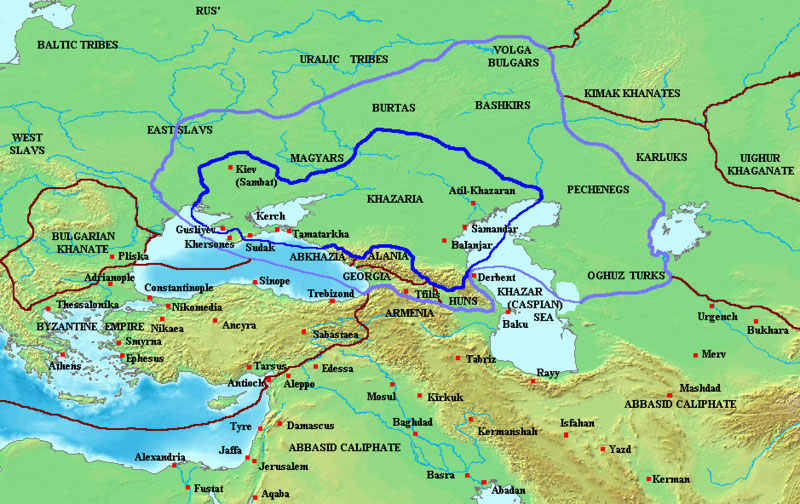
Map of the Khazar Khaganate and surrounding states, c. 820 CE. Area of direct Khazar control shown in dark blue, sphere of influence in purple. Other boundaries shown in dark red. Khazar towns
A number of Khazar settlements have been discovered in the Mayaki-Saltovo region. Some scholars suppose, that on the Dnieper, the Khazars founded a settlement called Sambat, which was part of what would become the city of Kiev. Chernihiv is also thought to have started as a Khazar settlement.
Map of the Khazar Khaganate and contemporary states, c. 820 CE. Tributary and subject nations Many nations were tributaries of the Khazars. A client king subject to Khazar overlordship was called an "Elteber". At various times, Khazar vassals included: Pontic steppes, Crimea and Turkestan The Pechenegs; the Oghuz; the Crimean Goths; the Crimean Huns (Onogurs?); the early Magyars Caucasus Georgia; various Armenian principalities; Arran (Azerbaijan); the North Caucasian Huns; Lazica; the Caucasian Avars; the Kassogs; and the Lezgins. Upper Don and Dnieper Various East Slavic tribes such as the Derevlians and the Vyatichs; various early Rus' polities Volga Volga Bulgaria; the Burtas; various Uralic forest tribes such as the Mordvins and Ob-Ugrians; the Bashkir; the Barsils. Decline and fall The 9th century is sometimes known as the Pax Khazarica, a period of Khazar hegemony over the Pontic steppe that allowed trade to flourish and facilitated trans-Eurasian contacts. However, in the early 10th century the empire began to decline due to the attacks of both Vikings from Kievan Rus and various Turkic tribes. It enjoyed a brief revival under the strong rulers Aaron II and Joseph, who subdued rebellious client states such as the Alans and led victorious wars against Rus' invaders. Kabar rebellion and the departure of the Magyars At some point in the 9th century (as reported by Constantine Porphyrogenitus) a group of three Khazar clans called the Kabars revolted against the Khazar government. Mikhail Artamonov, Omeljan Pritsak and others have speculated that the revolt had something to do with a rejection of rabbinic Judaism; this is unlikely as it is believed that both the Kabars and mainstream Khazars had pagan, Jewish, Christian, and Muslim members. Pritsak maintained that the Kabars were led by the Khagan Khan-Tuvan Dyggvi in a war against the Bek. In any event Pritsak cited no primary source for his propositions in this matter. The Kabars were defeated and joined a confederacy led by the Magyars. It has been speculated that "Hungarian" derives from the Turkic word "Onogur", or "Ten Arrows", referring to two Uralic tribes and eight Turkic tribes (composed of Sabirs, Onogurs, and the three tribes of the Kabars).[57][58] In the closing years of the 9th century the Khazars and Oghuz allied to attack the Pechenegs, who had been attacking both nations. The Pechenegs were driven westward, where they forced out the Magyars (Hungarians) who had previously inhabited the Don-Dnieper basin in vassalage to Khazaria. Under the leadership of the chieftain Lebedias and later Árpád, the Hungarians moved west into modern-day Hungary. The departure of the Hungarians led to an unstable power vacuum and the loss of Khazar control over the steppes north of the Black Sea. Diplomatic isolation and military threats The alliance with the Byzantines began to collapse in the early 10th century. Byzantine and Khazar forces may have clashed in the Crimea, and by the 940s Constantine VII Porphyrogentius was speculating in De Administrando Imperio about ways in which the Khazars could be isolated and attacked. The Byzantines during the same period began to attempt alliances with the Pechenegs and the Rus', with varying degrees of success. From the beginning of the 10th century, the Khazars found themselves fighting on multiple fronts as nomadic incursions were exacerbated by uprisings by former clients and invasions from former allies. According to the Schechter Text, the Khazar ruler Benjamin ben Menahem fought a war against a coalition of "'SY, TWRQY, 'BM, and PYYNYL," who were instigated and aided by "MQDWN". MQDWN or Macedon refers to the Byzantine Empire in many medieval Jewish writings; the other entities named have been tenuously identified by scholars including Omeljan Pritsak with the Burtas, Oghuz Turks, Volga Bulgars and Pechenegs, respectively. Though Benjamin was victorious, his son Aaron II had to face another invasion, this time led by the Alans. Aaron defeated the Alans with Oghuz help, yet within a few years the Oghuz and Khazars were enemies. Ibn Fadlan reported Oghuz hostility to the Khazars during his journey c. 921. Some sources, discussed by Tamara Rice, claim that Seljuk, the eponymous progenitor of the Seljuk Turks, began his career as an Oghuz soldier in Khazar service in the early and mid-10th century, rising to high rank before he fell out with the Khazar rulers and departed for Khwarazm.
Map showing Varangian or Rus' settlement (in red) and location of Slavic tribes (in grey), during the mid-9th century. Khazar influence indicated with blue outline. Rise of Rus' Originally the Khazars were probably allied with various Norse factions who controlled the region around Novgorod. The Rus' Khaganate, an early Rus' polity in modern northwestern Russia and Belarus, was probably heavily influenced by the Khazars. The Rus' regularly travelled through Khazar-held territory to attack territories around the Black and Caspian Seas; in one such raid, the Khagan is said to have given his assent on the condition that the Rus' give him half of the booty. In addition, the Khazars allowed the Rus' to use the trade route along the Volga River. This alliance was apparently fostered by the hostility between the Khazars and Arabs. At a certain point, however, the Khazar connivance to the sacking of the Muslim lands by the Varangians led to a backlash against the Norsemen from the Muslim population of the Khaganate. The Khazar rulers closed the passage down the Volga for the Rus', sparking a war. In the early 960s, Khazar ruler Joseph wrote to Hasdai ibn Shaprut about the deterioration of Khazar relations with the Rus: "I have to wage war with them, for if I would give them any chance at all they would lay waste the whole land of the Muslims as far as Baghdad." The Rus' warlords Oleg and Sviatoslav I of Kiev launched several wars against the Khazar khaganate, often with Byzantine connivance. The Schechter Letter relates the story of a campaign against Khazaria by HLGW (Oleg) around 941 (in which Oleg was defeated by the Khazar general Pesakh); this calls into question the timeline of the Primary Chronicle and other related works on the history of the Eastern Slavs.
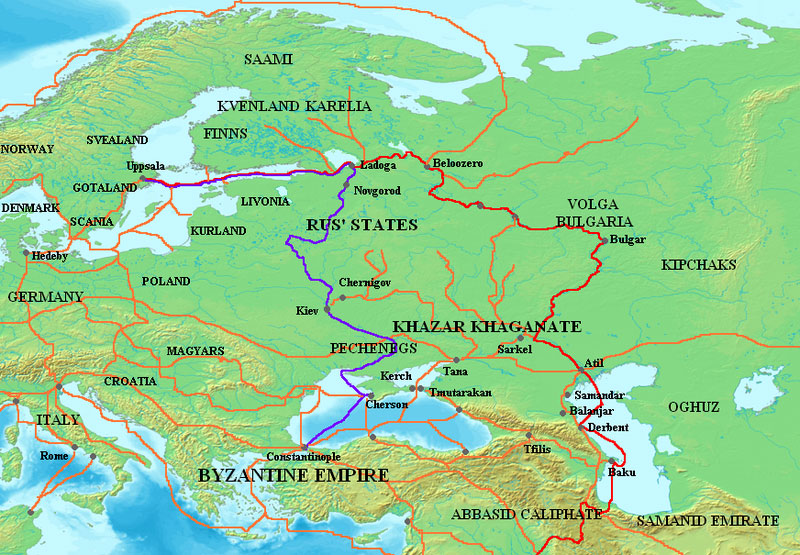
Map showing the major Varangian trade routes: the Volga trade route (in red) and the Trade Route from the Varangians to the Greeks (in purple). Other trade routes of the 8th-11th centuries shown in orange. Sviatoslav finally succeeded in destroying Khazar imperial power in the 960s. The Khazar fortresses of Sarkel and Tamatarkha fell to the Rus' in 965, with the capital city of Atil following circa 968 or 969. A visitor to Atil wrote soon after the sacking of the city: "The Rus' attacked, and no grape or raisin remained, not a leaf on a branch." Khazars outside Khazaria Khazar communities existed outside those areas under Khazar overlordship. Many Khazar mercenaries served in the armies of the Caliphate and other Islamic states. Documents from medieval Constantinople attest to a Khazar community mingled with the Jews of the suburb of Pera. Christian Khazars also lived in Constantinople, and some served in its armies, including, in the 9th and 10th centuries, the imperial Hetaireia bodyguard, where they formed their own separate company. The Patriarch Photius I of Constantinople was once angrily referred to by the Emperor as "Khazar-face", though whether this refers to his actual lineage or is a generic insult is unclear. Abraham ibn Daud reported Khazar rabbinical students, or rabbinical students who were the descendants of Khazars, in 12th century Spain. Jews from Kiev and elsewhere in Russia, who may or may not have been Khazars, were reported in France, Germany and England. Polish legends speak of Jews being present in Poland before the establishment of the Polish monarchy. Polish coins from the 12th and 13th centuries sometimes bore Slavic inscriptions written in the Hebrew alphabet[59][60] though connecting these coins to Khazar influence is purely a matter of speculation. Khavars in Hungary The Khavars (called often Kabars) who settled in Hungary in the late 9th and early 10th centuries may have included Khazars among their number. According to the archaeologist-historian Gábor Vékony, the native language of the Khavars was Khazar.[61] According to the Turkologist Prof. András Róna-Tas part of the Khazars -- who rebelled but then were subverted by the Khazar Khagane -- joined with the Magyars and then took part with them in the Settlement of Hungary at the end of the 9th century CE.[62]
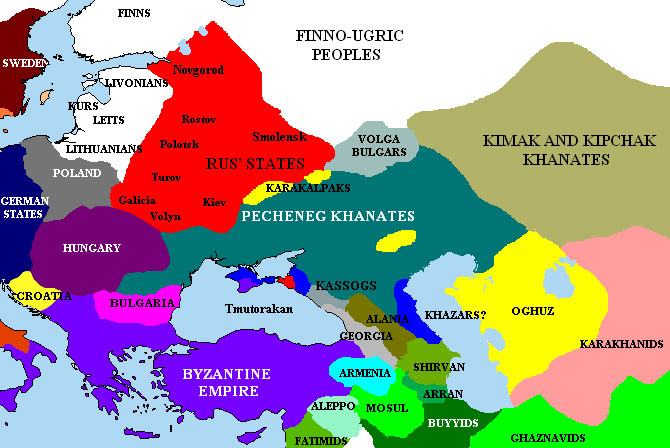
The Pontic steppes, c.1015. The areas in blue are those possibly still under Khazar control. Late references to the Khazars There is debate as to the temporal and geographic extent of Khazar polities following Sviatoslav's sack of Atil in 968/9, or even whether any such states existed. The Khazars may have retained control over some areas in the Caucasus for another two centuries, but sparse historical records make this difficult to confirm. The evidence of later Khazar polities includes the fact that Sviatoslav did not occupy the Volga basin after he destroyed Atil, and departed relatively quickly to embark on his campaign in Bulgaria. The permanent conquest of the Volga basin seems to have been left to later waves of steppe peoples like the Kipchaks and Cumans. Jewish sources A letter in Hebrew dated AM 4746 (985–986) refers to "our lord David, the Khazar prince" who lived in Taman. The letter said that this David was visited by envoys from Kievan Rus' to ask about religious matters — this could be connected to the Vladimir conversion which took place during the same time period. Taman was a principality of Kievan Rus' around 988, so this successor state (if that is what it was) may have been conquered altogether. The authenticity of this letter, the Mandgelis Document, has however been questioned by such scholars as D. M. Dunlop. Abraham ibn Daud, a 12th-century Spanish rabbi, reported meeting Khazar rabbinical students in Toledo, and that they informed him that the "remnant of them is of the rabbinic faith." This reference indicates that some Khazars maintained ethnic, if not political, autonomy at least two centuries after the sack of Atil. Petachiah of Ratisbon, a 13th-century rabbi and traveler, reported traveling through "Khazaria", though he gave few details of its inhabitants except to say that they lived amidst desolation in perpetual mourning. He further related:
The account of the conversion of the "seven kings of Meshech" is extremely similar to the accounts of the Khazar conversion given in the Kuzari, and in King Joseph's Reply. It is possible that Meshech refers to the Khazars, or to some Judaized polity influenced by them. Arguments against this possibility include the reference to "seven kings" (though this, in turn, could refer to seven successor tribes or state micropolities).
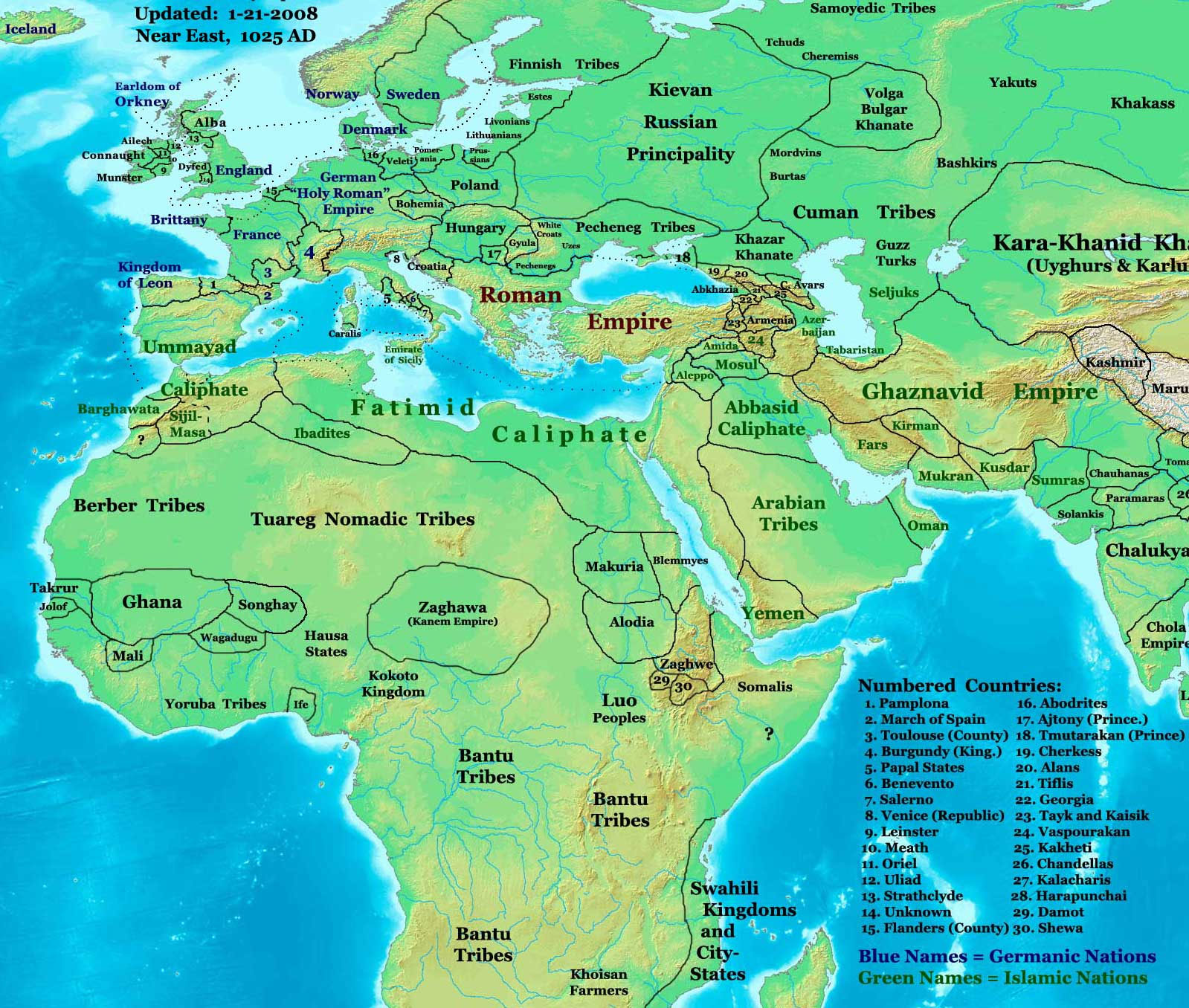
Khazar Empire and its neighbors in 1025 CE. Arabic and Muslim sources Ibn Hawqal and al-Muqaddasi refer to Atil after 969, indicating that it may have been rebuilt. Al-Biruni (mid-11th century) reported that Atil was in ruins, and did not mention the later city of Saqsin which was built nearby, so it is possible that this new Atil was only destroyed in the middle of the 11th century. Even assuming al-Biruni's report was not an anachronism, there is no evidence that this "new" Atil was populated by Khazars rather than by Pechenegs or a different tribe. Ibn al-Athir, who wrote around 1200, described "the raid of Fadhlun the Kurd against the Khazars". Fadhlun the Kurd has been identified as al-Fadhl ibn Muhammad al-Shaddadi, who ruled Arran and other parts of Azerbaijan in the 1030s. According to the account he attacked the Khazars but had to flee when they ambushed his army and killed 10,000 of his men. Two of the great early 20th century scholars on Eurasian nomads, Marquart and Barthold, disagreed about this account. Marquart believed that this incident refers to some Khazar remnant that had reverted to paganism and nomadic life. Barthold, (and more recently, Kevin Brook), took a much more skeptical approach and said that ibn al-Athir must have been referring to Georgians or Abkhazians. There is no evidence to decide the issue one way or the other. Kievan Rus' sources According to the Primary Chronicle, in 986 Khazar Jews were present at Vladimir's disputation to decide on the prospective religion of the Kievian Rus'. Whether these were Jews who had settled in Kiev or emissaries from some Jewish Khazar remnant state is unclear. The whole incident is regarded by a few radical scholars as a fabrication, but the reference to Khazar Jews (after the destruction of the Khaganate) is still relevant. Heinrich Graetz alleged that these were Jewish missionaries from the Crimea, but provided no reference to primary sources for his allegation. In 1023 the Primary Chronicle reports that Mstislav of Chernigov (one of Vladimir's sons) marched against his brother Yaroslav with an army that included "Khazars and Kasogs". Kasogs were an early Circassian people. "Khazars" in this reference is considered by most to be intended in the generic sense, but some have questioned why the reference reads "Khazars and Kasogs", when "Khazars" as a generic would have been sufficient. Even if the reference is to Khazars, of course, it does not follow that there was a Khazar state in this period. They could have been Khazars under the rule of the Rus. A Kievian prince named Oleg (not to be confused with Oleg of Kiev) was reportedly kidnapped by "Khazars" in 1078 and shipped off to Constantinople, although most scholars believe that this is a reference to the Kipchaks or other steppe peoples then dominant in the Pontic region. Upon his conquest of Tmutarakan in the 1080s Oleg gave himself the title "Archon of Khazaria". Byzantine, Georgian and Armenian sources Kedrenos documented a joint attack on the Khazar state in Kerch, ruled by Georgius Tzul, by the Byzantines and Russians in 1016. Following 1016, there are more ambiguous references in Eastern Christian sources to Khazars that may or may not be using "Khazars" in a general sense (the Arabs, for example, called all steppe people "Turks"; the Romans/Byzantines called them all "Scythians"). Jewish Khazars were also mentioned in a Georgian chronicle as a group that inhabited Derbent in the late 12th century. At least one 12th-century Byzantine source refers to tribes practicing Mosaic law and living in the Balkans; see Khalyzians. The connection between this group and the Khazars is rejected by most modern Khazar scholars. Western sources Giovanni di Plano Carpini, a 13th century Papal legate to the court of the Mongol Khan Guyuk, gave a list of the nations the Mongols had conquered in his account. One of them, listed among tribes of the Caucasus, Pontic steppe and the Caspian region, was the "Brutakhi, who are Jews." The identity of the Brutakhi is unclear. Giovanni later refers to the Brutakhi as shaving their heads. Though Giovanni refers to them as Kipchaks, they may have been a remnant of the Khazar people. Alternatively, they may have been Kipchak converts to Judaism (possibly connected to the Krymchaks or the Crimean Karaites). Khazar place names today Today, various place names invoking Khazar persist. Indeed, the Caspian Sea, traditionally known as the Hyrcanian Sea and Mazandaran Sea in Persian, came to be known to Iranians as the Khazar Sea as an alternative name. Many other cultures still call the Caspian Sea "Khazar Sea"; e.g. "Xəzər dənizi" in Azerbaijani, "Hazar Denizi" in Turkish, "Bahr ul-Khazar" in Arabic (although "Bahr Qazween" is becoming more popular now), "Darya-ye Khazar" in Persian. In Hungary, there are villages (and people with family names) called Kozár and Kazár. Debate about Khazar conversion to Judaism Date and extent of the conversion The date of the conversion of the Khazars to Judaism, and whether it occurred as one event or as a sequence of events over time, is widely disputed. The issues surrounding this controversy are discussed above. The number of Khazars who converted to Judaism is also hotly contested, with historical accounts ranging from claims that only the King and his retainers had embraced Judaism, to the claim that the majority of the lay population had converted. D.M. Dunlop was of the opinion that only the upper class converted; this was the majority view until relatively recently. Analysis of recent archaeological grave evidence by such scholars as Kevin A. Brook asserts that the sudden shift in burial customs, with the abandonment of pagan-style burial with grave goods and the adoption of simple shroud burials during the mid-9th century suggests a more widespread conversion.[64] A mainstream scholarly consensus does not yet exist regarding the extent of the conversions. Crimean Karaites Turkic-speaking Karaites (in the Crimean Tatar language, Qaraylar) have lived in Crimea for centuries. Their origin is a matter of great controversy. Some regard them as descendants of Karaite Jews who settled in Crimea and adopted a form of the Kypchak tongue (see Karaim language). Others view them as descendants of Khazar or Kipchak converts to Karaite Judaism. Today many Crimean Karaites deny Israelite origins and consider themselves to be descendants of the Khazars.[65] The consensus view among historians, however, considers that religion form of the Khazars was Talmudic Judaism.[66] Some modern Crimean Karaites seek to distance themselves from being identified as Jews, emphasizing what they view as their Turkic heritage and claiming that they are Turkic practitioners of a "Mosaic religion" separate and distinct from Judaism. Krymchaks The Krymchaks are Turkic people, community of Turkic languages and adherents of Rabbinic Judaism living in Crimea. In the late 7th century most of Crimea fell to the Khazars. The extent to which the Krymchaks influenced the ultimate conversion of the Khazars and the development of Khazar Judaism is unknown. During the period of Khazar rule, intermarriage between Crimean Jews and Khazars is likely, and the Krymchaks probably absorbed numerous Khazar refugees during the decline and fall of the Khazar kingdom (a Khazar successor state, ruled by Georgius Tzul, was centered on Kerch). It is known that Kipchak converts to Judaism existed, and it is possible that from these converts the Krymchaks adopted their distinctive language. They have historically lived in close proximity to the Crimean Karaites. At first krymchak was a Russian descriptive used to differentiate them from their Ashkenazi coreligionists, as well as other Jewish communities in the former Russian Empire such as the Georgian Jews, but in the second half of the 19th century this name was adopted by the Krymchaks themselves. Theory of Khazar ancestry of Ashkenazi Jews Early Khazar theories The theory that all or most Ashkenazi Jews might be descended from Khazars dates back to the racial studies of late 19th century Europe, and was frequently cited to assert that most modern Jews are not descended from Israelites and/or to refute Israeli claims to Israel. It was first publicly proposed in a lecture given by the racial-theorist Ernest Renan on January 27, 1883, titled "Judaism as a Race and as Religion."[67] It was repeated in articles in The Dearborn Independent in 1923 and 1925, and popularized by racial theorist Lothrop Stoddard in a 1926 article in the Forum titled "The Pedigree of Judah", where he argued that Ashkenazi Jews were a mix of people, of which the Khazars were a primary element.[45][68] Stoddard's views were "based on nineteenth and twentieth-century concepts of race, in which small variations on facial features as well as presumed accompanying character traits were deemed to pass from generation to generation, subject only to the corrupting effects of marriage with members of other groups, the result of which would lower the superior stock without raising the inferior partners."[69] This theory was adopted by British Israelites, who saw it as a means of invalidating the claims of Jews (rather than themselves) to be the true descendants of the ancient Israelites, and was supported by early anti-Zionists.[45][68] In 1951 Southern Methodist University professor John O. Beaty published The Iron Curtain over America, a work which claimed that "Khazar Jews" were "responsible for all of America's — and the world's — ills beginning with World War I". The book repeated a number of familiar antisemitic claims, placing responsibility for U.S. involvement in World Wars I and II and the Bolshevik revolution on these Khazars, and insisting that Khazar Jews were attempting to subvert Western Christianity and establish communism throughout the world. The American millionaire J. Russell Maguire gave money towards its promotion, and it was met with enthusiasm by hate groups and the extreme right.[46][47] By the 1960s the Khazar theory had become a "firm article of faith" amongst Christian Identity groups.[45][48] In 1971 John Bagot Glubb (Glubb Pasha) also took up this theme, insisting that Palestinians were more closely related to the ancient Judeans than were Jews. According to Benny Morris:
The theory gained further support when the novelist Arthur Koestler devoted his popular book The Thirteenth Tribe (1976) to the topic. Koestler's historiography has been attacked as highly questionable by many historians;[50][70][71] it has also been pointed out that his discussion of theories about Ashkenazi descent is entirely lacking scientific or historiographical support; to the extent that Koestler referred to place-names and documentary evidence his analysis has been described as a mixture of flawed etymologies and misinterpreted primary sources.[72] Commentors have also noted that Koestler mischaracterized the sources he cited, particularly D.M. Dunlop's History of the Jewish Khazars (1954).[71] Dunlop himself stated that the theory that Eastern European Jews were the descendants of the Khazars, "... can be dealt with very shortly, because there is little evidence which bears directly upon it, and it unavoidably retains the character of a mere assumption."[73] Koestler, an Ashkenazi Jew himself, was pro-Zionist based on secular considerations, and did not see alleged Khazar ancestry as diminishing the claim of Jews to Israel, which he felt was based on the United Nations mandate, and not on Biblical covenants or genetic inheritance. In his view, "The problem of the Khazar infusion a thousand years ago ... is irrelevant to modern Israel". In addition, he was apparently "either unaware of or oblivious to the use anti-Semites had made to the Khazar theory since its introduction at the turn of the century."[74] Theories linking Jews to Khazars today Although the Khazar theory is contradicted by genetic evidence[75][76][77] and has little support amongst academics, in the Arab world it still enjoys popularity among anti-Zionists[50] and antisemites.[78] Such proponents argue that if Ashkenazi Jews are primarily Khazar and not Semitic in origin, they would have no historical claim to Israel, nor would they be the subject of God's Biblical promise of Canaan to the Israelites, thus undermining the theological basis of both Jewish religious Zionists and Christian Zionists. In the 1970s and 80s the Khazar theory was also advanced by some Russian chauvinist antisemites, particularly the historian Lev Gumilyov, who portrayed "Judeo-Khazars" as having repeatedly sabotaged Russia's development since the 7th century.[79] Bernard Lewis stated in 1999:
Genetic studies on Ashkenazi Jewry A 1999 study by Hammer et al., published in the Proceedings of the United States National Academy of Sciences compared the Y chromosomes of Ashkenazi, Roman, North African, Kurdish, Near Eastern, Yemenite, and Ethiopian Jews with 16 non-Jewish groups from similar geographic locations. It found that "Despite their long-term residence in different countries and isolation from one another, most Jewish populations were not significantly different from one another at the genetic level... The results support the hypothesis that the paternal gene pools of Jewish communities from Europe, North Africa, and the Middle East descended from a common Middle Eastern ancestral population, and suggest that most Jewish communities have remained relatively isolated from neighboring non-Jewish communities during and after the Diaspora."[80] According to Nicholas Wade "The results accord with Jewish history and tradition and refute theories like those holding that Jewish communities consist mostly of converts from other faiths, or that they are descended from the Khazars, a medieval Turkish tribe that adopted Judaism."[81] A 2010 study on Jewish ancestry by Atzmon et al. says "Two major groups were identified by principal component, phylogenetic, and identity by descent (IBD) analysis: Middle Eastern Jews and European/Syrian Jews. The IBD segment sharing and the proximity of European Jews to each other and to southern European populations suggested similar origins for European Jewry and refuted large-scale genetic contributions of Central and Eastern European and Slavic populations to the formation of Ashkenazi Jewry."[82] Concerning male-line ancestry, several Y-DNA studies have tested the hypothesis of Khazar ancestry amongst Ashkenazim.[83][84][85] In these studies Haplogroup R1a chromosomes (sometimes called Eu 19) have been identified as potential evidence of one line of Eastern European ancestry amongst Ashkenazim, which could possibly be Khazar. One concluded that "neither the NRY haplogroup composition of the majority of Ashkenazi Jews nor the microsatellite haplotype composition of the R1a1 haplogroup within Ashkenazi Levites is consistent with a major Khazar or other European origin"[84] and another that "if the R-M17 chromosomes in Ashkenazi Jews do indeed represent the vestiges of the mysterious Khazars then, according to our data, this contribution was limited to either a single founder or a few closely related men, and does not exceed ~ 12% of the present-day Ashkenazim."[83] Other claims of descent Others have claimed Khazar origins for such groups as the Mountain Jews and Georgian Jews. There is little evidence to support these theories, although it is possible that some Khazar descendants found their way into these communities. Non-Jewish groups who claim at least partial descent from the Khazars include the Kumyks and Crimean Tatars; as with the above-mentioned Jewish groups, these claims are subject to a great deal of controversy and debate. Fiction The Kuzari is one of most famous works of the medieval Spanish Jewish philosopher and poet Rabbi Yehuda Halevi. Divided into five essays ("ma'amarim" (namely, Articles)), it takes the form of a dialogue between the pagan king of the Khazars and a Jew who was invited to instruct him in the tenets of the Jewish religion. Originally written in Arabic, the book was translated by numerous scholars (including Judah ibn Tibbon) into Hebrew and other languages. Though the book is not considered a historical account of the Khazar conversion to Judaism, scholars such as D.M. Dunlop and A.P. Novoseltsev have postulated that Yehuda had access to Khazar documents upon which he loosely based his work. His contemporary Avraham ibn Daud reported meeting Khazar rabbinical students in Toledo, Spain in the mid-12th century. In any case, however, the book is in the main - and clearly intended to be - an exposition of the basic tenets of the Jewish religion, rather than a historical account of the actual conversion of the Khazars to Judaism. The question of mass religious conversion is a central theme in Milorad Pavić's international bestselling novel Dictionary of the Khazars. The novel, however, contained many invented elements and had little to do with actual Khazar history. More recently, several novels, including H.N. Turteltaub's Justinian (about the life of Justinian II) and Marek Halter's Book of Abraham and Wind of the Khazars have dealt either directly or indirectly with the topic of the Khazars and their role in history. In 2007, the New York Times Magazine serialized a novel by Michael Chabon entitled Gentlemen of the Road which features 10th century Khazar characters. Notes 1.
http://books.google.com/booksid=3ZzXjdyKCEC&pg=PA136&dq=khazaria+christian 2. .......in the
middle agas in which pagans, Christians, Muslims and Jews, could
peacefully co-exist..............http://books.google.com/books?id=pF-I25OC5ugC&pg=PA84&dq=khazaria+ 3. Galina M. Yemelianova, Russia and Islam: A Historical Survey, Palgrave Macmillan, 2002, ISBN 9780333683545, p. 3. "By the end of the eighth century the Khazar capital, Itil', and other Khazar towns had mosques... The military guard of the Khagan were predominantly Muslim." 4. Wexler 1996, p. 50 5. Encyclopaedic ethnography of Middle-East and Central Asia: A-I, Volume 1 By R. Khanam 6. The world of the Khazars: new perspectives page 28, 38, 202, by Peter B. Golden, Haggai Ben-Shammai, András Róna-Tas (BRILL, 2007) 7. The world of the Khazars: new perspectives page 202, by Peter B. Golden, Haggai Ben-Shammai, András Róna-Tas (BRILL, 2007) 8. Hebrew sing. "Kuzari" כוזרי plur. "Kuzarim" כוזרים; Turkish sing. "Hazar" plur. Hazarlar; Russian sing. Хазарин plur. Хазары; Tatar sing. Xäzär plur. Xäzärlär; Crimean Tatar sing. Hazar, plur. Hazarlar; Greek Χαζάροι/Χάζαροι; Persian خزر khazar; Latin "Gazari" or "Cosri" 9. cf. Turkish adjective 'gezer' = "mobile", verb 'gezmek' = "to walk around", 'gez-' being the root for the idea of "stroll". 10. Khazar, Encyclopædia Britannica online 11. http://www.khazaria.com/sarkel.html 12. http://www.khazaria.com/khazar-history.html 13. David Keys; Catastrophe: An Investigation into the Origins of Modern Civilization 14. http://www.apfn.org/thewinds/library/khazars.html 15. Abraham Firkovich, a leader of the Crimean Karaites in the 19th century, argued that the Khazars converted to Karaite Judaism. See Omeljan Pritsak (1978). "The Khazar kingdom's conversion to Judaism". Harvard Ukrainian Studies 2 (3): 261–281. JSTOR 41035790. for a discussion. 16. http://www.tubar.com.tr/TUBAR%20DOSYA/pdf/2006BAHAR/19.19.gunay%20karaagac.s.307-316.pdf 17. Kevin A. Brook, The Jews of Khazaria, Northvale, New Jersey: Jason Aronson Inc., 1999, pages 82-86, 99-107; and Samuel Kurinsky, The Glassmakers: An Odyssey of the Jews, New York: Hippocrene Books, 1991, pages 321-352 18. "Scholar Claims to Find 1,000-Year-Old Jewish Capital – Fox News". Fox News. 21 October 2011. http://www.foxnews.com/story/0,2933,425687,00.html. 19. The Oghuric origin hypothesis for the Khazar language has been disputed by recent scholarship; for a full discussion see Erdal (2007). 20. These theories mostly originate from the 19'th century Kreolic writings, which had the intent of proving that this tribe originated from Turkish descent, distancing themselves from the original Jewish lineage, and therefore exempting themselves from Christian religious discrimination towards the original Jews (for example: not being the family of those who killed Jesus). This same distancing has survived into the Soviet era. See Separatist Ethnic Identity chapter in "Identity, Assimilation and Revival: Ethnosocial Processes among the Jewish Population of the Former Soviet Union" a research paper from Bar Ilan University in 2007 21. Chronicles of Khazars, Hrono (Russian) 22. "Scholar claims to find medieval Jewish capital". Associated press (FoxNews). 2008-09-22. http://www.foxnews.com/story/0,2933,425687,00.html. Retrieved 2008-10-28. 23. "Chechens and Jews", accessed 23 Dec 2010 24. G. Hosszú: Proposal for encoding the Khazarian Rovas script in the SMP of the UCS. National Body Contribution for consideration by UTC and ISO/IEC JTC1/SC2/WG2, January 21st, 2011, revised: May 19th, 2011, Universal Multiple-Octet Coded Character Set. ISO/IEC JTC1/SC2/WG2 N3999, http://std.dkuug.dk/jtc1/sc2/wg2/docs/n3999.pdf 25. Dunlop, History 96. 26. Brook 3-4. 27. Raphael Patai, Jennifer Patai, The myth of the Jewish race, Wayne State University Press, 1989, p.70 28. Gyeorgos C. Hatonn, The Trillion Dollar Lie - The Holocaust: The Force Behind the Lie, the Cause of the Lie, and the Prince of Deceit: The Anti-Christ, Phoenix Source Distributors, 1991, p.15 29. Jits Van Straten, The Origin of Ashkenazi Jewry: The Controversy Unraveled, Walter de Gruyter, 2011, p.148 30. Joseph Roth, Radetzkymarsch, tredition, 2011, p.136 31. Fundația Culturalǎ Română, Plural: culture & civilization, Ausgabe 27, The Foundation, 2006, p.232 32. Kevin Alan Brook, The Jews of Khazaria, Rowman & Littlefield, 2009, p.3 33. Mourant, A. E.; Kopec, A. C.; and Domaniewska-Sobczak, K. The Distribution of the Human Blood Groups and Other Polymorphisms. London: Oxford University Press, 1976 34. Khazars at hrono (Russian) 35. Pletneva 15-16. 36. Golden, "conversion" 141-145, 161; Brook passim; Graetz 139; Rossman 82; Pinkus, Benjamin. The Jews of the Soviet Union: The History of a National Minority, Cambridge University Press, 1988, p. 2. While anti-Jewish persecutions are known to have occurred in Byzantium, scholars differ on their specific extent, nature and consistency. E.g., Angold, Michael. Church and Society in Byzantium Under the Comneni, 1081-1261, Cambridge University Press, 1995, p. 508; Gil, Moshe. A History of Palestine, 634-1099, Cambridge University Press, 1992, p. 9; Haldon, John F. Byzantium in the Seventh Century: The Transformation of a Culture, Cambridge University Press, 1990, 345. ISBN 052131917X. See also Scharf 97-99; Whittow, Mark. The Making of Byzantium, 600-1025, University of California Press, 1996, p. 44; Bowman, Stephen B., Ankori, Zvi The Jews of Byzantium 1204-1453 Bloch Pub Co (December 2001); Starr, Joshua, The Jews in the Byzantine Empire 641-1204 Burt Franklin (1970); R. Jenkins "Byzantium"; Ostrogorski 161; Cohen 112; Norwich 89; Geanakoplos 268; The Oxford History of Byzantium 13; Browning 54; Cameron 272-274. 37. Levy ch. 4 passim; Rossman 82. 38. E.g., Brook; Dunlop; Golden, Khazar Studies passim; Christian 282-300. 39. Claude CahenL'Islam, des origines au début de l'Empire ottoman, Hachette Littérature, 1997, ISBN 2012788521, pp. 137-139. 40. Dunlop; Pritsak, "Conversion"; and Barthold passim. 41. Harkavy, in Kohut Memorial Volume, p. 244. 42. Harkavy in "Ha-Maggid". 1877, p. 357. 43. Harkavy, in Kohut Memorial Volume, p. 244. 44. Michael Barkun, Religion and the Racist Right: The Origins of the Christian Identity Movement, UNC Press, 1997, ISBN 0807846384, pp. 137-139. 45. Nicholas Goodrick-Clarke, Black Sun: Aryan cults, esoteric nazism, and the politics of identity, NYU Press, 2002, ISBN 0814731554, p. 237. 46. Paul F. Boller, Memoirs of an Obscure Professor and Other Essays, TCU Press, 1992, pp. 5-6. 47. Barkun, pp.140-141. 48. Barkun, p. 142. 49. Behar, Doron M.; Ene Metspalu, Toomas Kivisild, Alessandro Achilli, Yarin Hadid, Shay Tzur, Luisa Pereira, Antonio Amorim, Lluı's Quintana-Murci, Kari Majamaa, Corinna Herrnstadt, Neil Howell, Oleg Balanovsky, Ildus Kutuev, Andrey Pshenichnov, David Gurwitz, Batsheva Bonne-Tamir, Antonio Torroni, Richard Villems, and Karl Skorecki (March 2006). "The Matrilineal Ancestry of Ashkenazi Jewry: Portrait of a Recent Founder Event" (PDF). The American Journal of Human Genetics 78 (3): 487–97. doi:10.1086/500307. PMC 1380291. PMID 16404693. http://www.ftdna.com/pdf/43026_Doron.pdf. 50. Lewis, Bernard. Semites and Anti-Semites, W.W. Norton and Company, 1999, ISBN 0-393-31839-7, p. 48. 51. Benny Morris, The Road to Jerusalem: Glubb Pasha, Palestine and the Jews, I.B.Tauris, 2003, ISBN 1860649890, p. 22. 52. "Arab anti-Semitism might have been expected to be free from the idea of racial odium, since Jews and Arabs are both regarded by race theory as Semites, but the odium is directed, not against the Semitic race, but against the Jews as a historical group. The main idea is that the Jews, racially, are a mongrel community, most of them being not Semites, but of Khazar and European origin." Yehoshafat Harkabi, "Contemporary Arab Anti-Semitism: its Causes and Roots", in Helen Fein, The Persisting Question: Sociological Perspectives and Social Contexts of Modern Antisemitism, Walter de Gruyter, 1987, ISBN 311010170X, p. 424. 53. Al-Masu'di The Book of Golden Meadows, c. 940 CE 54. The image is based on reconstruction by Norman Finkelshteyn of image from an 8th-century ewer found at Nagyszentmiklos in Transylvania (original at Geocities.com) 55. Brook ch. 5. 56. Kovalev, "Creating Khazar Identity" 220-253. 57. Érdy, Miklós. A Magyarság Keleti Eredete és Hun Kapcsolata. 2010. ISBN 978-963-662-369-2 58. Petrik, István. Rejtélyek Országa. 2008. ISBN 978-963-263-006-9 59. Jewish Encyclopædia. 60. Jewish Encyclopædia. 61. Vékony, Gábor (2004): A székely rovásírás emlékei, kapcsolatai, története [The Relics, Relations and the History of the Szekely Rovas Script]. Publisher: Nap Kiadó, Budapest. p. 217 62. Róna-Tas, András (1999): Hungarians and Europe in the Early Middle Ages – An Introduction to Early Hungarian History, Budapest: CEU Press, ISBN 9799639116480, p. 56 63. Benisch,
Abraham; William Ainsworth (1856) (PDF). Travels of Rabbi Petachia of
Ratisbon: who in the later end of the twelfth century, visited Poland,
Russia, Little Tartary, the Crimea, Armenia, Assyria, Syria, the Holy
Land, and Greece.. London: Messrs. Trubner & Co.. p. 47. OCLC 122750941.
http://www.teachittome.com/seforim2/seforim/travels_of_rabbi_pesachia_of_ 64. Brook, ch. 4 passim. 65. Blady 113-130. 66. Brook 110-111, 231. 67. Michael Barkun, Religion and the Racist Right: The Origins of the Christian Identity Movement, UNC Press, 1997, ISBN 0807846384, p. 137. 68. Barkun, pp. 138-139. 69. Barkun, p. 139. 70. E.g., Abramsky, Chimen. "The Khazar Myth." Jewish Chronicle (April 9, 1976): 19; Maccoby, Hyam. "Koestler's Racism." Midstream 23 (March 1977). 71. McInnes, Neil. "Koestler and His Jewish Thesis." National Interest. Fall 1999. 72. E.g., Abramsky, Chimen. "The Khazar Myth." Jewish Chronicle (April 9, 1976): 19; Maccoby, Hyam. "Koestler's Racism." Midstream 23 (March 1977). 73. Klier, John D. (2005) The Slavonic and East European Review 83:4 , pp. 779-781. — Review of Victor Shnirelman, The Myth of the Khazars and Intellectual Antisemitism in Russia, 1970s-1990s (Jerusalem: Vidal Sassoon International Center for the Study of Antisemitism and the Hebrew University of Jerusalem, 2002) 74. Barkun, pp. 144-145. 75. http://news.sciencemag.org/sciencenow/2010/06/tracing-the-roots-of-jewishness.html 76. http://www.familytreedna.com/pdf/Behar_contrasting.pdf 77. http://www.liebertonline.com/doi/abs/10.1089/109065703321560976 78. "Arab anti-Semitism might have been expected to be free from the idea of racial odium, since Jews and Arabs are both regarded by race theory as Semites, but the odium is directed, not against the Semitic race, but against the Jews as a historical group. The main idea is that the Jews, racially, are a mongrel community, most of them being not Semites, but of Khazar and European origin." Harkabi, Yehoshafat, "Contemporary Arab Anti-Semitism: its Causes and Roots", in Fein, Helen. The Persisting Question: Sociological Perspectives and Social Contexts of Modern Antisemitism, Walter de Gruyter, 1987, ISBN 311010170X, p. 424. 79. CDI. 80. Hammer, M. F.; A. J. Redd, E. T. Wood, M. R. Bonner, H. Jarjanazi, T. Karafet, S. Santachiara-Benerecetti, A. Oppenheim, M. A. Jobling, T. Jenkins, H. Ostrer, and B. Bonné-Tamir (May 9 2000). "Jewish and Middle Eastern non-Jewish populations share a common pool of Y-chromosome biallelic haplotypes". Proceedings of the National Academy of Sciences 97 (12): 6769. Bibcode 2000PNAS...97.6769H. doi:10.1073/pnas.100115997. PMC 18733. PMID 10801975. http://www.pubmedcentral.nih.gov/articlerender.fcgi?tool=pmcentrez&artid=18733. 81. Nicholas Wade (May 9 2000). "Y Chromosome Bears Witness to Story of the Jewish Diaspora". New York Times. http://query.nytimes.com/gst/fullpage.html?res=9D02E0D71338F93AA35756C0A9669C8B63. 82. G.Atzmon, L.Hao, I.Pe'er, C.Velez, A.Pearlman, P.F.Palamara, B.Morrow, E.Friedman, C.Oddoux, E.Burns and H.Ostrer. Abraham's Children in the Genome Era: Major Jewish Diaspora Populations Comprise Distinct Genetic Clusters with Shared Middle Eastern Ancestry. The American Journal of Human Genetics, 03 June 2010. 83. Almut Nebel, Dvora Filon, Bernd Brinkmann, Partha P. Majumder, Marina Faerman, Ariella Oppenheim. "The Y Chromosome Pool of Jews as Part of the Genetic Landscape of the Middle East", (The American Journal of Human Genetics (2001), Volume 69, number 5. pp. 1095–112). 84. Behar Doron M., Thomas MG, Skorecki K, Hammer MF, Bulygina E, Rosengarten D, Jones AL, Held K et al (2003). "Multiple Origins of Ashkenazi Levites: Y Chromosome Evidence for Both Near Eastern and European Ancestries" (PDF). Am. J. Hum. Genet 73 (4): 768–779. doi:10.1086/378506. PMC 1180600. PMID 13680527. http://www.familytreedna.com/pdf/400971.pdf. 85. Almut Nebel, Dvora Filon, Marina Faerman, Himla Soodyall and Ariella Oppenheim. "Y chromosome evidence for a founder effect in Ashkenazi Jews", (European Journal of Human Genetics (2005) 13, 388–391. doi:10.1038/sj.ejhg.5201319 Published online 3 November 2004). Resources
Works written before 1915
|