|
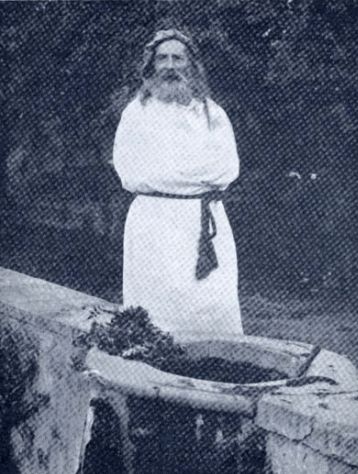
MAX THEON |
|
|
by Wikipedia Secret Rituals of the Men in Black, Appendix Two: Identifying Aliens, by Allen Greenfield
Max Theon in Algerie Max Théon (1848-1927) perhaps born Louis-Maximilian Bimstein, was a Polish Jewish Kabbalist and Occultist. In London while still a young man, he inspired The Hermetic Brotherhood of Luxor in 1884, but seemed to have little to do with the day to day running of the organisation, or indeed its actual teachings (Chanel et al., Hermetic Brotherhood of Luxor).
There is some dispute over whether
Theon taught Blavatsky at
some stage; the Mother in
The Agenda says he did, Chanel et al. considers this unlikely, while K.
Paul Johnson speculates in The Masters Revealed that the Theosophical
adept Tuitit Bey might be based on Theon. The Hermetic Brotherhood of
Luxor claimed to have originated in Egypt in 1870 and been brought to
England by Theon in 1884.
In 1885 Theon married Mary Chrystine Woodroffe Ware (Madame Alma Theon), and the following year the couple moved to Paris. In December 1887, the Theons left France for Algiers, where they were later joined by Alma Theon's friend Augusta Roife (Miss Teresa), and acquired a large estate in Zarif, a suburb of Tlemcen, Algeria. However Theon would still go on frequent visits to Paris. Theon gathered a number of students, including Louis Themanlys and Charles Barlet, and they established the "Cosmic Movement". This was based on material, called the Cosmic Tradition, received or perhaps channelled by Theon's wife. They established the journal Cosmic Review, for the "study and re-establishment of the original Tradition". Theon stated that his wife Alma was the moving spirit behind this idea, and without her the Tradition and the cosmic philosophy would never have come about. Louis was a friend of Matteo Alfassa, the brother of Mirra Alfassa (who would later associate with Sri Aurobindo and become The Mother), and in 1905 or 1906 Mirra travelled to Tlemcen to study occultism under Theon (Sujata Nahar, Mirra the Occultist). The Mother mentions that Sri Aurobindo and Theon had independently and at the same time arrived at some similar conclusions about evolution of human consciousness without having met each other. The Mother's design of Sri Aurobindo's symbol is very similar to that of Theon's, with only small changes in the proportions of the central square (Mother's Agenda, vol 3, p. 454). The death of his wife in 1908 was a huge blow to Theon, from which he never really recovered. He fell into a deep depression, and cancelled the Cosmic Movement. During this time he was cared for by his followers. He recovered somewhat but never retained his former status. Theon died at Tlemcen on 4 March 1927. References
|