|
Chapter 7:
Conclusions: The future of polyarchy and global society
Most people in the
world put up with very great inequalities, but
when these inequalities appear to be increasing without prospect of
being reversed and when they mean famine, epidemic, and certain
death for millions of people, they cease to be merely aesthetic
problems and acquire the status of political crises.
--
Richard Barnet and Ronald Muller [1]
The world of humankind constitutes a manifold, a totality of
interconnected
processes, and inquiries that disassemble this totality into
bits and then fail to reassemble it falsify reality. Concepts like
"nation," "society," and "culture" name bits and threaten to turn
names into things. Only by understanding these names as bundles of
relationships, and by placing them back into the field from which
they were abstracted, can we hope to avoid misleading inferences and
increase our share of understanding.
-- Eric Wolf [2]
The present study, as stated in the introduction, has a dual purpose.
The first was to analyze and explain the promotion of polyarchy in US
foreign policy. The second, more open-ended, was to explore political
and social dimensions of globalization. This concluding chapter is
divided into two parts. In the first part, I recapitulate my main
thesis,
take a brief look at "democracy promotion" programs in the former
Soviet bloc and South Africa and US activities worldwide so as to
strengthen generalizing conclusions, and summarize in comparative
perspective the case studies. I then go on to address the relationship
between capitalism and democracy in light of globalization, and
present a novel Gramscian framework for analyzing this relationship.
This discussion forms the backdrop to an analysis of the contradictions
internal to the transnational agenda and to an evaluation of the
prospects that the promotion of polyarchy will succeed in its
objectives.
It also forms a logical bridge to the second part of the chapter, an
exploration of broader theoretical issues, including the prospects for
world order, intended to contribute to current research and debate on
emergent global society.
Prospects and contradictions of the
transnational agenda: capitalism and
democracy in light of globalization
A recapitulation of the central thesis
A significant shift has taken place in US foreign policy, from backing
authoritarianism and dictatorships to promoting polyarchic political
systems. Behind this shift is a change in the salient form of social
control exercised in a transnational setting, from coercive to
consensual
means of domination within a highly stratified international system, in
which the US plays a leadership role as the dominant world power.
This policy shift was analyzed through a methodological approach
that weaved together practical-conjunctural, or behavioral, analysis
with structural analysis (along with a third mediating level, the
structural-conjunctural). At the structural level, the shift is grounded
in
globalization, which occasions highly fluid social relations, "stirs"
masses of people to rebel against authoritarian forms of political
authority, and thus calls forth new political structures to mediate
social
relations within and between nations in the world system. Just as
polyarchy emerged in the core countries of the world system when
capitalism became fully consolidated there, polyarchy is now emerging
as the principal political system in the Third World, and increasingly,
as a transnational political system corresponding to global capitalist
society. At the practical-conjuncturallevel, the extended policymaking
community in the United States developed a theoretical awareness and·
a practical attunement to changes taking place in the world and to
what is required for the maintenance of social control in twenty-firstcentury
global society, which led to the development of new policy
instruments, to the reorganization of the foreign-policy apparatus, and
to the launching, from the early 1980s and on, of "democracy promotion"
operations around the world. The immediate purpose of US
intervention in national democratization movements was to gain
influence over and to try to shape their outcomes in such a way as to
preempt more radical political change, to preserve the social order and
international relations of asymmetry. Beyond this immediate purpose,
the new political intervention is aimed at advancing the agenda of the
transnational elite - consolidation of polyarchic political systems and
neo-liberal restructuring. It seeks to develop technocratic elites and
transnational kernels in intervened countries who will advance this
agenda through the formal state apparatus and through the organs of
civil society in their respective countries.
The operating assumption is that these analytical precepts and
theoretical propositions should be evaluated by assessing their utility
in providing rational explanations congruent with empirical findings.
As the case studies make clear, there is a "good fit" between those
precepts and propositions and the findings. But to what extent
generalizations
can be made based on these four case studies alone remains
open to question. The particular history and conditions of each country
and region determine the circumstances under which it enters global
society. Exactly what form US political intervention takes in a specific
country (if it even occurs) depends on a host of factors, including the
complex of circumstances within the intervened country and its
historical relationship with the United States. The countries examined
in preceding chapters, while they differed from each other, all shared a
long history of US penetration and intervention. The Philippines was
an outright colony, Nicaragua and Haiti were near-protectorates, and
Chile, although it enjoyed more clout and autonomy vis-a-vis the
United States, had been under US domination since late last century. It
is safe to rule out a "deviant case" argument on the basis of definite
patterns identified in four countries. However, on this basis alone it
is
difficult to draw general conclusions with certainty. Brief overviews of
US "democracy promotion" programs in the former Soviet bloc and in
South Africa, and a summary of these activities worldwide, allow us to
make generalizing claims with much greater certainty and to
strengthen the validity of the general thesis.
The Soviet bloc and South Africa: complex
convergences of US intervention and globalization
pressures
A brief look at the former Soviet-bloc countries and South Africa
reveals the same patterns of US conduct apparent in the four case
studies, and the intersection of US intervention with endogenous
developments and globalization pressures, under circumstances
dramatically
different from those in the studies. The former Soviet bloc
was not a part of the Third World but constituted the "Second World"
- powerful contenders in the semi-periphery in the world system
framework. South Africa was also a strong semi-peripheral country
with a well-developed domestic capitalist class and an advanced
process of internal capital accumulation. The United States was not the
principal outside power in South Africa, much less in the former Soviet
bloc, and relations were never ones of domination and dependency in
either case.
The new instruments of political intervention were deployed
throughout Eastern Europe starting in the mid-1980s, and later on in
the Soviet Union itself. Similarly, the NED and other "democracy
promotion" programs were set up in South Africa in the mid-1980s. In
neither of these cases did the United States create movements for
democratic change - these movements were endogenous developments
- but it did set out to gain as much influence as possible over
their outcomes. In the former Soviet bloc, the objective was not
specifically to bring about the demise of communist regimes; this was a
goal already actively pursued on all fronts since 1917. Rather it was to
accelerate that demise and, more significantly, to contribute, through
elections and in subsequent programs, to strengthening the most
procapitalist
factions with favorable perspectives for developing a "global
outlook" and for promoting the agenda of the transnational elite. US
intervention helped these factions come to power in place of discredited
communist parties, or at the minimum, helped them to spread
their influence and position themselves strategically in post-communist
societies. In South Africa, the goal was to bring within manageable
bounds the struggle against apartheid so as to limit the extent of a
popular outcome and to try to substitute white minority rule with
inter-racial polyarchic minority rule, as part of a transition from
racial
to non-racial capitalism.
The Soviet bloc
During the first half of 1982, a five-part [US] strategy emerged that
was aimed at bringing about the collapse of the Soviet economy,
fraying the ties that bound the USSRto its client states in the Warsaw
Pact and forcing reform inside the Soviet empire. Elements of the
strategy included: The US defense buildup already under way, aimed
at making it too costly for the Soviets to compete militarily with the
US ... Covert operations aimed at encouraging reform movements in
Hungary, Czechoslovakia and Poland; Financial aid to Warsaw Pact
nations calibrated to their willingness to... undertake political and
free-market reforms; Economic isolation of the Soviet Union and the
withholding of Western and Japanese technology ... Increased use of
Radio Liberty, Voice of America and Radio Free Europe to transmit
[US] messages to peoples of Eastern Europe.
--
Time magazine [3]
In the 1960s and onward, the Soviet-bloc countries became increasingly
integrated into the capitalist world market through loans, trade,
technology transfers, and even direct foreign investment (a process
which, in my view, was inevitable). This integration overlapped with
globalization, and had social, political, and ideological ramifications
that interacted with, and aggravated, problems internal to the bloc,
namely rigid statist models of socialism and highly authoritarian
political systems that suppressed popular participation and subordinated
civil society to the state. The social response to this process
eventually burgeoned into the mass movements for democratic change
of the 1980s.A review of these movements prior to the collapse of the
bloc in the period 1989-1991 reveals, in highly simplified terms, that
two broad strands had developed among the region's political leaders,
trade unionists, grassroots activists, and intellectuals who led the
revolutions in civil society: those whose vision of change was the
creation of societies free from the defects of both capitalism and the
existing brand of statist and authoritarian socialism (that is, those
who
were seeking some type of a democratic socialist renewal along the
lines of the model of popular democracy), and those who were more
closely tied to the West and who, whether for reasons of personal
ambition or of political conviction, sought the creation of capitalist
systems modeled after the developed Western countries and managed
by polyarchic elites.4
It was in this milieu, and alongside the extraordinary structural
power which transnational capital could impose on the former Soviet
bloc once it had become integrated into the world economy, that the
United States introduced massive "political aid" programs into the
tegion. This aid started with support for the Solidarity trade union
federation in Poland in the early 1980s and snowballed by the end of
the decade into multi-million dollar programs in all the countries of
the
bloc, in synchronization with the rekindling of the Cold War under the
Reagan presidency and a host of military, economic, political, and
ideological activities.5 Political aid was utilized in a very specific
and
highly effective manner. Its purpose was to identify and support those
groups and individuals within the loose coalitions of political clubs
and civic groups in civil society that could gain leadership positions
in
highly fluid and semi-spontaneous mass movements and steer these
movements into outcomes of "free-market democracy."
In 1982, the United States and the Vatican launched a joint secret
program, managed largely by the CIA and by the AFL-CIO, to support
Solidarity. In 1984, the NED took over much of the US support for
Solidarity, which became overt and channeled through the FrUI, in
close coordination with the CIA. "Money for the banned union came
from CIA funds, the National Endowment for Democracy, secret
accounts in the Vatican and Western trade unions," reported Time
magazine in a 1992 after-the-fact expose.6 Solidarity had emerged
several years earlier as an authentic movement for democratization
incorporating some ten million Polish workers. The covert aid did not
create the movement but facilitated US influence over it and helped the
more pro-Western elements assume leadership during the course of
the 1980s. In 1982, the same year as President Reagan signed the
National Security Decision Directive (NSDD) authorizing Project
Democracy
(see chapter 2) and parallel to the Washington-Vatican
program, he also signed NSDD 32, which authorized a vast range of
economic, political, diplomatic, military, and psychological operations
to destabilize the Soviet bloc. One of the key planks of the regional
operation was the use of Solidarity to launch operations throughout
the region, often without Solidarity leaders - much less Polish workers
at the grassroots - having any knowledge of such external linkages or
manipulation for outside purposes. "The Solidarity office in Brussels
became an international clearinghouse: for representatives from the
Vatican, for CIA operatives, for the AFL..CIO, for representatives of
the
Socialist International, for the congressionally funded National
Endowment
for Democracy, which also worked closely with [CIA director
William] Casey," reported Time?
The assistance for Solidarity provided a precedent and a model for
massive overt, as well as covert, political aid programs throughout the
decade and into the 1990s. Solidarity was utilized as a point of
penetration not only of the Polish state, but of governments and of
dissident civic and political groups throughout Eastern Europe and the
Soviet Union. In this way, the endogenous and authentic stirrings in
civil society in the Soviet bloc were latched on to a US destabilization
campaign. It is worth reiterating that the United States did not create
the democratization movements in the Soviet bloc or the crisis that led
to the collapse of Soviet communism, but rather manipulated that
crisis and intervened in the mass movements to try to assure an
outcome favorable to the interests of the transnational elite. US
activity
sought to encourage existing discontent and to harness that discontent.
Between 1984 and 1992, the NED spent an astonishing $50.5 million in
the former Soviet bloc.8 On the eve of the collapse of the Soviet bloc,
Gershman argued:
[P]iecemeal reforms and greater openness will release pent-up political
pressures for change ... Indeed, it has now become possible to
consider practical measures to support democratic efforts that are
already underway in Poland and elsewhere in Eastern Europe, as well
as in the Soviet Union itself. The measures will naturally vary,
depending on the extent to which democratic movements have
developed in different countries... Efforts to assist the emergent
pluralism in the Soviet Union and Eastern Europe should have as
their overriding objective the growth and eventual empowerment of
civil society ... As democratic movements in the Soviet bloc take this
path, they should receive moral, material, technical and political
support from their democratic friends in the West.9
One month after the collapse of the Soviet Union, in August 1991,
the Washington Post reported: "Preparing the ground for last month's
triumph was a network of overt operatives who during the last 10
years have quietly been changing the rules of international politics.
They have been doing in public what the CIA used to do in private -
providing money and moral support for pro-democracy groups,
training resistance fighters, working to subvert communist rule."lO A
"strategy paper" drafted a month later, in October 1991, stated that
"the Endowment's mission was from the very outset conceived not as
anti-communist but as pro-democratic [read: not just to destabilize
existing regimes, but to place viable alternatives into power]. Its aim
was not only to assist those seeking to bring down dictatorships, but
also to support efforts to consolidate new democracies." The document
went on to note that NED activities throughout the 1980s
involved three essential tasks: "strengthening democratic culture";
"strengthening civil society"; and "strengthening democratic political
institutions. "11
Although a full exploration is not possible here, these programs, in
much the same way as programs documented in the case studies,
ranged from support for trade unions, to the creation of new business
associations, women's, student, and youth organizations, and media
outlets, and/or support for existing ones. US officials also convened
hundreds of bilateral and multilateral seminars, conferences, and
training sessions for the development of political leadership among the
civic groups, political clubs, and social movements that sprang up in
the bloc. These activities helped to establish a network of individuals
and groups throughout the Soviet bloc, to place them in contact with
one other, and, with US and other Western backers, to provide them
with an effective "political action capacity" and the ability for public
projection (thus to creating demonstration effects) through diverse
communications technologies. Such financial, technical; and political
support allowed these "agents of influence" to assume leadership roles
in the uprisings in civil society and was critical in tipping the
balance
in the string of elections held in the region in 1989-1990. Many of the
US organizations that were involved in NED and other "democracy
promotion" operations in the Philippines, Chile, Nicaragua, and Haiti
also became involved in Eastern Europe and the Soviet Union. Prominent
among these was the CFD, which opened a permanent office in
Moscow and undertook "a broad program of technical assistance to
independent groups and publications."12
The case of the Inter-Regional Deputies Group (IRG) in the Soviet
Union is a concrete illustration of how strategic doses of US political
aid, injected into the complex milieu of a disintegrating communist
bloc, proved to be highly effective. The IRG was formed in summer
1989 at a meeting of the Congress of People's Deputies, was led by
Andrei Sakharov and Boris Yeltsin, and brought together some 400
members of the Congress, or about 20 percent of the 2,250 seats. The
IRG won international attention, but its links to US intervention
programs were little known. By the end of 1989, with assistance from
the right-wing Free Congress Foundation, the CFD, and other US
groups operating with NED and other "private" and public US funds,
the IRG had set up a training school for candidates to put forward the
IRG program, which called for the restoration of private property, a
market economy, and a constitutional system of formal representative
(polyarchic) democracy. The IRG provided the institutional basis for
Yeltsin's electoral success in securing the leadership of the Russian
Soviet Socialist Republic. From that institutional foothold, Yeltsin and
the IRG network continued to extend their influence.
The IRGbrought together the core group that not only pressed for the
demise of the Gorbachev government from within Soviet institutions,
but also managed to assume the reins of the state following the abortive
1991 coup d'etat. Its members most closely approximate those groups
within the post-communist elite which are identified with the
transnational
agendaP The IRG developed enough organizational coherence
and a network of strategically placed leaders in the crumbling Soviet
government and its different branches to quickly fill the vacuum of
power that developed after the abortive coup. The IRG members were
not pliant US puppets: US political aid and intervention gave a crucial
boost to the IRG by helping its members come together and develop a
working network, and create a capacity for communications amongst
themselves and before the Soviet public, and for political action from
within different institutional bases of the Soviet state. This was
achieved
on the part of US operatives, apart from the supply of important
communications equipment and training programs, through establishing
numerous liaison mechanisms with external constituencies, in
conjunction with USdiplomacy and other components of US policy.14
Similarly, throughout Eastern Europe US political intervention
played the role of organizing small nuclei that could sweep into
vacuums left at the top, once mass pressure from below forced the
collapse of the old communist regimes. The Free Congress Foundation
and the CFD, for instance, established offices and set up equipment
supply, communications, and training programs in Hungary, East
Germany, Estonia, Romania, Yugoslavia, Czechoslovakia, and Bulgaria,
just as they had done in Moscow with the IRG and other Soviet
groupS.IS Reciprocal to Western efforts to seek out potential nuclei,
factions in the bloc that identified with the transnational agenda
gravitated naturally toward those who managed US political aid
programs, knowing that these programs would link them to Western
constituencies and resources. In this way, US political aid facilitated
East-West elite bonds and shared identities of interest in the heady
transition period.
Following the demise of the old communist regimes, the United
States played the leadership role on behalf of the transnational elite
in
a long-term project for integrating the former Soviet bloc fully into
the
global economy and for promoting the transnational agenda. On the
economic side, this involved massive restructuring, including
privatization,
eliminating trade barriers, creating a new legal framework for
private property and the institutions of capitalist economic manage-
ment, and opening up the region's natural resources and labor force to
transnational capital. On the social and political side, this involved
attempts to create formal polyarchic structures and to encourage
postcommunist
class formation and the emergence of elites that could
promote the transnational agenda within their countries. This included
not just bolstering an elite with a transnational outlook, but
countering
nationalist elements (of the right, in particular) that were exploring
inward-looking strategies.
Whether the former "Second World" would move towards the core
of the global economy or experience peripheralization was certainly
not clear in the 1990s. Nor was it possible to predict whether tenuous
polyarchic political systems would stabilize in Russia and Eastern
Europe. But the collapse of the Soviet bloc, seen at the structural
level
and beyond the immediate political unknowns, had the effect of
accelerating world economic integration into a single global economy.
Economic restructuring went together with the inflow of tens of
billions of dollars in external aid, from the G-7 industrialized
countries,
the IMF, the World Bank, and other multilateral sources, while political
aid programs that continued after the 1989-1991 transitions pushed
institution-building and class fonnation.16
South Africa
Endowment programs in Africa continued to stress building such
pluralist institutions as free trade unions, business associations, a
free
press, and independent civic organizations as a basis for the eventual
development of democratic political institutions. The country of
greatest priority for the Endowment in Africa was South Africa... The
Endowment has begun programs to develop black consumer groups
and cooperatives, support the activities of community groups
working to reduce violence and encourage peaceful change, and aid
intellectual and informational efforts to promote understanding of
democracy and dialogue among anti-apartheid groups seeking alternatives
to violence.
--
NED Annual Report, 1987 [17]
US policy toward South Africa was the linchpin of policy toward Black
Africa for much of the post-World War II years, and was predicated on
support for colonial and racial authoritarian regimes. Successive
Democratic
and Republican administrations in this period, despite verbal
condemnation of white minority regimes, developed strategic alliances
with Portuguese colonies and with white minority governments in
South Africa, South-West Africa (now Namibia) and Rhodesia (now
Zimbabwe). In 1969, the Nixon administration drafted National Security
Study Memorandum 39. This document, which became known
as the "Tar Baby Report," concluded that Africa policy should be
based on a long-term strategic alliance with the apartheid regime in
South Africa.18 The African National Congress (ANC), the South-West
African People's Organization (SWAPO) and the Zimbabwe African
National Union (ZANU), all of which went on to win elections and
head post-independence and post-apartheid governments, were labelled
"terrorist" organizations by the State Department throughout
the 1960s, 1970s, and into the 19805,and the United States provided
low-key military assistance, political and diplomatic support, and
intelligence information to the white minority regimes. The US alliance
with racialized authoritarianism was complementary and subordinate
to European imperial powers who pursued similar policies and were
historically the dominant outside powers in the region. Support for
authoritarianism in southern Africa was not a particularly US policy
but a general practice of the core powers in the world system toward
this region.
From the 1960s and on, South African capital became thoroughly
intermeshed with capital originating in Europe, the United States, and
Japan. As globalization advanced, South Africa became a key outpost
of transnational capital. South African capitalists had themselves
become thoroughly transnationalized (epitomized by the Oppenheimer
family and the Anglo-American Corporation, a leading transnational
corporation, in the same league as any Northern-based global
corporation), and South Africa became the principal staging point for
the operations of transnational capital throughout southern and central
Africa. In this way, the relations of dependence and the peripheral
status in the world system of a good portion of Black Africa "passed
through" South Africa itself. On the heels of the mass rebellion that
began with the 1976 Soweto uprising, the transnational elite began to
push their South African counterparts to search for a political solution
that would involve a transition from racial to non-racial capitalism and
thus preserve the interests of transnational capital, not just in South
Africa but in southern and central Africa as a whole. US calls for such
a transition were coordinated with concerted European support for
this transition. In was in this context that US policy changed
dramatically
in the mid-1980s, from support for apartheid to "promoting
democracy. "19
This shift in policy towards southern Africa was part of a broader
process of policy reformulation from the 1960s to the 1990s in the face
of the mass, popular movements against the repressive political
systems and exploitative socioeconomic orders established during the
Cold War years. In Africa, this included the collapse of Portuguese
colonialism and successful revolutions in Angola and Mozambique in
1975 (these revolutions were subsequently subject to low-intensity
warfare campaigns similar to that waged against Nicaragua) and a
transition to black majority rule in Zimbabwe in 1980 in the face of an
armed insurgency which came close to seizing power. In 1977, the
United States, under the Carter administration, publicly called for the
first time for majority rule in South Africa. It adopted a policy of
applying diplomatic pressure to, but not withdrawing support for, the
apartheid regime. At the same time, it sought to identify and support
"moderates" among both black and white groups and to isolate the
radical elements, including the ANC, which were leading the mass
movement against apartheid. The first Reagan administration launched
a "constructive engagement" policy similar to its "quiet diplomacy"
policy towards the South American dictatorships. This policy was
jettisoned in the mid-1980s, however, as mass protests escalated in
South Africa and as domestic pressure against apartheid heightened in
the United States. The latter included a grassroots anti-apartheid
movement and growing consensus among elites that a post-apartheid
strategy had to be developed and implemented while events still
remained within limits which could be managed by the transnational
elite. In 1981, the Foreign Policy Association - a leading private group
of the extended US policymaking community tied to the transnationalized
fraction - published a 520-page report titled South Africa: Time
Running Out, or simply the SATRO report. This report was prepared
by a special Study Commission on US Policy Toward South Africa set
up in the Council on Foreign Relations. It called for a transition to
"democracy" and non-racial capitalism.20
A key turning point in US policy came in 1985, when Congress
imposed limited economic sanctions on South Africa. A year later it
enacted the Comprehensive Anti-Apartheid Act, which tightened sanctions,
as part of a strategy of pressuring the white regime into
negotiations. President Reagan vetoed the Act, but his veto was
overridden by a large congressional majority, including a majority of
his own Republican Party.21Seen in the abstract, the Reagan
administration's
policies until 1986 reflected the disjuncture analyzed in
chapter 2 between the neo-conservatives who held important posts in
the formal state apparatus in the first part of the 1980s and the agenda
and policies of the transnational elite which had become hegemonic
and gradually became officialUSstate policy during the 1980s.
US policy turned to increasing pressure on the apartheid regime and
to developing moderate black leaders and organizations in civil
society as a counterweight to the militant black movement. This
change in policy, synchronized with pressures exerted by the
transnationalized
capitalist fraction inside South Africa and by other core
powers on the state, led the regime to open a reform process. In
September 1989, Frederik de Klerk was elected president of South
Africa and announced his intention to create a "new [post-apartheid]
South Africa." Four months later he released Nelson Mandela from
prison and legalized previously banned opposition groups, including
the ANC. De Klerk and his cabinet - "proximate policymakers"
representing South Africa's transnationalized fraction - faced the dual
challenge of negotiating with the black majority and easing the fears of
the regime's white base that an end to apartheid would mean radical
change in the social order. In 1992 the de Klerk government began
negotiations with the ANC and other anti-apartheid groups. In April
1994, Mandela was elected president of South Africa and apartheid
came to an official end.
From the mid-1980s and on, the issue for the United States became
not whether apartheid would be dismantled, but how South African
capitalism and the interests of the transnational elite in the region
could be preserved following a transition period. US influence in South
Africa should not be exaggerated: intervention in the transition period
was only one of many factors shaping the outcome, and events in
South Africa consistently overtook US policy. Given the overwhelming
support the ANC enjoyed among the black population, and Mandela's
tremendous international stature, the USobjective was not to disregard
the ANC or Mandela, but to check the growing radicalism among the
black population by developing counterweights to popular leadership
through US political and economic aid programs. One prominent
"credible black leader" promoted in this way was Zulu Chief Gatsha
Buthelezi, whom President Bush attempted to place, in his public
diplomacy toward South Africa, at par with de Klerk and Mandela
during the transition period.ll What concerned the transnational elite
most was Mandela's insistence that the dismantling of apartheid
should involve not just eliminating racial discrimination from the
political sphere but also eliminating inequalities in the socioeconomic
order. "As far as the economic policy is concerned, our sole concern is
that the inequalities which are to be found in the economy should be
addressed," stated Mandela shortly after his release. "We have mentioned
state participation in certain specific areas of the economy, like
mining, the financial institutions and monopoly industries."23 Such
economic thinking was not only diametrically opposed to the
transnational
project of neo-liberalism but also went to the "commanding
heights" of the powerful (and thoroughly transnationalized) South
African economy - mining, finance, and industry. In contrast, Buthelezi
argued that "Socialism... has failed miserably ... The free enterprise
system remains the only system in which wealth can be generated in
such a way as to provide the jobs and infrastructure necessary for
growth and stability."24
In 1985, the NED launched Project South Africa to "identify and
assist South African organizations dedicated to a non-violent strategy
to eliminate apartheid and to achieve democracy. Among the South
African organizations already identified are trade unions, churches
and church groups, human rights and voluntary agencies, educational
associations and many others. Project South Africa hopes to facilitate
direct contact between such groups and Americans dedicated to
providing material and moral support to their efforts."2s Between 1985
and 1992, the NED set up programs with a host of trade unions,
community groups, and black business associations. It also set up and
funded several clearing-houses whose multiple functions ranged from
developing strategies on a transition, coordinating diverse "moderate"
political activities, and funding moderate black media outlets and
publications. These clearing-houses played a role similar to the
thinktanks
funded in Chile in that country's transition and to the two
clearing-houses of this type funded by the NED and the AID in Haiti.26
Alongside NED programs, the AID initiated in the late 1980s a
multi-million dollar program, known as Assistance for Disadvantaged
South Africans, to fund housing, economic development, and educational
programs for black South Africans and provide loans and grants
to blacks to set up private businesses. The objective was to open up the
economic system to greater black participation without proposing
basic restructuring. The program sought "to broaden understanding of
the free market system and prepare black business owners, managers,
and employees for success in a postapartheid South Africa." Funding
went to "strengthen black business associations" and to "training
black women to become leaders in the accounting and financial
services field and providing credit to small businesses."27
These NED and AID programs had several overlapping strategic
objectives: (1) identify and support an emergent black middle class of
professionals who could be incorporated into a post-apartheid hegemonic
bloc (2) develop a nationwide network of grassroots community
leaders among the black population that could win leadership positions
in diverse organs in civil society and compete with more radical
leadership and (3) cultivate a black business class among small and
mid-level black-run or mixed enterprises that would have a stake in
stable South African capitalism, develop economic power, and view
the white transnationalized fraction of South African capital as allies
and leaders. Scrutiny of the NED-AID programs reveals that recipients
were almost all moderate and conservative groups that competed with
the ANC and with the mass popular organizations of the United
Democratic Front, a militant national coalition of some 600 affiliated
civic associations.28 For instance, the NED provided funds to the FfUI
and the AID provided funds to the AALC in order to support the
United Workers Union of South Africa, which was linked to Buthelezi's
Inkatha Freedom Council, and the small but influential South African
Black Taxi Association, both of which competed with the Congress of
South African Trade Unions, the powerful federation, oriented to the
social movement, that sympathized with the ANC and organized over
one million black workers from the mines, and the industrial,
commercial,
and civil service sectors. The NED-funded think-tanks and
clearing-houses, among them the Get Ahead Foundation and the
Institute for a Democratic Alternative in South Africa, organized
workshops,
seminars, conferences, research programs, and media activities,
and set up training programs for black business and community
leaders, and for moderate and conservative trade unions, and
women's, youth, and church groups. Through these programs, US
intervention helped foster a core of grassroots leaders that were
strategically placed throughout the organs of an already densely
organized civil society comparable to that of Haiti.
Neither Washington nor the apartheid regime had the ability to
control the South African mass movement. The counterweights to the
ANC and the mass popular movement were not expected to win
transitional elections, but rather to continue building constituencies
and exerting influence in the post-apartheid period, as part of a
longterm
project for the construction of a hegemonic post-apartheid social
order. The election of Mandela and the end of apartheid was a
tremendous victory for democracy worldwide. But it was not clear,
given South Africa's thorough integration into the global economy and
the strength of transnationalized South African capital and its control
over the country's resources, how much structural power Mandela's
government would actually be able to exercise in bringing about
fundamental transformations in the social order.
US "democracy promotion" operations worldwide
Between 1984 and 1992, the NED and other branches of the US state
mounted "democracy promotion" programs in 109 countries around
the world, including 30 countries in Africa, 24 countries in Asia, 21
countries in Central and Eastern Europe (including the republics of the
former Soviet Union), 8 countries in the Middle East, and 26 countries
in Latin America and the Caribbean. In addition, what the NED
referred to as "regional programs" (Asia-wide, Africa-wide, Latin
America-wide, etc.), and what it referred to as "multiregional programs"
(worldwide) involved dozens of other countries.29 The NED,
as discussed in chapter 2, is only one of many policy instruments in
"democracy promotion" operations, and is usually not even the
principal one. Since it is an adjunct component of US engagement
abroad and of the full panoply of foreign-policy instruments, the
presence of its activities in a country or region generally indicates
that
broader and related activities are underway as part of a larger
"democracy promotion" undertaking. The operation of the NED in 109
countries in every region of the world underscores that the new
political intervention is a worldwide policy.
A review of the NED's Annual Reports from 1984 to 1992 indicates
that most of its activities were concentrated in the 1980s in those
areas
and countries where the United States has traditionally exercised
domination, particularly, in Latin America, in key client regimes, such
as the Philippines, as well as in crisis situations and in strategic
zones
and countries, such as Poland throughout the 1980s and the entire
former Soviet bloc by the end of that decade. In the early 1990s,NED
operations continued in these countries and regions, but also expanded
dramatically in Africa, the Middle East and other Asian countries. For
instance, the NED reported programs in just two African countries in
1986but in seventeen in 1992.The new political intervention started in
those areas of traditional US influence and then began to spread out
around the globe. In an early 1993 meeting of the board of directors,
Gershman reported: "the Endowment has taken measures to
address ... three key elements of its long-term strategy, namely,
providing
venture capital to advance democratic forces in 'pre-breakthrough'
countries; developing mechanisms to facilitate coordination
among its grantees; and increasing its role as a center of democratic
thought and activity." He noted that the NED "has begun an active
program in the Middle East and increased its efforts in the 'tougher'
countries in Africa and Asia."30
This expansion of NED activities also reflects the broader issue of the
transnationalization of political processes in the age of global
society.
"Developing mechanisms to facilitate coordination among its grantees,"
which Gershman identified as one of three key elements in the
NED's long-term strategy, implies the development of mechanisms to
facilitate coordination among the organs of civil societies [Le., NED
"grantees"] which the United States is promoting around the world - a
further sign of the transnationalization of civil society, and relatedly,
of
the tendency toward a shift in the locus of social control toward civil
society. A careful review of the Annual Reports also underscores the
tight correlation between the promotion of polyarchy and of
neoliberalism,
and efforts to promote political and economic integration of
countries and regions into global society. The NED's "regional programs"
and "multiregional programs" generally focused on arranging
international forums or launching transnational communications projects
for the purpose of establishing cross-national South-South and
North-South linkages around programs and strategies for promoting
polyarchy and neo-liberalism. In turn, individuals and groups drawn
into these regional and international forums are the same people
involved in NED and other "democracy promotion" programs in their
own countries, and represent their country's transnational pools. In
this way, we see how "democracy promotion" acts in a recursive
manner to facilitate globalization.31
The Philippines, Chile, Nicaragua, Haiti, the
Soviet bloc, and South Africa in comparative
perspective
Each study illustrated, in different manners and on the basis of
particular circumstances, the analytical precepts and theoretical propo-
sitions advanced in chapters 1 and 2. In all four countries, cross-class
majorities had coalesced into national democratization movements
against US-backed authoritarian regimes, yet behind these majoritarian
movements were distinct visions of what type of social order should
follow dictatorship. Opposition elites sought the establishment of
polyarchic political systems and free-market capitalism. Popular forces
called for fundamental changes along the lines of the model of popular
democracy. (The same was true, although in their unique settings, for
the Soviet bloc and South Africa.) The strength of the elite versus that
of popular sectors and their leaderships varied from case to case. In
Nicaragua and Haiti popular sectors were considerably stronger than
elites, and in both countries they came to power and attempted to
implement projects of popular democracy. In the Philippines, the
correlation between popular and elite sectors hung in the balance
during a tenuous transition period. In Chile, a combination of
circumstances
assured a fairly smooth consolidation of elite hegemony over
the transition. In all cases, the forces of global capitalism acted to
strengthen projects of polyarchy and neo-liberalism and to weaken the
projects of popular social change.
The United States intervened when these national democratization
movements were reaching crescendos, threatening not just the existing
regime but the social order itself. The beneficiaries of this
intervention
were neither the popular sectors nor the old autocrats, dictators and
"crony" elites, but new technocratic sectors tied to the global
economy that articulated the transnational agenda. In the Philippines
and in Chile, policymakers withdrew support for Marcos, Pinochet
and their respective cohorts, and placed support fully behind elite
opponents. In Nicaragua, policymakers failed in their attempt to
facilitate a transition from Somoza to his elite opposition. By the time
they retook the "democracy promotion" effort - in the mid-1980s and
as part of a broader war of attrition against the Nicaraguan revolution
- they supported not the old Somocistas but new elite groups that
went on, following US intervention in the 1990 elections, to assume
the reins of the executive. In Haiti, the United States orchestrated the
replacement of the Duvaliers with an interim junta but could not
place in power a weak and fledgling technocratic elite. After Aristide
came to power, support for this elite escalated. How decisive US
intervention was as one key variable among many in assuring elite
outcomes varied from case to case and depended on the circumstances
of each country. However, in all cases, the new political intervention
became well synchronized with the complex of factors determining
outcomes.
All four cases and the two synopses demonstrated the intersection of
globalization and "democracy promotion" and the relationship
between polyarchy and neo-liberal restructuring. This included multiple
overlaps between the penetration of transnational capital, the
reorganization of productive processes, the recomposition of national
class structures and the emergence of new political protagonists,
external constraints which the global economy placed on internal
policy options and socioeconomic transformations, and so on. Transitions
to polyarchy coincided with structural adjustment and a deeper
insertion into the global economy, and US policymakers intentionally
linked the two in the process of policy formation towards each
country. In the Philippines, Nicaragua, and Haiti, the increasing
penetration of transnational capital starting in 1960s simultaneously
spawned popular, mass movements and clashed with local brands of
"crony capitalism," making a transition to polyarchy and neo-liberalism
necessary for both political and economic reasons (to prevent a
popular revolution and to dismantle "crony capitalism" impediments
to transnational capital). The transition in the Philippines was
followed
by a broad neo-liberal program. In Nicaragua, the global economy
imposed enormous constraints on the ability of the revolutionary
government to effect internal socioeconomic changes in favor of the
poor majority. After the 1990 "electoral coup d'etat," the country's
rapid
reinsertion into the global economy and free-market mechanisms
helped to reverse quickly those transformations that had occurred
during the revolution. In Haiti, Aristide's mild reform program was
opposed by transnational capital, which helped generate conditions
propitious to the 1991 coup d'etat. In Chile, massive economic
restructuring
that began under Pinochet corresponded to that country's
reinsertion into the world market under new conditions of globalization.
This restructuring disaggregated and demobilized popular sectors
and facilitated the emergence, and eventual hegemony, of entirely new
fractions among dominant Chilean groups tied to transnational capital
who became articulate ideologues and promoters of the transnational
agenda. The Soviet bloc and South Africa presented more multifarious
scenarios, but these same patterns were manifest, including the
pressures
induced by globalization and the role played by transnational
pools as protagonists. Political and economic aid was carefully
synchronized
in all countries, and these aid flows facilitated the recompo-
sition of internal classes, tied local classes to transnational class
structures, and bolstered transnational kernels in each country.
Networks
were developed that linked the organs of civil society in the
United States and in the intervened countries. Penetration of civil
societies in the intervened countries by the organs of US civil society,
linked in turn to the US state, sought to strengthen elite groups in
order
to compete with and suppress popular organizations and movements
and to construct elite hegemony, "bottom-up," from within civil
society. Political and economic aid and the policies promoted from
within and without the formal state apparatus by these transnational
kernels contributed to the construction of neo-liberal states.
The case studies also made evident the contradictions between
polyarchy and popular democracy. In the Philippines, for instance,
regular elections, a free press, constitutional rule and formal
political
and civil rights became institutionalized in the post-Marcos period. Yet
the elite, through control over the formal legislative process,
executive
prerogative, and of low-key, but systematic, repression, was able to
prevent any significant reform in the social order and to minimize
actual mass participation in the formal political process. A similar
situation occurred in Chile. In Nicaragua, the Sandinistas' attempt to
win international legitimacy led them to expand the institutions of
representative democracy (polyarchy) at the expense of the structures
of participatory democracy that were established in the early years of
the revolution. This process gave the elite increasing institutional
leverage and led to a loss of popular support for the revolutionary
government - factors which contributed to the subsequent restoration
of elite rule. This contradiction became crystal clear in Haiti, where
highly organized popular majorities were utterly unable to utilize the
formal structures of polyarchy to advance their own interests. These
structures acted to institutionally block and to ideologically
delegitimize
the demands for fundamental change in the social order. All cases
show mixed outcomes as regards the stabilization of polyarchic
political systems and hegemonic social order. Chile was a tremendous
success for the transnational elite (and is touted as such). The
Philippines
and Nicaragua approximate a situation of highly unstable polyarchies
and problems of govemability. Haiti was a failure for the US
effort to implant a polyarchic political system. The situation in the
former Soviet bloc was highly unstable and unpredictable in the early
1990s.The end of apartheid in South Africa is too recent at the time of
writing (1995)to venture any predictions.
Comparative conclusions in mainstream social science, whether
quantitative or qualitative in approach, are often based on an
abstracted
empiricism that examines different variables and then measures
and correlates the presence or absence of variables (Xl, X2, etc.)
to distinct outcomes (YI, Y2, etc.). These relationships are important
but must be tempered. In a dialectic model based on the methodology
of historical materialism, variables as empirical approximations are
recursive, multicausal, and subsumed under holistic reconstruction.
The various sequences of historical events are not separate and
independent; they are elements of a dialectic process of "social
ensembles" in the course of which relations of cause and effect
intervene, reverse, and interact. With this caveat in mind, we may note
the following: there are clearly certain general conditions propitious
to
successful transitions to polyarchy and the consolidation of polyarchic
political systems. Among these conditions, five stand out: the relative
strength of popular versus elite forces; reciprocity of domination in
political and civil society; the legacy of authoritarian arrangements
and
attendant political cultures; the presence and relative strength of
transnationalized fractions among dominant groups; and historical
timing and conjunctural circumstances during transitions.
A comparative summary reveals a direct correlation between these
five factors and outcomes. Popular forces were the strongest in
Nicaragua and in Haiti. They were the weakest in Chile. In the
Philippines they were on the ascent but faced an elite that had not
exhausted its own capacity for political protagonism. Similarly, the
transnationalized fraction was the strongest in Chile. It was present
and in the process of development in the Philippines, and, to a much
lesser extent, in Nicaragua. In Haiti, a technocratic elite was unable
to
coalesce effectively. Similarly, Haiti, followed by Nicaragua, shows
the deepest legacy of authoritarianism and dictatorship, while Chile
had a long history of functioning polyarchy prior to dictatorship and
globalization. The Philippines also experienced several decades of
proto-polyarchy before its lapse into authoritarianism. In Haiti, the
correlation of forces favored popular hegemony in civil society even
though the state remained a bastion of the dominant groups. State
power was seized in Nicaragua by popular classes simultaneously
with the development of a Sandinista hegemony in civil society. In the
Philippines, hegemony and the state were disputed for several crucial
years before the elite consolidated a tenuous hold over the social
order. A similar dispute took place in Chile in the Allende period, and
then by the time of the late 1980s "transition," the state was returned
to the dominant groups simultaneously with the construction by those
groups of hegemony in civil society. It is not surprising, therefore,
that
Chile showed the most developed post-authoritarian hegemonic social
order, the Philippines showed a consolidated but somewhat unstable
polyarchy, while Nicaragua had a nearly ungovernable polyarchy,
and Haiti seemed as far away as ever from hegemonic order. Such
"preconditions" for successful transitions to polyarchy can only be
gauged by analyzing each country's particular circumstances in
historical
context, and by factoring in the fifth variable, that of historical
timing and conjunctural circumstances, neither of which lend themselves
to predictability or facile generalizations.
However, "success" is not measured only by the stabilization of
consensual forms of domination. It is also measured by the extent to
which projects of popular democracy were suppressed, and to which
neo-liberal restructuring has taken place. In this regard, there was
remarkable "success" in five of the six cases (South Africa is the
unknown) in suppressing popular democracy and in initiating neoliberal
restructuring. The structural power of transnational capital and
the impossibility of individual countries and regions remaining outside
the global economy makes the imposition of neo-liberal restructuring,
as the economic plank of the transnational elite project, considerably
easier than the political counterpart of that project, the development
of
functioning polyarchic systems. Clearly, it is easier to suppress
popular
democracy than to stabilize its "consensual" antagonist, polyarchic
systems, which leaves open the question of a possible general reversion
to its "coercive" antagonist, authoritarianism and dictatorship.
Behind the issue of mixed outcomes and the prospects for the
consolidation of functioning polyarchies are the contradictions internal
to the transnational project. A discussion of these contradictions
appropriately rests on a reexamination of the historical relationship
between capitalism and democracy. All five variables mentioned
above as determinants in outcome are structurally contingent. The
structural basis of the variables is the social structure of
accumulation:
a set of mutually reinforcing social, economic, and political
institutions
and cultural and ideological norms which fuse with, and facilitate, a
successful pattern of capital accumulation over specific historical
periods. In turn, examining capital accumulation under distinct
institutions
and norms brings us to the relationship between capitalism and
democracy, which is central to my entire thesis and which allows us to
answer the questions: what conditions actually allow for stable
polyarchies
and what are the prospects that these conditions will be met in
specific regions and in the world as a whole? The reexamination, taken
up in the following section, paves the way for discussion on the
prospects for hegemony and world order in the twenty-first century
and forms a logical bridge between the two parts of this concluding
chapter.
Capitalism and democracy
The contradiction between neo-liberalism and polyarchy
If the promotion of polyarchy is concerned chiefly with social
stability,
an assessment of its prospects necessarily begins with an examination
of the causes of social instability. Such an examination brings us to
the
very heart of the contradiction internal to the transnational project of
neo-liberalism and polyarchy: the dramatic growth under globalization
of socioeconomic inequalities and of human misery in nearly every
country and region of the world, and a frightening increase in the gap
between the haves and the have-nots in the new world order. The
problem of "poverty amidst plenty," a consequence of the unbridled
operation of transnational capital, appears to be worldwide and
generalized. The tendency is for wealth to become concentrated in a
privileged stratum encompassing some 20 percent of humanity, in
which the gap between rich and poor is widening within each country,
North and South alike, simultaneously with a sharp increase in the
inequalities between the North and the South.
In its widely disseminated report, Human Development Report 1992,
the United Nations Development Program (UNDP) provided a frightening
global snapshot of this chasm between a shrinking minority of
haves and a vast majority of have-nots. The report provided a
"structural photograph of the planet," which it described as a global
"champagne glass" (see fig. 2). In this champagne glass, 83 percent of
the world's wealth is concentrated in the shallow but ample cup of the
North to the benefit of the 20 percent of the world's population living
there, while 60 percent of the planet's human beings are crammed into
the slender stem and base of the South, which sustains this wealth yet
benefits from only 6 percent of it. The North, noted the report, with
about one-fourth of the world's population, consumes 70 percent of the
world's energy, 75 percent of its metals, 85 percent of its wood and
60 percent of its food. It controls 81 percent of world trade, 95
percent
of its loans, and 81 percent of it&domestic savings and its
investment.32
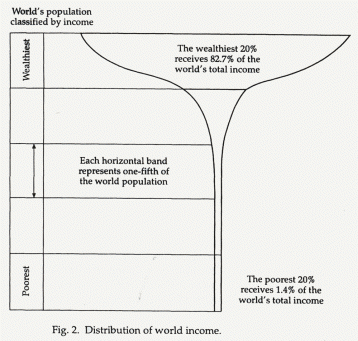
Fig. 2. Distribution of world
income.
The report noted that the gap between the rich and the poor nations
is becoming an abyss. In 1960, the wealthiest 20 pert cent of the
world's
nations were thirty times richer than the poorest 20 percent. Thirty
years later, in 1990, they were sixty times richer. This comparison was
based on the distribution between rich and poor countries, in which the
ratio of inequality went in the thirty-year period from 1:30 to 1:60.
However, the report noted: "these figures conceal the true scale of
injustice since they are based on comparisons of the average per capita
incomes of rich and poor countries. In reality, of course, there are
wide
disparities within each country between rich and poor people" (emphasis
in original). Adding the maldistribution within countries, the
richest 20 percent of the world's people got at least 150 times more
than
the poorest 20 percent.33 In other words, the ratio of inequality
between the global rich and the global poor seen as social groups in a
highly stratified world system was 1:150.Broken down into quintiles,
global income distribution in 1992, according to the report, was as
follows:
| World population |
World income
(percent) |
Richest 20 percent
Second 20 percent
Third 20 percent
Fourth 20 percent
Poorest 20 percent |
82.7
11.7
2.3
1.9
1.4 |
Source: UNDP, Human Development Report 1992. (The UNDP report notes that
these statistics hide a part of the picture, because a further breakdown
of the
distribution of wealth within the top quintile, if one were to
generalize from a
pattern revealed by forty-one countries for which statistics are
available, could
be expected to show a very high concentration among the top 1 percent
and
one-half percent.) |
Simultaneous with the widening of the North-South divide, there
has been a widening gap between rich and poor in the United States
and the other developed countries, along with heightened social
polarization and political tensions.34 Between 1973 and 1990, real
wages dropped uniformly for 80 percent of the US population and rose
for the remaining 20 percent.35 The top quintile in the United States
had increased its share of income from 41.1 percent in 1973 to 44.2
percent in 1991. The concentration of wealth (which includes income
and assets) was even more pronounced. By 1991, the top 0.05 percent
of the population owned 45.4 percent of all assets, excluding homes.
The top 1 percent owned 53.2 percent of all assets, and the top 10
percent owned 83.2 percent. The United States belonged to a tiny
minority. In that same year, those living either below the
governmentestablished
poverty line or below 125 percent of the poverty line
represented 34.2 percent of the population of the United States. In
other words, 34.2 percent of the US population was "poor" or "very
poor," or in more sociologically precise terms, over one-third of the US
population lived in absolute or relative poverty. The pattern is similar
in other developed countries of the Organization of Economic Cooperation
and Development (OECD).
Globalization involves restructuring in both center and periphery,
which is resulting in what some have called the "Latinamericanization"
of the United States or the "Third-Worldization" of the First
World. The same globalizing forces bringing forth the new international
division of labor discussed in chapter 1 are also resulting in a
new structure of labor within the developed countries of the North.
Labor there is recomposing into three clusters. First, there is that
sector
"above" traditional industry: those involved in global management,
professional services, and high-skill, high-technology production,
which constitutes an affluent 20 percent of society in the United States
and the other developed countries. Then there is the service sector
"below" traditional industry: tens of millions of low-wage, dead-end
jobs in diverse local services and assembly line operations which have
been subdivided by new technologies to the point at which it has
become deskilled work. These jobs often do not even amount to
subsistence-level employment. Finally, there is an entirely new group
completely marginalized from the production process itself: permanent
surplus labor, the "structurally unemployed," or the "supernumeraries"
of global capitalism - what mainstream sociology in the North
has termed a "permanent underclass." Those in the second and third
of these clusters (the tendency is for these two clusters combined to
encompass some 80 percent of the population) increasingly approximate,
in their life conditions, the vast impoverished majorities of the
Third World. This tendency should not be exaggerated. There remain
important distinctions between life conditions and opportunities in the
underdeveloped and the developed regions. Absolute poverty is
becoming generalized in the South; relative poverty is becoming
generalized in the North. Nevertheless, the phenomenon further
underscores increasing uniformity of social life under global society,
and a general worldwide polarization between rich and poor.
There are deep and interwoven racial, ethnic, and gender dimensions
to this escalating poverty and inequality in the North, the South, and
globally. As transnational capital moves to the South of the world, it
does not leave behind homogeneous working classes but historically
segmented and racially and ethnically stratified ones. Labor of color,
drawn originally, and often by force, from the periphery to the core as
menial labor, is disproportionately excluded from strategic economic
sectors in the North, relegated to the ranks of the second and third
clusters - particularly to the ranks of the supernumeraries - and
subject to a rising tide of racism, including repressive state measures
against immigrant labor pOOls.36The theoretical root of the historical
subordination of women - unequal participation in a sexual division of
labor on the basis of the female reproductive function - is exacerbated
by globalization, which turns women from reproducers of labor power
required by capital into reproducers of supernumeraries for which
capital has no use. Female labor is further devalued, and women
denigrated, as the function of the domestic (household) economy
moves from rearing labor for incorporation into capitalist production to
rearing supernumeraries. This is one important structural underpinning
of the global "feminization of poverty" and is reciprocal to, and
mutually reinforces, racial/ethnic dimensions of inequality. It helps
explain the movement among Northern elites to dismantle Keynesian
welfare benefits in a manner which disproportionately affects women
and racially oppressed groups, and the impetuousness with which the
neo-liberal model calls for the elimination of even minimal social
spending and safety nets that often mean, literally, the difference
between life and death.
The socioeconomic portrait of the world makes clear that in the
North-South global divide, the "South" refers to the impoverished
people of Latin America, Africa, and Asia, and also to all the poor and
excluded within the rich countries, and the "North" refers to the
centers of power that tend to be found in the richest countries of the
world and to the rich and powerful in both the North and the South
who sustain, enjoy, or manage these centers of power. In other words,
the geographic fragmentation of production and the separation of
production from territoriality is leading to a decrease in the
significance
of geographic or spatial factors in the division of humanity into haves
and have-nots, which requires a rethinking of the whole concept of
dominance and spatial organization. Globalization is producing
vacuums at national levels, and simultaneously opening up new
international spaces, in which the consumption patterns of the top
quintile of humanity, through demonstration effects associated with
global communications, the marketing strategies of transnational
corporations,
and the breakdown of cultural barriers in the new "global
village," become the standard for generalized emulation and the
source of a dramatic rise in global relative deprivation.
The shift in US policy from promoting authoritarianism to promoting
polyarchy thus takes place at a time of dramatic increases in
global inequalities, in the backdrop of what can only be considered a
situation of structural injustice and systemic violence against the
world's majority. It is more than a commonsense axiom that deepening
socioeconomic inequalities lead to social polarization, and that
such polarization leads to social conflict and political instability.
The
correlation between a deepening of socioeconomic inequality and the
breakdown of polyarchy has been fairly well established in the
sociological
literature. Sociologist Edward Muller, whose research has
focused on the relation between income inequality and "democracy,"
found in a study which analyzed over fifty countries that:
A very strong inverse association is observed between income inequality
and the likelihood of stability versus breakdown of democracy.
Democracies... with extremely inegalitarian distributions of
income... all experienced a breakdown of democracy (typically due to
military coup d'etat), while a breakdown of democracy occurred in
only 30 percent of those with intermediate income inequality. It did
not occur at all among democracies with relatively egalitarian
distributions
of income. This negative effect of income inequality on
democratic stability is independent of a country's level of development.
.. Indeed, level of economic development, considered by many
scholars to be the predominant cause of variations in the stability of
democratic regimes, is found to be an irrelevant variable once income
inequality is taken into account.37
Because the political system is separated from the socioeconomic
basis of society in the polyarchic conception of democracy upon which
policymakers and "organic intellectuals" of the extended policymaking
community base "democracy promotion," these same intellectuals and
policymakers have not concerned themselves with this correlation.
Whether this is merely a methodological flaw or a political selfdelusion
is not relevant to the obvious conclusion: there is a fundamental
contradiction between promoting neo-liberalism and promoting
polyarchy. By its very nature, the neo-liberal model is designed
to prevent any interference with the workings of the free market,
including state redistributive policies and such structural
transformations
as agrarian reform, which could counterbalance the tendency
inherent in capitalism toward a concentration of income and productive
resources. The neo-liberal model therefore generates the seeds of
social instability and conditions propitious to the breakdown of
polyarchy.
"Democracy promotion" is an attempt at political engineering,
at tinkering with the political mechanisms of social control, while
simultaneously leaving the socioeconomic basis of political instability
intact, and even aggravating that basis through the liberation of
capital
from any constraints to its operation. This is a contradiction internal
to
the transnational elite's project.
In a 1990 report assessing the prospects of democratization in the
Third World, the State Department affirmed: "Past failures to establish
enduring democratic regimes were the consequence of an inability to
meet six critical challenges. To succeed, the peoples and governments
of democratic societies must: a) build a national identity; b) foster
democratic values and practices; c) build effective democratic
institutions;
d) guarantee the honesty of government; e) promote democratic
competition; and, f) ensure civilian control of the military."38 What is
astonishing is that the State Department did not so much as mention
economic inequalities and the lack of social justice as an explanation
for the failure of "democracy" in the past or as factors relevant to its
prospects in the future. In the view of the State Department, the
success of "democracy," even in its polyarchic form, is merely the
inculcation of polyarchic political culture and procedures - identity,
values, practices, institutions, honesty, competition, and civilian
authority over the military.
The global economy is increasing what can already be considered a
level of generalized immiseration in the South of the planet and
relative
deprivation in both South and North, and widening the gap between
"democratic" political systems and inequalities in the socioeconomic
system. A stable polyarchic political system, in which social control is
exercised through consensual mechanisms, has historically rested on
the material basis of concentric economic development which has
brought generally rising standards of living and material well-being.
Herein lies the pitfall of the post-World War II modernization and
political culture/development theories and their latter-day variants.
Ultimately, stability is not grounded in "political culture" but in a
socioeconomic system which meets the needs of the majority of society.
The possibility of achieving social stability in the South (and of
maintaining enough stability to secure the social order in the North) is
dependent upon greater socioeconomic equalities within and between
nations in the world system, which in turn depends on the extent to
which popular democratization advances around the world against the
efforts to curtail popular democracy via the promotion of polyarchy.
Stability
in the emergent global society, I submit, enjoys a correlation not with
polyarchy but with popular democracy. This poses the need for
historical reflection on this relationship between the growing
socioeconomic
domination of a wealthy minority and the ostensible opening
of formal political systems through transitions to polyarchy. In turn,
such reflection raises important theoretical questions regarding the
future of capitalism and democracy in the era of globalization.
Democracy, imperialism and the state
Karl Marx predicted that as capitalism develops, it would polarize
society into an ever smaller and richer minority and an impoverished
majority. This social contradiction would eventually lead to the
breakdown
and supersession of the capitalist system. Analyzing the capitalist
system before its monopoly stage, there were two factors which
Marx did not foresee and which help account for the failure of his
prediction to materialize over the past century. The first was the
intervention of states to regulate the operation of the free market, to
guide accumulation, and to capture and redistribute surpluses. The
second was the emergence of modem imperialism to offset the
polarizing tendencies inherent in the process of capital accumulation in
the core countries of the world system. Both these factors therefore
fettered the social polarity generated by capitalist production
relations,
and attenuated contradictions between capitalism and democracy.
The role of states in stabilizing capitalism was already apparent in
the late nineteenth and early twentieth centuries in the advanced
capitalist countries, with the first social welfare programs,
anti-monopoly
legislation, and other measures of the "progressive era." John
Maynard Keynes raised state intervention to regulate capitalism and
offset its internal contradictions to theoretical status, and also
developed
practical monetary, fiscal, tax, and other policies to achieve this
regulation. Keynesianism provided the basis for the "welfare capitalism"
or "New Deal capitalism" which prevailed in the core countries
of the world system from the Great Depression to the eve of the global
economy, and for the various populist models and the "developmentalist
states" which prevailed in the peripheral regions.
On the second development, both capitalists such as Cecil Rhodes
and socialists such as V. 1.Lenin saw eye to eye. Lenin argued that in
its monopoly stage, capitalism would incorporate pre-eapitalist and
peripheral regions via colonization and capital export, which would
help offset the social contradictions internal to capitalism in the
advanced capitalist countries. Rhodes, a British financial magnate who
led colonial expeditions in southern Africa at the turn of the century,
wrote in 1895:
I was in the West End of London yesterday and attended a meeting of
the unemployed. I listened to the wild speeches, which were just a cry
for "bread!" "bread!" and on my way home I pondered over the
scene and I became more than ever convinced of the importance of
imperialism ... My cherished idea is a solution for the social problem,
i.e., in order to save the 40,000,000 inhabitants of the United Kingdom
from a bloody civil war, we colonial statesmen must acquire new
lands to settle the surplus population, to provide new markets for the
goods produced in the factories and mines. The Empire, as I have
always said, is a bread and butter question. If you want to avoid civil
war, you must become imperialists.39
Rhodes had the perspicacity to recognize what social scientists from
dependency, world systems and related social science schools of
underdevelopment and international political economy would argue
decades later: the surpluses syphoned out of the underdeveloped
regions and into the centers of the world economy, via direct mechanisms
such as colonial plunder and a host of indirect mechanisms such
as unequal exchange, would ameliorate in the advanced countries
social contradictions germane to capital accumulation. The extraction
of surpluses from the peripheral to the center regions of the world
system, and the redistribution of these surpluses in the center
countries
via state policies, led to the emergence of a huge "middle class" in the
developed countries (what Lenin termed a "labor aristocracy" and
what modernization theorists such as S. M. Upset assert is essential for
"democracy"), averted the civil wars which Marx predicted and
Rhodes feared, and provided the social conditions for relatively stable
polyarchic political systems. It is not without irony that some baptized
as "democratic capitalism" this particular social structure of
accumulation
that emerged in the center countries on the basis of state intervention
in the free market and surplus flows from peripheral to center
regions to sustain a high level of development. It was, after all, these
two factors that provided the conditions for relatively stable
"democracy"
in the centers of world capitalism. It is no coincidence that the
enfranchisement of the propertyless, the poor, and the illiterate in the
centers of world capitalism occurred in the final decades of the
nineteenth
and the first decades of the twentieth century - precisely as
modem colonialism and imperialism were taking hold. The per capita
income ratio between rich and poor countries was only 1:2 in the year
1900. Six decades later it was 1:30.40 Instead of polarization within
the
nations of the North between a tiny minority of the rich and an
overwhelming majority of the impoverished, such a polarization took
place on a worldwide level, between the prosperous nations of the
capitalist North and the impoverished nations of the newly created
Third World - a contradiction which, as I argued at the beginning of
this study, always stood behind the East-West conflict. It was therefore
no coincidence that formal democratic structures tended to develop in
the capitalist North (consensual mechanisms of domination) while
authoritarian structures (coercive domination) tended to develop in the
South.
By reducing and even eliminating the ability of individual states to
regulate capital accumulation and capture surpluses, globalization is
now bringing - at a worldwide level - precisely the polarization
between a rich minority and a poor majority which Marx predicted.
Yet this time there are no "new frontiers," no virgin lands for
capitalist
colonization and incorporation into the world system which, as Cecil
Rhodes argued, could offset the social and political consequences of
global polarization. Behind the contradiction between neo-liberalism
and polyarchy there is a more fundamental issue, the contradictory
relationship between capitalism and democracy.
The relationship in historical perspective
Gaetano Mosca, who most fully developed elitism theories in the late
nineteenth and early twentieth centuries, stood on the diametrically
opposite side of the social struggles of his time from that of his
contemporary and fellow countryman, Antonio Gramsci. Yet they did
agree on two points: dominant minorities rule society in their own
interests, and they rule by force in the last resort. Generally, a
ruling
minority succeeds in stabilizing its rule by making it acceptable to the
masses. Mosca advanced two intertwined notions of how dominant
minorities stabilize their rule. One was a "political formula," or the
particular political relations through which the rulers rule, and the
other was the "moral principle" which envelops and justifies the
particular political formula. He noted that every ruling class
constructs
a political formula for its rule and then "tends to justify its actual
exercise of power by resting it on some universal moral principle."41
The "political formula" and its "moral principle," although akin to
Marx's ruling class ideology, Max Weber's "legitimation" of power, or
George Sorel's "myths," is most equivalent to Gramsci's "hegemony."
According to Mosca, the "political formula" is not invented and
employed "to trick the masses into obedience." It is a "great
superstition"
or illusion that, at the same time, is a great social force, in the
absence of which, maintained Mosca, it is doubtful that societies could
exist.42
How minorities maintain their control over majorities has consti-
tuted the great dilemma of the modem era. Under capitalism, democracy
(polyarchy) has been the principal "political formula" for elite
rule in the centers of the world system ever since the French
Revolution,
and the "moral principle" of democracy is embodied in the French
revolutionary ideals of "liberty, equality, fraternity." Democracy's
legitimizing discourse of "liberty, equality, fraternity" stands in
stark
contrast to the actual reality of deep, structural, and growing
inequality,
increased restrictions and diminished prospects as regards
life opportunities rather than more liberties and freedoms in life, and
an extremist individualism which breaks down all bonds of human
solidarity (fraternity). The legitimizing discourse of the emergent
capitalist system became the ideals of the French Revolution - liberty,
equality, and fraternity - which in turn embody the contradictory
nature of democracy under capitalism, whereby formal juridical
equality and political rights exist side by side with gross
socioeconomic
inequalities and a tendency towards extreme concentrations of wealth
and real political power. This represents a deep paradox, a fundamental
and perhaps irreconcilable contradiction between capitalism,
on the one hand, and its political formula and moral principle, on the
other - a contradiction which is intensifying exponentially under the
global economy.
The ideology of "liberal democracy" emerged in Europe from the
seventeenth to the twentieth century as an instrument in the struggle
of an emergent capitalist class against two adversaries: the feudal
aristocracy, and lower-class masses newly freed from manorial ties but
not yet incorporated into a hegemonic capitalist order.43 It developed
first to counter the ideology of the old feudal order, and later to
legitimize the new capitalist order and incorporate subordinate
groups. It involved resurrecting the doctrine of "natural law" of
antiquity to substitute the "divine right" of the feudal aristocracy,
and
then to transform "natural right" into the social contract. The social
contract replaced divine right at the level of ideology in parallel with
the replacement of fixed economic exchanges of feudalism with market
relations of exchange. From divine law or equality before God, natural
law and the social contract brought equality before the law, or
juridical
equality, and transformed the state from divine authority to the
protector of juridical equality and guarantor of private property. The
ideology of individualism and doctrines of individual liberties
countered
the feudal corporate ideologies and restrictions on the activities
of emergent merchants and industrialists.
The philosophical notion of isolated individuals as the possessors of
innate rights and the ideal of free individual development bequeathed
by the "Enlightenment" was a powerful ideological weapon against
the constraints placed on economic and social life by the feudal
aristocracy. The notion of self-contained individuals stemming from
the empirical philosophers of the seventeenth and eighteenth centuries
formed the philosophical basis of the juridical equality and individual
rights under polyarchic capitalism, and as well, the philosophical basis
for the structural-functionalist meta-theory that would later girder the
twentieth century theories of modernization and of a "more realistic"
definition of democracy. Hobbes's worldview was of a universe made
up of atoms having only external relations with one another, which in
social theory became isolated individuals externally linked via market
exchange and whose behavior is regulated by the state as a sovereign
and coercive authority preventing the "war of all against all" and
sanctifying the "natural right" of private property.
But this same "Enlightenment," culminating in the ideals of the
French Revolution, inspired not just the emergent capitalists but also
the lower classes newly freed from feudal bonds. A careful study of the
thought of Hobbes, Locke, Burke, J. S. Mill, Tocqueville, Voltaire,
Rousseau, and other great "democratic thinkers" of the modem order
reveals a central preoccupation not with mass, popular democracy, but
with the construction of political systems that would be most propitious
to simultaneously containing subordinate classes and achieving
working consensus among dominant groups on the basis of the
organizing principle of the most "fundamental liberty" of property
rights and the freedom of the market. It should be recalled that when
Locke spoke of "majority rule" his definition of this majority was
limited strictly to property-owners. Locke, like Hobbes, did not
advocate
political rights for the propertyless. John Adams had noted a
decade after the US Revolution that "it is essential to liberty that the
rights of the rich be secured; if they are not, they will soon be robbed
and become poor, and in turn rob the robbers, and thus neither the
liberty or property of any will be regarded."44 According to Adams,
"the rich, the well-born and the able" should be manifestly in charge of
govemment.45 James Madison argued that the assumption of rule by
and for the propertied and the theory of popular sovereignty would
become more and more impossible to reconcile. He predicted quite
prophetically that capitalism would face a major crisis in the
midthirties
of the twentieth century.
Once the emergent capitalist class had triumphed over the feudal
aristocracy, the new challenge became the threat from below. Unlike
their predecessors such as Hobbes and Locke, the next generation,
among them Jeremy Bentham, James Mill, and John Stuart Mill, turned
to the problem of the inherent contradiction in a mass of propertyless
and a minority of propertied under a capitalist system whose ideology
proclaimed equality and individual liberty. The tension and ambivalence
evident in their thought stemmed from the formal equality of
exchange relations which masked the real, living inequalities of classes
and groups under capitalism. The dilemma for these thinkers in the
eighteenth and nineteenth centuries was remarkably similar to the
problem Samuel Huntington pointed to in the Trilateral Commission's
report, The Crisis of Democracy, of how democracy legitimizes capitalism
yet "too much" democracy becomes a "threat" to the capitalist
social order. Their social thought centered on how to extend formal
political rights, including the vote, to the mass of the propertyless,
without destabilizing the system of private property itself, or in the
words of political scientist George Novack, "how can wealth persuade
poverty to use its political freedom to keep wealth in power."46 The
intrinsically contradictory nature of democratic thought under
capitalism/
in which one side stresses the sanctity of private property (from
which flows inequalities in the "social rewards" of wealth, status, and
.
power) and the other popular sovereignty, has bedeviled theorists of
"democratic capitalism" who followed the classical thinkers. As analyzed
in chapter 1/ the third generation of "democratic thinkers/" from
Joseph Schumpeter and on, clustered in US academia, constructed the
new "realistic" definition of democracy in an effort to resolve the
inherent tension between capitalism and democracy.
The Machiavellis of the modem order churned out social theories
that served as the intellectual and ideological midwife of modem
capitalism and yet expressed in themselves the tension between
democracy and capitalism. The contradiction has not been reconciled,
despite the new "realistic" definition. Every demand for deeper
democratization, for popular democracy, touches upon the nerve
center of the social order, the material (socioeconomic) distinctions
and
systematic inequalities among classes and groups. Absolute abstraction
of ideal equality is at variance with the fundamental facts of
capitalist
life, a phenomenon which is becoming patently manifest in the
emergent global society. There is a glaring discrepancy between the
dominant democratic ideology, with its pretensions of equality, and
the persistence and dramatic deepening under global capitalism of
inequalities at all levels of social life. A precise identification of
this
contradiction requires a brief theoretical excursion.
The relationship in theoretical perspective
In chapter 1 it was demonstrated that the organic separation of the
political from the social and the economic in the discussion on
democracy - rooted theoretically in the structural-functionalist
disaggregation
of spheres in the social totality and rooted politically in the
interests of those who benefit from unjust social and economic
structures
in an asymmetric world system - is an illusion whose antinomy
was exposed through a cursory analysis of the very discourse and
premises of those who posit such a separation. The separation of the
political and the economic isformal but not organic - illusory in the
last
instance. However, this separation does find a certain theoretical
validity in the nature of capitalism itself, and provides the key to
identifying the contradictory nature of democracy under capitalism.
The relations between economic and political power can be quite
complex and difficult to decipher. As is well known, there is no simple
correspondence between economic and political power, and governing
political elites may rule politically without necessarily forming the
dominant class, or the class which holds economic power. However,
this was not the case in pre-capitalist societies, where political and
economic power were much more transparent by virtue of their fusion.
Through historical analysis which transcends the particular conditions
of capitalism and inquires into the nature of the relation between the
political and the economic in social formations, we are able to pinpoint
the objective contradiction between capitalism and democracy.
Karl Polanyi, Nicos Poulantzas, and Antonio Gramsci have analyzed
the formal separation of the economic from the political under the
capitalist mode of production. Polanyi, in his classic work The Great
Transformation, showed how the transition from pre-capitalist systems
to capitalism involves the emergence and extension of markets as the
underlying dynamic in the making of the modem order. In precapitalist
societies, for Polanyi, economic relations are "embedded" in
the social structure, and thus there is a "natural economy" which fuses
the economic and the social (including the political). With the spread
of
capitalism, the central social dynamic is the separation of the economic
(market, or exchange) relations from the social fabric, so that the
economy is no longer "embedded" in the social order. The market, for
Polanyi, becomes determinative of all aspects of social and political
life, including a new type of state, in which public (the state) and
private (producers for the market) become fused, the former in
function of the market, yet remain separated at the formal level.47
Poulantzas extended this analysis in order to arrive at his central
tenet: the relative autonomy of the state, and, by extension, the formal
and relative autonomy of the political sphere under capitalism. In
precapitalist
societies, there was a direct correspondence between the
economic and the political, e.g. the feudal lord was at once the
political
authority and the economic authority. The production relations which
brought lord and serf together were at once political and economic
relations fused in the lord-serf social relation. Recall that the term
"state" is derived precisely from "estate", in which the pre-capitalist
estate was at once the fused economic and political domain. Under
capitalism, the political and economic are completely separate.
Capitalist
production relations are strictly economic relations between
individual agents of production (this is the private, non-political
sphere), whereas the state (and the political system) is the site of
political relations (political society). The economic domain of the
"estate" becomes the "economy," and remains private, although
commodified, while the political domain of the "estate" becomes
public, that is, the "state." However, to elevate this formal separation
into an organic and theoretical severance of the "estate" from the
"state," or to sever the "political" in the state and the socioeconomic
in
society (and, by extension, to posit democracy as a purely political
phenomenon, as merely a "system of government") is to fall into an
illusion.48
Gramsci developed his theory of the rise of civil society and of
hegemony as a form of class domination (consensual domination)
exercised from within civil society precisely on the theoretical basis
of
the separation of the political and the economic (political and civil
society) under capitalism. Because their hegemony is firmly entrenched
in civil society (the "private" sphere in which economic relations
unfold), the dominant classes do not necessarily need to run the state
themselves (this explains, for instance, the seventeenth- and
nineteenth-
century states in England and Germany which were run by
landlords and Junkers even as capitalist production relations were
unequivocally taking hold in the economy). The state in the Gramscian
construct is an enlarged state, encompassing both political society,
which is the formal political/public sphere, or what mainstream social
science refers to as the state proper (the government and its executive,
administrative, and coercive apparatus, and the site of "democracy"),
and civil society, which is the private sphere. Thus the political and
the
economic are separable spheres in a formal (methodological) sense but
not in any organic conceptualization.
This separation of the economic from the political for the first time in
history under capitalism - that is, the apparent condensation of class
domination from a fused economic-political sphere into a more
exclusively
economic sphere - explains both the emergence of democracy
under capitalism and its contradictory status under capitalism. In
precapitalist
societies or "natural economies," owing to the fusion of the
economic and the political, any economic demand of dominated
classes was by definition also a political demand, and vice versa. In
the
capitalist mode of production, economic demands of dominated
classes are not necessarily political demands, and so long as consensual
mechanisms of domination are at play such demands do not transgress
the private sphere. Economic demands are raised in the private sphere,
as private affairs, and political demands in the public sphere, as
public
affairs. Yet formal juridical equality and political liberties, or
formal
democracy, under capitalism specifically sanctions the placing of
demands in both the economic and the political spheres. Under these
conditions, democracy in the political realm tends to "overflow" into
demands for democratization of social life (the social order), which
means questioning the legitimacy of capitalism. The paradoxical
situation
of formal democracy side by side with systematic social inequalities
runs up against the legitimizing ideology of capitalism, which is
democracy and its ideals of "liberty, equality, fraternity." The process
of capitalist production, allowed to operate unfettered, generates both
wealth and social polarity. In turn, syster:natic socioeconomic
inequalities
generate political demands and social conflict that can rarely be
contained without repression. Yet such repression transgresses the
norms and the legitimizing ideology of democracy. This repression -
however much it is more low-key, selective, and secondary than
consensual mechanisms of domination - remains a subterranean but
permanent feature of "capitalist democracies" around the world, in
both the North and the South, as annual reports of international
human-rights monitoring groups make clear year after year. This
includes the United States, as sociologist Alan Wolfe, among others,
documents and analyzes in his study The Seamy Side of Democracy.49
The fundamental theoretical conclusion is the following: the relation-
ship between capitalism and democracy is contradictory because democracy
implies placing demands on the political sphere transposed from the
economic
sphere, which the political sphere cannot manage without transgressing
capitalism. The argument that democracy - and, by extension,
democratization
movements, which were the object of this study - is more a
matter of methods than of objectives becomes theoretically
unintelligible.
Achieving "liberty, equality, fraternity" can only fully be realized
with the democratization of social and economic life. The contradiction
can ultimately be resolved only in the transformation of the social
order itself. Thus democracy is an historical process which began
under capitalism but can only be consummated with the supersession
of capitalism.
Examining the paradoxical situation in which it was capitalism
which first ushered democracy into the world, and yet it is capitalism
that blocks the consummation of democracy, was the concern of
sociologist Goran Therborn in his pathbreaking article, "The Rule of
Capital and the Rise of Democracy." He argued that the relationship
between capitalism and democracy "contains two paradoxes - one
Marxist and one bourgeois ... How has it come about that, in the major
and most advanced capitalist countries, a tiny minority class - the
bourgeoisie - rules by means of democratic forms."so Political scientist
George Novack emphasizes the same paradox of political democracy
on the basis of "socioeconomic dictatorship."sl As both note, to point
to this contradiction is not to exhibit "skepticism about democracy"
but to acknowledge theoretically that capitalism and democracy
become a contradiction in terms when one moves from a democratic
form of political life to a democratic content in social life (in which
political life is subsumed), that is, when pondering the elimination of
actual rule by an exploiting minority. Democracy is thus real, but
limited, under capitalism ("restricted democracy," "limited democracy,"
"partial democracy," "low-intensity democracy").
The historical emergence of capitalism as a new social system
brought with it new political forms distinct from earlier forms of class
domination. The requirements for the emergence and development of
capitalism were also conducive to polyarchy, e.g., a free labor market,
a Weberian rationalization and bureaucratization process, juridical
equality, legal social contract, and so on. There is therefore a certain
historical "elective affinity" between capitalism and democracy, under
certain conditions (to be explored below). What is required is a
reexamination
of the relationship between capitalism and polyarchy.
The relation between capitalism and polyarchy: elements of a
Gramscian model for a research agenda
Much social science investigation into polyarchy in recent decades has
been concerned with examining the interrelationships through time
between capitalism and "democracy." Ever since Barrington Moore's
classic study The Social Origins of Dictatorship and Democracy, a
central
concern in this regard has been to explore the "preconditions" for the
emergence of "democracy," and more recently, the conditions under
which "democracy" breaks down and is restored.52 Moore managed in
his study to link "structural" and "process-oriented" analysis, in
which structure informed historical outcomes but issues of process
conditioned those outcomes. Subsequent research has generally split
into two separate tracks: structural or process-oriented. However,
what has been referred to in general as "democracy" should more
properly be called polyarchy, since the concept associated with the
term polyarchy more accurately describes the new political system
which emerged under capitalism: elite minority rule and socioeconomic
inequalities alongside formal political freedom and elections
involving universal suffrage.
Using the comparative historical method first developed by Weber,
Moore investigated different patterns in which the struggle between
social classes (in particular, peasantries and aristocracies) interfaced
with socioeconomic structures in producing different outcomes or
"paths to the modem world." His essential conclusion is that the
emergence of a strong and independent bourgeoisie is essential to
polyarchy ("no bourgeoisie, no democracy"). His study is masterful,
but from beginning to end Moore fuses what are two distinct variables.
He is concerned with two outcomes: what accounts for "democracy"
versus an outcome of authoritarianism (either its fascist or
"totalitarian/
communist" variants); and what accounts for the outcome of
economic development, or "modernization." But how historical class
struggles lead to specific political systems and how these struggles
lead to economic development are two very distinct variables. The
failure to make this distinction leads to two related flaws.
First, the underlying process which informs Moore's study is how
different classes respond to what he calls the process of
"commercialization,"
or the development of capitalism. Yet this process is taken as a
given; there is no attempt to explain the development of capitalism
itself. It simply "appears" in history. Since Moore gives commercializa-
tion a pivotal causality in the entire process, he would need to
incorporate into the analysis an explanation of how and why capitalism
emerged and developed. In turn, an analysis of the process of
capitalist development is crucial to analyzing the relationship between
capitalism and polyarchy. Second, Moore does not incorporate a
broader historical-international or world-system perspective into his
study. In his chapter on India, for instance, there is scant
understanding
of colonialism, much less any notion that what brought
industrialization to England and backwardness to India are part of the
same historical process. The development of some regions of the world
and the underdevelopment of others are not separate dynamics which
can be treated and compared as autonomous and externally related
phenomena, but are tied into the same world-historical dynamic - the
emergence of capitalism as a world system.
In their 1992 work Capitalist Development and Democracy, sociologist
Dietrich Rueschemeyer and political scientists Evelyne Stephens and
John Stephens summarize much of the accumulated research since
Moore's 1966 study and offer several new elements.53 Their essential
conclusion is that as capitalist development changes the class
structure,
new working and middle classes, to the extent that they are able to, do
away with the landlord class and usher in polyarchy (like Moore, they
define "democracy" as a political system meeting three conditions -
universal suffrage, free elections, and civil liberties). In this
"working
class thesis" - first developed by Goran Therborn in his article "The
Rule of Capital and the Rise of Democracy" - the working class is the
key to polyarchy ("no working class, no democracy"). The two studies
combined underscore one essential element (almost tautological) of a
Gramscian model: the two classes germane to capitalism, the bourgeoisie
and the working class, constitute the essential class base of
polyarchy, and the struggle between classes is determinative in
political
outcomes.54
However, the model established by Rueschemeyer and the Stephens
exhibits an underlying flaw similar to Moore's. The triad construct
which they say will inform their analysis - the intersection of "class
power," "state power," and "transnational structures of power" -
leaves out the underlying factor which is determinative in shaping the
triad and which would operationalize and make intelligible their
model: capital accumulation and capitalist development in the context
of the world system. "Transnational power structures," as they define
them, do not refer to capital accumulation and class formation on a
global scale, but to geo-political competition between European
countries
and to "dependency" in Latin America, which they reduce to
"outside domination." This omission means that the model is unable
in the first place to explain what accounts for the development of
bourgeois and working classes and for "class power" and "state
power:' Their essential explanation for the strength of "democracy" in
Europe and its weakness in Latin America is the following: the
working class plays the key role in "democratization" and is larger
and stronger in the advanced European countries than in Latin
America, and thus "democracy" is better established in the advanced
countries and weaker in Latin America. But, in turn, how are they to
explain the existence of a mass-majority working class in Europe and a
small-minority working class in Latin America? This is to be explained
precisely in analysis of a process of global capital accumulation in
which accumulation (and thus wage labor) is concentrated in the core.
It is the development of capitalism that generates classes and their
size,
structure, and so on.
In contrast, a Gramscian model of the interrelationship over time
between capitalism and polyarchy takes as its basis Therborn's essential
argument: polyarchy has been the outcome of multiple classes in
struggle in the context of the emergence and consolidation of capitalism
as a mode of production. "Democracy" (polyarchy) has also
shown to be the best mechanism of assuring compromise and stability
in situations of disunited ruling classes and competing capitalist
fractions and groups. It is thus concerned with relations between
dominant and subordinate classes as well as within dominant classes
and groups, and is grounded structurally and historically in the
process of capitalist production.55 However, the Gramscian model I
propose, as a working hypothesis to be developed, goes further in two
crucial respects. First, it incorporates the world system and capitalism
in its global setting. It posits that the stable exercise of polyarchy
as a
political form of class domination requires particular conditions of
capital accumulation, and those conditions are to be identified through
international political economy and world-system analysis. Second, it
is absolutely essential to be precise on the terminology used for
concepts
which form the raw materials of social science. Therefore, the more
precise and clearly defined concept of polyarchy must substitute in any
analysis the essentially contested concept of democracy. This is not
semantics; it is of crucial import to any theoretical discussion and to
establishing the validity of empirical relations between variables. The
consequences of uncritically using an essentially contested concept is
that key political and ideological notions, meanings and assumptions
embedded in language, as well as underlying theoretical discourse and
levels of analysis, remain implicit and, at times, even unrecognized by
social scientists. Implicit assumptions and meanings often guide, and
circumscribe, the types of questions and testable hypotheses to be
raised and the interpretation given to empirical data, even beyond the
conscious intent of the researcher. Using the most precise language
possible regarding a concept under study helps make explicit underlying
meanings, expose assumptions, and uncover key political and
ideological notions. It can even change the entire frame of inquiry. In
short, it allows social science to move beyond self-constructed impasses
and quandaries such as the debate on the "preconditions" of democracy
or the causes of its breakdown and restoration.
Gramsci's concept of hegemony has remarkable explanatory and
predictive powers in analyzing the relationship between capitalism
and polyarchy. When hegemony by dominant classes has been
achieved, coercive mechanisms of social control remain latent, in the
background, and instead, consensual mechanisms of social control are
at play. Consensual mechanisms of social control correspond roughly
to a polyarchic political system. When these consensual mechanisms
break down, coercive mechanisms pass from latent to active, under a
coercive, or authoritarian, political system. These same consensual
mechanisms for the reproduction of a given dominant constellation of
social forces ("historical bloc"), involve mechanisms for consensus
among dominant groups themselves (e.g., the competing elites of
polyarchy), as well as between dominant and subordinate groups. On
the surface, Gramsci's notion of hegemonic social order under capitalism
is not too different from Dahl's polyarchy, yet for Gramsci, the
political structure is grounded, ultimately, in exploitative social
relations
of production and conflicting class and group interests therein
(whereas Dahl sees elites as responsive to the interests of masses and
separates the political from the social and economic). Alterations in
the
structure of production or of power may lead to breakdowns in the
mechanisms of social control. Historical periods in which the structure
of production undergoes alterations or experiences endemic instability
or crises generally involve concomitant shifts in the mechanisms of
social control - indeed, this goes far in explaining the "pendular
swings" between authoritarianism and polyarchy in Latin America.
"Transitions to democracy" and "democratic breakdowns" in the
capitalist epoch of world history, whether seen in the "long historical"
perspective or in shorter conjunctural circumstances, should be seen as
constructions,breakdowns, and reconstructions of consensual mechanisms
of class domination within a given social structure. The research
agenda poses the problem as the interrelationship over time between
capitalism and the distinct patterns of social control under which it
functions. The key question is: under what conditions do consensual
mechanisms of class domination become viable and stable, and under
what conditions do they exhibit instability and a tendency for
breakdown?
What are the factors associated with the emergence and
maintenance of polyarchy? The conditions in which consensual versus
coercive domination may prevail are determined by a complex array of
historical and conjunctural factors, and there is a risk of
simplification.
However, the viability of polyarchy under capitalism has been, above
all, a function of three interrelated factors.
The first factor is consensual mechanisms among dominant groups.
Political mechanisms must be in place for the resolution of intra-elite
disputes. The "breakdown" of polyarchy may result from the inability
of these mechanisms to achieve consensual relations among the dominant
groups themselves ("breakdown of consensus among elites"). In
turn, this "breakdown" is closely tied to the second and third factors.
The second factor is demands for popular democratization by subordinate
groups. When demands from subordinate groups do not threaten
the social order (class domination itself), these demands for
democratization
help facilitate transitions to, or the consolidation of, polyarchy.
This is what took place in the United States and much of Western
Europe with the gradual enfranchisement and incorporation of the
working classes into the political system. When these demands challenge
class domination itself, such as in Spain under the Republic,
Chile under Allende, and Haiti under Aristide, the "outcome" is not
polyarchy, or relations of consensual domination, but coercive
domination
or authoritarian political forms (or its opposite, popular revolution).
The third factor is the stabilization of a given pattern of capital
accumulation. The viability of a given "social structure of
accumulation"
conditions, and may be determinative of, the first and second
factors. Polyarchy is an historical outcome of class struggles that took
place around the emergence of capitalism and the formal separation
under capitalism of the economic and the political. Specific historical
outcomes to the combination of class struggle and the accumulation
process, in the context of the emergence of capitalism, produce
different
forms of state (e.g., republic, constitutional monarchy, etc.) and
different
political forms (authoritarianism, polyarchy, "Bonapartism,"
etc.). Polyarchy is one specific political form of the capitalist state,
and
that form which tends to emerge and/or stabilize under conditions of
stable capital accumulation and/ or in the absence of subordinate class
challenges which threaten the social order itself.
Polyarchy and the world system
Above I have shown that the contradiction between democracy and
capitalism lies theoretically in placing demands in the political sphere
transposed from the economic sphere which the political sphere cannot
manage without transgressing capitalism. Therefore, polyarchy is
maintained so long as the political sphere has the capacity to meet
(through a myriad of methods) the demands placed on it transposed
from the economic sphere. But this capacity is, in turn, a variable
relying on a process of capital accumulation sufficient to offset the
social contradictions that capitalism generates. An assessment of the
prospects for the stability of polyarchy therefore rests on an
assessment
for the prospects of capitalism.
Polyarchy is a political system which corresponds more organically
to the capitalist economic organization of society at the centers of
world accumulation, where production and social relations are
"concentric."
It should be recalled that the historical emergence of polyarchy
in the advanced capitalist core involved a dual transition: in the
social order itself from feudalism to capitalism, and in the political
sphere from pre-polyarchic political forms (absolute monarchies, etc.)
to polyarchy, whereas the recent "transitions" in the Third World have
involved no change in the social order, but only in the political
structure. Polyarchy as the political system based on consensual
domination under the social system of capitalism requires that the
process of capital accumulation and the generation of wealth be
sufficient to sustain or contain the demands from subordinate groups
placed on the system. Therefore, polyarchy exhibits greater stability
precisely in the centers of the world system, where wealth is
concentrated
and the process of capital accumulation most dynamic.
The transplant of polyarchy into peripheral regions, through what I
have analyzed as the new political intervention, is an attempt to
artificially implant a political "organ." This does not mean that
polyarchy
will not take hold in the periphery, or that there are no exceptions.
But it does mean that polyarchy is considerably more fragile in
peripheral countries. It is more vulnerable and less stable precisely
because of the much more tenuous nature of capital accumulation in
peripheral regions of the world system. Social struggles unfolded in
core regions in the context of "endogenous" or "autocentric" patterns
of accumulation particular to the centers of world capitalism, whereas
the pattern of accumulation tends to be "extraverted" in peripheral
regions. The material basis for polyarchic stability is more propitious
in
the center than in the periphery of the world system.
Perhaps unintentionally, Samuel Huntington stumbled across the
relation between polyarchy and location in the world system when he
argued that "probably the most striking relationship between economics
and politics in world affairs is the correlation between political
democracy and economic wealth... Rich countries are democratic
countries and with only a few exceptions democratic countries are rich
countries."56 Huntington has in fact identified a causal relation,
although he has confused the lines of causation. Polyarchy is not the
causal factor for the accumulation of wealth. Polyarchy emerged as a
political requisite of the emergent capitalist system in Europe, and it
was the emergence of capitalism in Europe that provides causal
explanation for the current unequal distribution of wealth among
center and periphery in the world system. Countries are rich in the
world because of their privileged location in a world system based on
asymmetries and surplus flows out of some regions and into others,
and because capital accumulates and capitalism develops unevenly,
with the dynamic centers of accumulation concentrated in the "core"
of the world system. The process of capitalist development, shaped by
the intersection of local class and social struggles with international
political economy and the dynamics of the world system, is the causal
variable in the relation between capitalism and polyarchy.
It is precisely when given patterns of capital accumulation in the
center countries have broken down that these countries have experienced
dramatic jolts in their political systems. These jolts have resulted
either in the replacement of consensual by coercive domination
(fascism in Germany, Italy, and Japan), or in the sweeping
reorganization
of the terms of consensual domination - the Keynesian welfare
state in most other countries. Those countries which turned to welfare
capitalism and thus preserved consensual domination did so on the
basis of the successful defense of their position in the world system
from the "latecomer" challengers - Germany, Italy, and Japan. The
challengers could not fully penetrate the center stage of world capit-
alism. Meanwhile, those states which have been unable in critical
moments of modem world history to remain within the center of the
world economy, which have moved outward from the center toward
the peripheral zones or into what Immanuel Wallerstein calls the
semiperiphery,
such as the Mediterranean countries, have also tended to
lapse into coercive systems of domination.
As a general rule, those countries which have always been in the
periphery, the "Third World proper," have been largely pre-eapitalist,
or only partially capitalist, in their economic systems and
authoritarian
in their political systems until the current period of globalization.
What
I have referred to as "low-intensity democracy" should more aptly be
called peripheral polyarchy, a particular regime of political domination
corresponding to peripheral capitalism. The tendency towards peripheral
polyarchy, corresponding to the emergence of a global economy,
appears as a variant of polyarchy which tends to take hold as capitalist
production relations fully penetrate and become consolidated in the
peripheral, semi-peripheral, and underdeveloped regions of global
society. The penetration by transnational capital of the most remote
regions of the world is expanding, and generalizing the existence of,
the two classes which form the class base of polyarchy - the bourgeoisie
and the working class. Yet the balance between consensual and
coercive mechanisms in peripheral polyarchy tends to weigh more
heavily toward the coercive side, such as in most Latin American
nations, or the Philippines, where systematic human rights violations
remain a permanent feature of the political landscape, notwithstanding
formal polyarchies which include elections, intra-elite competition, and
formal constitutional rights.
Globalization as system change: the need for
reconceptualizations
The promotion of polyarchy as a transnational
project reflecting globalization
I have discussed the promotion of polyarchy as a US policy and
simultaneously a policy response to an agenda of a transnational elite.
My reasoning is that the United States, or more precisely, dominant
groups in the United States, on the eve of the twenty-first century, are
assuming a leadership role on behalf of a transnational hegemonic
configuration. If my reasoning is correct, the promotion of polyarchy
should increasingly become a policy practiced by the transnational
elite. This policy initiative was being adopted in the 1990s by other
Northern states and by the supranational institutions. In effect, the
promotion of polyarchy is a policy initiative which is becoming
transnationalized under US leadership.
This process is taking place through the development at two distinct
levels of transnational mechanisms for promoting and institutionalizing
a polyarchic global political system.57The first level is that of
other Northern countries. These countries have set up their own
government-linked "democracy promotion" agencies and launched
programs to intervene in the political systems and civil societies of
the
Third World, in coordination with US programs. By the early 1990s:
the British government had established a quasi-private foundation
similar to the NED, the Westminster Foundation; the Canadian
government had established a similar International Center for Human
Rights and Democratic Development; Sweden, Japan, and France were
expected to develop their own foundations; and several German
foundations which had been active in limited "political aid" programs
overseas since the 1970s, began to expand these programs and to
coordinate them with the NED.58 In 1993, the NED sponsored a
"democracy summit" in Washington of officials from "the world's
government funded democracy foundations to explore how our work
might be coordinated."59 The NED also proposed ongoing "coordinating
meetings" and that "the Endowment will develop a database
of democracy grant-making that could be accessed by all of the
participating foundations, thereby further enhancing possibilities for
coordination."60
The second level is that of international forums and of multilateral
lending agencies. The UN, the OAS, the Conference on Security and
Cooperation in Europe, and the European Community had all established
diverse "democracy units" whose functions ranged from electoral
observation, technical assistance programs for elections and for
"civic groups" in Third World countries, to mechanisms for the
application of coordinated international diplomatic pressures against
states which threatened to relapse from polyarchic to authoritarian
governments.61 In 1991, the UNDP initiated "political institution
building activities" and set up an electoral monitoring unit, and the
OAS set up a "Unit For Democracy," among other such developments
within international organizations.62 Similarly, the multilateral
lending
agencies such as the IMF and the World Bank proposed making
multilateral aid, bilateral aid, and access to international financial
markets in general, conditional upon a polyarchic system in the
recipient country.63 The importance of the multilateral and
supranational
institutions in reflecting of the internationalization of the state is
discussed below. We can hypothesize a gradual shift in political aid
and "democracy promotion" in the twenty-first century away from
autonomous agencies such as the NED or the AID and toward
centralized core-state organs such as departments of state and foreign
ministries, and a concomitant transfer of these activities from core
states to supranational organs. Future research should investigate the
coordination of the promotion and defense of polyarchy among
Northern states and of the use of multilateral and supranational
institutions for this purpose, reflective of the transnationalization of
policy.
Towards a transnational hegemony and an
internationalized state
The notion of promoting polyarchy as a policy initiated by the United
States on behalf of a transnational elite is closely tied to the issue
of an
emergent transnational configuration. Contrary to predominant views,
I believe that the historical pattern of successive "hegemons" has come
to an end, and that the hegemonic baton will not be passed from the
United States to a new hegemonic nation-state. Pax Americana was the
"final frontier" of the old nation-state system and "hegemons" therein.
Instead, the baton will be passed in the twenty-first century to a
transnational configuration. Precisely because it was the last
"hegemon" among the core countries - that is, because the globalization
process emerged in the period of worldwide US empire - the
United States has taken the lead in developing policies and strategies
on behalf of the agenda of the transnational elite. The effort to bring
about a transition to global polyarchy is being conducted under the
aegis of the United States as the twentieth-eentury "hegemon" and as
the world's only post-Cold War "superpower." Examining the foreign
policy of the United States as the last "hegemon" gives us an indication
of where things are going globally and what types of initiatives
respond to the transnational agenda. Put in other words, the "US
contingent" of the transnational elite was the first to become
thoroughly
transnationalized, and is the most transnationalized. What was
the monopoly capitalist class fraction in the United States became,
through the post-World War II process of internationalization and
reconstruction of world order, the first "national contingent" of the
transnational elite, and the leadership fraction among that elite.
Osvaldo Sunkel and Edmundo F. Fuenzalida capture this dynamic:
Although the immediate origin of transnational capitalism is the
oligopolistic corporate sector of the American economy, and the
techno-scientific establishment of American society, as well as parts of
its government apparatus, its American "national" character has been
gradual1y eroded as similar dynamic cores of business, science,
technology and government have emerged in the revitalized industrial
centres of Europe and Japan, and as their subsidiaries expand
and penetrate the underdeveloped countries and even, to a more
limited extent, the socialist countries. The original American drive to
reorganize capitalism has therefore been transformed, becoming a
transnational drive, which is in turn penetrating and affecting American
society itself, as wel1as others.64
When this passage was written in 1979, US and European capital
had long since thoroughly interpenetrated. The 1980s saw the massive
penetration of the US and, to a lesser extent, the European economy
by Japan-based capital.65 Gill argues that the 1990s and onward
should see the counterpenetration of Japan by United States and
Europe-based capitals, thus completing the Northern transnational
fusion. As I argued in chapter 1, globalization is also integrating
Southern-based elites into the transnational configuration, and US
political intervention programs are facilitating that integration by
linking civil society and political systems in the South to each other
and to Northern counterparts.
My notion of a transnational configuration is quite distinct from that
found in much international relations, world systems, and related
social science literature. The three paradigms in international
relations
- liberalism/pluralism, realism, and the class model - have all
sustained an internal logic and consistency on the basis of the
nationstate
and on the international state system as the unit of analysis. With
the rise of the global economy and globalization processes, the
nationstate
is increasingly becoming obsolete as the unit of analysis. The very
term "international" is revealing: it means, literally, inter-national,
or
between nations. The forefathers of liberalism (Smith and Ricardo in
particular), the class model (Marx), and realism (Weber and Morgenthau,
among others), all analyzed a world in which labor and
capital were nation-based and international relations were based on
national products. But globalization is undermining the logic of
viewing worldwide intercourse as exchanges between nations. Trade
between nations is no longer the exchange between individual nations
of goods that each has produced; it is merely formal linkage as the
surface reflection of integrated participation in a singular global
production process. The notion that the nation-state system is an
immutable or timeless phenomenon is ahistorical and undialeetic. The
nation-state is an historically bound phenomenon which emerged in
the past 500 years or so, in conjunction with the consolidation of
national markets, productive structures, and concomitant states and
polities. In the age of the nation-state, these units incubated and
circumscribed class formation. Dominant groups and their subordinate
adversaries (or allies) exhibited a certain congruence with
nation-states
and governments, and international arenas involved intersections of
territorially organized groups whose social protagonism became expressed
in the policies of nation-states.
The global economy is eroding the very material basis for the
nationstate,
yet social scientists, for the most part, stubbornly cling to
outdated notions of international relations as a phenomenon in the
social universe whose principal dynamic is interaction between
nationstates.
This outdated nation-state framework conceives of states and
their agencies as the most important actors in the global system and
fetishizes inter-state relations. I concur with Sklair's critique of
"statecentric
approaches": "state-centrists, transnational relations advocates
and Marxists of several persuasions, while acknowledging the growing
importance of the global system in one form or another, all continue to
prioritize the system of nation-states, they all fall back on it to
describe
what happens in the world, and to explain how and why it
happens."66 But I part ways with Sklair in his conceptualization of the
state as a territory-bound unit, in contrast to social classes that have
become transnational. States should appropriately be conceived as sets
of social relations with no theoretical requirement that these sets
correspond to a territorial unit. These sets of social relations
unfolded
within territorial coordinates in an historical period now being
superseded
by the material and social processes bound up with globalization.
Gramsci's concept of the extended state shows the way forward
by placing the emphasis fully on to social classes acting in and out of
formal state institutions in political societies which need not
necessarily
be territorially conceived. Political societies are becoming
transnationalized
as arenas of institutionalized social (class) relations even though
governments as territorially bound juridical units remain in place as
transmission belts, filtering devices, and targets of "condensation" for
dominant and subordinate social classes whose objective identities are
not determined by relations to any specific government or to nationally
bound material processes.
Utilizing the concepts of nation-state analysis can be highly misleading
and illusory. For instance, the old units of analysis such as
national trade deficits and current account balances acquire an entirely
different meaning once it is pointed out that the vast majority of world
trade is currently conducted as "intra-firm trade," that is, as trade
between different branches of a few hundred oligopolistic transnational
corporations. What is meant by intra-firm trade is when a single
global corporation operates numerous branches and subsidiaries
across the globe, each with specialized operations and output.
Therefore,
what appears as trade between "nations" is actually movements
between different branches and units of global corporations that have
no single national headquarters. Robert Gilpin has estimated that such
intra-firm trade now accounts for some 60 percent of US imports.67 The
World Bank estimated that by the early 1980s, intra-firm trade within
the largest 350 transnational corporations contributed about 40 percent
of global trade.68 Seen through the lenses of the nation-state system,
the much talked about "us trade deficit" is characterized as a situation
in which the United States imports more goods from other countries
than it exports to other countries. But this is a meaningless construct.
In reality the trade deficit has nothing to do with nation-state
exchanges, but is a consequence of the operation of totally mobile
transnational capital between the ever more porous borders of
nationstates
across the globe. This intra-firm trade belies liberal notions that a
world market is operating in which price and market mechanisms
allocate resources and regulate output. When the same agent - the
global corporation - acts as buyer and seller, there is no market and
there is no price mechanism, as Adam Smith himself would argue.
What we have is a centrally planned global economy, or what Barnet
and Muller refer to as a "post-market global economy," in which
neither markets nor states are the agents of planning. Planning is done
by transnational capital which has taken the institutional form of an
oligopolist cluster of global corporations. To be sure, trade and
current
account deficits are not irrelevant, but they must be seen in a
different
light, not as indicators of national economies competing with each
other but as factors which upset macro-economic indicators in individual
national territories and therefore impede the cross-border operations
of transnational capital. The point is that a correct understanding
of intra-firm trade and a centrally planned global economy demonstrates
how inappropriate and misleading the old nation-state framework
of analysis can be.
On the basis of the logic of a competitive nation-state system, much
international relations, world-system, and Marxist literature has
searched for signs of a "new hegemon," for a continuation of the
historical succession of "hegemons," from the United Provinces to the
United Kingdom and the United States. Among the predictions are the
emergence of a ]apanese- or Chinese-centered Asian hegemony; a
Pacific Basin hegemonic bloc incorporating the United States and Japan
(the "Nichibie economy"); a split in the centers of world capitalism
into three rival blocs and their respective peripheral and
semi-peripheral
spheres (North America and its Western Hemispheric sphere,
Western Europe and its Eastern European and African spheres, and
Japan and its Asian sphere), and so on. These different scenarios of a
new "hegemon" or "hegemonic bloc" among regional rivals are all
predicated on important phenomena in the global economy. The
problem lies in how to interpret empirical data, and the pitfall is in
looking for a new "hegemon" based on the outdated notion that a
competitive nation-state system is the backdrop to international
relations.
For instance, the "three competing blocs" prognosis correctly
notes that each bloc is developing its own trade, investment, and
currency patterns. It makes reference in this regard to widely
circulated
World Investment reports for 1991 and 1992 by the United Nations'
Centre on transnational corporations.69 Those reports concluded that
investment patterns by transnational corporations (TNCs) were
driving the evolution of the world economy, and that three "clusters"
based in the United States, Japan, and the European community had
each developed as a "pole" around which a handful of "developing"
countries were grouped. But what the "three competing blocs" prognosis
fails to note is that, in turn, each "cluster" is thoroughly
interpenetrated by the other two. The United Nations' reports, in fact,
stressed that the three regional structures formed an integrated global
"Triad." This in turn is based on the thorough interpenetration of
capital among the world's top TNCs, such that countries in the South
tend to become integrated vertically into one of three regional poles,
while in turn the Triad members themselves exhibit horizontal
integration
In effect, therefore, regional accumulation patterns do not signify
conflicts between regions or core-country "blocs" but rather certain
spatial distinctions complementary to increasingly integrated
transnational
capital which is managed by a thoroughly transnationalized and
now-hegemonic elite.
For both realists and world system analysts, hegemony is inextricably
tied up with state power, and state power is conceived in terms of
the nation-state. Clinging to the logic of a competing nation-state
system as the basis for international relations leads analysts to search
for hegemony in some type of nation-state configuration in the new
world order. I propose that class power and state power (conceived of
in terms of nation-states), while still related, needs to be entirely
redefined, and that the emergence of a new historical bloc, global in
scope and based on the hegemony of transnational capital, constitutes
a new formulation of class hegemony in which the relation between
political and civil society needs to be reconceived in a cross- or
transnational setting. From a Gramscian viewpoint, this is logical: the
extended state which incorporates civil and political society and upon
which hegemony is constructed needs in no way to be correlated,
theoretically, with territory, or with the nation-state. (Even Weber's
definition of the state as that institution which holds a monopoly on
the legitimate use of force within a given territory loses its logic
under
globalization, since global economic and social forces may exercise
veto power or superimpose their power over any "direct" state power
exercised in the Weberian sense - see below.) Stephen Gill's views
come closest to my own. On the basis of the leadership role played by
the United States in the emergent transnational configuration, Gill
argues that "American hegemony" is not coming to an end but is
undergoing redefinition. In my view, Gill has correctly identified the
leadership role of the United States for the transnational elite, but is
confusing "US" hegemony with the hegemony of a transnational class
configuration, on the basis of his realist retention of the notion that,
even in the age of global society, analysis in international relations
is
still centered around nation-states and their roles.
I submit the following as a theoretical proposition for future
exploration.
A transnational hegemonic configuration is conceptualized on the
basis of the transcendence of the competitive nation-state framework,
yet not on the transcendence of capitalism as a world system. This
emergent configuration may be conceived in social (class),
institutional,
and spatial terms. The social composition of the configuration is of
class fractions drawn from the different countries and regions of the
three clusters and increasingly fused into a transnational elite and a
privileged stratum underneath this elite comprising 20 percent of the
world's population. The institutional embodiment of this configuration
is the lNCs which are driving the global economy and society, taken
together with emergent supranational institutions, which incorporate
junior managers in the South and senior managers in the North.
Spatially, the configuration takes shape as vertical and horizontal
integration around the Triad identified by the United Nations' Centre
on Transnational Corporations. A "transnational managerial class" at
the apex of the global class structure provides leadership and direction
to such a new "historical bloc." The reason why such a configuration is
conceived as hegemonic, in the Gramscian sense, is because it exercises
structural dominance and also its ideology of neo-liberalism and
polyarchy
has become internalized as legitimate and "natural" at the level
of international discourse and among broad sectors of the global
population.
To be sure, the organic unification of a transnational elite which
leaves behind any national identity or consciousness should not be
exaggerated. There are tensions and contradictory impulses which
checker all historical processes. The view that a transnational elite
has
become hegemonic, is consolidating its class domination under the
global economy, and is constructing a new "historical bloc" needs to
be tempered. There are well-known arguments regarding competition
between nationally based capitalist fractions in countries of the North
whose interests remain tied to the nation-state, as well as national
economic and political elites in the South whose interests lie in local
accumulation and development. State managers or "proximate policymakers"
in center countries are often drawn from the ranks of the
transnational elite (members of the Trilateral Commission have occupied
the key posts in every US administration since the Carter
presidency). As state managers, they respond to the agenda of the
transnational elite. But they must simultaneously sustain legitimacy
among nation-based electorates in fulfillment of the state's legitimacy
function. This can produce confusing and contradictory behavior on
the part of policymakers.7° What is unfolding is a gradual process
which requires a long-historical view. The supersession of the nation-
state system will be drawn out over a lengthy period and checkered by
all kinds of social conflicts played out along national lines and as
clashes between nation-states. However, social science should be less
concerned with static snapshots than with the dialect of historical
movement, with capturing the central dynamics and tendencies in
historical
processes. The central dynamic of our epoch is globalization, and
the central tendency is the ascendance of transnational capital, which
brings with it the transnationalization of classes in general. In the
longhistorical
view, the nation-state system, and all the frames of reference
therein, is in its descendance.
One key disjuncture in the transnationalization process which has
caused confusion in this regard is the internationalization of
productive
forces within an institutional system still centered around the
nationstate.
A full capitalist global society would mean the integration of all
national markets into a single international market and division of
labor, and the disappearance of all national affiliations of capital.
These
economic tendencies are already well underway. What is lagging
behind are the political and institutional concomitants - the
globalization
of the entire superstructure of legal, political, and other national
institutions, and the internationalization of social consciousness and
cultural patterns. Ultimately, a world state would come to supersede
nation-states. The globalization process is leading to such an outcome.
Whether capitalism breaks down before it becomes a single global
system is not known; there are no predetermined outcomes. More
important are the following two points: first, predictions or discussion
of a world state should be seen in the long-historical context; and,
second, the emergence at some point in the future of a world state
could come about through a lengthy, tension-ridden, and exceedingly
complex process of the internationalization of the state.
This internationalization of the state, lagging behind the globalization
of production, has involved the emergence of truly supranational
institutions. These supranational institutions of the late twentieth
century are gradually supplanting national institutions in policy
development and global management. The IMF, the World Bank, and
GAIT (now supplanted by the World Trade Organization) are
assuming management of the global economy and owe their allegiance
not to anyone state but to the transnational elite.71 Within
these powerful supranational economic institutions, technical economic
criteria corresponding to the objective needs of capital replace,
as Robert Gilpin observes, "parochial political and national inter-
ests."72 This phenomenon expresses transnational capital's unity of
political interests and lack of any national interests. The shift from
national to supranational institutions is also evident in supranational
political institutions. Such political forums as the Trilateral
Commission,
the UN, OAS, and the Conference on Security and Cooperation
in Europe have acquired new-found and increased importance as
political organs responsive to the agenda of the transnational elite,
although their functions as components of an "internationalized state"
are considerably less developed than those of the supranational
economic institutions.
These emergent supranational institutions are representative of new
forms of state power in the context of an internationalized state, in
which state apparatuses and functions (coercive and administrative
mechanisms, etc.) do not necessarily correspond to nation-states. These
supranational institutions are incipient reflections of the political
integration of core states and their Southern "clusters." It is not that
the nation-state will disappear. Rather, important functions of the
nation-state are gradually being transferred to supranational economic,
social, and political institutions. In the mid-1990s, for instance, US
and
core-state bilateral foreign aid levels began to drop simultaneously
with an increase in financial flows through supranational institutions.
Viewing things through the nation-state framework, some interpreted
plans to downsize the AID and other autonomous foreign-policy
organs, and to centralize them in the State Department, as signs of a
"new isolationism" or as consequences of budgetary constraints.73 To
the contrary, the decrease in core-state foreign aid reflects the
declining
importance of "aid" in imposing policy conditionality on the periphery
given the structural power of transnational capital to do so. More
importantly, such plans reflected an accelerated transnationalization
and externalization of states, in which the tendency is for increased
core-state centralization and a shift in the functions of core states to
supranational institutions. The function of the nation-state is shifting
from the formulation of national policies to the administration of
policies formulated by the transnational elite acting through
supranational
institutions. However, hegemony is exercised in these transnational
institutions under relations of international asymmetry. These
organizations impose their rules on every "national" society in the
context of structural inequality in the world system. The more
subordinate
each nation-state is in the world system, the less ability it has
to resist external impositions. Therefore, the emergent
internationalized
state plays a dual role: reproduction of the relations of transnational
class domination, and reproduction of asymmetries in the world
system. This raises the issue of world order and its prospects, and puts
in a new light the contradictions internal to the project of the
transnational
elite.
Polyarchy and world order
Globalization presents a contradictory situation. The prospects for
world order are enhanced on the basis of a greater worldwide unity of
interests, and therefore consensus, among elites, and on the diminished
threat that social conflict poses. At the same time, the prospects for
world order are threatened by the maturation under globalization of
contradictions internal to capitalism.
Because of the very nature of globalization - the new international
division of labor and global class structure it is bringing about -
there
is less tension between senior Northern elites and junior Southern
elites
than in earlier periods. Globalization has redefined both the
relationship
between Northern and Southern elites and between elites and
popular classes in the South. There is no longer a solid class base
among Third World elites for the old populist projects, for calls for a
New International Economic Order, and so on. Instead, elites in the
South, as local contingents of the transnational elite, are increasingly
concerned with creating the best local conditions for transnational
capital within the new North-South international division of labor, in
which the South provides cheap labor for the labor-intensive phases of
transnational production. Fulfilling this function requires, in essence,
prostituting a population. Making a national labor force attractive, and
thereby "marketable," means assuring the lowest possible wages and
the highest level of docility on the part of labor. State administrators
therefore increasingly act as the pimps of global capitalism. As David
Mulford, Undersecretary of the Treasury for International Affairs in
the Bush administration, put it: "The countries that do not make
themselves more attractive will not get investors' attention. This is
like
a girl trying to get a boyfriend. She has to go out, have her hair done
up, wear makeup ... "74 The impulse to prostitute popular majorities,
besides positing competition instead of cooperation as the basis of
human interaction, is conducive to highly authoritarian and
antidemocratic
social relations even under formal polyarchic systems.
Meanwhile, elected offices and public institutions under polyarchic
systems are not controlled by mass constituencies. But they are subject
to minimal public pressure and scrutiny. However, international
agencies are secretive, anti-democratic, and dictatorial in the
imposition
of their policies, with absolutely no accountability to the mass
publics to which under polyarchic systems states are ostensibly
accountable. New institutions required for the management of globalized
production have come into being, conceived here as components
of an internationalized state, but they are even less democratic and
less
accountable than nation-states. These institutions have usurped the
functions of economic management from the public sphere (governments)
and transferred them to their own private, and almost secretive,
spheres. This means that individual states, not the supranational
institutions of transnational capital, must bear the problems of
legitimacy
crises and social protest generated by the processes of neo-liberal
adjustment and integration into the world economy. This phenomenon
is, in turn, linked to the general decline in the legitimacy of the
nationstate.
Both states and political parties not only face mounting crises of
legitimacy but are increasingly unable to deal with problems of social
decay, cultural alienation, and political crises that accompany the rise
of global "poverty amidst plenty."
I noted above the contradiction between growing socioeconomic
inequalities on a world scale and stability. The relation between a
global polyarchic political system and world order, which is not
synonymous with social stability, needs to be reexamined. By world
order I do not mean the absence of conflict, but stable patterns of
social
relations around a global production process. Do the large-scale
upheavals and political turmoil around the world of the 1980s and the
1990s point to a period of protracted worldwide conflict that could
threaten global accumulation, or rather to the rough bumps and
instability associated with an uncertain period of transition toward a
consolidated global social structure of accumulation which manages to
achieve a certain world order? History has shown that it would be
foolish to underestimate the resilience of capitalism as a social system
or its ability to develop mechanisms which attenuate the contradictions
internal to it. For instance, will some form of "global Keynesianism"
come to stabilize global capitalism in the same way as national
Keynesianism stabilized national capitalism half a century ago? A
more pertinent and pointed issue is not whether capitalism itself will
survive in the foreseeable future, but whether polyarchy will remain
tenable as a political system of capitalism. The question is equally
pertinent for polyarchy in the periphery as it is for the center regions
of
the world system.
The dramatic worldwide increase in poverty and in inequalities
within and between nations makes clear that polyarchy as the
legitimizing
political system of global capitalism is not matched by any
material basis to sustain relations of consensual domination in global
society. A generalized reversion to such authoritarian systems as
dictatorship and fascism, in the North or the South, should certainly
not be ruled out. However, for a number of reasons, the more likely
scenario in the emergent global society is a situation of increasingly
hierarchical and authoritarian social relations permeating every aspect
of life, from public institutions such as school systems and government
bureaucracies, to workplaces in office and administrative headquarters
and direct sites of material production. We can expect an everwidening
gap between the maintenance of the formal structures of
polyarchy, such as regular elections and a functioning constitution,
and authoritarianism in everyday life deriving from the increasing
powerlessness of people to control or even exert any influence over the
conditions of social life.
We are already witnessing such "social authoritarianism." The
brand of polyarchy which is becoming universalized is not the more
"liberal" version traditionally associated with the developed capitalist
nations but the more "authoritarian" and exclusionary version associated
with "peripheral polyarchy." A situation of anomie is becoming
endemic in life around the world on the eve of the twenty-first century:
pandemics of crime and drugs, crises of "governability," the
disintegration
of family and community bonds, widespread personal alienation
and despondence, and so on. The type of hegemonic order we are
witnessing in this "brave new world" of global capitalism is, without
doubt, what some Gramscians might refer to as "hegemony based on
fraud," in which a rapacious global elite is thrusting humanity into
deeper levels of material degradation and cultural decadence,75Under
such conditions, there are no guarantees for the personal security of
any member of society, even that 20 percent of the world's population
that forms the privileged stratum under the global economy. The
United States seems to be the model, not the exception. While the
United States "promotes democracy" around the world, Amnesty
International released annual reports in the early 1990s documenting a
growing pattern of systematic human rights violations inside the
United States,76The US prison population doubled between 1960 and
1980, and then tripled between 1980 and 1990.77 Robert Reich reports
that private security guards constituted a full 2.6 percent of the US
workforce in 1990, double the percentage in 1970, and outnumbered
public police officers.78He describes a situation of "fortress cities"
and
"social class apartheid" which is nearly identical to patterns found in
most Third World countries. In Latin America, meanwhile, the number
of those living below the poverty line increased 44 percent between
1980 and 1990, from 136 million to 196 million, representing nearly
one-half of Latin America's population.79 In that same period, 90,000
people were "disappeared" by government and security forces. A
frightening new phenomenon appeared in the capitals of nearly every
Latin American country: "social cleansing," or the systematic killing,
sometimes by official security forces but mostly by shadowy private
paramilitary groups and security guards tied to the wealthy, of
indigent people pushed by economic forces beyond their control to the
margins of society.8o And this was the decade of "transitions to
democracy" in Latin America. Will "social cleansing" become a
standard feature of the new world order?
The historical relation between nation-states and capital is being
transformed through globalization. But transnational capital still
requires
the state (a nee-liberal state) for the three functions of macroeconomic
stability, the provision of infrastructure, and assuring an
environment of political stability and social peace. It is this last
function
which threatens polyarchy. As social tensions and political polarization
mount in the face of global inequalities, states are likely to turn to
diverse forms of repression. However, we are more likely to see new
types of repression under "peripheral polyarchy" than a reversion to
outright dictatorship or fascism. This is to be explained in part by the
very nature of the global economy, which redefines spatial and social
organization and human settlement. The disaggregation and atomization
of individuals brought about by the fragmentation of the production
process means that subordinate groups are no longer aggregated
into large production units. Intersubjectivities tend to be linked via
communications (symbols) rather than by physical association. The
nature of repression is thus modified. The isolation of individuals and
groups tends to impede traditional forms of collective action and make
unnecessary the old forms of mass repression. For instance, in the
"social apartheid" which is now found in much of the United States,
those who are excluded from the benefits of global capitalism are
segregated into urban zones. The social control of those locked into
these socially and economically depressed zones involves containment
rather than repressive incorporation. This containment function is
conducted more easily by small-scale police units and sophisticated
technologies of control rather than by crude weapons of repression. [81]
There is a huge pool of humanity that has become alienated from the
means of production but not incorporated as wage labor into the
capitalist production process, encompassing hundreds of millions, if
not billions, of supernumeraries on a global scale. These
"supernumeraries"
appear to be of no direct use to capital, and pose a potential
massive threat to the stability of global capitalist society. How to
prevent poverty and marginalization from fueling revolt, particularly
organized revolt, is a major challenge for the transnational elite, made
easier, but certainly not resolved, by two intertwined factors. One is
the existence of solid polyarchic structures of incorporation, which
lead
to political disaggregation and apathy, rather than authoritarianism,
which can lead to political aggregation and mobilization against visible
targets such as dictatorships. The other is the dominant culture
imposed by the transnational elite, what Sklair calls the
"cultureideology
of consumerism," or the cultural component in his model of
transnational practices, which "proclaims, literally, that the meaning
of
life is to be found in the things that we possess." 82 Escalating global
inequalities mean that only a shrinking minority of humanity can
actually consume. But the "culture-ideology of consumerism,"
disseminated
through omnipresent symbols and images made possible by
advanced communications technologies, is a powerful message that
imbues mass consciousness at the global level. Its manifest function is
to market goods and make profits, but its latent political function is
to
channel mass aspirations into individualist consumer desires and to
psychologically disaggregate intersubjectivities. Induced wants, even
though they will never be met for the vast majority, serve the purpose
of social control by depoliticizing social behavior and preempting
collective action aimed at social change, through fixation on the search
for individual consumption. Personal survival, and whatever is required
to achieve it, is legitimized over collective well-being. Social
bonds of pre-alienation (pre-capitalist bonds) dissolve but new bonds
are not forged among marginalized supernumeraries. Social disaggregation
makes control of these teeming masses easier since the prospects
of development of a counter-hegemonic alternative are more difficult
on the basis of marginalization (see below). One outcome of the social
polarization and other contradictions of global capitalism that should
not be ruled out is general mass apathy and random violence within
marginalized communities which do not pose any fundamental threat,
in the foreseeable future, to the stability of the new world capitalist
order.
Another outcome might be local and regional conflicts which bring
prolonged suffering to millions of people yet, paradoxically, do not
undermine world order itself. This is because capital and its circuits
are
so mobile that productive phases can shift almost instantaneously from
one geographic location to another without interrupting the global
accumulation process. (The exception is conflict located in regions
which contain indispensable natural resources, such as the Middle
East. In these areas, transnational capital can apply massive direct
coercive power to attain its interests, as was seen in the 1991 Gulf
War.) Side by side with a tendency toward a transition from
authoritarianism
to polyarchy is a generalized pattern of political instability
in diverse locations around the world. Such instability ranges from
civil wars in the former Yugoslavia and in numerous African countries,
to simmering social conflict in Latin America and Asia, endemic civil
disturbances, sometimes low-key and sometimes high profile, in Los
Angeles, Paris, Bonn and most metropolises of the Northern countries,
and diverse forms of fundamentalism, localism, nationalism, and racial
and ethnic conflict. The disproportionate concentration of people of
color among supernumeraries in the North, and the turn to religious
and ethnic loyalties in the North and South in the face of uncertain
survival and insecurities posed by global capitalism bodes a period of
heightened racial and ethnic conflict in global society. However, the
question is whether such local and regional conflicts pose any threat to
global order. In many respects, the world has become "safer" for local
and regional conflicts as a result of the end of the Cold War and the
reduction of the nuclear threat to a minimum. I would submit that one
major structural phenomenon, theoretically conceived, that accounted
for a good part of the conflicts in the early 1990s (although certainly
not the only one) was the disjuncture mentioned above, and that it was
rooted in the nature of the globalization process, the transition
between
the historic functions of the nation-state in maintaining the internal
unity, cohesion and reproduction of each social formation, and the
emergence of supranational structures, still in the process of
consolidation,
conceived as internationalized state apparatuses. The decline of
the capacity of individual nation-states to control processes within
their own borders and to maintain the unity of national formations left
major social, political, economic, cultural, and ideological vacuums
which were not filled by the emergent transnational elite and its
international state apparatuses.
Another consequence of globalization is the possible heightened
conflict between nation-states and transnational capital, in instances
where these states become arenas disputed by different classes, class
fractions, and groups. But as the case studies made clear, and Gill and
Law argue, the structural power of capital is such that it is
superimposed
on the "direct power" of states. Even states that attempt to
respond to the needs of popular majorities, such as the Sandinista
government in Nicaragua and the Aristide government in Haiti, are
deeply constrained in what they can actually do. Transnational capital
controls global resources and gateways to world markets.
Prospects of popular democracy and
a counter-hegemonic bloc
Since it is not for us to create a plan for the future that will hold
for all
time, all the more surely what we contemporaries have to do is the
uncompromising critical evaluation of all that exists, uncompromising
in the sense that our criticism fears neither its own results nor the
conflict with the powers that be.
--
Karl Marx
There are many contradictions internal to the agenda of the
transnational
elite. But the existence of these contradictions does not mean that
this elite will not succeed in implementing its project and
consolidating
its hegemony. Contradictions always exist within a given set of
historical social arrangements. This is the law of dialectics as applied
to
the social universe. It is not the mere existence of contradictions
which
determines whether or not these social arrangements are sustained.
Global capitalism may result in worldwide "poverty amidst plenty,"
in a predatory degeneration of civilization. However, there are no
automatic resolutions to such a crisis. Human misery and world order
are not necessarily incompatible. That global capitalism is generating
social crises for billions of people does not at all mean that
capitalism
will automatically be superseded. A popular resolution to the social
crises of global capitalism does not lie in discovering any "laws" of
social development. Historical outcomes are not predetermined. The
social evolutionary overtones of Marxist and other "meta-theories" are
useful insofar as they help identify general tendencies in historical
processes, indicate possible outcomes, and provide analytical constructs
for making sense out of reality. There is nothing to indicate, for
instance, that the crisis of global capitalism, rather than leading to
its
supersession by socialism, will not end up in the breakdown of
civilization and the destruction of our species, or indeed, of our
planet.
The "subject" side in the relation between subject and object is not
predetermined in any way and authoritative predictions for the future
are of little value.
In fact, much of Antonio Gramsci's thought and political activity
was aimed at countering economistic and deterministic notions of an
inevitable breakdown and supersession of capitalism. Gramsci's
polemic with the political and intellectual colleagues of his day,
including those in the Second International, was that the supersession
of capitalism by socialism involves the dialectic between social
structure
and human agency (or between "structure and superstructure").
His concept of hegemony weighed heavily on the human agency side,
on subjective factors, and the role of subjectivities. For the
supersession
of capitalism, the social order has to experience an "organic crisis,"
not
just a structural crisis of capitalism but a correlating
"superstructural"
crisis, or political-ideological crisis predicated on the breakdown of
the
dominant classes' hegemony and the development of "counter-hegemony"
among subordinate classes and groups. A counter-hegemonic
bloc would have to articulate a viable alternative for organizing
society. This alternative would have to achieve ideological hegemony,
that is, it would have to be seen by popular majorities as both viable
and necessary. The form and emergence of a popular counter-hegemonic
bloc in global society is entirely unclear at this time, but we can
advance several observations.
A counter-hegemonic bloc requires the development of concrete
programmatic alternatives to neo-liberalism. But these alternatives
must go beyond national projects. The global economy places enormous
constraints on popular democratic transformations in anyone
country. Governments in the new global society may be captured by
national coalitions in which popular sectors are heavily represented.
The contradictions of neo-liberalism open up new possibilities as well
as enormous challenges for a popular alternative. Without their own
viable socioeconomic model, popular sectors run the risk of political
stagnation under the hegemony of the transnational elite, or even
worse, being reduced, if they come to occupy governments, to
administering
the social crises of nee-liberalism with a consequent loss of
legitimacy. Under such a scenario, the hegemonic view that there is no
popular alternative to unbridled global capitalism becomes reinforced.
But a popular project as a viable alternative for each country inserted
into global society is far from elaborated.
These issues and a host of questions they raise are best left for future
research. However, there is a theoretical point to be made here. In the
age of the global economy into which all nations are inexorably drawn,
the notion developed by Nicos Poulantzas of the distinction between
legal or formal ownership and "economic ownership" of the means of
production becomes crucial in conceptualizing power. Poulantzas
referred to economic ownership as "the power to assign the means of
production to given uses and so to dispose of the products obtained,"
in distinction to formal legal ownership or possession of the means of
production. 83 In this regard, we have seen that even if peasants in
Nicaragua have formal ownership of their land, transnational capital
operating at the level of the global economy has the structural power
to decide how and under what terms those means of production are
actually put to use. Similarly, the debt crisis, as analyzed in the
chapter
on Chile, plays the same role in assigning to transnational capital
"economic ownership" of the means of production in debtor countries,
in the sense meant by Poulantzas, even when formal, legal ownership
remains in the hands of local groups. The challenge, therefore, is how
to counter the structural power, at the transnational level, of
transnational
capital.
Any counter-hegemonic bloc would, of necessity, have to be a
transnational bloc linking popular majorities across national borders
and advancing a concrete, viable program for the organization of
global society. One of the consequences of globalization is a
redefinition
of the relations between nations and classes. The frame of
reference for classes is no longer the nation-state. Global class
structures
tend to become superimposed on national class structures, and
both dominant and subordinate classes are involved in global class
formation.54 The "race to the bottom" - the worldwide downward
leveling of living conditions and the gradual equalization of life
conditions in North and South - creates fertile objective conditions for
the development of transnational intersubjectivies, solidarities, and
political projects. The communications revolution has facilitated global
elite coordination but it can also assist global coordination among
popular classes. A class-conscious transnational elite is already a
political actor on the world stage - a "class-for-itself." Will
subordinate
classes become "transnationalized," not only structurally, but in
developing
a consciousness of transnationality and a global political protagonism?
Will they become global popular "classes-for-themselves"?
There were some signs in the early 1990s that this was beginning to
occur. Popular political parties and social movements in the South
began to establish diverse cross-national linkages and a general
awareness
of the need for concerted transnational action. Discussions were
not limited to exchanging national experiences, but addressed developing
forms of transnational coordination of national strategies,
actions, and programs.8S Ironically, the new forms of US intervention
act as "integrative mechanisms" for both dominant and subordinate
groups in the South. However, this nascent tendency should not be
exaggerated. National identities and nationalisms as ideologies will
persist for generations to come, as will the nation-state as the
concrete
and practical arena of social struggle. Transnational political
protagonism
among subordinate classes means developing transnational
consciousness and protagonism at the mass, grassroots level - a
transnationalized participatory democracy - well beyond the old
"internationalism" of political leaders and bureaucrats.
A counter-hegemonic project would not entail resisting globalization
- alas, we cannot simply demand that historical processes be halted to
conform to our wishes, and we would do better to understand how we
may influence and redirect those processes - but rather trying to
convert it into a globalization from below. Such a process from the
bottom
up would have to address the deep racial! ethnic dimensions of global
inequality, resting on the premise that, although racism and ethnic and
religious conflicts rest on real material fears among groups that
survival is under threat, they take on cultural, ideological and
political
dynamics of their own which must be challenged and countered in the
programs and the practice of counter-hegemony. A counter-hegemonic
project would have to be thoroughly imbued with a gender equality
approach, in practice and in content. It would also require alternative
forms of democratic practice within popular organizations (trade
unions, the "new social movements", etc.), within political parties, and
- wherever the formal state apparatus is captured, through elections or
other means - within state institutions. These new egalitarian practices
must eschew traditional hierarchial and authoritarian forms of social
intercourse and bureaucratic authority relations, and must overcome
personality cults, centralized decision-making, and other such
traditional
practices. The flow of authority and decision-making in new
social and political practices within any counter-hegemonic bloc must
be from the bottom up, not from the top down, as alluded to in the
model of popular democracy.
A counter-hegemonic bloc would have to counterpose the legitimizing
discourse of polyarchy to that of popular democracy. As we
have seen with particular clarity in the cases of Haiti and Nicaragua,
and also in Chile and the Philippines, the struggle between dominant
and subordinate groups is played out, in part, around the issue of
what is legitimate and what is illegitimate in a polyarchic political
system. Capitalism and democracy are ultimately contradictory and
theoretically incompatible. But to what extent any popular
democratization
can take place within the constraints of polyarchic political
systems is not clear. Robert Barros poses this dilemma as one of a
"Gordian knot: How can institutions designed to minimize the extent
of post-authoritarian transformations both be strengthened and at the
same time subverted? In other words, how can a popular movement
strengthen democracy so as to avoid another collapse into military
rule, while simultaneously challenging the exclusionary mechanisms of
specific democratic institutions?"86 As we saw with crystal clarity in
the case of Haiti, there is no easy undoing of this Gordian knot.
However, the construction of counter-hegemony would include challenging
the conceptual status polyarchy currently enjoys as the hegemonic
definition of democracy. In this regard, a counter-hegemonic
bloc would require the full development of a theory of popular
democracy.
Polyarchy in the emergent global society has as little to do with
democracy as "socialism" in the former Soviet bloc had to do with
socialism. V. I. Lenin argued that "the victory of socialism is
impossible
without the realization of democracy."87 The reverse is equally true:
the victory of democracy is impossible without the realization of
socialism. A democratic socialism founded on a popular democracy
may be humanity's "last, best," and perhaps only, hope. Under the
global economy the world's productive resources are controlled by an
ever smaller circle of human beings. It is estimated that by the year
2000, some 400 transnational corporations will own about two-thirds
of the fixed assets of the planet.88 This makes transnational corpora-
tions, the institutional agents of transnational capital, more powerful
than any government in the world. With the world's resources
controlled by a few hundred such global corporations, the life-blood
and the very fate of humanity is in the hands of transnational capital,
which holds the power to make life and death decisions for millions of
human beings. Such tremendous concentrations of economic power
lead to tremendous concentrations of political power at a global level.
Any discussion of "democracy" under such conditions becomes meaningless.
It should be recalled that capital organizes production not in
order to meet human needs (create use values) but in order to generate
profit (realize exchange values). The way in which the overwhelming
majority of humanity's resources is used is decided not on the basis of
humanity's needs but on the basis of the drive for profit by
transnational
corporations. The burning challenge of our time is how to wrest
such enormous power away from transnational capital and its agent,
the transnational elite. This challenge amounts to no more or less than
how to democratize global society.
It is fitting by way of conclusion to point to another element any
counter-hegemonic popular bloc would require: its own organic
intellectuals.
Social phenomena are always, and inevitably, many times
more complex than our explanations. Analytical constructs (such as the
present study) are simplifications of reality that facilitate our
understanding
and also guide our social action. Yet erecting analytical
constructs is very much a form of social action. It is social action in
the
world that makes history and constantly transforms reality, thus
providing social science with the raw material of its trade. Social
scientists, in order to truly understand reality, must participate in
its
transformation. And participate we do. The question is: for whom are
we doing the thinking? We who claim the mantle of social science run
the risk of becoming the new mandarins of an anti-democratic global
society founded on injustice and inequality. Truth, in Gramsci's view,
is always revolutionary. This is because to arrive at the truth we must
act; truth compels actions.
Go to Next Page |
