|
FROM SEPHARDIC JEW TO HINDU GURU: HOW A PROSELYTIZED SECULAR JEW BECAME A HINDU SPIRITUAL LEADER |
|||
|
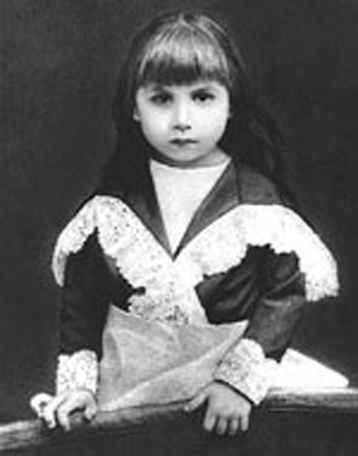
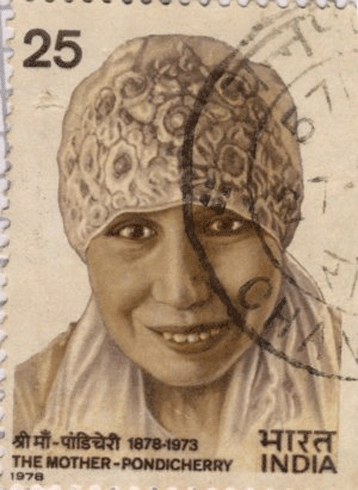
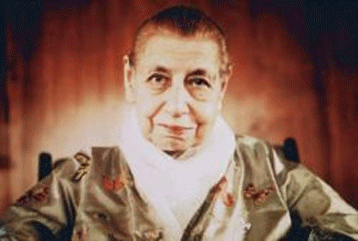
by Shelomo Alfassa (a distant relative) September, 2006 Introduction Blanche Rachel Miriam (Mirra) Alfassa (1878-1973), later known to some of her followers as "The Mother" is considered a Hindu spiritual leader by a large group of followers in India. In this essay, I will explain the history of this distant relative of mine. I will explain that she was a Jew, a lost Jew. Childhood Mirra was born in Paris on Thursday, February 21, 1878 at about 10:15 am in the morning. Mirra was the third child of her parents, Maurice Alfassa (his mother was Rachel Hillel), born 1843 at Adrianople [modern Edirne] and Mathilde Ismaloun, born 1857 at Alexandria, Egypt, both locations that were then part of the Ottoman Empire. At some point Maurice traveled from Adrianople to Egypt. There he met his wife and in 1876 they had a son named Matteo at Alexandria. During the period, it as not uncommon for Sephardic Jews to holiday in Alexandria which was an Egyptian gem. The relationship between Sephardim in the Ottoman Empire and France lends itself to the educational institution known as the Alliance Israélite Universelle (AIU) which brought the modern French educational system to Jewish children throughout the Mediterranean and beyond. After many of the families learned French, it was not uncommon for some to migrate to France and other French speaking locations.
The family emigrated to France in 1877 and Mirra was born the following year. She was reported to be born on the "boulevard Haussmann near the Opera," located in the heart of Paris. Purportedly, Mirra once stated that when she and her brother were children, her mother:
In 1888 Alfassa joined an "exclusive school for the rich," a formal academic education. "I never went to a public school," she said, "because my mother considered it unfitting for a girl to be in a public school." "She was not interested in learning for the sake of 'having a knowing air'. She wanted to understand all that she did, and it was understanding that brought her great joy." "… all my studies were like that, the whole time. I enjoyed myself -- enjoyed, enjoyed, enjoyed ... it was all enjoyable." Mirra once wrote that between eleven and thirteen, she said, a series of psychic and spiritual experiences revealed to her the existence of God and man's possibility of uniting with Him. In 1893 she traveled to Italy with her mother. While at the Palazzo Ducale in Venice she recalled a scene from a past life where she was strangled and thrown out into the canal.
Adulthood At age 16, in 1894, Mirra Alfassa joined the Ecole des Beaux Arts where she acquired the nickname, "the Sphinx". There she studied drawing as a student of the French painter Gustave Moreau, and was said to have exhibited at the Paris Salon. During her career as a painter, she was said to associate with Rodin, Monet and other (now) famous artists. On September 26, 1897, at age 19, she married François Henri Morisset (Son of Henri Georges Louis Morisset and Marie Naudet). The couple had a child in 1898, Andre (of which nothing else is known except that in 1945 he visited India to see her). She dabbled in the occult and eastern religions, and traveled to North Africa to more formally investigate these interests. Between 1905 and 1906 she studied in Tlemcen, Algeria with an Ashkenazi Jew calling himself "Max Theon" whose Arab name was Aia Aziz, a man who once said his father was Rabbi Judes L. Bimstein of Warsaw. Max, an interesting character, was a man whose long hair never once touched a pair of scissors. It was from Louis M. Themanlys (a Jew), Matteo's college friend, that Mirra first heard about Max and his Cosmic Philosophy. Development of a Guru Max was said to have given "rational explanation of the spontaneous experiences she had had since her childhood." He introduced Mirra to a man born in India, Sri Aurobindo (1872-1950) whose cult-like leadership captured both of their imaginations. Max studied and lead a program called Cosmic Philosophy which according to Mirra (and others) was based on Jewish practices of kabbalah. Aurobindo liked Jews. He once pointed out that "the contribution of the Jews towards the world's progress in every branch is remarkable." Indeed the Jewish race has produced not only prophets like Elijah or philosophers like Spinoza, but also the greatest of our modern scientists, Albert Einstein, born one year after Mirra. Besides, my acquaintances of that race are all people of refinement.
Mirra once said that in 1904 at age 26 she met during a dream, a dark Asiatic figure whom she called Krishna. She said that Krishna guided her in her inner journey. She came to have total implicit faith in Krishna, and was hoping to meet him one day in real life. She returned to France where she expanded her study on various Hindu practices and soon would give over her life to the study. She is quoted as saying about Judaism, that God is basically "depicted as the Judge of mankind, and not its Lover as in Hinduism. Perhaps it was also against this sense of severity that Christ rebelled?" From these thoughts, we can get a glimpse of Mirra's thoughts, we can see that they were inconsistent with Judaism. In 1906 she founded a group of spiritual seekers in Paris which was named l'Idée Nouvelle. This group met at her home on Wednesday evenings, first at Rue Lemercier and then at rue des Lévis. In 1908 she divorced Henri and abandoned her sons to his sisters, marrying a lawyer and former Christian pastor, Paul Richard of Lille, France. Paul and Mirra lived at Rue du Val de Grace, in a small house at the back of a garden or courtyard. Andre, then around twelve, was a regular visitor who came around to see his mother. Paul had an interest in Hinduism and went to India in search of meeting a Hindu leader. He met a man named Aurobindo who had just been released from prison for revolutionary activities against the British. Aurobindo had just given up on politics and entered the Hindu spiritual world. After Paul returned from India, he introduced his wife to the teachings of Aurobindo. On 7 March 1914, Mirra and Paul embarked for India aboard the steamer Kaga Maru, reaching Pondicherry on the 29th. There, Paul founded a Hindu publication called Arya. Paul eventually went back to serve in the French Army during WWI. Mirra left because of the war, but returned in 1920. Sometime during this decade they had moved to Japan where they stayed for four years. Eventually they went back to Pondicherry, where Mira would stay until her death in 1973. Her marriage would fall apart, and Mira became close to Aurobindo who then called her Mirra Devi (goddess Mirra). She eventually was put in charge of the community and followers became numerous. Having left two ex-husbands and a young son in Paris, Mirra Alfassa settled permanently in India in 1921 and was soon declared a Hindu goddess. Renamed "the Mother", she spent the next 50 years as a spiritual leader (a guru). In 1926 Sri Aurobindo and Mirra Alfassa founded the location of their spiritual base, an ashram in Pondicherry, India. As the ashram grew, many departments sprang up including an office, library, dining room, press, workshops, playground, art gallery, dispensary, farms, dairies, flower gardens, guest houses, legal department. In the 1920s the daughter of Woodrow Wilson, the US President, came to the ashram and chose to remain there for the rest of her life. In later years Mirra met with other individuals, including the king of Nepal. She had a significant meeting with the Dalai Lama who had recently escaped from Chinese occupation of Tibet. In 1950 Aurobindo died and in the next decade Mirra and her followers would dedicate Auroville (i.e. town of Sri Aurobindo) in his name. Indira Gandhi and Mirra had a close relationship; Indira Gandhi was a devotee of Mirra and often sought her counsel on various issues.
In 1951 Mirra founded the Sri Aurobindo International University to modernize and expand the scope of the Sri Aurobindo Ashram in Pondicherry. Today in 2005, the Center's subjects include English, French, Sanskrit, Mathematics, Physical Sciences, Life Sciences, Applied Sciences, Computer Science, History, Geography, Indian languages, foreign languages, Music, Dance, Drawing, Painting and Handwork. Revisionists? Some of the people who "follow" Mirra have been in denial that she was Jewish, some of her followers have taken the time to invent a story and circulate it that she was "A Parisian of Egyptian descent" when in fact she was solely Jewish. Her followers write of her:
This is ridiculous! Her father was Jewish, and Jews don't get "christened." It was said about her parents that her father was a secular Jew, a banker and a first-rate mathematician, her mother was a disciple of Marx (a communist) until the age of eighty-eight. Another account states he knew German, English, Italian and Turkish, "He liked very much birds and circus. His career of banker was not fruitful." They continue…
Yes, Turkey was an Islamic country, but it had hundreds of thousands of Spanish Jews living there. Alfassa is a Sephardic Jewish surname, something they obviously do not realize or maybe do not want to admit. The idea that she is related to Egyptian pharaohs is preposterous and probably perpetuated as a way to make her ancestry more appealing to her cult followers. Research will show the investigator that the relation to "Egyptian pharaohs" comes from a story Mirra told her mother while on a trip to Italy at age 15 in 1893. Alfassa means "one from Fes" (as in the city of Fes in modern Morocco) however it is obvious these people do not know this. Many Jews with the name Alfassa, DeFes or Alfasi lived in Turkey, specifically Adrianople. A common ancestor and one of the most important rabbis in Jewish history was Isak Alfassi (known as the RIF) who came from Fes and moved to Spain in the 11th century. Alfassi/Alfassa surnames can be found in Spain since that time. With the bloody carnage thrust upon the Jews in Spain by members of the Catholic Church in the 14th and 15th century, thousands of Jews fled to Turkey; later, hundreds of thousands were forced out in 1492 and also went there. Her father Maurice was said to have been, "born in Adrianople" which was in Turkey. This is logical, as there was a large group of Alfassas living in Adrianople in the early 20th century. The story of having roots in both oriental and occidental countries is often exploited by her followers to make her sound more interesting. I guess they can't accept the account that she was born Jewish, with plain Jewish roots. Her followers continue with their propaganda saying she was born into a "family of mixed race and religion and nationality." This is pure fabrication. Again, she was born a Jew to Jewish parents who were Ottoman citizens. Mirra Alfassa's grandparents were Mirra Pinto and Matteo Ismaloun who married in Ottoman Alexandria. Mirra Pinto (daughter of Saïd Pinto) was born in Ottoman Cairo. Pinto is a Sephardic name, a name Spanish & Portuguese Jews brought with them from Iberia in the 15th century to the Ottoman Empire. It is an old surname, from Castile. In the Sephardic Jewish tradition of naming children after the living, both Mirra and her brother have first names which were their grandparents. Converted to Hinduism Hindus believe in life after death and that for every action there is a reaction. Every action, even every thought produces a reaction. Hindus believe that every thought and every action is weighed on the scales of eternal justice. Hindus believe that the body alone dies, the soul never dies. The path the soul takes is decided upon by the past actions. Sound familiar -- these concepts come straight out of Judaism. Even though these ideas are similar, there is much which is definitely foreign to Judaism and utterly opposed to it. Her followers quote Mirra:
Mirra's lack of Judaism at home sent her searching for something. In 1899, at the age of 21, she was proselytized by a Hindu, "I met a man, an Indian ... who told me about the Gita ... He gave me the key ... The man said, 'Read the Gita, and take Krishna as the symbol of the immanent Divine, the inner Divine.'" Like most sincere converts, she jumped into her newly found religion with full zeal. Her story is no different than other apostates who because of a lack of knowledge of their own religion became idol worshipers. Her Brother Matteo Mathieu Maurice Alfassa (her brother) was born 13 July 1876 at Alexandria, Egypt. He graduated polytechnic at Paris, and was said to have a library of some 2,000 books at home. There was a French politician with the same name, and it can be concluded this is the same person. Matteo Mathieu Maurice Alfassa (aka Governor General Alfassa) held the following posts throughout French occupied lands:
Today the Embassy of France in Brazzaville, Congo is situated on a street called "Rue Alfassa." The tourism ministry of Martinique is located on "Alfassa Boulevard" that skirts the edge of sea with greenery and flowered alleys and beautiful large royal palm trees. Closing Thoughts On May 20, 1973 Mirra was struck down with chronic illness and had to be visited by a physician each day for six months. In November she asked for help to try to walk, but she was too weak. On November 17 she went into cardiac arrest and although CPR was given to her, she died at the age of 95. Today, cultists from all over the world visit Pondicherry, in South India, to worship this Jewish woman, a heretic to her religion, a woman deprived of the legacy of her heritage. Today her teachings are worshiped in Auroville, which is called an international city "dedicated to Human Unity." It is said to be a growing and vibrant community of about 1500-2000 persons from over 30 countries. In 1968, the center was moved to this location which is six miles north of Pondicherry. A publication of the United Nations Educational, Scientific and Cultural Organization discussed the center in India:
In 1999, a reporter for The New York Times recommended Auroville as a primary destination for tourists who go to India. Money has no role to play in Auroville. Cars are banned. No administration with authority over the lives of the members is created. No one is appointed as the head or leader whom all should obey. However, there is a temple where Mirra is worshiped called the Matrimandir. It is a 100 foot high imposing elliptical sphere. Inside the upper portion of the huge structure is the meditation chamber, a 12-sided room whose walls are lined with white Italian marble. At the center of the chamber is a sphere of pure crystal, illuminated by sun light channeled from an opening at the top of the chamber. Postscript So what do I make of all of this, well, not that much. I had a great-great-aunt who was sadly lost due to assimilation. She was proselytized and led off by new age Hindu thought which was popular in the early 20th century among some in the French intellectual circles. She had lost her ancestry, her religion, her culture and her roots. She marginalized herself from her family, and today has a following, for she is still thought of in the Hindu world as a spiritual leader. Today this woman is worshipped by thousands in India. Imagine what a woman like this could have done if she directed her energies towards her own faith and culture. Matteo Maurice Alfassa: Sephardic Intellectual / French Government Official by Shelomo Alfassa DRAFT – NOT COMPLETE - MAR 07 Matteo Maurice Alfassa (1876-19XX?) was the son of Maurice Alfassa, born 1843 at Adrianople (modern Edirne, Turkey). [1] Maurice traveled from Adrianople to Egypt where he met his wife Mathilde Ismaloun (b. 1857 in Alexandria). Max, their first child died; they then had Matteo who was born at Alexandria in 1876, and later a daughter, Mirra, while in Paris. [2] Matteo’s grandparents were Mirra Pinto and Matteo Ismaloun who married in Ottoman Alexandria. Mirra Pinto (daughter of Saïd Pinto) was born in Ottoman Cairo. Pinto is a Sephardic name, a name Spanish & Portuguese Jews brought with them from Iberia in the 15th century to the Ottoman Empire; it’s an old surname, from Castile.
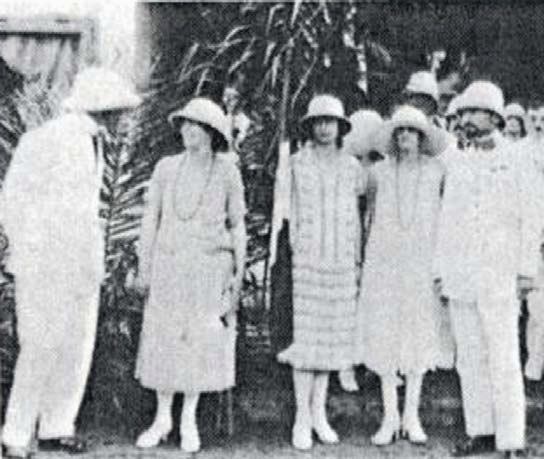
Governor-General Alfassa (on right with beard), with Madame Alfassa (on left) speaking with future Governor-General Reste The Alfassa family emigrated to France in 1877 and lived on the “Boulevard Haussmann near the Opera” located in the heart of Paris. The relationship between Sephardim in the Ottoman Empire and France lends itself to the educational institution known as the Alliance Israélite Universelle (AIU) which brought the modern French educational system to Jewish children throughout the Mediterranean and beyond. After many of the families learned French, it was not uncommon for some to migrate to France and other French speaking locations. France had colonial possessions, in various forms, from the beginning of the 17th century until the 1960s. In the 19th and 20th centuries, its global colonial empire was the second largest in the world behind the British Empire. An intellectual, Matteo was said to have a library of some 2,000 books at home. He graduated Ecole Polytechnique in Paris and married Eva Brosse. He had many papers published on the subject of labor and politics, [3] and helped translate a book into French from English. [4] Along with a George Alfassa [who has not yet been researched] he edited a large volume, a formal report on home “sweatshop” workers in Paris that worked in the linen trade. [5] After the turn of the 20th century, Matteo would become the general manager of a railway [6] where he dealt with various union issues. [7] It is the railroad which may have lead him to Africa, but this is only a theory of the author of this paper.
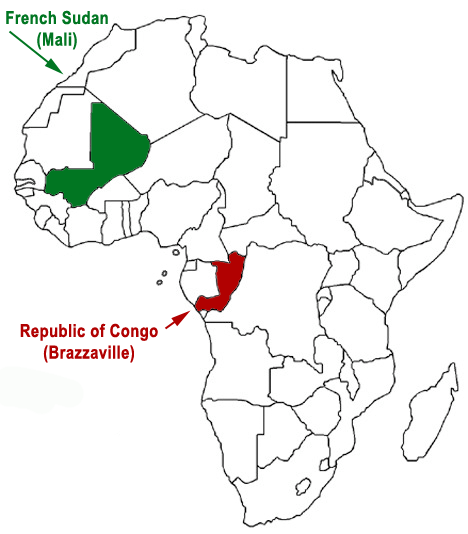
Matteo Alfassa served the French government as Lieutenant Governor of the Middle Congo and Congo (Brazzaville) [8] from August 21, 1919 to August 16, 1922. Two years later, at age 48, Alfassa was promoted to Governor-General of the French Congo and French Equatorial Africa, where he would serve five separate terms. [9] He held the office of Governor-General from July 8, 1924 to October 1924. His second post was May 1925 to December 1925. A photo from November 11, 1925 marking a ceremony for Armistice Day, shows Matteo as a slender man, tall, with a dark trimmed beard. He is wearing a light colored suit and is donning a pith helmet, as is his wife Madam Eva Alfassa. Matteo’s third term in office was November 1929-August 1930; fourth, April 1931-November 1931; and fifth, December 1932-December 1933. [10] A street was named on behalf of the Governor and it remains today, “Rue Alfassa,” where the French Embassy still exists. From 1934-1935, Alfassa served as Governor of the country of Martinique. Martinique is an island in the eastern Caribbean Sea, south of Puerto Rico, that has remained part of France. [11] Today there remains a well known major street named after the Governor, known as “Boulevard Alfassa” that runs along the coast line in the capital city of Fort-de-France. At the end of 1935, Matteo Alfassa arrived to take up the post of governor of French Sudan. [12] He held office from November 20, 1935 to November 9, 1936. French Sudan was a colony in French West Africa that had two separate periods of existence, first from 1890 to 1899, then from 1920 to 1960, when the territory became the independent nation of Mali. At the time Alfassa held office, the land had an essentially Muslim and hierarchized population with a higher level of education than in French Equatorial Africa. _______________ Notes: 1 Alfassa means "one from Fes" (as in the city of Fes in modern Morocco) however it is obvious these people do not know this. Many Jews with the name Alfassa, DeFes or Alfasi lived in Turkey, specifically Adrianople. A common ancestor and one of the most important rabbis in Jewish history was Isak Alfassi (known as the RiF) came from Fes and moved to Spain in the 11th century. Alfassi/Alfassa surnames can be found in Spain since that time. With the bloody carnage thrust upon the Jews in Spain by members of the Catholic Church in the 14th and 15th century, thousands of Jews fled to Turkey, later, hundreds of thousands were forced out in 1492 and also went there. 2 Their third child was Mirra Alfassa (1878-1973), known as "The Mother," she is/was considered a Hindu spiritual leader by a large group of followers in India. See www.alfassa.com/momma.html. 3 M. Alfassa. "La Crise Ouvriere Recente des Chemins De Fer Anglais. Une solution nouvelle des conflits." Paris, 1908. Qtd. in Alderman, Geoffrey. "The Railway Companies and the Growth of Trade Unionism in the Late Nineteenth and Early Twentieth Centuries." The Historical Journal, Cambridge University Press: 1971. 4 Cannon, E. Histoire des theories de la production et de la distribution dans l'economie politique anglaise de 1776 a 1848. 1910. 5 See: "Recent Official Papers." The Economic Journal: Royal Economic Society, 1908. 6 P. Mantoux and M. Alfassa, La Crise du Trade-Unionisme. Paris, 1903. pp. 213,320. 7 As an intellectual, Alfassa wrote various articles. For his comments on post WWI accounts, see: Alfassa, M. "L'Amerique, Suzeraine de Monde." La Nouvelle Revue. 4th ser., 58. April 1922; For an article of political interest, see: Alfassa, M. Le probleme financier: la politique de tresorerie. Nouvelle Rev. February 15, 1925; also see: Alfassa, M. "Le billet de rente." Nouvelle Rev., November 1920; He wrote about the trade-union acts of 1871 and 1876 in Alfassa, M. Le chambre des lords et les trade-unions. Rev. d'Econ. Pol., Oct.-Nov. 1905; Discussion about post-WWI, see: Alfassa, M. “Preparation (La) de l'apres-guerre.” IV. Nouvelle R., 21 (2): 101, 209. September 1918; Article on the UK Parliament, see: Alfassa, M. Le parti ouvrier au parlement anglais. An. de. Sci. Pol. January 15, 1908. 8 Brazzaville is the capital and largest city of the Republic of the Congo and is located on the Congo River. It has a population of 1,174,000 (2005 census). The city was founded in 1880 on the site of a village named Nkuna by an Italian born French explorer, Pierre Savorgnan de Brazza, after whom the city was named. In order to distinguish between the two African countries with "Congo" in their names, the Republic of the Congo is sometimes called Congo-Brazzaville, as opposed to Congo-Kinshasa (the Democratic Republic of the Congo, known from 1971 to 1997 as Zaire, the capital of which is Kinshasa). Kinshasa lies on the southern bank of the Congo, across from Brazzaville. This is the only place in the world where two national capital cities are situated on opposite banks of a river, within sight of each other. 9 For more on the country, see: M. Mazen. "A Visit to French West Africa and Nigeria." Journal of the Royal African Society. Oxford University Press: 1937. 10 Some of his papers reside in the Depot des Archives, Section Outre-Mer ar Aix-en-Provence, dossier 5D74. 11 As part of France, Martinique is part of the European Union. 12 In 1902 the parts of the French Sudan colony not organized into military districts became Senegambia and Niger, then Upper Senegal and Niger in 1904, then the old name came back in a reorganization of 1920. When Upper Volta was first abolished in 1933 (it was reestablished in 1947), French Sudan picked up some of its provinces. After the 4 October 1958 French constitutional referendum, the "République Soudanaise" became a member of the French Community, once again with the name French Sudan, and gained complete internal autonomy 25 November 1958. On 4 April 1959, French Sudan was joined with Senegal to form the Mali Federation, which became fully independent within the French Community on June 20, 1960. The federation collapsed on August 20, 1960, when Senegal seceded. On 22 September, French Sudan proclaimed itself the Republic of Mali and withdrew from the French Community. The Tree of Wisdom: Haham Isak Alfassi by Shelomo Alfassa Originally published in the 'Sephardic Image Magazine' Vol. 12, No 7. July 2001 It was edited and revisited in February 2008 The crusades which started in the beginning of the last millennium virtually destroyed Jewish intellectual life. It suppressed and almost brought an end to the Jewish creative process in the middle European countries and the holy land. It was during this period, that further development of the Talmud passed to Jews living in Iberia and North Africa. Remembered nearly one thousand years later, Haham Isak Alfassi (often called "HaRIF" for Rabbi Isak Alfassi) is still today considered one of the most influential Talmudists of all time, a man who brought a close to the Geonic Period (c. 589 CE - 1030 CE). Born in the Spring of 4773 (1013 CE) in Qal'at Hammad (modern Algeria) was Isak ibn Yossef, known to history as Haham Isak Alfassi. He was one of the greatest codifier of Jewish law of his time, writing the most important Jewish code, prior to Maimonides Mishna Tora. Alfassi bridged a major link between the tradition of the gaonim (rabbinical leaders) who headed the ancient Talmudic yeshivot (rabbinical colleges) of Babylonia, and the burgeoning aljamas (Jewish communities) in Al-Andalus, Muslim Spain. After studying in Kairuan, a scholarly Jewish community and main intellectual center on the east coast of Tunisia, he settled in Fez, Morocco. Alfassi is best known for his brilliant legal code, Sefer ha-Halakhot (Book of Laws). His work was extremely popular, and was revered by the Iberian and French scholars of his day. In his Book of Laws he summarized the discussions of the Talmud; he preserved the order in which they were written; he formulated his own decisions; and he did it all to make the Talmud more digestible for the community. This work, and hundreds of his written opinions (responsa), earned him a reputation as the first of the great codifiers after the finalization and closing of the Talmud. Haham Alfassi's writings allowed a wider audience to have access to understanding the Talmud and thus to interpret Jewish law. In doing so, his work superseded study of the original Talmud in many locations. This smaller, more comprehensive, easier to understand version became the standard of the Jewish world, being known as the Talmud Kattan or "miniature Talmud." Many decades later, Maimonides called it, "the flower of all post-Talmudic rabbinic literature." As an independent thinker, Alfassi dared to differ from the gaonim, all the while respecting them. He established a great number of methodical rules for the interpretation of the Talmud. Not only did he give the law in accordance with his own judgment, but he also cited the relevant passage in the Talmud dealing directly or indirectly with the subject at hand. By removing the material not affecting contemporary life outside of ancient Jerusalem (i.e. animal sacrifices and ritual purity), he was able to concentrate on expanding upon items related to everyday life. In doing so, Alfassi brought a better understanding of the Talmud, and thus Judaism, to the lives of ordinary Jews. During his lifetime, Alfassi was considered one of the foremost and final authorities on the Talmud, and in time, many commentaries were written in regard to his work. Years later, his work itself had become the center and subject of a vast literature. Alfassi influenced several great Jewish scholars over succeeding centuries. Maimonides, who studied under Haham Joseph ibn Migash [a prodigy of Alfassi] wrote that Alfassi's work: "has superseded all the gaonic codes… for it contains all the decisions and laws which we need in our day…" Obviously, Maimonides had great praise for Alfassi, this is demonstrated in his Mishnah Tora where he seems to strategically omit any reference to the gaonim, while continuing to praise Alfassi. Diversity of rabbinical opinion existed back then, as it does today. Maimonides, himself, would come to note places in Alfassi's Code where there were items bearing a non-mutual opinion. However, Maimonides did defend Alfassi on occasions, even declaring, "one would be hard put to find as many as ten errors in his monumental work." In 1089 CE when Alfassi was about 75 years old, a fellow Jew slandered him to the Islamic authorities, and this sent him fleeing to Spain. Alfassi brought with him there the seeds of wisdom, which contributed to the tree of future Jewish sages. Soon after settling in Cordoba in 1088 CE, he relocated to the city of Lucena (a few miles southeast) after hearing of the death of Haham Yitshak ibn Gayyat, head rabbi of the Lucena yeshiva. Lucena was a grand center for Jewish learning, and was written about in contemporary accounts as the "city of the Jews." At the time when Ashkenazi Jewry was still in its infancy and Sephardi Jewry was still yet to mature, Lucena had become a center for rabbinical opinions and rulings in Western Europe, and correspondence was known to be exchanged with communities in both the holy land and Babylonia. Haham Alfassi became both the head of the yeshiva (rosh) and the judge (dayan) of the city; he remained there for the next fourteen years. Before his death, Alfassi turned the Lucena yeshiva over to Haham Yossef ibn Migash, future teacher of Maimonides' father. Jewish codes were initially created to answer specific internal needs of Jewish law, and to respond to several external threats to its existence and authority. However, they were quite complicated, and what Alfassi did was to clarify and enhance them so that the average person could comprehend and appreciate them. His writings not only influenced Maimonides, but many subsequent sages such as Mordehi ben Hillel, Yossef Karo, and Yishak Luria. Haham Karo, a Portuguese expulsion victim who settled in Ottoman Safed, later wrote: "Haham Alfassi, Maimonides, and Haham Asher [the ROSH of Spain], are the pillars of Jewish Law, which all of Israel bases itself on." During his long lifetime, Haham Alfassi influenced and taught many future scholars. This included his students Moshe ibn Esra, and Yossef HaLevi, both who would later become widely regarded poets and thinkers. Haham Isak Alfassi died 10 Iyar, 4863 (1103 CE) at the ripe age of ninety. Though his burial location in Spain has been lost to history, the epitaphs from his tombstone have been recorded for time immemorial. Ibn Esra wrote a brief poem, one line reads, "in this grave the fount of wisdom is buried, and the world has come into blindness." HaLevy wrote "… upon the tablets of thy heart they wrote the Law, upon thy head they placed the crown of glory, even sages cannot learn to stand upright, unless they have sought wisdom from the tree." Nine centuries later, Haham Alfassi's decisions still effect the life of religiously observant Jews everyday.
|