|
HEALING: THE DIVINE ART |
|
|
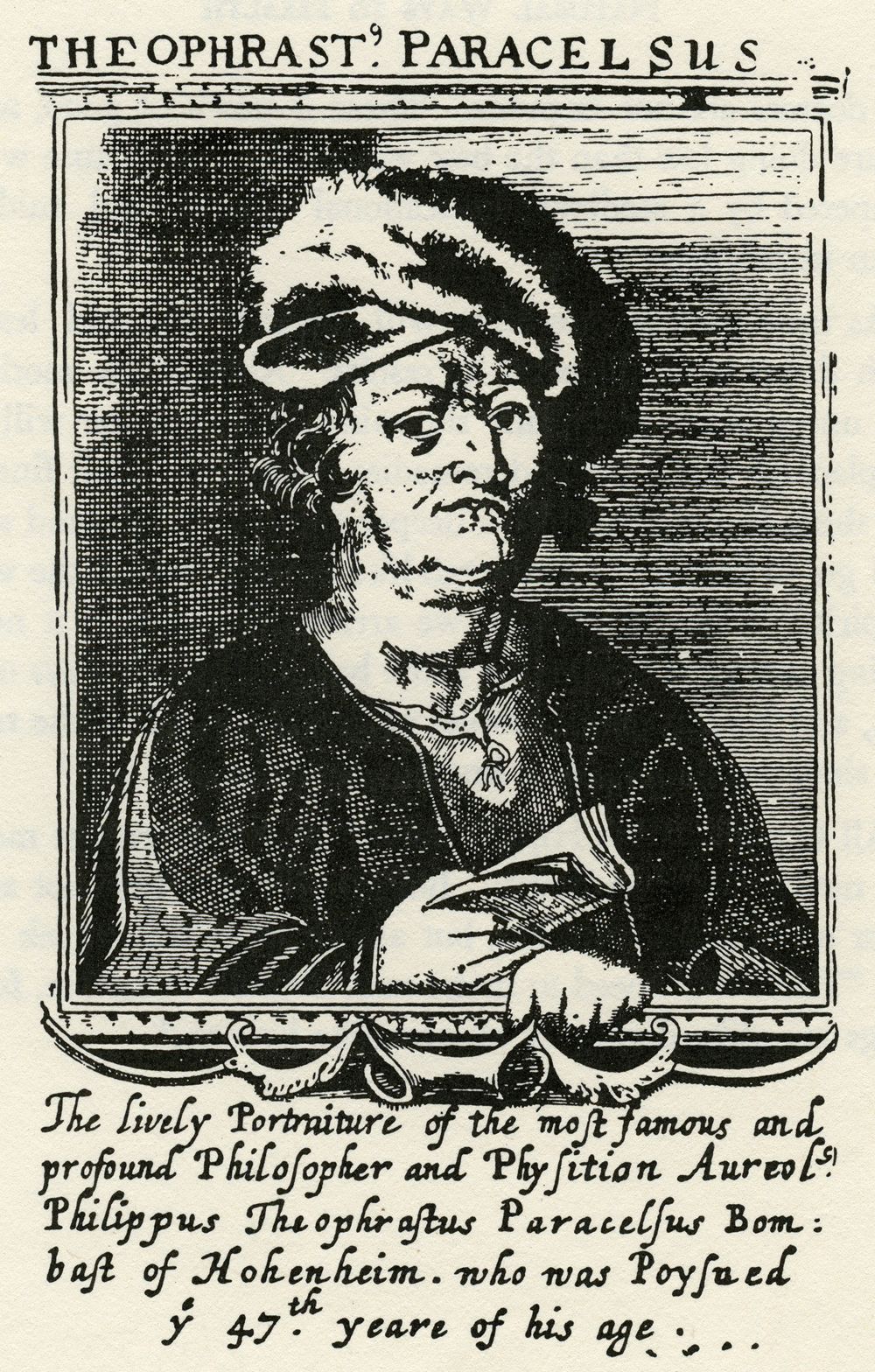
THEOPHRAST. PARACELSUS A quaint old portrait which records the death by poison of Paracelsus of Hohenheim, the greatest metaphysical physician in the history of Europe. It is believed that the great physician was murdered by professional assassin in the hire of jealous and vindictive doctors. CHAPTER 4: HEALING DURING THE RISE OF THE CHRISTIAN CHURCH EVIL DEMONS IN THE HEALING ARTS -- SAINTHOOD ONLY THROUGH PROVED MIRACLES -- GALEN AND AVICENNA -- THE PLAGUES OF THE DARK AGES -- MUMIE, THE GUM FROM MUMMIES -- OUR GREAT MISFORTUNE TO BE BORN -- OBEDIENCE TO DOCTOR AND TO GOD -- THE ERA OF WITCHCRAFT -- THE DEVIL FIXATION -- THE CAUSES OF PLAGUES -- PARACELSUS, THE MYSTIC DOCTOR -- THE PROTESTANT REFORMATION -- THE PARTING OF THE WAYS -- END OF THE CHRISTIAN MINISTRY OF HEALING. THE Christian ministry of healing is founded in the words of Christ, in the miracles which he performed, and in his bestowal upon his disciples of the power to heal the sick. The attitude of the early Christians on the important subject of mystical healing may be summed up in the words of the Apostle James: "Is any sick among you? let him call for the elders of the church; and let them pray over him, anointing him with oil in the name of the Lord: And the prayer of faith shall save the sick, and the Lord shall raise him up; and if he have committed sins, they shall be forgiven him." The Epistle of James, 5, xiv, xv. Of the miracles of Christ, the devout Alexander Cruden wrote: "Our Savior confirmed the doctrine which he taught by a train of incontestable miracles: they were so great in their nature, so real and solid in their proof, so divine in the manner of performing them, by the power of his will; so holy in their end, to confirm a doctrine most becoming the wisdom and other glorious attributes of God, and for the accomplishment of the prophecies concerning the Messiah, whose coming as foretold was to be with miraculous healing benefits; that there was the greatest assurance, that none without the omnipotent hand of God could do them." Should any doubt remain as to the importance of miracles in the proof and justification of the Christian dispensation, these few lines are quoted from the Vatican Council, sess. iii, canon 3, 4: "If anyone should say that no miracles can be performed ... or that they can never be known with certainty, or that by them the divine origin of the Christian religion cannot be rightly proved, let him be anathema." When the Church leaned so heavily upon miracles as proof of its divine estate it fell almost immediately into a serious difficulty. Most of the pagan faiths which flourished in the early centuries of the Christian Era could also advance miraculous happening to justify an equal claim to divine overshadowing. To extricate themselves from this embarrassing situation the early Fathers had recourse to the Second Chapter of Second Thessalonians, in which is described the "man of sin" who should come with lying wonders after the working of Satan. By various improvisations upon this theme, it was demonstrated to the satisfaction of the pious that all miracles not arising within the Christian faith were snares and delusions, originated with the devil, and calculated to destroy utterly all who regarded them favorably. This solution invited disaster, for it stigmatized all non-Christian beliefs, and set the stage for a vast program of religious intolerance. The devil became the ruler of three quarters of the earth. The Church had set itself the heroic task of fighting his power in the four corners of the world. And, as might be suspected, non-Christians did not take kindly to the idea that they were worshippers of Satan, and as the centuries passed, the inevitable consequences of these theological pronouncements were Holy Wars and Crusades. In addition to various healings of physical disease and sickness, the Gospels ascribe to Jesus the power of casting out demons. He cast seven devils out of Mary of Magdala; and in Gerasa he caused a legion of evil spirits to depart out of a man and enter into a herd of swine. Miracles of this kind justified the theological doctrine of demoniacal possession, and strengthened generally the public belief in the reality and power of evil. It was upon the authority of the scripture therefore, that the medieval Church made an extensive study of demonology; and the casting out of evil spirits became an important part of the healing arts during the Middle Ages. EVIL DEMONS IN THE HEALING ARTS As the various isolated Christian communities of the first three centuries were gradually drawn together into one great assembly, the historical Church began to take form. Much of its symbolism and many of its rites were patterned after the pre-Christian religions of India, Egypt, Greece, and Rome. Every effort was made to conceal this borrowing, but from the wider vista of present knowledge the borrowings are evident. The Christian doctrine of the canonization of saints, it seems to me, came directly from the Hindus, especially the Buddhists, and the Greeks. Because of the importance of the saints in the religious healings of the Church, it seems well to look more closely into this phase of spiritual tradition. SAINTHOOD ONLY THROUGH PROVED MIRACLES In the early years of the Christian faith, canonization was performed by the local communities. This gives support to the belief that it was patterned after some already existing formula. In the tenth century the Pope reserved this power to himself. Since that time canonization has been an elaborate process often requiring centuries. The servant of God, who is to be canonized, passes through three steps. He is first made Venerable. Then, after further consideration and evidence, he is advanced and becomes known as Blessed. If additional investigation proves his worthiness, he receives the final honors and the word Saint is placed before his name. Except in the case of Martyrs, it is usual for the sanctified state to be discovered by miracles, performed in the lifetime of the Saint, and further proven by his miraculous intercessions after death. When the candidate for canonization has been advanced to the state of Venerable, "at least two important miracles wrought through the intercession of the servant of God must be proved," before he can be acknowledged as Blessed. And two further miracles must take place through the intercession of one called Blessed, before canonization can be completed. One who is Blessed may receive veneration locally, and prayers may be addressed to him under certain conditions, but only after canonization may he be appealed to by the whole body of the Church. The Saints were important in the mystical medicine of the medieval Christian faith, even as in the Catholic Church of today. They were called upon selectively by those suffering from various ailments. St. Apollonia was prayed to for toothache, St. Valentine for epilepsy, St. Vitus for nervous disorders, and St. Anthony of Padua for difficult childbirth. Charms bearing the likenesses of different Saints were worn for protection, one of the most popular being the medals of St. Christopher, supposed to preserve travelers from the dangers of their journeys. Although the early Church had an elaborate theory about sickness and healing by Grace, it does not seem to have interfered with the secular practice of medicine. Many of the great leaders of the Christian faith, including St. Augustine himself, were physicians. So long as the medical practitioner did not become involved in some fine point of theology, he practiced in whatever place was natural to his times. It was well that the Church did not further complicate the life of the physician; he was having trouble enough with the patron saints of his own profession. There was Galen to make things difficult, and later was Avicenna, to make them more difficult; and then with the two of them, the confusion was worse confounded. GALEN AND AVICENNA Greatest of the Greek physicians to practice in Rome was Galen, (Claudius Galenus), born in Mysia, 131 A. D. His fame in medicine won him the appointment of official doctor to the school of the gladiators at Pergamos, the city of his birth. He attended several of the Roman Emperors, and according to the Arabic tradition, died in Sicily about the year 201 A. D. In anatomy, Galen is known for his persevering dissection on the bodies of animals, but he had no opportunity for a detailed study of human structure. In physiology, he was dominated by the four humours of Hippocrates, and sought to correct their unbalances by medicines of sympathy and antipathy. Galen was much given to magical processes, and put more faith in amulets than in drugs. According to Cullen, he is supposed to be the originator of the anodyne necklace so long famous in England. Avicenna, (Ibn-Sina), the Mohammedan philosopher and physician, (980-1037A. D.), was a student of the writings of Galen, and his principal interpreter among the Eastern, and later, the European nations. He added many opinions drawn from Aristotle, and mixed with these considerable Neo-Platonic lore and a great inspiration gathered from early study of the Koran. Like Galen, he had very little actual knowledge of the human body and its functions. Both Galen and Avicenna left voluminous writings, and their books became the official texts of the medieval physician. These 'priceless' treatises were interminable volumes, rich in noble generalities, and laden with philosophical discourses on every subject from stomach ache to falling sickness, with occasional references to volcanoes. It is beyond doubt that the books of Galen and Avicenna retarded medical progress for hundreds of years; but in their time, there was neither recourse nor relief from their authority. Galen was medicine's god, and Avicenna was his prophet. THE PLAGUES OF THE DARK AGES The thousand years from the fourth century to the fourteenth is the period usually referred to as the Middle Ages, with the first six hundred years graphically designated the Dark Ages. It is pretty much of a mystery what happened to human nature and human progress after the fall of the Roman Empire. All that can be said with certainty is that European civilization was in the doldrums for a millennium. The wisdom of the classical civilizations was lost, and not until after the Crusades did the minds of men finally shake off the inertia of these melancholy times. Many have asked if the Christian Church was responsible for the Dark Ages. In some ways possibly, but in general it was a victim in common with the rest. The pivotal cause seems to have been the collapse of pagan Rome, for with it passed the law and order of its time. A second cause was the closing of the schools of Athens by Justinian, in 529 A. D. The Church may have been partly responsible for this, but the emperor himself was largely to blame. H. G. Wells, in his Outline of History, takes another view of the case. "It is not perhaps true," he writes, "to say that the world became miserable in those 'dark ages'... much nearer the truth is it to say that the violent and vulgar fraud of Roman imperialism, that world of politicians, adventurers, landowners and financiers, collapsed into a sea of misery that was already there." The Wells' analysis is thought provoking, but it seems a little strange that a great cultural system, built up through thousands of years of human effort, in a dozen highly civilized nations, and able to survive the vices of Imperial Rome, should have perished with the fall of a system of which it was never a part. The arts and sciences were not driven to Islam simply by the Roman debacle. More likely an ignorant aristocracy took the place of a corrupt one -- always, the beggar on horseback's first act is to persecute the learned. From the meager history that lights the Dark Ages it would seem that a succession of plagues and fevers ravaged most of Europe. These nearly always follow in the wake of war. The armies of Attila were stricken while invading Northern Italy. Barbarians had broken up the existing pattern of life and brought nothing in its place. Men were wandering about hopelessly, spreading chaos and the plague. Earthquakes added to the general misery and terror, as whole cities vanished from the earth. Famine also swept the continent; the death rate was appalling. By establishment of the monastery system the Church did what it could to preserve the remnants of culture -- but only such parts as were not in conflict with the dogmas of the faith. In the monastery libraries the great texts of medicine, art and music were preserved, together with many of the older sciences such as mathematics, geometry, astronomy, logic, rhetoric, and the languages. These monasteries were virtually the only schools, and the clergy, with no worldly ties and with ample time for study, became the only literate class. As the temporal power of the Church grew, Europe slowly organized itself into the semblance of order. The Benedictines were the monastery builders, and in time they added schools to their Holy Houses; from these simple schools grew the great universities that were to become the pride of Europe. The Church patronized the universities generously, and kings and princes followed its example. Lack of knowledge was the primary impediment to the progress of these schools. Four branches of learning were favored; belles-lettres, law, medicine, and theology. To enter the universities, it was usually necessary to sign a statement to the effect that the applicant was a Christian, over twenty years of age, a freeman, not a peasant, and of good family. Then, as now, there was also a delicate financial consideration. The curriculum was impressive but sterile. Hooded savants on gilded thrones lectured, or simply read, from ancient authorities; and the students sat, listened, believed, accepted, and were overwhelmed, but not informed. Neither science nor the Church was particularly to blame; there was no one who knew more to lead the rest to a better way. The colleges of medicine were typical of the rest. They were grand and impressive necropolises, where somber professors mumbled over the dead tomes of Galen and Avicenna. Diseases were worked out by mathematics, and remedies selected because the herbs themselves resembled the afflicted organ. Thus toothwort was recommended for toothache, ivy for the nerves. These were the times of the unicorn's horn and the bezoar stone. These moderns who like to think of the Church arguing for generations over the respective dignities of the Three Persons of the Trinity, may be interested in knowing how the doctors of that time were amusing themselves. MUMIE, THE GUM FROM MUMMIES The hooded and sceptered medics were wrestling with the momentous problem of the comparative medicinal virtues of the Arabian, Egyptian, Pissasphaltos, and Lybian Mumie. The Arabian mumie was a gum that exuded from ancient bodies that had been mummified with aloes, myrrh, crocus, and balsam. Egyptian mumie was a similar exudation from the humbler dead who had been preserved only with asphaltum. The Pissasphaltos mumie, highly recommended by Dioscorides, was made from the crystals found on the bodies of mummies embalmed with bitumen -- but our authority notes how this is very difficult to secure and is extensively counterfeited by the apothecaries. The Lybian mumie was derived from bodies that had been swallowed up by Lybian quicksands, and had not been embalmed at all. This delightful argument was finally solved by the discovery of a still more important mumie that could be made from the moss growing on the skull of an executed criminal. Thus went medicine in the good old days, when men feared the physician more than they did the disease. Medieval doctors did not exactly burn the midnight oil in a consecrated search for new ideas in medicine. They were quite impressed with their own magnificence, smug and self-satisfied, and of a mind to murder any confreres whose originality threatened their composure. The prince, the priest, and the physician alike were members of closed corporations; they hung together for mutual support in times of trouble; and when fortune favored, they pillaged from each other, with a good conscience. In the heyday of the clergy the heavy hand of ecclesiastical displeasure fell not on the physician, but on the astronomer. Men like Bruno, Galileo, and Copernicus could upset the Christian order of the world, for they stepped directly on the toes of the Fathers who had been taught that the earth was God's foot-stool, and that the whole mystery of creation had been worked out on this planet. When Copernicus stopped the sun and made the earth to move, he outdid Joshua, who only stopped the sun. The Church acted against these men with all sincerity -- but with a woeful lack of knowledge -- to put these innovationists back in their places before they tore the universe apart. It does not appear that the early Church made any general effort to limit the study of medicine, or to declare against its practices. The Church respected the doctor, according to the authority of Eccl. 38, i, iv: "Honor the physician for the need thou hast of him: For the most High hath created him ... The most High hath created medicines out of the earth, and a wise man will not abhor them." The Church was the only institution great enough to demand common consideration from all the confused factions that made up medieval life. Unfortunately the Fathers were not 'health conscious.' They honored the physician, but they did not inspire him to any general effort to improve the health of his world. To the extremely pious, the doctor was just another cross to bear, in a world of pain and misery. In many instances this attitude could be justified by the gruesome way in which the healing arts were practiced. Paracelsus cried out in the agony of his spirit against barber surgeons and barbarous doctors, in these words: "Fortunate is that man whose physician does not kill him." Early Christian psychology shows how profound was the influence of the decadence and degeneracy of the Romans. The debauchery of the Caesars and the indescribable licentiousness of the aristocracy set up such a revulsion mechanism in the early Church that it turned against all worldly things, including life itself. In an effort to preserve its followers from the evils of the times, the Church thundered its disapproval of the intemperances of the flesh, carrying its pronouncements to such an extreme as to violently disturb the normal patterns of living. OUR GREAT MISFORTUNE TO BE BORN To the mind once set in a concept of sin, it is not hard to see faults in the simplest and most natural of habits and customs -- "Nothing is either good or bad, but thinking makes it so." In application, theology saw evil everywhere, because it was thinking of evil. The world was regarded as corrupt in all its parts; the greatest misfortune was to be born into the physical state, and the greatest blessing was to die out of it on one's natal day. Coinciding with this religious viewpoint was the condition of the world itself. Men had small hope of physical security or happiness during the Dark Ages. Life was a painful ordeal, burdened with uncounted woes and hopeless to the end. Sickness and poverty were universal, and tyranny rested cruelly upon all. Those who were not carried away by disease or starvation, died on the field of battle. It is little wonder in such an atmosphere a doctrine of corporeal misery and incorporeal bliss flourished. It was inevitable that men should dream of death as liberation, to regard it desirable to leave this world behind. In a sorrowing sphere, sorrow became the virtue of the hour. To the medieval Christian it was dangerous to be happy, for joy might cause the mind to forget the sordid fact of ever present temptation, and might also lead into actions which would result in sin. It seemed obvious that the longer a man lived the greater would be his opportunity and temptation to make mistakes and commit wrong deeds. With his eternal salvation depending upon his faultless behavior in this life, the sooner he left the mortal world the better. In addition to these negative considerations, the Church advanced a very positive reason why it was not fortunate to live long. Those who died in the faith of Christ passed to a better life, where close to the noble Saints and Martyrs, they might be one with the legion of the blessed who had gone before. One of the great authorities of the Church, St. Augustine, wrote in a moment of rapture: "O let me die, Lord, that I may behold Thee." The Church did not encourage men to hasten their ends by any unnatural means, as this would be contrary to the will of God, who has given to each the burdens that he must bear; but the Church certainly did not inspire medieval medicine to seek for unusual means of prolongating life. Under a doctrine which taught that all misfortunes were sent by God, and must be borne without complaint and without sin, there was a completeness about things, with no change needed, and no correction. St. Alphonsus was a man of such extreme piety that Pope Pius the VII desired to possess as relics the three fingers of his right hand. These were the fingers that held the pen with which he wrote down his inspired thoughts. St. Alphonsus lived to great age, but his health was always poor; and for many years he suffered his physical pains with patience and humility. His words are regarded as expressing the highest form of Christian teaching on such matters as health. "We must be particularly resigned," he wrote, "under the pressure of corporeal infirmities, and we must embrace them willingly both in such a manner and for such a time as God wills. Nevertheless we ought to employ the usual remedies, for this is what the Lord wills also, but if they do us no good, let us unite ourselves to the will of God, and this will do us much more good than health. 'Oh, Lord,' let us then say, 'I have no wish either to get well or remain sick:I1 will only that which thou dost will." OBEDIENCE TO DOCTOR AND TO GOD Miracles resulting from prayer indicated that God in his wisdom was moved to relieve the suffering of certain persons. The miracle thus was the perfect remedy, for it further revealed the will of Deity. Medicine, on the other hand, sanctified to a lesser degree, might cope with the ailment; then if a cure resulted, it was to be understood that God had effected the work through the physician. To again quote St. Alphonsus, when a doctor had prescribed for him; "If I take your medicine, it is because obedience to you is obedience to God." There was no place in the medieval world for any form of metaphysical healing outside of the Church, and there was very little need for separate healing cults. Those who sought for health through prayer and meditation could fulfill their mystic longings in the cathedrals, churches, and shrines of their faith. Or, if they chose to trust themselves to the physicians, these were available at a price; and their remedies, if not effective, were certainly sensational. Funds permitting, there could even be, then as now, a consultation of tasselled medics. There was, however, a thin fringe of unorthodox magical-medicine, a fringe that was to grow so long and heavy that eventually it wagged the garment. The poor had little hope of medicine from the elegant physicians who served nobility; and under the feudal system, even less hope of buying expensive remedies like the Pissasphaltos mumie; they had to depend upon simple home-made remedies. So the lowly and the poor followed the little path that led to the edge of the village, where some old 'widow-woman' held forth medicinally amid bunches of dangling herbs. The lonely and old had a hard time in those days, and if their skill permitted, they would trade in simples, nurse the sick, and deal in charms and philters. Respectable doctors usually had a stuffed crocodile to adorn their reception rooms, but the 'widow-women' could not afford such grandeur; so they hung up a dead owl or bat instead. This is all very childish in the light of our present day, but in the thirteenth century the smallest circumstance took on an air of significance. It seems that these old herbalists, at least on some occasions, gained considerable fame for their remedies, and persons of consequence came to consult them. It would then not be long before the robed physician appeared upon the scene in high dudgeon. His personal reactions were precisely those of the modern practitioner should his best paying patient desert him for the local naturopath. But the medieval doctor was not to be outwitted by a 'widow-woman'; he promptly accused her of being in league with the devil; and the temper of the times accomplished the rest. THE ERA OF WITCHCRAFT European civilization of the Middle Ages was overshadowed by the most sinister creature ever fabricated by the human mind -- the devil. For centuries this monstrous hallucination ruled supreme in Christendom, blocking the normal growth of human thinking. If the Romans had a goddess for every itch, the medieval Europeans had a demon for every chimney corner. No one ventured out at night because any one of a host of evil spirits might be lurking under doorsteps and around dark corners. In some of the old churches carven imps peered out from under the pews, and a man was not safe from harm even while he prayed before the altar. These spirits were not at all kindly sprites, like the nymphs and dryads of classical mythology; the demons of medieval imagining were all horrible, soul-devouring monsters; and the poor rustics huddled close to each other, in their cots and hovels, their teeth chattering with fear every time a gust of wind shook the eaves or muttered in the chimney pots. Ghosts galloped through the night on skeleton steeds; the dead came from the churchyards in tattered winding sheets; the Prince of Darkness himself haunted crossroads; and witches and warlocks greased their bodies with human fat and rode on knotted broom handles to the infernal rites of the Goat of Mendes. Priests exorcised demons from half demented creatures who howled and struggled on the steps of the cathedrals. Princes and dukes hired private sorcerers to work evil enchantments on their enemies, and to brew poisons to further the conspiracies of the state. Those few more enlightened ones who raised their voices against the prevailing madness were silenced by the rack and gibbet; and after dark wizards crept out to steal the broken bodies, so they could mix the flesh with their infernal potions. This was the era of witchcraft, and it brought misery to millions and horrible death to hundreds of thousands. Men, denied the right to think, ceased to be men; they became again creatures of the jungle, with all the fears and terrors of that state. THE DEVIL FIXATION Demonism in Europe was the direct result of a feudal system that held countless human beings in a state of ignorance and illiteracy for the profit of their overlords. Let us examine some of the factors that were involved in the mass mania of medieval witchcraft:
How were the medical sciences faring during those long years of witchcraft and demonology? There is nothing to indicate that things went particularly well with any branch of the sciences. If the physician managed to pacify the Church, and dodge the wrath of the Universities, he still had the devil and public opinion at his heels. Ignorance ruled supreme and unchallenged, and the thoughtful man was in constant danger of his life. Mental initiative was penalized on every hand; this we know, for little of importance has come down to us from the Middle Ages. There were honest doctors in those days; many of these traveled about Europe, consulted with leading practitioners in various countries, and exchanged secret formulas which had been proved successful. These men had learned that they could not depend upon the Universities for practical information. They took their degrees as a matter of precaution and safety; and then, protected by the illuminated vellums that itemized their privileges, each evolved techniques according to personal ability. But such men lived in constant hazard. If their cures were too effective they might be accused of sorcery and turned over to the spiritual courts. The progressive practitioner was also in constant danger from other physicians who might be, and usually were, jealous of his successes. These rivals could accuse him of malpractice, and throw him to the civil courts, which were scarcely less dangerous than the clergy. The apothecaries were, for the most part, corrupt, and would falsify prescriptions regardless of consequences to the patients.
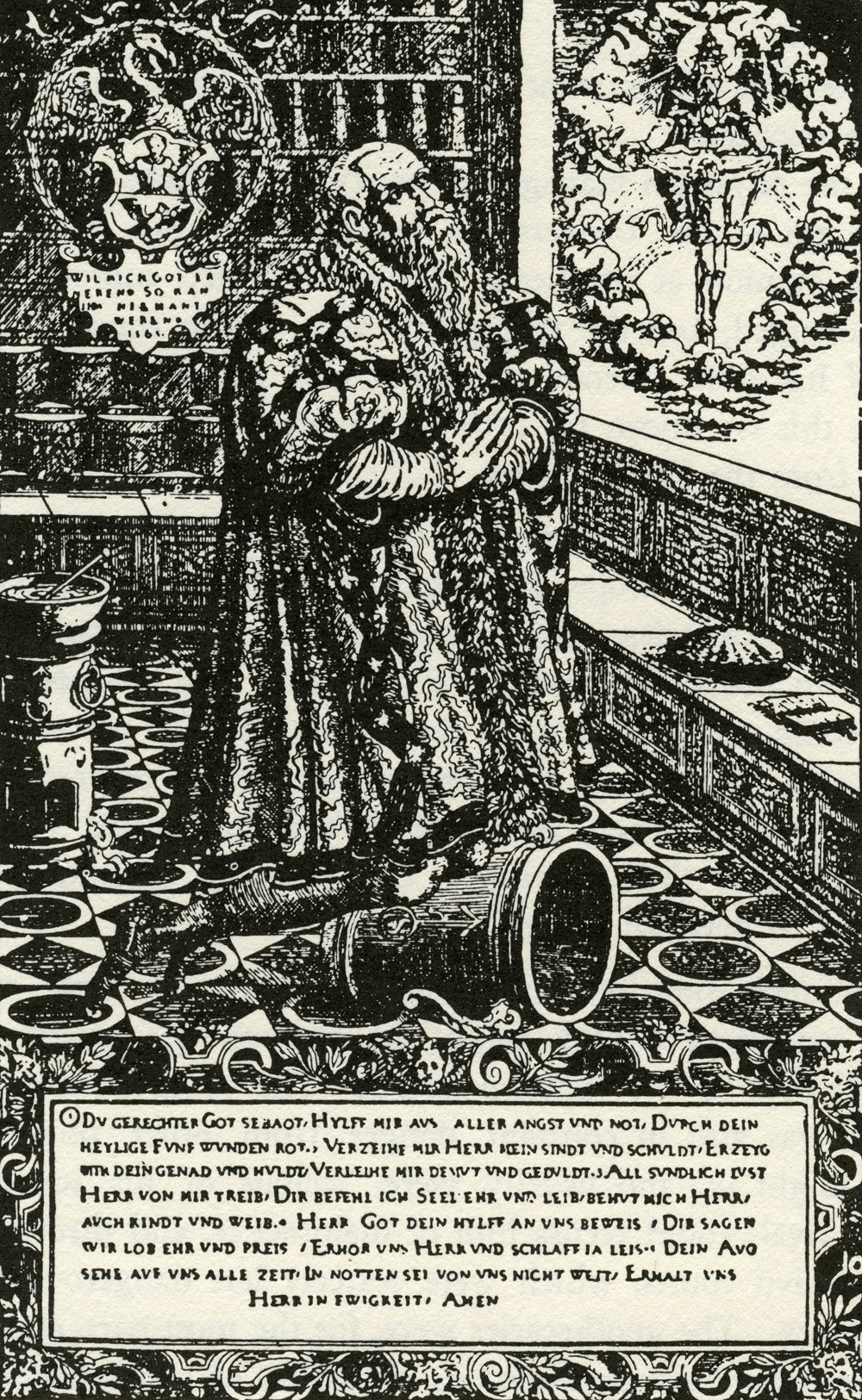
A medieval apothecary in a period when there was open warfare between the conscientious doctor and the unscrupulous chemist, prays: "Listen to us, O Lord, and sleep lightly. Let Thine eyes rest upon us at all times." As a result of the delinquencies of the chemists, many physicians prepared their own medications and reverted to the old practice of raising herbs in their own gardens. That brought on open warfare between the conscientious doctor and the unscrupulous apothecary. In an emergency of this kind the apothecary usually accused the physician of being in league with the devil. When this rumor was spread through the town, the populace, including many of the doctor's own patients, turned on the physician, pelted him with rocks and filth from the streets, and forced him to leave town. It required considerable fortitude to practice medicine under such conditions. THE CAUSES OF PLAGUES The Church and state were deep in theories, but the doctor had to face facts that were the direct result of false theories. For centuries, Europe was afflicted periodically by waves of the bubonic plague. Whole regions were depopulated and every medical facility was taxed to the limit. Thousands of doctors themselves died of the plague, which spread like wildfire through the towns and villages. It was useless for the medieval medic to preach sanitation; the plague was generally regarded as a religious calamity. The faculty of the Paris College of Medicine was of the opinion that the plague was the result of a conjunction of Jupiter and Saturn over the Indian Ocean, but the wiser heads were agreed that the devil was the real cause. Most of the doctors of the Middle Ages were themselves religious men, and accepted without question the teachings of their Church. They believed in a personal God and a personal devil, as was the custom of their time. But gradually, over a period of centuries, the thoughtful physician began to observe the relationship between sickness and unhealthful environments. It dawned upon him that those who believed most firmly in the devil had the least need of this conviction to explain their miseries. This newly developed power of observation resulted in a gradual rift between the Church and the sciences. By the fifteenth century the devil had lost considerable ground. Its existence was still acknowledged by the majority, but to the enlightened minority the Prince of Darkness was slowly passing into the condition of a myth. But if Satan had lost his power over the minds of the thoughtful, his botheration value in the field of learning can scarcely be overestimated. When the physicians in a certain town decided that a nearby swamp was the cause of a local epidemic, the local clergy was equally certain that the devil was to blame. To arbitrate this dilemma, the physicians came to the conclusion that the swamp was the direct cause of the fever, but the devil was the direct cause of the swamp. The final cure for ignorance is knowledge. About 1440, Gutenberg of Mainz invented the printing press. According to some of his contemporaries, Gutenberg employed the devil as his first printer, and the Prince of Demons assisted personally in the publication of the great Bible. Regardless of this, the printing press was the greatest single force in bringing the world out of the Middle Ages. But it was also necessary to break forever the power of scholasticism. At the University of Basel, Paracelsus burned the writings of Galen and Avicenna in a public ceremony. The old era of empiric medicine was closing. Already Leonardo da Vinci was performing dissection for the purposes of art, and a few years later Andreas Vesalius published his great textbook of human anatomy. Nothing could stop the forward motion. PARACELSUS, THE MYSTIC DOCTOR Paracelsus of Hohenheim, burner of the textbooks, was the greatest metaphysical physician in the history of Europe. Theophrastus Paracelsus was born in 1493, the year after Columbus discovered the West Indies. His father was a physician, and in medicine and the letters the young man received the benefits of a University education, if the system of teaching then in vogue could be said to bestow any benefits. After he had finished with the schools, the young doctor began his real medical education. One of the happy circumstances that was to mould his character was a journey to Constantinople where he was able to study with the Mohammedan physicians. It is not often that a serious student of the sciences is also a man of action, but these two extremes were dramatically mingled in the personality of the man who called himself "Paracelsus" -- to indicate that he vastly excelled the Greek philosopher Celsus. His contemporaries described Paracelsus as rough, uncouth, bombastic, and fanatically egocentric. He was not attractive in appearance, and made no effort to develop an engaging manner. He preferred arguments to discussions, and liked nothing better than an opportunity to insult important scholastics. Paracelsus traveled extensively and was particularly interested in the healing lore of gypsies, witches, herbalists, and alchemists. He studied astrology and demonism, talismanic magic, and the Cabala. He was interested in sympathetic medicine and magnetism, and is said to have had a piece of the mysterious alchemical magisterium, Azoth, in the hilt of his sword. To Paracelsus, only results were important, in a day when most men were trying to maintain the dignity of theories. To this daring Swiss doctor, all means physical and magical were justified if they contributed to the recovery of the patient. He cured dropsy with rings of antimony, and when a man was wounded, he rubbed the ointment on the weapon and not the wound. The books of Paracelsus were dictated to his disciples, and published, not in the medieval Latin of the schoolmen, but in low German, so that all who could read their native tongue could study the problem of health. To the horror of the other professors he also lectured in German, considering it more important to be understood than to be impressive. For these heresies, and the even greater sin of being successful in his handling of diseases that had never before responded to treatment, Paracelsus earned for himself the undying gratitude of suffering humankind, and the equally undying hatred of his fellow doctors. At last, the respectable and self-righteous physicians could stand no more of the rabble-rouser who announced publicly that the soft down on the back of his neck knew more about the healing arts than all the doctors of Europe put together. To this insult he added the further injury of taking difficult cases, solemnly pronounced as incurable by the most learned savants, and restoring the sufferers to health. It is sometimes said that Paracelsus was killed in a brawl, but it has been my privilege to examine various old books and manuscripts, and they are unanimous in stating that in 1541 the great physician was murdered by a professional assassin in the hire of the jealous and vindictive doctors. Despite his magic and his mysticism, Paracelsus is honored today as a great pioneer of medicine; but scientific men who revere his name seldom study the metaphysical methods which were the real basis of his greatness. Paracelsus, the first doctor of the modern world, was like most of those who have led men to the truth, a mystic and a seer. THE PROTESTANT REFORMATION A vital factor in the development of modern metaphysical healing was the Protestant Reformation of the sixteenth century. Even now, after four hundred years, it is difficult to fully estimate the consequence of this upheaval within the body of the Christian faith. The Protestant reformers not only decentralized the power of the religion, they altered the entire form of worship; additionally, they carved out entirely new sects, dominated by new viewpoints and separated by a confusion of contrary doctrines. Like most who desire emancipation from tyrannical forms, these protestants immediately set up tyrannies of their own. In their zeal they were guilty of nearly every fault with which they had stigmatized the elder Church. Again it was not a matter of sincerity, but of basic inability to meet the challenge of progress. When Calvin caused Servetus to be burned at the stake over a theological squabble, it is hard to reconcile such an action with the Protestants' claim that he was seeking the freedom to worship God according to the dictates of conscience. Or perhaps it was conscience itself that lay at the root of the trouble. In any event, the Reformation did not end bigotry; it only started a number of smaller bigotries, and began a motion toward separation that resulted in hundreds of arbitrary cults, with little of friendliness for each other. Puritanism worked a serious hardship upon the psycho-emotional part of human nature, by depriving it of participation in the pageantry of religion. The grandeur, pomp and glory of the Church was lost to those who left to find their own way of faith. Gone was the Infallibility of the Popes, gone were the Princes of the Church in their scarlet robes, gone were the Gregorian Chants and the mass, gone were the great cathedrals with their rose windows of priceless glass, gone were absolution and the confessional, and gone was the Apostolic Succession. All this was swept from the life of the Protestant, and nothing of solemn beauty was put in its place. But it is not the province of the present work to argue the virtues or vices of the Church, or the spiritual reality or unreality of its rituals. These pages are concerned rather with the psychological results of depriving the human consciousness of religious ceremonial and symbolism, and of the emotional exaltation which comes from participation in such rites. Puritanism chose to take an attitude of extreme austerity. Beauty found no place in its early concepts. Everything religious became drab and colorless. The new churches were mostly barren and shabby; the virtuous dressed in somber black and developed a dour and stubborn devotion to the jots and tittles. Martin Luther had thrown his ink pot at the devil while translating the Bible into German. The Prince of Evil was still on the job, and never had the medieval Church worked him harder than did the Protestants. After Jonathan Edwards finished one of his sulphurous sermons in old New England, a deacon came up to him and said, "Dr. Edwards, is there any hope for any of us?" If the Latin sermons of the Middle Ages were meaningless to the unlearned, the English sermons of the eighteenth century were equally meaningless to the informed. Stolid men in square-toed shoes sat for hours on rough benches and listened to various divines who denounced every human impulse as infernally inspired. And little children with pale frightened faces heard the dreadful words of common doom, while their hearts were still too young to know good from evil. The doctrine of eternal damnation in the name of an all-loving God blighted the arts and frustrated the sciences. Now there was neither beauty nor hope, and even human kindliness might be weakness endangering the immortal soul. Many of the older men and women of today have suffered all their lives from that strange sickness of their spirits which resulted from puritanical parental homes. THE PARTING OF THE WAYS With the coming of the nineteenth century, religion, medicine, and mysticism, associated since the beginning of recorded history, arrived at the parting of the ways. There was no place for mysticism in those neat little red brick churches, shaded with stately elms, where kindly clergymen preached trite sermons from well-loved verses of the scriptures. Great orators like Henry Ward Beecher and DeWitt Talmadge drew admiring throngs, and evangelists of the caliber of Dwight Moody and Charles Spurgeon converted thousands. But these men were untouched by that mystical divinity which comes to those, who like Francis of Assisi, preached their sermons to the birds. Nor was there any place for metaphysics in the distant vaulted temples of science, where mathematical-minded physicists pondered the plane of the continuum. Charles Darwin and Thomas Huxley ruled supreme in the empire of the mind, and with all the material world to explore, there was no time for vagaries of the spirit. The rise of mystical organization in the modern scheme of life is the direct result of three centuries of Protestant Christianity and a hundred years of materialistic science. The spirit force at the root of things cannot be denied. Blocked by the organized literalism of both religion and science, the metaphysical energies in human consciousness were to break through the intellectual barriers men had set up, and create new channels that the old truths should not die. The sages of ancient India reached out across time and space and raised up a Brahman in the West. He was Ralph Waldo Emerson, America's only great philosopher, and the moving spirit of the New England Transcendentalists. Visions came to Joseph Smith, and the religion of Jesus Christ of the Latter Day Saints was born. Spirits rapped on the walls of the old Eddy homestead, and ageless spiritism became modern Spiritualism. Phineas Quimby, obeying the admonition of Christ to heal the sick, taught men the power of Truth within the self. Andrew Jackson Davis talked with spirits from the other side of death, and learned from them the mysteries of the Summerland. A little later, H. P. Blavatsky brought esoteric Buddhism to prosaic old New York. If modern materialists are unhappy about the renaissance of the old mystic cults, they should remember that they have no one but themselves to blame for the condition. If these scoffers had given but an instant of sober thought to the natural structure of the human being, they would have realized that metaphysics is necessary to the survival of civilization. Not ridicule, but thoughtful consideration, was indicated; but the worldly-wise had no temper for this more reasonable approach. END OF THE CHRISTIAN MINISTRY OF HEALING The Protestant sects did not perpetuate the Christian ministry of healing, and materia medica had divorced itself from the last vestiges of magical practice. Psychologists are just now beginning to realize the magnitude of this mistake. Humanity was deprived of a spiritual consolation essential to its well-being, and nothing was offered to take the place of this loss. We cannot do better than to refer to a statement made by the distinguished Swiss psychologist, Carl Jung, in a recent interview. He said, in substance, that it was not necessary to psychoanalyze Catholics because they had the confessional. Most doctors have little time to sympathize with the personal problems of their patients, yet it is the sick who stand in the greatest need of gentle understanding. This is the reason why the old family physician, fast disappearing from modern practice, was frequently more successful than the better informed modern practitioner. The average clergyman has had no training in psychology, and can offer little that is useable to those with muddled lives. Sad experiences have awakened the public mind to this situation, and in recent years, those troubled in themselves have turned hopefully to the psychologists for relief. But many of these doctors of the mind have themselves been unfortunately suffering from a materialistic fixation, and could offer only Freudian formulas, for problems that Freud himself never understood. Those who found no help in the churches of their faith turned to other beliefs for guidance and inspiration. They revived old cults, pondered the scriptures of other nations, worshipped at strange shrines, and received with open arms the missionaries of Eastern religions. The churches stormed against these heathen practices, but the fault lay at their own door. Men who have discovered the answers to their questions will seek no further; but those who have not found what they need will go on searching, and no power in heaven or earth can stop them. The same holds true in the field of medicine. The various non-medical schools of healing survive and flourish only because a great number of men and women are dissatisfied with the theories and practices of orthodox physicians. Instead of trying to understand the reasons for this popular trend, the medical powers-that-be merely thunder their disapproval, and use every means at hand to prohibit the practice of nonmedical healing. But vox populi, vox Dei, and history has proven beyond all doubt that the will of the people cannot be denied. It is the unchangeable purpose of the human being to restore the spiritual foundations of his world.
The great English physicist, Sir James Jeans, has admitted that the mechanistic theory of life has failed, and it is necessary to restore intelligence to space. Materialism has failed in man, failed in society, and failed in the universe. The human instinct, wiser and older than all the sciences, knows that creation is a mystery in the spirit, and that the man who would solve the riddle of himself, must find the mystic ways that lead to God. |