by Sidney M. Hirsch
© February 7, 1913 by Sidney M. Hirsch
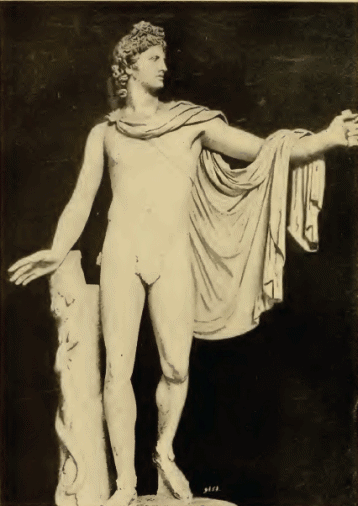
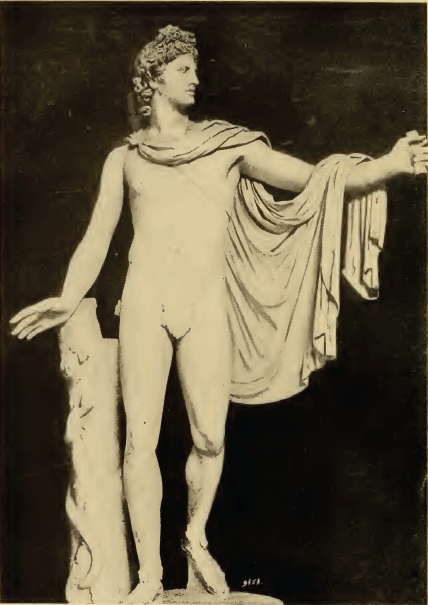
APOLLO BELVEDERE.
(VATICAN.)
To supremest Jove
I 'grave this image.
DEDICATED TO MRS. JAMES C. BRADFORD AND MRS. ROBT.
W. NICHOL
|
The Fugitives: The Fabian Society
Joins the Klan (1920s)
In 1917, Walter L. Fleming was
appointed dean of Vanderbilt University in Nashville, Tenn. During
the preceding years, the college, once Southern Methodist
Church-sponsored, had been taken over by a consortium of Rockefeller
and J.P. Morgan Wall Street financier interests. Vanderbilt,
under Fleming, would provide the launching pad for the Fugitives, a
literary mafia that would promote a revival of Confederate ideology
and wage cultural war against the American System paradigm of
scientific and technological progress and republican statecraft.
Beginning in the 1920s, the Fugitives published a literary magazine
of the same name.
Fleming's most famous work had been
his 1905 history of the original post-Civil War Ku Klux Klan, which
he prepared in consultation with many of the surviving "Tennessee
Templars" who had led that organization. Fleming, along with
other political, cultural, and spiritual leaders, had been
instrumental in the 1915 re-launching of the Klan, which was
promoted through the mass circulation of Hollywood's first
full-length feature film, D.W. Griffith's Birth of a Nation,
beginning with highly publicized screenings at President Woodrow
Wilson's White House, and at the Supreme Court.
The Fugitive's high priest was a
Rosicrucian mystic, Sidney Mttron Hirsch. Its temporal leader, John
Crowe Ransom, had just returned from his Rhodes Scholarship studies
at Oxford University. Ransom was well known, at least by his family
connections, to Dean Fleming, because his great uncle, Tennessee
Templar and Ku Klux Klan founder James R. Crowe, had been Fleming's
chief source on Klan history. In fact, the entire Crowe family were KKK, and Ransom cherished his childhood memories of mama Ella
Crowe, and the other Crowe women, sitting around the family hearth,
sewing sheets together for the rallies.
This was not an aberration. The core
of the Fugitive circle, and their later literary and political
collaborators, were descended from Tennessee Templars, officers of
Nathan Bedford Forrest's Confederate Army "Critter Company." The
small Fugitive circle, in addition to Ransom, included five others:
William Yandell Elliott, Bill Frierson, Robert Penn Warren, Allen
Tate, and Cleanth Brooks. All but Tate were also to be Rhodes
Scholars. And Warren, Brooks, and Tate, along with Ransom's younger
students, John "Jack" Thompson, Robbie Macauley, and Robert Lowell,
were all to play leading roles in the Congress for Cultural Freedom.
At the time Ransom's Fugitive circle
was formed, the main Fabian Society publication was a journal
called The New Age, which was financed by the Fabian playwright, and
promoter of Friedrich Nietzsche,
George Bernard Shaw
and published by a Theosophist, Alfred Richard Orage, who later
became a disciple of the Russian mystic,
Georg Gurdjieff. In The New
Age, the works of Fabians Shaw, H.G. Wells, G.K. Chesterton, and
Hilaire Belloc, appeared alongside those of the leading Satanist of
the 20th Century, the self-proclaimed "Great Beast",
Aleister Crowley, and
assorted other pornographers and mystics like William Butler Yeats,
future Fascist spy Ezra Pound, T.S. Eliot, and D.H. Lawrence.
Chesterton and Belloc, though
associated with the Fabian Society early in the 20th Century, were
to become the leaders, along with Maurice Baring, of a Synarchist,
pro-Spanish Inquisition, pro-Roman Empire, pro-Fascist Catholic
grouping known as the Distributists. Fellow New Ager (and later
Nobel Prize winner and major figure in CCF operations) T.S. Eliot,
was to ally with them in this effort, as were Ransom and the
Fugitives.
During the First World War,
Chesterton, Wells, and others of the New Age crowd worked for
Wellington House, Britain's propaganda unit under Charles Masterman,
which was taken over by Lord Beaverbrook [aka Max Aitken] in 1917.
The alliance between the New Age
crowd and the Fugitives was initially forged by William Yandell
Elliott. During his Rhodes Scholarship term, 1922-24, at Oxford's
Balliol College, he came under the influence of leading Round Table
and Fabian Society figure, A.D. Lindsay. Elliott's subsequent
professional career at Harvard's Government Department, and in
various Congressional and Executive positions in Washington,
centered on the idea that the United States Constitution should be
scrapped, and the nation reorganized as a section of a "New British
Empire," an idea derived from Lindsay's Round Table program.
At Oxford, Elliott had consorted with
the occultist literary figures of The New Age. He was part of a
late-night drinking circle including Aleister Crowley's one-time
lodge brother, the Nobel Prize-winning poet William Butler Yeats,
and long-time Fugitive intimate Robert Graves. Future CCF operative
Graves is known today for his adoring history of the Roman Empire, I
Claudius and his promotion of the cult of the White Goddess.
--
The CCF and the
God of Thunder Cult, by Stanley Ezrol & Jeffrey
Steinberg |
ACT I
(Scene: Grazing sheep upon a meadow
guarded by two dogs. The Shepherd (a youth) lies sleeping under a
tree. Several Pans, Satyrs, etc., appear and hold revel, dancing
about. The Youth moves uneasily in troublesome dreams. The figures
disappear. The Shepherd arises as one in a trance; he appears
strangely troubled and makes exclamation of deep despair, then falls
heavily to the earth and immediately enters into a profound,
dreamless sleep. Three Muses arise from the midst of the herd
(Calliope, Euterpe, and Polyhymnia); they are draped with diaphanous
veilings of delicate pinks and blues, bare-limbed and sandal-shod.
Their hair, at first corymbus, shortly falls and envelops them in a
vaporous cloud. They speed lightly over to the sleeping Shepherd.)
Euterpe
O! Thou peasant, made poet, now
living abreathing, twice born
O singer, mellifluous, fresh waken, ... aye sing to the morn,
Aye sing to the dawn of the day when was shorn.
Thy memories of night.
O sleeper of death, in the kiss; ... now awaken to life that is life
Awake to thy nuptial, behold, aye! Enfold now thy mystical wife.
Whose embrace doth now give thee a light,
For the loss of that fire, consuming, O fire of strife
O my lover of light! Child husband
Ecstasy hushes and hangs o'er earth and its whirr --
Wings are down folded, quivers the violet to birth
Within ear of the tiniest furry winged delicate thing,
'Tis whispered ... be without fear,
'Tis a gift in the kiss of our might
O my lover ... my leman of light
(She stoops and kisses the Shepherd.)
Calliope
Hero born! sword wielder! helmeted
fierce,
Hurling back spears of the Sun, mimic of Ar's,
Maimer of underworld glyphs; astride now thy horse.
Winged and thirstful, aerial to drink 'pon the highest of heights,
O rider, drink now of my gift
From hence now thy mouth, be to river, the lips ...
The lips on the waters that flow,
That the rhythm shall rhyme, as a shore-thirsting wave-measured sea.
O waters of words! that shall rouse, that shall flame heroes'
hearts.
Youths drinking shall long for a spear and a beard, long for the
shock!
And the clashing of shields 'pon the plains of the battling wraths.
Aye, dream dreams from the hearing of veterans,
Who'll straighten and tense and live all again in the birth of the
telling,
And maidens and wives in presaging --
Shall weep o'er the woes of the wars in the years!
O youth, 'tis the breath-measured gift of my kiss.
(She stoops and kisses the Shepherd.)
Polyhymnia
O mortal who dies in my kiss! man who
is born!
Count the heart now thy mother, the virgin, ... no mortal hath
known.
Thy Father is he. Concealed of all the Concealed!
The White Head ... Supernal, O blessed be He!
O man in my kiss, shall much of his name ...vouchsafed unto thee!
(She kisses Shepherd, then
disappears. He rises enthralled by what he considers a ''vision
dreamed.'')
Shepherd
Ye Sun! Consoling light, O Earth!
Ye trees and shadowed streams, ye sky-lined hills,
O bleating lambs, ye rams, ye pebbled rills,
I've dreamed a dream! a vision rare vouchsafed to me,
A maid, three heavenly maids
Came down and kissed my mouth,
And breath of theirs was sweeter far than any flower!
Sweeter than waters from a native youth-known well
Drunk upon a parched midnight palate!
Sweeter than a love child's earliest lisp
Upon the youngest mother's breast,
O sweet it was and balmy past the telling!
And flame they brought that fires to whitest light,
That purged my dross, refined, yea purified my very pure!
Henceforth ... I their prophet am, --
My lips can utter concord of but sweetest sounds,
O balmy breath, O soul of flowers, return again!
(An olive tree opens and admits
Athene. She is helmeted and carries a spear. The Youth falls
prostrate in reverence and awe.)
Shepherd
O! ... O! ... O!
Now is this miracled day at zenith!
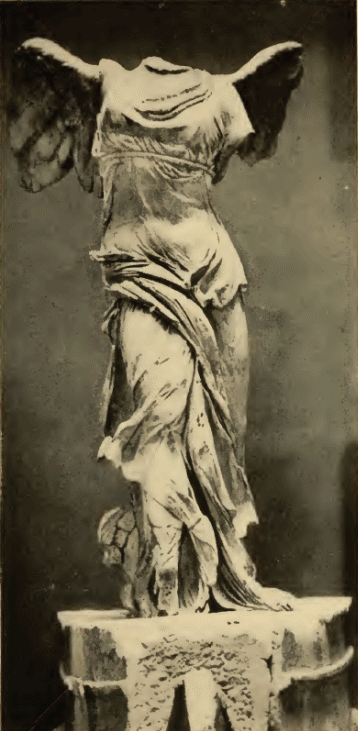
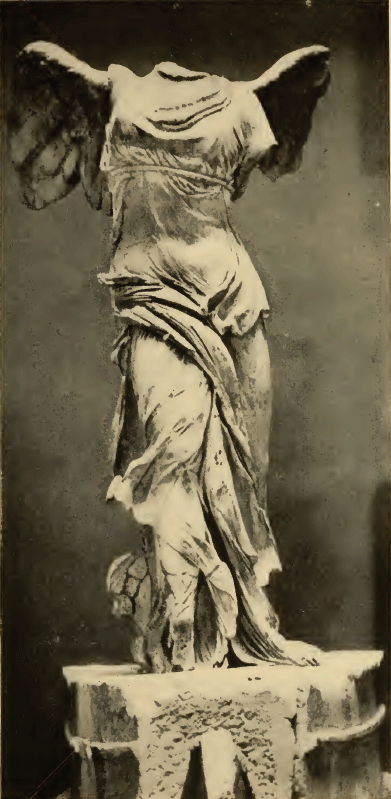
THE WINGED VICTORY OF SAMOTHRACE. (LOUVRE.)
Athene
I am Athene!
Fairest daughter of supremest Jove!
I sprang full lipped; ... full armed from that broad brow,
Clove at one mighty stroke of ax by that lame God.
I am the soul of man!
That mystic bride that weds him 'pon the highest height of mind,
When all he gives in gladness, that he all might gain,
Delights he, life to lose that he might live.
O man! unweighted idea!
One thought of Him who thinks on thought!
Well wilt thou serve me,
For deed in mine own city, Athens, violet crowned,
A maid, who guards my sacred flame.
Spotless, untainted e'en by a thought.
To shameful, hideous death decreed.
The nether-world manes wrought
By machinations foul that fume but in the darkest minds.
This deed that e'en basest mortal,
Man of reddest earth would shrink.
These shades, ... Ate inspired, have connived;
And Persephone in meads of Asphodel agreed.
With Furies three, with fire controller's self,
That each a runner should dispatch.
Illy visaged, ... illy humored, ... illy seen.
Four despicables! ... four Hadean helots!
And winner of this grizzly crew
Should in embrace, foul ... fetid.
And claim the Hestia's virgin priest. --
Shepherd (to Athene)
O! Wisdom's Self!
O! Princess, daughter of the King of Kings!
Aflame am I to speed, --
My feet disdain the earth!
O! earth sink from me! ...
Athene (to Shepherd)
O eager youth!
Becalm thy flamings with wisdom's waters!
To underrate the runners 'tis to lose the race already.
Take thou my shield and speed!
And whoso looks therein, shall find a fate
Acquired of himself ... fearful either or fearsome --
Shepherd
I stand with tingling feet!
The flame to speed consumes me!
Oh. ... I flame ... I flame....
(Shepherd falls in a trance to the
earth.)
Athene
O poet who dies ...
Thou shalt prophet arise --
(The Shepherd falls in a trance. The
nine muses appear and wrap him in the white napery of the grave.
The thirty-two blackrobed acolytes
appear carrying torches. The Shepherd is lowered into the sepulchre.)
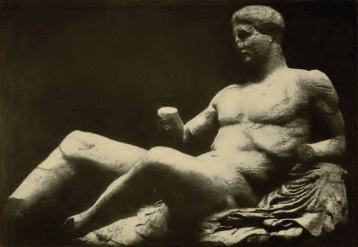
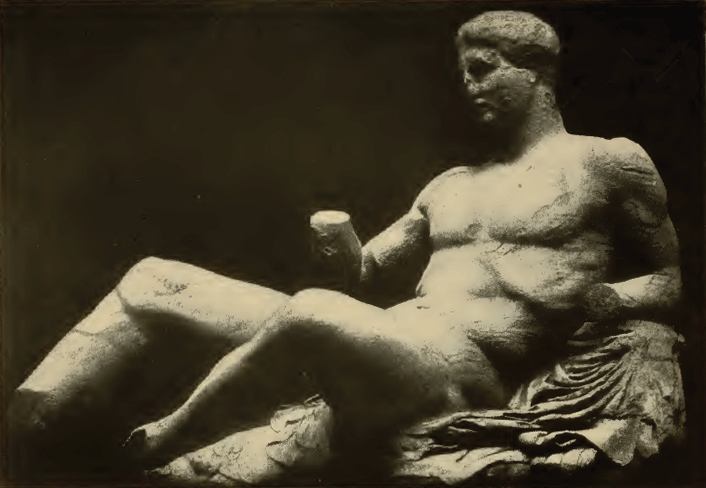
THESEUS OR DIONYSIUS. (BRITISH MUSEUM)
Athene
The death of the poet!
Ah, weep all ye muses, ye glorious nine who are sung ... who are
evermore sung!
Attending the princess, whose heart is now sobbing, is evermore
sobbing ... is evermore wrung!
For paused the galloping hills in their headlong and tireless
flight,
Bowed ... their heads in the mourning of draperied night.
Noble the night-bird in song of unnamable pain,
Silent the wind, that aeolian through grasses and grain.
Runic the murmur of river and reeds 'long the shore
Revealing of passionate pain in ineffable lore.
Oh, that the soul of the world should be cleansed by the solace of
tears.
And its rock-ribbed heart attuned to the mystical
music of spheres!
High in the perfume of pallid magnolia and moon.
Coalescing with comfortless woe and the sob and the psalm of the
loon,
Ah! sorely oppressed are the valleys, the velvet savannahs and
streams.
For mute is their prophet, and silent their psalmist, ... their
dreamer of dreams.
Back to the hills went his largeness ... to the reeds his pure
polonaise.
Back to the Soul-source, helaic, returned the seer's white rays,
Back to the All-love, his loving, aflame in the wine of the vale
In the peace past sublime and supernal --
'Tis the kiss of the groom Astreal.
(The goddess Athene moves over and
attends before the aperture of the sepulchre.)
Athene (with authoritative
gesture)
Thou Might of Jove ... arise!
(The stones at the top of the
sepulchre appear to separate and shortly, to the amazed eyes of the
muses and sombre-garbed males, the Youth still wrapped in the
grave-clothes slowly ascends into view. When he stands on the summit
of the sepulchre, with one convulsive effort the grave napery is
parted and thrown aside. He stands garbed in shimmering white.)
Athene (to Youth as she gives
her shield)
Speed ... and upon the coursive
corridor
Shall much be given thee!
All that hast unlearned been by thee
Hath left a void, wherein shall rush
In thy delight, purest word,
A Name that doth the all contain!
Speed, goodly messenger
(Athene disappears. A youthful Eros
enters, leading Pegasus, who appears as a surpassingly beautiful
white-winged stallion and seemingly aflame with light. The Eros
delivers the Pegasus to the Youth and disappears. Then Youth taking
the bridle delivers ode.)
Shepherd
O Jove! Supremest, past thy Name!
Enthroned above the waters, ... 'lone ... complete!
Reclaiming from him, who kings the River-ocean,
Mighty monarch! Horse creator!
Thou God of Gods! Of king of Gods, ... the King!
To Thee, my prayer, that like the eagle's flight
The highest height would no less gain!
O, AEther! way my winged words
And hinder not their swiftest ascension.
To Him, whose ear divine, doth man's word try
Thou Light of Sun! O Dionysos child!
Passion I beseech, of thine own golden grapes.
That nether shades, in ecstasy, are Lethe held,
Nor can distract within of secret sin nor latent lie!
I speed! ... I speed!
O Jove! O Jove! O Jove! O Jove!
(The Shepherd carrying shield of
Athene and leading the winged horse speeds once around the
encircular and exeunt.)
ACT II
(The Hierophant, a broad-browed,
ample man with streaming white beard and hair covering his breast
and shoulders, attired in white sacerdotal garments, enters
accompanied by three black-bearded young Priests. They advance with
solemn and majestic mien to the sacrificial altar. The Hierophant
makes low obeisance and kneels before the cubical stone.)
Hierophant
O Zeus! Thou cloud conformer! Mist
destroyer!
Whose breath is vital air and fire's soul,
Whose wrath is lightning's spears and thunder's rumbling car!
Despoiling souls as sun dispels the clouds!
Thou! whose terroring eye, this delumed flame discerns!
I thee approach, that I might name thine awesome Name!
Ineffable word! O meditative mind!
Per'venture I, numbered negations have confessed and cleansed mine
heart.
Attending here before thine Oracle
Might I within enveloping truth now call --
And hear the voice unheard of mortal ear, the unseen rays discern,
I utter now, with cleansed lips, and heart, and ears!
Jove! ... Jove! ... Jove! ... Jove! ...
A Voice of the Oracle
The stone.... The stone!
(The Hierophant and Priests fall
prostrate in awe.)
The Voice
Double the cube.... Double the
cube!
Hierophant
(Arises. To three Priests in great
alarm.)
Assemble the priests! Gather together
the peoples!
Sound upon the ram's horn! Let blare the red-voiced trumpets ...
Wind upon the cornet!
For the Oracle hath spoken! ... it hath cried aloud ...
And that which is voiceless hath uttered! ...
Yea! that which is unrayed hath given forth rays!
(The three Priests sound upon the
trumpets, etc., and are echoed from within the temple. Three times
they wind. (a) Then enters a high priestess. She advances with
stately step. Then follow thirty white- draped maidens with loosened
hair. (b) Enters a black-robed priest followed by thirty
black-garbed priests. (c) Enters chorus, of maidens and male
priests.)
HIEROPHANT
Ye ample men of Jove! Ye virgin
priests! --
O! Herders of the sacred sheep! O Hounds that guard the temple's
flock
Attend thine earnest ear! ... Attend! ... Attend!
For unto thee hath heaven's wish
In hidden secret word come down.
O! awesome was the hearing! Awesome now!
Mine inner heart! My soul's own soul did quake!
O! that I may with censor stand between thee and the wrath ...
That incense prayerful, spread abroad, might stay the plague!
O Zeus! That white-armed Justice should with Graces three,
Whose loveliness is tender-eyed as stars inwoven
Through weeping rain, o'erwatch us now!
O! Omnivirgin, clear-eyed Jove's Athene!
For thine own sacred city, Athens, we beseech ...
That wisdom, whose inner, whitest soul thou art,
Might bring that liberty, that calm, serenest poise
Wherein, discernment of the secret words divine, shall be.
With purest lips I voice ... Athene!
The Maxima
Hierophant triumphant! Thou mortal
God!
Archtype of Him who spake the awesome word
And formed this bounded earth!
Thou Head, Thou art of life in this our Argive land!
Let Mercy now attend 'pon Justice sombre.
How else might Zeus his might express?
Who mortal, could coincidence that line?
O Thou whose thought is beauty, and whose word ... the good,
What hath perceived thee in commune with Jove
That arrows aerial emanate from thee.
And tremulous votaries, maids who guard the light,
With timid step approach and search with eye suspicious?
Hierophant
Let pulsing silence, and thick
darkness cover!
Let words flexible be, and gates to memory!
Attend ye, who have gained an eye, and inner ear,
Initiates, and all who are elect!
The Kings, the Thirty-two have
with the Thirty fought --
With fierce and soft desire did they now o'ercome.
And they who reigned ere balanced force did rule
The victory gained. Oh, wail ye men of Jove!
For one among the Thirty who with prudence guards the light
Hath sullied maidenhood and chastity hath treasoned....
Maidens and Chorus
Woe.... Woe....
Strophe (Males)
Justice decrees ... Justice decrees!
Women are sobbing, strengthen our pleas!
Justice severe ... Justice severe!
Yoke is now galling ... yoke we revere!
Justice deferred ... Justice departs!
Strengthen our purpose ... harden our hearts!
Antistrophe (Maidens)
O Justice, veil thine eyes in mist!
See beauty is balanced, 'twas wedded when kiss't.
Let misty ey'd Mercy with Justice commune,
Gentle Faith and lone Hope in our cause importune!
See hills 'gainst the Argent, ... tense stone weds the earth.
Fierce Sun and the Sea ... gentle rain brought to birth.
Aye, Tide and the Moon in a
Lesbian love,
Strange sisters that live in the law of great Jove.
Yea, Sun and the Clouds ... e'en Sun and the Sod!
The Artist with beauty ... the Rhapsodist with God!
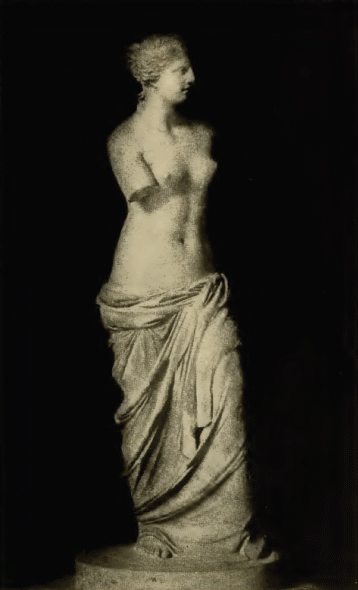
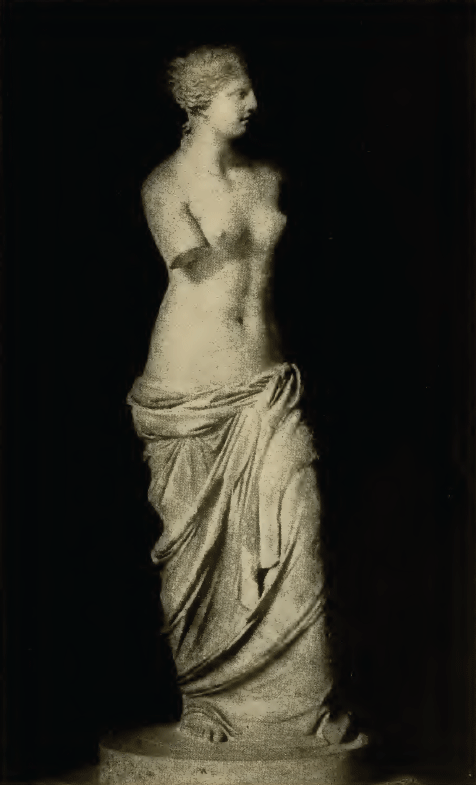
APHRODITE (VENUS DE MILO). (LOUVRE.)
Males
(Repeat Strophe.)
Epode
Let cooling memories heal the mind,
Serenity and calm repose attend,
And 'neath that shield no shade can send
An arrow nor a spear to blind.
For 'pon that pleasant land Jove hath his eye
And sends his rain and later rain,
The law that cleanses, ... the gold we buy,
Wisdom we purchase with our pain.
O Souls that throng the aether and will blend --
Cause adamantine hearts to break, and peace descend.
HIEROPHANT
When hero-born scans unhorizoned
mind,
And gains the grandeur of the plan entire,
Then e'en deathless demons who do dwell in death
Can serve. I call them now.
(The
underworld Gods appear and with weird ceremony torment the
maidens.)
Upon the temple's traitor, ... Pan, I
urge
Thy sudden and thy frentic fear
That guilt should be established....
Satyrs, Cybele, Hecate, all! Ye Gods of caves and grottos,
Of frentics irrational.... Of panics irredeemable!
O Artemis, black melancholy that shall blast her soul!
O caves and mystic marshes send
mephitic vapors,
Earth hide her not! ... Sea cast her forth....
Shriek ... shriek thou treasoned priest!
Let cries of thine, unclouded heaven blast
And point thy guilt as bleak trees stab the sky!
(One of the maidens suddenly becomes
possessed of hysteria and flees frantically towards the altar. She
is overtaken by two priests and brought before the Hierophant.)
Strophe (Male)
The sins that mar our pristine
state
Demand propitiation!
The clay that clogs our truest fate
Demands an immolation!
Nor Pity's tear scald fertile earth
Nor heave the windy sigh!
The laws immute that brought us birth
Demand a victim die!
O Justice send thy dire decrees.
Choose thou a maid of one of these!
Antistrophe (Maidens)
O Hestia! Virgin votaries we,
Attend our tremulation.
Come Astraea from cerulean seas,
To fend our tribulation.
O guard thy doves within the cote
That is thine own afflatus,
Defence devise that shall defeat
Storm shades would devastate us!
O Pallas! clearest eyed and brow'd
Save thou thy maid from flaming shroud!
Three Acolytes
O Zeus!
Stern stands thy charioteer;
Thy might should be established.
Lest wrath like green-eyed, mountain wolves
Should plague the plains afamished!
Male Chorus (Insistent)
Justice clear-eyed name decrees!
Choose thou a maid of one of these!
Maiden Chorus
O Pallas e'en thee! O ... e'en thee
we cry
Lest tend'r'st bosom'd virgin die!
Male Chorus
O Justice stern-eyed voice decrees!
Maiden Chorus
O Pallas Athene! Hear our pleas!
Chant (Antiphonal. In unison)
Priests: O Zeus! that thy might --
Response: O Zeus! that thy might
Priests: In the earth be established --
Response: In the earth be established --
Priests: Through justice and with clinging mercy --
Response: Through justice and with clinging mercy --
Priests: Hail! Hail! Thou Supremest Jove!
Response: Hail! Hail! Thou Supremest Jove!
Priests: Giver of the com, the wine, and the oil --
Response: Giver of the corn, the wine, and the oil
Priests: That nourisheth the heart
Response: That nourisheth the heart --
Priests: That delighteth the soul --
Response: That delighteth the soul
Priests: That maketh my face to shine --
Response: That maketh my face to shine!
Entire Chorus (in unison)
Hail! Hail! Unto thee Jove
supernal!
Light of the Sun! Of the Sun of the Suns!
Giver of the corn, the wine, and the oil!
Bread of the heart, ecstasy of soul, light that rays the face.
Bountiful Jove! Former of form!
Hail unto Thee! Hail unto Thee!
Essence of ecstasy! Return I unto Thee in rhapsody!
Hail unto Thee, Hail! Hail!
(Athene appears in the midst of a
misty fountain. All kneel in reverence.)
Chorus
Males
Woe.... Woe!
Maidens
O ... h! Oh!
Athene
The cube 'twas ever symboled man,
And doubled ... be but born anew!
Again the flame shall seek the sky,
The red attain the blue.
Then thrice ordeal of doves and lambs
And night and day shall race,
Lest innocence should shriek in vain
And wrath cloud heaven 's face --
Strophe (Maidens)
Athene grave-eyed hath granted our
boon,
Yea wisdom unweighted enveiled the rune!
And stone to be doubled, ... the riddle is ceased;
In new birth is now added, ... of the Best to the beast.
Now him double-natured, ... the mortal adds man,
No longer obdurate, Jove's purpose can scan.
Trust now to ordeal, seeking laurel coronal.
Diadem rarest of Saturn's supernal.
Antistrophe (Males)
We host of might do voice regret,
No longer do the senses reign,
No longer do they weigh of pain
But rather of perfection fret;
These mortals who would 'scape the net!
But though they dream ... 'tis noble dream,
Still Acheron will claim his debt.
And we, obdurate to the lucid beam.
Must, too, our barks that course beset.
O Jove who veils himself in light
E'en thou art bull indwelling night!
Epode
Should changeless God gain Protean
plan,
Whate'er is willed; ... 'tis then the good;
And man's new heritage of true law must scan,
For what He is ... He is the God.
Of type, then arch-type makes a new demand,
And conscience be but quarrel 'twixt "to be" and "is."
Perceiving some, the wheel an endless saraband
None amaranthine but him, ... Thanatos.
O omniman nought constant is but change!
'Cept him who thinks on thought and nought can disarrange.
HIEROPHANT (to Athene)
Hail thou clear-eyed Olympian Athene!
Omnivirgin, omniscient!
Thy cryptic words inflame the mind eristic,
But soothing waters are and palliative balm
To simple memories who much of knowledge have unlearned,
Perception trusting, essorant of wall and rampired banal states.
And leaping troops that brandish black-gored spears
As deadly keen as brumal winds that blast the vernal trees;
White poplars slim, ah shadowy slender brides
That kiss Scamander's moon-thralled tremulous breast
And willows wan that weep sweet melancholy's ecstasy.
O Virgin wife! Of all who in life live, ... the mother!
Thy word ... and will of mine was banished, and my will ... thy
word
Be it of holocaust or hecatombs.
Or monstrous miracles with blood of goats and blood of bulls;
For 'mersed within the mood that doth preclude thine unveiled
science,
"To be," and "good to be," of dire difficulty knows not any.
So be it then of thrice ordeal, of dove and ram and horse.
And thou, the azure eyed, whom oaten pipes can ne'er o'ercloud.
Shall in mine golden moment, give me gain of verdict.
Strophe (Male)
Justice demands.... Justice demands!
Pity is manless.... Strengthens our hands!
Justice deplores.... Justice deplores!
Pity is sown.... And Panic the sowers!
Justice deferred.... Justice departs!
Strengthen our purpose.... Harden our hearts!
Maiden Chorus
Hestia! Astraea! Athene! we
beseech....
Male Chorus
Justice attend.... Justice attend!
Stern eye and tearless ... pity to 'fend!
Maiden Chorus
Artemis, O moon-maid, we beseech....
Male Chorus
Justice disown.... Justice disown!
Change in perfection ... perfection is flown!
Maiden Chorus
Nymphs and Nereids, Hera all now we
beseech....
Male Chorus
Justice deferred.... Justice departs!
Strengthen our purpose.... Harden our hearts!
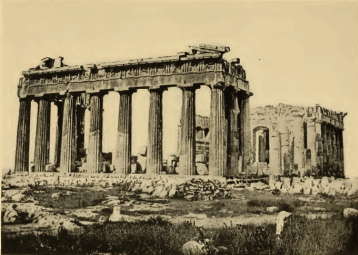
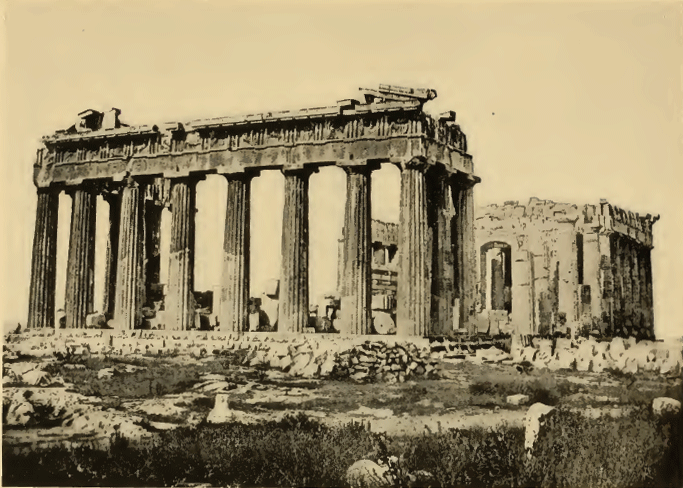
PARTHENON, EAST FRONT. (ATHENS.)
(The
thirty-two black-robed priests enter, each holding two black
pigeons freighted with mourning streamers. Thirty white-draped
maidens enter, each with two white doves with white ribbons
attached.)
Maidens
Thou tenderest doves ... thou
symboled souls of light
Let thy caressing wings the empherean win,
Thou gentle God-wives who do sear out blackest night
List no outer, but intrinsic sprite within,
Else some soilure should o'erfreight our prayers palanquin.
O doves, thou amorous souls of light,
Guide thy gentle flow aright!
Guide thou aright!
Thirty-two Priests
Eerys of Erebus.... Erynys of fate!
Careering 'pon the phantom's vapors
Keen thy sensing ... eyes dilate,
Seek the regions ... he adores
Who doth guard the Stygian shores.
Tend thy forehead, guide thy flow.
Woe and woe heaped high on woe,
Yea, from right to left they flow!
Entire Body
Woe and woe.
(The thirty maidens and
thirty-two priests loosen the
doves. Then each member of both choruses simultaneously loosens two
doves, chanting the while the last three lines of the maidens' and
men's chorus.)
HIEROPHANT (after observing
flight of doves)
The monad doth defeat our restive
poise,
No vouchsafed answer hath this first boon limned,
And dreaded two, discordant ever; seek ye now,
Of lambs, white fleeced and dark wooled rams
That she, who o'erwatches flocks, feeds well her jealous eye
And sees no slight, that maddening beams should sear us
Broken minded, bruited sad ones, prophets, sibyls, silly seers.
Prescience urges that your smoking brands of resinous pine
Propitiate and stave that fearsome fate.
(The
thirty-two priests and thirty maids exeunt and re-enter with
white lambs and black rams and after choral dance, the lambs and
rams are loosened from centre. After thirty seconds have expired,
smoking brands are stuck into the ground whereon the lambs and rams
are grazing, and direction of smoke noted.)
HIEROPHANT
The breath of bounded gods, Olympian
Joves combat!
O direful is the predilection!
Hence to your grottos ... vade foul vapors!
Oppressing vitiated bodies, thy plaguing nocturnal
O Phoebus dispel, permeate this discolored aether!
Sminthian, thou attend these mice of lumest whiteness
Who do now in ordeal triune.
Driving coursers, lion waisted, noble breasted,
Black and white for doom or day,
O attend ye River-ocean's King!
(Enter two chariots with four horses
each, four white and four black. A white-attired maid drives the
white and a black-garbed Priest the black horses. Thrice around they
race. Black-garbed Priest wins.)
Maidens
Woe! Woe!
Woe and woe!
Male Chorus
Justice attends.... Justice attends!
Woeful and awesome the omen portends!
Justice immute.... Justice immute!
Doleful and direful her laws to refute!
Justice deferred! Justice departs!
Strengthen our purpose.... Harden our hearts.
Hestia's Maidens (they surround
the doomed maid)
O give to the maids their sad sister
maid!
O let us bewail, ah, bewail!
All ye Nymphs and Dryads look 'pon slend'rest Maenad
Who was frail ... who was tremulous frail.
'Tend ye timid'st Sprites ... ye Eerys of light
Who are known ... who are evermore known.
Indwelling the zone of the soundingless tone,
'Yond the pale ... aye far 'yond the pale,
How the wind in the vale ... in the sea sounding vale,
How the wind doth bewail.... How the wind doth bewail.
(The Hierophant and three acolytes
leading the accused maid accompanied by the twenty-nine maidens
enter the Temple to the accompaniment of the maidens repeating the
bewailment. After a silence, there enters a procession in
stately and solemn movement. First the Hierophant followed by the
three acolytes, then the thirty maidens, then
thirty-two black-garbed priests,
ten Ethiopian captives, four Numidian slaves, leading a red bull.
Then four Numidians leading white ox with maiden hound upon ox's
back, then four Numidians with black bull, then follow ten Ethiopian
barbarians. The procession halts before the altar and maiden is
bound to post with red and black bull facing her on each side. The
Hierophant advances with sacrificial knife. He purifies it in the
water, air, fire, and earth. He raises knife to strike the neck of
the maiden ... when Hermes
appears on top of Parthenon and with great and authoritative voice
proclaims.)
Hermes
Stay.... Stay that thirsting knife
That thirsts for purest maiden's blood....
Maiden Chorus
Ah ... Ah!
Hermes
Halt thine activities ... gaze with
rage impotent --
Ye hosts of nocturnal discordances!
From high Olympus have I gained this vantage
And far upon tumultuous seas,
Five runners I descry --
Maidens
Ah, Hestia ... Astraea, we
beseech....
Hermes
They speed with swiftness that doth
at once proclaim
No mortal runners they,
But rather disembodied shades --
Male Chorus
Woe ... woe ...
(The three fury runners enter,
horribly visaged, hideous nether shades; one is armed with a spear,
one a net, and one a trident; when they near the maiden, they begin
fighting among themselves and all fall. Then enters the fire
god's runner, he is limping and
carries a long-handled hammer. He appears exhausted and
makes painful, slow advance. Maidens are sobbing aloud.)
Male Chorus
Justice decrees ... Justice decrees!
Women are sobbing ... strengthen our pleas!
Justice severe ... justice severe!
Yoke is now galling ... yoke we revere!
Justice deferred ... justice departs!
Strengthen our purpose ... harden our hearts!
(When fire god's runner nears maiden,
he staggers and falls from exhaustion and is unable to arise. He
painfully attempts to draw onward. Enter Athene's messenger.)
Maiden Chorus
Ah ... Ah!
(He, too, appears exhausted and
stumbles slowly along.)
Maiden Chorus
Athene ... Hestia ... Astraea ... we
beseech....
(Youth struggles on and when abreast
of the fiery messenger, he too falls.)
Maiden Chorus
Woe ... Woe ...
(The fiery one regains his feet and
raises hammer to strike the goodly youth, when recalling the shield
of Athene, that the goddess herself had given him, the youth raises
it and the fire god's runner, seeing his own reflection in the
shield, falls shrieking horribly to the ground. The goodly youth
takes the fire god's hammer, and strikes the rock, and a spark is
communicated to the altar; the flame is rekindled amidst shouts of
great acclaim. The youth releases the maiden, who on becoming
unbound, is discovered as Athene herself, helmeted and triumphant!
She mounts to the altar and stands unharmed amidst the flames.
The entire assembly make deep obeisance of reverence and awe.)
Entire Assembly
Hail! Hail! Hail! Unto Thee, Jove's
supernal!
Hail unto thee! Hail unto thee! Hail unto thee!
God of all gods! King of the King of Kings! Sov'ran of all!
Reclaimer and Redeemer! Restorer and Reformer!
Merciful past mercy!
Father of gods! Father of Light! Source of true Light!
Hail! ... Hail! ... Hail!
Merciful Jove.... Bountiful Jove. ... All loving Jove!
Hail thou supernal!
Hail! ... Hail! ... Hail! ...
(A chorus from within Temple repeats
as echo.)
FINIS
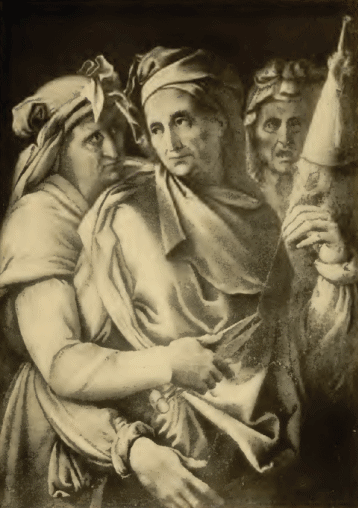
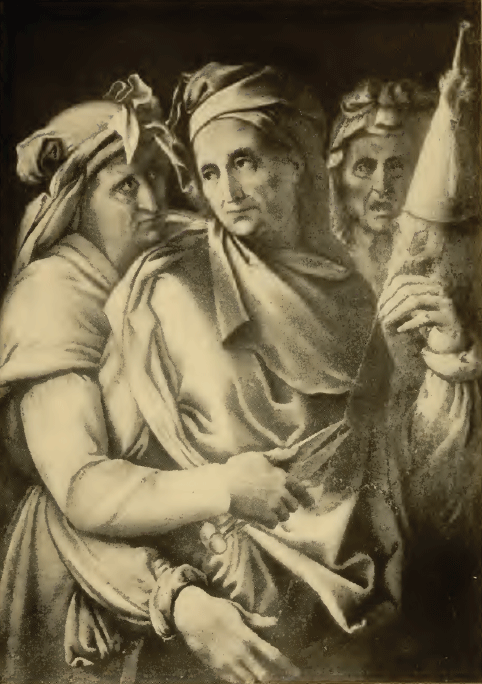
THE THREE FATES. BY MICHAEL ANGELO. (FLORENCE.)
ARGUMENT
A Shepherd lies sleeping under a
tree, his flock of sheep graze near by. A number of Wood Nymphs
Dryads, etc., appear; they are pursued by Pans, Satyrs, etc. After
throwing leaves of the soma plant, grapes, etc., upon the Shepherd,
they disappear.
Three Muses appear and speed over to
the sleeping Shepherd, and after chanting of their gifts they stoop
and kiss the youth. They disappear.
The youth arises, enthralled by the
beauty of what he considers a vision dreamed, and addresses ode in
praise.
Athene (the goddess of wisdom)
appears; the youth falls prostrate in awe and reverence. She informs
him that, in Athens, one of the thirty virgins who guard the sacred
flame is falsely accused of unchastity. The underworld gods or
demons have connived, and the Furies and Hephaestus (the fire god)
have dispatched four runners to consummate the agonized death of the
virgin.
They can be defeated only by the
youth defeating them in the race over the horizon and seas, etc.,
and rescuing the maiden.
The Shepherd at a glance from Athene,
dies. The nine Muses appear and prepare him for the grave.
Black-robed figures appear and lower him into the sepulchre; they
disappear. Eros enters with Pegasus. The youth, taking the winged
horse, delivers ode and beseeches aid for his perilous mission. Then
exit.
ACT
The Hierophant, accompanied by three
young priests, enters and stands before the oracular stone, and
inquires of the gods. The oracle answers in secret phrase. The
Hierophant assembles all the priests, maidens, etc., and makes known
to them the terrifying omen.
He attempts to discover the guilty
one amongst the thirty maidens and calls upon all the underworld
demons to appear, and, through their weird ceremonies, to blast and
break the mind of the guilty maiden.
One of the maidens suddenly becomes
possessed of hysteria and the facts seem to assure all of her guilt
and she is brought shrieking horribly before the altar and condemned
to death.
At this moment the goddess Athene
appears and orders that the maiden be granted boon of trial by
ordeal.
The first ordeal, that of dove
flight, is to determine her innocent if the doves fly to the right,
and guilty if to the left.
The second ordeal consists of lamb
and ram ceremony and afterwards the direction of the smoke from
smoking torches noted which had been stuck into the ground.
Third ordeal, chariot race, maid
driving white, and male priest black chariot, and black wins.
Maiden is condemned to death and the
maidens surround her and lament her maidenhood.
All enter Parthenon.
Procession then enters of priests,
maidens, barbarians, etc., chanting the death chant.
Maiden is bound upon back of an ox,
led by four Numidian slaves; she is preceded by a red bull and
followed by a black bull, both attended by Ethiopian slaves.
The maiden is bound to post, with a
bull facing her on either side.
The Hierophant advances with
sacrificial knife. He purifies knife in water, air, fire, and earth.
Just as he would strike, Hermes,
the messenger of the gods, appears and stays all proceedings. He
announces the discovery of the five runners that are racing for the
shades.
The Furies' messengers break into
view; they are followed by the fire god's racer. The goodly youth
enters last.
In contest with the other runners, he
recalls the shield of the goddess which will turn all beholders to
stone, and succeeds in rescuing the maiden, who on being released is
discovered as Athene herself, helmeted and triumphant.
PERSONS IN THE DRAMA
Pallas Athene
Hierophant
Shepherd
Pans, Satyrs, etc.
Nymphs, Dryads, Bacchantes, etc.
The Furies' Three Runners
The Fire God's Runner
The Thirty Maidens
The Thirty-Two Male Priests
Attendant Priests and Priestesses
The Nine Muses
Hermes
Three Acolytes
Eros
The Maximae.
Ares or Ar's -- The god of war.
Ate -- The goddess of malicious
mischief, an ever-present evil genius who incites to folly and
crime. Daughter of Eris or strife.
AEther -- Personification of the air.
Acheron -- A fabled river of Hades.
Amaranthine -- The amaranth plant,
symbol of immortality.
Acolyte -- A young priest, a novice.
And leaping troops, etc. --
Symbolically speaking, there is a wall that separates the
supermundane from the mundane. This wall is guarded by a grizzly
crew of banal temptations.
Argive -- Poetic name for Greece.
Artemis -- The lunar goddess, hence
one smitten by her beams -- a lunatic.
Astraea -- A personification of
purity
Astrial -- A personification of
purity
Bounded gods -- Other than the
infinite Olympians.
Cybele -- A fearful goddess of the
earth.
Calliope -- Muse of epic poetry.
Clio -- Muse of history.
Cryptic -- Secret.
Dryads -- Maids of the woodland.
Dionysos -- God of wine that
intoxicates the soul -- ecstasy.
E'en thou art hull in dwelling night!
When in the earth (or the land of darkness as compared to heaven,
the land of true light), Jove would assume the form of a bull.
Witness his occasion with Europa, Io, etc. Also in Egypt (the land
of darkness) he was worshipped as the bull.
Enthroned above the waters -- The
Creator is greater than the created law. (Water, symbol of truth.)
Eros -- God of love.
Eerys -- Spirits.
Erebus -- A place of utter darkness
between the earth and Hades.
Euterpe -- Muse of lyric poetry.
Erato -- Muse of love poetry.
Eristic -- Argumentative,
self-righteous.
Glyphs -- Shades, shadows, spirits.
Graces -- Hope, Faith, and Mercy.
God-wives -- Doves (the symbol of the
soul); the soul is mystically spoken of as the bride of God.
Holocaust -- A burnt sacrificial
offering.
Hermes -- Son of Zeus and Maia,
messenger and herald of the gods.
Hero born of twice born -- Awakened
to spiritual understanding.
Hestia -- The goddess of the hearth,
corresponding to the Roman Vesta.
Hierophant -- The chief priest or
expositor of the Eleusinian mysteries in ancient Greece.
Hera -- The queen of the gods,
daughter of Kronos, sister and wife of Zeus.
Hecate -- A three-headed goddess
having power over three worlds, earth, heaven, and the underworld; a
much dreaded, fearful shade of sorcery, hatred, etc.
Hecatomb -- A sacrifice of a hundred
bulls.
Horse creator -- Poseidon, the god of
the River-Ocean, a body of water that encircles the world.
Poseidon created the horse (symbol of passion).
Jove -- The highest name of the
highest god.
Lesbos -- The isle where Sappho loved
and sung.
Lethe -- The stream of oblivion in
the lower world, from which souls drank before passing to Elysium,
that they might forget all earthly sorrows.
Mephitic -- Poisonous, pestilential.
A cavern at the foot of Mt. Parnassus, near Delphi, was remarkable
for a vapor which it exhaled, which had the power of convulsing any
one who breathed it.
Monad -- Unity, the one.
Man of reddest earth -- Base mortals.
Red was the symbol of the fiery passions.
Maenad -- A broken-minded maiden.
Mystical music of Spheres -- The
relations of the notes of the musical scale to numbers, whereby
harmony results from propositional vibrations of sound, and discord
from the reverse, was one of the reasons that led
Pythagoras to speak thus.
Muses -- The nine daughters of Zeus
(rational mind) and Mnemosyne (memory).
Melpomene -- Muse of tragedy.
Nymphs -- Maiden spirits that
inhabited trees.
Nereids -- Sea nymphs, daughters of
Nereus and Doris. Attendants of Poseidon.
One thought of him who thinks on
thought -- Aristotle wrote: "But behind all these gods, there is
One, the prime mover, whose essence is that ecstasy to which the
wisest men sometimes attain. He spends his time thinking on
thought."
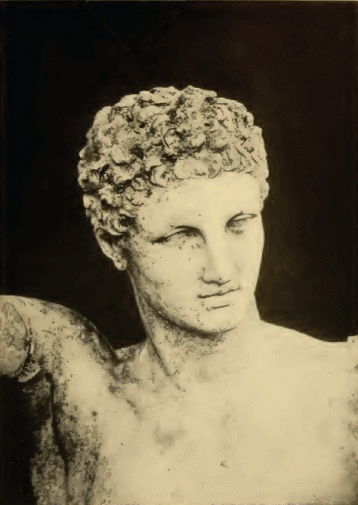
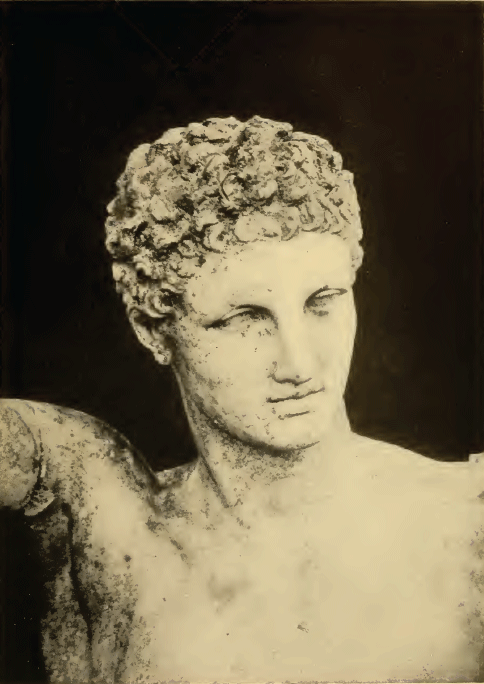
HEAD OF HERMES BY PRAXITELES. (BERLIN.)
Oaten pipes -- Pan's pipes.
O Jove who veils himself in light
O Jove! Supremest, past thy Name!
-- The Grecian mystics held that the name of Jove only, expressed
their highest ideal and the idea of God. His majesty and greatness
extended far beyond that ideal.
O Zeus! Thou cloud conformer! -- The
cloud was the symbol of the soul, since the sun (symbol of Zeus)
formed them from water (truth).
Polyhymnia -- Muse of religious
poetry.
Pan -- An Arcadian woodland spirit
and god of the hills and woods, flocks and herds, son of
Hermes or Zeus and Callisto.
He is represented as horned, goat-footed, playing on his pipes and
exciting sudden and irrational fear (hence panic).
Protean -- Personification of
constant change.
Proteus -- God of change.
Palanquin -- A vehicle.
Pallas Athene -- Daughter of Jove.
She sprang fully formed from his head. The god of fire, Hephaestus,
assisted at the birth by splitting Jove's head with a hammer.
Pallas -- Daughter of Jove. She
sprang fully formed from his head. The god of fire, Hephaestus,
assisted at the birth by splitting Jove's head with a hammer.
Per'venture 1, numbered negations
have confessed -- In the ancient
mysteries initiates swore aloud that they had not been guilty of
any one of the thirty-two vices.
Phoebus -- Name of Apollo.
Perception trusting, essorant of
wall, etc. -- Trusting perception instead of sense-received evidence
and avoiding mental states, etc.
Pegasus -- The winged horse of
inspiration, a blow from whose hoofs caused the fountain of
inspiration called Hippocrene to spring from the mountain Helicon.
Rune -- Secret, Runic.
Stygian -- Pertaining to the River
Styx, the infernal regions.
Sibyl -- A prophetess.
Sminthian -- So called from the fact
that mice (the symbol of the soul) were sacred to him; one of
Apollo's names.
Satyr -- Woodland demon in the train
of Dionysos, depicted as a shy, wanton, cunning creature with
goat-like ears, pug nose, short tail, and budding horns, delighting
in music, dancing, revel, wine, and women.
Saturn -- King of the older Grecian
deities and father of Jove.
Saraband -- A ghostly, weird dance.
Scamander -- A sacred river of
Greece.
Thanatos -- The shade of death.
Tend thy forehead -- Depend upon self
instead of the beneficent powers.
That she who o'erwatches flocks, etc.
-- Artemis, who, if slighted, would render them all lunatics.
The Name -- The understanding of
Jove's name which was believed to bestow miraculous power upon the
possessor.
The stone, etc., Double the cube
-- It is recorded that in the dim antiquity a fearful plague ravaged
Greece and when the Hierophant inquired of the oracle at Delphi how
the plague might be stayed, the enigmatical answer of doubling the
stone was given.
The Kings, the thirty-two have with
the thirty fought -- The vices that attack the soul were thirty-two
in number and the virtues that protected were thirty.
The yoke we revere -- The religious
law was termed the yoke.
Thy cryptic words inflame the
minds eristic -- The populace and uninitiated are angered by their
inability to penetrate past the veil of symbolism of the sacred
literatures.
To Simple memories who much of, etc.
-- Wisdom was said to be the memories from a past pristine state as
differentiated from knowledge gained by senses, which only
obstructed the flow of wisdom's streams.
"To be'' and "good to he'' For 'mersed
within the mood, etc. -- Socrates and Protagoras argued on the
famous line of Simonides' poem, "It is easy to be good." It was
concluded that it was difficult to become good (great) but easy to
he afterwards.
Terpsichore -- Muse of dancing.
Thalia -- Muse of comedy and bucolic
poetry.
The zones of the soundingless tone --
Beyond the senses.
Urania -- Muse of astronomy.
Unhorizoned mind -- The limitless
mind of the Infinite.
Water -- The symbol of the law of
truth.
Zeus -- Another name for Jove.
Return to Table of
Contents