|
THE LIFE OF PHILIPPUS THEOPHRASTUS BOMBAST OF HOHENHEIM KNOWN BY THE NAME OF PARACELSUS AND THE SUBSTANCE OF HIS TEACHINGS |
||
|
PARACELSUS. I. THE LIFE OF PARACELSUS.
THE dawn of the sixteenth century called into existence a new era of thought, and was the beginning of the most stupendous and important accomplishments of those times -- the reformation of the Church. The world awoke again from its long sleep in mental torpitude during the Middle Ages, and shaking off the incubus of Papal suppression, it breathed freely once more. As the shadows of night fly at the approach of the day, so clerical fanaticism, superstition, and bigotry began to fade away, because Luther, in the name of the Supreme Power of the Universe, spoke again the Divine command: "Let there be light!" The sun of truth began again to rise in the East, and although his light may afterwards have been obscured by the mists and vapours rising from fields on which dogmas and superstitions were undergoing the process of putrefaction, nevertheless it was penetrating enough to extend its beneficial influence over the subsequent hours of that day. It shone through the murky atmosphere of sectarian bigotry, and sent its rays into doubting minds. Free thought and free investigation, having shaken off the chains with which they were bound down for centuries by the enemies of religious liberty, broke the door of their dungeon, and rose again to heaven to drink from the fountain of truth. Free inquiry took the place of blind credulity; reason rose victorious out of its struggle with blind belief in clerical sciences led him to enter the laboratory of the rich Sigismund Fugger, at Schwatz, in Tyrol, who, like the abbot, was a celebrated alchemist, and able to teach to his disciple many a valuable secret.
Later on, Paracelsus travelled a great deal. He visited Germany, Italy, France, the Netherlands, Denmark, Sweden, and Russia, and it is said that he even went to India, because he was taken prisoner by the Tartars and brought to the Khan, whose son he afterwards accompanied to Constantinople. Every reader of the works of Paracelsus who is also acquainted with the recent revelations made by the Eastern Adepts, cannot fail to notice the similarity of the two systems, which in many respects are almost identical, and it is therefore quite probable that Paracelsus during his captivity in Tartary was instructed in the secret doctrine by the teachers of occultism in the East. The information given, by Paracelsus in regard to the sevenfold principles of man, the qualities of the astral body, the earth-bound elementaries, &c,, was then entirely unknown in the West; but this information is almost the same as the one given in "Isis Unveiled," "Esoteric Buddhism," and other books recently published, and declared to have been given by some Eastern Adepts. Paracelsus, moreover, wrote a great deal about the Elementals, or spirits of Nature, but in his description of them he substituted for the Eastern terms such as were more in harmony with the German mythological conceptions of the same, for the purpose of bringing these subjects more to the understanding of his countrymen, who were used to the Western method of thought. It is probable that Paracelsus stayed among the Tartars between 1513 and 1521, because, according to Van Helmont's account, he came to Constantinople during the latter year, [1] and received there the Philosopher's Stone. The Adept from whom Paracelsus received this stone was, according to a certain aureum, vellus (printed at Rorschach, 1598), a certain Solomon Trismosinus (or Pfeiffer), a countryman of Paracelsus. It is said that this Trismosinus was also in possession of the Universal Panacea; and it is asserted that he had been seen, still alive, by a French traveller, at the end of the seventeenth century. Paracelsus travelled through the countries along the Danube, and came to Italy, where he served as an army surgeon in the Imperial army, and participated in many of the warlike expeditions of these times. On these occasions he collected a great deal of useful information, not only from physicians, surgeons, and alchemists, but also by his intercourse with executioners, barbers, shepherds, Jews, gypsies, midwives, and fortune-tellers. He collected useful information from the high and the low, from the learned and from the vulgar, and it was nothing unusual to see him in the company of teamsters and vagabonds, on the highways and at public inns -- a circumstance on account of which his narrow- minded enemies heaped upon him bitter reproach and vilifications. Having travelled for ten years -- sometimes exercising his art as a physician, at other times teaching or studying alchemy and magic, [2] according to the custom of those days he returned at the age of thirty-two again to Germany, where he soon became very celebrated on account of the many and wonderful cures which he performed. In the year 1525 Paracelsus went to Basel; and in 1527, on the recommendation of Oxcolampadius, he was appointed by the City Council a professor of physic, medicine, and surgery, receiving a considerable salary. His lectures were not -- like those of his colleagues -- mere repetitions of the opinions of Galen, Hippocrates, and Avicenna, the exposition of which formed the sole occupation of the professors of medicine of those times. His doctrines were essentially doctrines of his own, and he taught them independently of the opinions of others, gaining thereby the applause of his students, and horrifying his orthodox colleagues by his contravention of their established custom of teaching nothing but what could be well supported by old and accepted authorities, irrespective of whether or not it was compatible with reason and truth. He held at the same time the office of city physician, and in that capacity he offered a resolution to the City Council of Basel to the effect that the apothecaries of that city should be subjected to his supervision, and that he should be permitted to examine whether or not the compounders of medicines understood their business, and to ascertain whether they had a sufficient quantity of pure and genuine drugs on hand, so that he might prevent them from asking exorbitant prices for their goods. The consequence of this measure was, as might have been expected, that he drew upon himself the concentrated hatred of all the druggists and apothecaries; and the other physicians and professors, jealous of his success in teaching medicine and curing diseases, joined in the persecution, under the pretext that his appointment as a professor at the university had been made without their consent, and that Paracelsus was a stranger, of whom "nobody knew where he came from," and furthermore that they did not know whether or not he was "a real doctor." But perhaps all these annoyances and vilifications would have had no serious consequences if he had not made the members of the City Council his enemies by writing a severe publication against a decision which he considered very unjust, and which was rendered in favour of a certain Canonicus Cornelius of Lichtenfels, whom he had saved from death after the latter had been given up to die by the other physicians, and who had acted very ungratefully towards him. The consequence of his hasty action was, that he had to leave Basel secretly and hurriedly in July 1528, to avoid unpleasant complications. [3] After this event Paracelsus resumed his strolling life, roaming as he did in his youth over the country, living in village taverns and inns, and travelling from place to place. Numerous disciples followed him, attracted either by a desire for knowledge or by a wish to acquire his art and to use it for their own purposes. The most renowned of his followers was Johannes Oporinus, who for three years served as a secretary and famulus to him, and who afterwards became a professor of the Greek language, and a well-known publisher, bookseller, and printer at Basel. Paracelsus was exceedingly reticent in regard to his secrets, and Oporinus afterwards spoke very bitterly against him on that account, and thereby served his enemies. But after the death of Paracelsus he regretted his own indiscretion, and expressed great veneration for him. Paracelsus went to Colmar in 1528, and came to Esslingen and Nuremberg in the years 1529 and 1530. The "regular physicians" of Nuremberg denounced him a quack, charlatan, and impostor. To refute their accusations he requested the City Council to put some patients that had been declared incurable under his care. They sent him some cases of elephantiasis, which he cured in a short time and without asking any fee. Testimonials to that effect may be found in the archives of the city of Nuremberg. But this success did not change the fortune of Paracelsus, who seemed to be doomed to a life of continual wanderings. In 1530 we find him at Noerdlingen, Munich, Eegensburg, Amberg, and Meran; in 1531 in St Gall, and in 1535 at Zurich. He then went to Maehren, Kaernthen, Krain, and Hongary, and finally landed in Salzburg, to which place he was invited by the Prince Palatine, Duke Ernst of Bavaria, who was a great lover of the secret arts. In that place Paracelsus obtained at last the fruits of his long labours and of a widespread fame. But he was not destined to enjoy a long time the rest he so richly deserved, because already, on the 24th of September 1541, he died, after a short sickness (at the age of forty-eight years and three days), in a small room of the inn called the "White Horse," near the quay, and his body was buried in the graveyard of St. Sebastian. There is still a mystery in regard to his death, but the most recent investigations go to confirm the statement made by his contemporaries, that Paracelsus during a banquet had been treacherously attacked by the hirelings of certain physicians who were his enemies, and that in consequence of a fall upon a rock, a fracture was produced on his skull, that after a few days caused his death. A German physician, S. Th. von Soemmering, examined the skull of Paracelsus, which on account of its peculiar formation could not easily be mistaken, and noticed a fracture going through the temporal bone, which, by reason of the age and frequent handling of the skull, had become enlarged in size so as to be easily seen, and he believes that such a fracture could only have been produced during the lifetime of Paracelsus, because the bones of a solid but old and desiccated skull would not be likely to separate in that manner. Certain it is that Paracelsus was not killed on the spot, but that at the time of his death he was in possession of his mental faculties and reasoning powers, as is shown by the documents containing his last will and testament, which were written down on the 20th of September 1541, at noon, in the presence of Melchior Spaech, city-judge of Hallein; Hans Kalbssor, notary-public of Salzburg; and several other persons of prominence. The bones of Paracelsus were exhumed in the year 1572, at a time when the church was repaired, and reinterred near the back side of the wall that encloses the space in front of the chapel of St. Philippi Neri an extension of the church of St. Sebastian, where his monument may be seen at the present time. The midst of a broken pyramid of white marble shows a cavity which contains his picture, and above it is a Latin inscription, saying:
Below the portrait are the following words:
The base of the monument contains the following inscription:
Below this inscription may be seen the coat-of-arms of Paracelsus, representing a beam of silver, upon which are ranged three black balls, and below are the words:
A translation of the above inscription into German may be seen on a black board on the left side of the monument. The two latter inscriptions have evidently been taken from the original monument, but the one around the portrait was added in 1572. Thus were the earthly remnants of Paracelsus disposed of; but an old tradition says -- and those who are supposed to know confirm the tale -- that his astral body having already during physical existence become self-conscious and independent of the physical form, he is now a living Adept, residing with other Adepts of the same Order in a certain place in Asia, from whence he still -- invisibly, but nevertheless effectually -- influences the minds of his followers, appearing to them occasionally even in visible and tangible shape.
Paracelsus left very few worldly goods at the time of his death, but the inheritance which he left in the shape of his writings is rich and imperishable. This extraordinary man -- one of the most remarkable ones of all times and all peoples -- found many enthusiastic followers; but the number of those who envied, and therefore hated, him was still greater. He had many enemies, because he overthrew the customary old-fogeyism of the orthodox physicians and speculative philosophers of his age; he proclaimed new, and therefore unwelcome, ideas; and he defended his mode of thinking in a manner that was rather forcible than polite. One-sided culture could see in Paracelsus nothing else but an enthusiast, a fanatic, and noise-maker; his enthusiastic followers, on the other hand, looked upon him as a god and a monarch of all mysteries and king of the spirits. It was his destiny to be misjudged by his friends as well as by his enemies, and each side exaggerated his qualities -- the one his virtues, the other his faults. He was denounced and vilified by one set of ignoramuses, and his qualities extolled by another, and the two camps roused each other into a frenzy by their inordinate praises and vile denunciations, whose exaggerations were evident to every one but themselves. Those historians who have criticised the character of Paracelsus severely, forgot to take into consideration the customs and fashions of the time in which he lived, the character of his surroundings, and his restless wanderings. Now, as the battle of contending opinions has ceased to rage, we may take a dispassionate view of the past, and after studying his works and the writings of his critics and biographers, we will arrive at the conclusion that he was one of the greatest and most sublime characters of all times. His works contain inexhaustible mines of knowledge and an extraordinary amount of germs out of which great truths may grow if they are attended to by competent cultivators, and a great deal that is at present misunderstood and rejected will by future inquirers be drawn to the light, and be cut into some of the noblest blocks in the spiritual Temple of Wisdom. The writings of Paracelsus are especially distinguished by the short and concise manner in which his thoughts are expressed. In this regard they may be compared to some of the writings of Thales, Heraclitus, Pythagoras, Anaxagoras, and Hippocrates. There is no ambiguity in his expressions, and if we follow the roads which he indicated, progressing at the same time along the path of physical science, we shall find the richest of treasures buried at the places that he pointed out with his magic wand. Paracelsus was a Christian in the true meaning of that word, and he always attempted to support the doctrines he taught by citations from the Bible. He asks: "What is a philosophy that is not supported by spiritual (internal) revelation? Moses did not attempt to teach physics; he wrote in a theological sense calculated to impress the feelings and awaken the faith of the simple-minded, and perhaps he may not have understood physics himself. The scientist, unlike the theologian, does not put any trust in his feelings, but believes only in his experiments, because physical science deals with phenomena and not with faith. The Hebrews, moreover, did not know much about natural science, and as a people they have always been more ignorant than others in that respect." "Faith is a luminous star that leads the honest seeker into the mysteries of Nature. You must seek your point of gravity in God, and put your trust into an honest, divine, sincere, pure, and strong faith, and cling to it with your whole heart, soul, sense, and thought -- full of love and confidence. If you possess such a faith, God (Wisdom) will not withhold His truth from you, but He will reveal His works to you credibly, visibly, and consolingly." "Everything that happens takes place through the will of the Supreme. Conscience is the state which we have received from God, in which we should see our own image, and according to the dictates of which we should act, without attempting to discover reasons in the guidance of our life in regard to morals and virtues. We should do that which our conscience teaches, for no other reason but because our conscience teaches it. He who does not burn himself will not be burned by God, and God provided him with a conscience into which he may put his implicit trust. To learn from others, to accept the opinion of others, to act in a certain manner because others are acting in that way, is temptation. Therefore faith in the things of the earth should be based upon the holy Scripture and upon the teachings of Christ, and it will then stand upon a firm basis. Therefore we shall put the foundation and the corner-stone of our wisdom upon three principal points, which are: first, Prayer, or a strong desire and aspiration for that which is good. It is necessary that we should seek and knock, and thereby ask the Omnipotent Power within ourselves, and remind it of its promises and keep it awake; and if we do this in the proper form and with a pure and sincere heart, we shall receive that for which we ask, and find that which we seek, and the doors of the Eternal that have been closed before us will be opened, and what was hidden before our sight will come to light. The next point is Faith: not a mere belief into something that may or may not be true, but a faith that is based upon soul-knowledge, an unwavering confidence, a faith that may move mountains and throw them into the ocean, and to which everything is possible, as Christ has Himself testified. The third point is Imagination. If this power is properly kindled in our soul, we will have no difficulty to make it harmonise with our faith. A person who is sunk into deep thought, and, so to say, drowned in his own soul, is like one who has lost his senses, and the world looks upon him as a fool. But in the consciousness of the Supreme he is wise, and he is, so to say, the confidential friend of God, knowing a great deal more of God's mysteries than all those that receive their superficial learning through the avenues of the senses; because he can reach God through his soul, Christ through faith, and attract the Holy Ghost through an exalted imagination. In this way we may grow to be like the apostles, and to fear neither death nor prison, neither suffering nor torture, neither fatigue nor hunger, nor anything else." But with all his piety Paracelsus was no bigot. He was an enemy of hypocrisy, ceremonial service, and pious ostentation. He says: "If you pray publicly, to what purpose will it serve? It will only be the beginning and the cause of idolatry, and therefore it has been prohibited by Christ." He did not teach that we should ignore or treat with contempt all external forms of religion, and imagine ourselves superior to them; but he taught that we should try to outgrow and rise above all externalism, and become members of the true inner Church of Christ. Therefore he says: "Let us depart from all ceremonies, conjurations, consecrations, &c., and all similar delusions, and put our heart, will, and confidence solely upon the true rock. We must continually knock and remind God in us to fulfill His promises. If this is done sincerely, without hypocrisy, with a true and pious heart, we will then obtain that for which we seek. If we abandon selfishness, the door (of our higher consciousness) will be opened for us, and that which is mysterious will be revealed" (Philosophia Occulta). "Salvation is not attained by fasting, neither by wearing a particular kind of clothing, nor by beating one's self. Such things are all superstition and hypocrisy. God, from the beginning of the world, has created all things holy and pure, and they need not be consecrated by man. God Himself is holy, and all that He made out of His own holy will is also holy. It is for us, by becoming holy, to recognise the holiness of God in all things" (Philosophia Occulta). During the time of the Reformation, when the mental atmosphere was in a state of great commotion, when everybody contended either for Luther or for the Pope, Paracelsus stood above the quarrelling parties, and rejected all sectarianism, for he said: "Among all sects there is none which possesses intellectually the true religion. We must read the Bible more with our heart than with our brains, until at some future time the true religion will come into the world." His sympathies, however, went with the liberal Protestants, and he expressed himself in regard to the action of Luther as follows: "The enemies of Luther are to a great extent composed of fanatics, knaves, bigots, and rogues. Why do you call me a 'Medical Luther'? You do not intend to honour me by giving me that name, because you despise Luther. But I know of no other enemies of Luther but those whose kitchen prospects are interfered with by his reforms. Those whom he causes to suffer in their pockets are his enemies. I leave it to Luther to defend what he says, and I shall be responsible for what I may say. Whoever is Luther's enemy will deserve my contempt. That which you wish to Luther you wish also to me; you wish us both to the fire." Such were the true characteristics of this great man. The accusations brought against him by his opponents show that his faults have been so grossly exaggerated that the very absurdity of the charges brought against him renders such statements incredible and harmless. He has been represented as a drunkard, and this accusation has been based upon a passage occurring in a letter which he wrote to some students of the University of Zurich, and in which he addresses them as Combibones optimi. It seems, however, more probable that the partnership in drinking alluded to in this expression was meant to refer to the "wine" of wisdom rather than to any more material liquid; moreover, the contents of that letter are very serious and pathetic, and show no indication of frivolity or a love for debauch. It has also been ascertained that Paracelsus up to his twentieth year never drank any intoxicating drinks, and even if it should be found that he afterwards drank wine, such a fact could easily be explained by the general custom of those times, according to which even the most honourable and respected persons (Luther included) were in the habit of "drinking each other's health." If we, moreover, take into consideration the quantity and quality of his works, which were all written within a period of time covering fifteen years, we may be permitted to conclude that he could not have accomplished such a work in a state of that continual intoxication in which, according to the statement of his enemies, he must have remained. "Therefore," says Arnold in his "History of Churches and Heretics" (vol. ii. cap. xxii.), "the report is disproved by the fact that a man who is a glutton and drunkard could not have been in possession of such divine gifts." Paracelsus has been accused of vanity and boasting, and the fact is, that he was proud of the attributes or accomplishments manifested in him; but he did not glorify his own person, only the spirit that exalted his soul. Seeing himself surrounded by ignorance, misjudged and misrepresented, but conscious of his own strength, he asserted his rights. He maintained that the value of the truths he taught would be appreciated in due time, and his prophecy has proved to be true. It was this consciousness of his superior power that inspired him to exclaim: "I know that the monarchy (of mind) will belong to me, that mine will be the honour. I do not praise myself, but Nature praises me, for I am born of Nature and follow her. She knows me and I know her." [4] His language is not that of a boaster, but rather that of a general who knows that he will be victorious, when he writes: "After me, ye, Avicenna, Galenus, Rhases, Montagnana, and others! You after me, not I after you, ye of Paris, Montpelier, Suevia, Meissen, and Cologne; ye of Vienna, and all that come from the countries along the Danube and Rhine, and from the islands of the ocean; you Italy, you Dalmatia, you Sarmatia, Athens, Greece, Arabia, and Israelita! Follow me! It is not for me to follow you, because mine is the monarchy. Come out of the night of ignorance! The time will come when none of you shall remain in his dark corner who will not be an object of contempt to the world, because I shall be the monarch, and the monarchy will be mine." [5] This is not the language of vanity and self-conceit; it is rather the language either of wisdom or of folly, because extremes resemble each other. Paracelsus was proud of the spirit that spoke through him; but personally he was modest and self-sacrificing, and he well knew that a man would be a useless thing if he were not overshadowed by the spirit of the Supreme. He says: "Remember that God has put a mark upon us, consisting in our shortcomings and diseases, to show to us that we have nothing to pride ourselves about, and that nothing comes within the reach of our full and perfect understanding; that we are far from knowing absolute truth, and that our own knowledge and power amount to very little indeed." Personal vanity and ostentation were not the elements to be found in the character of Paracelsus -- they were the customs of the physicians of that age; but it is a daily occurring fact, that he who exposes and denounces the faults of others appears to the superficial observer as boasting of his own superiority, although no such motive may prompt him. And as Paracelsus was not slow to criticise the ignorance of the "learned," it was necessarily supposed by the vulgar that he looked upon himself as more learned than all others, and they had not the capacity to know whether or not he was justified in such an estimate of himself. He was, however, far superior in medical skill to all his colleagues, and performed apparently miraculous cures among many patients that had been pronounced incurable by the leading doctors -- a fact that has been proved by Erasmus of Rotterdam, a most careful and scientific observer. Among such patients were not less than eighteen princes, on whom the best physicians had tried their arts and failed. In his thirty-third year he was already an object of admiration for the laity, and an object of professional jealousy for the physicians. He also incurred the wrath of the latter by treating many of the poorer classes without pay, while the other physicians unrelentingly claimed their fees. The most common reward for his labour was ingratitude, and this he earned everywhere, not only in the houses of the moderately wealthy, but also among the rich; for instance, in the house of the Count Philippus of Baden, whose case had been given up as hopeless by his physicians, Paracelsus cured the count in a short time, who in return showed great penuriousness towards him. Moreover, the ingratitude of that prince caused great joy to the enemies of Paracelsus, and gave them a welcome opportunity to ridicule and slander him more than ever. Accusations of a different order are brought against him, referring to the bluntness of his style of writing, which was not always refined or polite. It should, however, be remembered that such a style of speaking and writing was universally used in those times, and objectionable expressions were adopted by all, not excluding Luther, the great Reformer, who, in spite of his genius, was a mortal man. Paracelsus was a great admirer of Luther, and even surpassed him in enthusiasm for religious and intellectual freedom. Luther seemed to him to be still too conservative. He believed that such a gigantic revolution in the world of mind could not be accomplished with meekness and condescension, but that it required firmness, tenacity, and an unbending will. He says of himself: "I know that I am a man who does not speak to every one only that which might please him, and I am not used to give submissive answers to arrogant questions. I know my ways, and I do not wish to change them; neither could I change my nature. I am a rough man, born in a rough country; I have been brought up in pine-woods, and I may have inherited some knots. That which seems to me polite and amiable may appear unpolished to another, and what seems silk in my eyes may be but homespun to you." Great abuse has been heaped upon Paracelsus by his enemies on account of his restless and roaming way of living. He acquired his knowledge, not in the comfortable manner in which the great majority of scientists acquire theirs, but he travelled all over the country on foot, and went wherever he expected to find something that might be useful to know. He writes: "I went in search of my art, often incurring danger of life. I have not been ashamed to learn that which seemed useful to me even from vagabonds, executioners, and barbers. We know that a lover will go a long way to meet the woman he adores: how much more will the lover of wisdom be tempted to go in search of his divine mistress!" (Paragranum: Preface). He says: "The knowledge to which we are entitled is not confined within the limits of our own country, and does not run after us, but waits until we go in search of it. No one becomes a master of practical experience in his own house, neither will he find a teacher of the secrets of Nature in the corners of his room. We must seek for knowledge where we may expect to find it, and why should the man be despised who goes in search of it? Those who remain at home may live more comfortably, and grow richer than those who wander about; but I neither desire to live comfortably, nor do I wish to become rich. Happiness is better than riches, and happy is he who wanders about, possessing nothing that requires his care. He who wants to study the book of Nature must wander with his feet over its leaves. Books are studied by looking at the letters which they contain; Nature is studied by examining the contents of her treasure-vaults in every country. Every part of the world represents a page in the book of Nature, and all the pages together form the book that contains her great revelations." So little has Paracelsus been understood by the profane, that even to this day he is supposed to have advocated the very superstitions which he tried to destroy. For instance, far from encouraging the superstitious practices of the star-gazers, he says: "The planets and stars on the sky neither build up a man's body, nor do they endow him with virtues and vices, or any other qualities whatsoever. The course of Saturn lengthens or shortens nobody's life; and although Nero was of a martial temperament, he was not the child of Mars, nor Helena the daughter of Venus. If there had never been any Moon on the sky, there would be nevertheless people inclined to lunacy. The stars force us to nothing, they incline us to nothing; they are free for themselves, and are are free for ourselves. It is said that a wise man rules over the stars; but this does not mean that he rules over the stars in the sky, but over the powers that are active in his own mental constitution, and which are symbolised by the visible stars in the sky" (Philosophia Occulta). Paracelsus did not read or write much. He says that for ten years he never read a book, and his disciples testify that he dictated his works to them without using any memoranda or manuscripts. On taking an inventory of his goods after his death, a Bible, a Biblical Concordance, a Commentary to the Bible, and a written book on Medicine were all the books that could be found in his possession. Even earlier than Luther he had publicly burned a Papal bull, and with it the writings of Galen and Avicenna. He says: "Reading never made a physician. Medicine is an art, and requires practice. If it were sufficient to learn to talk Latin, Greek, and Hebrew to become a good physician, it would also be sufficient for one to read Livius to become a great commander-in-chief. I began to study my art by imagining that there was not a single teacher in the world capable to teach it to me, but that I had to acquire it myself. It was the book of Nature, written by the finger of God, which I studied -- not those of the scribblers, for each scribbler writes down the rubbish that may be found in his head; and who can sift the true from the false ? My accusers complain that I have not entered the temple of knowledge through the 'legitimate door.' But which one is the truly legitimate door? Galenus and Avicenna or Nature? I have entered through the door of Nature: her light, and not the lamp of an apothecary's shop, has illuminated my way." Great stress was laid by his accusers upon the fact that he wrote the greater part of his books and taught his doctrines in the German language, and not, as was then customary, in Latin. But this was one of his most important acts; because in so doing he produced a reformation in science similar to the one that Luther produced in the Church. He rejected the time-honoured use of the Latin language, because he believed that "the truth could as well be expressed in the language of the country in which he lived. This daring act was the beginning of free thought in science, and the old belief in authorities began to weaken. It is probable that Paracelsus would never have attained his knowledge if he had permitted his mind to be fettered and imprisoned by the idle formalities that were connected with a scientific education at that time. Here it may not be improper to add a few opinions concerning Theophrastus Paracelsus from persons of repute: -- Jordanus Brunus says: "The highest merit of Paracelsus is, that he was the first to treat medicine as a philosophy, and that he used magical remedies (hypnotism, suggestion, &c.) in cases where the physical substances were not sufficient." J. B. van Helmomt: "Paracelsus was a forerunner of the true medicine. He was sent by God, and endowed with divine knowledge. He was an ornament for his country, and all that has been said against him is not worthy to be listened to." Opposed to this there are the opinions of certain "authorities," whose memory does not longer exist, but who may be quoted as specimens of learned ignorance: -- Libanius: "Opera Paracelsi sunt cloaca, monstrosa, jactantia rudiate, temeritate conflata." K. G. Neumann: "No one can take up a book of Theophrastus without becoming convinced that the man was insane." Very recently one medical authority, while acknowledging publicly the high merits of Paracelsus, said that the consequence of the promulgation of his doctrines was the growth of a sickly mysticism. This may be true, but Paracelsus cannot be blamed for the inability of those who do not understand him; we may just as well make Jesus Christ responsible for the introduction of the Inquisition and other follies that arose from a misinterpretation of what He taught. It is true that it is very difficult, if not altogether impossible, to understand the writings of Paracelsus without possessing a certain amount of spiritual insight and intuition. The writings of Paracelsus deal especially with metaphysical and not with corporeal things. Thus, for instance, when he speaks of "Sulphur," he, like other Alchemists of his times, refers to a certain active energy or form of the will, for which even modern science has not yet invented a name, and for which the term "Sulphur" is a symbol, in the same sense as "Mercury" is a symbol for intelligence, "Salt" for substance, "Venus" for love, and so forth. One would therefore vainly inquire at the chemist's shop for the "sulphur" of Paracelsus, for he says: "If any one wanted to thoroughly describe the sulphur, and if it were proper to do so, which it is not, paper alone would not be sufficient for that purpose. To the sulphur belongs a good worker and artist, well experienced and capable to think profoundly; not a mere talker and theorist, who is only great in preaching but does not act. He who knows how to use the sulphur (his own power) will be able to produce more miracles than I can describe. He who does not know the sulphur knows nothing, and can accomplish nothing, neither of medicine nor of philosophy, nor about any of the secrets of Nature" (Vom Sckwefel, vol. vii. p. 182). This is merely to show that the language of Paracelsus has to be taken in an allegorical and mystical sense, which was well understood by the Alchemists of his time, but for which modern erudition has no comprehension; because with the knowledge of spiritual mysteries and secret powers of Nature, the meaning of the symbols representing those things has also been lost. It is therefore not surprising to see that Paracelsus is very little understood even by his admirers, and that the majority of his researchers seem to be far more concerned about his person than about his philosophy. Moreover, Paracelsus uses a terminology of his own. He deals in his writings with many subjects, for which his language had no appropriate terms. [6] He therefore invented a great many words of his own to express his meaning, and only few of his words have obtained the right of citizenship in our language. To facilitate the study of the works of Paracelsus, his disciples, Gerhard Dorn, Bernhard Thurneyssen, and Martin Ruland, composed dictionaries to explain the meaning of such curious terms. The one compiled by Buland, entitled "Lexicon Alchemicum" (Prague, 1612), is the most complete. Guilhelmus Johnson published the same under his own name at London in 1660, and it has been incorporated into the greatest collection of alchemical writings, the "Bibliotheca Ohymica Curiosa," by J. T. Mangets (Geneva, 1702). Another "Dictionarium Paracelsicum" was written by a certain Bailiff, and added to the Geneva publication. But as all these books have become very rare, and can only be obtained with difficulty and at a great expense, we therefore add below a complete list of his favourite terms, for the benefit of those who may wish to read his complete works. THE WRITINGS OF PARACELSUS. Paracelsus wrote personally not a great deal. He usually dictated that which he desired to be put into writing to his disciples. The greatest part of his works is therefore in the handwriting of his disciples. Few of the works of Paracelsus were printed during his lifetime. Those that were printed consist of his seven books, "De Gradibus et Compositionibus Receptorum et Naturalium," Basel, 1526; and of his "Chirurgia Magna," printed at Ulm, 1536. The rest of his writings did not become known publicly until after his death, and it is to be regretted that his disciples and followers -- such as Adam von Bodenstein, Alexander von Suchten, Gerhard Doru, Leonhard Thurneyssen, Peter Severinus, Oswald Crall, Melchior Schennemann, and others -- delivered them in such a state of confusion to the printer, that frequently entire pages were missing, and it was very difficult to put those that were to be had into some order. Separate editions of the works of Paracelsus were published by Hieronymus Feierabend in Frankfurt, by Arnold Byrkmann in Cologne, and by Peter Barna in Basel. Simultaneously a great many spurious prints and writings, falsely attributed to Paracelsus, were put into circulation, as appears from a note by Antiprassus Siloranus, who says that Paracelsus wrote 35 books on Medicine, 235 on Philosophy, 12 on Politics, 7 on Mathematics, and 66 on Necromancy. If we remember that Paracelsus was engaged in literary labours for only fifteen years, it appears self-evident that Siloranus referred in his note to all the books and papers that were put into circulation, and attributed to Paracelsus by the public. John Huser, doctor of medicine at Grossglogau, undertook a critical examination of such works, on the request of the Archbishop Prince Ernst of Cologne. [LC-1] He collected with great labour all the autographs of Paracelsus and the original manuscripts of his disciples, such as could be found; he put them into order, and revised and published them at Cologne in a general edition during the years 1589 and 1590. That collection contains the following works: -- I. WORKS ON MEDICINE. 1. Paramirum de Quinque Entibus Omnium Morborum (Paramirum of the Five Causes of Disease). (Autograph of Paracelsus ) 2. Opus Paramirum Secundum (2 Second Book, Paramiruno). (Autograph.) 3. Liber de Generatione Hominis (Book of the Generation of Man). 4 Liber Paragranum (Paragranum). (Autograph.) 5. Liber Paragranum Secundum (Paragranum, Second Book. (Autograph.) 6. Chronica des Landes Kaernthen (History of the Country of Kaernthen). 7. Defensiones und Verantwortung wegen etlicher Verunglimpfung seiner Misgoenner (Defence and Answer respecting some Misrepresentations made by his Enemies). 8. Labyrintbus medicorum errantium (The Labyrinth of the Wandering Physician). 9. Das Buch vom Tartaro, das ist vom Ursprung des Sands und Steins (The Book of Tartarus -- i.e., of the Origin of Stones in the Bladder). 10. Epistel der Landschaft Kaernthen an Theophrastum (Letter of the Country of Kaernthen to Theophrast). 11. De viribus membrorum (Of Organic Powers). 12. De primis tribus essentiis (Of the Three First Elements). 13. Vom Ursprung und Heilung der natuerlichen Pestilenz (Of the Cause and Cure of the Ordinary Pest). (From the original MS. of Dr. Joh, Montanus, of Hirschfeld.) 14. Ein Buechlein von der Pestilenz an dir Stadt Sterzingen (Letter about the Pest to the Town of Sterzingen). (From the original MS. of Dr. Joh, Montanus, of Hirschfeld.) 15. Zwei Buecher vom Ursprung und Ursach der Pest (Two Books on the Cause and Origin of the Pest). (From the original MS. of Dr. Joh, Montanus, of Hirschfeld.) 16. Drei andere Buecher von der Pestilenz (Three more Books on the Pest). (From the original MS. of Dr. Joh, Montanus, of Hirschfeld.) 17. Eltiche Collectanea de Peste (Collections of Notes on the Pest). (Autograph.) (MS. of Montanus.) 18. De Morbis ex Tartaro oriundis (On Diseases coming from the Tartarus). (MS. of Montanus.) 19. Theophrasti Epistola ad Erasmum Rotterdamum (Theophrastus' Letter to Erasmus of Rotterdam). (MS. of Montanus.) 20. Erasmi Rotterdami Responsio (His Answer). (MS. of Montanus.) 21. Liber de Teteriis (Book on Jaundice). (MS. of Montanus.) 22. Liber quatuordecim paragraphorum (Book of Fourteen Paragraphs). (Autograph of Paracelsus.) 23. Von den tartarischen Krankheiten (On Tartaric Diseases). (Autograph of Paracelsus.) 24. Von den Krankheiten die den Menschen der Vernunft herauben (On Diseases causing Insanity). (Autograph of Paracelsus.) 25. Von Krummen und lahmen Gliedern (On Contracted and Paralysed Members). (Autograph of Paracelsus.) 26. Von den astralischen Krankheiten (Diseases caused by Astral Influences). (Autograph of Paracelsus.) 27. Vom Padagra (On Gout). (Autograph of Paracelsus.) 28. Andere zwei Buecher vom Podagra (Two more Books on Gout). (Print.) 29. Vom Ursprung, Ursach und Heilung des Morbi Caduci und Epilepsy (On the Cause, Origin, and Cure of Nervous Diseases and Epilepsy). (MS.) 30. De Caduco matricis (On Displacements of the Uterus). (MS.) 31. Von den Bergkrankheiten (Diseases in Mountainous Regions). (MS.) 32. Theorica Schemata seu Typi (On Types of Diseases). (Autograph.) 33 Practicae particularis sen Curationis morborum Tartareonum (Cure of Tartaric Diseases). (Fragment.) 34. Etliche Consilia Medica (Some Written Consultations). (MS.) 35. Etliche Fragmenta Medical (Medical Fragments). (MS.) 36. De Sanitate et Aegritudine (Health and Disease). (Autograph.) 37. De Stercore et Aegritudinibus en hoc oreundis (Excrementive Substances and Diseases caused by them). (Autograph.) 38. De anatomia oculorumm et eorum affectionibus (The Eye: Its Anatomy and Diseases). (Autograph.) 39. Auslegung primae sectionis Aphorismorum Hippocrates (Explanation of the First Sections of Hippocrates' Aphorisms). (Sources not mentioned.) 40. De modo phlebotomandi (How to Let Blood). (Sources not mentioned.) 41. De urinis et pulsibus (Diagnostics from Urine and Pulse). (Sources not mentioned.) 42. De modo pharmacandi (Pharmaceutics). (Sources not mentioned.) 43. Archidoxorum Libri X (The Book of Archidoxes). (Autograph.) 44. De Renovatione (Renewal). (Autograph.) 45. De Vita longa (Long Life). (German.) (Autograph.) 46. De Vita longa (Ditto). (Latin.) 47. Some fragments in German (Various Fragments). (MS.) 48. De praeparationibus libri duo (Preparations of the Second Book). (MS.) 49. Process den Spiritum Vitrioli zu machen (How to make Spirit of Vitriol). (MS.) 50. De natura rerum (The Essential Nature of Things). (MS.) II. ALCHEMY. 51. De Tinctura Physica ("Curative Tincture"). (MS.) 52. Liber Vexationum (Vexations). (MS.) 53. Thesaurus Alchemistarum (Alchemical Treasures). (MS.) 54. De Cementis (Cements). (Autograph.) 55. Cementum super Venerem et Marte (A Cement for Venus and Mars). (Autograph.) 56. Das Manuale de Lapide Philosophorum (Manual of the Philosopher's Stone). (MS.) 57. Ratio extrahendi ex omnibus metallis Mercurium, Sulphur, et Crocum (How to Extract of all Metals their Mercury, Sulphur, and Crocus). (MS.) 58. Intimatio Theophrasti (Advice of Theophrastus). (MS. of Aporinus.) 59. De gradibus rerum naturalium (Of the Various Grades of Things). (MS. of Aporinus.) 60. Herbarius (On Plants). (Autograph.) 61. Von den fuenf natuerlichen Dingen (On the Five Natural Things). (Autograph.) 62. Zwei Tractate vom Terpenthin und Honig (Two Tracts on Turpentine and Honey). (MS. of Montanus.) 63. Vom Ebenholz, von Bruechen und Praeparation der Mumie (Ebony-Wood, Ruptures, Preparation of the Mumia). (MS. of Montanus.) 64. De virtutibus herbarum (The Virtues of Plants). (MS. of Aporinus.) 65. Liber Principiorum (The Books of Beginnings). (MS. of Montanus.) 66. De Thermis (Mineral Springs). (MS. of Oporinus.) 67. Vom Bade Pfeffers (The Baths of Pfeffers). (MS. of Montanus.) 68. De gradibus et compositionibus (Gradations and Compositions). (MS. of Montanus.) 69. Scholia in libros de gradibus (Remarks about Gradations). (MS. of Montanus.) 70. Fragmenta (Fragments). 71. Fragmenta aliquod de re Herbaria (Fragments treating of Plants). (Autograph.) IV. NATURAL HISTORY AND PHILOSOPHY. 72. Philosophia ad Athenienses (Letters to the Athenians). (Print.) 73. Opus anatomicum (Anatomy). (Autograph.) 74. Philosophia degenerationibus et fructibus quatuor elementarum (Doctrine of the Products and Fruits of the Four Elements). (Print.) 75. Philosophia de generatione hominis (On the Generation of Man). (Print.) 76. De meteoris (Meteors). (Autograph.) 77. Aliud opusculum de meteoris (More about Meteors). (Autograph.) 78. Liber meteorum tertius (Third Book on Meteors). (MS. of Montanus.) 79. De generatio metallorum (The Generation of Metals). (Ditto.) 80. Von den natuerlichen Waeasern (Natural (Thermal) Springs). V. MAGIC. 81. De divinibus operibus et secretis naturae (The Divine Works and Secrets of Nature). (Autograph.) 82. De sagis earumque operibus (Sorcerers and Witches and their Arts). (Autograph.) 83. De Daemonicis et Obsessis (Devils and Obsessions). (Autograph.) 84. De somniis (Dreams). (Autograph.) 85. De sanguine ultra mortem (The State of the Blood after Death). (Autograph.) 86. De animalium hominum post mortem apparentibus (Souls of Men appearing after Death). (Autograph.) 87. De virtute imaginativa (____________). (Autograph.) 88. De characteribus (Characters). (Autograph.) 89. De Homunculis et Monstris (Homunculi and Monsters). (Autograph.) 90. De Philosophia occulta (Occult Philosophy). (MS. of Montanus.) 91. De Imaginationibus (Imaginations). (MS. of Montanus.) 92. Philosophia Paracelsi (The Philosophy of Paracelsus). (MS. of Montanus.) 93. Vom Fundamente und Ursprung der Weisheit und Kuenste (The Foundation and Origin of Wisdom and Arts). (Other Manuscript.) 94. Fragmenta (Fragments). (Other Manuscript.) 95. Philosophia sagax (Critical Philosophy). (Other Manuscript.) 96. Erklaerung der ganzen Astronomie (Explanation of Astronomy). (MS. of Montanus.) 97. Practica in Scientiam Divinationis (Instructions in the Science of Divination). (Autograph.) 98. Erklaerung der natuerlichen Astronomie (Natural Astronomy). (Autograph.) 99. Fragmenta (Fragments). (Autograph.) 100. Das Buch Azoth seu de ligno Vitae (The Book Azoth, or the Tree of Life). (Ms.) 101. Archidoxes Magicae (seven books) (Fundamental Doctrines of Magic). (Ms.) 102. Auslegung von 30 magischen Figuren (Explanation of Thirty Magic Figures). (Autograph.) 103. Prognostication zukuenftiger Geschichten auf 24 Jahre (Prophecies for Twenty-four Years). (Print.) 104. Vaticinium Theophrasti (The Predictions of Theophrast). (MS. of Montanus.) 105. Verbesserte Auslegung Theophrasti (Explanations). (MS. of Montanus.) 106. Fasciculus Prognosticationum Astrologicarum (Astrological Predictions). _______________ Notes: 1. Van Helmont, “Tartari Historia," § 3. 2. Conrad Gesner, "Epist. Medic.” lib. i fol. I. 3. Urtstisitis, "Baseler Chronik," bk. vii. chap. xix. p. 1527. 4. Libr. Paramirum," Preface. 5. "Libr. Paragranum," Preface. 6. Appropriate terms for the subjects referred to are only found in Eastern languages, especially in Sanscrit. _______________
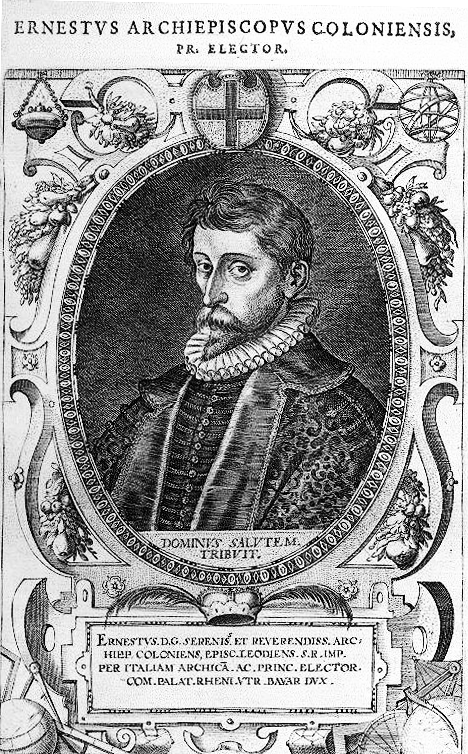
Ernest of Bavaria
Ernest of Bavaria (17 December 1554 – 17 February 1612) was Prince-elector-archbishop of the Archbishopric of Cologne from 1583 to 1612 as successor of the expelled Gebhard Truchsess von Waldburg. He was also bishop of Münster, Hildesheim, Freising and Liège. Ernest was born in Munich, the son of Albert V, Duke of Bavaria, and Anna of Austria. Duke Albert had destined his third son, Ernest, for the clerical vocation. He was educated and trained by the Jesuits. In 1565 he became a canon at Salzburg, and soon afterward at Cologne, Treves, and Würzburg as well; in the autumn of 1565, at the age of twelve, he likewise was elected bishop of Freising. Albert's wishes no doubt centered upon the neighboring archdiocese of Salzburg; but in 1569, when Elector Salentin VII of Isenburg-Grenzau incurred difficulties with the curia for non-recognition of the Council of Trent and was contemplating resignation, Ernest was proposed by his father, who had the support of the Spanish government at Brussels, as Salentin's successor. At the imperial Diet of Speyer (1570), the negotiations with Salentin were so far advanced that Ernest went to Cologne in November, and served his first residence there as canon till May 1571, such being the preliminary condition in the line of election. Salentin's resignation, however, was deferred, and in 1573 he actually submitted to the Council of Trent, and was thereupon confirmed by the curia as archbishop, foregoing the priestly consecration. That year instead saw Ernest elected, at the age of 19, as bishop of the small see of Hildesheim. In 1577, after the Bavarian court had failed in an attempt to secure Münster for Ernest, efforts looking to Cologne were resumed and prosecuted more zealously than before. Moreover, the support of the curia now heightened the hope of some practical result. Duke Ernest, who for a time, in 1572, had well-nigh thwarted all his father's plans by a suddenly outcropping disinclination to ward the spiritual vocation, was sent to Rome in the spring of 1574, for a sojourn of nearly two years, by way of reward for submitting to his father's will. At Rome he won the particular good-will of the pope, so that Gregory XIII resolved to support, with all his might, Ernest's installation as coadjutor to Salentin; in fact, the advancement of Bavarian family interests appeared to be the only possible way of recovering a more secure standing for the Roman Catholic Church in Lower Germany. The status which had been gained by the election of Ernest to Hildesheim could not as yet, by itself alone, afford a very trustworthy base of support. But against the common plans of Salentin, the curia, and the Bavarian court, opposition manifested itself on the side of the chapter at Cologne; when, in 1577, Salentin resigned, Ernest was defeated at the new election by twelve votes to ten by Gebhard Truchsess von Waldburg, who was elected by the Protestants and the lukewarm Catholics of the chapter. Duke Albert, as well as the papal nuncio Portia, protested against the election; but as both the emperor and the electors espoused Gehbard's cause, and as he passed for a good Catholic, receiving priestly consecration in March 1578, and swearing to the Council of Trent, the curia disregarded the Bavarian protest and in March 1580, confirmed the election. In 1581 Ernest was elected the Bishop of Liège. When Archbishop Gebhard of Truchsess Waldburg converted to Protestantism in 1583, Ernest was elected Archbishop of Cologne on 22 May 1583. With Spanish and Bavarian troops he quickly drove Gebhard into Werl in the Cologne War (German: Kölner Krieg or Truchsessischer Krieg). In 1584 he was elected the Bishop of Münster, and also in that year the Papacy nuntiator was published. The Archbishopric of Cologne was important because it was one of the seven Imperial Electors of Holy Roman Empire, and as three of them were already Protestant, if Cologne was ruled by a Protestant a Protestant Emperor could be elected. By now he was the Archbishop of Cologne and the Bishop of Liège, Münster, Freising and Hildesheim, and he was called the protector of Roman Catholicism in northwestern Germany. He was an ardent supporter of the Counter-Reformation, and assisted the Catholics in Jülich-Cleves-Berg and Baden. In 1595 he selected his nephew Ferdinand of Bavaria to be the coadjutor of the bishoprics and retired from most secular affairs. Ernest died in 1612 in Arnsberg, Westphalia, and was buried in Cologne Cathedral. He was succeeded by Ferdinand of Bavaria.
|
||