|
"To love Opus Dei unity
means to feel like part of its body, where we are called to
be. We do not care whether we are hand or foot, tongue or
heart because we all belong as parts of that body, since we
are one by the charity of Christ which unites us all. I
would like to make you feel as members of just one body.
Unum corpus multi sumus. We are all just one body, and this
is manifested in unity of goals, in unity of apostolate, in
unity of sacrifice, in unity of hearts, in the charity with
which we treat one another, in the smile before the Cross
and on the Cross itself. To feel, to vibrate, all of us in
unison!"
***
"Have a brandy as I told
you, but be careful, don't do what that Monsignor Galindo,
my fellow countryman, did, who used to warm up the snifter
in his fly!"
***
"If I knew that my parents
had not desired me when I was conceived, I would have spit
on their tomb."
***
"Only the dry branches
fall. And it is best that they fall!"
***
"Opus Dei numeraries are
ordained to serve their brothers."
***
"To only a few members he
expressed a more intimate desire to wage a crusade against
the Institucion Libre de Ensenanza, founded in 1876 by
Francisco Giner de los Rios, a bold defender of freedom in
culture and the humanities, who never invoked freedom for
political or sectarian reasons. Curiously, Monsignor
Escriva's crusade to neutralize the Institucion Libre de
Ensenanza ended by imitating its projects. One of them was
the Junta de Ampliacion de Estudios (Board for Advanced
Research), which ran the still famous Pinar Residence. This
residence was directed by a foundation whose president was
Ramon Menendez-Pidal and included Jose Ortega y Gasset among
its members. The residence was famous in Spain because it
housed not only students from the different departments of
the University of Madrid but also Spanish intellectuals,
poets, scientists, philosophers -- many of them of world
renown like Miguel de Unamuno, Federico Garcia Lorca,
Federico de Onis, Juan Negrin, and Calandre. It also opened
its doors to foreign scholars like Albert Einstein, H. G.
Wells, Henri Bergson, Paul Valery, Marie Curie, Paul
Claudel, Charles Edouard Jeanneret (Le Corbusier), Darius
Milhaud, and Maurice Ravel.
The Board for Advanced
Research created the Pegagogical Museum and the Casa del
Nino (House of the Child) in Madrid and the College of Spain
at the University of Paris.
General Franco's government
abolished the Junta de Ampliacion de Estudios at the end of
the Spanish Civil War. Jose Ibanez-Martin, the Franco
regime's new Minister of National Education, founded the
Consejo Superior de Investigaciones Cientificas (High
Council for Scientific Research) to replace it. This was
lucky for Monsignor Escriva, who was at once able to place
Opus Dei under the wing of this new institution. One of the
first numeraries, Jose Maria Albareda, was a close friend of
Ibanez-Martin and was appointed general secretary of the
CSIC. The maneuver was extraordinarily discreet. Albareda
and Escriva were able to place their first young
intellectuals in key posts in the fledgling CSIC. They were
able to begin their intellectual apostolate via the new high
council. We next encounter the names of Rafael de Balbin as
director of Arbor, the general cultural journal of the CSIC,
and Raimundo Panikkar as the associate director of this
journal. Interestingly, Panikkar vividly recalls the meeting
that took place within Opus Dei and how he thought of the
name Arbor, symbolizing the many branches of that
organization: the seal of the tree of wisdom became and
continues to be the official seal of the CSIC. Rafael Calvo
Serer, Florentino Perez Embid, Tomas Alvira, and so forth,
all of them original Opus Dei numeraries, were the leading
intellectual figures of the new Spain. Named as architects
for the new buildings were Miguel Fisac and Ricardo
Vallespin, also from the first group of numeraries.
The Consejo Superior de
Investigaciones Cientificas was Monsignor Escriva's most
important tool in appealing to intellectuals. Opus Dei still
has a strong control of it. Fairly recently, for instance,
the Church of the Holy Spirit, which belonged to the CSIC,
has been transferred to Opus Dei as one of its public
churches. Grants for study abroad, especially at the College
of Spain, as well as support in favor of people competing
for professorial chairs at Spanish universities often
emanated from someone at the CSIC.
***
That afternoon, when
Monsignor Escriva and Don Alvaro came to the ironing room,
we told them about the visits by Mrs. Lantini and Mrs.
Marchesini, and especially about Encarnita's response
concerning the death of the King of England.
At that point, I am not
sure which of the numeraries remarked: "So, Father, now
Princess Elizabeth, who is so young, will be Queen of
England."
The person had not finished
her sentence, when Monsignor Escriva rose violently from his
chair, gathered up his cape, headed for the middle of the
ironing room, shouting at the top of his lungs: "Don't speak
to me about that woman! I don't want to hear you talk about
her! She is the devil! The devil! Don't talk to me again
about her! Understood? Well, now you know!"
***
"Here is your passport,
your pen, your crucifix, the plane ticket, and the Italian
residence permit, because without them you can't leave the
country."
Then Monsignor Escriva
began to pace from one side of the room to the other, very
agitated, irritated, red, furious, while he declared: "And
don't talk with anybody about the Work nor about Rome. Don't
set your parents against us, because, if I find out that you
are saying anything negative about the Work to anybody, I,
Jose Maria Escriva de Balaguer, have the world press in my
hands," and as he said this he made a gesture with his hands
confirming the notion. "I will publicly dishonor you. Your
name will appear on the front page of every newspaper,
because I will personally see to it. It would bring dishonor
on you before men and on your own family! Woe to you if you
try to alienate your family from the good name of the Work
or tell them anything about this!"
He went on: "And don't
return to Venezuela! Don't even think of writing to anybody
there! Because if you even think of going to Venezuela, I
will assume the responsibility of telling the Cardinal what
you are. And it would dishonor you!" Pacing the room he
continued shouting at me: "I was thinking all night about
whether to tell you this or not, but I believe it is better
that I should tell you." Looking directly at me, with a
dreadful rage, moving his arms toward me as if he was going
to hit me, he added at the top of his voice: "You are a
wicked woman! A lost woman! Mary Magdalen was a sinner, but
you? You are a seductress with all your immorality and
indecency! You are a seductress! I know everything.
EVERYTHING! EVEN ABOUT THE VENEZUELAN NEGRO! You are
abominable. YOU HAVE A WEAKNESS FOR BLACKS! First with one
and then with the other. LEAVE MY PRIESTS ALONE! DO YOU
HEAR? LEAVE THEM ALONE! In peace. Don't meddle with them!
You're wicked! Wicked! Indecent! Come on, look at the
business of the Negro! And don't ask me for my blessing
because I don't intend to give it to you!"
Monsignor Escriva went away
toward the Relics Chapel. From there he turned around to
shout a final insult: "Hear me well! WHORE! SOW!"
--
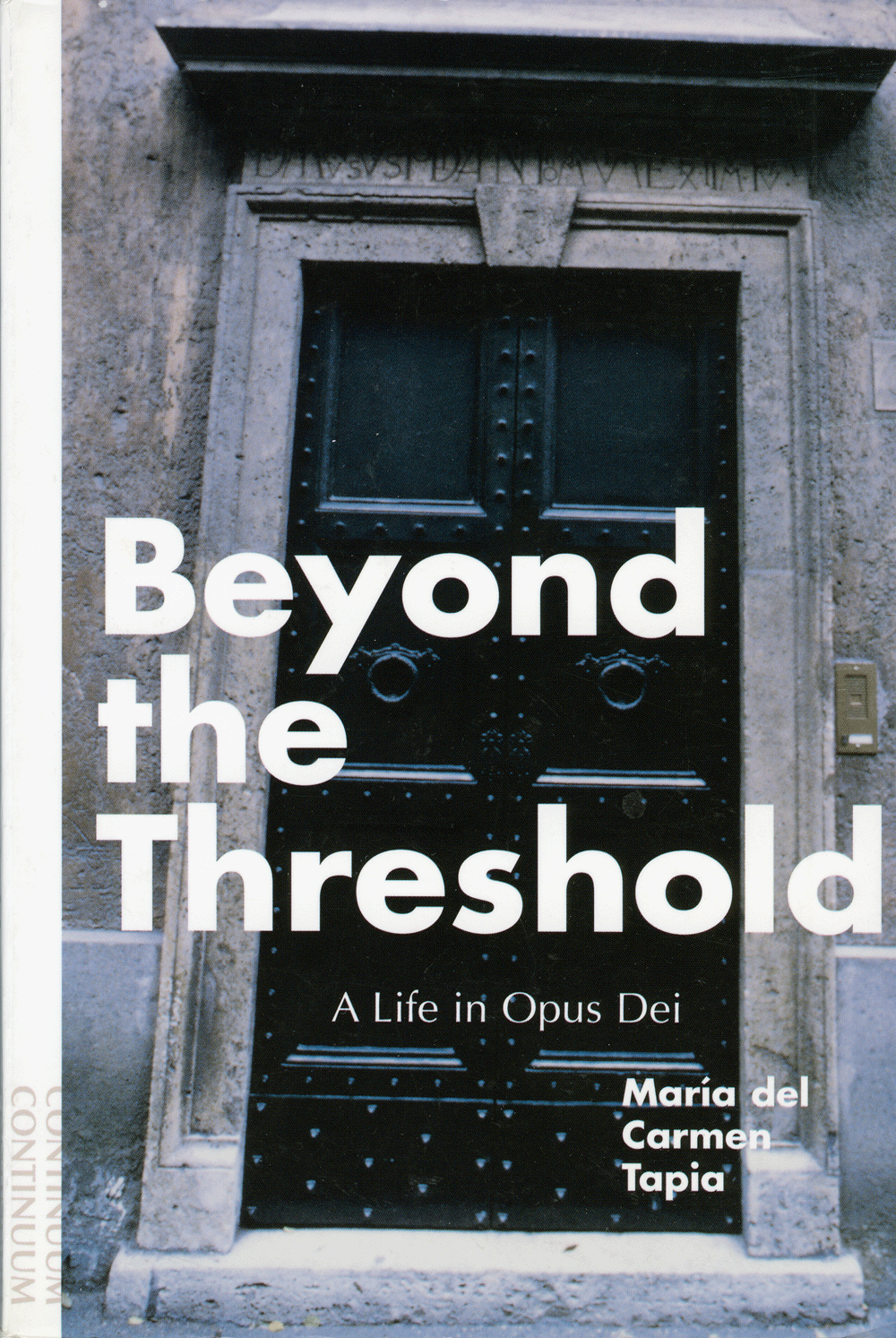
Beyond the Threshold -- A Life in Opus Dei |