|
DIETRICH BONHOEFFER |
|||
|
by Wikipedia
Dietrich Bonhoeffer (February 4, 1906 – April 9, 1945) was a German Lutheran pastor, theologian and martyr. He was a participant in the German resistance movement against Nazism and a founding member of the Confessing Church. He was involved in plans by members of the Abwehr (the German Military Intelligence Office) to assassinate Adolf Hitler. This led to his arrest in April 1943 and execution by hanging in April 1945, 23 days before the Nazis' surrender. His view of Christianity's role in the secular world has become very influential.[1] Family and youth Bonhoeffer was born in 1906 with his twin sister Sabine to a prominent middle-class family in Breslau (Wrocław), the sixth of eight children. His father, Karl Bonhoeffer, was one of the most distinguished neurologists in Germany as a professor of neurology and psychiatry at the University of Berlin and the director of the psychiatric clinic at Charité Hospital in Berlin. His mother, Paula von Hase, was a daughter of Klara von Hase, a countess by marriage who had been a pupil of Clara Schumann and Franz Liszt,[2] and a granddaughter of Karl von Hase, the distinguished church historian and preacher to the court of Kaiser Wilhelm II.[3] Nonetheless, the Bonhoeffer family was not notably devout. Paula was a college graduate and home-schooled the children until each was 6 or 7. Bonhoeffer lost his older brother Walter to World War I. His sister Christine married Hans von Dohnanyi, one of the conspirators against Hitler. His twin sister Sabine married Gerhard Leibholz, a notable jurist of Jewish descent who had been baptized as a child. Bonhoeffer was an exceptional pianist, and his parents thought he might pursue a music career. He was also athletic, and played such games as tennis and chess with ardor. Expected to follow his father into psychiatry, Bonhoeffer surprised and dismayed his parents when he decided as a teenager to become a theologian and later a pastor. When his older brother told him not to waste his life in such a "poor, feeble, boring, petty, bourgeois institution as the church", fourteen-year-old Dietrich replied, "If what you say is true, I shall reform it!"[4] Academic training Bonhoeffer attended Tübingen University for a year and visited Rome, where he became conscious of the universality of the church, before matriculating at the University of Berlin in 1924, then a centre of liberal theology under theologians such as Adolf von Harnack. Around this time, he discovered the writings of Karl Barth, the eminent Swiss theologian whose pioneering work in neo-orthodoxy was a reaction against liberal theology. Barth believed that "liberal theology" (understood as emphasizing personal experience and societal development) minimized Scripture, reducing it to a mere textbook of metaphysics while sanctioning the deification of human culture. Von Harnack cautioned Bonhoeffer against dangers posed by Barth's "contempt for scientific theology", but the younger Bonhoeffer became increasingly critical of liberal theology as not only too constraining but also responsible for the lack of relevance in the church.[5] Won over to Barth's dialectical theology, Bonhoeffer was nevertheless not beyond criticizing Barth. The confluence of Barth's Christocentrism and Harnack's concern to show the relevance of Christianity to the modern world had an indelible effect on Bonhoeffer's approach to theology.[6] Bonhoeffer graduated summa cum laude from the University of Berlin in 1927 and earned his doctorate in theology at the age of 21 with his doctoral thesis, Sanctorum Communio (Communion of Saints), which presented a significantly new way of looking at the nature of the Christian church and was praised by Barth as a "theological miracle." [7] In order to become a pastor, Bonhoeffer spent a year in 1928–1929 as a curate in a parish of a German community in Barcelona, Spain. At this time, Bonhoeffer witnessed social chaos and a decline of traditional values amid international financial crisis, and became critical of the church as being insensitive to evident needs of the world around it and instead burying Christ in a load of religiosity. In 1929, Bonhoeffer returned to the University of Berlin to work on his habilitation thesis Act and Being (German "Akt und Sein"), in which he traced the influence of transcendental philosophy on Protestant and Catholic theologies. Bonhoeffer in Harlem Still too young to be ordained, Bonhoeffer went to the United States in 1930 for postgraduate study and a teaching fellowship at New York City's Union Theological Seminary. Although Bonhoeffer found the American seminary not up to his exacting German standards ("There is no theology here."),[6] he had life-changing experiences and friendships. He studied under Reinhold Niebuhr and met Frank Fisher, a black fellow seminarian who introduced him to Abyssinian Baptist Church in Harlem, where Bonhoeffer taught Sunday school and formed a life-long love for African-American spirituals — a collection of which he took back to Germany. He heard Adam Clayton Powell, Sr. preach the Gospel of Social Justice and became sensitive not only to social injustices experienced by minorities but also the ineptitude of the church to bring about integration.[8] Bonhoeffer began to see things "from below" — from the perspective of those who suffer oppression. He observed, "Here one can truly speak and hear about sin and grace and the love of God...the Black Christ is preached with rapturous passion and vision." Later Bonhoeffer was to refer to his impressions abroad as the point at which "I turned from phraseology to reality." [6] He also learned to drive an automobile, although he failed the driving test three times.[9] He traveled by car through the United States to Mexico, where he was invited to speak on the subject of peace. His early visits to Italy, Libya, Spain, United States, Mexico, and Cuba opened Bonhoeffer to ecumenism.
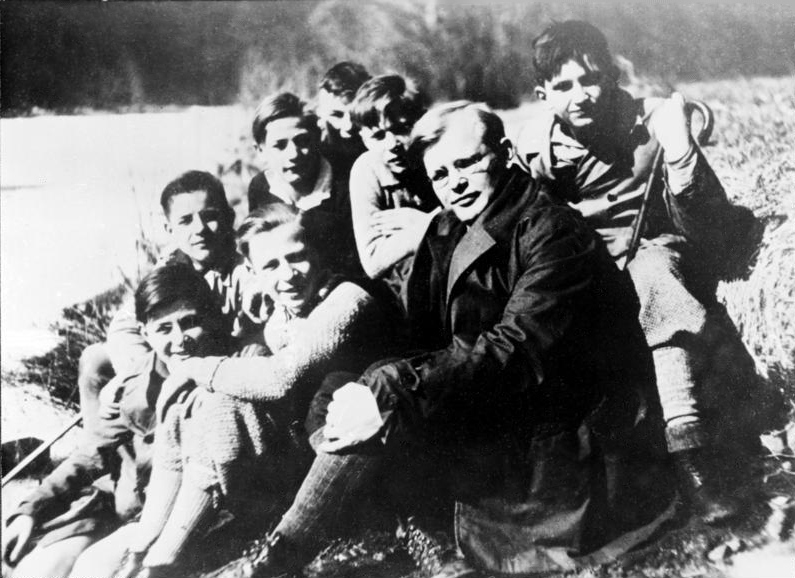
Dietrich Bonhoeffer on a weekend getaway with confirmands of Zion's Church congregation (1932)[10] After his return to Germany from America in 1931, Bonhoeffer became a lecturer in systematic theology at the University of Berlin. Deeply interested in ecumenism, he was appointed by the World Alliance for Promoting International Friendship through the Churches (a forerunner of the World Council of Churches) as one of its three European youth secretaries. At this time he seems to have undergone something of a personal conversion from a theologian primarily attracted to the intellectual side of Christianity to a dedicated man of faith, resolved to carry out the teaching of Christ as he found it revealed in the Gospels.[7] On November 15, 1931 — at the age of 25 — he was ordained at the old-Prussian united St. Matthew's Church (German: St. Matthäikirche) in Berlin. Confessing Church Bonhoeffer's promising academic and ecclesiastical career was dramatically altered with Nazi ascension to power on January 30, 1933. He was a determined opponent of the regime from its first days. Two days after Hitler was installed as Chancellor, as Bonhoeffer delivered a radio address in which he attacked Hitler and warned Germany against slipping into an idolatrous cult of the Führer (leader), who could very well turn out to be Verführer (mis-leader, or seducer), he was cut off the air in the middle of a sentence,[3] though it is unclear whether the newly elected Nazi regime was responsible.[11] In April, Bonhoeffer raised the first and virtually only voice for church resistance to Hitler's persecution of Jews, declaring that the church must not simply "bandage the victims under the wheel, but jam the spoke in the wheel itself." [12] In November 1932 (before the Nazi takeover), there had been an election for presbyters and synodals (church officials) of the German Landeskirche (Protestant established churches). This election was marked by a struggle within the Old-Prussian Union Evangelical Church between the nationalistic German Christian movement and Young Reformers — a struggle which threatened to explode into schism. Hitler now unconstitutionally imposed new church elections in July 1933. Bonhoeffer put all his efforts into the election, campaigning for the selection of independent, non-Nazi officials. Despite Bonhoeffer's efforts, in the rigged July election an overwhelming majority of key church positions went to Nazi-supported German Christians.[13] The German Christians won a majority in the general synod of the Old-Prussian Union Evangelical Church and all its provincial synods except Westphalia, and in synods of all other Protestant church bodies, except for the Lutheran churches of Bavaria, Hanover, and Württemberg. These bodies the opposition regarded as uncorrupted "intact churches", as opposed to the other so-called "destroyed churches". In opposition to Nazification, Bonhoeffer urged an interdict upon all pastoral services (baptisms, weddings, funerals, etc.), but Karl Barth and others advised against such a radical proposal.[14] In August 1933, Bonhoeffer and Hermann Sasse were deputized by opposition church leaders to draft the Bethel Confession, a new statement of faith in opposition to the German Christians. Notable for affirming God's faithfulness to Jews as His chosen people, the Bethel Confession was however so watered down to make it more palatable that later Bonhoeffer himself refused to sign it. In September 1933, Bonhoeffer and his colleague Martin Niemöller helped form the Pfarrernotbund — a forerunner to the Confessing Church that was to be organized in May 1934 at Barmen in opposition to the German Christians.[15] Although not large, the Confessing Church did represent a major source of Christian opposition to the Nazi government. The Barmen Declaration, drafted by Barth and adopted by the Confessing Church, insisted that Christ, not the Führer, was the head of the church. However, the reorganized Protestant churches and the newly established Nazi-submissive German Evangelical Church — being influenced by nationalism and their traditional obedience to state authority as state churches (until 1918) — acquiesced to Nazification of the churches. In September 1933, the national church synod at Wittenberg approved the Aryan paragraph prohibiting non-Aryans from taking parish posts. When Bonhoeffer was offered a parish post in eastern Berlin, he refused it in protest of the racist policy.[16] London ministry Disheartened by the German Churches' complacency with the Nazi regime, the 27-year-old Bonhoeffer accepted in the autumn of 1933 a two-year appointment as a pastor of two German-speaking Protestant churches in London: St. Paul's and Sydenham. He explained to Barth that he had found little support for his views – even among friends – and that "it was about time to go for a while into the desert", but Barth regarded this as running away from real battle. He sharply rebuked Bonhoeffer, saying "I can only reply to all the reasons and excuses which you put forward: 'And what of the German Church?'" Barth accused Bonhoeffer of abandoning his post and wasting his "splendid theological armory" while "the house of your church is on fire" and chided him to return to Berlin "by the next ship." [17] Bonhoeffer however did not go to England simply to avoid trouble at home, but hoped to put the ecumenical movement to work in the interest of the Confessing Church. He continued his involvement with the Confessing Church, running up a high telephone bill to maintain his contact with Martin Niemöller. In international gatherings, Bonhoeffer rallied people to oppose the German Christian movement and its attempt to amalgamate Nazi racism with the Christian gospel. When Bishop Theodor Heckel – the official in charge of German Evangelical Church foreign affairs – traveled to London to warn Bonhoeffer to abstain from any ecumenical activity not directly authorized by Berlin, Bonhoeffer refused to abstain.[18]
Finkenwalde Seminary In 1935, Bonhoeffer was presented with a much-sought-after opportunity to study non-violent resistance under Gandhi in his ashram, but, perhaps remembering Barth's rebuke, decided to return to Germany in order to head an underground seminary for training Confessing Church pastors in Finkenwalde. As the Nazi suppression of the Confessing Church intensified, Barth was driven back to Switzerland in 1935; Martin Niemöller was arrested in July 1937; and in August 1936, Bonhoeffer's authorization to teach at the University of Berlin was revoked after he was denounced as a "pacifist and enemy of the state" by Theodor Heckel (German: de:Theodor Heckel). Bonhoeffer's efforts for the underground seminaries included securing necessary funds, and he found a great benefactor in Ruth von Kleist-Retzow. In times of trouble, Bonhoeffer's former students and their wives would take refuge in von Kleist-Retzow's Pomeranian estate, and Bonhoeffer was a frequent guest. Later he fell in love with Kleist-Retzow's granddaughter Maria von Wedemeyer, to whom he became engaged three months before his arrest. By August 1937, Himmler decreed the education and examination of Confessing Church ministry candidates illegal. In September 1937, the Gestapo closed the seminary at Finkenwalde and by November arrested 27 pastors and former students. It was around this time that Bonhoeffer published his best-known book, The Cost of Discipleship, a study on the Sermon on the Mount, in which he not only attacked "cheap grace" as a cover for ethical laxity but also preached "costly grace". Bonhoeffer spent the next two years secretly travelling from one eastern German village to another to conduct "seminary on the run" supervision of his students, most of whom were working illegally in small parishes. The von Blumenthal family hosted the seminary in its estate of Groß Schlönwitz. The pastors of Groß Schlönwitz and neighbouring villages supported the education by employing and housing the students (among whom Eberhard Bethge, who later would edit Bonhoeffer's "Letters and Papers from Prison") as vicars in their congregations.[19] In 1938, the Gestapo banned Bonhoeffer from Berlin. In summer 1939 the seminary was able to move to Sigurdshof, an outlying estate (Vorwerk) of the von Kleist family in Wendisch Tychow. In March 1940 the Gestapo shut down the seminary there following the outbreak of World War II.[19] Bonhoeffer's monastic communal life and teaching at Finkenwalde seminary formed the basis of his books, The Cost of Discipleship and Life Together. Bonhoeffer's sister Sabine, along with her Jewish-classified husband Gerhard Leibholz and their two daughters, escaped to England by way of Switzerland in September 1940.[20] Return to the United States In February 1938, Bonhoeffer made an initial contact with members of the German Resistance when his brother-in-law Hans von Dohnanyi introduced him to a group seeking Hitler's overthrow at Abwehr, German military intelligence. Bonhoeffer also learned from Dohnanyi that war was imminent and was particularly troubled by the prospect of being conscripted. As a committed pacifist opposed to Nazi regime, he could never swear an oath to Hitler and fight in his army. Not to do so was potentially a capital offence. He worried also about consequences his refusing military service could have for the Confessing Church, as it was a move that would be frowned upon by most Christians and their churches at the time.[18] It was at this juncture that Bonhoeffer left for the United States in June 1939 at the invitation of Union Theological Seminary in New York. Amid much inner turmoil, he soon regretted his decision despite strong pressures from his friends to stay in the U.S. He wrote to Reinhold Niebuhr: "I have come to the conclusion that I made a mistake in coming to America. I must live through this difficult period in our national history with the people of Germany. I will have no right to participate in the reconstruction of Christian life in Germany after the war if I do not share the trials of this time with my people... Christians in Germany will have to face the terrible alternative of either willing the defeat of their nation in order that Christian civilization may survive or willing the victory of their nation and thereby destroying civilization. I know which of these alternatives I must choose but I cannot make that choice from security." [21] He returned to Germany on the last scheduled steamer to cross the Atlantic.[22] Double agent of Abwehr Back in Germany, Bonhoeffer was further harassed by the Nazi authorities as he was forbidden to speak in public and was required to regularly report his activities to the police in 1940. In 1941, he was forbidden to print or to publish. In the meantime, Bonhoeffer – a pastor – joined the Abwehr (a German military intelligence organization) which was also the center of the anti-Hitler resistance. Bonhoeffer presumably knew about various 1943 plots against Hitler through Dohnanyi, who was actively involved in the planning. In the face of Nazi atrocities, the full scale of which Bonhoeffer learned through the Abwehr, he concluded that "the ultimate question for a responsible man to ask is not how he is to extricate himself heroically from the affair, but how the coming generation shall continue to live."[23] He did not justify his action but accepted that he was taking guilt upon himself as he wrote "when a man takes guilt upon himself in responsibility, he imputes his guilt to himself and no one else. He answers for it...Before other men he is justified by dire necessity; before himself he is acquitted by his conscience, but before God he hopes only for grace."[24] (In this connection, it is worthwhile to recall his 1932 sermon, in which he said: “the blood of martyrs might once again be demanded, but this blood, if we really have the courage and loyalty to shed it, will not be innocent, shining like that of the first witnesses for the faith. On our blood lies heavy guilt, the guilt of the unprofitable servant who is cast into outer darkness.”[25]) Under cover of the Abwehr, Bonhoeffer served as a courier for the German resistance movement to reveal its existence and intentions and, through his ecumenical contacts abroad, to secure possible peace terms with the Allies for a post-Hitler government. His visits to Norway, Sweden, and Switzerland were camouflaged as legitimate intelligence activities for the Abwehr. In May 1942, he met Anglican Bishop George Bell of Chichester, a member of the House of Lords and an ally of the Confessing Church, contacted by Bonhoeffer's exiled brother-in-law Leibhol; through him feelers were sent to British foreign minister Anthony Eden. However, the British government ignored these, as it had all other approaches from the German resistance.[26] Dohnanyi and Bonhoeffer were also involved in Abwehr operations to help German Jews escape to Switzerland. It was during this time that Bonhoeffer worked on Ethics and wrote letters to keep up the spirits of his former students. He intended Ethics as his magnum opus, but it remained unfinished when he was arrested. Arrest On April 6, 1943, Bonhoeffer and Dohnanyi were arrested not because of their conspiracy but because of long-standing rivalry between SS and Abwehr for intelligence fiefdom. One of the informers of Abwehr, Wilhelm Schmidhuber, was arrested by the Gestapo for involvement in a private currency affair. In the subsequent investigations the Gestapo uncovered Dohnanyi's operation in which 14 Jews were sent to Switzerland ostensibly as Abwehr agents and large sums in foreign currency were paid to them as compensation for confiscated properties. The Gestapo, which had been looking for information to discredit Abwehr, sensed that they had a corruption case against Dohnanyi and searched his office at Abwehr where they discovered notes revealing Bonhoeffer's foreign contacts and other documents related to the anti-Hitler conspiracy. One of them was a note that discussed plans for a journey by Bonhoeffer to Rome, where he would explain to church leaders why the assassination attempts on Hitler in March 1943 had failed.[27] Nevertheless, Bonhoeffer's involvement in assassination plots was not known by the Gestapo as Abwehr succeeded in explaining away the most damaging documents as official coded Military Intelligence materials. Dohnanyi and Bonhoeffer were, however, suspected of subverting Nazi policy toward Jews and misusing Abwehr for inappropriate purposes. Bonhoeffer was suspected of evading military call-up, using Abwehr to circumvent Gestapo injunction against public speaking and staying in Berlin, and using Abwehr to further Confessing Church works, amongst other charges. Imprisonment For a year and a half, Bonhoeffer was imprisoned at Tegel military prison awaiting trial. There he continued his work in religious outreach among his fellow prisoners and guards. Sympathetic guards helped smuggle his letters out of prison to Eberhard Bethge and others, and these uncensored letters were posthumously published in Letters and Papers from Prison. A guard named Corporal Knobloch even offered to help him escape from the prison and "disappear" with him, and plans were made for that end. But Bonhoeffer declined it fearing Nazi retribution on his family, especially his brother Klaus and brother-in-law who were also imprisoned.[28] After the failure of the July 20 Plot on Hitler's life in 1944 and the discovery in September 1944 of secret Abwehr documents relating to the conspiracy, Bonhoeffer's connection with the conspirators was discovered. He was transferred from the military prison in Berlin Tegel, where he had been held for 18 months, to the detention cellar of the house prison of the Reich Security Head Office, the Gestapo's high-security prison. In February 1945, he was secretly moved to Buchenwald concentration camp, and finally to Flossenbürg concentration camp.[29] On April 4, 1945, the diaries of Admiral Wilhelm Canaris, head of the Abwehr, were discovered, and in a rage upon reading them, Hitler ordered that the Abwehr conspirators be destroyed.[30] Bonhoeffer was led away just as he concluded his final Sunday service and asked an English prisoner Payne Best to remember him to Bishop George Bell of Chichester if he should ever reach his home: "This is the end — for me the beginning of life."[31] Execution Bonhoeffer was condemned to death on April 8, 1945, by SS judge Otto Thorbeck at a drumhead court-martial without witnesses, records of proceedings or a defence in Flossenbürg concentration camp.[32] He was executed there by hanging at dawn on April 9, 1945, just two weeks before soldiers from the United States 90th and 97th Infantry Divisions liberated the camp,[33][34] three weeks before the Soviet capture of Berlin and a month before the capitulation of Nazi Germany. Like other executions associated with the July 20 Plot, the execution was particularly brutal. Bonhoeffer was stripped of his clothing and led naked into the execution yard, where he was hanged with thin wire for death by strangulation. Hanged with Bonhoeffer were fellow conspirators Admiral Wilhelm Canaris; Canaris' deputy General Hans Oster; military jurist General Karl Sack; General Friedrich von Rabenau;[35] businessman Theodor Strünck; and German resistance fighter Ludwig Gehre. Bonhoeffer's brother, Klaus Bonhoeffer, and his brothers-in-law Hans von Dohnanyi and Rüdiger Schleicher were executed elsewhere later in the month. The camp doctor who witnessed the execution wrote: “I saw Pastor Bonhoeffer ... kneeling on the floor praying fervently to God. I was most deeply moved by the way this lovable man prayed, so devout and so certain that God heard his prayer. At the place of execution, he again said a short prayer and then climbed the few steps to the gallows, brave and composed. His death ensued after a few seconds. In the almost fifty years that I worked as a doctor, I have hardly ever seen a man die so entirely submissive to the will of God.”[31] Legacy Bonhoeffer is commemorated as a theologian and martyr by the Evangelical Lutheran Church in America, the Church of England, the Church in Wales and the Episcopal Church (USA). Bonhoeffer's life as a pastor and theologian of great intellect and spirituality who lived as he preached — and his martyrdom in opposition to Nazism — exerted great influence and inspiration for Christians across broad denominations and ideologies, including figures such as Martin Luther King, Jr. and Archbishop Desmond Tutu. Overshadowed by his life and death, his theology has nevertheless remained very influential, although interpretations are necessarily often based on speculations and projections; Comboni missionary Father Ezechiele Ramin was specially influenced by it. Because of Bonhoeffer's early death, his theology had an unsystematic and fragmentary nature and was subject to diverse and often contradictory interpretations. His Christocentric approach appealed to conservative, confession-minded Protestants; while his commitment to social justice as a cardinal responsibility of Christianity appealed to liberal Protestants. Central to his theology is Christ, in whom God and the world are reconciled. Bonhoeffer's God is a suffering God, whose manifestation is found in this-worldliness. He believed that the Incarnation of God in flesh made it unacceptable to speak of God and the world "in terms of two spheres" — an implicit attack upon Luther's doctrine of the two kingdoms. Bonhoeffer stressed personal and collective piety and revived the idea of imitation of Christ. He argued that Christians should not retreat from the world but act within it. He believed that two elements were constitutive of faith: the implementation of justice and the acceptance of divine suffering.[36] Bonhoeffer insisted that the church, like the Christians, "had to share in the sufferings of God at the hands of a godless world" if it were to be a true church of Christ. In his prison letters, Bonhoeffer also raised tantalizing questions about the role of Christianity and the church in a "world come of age", where human beings no longer need a metaphysical God as a stop-gap to human limitations; and mused about the emergence of a "religionless Christianity", where God would be unclouded from metaphysical constructs of the previous 1900 years. Influenced by Barth's distinction between faith and religion, Bonhoeffer had a critical view of the phenomenon of religion and asserted that revelation abolished religion (which he called the "garment" of faith). Having witnessed the complete failure of the German Protestant church as an institution in the face of Nazism, he saw this challenge as an opportunity of renewal for Christianity. Years after Bonhoeffer's death, some Protestant thinkers developed his critique into a thoroughgoing attack against traditional Christianity in the "Death of God" movement, which briefly attracted the attention of the mainstream culture in the mid-1960s. However, some critics — such as Jacques Ellul and others — have charged that those radical interpretations of Bonhoeffer's insights amount to a grave distortion, that Bonhoeffer did not mean to say that God no longer had anything to do with humanity and had become a mere cultural artifact. More recent Bonhoeffer interpretation is more cautious in this regard, respecting the parameters of the neo-orthodox school to which he belonged. Works by Bonhoeffer English translations of Bonhoeffer's works, most of which were originally written in German, are available. Many of his lectures and books were translated into English over the years and are available from multiple publishers. These works are listed following the Fortress Press edition of Bonhoeffer's writings which will be, when completed, the definitive edition of Bonhoeffer's theological works and correspondence. The English language edition of Bonhoeffer's Works contains, in many cases, more material than the German Works series because of the discovery of hitherto unknown correspondence. Thirteen of sixteen volumes have been published, the latest being one of the most valuable, his Letters and Papers from Prison, which is Volume 8 in the Bonhoeffer Works series. Definitive Fortress Press Editions of Bonhoeffer's Works:
Various works in the Bonhoeffer corpus individually published in English:
References
Excerpts from "Letters And Papers From Prison," by Dietrich Bonhoeffer (Collins Fontana Books: London, 1953), pp. 122-125. July 18th 1944
He must therefore plunge himself into the life of a godless world, without attempting to gloss over its ungodliness with a veneer of religion or try to transfigure it. He must live a ‘Worldly” life and so participate in the suffering of God. He may live a worldly life as one emancipated from all false religions and obligations. To be a Christian does not mean to be religious in a particular way, to cultivate some particular form of asceticism (as a sinner, a penitent or a saint), but to he a man. It is not some religious act which makes a Christian what he is, but participation in the suffering of God in the life of the world.
This is metanoia. It is not in the first instance bothering about ones own needs, problems, sins, and fears, but allowing oneseIf to be caught up in the way of Christ, into the Messianic event, and thus fulfilling Isaiah 53. Therefore, "believe in the Gospel or in the words of St John the Baptist `’Behold the lamb of God-that taketh away the sin of the world.” (By the way, Jeremias has recently suggested that in Aramaic the word for “lamb” could also mean “servant” – very appropriate, in view of Isaiah 53) This being caught up into the Messianic suffering of God in Jesus Christ takes a variety of forms in the New Testament. It appears in the call to discipleship, in Jesus’ table fellowship with sinners, in conversions in the narrower sense of the word (e.g. Zacchaeus) , in the act of the woman who was a sinner (Luke 7), an act which she performed without any specific confession of sin, in the healing of the sick (Matthew 8.17, see above), in Jesus’ acceptance of the children. The shepherds, like the wise men, from the cast standing at the crib not as converted sinners, but because they were drawn to the crib, by the star just as they were. The centurion of Capernaum (who does not make any confession of sin) is held up by Jesus as a model of faith, (cf Jairus). Jesus loves the rich young man. The eunuch (Acts 8), Cornelius (Acts 10) are anything but “existences over the abyss.” Nathanael is an Israelite without guile (John 1.47). Finally, Joseph of Arimathaea and the women at the tomb. All that is common between them is their participation in the suffering of God in Christ. That is their faith. There is nothing of religious asceticism here. The religious act is always something partial, faith is always something whole involving the whole life. Jesus does not call men to a new religion, but to life. – What is the nature of that life, that participation in the powerlessness of God in the world? More about that next time, I hope. Just one more point for to-day. When we speak of God in a non-religious way, we must not gloss over the ungodliness of the world, but expose it in a new light. Now that it has come of age, the world is more godless, and perhaps it is for that very reason nearer to God than ever before. Forgive me putting it all so clumsily and badly… We have to get up nearly every night at 1.30, which is not very good for work like this. *** July 21st 1944 All 1 want to do to-day is to send you a short greeting. I expect you are often thinking about us, and you are always pleased to hear we are still alive, even if we lay aside our theological discussion for the moment. It’s true these theological problems are always occupying my mind, but there are times when I am just content to live the lift of faith without worrying about its problems. In such moods I take a simple pleasure in the text of the day, and yesterday’s and to-day’s were particularly good (July 20th: Psalm 20.8: Romans 8.31; July 21st: Psalm 23.1: John 10.24). Then I go back to Paul Gerhardt’s wonderful hymns, which never pall. During the last year or so I have come to appreciate the worldliness of Christianity as never before. The Christian is not a homo religiosus, but a man, pure and simple, just as Jesus was a man, on par with John the Baptist anyhow. I don’t mean the shallow this-worldliness of the enlightened, of the busy, the comfortable or the lascivious. It’s something much more profound than that, something in which the knowledge of death and resurrection is ever present. I believe Luther lived a this-worldly life in this sense. I remember talking to a young French pastor at A. thirteen years ago. We were discussing what our real purpose was in life. He said he would like to become a saint. I think it is quite likely he did become one. At the time I was very much impressed, though I disagreed with him, and said I should prefer to have faith, or words to that effect. For a long time I did not realise how far we were apart. I thought I could acquire faith by trying to live a holy life or something like it. It was in this phase that I wrote the Cost of Discipleship. Today I can see the dangers of this book, though I am prepared to stand by what I wrote. Later I discovered and am still discovering up to this very moment that it is only by living completely in this world that one learns to believe. One must attempt to abandon every attempt to make something of oneself, whether it be a saint, a churchman (the priestly type, so called!) a righteous man or an unrighteous one, a sick man or a healthy one. This is what I mean by worldliness – taking life in one’s stride, with all its duties and problems, its successes and failures, its experiences and helplessness. It is in such a life that we throw ourselves into the arms of God and participate in his sufferings in the world and watch with Christ in Gethsemane. That is faith, that is metonoia and that is what makes a man and a Christian (cf Jeremiah 45) How can success make us arrogant or failure lead us astray, when we participate in the sufferings of God by living in this world?
I think you get my meaning, though I put it so briefly. I am glad I have been able to learn it, and I know I could only have done so along the road I have travelled. So I am grateful and content with the past and the present. Perhaps you are surprised at the personal tone of this letter, but if for once I want to talk like this, to whom else should I say it? May God in his mercy lead us through these times. But above all may he lead us to himself! I was delighted to hear from you, and glad you aren’t finding it too hot. There must still be many letters from me on the way. Did we travel more or less along that way in 1936? Good-bye. Take care of yourself and don’t lose hope that we shall all meet again soon! |